November 30, 2004
And the Wins Just Keep on Comin'!
The doughty Pittsburgh Steelers won yet again this past weekend, taking down the Redskins 16-7. (Whew!)
I made an error last week about team records. Seems the Pats and the Eagles both (now) share the same 10-1 record with the Men of Steel. I'd forgotten the Pats. The Eagles have clinched their division (NFC East), and thus a playoff berth. Falcons can clinch the NFC South with a win or tie. (I know this because NFL.com tells me so, not because I've pierced the sacred mysteries of the League's playoff rules.)
But hey, the Three Rivers team still has the best winning streak in the NFL (at nine and counting). So there. Nyah.
O Clavis David
O Clavis David,
et sceptrum domus Israël,
qui aperis, et nemo claudit,
claudis, et nemo aperuit:
veni, et educ vinctum
de domo carceris,
sedentem in tenebris,
et umbra mortis.
O Key of David,
and scepter of the house of Israel,
you open, and no one shuts,
you shut, and no one opens:
come, and lead the prisoner
from jail,
seated in darkness
and in the shadow of death.
Christ is born to us. Glorify him.
The Key of David is an image found in a couple of places in Scripture. Once in Isaiah 22, where the Lord, having taken exception to Shebna, King Hezekiah’s secretary, for his presumptive building of an expensive tomb for himself, thus displaying a failure to understand and appreciate the coming judgment and exile of Judah, promises to replace Shebna with Eliakim. The new steward of the house, with access to all the royal rooms and buildings, including the prison house, will be Eliakim. Isaiah writes:
In that day I will call my servant Eliakim the son of Hilkiah, and I will clothe him with your robe, and will bind your sash on him, and will commit your authority to his hand. And he shall be a father to the inhabitants of Jerusalem and to the house of Judah. And I will place on his shoulder the key of the house of David. He shall open, and none shall shut; and he shall shut, and none shall open. And I will fasten him like a peg in a secure place, and he will become a throne of honor to his father's house. Isaiah 22:20-23 (ESV)
But this sturdy peg, upon whom are placed the hopes of all his father’s house, will not escape the coming judgment in the armed hosts of the Babylonians, and will, with the rest of Judah, be cut off, and all the hopes hung on it coming crashing down like tin cups.
This Key of David is found again in the Apocalypse. Here, it is in reference to the Church at Philadelphia, one of the seven Churches of Revelation, about whom the Lord has nothing critical to say:
“And to the angel of the church in Philadelphia write: ‘The words of the holy one, the true one, who has the key of David, who opens and no one will shut, who shuts and no one opens. I know your works. Behold, I have set before you an open door, which no one is able to shut. I know that you have but little power, and yet you have kept my word and have not denied my name. Behold, I will make those of the synagogue of Satan who say that they are Jews and are not, but lie—behold, I will make them come and bow down before your feet and they will learn that I have loved you. Because you have kept my word about patient endurance, I will keep you from the hour of trial that is coming on the whole world, to try those who dwell on the earth. I am coming soon. Hold fast what you have, so that no one may seize your crown. The one who conquers, I will make him a pillar in the temple of my God. Never shall he go out of it, and I will write on him the name of my God, and the name of the city of my God, the new Jerusalem, which comes down from my God out of heaven, and my own new name. He who has an ear, let him hear what the Spirit says to the churches.’” Rev. 3:7-13 (ESV)
Once again, the theme of judgment and suffering is sounded in concert with the image of the Key of David. How is it that this one, in whom all access to the Father is given, will also be judged? St Peter tells us:
For Christ also suffered once for sins, the righteous for the unrighteous, that he might bring us to God, being put to death in the flesh but made alive in the spirit, in which he went and proclaimed to the spirits in prison, because they formerly did not obey, when God's patience waited in the days of Noah, while the ark was being prepared, in which a few, that is, eight persons, were brought safely through water. Baptism, which corresponds to this, now saves you, not as a removal of dirt from the body but as an appeal to God for a good conscience, through the resurrection of Jesus Christ, who has gone into heaven and is at the right hand of God, with angels, authorities, and powers having been subjected to him. 1 Peter 3:18-22 (ESV)
This Key of David is the harrower of hell. Our Lord is not only him who goes to prepare a place for us, in the many roomed house of God, but is also him who has preached the Gospel of Life to the dead, and emptied hell of all those called to eternal life. The Key of David has, himself, become subject to judgment and death. He has become sin for us, and received in himself the due penalty for our sins. He has tasted death, and thus having been resurrected from the dead, given the Father’s seal of approval, there is no hindrance to the freedom from death that Christ brings us. The dead in Christ will live, for hell has already been swallowed up in victory. In Christ we will not escape suffering and death, because even our hope of freedom from death is a path itself carved through the valley of the shadow. We must walk that pathway of suffering and death, but we walk it as free, knowing that our hope lies firm behind the veil of the holy of holies.
As we await the Advent of our Lord, here among our darkening days and killing frosts, we are given small glimpses of these images. Darkness overtakes the light. We are constrained and huddled against the encroaching cold. But real suffering is ours, too. The pain of untimely death. The suffocating despair of poverty. The heavy shackles of failure against images never meant to be real. We are aliens to ourselves and to one another. This aging body, heavier and slower, is not the young self we once knew. This growing impatience and irritation at slights more imagined than real, affronts to our self-created dignity. We snap and snarl now as false gospels of prosperity and worldly peace fail to materialize and to satisfy.
Come, Key of David. Lead us from jail, from shadow and darkness. Come, Harrower of Hell, and make us truly free, truly alive.
Christ is born to us. Glorify him.
November 29, 2004
The New Testament Marks of the Church
Introduction:
As most Christians know, the traditional marks of the Church, taken from the Nicene Creed, are that the Church is “one, holy, catholic and apostolic.” Each of these can be traced directly to New Testament precedents (Ephesians 4 is a good place to begin, where all of them are manifest). Indeed, most, if not all, Christians can agree with them, though their implications may create some controversy.
But rather than talk of the “Nicene” marks of the Church, I want to highlight three other New Testament markers. As will be seen, I am sensitive to these marks particularly and specifically because of my background in Protestant churches. They are as follows: The Church is the pillar and ground of the truth, is the dwelling place of the Living God, and is one Body.
The Pillar and Ground of the Truth:
I begin with two important verses:
I still have many things to say to you, but you cannot bear them now. When the Spirit of truth comes, he will guide you into all the truth, for he will not speak on his own authority, but whatever he hears he will speak, and he will declare to you the things that are to come. He will glorify me, for he will take what is mine and declare it to you. John 16:12-14 (ESV)
I hope to come to you soon, but I am writing these things to you so that, if I delay, you may know how one ought to behave in the household of God, which is the church of the living God, a pillar and buttress of truth. 1 Tim. 3:14-15 (ESV)
This is often overlooked by Protestants. Protestants necessarily must make the Scriptures the foundation of our Faith. If they make the Church their foundation, one automatically must inquire, “Which one?” We cannot appeal to the “invisible Church” because our very notion of the “invisible Church” carries with it irreconcilable contradictions. Does the invisible Church believe, for example, that baptism by immersion is essential to being saved or not? One cannot claim that the invisible Church is indifferent to this matter, because after all, sincere and pious believers who presumably are part of the invisible Church believe that this matter is important. And what could be more important than a proper understanding of how one gets to be part of the invisible Church?
So, Protestants are forced back to the Scriptures. But nowhere are the Scriptures called “the pillar and ground of the Truth.” Indeed, if the Scriptures were absolutely important to the founding of the Church, then one is left with the problem of how to found the Church prior to the writing of the New Testament Scriptures? Presumably the Church was founded some twenty or more years before the writing of the first of the New Testament Scriptures, but if so, it was founded apart from the Scriptures. And of course, no New Testament congregation had all the New Testament, let alone any of the books of the New Testament for many decades.
More telling, Protestants cannot agree on the proper interpretation of key biblical passages. Are works part of saving faith or not? Can one lose one's salvation after having been (really) saved? There are as many interpretations as there are Protestants.
Clearly, then, the Scriptures cannot be the foundation of the Christian faith. Scriptures support the Christian faith. They are indispensable to the Christian faith, but if the Scriptures were to ever be completely lost to us, we would not suffer. The Church has kept alive all which we need to embrace the Christ of the Gospel. Christians need not worry overmuch about attacks on the faith that take on the Christian Scriptures, alleging contradictions, fiction and so forth. The Church existed before the completion of the Christian Scriptures, and quite plausibly would continue to exist without them.
Indeed, the Church is the one who confirmed and verified exactly which Christian writings were to be included in the canon of Scripture. The Church kept and preserved the manuscripts of the Scriptures, to the point of execution. And the Church has laid down the standard of proper interpretation of the Scripture.
What Protestants often fail to realize is that if you take away the Church, and leave the ancient disciples with nothing more than the Scriptures, the Church would not have been founded until after the death of the Apostle John. In short, we would not be talking about the “New Testament Church” but the “Second Century Church” as the original. We would also have no clear teaching on: the Trinity, the life of Jesus, the role and place of the Old Testament, on whether Jesus was God-incarnate or not, on whether the body was important to salvation or not, and so forth. We take all these things as pretty much given, and point to the New Testament for evidence of these dogmas. But in point of fact, opponents to the Trinity, to Jesus as God-incarnate, and so forth, also utilized the Scriptures. What solved these controversies was not a particular hermeneutic, the voting power of the majority, or the speaking in tongues. Rather, it was the self-evident fact that Christians have believed these things from the beginning—and evidence pointing back through the Fathers to the apostles was mounted effectively.
In other words, it was the Church, as pillar and ground of the Truth, that verified and confirmed what Christians believed and are to believe. The Scriptures are part of that verification and confirmation, make no mistake. The Scriptures are an essential and non-negotiable aspect of the life of the Church. We need them. But we need them because we need the Church who gave them to us and interprets them for us.
The Dwelling Place of the Living God:
Another important verse:
So then you are no longer strangers and aliens, but you are fellow citizens with the saints and members of the household of God, built on the foundation of the apostles and prophets, Christ Jesus himself being the cornerstone, in whom the whole structure, being joined together, grows into a holy temple in the Lord. In him you also are being built together into a dwelling place for God by the Spirit. Ephesians 2:19-22 (ESV)
Protestants have consistently taken most of the “you” passages—such as the one above—in individual terms. That is to say, what Paul is saying here is that “you, Clifton Healy” are a dwelling place of the living God. This is true, of course, by virtue of the gift and seal of the Holy Spirit. But it is only a part of the truth. And if left by itself, it is a distorting, and potentially heresy-making, part of the truth.
The fact of the matter is, almost all of the “you” passages which Protestants apply individualistically are plural “you's.” That is to say, Paul is addressing the group of Christians at, say, Ephesus, collectively: “you all.” Modern English lost the second person plural form (“ye”) more than a century ago. So, when we read “you” in the English translations of the New Testament, we hear “me.” Or, to put it more bluntly: Most of the time Paul is not speaking to you, the individual Christian, but the Church. And if Paul is speaking to you, he is doing so on the presupposition that you are part of the Church.
This distinction, then, is important. The living God dwells, not in individual Christians, as such, but only in his Body, the Church. In fact, this Church that God dwells in is the one founded on the apostles and prophets, with Christ as the cornerstone. As Paul says earlier in the chapter of the verse above, there is one Church (about which more in a moment), and it is in that one Church that God dwells.
God does not dwell in just any gathering of two or more Christians. Indeed, the verse (Matthew 18:20) which many Protestants claim for home Bible studies, or low attendance Sunday evenings, is not a promise that Christ will bless just any gathering of two or more believers. Rather, it is a promise that when the Church prays and exercises discipline upon an impenitent member, it is Christ himself acting in the Church administering the discipline. In other words, it's not about individual Christians coming together but about the Church acting in Christ's behalf.
So, where does God dwell? In the Church that is apostolic. And, as we will see shortly, apostolic means not only in doctrine—and many claiming apostolicity of doctrine do so incorrectly—but also apostolic in historical, which is to say, incarnate, descent. To say it another way, there is only one Church where God dwells.
The Lord’s Body is One Body:
What is that one Body?
I do not ask for these only, but also for those who will believe in me through their word, that they may all be one, just as you, Father, are in me, and I in you, that they also may be in us, so that the world may believe that you have sent me. The glory that you have given me I have given to them, that they may be one even as we are one, I in them and you in me, that they may become perfectly one, so that the world may know that you sent me and loved them even as you loved me. John 17:20-23 (ESV)
There is one body and one Spirit—just as you were called to the one hope that belongs to your call— one Lord, one faith, one baptism, one God and Father of all, who is over all and through all and in all. Ephesians 4:4-6 (ESV)
First of all, the one Church is the one Christ formed with his disciples, and which is a mystical unity with the Trinity. The one Church is not merely an institutional unity. In fact, apart from the mystical union with Christ and the apostles, no amount of institutional unity will make the Church.
But this one Church is also not merely a mystical unity. The one Church has a bodily life, which is to say, a history. The institutionality of the Church, therefore, is as essential as the mystical unity of the Church.
Indeed, neither the visible, institutional unity of the Church nor the mystical unity, are actually anything different from one another. They are both the unity that makes the Church. Or, rather, the unity of the Church is necessarily manifest in its fullness as a visible institution and a mystical spiritual union.
Therefore, it is rationally and ontologically impossible for all of the institutional divisions among Christians (Roman, Orthodox and Protestant) to be the visible and manifest mystical unity which necessarily constitutes Christ's Church. One cannot both be one and be many.
This leads inescapably to the following conclusion: the one Church, which is both a mystical and a bodily unity, cannot be all the churches of Christendom, nor all the (true) Christians among them. The former denies the mystical union (by including division and schism), and the latter denies the institutional union (by excluding the organized visible manifestation of the Church). From this follows the conclusion: there is one Church in which the mystical and visible unity that is necessary to the life of that Church obtains.
We have no other recourse than to ask: Where is that Church?
Conclusion:
There are many other important marks of the Church in the New Testament. One can speak of love, faith and hope, especially love. One can speak of the martyrs of the Apocalypse. One can speak of the episcopacy, of evangelism, of service to the poor.
But coming from my background, when these three essential aspects made their mark on me, I could only come to one conclusion. My answer to the question “Where is that Church?” is crystal clear and unequivocal. And such conviction grows more each day.
Of Red Stick and Debutantes
The women and I headed south to Baton Rouge last Wednesday. We'd been invited, a couple of months ago, to a "presentation ball" by one of Anna's former co-workers and friends, Patti. Her daugther, Jacque, was being presented on Saturday, and Patti and Harold had wanted us down for Thanksgiving ever since we left Lousiana in January 2000. So, we decided to both take advantage of a trip to see warm and wonderful friends, and to get our experience of southern tradition.
It was everything we thought it would be, and then some. There were a score of young women (set to graduate high school in the spring), dressed in white wedding gowns (yes, wedding gowns) and white gloves, presented by (mostly) their fathers, in tails, and introduced by long resumes of their accomplishments--all set to Vivaldi, Strauss, et. al., attended by guests in black tie and formal gowns, and accompanied by filet mignon and wine.
An amalgamated example: A young women, dresssed in strapless white, with long gloves and pearls, approaches the arch on a largish stage. Spotlights train directly on her. Her hair and makeup are immaculate, her grin porcelain. The M.C. intones: "Christiana Suzanne St. Romain-Hebert Melancon, daughter of Dr. and Mrs. Pierre Melancon, granddaughter of the late Paul-Robert St. Romain-Hebert and Giuseppina St. Romain-Hebert, and granddaughter of Joseph and Marie Melancon. She is presented by her father, Dr. Pierre Melancon. Christiana is a member of [insert about a dozen volunteer organizations], was last year a maid of the court of Krewe Germain, and this year is a lady-in-waiting. She hopes to find the cure for cancer, and to work for world peace. She will attend either Lousiana State University, Tulane, the University of Mississippi, Harvard, Yale or Copiah-Lincoln County Community College in the fall." Once all the near-two-dozen presentations had been made, the young ladies were led in a waltz by their fathers/presenters, and then joined for a second waltz by their mothers and escorts (mostly boyfriends or close kin).
Of course, I'm exagerrating for humorous effect, but not by much--as any who have attended such functions can attest. This presentation ball was different from the one that had taken place the night before. These young ladies were la jeune amie of the Baton Rouge Symphony League, a service organization in which the young women must perform a certain number of volunteer service duties over the course of their high school career. It's rather rigorous in expectation, and only rarely does a junior enter the la jeune amie and complete all the requirements necessary to be presented in her senior year. (By comparison, the ball the night before was nothing more than the presentation of the ladies, without the resume.)
But no matter how you cut it, these families were the affluent (or minimally upper middle class) of Baton Rouge, many of them with histories going, well, waaaay back. And this was the modern incarnation of the old southern tradition of debutante balls. It was a sight to behold.
For this Kansas boy, it was a fun experience. Of course, the best part was joining with Patti and Harold in an important milestone for them and their daughter. Whatever one may think of such traditions as these in our modernist era, I'm all for them, markers of the transition from one stage of life to another. We have no such markers, incarnate rituals which unite a community and help us move from one life to the next.
As a father, of course, I'm not so keen on the expense. But then again, that's all part of it, too.
November 25, 2004
O Radix Jesse
O Radix Jesse,
qui stas in signum populorum,
super quem continebunt reges os suum,
quem gentes deprecabuntur:
veni ad liberandum nos,
jam noli tardare
O Root of Jesse,
who stand as a sign for the people,
kings stand silent in your presence,
whom the nations will worship:
come to set us free,
put it off no longer.
Christ is born to us. Glorify him.
Root of Jesse. Descendant, branch of the family. Christ is the descendant of Jesse, the offspring of David to whom God had promised an eternal throne. And David sang, “Who am I, that God would thus show me his mercy?”
This Root is a sign. On him the Spirit of the Lord rests, the Spirit of wisdom and understanding, of counsel and might, of knowledge and the fear of the Lord. This Root is a righteous judge, who vindicates the oppressed and kills the wicked. Righteousness and faithfulness gird his loins and belt his waist. Our judgments are flawed. We fight to enact justice, only to further oppress. But the Root of Jesse enacts perfect justice and perfect peace. Isaiah says of him:
The wolf shall dwell with the lamb,
and the leopard shall lie down with the young goat,
and the calf and the lion and the fattened calf together;
and a little child shall lead them.
The cow and the bear shall graze;
their young shall lie down together;
and the lion shall eat straw like the ox.
The nursing child shall play over the hole of the cobra,
and the weaned child shall put his hand on the adder's den.
They shall not hurt or destroy
in all my holy mountain;
for the earth shall be full of the knowledge of the Lord
as the waters cover the sea. (Isaiah 11:6-9 (ESV)).
This Root is a sign of whom all the nations shall inquire, and who shall gather his remnant from among all peoples. Indeed, in Paul, the Root is particularly a signal of hope to the nations (Romans 15:8-12). This descendant of David, Israel's Messiah, has become the hope of the world, the goyim, in whom passionate conflicts cease, who restores the ordered creation.
This Root is the Lamb who was slain from the foundation of the world. The revelation of Christ given to John reads:
And between the throne and the four living creatures and among the elders I saw a Lamb standing, as though it had been slain, with seven horns and with seven eyes, which are the seven spirits of God sent out into all the earth. And he went and took the scroll from the right hand of him who was seated on the throne. And when he had taken the scroll, the four living creatures and the twenty-four elders fell down before the Lamb, each holding a harp, and golden bowls full of incense, which are the prayers of the saints. And they sang a new song, saying,"Worthy are you to take the scroll
and to open its seals,
for you were slain, and by your blood you ransomed people for God
from every tribe and language and people and nation,
and you have made them a kingdom and priests to our God,
and they shall reign on the earth."
Then I looked, and I heard around the throne and the living creatures and the elders the voice of many angels, numbering myriads of myriads and thousands of thousands, saying with a loud voice, "Worthy is the Lamb who was slain, to receive power and wealth and wisdom and might and honor and glory and blessing!" And I heard every creature in heaven and on earth and under the earth and in the sea, and all that is in them, saying, "To him who sits on the throne and to the Lamb be blessing and honor and glory and might forever and ever!" And the four living creatures said, "Amen!" and the elders fell down and worshiped. (Rev. 5:1-14 (ESV))
And the nations are silent at this sign. Kings are more often pawns to their own advisers. Kings can be bribed and placated. But what does one do with the slain Lamb? How can one manipulate him who rejected all temptation? What reply can we have to one who became sin for us? Only him who was crucified could reveal the unfathomable judgments of God's mercy. And the only response to such a one who in being killed conquers all, is self-abasement.
The Latin of the antiphon which is here translated “whom the nations will worship” may better be rendered “whom the nations will entreat” or “to whom the nations will pray.” But prayer and worship are separated by no distance greater than the length of one's love. For the heart that prays, entreaty is worship. For the heart that worships, all entreaties are prayer.
The Root of Jesse stands in our midst, a slain Lamb, as a sign. Rendering righteous judgments, girded by faithfulness. This Root is solid, strong. We may place the weight of all our hopes and expectations upon it, and let fall those which are not truth and integrity. Our prayers and entreaties, founded on such faithful promises, confronted by the marvelous image, soon lapse into silence. Not even Kings dare recline in the presence of the Root of Jesse. All our crowns cast down at his feet, we can only be still, amazed and awed at the terrible mercy of his peace. Worthy is the Lamb.
What are these hopes and expectations? What are the content of these our prayers and entreaties? In all things they are little more than the hope of restoration, the promise of life and wholeness. During these dark days we long for light even when we are unaware of such longing. And so the mother that prays over her sick child may know nothing of the Root of Jesse, may never have heard the song of the many-eyed Lamb. But in that Root, in the work of that Lamb are all her hopes and desires fulfilled. The husband who sits silent in the empty house, pierced by faithlessness, bereft of the family that once was his, stolen the hearts of his beloved by another less worthy than himself, this man's longings can only be met ultimately in him who was forsaken by all and calls all to himself. The young woman who stares at herself as an alien thing, exiled in her own body, will one day find her integration in the lightning flash that will split the sky east to west. The young man who lingers at day's end behind all his co-workers, and mystified at the utter banality of the profession he sought with such passion, will in the call of Jesse's Root the daily measure of manna that will grant him life.
The Root of Jesse has appeared to us, marveling the nations. Struck dumb, faint with longing, we cast our crowns at his feet. Grant us deliverance. Make haste to help us.
Christ is born to us. Glorify him.
November 23, 2004
How the Restoration Movement Plea Directed Me to the Orthodox Church
For my brothers and sisters in the Restoration Movement churches, the following statement may seem fundamentally contradictory and nonsensical: It is the Restoration Movement Plea itself that directed me to the Orthodox Church.
The Restoration Movement Plea has never been officially formulated. Its end is, as Thomas Campbell put it, “simple Evangelical Christianity.” Of course, he did not mean by that what we know usually mean by evangelical. Rather, “simple Evangelical Christianity” is “that original simple form of Christianity expressly exhibited upon the sacred page.” The means to attaining that end are variously expressed as the reform of the present churches toward or the restoration to them of the apostolic beliefs and practices of the New Testament Church.
The Restoration Movement churches arose historically out of the primitivist and revivalist trends of the then-frontier lands of Ohio and Kentucky. And many of the original leaders, particularly Barton Stone and Thomas and Alexander Campbell, were Presbyterians. These early Stone-Campbell Movement (as the churches are also known) leaders stressed two things: unity and purity of doctrine. Stone and his followers tended to emphasize unity. The Campbells and their followers tended to emphasize purity of doctrine. Whether by accident or design, those who sought unity through apostolic doctrine gained the printing presses, and thus the minds and imaginations of the young movement.
As the Movement leaders put it: they sought the common denominator all churches had, the New Testament Scriptures. As Thomas Campbell put it, “[T]he New Testament is as perfect a constitution for the worship, discipline, and government of the New Testament Church, and as perfect a rule for the particular duties of its members, as the Old Testament was for the worship, discipline and government of the Old Testament Church, and the particular duties of its members” (Declaration and Address). But what rule were Christians to follow in using the New Testament to restore apostolic belief and practice? That which is “expressly enjoined by the authority of our Lord Jesus Christ and his apostles upon the New Testament Church; either in expressed terms or approved precedent” (ibid).
Many of these sentiments and principles can be found online in the fundamental texts of the Restoration Movement:
- “The Last Will and Testament of the Springfield Presbytery”
- Alexander Campbell, The Christian System
- Thomas Campbell, Declaration and Address
It is here, in these principles, of course, that we begin to see the problem. Not all Christians agree as to what is “expressly enjoined.” The Stones and the Campbells lived at a time in European and American history that gave great weight and authority to human reason. There was a certain naivete as to the ability of reason to go straight as an arrow to the truth, if one could but eliminate subjective prejudices. In this atmosphere, the Restoration Plea, so simple, so self-evident, so reasonable, was winsome. The Restoration Movement grew at a brisk clip in those early decades.
But the naivete of these early impulses were brought home as following the Civil War, the Stone-Campbell churches split over the use of instruments in worship. Instruments were not “expressly enjoined by the authority of the Lord Jesus Christ and his apostles” said most of the southern “Campbellites.” More of the northern brothers and sisters stated that instruments were not expressly forbidden, and thus were permissible. Forbearance won the day for a time, but since the division was predicated on more than instruments (it is hard to see how the sociopolitical tensions did not influence the split), in time this unity movement divided in two.
But reared as I was in the Restoration Movement churches, and educated and trained for ministry at one of the Movement Bible colleges, I was a firm believer in the Plea. Like the Stone-Campbellites of old, I loathed the divisions, having experienced their hateful effects in my own developing faith. But given my education, I also knew I could not just merely accommodate my beliefs to whatever Christian group I found in which I felt most at home. Many of my high school friends were Baptists, but I could not give up the belief that baptism was by immersion and which administration brought forgiveness of sins and the indwelling of the Holy Spirit. But my heritage churches, though begun with noble principles and labor, had fallen prey to the same schism they had sought to remedy. And by the time I was born, the Movement had split again, and now the three branches of Restoration Movement heritage were merely three more options among the vast sea of other Protestant divisions.
So as I entered my last couple of years at Bible college I knew that if I were to discover that New Testament Church toward which I had been inculcated to give my allegiance and all my labor, it would have to be beyond naive rationalist hermeneutics and simple primitivism. With Barton Stone and others I, too, willed that my heritage churches “die, be dissolved, and sink into union with the Body of Christ at large; for there is but one body, and one spirit, even as we are called in one hope of our calling” (“The Last Will and Testament of the Springfield Presbytery”).
I had discovered that my own churches had not lived up to their own principles. Yet I believed in those principles as fervently as ever--and even more so today. If my churches had failed, yet had had the proper basic impulses and original principles, what could I do to correct those mistakes, at least in my own individual efforts, and at the same time still live my heritage?
To begin with, I had to note where these principles were driving me. I was driven, of course, to the New Testament Church, but I was also driven to reexamine my supposed “objectivity.” The hermeneutic I employed, although it resonated in certain respects with other ancient practices, such as that of the Antiochene school, in its historical, grammatical emphases, by the same token, it was an alien mind forced upon the documents. The Scriptures were not originally interpreted as much as they were performed. That is to say, the Corinthians did not read the epistles addressed to them to ascertain as to whether or not spiritual gifts were still operative in their day, or had to come to some understanding as to the place of head coverings on women during worship. Rather, they heard the epistles in the context of the Eucharist and with an ear to doing that which had been enjoined upon them.
But how was I, removed by some eighteen centuries, by continents and oceans, cultures and language, to hear the texts as the Corinthians heard them? In the end, the very Restoration Movement Plea I was attempting to live gave me my clue: I would have to hear with the ears of the Christians who had heard the ones who had hear Paul. I would have to read the apostolic fathers (Ignatios of Antioch, the Didache) and the sub-apostolic fathers (Justin the philosopher, Irenaeus of Lyons) to best hear the New Testament as it was meant to be heard and obeyed.
This led me to read, as is often quipped by Protestant converts to Orthodoxy, all the parts I hadn’t underlined. I looked at 1 Corinthians 10 and 11 with new eyes, heard the text with new ears, and discovered that the Stone-Campbell understanding of the Lord’s Supper was profoundly mistaken. Indeed, far from restoring a New Testament practice, the Restoration Movement understanding of the Lord’s Supper as simply a memorial remembering what Christ had done, and nothing more, was only as old as the Reformation. In fact, Ignatios of Antioch, Justin Martyr, Irenaeus of Lyons, and, to put it plainly, the entire apostolic Church, had always believed that in the Lord’s Supper, the elements of bread and wine become the very Body and Blood of our Lord Jesus Christ.
I heard again, what I had so egregiously missed the first several times, that bishops are as old as 1 Timothy 3. I heard for the first time that tradition, far from being an evil thing, was absolutely necessary to genuine Christianity. It’s how, Paul told the Thessalonians, one tells the true from the counterfeit. I began to realize the full implications of Jesus’ promise that the gates of Hades would not prevail against his Church.
In the end, the Restoration Plea drove me to the historic Church. I first started with the Benedictine monastic movements, and the classical texts on spiritual disciplines, worship and prayer. Simultaneously, I sought not only the origins of the apostolic Church, but sought, too, to trace its historical lineage. If I truly believed in the Incarnation and Jesus’ promise of the endurance of his Church, then it only made sense that I would be able to trace the Church from the New Testament era down to the present. Only if schism and division could make Jesus’ promise fail would my search be unsuccessful. But then, as the early Restoration Movement leaders expressed it, “Could anyone frustrate the desire and prayers of the Lord himself for the union of his Body?”
Of course, I believe that the search enjoined upon me by my devotion to the principles and desires of my heritage churches is ended in the Orthodox Church. Here is the apostolic Christianity I was taught to seek. Here is the basis and foundation for unity among all Christians. Here is no sect, or another party of Christians, but the Church of Jesus Christ itself. As Thomas Campbell said, “Were we, then, in our Church constitution and managements, to exhibit a complete conformity to the apostolic Church, would we not be, in that respect, as perfect as Christ intended we should be? And should not this suffice us?” (Declaration and Address). He, of course, did not mean, then, the Orthodox Church. But the implication for me is inescapable. The Orthodox Church is that apostolic church Thomas Campbell, his son, Alexander, Barton Stone, and many other early Restoration Movement Christians were seeking. My own search is at an end. All that is left is to arrange, as best I can, the final arrival of me and my family.
I said at the beginning that my claim that the Restoration Movement Plea drove me into the open arms of Orthodoxy would seem contradictory and nonsensical to my brothers and sisters in the Restoration Movement churches. I hope that such a peregrine journey as mine has been will now seem more reasonable and necessary. For my brothers and sisters in the Orthodox Church who have come from the Restoration Movement churches, you know well what I mean here. And please pray for me and my family that we may soon join you.
Pew Research Clears Up the "Moral Values" Votes
Maggie Gallagher, in her NRO article today, pointed me to the Pew Research Center's Summary of Findings for their quadrennial post-election 2004 survey.
Reading from the summary is very revealing. I quote from the summary:
Voters and the Issues
Since the election, there has been considerable debate over the relative importance of moral values to voters. More than one-in-five (22%) of those questioned by the National Election Pool on behalf of the Associated Press and the major networks cited moral values as the most important issue in their vote, from a list of seven items on the exit poll questionnaire. In Pew's post-election survey, half of the respondents were presented with the same list of issues as on the exit poll and asked to choose which was most important while half were asked an open-ended version of the question.
Among those offered the seven-item list, a plurality of 27% selected moral values, followed by 22% who chose Iraq and 21% who selected the economy and jobs. Terrorism was chosen by 14%; education and health care were chosen by 4% each and taxes by 3% . . . .
The responses were significantly different among those who were not offered a fixed list of choices. The war in Iraq was mentioned as the single most important issue by a similar number (25%), but the economy and jobs were mentioned by only 12%; and only 9% mentioned terrorism. Notably, just 9% used the terms "moral values," "morals," or "values." Specific social issues including abortion, gay marriage, and stem cell research were volunteered by 3%, while another 2% cited the candidates' morals.
So, unsurprisingly, an open-ended survey question yields differing results from a closed list. One cannot conclude, of course, that the open-ended question is somehow a more authentic response. In fact, if you aggregate the specific and general terms in the open-ended question, moral values add up to 14%, outranking both terrorism and the economy. Only the war in Iraq exceeded the aggregate.
Beyond that, however, the survey notes a very important distinction:
Regardless of how the question is asked, the poll shows that Bush and Kerry voters are far apart in their issue priorities. In both the open and closed formats, moral values are the most important issue to Bush voters 44% selected it from the seven-item list, while 27% volunteered moral values or a related topic in the open format. In both forms of the question, terrorism and homeland security are the next most important issue for Bush voters. No Bush voters in the open-ended format mentioned education, and virtually none mentioned health care.
For Kerry voters, the format makes a difference in the relative ordering of the issues, though in both versions Iraq and economy eclipse other issues in importance. When presented with a list of seven items, about equal numbers of Kerry voters chose economy/jobs (36%) and Iraq (34%). In the open-ended format, nearly twice as many volunteered the war in Iraq (39%) as mentioned an economic issue (21%). Just 2% of Kerry voters volunteer any topic related to moral values, and even fewer mention terrorism as most important to their vote.
Thus, despite all the punditry, the issue or group of issues that moved Bush voters, and gave him the plurality, are moral issues generally, and gay marriage, abortion and embryonic stem cell research specifically. By contrast, Kerry voters cast an eye to economic interests and Iraq.
But Kerry supporters and other blue state pundits want to assert that moral values is too vague a term, and it doesn't necessarily mean just right wing causes. That may well be the case. But what did the voters think the phrase "moral values" meant?
Defining Moral Values
The survey asked voters who were given the list of issues to describe, in their own words, "what comes to mind when you think about 'moral values'?" Among voters who chose moral values as most important from the list of seven issues, about half gave a response that mentioned a specific issue. More than four-in-ten (44%) defined the phrase specifically in terms of social issues, including abortion (28%) homosexuality and gay marriage (29%), or stem cell research (4%). A few other issues also were mentioned, including poverty, economic inequality, and the like.
But the definition of moral values is not limited to policy references. Nearly a quarter of respondents (23%) who cited moral values as important explained their thinking in terms of the personal characteristics of the candidates, including honesty and integrity (cited by 9%). Almost one-in-five (18%) explicitly mentioned religion, Christianity, God, or the Bible. Another 17% answered in terms of traditional values, using such language as "family values," "right and wrong," or "the way people live their lives."
People who did not choose moral values from the list of issues were also asked what the term meant to them. The pattern of responses was quite different from those who said moral values were an important consideration. Fewer mentioned a specific issue, candidate quality, or general religious theme; more answered in general terms, and 12% explicitly protested the imposition of others' values on them, said the idea was being used as a "wedge" against Democrats, or otherwise expressed a negative reaction to the phrase.
In other words, even among those who did not choose "moral values" as the most important issue determining their vote, the consensus of what the term "moral values" met was fully in line with the "moral values voters." In fact, the majority of those who did not choose "moral values" as their determining vote, consistently defined "moral values" along traditionalist lines, or within the same parameters as the "moral values voters." Keep in mind that a significant number (almost one-fifth) of those who did not select "moral values" as their determining issue, had a negative reaction to the term. A mere fifteen percent of those who did not select "moral values" indicated that the term meant nothing or they didn't know what it meant.
What are "moral values" then? The upholding of the traditional structure of marriage as one man and one women for life, the protection of the life of the unborn, and the rejection of scientific experimentation on human embryos. Significantly, it also included honesty and integrity, or character matters, in the candidates.
So, despite all the nay-saying and explaining away of the exit polls, the Pew Research has done an important job in documenting that moral values did, indeed, determine the election, and that those moral values are, indeed, what most of us already knew: the traditional values of marriage, family and character.
Great Review of U2's New Album
Kenneth Tanner, who also writes for Touchstone Magazine, pens a great review of U2's "How to Dismantle an Atomic Bomb."
November 22, 2004
VDH: On " the Strangest, Most Perilous, and Unbelievable Decade in Modern Memory"
Victor Davis Hanson, my all-time favorite classicist, has penned an important article for NRO, entitled "The Real Humanists" (and here). Hanson is an expert in classics generally, but especially ancient warfare. Among his well-known titles are The Other Greeks, and The Wars of the Ancient Greeks. He concludes his article:
We are living in historic times, as all the landmarks of the past half-century are in the midst of passing away. The old left-wing critique is in shambles--as the United States is proving to be the most radical engine for world democratic change and liberalization of the age. A reactionary Old Europe, in concert with the ossified American leftist elite, unleashed everything within its ample cultural arsenal: novels, plays, and op-ed columns calling for the assassination of President Bush; propaganda documentaries reminiscent of the oeuvre of Pravda or Leni Riefenstahl; and transparent bias passed off as front-page news and lead-ins on the evening network news.
Germany and France threw away their historic special relationships with America, while billions in Eastern Europe, India, Russia, China, and Japan either approved of our efforts or at least kept silent. Who would have believed 60 years ago that the great critics of democracy in the Middle East would now be American novelists and European utopians, while Indians, Poles, and Japanese were supporting those who just wanted the chance to vote? Who would have thought that a young Marine from the suburbs of Topeka battling the Dark Ages in Fallujah--the real humanist--was doing more to aid the planet than all the billions of the U.N.?
Those on the left who are ignorant of history lectured the Bush administration that democracy has never come as a result of the threat of conflict or outright war--apparently the creation of a democratic United States, Germany, Japan, Italy, Israel, El Salvador, Nicaragua, Panama, Serbia, and Afghanistan was proof of the power of mere talk. In contrast, the old realist Right warned that strongmen are our best bet to ensure stability--as if Saudi Arabia and Egypt have been loyal allies with content and stable pro-American citizenries. In truth, George Bush's radical efforts to cleanse the world of the Taliban and Saddam Hussein, bring democracy to the heart of the Arab world, and isolate Yasser Arafat were the most risky and humane developments in the Middle East in a century--old-fashioned idealism backed with force in a postmodern age of abject cynicism and nihilism.
Quite literally, we are living in the strangest, most perilous, and unbelievable decade in modern memory.
Necessary Gospel Division and Its Implications for Ecumenical Work
[Note: The following is bound to offend most. Read with caution. Pray with discernment. But most of all pray for me, a sinner.]
It is taken as a given that the divisions among Christian churches is a scandal and a blasphemy. This is unquestionably true. It is also taken as a given that the reunion of all Christians in one visible body is a good explicitly tied to which is a more effective evangelism. This, too, is unquestionably true.
On the basis of these fundamental truths, then, is raised the ecumenical edifice. The rationale is something like this: We must work to eliminate division between our various bodies and to foster unity at every opportunity. So ecumenical groups such as the World Council of Churches, and the U.S. National Council of Churches work hard to remove the barriers circumscribing fellowship. Other groups, such as pro-life Catholic and Evangelical organizations, work hard to join together in common causes based on clear Gospel and Church teaching. But primarily, ecumenical work is seen as the coming together on matters of belief and worship, discipline and polity, such that denominations otherwise formally divided from one another can come more closely to share in ministerial, liturgical, and, ultimately, Eucharistic fellowship. To accomplish this, of course, the primary and non-negotiables of belief must be staked out and common ground achieved.
This last is not only misguided, but a mistake. Contrary to common present-day mores, unity is not about feeling close, or doing and saying the same things at the same times with one another. Rather, unity has to do with dying to self and thorough-going obedience to Christ. Indeed, the Gospel necessarily creates division. The Gospel necessarily destroys any peace that is not built on the exclusive claims of Christ on us.
Matthew puts it primarily in filial terms:
"Do not think that I came to bring peace on earth. I did not come to bring peace but a sword." (Matthew 10:34 (NKJV))
Luke gives even more violent imagery:
"Do you suppose that I came to give peace on earth? I tell you, not at all, but rather division." (Luke 12:51 (NKJV))
The Gospel necessarily creates divisions. Thus, due to the very nature of the Gospel itself, ecumenical work among Christians is bound to fail. Not because the Lord wishes division, nor because God is not powerful enough to save, but because the ecclesial principles of the various Christian bodies are diametrically and hopelessly opposed to each other, and to the biblical and patristic dogma of the Church.
Modern ecumenism seeks to take foundational doctrinal positions and boil them down to a common level of accommodation. What is it, in the final analysis, that everyone can say “Yes” to? But not only do we do not have the right to so alter Gospel teaching, the basis of Church unity is not doctrinal and canonical agreement. Church unity is predicated upon the reality of what the Church is: Christ's Body. If we are members of that Body, we are one with another. If we are members of that Body, we gather with Christ. Christ did not come to bring accommodation. Unity within Christ's Body is already a reality. The question is: Are we part of that reality?
Modern ecumenism must fail because it misunderstands both the Gospel and the Church. It misunderstands the Gospel because it thinks both that we humans have the capacity to say what are the boundaries of that Gospel and that we humans have the capacity to assign various weights to certain Gospel doctrines, emphasizing one over the other. It misunderstands the Church because it thinks that Church unity is predicated upon human effort, both to preserve it and to reinstitute it when it fails.
But in point of fact, we have no say over the Gospel boundaries. We can only receive the Gospel that has been given us, whole and entire, without revision. Nor do we have it within ourselves to judge which Gospel doctrines are more important than others. It is not to us latter-day Christians that the promise of the Spirit leading us into all truth was given, but to the Church built on the Apostles. For us to alter the foundation is in effect to build another Church. If the Gospel says the bread and wine become the very Body and Blood of Christ, who are we to alter this for the sake of institutional unity?
Furthermore, the Church is not subject to our ministrations. The Church is a reality with which we have to do. It does not answer to us. We answer to it. We no more have the right to set the boundaries of the Church than we do those of the Gospel. It is not we latter-day Christians who are called the pillar and ground of the Truth, but the Church. If the Church so delimits the ministry of the Eucharist so as to exclude the ministration of women, who are we to set that aside so as to achieve some institutional unity?
Modern ecumenical work does not think much of the Orthodox Church who refuses to join their ranks. Many Christians bristle at the thought that God would have only one Church among all the churches, and that they, themselves, not being in that Church, are outside it. But Orthodox are only doing that which they must do: preserve the Gospel entire, and maintain the Apostolic foundations upon which the Church rests. In a Christian world rife with the promise of denominational utopia with calls for feel-good peace and unity, the Orthodox, for all their other failings, at least have the humility to know that they have no authority to change or alter what they have received from their forebears, who themselves received it from theirs, and so on back the long ages.
The Coherence of Christian Theology IX
[Note: This completes this series of posts. The entire series can be found here on this blog. I have also posted it here as a single html document.]
Conclusion
It may not be hyperbole, nor redundant, to say that for Christianity everything is in some way a reflection of Christology. Ecclesiology is founded on a proper Christology; what you say about the Church you effectively say about Christ. What you believe about the Mysteries (or Sacraments) is an outgrowth of what you believe Christ has come to do. The reverence or inattention you give to Mary comes from your vision of Jesus. Whether or not you believe the classical dogma of the Trinity will determine what you believe about Jesus. Christology is the dogma upon which hang all the unique beliefs and practices of the Christian Faith.
The divisions among Christians are not so monstrous simply in terms of a lack of institutional unity. Rather such divisions are so hideous because they divide not a Church, they sever Christians from one another not merely over whether baptism is necessary to salvation or not, no, such divisions are hideous because they attempt blasphemy: the division of Christ within himself. Whether or not the Church is to have bishops is not a matter of Church polity, it strikes at the heart of what we believe about Jesus. If we believe differently about the Church, we believe differently about Jesus. The implication is inescapable: to preach a different Church is to preach a different Christ. The Incarnation is that central to every particle of our faith.
These several doctrines of Christianity make sense only in light of the Incarnation. Philosophy does not comprehend Christian theology. Philosophy attempts to reduce talk of God to logical syllogism and rational category. But no person can be reduced to a logical formula or defined in a single concept, or even a group of concepts. And if this is true of human persons, how much more the Second Person of the Trinity. Philosophy must reduce God to a concept. But God is not a concept. God is a Person, indeed a Trinity of Persons. Philosophy cannot synthesize this. Confronted by the Incarnation, philosophy is burst asunder, unable to hold together the paradox. Theology shares this same ultimate failure when theology takes its cue from philosophy rather than from prayer, worship and poetry.
But one thing philosophy can witness to is that on Christianity's own unique terms, which is to say, on the terms of the Incarnation, it is coherent. Philosophy may not accept the cornerstone of Christianity, the Incarnation of Christ. But philosophy can attest that having been built on and from that cornerstone, the lines are straight. The various patterns are woven expertly together into a whole so beautiful, so pure, so real that one is left speechless and penitent.
Christ himself has appeared to us. Glorify him.
November 21, 2004
Oh, Pittsburgh! How Do I Love Thee? Let Me Count the Ways . . .
I will count them thus: 19 points versus 14 points from the Bengals, O Pittsburgh Steelers, and thou hast won again.
Thou hast nine wins and one loss.
Thou sittest atop the AFC North, and hast the best winning streak of the season, which beeth eight games.
If Philadelphia loseth, thou wilt have the best record in the NFL this season. Glory.
Update:
O glorious Steelers, team of rivers three, fear not that Philadelphia hath won, for thou hast beaten them twice, once in the season before the season, and once but a fortnight ago. And a most righteous drubbing that was, O valiant men of iron.
The Coherence of Christian Theology VIII
The Incarnation and Mary
We have already seen how the Incarnation is not just an isolated point of doctrine among a list of other points of doctrine which Christians are called to believe. Rather, the Incarnation is the foundation and limit of all our doctrines, from the Holy Trinity, to salvation, to the Church and Sacraments. But most especially is this so in terms of Mary, our Lord's mother.
Christians believe what we do about Mary precisely on the basis of the Incarnation. If there were no Incarnation, Mary would be among the great saints of the Old Testament, and a worthy exemplar. But it is hard to see how she would be more remarkable, say, than Elijah. That she was, and is, a holy woman, would no doubt be true. However, it is not on account of her holiness that we remember her. We honor her, and call her blessed, because from her our Lord took his humanity, and in her womb he resided for nine months. She is unique among all human beings, and apart from her obedience there would be no Incarnation. God prepared just one woman among all women to bear the Son. Upon her voluntary acquiescence hung all of salvation history.
And because she said yes, because all those years of preparation and her consecration to virginity and her life in the Temple were not in vain, God blessed us in her by sending us his Son through her. Mary was mortal and subject to death as we all are, and she needed the same redemption we need. But she, and no one else, is the Mother of our Lord, and so we honor her with special honor.
It is because of the Incarnation that the Church knew and teaches us, that Mary remained a virgin after the birth of our Lord. It is because of the Incarnation that the Church knew and teaches us, that on Mary's falling asleep, the Lord himself raised her to incorruptibility. It is because of the Incarnation that the Church knew and teaches us, that Mary has a special place among God's saints and a special efficacity in interceding for us. It is because of the Incarnation that the Church knew and teaches us, that the Mother of our Lord is our own Mother, too. It is because of the Incarnation that the Church knew and teaches us, that Our Lady is truly all-holy, Panagia.
Who, believing that Mary held in her womb the Living God, could ever suppose that Mary would not remain virgin? Who, believing that Mary gave birth to the One who redeemed us from death, could ever think that Christ would not also raise her from corruptibility upon her own death? Who, believing that Mary is truly the Mother of our Lord, could ever subscribe to the notion that Mary is no better than us and no more powerful an intercessor for us? Who, believing that her own words indicating all generations would call her blessed, could ever think that she is not, by virtue of the Incarnation, our own Mother, too? Who, believing that the ministry of Christ brought into union the human and divine, believing that by virtue of Christ's baptism in the Jordan all the waters on earth have been blessed, could ever think it improper to call she who nursed at her breast the Great God and Savior of us, all-holy?
All that Mary is to us, she is because the Person who was conceived in her womb, whom she carried for those nine months, whom she bore in a stable, is Light of Light, very God of very God, begotten not made, of one essence with the Father, by whom all things were made. All that we believe about Mary is predicated upon her Son. If we believed these things apart from the Incarnation, we may well be suspected of idolatry. But believing in the Incarnation we cannot but believe these things about Mary, and call her what she is, indeed: the Mother of our God.
When one begins seriously to think through the logic of the Incarnation, then it is simple and self-evident: Mary has a unique place in salvation history, and all that we know of her from the Church--in the Church's Scriptures, the Church's worship, and the Church's tradition or life--is manifestly true . . . on the basis of the fact of the Incarnation.
I, myself, did not always understand the Church's devotion to and respect for the Virgin Mary. Good Protestant that I was, I frankly was suspicious of the requesting of Mary's prayers, cast a doubtful eyebrow upward at the Rosary, and would never be caught praying the Akathist to Mary. But all that began to change when I began to think through the implications of the Incarnation. Less than a year after my graduation from Bible college, after careful thought, I began to pray the Rosary from time to time. But even then, that was a rare practice, and I never otherwise asked Mary's intercessions of more fully thought through what the Church knows about Mary.
Until two years ago. It was mid-October 2002, and I was on an individual retreat at a Benedictine monastery in central Michigan. There were many things on my mind that weekend, not the least of which was the subject of the Orthodox Church and several doctrinal matters I'd been studying and meditating on for several months. Among those things on my mind was concern for my marriage. Not that Anna and I were having any serious troubles, but as all couples from time to time experience, I did not then feel that we were as close as we could be. It sometimes felt that we were two individuals, very much in love, but nonetheless more a couple than a union. So, after browsing through the monastery library for a good part of Saturday afternoon, I came across the Akathist to the Theotokos, a long and lyrical hymn about the Virgin Mary. I determined that during the meditation hour after compline, I would pray that prayer. So I did. And at the end of it, I asked Mary to pray for Anna and I, that we would be more one than two.
What I will know relate is simple fact: Within a month of that prayer, Anna was pregnant with our daughter Sofie. Some will scoff at the coincidence. Others will solemnly declare that when it comes to prayer, there are no coincidences. All I can say for sure is that the after-effects of that pregnancy are precisely what I asked for in that prayer, and likely what the Blessed Lady herself asked for as well. Can I prove this to you? No. I will not try. But I know what I believe. And that is enough for me.
Since that time two years ago, the logic of the Incarnation has made its way into my understanding about Mary, Mother of Jesus. And because of the Incarnation, I believe what I do about Mary. She is the Mother of our Lord, and my Mother, too.
More honorable than the cherubim, more glorious beyond compare with the seraphim, O thou who without stain, bore God the Word, true Mother of God, we magnify thee. So did Elizabeth, Mary's cousin. So do I.
November 20, 2004
O Adonai
O Adonai,
et dux domus Israël,
qui Moyse in igne flammae rubi apparuisti,
et ei in Sina legem dedisti:
veni ad redimendum nos in brachio extento.
O Mighty Lord,
and leader of the house of Israël,
who appeared to Moses in the burning bush,
and on Sinai gave him the law,
come to redeem us with outstretched arm.
Christ is born to us. Glorify him.
The burning bush. I AM. Thunder and lightning on the mountatin top. Lawgiver. He who is. He who gives to us words of life, which are a bread more nourishing than any man can fashion. And in his Person and through his lifegiving words, he redeems us. Not in niggardly minimal doses, but with power and excess, with an outstretched arm. This is our God. This God is our Lord Jesus Christ, who comes to us anew as we await him in this Advent.
The God of the burning bush is a God whose name cannot be known. All that can be know of him is that he is. But this God of fire manifest himself to us in the burning bush, and for us the world is set afire by his footsteps. His very being is light and life, and we, in our darkness and mortal corruption cannot but be burned by his living fire. And in being burned, we are made clean, whole. That lie is consumed. That contempt for our neighbor is engulfed. That dark and loathsome inability to escape our despair, that acidie, that demon of the noon day, is lit, smoking and flaming, with the glory of God. I AM has spoken a word which will not be denied.
That word is Law. And because the I AM has spoken it, that Law is life. The Latin Lex cannot adequately capture the fullness of the Heberw Torah. The Latin carries the connotation of process, convention, juridicy. But the Scriptures describe "Law" as instruction in the way of life. It is the difference between an instruction which says, "Drink this pure water; eat this wholesome bread. By these you will live." and that which says, "This is not poison, this is of no danger; it will make you wise and give you joy." The one is the manna from heaven. The other is the delightsome apple. The one is given and received. The other is taken and takes. This Law is. It needs no defense or proof. How does one prove that reality is real? One does not. One simply accepts it, and trusts. It is the delusion that needs proof, that needs buttressing against doubt. And thus it is the lawbreaker who must be most resolute against the word spoken which delivers.
This redemption of the Lord is not by half-measures. It is with outstretched arm. Not an arm which barely raises the hand in gift-giving. Not an arm which merely restrains. But one that commands in its gesture, with a power so deep, so thorough and so mighty it goes to extreme lengths to save. What is the measure of such lengths? Nothing less than the life of the Law himself. This word whose judgments prevail has travelled down the length of that outstretched arm and come to us. Come to us with life, to die to give us life.
Christ is born to us. Glorify him.
Put It On Your Calendar!
Don't forget:
2004 National Bible Week is November 21 - 28
Here's what you can do, twenty things, in fact, to celebrate National Bible Week.
A little history about National Bible Week:
On the eve of that first National Bible Week™ a nation-wide radio broadcast over the NBC network was to launch a week of activity. Events were scheduled from communities across the nation to the White House. Given the news from Pearl Harbor earlier that Sunday afternoon, the largest possible radio audience was tuned in when the National Bible Week™ broadcast began at 8 pm. A more auspicious timing could not have been planned. Even Mrs. Roosevelt, in her daily newspaper column for Monday, December 8, 1941, expressed her sentiments about the timeliness of this call to the nation to turn to the Bible.
National Bible Week™ has been an annual tradition since that first effort in 1941. Since 1951 the celebration of National Bible Week™ has been led each year by a prominent business or professional leader serving as the National Chair. It is now celebrated the week of Thanksgiving, from the Sunday before until the Sunday following, making it an 8-day week. Every U.S. President since Franklin Roosevelt has issued a Message for National Bible Week™. Members of Congress enter statements in the "Congressional Record" highlighting the Bible’s importance in the history and culture of our nation. Governors and Mayors proclaim Bible Week and encourage its observance. In recent years more than 30 governors and 500 mayors have issued Bible Week proclamations.
November 18, 2004
I'm Floored
I just moments ago encountered for the first time the World Vision Gift Catalog. For varying monetary amounts, donations can be given in the names of family and friends, to provide the needy of the world material goods.
$120 provides a brood of chickens for eggs
$75 provides a goat for milking
$50 sends a child to school for one year
$45 provides ten fruit trees
$25 clothes five homeless children in the U.S.
$15 provides two rabbits for breeding and selling in the marketplace
There are other more expensive items (dig a well for $12,500; buy a farmyard of animals--two cows, two sheep, two goats, two pigs, four rabbits, twenty ducks, and enough chickens to lay about two dozen eggs per day--for $2250; etc.), and one can buy shares of these more expensive gifts. But I thought about what Anna and I spend on each other for Christmas, as well as family and friends--and we're no rabid consumerist materialists, mind you--and I wanted to start crying. Seriously.
How much can be done for the poor for, relatively, so little of my money! My tears were in part a realization of the hardness of my heart, but also from a sense of relief that there is something so tangible I can actually do.
And all I've ever heard is that World Vision is a worthy outfit.
[Via, with much gratitude, Michael]
The Fatherhood Chronicles LII
A brief moment of unmitigated, unpasteurized, unhomogenized fatherly pride happened last night at Vespers. Well, actually a couple of moments.
First, during one of the prayer litanies, Sofie got a little restless, so we let her down. She walked around a bit, but finally came up to me on my left side, and pointed at my prayerbook. I had her sit on the floor, and then I let her hold my book. As she grabbed it, she attempted to make the sign of the cross: pinched her little fingers together and made the vertical. I helped her with the rest of it, then she opened the book and turned some pages and tried to make the sign of the cross a couple more times during the prayers. She sang with the choir a couple of times.
It was glorious. She was there all good-smelling from her bath and dressed in her footy pajamas worshipping her little heart out with the rest of us.
But the best part of all happened after the service was over.
Anna was talking to one of the parishioners, so I took Sofie up to the iconostasis. I helped her make the sign of the cross in front of the icon of the Theotokos, then held her up so she could kiss it. We did the same in front the icon of Jesus the Pantokrator.
As we finished, Father Patrick was closing the Royal Doors and said, "Now there's a little girl that loves Jesus."
I smiled in response . . . and glowed the rest of the night.
I'm still a bit luminescent.
Glory be to God.
November 17, 2004
The Coherence of Christian Theology VII
[Note: It's been over a month since my last entry in this series. The entire series can be found here. Once complete, I will format the entire series into a single html document and will post the URL for those interested.]
The Incarnation and the Sacraments
When one turns to the Sacraments, or the Mysteries, one has not ceased to have to do with the Church. There are two extremes one may fall prey to here, both of them a separation of the Sacraments from the Church, and both of them denials of the fullness of the Incarnation.
On the one hand one may consider the Sacraments apart from the Church in that they are efficacious on their own merits and the faith of the individual. But Sacraments administered apart from the Church are little more than magical mummery, and something the Reformers rightly reacted against. Parents who, themselves little more than nominal Christians, never darken the doorway of their local parish, but insist on having their children baptized are one example, but not the only one. Christians who make confession and attend worship only once or twice a year are another example. My intent here is not to judge the misunderstandings of otherwise genuinely sincere religious persons, nor to determine their eternal destiny, but to highlight that the Sacraments are the life of the Church in concretum, most especially the Eucharist, on which more in a moment.
On the other hand, one may separate the Sacrament from the Church by the nullification of their reality and efficacy. This is typical of the Protestant response. But this is a response little short of the denial of the Incarnation altogether. Protestants, of course, do not intend to deny the Incarnation. But in asserting that God saves us apart from human cooperation and actions, apart from material things, is to implicitly deny the need for God to save us in the human cooperation and actions of Jesus, and the material things he blessed by his life and work: the cross, bread, wine, children, men, women. If we deny these material elements of the present life of the Church—bread, wine, oil, wood, water—then we must also deny the material elements of the historically located salvation God has accomplished for us. If the one cannot save us now, neither can the other.
But the fact of the matter is that just as those material elements were necessary for the outworking of the grace of God in the time, place, life and ministry of our Lord Jesus, then those same material elements are necessary—yes, necessary—for the outworking of the grace of God in the time, place and ministry of our Lord Jesus today, which means in the Church, who is his Body. When I say necessary, I do not intend to mean that God is not able to save whom he will. This is the age-old and unfathomable mystery of how God will judge those who have never had the opportunity to hear the Gospel. We know only that whatever God will do will be according to his love for all mankind and his great mercy. Rather, by necessary I mean that which God has clearly revealed as necessary for us to do and to believe. Thus, repentance, faith and immersion are necessary elements for the initiation into the grace of God's life. Consumption of the sanctified Gifts of bread and wine are necessary elements for the nourishing of body and soul and for the continuation in that grace into which we have been initiated.
The Sacraments mark and delimit all the major creases in the fabric of human life: birth (baptism and chrismation), growth and maturation (confession and Eucharist), sickness (unction, or the anointing with holy oil), marriage, and worship and prayer (priesthood). Certainly one may do all these things apart from the ministrations of the Church, but in so doing one does not actively participate in the life of the Church. These Sacraments are fundamentally and always about life: its beginnings, its continuation, its healing from disorder, its union of husband and wife who together by God's grace create human life, and with God the source and author of all life.
The Sacraments are given us not as individuals but as members of Christ's Body. The Sacraments, indeed, are given in Christ, in his Body. There are no Sacraments apart from Christ's Body, because there is no life apart from Christ. And if we desire life, we can only find it in Christ, which means we can only certainly find it in his Body, the Church. This life is not some attenuated spiritual realm separate from the material realm—the Incarnation itself reveals to us that life, the life only Christ can give, is a fullness of body and soul. Our salvation is as material as it is spiritual. If we make of our salvation anything less than a salvation of both body and soul, we make a lie of the cornerstone of the Christian Gospel: the Incarnation of God in and as the God-man, Christ Jesus. And because our salvation is both material and spiritual, we must participate in the life of the Church, which means the life given us in the Sacraments.
This is eminently and primarily exemplified in the Eucharist. The Church received from Christ himself the truth that what we now call the Lord's Supper, the Holy Eucharist, is the mysterious reality of the joining of material reality, the bread and wine, with the divine reality, Christ's real presence. This is accomplished in the prayers of the Church (in the person and ministry of the praying priest) for the Holy Spirit to descend upon the bread and wine and to make these things what they really are in the Lord's Supper, the Body and Blood of the Lord. Just as Jesus did not cease to be God in being human, nor cease being human in being God, so the Holy Gifts, sanctified by the Holy Spirit in the prayers of the Church, do not cease being at once bread and wine and Christ's Body and Blood. And in this joining of the human and earthly with the divine and heavenly is accomplished our participation in grace. The Incarnation gives us this truth, and all our life in the Church celebrate it and make it real for us each day.
Indeed, not only does the Holy Eucharist testify to us of the Incarnation, but it gives us, too, the promise of the Resurrection. Just as bread and wine—which in themselves are subject to decay and corruption, and in themselves give no life—when they are made Christ's Body and Blood are raised from death and corruption and made participants of Christ's life, ministering his actual presence to us (and so they are handled with the utmost of reverence and humility by only those specially set apart for this ministry), so too when we partake of that life by consuming them, begin ourselves to participate in the Resurrection from the dead accomplished in Christ.
This participation, in holistic concert with what we know, believe and experience in the Incarnation, not only saves us spiritually but saves us bodily. So we have received from the Church the histories of those handful of saints who were known to have been sustained by consumption of the Holy Eucharist alone, desert dwellers who fasted continuously, eating only the Holy Gifts and only on the occasions in which such Gifts were made available to them.
This participation of the Resurrection is true, however, not only of the Eucharist, though preeminently so, but is true of all the Sacraments. In baptism and chrismation we are raised to newness of life and given a promise of the final Resurrection to come. In confession we are raised from the corruption of our deeds which foster death in us. In the marriage blessing of the Church our human relations, which can only ultimately bring separation and dissolution, we are raised from schism to union, and from death and mortality, new life is given. In holy unction, the disease which is a present foretaste of final death, disorder is put to rout and we are made whole and raised from our beds of corruption. And in ordination to the priesthood all the vocations of men are raised from their infection of selfishness and lust and greed, all the disordered priesthoods of the father in the home, the pagan celebrant before his idols, and that of the fool who worships none but himself, are raised from decay and brought into the only worship and prayer that can give life: the celebration and honoring of the Holy Trinity.
But not only is the Incarnation the centerpiece bringing into coherence our understandings and dogmas of the Trinity, theosis and salvation, the Resurrection, the Church and the Sacraments, it also beautifully explicates the person and place of our Lady, Mary, the Mother of God.
Aragorn, the Selected (Not Elected) King
First there was Michael Moore's "Fahrenheit 911", then there was some group's "Fahrenhype 911", then somebody did something else that had a number in the title that was a vague satiric reference of some sort to Michael Moore's stupid film.
But just when you thought it would be impossible to satirize something as already ludicrous as "Fahrenheit 911" comes a new excellence in satirical short films:
One of the most controversial and provocative films of the year, Fellowship 9/11 is Academy Award-winning filmmaker Michael Moore's searing examination of the Aragorn administration's actions in the wake of the tragic events at Helms Deep.*
With his characteristic humor and dogged commitment to uncovering - or if necessary fabricating - the facts, Moore considers the reign of the son of Arathorn and where it has led us.
He looks at how--and why--Aragorn and his inner circle avoided pursuing the Saruman connection to Helms Deep, despite the fact that 9 out of every 10 Orcs that attacked the castle were actually Uruk-hai who were spawned in and financed by Isengard.
Fellowship 9/11 shows us a Middle Earth kept in constant fear by "Orc Alerts" and shows us a Middle Earth kept in constant fear by "Orc Alerts" and lulled into accepting a piece of legislation, the Patriot Scroll, that infringes on basic civil rights. It is in this atmosphere of confusion, suspicion and dread that Aragorn, backed by the secretive "Fellowship Group," makes his headlong rush towards war in Mordor - and Fellowship 9/11 takes us inside that war to tell the stories we haven't heard, illustrating the awful cost to soldiers and to orcs and to their families.
*Not really. This is a parody.
Click here to view.
[Via Karl]
November 16, 2004
In Honor of My Grandfather, Everett Daniel Thompson
I have in past months included posts expressing appreciation for my late paternal grandfather, Clifton F. Healy. There are many reasons for having posted thoughts on my grandfather. I am his namesake. His strength of character showed through the imperfections he, as all of us, had. His Midwestern rural values inform my own present ones, especially since such values are in bold contrast to those of the city where I currently dwell. I love Grandpa Healy, and miss him.
But one should not get the impression from my relative silence about my maternal grandfather, Everett D. Thompson, that I love or respect him less. I am also Grandpa Thompson's namesake, sharing my middle name, Daniel, with him. His character strengths are different, in some respects, than Grandpa Healy's, but they are no less important. Nor do they any less inform my own present values.
I'm thinking about Grandpa Thompson today, because I had the honor of sharing with him and Grandma the good news that Anna and I are having another child. Grandpa served most of his adult life as a minister among the Restoration Movement churches in which I was raised. He mostly served small, rural congregations. He and Grandma had six children (three boys and three girls), whom they raised on the pittance that ministers of the Gospel receive. I happen to be the eldest of their grandchildren, our daughter Sofie, one of eleven (soon to be twelve) great-grandchildren.
I pray for Grandpa and Grandma each day in my morning prayers, and when I think of Grandpa I think of such characteristics as endurance, faith, and integrity.
My grandfather was a Quaker before he became a member of the Restoration Movement churches. But as an adult, he considered the claims of the Restoration Movement churches, and decided, in light of his study and conviction, not only to become a member of this brotherhood of churches, but also to spend his life serving them in a vocation of ministry. One cannot, it seems, have a more solid example of integrity.
My grandfather has lived his faith in Christ in the midst of struggle and not a little suffering. One of his sons, my uncle Mark, died as a young man. The family history with which I grew up had had hopes for Mark that he would go into ministry as Grandpa had done. This promise, however, was not fulfilled. My grandfather raised a large family on a meager income. Grandpa could have sought a different occupation—and he often needed to supplement his income in other ways (bus driver, piano tuning, and so on). For a time he managed a nursing home, but eventually went back into ministry, once again in a small rural town. Every family has their own crises and pain, and Grandpa has had to watch and pray over the struggles and hurt of his children. Yet, he endures in his faith. Just last night, as I spoke with him on the phone, his voice was filled with excitement and justifiable pride in the ministers and service of the congregation where he and Grandma worship. A life lived with little worldly acclaim or wealth may well discourage the best of us, not less so when it is coupled with deep tragedy and sorrow. Yet Grandpa still finds joy and excitement in the service of God.
But perhaps most of all, of all his qualities, my grandfather's faith stands out to me. Both my sets of grandparents instilled in me the faith I now carry, but particularly since Grandpa Thompson served as a minister, and since I grew up in the group of churches in which he served, I have a lot of church memories when I think of Grandpa. I still have a children's New Testament given me by my grandparents as a gift in 1975 (taped together, true, but still useful), and will be reading from it to Sofie when she gets a little older. When I decided to go to Bible college to serve as a minister, Grandpa was unsurprisingly proud. Visiting my grandparents for school breaks or in the summer I was regularly and unostentatiously inculcated in the Christian faith.
I am no longer serving in ministry. But I have not left the faith in which I was raised. I no longer worship in the churches in which I was raised, but in the same spirit of integrity, of study and conviction, that my Grandpa has exhibited, I have found a way to live the faith in which I was raised in a new setting. And although my tragedies have not been of the depth my grandfather has experienced, his example of endurance has, in part, been used of God to keep me present in the grace of the Holy Trinity.
Due to my current location, my job and my studies, I do not get to see Grandpa and Grandma much. I heard the longing to see us and our daughter when I spoke with them last night. We are the poorer for not seeing them more often. And though our daughter is too young to have a conscious understanding of the qualities Grandpa exemplifies, she does not need it. She will grasp those qualities by merely being around him more.
I most definitely want my children to have the character traits of their great-grandparents. Grandpa Healy's characteristics will have to live in family story, and in me. So, too, will Grandpa Thompson's. But they need also to be received in the ministry of presence. God grant us the time to make that so.
Ah, So Plato Was Right!
I can't wait to tell my students that a private Researcher Claims to Have Found Atlantis.
"We found more than 60-70 points that are a perfect match with Plato's detailed description of the general layout of the acropolis hill of Atlantis. The match of the dimensions and the coordinates provided by our sonar with Plato's description are so accurate that, if this is not indeed the acropolis of Atlantis, then this is the world's greatest coincidence," he said.
Tests of that part of the seabed showed it had once been above sea level, he said.
"We cannot yet provide tangible proof in the form of bricks and mortar as the artifacts are still buried under several meters of sediment at a depth of 1,500 meters (1,640 yards), but the evidence is now irrefutable," he added.
Asked if the ruins could not be that of another city that sank beneath the waves, Sarmast said the remains match Plato's description of Atlantis so closely that they could not be anything else.
"If you compare it with Plato, you will be astonished," he said. "We hope that future expeditions will be able to uncover the sediment and bring back physical proof."
So, despite the lack of archaeological evidence (till now) and the manuscript discrepancies and variations, Plato's account of Atlantis is true. I'll sleep better, and now I have an article to add to my Plato Apologetics page.
Plato writes about Atlantis in the Timaeus:
In the Egyptian Delta, at the head of which the river Nile divides, there is a certain district which is called the district of Sais, and the great city of the district is also called Sais, and is the city from which King Amasis came. The citizens have a deity for their foundress; she is called in the Egyptian tongue Neith, and is asserted by them to be the same whom the Hellenes call Athene; they are great lovers of the Athenians, and say that they are in some way related to them. To this city came Solon, and was received there with great honour; he asked the priests who were most skilful in such matters, about antiquity, and made the discovery that neither he nor any other Hellene knew anything worth mentioning about the times of old. On one occasion, wishing to draw them on to speak of antiquity, he began to tell about the most ancient things in our part of the world-about Phoroneus, who is called "the first man," and about Niobe; and after the Deluge, of the survival of Deucalion and Pyrrha; and he traced the genealogy of their descendants, and reckoning up the dates, tried to compute how many years ago the events of which he was speaking happened. Thereupon one of the priests, who was of a very great age, said: O Solon, Solon, you Hellenes are never anything but children, and there is not an old man among you. Solon in return asked him what he meant. I mean to say, he replied, that in mind you are all young; there is no old opinion handed down among you by ancient tradition, nor any science which is hoary with age. And I will tell you why. There have been, and will be again, many destructions of mankind arising out of many causes; the greatest have been brought about by the agencies of fire and water, and other lesser ones by innumerable other causes. There is a story, which even you have preserved, that once upon a time Paethon, the son of Helios, having yoked the steeds in his father's chariot, because he was not able to drive them in the path of his father, burnt up all that was upon the earth, and was himself destroyed by a thunderbolt. Now this has the form of a myth, but really signifies a declination of the bodies moving in the heavens around the earth, and a great conflagration of things upon the earth, which recurs after long intervals; at such times those who live upon the mountains and in dry and lofty places are more liable to destruction than those who dwell by rivers or on the seashore. And from this calamity the Nile, who is our never-failing saviour, delivers and preserves us. When, on the other hand, the gods purge the earth with a deluge of water, the survivors in your country are herdsmen and shepherds who dwell on the mountains, but those who, like you, live in cities are carried by the rivers into the sea. Whereas in this land, neither then nor at any other time, does the water come down from above on the fields, having always a tendency to come up from below; for which reason the traditions preserved here are the most ancient.
The fact is, that wherever the extremity of winter frost or of summer does not prevent, mankind exist, sometimes in greater, sometimes in lesser numbers. And whatever happened either in your country or in ours, or in any other region of which we are informed-if there were any actions noble or great or in any other way remarkable, they have all been written down by us of old, and are preserved in our temples. Whereas just when you and other nations are beginning to be provided with letters and the other requisites of civilized life, after the usual interval, the stream from heaven, like a pestilence, comes pouring down, and leaves only those of you who are destitute of letters and education; and so you have to begin all over again like children, and know nothing of what happened in ancient times, either among us or among yourselves. As for those genealogies of yours which you just now recounted to us, Solon, they are no better than the tales of children. In the first place you remember a single deluge only, but there were many previous ones; in the next place, you do not know that there formerly dwelt in your land the fairest and noblest race of men which ever lived, and that you and your whole city are descended from a small seed or remnant of them which survived. And this was unknown to you, because, for many generations, the survivors of that destruction died, leaving no written word. For there was a time, Solon, before the great deluge of all, when the city which now is Athens was first in war and in every way the best governed of all cities, is said to have performed the noblest deeds and to have had the fairest constitution of any of which tradition tells, under the face of heaven.
Solon marvelled at his words, and earnestly requested the priests to inform him exactly and in order about these former citizens. You are welcome to hear about them, Solon, said the priest, both for your own sake and for that of your city, and above all, for the sake of the goddess who is the common patron and parent and educator of both our cities. She founded your city a thousand years before ours, receiving from the Earth and Hephaestus the seed of your race, and afterwards she founded ours, of which the constitution is recorded in our sacred registers to be eight thousand years old. As touching your citizens of nine thousand years ago, I will briefly inform you of their laws and of their most famous action; the exact particulars of the whole we will hereafter go through at our leisure in the sacred registers themselves. If you compare these very laws with ours you will find that many of ours are the counterpart of yours as they were in the olden time. In the first place, there is the caste of priests, which is separated from all the others; next, there are the artificers, who ply their several crafts by themselves and do not intermix; and also there is the class of shepherds and of hunters, as well as that of husbandmen; and you will observe, too, that the warriors in Egypt are distinct from all the other classes, and are commanded by the law to devote themselves solely to military pursuits; moreover, the weapons which they carry are shields and spears, a style of equipment which the goddess taught of Asiatics first to us, as in your part of the world first to you. Then as to wisdom, do you observe how our law from the very first made a study of the whole order of things, extending even to prophecy and medicine which gives health, out of these divine elements deriving what was needful for human life, and adding every sort of knowledge which was akin to them. All this order and arrangement the goddess first imparted to you when establishing your city; and she chose the spot of earth in which you were born, because she saw that the happy temperament of the seasons in that land would produce the wisest of men. Wherefore the goddess, who was a lover both of war and of wisdom, selected and first of all settled that spot which was the most likely to produce men likest herself. And there you dwelt, having such laws as these and still better ones, and excelled all mankind in all virtue, as became the children and disciples of the gods.
Many great and wonderful deeds are recorded of your state in our histories. But one of them exceeds all the rest in greatness and valour. For these histories tell of a mighty power which unprovoked made an expedition against the whole of Europe and Asia, and to which your city put an end. This power came forth out of the Atlantic Ocean, for in those days the Atlantic was navigable; and there was an island situated in front of the straits which are by you called the Pillars of Heracles; the island was larger than Libya and Asia put together, and was the way to other islands, and from these you might pass to the whole of the opposite continent which surrounded the true ocean; for this sea which is within the Straits of Heracles is only a harbour, having a narrow entrance, but that other is a real sea, and the surrounding land may be most truly called a boundless continent. Now in this island of Atlantis there was a great and wonderful empire which had rule over the whole island and several others, and over parts of the continent, and, furthermore, the men of Atlantis had subjected the parts of Libya within the columns of Heracles as far as Egypt, and of Europe as far as Tyrrhenia. This vast power, gathered into one, endeavoured to subdue at a blow our country and yours and the whole of the region within the straits; and then, Solon, your country shone forth, in the excellence of her virtue and strength, among all mankind. She was pre-eminent in courage and military skill, and was the leader of the Hellenes. And when the rest fell off from her, being compelled to stand alone, after having undergone the very extremity of danger, she defeated and triumphed over the invaders, and preserved from slavery those who were not yet subjugated, and generously liberated all the rest of us who dwell within the pillars. But afterwards there occurred violent earthquakes and floods; and in a single day and night of misfortune all your warlike men in a body sank into the earth, and the island of Atlantis in like manner disappeared in the depths of the sea. For which reason the sea in those parts is impassable and impenetrable, because there is a shoal of mud in the way; and this was caused by the subsidence of the island.
And in the Critias:
Let me begin by observing first of all, that nine thousand was the sum of years which had elapsed since the war which was said to have taken place between those who dwelt outside the Pillars of Heracles and all who dwelt within them; this war I am going to describe. Of the combatants on the one side, the city of Athens was reported to have been the leader and to have fought out the war; the combatants on the other side were commanded by the kings of Atlantis, which, as was saying, was an island greater in extent than Libya and Asia, and when afterwards sunk by an earthquake, became an impassable barrier of mud to voyagers sailing from hence to any part of the ocean. The progress of the history will unfold the various nations of barbarians and families of Hellenes which then existed, as they successively appear on the scene; but I must describe first of all Athenians of that day, and their enemies who fought with them, and then the respective powers and governments of the two kingdoms. Let us give the precedence to Athens.
In the days of old the gods had the whole earth distributed among them by allotment. There was no quarrelling; for you cannot rightly suppose that the gods did not know what was proper for each of them to have, or, knowing this, that they would seek to procure for themselves by contention that which more properly belonged to others. They all of them by just apportionment obtained what they wanted, and peopled their own districts; and when they had peopled them they tended us, their nurselings and possessions, as shepherds tend their flocks, excepting only that they did not use blows or bodily force, as shepherds do, but governed us like pilots from the stern of the vessel, which is an easy way of guiding animals, holding our souls by the rudder of persuasion according to their own pleasure;-thus did they guide all mortal creatures. Now different gods had their allotments in different places which they set in order. Hephaestus and Athene, who were brother and sister, and sprang from the same father, having a common nature, and being united also in the love of philosophy and art, both obtained as their common portion this land, which was naturally adapted for wisdom and virtue; and there they implanted brave children of the soil, and put into their minds the order of government; their names are preserved, but their actions have disappeared by reason of the destruction of those who received the tradition, and the lapse of ages. For when there were any survivors, as I have already said, they were men who dwelt in the mountains; and they were ignorant of the art of writing, and had heard only the names of the chiefs of the land, but very little about their actions. The names they were willing enough to give to their children; but the virtues and the laws of their predecessors, they knew only by obscure traditions; and as they themselves and their children lacked for many generations the necessaries of life, they directed their attention to the supply of their wants, and of them they conversed, to the neglect of events that had happened in times long past; for mythology and the enquiry into antiquity are first introduced into cities when they begin to have leisure, and when they see that the necessaries of life have already been provided, but not before. And this is reason why the names of the ancients have been preserved to us and not their actions. This I infer because Solon said that the priests in their narrative of that war mentioned most of the names which are recorded prior to the time of Theseus, such as Cecrops, and Erechtheus, and Erichthonius, and Erysichthon, and the names of the women in like manner. Moreover, since military pursuits were then common to men and women, the men of those days in accordance with the custom of the time set up a figure and image of the goddess in full armour, to be a testimony that all animals which associate together, male as well as female, may, if they please, practise in common the virtue which belongs to them without distinction of sex.
Now the country was inhabited in those days by various classes of citizens;-there were artisans, and there were husbandmen, and there was also a warrior class originally set apart by divine men. The latter dwelt by themselves, and had all things suitable for nurture and education; neither had any of them anything of their own, but they regarded all that they had as common property; nor did they claim to receive of the other citizens anything more than their necessary food. And they practised all the pursuits which we yesterday described as those of our imaginary guardians. Concerning the country the Egyptian priests said what is not only probable but manifestly true, that the boundaries were in those days fixed by the Isthmus, and that in the direction of the continent they extended as far as the heights of Cithaeron and Parnes; the boundary line came down in the direction of the sea, having the district of Oropus on the right, and with the river Asopus as the limit on the left. The land was the best in the world, and was therefore able in those days to support a vast army, raised from the surrounding people. Even the remnant of Attica which now exists may compare with any region in the world for the variety and excellence of its fruits and the suitableness of its pastures to every sort of animal, which proves what I am saying; but in those days the country was fair as now and yielded far more abundant produce. How shall I establish my words? and what part of it can be truly called a remnant of the land that then was? The whole country is only a long promontory extending far into the sea away from the rest of the continent, while the surrounding basin of the sea is everywhere deep in the neighbourhood of the shore. Many great deluges have taken place during the nine thousand years, for that is the number of years which have elapsed since the time of which I am speaking; and during all this time and through so many changes, there has never been any considerable accumulation of the soil coming down from the mountains, as in other places, but the earth has fallen away all round and sunk out of sight. The consequence is, that in comparison of what then was, there are remaining only the bones of the wasted body, as they may be called, as in the case of small islands, all the richer and softer parts of the soil having fallen away, and the mere skeleton of the land being left. But in the primitive state of the country, its mountains were high hills covered with soil, and the plains, as they are termed by us, of Phelleus were full of rich earth, and there was abundance of wood in the mountains. Of this last the traces still remain, for although some of the mountains now only afford sustenance to bees, not so very long ago there were still to be seen roofs of timber cut from trees growing there, which were of a size sufficient to cover the largest houses; and there were many other high trees, cultivated by man and bearing abundance of food for cattle. Moreover, the land reaped the benefit of the annual rainfall, not as now losing the water which flows off the bare earth into the sea, but, having an abundant supply in all places, and receiving it into herself and treasuring it up in the close clay soil, it let off into the hollows the streams which it absorbed from the heights, providing everywhere abundant fountains and rivers, of which there may still be observed sacred memorials in places where fountains once existed; and this proves the truth of what I am saying.
Such was the natural state of the country, which was cultivated, as we may well believe, by true husbandmen, who made husbandry their business, and were lovers of honour, and of a noble nature, and had a soil the best in the world, and abundance of water, and in the heaven above an excellently attempered climate. Now the city in those days was arranged on this wise. In the first place the Acropolis was not as now. For the fact is that a single night of excessive rain washed away the earth and laid bare the rock; at the same time there were earthquakes, and then occurred the extraordinary inundation, which was the third before the great destruction of Deucalion. But in primitive times the hill of the Acropolis extended to the Eridanus and Ilissus, and included the Pnyx on one side, and the Lycabettus as a boundary on the opposite side to the Pnyx, and was all well covered with soil, and level at the top, except in one or two places. Outside the Acropolis and under the sides of the hill there dwelt artisans, and such of the husbandmen as were tilling the ground near; the warrior class dwelt by themselves around the temples of Athene and Hephaestus at the summit, which moreover they had enclosed with a single fence like the garden of a single house. On the north side they had dwellings in common and had erected halls for dining in winter, and had all the buildings which they needed for their common life, besides temples, but there was no adorning of them with gold and silver, for they made no use of these for any purpose; they took a middle course between meanness and ostentation, and built modest houses in which they and their children's children grew old, and they handed them down to others who were like themselves, always the same. But in summer-time they left their gardens and gymnasia and dining halls, and then the southern side of the hill was made use of by them for the same purpose. Where the Acropolis now is there was a fountain, which was choked by the earthquake, and has left only the few small streams which still exist in the vicinity, but in those days the fountain gave an abundant supply of water for all and of suitable temperature in summer and in winter. This is how they dwelt, being the guardians of their own citizens and the leaders of the Hellenes, who were their willing followers. And they took care to preserve the same number of men and women through all time, being so many as were required for warlike purposes, then as now-that is to say, about twenty thousand. Such were the ancient Athenians, and after this manner they righteously administered their own land and the rest of Hellas; they were renowned all over Europe and Asia for the beauty of their persons and for the many virtues of their souls, and of all men who lived in those days they were the most illustrious. And next, if I have not forgotten what I heard when I was a child, I will impart to you the character and origin of their adversaries. For friends should not keep their stories to themselves, but have them in common.
Yet, before proceeding further in the narrative, I ought to warn you, that you must not be surprised if you should perhaps hear Hellenic names given to foreigners. I will tell you the reason of this: Solon, who was intending to use the tale for his poem, enquired into the meaning of the names, and found that the early Egyptians in writing them down had translated them into their own language, and he recovered the meaning of the several names and when copying them out again translated them into our language. My great-grandfather, Dropides, had the original writing, which is still in my possession, and was carefully studied by me when I was a child. Therefore if you hear names such as are used in this country, you must not be surprised, for I have told how they came to be introduced. The tale, which was of great length, began as follows:-
I have before remarked in speaking of the allotments of the gods, that they distributed the whole earth into portions differing in extent, and made for themselves temples and instituted sacrifices. And Poseidon, receiving for his lot the island of Atlantis, begat children by a mortal woman, and settled them in a part of the island, which I will describe. Looking towards the sea, but in the centre of the whole island, there was a plain which is said to have been the fairest of all plains and very fertile. Near the plain again, and also in the centre of the island at a distance of about fifty stadia, there was a mountain not very high on any side.
In this mountain there dwelt one of the earth born primeval men of that country, whose name was Evenor, and he had a wife named Leucippe, and they had an only daughter who was called Cleito. The maiden had already reached womanhood, when her father and mother died; Poseidon fell in love with her and had intercourse with her, and breaking the ground, inclosed the hill in which she dwelt all round, making alternate zones of sea and land larger and smaller, encircling one another; there were two of land and three of water, which he turned as with a lathe, each having its circumference equidistant every way from the centre, so that no man could get to the island, for ships and voyages were not as yet. He himself, being a god, found no difficulty in making special arrangements for the centre island, bringing up two springs of water from beneath the earth, one of warm water and the other of cold, and making every variety of food to spring up abundantly from the soil. He also begat and brought up five pairs of twin male children; and dividing the island of Atlantis into ten portions, he gave to the first-born of the eldest pair his mother's dwelling and the surrounding allotment, which was the largest and best, and made him king over the rest; the others he made princes, and gave them rule over many men, and a large territory. And he named them all; the eldest, who was the first king, he named Atlas, and after him the whole island and the ocean were called Atlantic. To his twin brother, who was born after him, and obtained as his lot the extremity of the island towards the Pillars of Heracles, facing the country which is now called the region of Gades in that part of the world, he gave the name which in the Hellenic language is Eumelus, in the language of the country which is named after him, Gadeirus. Of the second pair of twins he called one Ampheres, and the other Evaemon. To the elder of the third pair of twins he gave the name Mneseus, and Autochthon to the one who followed him. Of the fourth pair of twins he called the elder Elasippus, and the younger Mestor. And of the fifth pair he gave to the elder the name of Azaes, and to the younger that of Diaprepes. All these and their descendants for many generations were the inhabitants and rulers of divers islands in the open sea; and also, as has been already said, they held sway in our direction over the country within the Pillars as far as Egypt and Tyrrhenia.
Now Atlas had a numerous and honourable family, and they retained the kingdom, the eldest son handing it on to his eldest for many generations; and they had such an amount of wealth as was never before possessed by kings and potentates, and is not likely ever to be again, and they were furnished with everything which they needed, both in the city and country. For because of the greatness of their empire many things were brought to them from foreign countries, and the island itself provided most of what was required by them for the uses of life. In the first place, they dug out of the earth whatever was to be found there, solid as well as fusile, and that which is now only a name and was then something more than a name, orichalcum, was dug out of the earth in many parts of the island, being more precious in those days than anything except gold. There was an abundance of wood for carpenter's work, and sufficient maintenance for tame and wild animals. Moreover, there were a great number of elephants in the island; for as there was provision for all other sorts of animals, both for those which live in lakes and marshes and rivers, and also for those which live in mountains and on plains, so there was for the animal which is the largest and most voracious of all. Also whatever fragrant things there now are in the earth, whether roots, or herbage, or woods, or essences which distil from fruit and flower, grew and thrived in that land; also the fruit which admits of cultivation, both the dry sort, which is given us for nourishment and any other which we use for food-we call them all by the common name pulse, and the fruits having a hard rind, affording drinks and meats and ointments, and good store of chestnuts and the like, which furnish pleasure and amusement, and are fruits which spoil with keeping, and the pleasant kinds of dessert, with which we console ourselves after dinner, when we are tired of eating-all these that sacred island which then beheld the light of the sun, brought forth fair and wondrous and in infinite abundance. With such blessings the earth freely furnished them; meanwhile they went on constructing their temples and palaces and harbours and docks. And they arranged the whole country in the following manner:
First of all they bridged over the zones of sea which surrounded the ancient metropolis, making a road to and from the royal palace. And at the very beginning they built the palace in the habitation of the god and of their ancestors, which they continued to ornament in successive generations, every king surpassing the one who went before him to the utmost of his power, until they made the building a marvel to behold for size and for beauty. And beginning from the sea they bored a canal of three hundred feet in width and one hundred feet in depth and fifty stadia in length, which they carried through to the outermost zone, making a passage from the sea up to this, which became a harbour, and leaving an opening sufficient to enable the largest vessels to find ingress. Moreover, they divided at the bridges the zones of land which parted the zones of sea, leaving room for a single trireme to pass out of one zone into another, and they covered over the channels so as to leave a way underneath for the ships; for the banks were raised considerably above the water. Now the largest of the zones into which a passage was cut from the sea was three stadia in breadth, and the zone of land which came next of equal breadth; but the next two zones, the one of water, the other of land, were two stadia, and the one which surrounded the central island was a stadium only in width. The island in which the palace was situated had a diameter of five stadia. All this including the zones and the bridge, which was the sixth part of a stadium in width, they surrounded by a stone wall on every side, placing towers and gates on the bridges where the sea passed in. The stone which was used in the work they quarried from underneath the centre island, and from underneath the zones, on the outer as well as the inner side. One kind was white, another black, and a third red, and as they quarried, they at the same time hollowed out double docks, having roofs formed out of the native rock. Some of their buildings were simple, but in others they put together different stones, varying the colour to please the eye, and to be a natural source of delight. The entire circuit of the wall, which went round the outermost zone, they covered with a coating of brass, and the circuit of the next wall they coated with tin, and the third, which encompassed the citadel, flashed with the red light of orichalcum.
The palaces in the interior of the citadel were constructed on this wise:-in the centre was a holy temple dedicated to Cleito and Poseidon, which remained inaccessible, and was surrounded by an enclosure of gold; this was the spot where the family of the ten princes first saw the light, and thither the people annually brought the fruits of the earth in their season from all the ten portions, to be an offering to each of the ten. Here was Poseidon's own temple which was a stadium in length, and half a stadium in width, and of a proportionate height, having a strange barbaric appearance. All the outside of the temple, with the exception of the pinnacles, they covered with silver, and the pinnacles with gold. In the interior of the temple the roof was of ivory, curiously wrought everywhere with gold and silver and orichalcum; and all the other parts, the walls and pillars and floor, they coated with orichalcum. In the temple they placed statues of gold: there was the god himself standing in a chariot-the charioteer of six winged horses-and of such a size that he touched the roof of the building with his head; around him there were a hundred Nereids riding on dolphins, for such was thought to be the number of them by the men of those days. There were also in the interior of the temple other images which had been dedicated by private persons. And around the temple on the outside were placed statues of gold of all the descendants of the ten kings and of their wives, and there were many other great offerings of kings and of private persons, coming both from the city itself and from the foreign cities over which they held sway. There was an altar too, which in size and workmanship corresponded to this magnificence, and the palaces, in like manner, answered to the greatness of the kingdom and the glory of the temple.
In the next place, they had fountains, one of cold and another of hot water, in gracious plenty flowing; and they were wonderfully adapted for use by reason of the pleasantness and excellence of their waters. They constructed buildings about them and planted suitable trees, also they made cisterns, some open to the heavens, others roofed over, to be used in winter as warm baths; there were the kings' baths, and the baths of private persons, which were kept apart; and there were separate baths for women, and for horses and cattle, and to each of them they gave as much adornment as was suitable. Of the water which ran off they carried some to the grove of Poseidon, where were growing all manner of trees of wonderful height and beauty, owing to the excellence of the soil, while the remainder was conveyed by aqueducts along the bridges to the outer circles; and there were many temples built and dedicated to many gods; also gardens and places of exercise, some for men, and others for horses in both of the two islands formed by the zones; and in the centre of the larger of the two there was set apart a race-course of a stadium in width, and in length allowed to extend all round the island, for horses to race in. Also there were guardhouses at intervals for the guards, the more trusted of whom were appointed-to keep watch in the lesser zone, which was nearer the Acropolis while the most trusted of all had houses given them within the citadel, near the persons of the kings. The docks were full of triremes and naval stores, and all things were quite ready for use. Enough of the plan of the royal palace.
Leaving the palace and passing out across the three you came to a wall which began at the sea and went all round: this was everywhere distant fifty stadia from the largest zone or harbour, and enclosed the whole, the ends meeting at the mouth of the channel which led to the sea. The entire area was densely crowded with habitations; and the canal and the largest of the harbours were full of vessels and merchants coming from all parts, who, from their numbers, kept up a multitudinous sound of human voices, and din and clatter of all sorts night and day.
I have described the city and the environs of the ancient palace nearly in the words of Solon, and now I must endeavour to represent the nature and arrangement of the rest of the land. The whole country was said by him to be very lofty and precipitous on the side of the sea, but the country immediately about and surrounding the city was a level plain, itself surrounded by mountains which descended towards the sea; it was smooth and even, and of an oblong shape, extending in one direction three thousand stadia, but across the centre inland it was two thousand stadia. This part of the island looked towards the south, and was sheltered from the north. The surrounding mountains were celebrated for their number and size and beauty, far beyond any which still exist, having in them also many wealthy villages of country folk, and rivers, and lakes, and meadows supplying food enough for every animal, wild or tame, and much wood of various sorts, abundant for each and every kind of work.
I will now describe the plain, as it was fashioned by nature and by the labours of many generations of kings through long ages. It was for the most part rectangular and oblong, and where falling out of the straight line followed the circular ditch. The depth, and width, and length of this ditch were incredible, and gave the impression that a work of such extent, in addition to so many others, could never have been artificial. Nevertheless I must say what I was told. It was excavated to the depth of a hundred, feet, and its breadth was a stadium everywhere; it was carried round the whole of the plain, and was ten thousand stadia in length. It received the streams which came down from the mountains, and winding round the plain and meeting at the city, was there let off into the sea. Further inland, likewise, straight canals of a hundred feet in width were cut from it through the plain, and again let off into the ditch leading to the sea: these canals were at intervals of a hundred stadia, and by them they brought down the wood from the mountains to the city, and conveyed the fruits of the earth in ships, cutting transverse passages from one canal into another, and to the city. Twice in the year they gathered the fruits of the earth-in winter having the benefit of the rains of heaven, and in summer the water which the land supplied by introducing streams from the canals.
As to the population, each of the lots in the plain had to find a leader for the men who were fit for military service, and the size of a lot was a square of ten stadia each way, and the total number of all the lots was sixty thousand. And of the inhabitants of the mountains and of the rest of the country there was also a vast multitude, which was distributed among the lots and had leaders assigned to them according to their districts and villages. The leader was required to furnish for the war the sixth portion of a war-chariot, so as to make up a total of ten thousand chariots; also two horses and riders for them, and a pair of chariot-horses without a seat, accompanied by a horseman who could fight on foot carrying a small shield, and having a charioteer who stood behind the man-at-arms to guide the two horses; also, he was bound to furnish two heavy armed soldiers, two slingers, three stone-shooters and three javelin-men, who were light-armed, and four sailors to make up the complement of twelve hundred ships. Such was the military order of the royal city-the order of the other nine governments varied, and it would be wearisome to recount their several differences.
As to offices and honours, the following was the arrangement from the first. Each of the ten kings in his own division and in his own city had the absolute control of the citizens, and, in most cases, of the laws, punishing and slaying whomsoever he would. Now the order of precedence among them and their mutual relations were regulated by the commands of Poseidon which the law had handed down. These were inscribed by the first kings on a pillar of orichalcum, which was situated in the middle of the island, at the temple of Poseidon, whither the kings were gathered together every fifth and every sixth year alternately, thus giving equal honour to the odd and to the even number. And when they were gathered together they consulted about their common interests, and enquired if any one had transgressed in anything and passed judgment and before they passed judgment they gave their pledges to one another on this wise:-There were bulls who had the range of the temple of Poseidon; and the ten kings, being left alone in the temple, after they had offered prayers to the god that they might capture the victim which was acceptable to him, hunted the bulls, without weapons but with staves and nooses; and the bull which they caught they led up to the pillar and cut its throat over the top of it so that the blood fell upon the sacred inscription. Now on the pillar, besides the laws, there was inscribed an oath invoking mighty curses on the disobedient. When therefore, after slaying the bull in the accustomed manner, they had burnt its limbs, they filled a bowl of wine and cast in a clot of blood for each of them; the rest of the victim they put in the fire, after having purified the column all round. Then they drew from the bowl in golden cups and pouring a libation on the fire, they swore that they would judge according to the laws on the pillar, and would punish him who in any point had already transgressed them, and that for the future they would not, if they could help, offend against the writing on the pillar, and would neither command others, nor obey any ruler who commanded them, to act otherwise than according to the laws of their father Poseidon. This was the prayer which each of them-offered up for himself and for his descendants, at the same time drinking and dedicating the cup out of which he drank in the temple of the god; and after they had supped and satisfied their needs, when darkness came on, and the fire about the sacrifice was cool, all of them put on most beautiful azure robes, and, sitting on the ground, at night, over the embers of the sacrifices by which they had sworn, and extinguishing all the fire about the temple, they received and gave judgment, if any of them had an accusation to bring against any one; and when they given judgment, at daybreak they wrote down their sentences on a golden tablet, and dedicated it together with their robes to be a memorial.
There were many special laws affecting the several kings inscribed about the temples, but the most important was the following: They were not to take up arms against one another, and they were all to come to the rescue if any one in any of their cities attempted to overthrow the royal house; like their ancestors, they were to deliberate in common about war and other matters, giving the supremacy to the descendants of Atlas. And the king was not to have the power of life and death over any of his kinsmen unless he had the assent of the majority of the ten.
Such was the vast power which the god settled in the lost island of Atlantis; and this he afterwards directed against our land for the following reasons, as tradition tells: For many generations, as long as the divine nature lasted in them, they were obedient to the laws, and well-affectioned towards the god, whose seed they were; for they possessed true and in every way great spirits, uniting gentleness with wisdom in the various chances of life, and in their intercourse with one another. They despised everything but virtue, caring little for their present state of life, and thinking lightly of the possession of gold and other property, which seemed only a burden to them; neither were they intoxicated by luxury; nor did wealth deprive them of their self-control; but they were sober, and saw clearly that all these goods are increased by virtue and friendship with one another, whereas by too great regard and respect for them, they are lost and friendship with them. By such reflections and by the continuance in them of a divine nature, the qualities which we have described grew and increased among them; but when the divine portion began to fade away, and became diluted too often and too much with the mortal admixture, and the human nature got the upper hand, they then, being unable to bear their fortune, behaved unseemly, and to him who had an eye to see grew visibly debased, for they were losing the fairest of their precious gifts; but to those who had no eye to see the true happiness, they appeared glorious and blessed at the very time when they were full of avarice and unrighteous power. Zeus, the god of gods, who rules according to law, and is able to see into such things, perceiving that an honourable race was in a woeful plight, and wanting to inflict punishment on them, that they might be chastened and improve, collected all the gods into their most holy habitation, which, being placed in the centre of the world, beholds all created things. And when he had called them together, he spake as follows-* The rest of the Dialogue of Critias has been lost.
Pro-Life in concretum
One of our parishioners, Jim Kushiner, is also executive editor of Touchstone. Yesterday he made comments ("Little Ones and Unity") thoroughly exhibiting our parish's commitment to an anti-abortion and pro-life conviction:
Abigail, 5, is someone whom the doctors at a local hospital recommended be "aborted" by her mother, because she was "50-50" for surviving after birth. (She had a herniated diaphram, which meant many of her vital organs were out of place). Our daughter-in-law would have none of the doctor's advice, went on-line, and discovered specialists at Philadelphia's Children's Memorial Hospital, where she delivered Abigail and where Abigail had surgery.
It's not as simple as this sounds, though. Many of the babies who come there for delivery and this surgery do not survive. But the point was not to kill the child in the womb, but give her every chance of success. She is now thriving and looks great.
On the same day this weekend that we will be going to St. John's to celebrate this birthday, my wife, later that day, will also be participating in a minstry of St. John's that she just found out about last week. They are sewing little white gowns for babies, mostly premature, who die after birth at Cook County's Stroger Hospital. I have no idea how babies like this die at County Hospital, but the provision of gowns for the burial of these littles ones strikes me as the very least we can do for the very least of these little ones.
It's a hidden, quiet work of mercy, upholding the dignity of all human life. When my wife shared this with the women at our Orthodox Church, there was a strong response, a serious interest in participating.
I am so grateful for All Saints. I grew up in conservative evangelical churches that were pro-life and anti-abortion, and these churches did work in concrete ways to counsel, comfort and aid mothers contemplating abortion. But mostly the actions these churches took amounted to political activism. This is not a bad thing, but it is a very limited thing.
All Saints embodies a pro-life conviction that is thorough and holistic, from the public exhortation to fulfill the creation mandate, to private counselling and prayer over matters involving the use of contraception, to support for our mothers, to visible tangible care for mothers considering abortion (financial support to crisis pregnancy centers, support to families who take in pregnant mothers to assist them in their struggles, and personal relationships with mothers considering abortion), to support for adoption, and extending to respect for and support of our elder members. It is manifestly beautiful and good, and by contrast shows abortion to be the hideous and ugly moral evil that it is.
UPDATE
Jim Kushiner adds comments today to his thoughts from yesterday (above):
As a follow-up on what I wrote yesterday about “Little Ones and Unity,” I report on a dinner held last night in Chicago on behalf of CareFirst Pregnancy Centers & Prevention Services. Christians are not just “pro-life” when they vote, but try to do something about the crisis by offering charitable works.
The caricature of pro-life as right-wing haters is quite unfair. Around 1,800 people gathered last night at the Hyatt Regency to support a ministry that reaches out to women and supports them through troubled pregnancies. There was no talk of politics, legislation, voting, candidates, protests, or judicial strategies. It was all about life, the babies, the mothers, the fathers, and how to support them. Those who wish to make abortion “safe, legal, and rare” should be supporting such ministries.
Another thing CareFirst does is teach abstinence in schools. The idea that sex is for marriage, or minimally that abstinence has significant benefits, is now being promoted in an increasing number of schools, and it is being supported with government funding.
November 15, 2004
So, Now It Can Be Told: Ahem . . . Your Attention, Please!
Well, it's official. And since parents, grandparents and siblings--and our priest--have been informed, this announcement now goes out to the blogosphere.
Healy Baby Number Two is on the way. (The Mrs. gave the official approval to blog this, by the way. For background as to why this approval is important, see here and here.)
Glory to God.
As I said when Sofie was on the way, I am happy to welcome any child God sends our way. Being a dad, however, has grown in me the desire to have a son. Yes, I really hope we'll have a boy. If we have another girl, great, wonderful. But it's that guy thing: father-son hikes, sports, someone to carry on the Healy name (though my uncle has four boys, so little danger there), but also to carry on the "firstborn son" name of Clifton--and, quite frankly, the need for more male representation in the Healy home!
But as I told a friend this weekend, it occurred to me that it's already too late to pray that this child will be a boy! (All the hosts of heaven roll their collective eyes.) So, thanks be to God, this child will be welcome no matter what!
Pray for us, Anna, Sofie and me, and our new soon-to-be-born child.
Most Holy Theotokos, Holy Priest-martyr Eleutherius, and all the saints, pray for our baby soon to be born.
Steelers "Steel" Rock!
My much- and long-loved Pittsburgh Steelers continue their seven-game winning streak, the longest of the NFL this season. They share an 8-1 record with the Pats (whom they crushed 34-20 earlier in the season), and sit comfortably atop the AFC North (New England tops the AFC East).
(Note: I should clarify that I became a Steelers fan during the season of the second of the back-to-back Super Bowl (XIII and XIV) wins led by Terry Bradshaw in 1979 and 1980. Yes, I cried in 1996 when they lost the Super Bowl to those dastardly Dallas "Showboys".)
O Sapientia
[Note: Today's post is the first of a series of reflections on the "O Antiphons" sung during the forefeast, or the week prior to, the Nativity of Our Lord and Savior, Jesus Christ. Huw will also be blogging reflections on the "O Antiphons" (his invitation is here).
The "O Antiphons" are normally seven in number, with the eighth, O Virgo virginum, used according to the Sarum rite. They are sung as refrains to the Magnificat during Matins, on each day of the week prior to the Nativity (16 or 17-23 December). Each antiphon reflects both an aspect of Christ's Person, and ties that to salvation history beginning with the Creation. Given my own personal history with Our Lady, I will be employing the eight antiphons (as will Huw).
If anyone would like to join us in posting their own reflections, we are spreading out the antiphons over the forty-day Nativity Fast according to this schedule:
15 Nov O Sapientia
20 Nov O Adonai
25 Nov O Radix Jesse
30 Nov O Clavis David
5 Dec O Oriens
10 Dec O Rex Gentium
15 Dec O Emmanuel
20 Dec O Virgo virginum
May your Nativity Fast, and the coming Feast, be filled with God's presence and the joy of the Gospel!]
O Sapientia,
quae ex ore Altissimi prodiisti,
attingens a fine usque ad finem fortiter,
suaviterque disponens omnia:
veni ad docendum nos viam prudentiae.
O Wisdom,
who proceeds from the mouth of the Most High,
reaching out mightily from end to end,
and sweetly arranging all things:
come to teach us the way of prudence.
Christ is born to us. Glorify him.
As we look at all of the O Antiphons together, we see that they form a consecutive series of refrains which recount salvation history, from the creation of the world, the calling of Israel, the promise to David, the harrowing of hell, the Resurrection, and the awaiting of his glorious coming. (The Sarum liturgy adds an eighth antiphon, one to the Theotokos, a call to fully stop and contemplate these great mysteries, as our Lady herself did.) These events are reflected in the very Person and life of our Lord, and as such invite us to go further in the struggle of salvation.
It is said that in Christ, "are hidden all the treasures of wisdom and knowledge" (Colossians 2:3 NKJV). Indeed, Paul has already told us, "For by Him all things were created that are in heaven and that are on earth, visible and invisible, whether thrones or dominions or principalities or powers. All things were created through Him and for Him. And He is before all things, and in Him all things consist" (Colossians 1:16-17).
This combination of wisdom and creation in our Lord is as ancient as Christianity. And it confronts us here, the first of the "O Antiphons" as we draw close to the feast of the Nativity. What does the antiphon have to say to us here as we turn to face Christ's birth?
Christ is that wisdom that was from the beginning and set creation in order (Proverbs 8.22-31). Christ is that wisdom without which we cannot know God (Proverbs 8.32-36). Christ is the wisdom who cries aloud in the streets and raises his voice in the market (Proverbs 1.20) and he is the invitation of the Spirit and the Bride to come (Revelation 22.17), an invitation to knowledge, the fear of the Lord. Christ is also the King of kings, leading forth the armies of God to set right, to reorder, the creation--a reordering which follows an invitation to the marriage supper of the Lamb (Revelation 19.9-16).
Christ it is who makes straight our path. If anyone is in Christ, he is a new creation (2 Corinthians 5.17). Outwardly wasting away, inwardly we are renewed day by day (2 Corinthians 4.16). This transformation of soul and body, however, can only come about through the wisdom of Christ, who learned obedience through the cross set before him (Hebrews 5.8-9). This wisdom is our wisdom, if only we have the mind of Christ in us (Philippians 2.5-11), the same mind that brings the humility of cross-bearing. It is this struggle of faith, this daily taking up our cross, which teaches us prudence, because, like Christ, it teaches us obedience to God the Father.
For us, struggle, pain, rejection, are occasions for questioning God. They are occasions which test our faith. But, if we are in Christ, they are occasions where we may learn obedience and humility. These teach us prudence, and in prudence we are able in Christ to rightly order all things. In the midst of chaos, we may have peace. Having come through the battle, we come to the marriage supper of the Lamb.
Christ is born to us. Glorify him.
Calendrical Reflections
If you wander around online Orthodoxy for any length of time, you'll soon come across: "the calendar question." I am not going to get into it here, except to explain that Orthodoxy remained on the Julian calendar until the 1920s when some local Orthodox Churches decided to use the "new" Gregorian calendar for fixed-day feasts. All Orthodox still use the "old" Julian calendar in calculating the date of Pascha, or Easter, but some, including the jurisdiction of the parish I attend, use the new calendar for fixed feasts.
Thus, for "new calendrists" the Nativity Fast begins today, and the Feast of the Nativity will fall on 25 December with the rest of the Western Christianity. Old calendar Orthodox will not begin the Nativity Fast until 28 November (on the new calendar), which means old calendar Christmas falls on (new calendar) 7 January.
Got it?
When I started attending my Orthodox parish, the use of the new calendar made the transition from Protestant Christianity to Orthodoxy much easier. I had, for several years, observed the feast days of the Episcopal Church, and so, to find these fixed day feasts at the same places in my Orthodox parish helped a lot. There's enough new stuff for transitioning Orthodox to get used to apart from the calendar.
But lately the Christmas ads have begun to break through. Anna and I don't watch much TV--a few hours a week at most--but even our brief forays into entertainment land have already deluged us with Christmas ads. In some ways, this is helpful, since we begin the Nativity Fast today.
But in other ways it is a hindrance. The Nativity Fast is a preparation for the Feast, not the feast itself. It is a season of repentance, not a season of material indulgence. We spend these forty days examining our hearts and lives, confessing and wrestling against sin. And most of the visual images and verbal messages we will see and hear are temptations to pride, greed, gluttony, deceit and lies, yes, even lust. All the death-inducing sins will be dressed up in ribbons, bells and bows and presented to us. It can be maddening.
"Make of these stones bread"--so that we can gorge ourselves. "God will not let you dash your foot against a stone"--so we can take on more consumer debt as we chase a materialist image of Christmas. "All these I will give you, if--" If we bow down to the god of this age. A god of excess, of material wealth and pleasure, of economic bondage.
Our Lord has met these temptations, and we will have to as well.
If our parish was on the old calendar we would have the benefit of being able to begin the fast after Thanksgiving. Not a small gift, if you ask me. We would also be able to quite consciously avoid celebrating the Feast until the world had long been surfeited and hung over from both Christmas and New Year's. The old calendar would help, I think, to preserve the sacredness of the season.
But if our faith is meant to be a struggle, a daily bearing of the cross, then the parish life in which I celebrate according to the new calendar will certainly conform to that struggle. Maybe, then, the celebration of the Feast, which will not come till 25 December, and will last till well past New Year's, will be the more sweet because more sacred, having been fought on the enemy's turf, and, in the grace and power of Christ, won for our Lord's glory and praise.
November 12, 2004
So, Red State Moral Values Don't Include the Poor? Hmmmm . . . Here's the Generosity Index. Wanna Rethink That?
According to the Catalogue for Philanthrophy's national Generosity Index 2004: (2002 US State Data): The top twenty-five generous states are all red states. New York bumps in at 26 (but New York state is pretty red). After California comes in at 29, the blue states start picking up steam.
What's the least generous state? New Hampshire, followed by, yup, Massachusetts at 49.
Now, I'm not suggesting that blue states are not concerned about the poor. Rather, I'm suggesting, as I have for some time, that red staters prefer to give personally and locally and not have the government do it for them. Red staters don't advocate for government help for the poor. But that doesn't mean they aren't concerned for the poor. Rather, they help the poor in, what they may well argue are, more efficient ways, through personal and local contact.
In the interest of full disclosure, I quote the Index on its methodology:
As we have said from the outset, the Generosity Index is a "crude but telling" indicator; it is not scientific (e.g., economics, sociology) but it is educational, and specifically for donor education. It tells people roughly where they stand in comparison with their peers in other communities, in the relation between their respective ranks in income and in charitable giving. By doing so it raises the level of public discussions of charitable giving, in ways that are strategically useful.
Public Transportation Haiku
Sweating, hot furnace
Inside the bus, heater blasts
Stop, go, coffee spills
Icy winds stab me
Tick, tock, wait and wait for train
Where, oh where is train?
Hurry, hurry run
Bus is leaving on its way
Wait, damn you, wait, wait
Bus is better, yes?
With train, no pay for parking
Screw it! I want car
Father Reardonism
My pastor has a wit that, like many good things, takes some time to appreciate. In a post over at Touchstone Magazine's Mere Comments Fr. Reardon offers this truism:
When obliged to deal with skeptics, however, we must be modest in our hopes. Failing to convince them, we may have to settle for putting them to confusion.
Wisdom. Let us attend.
November 11, 2004
Head and Heart Christianity
Blessed Seraphim writes:
Do not trust your mind too much; thinking must be refined by suffering, or it will not stand the test of these cruel times.
Of course, one can always act wrong even on a clear conscience! But even that is not a fatal mistake as long as ones mind and heart remain open and one keeps first things first.
How much our American Orthodoxy needs more heart and not so much mind! I dont know any answer for it, except more prayer and basic education in Orthodox sources.
I see this dynamic all the time on the atheist/agnostic message board I still drop in to from time to time. The Scriptures and Christian dogma are argued over like so much turf, the fundamentalists staking out their positions, the atheists/agnostics theirs. It's not the argumentation that I criticize. I attempt to defend the Faith as I can from time to time (and that sometimes means arguing against the Christians themselves, as well as the atheists/agnostics). But this dynamic is as fatal to non-Christians as it is to Christians: the prioritizing of the mind over the heart.
I know, because I've been doing it all my life. And in the last year in particular, I am better able to see the poison it leaks into my life, distorting my faith and my very person.
Here's how it used to work for me. Being a young, warm-blooded American male in a sex-saturated society, it will come as no surprise that sexual immorality was a temptation to me. But rather than approach these testings from the heart of faith, I went the route of the mind. "The term 'porneia' is too broad to be helpful, and really, the thing a Christian must guard against is not petting and French kissing, but sexual intercourse." I wielded my Greek New Testament and lexicon, did my word studies and concordance work, and in the space of an hour or so, I had laid the intellectual framework which would give me what I wanted anyway: permission to go as far as I wanted to up to but not including sex.
Pretty sick and twisted, isn't it?
But it gets worse. Being a "smart" Christian, I could "see through" my "semi-fundamentalist" upbringing. I could watch and enjoy R- and NC-17-rated movies--after all, what's important are the artistic merits of the work. Indeed, I prided myself on thumbing my nose at some of my former taboos, settling into an air of "respectability" among my fellow (if non-Christian) "intellectuals" yet maintaining my claim to the name of Christ.
More the fool me.
If I suffered, I could intellectualize that such events were merely consequences of choices I made--and therefore would only need to critically examine them so as to have a better outcome, more favorable to my wants and preferences, occur--or merely the result of chance. I had given up the "pious belief" that God in anyway had anything to do with the orchestration of such events, without denying my free will, for my own growth and discipline. I could keep any concerns about sin and guilt separated off from the daily events of my life. I need not worry about "looking for signs" from God.
Needless to say, with all that emphasis on the mind, on the intellect, now that I'm thirty-seven, my heart is pretty hard and empty. This, no doubt, is why I have so many problems with praying.
Thankfully, God is breaking through those stone-hard walls of my heart. "New ears you have dug for me." The birth of a daughter. Being forced to trust God for next week's and next month's provision (instead of not worrying about trusting him at all). The faith that one's prayers and the intercession of the saints have, indeed, been heard and answered.
What is needed is, as Father Seraphim would have put it, an Orthodoxy of the heart. What is needed is a faith that seeks not reason first but worship. What is needed is a faith that seeks not respectability first but obedience. What is need is a faith that seeks not answers first but trust. Jesus did not call us to become as philosophers and intellectuals but to become as children.
Let the atheists, agnostics, the heretics and the enemies of the faith offer up their challenges to our faith. Bible contradictions. Scientific laws. Derision. Sneering. Let them do what they will. It will not be intellectual arguments which uphold us in the martyr's flames. It will not be our apologetics textbooks we carry in our hearts as we are attacked. It will be the Faith, the prayers, the Scriptures we carry in heart.
The life of the mind cannot save us. And without the heart of faith, we cannot know God.
One is tempted at this point to offer the disclaimer: Of course, I'm not suggesting that one preclude thinking altogether; it's both/and, not either/or. But such a temptation, given my history, is best resisted. My mind must descend into my heart, if I am going to be saved. And if that means giving up the life of the mind for the life of the heart, I would not be ill served by the trade.
To All Veterans
Let me, today, thank you for your service to our country, and the sacrifices you've made for all of your fellow citizens.
I honor what you've done, and the honor and dignity with which you've done it.
Thank you.
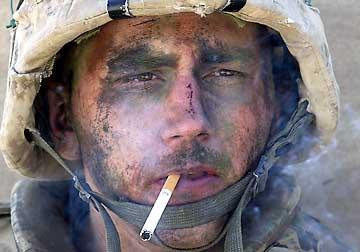
Photo by Luis Sinco/AP
I invite my readers to join with me in offering prayer for our soldiers in Fallujah, and elsewhere througout the world, for the wounded and dying, and for the dead, that God would grant them eternal rest.
November 10, 2004
What an Interesting Concept!
If any of our Christian forebears from more than forty or fifty years ago could project forward in time to our era, they would look at our views on sex and conception and think we are one weird, freaked out bunch of folks.
Why, we actually talk about "trying to conceive"!
Don't get me wrong. I recognize that part of the meaning behind that phrase is the recognition that conception, even under the most ideal of circumstances, can sometimes be a chancy thing. One act of marital coitus does not automatically result in procreation.
However, in modern understanding, that's not the main idea behind the phrase. Rather, behind the "we're trying to conceive" is the notion that we are actually intending to get pregnant. Gone the contraceptive pills and/or devices. Doggone it, we're going to let nature take it's course.
What a weird way to look at it.
There are many components to sex: marital intimacy, pleasure-giving and -receiving, joy and fun, as well as procreation. But only in our era have these components been compartmentalized and separated off into one another. Especially segregated is the notion--and reality--of procreation.
This is not the biblical, or, dare I say it, the Christian way. I say this not to cast stones, because for the first decade of our relationship, Anna and I did this very segregating off of procreation from sex.
Since the birth of our daughter, however, God has been working on my heart. I'm rethinking these matters. I want to think about it, to live this matter, just as Christ would have me think about and live it.
I cannot tell you the dimensions that this "holistic" understanding of sex and its place within marriage has opened up in my mind. I've expressed before the difference Anna's pregnancy made in my own love for her and our daughter. I found new depths and variations of the love I had for her, and a new expansion of my love in adding Sofie to the circle of our family. It was like I grew another heart, or that this imperfect man's heart expanded to not only pour out more love for my wife, but draw within it's confines my daughter as well. I can't even begin to imagine, let alone understand, what a new life in our home would do to me.
Though with all my failings, one may well wonder what, if anything, it has done for me.
In the end, it is unnatural to seperate procreation from sex, and therefore the biblical strictures limiting sex to the marital union of husband and wife not only make eminent sense, but can only be self-evident. They are also a most mystical inroad to an understanding of the Faith, most expecially the Holy Trinity.
So, Anna and I have been "trying to conceive." Pray God from now on that that phrase will mean in my own mind, heart and strength, not a separation of God-given procreation from equally God-given sex, but a full union of the whole of life and marriage in us.
Semper Fi, Marines!
On this day in 1775--before the U. S. of A. was even born--the Marines were born.
Happy 229th Birthday Marines! (note: pdf document)
And to my cousin: Semper Fi!
Almighty Father, whose command is over all and whose love never fails, make me aware of Thy
presence and obedient to Thy will. Keep me true to my best self, guarding me against dishonesty in purpose in deed and helping me to live so that I can face my fellow Marines, my loved ones and Thee without shame or fear. Protect my family. Give me the will to do the work of a Marine and to accept my share of responsibilities with vigor and enthusiasm. Grant me the courage to be proficient in my daily performance. Keep me loyal and faithful to my superiors and to the duties my country and the Marine Corps have entrusted to me. Make me considerate of those committed to my leadership. Help me to wear my uniform with dignity, and let it remind me daily of the traditions which I must uphold.
If I am inclined to doubt; steady my faith; if I am tempted, make me strong to resist; if I should miss the mark, give me courage to try again. Guide me with the light of truth and grant me wisdom by which I may understand the answer to my prayer. Amen.
From the halls of Montezuma, to the shores of Tripoli,
We fight our country's battles in the air, on land and sea.
First to fight for right and freedom, and to keep our honor clean;
We are proud to claim the title of United States Marine.
Our Flag's unfurled to every breeze from dawn to setting sun.
We have fought in every clime and place, where we could take a gun.
In the snow of far off northern lands and in sunny tropic scenes,
You will find us always on the job, the United States Marines.
Here's health to you and to our Corps, which we are proud to serve.
In many a strife we've fought for life and never lost our nerve.
If the Army and the Navy ever look on heaven's scenes,
they will find the streets are guarded by United States Marines.
An Appreciation of Attorney General John Ashcroft
Although this could probably be categorized as a "political" entry, in contradiction to my "fast," if you read to the end, you'll see it's much more than about politics.
Shannen W. Coffin at National Review Online gives some balanced comments on the retiring Attorney General John Ashcroft:
Attorney General Ashcroft's legacy is a complex one. In ordinary times, the accomplishments of the Department of Justice under his watch would be impressive. Violent crime is at a 30-year low, declining by 27 percent during the three-year period between 2001-2003. While a staunch supporter of gun ownership, Ashcroft also realized what many of his predecessors had not--that the way to stop violent crime is to enforce the gun laws that are on the books. Thus, federal gun-crime prosecutions are up over 75 percent in the last four years. In 2003 alone, more federal gun charges were brought than any prior year on record. The result was that 250,000 fewer gun crimes were committed in the last three years than in the prior three. Drug trafficking and human trafficking have been heavily targeted by the Justice Department, resulting in severe disruptions in criminal syndicates operating in both areas. The list goes on.
Yes, there is the Patriot Act, but Ms. Coffin points out a very important fact:
Has there been controversy? Most definitely. The mere mention of the Patriot Act sends shivers down the spine of the American Civil Liberties Union and its supporters. But Ashcroft's use of the enhanced law enforcement and intelligence tools provided by the Patriot Act has been as measured as it has been effective. When the ACLU sued Ashcroft in Detroit last year to stop him from enforcing Section 215 of the Patriot Act — which it derisively (and inaccurately) calls the "libraries" provisions — it learned he had never authorized a Section 215 order to be sought. Ashcroft, contrary to his critics' hype, realizes that liberty is a precious thing. (emphasis added)
Critics may also not realize (or admit) that the so-called "libraries provision" is available to grand juries in the course of their proceedings, long before the Patriot Act.
Jay Homnick over at The American Spectator points out something very few know about Ashcroft:
This is a mild-mannered Missourian whose Senate office was noted among Washington staffers as a pleasant and respectful work environment. Some years ago, tragically, his wife had been raped, and the gentleness with which he shepherded her through the recovery was the stuff of legend.
And, of course, Ashcroft was a sincere man of faith, something his critics often fail to understand and even more often fail to appreciate. Ms. Coffin continues:
Ashcroft is also a man of enduring faith in God, a faith that guided his stewardship of the Department of Justice and that often drove his critics mad. But that faith was a necessary part of his most difficult job in our country's most difficult time. And it was a blessing to us all. In his farewell message to the Department of Justice, he expressed gratitude for a successful tenure and underscored the challenges the country had faced over the last three years:I express my gratitude to God for the each day the sun rises on a free and safe America. For the past three years, my every working day has begun with a report - a catalog of the murderous acts being plotted against Americans. That we have passed these three years in safety and security is a credit to you. But it would be the height of arrogance to assume we achieved this alone. The Psalms remind us: 'Unless the Lord watches over the city, the watchman stands guard in vain."... And as I take my leave of this privileged post, I know that our efforts have not been in vain. The Builder of our city and the Author of our freedom has stood beside us. He stands beside us still.
Amen, Mr. Ashcroft. Amen.
November 09, 2004
Important Rules for Writing Good
1. Avoid alliteration. Always.
2. Prepositions are not words to end sentences with.
3. Avoid clichés like the plague. (They're old hat.)
4. Employ the vernacular.
5. Eschew ampersands & abbreviations, etc.
6. Parenthetical remarks (however relevant) are unnecessary.
7. It is wrong to ever split an infinitive.
8. Contractions aren't necessary.
9. Foreign words and phrases are not apropos.
10. One should never generalize.
11. Eliminate quotations. As Ralph Waldo Emerson once said: "I hate quotations. Tell me what you know."
12. Comparisons are as bad as clichés.
13. Don't be redundant; don't use more words than necessary; it's highly superfluous.
14. Be more or less specific.
15. Understatement is always best.
16. Exaggeration is a billion times worse than understatement.
17. One-word sentences? Eliminate.
19. Analogies in writing are like feathers on a snake.
19. The passive voice is to be avoided.
20. Go around the barn at high noon to avoid colloquialisms.
21. Even if a mixed metaphor sings, it should be derailed.
22. Who needs rhetorical questions?
Wandering Thoughts
I'm not sure if it's coincidence or not, but yesterday the Light & Life catalog came in the mail. There were a couple of books featured that piqued my ad hoc interest: Confronting and Controlling Your Thoughts According to the Fathers of the Philokalia and Thoughts and How to Confront Them.
No, I'm not hearing voices in my head--though some of you may well wonder. No, my problem is much less interesing and far more vexing.
I can't keep myself focused during my prayers. From "In the name of the Father, Son and Holy Spirit" to "Through the prayers of thy immaculate Mother . . ." my mind is all over the map. As soon as I bring it back to attention, it flies off again. Apparently it's far more important to try to remember which bills are due next than it is to praise the Holy Trinity. From the way my thoughts go during prayer, you would think it's much more critical that I contemplate whether or not to splurge and buy a coffee at work today than it is to intercede for my family and friends.
Sheesh.
This was a problem when I was still reading my prayers. I could read them straight from the book, start to finish, and realize when I finished that my mind had been off somewhere else the whole time. So I memorized the prayers. This helped immensely. I learned to try to move my mind into my heart--still trying that--and it was so helpful to focus on the words.
Now it's the memorization that's the problem. I turn on the "machine" and blam, when I'm done I've finished the grocery list, added three items to my "to do" column, and daydreamed about Sofie going to grade school. So I pulled out the prayerbook and tried reading the prayers again. It helped . . . a little.
Again, I keep trying to "rassle" these dang flighty thoughts, but with almost no success. As soon as I grab them, they wriggle free.
I suppose the good news is: I'm normal. The bad news may not so much be bad news as just a slightly overwhelming reality: It's going to be this way for a long, long, long time.
Does God accept these futile and flimsy prayers of mine? I think so. I sure want him to. Sofie pays far more attention to me than I do to God. What must God think of my own attention to him? Or, rather, inattention.
Pray for me, a sinner.
A Different Sort of U. S. County Map
Although I'm fasting from politics for a bit, I'm still fascinated by these county maps. Here's one of the percentage of Orthodox vis a vis the county population:
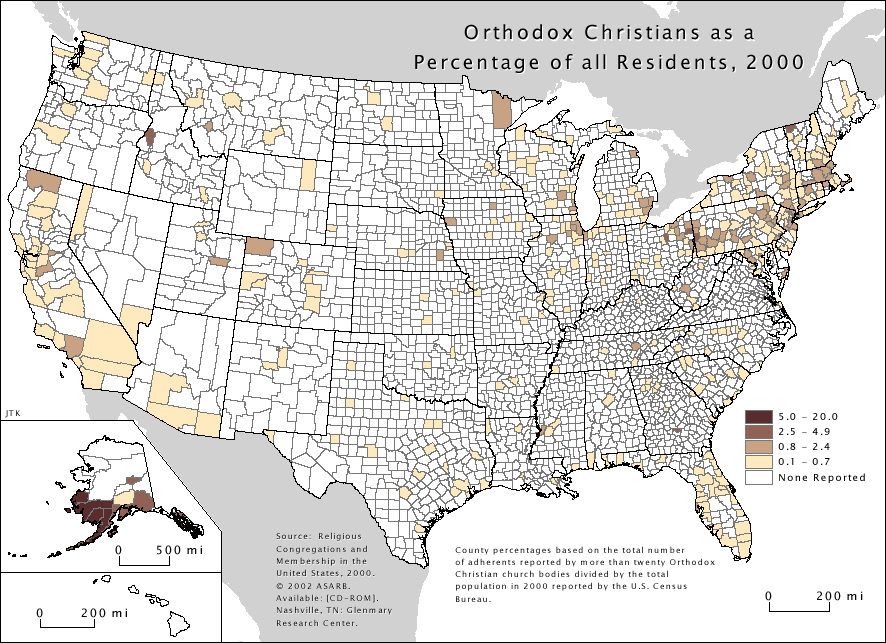
[From here--scroll down to Eastern Orthodox. By going to this link, you can click on the image to enlarge it.]
For My Restoration Movement Brothers and Sisters
And, with the same stultefying fascination gripping me, here's a county map of Restoration Movement churches vis a vis U. S. county population:
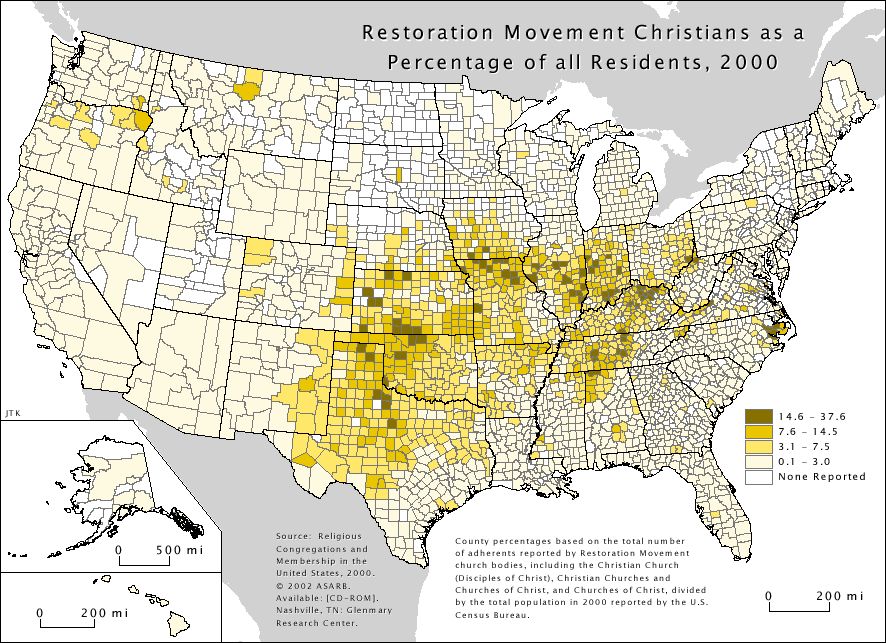
[From here--scroll down to Christian. By going to this link, you can click on the image to enlarge it.]
November 08, 2004
Who Were the Best Tea Leaf Readers?
Nationally:
Ed Goeas GW-Battleground Vote Projection (51.2 Bush, 47.8 Kerry and 0.5 Nader) and Pew Research (51 Bush-48 Kerry-1 Nader) got it exactly right.
Battleground states:
Mason-Dixon got 15 out of 16 (Minnesota: Bush by one point was the failed call)--calling four states dead on, and the difference between their calls and actual votes was 1.8.
Rasmussen just missed Iowa, but missed the point margins by more than three points in NJ and AZ.
Okay, so next time you know who to watch.
Now how about who to avoid? Who got it worse?
Nationally:
Marist College called Kerry by one (50-49), Lake, Snell, Perry and Associates (Battleground/Lake) called Kerry by two (51-49) and Fox News/Opinion Dynamics called Kerry by two (48-46).
Battleground states:
Fox News/Opinion Dynamics. Called Florida for Kerry by five points.
Strategic Vision: a bit too Republican (called Bush win in MI and tie in NJ and consistently underestimated support for Kerry.
CNN/USA Today/Gallup: Missed FL, OH, PA and WI by large margins.
Next time out, you can probably bypass these folks.
RealClear Politics' US Presidential Election County and States
No Mandate? II
If it's true that having a mandate depends on a large coalition of portions of the country, then according to the map below, the more purple one gets, the more solid President Bush's mandate. Right?
Do we now have a new mantra for divisiveness? "That's not very purple of you." Hmmmm . . . .

Christian Persecution in Iraq
Militants Bomb Orthodox Church in Baghdad
BAGHDAD, Iraq (AP) - Masked men detonated a bomb near an Orthodox church in southern Baghdad on Monday, and police at the scene said three people were killed and 34 wounded.
A guard at the St. Bahnam and Sheik Matti Orthodox Church in the capital's Doura neighborhood said the militants drove up in a pickup truck.
"They were all armed," said Khalaf Enad. "They quickly poured out of the car, pointed their weapons at me and said 'Get in.' They opened fire for over a minute and then I heard a big explosion."
The blast created a crater over 12 feet wide and 3 feet deep.
Church deacon Matti Qeryaqos, who lives nearby, said the explosion shattered church windows and blew the doors off their hinges, collapsing the outer wall. He said there was no service at the church at the time of the blast, and that the dead and wounded were mostly neighbors.
Mohammed Aziz said strong explosions rocked the area. "I felt my house shaking three times and then saw the fire set in the church."
Police sealed off the area and fired bullets in the air to disperse the crowd, according to another witness, Lyon Emad Elias, whose home faces the church.
O Frabjous Day!
Is it just me, or are my beloved Pittsburgh Steelers kicking some NFL butt? 7-1? Sitting atop the AFC North by a couple of games, and tied with New England in the AFC East. Oh, and now that they've plucked the Eagles, they're tied with them, too. I'll take it.
No Mandate?
There's been a bunch of talk about how Bush "only" won 51% of the vote, compared to Kerry's 48%. And although Bush won more votes than any president in history, Kerry did win more votes than Reagan did in his first term. So, the argument goes, one cannot build a mandate off only 3.5 million voters, or, heck, off some 70,000 voters in Ohio.
One is also pressed to delicately remind "no mandaters" that Clinton's first term saw more Republican and Reform voters arrayed against him than voters that were for him. How many more voters voted for someone other than Clinton? 13,936,923. But let's call it fourteen million even. Fifty-seven percent of the country didn't want Clinton. In 1994, of course, it was clear Clinton didn't have a mandate. Even the 1996 election saw Clinton winning only by 118,200 votes (over the Republican/Reform aggregate). A plurality of 0.1%. Yes, a tenth of one percent. Anywho . . .
Much, of course, has been made of the "moral values" voters and evangelicals who turned out to support Bush and give him his clear and decisive election victory. I, myself, have made much of these facts.
But before we dismiss Bush as not having a mandate, let's take another look at those voter demographics.
More than a third (almost two-fifths) of union members, thirty-eight percent, supported Bush. Nearly a fourth (23%) of gays, lesbians and bisexuals voted Bush. Almost half of independents (47%) pulled the lever for Bush. Although just a bit more than a tenth of blacks voted for Bush, Bush increased his support among blacks by two percent from 2000. More than two-fifths (42%) of Hispanics voted for Bush, an increase of seven percent (I think). And Asians were right along with Hispanics at 41%.
And the youth vote? Well, despite the fact that millions more youth were registered by entertainment stars, they remained the same percentage as 2000. Of course, this was a numerical increase, since voter turnout was huge this year. But of those new voters, 44%, voted Bush. Yes, the majority broke Kerry's way, but the youth vote is not the huge Democratic vote cache everyone thought they were. Indeed, except for the youth vote, all age groups preferred Bush over Kerry.
As I've said, much has been made over the evangelicals and Catholics who gave Bush the victory, but those who only occasionally attended religious services voted Bush to the tune of 46%, and even those who never went to religious services voted just more than a third (34%) for Bush.
Given that Bush was able to draw into his electoral tent not only the greater number of voters, but also a vast and diverse coalition of voters--which transcends the blue/red divide--it seems more than reasonable to conclude Bush has a mandate.
November 07, 2004
Moral Values and the Battle Over Who are the Bigger Hypocrites
I've calmed down a bit from Saturday's "proud red stater" rant, but not much. So if some irony, sarcasm and snippiness come through, well, you've been warned. Stop now or you may get offended by reading further.
First reactions to the elections and the ascendancy of "moral values" into this year's campaign had mainly to do with pegging red staters with ignorance and certain phobias, homophobia playing the loudest tune, but xenophobia and misogyny were close behind. As the internet continues to get "hetted up" over the election, it seems now reactions are turning to accusations that red staters are just a bunch of hate-filled hypocrites. They cry "moral values" and "traditional marriage" but have just as high divorce rates as blue staters (or, heck, some blue states have lower divorce rates!). And for all their advocacy of the unborn, them red staters sure do like to drop bombs on people, kill criminals, and otherwise ignore the poor.
Give me a break.
I'll get to the hypocrisy equalizer in a moment. But let's take a look at these blue staters. These folks crying red state hypocrisy are the same folks who blather on and on about women's reproductive rights, but last time I checked, every woman still had a right to reproduce or not, as she sees fit. In fact, as one commentator noted, anyone who tries to force a woman to reproduce will get his butt landed in jail darn quick. And God forbid any parent try to keep their underage daughter from reproducing--there are a ton of government subsidized agencies that will help her accomplish her reproductive activities outside of parental consent. Oops. Did I say reproductive activies? Well, yes, I did. But that's the hypocrisy: blue staters don't want to women to have the right to reproduce. Nope. They want women to have the right to engage in any and all sexual activities they desire--without the consequences. Reproductive rights? Hardly. The right to kill off any consequences of consensual activity, that's what they want.
And blue staters are so tagged with care for and outreach to the poor. But as we all know one of the primary ways for the poor to escape the rigid cycle of poverty is to get a good education. And here's where blue staters balk: don't you dare take kids out of worthless, underperforming, overfunded inner city schools. Heavens, what would happen to all the overpaid administrators of those schools? Er, I mean, what would happen to all the teachers we don't really care about because we won't eliminate duplicate administration and non-school union jobs to free up funds to give them a raise? Er, I mean, what would happen to all those students? What would happen, you ask? They would go to schools that do perform and get an education that will at least give them the chance to break the cycle of poverty in their own lives.
These blue staters are starting to get rid of that "deer-in-the-headlights" look they took on when "moral values" burst on the election scene. Why, they crow, we have values, too. We value diversity, plurality, freedom, and so on. Indeed, those blue staters do. They value all opinions and religious beliefs--except Christian ones. Schools have mandated the saying of Muslim prayers and reading of Islamic literature, and the wearing of Muslim dress in classes devoted to studying other groups. Try to do that with Christianity . . . Uh, well, never mind. Yes, blue staters value morals and values, just not those exclusivist, rigid and homophobic Christian ones. I mean, Christians actually believe their faith should have a role in the public square? Can you believe that? What rubes. Maybe all those blue staters have lower divorce rates because fewer of their people would dare to submit to as outdated and backward a ritual as a "Christian wedding ceremony" so they don't get married, and therefore don't get divorced. After all, who needs a piece of paper and a minister to authenticate a couple's love, right? More to the point, if traditional marriage is such a means of oppression to women and is nullified by rampant divorce, why do blue staters want it for gays and lesbians?
Yes, yes, see--two can play the hypocrisy game. And that's my point: blue staters and red staters have equal numbers of hypocrites, they're just hypocritical about different things. No, the proof is in the pudding. What actually are the moral values red staters and blue staters hold? And do those beliefs hold up to reasonable inquiry? And when those beliefs do get lived consistently--and red staters and blue staters do exist who live their respective moral values consistently--what are the consequences and results? Those are the questions that need to be asked.
November 06, 2004
Proud Red Stater
Color me a little cranky, but the backhanded bitch-slapping the anti-Bush left is handing out to all the red staters and Bush supporters is getting under my skin. We red staters apparently are ignorant, inbred homophobes who sit around dreaming up ever new ways to subjugate women and drown puppies. We red staters are told it is we, not the ever-tolerant leftward media and academics, who are dividing America with our fundamentalist cretinism. Well, in the words of one former First Lady candidate, "Shove it."
I've lived most of my life in red state land. My grandfather was a farmer. My dad works in the oil industry. My mom didn't get her college degree till we kids had left the home, but by the time I was five, she had already run a successful business, working full-time, and raised us kids while my dad worked shift work. When our families gathered at holidays, we didn't discuss the newest intellectual idea that had come down the academic pike, we didn't get all giddy over some new fashion accessory, and we never gave a thought about which posh social club we should frequent.
My grandmother didn't worry too much about any equal rights amendment or fret over whether or not her pay was equal to any man working the same job. You see, she made as much as my grandfather, which meant, they both made whatever could be brought in from harvest and livestock sales. With my dad and his siblings grown, she did work part-time at a dentist's office in town, but she was a farmer's wife. She had equal say in the discipline, because you just couldn't run out and pull grandpa off the tractor to settle some sibling dispute. She had equal pay, because it all went to the same account at the bank. And though grandpa was a strong stubborn cuss, he also only had one arm and a stump, one of his arms having been torn off in a cutter when my dad was young. Self-reliant as he was, he depended on my grandma for a lot.
Now I'll grant you, I was, and still am, a city kid, a townie. And more so now that I'm living in Chicago. My grandfather might well scratch his head, were he still living, wondering what the heck I want to go and waste my life chasing after the ideas of dead men. There are times I wonder myself. You see nerdy academics like me don't grow food, or build houses, or manufacture clothing. But that food doesn't magically appear in a refrigerated semi on its own. Sure, small famers like my grandfather was are a dying breed, if not already all but dead. They've been replaced by larger industrial farms. But you get right down to it, it's still farmers in red states that put food on all our tables.
Blue staters have the luxury of living off the toil and hard work of red state farmers. They bitch and moan about the cost of a head of lettuce, but little realize that the increase in price almost never makes it back to the farmer, who lives on precious little with machine and land debt all but crushing him if he doesn't move fast enough to stay ahead of it. Blue staters have the luxury of letting others serve in the military and keep them safe. Who makes up our military? Largely poor and middle class red staters. Talk all you want about the dozen or so who were involved in the Abu Ghraib scandal, there are hundreds of thousands more like my cousin Justin who serve with honor, dignity and pride to keep madmen like Hussein, Zarqawi and bin Laden from accomplishing their satanic ends.
Blue staters have the luxury of living lives of fantasy, thinking they'll never have to worry about having food to buy at the grocery store, overpriced clothing to buy at the mall, and endless rubbish of entertainment poured into their skulls as they try to escape the tedium of daily life. They have the luxury to say all sorts of insane crap--witness all the puppy-drowning screeds that are some of the sorriest excuses for First Amendment rights, and attempt to foment all sorts of inhuman practices--such as abortion, on the red staters. They have that luxury because, in large part, red staters provide the basic goods and civil defense that blue staters take for granted.
Blue staters want us red state folks to believe that we're too stupid to have a thought of our own, but can only blindly follow our preachers, Karl Rove or our Amway directs. But if I'm not mistaken, these are the same folks who were supposed to listen to entertainment gurus who've never studied politics, don't know anything about foreign policy other than what their own media tells them, and are deadly afraid that Europe won't like us any more. Independent thinking? Sure. If you say so.
But the thing that grates me the most is the snobbish hypocrisy of these blue state rants. Preaching tolerance and diversity, they prove themselves to be little more than intolerant and exclusive. More fundamentalist than any holy roller preacher, they are doing little else but projecting on others their true inner selves. And ignorant? They wouldn't know a red state if it jumped up and slapped the planes they use to skip over the vast desert expanse of "flyover country."
Blue staters get to live their blue state fantasy lives at the expense of the good name and character of red state folks like my late grandfather. So be it. Red staters are too busy living real life to much care. Our red state men may not have extra letters after their names, our women may not work "real jobs," but red state life is a hell of a lot more real than blue state fantasy. I'm a red stater. Deal with it.
Redstate.Org: 25 Reasons to Enjoy the Post-Election Weekend
Happened across a nifty little site called Redstate.org, who had a blog post satirizing this out of work fake documentariat.
I excerpt some of my favorite Twenty-Five Reasons to Enjoy the Weekend:
1. We can finally get around to razing the virgin forests, slaughtering every non-human species of animal on earth, and destroying rain forests for giant, sprawling exurb communities in South America (with commuter jets for everyone).
2. Ladies: Take your shoes off, get in the kitchen, and warm up the wombs. You can start dinner with your college, post-grad, law, or medical diplomas. Think of The Handmaid's Tale not so much as a bitter, shrill, poorly-written, flat, loony-left warning, but rather as a primer for your existence for the next several decades.
7. Mandate.
8. Four words: Chief Justice Robert Bork.
11. Somewhere, as we speak, Tom Daschle is very, very saddened. And regretful. And disappointed. And this time, it's for real.
12. The entire foreign policy establishments of France, Germany, China, North Korea, Cuba, Iran, Syria, and Canada are shocked and dismayed. Heck, that's worth two items by itself.
15. We finally get to round up liberals, leftists, gays, atheists, agnostics, polytheists, Darwinists, secular humanists, Bill Moyers, and Dan Rather, and put them in Fundamentalist-Evangelical-Hard-Line Catholic (they don't know the difference, so we won't tell) Christian Re-Education Camps. They'll be productive citizens soon enough.
Simultaneously, we smash every medical lab everywhere, and revert to faith healing. By law. We'll see by the burning copies of the Bill of Rights we carry around.
16. The Honorable William Pryor; The Honorable Janice Brown; The Honorable Priscilla Owen; and the Honorable Carolyn Kuhl.
20. We get to pave France. We'll need the parking and air strips for the next stages of the Dread NeoCon World Conquest.
21. We can finally release Osama, fresh from a Christian re-education/Amway teaching camp.
23. The Bush twins. Not the Kerry daughters. 'Nuff said.
25. Four. More. Years.
November 05, 2004
The Issue That Tipped the Election
The day after the election, the talking heads were dumbfounded. The issue that tipped the election in George Bush's favor wasn't the war on terror. That was the third place issue. Bush did prevail on that matter, to the tune of 86% to 14%. It was no surprise that the economy was a major issue, but it come in at second place, just one point above terrorism. It was no surprise that this was Kerry's issue. On the economy, Kerry prevailed over Bush 80% to 18%. Healthcare and education were also Kerry winners, but they were way down the list at fifth and seventh place respectively.
No, the issue which caused Bush to prevail was "moral values." On moral values, Bush prevailed 79% to 18%. Given that married men and women as a group, preferred Bush 56% to 43%, and that those who attended religious services weekly preferred Bush 60% to 39%, and that Bush not only has never been shy about his own religious experience and has actively courted religious citizens, it is no wonder that Bush was propelled into a second term by voters who listed their top concern of the election "moral values."
But how to read this? What are the "moral values" that voters were concerned about? In what way did these nebulous "moral values" move voters to prefer Bush over Kerry by such margins that these voters decided the election? And why were the media pundits caught with "deer-in-the-headlight" expressions Thursday morning?
In looking at the election in broad terms, one notices that eleven states had voter referenda on the issue of gay marriage. Eleven states voted by overwhelming margins to ban gay marriage in their states, some of the states voting these bans into their state constitutions. One also notices the timing of Chief Justice William Rehnquist's critical bout with cancer. News of this broke mere days before the election. It seems clear that at least two of the issues comprising the amorphous term "moral values" had to do with issues of marriage and the makeup of the Supreme Court, and the latter issue comprises issues surrounding marriage, abortion and religious freedoms.
In other words, it seems clear to me that the moral values to which these exit polls refer are these: the upholding and support of traditional structures of marriage, the fight for the life and rights of the unborn, and the fight against judicial suppression of the freedom of religious expression. In the last several months, all these "moral value" issues have played out in our nation: the passage of the partial birth abortion ban and its subsequent annulment by the courts, the fight to remove the phrase "under God" in the Pledge of Allegiance, and the forcing by judicial fiat of gay marriage on a populace that doesn't approve of it. The moral values of life, marriage, and freedom of religion, it seems to me, were the keys to Bush's reelection.
Life issues encompass the various matters related to the beginnings and endings of life: advocating for the rights of the unborn, prohibiting embryonic stem cell research, and resisting euthanasia. Life issues did not encompass support for abortion-on-demand and a woman's right to choose it, because those who advocate for that in large part cast their votes for Kerry.
Another of the moral values these voters found to be important enough to put Bush back in office was the upholding and protection of traditional marriage and family. Although Bush supporters may have been disappointed with their president that he did not fight for the marriage amendment to the Constitution as he seemed to indicate he would, it's not as though Bush hadn't done anything else for traditional families, not the least of which was tax relief. These moral issues voters, though, put the country and Bush on notice: marriage is only between a man and woman. Period.
But moral issues voters also know that these twin concerns are being attacked by judges who are intent on pushing not merely a secular values system on the nation, but an anti-religious one. I am absolutely certain that Rehnquist's health was one of the major catalysts for getting out the moral issues voters. This was their wakeup call. If they wanted to entertain any hope of seeing the values they live their lives by protected, they needed a president in office who had pledged to appoint judges who interpreted the Constitution strictly.
It's not as though the rest of the country didn't vote their values, or that they don't have any. But clearly, their values differ from the moral values voters either in content or in importance. I have friends who are pro-life but anti-Iraq-war. Some of them may well have pulled the lever for Kerry. Why? Did they not really believe in supporting the unborn? No. They had to prioritize their values, and when it came to voting, they put their war concerns over concerns about abortion. It's not as though moral values voters are the only ones who believe in traditional marriage, but there are voters who believe traditional marriage is the norm yet still pulled the lever for Kerry. Why? They prioritized a different value over their valuing of traditional marriage. Maybe that value was a libertarian tolerance of different moral values. Maybe that value was civil rights. Who knows.
The point though is this: moral values voters decided, when push came to shove, they were going to place their moral values as the priority upon which to vote. And in that, they showed the single moral value which differentiates them from the rest of the nation: moral values come before anything else.
And that last is why the rest of the nation, and the so-called "liberal media elite," had such expressions of utter bewilderment. They have moral values, too, different though they may be on some of these issues. But their moral values are ranked differently. And one of those rankings put moral values themselves further down the list than other concerns.
In other words, it's not merely the content of the moral values that differed, but rather the value of moral values themselves. Those who ranked moral values as central to this election not only outnumber those who didn't, they also rank moral values--of protecting the life of the unborn, of promoting and supporting traditional marriage and family, of valuing and protecting religious expression inthe public square--as central to life. And that, that, is the issue that tipped this election.


November 04, 2004
Religion Front and Center
In the USA Today online article "Election reinforces USA's religious schism" it's noted that:
Exit polls conducted for The Associated Press and television networks by Edison Media Research/Mitofsky International showed clearly that the president draws much of his support from religious people:
* The president had the support of 78% of white evangelicals, 23% of the voters.
* Bush won 52% of the Roman Catholic vote on Tuesday, and got the support of 56% of white Catholics, defeating the first Catholic presidential candidate from a major party since John F. Kennedy. In 2000, Bush narrowly lost the Catholic vote.
* Bush was favored by 61% of people from all faiths who attend services weekly; they made up 41% of the electorate. Democrat John Kerry drew 62% of Americans who never attend worship, but they only accounted for 14% of voters.
* When respondents were asked to pick the one issue that mattered most in choosing a president, "moral values" ranked first at 22%, surpassing the economy (20 percent), terrorism (19 percent) and Iraq (15 percent).
Gay marriage bans were handily approved in all 11 states that held referendums, and analysts said that issue drove up turnout. "This was a high stakes election for those who support traditional moral values," said Geoffrey Layman, a University of Maryland political scientist.
We are a religious nation, and a nation that is mostly traditional in its moral values. We're all going to have to get used to this reality. For too long we've lived in a delusional fantasy world which discounted the impact of religious faith. Tuesday, 2 November, was our wakeup call.
Good morning, real world.
Election Analysis
Taking a look at the demographics of the vote reveals some important, and disturbing, trends.
In terms of party affiliation, Democrats and Republicans both stuck by their parties. But the Republicans were marginally more loyal. Democrats brought home 89% of their base, Republicans brought home 93%.
Minorities still break decisively for Democrats: 89% of blacks, 55% of Hispanics and 59% of Asians. Whites break 57% for Republicans. Race still divides us, but why this is the case may not be clear. Is it part of the deep cultural structures in America? Do the Democrats exacerbate the divisions toward their own political ends? Are Republicans, without whose support and efforts, there would have been no civil rights act, now carelessly ignorant of the issues of race?
Those who graduated high school and had some college or were college graduates tended to be Republican, though all the margins were close. Those who did not graduate high school barely tipped Democrat, but those who had post graduate work were the biggest Democratic margin (55% to 43%).
While it's true that women went Democrat by a margin of 52% to 45%, and men went Republican by a margin of 54% to 45%, that doesn't tell the whole story. Married men and women went Republican (59% and 54% respectively) with wide margins. Marrieds generally went Republican by a margin of 56% to 43%. Singles went Democrat 59% to 37%, with single men going Democrat to the tune of 53% and unmarried women by 63%. So the gender gap wasn't so simple as it looked: it depended more on marital status than on gender.
Union members (61%), gays and lesbians (77%), and political independents went Democrat, though the political independents were only marginally more Republican at 50% to 47%. White evangelicals broke decisively Republican at 77%.
In terms of religion, the Republican party garnered 60% of the vote of those who attended religious services weekly, while those who only occasionally or never attended services went Democrat by 53% and 64% respectively.
With all that in mind, then, it's not surprising that the single most important issue on voters minds this year was moral values at 22%, followed closely by the economy and jobs (20%) and terrorism (19%). Of those who listed moral values as the top concern, 79% went Republican, while those who ranked the economy and jobs first went Democrat to the tune of 80%.
In other words, the lines of division in this country run clearly in conformity with moral and religious values and race. The Democrats clearly appeal to unmarrieds, the nonreligious, and those with secular values, as well as minority voters. The Republicans clearly draw in marrieds, the religious and those of conservative and/or traditional values, as well as whites.
The religious and racial divisions in our country are real and troublesome. But they are made only more so in that they align with the political divide in this country as well. Political, religious and racial divisions line up almost perfectly, and it is this, not any single candidate, which is the source of our country's division.
Ratherisms from Election Night 2004
From About.com comes Dan Ratherisms - Election Night Dan Rather Quotes:
"Do you hear that knocking...President Bush's re-election is at the door."
"This race is hotter than the Devil's anvil."
"His lead is as thin as turnip soup."
"This race is humming along like Ray Charles."
"This race is hotter than a Times Square Rolex."
"Ohio becomes like a sauna for the two candidates. All they can do is wait and sweat."
"One's reminded of that old saying, 'Don't taunt the alligator until after you've crossed the creek.'"
"Bush is sweeping through the South like a big wheel through a cotton field."
"No question now that Kerry's rapidly reaching the point where he's got his back to the wall, his shirttails on fire and the bill collector's at the door."
(To Joe Lockhart) "I know that you'd rather walk through a furnace in a gasoline suit than consider the possibility that John Kerry would lose Ohio."
"This presidential race has been crackling like a hickory fire for at least the last hour and a half."
"We used to say if a frog had side pockets, he'd carry a handgun."
"No one is saying that George Bush is not going to win the election, and if you had to bet the double-wide, you'd have to bet that he'd win."
"In southern states they beat him like a rented mule."
"If you try to read the tea leaves before the cup is done you can get yourself burned."
"We had a slight hitch in our giddy up, but we corrected that."
"In some ways, George Bush's lead is as thin as November ice."
"Put on a cup of coffee, this race isn't going to be over for a while."
"You look at the map and say it's all a big Bush victory. But this is one time when your Mother is right, looks can be deceiving."
"John Kerry's moon has just moved behind a cloud, as far as Florida is concerned."
On Kerry's chances: "To use a metaphor, he's gotta draw to an inside straight. But hey, sometimes you get lucky and hit that straight."
"Is it like a swan, with every feather above the water settled, but under the water paddling like crazy?"
The election is "closer than Lassie and Timmy"
"Keep in mind they are teetotally meetmortally convinced they have Ohio won."
"President Bush smiling there with his family. He's laid down aces so far."
"We don't know what to do. We don't know whether to wind a watch or bark at the moon."
On how the results are affecting strategists: "It's one reason so many of them drink a lot."
Sen. John McCain (R-AZ), on being congratulated on victory by Rather: "Thanks Dan, I always believe you." Rather: "Now, ladies and gentleman, if you believe that, you'll believe rocks can grow."
November 03, 2004
Further Reflections on President Bush's Reelection
Old media? CBS, NBC, ABC, CNN, New York Times. Done. Stick a fork in 'em.
The new media? Bloggers, World Net Daily, Drudge, conservative talk radio. Kings of the world.
Exit polls. Confirmed useless for the second straight presidential election. Get rid of 'em.
Democrats? Done for. Can they be resurrected? Only if they give up attack politics as their primary message. Gotta be for something, not just agin' it.
Third parties? Irrelevant. But how I wish they weren't.
Republicans? Learning to govern while in power. Have had mixed reviews these past couple of years. They now have more solid control. They's better do somethin' wid it.
Social and political liberals? Fangs pulled. Control diminished. Their agenda may well finally be slowed for a while.
Social and political conservatives? Justly proud of their accomplishments. Endouraged. Have new opportunities. But what will they do with it?
Zogby International polling company? No longer the wunderkind.
Mason-Dixon Polling and Research? Dead on. The king is dead. Long live the king.
The times they are a-changin'.
Thank God Ohio was no Florida 2000. We waited a few extra hours. Democracy works.
My Initial Reflections on President Bush's Reelection
It doesn't look good for Kerry-Edwards. With 100% of precincts reporting in Ohio, Bush has a 130,566 vote lead. Those in the know estimate that there are 175,000 provisional ballots. For Kerry to legitimately win Ohio, seventy-five percent of those ballots would have to prove legitimate and all of those seventy-five percent would have to break for Kerry. Not 74%, not 73%, but 75%. If 90% of the ballots prove legitimate, Kerry would have to gain 83% of those ballots to prevail over Bush.
No matter how you slice it, it's a tall order.
So, assuming that the present reality--Bush wins the popular vote by 51% and by more votes than any other president in history (even Reagan), and wins the electoral college 286-252--hold through today and the next few days, what does that mean?
First of all, the war on terror trumped healthcare and the economy, although the present economy is not only not terrible, it's very, very decent. Many of those who voted Bush back in precisely because of the war very significantly disagreed with many of the particulars of that war, but also agreed that his principles and convictions about the war are right.
But what commentators are only now beginning to realize is that moral issues swung this election in Bush's direction. Life and marriage issues clearly gave the president the victory. In all the states where bans on gay marriage were up for vote and won, they won by crushingly clear mandates. The voters said clearly: marriage is between a man and a woman. Bush's pro-life stance also clearly connected with voters.
One thing the commentators will have to come to terms with, though, is that it was not just the "evangelical Christians" who put this in the win column for Bush, but Roman Catholics and Orthodox and Anglo-Catholics as well. As populous as evangelicals are (and what an amorphous term "evangelical" is!), they could not have won so decisively as they did without Roman Catholics and Orthodox and Anglo-Catholics who take seriously the Church's moral doctrines.
In addition, this election was the coastal and upper Midwest liberals (to oversimplify a bit) versus the exurban/suburban and rural conservatives. The three states which are home to the three largest cities in American (Illinois/Chicago, New York/New York, California/Los Angeles) which would almost assuredly give the liberals a popular vote advantage were counterbalanced by "flyover" country. In this election the moral values and commonsense assessment of foreign policy of the "flyovers" won out over the urban "liberals." Flyovers said, "We don't want your moral picture to be our reality, and we prefer a president who is clear in his convictions on terrorism even if we don't always like the way he fights it."