December 20, 2004
O Virgo Virginum
O Virgo virginum,
quomodo fiet istud?
Quia nec primam similem visa es
nec habere sequentem.
Filiae Ierusalem,
quid me admiramini?
Divinum est mysterium hoc quod cernitis.
O Virgin of virgins,
how shall this be?
For neither before was any like thee,
nor shall there be after.
Daughters of Jerusalem,
why marvel ye at me?
That which ye behold is a divine mystery.
Christ is born to us. Glorify him.
The Virgin shall bear a Son. And he shall crush the head of the serpent. Mary. Birthgiver of God. Mother of our Lord. Our Lady.
This was almost the only time of year that, growing up Protestant in the Restoration Movement churches, that I ever heard much about Mary. We were exhorted to the submission and obedience she exhibited. And we marveled that a human woman would give birth to Him who was Everlasting God. But I don't ever recall meditating overlong on the significance and singularity of Mary.
God spent not only all of Mary's life co-working with her to prepare her for the Incarnation, he spent all of human history working to the day when Mary gave birth to her firstborn, a Son. Mary's Son is the Lamb slain from the foundation of the world. There was no other woman God could have depended upon to give her humanity to our Lord. “At the right time” Paul says, “Christ was born of the woman.”
This is a marvel. We do well to wonder, that through the long ages, out of the countless people who'd lived, God kept narrowing his focus, the point of the wedge became smaller and smaller, until it all coalesced in one young woman in Roman-occupied Israel. In a moment of time, in the space of a breath, in an as-yet-unformed intention, hung all the labors of God from before the creation of the world.
“Let it be to me . . .” says the Virgin. And in a mystery shut to human pretension, him whom the heavens and earth could not contain, condescended to be circumscribed in the womb of Mary. And with the Virgin's “Fiat mihi,” her “Genoito moi,” all of heaven and earth now rejoices at the mighty act God has done.
Never before her, nor ever since, has any woman been so favored by God. Truly, the Birthgiver of God, is she whom Gabriel called, “Full of grace.” Truly, as Mary herself prophesied, all generations have called her “Blessed.” In her womb was accomplished salvation, the union of humanity with God by his great mercy.
Christ is born to us. Glorify him.
December 16, 2004
Ancient Faith Radio--Listen and Spread the Word
Our parish, All Saints Orthodox Church, has its own online radio station: Ancient Faith Radio. Take a listen. I think you'll like it. I've linked to it under my "Orthodox Links" section.
Helpful Finds
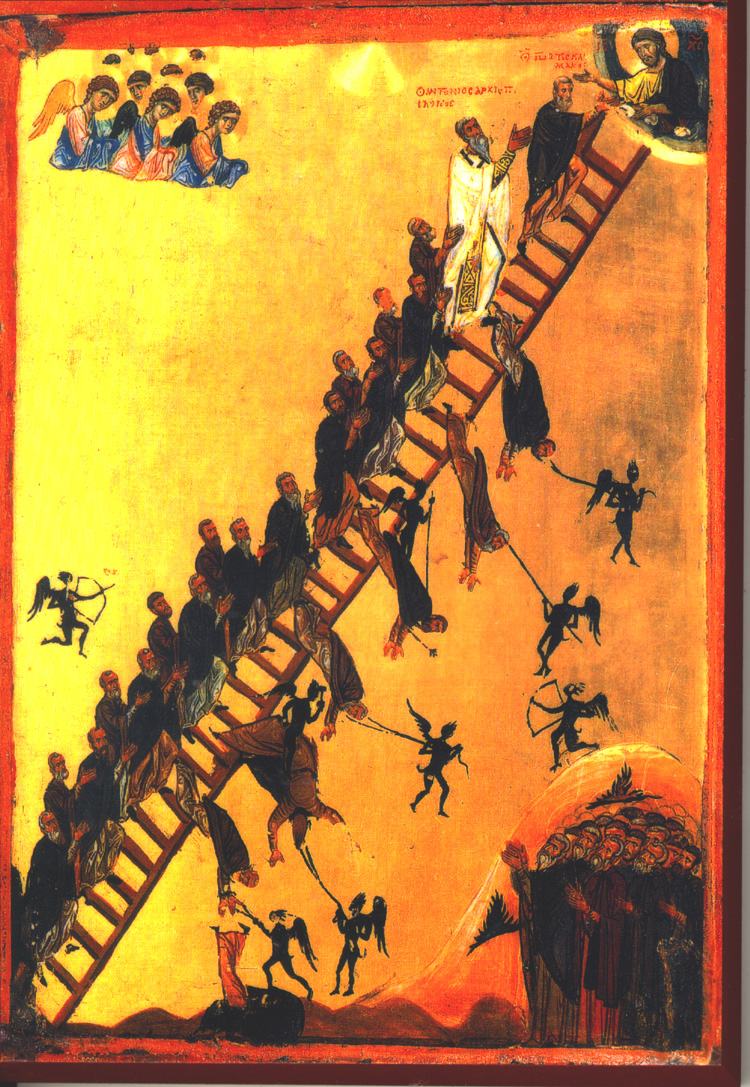
After some searching, I found this information on the Orthodox Church funeral practices and A Requiem Service for Non-Orthodox (pdf file). This requiem, along with the traditional praying of the Psalter, will be very helpful. I won't be able to pray it over the body, but can do so at home. Delane is not Orthodox, but the Church, in her wisdom, allows us to pray privately for the repose of our non-Orthodox loved ones. Heck, I'm not even Orthodox. My life is confusing.
I also happened by chance to come across Boris Bobrinskoy's The Compassion of the Father (SVS Press, 2003) at the Loyola library prior to giving my final Tuesday night. Two chapters that stood out to me: "The Lamb of God Takes Upon Himself Human Suffering" and "The Prayer of the Heart and Suffering."
What a weird, weird thing is this waiting for death.
December 15, 2004
O Emmanuel
O Emmanuel,
Rex et legifer noster,
expectatio gentium,
et Salvator earum:
veni ad salvandum nos,
Domine, Deus noster.
O Emmanuel,
our King and Lawgiver,
the one awaited by the gentiles,
and their Savior:
come to save us,
Lord our God.
Christ is born to us. Glorify him.
Desire of all nations. Emmanuel. The Gospel in a nutshell. Our desire: God with us. In the dark and cold of winter, God with us. In the bright sunshine of spring and summer, God with us. In loneliness and belonging, in calm and chaos, God with us. In sleeping and waking, in life and death, God with us.
In a transplant ICU in a Pittsburgh hospital, when the mother-hopes of the decades-ago birth of a firstborn son begin to fade one by one, this is a time when desire, presence and God conjoin. When the new life born out of present suffering, this young boy, Lucas, too young to understand, even too young later to remember, looks uncomprehendingly at medical technology and this person lying in a hospital bed, this is a time for a God who is with us. When the fierce fight to survive, to live, of a young Oklahoma son loses its force, when time is measured in milliliter drips, punctuated by beeps and chirps and the breath-like sound of machine pumps, this is a time for Emmanuel.
Our secularized world does not understand Christmas. If it did, it would cease now with the bright lights, the relentless onslaught of packaged muzac, the greeters and the plastered smiles. It would halt forever the talk of consumer spending, of “Christmas cheer,” and the checking of lists. If this secularized world took its wisdom from Holy Mother Church, it would disconnect the lights, take down the tree, put away the music, and don sackcloth. It would sit in ashes. And it would look in on an ICU room in Pittsburgh and go there and learn wisdom. It would go to meet God with us.
The atheists and other anti-Christian bigots have it wrong. Christians didn't take over pagan holidays and call it Christmas. Rather, Christians simply lived out what Christmas means. They stormed the beaches of darkness, turned the waters red with their blood, and planted the Holy Cross firmly in the soil of death. It was not an attempt to copy someone else's celebration. It was a mission to trample down death by death. Dagon bows before the Holy Ark, hands and feet broken in pieces on the threshold. God with us.
It is cruel, this dying of loved ones during the season the world knows as Christmas. Unutterably cruel. But God is with us. God knows what it's like to watch the slow, horrible death of a Son. On the bitter cold walks on Chicago's streets, in Pittsburgh's hospitals, in the long, silent moments of the deathwatch, God with us.
Christ is born to us. Glorify him.
December 14, 2004
A Dying Brother-in-Law and My Thoughts
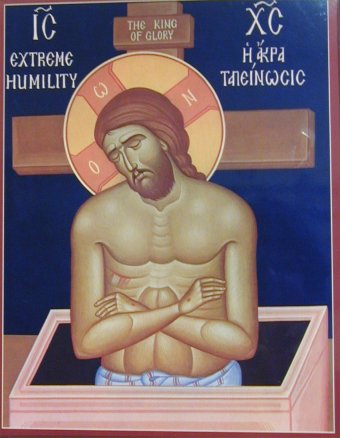
I have been thinking about suffering, prayer and death.
There is a part of me that has wrestled with how to pray for Delane. More and more I have just settled on "Save Delane" and let God work out what that means for Delane. I know what I wanted. I asked for it. But is what I wanted (restoration of health, restoration to his wife and children, to his family and work) the sort of salvation God is working out for Delane? Is Delane a co-worker in this? I don't know the answers to these questions. So I just pray on my prayer rope that the Lord would have mercy on Delane, and through the intercessions of the most holy Theotokos, St. John the Wonderworker, St. Herman and St. Spyridon (whose feastday it was Sunday), Blessed Seraphim, and all the saints, that God would save Delane.
But the prayer I want answered is one that has involved more physical suffering for Delane. There is no one on whom I would wish Delane's plight these past three and a half years. And yet, his family loves him, his wife and children need him, and we don't want to let him go. But thus far, short of full restoration to health, our prayers have meant daily suffering for Delane.
Mind you, my wife and I are Christians. So we reject any and all pagan notions that any suffering is an unmitigated evil. But neither do we ask for it, nor embrace it apart from the permissive will of God. It is necessary for us to be brought to salvation through suffering. Why this is so will remain a mystery to us, at least until the Parousia, if not beyond. It is a terrible mystery, to be sure. And so we plead God's mercy and grace, even as we recognize that in this awful darkness God's good will cannot be frustrated from bringing good from evil.
It seems less clear in suffering than it is at other more blessed times, that God's wisdom, goodness and power are so great that all things work together for the good of those who love him. Providence is for the Christian a blessed hope, an interpretive key, and the paradigm for faith. Still, we see through a glass darkly, and can only rest in the faith of Christ and his Church at these times. God knows my own faith is not enough.
But most of all I am thinking about dying. Delane's death, yes, but mostly my own. I spoke with my priest about this on the drive back home last night. (What else would you speak with your priest about on the Ohio turnpike in a snowstorm?) I do not want to die outside the Orthodox Church, nor without having brought my family with me into the Church. Memento mori. It is a time-tested discipline. But not an easy one. It is too easy to say that one must live as though the next step would lead one into eternity. It is unutterably hard to do it.
"Batter my heart, three-personed God," sings Donne. But I would rather God flirt--a playful, carefree "shave-and-a-haircut" suits my fancy much better. I'm with Eliot: "Humankind cannot bear much reality." But here's the reality: I'm not even guaranteed this moment. This now is not eternal. And each future moment may be the silent harbinger of my end, a now that will bring to cessation all my nows. Only God knows. "Teach me to number aright my days," is the plea.
I'm tired and sleepy. I have a final exams and papers to grade. My wife is sick. Her brother is dying. And I'm confronted once again with the utter inability of human wisdom to confront death.
Pray for me a sinner.
December 12, 2004
The Blessed Repose of Our Father Among the Saints, Herman of Alaska, Patron of the Americas
Troparion of St Herman of Alaska Tone 4
Blessed ascetic of the northern wilds/ and intercessor for the whole world;/ teacher of Orthodoxy, instructor of piety,/ adornment of Alaska and gladness of America,/ holy Father Herman, pray to Christ our God that He may save our souls.
Kontakion of St Herman of Alaska Tone 8
Monk of Valaam and beloved of the Mother of God,/ new zealot of the old desert-dwellers in thy labours;/ armed with prayer as thy sword and shield, thou wast terrible to demons and pagan darkness./ O St. Herman, we cry to thee: pray to Christ our God that our souls may be saved.
[Note: The Orthodox Church in America celebrates St. Herman's repose on 13 Dec.]
The time of the Elder's passing had come. One day he ordered his disciple, Gerasim, to light a candle before the icons, and to read the Acts of the Holy Apostles. After some time his face glowed brightly and he said in a loud voice, "Glory to Thee, 0 Lord!" He then ordered the reading to be halted, and he announced that the Lord had willed that his life would now be spared for another week. A week later again by his orders the candies were lit, and the Acts of the Holy Apostles were read. Quietly the Elder bowed his head on the chest of Gerasim; the cell was filled with a pleasant smelling odor; and his face glowed, and Father Herman was no more! Thus in blessedness he died, he passed away in the sleep of a righteous man in the 81st year of his life of great labor, the 25th day of December, 1837. (According to the Julian Calendar, the 13th of December 1837, although there are some records which state he died on the 28th of November, and was buried on the 26th of December).Those sent with the sad news to the harbor returned to announce that the administrator of the colony Kashevarov had forbidden the burial of the Elder until his own arrival. He also ordered that a finer coffin be made for Father Herman, and that he would come as soon as possible and would bring a priest with him. But then a great wind came up, a rain fell, and a terrible storm broke. The distance from the Harbor to Spruce Island is not great - about a two hour journey - but no one would agree to go to sea in such weather. Thus it continued for a full month and although the body lay in state for a full month in the warm house of his students, his face did not undergo any change at all, and not the slightest odor emanated from his body. Finally through the efforts of Kuzma Uchilischev, a coffin was obtained. No one arrived from the Harbor, and the inhabitants of Spruce Island alone buried in the ground the remains of the Elder. Thus the words which Herman uttered before his death were fulfilled. After this the wind quieted down, and the surface of the sea became as smooth as a mirror.
One evening from the village Katani (on Afognak) was seen above Spruce Island an unusual pillar of light which reached up to heaven. Astonished by the miraculous appearance, experienced elders and the creole Gerasim Vologdin and his wife, Anna, said, "it seems that Father Herman has left us," and they began to pray. After a time, they were informed that the Elder had indeed passed away that very night. This same pillar was seen in various places by others. The night of his death in another of the settlements on Afognak was seen a vision; it seemed as though a man was rising from Spruce Island into the clouds.
The disciples buried their father, and placed above his grave a wooden memorial marker. The priest on Kodiak, Peter Kashevarov, says, "I saw it myself, and I can say that today it seems as though it had never been touched by time; as though it had been cut this day."
Having witnessed the life of Father Herman glorified by his zealous labors, having seen his miracles, and the ful- fillment of his predictions, finally having observed his blessed falling-asleep, "in general all the local inhabitants" witnesses Bishop Peter, "have the highest esteem for him, as though he was a holy ascetic, anti are fully convinced thdt he has found favor in the presence of God."
In 1842, five years after the passing away of the Elder, Innocent, Archbishop of Kamchatka and the Aleutians, was near Kodiak on a sailing vessel which was in great distress. He looked to Spruce Island, and said to himself, "if you, Father Herman, have found favor in God's presence then may the wind change!" It seems as though not more than fifteen minutes had passed, said the Bishop, when the wind became favorable, and he successfully reached the shore. In thanksgiving for his salvation, Archbishop Innocent himself conducted a Memorial Service over the grave of the Blessed Elder Herman.
In 1970, the Orthodox Church in America glorified the monk Herman as the Venerable Herman of Alaska, Wonderworker of All America.
December 10, 2004
Suspended Blog
As I look around the blogosphere, I note that many are giving up on blogging or are suspending their blogging. I also notice some musing sorts who rigidly discipline themselves to three blogs a week. I'm particularly stung by this, because as I look on the spate of blogging I've engaged in over the past five months, I see that it was not unusual for me to have a couple of entries each day, and since the election a month ago, I've averaged more along the order of three a day, often posting four or five.
Can you say logorrhea?
I have used as my excuse in the past that writing like this is good for me. I like to do it. It affords me the opportunities to shape my thoughts around a topic. And so forth. But as the glutton is disgusted with himself in the aftermath of his excess, so I sit here today not at all pleased with the volume of my posts.
There seem to me to be two roads to follow: 1) full and complete suspension (for a yet-to-be-determined period) or 2) a discipline such as the crowned-one's musing to the tune of three days a week. Given my personality, there is much to be said for the latter, as it would be more challenging and much more difficult.
But it would also be much easier to make excuses for breaching the discipline. Oh, just one more post today--it's an important one. Or: I know this is Tuesday, but this is too important to wait. Well, you know the drill.
It's not so much a matter of stewardship of time. Though it may not look like it, I neither take time away from my family, nor infringe on my work time illegitimately. (Hint: think early morning/late night writing into a word-processor, then cutting and pasting. Some stuff is ad hoc, but less so now than used to be the case.)
No, it's just a nagging feeling I have. One that keeps coming back from time to time. I should not blog as much as I do, sez that inner voice.
In certain ways, there has become a sort of self-absorption about the whole thing. It's one thing to like what you've written in terms of content and structure. But it's a whole 'nother thing to reread that post for the umpteenth time and revel in it's (to me) deliciousness. Something very Gollum-like going on here. And that disturbs me.
It would seem then, that I'm in very dangerous spiritual territory. A narcissistic myopia has led not a few to damnation.
I'll post the remaining two entries in the "O Antiphon" series of posts I'm doing, of course. But being the ruminative sort that I am, if I think on this too much, or delay action, I will think myself out of it.
So: Bye for now.
O Rex Gentium
O Rex Gentium,
et desideratus earum,
lapisque angularis,
qui facis utraque unum:
veni, et salva hominem,
quem de limo formasti.
O King of the Nations,
and the one they desired,
keystone,
who makes both peoples one,
come and save mankind,
whom you shaped from the mud.
Christ is born to us. Glorify him.
Cornerstone. We usually think of those ornamental things at the corners of large buildings. We don't usually think of them in substantial ways. If the cornerstone is true, if its angle is precisely correct, the rest of the building will conform itself to the “truth” of the cornerstone. That is to say, the building gains not only its existence but its rightness from the cornerstone. Indeed, its entire unity derives from its conformity to the cornerstone.
Mankind cannot but seek heaven. Encoded in them is this image of God which resolutely awakens the yearning for the fulfillment of that yearning. We desire Life in all its fullness, and we desire unity with our neighbor. And all of human history may be seen as consequences of paths wrongly chosen, the hubris of self-creation, the counterfeiting of life.
In the coming King, the Babe in the Manger, is met all the desires of all mankind for Life and unity, for the cessation of strife and the overthrow of death. But we refuse to see the end of all our yearning, and mistake Emmanuel for our enemy. Or at very least, fail to see how a Jewish baby, even one become an itinerant first century rabbi, can be the locus of our fulfillment.
So we substitute and reinvent. Instead of discipleship, we seek “personal growth.” Instead of the now-and-not-yet Kingdom of heaven, we opt for the right-now of political utopia, pinning our hopes for peace and prosperity on the mortal princes of men. Instead of our daily bread, we look for manna in the stock portfolio. We seek first all the things added, and only then the Kingdom of God.
We need no experts to tell us how well this paradigm is working. It is precisely because we believe we must take our provision for ourselves that we find ourself at enmity with our neighbor. We live in a world of God's abundance. But we act from a perception of mortal scarcity. Our utopias ravage human lives and our wars steal the bread from the mouths of generations.
We need a King to lead us. We have that King, for God-with-us has come to us, will come to us, and prepares for us a home.
Only by confirmation to the Cornerstone, by being made building blocks of his Temple, will we not only be grafted onto Life itself, but all our existence will conform to that Life. We will know unity with our neighbor. We will eat manna and wear the wardrobe of lilies. And we will know what it means to never be forsaken.
Christ is born to us. Glorify him.
Group Sessions and Being More Interactive (How Vomitous!)
Do you dislike this thing called "breakout sessions" or "group sessions"? Do you cringe at comments like "this would be better if it were more interactive"? Are you one of the ones that audibly groan, indeed, suffer convulsions of nausea, when you hear "Now, let's break into small groups"? Then you'll love this rant.
So, I'm compiling some evaluation surveys of various staff development workshops held last year here at the library. As I compile some of the written statements, I'm running across things like "More group interaction so we know what others are thinking," "More group discussion," and "Be more interactive."
Gag! Cough! Spatter.
First of all, answer me this: What is a class but a group? Huh? It's a congregation of some thirty or forty individuals who collectively have signed up for a class. Therefore, anytime the class meets we are having a group session. QED.
"Oh," you say, "but we want smaller groups." Fine. Contact the administration and lobby for capping class size at twelve. I know for a fact that all your instructors will go for it.
What is it about group sessions that they are now the orthodoxy of paedogogy? I mean people don't even think when they write this tripe. You could facilitate the most dynamic lecture/discussion/multimedia presentation on Cartesian dualism, which both informs and entertains, as well as brings forth actual rational thought and analysis. And the evaluations would always read: "Needs more small groups."
"You're just a grouch. Important learning takes place in small groups that wouldn't take place otherwise."
Really.
So, what you're telling me is that the class of thirty-seven students (all but three of whom did not read the text, and of the three that did, two of them read it like a novel--with music blaring through headphones, sipping a latte, and after one reading put it down) is competent to sit down in groups of seven (which means you'll actually have to explain to the students that two groups will have eight members) and instruct each other in a text in which (in most groups) no one will actually have read it.
Yep. That'll work.
But okay, let's assume that the students have at least read some parts of the text. You expect all thirty-seven students to be competent enough to have not only analyzed the text but are then able to communicate that analysis to their peers, then discuss and debate differences of analysis, and following all that come to a consensus?
Of course, my mistake is to have them read a text at all. Silly dork, me.
No. Here's what happens in groups--if you're lucky. One student will take the assignment seriously, two or three will at least be interested enough in watching the serious student do her thing that they'll take part. The remaining four or five are grateful for an opportunity to cease all rational cognition (if they'd ever engaged in any in the first place). In the end, one student does the work of all seven, with minimal assistance of one or two others. And all get credit for the work of one.
No, all groups do is enforce groupthink. They accomplish social engineering in getting everyone to "go along" and "reach consensus." We all feel better that we could sacrifice our brains to the greater well-being of the Borg . . . er, I mean, the community.
Friggin' lemmings.
Big Ben Feels the Luuuuuv
For the eighth time this season, Ben Roethlisburger wins the NFL Rookie of the week, a vote which drew the highest total of the season thus far.
Team writer Teresa Varley sings Ben's praises:
Before Sunday night it had appeared to many that Ben Roethlisberger had done it all for the Steelers. He won the first nine games of his rookie season, has made smart decisions and has helped to bring excitement back to the black and gold.But he was asked to do even more on Sunday against the Jaguars. Roethlisberger was asked to engineer a game-winning drive with just 1:50 left on the clock and no timeouts remaining.
“After they (Jaguars) kicked the field goal, I told him this is like training camp,” said head coach Bill Cowher, referring to a drill the team ran in camp that almost mirrored the game, except for the extra three seconds. “It was a two-minute drill with 1:47 left and no timeouts left, and we needed a field goal, and that is what it was”
So with that thought in mind, Roethlisberger went out on the field and was cool, calm and collected as he drove the team down the field just like he did during training camp.
But wait. There's more.
Roethlisberger has given the Steelers more than they could possibly ask for. Teammates sing his praises; coaches’ sing his praises and the fans just can’t get enough of Big Ben."The legend grows," said guard Alan Faneca. "I mean, come on, under two minutes, take it down the field, picking the plays, calling it out, stepping up in the pocket, making the passes, that's huge. He's been making the plays all year, the difference-makers. And that drive right there was a difference-maker."
Roethlisberger completed 14 of 17 passes for 221 yards and two touchdowns and had a 158.0 passer rating for the game as he improved his record as a starter to 10-0.
“What can you say? He is resourceful, he sees the field, he is accurate, and he scrambles,” said head coach Bill Cowher.
And he has something that many quarterbacks don’t develop until a few years into their career. He has poise.
It's a downright lovefest there in Roethlis-burgh. Keep it up, ace.
December 09, 2004
See? See? Men and Women Are Different! A Pox on Androgyny!!
My good friend Tripp sends me evidence that I'm right again: Men and women are different, and that difference runs very, very deep. As a Christmas gift, the Rev sends me this link about how men and women handle stress differently.
From the announcement:
"We found that men often react to stress with a fight-or-flight response," Taylor said, "but women are more likely to manage their stress with a tend-and-befriend response by nurturing their children or seeking social contact, especially with other women." . . ."The tend-and-befriend method of coping with stress seems to be characteristic of females in many species," Taylor said. . .
The UCLA study also found that women are far more likely than men to "befriend" in response to stress - seeking social contact when they are feeling stressed, with befriending methods ranging from talking on the phone with relatives or friends, to such simple social contacts as asking for directions when lost.
"This difference in seeking social support during stressful periods is the principal way men and women differ in their response to stress, and one of the most basic differences in men's and women's behavior," Taylor said. . . .
"When the typical father in the study came home after a stressful day at work, he responded to stress by wanting to be left alone, enjoying peace and quiet away from the stress of the office; when office-related stress was particularly acute, a typical response would be to react harshly or create conflict with his wife or children," Taylor said. "When the typical mother in the study came home from work bearing stress, she was more likely to cope with her bad day by focusing her attention on nurturing her children.
I think I'll go home and kick the cat and yell and scream a bit, while my wife changes Sofie's diapers and calls her friends.
It's Not Looking Pretty for ECUSA
Since the beginning of the year, I have resolutely refrained from posting anything on my one-time church home, the Episcopal Church. I'd gotten into a bit too much criticism without having any real investment in the arguments. That, to me, didn't seem either fair or helpful.
I am, however, going to make some observations and offer my thoughts on the recent information from ECUSA about membership. (Not that ECUSA cares about my thoughts, you understand.)
According to a one page summary [via MCJ] from the Episcopal Church, the people are leaving.
In 2002, ECUSA had lost just over eight thousand active baptized members from the previous year. Last year that number jumped to nearly 36,000, or four-and-a-half times. The five year active change in membership shows a decline of two percent, and six percent over ten years (an increase of three hundred percent). The percentage of individual churches growing or declining over the past five years has held relatively stable in the mid-thirties.
Average Sunday attendance tells pretty much the same story. In 2002, there was a loss of almost twelve thousand people. In 2003 that loss nearly doubled to just more than 23,600. In 2002, the five and ten year changes in average Sunday attendance held at an increase of one percent. Last year, that percentage dropped to a two percent loss over five years, and a percent loss over ten years.
In 2002, the percentage of churches reporting an increase in average Sunday attendance were 39%, while those reporting losses were just under half at 49%. But in 2003, the percentage of churches increasing fell to 34%, while the percentage experiencing losses increased to 54%.
The monetary picture at first glance looked slightly better. The average pledge grew slightly over the five year period, and the average pledge itself increased from the previous year by almost $70. Total plate and pledge income grew by more than $30 million dollars.
What do these things tell us? Well, it makes sense that the average pledge would increase, even without an overall increase of giving, if the average membership and attendance declined to the extent they did in the past year. But given that not only the average but the overall take has increased speaks well of the remaining members that they have increased their pledges and giving. Financially, then, things look decent, even if one cannot yet relax one's vigilance.
But the decline of membership is clearly a problem. It's no secret that ECUSA has been on a trajectory of decline in membership over the last few decades. So, in general, these trends fit an already well-established pattern.
What is remarkable, however, is the increase in the loss over just one year: about a 450% increase. Given the trends, ECUSA would have lost members again, anyway. But the loss spiked last year.
It seems reasonable to suppose that the dissension and chaos within ECUSA over issues of authority and discipline (manifested microcosmically in the issues of same-sex unions and non-celibate homosexual clergy) which came to a head in GenCon03 was one important catalyst, if things such as this are impossible to boil down to a single causative factor.
ECUSA couldn't care less what I have to say, but if they want to reverse these trends, and if they do not want to see a similar sharp decline in coming years, they'd better handle their authority and discipline issues. Unfortunately, it seems they do not yet have the capacity to do so. Many Episcopalians will surely point the finger at their own who have formed a network of parishes and dioceses opposed to the actions of GenCon03, and at overseas bishops who have crossed diocesan lines to minister to parishes requesting alternative oversight. But fingers might well also be pointed at the Presiding Bishop who himself refused to be held to the last Lambeth Conference's guidelines regarding human sexuality and same-sex unions, and made public statements about consecrating Gene Robinson as bishop that were later in strong contradistinction to his public actions, as well as to other bishops and primates who similarly flouted other primatial agreed statements to pursue what they had already determined to do.
Part of the issue, however, is that ECUSA cannot agree on what constitutes proper Christian dogma (especially on sexuality matters), which is the foundation of church discipline. Church discipline itself cannot be enforced, especially as bishops selectively enforce canons or misconstrue their interpretation. Witness the fiasco under Charles Bennison in Pennsylvania. Or note the failure of any charges to be brought on various bishops for their individual sundry alleged violations. Spong has point-by-point denied every one of the tenets of the Nicene Creed, yet retains his ecclesiastical status and his pension. Pagan liturgies can be posted (and implicitly endorsed) on the ECUSA website with apparently no repurcussions against those posting them and endorsing them.
The much-vaunted Anglican via media cannot work. It's one thing to allow some quibbles over the Eucharist to save an island nation from more bloody civil war. But no nation needs saving from religious bloodbaths here, and when diametrically opposed yet fundamental beliefs (such as what it means to be human) confront each other there can be no compromise. The via media is not an ecclesiology, it's a political bandaid. And that bandaid has been ripped off.
In short, ECUSA is a house riven. There are at least two distinct bodies vying for control of the denomination and ownership of what it means to be Anglican in America. If a house divided against itself cannot stand, then surely ECUSA will fall. The only question is when.
Papa Roach and the Passions
On the way to class Tuesday evening, I was listening to the radio and decided to scan the FM stations. So I go from classical 98.7 WFMT to Q101, the, um, alternative/thrash/metal station. Quite a change. But as it happened, the song "Scars" by Papa Roach came on. I don't know these guys from Adam, but the chorus runs:
I tear my heart open, I sew myself shut
My weakness is that I care too much
My scars remind me that the past is real
I tear my heart open just to feel
The song epitomizes with angry emphasis the inability of the protagonist to break out of his narcissistic bondage to the extremes of experience and emotions. It is, it seems to me, emblematic of our U. S. society. We are suffering from a pandemic. It's called the passions.
The protagonist of the song is drunk and depressed. An old flame ("Tonight is our last stand"?) or an old acquaintance, themselves damaged and needy, comes round. The protagonist is pissed. Not really wanting to help, the protagonist acted "against [his] own advice" and did help once. Now the flame/friend has come back around, and the protagonist just wants her to "go home" (he says it twice). He can't help her fix herself and all this is just making him "insane." But "compassions in [his] nature" at least give him the freedom to say "he tried." Now get lost.
Here's the problem: Life for modern Americans has been reduced to the body. Everything we do is oriented around the biological life, which includes, especially, the emotions. After all, once one has gotten the perfect night's sleep on an adjustable-comfort bed, eaten ready-made cereal out of boxes, drank pre-ground coffee, driven the ten blocks to work, consumed a supersized lunch, worked out at the gym, eaten a meal-in-a-box for supper, and sank comfortably into an overstuffed sofa to engage in an activity that requires less mental energy than sleeping (i. e., watching television), and gone to bed once again--well, it's pretty much the same ol' same ol'. When large is the new medium, and supersized is the new normal, when a meal at a restaurant is actually the caloric equivalent of three-fourths of one's daily food intake, and just enough physical exercies (in a climate-controlled environment, with accompanying juice-bar, and in clothes colored and striped in such a way so as to already make one look thinner than one actually is) to rid oneself of some of those extra calories, there just isn't really much more out there. One can eat more or eat differently, but it's still eating. One can change the bedding, but you can't really sleep more or sleep less without really messing things up eventually. But there are natural limits here that the body imposes. Extremes too easily and noticeably damage one.
The only place left, in the biological life, is the arena of the emotions. But if one is judging the quality of one's life by one's emotions, then the only remedy are the extremes. Things become "real" only to the extent that they are felt deeply and even violently. Where does the Papa Roach song begin: in the excess of alcohol consumption and the nadir of depression. Compassion is rejected and ridiculed, in part because of the remains of "scars"--though we are not given any clue as to what those are--but also because, really, compassion is rather bland in comparison.
Americans take their cue from music culture where love must be passionate, overwhelming, controlling. Sex must be a pounding, driving red-filtered haze of writhing and sweat underscored by guttural moans and cries. Television only reinforces that genuine emotions are raw, unbridled and uncontrolled. We have soap operas entitled "Passions." We have reality shows, in which we can vicariously experience the "fear factor." Our "news" and political debate and commentary comes packaged so that we can experience moral outrage over the views and actions of others, without ever having to examine the manner in which we blare our car horn and lift a clearly communicative finger in the air. Something like Orwell's "the Great Hate." Our movies are extravaganzas of unfaithfulness/adultery (because sexual stimulation combined with guilt/thumbing one's nose at social/religious mores is more deeply felt than mere sex alone), violence, and humanly impossible feats (the "wire-work" of the Matrix and Crouching Tiger Hidden Dragon).
But as "Scars" shows, such living at emotional extremes leave us incapable of the really genuine human emotions. Our irritation at city drivers should just be that. Irritation. Instead, it manifests as violent anger: we attempt to speed up and cutoff the driver merging illegally, thereby endangering everyone within reach of our careening automobiles. The normal human expressions of play and goodnatured laughter at our imperfections and failures that are at the heart of sexual intercourse we only consider as some sort of problem that must be fixed--and an indication that we have a "failed relationship." Since only extreme emotion is legitimate, we are afraid to open ourselves to another that they might see we are, well, boring, normal. Or worse, unable to feel at all.
When exposed to excessive light, our eyes go blind, even if momentarily. After a concert spent in front of audio equipment the size of a bus we suffer temporary hearing loss. A significant time spent in yelling leaves us unable to talk. And a life lived at the extremes of emotion can only leave us numb and unable to handle the ordinary, everyday, gentle emotions of normal human living. Anger. Sexual dysfunction. Inability to relate. These are all consequences of such a life.
This is why one of the most important of the spiritual disciplines is silence. Hesychia. We are infected, all of us, by the passions, those things within us that tempt, distort and disfigure our humanity, which is to say, the image of God in which we have been created. The passions always tempt us to extremes. If Wednesday and Friday fasting from animal products and olive oil is good, then a water-only fast for the whole week is better. If repentance is good, then seeking feelings of remorse in every prayer and service is better. If praying the "Our Father" thrice a day is good, then observing the full monastic daily office is better. If I'm doing too much prayer--and thus neglecting other God-ordained duties--and must reduce my prayers to the "Our Father" three times a day, then not praying at all would be better. Temptations to gluttony or abstemiousness, to avarice or to wastefulness, to lying or to gossip are, among their other characteristics, temptations to abnormality, and we then lose the capacity to judge what is normal. Gluttons lose the ability to discriminate among foods. The greedy lose the ability to understand a thing's true value. Liars lose the ability to distinguish between the real and the fictional--even within their own memories. And so it goes.
The only way to escape "scars" then, is to repent of these passionate extremes, and seek stillness in Christ. Because only in stillness can we become attuned to the subtle shiftings of the work of God with which we must cooperate.
December 08, 2004
The Fatherhood Chronicles LVII
Baby Number Two
What?! Two Fatherhood Chronicles in one day? What gives?
Well, Anna has been very sick in the last couple of weeks, and without going into details, after relating some of her experiences with her doctor, he rescheduled her first sonogram for today, to make sure everything was okay.
As it turns out everything is okay. We have a very healthy baby (sex to remain unknown till birth), who kicked and wriggled "his"* way all over the place. We could see the heart beating, the spine, and umbilical cord. And it even looked as though "he" tried to suck "his" thumb. (Do they do that this young? I can't remember.)
We also found out we were two weeks off in calculating Anna's last cycle. The baby is eleven weeks along, not eight or nine. So instead of 8 July, our new due date is 28 June. (Justin and Mae breathe a sigh of relief!)
Praise God!
I also found out this fatherhood thing doesn't get any more bland or stale the second time around. Watching our baby on the monitor, I got all sniffly and gooey. I'm such a marshmallow.
But I'm ecstatic. I'd taken the rest of the day off, in case it was going to be bad news, but instead I get to celebrate by playing hard with my daughter and giving Anna a chance to take an undisturbed nap.
*Again, we don't know the sex of the baby, and do not choose to know until the baby is born. But I really want a boy, and Anna has an intuition that the baby is a boy, even though all her "symptoms" are the same as when she was pregnant with Sofie. But she had an intuition Sofie was a girl, and she was definitely right about that. We'll see. God knows. And whoever the baby turns out to be, she or he is already welcome and being prayed for.
The Fatherhood Chronicles LVI
More on Sofie's Faith
Another post on Douglas' blog, set me to thinking about Sofie and our raising her in the Faith, and what the differences would be between where I was in my faith a few years ago and now.
Previously, as a Restoration Movement Christian, my faith revolved around two things: right belief and right behavior. (It was the same for me during the relatively short time I was an Episcopalian, though that may have been a reflection more of my Restoration Movement background than the Episcopal Church.) I believed that it was God who saved me, not I, myself, through my own efforts. But I believed that salvation was synergistic: God worked and I cooperated with him. It was important, then, that I believe rightly and live rightly. God would take care of the rest.
What was missing out of all that, however, was the heart.
By that I do not mean the emotions. Nor do I merely mean the will. Though both the emotions and the will are certainly part of it. Rather, I mean the biblical and patristic center of human personhood. And that missing element, the heart, left me divided. I found the more correct were my beliefs, the more I knew my behavior was wrong in so many ways. The more correct I tried to be in my behavior, I found myself subtly shifting into legalism, and thus false belief. If I failed to focus rightly on my behavior, I found my beliefs shifting as well. Clearly the two were interlinked, but I could not discern how.
How would I have then raised Sofie--and our soon-to-come child--in the Faith? Especially now as an almost-sixteen month old? I could speak to her of proper Christian dogma, indeed, I must, but that would not be something she could even begin to grasp for many years. I could teach her proper behavior, but how to communicate the content of that behavior (i.e., love of Jesus)? Discipline is certainly an essential aspect of Christian catechesis, but how to transmit the essential content of the catechesis, the heartfelt devotion to the Lord?
I would have had a daughter who may well have believed the right things, and even done the right things. And she may well still go to hell, if these two essential components are not united by faith in the center of her being: her heart.
Here is where a growing realization has come upon me as a parent. And it is Sofie who has taught me this. Belief and Faith are not necessarily the same things. James says that even the demons believe in God, but they do not have faith. Paul says not all our righteous acts can do a thing to save us. What we need is faith. And faith is a unique property of the heart.
Faith encompasses belief and behavior. But ultimately it is a stance of trust. A recognition that God is who he is. That we are incapable on our own merits of abolishing the curse of mortality, or healing ourselves of the passions with which we have chosen to be infected, of acquitting ourselves of the guilt of our sins and saving ourselves from their consequences. I know this sort of trust, because I see it everyday in the upraised arms of my daughter, as she stretches out her entire body, standing on tiptoe, communicating with every cell of her being that she wants me to hold her, and trusts me to hold her safely. It is the trust she expresses as she lays back in my arms when we sing hymns as I put her to bed. It is the trust she communicates when she takes my hand and we walk to where I want to lead her.
Sofie has no right belief yet, because she has no intellectual or analytical content to her thoughts. Sofie is only now learning right behavior. And this is a very challenging thing to teach with the right balance and direction.
But Sofie has faith. And right now she lives by her heart. As I remarked to Anna several weeks ago, Sofie doesn't really know what she's doing when she tries to cross herself. She couldn't tell you what it means for her to kiss the icons or the prayerbook. When she grabs the blessing cross for me to bless her with, she's pretty much doing it because it's what we do. She is imitating us, for the most part. And this is precisely why the Church does not, and should not, baptize children who are not being brought up in Christian homes.
It may not be theologically correct to say that faith comes naturally to Sofie. But because faith is of the heart, I think it safe to suppose that faith comes readily to her, since we, her parents, are trying to guide her in the Faith of the Church. Sofie loves and lives by her heart. And so Sofie has faith. As our priest said of her a few weeks ago: "Now there's a little girl who loves Jesus."
If I were still under the belief-behavior paradigm, as a parent, my daughter would still be living and loving with her heart. The trouble is, I would be steering her away from that. And that would be catastrophic.
Our Lord himself said that we should not hinder the little children to come to him. If we cause one of these little children to stumble, it were better for us to be cast into the sea with a millstone around our neck. Indeed, we all must become as little children if we want to enter the Kingdom of Heaven. We only do that through the faith which lives and acts in the heart.
God grant me to be a father who unifies belief and behavior in the heart by faith. God grant me to be as my daughter Sofie, that I may enter the Kingdom of Heaven.
Our Lady
I have been very fortunate with my wife's pregnancies in that they've both thus far fallen during the Nativity Fast and Feast. It has afforded me much time for thought and reflection on the Incarnation.
This morning, while reading Douglas' entry on the Theotokos, he pointed me to the Pontificator's similar entry. I want to quote both these fine gentlemen and offer my own meager reflections.
Pontifcator captures the essence of my Protestant heritage on this matter:
The Church catholic has always kept Jesus and Mary close together, as evidenced by the ecumenical confession of Mary as Theotokos, “Mother of God.” This title was formally authorized by the General Council of Ephesus (A.D. 431), a council convened not to address Mariology but Christology. At a deep intuitive level, the Church has understood that her confession of the Incarnation of the eternal Word is intrinsically connected to the veneration of the blessed Virgin.Yet for some reason Protestants, including the overwhelming majority of Anglicans, do not intuit this connection. . . .
Something is very wrong with Protestantism. Our ecclesial communities do not generate a devotion to Mary. This absence of Marian devotion suggests to me a theological flaw. . . .
The Protestant, of course, immediately protests: “I believe in the Incarnation as strongly as any Catholic or Orthodox Christian!” But the fact remains that all of Protestantism has lost Mary, and many forms of Protestantism are now on the verge of losing Christ.
This raises a critical question for me: Is a Protestant competent to offer judgment on Marian devotion or Marian titles? I am beginning to suspect that no matter how “orthodox” we Protestants think we are in our doctrine of the Incarnation, we in fact are not. We have not faithfully appropriated the orthodox doctrine, because we have deleted Mary from the Church’s life of worship and prayer. This deletion of Mary is both evidence of our deficiency in our understanding of the Incarnation and a cause of this deficiency. Something is very wrong when our teaching and love of Christ does not generate the kind of hymnody, veneration, and devotion that is common in Orthodoxy and Catholicism. . . .
Within the tradition and history of the Church, a lively faith in Jesus as the incarnate Word has gone hand-in-hand with a lively veneration of his blessed Mother. Yet for Protestants, Mary remains a person of the past, much like Abraham, David, and John the Baptist. One must wonder if we really have understood the mystery of the Incarnation.
I know this has been true of me. I would have fought tooth and nail, indeed, I believe I may well even have died, for the dogma that God became man in the flesh and Person of Jesus, and remained essentially and fully God. But the only time I contemplated Mary was at Christmas Eve during our church's evening service, and while Grandpa or my dad read from Luke 2. As a pastor, occasionally I would preach on the passages in which Mary appeared, and I would emphasize her faith and obedience. But the Pontificator is right: to me she was an historic person just like Abraham and David.
Oh, I would agree with the title Mother of God, something we came across in my second year Greek class at Ozark Christian College. But it was a theological point. Even after coming to some level of comfort in praying the rosary shortly after I graduated from Ozark, and even after being confirmed in the Episcopal Church, Mary remained essentially a stranger to me. Then I turned to Orthodoxy. I prayed the Akathist Hymn one Saturday evening in October a couple of years ago, and about a month later Anna was pregnant.
Enter Mary.
Douglas sums up in an achingly beautiful way how my reflections on Mary have grown over the last couple of years:
Mary was not just some woman. She was not just a womb to carry Jesus. God did not pass through her womb to enter into time and this world as if through a tube. God united her to Himself and through her took on our human nature. Her flesh became His. Christ had no earthly father, after all. If you want to look at it scientifically, Christ’s DNA was Mary’s. In His human nature, Jesus Christ is accessible to us all because He become one essence with us through Mary, but in all aspects of His humanity He was nearer to and resembled no one more than His Mother.And not only this, but Mary for nine months bore the Divine Person of the Logos, God Himself, in her womb. God whom the heavens cannot contain was contained in Her womb. With every kick and turn of the unborn One within her, Mary felt the movements and life of her Child and Her God. And when He was born and she nursed and cared for Him, she suckled at once her Child and the God who had fashioned all things, in whom we live and move and have our being.
I once had the Incarnation but did not have Mary. The Pontificator is right. My faith was very different then. I now have the Incarnation and I have Mary. It makes all the difference in the world.
December 07, 2004
More Proof That Latin is NOT a Dead Language
[Oh, and there's this one, too. There, I'm done for the day.]
amnesia--memóriae amíssio
baby-sitter--infantária (-ae)
check-up--totius córporis inspéctio
dessert--secunda mensa; prándii appendix
drink--pótio alcohólica
fans--admiratores studiosíssimi
fifty-fifty--aequíssima partítio
flirt--amor levis
full time--munus pleni témporis
gang--praedatória manus
gangster--gregalis latro
gas--gásium (-ii)
gin--pótio iunípera
gulag--campus captivis custodiendis
high life--élegans vita; láuta vivendi rátio
hostess--vectorum adiutrix; aëria ministratrix
idiot--homo hebes
leader--factionis princeps
leitmotiv--melos perductórium
lunch--prandículum
mineral water--aqua medicata
minigolf--pilamálleus minutus
picnic--cénula subdivalis
pizza--placenta compressa; placéntula
pizzeria--taberna salsária
playboy--iúvenis voluptárius
scotch--víschium Scóticum; taeníola glutinativa
[from Lexicon recentis Latinitatis]
December 06, 2004
First, There Was Sir Mixalot . . . Then Latin Got Hold of 'im!
[Note: The following is an linguistic examination of a modern musical aspect of human culture. It is not meant for pious meditation. Heck, it may well offend.]
First, you may want to refresh your memory on the lyrics for "Baby Got Back". (This is a family-friendly blog--most of the time--so I won't copy the lyrics here.)
Now, we begin with the first half of the song, helpfully translated into Latin (with back-translation in interlinear English) by quislibet:
De clunibus magnis amandis oratio
Mixaloti equitis
mehercle!
(By Hercules!)
Rebecca, ecce! tantae clunes isti sunt!
(Rebecca, behold! Such large buttocks she has!)
amica esse videtur istorum hominum rhythmicorum.
(She appears to be a girlfriend of one of those rhythmic-oration people.)
sed, ut scis,
(But, as you know)
quis homines huiusmodi intellegere potest?
(Who can understand persons of this sort?)
colloquuntur equidem cum ista eo tantum, quod scortum perfectum esse videtur.
(Verily, they converse with her for this reason only, namely, that she appears to be a complete whore.)
clunes, aio, maiores esse!
(Her buttocks, I say, are rather large!)
nec possum credere quam rotondae sint.
(Nor am I able to believe how round they are.)
en! quam exstant! nonne piget te earum?
(Lo! How they stand forth! Do they not disgust you?)
ecce mulier Aethiops!
(Behold the black woman!)
magnae clunes mihi placent, nec possum de hac re mentiri.
(Large buttocks are pleasing to me, nor am I able to lie concerning this matter.)
quis enim, consortes mei, non fateatur,
(For who, colleagues, would not admit,)
cum puella incedit minore medio corpore
(Whenever a girl comes by with a rather small middle part of the body)
sub quo manifestus globus, inflammare animos
(Beneath which is an obvious spherical mass, that it inflames the spirits)
virtute praestare ut velitis, notantes bracas eius
(So that you want to be conspicuous for manly virtue, noticing her breeches)
clunibus profunde fartas(*1) esse [--his footnotes are added below after the second translation--]
(Have been deeply stuffed with buttock?)
a! captus sum, nec desinere intueri possum.
(Alas! I am captured, nor am I able to desist from gazing.)
o dominola mea, volo tecum congredi
(My dear lady, I want to come together with you)
pingereque picturam tui.
(And make a picture of you.)
familiares mei me monebant
(My companions were trying to warn me)
sed clunes istae libidinem in me concitant.
(But those buttocks of yours arouse lust in me.)
o! cutis rugosa glabraque! (*2)
(O skin wrinkled and smooth!)
dixistine te in meum vehiculum intrare velle?
(Did you say you wish to enter my vehicle?)
in arbitrio tuo totus veni
(I am entirely at your disposal)
quia non es mediocris adsecula.
(Because you are not an average hanger-on.)
vidi illam saltantem.(*3)
(I have seen her dancing.)
obliviscere igitur blanditiarum! (*3a)
(Forget, therefore, about blandishments!)
tantus sudor! tantus umor!
(Such sweat! Such moisture!)
vehor quasi in curru quadrigarum! (*4)
(I am borne along as if by a four-horse chariot!)
taedet me in diurnis legendi
(I am tired of reading in the gazettes)
planas clunes gratiores iudicari.
(That flat buttocks are judged more pleasing.)
rogate quoslibet Aethiopes: responsum erit
(Ask any black men you wish: the answer will be)
se libentius expletiores (*5) anteponere.
(Rather that they prefer fuller ones.)
o consortes (quid est?) o consortes (quid est?)
(O colleagues [What is it?] O colleagues [What is it?])
habent amicae vestrae magnas clunes? (certe habent!)
(Do your girlfriends have large buttocks? [They certainly have!])
hortamini igitur ut eas quatiant (ut quatiant!)
(Encourage them therefore to shake them! [To shake them!])
ut quatiant! (ut quatiant!)
(To shake them! [To shake them!)
ut quatiant illas clunes sanas!
(To shake those healthy buttocks!)
domina mea exstat a tergo! (*6)
(My mistress stands out behind!)
And ukele adds to part one with his additional Latin translation (same back-translation into English):
Malo ut illas maiores rotondasque sint
(I prefer that they are quite large and round)
et cum hospitium profiteor
(and when I proffer my hospitality)
me continere non possum
(I am not able to restrain myself)
in modum animalis me gero
(I conduct myself in the manner of an animal)
hic est infamia
(this is my disgrace)
volo ut apud me venias et
(I would like that you come to my house and)
inquam!
(I say!)
copulemus
(that we copulate)
inquam! inquam!
(I say! I say!)
Non disputo de arte amatoria
(I do not hold forth concerning a well-known publication about lust)
illa membra artificiosa ad ludendum facta sunt
(those artificial body parts are made for playing)
Cupio ut pingues sucosaeque sint
(I desire that they be fat and juicy)
hac causa necesse est tibi sucosos geminos invenire
(for this reason, it is necessary for you to find the juicy twins)
Mixaloto molestia est
(There is trouble for Mixalot)
flagitanti illae bullae partem
(who is earnestly demanding a part of that bubble)
Igitur symphonias specto quae adulescentibus placent
(Therefore I watch the musical performances which the teenagers enjoy)
observans illas feminas pictas ambulantes in modum scortorum
(watching these painted women walking after the manner of whores)
Tibi licet istas feminas tenere
(You may keep those women)
Habebo feminas meas tam sanas quam Flo-Io
(I will have my women as healthy as Flo-Jo)
Pingues adloquor, sorores animae: Cupio ut nos coniungamus
(I address the fat, sisters of the soul: I desire that we ally ourselves
Neque exsecrationes dicam neque vos feriam
(Neither will I utter imprecations nor will I smite you)
Sed necesse est mihi aperte dicere cum inquam "Volo futuere
(But it is necessary for me to speak openly when I say "I wish to have sexual intercourse)
donec inlucescit"
(until it grows light")
Dominola mea optimam rem agit [*] [--his footnote follows the first set of footnotes--]
(My mistress does the best thing)
Multi homines molles hoc carmen non diligent
(Many soft men will not esteem this song)
quia isti vexatores rem gerere et deserere malunt
(because those ruffians desire to conduct the thing and abandon it)
Et ego malo lascivire morarique,
(And I myself prefer to gambol and delay)
Quia longus et fortis sum
(Because I am long and strong)
et avidus tritum rei adhibere
(And eager to apply friction to the matter)
O dominae! (Quid est?) Dominae! (Quid est?)
(O ladies! (What is it?) Ladies! (What is it?))
Si cupiunt ut in mea raeda pretiosissima volutemur,
(If you desire that you may roll about in my extremely expensive carriage)
terga vertete! clunes protrudete!
(Turn your hides! Make your buttocks protrude!)
Iuvenes albi etiam clamare debent!
(Even white youth ought to shout!)
Domina mea exstat a tergo!
(Baby got back!)
Part one footnotes:
(*1) Any apparent connection with flatulence, even in this context, is purely coincidental.
(*2) The original doesn't make much sense either. Is it a cellulite reference? -- ADDENDUM Nov. 14, 2003: The reading of the text here is a problem which has much exercised the scholarly community, with attempts to explain "rumpled smooth skin," or to suggest that it is a pun (a lame one, if you ask me) on Rumplestiltskin. The likeliest reading is "rub her smooth skin" (cutem glabram eius tere [or terere volo]). Now, there are ten pages of comments below, and a great many of them are devoted to this matter. Please familiarize yourself with the status quaestionis before making your own contribution. -- UPDATE 12/9/03: a reader tells us that Sir Mixalot's official site confirms the lyrics "rub all of that smooth skin." I am therefore willing to declare the matter solved, and wish to hear no more of it. Thank you.
(*3) Or saltare?
(*3a) I can find no obvious Latin expression that implies "romantic courtship." -- ADDENDUM 10/14/03: Amores has been suggested, but that can also be used for purely sexual liaisons, which is clearly the goal here, and so not to be thus dismissed.
(*4)All right, how would you say "got it goin' like a Turbo 'Vette"? And what exactly is "goin'" here? I have chosen to understand that the unnamed woman's extraordinary callipygy has inspired a primal response in the narrator, rather than that she "has got it goin' on," i.e., that she "is all that" -- although the later lines (not included here) concerning Fonda's Honda and the speaker's anaconda can, ultimately, be invoked in support of either interpretation. -- ADDENDUM 10/24/03: I have heard from several readers that the music video suggests that this line should rather be interpreted along the lines of "she shakes her posterior most vigorously."
(*5) Or uberiores? Although that's perhaps better reserved for a different fetish.
(*6) This line is not as succinct as the original, to be sure. -- ADDENDUM 10/24/03: I wish I'd said puella here, as domina suggests a power relationship different from the English original.
Part two footnote:
[*] Oh, come on. I had no more idea how to translate "[She's] got it goin' on" than did the original translator. As, however, the text did not give me the opportunity to sidestep the issue, I've chosen the vaguest noun and verb Latin has to offer, in hopes of capturing the spirit of the original.
[via, with much guffawing, Occidentalis]
Latin Is NOT a Dead Language
Occidentalis travels to Rome (i.e., the Vatican) and grabs some recent Latin terms for everyday things:
Blue jeans--bracae linteae caeruleae [blue linen pants]
Cigarette--fistula nicotiana [little nicotine tube]
Computer--instrumentum computatorium [computing instrument]
Cowboy--armentarius [armed one]
Deodorant--foetoris delumentum [stink eliminator]
Hot pants--brevissimae bracae femineae [very short women's pants]
Jazz--iazensis musica [Jazz music]
Jeep--autocinetum locis iniquis aptum [automobile suitable for dangerous places]
Mini skirt--tunicula minima [very small tunic]
Motel--deversorium autocineticum [automobile inn]
Rodeo--spectaculum equestre [equestrian spectacle]
Shampoo--capitilavium [head washing substance]
Thermos--lagoena calefactoria [warming flask]
Vodka--valida potio Slavica [very strong Slavic drink]
The Fatherhood Chronicles LV
Daddy's Heart Gets Broken
So, today, I'm doing all the things I've done on pretty much every other weekday morning. I kiss Anna good-bye and affirm my love. I ask Sofie for a good-bye kiss, which she gives. We go to the icon corner, I grab the blessing cross and I bless her with it. She kisses it and continues playing. I don my jacket and grab my gear. As I head out the door, I say to Sofie, "Good-bye, Sweetie! I'll see you when I get home." Normally, at this point, Sofie waves to me and says, "Bye."
Today, her face screwed up into a grimace, her bottom lip pushed forward, and she began to cry.
I assured her I would be back soon. She cried all the more. Momma gathered her up in her arms, and I waved good-bye one more time.
This morning is cloudy and grey. And so am I.
December 05, 2004
Nervously Biting Nails (or Clifton Liveblogs the Fourth Quarter of the Steelers-Jags Game)
Since I don't have ESPN, I have to "watch" the Steelers-Jaguars game via NFL.com - GameCenter : Game Stats--although MSNBC Sports Scoreboard (updated every 30 seconds) is excellent too, it just doesn't have the nifty little football field graphic showing the to-and-fro of the drive.
The Pats and the Eagles both won today, both standing tall at 11-1. Pittsburgh has to beat the Jaguars to stay up with them. Unfortunately, Pittsburgh is 2-6 at Jacksonville. Eeek.
At least the Steelers kept the Jags to a field goal on the last drive of the third quarter, maintaining a one point edge going into the fourth.
C'mon Iron Men. Do it for me, baby!
UPDATE
(7:41 4thQtr) Why is this the third sack of the game against the Steelers? Huh? Answer me that! There is to be no more sacking of Roethlisberger! And I mean it!
And why does Roethlisberger have 37% of the rushing yards! The quarterback for pity's sake!
UPDATE
(4:54 4thQtr) Yes! Yes, Mr. Haggans of the Steel Men! Return the favor of the sack! Reduce the sack-deficit!
UPDATE
(3:28 4thQtr) Okay, Steelers defense; or should I say, Steelers Girliemen? It's time to show up on the field. What's with this letting the Jags just walk up the dadgum field? And give them freebie yards on penalties to boot?
Aaaarrgh!!
UPDATE
(2:30 4thQtr) Yeah, you'd better take a timeout and get your heads out yer arses!
UPDATE
(2:00 4thQtr) Sheesh. Another field goal? Well, at least it's only a two-point deficit. Just get within field goal range--oh, and make the dang field goal--and that's all ya need. 'Course, a touchdown and PA would be much better. You got two mintues. Go.
UPDATE
(1:07 4thQtr) Dayum! What a nice drive, Mr. Roethlisberger. Keep it up. Them there twelve, eighteen and ten yard passes shore do satisfy!
UPDATE
(0:23 4thQtr) And a clock-draining third down field goal helps. Now keep that one point lead, dang you!
UPDATE
(0:04 4thQtr) Jags at Steelers 42. Oh, sweet petunias! Hang tough, Steelers!
. . . And the 60-yard FGA is no good, wide right.
STEELERS DO IT AGAIN!!!
Still up there with the Pats and Eagles. And still . . . the best dang winning streak in the NFL this season!
Next week, Jets at Pittsburgh. It's on CBS, so I may actually get to watch it!
O Oriens
O Oriens,
splendor lucis aeternae,
et sol justitiae:
veni, et illumina
sedentes in tenebris,
et umbra mortis.
O Dawn,
splendor of eternal light,
and sun of justice,
come, and shine
on those seated in darkness,
and in the shadow of death.
Christ is born to us. Glorify him.
In winter, here in Chicago, I have the pleasure of greeting the dawn by prayer. As it so happens, our fireplace, and the mantel on which is our prayer "corner," faces directly east. There are two small stained glass windows on either side of the fireplace, with sashes just about eye level. (The windows sit high up the wall.) When I pray, I turn on a small low-wattage lamp, and light the vigil candle. The rest of the house is dark and silent. I pray in a hushed voice, or whisper, and face the icons. About halfway into my prayer, the windows begin to take on greyish color, and out the north window I can see the sky start to turn pink and orange.
If you stand and watch for it, dawn comes unnoticeably. There is rarely a point at which you can say, "Here it was not day. Now it is day." Dawn only becomes noticeable once it has already crept up on you. You can say, "Ten minutes ago I did not notice it was becoming day. Now I see that it is." The temptation, of course, is to make dawn come early. To stumble into the front room with the icons and the prayerbooks, turning on each light in the room as you make your way to the front of the house--to stand in brilliant, but imitation, light is, or at least it is to me, very unsatisfactory. Even on the coldest days (and the front room, being the north room, is the coldest in the house), there is something warm about the gradual dawn. Warm, and hopeful.
It is said that when Christ comes again, he will appear in the east. I take it that such a premise comes from the Olivet Discourse, where Jesus says, "For as the lightning comes from the east and shines as far as the west, so will be the coming of the Son of Man" (Matthew 24:27 ESV). But it makes perfect sense to me. If the inauguration of the Kingdom of God is made on the eighth day, the day of eternity, then the final consummation of that inauguration should happen from the eastern sky, whence all our earthly days begin.
It is a day which will bring release, full freedom from bondage, and the fulfillment of all justice. That day has already begun to break. Already the sky brings forth grey tones, and promises of final fulfillment. But the full day has not yet dawned. Evil, bondage, suffering must yet remain with us, must yet be an integral part of Christian striving and holiness. We remain always barely satisfied, we remain hungry yet, as with all creation we groan awaiting his coming. The more we console ourselves with this-worldly happiness, the less vigilant we will be of his coming. The more effort we expend in making his eternal reign an earthly kingdom, the less peace and justice we will see in our lifetimes. Ours is to awaken the sleepers, and to keep our lamps trimmed. We have here no earthly hope. Here all we have is the bondage of illness and suffering, of injustice and evil, of the chaos of the passions which infect all we are and do. We cannot free ourselves. We can but wait, and pray and strive and hope.
Come, O eastern Dawn. Shine on us, and make us whole.
Christ is born to us. Glorify him.
Father Seraphim Rose Video
On Friday, I finally received from The Father Seraphim Rose Foundation a copy of the video commemorating the twentieth anniversary of his blessed repose. It was $24.95 ($20 for the video and $4.95 S&H;). The picture quality is very good (though some of the editing of parts is a bit choppy). The sound quality is fair, sometimes poor, but not unlistenable.
The video runs just under two hours. On the video you see:
# Trip up the road to the St. Herman of Alaska Monastery
# Sermon by Fr. Thomas Hopko
# Segments from the Divine Liturgy with 12 priests at Fr. Seraphim's grave
# Segments from an English-language Pannikhidas
# Presentation of Fr. Seraphim's vestments to Hieromonk Ambrose (Young)
# Talk by Hieromonk Damascene
# Talk by Hieromonk Ambrose
# Talk by Protopriest Petr Perekrestov of Joy of All Who Sorrow Cathedral, San Francisco
# Reminiscences by Abbot Gerasim and Barbara Murray
# Tour of Fr. Seraphim's Optina cell
# Segments from Slavonic-language Pannikhida at Fr. Seraphim's grave
# Trip down the road
The sermon by Fr. Hopko and the talks by Hieromonk Damascene and Hieromonk Ambrose were printed in the edition of The Orthodox Word which similarly commemorated Father Seraphim's repose.
I very much liked the video tour of Father Seraphim's cell. Amazing to think of him sleeping, praying and working there in the stifling heat of summer and freezing temperatures of winter with nothing but a woodstove for warmth.
But I think the best part of all was the audio excerpts from sermons and talks that Father Seraphim gave which both open and close the video. It moved me to tears. Here was the voice of my patron, whom I ask each day to pray for me, whose books I've read. It was amazing.
For those of you interested in Father Seraphim, I recommend writing the Foundation and obtaining your own copy of the video.
December 02, 2004
The Fatherhood Chronicles LIV
Sofie Imitates
As has been evident in my recent Fatherhood Chronicles, Sofie is learning about her world through imitation.
When in Baton Rouge, last week, she saw the blessing cross on the hotel nightstand, and the diptych of Mary and Jesus. I was brushing my teeth or combing my hair or otherwise getting dressed, and when I turned around, there was Sofie, cross in hand, crossing herself and then handing me the cross. Just like we do almost every morning. I grab the blessing cross, sign her with it, and she kisses the icon of Jesus on it. The difference is, at home, the cross is on the (faux) fireplace mantle out of her line of sight. The hotel nightstand was chest-high on her.
But probably the most funny instance of imitation happened a couple of weeks ago. Anna is suffering through morning (aka, all day) sickness, and so was lying on the futon, munching on soda crackers and sipping Gatorade. So what did Sofie do? She climbed up on the futon, lay down next to Momma and Sofie put her (Sofie's) hand on her own tummy, just like Momma was doing. When Momma ate a cracker, so did Sofie. When Momma sipped Gatorade, so did Sofie. When Momma high-tailed it to the bathroom to throwup, Sofie followed along. And when they both retreated to the futon again--this time with wastebasket nearby--Sofie hovered over the waste basket making coughing noises just like Momma had done.
Talk about your "sympathetic pregnancy" symptoms! It's not just dads who get them, it seems.
Sometimes, folks, this stuff just writes itself.
December 01, 2004
Christmas, Religious Expression and the Law
From The Rutherford Institute comes the The Twelve Rules of Christmas
1
Public school students’ written or spoken personal expressions concerning the religious significance of Christmas (e.g., T-shirts with the slogan, "Jesus Is the Reason for the Season") may not be censored by school officials absent evidence that the speech would cause a substantial disruption.
2
So long as teachers are generally permitted to wear clothing or jewelry or have personal items expressing their views about the holidays, Christian teachers may not be prohibited from similarly expressing their views by wearing Christmas-related clothing or jewelry or carrying Christmas-related personal items.
3
Public schools may teach students about the Christmas holiday, including its religious significance, so long as it is taught objectively for secular purposes such as its historical or cultural importance, and not for the purpose of promoting Christianity.
4
Public school teachers may send Christmas cards to the families of their students so long as they do so on their own time, outside of school hours.
5
Public schools may include Christmas music, including those with religious themes, in their choral programs if the songs are included for a secular purpose such as their musical quality or cultural value or if the songs are part of an overall performance including other holiday songs relating to Chanukah, Kwanzaa, or other similar holidays.
6
Public schools may not require students to sing Christmas songs whose messages conflict with the students’ own religious or nonreligious beliefs.
7
Public school students may not be prohibited from distributing literature to fellow students concerning the Christmas holiday or invitations to church Christmas events on the same terms that they would be allowed to distribute other literature that is not related to schoolwork.
8
Private citizens or groups may display crèches or other Christmas symbols in public parks subject to the same reasonable time, place, and manner restrictions that would apply to other similar displays.
9
Government entities may erect and maintain celebrations of the Christmas holiday, such as Christmas trees and Christmas light displays, and may include crèches in their displays at least so long as the purpose for including the crèche is not to promote its religious content and it is placed in context with other symbols of the Holiday season as part of an effort to celebrate the public Christmas holiday through its traditional symbols.
10
Neither public nor private employers may prevent employees from decorating their offices for Christmas, playing Christmas music, or wearing clothing related to Christmas merely because of their religious content so long as these activities are not used to harass or intimidate others.
11
Public or private employees whose sincerely held religious beliefs require that they not work on Christmas must be reasonably accommodated by their employers unless granting the accommodation would impose an undue hardship on the employer.
12
Government recognition of Christmas as a public holiday and granting government employees a paid holiday for Christmas does not violate the Establishment Clause of the First Amendment.
The Fatherhood Chronicles LIII
Sofie and the Potty
To really understand what I'm about to relate, you must have a grasp, however minimal, of the sacred relationship between a man and his "throne." That is to say, aside from, perhaps, that mother-son relationship, there is probably nothing more primal than the relationship between a man and his bathroom. It is here that man is purged and renewed. Here man thinks his great thoughts. After all, it is said that Martin Luther's moment of insight, conversion, gnosis, whatever you want to call it, happened on the commode. Here man stays in touch with world events, societal opinion, and the funny papers. Some, indeed, perhaps all, of the fairer sex may well wonder at this mystery of mysteries. Jibes and jabs are tossed our way while incommunicado: "Shall I send in search and rescue teams?" or the ever-popular "Did you fall in?" But laugh they well may, they cannot do away with the offal truth: A man's bathroom is his sacred refuge.
So, it is something of a tectonic shift to allow this sacrosanct sanctuary to be invaded. It helps if the invader is a brown-haired, blue-eyed fifteen month old infected with a case of terminal cuteness. Oh, and who has her own potty.
Yep, we're taking the gradual approach to potty-training, hoping for success by the arrival of our next child in July. Since Sofie is heavily into imitation, we decided to get a potty and--gasp--allow her to join us when nature calls.
So there I sit in the sanctum sanctorum with my little daughter singing her morning jibber-jabber carols and hymns. She climbs on her potty, because, of course that's what a potty is for. She takes the "bucket" part out of the potty and tries to hand it to daddy. "No, thank you, sweetheart. That goes in your potty." The potty, of course, must also be scooted across the bathroom floor. Especially must it be scooted right into daddy's feet. And then: "No, Sofie. It's not time to sit on daddy's lap. Daddy's busy right now."
Sigh. Bathroom time is not what it used to be.