February 20, 2006
American Public to the White House Press Corps and National News Media: "Shut Up! Please!"
If you take a look at this latest poll on Cheney's digits you'll find--no surprise--that most 'Murricans disapprove of his Darth Vaderness, think he's too secretive, and all that. Pretty much the Dowd-y phantom behind creaking doors (and doesn't that say so much more about her own neuroses than it does about the veep?!).
But when it comes to, as it's being called, "Fuddgate" the American public wishes the media would just shut up already.
Approve of way Cheney handled the situation: 52% (Dis: 42%)
Cheney being too secretive about it? No: 56% (Yes 39%)
Has the accident caused you to view Cheney more negatively? No effect: 69%
Should veep resign over the accident? No: 85%
Can we puhleeeze move on to more important stuff: Like Al Gore lying to the Saudis, Iran's nuclear buildup, and Johnny Weir's impotent namby-pamby trashtalking.
February 07, 2006
Tacky
Well, been listening to the Coretta Scott King funeral. So far there's been critical comments about there being no WMDs in Iraq, about the NSA wiretapping, and about the Katrina fiasco.
Oh, did I mention that Bush 43 is sitting on the podium with the other speakers?
What is it about the political left that they insist on turning memorial services into political rallies?
Insulting and tacky. Ms. King deserves better. Shame on them.
Update:
Oh, good grief. Even in Ms. King's commemorative video is a dig on Bush's "war on terror." As though non-violence would have removed any bin Laden or the war in Iraq.
Worser and worser.
February 01, 2006
POTUS' SOTUA
Let's all admit that the SOTUA is pomp and ceremony, sort of like Roman gladitorial contests: government is not advanced, but everyone debauches themselves on the punditry.
I will, now, myself join in the bacchanalia. I obviously did not watch it, but I've read over the speech and listened/seen clips.
First, can the Dems have not appeared more silly by cheering raucously at this:
Congress did not act last year on my proposal to save Social Security -- (applause)--
only to have the President follow with this:
yet the rising cost of entitlements is a problem that is not going away. (Applause.) And every year we fail to act, the situation gets worse.
Whoopsie. They just highlighted that really all they've done with Social Security is play obstructionism without offering anything productive to counter the President's admittedly controversial proposal.
But you just gotta know that President Bush loved, I mean absolutely one-hundred-freaking-percent LOVED, serving up the following two poopoo sandwiches to his opponents.
In recent years, America has become a more hopeful nation. Violent crime rates have fallen to their lowest levels since the 1970s. Welfare cases have dropped by more than half over the past decade. Drug use among youth is down 19 percent since 2001. There are fewer abortions in America than at any point in the last three decades, and the number of children born to teenage mothers has been falling for a dozen years in a row. (Applause.)
Cut to Dems sitting on their hands.
Want that with or without onions?
And here's seconds:
A hopeful society depends on courts that deliver equal justice under the law. The Supreme Court now has two superb new members -- new members on its bench: Chief Justice John Roberts and Justice Sam Alito. (Applause.) I thank the Senate for confirming both of them. I will continue to nominate men and women who understand that judges must be servants of the law, and not legislate from the bench. (Applause.)
And I'm outta here! Thank you, D. C.! I love you! Rock on!
January 31, 2006
Sam I Am
Judge Samuel Alito has just been confirmed by Senate vote 58-42.
Sen. Chafee (RI) broke Republican ranks and voted No.
Four Democrats (Tim Johnson [SD], Robert Byrd [WV], Ben Nelson [NE], and Kent Conrad [ND]) broke ranks and voted Aye with 54 Republicans.
Roll call vote is up here.
(It has come to my attention that on 23 Oct. 1987 Judge Robert Bork's confirmation was rejected 58-42. Oh, the symmetry of history!)
January 26, 2006
Uh-oh, Hill!
Gallup's new poll, Hillary/Condi Polarize Electorate, is out. And I haven't seen or heard a thing about it in the news. It doesn't take a conspiracy theorist to come up with a short list of reasons why. Quoting from the poll summary (emphases added):
A new CNN/USA Today/Gallup poll finds the two women who are most frequently mentioned as potential presidential candidates of their respective parties are each opposed by about half the electorate. Among registered voters, 48% would consider voting for New York Sen. Hillary Rodham Clinton for president in 2008, including 16% who say they would "definitely" vote for her. Fifty-one percent say they would "definitely" not vote for Clinton.
Think about that for a minute. Just more than half the electorate would "definitely not" vote for Hilary.
Rice, who has explicitly and repeatedly stated she will not run for president, has better results.
Slightly more positive feelings are found for Secretary of State Condoleezza Rice. Fifty-two percent would consider voting for her for president, including 14% who would "definitely" commit. Forty-six percent say they would "definitely" not vote for Rice.
The rest of the poll results break pretty much as one might expect. More Republicans (89%) would definitely not vote for Clinton than Democrats oppose Rice (65%).
In some surprising results, more independents (50%) oppose Rice than oppose Clinton (41%). But what's even more suprising is:
About the same number of each party say they would definitely not vote for their own party's female candidate -- 19% of Republicans "definitely" against Rice, and 20% of Democrats "definitely" against Clinton.
Things are not looking good for Hillary. Just more than half of registered voters would not vote for Hillary, and nearly one-fifth of her presumed Democratic base would not vote for her. Ouch.
And if anything, the last two election cycles have demonstrated that you cannot win elections with only eighty percent of your base.
Disclaimer: Hillary has neither explicitly said she's not running for President, nor declared her candidacy. But very few people think she's not seriously considering running and/or has plans to run.
These numbers have to have her thinking much harder about it all.
January 18, 2006
Close to Home
Heather Wilhelm brings to light an evil governmental action in her National Review Online article. Sand Springs, as you will know, is a suburb of Tulsa, Oklahoma, and only about a half hour drive from the Hominy and Cleveland area. My wife's homeland.
For seven years, Reverend Roosevelt Gildon has preached the gospel at the Centennial Baptist Church in Sand Springs, Oklahoma. His congregation, around 50 strong, is like a small family. The elderly members, and those without cars, often walk to Sunday services.“Rosey,” as his friends call him, figured he’d go on preaching in the tidy steel structure for years to come. That was, until the government told him they were taking his church away.
Since the Supreme Court's controversial Kelo decision last summer, eminent domain has entered a new frontier. It’s not just grandma’s house we have to worry about. Now it’s God’s house, too. “I guess saving souls isn’t as important,” says Reverend Gildon, his voice wry, “as raking in money for politicians to spend.” The town of Sand Springs, Oklahoma, has plans to take Centennial Baptist — along with two other churches, several businesses, dozens of small homes, and a school — and replace them with a new “super center,” rumored to include a Home Depot. It’s the kind of stuff that makes tax collectors salivate. It’s also the kind of project that brakes for no one, especially post-Kelo. “I had no idea this could happen in America,” says Reverend Gildon, after spending Monday morning marching in the Sand Springs Martin Luther King Day parade.
This unholy takeover goes back to Sand Springs’s controversial “Vision 2025” project, which emerged in 2003. The plan includes, according to its website, the “largest set of public redevelopment projects in the history of Tulsa County.” The money earmarked for Sand Springs was supposedly meant to focus on redeveloping an abandoned industrial area for big box retailers and other stores. One problem: Centennial Baptist Church isn’t abandoned, and unlike some of the other buildings in its neighborhood, it is in pristine condition. More importantly, the church doesn’t want to sell — and they have good reasons. “After I heard the news, we started looking to see if we could move,” Gildon said. “I just don’t think we can afford it. It’s too expensive. And if we can’t move, and they take our building, what happens to the church? If we leave, who is going to minister to the black community in Sand Springs?”
Reverend Gildon is a practical man. He’s not a firebrand, and he’s not looking for a fight. He just loves God and loves his church, and wants to continue serving his community. Unfortunately, local officials would rather have an extra parking lot for a new Bed Bath & Beyond.
It makes sense on one level. Churches don’t generate any tax revenue for the government to spend. They don’t “stimulate” the economy. They often, much to their peril, occupy prime, envied real estate. With the supercharged powers granted by Kelo, be very, very afraid.
Read the rest at the link above.
November 18, 2005
Whoopsie! II: Katrina Blowback
The folks at The American Thinker, opine on the after effects of Katrina:
The Los Angeles Times describes the vast changes underway in Louisiana politics as a result of the population dislocations in the wake of Hurricane Katrina. In a nutshell, much of the Democratic base in New Orleans has not come home, changing the balance of power in the state from pretty even to decidedly Republican.As a result, the amount of pork flowing from the state legislature to New Orleans is diminished. And eventual redistricting will further enhance the power of Republicans, whose districts have gained population. Democrats are in despair.
The GOP could well pick up one or two more seats in the House of Representatives, and Democrat Mary Landrieu may have trouble holding onto her seat, not to mention hapless Governor Blanco.
While press coverage of the Hurricane aftermath did hurt President Bush and the GOP, there are definite signs that a blowback is underway. The questionable behavior of some refugees, with stories of lap dances and luxury goods purchased with aid dollars and other outrages, is having an effect. And in the long run, the swing of Louisiana into the solidly red column could be the most lasting political effect.
November 16, 2005
Whoopsie! Caught on Tape (For Political Junkies)
The good ol' boys over at the GOP website have put together a pretty damning video.
Check it out (Opens in Windows Media Player)
November 11, 2005
From President's Speech Today
From the transcript of President Bush's speech today:
And our debate at home must also be fair-minded. One of the hallmarks of a free society and what makes our country strong is that our political leaders can discuss their differences openly even in times of war.When I made the decision to remove Saddam Hussein from power, Congress approved it with strong bipartisan support.
I also recognize that some of our fellow citizens and elected officials didn't support the liberation of Iraq. And that is their right, and I respect it.
As president and commander in chief, I accept the responsibilities and the criticisms and the consequences that come with such a solemn decision.
While it's perfectly legitimate to criticize my decision or the conduct of the war, it is deeply irresponsible to rewrite the history of how that war began.
Some Democrats and anti-war critics are now claiming we manipulated the intelligence and misled the American people about why we went to war.
These critics are fully aware that a bipartisan Senate investigation found no evidence of political pressure to change the intelligence community's judgments related to Iraq's weapons programs.
They also know that intelligence agencies from around the world agreed with our assessment of Saddam Hussein.
They know the United Nations passed more than a dozen resolutions, citing his development and possession of weapons of mass destruction.
Many of these critics supported my opponent during the last election, who explained his position to support the resolution in the Congress this way: "When I vote to give the president of the United States the authority to use force, if necessary, to disarm Saddam Hussein, it is because I believe that a deadly arsenal of weapons of mass destruction in his hands is a threat and a grave threat to our security."
That's why more than 100 Democrats in the House and the Senate, who had access to the same intelligence, voted to support removing Saddam Hussein from power.
The stakes in the global war on terror are too high and the national interest is too important for politicians to throw out false charges.
These baseless attacks send the wrong signal to our troops and to an enemy that is questioning America's will.
As our troops fight a ruthless enemy determined to destroy our way of life, they deserve to know that their elected leaders who voted to send them to war continue to stand behind them.
Our troops deserve to know that this support will remain firm when the going gets tough.
And our troops deserve to know that, whatever our differences in Washington, our will is strong, our nation is united and we will settle for nothing less than victory.
October 17, 2005
Rush: On American Conservatism
At the risk of being forever tainted by the epithet "dittohead," I wanted to post Rush's piece from today's OpinionJournal on American conservatism.
I love being a conservative. We conservatives are proud of our philosophy. Unlike our liberal friends, who are constantly looking for new words to conceal their true beliefs and are in a perpetual state of reinvention, we conservatives are unapologetic about our ideals. We are confident in our principles and energetic about openly advancing them. We believe in individual liberty, limited government, capitalism, the rule of law, faith, a color-blind society and national security. We support school choice, enterprise zones, tax cuts, welfare reform, faith-based initiatives, political speech, homeowner rights and the war on terrorism. And at our core we embrace and celebrate the most magnificent governing document ever ratified by any nation--the U.S. Constitution. Along with the Declaration of Independence, which recognizes our God-given natural right to be free, it is the foundation on which our government is built and has enabled us to flourish as a people.
We conservatives are never stronger than when we are advancing our principles. And that's the nature of our current debate over the nomination of Harriet Miers. Will she respect the Constitution? Will she be an originalist who will accept the limited role of the judiciary to interpret and uphold it, and leave the elected branches--we, the people--to set public policy? Given the extraordinary power the Supreme Court has seized from the representative parts of our government, this is no small matter. Roe v. Wade is a primary example of judicial activism. Regardless of one's position on abortion, seven unelected and unaccountable justices simply did not have the constitutional authority to impose their pro-abortion views on the nation. The Constitution empowers the people, through their elected representatives in Congress or the state legislatures, to make this decision.Abortion is only one of countless areas in which a mere nine lawyers in robes have imposed their personal policy preferences on the rest of us. The court has conferred due process rights on terrorists detained at Guantanamo Bay and benefits on illegal immigrants. It has ruled that animated cyberspace child pornography is protected speech, but certain broadcast ads aired before elections are illegal; it has held that the Ten Commandments can't be displayed in a public building, but they can be displayed outside a public building; and the court has invented rationales to skirt the Constitution, such as using foreign law to strike down juvenile death penalty statutes in over a dozen states.
For decades conservatives have considered judicial abuse a direct threat to our Constitution and our form of government. The framers didn't create a judicial oligarchy. They created a representative republic. Our opposition to judicial activism runs deep. We've witnessed too many occasions where Republican presidents have nominated the wrong candidates to the court, and we want more assurances this time--some proof. The left, on the other hand, sees the courts as the only way to advance their big-government agenda. They can't win national elections if they're open about their agenda. So, they seek to impose their policies by judicial fiat. It's time to call them on it. And that's what many of us had hoped and expected when the president made his nomination.
Some liberal commentators mistakenly view the passionate debate among conservatives over the Miers nomination as a "crackup" on the right. They are giddy about "splits" in the conservative base of the GOP. They are predicting doom for the rest of the president's term and gloom for Republican electoral chances in 2006. As usual, liberals don't understand conservatives and never will.
The Miers nomination shows the strength of the conservative movement. This is no "crackup." It's a crackdown. We conservatives are unified in our objectives. And we are organized to advance them. The purpose of the Miers debate is to ensure that we are doing the very best we can to move the nation in the right direction. And when all is said and done, we will be even stronger and more focused on our agenda and defeating those who obstruct it, just in time for 2006 and 2008. Lest anyone forget, for several years before the 1980 election, we had knockdown battles within the GOP. The result: Ronald Reagan won two massive landslides.
The real crackup has already occurred--on the left! The Democratic Party has been hijacked by 1960s retreads like Howard Dean; billionaire eccentrics like George Soros; and leftwing computer geeks like Moveon.org. It nominated John Kerry, a notorious Vietnam-era antiwar activist, as its presidential standard-bearer. Its major spokesmen are old extremists like Ted Kennedy and new propagandists like Michael Moore. Its great presidential hope is one of the most divisive figures in U.S. politics, Hillary Clinton. And its favorite son is an impeached, disbarred, held-in-contempt ex-president, Bill Clinton.
The Democratic Party today is split over the war and a host of cultural issues, such as same-sex marriage and partial birth abortion. It wants to raise taxes, but dares not say so. It can't decide what message to convey to the American people or how to convey it. And even its once- reliable allies in the big media aren't as influential in promoting the party and its agenda as they were in the past. The new media--talk radio, the Internet and cable TV--not only have a growing following, but have helped expose the bias and falsehoods of the big-media, e.g., Dan Rather, CBS News and the forged National Guard documents. Hence, circulation and audience is down, and dropping.
The American left is stuck trying to repeat the history of its presumed glory years. They hope people will see Iraq as Vietnam, the entirety of the Bush administration as Watergate and Hurricane Katrina as the Great Depression. Beyond looking to the past for their salvation, the problem is that they continue to deceive even themselves. None of their comparisons are true. Meanwhile, we conservatives will continue to focus on making history.
July 23, 2005
Oh, Yeah, Right!
Providing further irrefutable proof as to why it's a good thing Kerry was not elected President, the fatuous Senator (who by the way once served four months in Vietnam and made home movies of his experience) demands that the White House Release Records on Roberts:
Democratic Sen. John Kerry urged the White House on Friday to release "in their entirety" all documents and memos from Supreme Court nominee John Roberts' tenure in two Republican administrations."We cannot do our duty if either Judge Roberts or the Bush administration hides elements of his professional record," said the Massachusetts senator who was his party's presidential candidate last year.
The White House won't, of course, and shouldn't. It would be against the law (attorney-client privilege, separation of powers, yada yada yada). But this is the response the White House could give:
"Sure, Senator. Give us somewhere in the vicinity of about two years, and after the Roberts confirmation process is long done and over with, we'll release the records. . . to a select newspaper. You wouldn't have a problem with that at all now would you?"
July 21, 2005
"Litmus Test? What Litmus Test?" Redux
The MSM always jumps on conservatives--and that mythical bogey "the religious right"--for having a one-issue mind on political matters: it's all about overturning Roe v. Wade.
But yesterday morning, after the President's announcement of his nomination of Judge Roberts the night before, what were all the morning shows talking about? You bet: the possibility that Judge Roberts could play a role in overturning Roe v. Wade.
Pot meet kettle.
As usual, the MRC has a good rundown of all the MSM hysterical blather. Start reading here.
July 20, 2005
"Litmus Test? What Litmus Test?", or, Media Hypocrites
Well, as is well known by now, and was by 6:45pm CDT last night, more than an hour before Bush's public announcement, Judge John Roberts has been nominated to the Supreme Court to fill the vacancy of the retiring Sandra Day O'Connor.
Most of the news coverage was politely laudatory of Judge Roberts, though the "conservative" label got thrown out in a way that one wonders if a Ginsburg-like successor had been nominated whether the "liberal" label would have been at all applied.
However, what is interesting is that even in the laudatory coverage, but especially in the critical covergae, what is the one thing the media highlighted? That's right, abortion.
And they say the religious right is obsessed with abortion. "I know you are but what am I." Darn hypocrites.
(Some roundup of the immediate reactions last night can be seen at MRC's website--and they'll doubtless have stuff from the morning shows later this afternoon, to which I'll link when it comes out.)
Judge Roberts now has his own advocacy website: JudgeRoberts.com
In any case, here's a vita from FindLaw.com.
And here's a quickie roundup of various groups' statements on Judge Roberts:
Left
NOW Vows to Fight Extremist Court Nominee (NOW)
Tonight, George W. Bush announced the nomination of John G. Roberts to replace Justice Sandra Day O'Connor on the Supreme Court."Once again, George Bush has chosen partisan politics and paybacks over uniting the country," said National Organization for Women (NOW) President Kim Gandy. "Roberts' background shows a political ideology that is inconsistent with the independence we have a right to expect from the Supreme Court. He does not have a commitment to the basic values of fairness and equality, and our hard-won rights will be in jeopardy if he is confirmed."
"NOW will fight Roberts' confirmation through a nationwide grassroots lobbying campaign. Sandra Day O'Connor, the first woman on the Supreme Court, leaves us a legacy as a centrist and independent jurist who upheld the rights of women. We don't need someone with an extremist political agenda, tied to special interests, who will tarnish that legacy," said Gandy.
The Supreme Court at Risk (NARAL)
President Bush has nominated anti-choice activist John Roberts to fill swing vote Sandra Day O'Connor's seat on the U.S. Supreme Court.If Roberts is confirmed to a lifetime appointment, there is little doubt that he will work to overturn Roe v. Wade. As Deputy Solicitor General under the first President Bush, he argued to the Supreme Court that “Roe was wrongly decided and should be overruled....” We must not allow someone who’s spent his career advocating ending the right to choose to be appointed to the most important court in our country.
NAF's Statement of Opposition (National Abortion Federation)
The National Abortion Federation opposes the nomination of Judge John G. Roberts to the United States Supreme Court. We also opposed Roberts when he was nominated to the District of Columbia Circuit because of his hostility to Roe v. Wade.Judge Roberts has argued for the reversal of Roe and stated that there was "no support in the text, structure, or history of the Constitution" for the reasoning behind Roe. As Deputy Solicitor General, Roberts co-authored a brief in Rust v. Sullivan arguing that "[w]e continue to believe that Roe was wrongly decided and should be overruled…" in a case where the validity of Roe was not even at issue.
NAF is very concerned that if confirmed, Roberts would vote to weaken or even overturn Roe. We implore the Senate to closely examine his judicial philosophies on privacy and women's reproductive freedom. Since the day he took office in 2001, President Bush has advanced his agenda to restrict women's access to reproductive health care. His nomination of Judge Roberts to the Supreme Court is another part of this strategy.
Judge John Roberts is Supreme Court nominee; careful scrutiny needed (National Women's Law Center)
President Bush has said his model justices are Scalia and Thomas, both of whom are hostile to fundamental rights and freedoms for all Americans. Far right advocates have made it abundantly clear that they will not accept a nominee whom they do not trust to serve their agenda. The public has a right to know why the White House and its far-right allies are so confident that John Roberts meets their test for a Supreme Court justice. . . .What we do know about Judge Roberts’s record raises serious concerns. He has repeatedly refused to say whether he believes in a constitutional right to privacy, or whether that right encompasses a woman’s right to choose. He has advanced legal positions that are hostile to women’s legal rights, including Title IX.
President Bush Nominates Right-Wing John Roberts to Supreme Court (Feminist Majority Foundation)
“I am extremely disappointed that the President did not appoint a centrist woman to fill Sandra Day O’Connor’s seat on the Supreme Court,” said Eleanor Smeal, president of the Feminist Majority. “We are now going back to tokenism for women on the highest court in the land.”“Everything we know about Judge Roberts’ record thus far indicates that he will be a solid vote against women’s rights and Roe v. Wade,” Smeal continued. “If he is to be confirmed by senators who support women’s rights, he must say where he stands on Roe and the right to privacy. The burden is on him.”
John Roberts: Sparse Record Raises Serious Concerns (People For the American Way)
Federal appeals court Judge John Roberts, nominated by President Bush to the U.S. Supreme Court, has a sparse public record; and several of his judicial opinions and argued cases raise real concerns about his suitability for the Supreme Court, said People For the American Way President Ralph G. Neas.“It is extremely disappointing that the President did not choose a consensus nominee in the mold of Sandra Day O’Connor,” said Neas. “John Roberts’ record raises serious concerns and questions about where he stands on crucial legal and constitutional issues – it will be critical for Senators and the American people to get answers to those questions. Replacing O’Connor with someone who is not committed to upholding Americans’ rights, liberties, and legal protections would be a constitutional catastrophe.”
Roberts Nomination Raises Concerns--Needs Full Review by Senate (Alliance for Justice)
“At this time, Alliance for Justice cannot support Judge Roberts’ elevation to the Supreme Court. While we will be conducting a complete analysis of his record on and off the bench, an initial review has led to serious concerns about whether he will be fair, independent and will protect the rights and freedoms of all Americans. . . .“One wonders why, unlike some reported to have been on the president’s short list, Judge Roberts has the support of not only mainstream conservatives, but the radical right as well. Let’s be clear: Judge Roberts is not a stealth nominee, because the president’s inner circle knows his views well, even if Americans do not. And given the administration’s track record of selecting ideologically-driven, divisive candidates for the bench, it would be unsurprising if Judge Roberts embraces a judicial philosophy that is insensitive to the rights and protections that, over the past century, have brought us closer to realizing the twin ideals of freedom and equality. We hope he doesn’t.
Oppose John Roberts' Supreme Court Nomination (MoveOn.org)
In nominating John Roberts, the president has chosen a right wing corporate lawyer and ideologue for the nation's highest court instead of a judge who would protect the rights of the American people. Working for mining companies, Roberts opposed clean air rules and worked to help coal companies strip-mine mountaintops. He worked with Ken Starr (yes, that Ken Starr), and tried to keep Congress from defending the Voting Rights Act. He wrote that Roe v. Wade should be "overruled," and as a lawyer argued (and won) the case that stopped some doctors from even discussing abortion.
Right
Statement on Roberts Nomination (Republican Jewish Coalition)
The Republican Jewish Coalition (RJC) applauds President Bush's nomination of Judge John Roberts and encourages the Senate to act swiftly on his confirmation."Judge Roberts is, according to his peers and bipartisan supporters, a jurist of the utmost integrity and intellect," said RJC Executive Director Matthew Brooks. "The fact that prominent Jewish Democrat lawyers such as former White House counsel Lloyd Cutler and former Solicitor General Seth Waxman heralded Judge Roberts, upon his nomination to the DC Circuit Court of Appeals, as 'one of the very best and most highly respected appellate lawyers in the nation, with a deserved reputation as a brilliant writer and oral advocate' speaks to his superior qualifications."
"President Bush defied the dire predictions of Democrats by nominating a mainstream jurist like Judge Roberts - who, just a two years ago, was approved by the vast majority of the Senate Judiciary Committee, and then was unanimously approved by the full Senate," Brooks remarked. "The Senate and interest groups should follow suit by using this nomination to unite our country, rather than using it to divide us and to fill their fundraising coffers."
CFJ Congratulates President on Roberts Nomination (Committee for Justice)
The Committee for Justice, which promotes constitutionalist judicial nominees, today congratulated President Bush on nominating Judge John Roberts to the U.S. Supreme Court and called on the Senate to confirm him without delay."John Roberts has had one of the most distinguished legal careers in modern times," CFJ Chairman C. Boyden Gray said. "His outstanding education and career, high character, and faithfulness to the Constitution make him an excellent fit for the court at this moment. His nomination is a solid first step towards returning the federal judiciary to its proper role in our system." . . .
"While we know liberal senators will resort to hyperbole against Judge Roberts, we call on moderate and red state Democratic senators such as Ben Nelson (Neb.), Joe Lieberman (Conn.), and Mark Pryor (Ark.) to ensure a fair and respectful confirmation process," Gray added. "It seems to us that a justice who will not use his power to redefine traditional marriage, strike under God from the Pledge of Allegiance, and undermine private property rights is well within the mainstream of American public opinion and legal thought."
CFIF Praises Judge Roberts's Nomination to the Supreme Court (Center for Individual Freedom)
President Bush today nominated Judge John Roberts to fill the vacancy on the U.S. Supreme Court. In response, Jeff Mazzella, President of the Center for Individual Freedom, a non-profit advocacy organization that has been working in the judicial confirmation arena for more than three years, made the following statement:“Judge Roberts is an outstanding nominee.
“Judge Roberts is a well-qualified, mainstream choice who will stand up for the Constitution and reject the temptation to legislate from the bench. He has a clear record demonstrating that he understands that the Constitution is the supreme law of the land, not an evolving set of flexible guidelines.
“With Judge Roberts’s nomination, President Bush has kept his campaign promise to select a Supreme Court justice who will put the Constitution first.
“Already, liberals and their special interest puppet masters are promising a war. But instead of making the confirmation process a war, Senators should make sure that the process is fair. And it must include a simple up-or-down vote on the Senate floor.
The American Center for Law and Justice (ACLJ), specializing in constitutional law said today that John Roberts, Jr., the nominee named by President Bush for a seat on the Supreme Court of the United States, is an exceptional choice who will bring sound legal reasoning to the high court.“Judge Roberts is an exceptional choice who will bring sound legal reasoning to the Supreme Court of the United States,” said Jay Sekulow, Chief Counsel of the ACLJ, who argues regularly before the high court. “He was one of the most gifted advocates before the high court and has served with distinction on the D.C. Circuit Court of Appeals. In my dealings with Judge Roberts over the years, I have found him to be a ‘lawyer’s lawyer’ exhibiting uncommon insight and judgment. A man of character, Judge Roberts understands the Constitution and has a record of applying the law – not legislating from the bench. He is extremely well suited and well qualified to serve this country on the nation’s highest court. We call on the Senate to begin the confirmation process and move swiftly to conduct fair hearings and to confirm this exceptional nominee.”
FRC Welcomes President Bush's Supreme Court Nomination (Family Research Council)
Family Research Council welcomed President Bush's nomination of Judge John Roberts to succeed retiring Associate Justice Sandra Day O'Connor. FRC President Tony Perkins released the following statement."President Bush has chosen an exceptionally well-qualified and impartial nominee for the Supreme Court. Judge Roberts is widely respected for his fair judgment, intellect and integrity, all things qualifying him to serve as the next Supreme Court Justice. I believe that Judge Roberts will strictly interpret the Constitution and not legislate from the bench.
"Judge Roberts is well-qualified and experienced and he deserves a fair up or down vote. There should be a fair hearing for this fair minded judge."
President Bush Nominated to the Supreme Court a Strict Constructionist in Judge John Roberts (Christian Coalition of America)
Roberta Combs, President of the Christian Coalition of America said, "We are believing that President Bush kept his campaign promise today when he nominated John Roberts to the Supreme Court. We are trusting that Judge Roberts is in the mold of Supreme Court justices who President Bush promised to appoint to the Supreme Court: such as Justices Antonin Scalia and Clarence Thomas. Democrat Senator Joe Lieberman said that John G. Roberts was "in the ballpark" amongst a list of 3 names of nominees who would avoid a filibuster. Hopefully, this is a sign that there will be bipartisan support for Judge Roberts."Recently the Christian Coalition announced the formation of its Judicial Task Force with chairmen in every state in the country, created to ensure that the U.S. Senate allows fair “up or down” votes on all nominees to the federal judiciary. Now that President Bush has nominated Judge Roberts to the Supreme Court, it is critical that pro-life and pro-family Americans speak up and have their voices heard in this process.
The President's Supreme Choice (Concerned Women for America)
President Bush has selected the Honorable John Roberts of the U.S. Court of Appeals for the D.C. Circuit, to take the seat on the U.S. Supreme Court vacated by retiring Justice Sandra Day O’Connor.“Everything we know about Judge Roberts tells us that he fulfills the President’s promise to nominate a judge who will strictly interpret the Constitution and not legislate from the bench,” said Jan LaRue, CWA’s chief counsel. “That’s why the President nominated him to the D.C. Circuit. He clerked for Rehnquist, which says a lot.”
No reasonable person can claim that Judge Roberts is “out-of-the-mainstream” or that his judicial philosophy or record constitutes “extraordinary circumstances” that would justify Democrats engaging in an abusive filibuster in order to deny him an up-or-down vote. The confirmation process should occur without partisan political rancor and be in keeping with the dignity of the Court. The past is the best evidence of future expectations. And there’s plenty of reasons to expect the Left to re-run plays from their judicial warfare book—distort-defame-delay. The problem for the left is that the American people are on to them and won’t stand for obstructionist, partisan politics.
“Judge Roberts is widely respected for his appellate advocacy, having argued some 39 cases before the Supreme Court. He knows how to think on his feet, his warm engaging personality will serve him well at his hearing and be a big plus for him with the American people,” LaRue concluded.
February 28, 2005
So, Apparently, See, When You Use a Word Too Much, Well, It Doesn't Really Mean Anything . . . Or, Does It?
Anyone still remember all the paranoid anti-Bush left rhetoric in the wake of the President's second inaugural speech? You know all the endless snickering over the "emptiness" of "freedom" because the President used the word too much? Or that all his chatter was mindless aping of past Presidents'? Or that his advocacy of democracy around the world was "unilateral scare-mongering"? Or . . . well, you get the idea.
Funny thing, that, the rest of the world must've not gotten the memo from the New York Times and the other members of the sneering chattering class, or worried overmuch about "America the democracy-monger."
According to a round-up of a couple of items on Opinion Journal's "Best of the Web Today" (third item for 28 February, "Democracy Marches On"), the Guardian in London and the L. A. Times are separately reporting on the successes of pro-democracy forces in Lebanon and Egypt respectively.
According to the reports, 25,000 peaceful demonstrators in Lebanon succeeded in ousting the current pro-Syrian government. The demonstrators want nothing of Syrian occupation and control of their government.
And in Egypt, Hosni Mubarak has apparently given in to real competitive and democratic elections. Quoting the L. A. Times:
"U.S. pressure was certainly material," said an official who spoke on condition of anonymity. "But [Mubarak's] people are sitting watching TV. You've seen free elections in Palestine, free elections in Iraq, hundreds of thousands of people demonstrating on the streets in Lebanon, illegitimate elections overturned in Georgia, illegitimate elections being overturned in Ukraine. . . . It's a combination of all these things."
I thank God for the paranoid anti-Bush left: without their continual harping, whining, and crying, there would be no foil against which to show the superiority, and pragmatic reality, of Bush's and his advisor's ideas.
Of course, these are but fledgling democracies and democratic actions. It will take years for all this to solidify. But no one is fooling themselves into thinking a Kerry, or Dean, administration would have done the same things. Leftist liberalism as a paradigm for global politics is dead, thank God. (No apologies to "old" Europe.) We would do well to remember it doesn't work.
January 20, 2005
Bush's Second Inaugural
Well, I watched the inauguration over the internet this morning. It was pretty cool, over all, I think.
Chief Justice Rehnquist is just an out and out Major Tough GuyTM. I haven't been paying too much attention to political news lately, and thought he was pretty much done being a SCOTUS Justice. Cancer or no, by golly he was going to fulfill his promise and commitment to swear in the President. Wow, what a stud.
With all the hoo-ha over prayer and such, I listened intently for the name of Christ to be invoked in any of the prayers. Kirby John did not disappoint--even if some of the vocabulary of the prayer ("confess," "declare") left me baffled as to whether or not I could agree with his petitions. But then, there it was, the only clergy who prayed who invoked the name of our Lord Jesus--respectfully done, too, I must say. Good show.
Bush's speech writer needs a raise and an all-expenses-paid vacation (money footed by the RNC). Wow. Dang good speech, I must say. Some o' my fav'rite bits:
"America's vital interests and our deepest beliefs are now one. From the day of our Founding, we have proclaimed that every man and woman on this earth has rights, and dignity, and matchless value, because they bear the image of the Maker of Heaven and earth. Across the generations we have proclaimed the imperative of self-government, because no one is fit to be a master, and no one deserves to be a slave. Advancing these ideals is the mission that created our Nation. It is the honorable achievement of our fathers. Now it is the urgent requirement of our nation's security, and the calling of our time."
"We will persistently clarify the choice before every ruler and every nation: The moral choice between oppression, which is always wrong, and freedom, which is eternally right. America will not pretend that jailed dissidents prefer their chains, or that women welcome humiliation and servitude, or that any human being aspires to live at the mercy of bullies."
"Some, I know, have questioned the global appeal of liberty - though this time in history, four decades defined by the swiftest advance of freedom ever seen, is an odd time for doubt. Americans, of all people, should never be surprised by the power of our ideals. Eventually, the call of freedom comes to every mind and every soul. We do not accept the existence of permanent tyranny because we do not accept the possibility of permanent slavery. Liberty will come to those who love it."
"By our efforts, we have lit a fire as well - a fire in the minds of men. It warms those who feel its power, it burns those who fight its progress, and one day this untamed fire of freedom will reach the darkest corners of our world."
"I ask our youngest citizens to believe the evidence of your eyes. You have seen duty and allegiance in the determined faces of our soldiers. You have seen that life is fragile, and evil is real, and courage triumphs. Make the choice to serve in a cause larger than your wants, larger than yourself - and in your days you will add not just to the wealth of our country, but to its character."
"Liberty for all does not mean independence from one another. Our nation relies on men and women who look after a neighbor and surround the lost with love."
"We go forward with complete confidence in the eventual triumph of freedom. Not because history runs on the wheels of inevitability; it is human choices that move events. Not because we consider ourselves a chosen nation; God moves and chooses as He wills. We have confidence because freedom is the permanent hope of mankind, the hunger in dark places, the longing of the soul. When our Founders declared a new order of the ages; when soldiers died in wave upon wave for a union based on liberty; when citizens marched in peaceful outrage under the banner "Freedom Now" - they were acting on an ancient hope that is meant to be fulfilled. History has an ebb and flow of justice, but history also has a visible direction, set by liberty and the Author of Liberty."
Whoo-wee! That is some damn fine preachin', bro. Can I get an Amen?
This will be an interesting 'nother four years. Buckle up.
The entire speech can be read by clicking on the "Continue reading" link immediately below.
Vice President Cheney, Mr. Chief Justice, President Carter, President Bush, President Clinton, reverend clergy, distinguished guests, fellow citizens:On this day, prescribed by law and marked by ceremony, we celebrate the durable wisdom of our Constitution, and recall the deep commitments that unite our country. I am grateful for the honor of this hour, mindful of the consequential times in which we live, and determined to fulfill the oath that I have sworn and you have witnessed.
At this second gathering, our duties are defined not by the words I use, but by the history we have seen together. For a half century, America defended our own freedom by standing watch on distant borders. After the shipwreck of communism came years of relative quiet, years of repose, years of sabbatical - and then there came a day of fire.
We have seen our vulnerability - and we have seen its deepest source. For as long as whole regions of the world simmer in resentment and tyranny - prone to ideologies that feed hatred and excuse murder - violence will gather, and multiply in destructive power, and cross the most defended borders, and raise a mortal threat. There is only one force of history that can break the reign of hatred and resentment, and expose the pretensions of tyrants, and reward the hopes of the decent and tolerant, and that is the force of human freedom.
We are led, by events and common sense, to one conclusion: The survival of liberty in our land increasingly depends on the success of liberty in other lands. The best hope for peace in our world is the expansion of freedom in all the world.
America's vital interests and our deepest beliefs are now one. From the day of our Founding, we have proclaimed that every man and woman on this earth has rights, and dignity, and matchless value, because they bear the image of the Maker of Heaven and earth. Across the generations we have proclaimed the imperative of self-government, because no one is fit to be a master, and no one deserves to be a slave. Advancing these ideals is the mission that created our Nation. It is the honorable achievement of our fathers. Now it is the urgent requirement of our nation's security, and the calling of our time.
So it is the policy of the United States to seek and support the growth of democratic movements and institutions in every nation and culture, with the ultimate goal of ending tyranny in our world.
This is not primarily the task of arms, though we will defend ourselves and our friends by force of arms when necessary. Freedom, by its nature, must be chosen, and defended by citizens, and sustained by the rule of law and the protection of minorities. And when the soul of a nation finally speaks, the institutions that arise may reflect customs and traditions very different from our own. America will not impose our own style of government on the unwilling. Our goal instead is to help others find their own voice, attain their own freedom, and make their own way.
The great objective of ending tyranny is the concentrated work of generations. The difficulty of the task is no excuse for avoiding it. America's influence is not unlimited, but fortunately for the oppressed, America's influence is considerable, and we will use it confidently in freedom's cause.
My most solemn duty is to protect this nation and its people against further attacks and emerging threats. Some have unwisely chosen to test America's resolve, and have found it firm.
We will persistently clarify the choice before every ruler and every nation: The moral choice between oppression, which is always wrong, and freedom, which is eternally right. America will not pretend that jailed dissidents prefer their chains, or that women welcome humiliation and servitude, or that any human being aspires to live at the mercy of bullies.
We will encourage reform in other governments by making clear that success in our relations will require the decent treatment of their own people. America's belief in human dignity will guide our policies, yet rights must be more than the grudging concessions of dictators; they are secured by free dissent and the participation of the governed. In the long run, there is no justice without freedom, and there can be no human rights without human liberty.
Some, I know, have questioned the global appeal of liberty - though this time in history, four decades defined by the swiftest advance of freedom ever seen, is an odd time for doubt. Americans, of all people, should never be surprised by the power of our ideals. Eventually, the call of freedom comes to every mind and every soul. We do not accept the existence of permanent tyranny because we do not accept the possibility of permanent slavery. Liberty will come to those who love it.
Today, America speaks anew to the peoples of the world:
All who live in tyranny and hopelessness can know: the United States will not ignore your oppression, or excuse your oppressors. When you stand for your liberty, we will stand with you.
Democratic reformers facing repression, prison, or exile can know: America sees you for who you are: the future leaders of your free country.
The rulers of outlaw regimes can know that we still believe as Abraham Lincoln did: "Those who deny freedom to others deserve it not for themselves; and, under the rule of a just God, cannot long retain it."
The leaders of governments with long habits of control need to know: To serve your people you must learn to trust them. Start on this journey of progress and justice, and America will walk at your side.
And all the allies of the United States can know: we honor your friendship, we rely on your counsel, and we depend on your help. Division among free nations is a primary goal of freedom's enemies. The concerted effort of free nations to promote democracy is a prelude to our enemies' defeat.
Today, I also speak anew to my fellow citizens:
From all of you, I have asked patience in the hard task of securing America, which you have granted in good measure. Our country has accepted obligations that are difficult to fulfill, and would be dishonorable to abandon. Yet because we have acted in the great liberating tradition of this nation, tens of millions have achieved their freedom. And as hope kindles hope, millions more will find it. By our efforts, we have lit a fire as well - a fire in the minds of men. It warms those who feel its power, it burns those who fight its progress, and one day this untamed fire of freedom will reach the darkest corners of our world.
A few Americans have accepted the hardest duties in this cause - in the quiet work of intelligence and diplomacy … the idealistic work of helping raise up free governments … the dangerous and necessary work of fighting our enemies. Some have shown their devotion to our country in deaths that honored their whole lives - and we will always honor their names and their sacrifice.
All Americans have witnessed this idealism, and some for the first time. I ask our youngest citizens to believe the evidence of your eyes. You have seen duty and allegiance in the determined faces of our soldiers. You have seen that life is fragile, and evil is real, and courage triumphs. Make the choice to serve in a cause larger than your wants, larger than yourself - and in your days you will add not just to the wealth of our country, but to its character.
America has need of idealism and courage, because we have essential work at home - the unfinished work of American freedom. In a world moving toward liberty, we are determined to show the meaning and promise of liberty.
In America's ideal of freedom, citizens find the dignity and security of economic independence, instead of laboring on the edge of subsistence. This is the broader definition of liberty that motivated the Homestead Act, the Social Security Act, and the G.I. Bill of Rights. And now we will extend this vision by reforming great institutions to serve the needs of our time. To give every American a stake in the promise and future of our country, we will bring the highest standards to our schools, and build an ownership society. We will widen the ownership of homes and businesses, retirement savings and health insurance - preparing our people for the challenges of life in a free society. By making every citizen an agent of his or her own destiny, we will give our fellow Americans greater freedom from want and fear, and make our society more prosperous and just and equal.
In America's ideal of freedom, the public interest depends on private character - on integrity, and tolerance toward others, and the rule of conscience in our own lives. Self-government relies, in the end, on the governing of the self. That edifice of character is built in families, supported by communities with standards, and sustained in our national life by the truths of Sinai, the Sermon on the Mount, the words of the Koran, and the varied faiths of our people. Americans move forward in every generation by reaffirming all that is good and true that came before - ideals of justice and conduct that are the same yesterday, today, and forever.
In America's ideal of freedom, the exercise of rights is ennobled by service, and mercy, and a heart for the weak. Liberty for all does not mean independence from one another. Our nation relies on men and women who look after a neighbor and surround the lost with love. Americans, at our best, value the life we see in one another, and must always remember that even the unwanted have worth. And our country must abandon all the habits of racism, because we cannot carry the message of freedom and the baggage of bigotry at the same time.
From the perspective of a single day, including this day of dedication, the issues and questions before our country are many. From the viewpoint of centuries, the questions that come to us are narrowed and few. Did our generation advance the cause of freedom? And did our character bring credit to that cause?
These questions that judge us also unite us, because Americans of every party and background, Americans by choice and by birth, are bound to one another in the cause of freedom. We have known divisions, which must be healed to move forward in great purposes - and I will strive in good faith to heal them. Yet those divisions do not define America. We felt the unity and fellowship of our nation when freedom came under attack, and our response came like a single hand over a single heart. And we can feel that same unity and pride whenever America acts for good, and the victims of disaster are given hope, and the unjust encounter justice, and the captives are set free.
We go forward with complete confidence in the eventual triumph of freedom. Not because history runs on the wheels of inevitability; it is human choices that move events. Not because we consider ourselves a chosen nation; God moves and chooses as He wills. We have confidence because freedom is the permanent hope of mankind, the hunger in dark places, the longing of the soul. When our Founders declared a new order of the ages; when soldiers died in wave upon wave for a union based on liberty; when citizens marched in peaceful outrage under the banner "Freedom Now" - they were acting on an ancient hope that is meant to be fulfilled. History has an ebb and flow of justice, but history also has a visible direction, set by liberty and the Author of Liberty.
When the Declaration of Independence was first read in public and the Liberty Bell was sounded in celebration, a witness said, "It rang as if it meant something." In our time it means something still. America, in this young century, proclaims liberty throughout all the world, and to all the inhabitants thereof. Renewed in our strength - tested, but not weary - we are ready for the greatest achievements in the history of freedom.
May God bless you, and may He watch over the United States of America.
November 23, 2004
Pew Research Clears Up the "Moral Values" Votes
Maggie Gallagher, in her NRO article today, pointed me to the Pew Research Center's Summary of Findings for their quadrennial post-election 2004 survey.
Reading from the summary is very revealing. I quote from the summary:
Voters and the Issues
Since the election, there has been considerable debate over the relative importance of moral values to voters. More than one-in-five (22%) of those questioned by the National Election Pool on behalf of the Associated Press and the major networks cited moral values as the most important issue in their vote, from a list of seven items on the exit poll questionnaire. In Pew's post-election survey, half of the respondents were presented with the same list of issues as on the exit poll and asked to choose which was most important while half were asked an open-ended version of the question.
Among those offered the seven-item list, a plurality of 27% selected moral values, followed by 22% who chose Iraq and 21% who selected the economy and jobs. Terrorism was chosen by 14%; education and health care were chosen by 4% each and taxes by 3% . . . .
The responses were significantly different among those who were not offered a fixed list of choices. The war in Iraq was mentioned as the single most important issue by a similar number (25%), but the economy and jobs were mentioned by only 12%; and only 9% mentioned terrorism. Notably, just 9% used the terms "moral values," "morals," or "values." Specific social issues including abortion, gay marriage, and stem cell research were volunteered by 3%, while another 2% cited the candidates' morals.
So, unsurprisingly, an open-ended survey question yields differing results from a closed list. One cannot conclude, of course, that the open-ended question is somehow a more authentic response. In fact, if you aggregate the specific and general terms in the open-ended question, moral values add up to 14%, outranking both terrorism and the economy. Only the war in Iraq exceeded the aggregate.
Beyond that, however, the survey notes a very important distinction:
Regardless of how the question is asked, the poll shows that Bush and Kerry voters are far apart in their issue priorities. In both the open and closed formats, moral values are the most important issue to Bush voters 44% selected it from the seven-item list, while 27% volunteered moral values or a related topic in the open format. In both forms of the question, terrorism and homeland security are the next most important issue for Bush voters. No Bush voters in the open-ended format mentioned education, and virtually none mentioned health care.
For Kerry voters, the format makes a difference in the relative ordering of the issues, though in both versions Iraq and economy eclipse other issues in importance. When presented with a list of seven items, about equal numbers of Kerry voters chose economy/jobs (36%) and Iraq (34%). In the open-ended format, nearly twice as many volunteered the war in Iraq (39%) as mentioned an economic issue (21%). Just 2% of Kerry voters volunteer any topic related to moral values, and even fewer mention terrorism as most important to their vote.
Thus, despite all the punditry, the issue or group of issues that moved Bush voters, and gave him the plurality, are moral issues generally, and gay marriage, abortion and embryonic stem cell research specifically. By contrast, Kerry voters cast an eye to economic interests and Iraq.
But Kerry supporters and other blue state pundits want to assert that moral values is too vague a term, and it doesn't necessarily mean just right wing causes. That may well be the case. But what did the voters think the phrase "moral values" meant?
Defining Moral Values
The survey asked voters who were given the list of issues to describe, in their own words, "what comes to mind when you think about 'moral values'?" Among voters who chose moral values as most important from the list of seven issues, about half gave a response that mentioned a specific issue. More than four-in-ten (44%) defined the phrase specifically in terms of social issues, including abortion (28%) homosexuality and gay marriage (29%), or stem cell research (4%). A few other issues also were mentioned, including poverty, economic inequality, and the like.
But the definition of moral values is not limited to policy references. Nearly a quarter of respondents (23%) who cited moral values as important explained their thinking in terms of the personal characteristics of the candidates, including honesty and integrity (cited by 9%). Almost one-in-five (18%) explicitly mentioned religion, Christianity, God, or the Bible. Another 17% answered in terms of traditional values, using such language as "family values," "right and wrong," or "the way people live their lives."
People who did not choose moral values from the list of issues were also asked what the term meant to them. The pattern of responses was quite different from those who said moral values were an important consideration. Fewer mentioned a specific issue, candidate quality, or general religious theme; more answered in general terms, and 12% explicitly protested the imposition of others' values on them, said the idea was being used as a "wedge" against Democrats, or otherwise expressed a negative reaction to the phrase.
In other words, even among those who did not choose "moral values" as the most important issue determining their vote, the consensus of what the term "moral values" met was fully in line with the "moral values voters." In fact, the majority of those who did not choose "moral values" as their determining vote, consistently defined "moral values" along traditionalist lines, or within the same parameters as the "moral values voters." Keep in mind that a significant number (almost one-fifth) of those who did not select "moral values" as their determining issue, had a negative reaction to the term. A mere fifteen percent of those who did not select "moral values" indicated that the term meant nothing or they didn't know what it meant.
What are "moral values" then? The upholding of the traditional structure of marriage as one man and one women for life, the protection of the life of the unborn, and the rejection of scientific experimentation on human embryos. Significantly, it also included honesty and integrity, or character matters, in the candidates.
So, despite all the nay-saying and explaining away of the exit polls, the Pew Research has done an important job in documenting that moral values did, indeed, determine the election, and that those moral values are, indeed, what most of us already knew: the traditional values of marriage, family and character.
November 22, 2004
VDH: On " the Strangest, Most Perilous, and Unbelievable Decade in Modern Memory"
Victor Davis Hanson, my all-time favorite classicist, has penned an important article for NRO, entitled "The Real Humanists" (and here). Hanson is an expert in classics generally, but especially ancient warfare. Among his well-known titles are The Other Greeks, and The Wars of the Ancient Greeks. He concludes his article:
We are living in historic times, as all the landmarks of the past half-century are in the midst of passing away. The old left-wing critique is in shambles--as the United States is proving to be the most radical engine for world democratic change and liberalization of the age. A reactionary Old Europe, in concert with the ossified American leftist elite, unleashed everything within its ample cultural arsenal: novels, plays, and op-ed columns calling for the assassination of President Bush; propaganda documentaries reminiscent of the oeuvre of Pravda or Leni Riefenstahl; and transparent bias passed off as front-page news and lead-ins on the evening network news.
Germany and France threw away their historic special relationships with America, while billions in Eastern Europe, India, Russia, China, and Japan either approved of our efforts or at least kept silent. Who would have believed 60 years ago that the great critics of democracy in the Middle East would now be American novelists and European utopians, while Indians, Poles, and Japanese were supporting those who just wanted the chance to vote? Who would have thought that a young Marine from the suburbs of Topeka battling the Dark Ages in Fallujah--the real humanist--was doing more to aid the planet than all the billions of the U.N.?
Those on the left who are ignorant of history lectured the Bush administration that democracy has never come as a result of the threat of conflict or outright war--apparently the creation of a democratic United States, Germany, Japan, Italy, Israel, El Salvador, Nicaragua, Panama, Serbia, and Afghanistan was proof of the power of mere talk. In contrast, the old realist Right warned that strongmen are our best bet to ensure stability--as if Saudi Arabia and Egypt have been loyal allies with content and stable pro-American citizenries. In truth, George Bush's radical efforts to cleanse the world of the Taliban and Saddam Hussein, bring democracy to the heart of the Arab world, and isolate Yasser Arafat were the most risky and humane developments in the Middle East in a century--old-fashioned idealism backed with force in a postmodern age of abject cynicism and nihilism.
Quite literally, we are living in the strangest, most perilous, and unbelievable decade in modern memory.
November 10, 2004
An Appreciation of Attorney General John Ashcroft
Although this could probably be categorized as a "political" entry, in contradiction to my "fast," if you read to the end, you'll see it's much more than about politics.
Shannen W. Coffin at National Review Online gives some balanced comments on the retiring Attorney General John Ashcroft:
Attorney General Ashcroft's legacy is a complex one. In ordinary times, the accomplishments of the Department of Justice under his watch would be impressive. Violent crime is at a 30-year low, declining by 27 percent during the three-year period between 2001-2003. While a staunch supporter of gun ownership, Ashcroft also realized what many of his predecessors had not--that the way to stop violent crime is to enforce the gun laws that are on the books. Thus, federal gun-crime prosecutions are up over 75 percent in the last four years. In 2003 alone, more federal gun charges were brought than any prior year on record. The result was that 250,000 fewer gun crimes were committed in the last three years than in the prior three. Drug trafficking and human trafficking have been heavily targeted by the Justice Department, resulting in severe disruptions in criminal syndicates operating in both areas. The list goes on.
Yes, there is the Patriot Act, but Ms. Coffin points out a very important fact:
Has there been controversy? Most definitely. The mere mention of the Patriot Act sends shivers down the spine of the American Civil Liberties Union and its supporters. But Ashcroft's use of the enhanced law enforcement and intelligence tools provided by the Patriot Act has been as measured as it has been effective. When the ACLU sued Ashcroft in Detroit last year to stop him from enforcing Section 215 of the Patriot Act — which it derisively (and inaccurately) calls the "libraries" provisions — it learned he had never authorized a Section 215 order to be sought. Ashcroft, contrary to his critics' hype, realizes that liberty is a precious thing. (emphasis added)
Critics may also not realize (or admit) that the so-called "libraries provision" is available to grand juries in the course of their proceedings, long before the Patriot Act.
Jay Homnick over at The American Spectator points out something very few know about Ashcroft:
This is a mild-mannered Missourian whose Senate office was noted among Washington staffers as a pleasant and respectful work environment. Some years ago, tragically, his wife had been raped, and the gentleness with which he shepherded her through the recovery was the stuff of legend.
And, of course, Ashcroft was a sincere man of faith, something his critics often fail to understand and even more often fail to appreciate. Ms. Coffin continues:
Ashcroft is also a man of enduring faith in God, a faith that guided his stewardship of the Department of Justice and that often drove his critics mad. But that faith was a necessary part of his most difficult job in our country's most difficult time. And it was a blessing to us all. In his farewell message to the Department of Justice, he expressed gratitude for a successful tenure and underscored the challenges the country had faced over the last three years:I express my gratitude to God for the each day the sun rises on a free and safe America. For the past three years, my every working day has begun with a report - a catalog of the murderous acts being plotted against Americans. That we have passed these three years in safety and security is a credit to you. But it would be the height of arrogance to assume we achieved this alone. The Psalms remind us: 'Unless the Lord watches over the city, the watchman stands guard in vain."... And as I take my leave of this privileged post, I know that our efforts have not been in vain. The Builder of our city and the Author of our freedom has stood beside us. He stands beside us still.
Amen, Mr. Ashcroft. Amen.
November 08, 2004
Who Were the Best Tea Leaf Readers?
Nationally:
Ed Goeas GW-Battleground Vote Projection (51.2 Bush, 47.8 Kerry and 0.5 Nader) and Pew Research (51 Bush-48 Kerry-1 Nader) got it exactly right.
Battleground states:
Mason-Dixon got 15 out of 16 (Minnesota: Bush by one point was the failed call)--calling four states dead on, and the difference between their calls and actual votes was 1.8.
Rasmussen just missed Iowa, but missed the point margins by more than three points in NJ and AZ.
Okay, so next time you know who to watch.
Now how about who to avoid? Who got it worse?
Nationally:
Marist College called Kerry by one (50-49), Lake, Snell, Perry and Associates (Battleground/Lake) called Kerry by two (51-49) and Fox News/Opinion Dynamics called Kerry by two (48-46).
Battleground states:
Fox News/Opinion Dynamics. Called Florida for Kerry by five points.
Strategic Vision: a bit too Republican (called Bush win in MI and tie in NJ and consistently underestimated support for Kerry.
CNN/USA Today/Gallup: Missed FL, OH, PA and WI by large margins.
Next time out, you can probably bypass these folks.
RealClear Politics' US Presidential Election County and States
No Mandate? II
If it's true that having a mandate depends on a large coalition of portions of the country, then according to the map below, the more purple one gets, the more solid President Bush's mandate. Right?
Do we now have a new mantra for divisiveness? "That's not very purple of you." Hmmmm . . . .
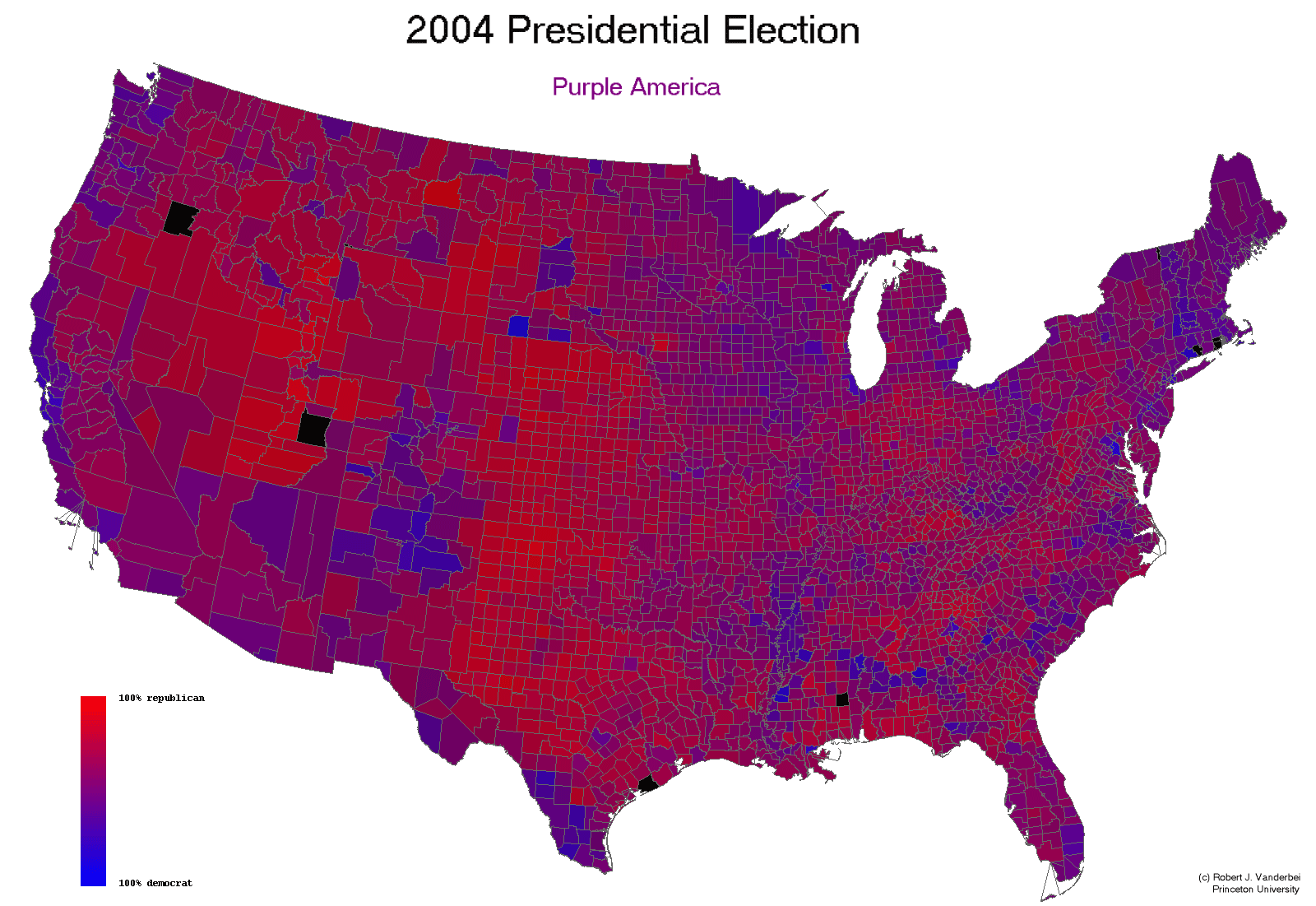
No Mandate?
There's been a bunch of talk about how Bush "only" won 51% of the vote, compared to Kerry's 48%. And although Bush won more votes than any president in history, Kerry did win more votes than Reagan did in his first term. So, the argument goes, one cannot build a mandate off only 3.5 million voters, or, heck, off some 70,000 voters in Ohio.
One is also pressed to delicately remind "no mandaters" that Clinton's first term saw more Republican and Reform voters arrayed against him than voters that were for him. How many more voters voted for someone other than Clinton? 13,936,923. But let's call it fourteen million even. Fifty-seven percent of the country didn't want Clinton. In 1994, of course, it was clear Clinton didn't have a mandate. Even the 1996 election saw Clinton winning only by 118,200 votes (over the Republican/Reform aggregate). A plurality of 0.1%. Yes, a tenth of one percent. Anywho . . .
Much, of course, has been made of the "moral values" voters and evangelicals who turned out to support Bush and give him his clear and decisive election victory. I, myself, have made much of these facts.
But before we dismiss Bush as not having a mandate, let's take another look at those voter demographics.
More than a third (almost two-fifths) of union members, thirty-eight percent, supported Bush. Nearly a fourth (23%) of gays, lesbians and bisexuals voted Bush. Almost half of independents (47%) pulled the lever for Bush. Although just a bit more than a tenth of blacks voted for Bush, Bush increased his support among blacks by two percent from 2000. More than two-fifths (42%) of Hispanics voted for Bush, an increase of seven percent (I think). And Asians were right along with Hispanics at 41%.
And the youth vote? Well, despite the fact that millions more youth were registered by entertainment stars, they remained the same percentage as 2000. Of course, this was a numerical increase, since voter turnout was huge this year. But of those new voters, 44%, voted Bush. Yes, the majority broke Kerry's way, but the youth vote is not the huge Democratic vote cache everyone thought they were. Indeed, except for the youth vote, all age groups preferred Bush over Kerry.
As I've said, much has been made over the evangelicals and Catholics who gave Bush the victory, but those who only occasionally attended religious services voted Bush to the tune of 46%, and even those who never went to religious services voted just more than a third (34%) for Bush.
Given that Bush was able to draw into his electoral tent not only the greater number of voters, but also a vast and diverse coalition of voters--which transcends the blue/red divide--it seems more than reasonable to conclude Bush has a mandate.
November 07, 2004
Moral Values and the Battle Over Who are the Bigger Hypocrites
I've calmed down a bit from Saturday's "proud red stater" rant, but not much. So if some irony, sarcasm and snippiness come through, well, you've been warned. Stop now or you may get offended by reading further.
First reactions to the elections and the ascendancy of "moral values" into this year's campaign had mainly to do with pegging red staters with ignorance and certain phobias, homophobia playing the loudest tune, but xenophobia and misogyny were close behind. As the internet continues to get "hetted up" over the election, it seems now reactions are turning to accusations that red staters are just a bunch of hate-filled hypocrites. They cry "moral values" and "traditional marriage" but have just as high divorce rates as blue staters (or, heck, some blue states have lower divorce rates!). And for all their advocacy of the unborn, them red staters sure do like to drop bombs on people, kill criminals, and otherwise ignore the poor.
Give me a break.
I'll get to the hypocrisy equalizer in a moment. But let's take a look at these blue staters. These folks crying red state hypocrisy are the same folks who blather on and on about women's reproductive rights, but last time I checked, every woman still had a right to reproduce or not, as she sees fit. In fact, as one commentator noted, anyone who tries to force a woman to reproduce will get his butt landed in jail darn quick. And God forbid any parent try to keep their underage daughter from reproducing--there are a ton of government subsidized agencies that will help her accomplish her reproductive activities outside of parental consent. Oops. Did I say reproductive activies? Well, yes, I did. But that's the hypocrisy: blue staters don't want to women to have the right to reproduce. Nope. They want women to have the right to engage in any and all sexual activities they desire--without the consequences. Reproductive rights? Hardly. The right to kill off any consequences of consensual activity, that's what they want.
And blue staters are so tagged with care for and outreach to the poor. But as we all know one of the primary ways for the poor to escape the rigid cycle of poverty is to get a good education. And here's where blue staters balk: don't you dare take kids out of worthless, underperforming, overfunded inner city schools. Heavens, what would happen to all the overpaid administrators of those schools? Er, I mean, what would happen to all the teachers we don't really care about because we won't eliminate duplicate administration and non-school union jobs to free up funds to give them a raise? Er, I mean, what would happen to all those students? What would happen, you ask? They would go to schools that do perform and get an education that will at least give them the chance to break the cycle of poverty in their own lives.
These blue staters are starting to get rid of that "deer-in-the-headlights" look they took on when "moral values" burst on the election scene. Why, they crow, we have values, too. We value diversity, plurality, freedom, and so on. Indeed, those blue staters do. They value all opinions and religious beliefs--except Christian ones. Schools have mandated the saying of Muslim prayers and reading of Islamic literature, and the wearing of Muslim dress in classes devoted to studying other groups. Try to do that with Christianity . . . Uh, well, never mind. Yes, blue staters value morals and values, just not those exclusivist, rigid and homophobic Christian ones. I mean, Christians actually believe their faith should have a role in the public square? Can you believe that? What rubes. Maybe all those blue staters have lower divorce rates because fewer of their people would dare to submit to as outdated and backward a ritual as a "Christian wedding ceremony" so they don't get married, and therefore don't get divorced. After all, who needs a piece of paper and a minister to authenticate a couple's love, right? More to the point, if traditional marriage is such a means of oppression to women and is nullified by rampant divorce, why do blue staters want it for gays and lesbians?
Yes, yes, see--two can play the hypocrisy game. And that's my point: blue staters and red staters have equal numbers of hypocrites, they're just hypocritical about different things. No, the proof is in the pudding. What actually are the moral values red staters and blue staters hold? And do those beliefs hold up to reasonable inquiry? And when those beliefs do get lived consistently--and red staters and blue staters do exist who live their respective moral values consistently--what are the consequences and results? Those are the questions that need to be asked.
November 06, 2004
Proud Red Stater
Color me a little cranky, but the backhanded bitch-slapping the anti-Bush left is handing out to all the red staters and Bush supporters is getting under my skin. We red staters apparently are ignorant, inbred homophobes who sit around dreaming up ever new ways to subjugate women and drown puppies. We red staters are told it is we, not the ever-tolerant leftward media and academics, who are dividing America with our fundamentalist cretinism. Well, in the words of one former First Lady candidate, "Shove it."
I've lived most of my life in red state land. My grandfather was a farmer. My dad works in the oil industry. My mom didn't get her college degree till we kids had left the home, but by the time I was five, she had already run a successful business, working full-time, and raised us kids while my dad worked shift work. When our families gathered at holidays, we didn't discuss the newest intellectual idea that had come down the academic pike, we didn't get all giddy over some new fashion accessory, and we never gave a thought about which posh social club we should frequent.
My grandmother didn't worry too much about any equal rights amendment or fret over whether or not her pay was equal to any man working the same job. You see, she made as much as my grandfather, which meant, they both made whatever could be brought in from harvest and livestock sales. With my dad and his siblings grown, she did work part-time at a dentist's office in town, but she was a farmer's wife. She had equal say in the discipline, because you just couldn't run out and pull grandpa off the tractor to settle some sibling dispute. She had equal pay, because it all went to the same account at the bank. And though grandpa was a strong stubborn cuss, he also only had one arm and a stump, one of his arms having been torn off in a cutter when my dad was young. Self-reliant as he was, he depended on my grandma for a lot.
Now I'll grant you, I was, and still am, a city kid, a townie. And more so now that I'm living in Chicago. My grandfather might well scratch his head, were he still living, wondering what the heck I want to go and waste my life chasing after the ideas of dead men. There are times I wonder myself. You see nerdy academics like me don't grow food, or build houses, or manufacture clothing. But that food doesn't magically appear in a refrigerated semi on its own. Sure, small famers like my grandfather was are a dying breed, if not already all but dead. They've been replaced by larger industrial farms. But you get right down to it, it's still farmers in red states that put food on all our tables.
Blue staters have the luxury of living off the toil and hard work of red state farmers. They bitch and moan about the cost of a head of lettuce, but little realize that the increase in price almost never makes it back to the farmer, who lives on precious little with machine and land debt all but crushing him if he doesn't move fast enough to stay ahead of it. Blue staters have the luxury of letting others serve in the military and keep them safe. Who makes up our military? Largely poor and middle class red staters. Talk all you want about the dozen or so who were involved in the Abu Ghraib scandal, there are hundreds of thousands more like my cousin Justin who serve with honor, dignity and pride to keep madmen like Hussein, Zarqawi and bin Laden from accomplishing their satanic ends.
Blue staters have the luxury of living lives of fantasy, thinking they'll never have to worry about having food to buy at the grocery store, overpriced clothing to buy at the mall, and endless rubbish of entertainment poured into their skulls as they try to escape the tedium of daily life. They have the luxury to say all sorts of insane crap--witness all the puppy-drowning screeds that are some of the sorriest excuses for First Amendment rights, and attempt to foment all sorts of inhuman practices--such as abortion, on the red staters. They have that luxury because, in large part, red staters provide the basic goods and civil defense that blue staters take for granted.
Blue staters want us red state folks to believe that we're too stupid to have a thought of our own, but can only blindly follow our preachers, Karl Rove or our Amway directs. But if I'm not mistaken, these are the same folks who were supposed to listen to entertainment gurus who've never studied politics, don't know anything about foreign policy other than what their own media tells them, and are deadly afraid that Europe won't like us any more. Independent thinking? Sure. If you say so.
But the thing that grates me the most is the snobbish hypocrisy of these blue state rants. Preaching tolerance and diversity, they prove themselves to be little more than intolerant and exclusive. More fundamentalist than any holy roller preacher, they are doing little else but projecting on others their true inner selves. And ignorant? They wouldn't know a red state if it jumped up and slapped the planes they use to skip over the vast desert expanse of "flyover country."
Blue staters get to live their blue state fantasy lives at the expense of the good name and character of red state folks like my late grandfather. So be it. Red staters are too busy living real life to much care. Our red state men may not have extra letters after their names, our women may not work "real jobs," but red state life is a hell of a lot more real than blue state fantasy. I'm a red stater. Deal with it.
November 05, 2004
The Issue That Tipped the Election
The day after the election, the talking heads were dumbfounded. The issue that tipped the election in George Bush's favor wasn't the war on terror. That was the third place issue. Bush did prevail on that matter, to the tune of 86% to 14%. It was no surprise that the economy was a major issue, but it come in at second place, just one point above terrorism. It was no surprise that this was Kerry's issue. On the economy, Kerry prevailed over Bush 80% to 18%. Healthcare and education were also Kerry winners, but they were way down the list at fifth and seventh place respectively.
No, the issue which caused Bush to prevail was "moral values." On moral values, Bush prevailed 79% to 18%. Given that married men and women as a group, preferred Bush 56% to 43%, and that those who attended religious services weekly preferred Bush 60% to 39%, and that Bush not only has never been shy about his own religious experience and has actively courted religious citizens, it is no wonder that Bush was propelled into a second term by voters who listed their top concern of the election "moral values."
But how to read this? What are the "moral values" that voters were concerned about? In what way did these nebulous "moral values" move voters to prefer Bush over Kerry by such margins that these voters decided the election? And why were the media pundits caught with "deer-in-the-headlight" expressions Thursday morning?
In looking at the election in broad terms, one notices that eleven states had voter referenda on the issue of gay marriage. Eleven states voted by overwhelming margins to ban gay marriage in their states, some of the states voting these bans into their state constitutions. One also notices the timing of Chief Justice William Rehnquist's critical bout with cancer. News of this broke mere days before the election. It seems clear that at least two of the issues comprising the amorphous term "moral values" had to do with issues of marriage and the makeup of the Supreme Court, and the latter issue comprises issues surrounding marriage, abortion and religious freedoms.
In other words, it seems clear to me that the moral values to which these exit polls refer are these: the upholding and support of traditional structures of marriage, the fight for the life and rights of the unborn, and the fight against judicial suppression of the freedom of religious expression. In the last several months, all these "moral value" issues have played out in our nation: the passage of the partial birth abortion ban and its subsequent annulment by the courts, the fight to remove the phrase "under God" in the Pledge of Allegiance, and the forcing by judicial fiat of gay marriage on a populace that doesn't approve of it. The moral values of life, marriage, and freedom of religion, it seems to me, were the keys to Bush's reelection.
Life issues encompass the various matters related to the beginnings and endings of life: advocating for the rights of the unborn, prohibiting embryonic stem cell research, and resisting euthanasia. Life issues did not encompass support for abortion-on-demand and a woman's right to choose it, because those who advocate for that in large part cast their votes for Kerry.
Another of the moral values these voters found to be important enough to put Bush back in office was the upholding and protection of traditional marriage and family. Although Bush supporters may have been disappointed with their president that he did not fight for the marriage amendment to the Constitution as he seemed to indicate he would, it's not as though Bush hadn't done anything else for traditional families, not the least of which was tax relief. These moral issues voters, though, put the country and Bush on notice: marriage is only between a man and woman. Period.
But moral issues voters also know that these twin concerns are being attacked by judges who are intent on pushing not merely a secular values system on the nation, but an anti-religious one. I am absolutely certain that Rehnquist's health was one of the major catalysts for getting out the moral issues voters. This was their wakeup call. If they wanted to entertain any hope of seeing the values they live their lives by protected, they needed a president in office who had pledged to appoint judges who interpreted the Constitution strictly.
It's not as though the rest of the country didn't vote their values, or that they don't have any. But clearly, their values differ from the moral values voters either in content or in importance. I have friends who are pro-life but anti-Iraq-war. Some of them may well have pulled the lever for Kerry. Why? Did they not really believe in supporting the unborn? No. They had to prioritize their values, and when it came to voting, they put their war concerns over concerns about abortion. It's not as though moral values voters are the only ones who believe in traditional marriage, but there are voters who believe traditional marriage is the norm yet still pulled the lever for Kerry. Why? They prioritized a different value over their valuing of traditional marriage. Maybe that value was a libertarian tolerance of different moral values. Maybe that value was civil rights. Who knows.
The point though is this: moral values voters decided, when push came to shove, they were going to place their moral values as the priority upon which to vote. And in that, they showed the single moral value which differentiates them from the rest of the nation: moral values come before anything else.
And that last is why the rest of the nation, and the so-called "liberal media elite," had such expressions of utter bewilderment. They have moral values, too, different though they may be on some of these issues. But their moral values are ranked differently. And one of those rankings put moral values themselves further down the list than other concerns.
In other words, it's not merely the content of the moral values that differed, but rather the value of moral values themselves. Those who ranked moral values as central to this election not only outnumber those who didn't, they also rank moral values--of protecting the life of the unborn, of promoting and supporting traditional marriage and family, of valuing and protecting religious expression inthe public square--as central to life. And that, that, is the issue that tipped this election.
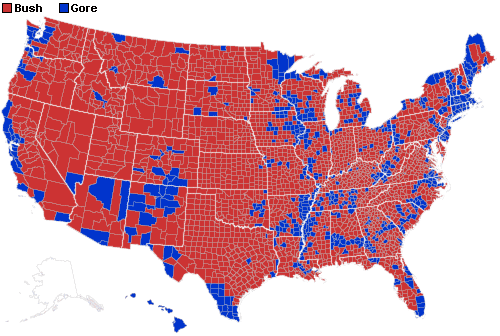
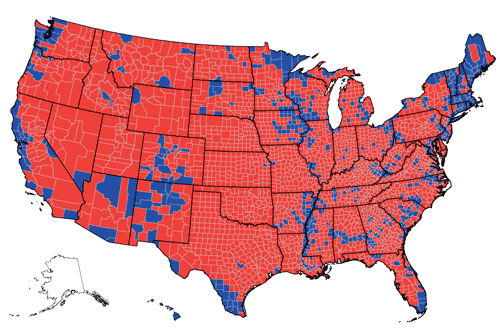
November 04, 2004
Religion Front and Center
In the USA Today online article "Election reinforces USA's religious schism" it's noted that:
Exit polls conducted for The Associated Press and television networks by Edison Media Research/Mitofsky International showed clearly that the president draws much of his support from religious people:
* The president had the support of 78% of white evangelicals, 23% of the voters.
* Bush won 52% of the Roman Catholic vote on Tuesday, and got the support of 56% of white Catholics, defeating the first Catholic presidential candidate from a major party since John F. Kennedy. In 2000, Bush narrowly lost the Catholic vote.
* Bush was favored by 61% of people from all faiths who attend services weekly; they made up 41% of the electorate. Democrat John Kerry drew 62% of Americans who never attend worship, but they only accounted for 14% of voters.
* When respondents were asked to pick the one issue that mattered most in choosing a president, "moral values" ranked first at 22%, surpassing the economy (20 percent), terrorism (19 percent) and Iraq (15 percent).
Gay marriage bans were handily approved in all 11 states that held referendums, and analysts said that issue drove up turnout. "This was a high stakes election for those who support traditional moral values," said Geoffrey Layman, a University of Maryland political scientist.
We are a religious nation, and a nation that is mostly traditional in its moral values. We're all going to have to get used to this reality. For too long we've lived in a delusional fantasy world which discounted the impact of religious faith. Tuesday, 2 November, was our wakeup call.
Good morning, real world.
Election Analysis
Taking a look at the demographics of the vote reveals some important, and disturbing, trends.
In terms of party affiliation, Democrats and Republicans both stuck by their parties. But the Republicans were marginally more loyal. Democrats brought home 89% of their base, Republicans brought home 93%.
Minorities still break decisively for Democrats: 89% of blacks, 55% of Hispanics and 59% of Asians. Whites break 57% for Republicans. Race still divides us, but why this is the case may not be clear. Is it part of the deep cultural structures in America? Do the Democrats exacerbate the divisions toward their own political ends? Are Republicans, without whose support and efforts, there would have been no civil rights act, now carelessly ignorant of the issues of race?
Those who graduated high school and had some college or were college graduates tended to be Republican, though all the margins were close. Those who did not graduate high school barely tipped Democrat, but those who had post graduate work were the biggest Democratic margin (55% to 43%).
While it's true that women went Democrat by a margin of 52% to 45%, and men went Republican by a margin of 54% to 45%, that doesn't tell the whole story. Married men and women went Republican (59% and 54% respectively) with wide margins. Marrieds generally went Republican by a margin of 56% to 43%. Singles went Democrat 59% to 37%, with single men going Democrat to the tune of 53% and unmarried women by 63%. So the gender gap wasn't so simple as it looked: it depended more on marital status than on gender.
Union members (61%), gays and lesbians (77%), and political independents went Democrat, though the political independents were only marginally more Republican at 50% to 47%. White evangelicals broke decisively Republican at 77%.
In terms of religion, the Republican party garnered 60% of the vote of those who attended religious services weekly, while those who only occasionally or never attended services went Democrat by 53% and 64% respectively.
With all that in mind, then, it's not surprising that the single most important issue on voters minds this year was moral values at 22%, followed closely by the economy and jobs (20%) and terrorism (19%). Of those who listed moral values as the top concern, 79% went Republican, while those who ranked the economy and jobs first went Democrat to the tune of 80%.
In other words, the lines of division in this country run clearly in conformity with moral and religious values and race. The Democrats clearly appeal to unmarrieds, the nonreligious, and those with secular values, as well as minority voters. The Republicans clearly draw in marrieds, the religious and those of conservative and/or traditional values, as well as whites.
The religious and racial divisions in our country are real and troublesome. But they are made only more so in that they align with the political divide in this country as well. Political, religious and racial divisions line up almost perfectly, and it is this, not any single candidate, which is the source of our country's division.
November 03, 2004
Further Reflections on President Bush's Reelection
Old media? CBS, NBC, ABC, CNN, New York Times. Done. Stick a fork in 'em.
The new media? Bloggers, World Net Daily, Drudge, conservative talk radio. Kings of the world.
Exit polls. Confirmed useless for the second straight presidential election. Get rid of 'em.
Democrats? Done for. Can they be resurrected? Only if they give up attack politics as their primary message. Gotta be for something, not just agin' it.
Third parties? Irrelevant. But how I wish they weren't.
Republicans? Learning to govern while in power. Have had mixed reviews these past couple of years. They now have more solid control. They's better do somethin' wid it.
Social and political liberals? Fangs pulled. Control diminished. Their agenda may well finally be slowed for a while.
Social and political conservatives? Justly proud of their accomplishments. Endouraged. Have new opportunities. But what will they do with it?
Zogby International polling company? No longer the wunderkind.
Mason-Dixon Polling and Research? Dead on. The king is dead. Long live the king.
The times they are a-changin'.
Thank God Ohio was no Florida 2000. We waited a few extra hours. Democracy works.
My Initial Reflections on President Bush's Reelection
It doesn't look good for Kerry-Edwards. With 100% of precincts reporting in Ohio, Bush has a 130,566 vote lead. Those in the know estimate that there are 175,000 provisional ballots. For Kerry to legitimately win Ohio, seventy-five percent of those ballots would have to prove legitimate and all of those seventy-five percent would have to break for Kerry. Not 74%, not 73%, but 75%. If 90% of the ballots prove legitimate, Kerry would have to gain 83% of those ballots to prevail over Bush.
No matter how you slice it, it's a tall order.
So, assuming that the present reality--Bush wins the popular vote by 51% and by more votes than any other president in history (even Reagan), and wins the electoral college 286-252--hold through today and the next few days, what does that mean?
First of all, the war on terror trumped healthcare and the economy, although the present economy is not only not terrible, it's very, very decent. Many of those who voted Bush back in precisely because of the war very significantly disagreed with many of the particulars of that war, but also agreed that his principles and convictions about the war are right.
But what commentators are only now beginning to realize is that moral issues swung this election in Bush's direction. Life and marriage issues clearly gave the president the victory. In all the states where bans on gay marriage were up for vote and won, they won by crushingly clear mandates. The voters said clearly: marriage is between a man and a woman. Bush's pro-life stance also clearly connected with voters.
One thing the commentators will have to come to terms with, though, is that it was not just the "evangelical Christians" who put this in the win column for Bush, but Roman Catholics and Orthodox and Anglo-Catholics as well. As populous as evangelicals are (and what an amorphous term "evangelical" is!), they could not have won so decisively as they did without Roman Catholics and Orthodox and Anglo-Catholics who take seriously the Church's moral doctrines.
In addition, this election was the coastal and upper Midwest liberals (to oversimplify a bit) versus the exurban/suburban and rural conservatives. The three states which are home to the three largest cities in American (Illinois/Chicago, New York/New York, California/Los Angeles) which would almost assuredly give the liberals a popular vote advantage were counterbalanced by "flyover" country. In this election the moral values and commonsense assessment of foreign policy of the "flyovers" won out over the urban "liberals." Flyovers said, "We don't want your moral picture to be our reality, and we prefer a president who is clear in his convictions on terrorism even if we don't always like the way he fights it."
October 29, 2004
Is Abortion Worse than an Unjust War? How to Think About Voting
For Christians who have the Ballot Box Blues--vote against abortion (for Bush) or against war (for Kerry), or, for some, avoid voting for the greater evil--Professor J. Budziszewski clarifies it for us.
October 18, 2004
The Election Debates in Terms of Viewership
The viewership for the presidential debates this year was nothing short of phenomenal: Between all three debates more than 157 million people watched the presidential debates; throw in the vice presidential debate and you have more than 200 million viewers.
First Presidential Debate: 62.5 million (46.6 million for Bush v. Gore 2000 first debate)
Vice Presidential Debate: 43.6 million (28.5 million for Cheney v. Lieberman 2000 Debate)
Second Presidential Debate: 46.7 million--and this was a Friday night! (37.6 million for Bush v. Gore 2000 second debate)
Third Presidential Debate: 51 million (37.7 million for Bush v. Gore 2000 third debate)
Clearly people understand the importance, from a human perspective, of this election.
October 14, 2004
The "Debate" III
The watching of this debate was made much more enjoyable by the gracious presence of my liberal friend, Tripp, and my Democratic friend, Justin. Anna missed most of the debate because she had a meeting with fellow children's book writers and illustrators in Wilmette. That left me car-less at home with Sofie. And Tripp and Justin decided to crash the party. I'm glad they did.
Well, you'll notice the quotation marks went back up in the post title. Geez. Back to talking points. Back to scripts. Back to little actual exchange. All the debates should have been townhall meeting style.
Kerry remained consistent both in his debating ability and in his dogged determination to not say anything new. One mercy: we only heard "I have a plan" a few times. His debate coach must have threatened to take away his snowboard if he said it more than five times. "Senator Kerry!" "Reporting for duty, sir!" "How many times did you say you had a plan?" "Seven times, sir!" "Drop and give me twenty!" "Sir, yes, sir!" If it's losing ground in a debate to go back and answer a previous question or respond to a previous attack, then Kerry, though consistent, wasn't as good as in the first debate, though he was a bit better than the second. Still, it was all rerun. Nothing knew. He did get the Soprano soundbyte in, but I don't think it will play that well, since it's a bit too-cliched and doesn't speak to any specific thing.
Bush was definitely better in this debate than the first, and, having thought about it, was better in style than the second debate. I still think Bush was better in substance in debate two, but in this third debate he was not only self-possessed (style), he had the facts and figures and direct responses to Kerry he couldn't seem to must in debate one. And Bush definitely landed more substantive soundbytes. They were both memborable and specific. My favorite: "A plan is not a litany of complaints. And a plan is not to lay out programs you can't pay for." Unfortunately, his coaching on job questions was blindingly evident: "Don't talk about jobs, talk about education." I thought that this, though a valid point to make, was a big loss of opportunity for Bush. The actual economic figures are robust and good, despite some areas of concern. Unemployment is the lowest it's been in some time even if the jobs being created are not as many in bulk as in other fiscal periods. Further, I think Bush should have touted the mistaken basis for the jobloss claim: the report only focuses on employer payroll, it doesn't focus on entrepeneurial job creation (small-business, and home-based work). I don't have actual figures to hand, but these numbers are solid. And these numbers play to the middle class where the jobless numbers have hit.
Be that as it may, neither candidate did as well as in the two previous debates. Kerry was best in debate one; Bush in debate two. Last night, Kerry looked tired, almost as if even he no longer believed he had "the plan." Bush looked invigorated and controlled, but missed some opportunities to tamp down Kerry. But given that the DNC was saying Kerry would mop the floor with Bush . . . um, I'm going to have to dock Kerry points. Bush did better than expected, but not as well as hoped.
Immediately after the debate, my gut instinct was to say that Kerry had won the debate. Tripp didn't think so. I can't remember whether Justin voiced his opinion on the winner, but I would guess he would argue for a Kerry win. After thinking about it, I wondered if last night wasn't a draw.
But then I got to thinking in terms of perception. Bush got schelacked in the first debate. Then came back and gave what for in debate two. Last night was Kerry's to end with on a dominant note and in his supposedly stronger area. It was his to end with: leave the American people with an image that could counter the coming attacks and could build a lead in the polls. I don't think he did that. I think the game stayed even, which leaves the Bush team openings for more hammering. I may be wrong in this, but I don't think Kerry will build a solid gain and maintain a lead out of this. He may get a little bump, as he did after the first debate. But that bump returned to the status quo fairly quickly. And the remaining three weeks is a long time.
So, with these additional considerations in mind . . . 2004 Presidential Debates: Kerry 1, Bush 2. See you at the polls on 2 Nov.
October 09, 2004
The Debate II
The sickness continues. Anna and I watched the second installment of the presidential debates. This time, there was some actual direct exchange (thus the elimination of the quotes in the title) between the candidates, though it still fell short of an actual debate.
Everyone was playing the expectation game: giving low expectations for Kerry, high expectations for Bush; that for Bush this was a "make or break" moment; and other sorts of hooha. And the spin afterwards was a bunch of deep doodoo. I watched NBC and the ex-Mrs. Prez was so over the top it was mindboggling. I'm sure Kerry supporters thought he won the debate, but Ms. Clinton was so unequivocal in her view that Kerry dominated (her word) the debate, one wonders if she's gone off her meds. That being said, it's clear that not even Sen. Clinton believed her own blathering. Her delivery of her evaluation of the debate was flat and lifeless. She seemed rather bored.
Now Kerry did land a few good ones, particularly on domestic policy, assertions that Bush did not directly respond to: the funding of the No Child Left Behind Act, the loss of health care for many millions, the net job loss during this administration thus far, and so forth. But he also did little more than repeat the same old mantras from last Thursday. Cheney had put to rest the notion of $200 billion for Iraq on Tuesday night, but there Kerry was mindlessing putting it out there again. Last presidential debate, the more Bush talked about how hard the work is, I wanted to throw things at the TV. Last night, the more Kerry said "I have a plan" I wanted to throw the TV out the window. Enough with "the plan" already, Senator. What the frick-frack is your plan? Oh, sure, I know he has a website we can all go to, but he should give us one or two examples. Bush did (note to self: when your opponent is giving details of your own plan, it's not a good thing). Kerry said Bush was mistaken on those details, but then never gave the actual details.
In short, through the whole debate Kerry was reduced to merely saying, "No, what President Bush told you was just wrong," but then instead of explaining why, he went on to say what Bush has been doing is bad and dangerous. In other words, Kerry came off as a big and empty windbag last night--nothing to offer us voters out here anything more than "Bush is bad and I can do better." I guess we just have to take it on faith, because Kerry has given us no reason to believe that his claim (and so far it's little more than that) is actually anything more than mere rhetoric.
As much as Bush sucked last week, last night Bush kicked some political butt. Some of it was show, I know. The springing from the chair--gotta show how energetic and "fired up" he was, donchaknow--the talking over Mr. Gibson at one point so as to respond to one of Kerry's criticisms--gotta show how he's the leader and in control even in the debate--all of that I'm fairly certain was staged. But in point of fact, President Bush had his facts and landed some charges that Kerry just couldn't respond to: how to cover the gap between the revenue Kerry would raise by taxing only the rich, and the full cost of Kerry's proposed budget (a difference, said Bush, of hundreds of billions of dollars); how you create an alliance when you call the world "coerced and bribed" and your enterprise a big mistake (and France and Germany have pointedly said they ain't sending anybody to Iraq); how you can be for our troops, but not vote to give them money for equipment (Kerry was reduced to saying "I said it badly." Huh?); and how Kerry nor Edwards, who claim to be for tort reform, never showed up for a vote on tort reform. And the one on the gap between Kerry's proposed budget and his tax-only-the-rich revenue, this came after Kerry's hokey look-in-the-camera and promise of "no-new-taxes" (hmmmm, I seem to remember another Bush doing something like that; didn't work for him either). Bush did a masterful job of calling up Kerry's record to counter some of the very promises Kerry has been making with regard to health care, taxes, and so forth. Last time it was Bush who was caught flatfooted. Last nght Kerry just came off as the professional politician with nothing meaningful to say.
Yes, they both hit their talking points. It was frustrating to hear them not respond to questions. But such is the nature of the game. Contrary to last time, no one sucked last night.
But still the clear winner was President Bush. 2004 Presidential Debates: Kerry 1, Bush 1. Here's to next Thursday.
One last thought, and this one's pretty subjective, I admit. Still, I think it's pretty indicative. If you watched the candidates greeting the crowd last night, there was a very marked and noticeable difference in how the audience received them. Kerry received polite, and surely heartfelt, applause, and people came up to him to get pictures taken, signatures, and so on. (Although both Anna and I noticed one gentlemen pointedly refusing to shake Kerry's hand.)
But Bush . . . Bush was like a rock star. The applause was hearty and enthusiastic. People rushed to him to shake his hand and get him to pose with them in pictures. It was a clear and telling difference: people love Bush the man, even when they disagree with his policies.
A final and side note: Doesn't the billionaire heiress Ms. Heinz Kerry have more than one presidential debate outfit? It sure looked like the senator's wife was wearing the same frock as a week ago. Maybe it's just me. Then again, at least the candidates wives' didn't look last night like they'd forgotten to call one another and coordinate their outfits. (What was with the matching white outfits last week?)
October 06, 2004
Political Pet Peeve #71
Edwards invoked the Democratic mantra last night during the veep debate: "The president said that he would unite this country, that he was a uniter, not a divider. Have you ever seen America more divided? Have you ever seen Washington more divided?"
Of course, this is the same Edwards that said, "I'd say if you live in the United States of America and you vote for George Bush, you've lost your mind."
But never mind, that's not divisive.
Really, though, this whole blather about "dividing," well it plays well on Oprah, and we can all gather round the campfire and sing "Kum By Ya" and feel all united and stuff, but unity ain't all what it's cracked up to be. A herd of swine going over a cliff are united, but they're also going to their destruction.
Furthermore, this whole "the President must be a uniter" is just plain bovine scatology.
First of all, it fails to acknowledge that the American electorate are free moral agents. The way you'd hear some folks tell it, so long as the president rings the divider bell, we Pavlovian dogs out here can do nothing else but snarl and snap at one another. Puh-leeeze. No, fact of the matter is, whatever rhetoric and polemic any politician or party utilizes, we don't either have to swallow it or allow it to stir up our emotion or dictate our actions.
Secondly, the cause of division in our society is not uniquely located in the office of the president, the person of George W. Bush, or any other external thing. Oh, how we would like it to be. It would sure make it easier for us. We could pass the blame off on someone or something else, and not give it another thought. But fact of the matter is, the principle of division in this country is located right there deep inside of us in the passions and behaviors we refuse to acknowledge, address, and repent of. That we allow political figures and their rhetoric to exacerbate the evil we already coddle and nurse within us is to our shame and condemnation.
No, folks, President Bush could be evil incarnate (and some of you think he is), but the one who is dividing this country is you. And me.
God forgive us and have mercy.
The Veep Debate: John Edwards Sez "[spank]Thank You, Sir! May I Have Another?[/spank]"
Thanks to the wondrous technology we have today, I've been able to watch the entire veep debate on my computer. Thanks be to God.
Let's get down to business: Dr. Evil Cheney ate Forrest Gump Edwards' lunch, spit it back out, and stomped up and down on it. Then for good measure, made Edwards eat it. With a large spoon. A silver one.
Now, no one really thought Cheney would perform badly. The only question was whether Edwards would do very well. My take on Cheney: absolutely awesome on substance. He corrected Edwards' manipulation of the "facts." I loved the exchange over including Iraqi deaths in the figures of the war. His refusal to do more than thank Edwards for his kind words about his love for his gay daughter was masterful. Cheney outlined the administration policy, let Edwards compliment him, then let the senator blather on and on about something, I'm not sure what it was. The contrast between the adult and the kid was palpable.
And I'm not really all that enamored of Cheney the man. But damn! He was good.
The other half of the Perfect Hair Ticket had his trademark pearly white teeth--can you believe that cheesy game show facing of the camera when he was introduced and flashing (no, really, flashing) his grin? I felt like I was watching reruns of the Match Game. Despite his best efforts, Edwards was little more than like that cartoon dog on the Bugs Bunny show, jumping up and down and yapping at the bulldog. To which the bulldog repititiously replies, "Awwww, shuddup!" Edwards did get better on domestic issues, but couldn't successfully land his attacks on jobs and health care. His trial lawyer background did him well in terms of presentation, but it was once again a failure of substance. And this time, a failure of style, too.
A note on Ms. Ifill. Her colleague, Lehrer, did a much better job of moderating without inserting his personal views. So many of the Ifill questions were more instances of pontifications than they were of actual interrogatories, that it was remarkable Edwards couldn't perform better than he did.
The veep debate for 2004: Advantage Cheney.
On to the next presidential debate on Friday.
September 10, 2004
An Incautious Attempt at Political Analysis
In an earlier post, I was sincerely and most conscientiously attempting to avoid the overtly political, and the consequences of/responses to that post showed most clearly my failure to do so. In this post, therefore, I am most sincerely and most conscientiously attempting to speak directly of the political and give most concretely my individual opinion.
Here it is: What are the Kerry campaign, the Democrats, and their allies thinking?
Kerry and Co. got schlocked by the anti-Kerry Swift Boat 527 in July and August, despite Kerry's almost obsessive focus on his military war record, which was most vividly on display at the DNC in June. [Bush had been getting his own schellacking from all the anti-Bush/Democratic 527s like MoveOn.org, the Media Fund (Harold Ickes' group), America Coming Together (the Rosenthal-led Soros-Lewis group).] Almost every pundit and Democratic strategist and their dog told Kerry to get the frick-frack away from Vietnam. Get back to the issues of the economy, health care, and Social Security. Indeed, there was that much-touted leak of the 90-minute Clinton-Kerry phone call giving essentially the same advice.
So what happens? This week we return to Vietnam and revisit (for the latest of several go-'rounds) Bush's National Guard service. This seems very much like a losing strategy. It didn't keep Bush out of the governor's office (or boot him out of it), nor did it keep him from the Oval Office. But maybe third-time's-the-charm? I don't know.
But aside from the questionable strategy, now the thing has absolutely blown up in their faces: there is significant doubt about the documents alleging some sort of malfeasance in the Bush camp vis-a-vis his National Guard duty. There's recanted sworn testimony and allegedly forged documents. Everyone and their dog is backing away from these documents. Not only is Bush's service now no longer in the spotlight, the story itself is a story. This may well be one of the most devastating blows to attacks on Bush's military service: the credibility factor for every subsequent attack will now be front-and-center. Instead of the attack getting the focus, the bona fides of the attack will garner the scrutiny.
But if this isn't bad enough, next week the infamous Kitty Kelly, mudraking biographer, will reportedly be spending three days--three days!--on the Today show alone. If I were John Kerry and the Democrats, why in the name of all that's rational would I remotely think of aligning myself with the attacks of a disreputable author?
If I may venture a prediction here? These two weeks will have done more to undermine the credibility of anti-Bush attacks than anything the Bush folks themselves could have cooked up. In short, barring some unforeseen, previously unknown, fatally egregious and one hundred percent verifiable Bush foul-up (past or present), the anti-Bush crowd has done more to protect President Bush from criticism--to in effect, coat him with Teflon--than anything the pro-Bushies could have ever hoped to have done in their most wild imaginations.
How does Kerry "recover" from this? It's hard to say. At the end of next week, there will be only six weeks till the election. That can be an eternity, in some respects, but it is also a very, very short time. Kerry needs to finally listen to his handlers and advisers: Get off the war and get on the issues! Granted, the economy has solidified, according to the Fed Chairman, and the polling seems to suggest that the electorate is responding favorably if not overwhelmingly so to Bush's policies on Social Security and health care. But the military thing is a proven albatross around the neck. And ultimately, the issues are the only things voters really want to know.
What does Kerry stand for, in policy terms, on the economy, health care and Social Security? I know he has a platform, but no one knows what it is. And that's my point. All we know is that he served in Vietnam. We haven't heard a thing about his service in the Senate. If "Give-'em-Zell" Miller got it all wrong during the RNC, we wouldn't know it, because Kerry and Co. hasn't shown us how it was wrong.
Like Bush or no, at least one has the ability to disagree with him: we know that Bush holds to military pre-emption, we know his stance on faith-based social programs, his stance on marriage, abortion and stem cell research, what he wants to do with Social Security, what he's done with Medicare, etc. Why doesn't Kerry run on his record rather than his Vietnam service? I can understand that in the beginning he might want to emphasize his military record as a counterfoil to Bush and the war in Iraq. But it is a proven losing strategy. It's time to say clearly what he's for and how that differs from Bush.
It's one thing to run on anti-Bush sentiment. But that can only take a candidate so far. Eventually people are going to want to know not what you're against (Bush in the White House) but what you're for (_________?).
There. There's my overt politickin' for now.
September 02, 2004
This, Dear Readers, Is Highest Praise
Conservative Democrat, Zell Miller, gave President Bush the highest praise:
I first got to know George Bush when we served as governors together. I admire this man.
I am moved by the respect he shows the First Lady, his unabashed love for his parents and his daughters, and the fact that he is unashamed of his belief that God is not indifferent to America.
I can identify with someone who has lived that line in "Amazing Grace," "Was blind, but now I see," and I like the fact that he's the same man on Saturday night that he is on Sunday morning.
He is not a slick talker but he is a straight shooter and, where I come from, deeds mean a lot more than words.
I have knocked on the door of this man's soul and found someone home, a God-fearing man with a good heart and a spine of tempered steel.
(I particularly and deliciously enjoy that last sentence: "I have knocked on the door of this man' soul and found someone home." Wow. I mean, wow! Can I borrow this for the eulogy at my funeral?)
Yep.
More from Zell on the American soldier:
For it has been said so truthfully that it is the soldier, not the reporter, who has given us the freedom of the press.
It is the soldier, not the poet, who has given us freedom of speech. It is the soldier, not the agitator, who has given us the freedom to protest.
It is the soldier who salutes the flag, serves beneath the flag, whose coffin is draped by the flag who gives that protester the freedom to abuse and burn that flag.
No one should dare to even think about being the Commander in Chief of this country if he doesn't believe with all his heart that our soldiers are liberators abroad and defenders of freedom at home.
(Would that more of us remembered this.)
July 27, 2004
Handicapping the Presidential Election
We all want a crystal ball on the future. Impatient cusses that we are, we don't want to wait till Election Day in November, but want some reassurance that the agony of anxiety we have about whether our candidate wins or loses will have a favorable payoff.
So, you are going to hear all sorts of predictions based on the facts of past elections. You know, the "No one has been elected President who hasn't dined at a Dairy Queen on the Fourth of July" or some such twaddle. In an Opinion Journal piece online James Taranto notes:
As in sports, streaks and slumps in politics go on only until they end. We keep hearing that Ohio is a crucial state for President Bush because no Republican has ever won the presidency without it. Yet while it's probably a good bet that Mr. Bush will either carry Ohio or lose the election, the recent past has seen plenty of similar streaks broken.
Want to learn some of the once-authoritative predictors of who would win the White House? Read on.
Mr. Bush was the first Republican since James Garfield in 1880 to win the White House without carrying California. That record would not have fallen had Al Gore received a few thousand more votes in Florida--but in that case, Mr. Gore would have become the first Democrat ever elected without carrying Missouri.
As it was, the Show-Me State became the most durable bellwether in America, having last backed a loser, Adlai Stevenson, in 1956. Missouri took that torch from Delaware, which voted for Thomas Dewey in 1948, then backed winners from 1952 through 1996 before falling to Mr. Gore in 2000.
In the process, George W. Bush became the first Republican to win the presidency without carrying Delaware since Benjamin Harrison in 1888. Mr. Bush was also the first president since Harrison to win election without a popular-vote plurality.
Perhaps it augurs well for John Kerry that neither Harrison nor the two earlier "minority" presidents, John Quincy Adams and Rutherford Hayes, won re-election (though Hayes didn't run). But in order to keep that streak going, Mr. Kerry would have to become the first president since Lincoln to win in November after being nominated at a convention in his home state.
He also would need to win the White House as a sitting member of Congress, something only three men have done: Rep. Garfield in 1880, Sen. Warren G. Harding in 1920 and Sen. John F. Kennedy in 1960. And here's a streak that might give Mr. Kerry pause: All three died in office.
July 14, 2004
The Roe Effect: A Sociopolitical Hypothesis
Way back when (which is to say, about a year or more ago), Opinion Journal, the online editorial presence of WSJ, hypothesized on the effect of legalized abortion on the political arena. Using statistics from the Alan Guttmacher Institute, and their own political research, they theorized that abortion is killing potential liberal voters. Larry Eastland builds on that hypothesis in The Empty Cradle Will Rock:
More than 40 million legal abortions have been performed and documented in the 30 years since the U.S. Supreme Court declared abortion legal. The debate remains focused on the legality and morality of abortion. What's largely ignored is a factual analysis of the political consequences of 40 million abortions. Consider:• There were 12,274,368 in the Voting Age Population of 205,815,000 missing from the 2000 presidential election, because of abortions from 1973-82.• In this year's election, there will be 18,336,576 in the Voting Age Population missing because of abortions between 1972 and 1986.• In the 2008 election, 24,408,960 in the Voting Age Population will be missing because of abortions between 1973-90.
These numbers will not change. They are based on individual choices made--aggregated nationally--as long as 30 years ago. Look inside these numbers at where the political impact is felt most. Do Democrats realize that millions of Missing Voters--due to the abortion policies they advocate--gave George W. Bush the margin of victory in 2000?
Eastland runs through the numbers (nine tables' worth). Some of his conclusions:
There were 105,405,100 votes cast for president in the 2000 general election, representing 51.2% of the Voting Age Population. The Missing Voters [i. e., babies aborted who would have been of eligible voting age] would have been 6,033,097 based on that portion of the 51.2% represented by (at their lower voting level) 18-24 year olds. This means that Missing Voters would have been 4.48% of all actual voters in 2000.
He goes on to run through some extrapolations from abortion data, surveys of Republican and Democratic views on abortion, and how that applies to the voters of the 2000 election. His conclusion:
In the actual popular vote for president in the 2000 general election in Florida, George W. Bush was declared the winner by 537 votes. But if the 260,962 Missing Voters of Florida had been present to vote, Al Gore would have won by 45,366 votes. Missing Voters--through decisions made in the 1970s and early 1980s, encouraged and emboldened by the feminist movement at the height of its power--altered the outcome of the U.S. presidency a generation later, in a way proponents of legal abortion could not have imagined.
Eastland asserts that this affect will continue:
Examining these results through a partisan political lens, the Democrats have given the Republicans a decided advantage in electoral politics, one that grows with each election. Moreover, it is an advantage that they can never regain. Even if abortion were declared illegal today, and every single person complied with the decision, the advantage would continue to grow until the 2020 election, and would stay at that level throughout the voting lifetime of most Americans living today.
He concludes:
Abortion has caused missing Democrats--and missing liberals. For advocates so fundamentally committed to changing the face of conservative America, liberals have been remarkably blind to the fact that every day the abortions they advocate dramatically decrease their power to do so. Imagine the number of followers that their abortion policies eliminate who, over the next several decades, would have emerged as the new liberal thinkers, voters, adherents, fund-raisers and workers for their cause.
July 09, 2004
The Law Always, Necessarily and Inescapably Legislates Morality
[Note: the date stamp on this post has been changed from the original, so as to keep it on the main page and further enable the argument that has been taking place in the comments.]
There's one thing we separate in our public consciousness here in the U. S. (and industrialized West more generally): the law and morality. We bristle at the suggestion that someone or some group "legislate their morality" on us. The law is simply a conventional code, in many peoples minds, that is agreed upon through the terms of a representative democracy, containing many items we can change, omit, and revise at the demonstrated will of the people and/or their elected representatives. A legal code is merely a convention for getting along.
This understanding, however, is sheer fantasy.
The law is not mere convention--though clearly there are conventional aspects to the law. The law is much more powerful than that, as Plato, Aristotle and many important thinkers have recognized throughout history. No, in point of fact, the law is a paedegogus, a tutor, instructing us in morality, inculcating in us notions of right and wrong, virtue and vice.
So the current understanding in the U. S. of the separation of Church and State is both philosophically unsound, and, ultimately, unworkable. And as the culture wars continue to flame, this is becoming more and more obvious.
We'll start first with Aristotle:
[T]he law also orders one to do the deeds of a courageous person, such as not to leave one's assigned place or run away or throw down one's arms, and the deeds of a temperate person, such as not to commit adultery or be wildly extravagant, and those of a gentle person, such as not to hit people or slander them, and similarly with the things that are in accord with the other virtues and vices, commanding the one sort and forbidding the other, rightly when the law is laid down rightly, but in a worse way when it is tossed off carelessly. (Nicomachean Ethics V.1/1129b20ff)
Aristotle's assertions have direct application and implication to our own time and place. Not only does the law tell us that murder is illegal, it inscribes within us the notion that it is a moral wrong to do murder. The law conventionally distinguishes between different types of killing (exonerating, for example, those who kill in self-defense or in the rightful and lawful engagement in military battle; while condemning, often to death, those who willfully commit premeditated killing of the innocent). But even those conventions reinforce and provide important moral distinctions in terms of the virtue of not taking another life and the vice of killing with malice aforethought.
Similarly, many states have "Good Samaritan" laws, demarcating the moral (as well as legal) necessity to aid those in distress. One could make similar cases about laws dealing with fraud, slander and libel, and so on.
Now I readily admit that our notions of morality do not only, indeed not even primarily (for many), come from the laws enacted in our communities and our nation. In fact, that is, ultimately, my point. The laws we enact come from the moral presuppositions we already hold. We do not, for example, gather together and review the statistics on death and killing, hear congressional testimony, conduct polling surveys, and then decide: killing with malice aforethought should be made illegal so that our citizens will form the moral notion that it is wrong to kill with willful premeditation. Rather, we already come to the legislative process with the understanding that killing with willful premeditation is a grave moral wrong, it is, indeed, murder, and we make laws reflecting that moral understanding. In this way the law reinforces, and also educates, the conscience of a people.
The moral imagination always already shapes and delimits our legislative activities. In short, the law codifies and embodies a community's morality. So it isn't a question of legislating morality. Any time we engage in legislative activity we are doing that: legislating morality.
The question, then, is: whose morality are we legislating? And here is where the dilemma of Church and State enters in.
Let's take the social hot button: abortion. Whenever those opposed to the practice of abortion attempt to legislate a moral understanding that gives social, political and legal recognition to the fetus (unborn child), abortion advocates raise the specter of Church and State--as did John Kerry in his recent comments about how, though he believes human life begins at conception, he would not legislate his Catholic beliefs on the rest of the nation. While this is a red herring--because the belief that the fetus is, indeed, an unborn human child, is not restricted to a specific religion or Christian denomination can easily be demonstrated, thus invalidating the claim that enacting legislation limiting abortion practices somehow establishes a religion or church--it is nonetheless true that such attempts do in fact legislate a particular morality. Namely, one that believes it is a moral wrong to abort (kill) a fetus (unborn child).
And what abortion advocates fail to admit--and many of us fail to realize--is that the laws that were passed granting the legal recognition of the practice of abortion themselves legislated a particular moral understanding. Namely, that the wishes, desires, and feelings of a mother were of more moral worth than the life of the unborn person in her womb. Indeed, the law also legislated an understanding that the life in her womb was subhuman, if human at all, and not worthy of the same legal rights she herself possessed. The law also enshrined the understanding that the father of the unborn baby held no moral status in terms of the decision to abort. The law shaped our conscience in such a way that we understand the father to be not, indeed, a father, but a sperm donor who has no legal or moral standing in relation to the product of his insemination, should the mother decide to "terminate her pregnancy." Even if the father wants the unborn child to live, the law implies he has no standing; he's just a sperm donor.
And we wonder that we hear stories of newborns abandoned to die in trash cans, or stabbed with scissors and thrown out a window to lie lifeless on a cement walkway. We wonder that we have "deadbeat dads" who refuse to provide financial support for the living products of their insemination.
As Aristotle noted: the laws legislate morality, sometimes well and rightly, and other times not. Laws can legislate vice instead of virtue. And those laws can and do shape or misform our moral understanding.
So now the question is not whether the laws legislate morality, but, whose morality will they legislate? There are two ways, in a representative democracy, to answer this question.
One can simply rely on the majority will of the people. And in America that will be a majority morally educated and informed by Christianity. So one can argue that the morality we should enshrine in law is that of Christian faith. Of course, because of the plurality of Christian groups in the U. S., we will be protected from establishing a single church as a state religion, because there will be differences in some particulars among Christians as to what is the proper moral belief to legislate. But this is the nature of political discourse in a representative democracy. And, in fact, in the U. S., this is has been the case for the first two centuries (or so). Minority religions have had their interests protected while at the same time the majority Christian faith shaped and formed our laws.
But the other argument can be made in a more general sense. What is the best source of moral understanding? Religion, broadly speaking. Therefore, religion ought to be the resource utilized for all legislation. Now, granted, this is only going to have a slightly different outcome than the above, because, once again, in religious terms, Christianity is clearly the most widely claimed religious faith. But Christians, Sikhs, Muslims, Hindus, Buddhists, Jews, and other faiths, share important broad principles and values. There are, for example, Hindus who oppose abortion on the terms of their faith. But once again, we are safeguarded against the establishment of a particular church or religion by the very plurality of religious belief.
But mostly what those who want a separation of religion from law want is a secular state. They want, however, a utopia, a no-place. Because secularism itself is a form of religion providing ultimate first principles and a life-guiding orientation--things that religions provide their adherents. And in any case, they would still be legislating morality, it would simply be a secular one.
July 08, 2004
On the Separation of Church and State
My parish priest, Fr. Patrick Reardon, makes some important points with regard to the First Amendment and freedom of the press and of the free exercise of religion:
It is important to examine carefully the precise wording of this very precisely worded affirmation. It does not say that religion and the press shall be prohibited from bringing political influence and power to bear on Congress. It says, rather, that Congress must not bring political influence and power to bear on religion and the press. In not the slightest respect does the First Amendment restrict the influence and activities of religion and the press with respect to the political life of the nation. The restrictions in this amendment are laid entirely on the government, none of them on religion and the press.
In order to appreciate this distinction, we may consider how the First Amendment commonly applies--and has always applied--to the press. Everyone expects the press to be actively involved in political life. No one is surprised when newspapers, radio stations, and television networks comment at length on political activity. We hear no complaints that a constitutional principle has been violated when a city newspaper or a local television channel espouses a particular political cause or endorses a particular political candidate. On the contrary, this is exactly what we envisage as healthy to the political process. We welcome the interference of the press into political matters. This is the state of affairs that the First Amendment was painstakingly written to preserve. Those responsible for the crafting of that amendment were convinced that a vigorous and vocal press is beneficial to the life of the nation.
The prohibition that restricts Congress from interfering with the press has never been regarded as some kind of "wall of separation" between government and the press. We do not expect to find on the editorial page of The Chicago Tribune a statement that says, for example, "Although we ourselves personally approve a woman's right to choose, we refrain from pushing the point in these pages, lest we appear to be imposing our own moral persuasion on the normal workings of the courts and the legislature. The traditional wall of separation between Press and State must be maintained at all peril." Likewise, we would be more than slightly miffed if The Weekly Standard were to declare, "No standard is more serious than the separation of government and the press. Therefore, we think it inappropriate for us to interject our own views into the political process and impose our morality on others. We are willing to admit, however, strictly in our private and personal capacity, that our own view of 'gay marriage' is something other than completely favorable." We never expect statements like that from the press.
Father's comments, it seems to me, make perfect sense. I have commented on this notion of the separation of church in state in this post and this one as well. Father Reardon gives support to my assertion that the notion of separation of Church and State is philosophically and politically untenable.
He goes on to say:
For the same reason, if we expect the press to argue for its own views with respect to the decisions and workings of government, we should expect no less from the churches. If we are not shocked when a newspaper editor takes a very firm stand in favor of “abortion rights” and employs all the influence of his position to advance this view, it is illogical to be shocked when a bishop takes a very firm stand in favor of “the rights of the unborn” and employs all the influence of his position to advance that view. The same First Amendment protects both the editor and the bishop. The government neither ties nor shortens the arm of either.
Father's summation of the main argument is extremely important:
The motive inspiring the First Amendment is the key to its understanding. It was the conviction of the founders of this country that the freedom of Americans was to be embodied and expressed in institutions other than the government. They did not believe that the government had all the answers. The government, on the contrary, because it bears not the sword in vain, always has about it some aspect of coercion. The better to insure the government’s own freedom, therefore, the First Amendment provides that there will always be other institutions left free to bring their own influence to bear on the government. Chief among these institutions are the press and the churches. The press and the churches, understanding this to be their role, have always functioned this way.
July 07, 2004
Ah, Yes, the Coercive Political Oppression of Inclusive Diversity
If you're a pastor in the Kansas City, Kansas, area and hold such socially conservative views as opposing gay marriage, then Big Brother may be watching you.
A group of pastors Thursday lashed out at the Mainstream Coalition over its plan to monitor Johnson County church services for potentially improper political activity.
“We are alarmed at such scare tactics,” the group, called Ad Hoc Pastors for Biblical Values, said in a written statement. “These are the methods of coercive rulers. There is no place for this type of intimidation by ‘secret police' in our land.”
The statement from the pastors came in response to an announcement that the Mainstream Coalition, whose members include moderates from the political and religious fields, will send undercover volunteers to worship services this month. Churches need to keep partisan politics away from the pulpit, the coalition said.
So, does this mean presidential candidate John Kerry, or former President Clinton, or Jesse Jackson, will all stay away from church pulpits? If one of the Kansas City churches receives a visit from a Rainbow/PUSH representative, will the Mainstream Coalition be there to "monitor" the services for partisan activities?
Right. This "monitoring" goes only one way: against conservative, traditionalist Christian groups.
But don't you love the "what do they have to be afraid of?" response the Mainstream Coalition gives Ad Hoc Pastors for Biblical Values?
“If they're not doing anything wrong, they shouldn't be worried about anything,” Caroline McKnight, executive director of the coalition, said Thursday. “Our goal is not to intimidate anyone. Our goal, which I think we've achieved to some degree, is to raise public awareness about this issue.”
Ah, yes, the "guilty until proven innocent" technique. My, my, these pastors are all in a dither. They must have something to hide.
Such smooth-tongued spin! Would you make sure and wear a velvet glove when you smack me with that iron fist?
But, as has been shown again and again, as soon as you hear the words "inclusivity" and "diversity" you know that the suppression of free speech, the free exercise of religion, and freedom of assembly are not far behind.
[Props to Chris Johnson.]
June 13, 2004
President Bush and His Faith
President Bush met with religious leaders recently, and Christianity Today has compiled a complete transcript of the meeting in an online resource: Bush Calls for 'Culture Change'. Following is one excerpt.
And finally, I say to people all the time, "Thank you for your prayers." Something's happening in America. Although I'm not the perfect guy because the focus groups I tend to be in front of are loud, are large, and you know, pretty well made up their mind. But when I'm walking the rope line people say things different than they did four years ago.
The thing they say different now than four years ago is, "Mr. President, we pray for you." That happens a lot--at least from my perspective, what I'm able to see. When I'm shaking those hands, I bet you every other person or maybe every third person says, "Mr. President, my family prays for you."
It's not, you know, "Good luck, I hope you go tear down your opponent or go do this." It is, "My family prays for you." Now I admit I'm not spending a lot of time when I'm working the rope line. I can only tell you what I hear. And that is an incredibly sustaining part of the job of president. And people say--that's why I need Father Richard [Neuhaus] around more, he helps me articulate these things--I say, "It helps a lot." And people say, "Well how do you know?" I say, "Well if I have to explain it to you how I know then you can't possibly get it. I just know." And it matters a lot. It has made being the President of the United States a heck of a lot easier to be sustained by the prayers of the people and my own personal prayers.
Just as an aside from a personal perspective, if you're interested: I read Oswald Chambers every morning. To me, he is good. He helps me understand how far I am on my walk. I mean if you can figure out everything he's saying, then you got a depth of understanding of the gospel beyond the emotional. He's a great Christian writer. And then I'm reading a devotional by the former chaplain of the Senate, Lloyd Ogilvie. And next year I'll read the One-Year Bible again. I read it every other year and a half.
People say, "When do you pray?" I pray all the time. All the time. You don't need a chapel to pray I don't think. Whether it be in the Oval Office, I mean, you just do it. That's just me. I don't say that to try to get votes. I'm just sharing that experience with you.
June 11, 2004
Ronald Reagan: Farewell Address
Excerpts from Ronald Reagan's Farewell Address:
This is the 34th time I'll speak to you from the Oval Office and the last. We've been together eight years now, and soon it'll be time for me to go. But before I do, I wanted to share some thoughts, some of which I've been saving for a long time.
It's been the honor of my life to be your president. So many of you have written the past few weeks to say thanks, but I could say as much to you. Nancy and I are grateful for the opportunity you gave us to serve. . . .
I've been asked if I have any regrets. Well, I do. The deficit is one. I've been talking a great deal about that lately, but tonight isn't for arguments. And I'm going to hold my tongue. But an observation: I've had my share of victories in the Congress, but what few people noticed is that I never won anything you didn't win for me. They never saw my troops, they never saw Reagan's regiments, the American people. You won every battle with every call you made and letter you wrote demanding action. Well, action is still needed. If we're to finish the job, Reagan's regiments will have to become the Bush brigades. Soon he'll be the chief, and he'll need you every bit as much as I did. Finally, there is a great tradition of warnings in presidential farewells, and I've got one that's been on my mind for some time. But oddly enough it starts with one of the things I'm proudest of in the past eight years: the resurgence of national pride that I called the new patriotism. This national feeling is good, but it won't count for much, and it won't last unless it's grounded in thoughtfulness and knowledge.
An informed patriotism is what we want. And are we doing a good enough job teaching our children what America is and what she represents in the long history of the world? Those of us who are over 35 or so years of age grew up in a different America. We were taught, very directly, what it means to be an American. And we absorbed, almost in the air, a love of country and an appreciation of its institutions. If you didn't get these things from your family, you got them from the neighborhood, from the father down the street who fought in Korea or the family who lost someone at Anzio. Or you could get a sense of patriotism from school. And if all else failed, you could get a sense of patriotism from popular culture. The movies celebrated democratic values and implicitly reinforced the idea that America was special. TV was like that, too, through the mid-'60s.
But now, we're about to enter the '90s, and some things have changed. Younger parents aren't sure that an unambivalent appreciation of America is the right thing to teach modern children. And as for those who create the popular culture, well-grounded patriotism is no longer the style. Our spirit is back, but we haven't reinstitutionalized it. We've got to do a better job of getting across that America is freedom--freedom of speech, freedom of religion, freedom of enterprise. And freedom is special and rare. It's fragile; it needs protection. . . .
And that's about all I have to say tonight. Except for one thng. The past few days when I've been at that window upstairs, I've thought a bit of the "shining city upon a hill." The phrase comes from John Winthrop, who wrote it to describe the America he imagined. What he imagined was important because he was an early Pilgrim, an early freedom man. He journeyed here on what today we'd call a little wooden boat; and like the other Pilgrims, he was looking for a home that would be free.
I've spoken of the shining city all my political life, but I don't know if I ever quite communicated what I saw when I said it. But in my mind it was a tall proud city built on rocks stronger than oceans, wind-swept, God-blessed, and teeming with people of all kinds living in harmony and peace, a city with free ports that hummed with commerce and creativity, and if there had to be city walls, the walls had doors and the doors were open to anyone with the will and the heart to get here. That's how I saw it and see it still.
And how stands the city on this winter night? More prosperous, more secure, and happier than it was eight years ago. But more than that; after 200 years, two centuries, she still stands strong and true on the granite ridge, and her glow has held steady no matter what storm. And she's still a beacon, still a magnet for all who must have freedom, for all the pilgrims from all the lost places who are hurtling through the darkness, toward home.
We've done our part. And as I walk off into the city streets, a final word to the men and women of the Reagan revolution, the men and women across America who for eight years did the work that brought America back. My friends: We did it. We weren't just marking time. We made a difference. We made the city stronger. We made the city freer, and we left her in good hands. All in all, not bad, not bad at all.
And so, good-bye, God bless you, and God bless the United States of America.
June 10, 2004
Ronald Reagan: Second Inaugural Address
Excerpts from Ronald Reagan's Second Inaugural Address:
My fellow citizens, our nation is poised for greatness. We must do what we know is right, and do it with all our might. Let history say of us: "These were golden years--when the American Revolution was reborn, when freedom gained new life, and America reached for her best." . . .
At the heart of our efforts is one idea vindicated by 25 straight months of economic growth: Freedom and incentives unleash the drive and entrepreneurial genius that are the core of human progress. We have begun to increase the rewards for work, savings, and investment; reduce the increase in the cost and size of government and its interference in people's lives. We must simplify our tax system, make it more fair and bring the rates down for all who work and earn. We must think anew and move with a new boldness, so every American who seeks work can find work, so the least among us shall have an equal chance to achieve the greatest things--to be heroes who heal our sick, feed the hungry, protect peace among nations, and leave this world a better place.
The time has come for a new American emancipation--a great national drive to tear down economic barriers and liberate the spirit of enterprise in the most distressed areas of our country. My friends, together we can do this, and do it we must, so help me God.
From new freedom will spring new opportunities for growth, a more productive, fulfilled, and united people, and a stronger America--an America that will lead the technological revolution and also open its mind and heart and soul to the treasures of literature, music, and poetry, and the values of faith, courage, and love. . . .
Today, we utter no prayer more fervently than the ancient prayer for peace on Earth. Yet history has shown that peace does not come, nor will our freedom be preserved, by good will alone. There are those in the world who scorn our vision of human dignity and freedom. One nation, the Soviet Union, has conducted the greatest military buildup in the history of man, building arsenals of awesome offensive weapons.
We've made progress in restoring our defense capability. But much remains to be done. There must be no wavering by us, nor any doubts by others, that America will meet her responsibilities to remain free, secure, and at peace. There is only one way safely and legitimately to reduce the cost of national security, and that is to reduce the need for it. And this we're trying to do in negotiations with the Soviet Union. We're not just discussing limits on a further increase of nuclear weapons; we seek, instead, to reduce their number. We seek the total elimination one day of nuclear weapons from the face of the Earth.
Now, for decades, we and the Soviets have lived under the threat of mutual assured destruction--if either resorted to the use of nuclear weapons, the other could retaliate and destroy the one who had started it. Is there either logic or morality in believing that if one side threatens to kill tens of millions of our people our only recourse is to threaten killing tens of millions of theirs?
I have approved a research program to find, if we can, a security shield that will destroy nuclear missiles before they reach their target. It wouldn't kill people; it would destroy weapons. It wouldn't militarize space; it would help demilitarize the arsenals of Earth. It would render nuclear weapons obsolete. We will meet with the Soviets, hoping that we can agree on a way to rid the world of the threat of nuclear destruction. We strive for peace and security, heartened by the changes all around us. Since the turn of the century, the number of democracies in the world has grown fourfold. Human freedom is on the march, and nowhere more so than in our own hemisphere. Freedom is one of the deepest and noblest aspirations of the human spirit. People, worldwide, hunger for the right of self-determination, for those inalienable rights that make for human dignity and progress.
America must remain freedom's staunchest friend, for freedom is our best ally and it is the world's only hope to conquer poverty and preserve peace. Every blow we inflict against poverty will be a blow against its dark allies of oppression and war. Every victory for human freedom will be a victory for world peace.
So, we go forward today, a nation still mighty in its youth and powerful in its purpose. With our alliances strengthened, with our economy leading the world to a new age of economic expansion, we look to a future rich in possibilities. And all of this is because we worked and acted together, not as members of political parties but as Americans.
My friends, we live in a world that's lit by lightning. So much is changing and will change, but so much endures and transcends time.
History is a ribbon, always unfurling. History is a journey. And as we continue our journey, we think of those who traveled before us. We stand again at the steps of this symbol of our democracy--well, we would have been standing at the steps if it hadn't gotten so cold. [Laughter] Now we're standing inside this symbol of our democracy, and we see and hear again the echoes of our past: a general falls to his knees in the hard snow of Valley Forge; a lonely President paces the darkened halls and ponders his struggle to preserve the Union; the men of the Alamo call out encouragement to each other; a settler pushes west and sings a song, and the song echoes out forever and fills the unknowing air. It is the American sound. It is hopeful, big-hearted, idealistic, daring, decent, and fair. That's our heritage, that's our song. We sing it still. For all our problems, our differences, we are together as of old. We raise our voices to the God who is the author of this most tender music. And may He continue to hold us close as we fill the world with our sound--in unity, affection, and love--one people under God, dedicated to the dream of freedom that He has placed in the human heart, called upon now to pass that dream on to a waiting and hopeful world.
God bless you, and God bless America.
June 09, 2004
Ronald Reagan: First Inaugural Address
Excerpts from Ronald Reagan's First Inaugural Address:
In this present crisis, government is not the solution to our problem; government is the problem. From time to time we've been tempted to believe that society has become too complex to be managed by self-rule, that government by an elite group is superior to government for, by, and of the people. Well, if no one among us is capable of governing himself, then who among us has the capacity to govern someone else? All of us together, in and out of government, must bear the burden. The solutions we seek must be equitable, with no one group singled out to pay a higher price.
We hear much of special interest groups. Well, our concern must be for a special interest group that has been too long neglected. It knows no sectional boundaries or ethnic and racial divisions, and it crosses political party lines. It is made up of men and women who raise our food, patrol our streets, man our mines and factories, teach our children, keep our homes, and heal us when we're sick--professionals, industrialists, shopkeepers, clerks, cabbies, and truck drivers. They are, in short, "we the people," this breed called Americans. . . .
It is no coincidence that our present troubles parallel and are proportionate to the intervention and intrusion in our lives that result from unnecessary and excessive growth of government. It is time for us to realize that we're too great a nation to limit ourselves to small dreams. We're not, as some would have us believe, doomed to an inevitable decline. I do not believe in a fate that will fall on us no matter what we do. I do believe in a fate that will fall on us if we do nothing. So, with all the creative energy at our command, let us begin an era of national renewal. Let us renew our determination, our courage, and our strength. And let us renew our faith and our hope.
We have every right to dream heroic dreams. Those who say that we're in a time when there are no heroes, they just don't know where to look. You can see heroes every day going in and out of factory gates. Others, a handful in number, produce enough food to feed all of us and then the world beyond. You meet heroes across a counter, and they're on both sides of that counter. There are entrepreneurs with faith in themselves and faith in an idea who create new jobs, new wealth and opportunity. They're individuals and families whose taxes support the government and whose voluntary gifts support church, charity, culture, art, and education. Their patriotism is quiet, but deep. Their values sustain our national life.
Now, I have used the words "they" and "their" in speaking of these heroes. I could say "you" and "your," because I'm addressing the heroes of whom I speak--you, the citizens of this blessed land. Your dreams, your hopes, your goals are going to be the dreams, the hopes, and the goals of this administration, so help me God.
We shall reflect the compassion that is so much a part of your makeup. How can we love our country and not love our countrymen; and loving them, reach out a hand when they fall, heal them when they're sick, and provide opportunity to make them self-sufficient so they will be equal in fact and not just in theory?
Can we solve the problems confronting us? Well, the answer is an unequivocal and emphatic "yes." To paraphrase Winston Churchill, I did not take the oath I've just taken with the intention of presiding over the dissolution of the world's strongest economy. . . .
On the eve of our struggle for independence a man who might have been one of the greatest among the Founding Fathers, Dr. Joseph Warren, president of the Massachusetts Congress, said to his fellow Americans, "Our country is in danger, but not to be despaired of . . . On you depend the fortunes of America. You are to decide the important questions upon which rests the happiness and the liberty of millions yet unborn. Act worthy of yourselves." Well, I believe we, the Americans of today, are ready to act worthy of ourselves, ready to do what must be done to ensure happiness and liberty for ourselves, our children, and our children's children. And as we renew ourselves here in our own land, we will be seen as having greater strength throughout the world. We will again be the exemplar of freedom and a beacon of hope for those who do not now have freedom. . . .
Beyond those monuments to heroism is the Potomac River, and on the far shore the sloping hills of Arlington National Cemetery, with its row upon row of simple white markers bearing crosses of Stars of David. They add up to only a tiny fraction of the price that has been paid for our freedom. Each one of those markers is a monument to the kind of hero I spoke of earlier. Their lives ended in places called Belleau Wood, the Argonne, Omaha Beach, Salerno, and halfway around the world on Guadalcanal, Tarawa, Pork Chop Hill, the Chosin Reservoir, and in a hundred rice paddies and jungles of a place called Vietnam.
Under one such marker lies a young man, Martin Treptow, who left his job in a small town barbershop in 1917 to go to France with the famed Rainbow Division. There, on the western front, he was killed trying to carry a message between battalions under heavy artillery fire.
We're told that on his body was found a diary. On the flyleaf under the heading "My Pledge," he had written these words: "America must win this war. Therefore I will work, I will save, I will sacrifice, I will endure, I will fight cheerfully and do my utmost, as if the issue of the whole struggle depended on me alone."
The crisis we are facing today does not require of us the kind of sacrifice that Martin Treptow and so many thousands of others were called upon to make. It does require, however, our best effort and our willingness to believe in ourselves and to believe in our capacity to perform great deeds, to believe that together with God's help we can and will resolve the problems which now confront us.
And after all, why shouldn't we believe that? We are Americans.
God bless you, and thank you.
June 08, 2004
Ronald Reagan: Point du Hoc Speech on the 40th Anniversary of D-Day
Here are excerpts from Ronald Reagan's Speech on the 40th Anniversary of D-Day (Point du Hoc):
The men of Normandy had faith that what they were doing was right, faith that they fought for all humanity, faith that a just God would grant them mercy on this beachhead or on the next. It was the deep knowledge--and pray God we have not lost it--that there is a profound, moral difference between the use of force for liberation and the use of force for conquest. You were here to liberate, not to conquer, and so you and those others did not doubt your cause. And you were right not to doubt.
You all knew that some things are worth dying for. One's country is worth dying for, and democracy is worth dying for, because it's the most deeply honorable form of government ever devised by man. All of you loved liberty. All of you were willing to fight tyranny, and you knew the people of your countries were behind you.
The Americans who fought here that morning knew word of the invasion was spreading through the darkness back home. They thought--or felt in their hearts, though they couldn't know in fact, that in Georgia they were filling the churches at 4 a.m., in Kansas they were kneeling on their porches and praying, and in Philadelphia they were ringing the Liberty Bell.
Something else helped the men of D-Day: their rock-hard belief that Providence would have a great hand in the events that would unfold here; that God was an ally in this great cause. And so, the night before the invasion, when Colonel Wolverton asked his parachute troops to kneel with him in prayer he told them: Do not bow your heads, but look up so you can see God and ask His blessing in what we're about to do. Also that night, General Matthew Ridgway on his cot, listening in the darkness for the promise God made to Joshua: "I will not fail thee nor forsake thee.''
June 07, 2004
Ronald Reagan: On Religion and Politics
On 23 August 1984, President Reagan spoke to an ecumenical prayer breakfast in Dallas, Texas.
I believe that faith and religion play a critical role in the political life of our nation -- and always has -- and that the church -- and by that I mean all churches, all denominations -- has had a strong influence on the state. And this has worked to our benefit as a nation.
Those who created our country -- the Founding Fathers and Mothers -- understood that there is a divine order which transcends the human order. They saw the state, in fact, as a form of moral order and felt that the bedrock of moral order is religion.
The Mayflower Compact began with the words, ``In the name of God, amen.'' The Declaration of Independence appeals to ``Nature's God'' and the ``Creator'' and ``the Supreme Judge of the world.'' Congress was given a chaplain, and the oaths of office are oaths before God.
James Madison in the Federalist Papers admitted that in the creation of our Republic he perceived the hand of the Almighty. John Jay, the first Chief Justice of the Supreme Court, warned that we must never forget the God from whom our blessings flowed.
George Washington referred to religion's profound and unsurpassed place in the heart of our nation quite directly in his Farewell Address in 1796. Seven years earlier, France had erected a government that was intended to be purely secular. This new government would be grounded on reason rather than the law of God. By 1796 the French Revolution had known the Reign of Terror. . . .
In 1962 the Supreme Court in the New York prayer case banned the compulsory saying of prayers. In 1963 the Court banned the reading of the Bible in our public schools. From that point on, the courts pushed the meaning of the ruling ever outward, so that now our children are not allowed voluntary prayer. We even had to pass a law -- we passed a special law in the Congress just a few weeks ago to allow student prayer groups the same access to schoolrooms after classes that a young Marxist society, for example, would already enjoy with no opposition.
The 1962 decision opened the way to a flood of similar suits. Once religion had been made vulnerable, a series of assaults were made in one court after another, on one issue after another. Cases were started to argue against tax-exempt status for churches. Suits were brought to abolish the words ``under God'' from the Pledge of Allegiance and to remove ``In God We Trust'' from public documents and from our currency.
Today there are those who are fighting to make sure voluntary prayer is not returned to the classrooms. And the frustrating thing for the great majority of Americans who support and understand the special importance of religion in the national life -- the frustrating thing is that those who are attacking religion claim they are doing it in the name of tolerance, freedom, and openmindedness. Question: Isn't the real truth that they are intolerant of religion? [Applause] They refuse to tolerate its importance in our lives.
If all the children of our country studied together all of the many religions in our country, wouldn't they learn greater tolerance of each other's beliefs? If children prayed together, would they not understand what they have in common, and would this not, indeed, bring them closer, and is this not to be desired? So, I submit to you that those who claim to be fighting for tolerance on this issue may not be tolerant at all. . . .
There are, these days, many questions on which religious leaders are obliged to offer their moral and theological guidance, and such guidance is a good and necessary thing. To know how a church and its members feel on a public issue expands the parameters of debate. It does not narrow the debate; it expands it.
The truth is, politics and morality are inseparable. And as morality's foundation is religion, religion and politics are necessarily related. We need religion as a guide. We need it because we are imperfect, and our government needs the church, because only those humble enough to admit they're sinners can bring to democracy the tolerance it requires in order to survive.
A state is nothing more than a reflection of its citizens; the more decent the citizens, the more decent the state. If you practice a religion, whether you're Catholic, Protestant, Jewish, or guided by some other faith, then your private life will be influenced by a sense of moral obligation, and so, too, will your public life. One affects the other. The churches of America do not exist by the grace of the state; the churches of America are not mere citizens of the state. The churches of America exist apart; they have their own vantage point, their own authority. Religion is its own realm; it makes its own claims.
We establish no religion in this country, nor will we ever. We command no worship. We mandate no belief. But we poison our society when we remove its theological underpinnings. We court corruption when we leave it bereft of belief. All are free to believe or not believe; all are free to practice a faith or not. But those who believe must be free to speak of and act on their belief, to apply moral teaching to public questions. . . .
Without God, there is no virtue, because there's no prompting of the conscience. Without God, we're mired in the material, that flat world that tells us only what the senses perceive. Without God, there is a coarsening of the society. And without God, democracy will not and cannot long endure. If we ever forget that we're one nation under God, then we will be a nation gone under.
[The Quicktime mp3 audio file is here.]
April 30, 2003
"Our Secularist Democratic Party"
Authors, Louis Bolce & Gerald De Maio, did some research and found some interesting information. Repeatedly, the political left sounds the warning cry about how the "radical religious right" has taken over, or otherwise has warped the Republican party. What isn't said is how the "radical secularist left" has influenced the Democratic party.
In an article, entitled, Our Secularist Democratic Party, from the Fall 2002 issue of The Public Interest:
Anyone who has followed American politics over the past decade cannot help but feel some concern about the supposed fundamentalist Christian threat to democratic civility, pluralism, and tolerance. At the very least, the attentive citizen would find it hard not to regard the cultural and political positions of fundamentalists as outside the mainstream, given the volume of media stories that have conveyed this point. At the same time, the media's obsession with politicized fundamentalism distracts public attention from the changing role of religion in political life today. In particular, the media overlooks the remarkable erosion of denominational boundaries that until a quarter century ago defined the religious dimension of partisan conflict, with Catholics, Jews, and southern evangelicals aligned with the Democratic party and nonsouthern white, mostly mainline Protestants forming the religious base of the Republicans. Also, the media mistakenly frames cultural conflict since the 1970s as entirely the result of fundamentalist revanchism. In so doing, the media ignores the growing influence of secularists in the Democratic party and obfuscates how their worldview is just as powerful a determinant of social attitudes and voting behavior as is a religiously traditionalist outlook. (Emphasis added.)
The rest of the article can be read at the link above.
March 24, 2003
Why the Anti-War Movement Did Not Achieve Its End
Although it is too soon to provide an in-depth analysis of the failure of the anti-war movement to achieve its end of preventing the war in Iraq, it seems that some preliminary remarks may be made. It should be noted from the outset that I have not referred to the worldwide protest movement as a pacifist movement. The reasons for this will be made clear in a moment, but it should be clear from this that I do not understand the anti-war protests to be the same as pacifist protests against the war. (And this will give a hint as to what I take to be the tenor of the failure.) It should also be clear that my criticisms are of the anti-war movement, and not of pacifism itself. Again, the reason will be made clear momentarily.
It seems to me that the anti-war movement not only failed to achieve its end of preventing war in Iraq, it also failed in persuading public opinion in the United States. Even prior to the war's commencement, a strong majority, roughly two-thirds, of the American public, according to the polls, supported President Bush and the planned military conflict in Iraq. Not surprisingly, that support has grown to almost three-fourths of the American public now that the war has begun, though this need not be an indication of agreement with the war so much as support for the troops, a quintessential American trait.
Why was the anti-war movement so evidently a failure? The media clearly and regularly presented the anti-war protests at home and abroad. Estimates of protestors in the millions worldwide were declared as growing evidence of public sentiment in opposition to war. Well-known celebrities lent their public personae and financial resources to the movement and its publicity. The protestors had the organization, especially in the all-important venue of grassroots movements, the airwaves, the money, strong political backing. Why did the movement fail? It seems to me there are two important reasons.
1. The lack of a cohesive message.
It is ironic that with such a vast amount of organization, publicity, platform, political backing, and money, that the largest failure of the anti-war movement was that of establishing a consistent and cohesive message. For reasons which are not clear to me, the protestors took what I believe could have been a persuasive pacificst platform, and bifurcated their message along the lines of anti-Americanism and anti-Bushism.
Clearly, anti-Americanism is not going to play well among a majority of the U. S. population, however well it may have worked around the world. Cries of "Empire" fell largely on deaf ears, as an American public gave little to no heed to allegations of American hegemony. Americans largely believed the administration's message that our country was not out to annex Iraq for our own purposes. The clear and evil atrocities perpetrated by the Iraqi regime under Saddam Hussein called for redress, even if many Americans were uneasy about America leading the way in that calling to account. For many Americans, however much they may have been persuaded, or not, of terrorist ties to Iraq, they viewed Iraq as a security issue, even if not the most important one, and the U. N. as too weak to enforce its own mandates. There was little but conspiracy theories presented as evidence of Amerian "Empire." The anti-war movement clearly did not persuade the American public on this matter.
With President Bush remaining at significant favorable polling numbers in the U. S., it struck me as ineffective that the anti-war protestors would focus their public arguments on attacking the President. Attributions of lust for oil as motivating the President to war with Iraq were met with about as much seriousness as were the cries of "Empire." With Iraqi oil production forming about five percent of U. S. imports, and with all the attendant losses associated with a military operation, the American public intuitively knew that this was not about oil. By and large, the American public accepted that what Bush claimed as his motives (disarmament of Iraq and the achieving of U. S. policy for the removal of Saddam Hussein from power set before Bush came to office), and gave little to no credence to the "oil motivation" attributed to him for starting this war.
It is my conviction that had the anti-war movement stuck to its pacifist critique of war that their message would have been both more cohesive and more persuasive. Instead, the protests were seen by the public at large as more about America and/or President Bush than they were about arguments in favor of peace.
2. The elitism of moral outrage.
This second failure is perhaps the most intuitively felt and therefore the most pervasive of reactions against the anti-war movement. The moral highroad and moral superiority are not the same thing. I personally witnessed a local protestor face the camera of one of the local news programs and say, once the war had started, "Do you feel good about yourself now, America?" The disgust on his face and in his tone was only too obvious. But instead of communicating a disgust at the war, this protestor communicated his disgust for America at large. Clearly he appeared to feel himself to be morally superior to roughly sixty-percent (now somewhere near mid-seventy percent) of the U. S. population.
Few Americans, ingrained as is our concept of absolute equality in the popular consciousness (however little it may be realized in actual fact), react positively to this sense of moral superiority. The anti-war protestors took on a strident and loveless tone that relegated all their opposition to the status of ethical Neanderthalism. Is it any wonder the American public wrote these protestors off. Jerry Falwell anyone?
American memories are not very long, as can be witnessed in every election cycle. But it seemed that there was just enough remembrance of the relative silence of the anti-war movement in the face of President Clinton's military action against Kosovo (unpopular worldwide, without U. N. backing, and with a smaller international coalition), and more particularly of his unilateral and opportunistic bombing of Iraq during his Monica Lewisky scandal, to give the lie to the supposition that the anti-war protestors were operating from some higher moral ground. And especially when these protesters took their apparent moral elitism and, instead of the dignity of civil disobedience, resorted to little more than the hooliganism of stopping traffic and disrupting pro-war rallies . . . well, they appeared less morally exemplary as strident and hypocritical.
It's sad, really, that the pacifist movement got coopted by the anti-war, anti-America, anti-Bush protests. Perhaps the pacifists hoped that strength of numbers would bolster their message in a milieu that seemed to them hell-bent on military conflict, death and destruction. But in the end, numerical augmentation proved to be little more than pragmatic dilution. Ultimately, when it was far too late, not even the moral authority of the Pope could turn the protests to the significant pacifist debate.
It does not appear likely, with Michael Moore's sophomoric propagandistic rant on the Oscar platform, that the ant-war movement will learn from the significant contributions pacifist argument could have made to this debate. But if the pacifists want to exert the significant influence that they have throughout the history of our nation, they will have to distance themselves from self-righteousness, anti-Americanism, and partisn politics. It is my hope that they will. I may have been one who could have been persuaded by their cause. At least I was open to it. And that's saying something, coming from this just war proponent.