August 10, 2006
My St. John the Wonderworker Blog Category Page
It's late at night, and once again I find myself in a reflective mode. Life here has begun to fall into the shape of new routines, some good, some already not so good. But while it's not that good a thing that I'm shorting myself of sleep--especially this week--the penchant for reflection during the quiet moments of darkness of night and early morning takes hold of me now more often.
I'm mindful again of the intercessions of our family's patron saint, St. John (Maximovitch) of Shanghai and San Francisco (or St John the Wonderworker as I prefer to call him). I've collected accounts of his intercessions for my family on my St. John the Wonderworker blog category page. There you will find other goods such as links to services, icons of the saint, his biography, and so on.
It occurred to me in reading the post below how many have been the answers to St. John's prayers for us. In fact, to be sure, I can think of nothing for which we've asked his prayers that God has not seen fit to answer in some affirmative way.
As I've remarked before, this isn't due to some magic or what have you. It's a matter of God's love. His love for the saint, his love for us.
St. John's protection of orphans is the quintessential picture of God's fatherhood, and revelatory, too, of what it means for God to love us.
I read again of the uncovering of the saint's incorrupt relics and was deeply moved.
Our God is a man-befriending God. What love he shows us in that he cares for us through the love and prayers of others, not the least of whom are his glorified ones.
St. John the Wonderworker's Effective Intercessions
From here:
M.A. Shakhmatova witnessed the saint’s ascetic exploit in Shanghai almost from the very moment of his arrival there in 1934, on the feast of the Entrance of the Theotokos into the Temple. She saw Archbishop John crucify himself in both founding and managing the orphanage. Living conditions were terrible, and the needs of the children, whose parents had escaped Communism, were overwhelming. The young Bishop, almost from the start, gathered concerned ladies from his parish, asked them to found a committee, rented a house, and opened up a hostel for orphans or children whose parents were in need. The children would often be underfed, abused, and frightened, until Archbishop John would come and personally take them into his orphanage and school. Each child – and there were over three thousand who went through the orphanage – had a traumatic story. There was, for example, a boy named Paul who had witnessed his father and mother being killed and chopped into pieces by the Communists right in front of his eyes. Because of the trauma the boy had become mute and could not even pronounce his own name. He was like a trapped animal, afraid of everyone, and trusted only his fists and spitting. He was brought into the orphanage at a time when it was packed and had no place for him. Due to the fact that Paul was so frightened, the ladies there thought that he was abnormal and refused to accept him lest he scare the other children.When Archbishop John found out about him, he insisted on immediately dropping everything and going to meet the boy personally. They did not even know that he was a Russian boy and spoke Russian, for he only mumbled and hissed like a caged animal. When Archbishop John arrived, he sat down before the boy, who was still trembling, and said to him the following: “I know that you have lost your father, but now you have found another one – me,” and he hugged him. This was said with such power that the boy burst out in tears and his speech returned to him.
In the slums of Shanghai there were cases in which dogs would devour baby girls who had been thrown into garbage cans. When the newspapers announced this, Archbishop John told Mrs. Shakhmatova to go and buy two bottles of Chinese vodka – at which she cringed in horror. But her horror increased when he demanded that she accompany him into these very slums, where it was common knowledge that grown-up people would be murdered. Fearless as ever, the young Bishop insisted on going there, walking through dark alleys in the worst neighborhood. She recalled what horror seized her heart when they, in the darkness of night, walked and encountered only drunkards, shady characters, and growling dogs and cats. She held the bottles in her hands, following him with trepidation, when suddenly a growl was heard from a drunken man sitting in a dark doorway, and the faint moan of a baby was heard from a nearby garbage can. When the Bishop hastened towards the cry, the drunkard growled in warning. Then the Bishop turned to Mrs. Shakhmatova and said, “Hand me a bottle.” Raising the bottle in one hand and pointing to the garbage can with the other, Blessed John, without words, conveyed the message of the proposed sale. The bottle ended up in the hands of the drunkard, and Mrs. Shakmatova saved the child. That night the Bishop returned to the orphanage with two more babies under his arms. This fearlessness, however, had not been acquired without a deep inner struggle.Even then he was already known as a miracle-worker, because he prayed for whomever would ask him, and often his prayer would be answered immediately. The Bishop never slept at night, but only dozed off sometimes, sitting in a chair. Once Mrs. Shakhmatova, in the middle of the night, chanced for some reason to climb up into the belfry. The door to it led from the top floor of the vicarage. It was cold and windy. As she opened the door, she saw that Blessed John was in deep, concentrated prayer, freezing, shivering in the open air, wind sweeping through his robe, and that he was blessing the houses of his parishioners from above. She thought, “While the world is asleep, he keeps watch like Habakkuk of old, guarding his flock with his fervent intercession before God, so that no harm can steal his sheep away.” Deeply shaken, she withdrew. Thus she had a clue as to what he was doing during the long winter nights when all the people take their normal rest in their comfortable beds. “Why was it needed?” asked Mrs. Shakhmatova. “Who asked him to do it? Why such self-sacrifice, when his presence was needed everywhere?” And she answered her own question: “He had an unquenchable love for God. He loved God as a Person, as his Father, as his closest Friend. He longed to talk with Him, and God heard him. It was not some conscious self-sacrifice. He just loved God and did not want to be separated from Him.”
“Once during the war,” she continued, “the poverty of the orphanage reached such immense proportions that there was literally nothing with which to feed the children, and there must have been at least ninety of them at that time. Our staff was indignant because Archbishop John kept bringing in new children, some of whom had parents, and we were having to feed someone else’s children. Such were his ways. One evening when he came to us – worn out, tired, cold and silent – I could not resist telling him off. I said that we women could not tolerate this any longer, that we could not bear to see hungry little mouths and not be able to put anything into them. I could not control myself and raised my voice in indignation. I not only complained, I was full of wrath at him for putting us through this. He looked sadly at me and said, ‘What do you really need?’ I said, right off the bat, ‘Everything, but at least some oatmeal. I have nothing to feed the children with in the morning.”
Saint John of San Francisco Archbishop John looked at her sadly and went upstairs. Then she heard him making prostrations, so vigorously and loudly that even the neighbors complained. Pangs of conscience bothered her, and that night she couldn't sleep. She dozed off in the morning, only to be awakened by the doorbell. When she opened the door, there stood a gentleman of English extraction who said that he represented some cereal company, and that he had a surplus of oatmeal; and he wanted to know whether they could use it since he heard that there were children here. They began to bring in bags and bags of oatmeal. While this was going on, with the commotion of banging doors, Blessed John began to descend the staircase. Hardly could Mrs. Shakhmatova utter a word to him when she saw his glance. He did not say anything, but with his eyes, with one single glance, he reproached her for her unbelief.
July 02, 2006
St. John the Wonderworker of Shanghai and San Francisco
From the St. Herman account of his life:
To the manager of the orphanage where he lived, who had spoken in the spring of 1966 of a diocesan meeting to be held three years later, he indicated, "I will not be here then. " In May, 1966, a woman who had known Vladika for twelve years - and whose testimony, according to Metropolitan Philaret, is "worthy of complete confidence" - was amazed to hear him say, "I will die soon, at the end of June... not in San Francisco, but in Seattle.... " Metropolitan Philaret himself testifies of Vladika's extraordinary final farewell to him when returning to San Francisco from the last session of the Synod which he attended in New York. After the Metropolitan had served the customary moleben before traveling, Vladika, instead of sprinkling his own head with holy water, as is always done by hierarchs, bent low and asked the Metropolitan to sprinkle him; and after this, instead of the usual mutual kissing of hands, Vladika firmly took the Metropolitan's hand and kissed it, withdrawing his own . . .
Again, on the evening before his departure for Seattle, four days before his death, Vladika astonished a man for whom he had just served a moleben with the words, " You will not kiss my hand again. " And on the day of his death, at the conclusion of the Divine Liturgy which he celebrated, he spent three hours in the altar praying, emerging not long before his death, which occurred at 3:50 p. m. on July 2 (June 19, OS), 1966. He died in his room in the parish building next to the church, without preparatory signs of any illness or affliction. He was heard to fall and, having been placed in a chair by those who ran to help him, breathed his last peacefully and with little evident pain, in the presence of the miracle working Kursk Icon of the Sign. Thus was Vladika found worthy to imitate the blessed death of his patron, St. John of Tobolsk.
St. Herman Brotherhood account of St. John's Life (and another here).
An Account of the Examination of the Incorrupt Relics of St. John the Wonderworker
Services to St. John, especially an Akathist to St. John
Troparion (Tone 5)
Thy care for thy flock in its sojourn has prefigured the supplications which thou didst ever offer up for the whole world. Thus do we believe, having come to know thy love, O holy hierarch and wonder-worker John. Wholly sanctified by God through the ministry of the all-pure Mysteries, and thyself strengthened thereby, thou didst hasten unto suffering, O most gladsome healer--hasten now also to the aid of us who honor thee with all our heart.
Kontakion (Tone 4)
Thy heart hath gone out to all who entreat thee with love, O holy hierarch John, and who remember the struggle of thy whole industrious life, and thy painless and easy repose, O faithful servant of the all-pure Directress.
Troparion (Tone 6)
Glorious apostle to an age of coldness and unbelief, invested with the grace-filled power of the saints of old, divinely-illumined seer of heavenly mysteries, feeder of orphans, hope of the hopeless, thou didst enkindle on earth the fire of love for Christ upon the dark eve of the day of judgment; pray now that this sacred flame may also rise from our hearts.
Kontakion of St John (Tone 8)
Chosen wonderworker and superb servant of Christ/ who pourest out in the latter times/ inexhaustible streams of inspiration and multitude of miracles,/ we praise thee with love and call out to thee:/ Rejoice, holy Hierarch John, wonderworker of the latter times.
O beloved Hierarch John, while living amongst us thou didst see the future as if present, distant things as if near the hearts and minds of men as if they were thine own. We know that in this thou wast illumined by God, with Whom thou wast ever in the mystical communion of prayer, and with Whom thou now abidest eternally. As thou once didst hear the mental petitions of thy far-scattered flock even before they could speak to thee, so now hear our prayers and bring them before the Lord. Thou hast gone over unto the life unaging, unto the other world, yet thou art in truth not far from us, for heaven is closer to us than our own souls. Show us who feel frightened and alone the same compassion that thou didst once show to the trembling fatherless ones. Give to us who have fallen into sin, confusion and despair the same stern yet loving instruction that thou didst once give to thy chosen flock. In thee we see the living likeness of our Maker, the living spirit of the Gospel and the foundation of our Faith. In the pure life that thou hast led during our sinful times, we see a model of virtue, a source of instruction and inspiration. Beholding the grace bestowed upon thee, we know that God hath not abandoned His people. It is rather we that haste fallen from Him, and so must regain the likeness of Divinity as thou hast done. Through thine intercession, O blessed one, grant that we may increase our striving toward our heavenly homeland, setting our affections on things above, laboring in prayer and virtue, waging war against the attacks of our fallen nature. Invoke the mercy of God, that we may one day join thee in His Kingdom. For our deepest wish is to live forever with Him, with the Father, and the Son and the Holy Spirit, now and ever and to the ages of ages. Amen.
June 05, 2006
St John the Wonderworker and Our Family
In my most recent post discussing the continuing intercessions of St. John the Wonderworker on our behalf, I noted both my struggle with despair over my situation and a tangible answer to our needs. I must confess that my requests for St. John's intercessions were more often irregular and motivated by anxiety and despair. I do not know why that is, for not only has St. John proven an able patron of our family's needs, but this most recent answer to his prayers, and our own, for a new job and for housing is not an anomaly.
More to the point, St. John's intercessions are efficacious for us for one very important reason: God loves us.
A friend and I were remarking to one another how fundamentally the Orthodox Liturgy has reframed our understanding of God. Speaking for myself, I knew God as mostly a God of judgment. Yes, he loved you, but mostly he was waiting for you to step out of line to punish you for your misdeeds. But a few years of continually hearing, "Thou art a good God who lovest mankind" and hearing that God is the "man-befriending" God, have really and radically reshaped my understanding and experience of God. What it has done is helped me to allow my faith to be strengthened.
I say that knowing full well that I have wrestled with and too often surrendered to darkness and melancholy, to a very pessimistic view of the future. I have too often thought that God would not help because after all this was my own doing and I deserved what I got. But thank the man-befriending God that this thinking is a lie. We do not get what we deserve: which is precisely the point of the Gospel's message of grace. And God isn't waiting to punish us, but is, instead, waiting with a towel around his waist to wash and bathe weary and sore feet. On divine authority we know that he waits to give us rest and guidance in the midst of our struggles and temptations.
There is no doubt either that we will suffer discipline to correct our misdeeds and set our souls in virtue that we may be made ready and worthy to participate in full union with the divine energies for all eternity. But this is not the same thing as punishment. This is the coach allowing the athlete to endure the muscles which seize, the breath which comes in searing and burning gasps, the pain and ache of growth in size and speed and flexibility. This is the father which lays the rod athwart the backside, not in anger nor in implacable quest for restitution, but with, if I may venture an overbold analogy, tears and love.
This God is, of course, the God who has "come through" again and again and again for us. Lincoln, Illinois. Baton Rouge. Chicago. With numerous and varied examples in each place.
I do not yet believe as I should. I am ever the father in the Gospels who cries, "I believe, help thou my unbelief."
But with such luminscent examples as St. John and his spiritual son (and one of my patrons), Blessed Hieromonk Seraphim, and with a growing experience of the God who loves mankind, it is becoming easier to believe than it is to doubt.
April 10, 2006
Festal Icon of St. John the Wonderworker
This webpage has a biography of St. John of San Francisco (accompanied by photos and other links), an account of the finding of the incorrupt relics of St. John and a nice (large) online copy of the Festal icon of St John the Wonderworker.
March 28, 2006
The Continuing Intercessions of St. John the Wonderworker
Yesterday I posted a large excerpt from a life of St. John of Shanghai and San Francisco on my blog, and linked to several posts describing instances of answers to St. John's intercessions for me and my family beginning in spring 2004.
I have to confess of late that I have been very despairing of any answers to our prayers for a positive resolution to our present circumstances. I have prayed many times with many tears, but the heavens have seemed shut to us. My wife and I have sought out many opportunities for jobs and housing, only to have no tangible return on our efforts thus far. Intellectually, I know that St. John is praying for us and our Lord is carrying out his loving will for us, but in the heart, where my faith resides, it was difficult--no it felt impossible--to believe that. But despite all that, I still try to offer myself to God and I still offer my prayers to the Most Holy Trinity and ask the intercessions of the Theotokos and of St. John.
Well, God condescended to my weak faith and granted me a peek behind the veil as it were, to see that he is, indeed, at work, and to draw me to deeper faith in his love and care for us.
Last night, while praying the Akathist to our holy hierarch John, our phone rang. It was after ten o'clock, and we never receive phone calls that late, not even from family--unless there's an emergency. The phone rang just as I had finished praying the following from the akathist:
All who have trusted in thy help in desperate circumstances and adversities have found deliverance, O bold intercessor before the Throne of God. Therefore, we too do place our hope in thee to protect us in dangers by thy prayers before God as we call out to thee:
Rejoice, thou who didst stop the powers of nature from doing harm to thy flock.
Rejoice, thou who providest by thy prayer for all in need.
Rejoice, inexhaustible bread for the hungry.
Rejoice, abundant wealth for those who live in poverty.
Rejoice, consolation for those in sorrow.
Rejoice, quick uplifting for those Who have fallen.
Rejoice, O holy Hierarch John, wonderworker of the latter times.
It wasn't perhaps appropriate to interrupt my prayers for a telephone call, but I did anyway. On the phone was my dad. He was on the way home from second shift at the refinery and was asking about our current circumstances. I told him where things stood. He told me that he was going to put a month's rent in our account at the credit union tomorrow (that is, today).
Now, a month's rent doesn't exactly wipe the slate clean, but it sure does bring some daylight to a dark situation.
You may guess that my gratitude to God, the Theotokos, St. John, and, of course, my father, runs deep. And I cannot but think, rightly or wrongly, that the juxtaposition of the timing of my praying those specific lines from the akathist prayers and one answer to those prayers was somehow divinely arranged for the strengthening of my faith.
September 07, 2005
Audio of St. John the Wonderworker's Voice
From the St. John the Wonderworker website comes a brief (about three minute) excerpt from one of St. John's sermon, which can be accessed here (opens in Windows Media). It's in Russian, so unless you can understand spoken Russian, it will be unintelligible. But it's incredible to hear the voice of a 20th century saint.
July 22, 2005
Photos of the Incorrupt Relics of St. John the Wonderworker
This site has a wonderful account of the revelation of the incorrupt relics of St. John and photos of the relics. May you be blessed by these as was I:
May 03, 2005
St. John's Prayers Continue for My Household
I became aware, almost a year ago, that St. John the Wonderworker, Archbishop of Shanghai and San Francisco, had through his intercessions established a watchcare over me and my family, particularly with regard to our finances. Through his prayers, God has provided me with the necessary jobs and income to honorably provide for my family, as well as graced us in difficult times (as when we totaled our car) with blessings far beyond what we deserve. (You can read about some of these things, here.)
St. John's intercessions continue to be efficacious for us. I just got word that I will be teaching an ethics course at Loyola in the fall. I will also be teaching a logic course at Oakton. Although it's incredibly tight for us, I can sustain our family on this sort of income.
I'm still praying for a summer course. Anna's current part-time job will end then, and I'm not sure what our financial situation will be like without me having additional income outside of my full-time work at the library.
October 23, 2004
More Answers to Prayer
St. John the Wonderworker, Bishop of Shanghai and San Francisco, and spiritual father to one of my own patrons, Father Seraphim of Platina, continues to intercede powerfully for the Healy family.
As I've noted in an earlier post, I've taken on asking St. John to pray for me that I would always be able to adequately provide for my family, including being aware of possible honorable sources of income outside what I'm currently doing, as well as that God would just make things happen. Well, St. John's prayers have again been answered.
Next semester was looking more and more uncertain, in terms of teaching loads for me. But as it turns out, it was much worse than I'd thought. Having taught for Loyola now for something like five straight semesters, and normally with two classes, I had begun to "count on" the availability of teaching through my department. Little did I know that such was not the case. The class list for next semester has only about a dozen courses, and only one of those could I have conceivably taught--it was the only evening class. And given that I'm a) part-time graduate lecturer, and b) unfunded, I am at least theoretically way down on the bottom of the totem pole. So, the odds of me getting the only course I could have taught are minimalist to say the least.
All this, as I say, was happening and I didn't even know it. Then Oakton's department chair emailed me about teaching some spring classes. As it turns out, she had three for me to choose from. I gave her a tentative affirmative on a class, then called my faculty contact at Loyola. His message, left on our answering machine and forwarded to me by Anna, basically said, "Take what you can get from Oakton." I emailed Oakton giving a firm yes on one class and asking for one of the other two. Within an hour the reply came back: you can have two classes.
So I'm set. Oakton pays a couple hundred less per contract than Loyola, but given that it's either a total of a few hundred less than what I'm used to getting for the semester or nothing, I'll take the shortfall.
Praise and thanksgiving be to God, who both provides for us all our needs, and continues to glorify and honor his wonderworker, St. John.
August 18, 2004
Further Intercessions of St John the Wonderworker, and Thoughts on a Family Patron
In two earlier posts (18 May and 11 June), and as the first item in this post, I have made reference to answers to prayers which have come about in conjunction with asking for the intercessions of St. John the Wonderworker.
To summarize: concerned about providing adequately for my family, but not (then) making a very adequate income, I prayed that somehow it would work out that my willingness to work would be matched with opportunities to work honorably and provide for my family's needs. As it happened, shortly after beginning to pray that prayer, I was able to begin working full time at Northwestern's library (where I've worked for the past three years now) and I was assigned a summer class to teach. We also received a very timely (and swift) tax refund check--the very day I asked St. John's prayers that we would receive it soon (we had been expecting it, but not quite that fast). And, when we could have been made to pay a very costly ticket related to our car accident, the other party failed to show, and the ticket was nullified.
Just yesterday, another answer to prayer came about. I have really felt that I needed to teach at least two classes this fall to make ends meet. But I only had one class definitely assigned to me. Another class was "in the works" but enrollment was low and there was serious doubt about whether the college would go forward with the class. One deadline for a decision came, and there was enough of an uptick in enrollment that another deadline was set. I learned yesterday that the college decided to go ahead with the class, so I will be teaching two classes.
I could understand if I'd asked St. John's intercessions for one need, and that prayer was answered, how one who otherwise believed in answers to prayer might be skeptical whether St. John really did intercede for us. But here a good almost half-dozen specific prayers have explicitly sought St. John's intercessions since late spring/early summer, and each of those have been answered. Clearly God hears the prayers of his people, and clearly the saints who are part of the Church Triumphant pray for us.
I hasten to add that I do not see in this some sort of "magical formula." With regard to this class I just got assigned: I was prepared to receive a negative answer from God, and prepared to work at finding ways to make our finances work. I knew that St. John would only ask God that which was for our souls' salvation. Maybe having two classes would not be good for my salvation or that of my family. So I'm well aware that simply because I ask St. John's intercessions for a particular need is no "guarantee" that I'll get what I ask for. To reiterate: this ain't magic.
But this "rate of answered prayer" has me wondering: should I take on St. John as the patron saint of our family? He clearly has demonstrated his love and care for our family and our financial needs. At the risk of asking a really foolish question: How does one decide on a family patron saint? My own personal patrons are St. Benedict of Nursia and Blessed Seraphim Rose. Dare I "make" St. John Maximovitch our family patron?
[Note: I should add that with the exception of the first paragraph, this post is an email I sent to my priest this morning.]
July 30, 2004
A Tale of Two Biographies, Answered Prayer, and Other Odds and Ends
St. John the Wonderworker continues to intercede efficaciously for the Healy household. Through his prayers, God provided me with needed income through a summer ethics class and full-time status where I work, worked all the myriad financial details and timing about our car, and got our tax refund to us in record time. Add to that one more answered prayer: we didn't have to pay a fine on the citation we got for the car accident because the other party didn't show. This was heavy on my mind this morning as I prayed my morning prayers and brought my particular petitions to God and his saints. For some reason I have been bringing my financial concerns to St. John to pray for, and God has heard and answered our prayers. Praise the Lord. (Oh, and Anna was in and out of traffic court in record time. I think St. John threw that in just for fun!)
I'm currently reading two massive biographies simultaneously: Eberhard Bethge's biography of Dietrich Bonhoeffer (over 900 pages of text), and Hieromonk Damascene's revised biography of Blessed Seraphim (over 1000 pages of text). The contrasts and similarities are striking. Both men were intellectually brilliant, yet left academia to serve God: Dietrich in the pastorate and in training underground pastors of the confessing church; Seraphim in the monastery and in regional mission work. Both men wrote important books that had profound impact on Christians worldwide. And both men's reputations suffered postmortem as fellow Christians struggled to bring divergent aspects of their lives and ministries into a single whole: Dietrich for his part in the plot to kill Hitler and his writings on religionless Christianity; Father Seraphim for what some critics called his "academic" approach to monasticism, as well as his writings on the soul after death. Both men had conversion experiences that so shaped them it called for a radical break with their lives in academia and some of their most important early convictions.
But the differences are just as striking. Dietrich wanted to understand Christianity in this-worldly terms: where is Christ here and now in our present godless society? Seraphim wanted to understand Christianity in otherworldly terms: how can one find Christ over against the cacophany of the blasphemy-shouting world? Dietrich wanted to find a way toward real and tangible unity among all the world Churches. Father Seraphim saw ecumenism as a dangerous distortion of ecclesiology. Dietrich wanted to bring traditional forms of worship (the daily office) into his modern Protestant setting. Seraphim wanted to find authentic traditional forms of worship and monasticism on their own terms.
One could go on. I have a penchant for these ponderous biographies of God's saints. There's just something about poring over the accounts of the grace of God working in men's lives, a handful of pages each day for months on end. Very, very satisfying.
On unrelated matters: my summer ethics course is done. Thank God. No more fourteen hour days. I've got a ton of grading to do, and still some loose ends to tie up from my classes this spring, but it's all downhill from here.
I found out I could register for two consecutive semesters of doctoral studies. This will keep me enrolled, give me a chance to work on my dissertation proposal, yet not add to the the number of seminar papers I need to do.
Speaking of papers, I have five, count 'em, five, incompletes to finish up in the next month. Yikes. And I came to a standstill on my thesis for Seabury. That needs to get back on the front burner. Got a lot of writing to do. So . . . I blog.
Go figure.
June 11, 2004
The Intercessions of St. John the Wonderworker Revisited
In a previous post, I discussed the intercessions of St. John the Wonderworker, and how this saint was watching over my family and how through his prayers, God was caring for us.
Today I was offered the second part-time job for which I'd applied. I, of course, accepted.
To all those who had joined their prayers for us with those of the Theotokos and St. John, I offer our thanks.
Glory be to God!
May 18, 2004
The Intercessions of St. John the Wonderworker
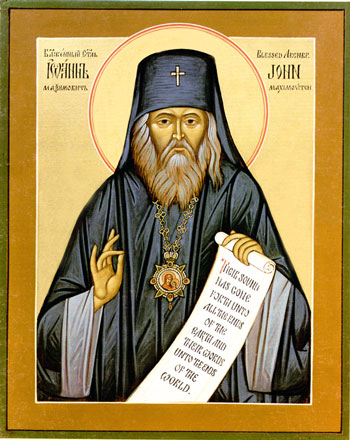
First, a little background. I first learned of St. John (Maximovitch) the Wonderworker of Shanghai and San Francisco from the first edition of the Seraphim Rose biography, Not of This World, and from the hagiographical book put out by the St. Herman Brotherhood, Blessed John the Wonderworker. St. John reposed on July 2 (June 19 Old Calendar), 1966, and was canonized June 19 (Old Calendar), 1994. (An account of the examination of the incorrupt remains of St. John can be found in the appendix to the volume Man of God [Nikodemos Orthodox Publication Society, 1994], excerpts of which can be found here.)
Recently (that is to say, since March), I have been reading the accounts of the life of St. John in the aforementioned Blessed John the Wonderworker, Man of God, and a small pamphlet entitled St. John the Wonderworker. Moved by the accounts of the sanctity of St. John's life, and of the efficacy of his intercessions, in the last few weeks I decided to ask St. John's intercessions that I would be able to secure an income adequate to provide for my family's needs. Being a graduate student in philosophy and the sole source of income for our home, this has weighed heavily on me.
I am convinced that through St. John's intercessions I became aware of no less than three job possibilities since I first started to ask his prayers: assisting another graduate student in the completion of a rough draft for a research project (and the initial editing of that project); a second part-time job through the university library where I work; and teaching a summer class. That last (teaching a summer class) I had completely given up on prior to asking St. John's prayers. Then, through a chance call to ask a professor for letter of reference I was asked if I were still available to teach. I said yes, and after some waiting was given confirmation this past week, that I do have a summer class to teach (an ethics course).
But perhaps the most timely answer to my prayer requests is exemplified by the events that happened yesterday. I was really sweating our financial situation. I figured that our tax refund (a helpfully sizable amount) would arrive near the first of June, since we had sent it on tax day and not before. But I was hopeful that if I got the second part-time job at the university library I would start by mid-May. However, at my interview last week, it was clear that even if I were offered the job (not a done deal, I shouldn't have to note), the offer would not come before the first week of June. This left the last half of May without any additional income. I just got my last check for teaching at Loyola, and this week will be my last check for teaching at Oakton. The only other income would be the few hundred dollars I get bi-weekly at my current part-time job. And there was rent, bills, groceries . . .
I was sweating it. So, with a much stronger sense of desperation, I again today asked St. John's intercessions. I didn't ask for money to fall out of the sky, nor did I buy a lottery ticket. I simply asked for wisdom, discernment, and ready hands. I thought maybe the parish could have some odd jobs I might be able to do. Maybe the research project writing job would come through. But there was nothing definite. So I just prayed and tried to be attentive to what God was doing, and willing to follow him wherever the path lay.
Yesterday afternoon, not twelve hours after I'd asked St. John's prayers, I opened the mailbox to find therein our much-anticipated tax refund. My first response was only, "Praise the Lord."
I still don't know what I will do if I don't get the other part-time job. And if the research project writing job comes through that will help a lot. Then there's the whole question of income for the fall semester. But God has been faithful thus far, and St. John's intercessions have been both timely and efficacious. My faith is being strengthened, and these things are a witness to my wife and daughter. (In fact, when we got the check, one of the first things I blurted out to Sofie and Anna was, "See! The saints do pray for us!")
Glory be to God! And may his saints, especially St. John, be honored among us!
Troparion (Tone 5)
Thy care for thy flock in its sojourn has prefigured the supplications which thou didst ever offer up for the whole world. Thus do we believe, having come to know thy love, O holy hierarch and wonder-worker John. Wholly sanctified by God through the ministry of the all-pure Mysteries, and thyself strengthened thereby, thou didst hasten unto suffering, O most gladsome healer--hasten now also to the aid of us who honor thee with all our heart.
Kontakion (Tone 4)
Thy heart hath gone out to all who entreat thee with love, O holy hierarch John, and who remember the struggle of thy whole industrious life, and thy painless and easy repose, O faithful servant of the all-pure Directress.
Troparion (Tone 6)
Glorious apostle to an age of coldness and unbelief, invested with the grace-filled power of the saints of old, divinely-illumined seer of heavenly mysteries, , feeder of orphans, hope of the hopeless, thou didst enkindle on earth the fire of love for Christ upon the dark eve of the day of judgment; pray now that this sacred flame may also rise from our hearts.