January 31, 2005
Lack of Charity?
Warning: Rant Ahead. I've been as restrained as I can be over the last several days. Today I allow myself a bit of whining.
I have been at some pains to communicate to my "atraditionalist" friends and acquaintances what my experience as one who is doing his best to accept, affirm and live the Holy Tradition is like. (See: Division and the Church, Why Tradition? Part I, Why Tradition? Part II, Why "Atraditionalists" Have It Easy, and A Good Question.). Today is another post, but this time more from the gut.
Why is it that the pain and suffering traditionalists encounter at being criticized, denigrated, mocked and condemned for their beliefs doesn't seem to count with their critics? Traditionalists are always called to apologize for their beliefs and criticisms, but I have yet to see their critics admit that traditionalists also experience the pain of rejection and shunning. I guess the critics of the Tradition either think that we traditionalists do not suffer the same feelings that they do--and by implication are less human than they--or that we deserve what we get since they seem to believe we're responsible for all the injustice and intolerance in the Church. And yet I was under the understanding that we both preach the Gospel of grace.
Why is it that traditionalists seem always to be counted as moral retards? Is intolerance only a one-way street? Why is it "groupthink" when traditionalists argue for a single, overarching Tradition, but when traditionalist critics all insist on criticizing the Tradition, that's somehow bold and original thinking? Why are traditionalists labelled "goosesteppers" and "Nazis" for upholding the Tradition's teaching on the human person, human sexuality and proper Church order, but when traditionalist critics uphold the "ethic of toleration," or the "paradigm of liberation" or some other singular rubric it's called "integrity"? Why is it when a traditionalist church leader experiences the pain of infidelity and divorce, it's hypocrisy, but when a traditionalist critic leaves his or her spouse or otherwise falls from grace, it's "authentic"?
I want those who criticize the Tradition to take some time right now and consider some things. When you criticize the Tradition, you do not just criticize a set of beliefs or a history, you criticize all of us who hold to that Tradition, as well as the Lord of that Tradition whom we love with all our heart, soul, mind and strength. Sound familiar? It should, because it's the thing traditionalist critics tell us all the time. I know I deservedly am told to remember that my arguments are not just against ideas but also involve people and their feelings, histories and experiences. I should state them sensitively. I try to always honor that reality. But traditionalist critics would do well to heed their own advice. Your jokes and putdowns about the Faith we hold dear sometimes brings deep sorrow to us. We usually don't say anything--I know I haven't till this past week--because we have a good idea what sort of reception our complaints will receive, and we really don't want to devolve into an "Oh, yeah? Well, my pain is worse!" sort of "top my testimony."
Amidst this complaint I don't want to be misunderstood. Speaking for myself, if I say something in a way that is rude, derisive and hateful, then I expect anyone, traditionalist or not, to call me on it. Furthermore, even if I've not done anything wrong strictly speaking, but nonetheless one of my readers or friends still feels hurt over something I've said or written, then by all means, let's clear the air. But just as my friends and traditionalist critics do not think they need to apologize when they criticize my own deeply held beliefs, so we traditionalists should not be expected to apologize for affirming the Church's ancient Tradition.
A Cautionary Tale for All Us Solitary, Bookish Types
From The Prologue from Ohrid:
As a monk Nicetas was disobedient to his superior, left the monastery and closed himself in a cell. Because of his disobedience, God permitted great temptations to befall him. Once, when Nicetas was at prayer, the devil appeared to him under the guise of a radiant angel and said to him: "Do not pray anymore; rather read books and I will pray for you!" Nicetas obeyed and ceased to pray and began to read books. He only read the Old Testament. He was unable even to open the Book of the New Testament, for the power of the devil prevented him from doing so. With the help of the devil, Nicetas prophesied only crimes, thefts, arson and other evil deeds which are known to the devil and in which he [the devil] participates. Finally, the holy fathers of the Caves realized that Nicetas had succumbed to the temptation of the devil, and they began to pray to God for him. Nicetas returned to the monastery, realized the destruction which plagued him, and directed himself on the right path. After prolonged repentance and many tears, God forgave him and bestowed upon him the gift of miracle-working. He died in the year 1108 A.D.
Study and prayer must necessarily go together. And with that in mind, here are some important prayers for students:
Prayer of a Student
Christ my Lord, the Giver of light and wisdom, who opened the eyes of the blind man and transformed the fishermen into wise heralds and teachers of the gospel through the coming of the Holy Spirit, shine also in my mind the light of the grace of the Holy Spirit. Grant me discernment, understanding and wisdom in learning. Enable me to complete my assignments and to abound in every good work, for to Thee I give honor and glory. Amen.
Prayers Before Study
Most blessed Lord, send the grace of Thy Holy Spirit on me to strengthen me that I may learn well the subject I am about to study and by it become a better person for Thy glory, the comfort of my family and the benefit of Thy Church and our Nation. AmenChrist, the true light, who enlightens and sanctifies every person coming into the world, let the light of Thy countenance shine upon me (us) that I (we) may see Thine unapproachable light; and guide my (our) steps in the way of Thy commandments, through the intercessions of Thy all-holy Mother and of all the Saints. Amen.
Prayer After Study
I thank Thee, Lord our God, that again on this occasion Thou hast opened my eyes to the light of Thy wisdom. Thou hast gladdened my heart with the knowledge of truth. I entreat Thee, Lord, help me always to do Thy will. Bless my soul and body, my words and deeds. Enable me to grow in grace, virtue and good habits, that Thy name might be glorified, Father, Son and Holy Spirit, now and forever. Amen.
Prayer Before Studying the Bible
Master who loves us, shine Thy eternal light in our hearts that we may better know Thee. Help us to fully understand Thy gospel message. Instill in us respect for Thy holy commandments, that by overcoming our worldly desires we might life a spiritual life of thoughts and deeds which pleases Thee. We ask this of Thee, O Christ our god, for Thou art the light of our souls and bodies and Thee we glorify with Thine eternal Father and Thine all-holy good and life-giving Spirit now and forever. Amen.Shine within my heart, loving Master, the pure light of Thy divine knowledge, and open the eyes of my mind that I may understand Thy teachings. Instill in me also reverence for Thy blessed commandments, so that having conquered sinful desires I may pursue a spiritual way of life, thinking and doing all those things that are pleasing to Thee. For Thou, Christ my God, art my light, and to Thee I give glory together with Thy Father and Thy Holy Spirit, now and forever. Amen.
January 30, 2005
A Good Question
Erica asks a good question: "Why become a theological liberal?" Her question really raises the whole issue of what is real Christianity? What is true Christian faith and life, and why would someone want to deviate from it? If true Christianity is the Christianity that is lived in the Tradition, why isn't everyone that sort of Christian?
Over at the atheist message boards I visit (far less frequently now than once was the case), which I've written about before, I find myself often in a two-pronged argument against the anti-Christian posters as well as the fundamentalist Christians who take great delight in sawing off the branch of the argument-tree on which they sit. The atheists and anti-Christians love it: "Here are two Christians disagreeing over the basic beliefs--so they claim--of their irrational doctrines. Let's just let them go at it and maybe they'll off one another and we won't have to worry about them anymore." It's not that I enjoy arguing against fundamentalist Christians, but to make an advancing argument against atheist attacks, I often find myself fighting a rearguard action so as to establish my advancing argument. Frustrating as heck, I must say.
There are two simple answers to Erica's question, or at least Erica's question as broadened by me here: Those Christians who do not follow the way Christianity has always been lived fail to do so either from ignorance (this was the case with me and many of my fellow parishioners, for example), or because they are convinced that there is no such thing as "the way Christianity has always been lived." These two answers, at least, fit the majority of people that I know personally. There is a third answer, which Erica gives in her post, and which I will comment on below. But I want to spend time with the first two possibilities I present here.
First of all, some Christians just simply are ignorant that there even is such a thing as the Tradition. The only understanding of tradition they've ever been given is Jesus' condemnation of the Jewish leaders of his day. They think, then, even if unconsciously, that Christianity must always be renewed from old practices lest we establish "traditions of men." Thus most present-day Christians have been taught to look no further back then yesterday's experience to guide tomorrow's actions. They fail to realize, however, that this is as much a human tradition--albeit an iconoclastic one--as those they think they're avoiding.
Of course, they also misunderstand not only our Lord's criticism of the Pharisees and scribes as well as misunderstand what the Tradition itself really is. Our Lord wasn't condemning all tradition altogether, but rather condeming the sort of tradition that by its very form and structure promotes the violation of God's will. If our Lord was against tradition altogether, he never would have commanded his apostles to "teach them [i. e., the disciples they would make of all nations] to obey everything I have commanded you." Indeed the one traditional thing many present-day Christians hold on to, failing to realize that it itself is as much Tradition as is the ancient liturgies, creeds, and dogmas of the Church, is the Scripture itself. Indeed, if there is one tradition of men that Protestants in particular continue to practice that keeps people from the full revelation of God it's their truncated Bible sans the so-called "Apocrypha."
Let me stress, very, very few of them do this maliciously. They're just simply practicing what they've been taught, and handing it down to those they teach. In other words, it's their tradition. Not a few, once they come to realize this inherent contradiction they've been unwittingly practicing all their lives, do the biblical thing and repent. And they come back to the one and only Tradition that gives Life because it comes from Christ himself.
The second answer to the above question, that Christians do not live the Traditional Christian faith because they are convinced that there is no such thing as "the way Christianity has always been lived," has various causes. These second sort of Christians do have a bit more historical awareness of Christianity. They know of the creeds, the battles over heresy, the practice of episcopal polity, and so forth. But they view the past through distorted lenses. They do not think there was a way that Christianity was always lived because they think Christianity has always been developing and growing, coming to greater awareness of the truth, and attaining ever greater maturity. They ascribe (falsely as it turns out) to the ancient Church views that we now have "grown out of," for example that the Church condoned slavery. (See the link just above and here.) Many who take these views do so innocently, sincerely, and with the best of reforming intentions. The trouble is, they haven't done two things: examined their own presuppositions and examined history more closely.
In their view basically all of the previous traditions and beliefs of the Church are mere human constructs built over the Gospel kernel. Since Tradition is a mere human construct, in their view, there really is no single way that Christianity has always been lived. Nearly everything is just historical accident. The early Church, for example, didn't ordain women because that just wasn't done in earlier societies. But we have outgrown such chauvinistic attitudes, they claim, and we can ordain women if we want. In fact, their view of the battles over heresy in the early Church is viewed from a sociopolitical standpoint--it just so happened that one group seized and wielded political power, smashing their opponents and rewriting history. Had Valentinus or Arius and their followers won out, we'd be badmouthing Athanasius.
But this view of history, and here I must speak bluntly, is distinctly pagan. The biblical and Christian view of history is one of the sovereignty of God which we humans experience as divine Providence (for exhibit A in this, refer to the book of Esther, especially the Hebrew version). The biblical view of history is not that it is getting better and better, humanity getting wiser and more mature. No, the biblical view is that history is getting worse, humans getting more and more wicked and devilish, and suffering is increasing. Indeed were it not that Christ will return to judge the living and the dead, there would be no hope, not even the elect would be saved. The darkling Norse understanding of Ragnorak is more Christian, at least in form, than the view of history of many Christians today.
Furthermore, if they'd just take a longer look at their presuppositions, they'd see that, like the ignorance mentioned above, their own view of history falls apart on its own weight. If history is little more than human constructs, then so is such a view. That is to say, it is a contradiction in itself. In point of fact, one has to come at Christian history with a presupposed hermeneutics of suspicion to build a case for such a radical diversity so as to do away with the claim that there is a single Tradition handed down faithfully from the Apostles to our own day.
When looking at the full history of the Church with an open mind, one cannot but come away with a strong understanding that there is, indeed, a single deposit of Faith, recognizably clear and the means by which we ourselves are judged today.
Nonetheless, those who are blind to their own contradictory presuppositions, who view the Tradition as merely human--including, by the way, the Scriptures as especially a mere human document--do find even in their distorted view of Church history, something in the Lord of Church history, Jesus the Christ, that they cannot but be attracted to. They are, at least the best of them are, so "in love" with Jesus that they want to honor what they take to be the truth of his Gospel and build an edifice to him. Because they have done away with the standard by which to build, they cannot but build askew, their walls and roof and doors leaning and discordant. They seek justice when they should find mercy. They seek liberation when they should be finding sanctification. They seek empowerment when they should be finding servitude. The Lord whom they love--even when they do not love the way of life he laid down in time and space for his Church--did not seek justice, but gave himself up to God and was unjustly condemned for us. The Lord they love did not seek liberation, though he could have called ten thousand angels to his side. The Lord they love did not seek empowerment, but emptied himself of his divine perogatives, and became a slave for our sakes. This is the way of life the Lord has laid down. If we love our Lord we will abandon all the counterfeits of human justice, political liberation and social empowerment.
We now come to the third answer to Erica's question, the one she herself gives. And here I cannot but agree and make some further comment. There is a segment, thankfully small but satanically wielding enourmous influence, of modern day Christianity who do not seek Tradition because they know it to be their enemy. These Christians know the Truth and reject it, point by point. When anyone of good conscience, like my atheist interlocutors on the message board referenced above, come to the decision that everything about historic Christianity they reject, they have the decency to abandon the name and religion they no longer claim. But these last enemies of Tradition are evil liars. They consciously seek to destroy. They hate the Lord and his Church, and fired by the demonic delusion to which God has given them up, they seek to undermine and destroy God's Church from within. They seek only to rape, pillage and destroy, hiding their vicious violence under a velvet glove and a whitened-sepulchre smile. We need not name them for their works are evident, and their lies betray their paternity.
What we need to do is to remember that these enemies that seek destruction and subversion were once men and women like you and me. But one day they made a decision to abandon one little aspect of the Faith. It was only a small thing, maybe fasting. They found they could still look like a Christian and sound like one, and so they let fasting go. But that small thing made it easier to let go another slightly bigger thing, like daily prayer. And those two things made it even easier to forego almsgiving. And thus their heart was shut to themselves, to God, and their fellow man. And being empty, but clean, seven terrible spirits moved in. And those seven will not now be evicted.
Those of us who love the Lord and his Tradition, his Way of Life, would do well to take heed lest we fall. We do not know today whether we will be found faithful, and so we should not worry too much as to which Christians we meet fall into which category. Their deeds will reveal them, as will our own. May our deeds say of us, "This one was born in Zion."
January 29, 2005
Why "Atraditionalists" Have It Easy
This post got me to thinking yet some more about this week's kerfuffle on my blog.
My Kreeft post earlier this week clearly hurt feelings and created offense among my in-person and blogosphere friends. And while I in no way apologize for my convictions and beliefs (nor would my friends want me to), I do sincerely regret that this was the occasion for such tears and anger. I will keep the post because I believe it to be an excellent resource for the Tradition's stance on women's ordination. But I also realize that keeping the post means it will remain on the main page for a few days, and my friends may continue to be reminded of their hurt and anger by its presence.
Still, my reflection on all this today is one of frustrated bewilderment. As Aaron notes in his post linked above, statements, beliefs and other such communications which criticize and undermine the Tradition of the Church are nearly always given carte blanche, and we traditionalists, it is assumed, will sit there and take it.
We traditionalists expect this from the culture at large. This Christmas holiday season just past is an example of the sort of blatant paganism and mocking of traditional Christian sensibilities about the dogma and reality of the Incarnation we face daily. The endless paeans to the economic god and how well his devotees were adhering to his laws by getting out there and making it a "good Christmas [so-called] shopping season" is something we know we will have to face.
But it is ever more disturbing when we get this same sort of treatment from our fellow Christians.
Don't misunderstand. I recognize that modern-day Christendom is fractured and pluralistic. And while conformity of belief and life along the lines of Tradition is a traditionalist's devout wish, I recognize that such will not be happening soon. But there are areas of agreement, and beyond that our common humanity as imago dei, and thus we can show hospitality and love to one another, pray for one another, and bless one another in Christ's name.
Still, what I have found so deeply ironic this week, is that when I commend the Tradition's teaching about women and Eucharistic ministry, I then find myself in the position of needing to rebuild fractured bridges and offer sincere embraces. I did these things, and didn't hesitate to do so, and was hopeful that in so doing the offenses taken and the feelings hurt might be assuaged with prayer and love and relationships restored. But what I don't think my "atraditionalist" friends quite realize is that the experience they had this week is something we traditionalists go through nearly every day.
We read the blogs of our co-religionist friends and come across snickering rejections of Mary's perpetual virginity. After all, how could Mary and Joseph not have had sex, right? But we are subjected to this notion of Mary and Joseph "getting it on" and meant to do so in silence. We are subjected to judgments against us as "bigots, misogynists, and homphobes" because we hold to the Church's Tradition regarding the human person, human sexuality, and proper order in the Church. And yet, do we dare defend ourselves, we are subjected further to the assertions that such defenses are an even surer proof of our "bigotry, misogyny, and homophobia" as our inner guilt moves us to deny what we cannot accept in ourselves. And once again we are meant to suffer these unjust attacks in silence. We are harried by the enemies of the Faith outside the Church, and often do not even find refuge among those who, with us, claim the name of Christ.
We traditionalists operate at a disadvantage. Atraditionlists arguments are almost always given a fair hearing, their premises (assumed or explicit) accepted on their face, and their exegesis, however contrived, nearly always noted for its "creativity, boldness, and insight." Where traditionalists offer the Church's dogma, no matter how creatively we construct our arguments, or how well-done rhetorically, we are subjected to evaluations of using those "tired old arguments," accused of being "reactionary and hidebound," and otherwise informed that our rational capacities are anchored somewhere in the vicinity of a squash and a block of wood.
My atraditionalist friends, when coming to my blog, may guess that they will find the Tradition's stance on women's ordination, same sex behavior, and abortion. And to the degree that they may suffer offense and hurt feelings at these things, these are probably the extent of any troublesome ideas they will encounter.
But we traditionalists know that when we visit their blogs we will see most of the beliefs we hold dear brought up for criticism, sometimes condemnation, and not infrequently even mockery. And we dare not say a word. We are meant to just suffer in silence.
This is not a rant. I bear no ill will to my friends. I very much want to remain part of their lives and for them to remain part of mine. And I very much look forward to seeing some of them this evening at a birthday celebration. But on this most recent occasion of hurt feelings and offense, I wanted to point out that we traditionalists do understand what they're going through.
We live it most every day.
January 28, 2005
Why Tradition? (Part II of II)
In my previous post I addressed one connotation contained in the title of these two posts, "Why Tradition?" I gave there an explanation by way of the Life we experience in Holy Tradition. Here I will address the second connotation contained in the question titling this post, "Why Tradition?" That is to say, why make so much out of it? Here I give my defense of what it is we hold on to.
My defense begins and ends with the exact same answer given to the question in the first post: We hold on to Tradition because in it we have the Life Christ gives to his people. "Will you also leave?" our Lord asks us. And with Peter, we reply, "Where else can we go? You have the words of Life."
But this answer does not satisfy my brothers and sisters who want only to hold on to certain parts of the Tradition and not the whole of it, or, more to the point, those who would reject the Tradition altogether. I will try to explain to these, then, why it is we hold on to the Tradition. From the outset, however, I recognize, as I noted in my previous post, that we do not speak the same language here. It's not just the difference between the dialects of justice and rights and of mercy and grace. It is, indeed, more deep even than that. We traditionalists do not have a perspective that Tradition ought even be measured and weighed by us. Rather it measures and weighs us.
Our brothers and sisters who do not understand us fail to do so on this very point. They see Tradition as always reformable, always infected by sinful human tendencies, and therefore always to be viewed with suspicion. It is not Life to them, it is convention. For us, the symbols and metaphors of the Faith do not carry meaning because we believers invest them with meaning. No, they are symbols and metaphors only precisely because they carry the meaning of the reality they represent. To speak in the beloved pragmatic terms of our present-day American culture: symbols and metaphors only "work" because there is a reality there to which they are metaphysically anchored. If it were mere convention only that invested them with meaning, then there would be no reality for them to point to, and we would indeed be justified in changing them to suit our generational moods. It is this deep difference in ecclesial understanding that divides us. And so much of what I say, despite my best efforts, may still fail to translate for my brothers and sisters who find me and my "kind" the most unusual and incomprehensible of Christians.
It is already plain by now that one of the most immediate phenomena that divides us advocates of Holy Tradition from our reforming brothers and sisters is exactly that of our experience of Holy Tradition. We believe that God has revealed himself to us, and that he does not lie or contradict himself. Our reforming advocates want us to believe that when God spoke and denied to same sex attracted Israelites and early Christians the specific physical fulfillment of their sexual desires (to use one divisive issue plaguing us today), he either did not mean it, our fathers and mothers in the Faith did not understand what God meant, or he has now changed his mind.
Reforming Christians claim for their authority the same divine agent traditionalists do for theirs: the Holy Spirit. But this cannot be. If God did not mean his original proscription of same sex behavior, then this God whose word spoke the universe into existence, who himself is the Logos, the Word, is false to himself. This God is a god of empty words that mean nothing, a god who is untrue to himself, who contradicts himself, a liar god, a capricious god, and no god. This is not the God we traditionalists know.
Our reforming brothers and sisters, however, usually don't go so far as to ascribe to God something like malicious capriciousness, rather they sometimes just simply claim that God has changed his mind. Maybe our ancestors did have it right, and maybe God did, indeed, mean to proscribe such behavior, and to keep women from the Eucharistic ministry. But now a new era of the Holy Spirit has arrived. The Church, one explanation goes, needed to mature, and now that we have done so, we have reached a point at which we are ready for these new practices never heard of before in the Church. Or at the very least we have grown past the immaturity of our ancestors in the Faith who were so mired in their sinful prejudices and cultural injustices that they mistook their own minds for the mind of God. But on what basis can we know these things? We surely cannot use God's past revelations in Scripture and Church, since these cannot guide us any longer—at least not without our laborious unearthing of the "true meaning" hidden in underneath layers and layers of historico-grammatical context—tied up as they presumably are in all sorts of sinful humanness. It would appear that we would only know these things on the evidence of our own present experience. Yet isn't this precisely what our ancestors in the Faith knew as well? And if our ancestors in the faith were so mired in their own prejudices, what guarantee have we that we are not mired in our own immaturity and biases? Who can say that this reforming impetus for same sex unions and women priests is not also some sinful human tendency? Might our sense of God's justice simply be nothing more than our own cultural distortions? How would we know it's not?
Most of the time, however, our reforming brothers and sisters focus on the assertion that the early Christians just got it wrong. They were no more immature or biased than are we, but we have the benefit of their history, and on the basis of our greater wisdom, we can with all humility and respect simply note they were wrong. But if our fathers and mothers in the Faith did not understand what God meant when he told them such behavior was proscribed, then we are in even worse shape. How can we trust them to have understood anything of fundamental importance in the Faith? If they cannot get something that is so fundamental to the modern Christian experience today right, how can we trust them on other fundamental issues? They are, we may postulate, perhaps wrong on women's ordination. And our reforming brothers and sisters would heartily agree. But then they also may well be wrong on even more fundamental levels: the exclusivity of Jesus as the way to God (again more agreement from many), the fundamental ontological reality of sin and the necessity of repentance (which our more therapeutic minded ecclesial siblings would themselves heartily affirm), and we could add more. But if you take away the male priesthood, the exclusivity of Jesus as the way to God, sin and repentance, you do not have anything resembling Christianity.
Our reforming brothers and sisters would perhaps take some umbrage at that assertion. After all, they claim, some of these things are not essential to the Faith. We're talking, they affirm, about Gospel essentials, not mere traditions. But we traditionalists know no such Faith that can be boiled down to bullet points. Our Faith is of one whole cloth. Our recitation of the Nicene Creed is not simply a list of the most important doctrinal points we must affirm. It is part and parcel of our daily lives as Christians. We light our vigil lamp and confess Jesus Christ as "Light from Light, Very God of Very God, begotten not made, of one essence with the Father." We pour a glass of water for our child and confess "one baptism for the remission of sin." We confess our sins to one another and embrace our spouses and thus proclaim that Christ "for us men and for our salvation came down from heaven and was incarnate of the Holy Spirit and the Virgin Mary, and was made man." We pay our bills because we confess "the Resurrection from the dead, and the life everlasting." If you take away one part of Tradition, you chip away at the Faith which saves us, altering the very fabric of our day to day existence. Take away one part of our Holy Tradition, and you take away our life.
My reforming brothers and sisters doubtless do not grasp this, or grasping it do not believe it. But let's take their assertion that our ancestors somehow just got it wrong. If this is so, if we can't trust our ancestors in the faith, on what basis can we trust our present-day peers in the faith? If our ancestors have been so wrong, is it not at least possible that our peers are equally wrong? What if we end up trusting in a lie? Will that save us? If our ancestors were wrong and yet claimed to be right, on what basis can we evaluate the claims of our peers who claim they are right and our ancestors wrong?
We traditionalists are given no valid reason to think that we should abandon Holy Tradition. Everything else comes to a dead end. And really, since our experience of Tradition is that it is the place to go, to be and to do in which we encounter the Life that Christ Himself gives us, we have no desire to go anywhere else, believe anything else or do anything else. And sadly, we are the misunderstood, sometimes mocked, sometimes despised, and not infrequently persecuted siblings in the modern churches for it. But we will not leave our Lord, nor will we abandon our reforming brothers and sisters by ceasing to love and pray for them.
Why Tradition? (Part I of II)
Some of the emails I've gotten and some of the public replies to my post on division and the Church have prompted me to some further reflection on the thing we "traditionalists" call the Holy Tradition. My reflections will unfold in two parts, of which this is the first, each part having to do with a different connotation of the question which is the title of this post. That is to say, one connotation of "Why Tradition?" is the sense of explanation, or what we mean when we say things like "Holy Tradition." The other connotation is "Why Tradition?" in the sense of justification and defense.
Many of the comments I've received have to do with an understanding that is radically at odds with the way we "traditionalists" understand ourselves when we say "Tradition." I am coming from the Orthodox perspective (insofar as I can best represent it), so mine will be different in some emphases from what an Anglican or a Roman Catholic means by "Tradition." But in that we are all referring to that living experience which has been transmitted from the Apostles down to our own day, we can said to be of one mind on the matter, and I hope to accurately reflect that mind.
First, what we do not mean by Holy Tradition. We do not mean those things that are not universal in shape and content to the entire apostolic Church. We also do not mean by Holy Tradition a set of legal codes or rules that must be unquestioningly obeyed at all times. We do not mean a love of the past merely for the past's sake. We do not mean a fortress into which we can retreat from the social realities we find troubling and distasteful. And we certainly do not mean by Holy Tradition a state of power in which we get to control the behaviors of other people. All of this is most emphatically not what we are about.
Rather, we mean by Holy Tradition quite simply that in which we know we can find the Life of Christ. We fast on Wednesdays and Fridays because we know that doing so brings us into real and vibrant contact with the Life of Christ. We rise bleary-eyed in the mornings to recite prayers somebody else wrote and prayed centuries ago because we know that those prayers unite us to all the saints here and in the heavenlies and in that union accomplished by the Holy Spirit we touch Life. We kiss our icons--which for many of us are paper reproductions pasted on wood (since we cannot afford a handwritten icon), these icons which have been blessed with holy water and lain on the very altar where bread and wine become the very Body and Blood of our Lord--because we know those kisses pass beyond paper or paint and wood and come in contact with the Life of all. We adhere to the male-only Eucharistic ministry because we know that our priests image for us Christ, who is male, and who himself images perfectly the Father in heaven, who is masculine. This is the only God we have ever known and the only one who has given us the Life we now live. We keep the only form of marriage the Church has ever known, that of one man and one woman for life and for the begetting of children, because in creating life and sustaining it, in our mortal unions themselves in a mytery too great to fathom we somehow touch Life. We keep the Eucharistic fast because we know that what we will consume in several hours' time is something so pure, so holy, and so life-giving, that to ingest anything else would be a mockery and an imitation of the only Food which can make us immortal.
Holy Tradition tells us that we are made in God's image, each of us united to him in his Son by the Holy Spirit. Our flesh became his flesh, and through that bridge our natures by grace became divine. Holy Tradition is that Life in which our orphans have a heavenly Father who revealed to them his only beloved Son, their brother, our fathers have a Mother who gave our Lord his humanity, their salvation, and our mothers have a divine Son, who gave them first of all the news of Resurrection, their special apostleship.
Those who speak to us of oppression and phobias, rights and justice, speak to us in a foreign language, and of an experience we have not known. Who can insist on rights when we are all slaves of God, bought at great price? Who of us would insist on justice when it is only by God's grace that we are shown mercy? What is oppression beside the despair one feels as the tyranny of our passions burden us with the sins we willingly commit at their urging? What sort of political freedom or empowerment could satisfy us when we are yet imprisoned by our own sins? What greater fear could one have than that of disowning our Lord? Not for nothing does the hymn ask of God that we never outlive our love for him! How is it possible that the same Tradition which gave us our reverence for the Mother of God could ever diminish the role and person of these daughters of the second Eve? We do not understand this language of oppression and rights, because it is not our language nor our experience.
By this we do not say to you that your hurts and fears are meaningless. How could we respond thus to your hurt and pain when we ourselves have been pierced through by our own misdeeds? We do not say of your exprience of oppression and injustice that it is all a will-o'-the-wisp, a black fantasy. We have only to say that what you describe is not our experience. Your darksome reality is not ours.
What we would be so bold as to say is to come to Holy Tradition and there meet the Life it gives in our Lord. There embrace his holy Mother, and all the saints. Come and experience the joy we know.
January 27, 2005
Division and the Church
Two quick but essential points before I get into the heart of my thoughts here. First, it is not my intent to "assign blame" in the matter of division. I am raising questions. I am not establishing conclusions. My questions, of course, will reveal my biases, but these biases should not be taken as conclusions, only as the impetus of my questions. Second, I will be bringing up two of the most contentious issues among Christians today: the ordination of women and the blessing of same sex behavior. I realize that the mere mention of these matters will likely inflame the prejudices and passions of my readers. I highlight this fact not because I deliberately wish to convect alienation and disagreeableness, but rather so that I can point out that this post is not about women's ordination or same sex behavior, but rather about a rather different phenomenon: schism.
Those two all-important qualifications having been set out, if you wish to read further, please do so.
I knew when I posted it that my friends here in Chicago, nearly all of them, would be in strong disagreement with my commendation of Kreeft's lecture opposing the ordination of women to the priesthood and episcopate. I also knew that this matter is one of deep feeling to my friends who favor women in Eucharistic ministry or otherwise ally themselves to varying degrees with feminist principles. However, since my friends know where I stand, and I where they stand, and since Kreeft's lecture I knew to be well-reasoned (which is not to say perfectly-reasoned), free of ad hominem, and otherwise forcefully stated, I considered it to be a resource worthy of thoughtful commendation to all my readers. I expected disagreement, and hoped for a lively dialogue.
I was, to my great sorrow, mistaken.
For those who don't know us (my Chicago brothers and sisters in Christ and myself), they might not quite realize how distinctly the odd-man out I am among them. My friends are all nearly perfectly aligned in theology, social mores, ethical paradigms, and political commitments--which is not to say there is no differences among them, but rather that those differences are ones of degree rather than of kind. I, on the other hand, find myself markedly different from them in almost every important way. My theology differs, I orient around different social concerns, my ethical paradigms are founded differently, and my political commitments are much more right than theirs. Yet, in God's inscrutable Providence, they include me as their friend and brother (and I must stress that I often feel this dynamic in precisely this direction). Still in a way which never ceases to both amaze and humble me, I know that if I found myself in dire straits, these brothers and sisters would not hesitate to come to my aid, and I suspect they pray for me often. I trust that they know the same is true of me: they may certainly count me as both friend and intercessor and one who would not hesitate to do all I could to aid them in whatever way their needs called for.
Which now brings me to my point. By my posting the link to Kreeft's lecture, division has come among us. One dear friend, indeed, one for whom I expressed a deep respect in my reply to a comment on the Kreeft post, wrote me personally to express this sense of division she felt. Another also expressed in a public comment he later withdrew his own sense of anger.
But here is where I am brought up against a seeming wall around or over or through which I cannot seem to go. My friends know me well, and know that I am no misogynist. If they think differently, they hide it well. We know each other's convictions. My good friend, Tripp, and I are rather known among our blogofriends for the role of foil we often play to one another on various matters.
So why is it that my upholding of the dogma and canon of the Church, which has held for two thousand years and counting is the cause and occasion of this schism?
This question is more than personal, please understand. For all that I might just be a flat-out jerk which may the more be blamed for this division, in point of fact, if we look around at the ecclesial world, where do present-day schisms take place? Precisely where the tradition is resisted. I am more conversant with the goings on of the Anglican churches than any other non-Orthodox body, and everywhere that departures from the tradition have been enacted there have been schisms. The ordination of women in the 70s. The validation of homosexual behavior and the blessing of same-sex unions in the 90s and currently. Why?
Let's have done with the assertion of ulterior motives of power-mongering and territorial preservation--these accusations prove nothing and fit everyone. Rather, let's assume the best of intentions on the parts of all. Why is it then, that those who wish to fully embrace the history and life of the Church and to live such in all its fullness today are most often the ones assigned as causes of these schisms?
Let me return to the personal. My friends know, and I am on record as affirming, my love, respect and esteem for them. They also know of my convictions. So why is it now, in the current set of circumstances, that this division runs between them and me?
Let me reiterate: I am not whining for my own sake, despite how I may feel about all these matters. Rather I am using my personal experience to elucidate and ask a most serious question. Why does the affirmation of Tradition get assigned the blame for schism among (American at least) Christians?
Perhaps I may benefit from someone's insight.
Welcome to the World, Baby Girl!
Karl and Carrie have had their baby girl: Kirsten was born--a miracle-- on Jan. 25th at 5:20 pm!
Truly miraculous. Praise be to God! And may the Lord grant his servants rest amidst their joy.
David B. Hart: The Unity of Orthodox and Roman Catholic
From First Things, March 2001: The Future of the Papacy:
Anyone familiar with the Eastern Christian world knows that the Orthodox view of the Catholic Church is often a curious mélange of fact, fantasy, cultural prejudice, sublime theological misunderstanding, resentment, reasonable disagreement, and unreasonable dread: it sees a misty phantasmagoria of crusades, predestination, “modalism,” a God of wrath, flagellants, Grand Inquisitors, and those blasted Borgias. But, still, and from my own perspective ab oriente, I must remark that the greater miscalculation of what divides us is almost inevitably found on the Catholic side, not always entirely free of a certain unreflective condescension. Often Western Christians, justifiably offended by the hostility with which their advances are met by certain Orthodox, assume that the greatest obstacle to reunion is Eastern immaturity and divisiveness. The problem is dismissed as one of “psychology,” and the only counsel offered one of “patience.” Fair enough: decades of Communist tyranny set atop centuries of other, far more invincible tyrannies have effectively shattered the Orthodox world into a contentious confederacy of national churches struggling to preserve their own regional identities against every “alien” influence, and under such conditions only the most obdurate stock survives. But psychology is the least of our problems.
In truth, so vehement is this pope’s love of Eastern Christianity that it has often blinded him to the most inexorable barriers between the churches. As an error of judgment, this is an endearing one, but also one possible only from the Western vantage. Of course a Catholic who looks eastward finds nothing to which he objects, because what he sees is the Church of the Seven Ecumenical Councils (but—here’s the rub—for him, this means the first seven of twenty–one). When an Orthodox turns his eyes westward he sees what appears to him a Church distorted by innovation and error: the filioque clause, the pope’s absolute primatial authority, purgatory, indulgences, priestly celibacy. Our deepest divisions concern theology and doctrine, and this problem admits of no immediately obvious remedy, because both churches are so fearfully burdened by infallibility. The disagreements in theology can be mitigated: Western theologians now freely grant that the Eastern view of original sin is more biblical than certain Latin treatments of the matter; only the most obtusely truculent Orthodox still believe that the huge differences in Trinitarian theology that a previous generation found everywhere in Latin tradition indeed actually exist; etc. But doctrine is more intractable. The Catholic Church might plausibly contemplate the suppression of the filioque, but could it repudiate the claim that the papacy ever possessed the authority to allow such an addition? The Eastern Church believes in sanctification after death, and perhaps the doctrine of purgatory really asserts nothing more; but can Rome ever say that in speaking of it as “temporal punishment,” which the pope may in whole or part remit, it was in error? And so on.Even if we retreat to the issue of psychology again, here too Catholic ecumenists often misconstrue the nature of the Orthodox distrust of their good will. It is not simply the case that the Orthodox are so fissiparous and jealous of their autonomy that the Petrine office appears to them a dangerous principle of homogeneity, an ordo obedientiae to which their fractious Eastern wills cannot submit. Jurisdictional squabbling aside, the Orthodox world enjoys so profound a unity—of faith, worship, spirituality, and ecclesiology—that the papacy cannot but appear to it as a dangerous principle of plurality. After all, under the capacious canopy of the papal office, so many disparate things find common shelter. Eastern rites huddle alongside liturgical practices (hardly a peripheral issue in the East) disfigured by rebarbative banality, by hymnody both insipid and heterodox, and by a style of worship that looks flippant if not blasphemous. Academic theologians explicitly reject principles of Catholic orthodoxy, but are not (as they would be in the East) excluded from communion. There are three men called Patriarch of Antioch in the Roman communion—Melkite, Maronite, and Latin (I think I have them all)—which suggests that the very title of patriarch, even as regards an apostolic see, is merely honorific, because the only unique patriarchal office is the pope’s. As unfair as it may seem, to Orthodox Christians it often appears as if, from the Catholic side, so long as the pope’s supremacy is acknowledged, all else is irrelevant ornament. Which yields the sad irony that the more the Catholic Church strives to accommodate Orthodox concerns, the more disposed many Orthodox are to see in this merely the advance embassy of an omnivorous ecclesial empire.
All of which sounds rather grim. But having made the necessary qualifications, I can now praise John Paul II for all he has done for the unity of the apostolic Churches. He is, simply stated, a visionary on this matter. True, human beings cannot overcome the obstacles dividing East from West; but the unity of the Church is never—even when it is only two or three gathered in Christ’s name—a human work. Each church is grievously wounded by its separation from the other, and only those who have allowed pride and infantile anger to displace love in their hearts are blind to this.
Moreover, our need for one another grows greater with the years. It is sometimes suggested that the future of society in the West—and so, perhaps, the world—is open to three “options”: Christianity, Islam, and a consumerism so devoid of transcendent values as to be, inevitably, nothing but a pervasive and pitiless nihilism. The last of these has the singular power of absorbing some of the energies of the other two without at first obviously draining them of their essences; the second enjoys a dogmatic warrant for militancy and a cultural cohesiveness born both of the clarity of its creed and the refining adversities of political and economic misfortune; but the only tools at Christianity’s disposal will be evangelism and unity. The confrontation between the Church and modern consumerism will continue to occur principally in the West, where a fresh infusion of Orthodoxy’s otherworldliness may prove a useful inoculant; but the encounter or confrontation with Islam will be principally, as it long has been, in the East. It is impossible to say what peace will be wrought there or what calamity, but it may well be that the Petrine office, with its unique capacity for “strengthening the brethren” and speaking the truth to the world, will prove indispensable.
The present pope has long been the great, indefatigable voice of Christian conviction in a faithless age. If future popes follow his lead, and speak out forcibly on behalf of the Christians—in Egypt, Syria, Turkey, and elsewhere—who will most acutely suffer the pressure of this difficult future, love will ever more drive out suspicion, and the vision of unity that inspires John Paul II will bear fruit. Sic, at any rate, oremus.
[Hat tip to the forgotten source of this link. You know who you are.]
January 26, 2005
You might be a redneck Jedi if...
You might be a redneck Jedi if...
1. You ever heard the phrase, "May the force be with y'all."
2. Your Jedi robe is a camouflage color.
3. You have ever used your light saber to open a bottle of Boone's Farm Strawberry Hill.
4. At least one wing of your X-Wings is primer colored.
5. You have bantha horns on the front of your land speeder.
6. You can easily describe the taste of an Ewok.
7. You have ever had an X-wing up on blocks in your yard.
8. You ever lost a hand during a light saber fight because you had to spit.
9. The worst part of spending time on Dagobah is the dadgum skeeters.
10. Wookies are offended by your B.O.
11. You have ever used the force to get yourself another beer so you didn't have to wait for a commercial.
12. You have ever used the force in conjunction with fishing/bowling.
13. Your father has ever said to you, "Shoot, son come on over to the dark side...it'll be a hoot."
14. You have ever had your R-2 unit use its self-defense electro-shock thingy to get the barbecue grill to light.
15. You have a confederate flag painted on the hood of your landspeeder.
16. Although you had to kill him, you kinda thought that Jabba the Hutt had a pretty good handle on how to treat his women.
17. You have ever accidentally referred to Darth Vader's evil empire as "them damn Yankees."
18. You have a cousin who bears a strong resemblance to Chewbacca.
19. You suggested that they outfit the Millennium Falcon with red wood deck.
20. You were the only person drinking Jack Daniels on the rocks during the cantina scene.
Peter Kreeft: Woman and the Priesthood (MP3 audio)
I commend to you: Peter Kreeft: Women and the Priesthood.
Some great "soundbyte" quotes:
"The Church did not invent the priesthood. She received it."
"If we don't understand the reason for some ancient tradition or rule or institution, that should be a good reason for not abolishing it until we do understand it. . . . So the only people who might have a right to change the old rule are precisely the people who don't want to change it. And the people who don't have a right to change it because they don't understand it are precisely the people who do want to change it."
"Ideology does not judge the Church, the Church judges ideologies. To be a Catholic is to believe that the Church and her traditions are more than human, that she is the body of Jesus Christ, graced with his real presence and power and promise of guidance. I have not yet once heard one advocate of priestesses face and affirm this fact, or manifest the loyal submission that all the saints had to our holy Mother. When feminists become saints, we will become their pupils."
"What more does anybody want? 'Rome has spoken; the case is closed.' That formula used to evoke love and loyalty. The issue today is not whether the Church will have priestesses. She won't. The only open issue today is whether the would-be priestess will have the Church."
"To say 'Yes' to Christ, but 'No' to his Church is to will a spiritual decapitation."
"God, who deliberately designed sexuality, also deliberately designed to incarnate himself as a male. Jesus Christ is still a male today. He still has his human body in heaven and it is a male body."
"Priests of Christ, who are Christ's mouths, through whom he speaks the words, 'This is my Body,' must be male because Christ is male."
"Christ, the perfect human image of the Father is male because God the Father is masculine; 'he' not 'she.'"
"Male and female are biological genders. Masculine and feminine . . . are cosmic universal principles extending to all reality."
"I think it is incredibly provincial and even arrogant for us to assume without a shred of proof that this nearly universal human instinct is mere projection, mere illusion, mere fantasy, rather than an insight into a cosmic principle that is really there. There is abundant, ubiquitous and obvious evidence for it from the bottom of the cosmic hierarchy to the top: from the electromagnetic attraction between electrons and protons, to the circumincession of divine Persons in the Trinity. Male and female are only the biological version of cosmic masculine and feminine. God is masculine to everything from angels to prime matter. That is the ultimate reason why priests who represent God to us must be male."
"If you can subtract the divine masculinity from Scripture when it offends you, why can't you subtract the divine compassion when that offends you? If you read your Marxism into Scripture today, why can't you read your Nazism into Scripture tomorrow? If you can change God's masculinity, why not change his morality, why not his very being? If you can twist the pronoun, why not twist the noun?"
"The Church tells us that the priesthood is not a right and not a privilege. No one can claim a right to be a priest."
"The most egregious error of all is the demand to be priestesses for empowerment. I can think of no term that more perfectly proves the speaker's utter incomprehension of what she says than that. . . . Priests are not power brokers or managers."
On God's Energies and the Passions
This post and the one preceding it, got started when I was thinking about New Year resolutions. With these previous posts as background, I want this time to discuss God's energies and the passions.
First, let me start with a disclaimer. I am not well-versed in the Church's teachings on God's energies and the fallen human passions. I only know enough to know that Orthodox are unique among the various churches in their teaching on God's uncreated energies, and emphasize, as other churches generally do not, the passions and the struggle against them as part of the daily struggle of Christians as they grow in holiness. But even this “knowledge” is sketchy and incomplete.
This post, then, is little more than a very simple Bible study, as I look at the references in the New Testament of the energeia and pathema word groups. It is certainly incomplete, and not exhaustive. More to the point, it is my own individual attempt to grasp what Scripture says. It does not necessarily reflect the mind of the Church. In fact, I ask any of those reading this who detect departures from Orthodox teaching or other mistakes to please correct what I've written—for my own edification and so as not to inadvertently lead my readers astray.
We first of all note some very basic facts. The noun energeia—working, or operation—occurs some eight times, all in Paul, three times in Ephesians, twice each in Colossians and 2 Thessalonians, and once in Philippians. We note also, that energeia is always used of supernatural beings: God (all three times in Ephesians, once in Philippians, both times in Colossians), Satan (once in 2 Thessalonians), and the influence of error God sends on the followers of Satan (the other reference in 2 Thessalonians). This working of God is tied to the growing of the Church into her Head, Who is Christ (Ephesians 4), and to the Resurrection of Christ from the dead (Colossians 2).
So the working or operation is a supernatural working, either of God or of Satan. It is not merely human activity.
The verb energeo—to be at work—occurs some nineteen times. It twice refers to the spiritual powers at work in a purportedly resurrected John the Baptist, which Herod feared in Jesus (the parallel passages in Matthew 14 and Mark 6). It twice refers to the working of God and the Spirit in the spiritual gifts in the Church (1 Corinthians 12), as well as Peter's and Paul's apostleship and the similar works God does in the Galatian Christians (Galatians 2 and 3; cf. the noun form in relation also to Paul's apostleship in Ephesians 3). It is the working of God in the Church and her members such that they will and do God's good will (Galatians 3, Philippians 2 and Colossians 1), to build themselves up into the head (for the noun form in Ephesians 4), the same sort of working that raised Jesus from the dead, and that works all things according to the counsel of his will (Ephesians 1; cf. the noun form in Colossians 2). In fact it is our faith, working out itself in love (Galatians 5) that is the substantive force of our salvation as opposed to mere ritual compliance or the casting off of ritual. This power works in us through the word of God handed down to us from the apostles and our spiritual fathers (1 Thessalonians 2). The mortality one faces in persecution on account of Jesus may work death in one's body—though that may well mean life for one's fellow Christians (2 Corinthians 4). Indeed, our salvation works in us patient endurance and consolation in the face of suffering (2 Corinthians 1). Finally, the prayer of a righteous man is exceedingly efficacious when it is “energized” by this power of God (James 5).
There is also, however, a spirit of lawlessness that works in the sons of disobedience (Ephesians 2 and 2 Thessalonians 2). This spirit works in the lawless one according to the power of Satan (2 Thessalonians 2), and it is in concert with this that God sends the influence of error (cf. the noun form in 2 Thessalonians 2). And, in fact, the passions of the sins can “energize” death in our bodily members (Romans 7).
The final two word forms are another noun (energema), used twice to speak of spiritual gifts in 1 Corinthians 12, and an adjective (energes), used three times: once in 1 Corinthians 16 to speak of the effectual door opened to Paul in the face of (or because of) the opposition he faced, once to speak of the communion of faith of Philemon and Onesimus that it might become effectual in the knowledge of the work of Christ in him, and once in Hebrews 4 to famously refer to the Word of God, which is living and active, and effectual toward discerning hearts and thoughts.
So we can in general emphasize that the sort of power working in the Christian for his salvation is the supernatural power of God in His Spirit who “energizes” the Christian to want to do and to accomplish God's will. It is a power triumphant over mortality and death, the power, in fact, that raised Christ from death, which turns suffering and death into consolation and life. This power is exhibited in the faith that works itself out in love, in the Logos of God which judges the thoughts and intentions of the heart and which we receive from the apostles and our spiritual fathers, in the gifts of ministry the Spirit gives to us for the building up of the Church into her Head, and in the prayer of a righteous man.
But there is another spiritual energy at work in us, as well. Speaking generally, it is the power of the passions of sins which work in us death and mortality. This spirit is a spirit of disobedience which energizes the enemies of God, particularly the lawless one and Satan. And God even works to confirm such willful rebellion with an efficacious influence of error.
It is here, in the energy of the passions, that our energeia word group and the passions (or, pathema) overlap. Pathema in the New Testament speaks generally of suffering and experience. In very general terms pathema are those things that happen to us, that affect us. There is a sense in which we are “passive” and the pathema which we experience or suffer is the active agent.
But in addition to these general senses of the word, there is a specific sense, which overlaps with our study here thus far. There are five overwhelmingly negative references (out of a total of twenty) for pathema, pathetos and pathos: passions of dishonor (Romans 1), passions of the sins (Romans 7) or of lusts (1 Thessalonians 4), and passion as an item in the sin lists of Galatians 5 and Colossians 3.
In Romans 1, these dishonorable passions are the judgment of God on those who insist on opposing God and his life-giving will. They are a sign of God's final handing over of rebellious human beings toward their own determined and willed ends. In Romans 7, these passions work death in our physical bodies, which bodies and their passion principles war against the Spirit. Apart from the deifying energies of God in us, we have no real ability to overcome these passions. (Which seems to me to be the point of Romans 7, though I know the interpretation of this chapter has been a point of contention in soteriological dialogues.) Indeed, we are twice expressly told to put to death, to crucify, to mortify these passions (Galatians 5, Colossians 3), and enjoined not to behave in passionate lust like those who have no life-giving knowledge of God (1 Thessalonians 4).
In summary, then, the passions are death-dealing forces at work in our bodies which war against our will to want and to do God's will. They are dishonorable and not to be entertained. Indeed, we are to put them to death. This war against the passions (as the conjoining of our two word groups, energeia and pathema in Romans 7:5 indicates) can only be done in the energies of God, that “Resurrection power” which is at work in us by the Spirit.
Having laid the foundations of a Christian anthropology and a biblical survey of the energies of God and the mortal passions, I can now pass on to speak of the thinking that got this whole process started: my New Year “resolution” to fight the passions.
January 25, 2005
No Compromise?
I made a comment over on Ryan's blog regarding the incommensurability of the traditional understanding of Christian marriage (one man, one woman, for life, and--as God grants--being fruitful and multiplying) and that of same sex unions. I stated, "In point of fact, it is a matter of irreconciable and diametrically opposed moral systems. As such, it cannot be solved by dialogue or compromise."
Ryan didn't appreciate my reply--and I admit my written "tone" probably came off as a bit more than brusque--taking my comment as simply a refusal to dialogue and work for compromise. In other words, my reply seems to stake out the conclusion before we can even get to the table.
I do, indeed, believe that there can ultimately be no compromise between Christians who insist on the traditional Christian dogma on marriage and that of Christian activists today who espouse the validity of same sex unions. I base my belief in part on my front-seat view of what's going on in the Anglican communion. (And you can see the impact of this activism in the Anglican communion at titusonenine, American Anglican Council Blog, VirtueOnline (David Virtue's news site), and CaNNet (Classical Anglican Net News) Update: Also The Anglican Communion and human sexuality.) Methodists, Presbyterians, and Lutherans could offer their comments vis a vis their own respective communions. But really it is very simply put:
Christians who espouse the tradition (Scripture, liturgy, canon and the lives of the saints) understand homosexual behavior as sin.
Christians who espouse the validity and blessing of same sex unions must necessarily also espouse the validity and blessing of homosexual practices.
Christians who espouse tradition can, and in the parishes I've encountered do, welcome gay and lesbian persons as they are. They are invited into their homes, prayed for, greeted at the passing of the peace, are guests at meals in home and elsewhere, and so forth. They are, in a word, loved. However, they are loved as Christ loves: which is to say, as they are and called to sin no more.
If Christian gay/lesbian activists feel that traditional Christians aren't loving as Christ loves, then they are right to call their traditional brothers and sisters to account, and to the path of Christ who shared meals and hospitiality with us sinners.
But if Christian activists ask their brother and sister traditional Christians to betray their Lord by failing to obey all that he commanded and taught, then they will find there is no compromise possible.
And unless I am greatly mistaken, Christian activists are not merely asking for the most basic of Christian obligations to love and care for our neighbor, they are asking traditional Christians to disobey and dishonor their Lord. Christian activists, of course, do not think they are doing this. But they fail to deeply apprehend that traditional Christians do not see Holy Tradition as a set of immutable laws to be obeyed, or as some great security blanket with which to shelter themselves from the cruel changing world. Rather, traditional Christians understand Holy Tradition to be nothing less than the life of Christ lived in his Body, the Church. It is the life-giving Torah, the way of living that is our manna, our transforming constraint. To cast it off is to cast off the only thing within which the Holy Spirit can transfigure us. (I make similar comments over on a thread at AKMA's blog.)
So, if the compromise sought which Ryan speaks of is for Christians to love the sinner and hate the sin, then indeed, traditional Christians can do this and indeed must do this. But if the compromise sought is both to love the sinner and love the sin, then traditional Christians cannot do this because to love the sin is to hate the sinner. And we are called to love, for love is of God.
The Fatherhood Chronicles LIX
Sherpa Sofie

From my sister, Kim, via email, a picture of Sofie over the holidays getting ready to go downstairs at Kim and Paul's to watch videos.
January 24, 2005
St. Theophan the Recluse, a Christian Anthropology
In St. Theophan the Recluse's book, The Spiritual Life and How to Be Attuned to It (St Paisius Abbey: St. Herman Press, 1995), he early on (Letters 5-14) describes his account of the human person. St. Theophan, a bishop of the Russian Orthodox Church, lived 1815-1894 and is an important example of the faithful transmission of the mind of the Holy Church and the Church Fathers into the modern era. His writings exhibit a deep patristic consciousness, yet also reveal an accurate familiarity with the mind of his (and our) age. His account of the human person is what I will summarize here, as preparation for another couple of posts that are forthcoming (one on energeia and its related words, and one on the passions).
First let me offer this disclaimer: I am no expert on St. Theophan, let alone on patristic anthropology. At most this post is a very simple offering, a summary, of my understanding of St. Theophan. I welcome any criticisms that will keep both me and my readers from straying away from the mind of the Church.
St. Theophan organizes human existence under three aspects: the body (or physical life), the soul (consisting of the intellect, the desiring or active aspect, and the heart), and the spirit (which is the highest aspect of the human person, and encompasses both body and soul). The saint writes:
Human life is complex and multi-faceted. It has physical, mental and spiritual aspects. Each aspect has its power, needs and modes, and the exercise and satisfaction of them. Only when all of our powers are in motion and all of our needs satisfied does a man live. But when only one small portion of his powers is in motion, and only a small number of his needs are satisfied, this life is not life. (p. 38)
He notes that the physical aspect of human existence has three major systems: digestive (here one should think of all the internal organs such as lungs, heart, veins and arteries, ducts, glands, etc.) whose function is the nourishment of the body; musculoskeletal (whose function is movement) and the nervous system (including the brain, spinal cord, and all nerve endings), whose function is sensory perception (cf. p. 46).
The body, however, is not cut off from the soul, which “by virtue of having the closest contact with the body, has become intertwined with it, therefore all the needs of the body are to be considered as its needs, too” (pp. 46-47). Though the body is often equated with carnality, according to the saint,
Only the digestive systems is strongly carnal; but even it is ennobled by the adaptation of its satisfaction to strictly mental needs and purposes. The organs of movement and feeling serve mental needs more than bodily ones. One organ, which stands apart from the system of other organs, the organ of speech is an organ exclusively of the soul, which alone it is intended to serve. (p. 47)
Rather, the things we often associate with carnality and sinful sensuality are really an extreme focus on the things that are necessary with an eye to bodily comfort, or with a forgetfulness of meeting mental, and even more, with spiritual needs (p. 47). But this focus on these things ultimately enslaves us. We are not free, because we are always focused on meeting these bodily needs over against our other needs (p. 48).
The soul has three capacities, each having their own needs and satisfactions: the intellect, desire (or volitional activity, the will), and the heart. Intellect is the home of imagination and memory, reason and logic, thinking things through. The intellect deals with thoughts, concepts, knowledge and cognition as well as opinions and suppositions. It always attempts to organize its thought into ordered bodies of concepts, or various sciences), which is the goal of the intellect—understanding after laboring in thought. But the intellect is also susceptible to wandering thoughts, and daydreams, which frustrates its purposes and lead to confusion and opinions and ignorance. (Cf. Letter 6.)
Desire is the home of the will. Here is the zeal and ardor which originate in the heart (on which more in a moment) which drive desire toward the satisfaction of a need. Desire presents the intellect with a choice as to which of any number of competing objects of desire the person is to pursue. The choice also includes and leads to deliberation about the means of obtaining said object, and this process itself lends itself to habituation and the formation of character. This active life exhibited in desire is designed to be ruled by prudence, the reason of intellect which serves the will. The desiring or active part of the soul is designed toward conducting one's life “sober-mindedly in accordance with the established norm in all its affairs and undertakings” (p. 55). When this end is not met, then there is in this aspect of the soul “inconstancy, disorder, selfish desires, and [the preoccupation with] them” (p. 55). (For this entire paragraph cf. Letter 7.)
The final facet of the soul St. Theophan considers is that of the heart. The heart is the center of one's life.
Everything which enters the soul from the outside, and which is shaped by the intellectual and active aspects, falls into the heart; everything which the soul observes on the outside also passes through the heart. That is why it is called the center of life.The heart's occupation is to sense everything concerning our person. It constantly and persistently senses the condition of the soul and body, and along with this the various impressions from the individual actions of the soul and body . . . . The health and and disease of the body, its vivacity and languor, fatigue and strength, liveliness and lethargy, along with what has been seen, heard, felt, smelled, tasted, and what has been recalled and imagined, what has been done, what one does and intends to do, what has been obtained and is being obtained, what may and may not be obtained, what is favorable to us or unfavorable, whether having to do with a person or concurrence of circumstances—all of this is reflected in the heart, and affects it either pleasantly or unpleasantly. (pp. 56, 57)
But the heart is no mere passive recorder of impressions. It is also an active agent which “maintains the energy of all powers of soul and body” (p. 57). As noted, “Zeal, the motive force of the will, comes from the heart” (p. 58). And the heart is also a place of the battle of the human will with the “alien passions” which “tyrannize” it.
If a person were to always maintain sobriety in his mental part, and prudence in his actions, then he would meet in life only the smallest number of occurrences unpleasant to his heart, and accordingly, would have a greater portion of happiness. But, as has been explained, the mental part rarely maintains itself worthily, giving itself over to idle dreams and distractions, while the active part deviates from its normal bent, being enticed by inconstant desires, which are aroused not by needs of nature, but by alien passions. That is why the heart has not rest, and, as long as these aspects are in such a state, it will not have any. The passions more than anything tyrannize the heart. If there were not passions, it would still meet with unpleasant things, of course, but they would never torment the heart in the same way the passions do. How anger consumes the heart! How hatred tears it! How evil envy grinds! How many disturbances and torments cause discontent or disgraceful conceit! How heavy lies grief when pride suffers! Indeed, if we were to examine a little more stringently, we would find that every one of our disturbances and pains of the heart are from the passions. (pp. 58-59).
(For the above, cf. Letter 8.)
Finally, just as the soul is inextricably intertwined with the body, so the spirit vivifies soul and body, and joins with the human soul. What is the spirit? “It is that force which God breathed into man when He created him” (p. 61). The spirit, since it comes from God “knows God, seeks God, and in Him alone finds rest” (p. 62). This movement toward God is found in three distinct manifestations: the fear of God, that inbuilt awareness that there is a Supreme Being to Whom we owe all our life and love; the conscience, which is the “natural codex of God's commandments” (p. 63), that moral awareness from which humans must deform themselves to ignore; and the longing for God, which is that need manifested in all of us for transcendence and the satisfaction of the divine. The spirit of man is the “distinguishing feature” within us. “The human soul makes us a little above the animals, while the spirit makes us a little below the angels” (p. 63). (For this paragraph cf. Letter 9.)
The spirit influences the soul in each of its aspects. In the intellect, the spirit causes the soul to yearn for the ideal (p. 67). In desire, or the will, the spirit causes the soul to orient itself toward the production of unselfish deeds or virtues (p. 68). And in the sensual part of the soul (that having to do with the heart), the spirit causes the soul to yearn for and to love the beautiful (p. 69). (For this paragraph cf. Letter 11.)
With all this one understands that the human life is hierarchical: the spirit is the highest aspect of life, followed by the intellectual (that is to say, the soul), with the physical occupying the lowest aspect of human existence. But all of these aspects of human life are intertwined, even if hierarchically arranged, and thus comprise some five layers of spiritual life: the spiritual, the spiritual-intellectual, the intellectual, the intellectual-physical and the physical, each giving a certain character to the life of the person whose existence is dominated by one of these layers.
There are five layers in all, but one person in man, and this one person lives first one life, then another, then a third life. Judging by this, a person receives a particular character according to the life he lives, and this character is reflected in his views and attitudes, his habits, and his feelings. That is, his life is either spiritual, with spiritual views, habits and feelings; or it is intellectual, with intellectual concerns, habits and feelings; or it is carnal, with carnal thoughts, deeds and feelings. (I am not taking into consideration the states in between—the intellectual-spiritual, or the intellectual-physical, because I do not want too many categories). This does not mean that when a man is spiritual that the intellectual and physical have no place in him, but only that the spiritual predominates, subordinating to itself and penetrating the intellectual and physical parts. (pp. 71-72)
A person is always free to move into one characteristic state or another of these levels. They are, in themselves, after all, natural to human beings (i. e., the intellectual, physical and spiritual states). However, depending on which state a person has come to be characterized by, it may not be without struggle and much labor that he moves from a carnal character to a spiritual one. However,
The condition that is unnatural, and consequently, is in and of itself opprobrious, is that in which the thoughts stray, steam and seethe, and in which the desires are inconstant, being stirred by the passions. The passions are not natural to us, but alien; and the emotions of the heart are agitated and disturbed by reason of these very passions. (p. 73)
Furthermore, even though the intellectual and physical aspects of human life are natural to us, it does not mean we are guiltless in giving the carnal or intellectual aspect reign over our lives. For such a person
is guilty of granting supremacy within himself to something that was not meant for supremacy, and that is supposed to be in a subordinate position. It turns out that although the intellectual is natural, for a man to be intellectual is unnatural; in the same way carnality is natural, but for a man to be carnal is unnatural. (p. 74)
Indeed, “according to natural purpose, man must live in the spirit, subordinate everything to the spirit, be penetrated by the spirit in all that is of the soul, and even more so in all that is physical—and beyond these, in the outward things, too, that is, family and social life. This is the norm!” (p. 75).
This, in sum, is St. Theophan's account of the human person. It is the mind of the Fathers, of the Church, even if, in some specific details the saint amplifies what the Fathers left in summary, weaving the wisdom of the Church into the scientific knowledge of his (and our) day. And this account is the basis on which I will further consider (in forthcoming posts) the work (energeia) of God in the life of the Christian, and the battle of the passions (I will also draw on St. Theophan here)—as these subjects are given in the New Testament.
January 23, 2005
"Gloom, Despair, and Agony on Me . . .
. . . deep dark depression, excessive misery! If it weren't fer bad luck, I'd have no luck at all. Gloom, despair, and agony on me!"
Oh, deep sorrow: the Pittsburgh Steelers lose to New England 41-27 in the AFC Championship game.
Boys, couldn't ya have lost a bit more respectably? Sheesh. I even wore my Steelers t-shirt today!
Oh, well, it's a good thing we were at one of our subdeacons and his wife's house for dinner and missed the game. I couldn't have taken it.
January 22, 2005
Abortion: Getting the Facts Straight
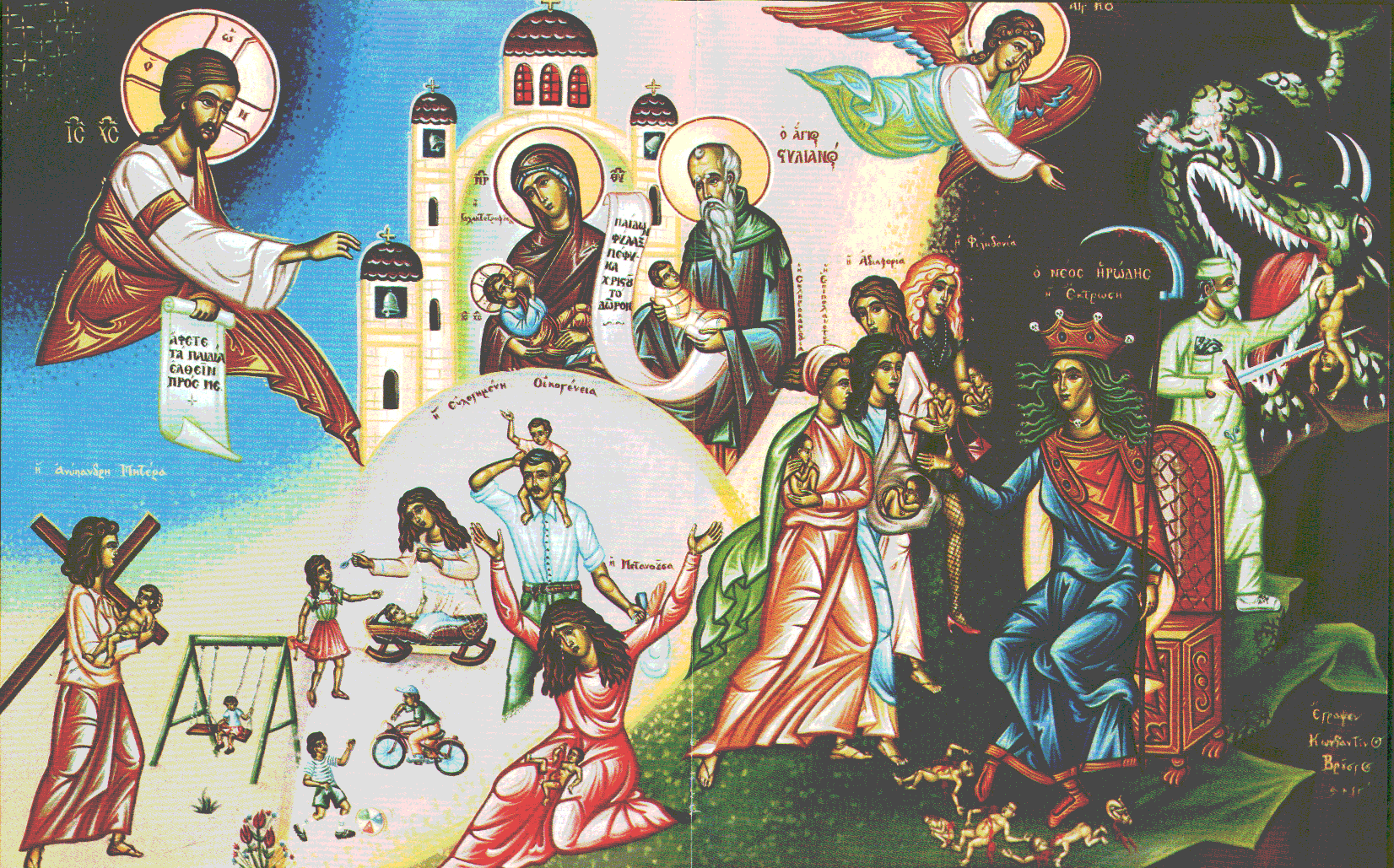
From the Allan Guttmacher Institute (props to Joshua for the link):
• 49% of pregnancies among American women are unintended; 1/2 of these are terminated by abortion.
• In 2000, 1.31 million abortions took place, down from an estimated 1.36 million in 1996. From 1973 through 2000, more than 39 million legal abortions occurred.
• Each year, 2 out of every 100 women aged 15-44 have an abortion; 48% of them have had at least one previous abortion and 61% have had a previous birth.
• 52% of U.S. women obtaining abortions are younger than 25: Women aged 20-24 obtain 33% of all abortions, and teenagers obtain 19%.
• Black women are more than 3 times as likely as white women to have an abortion, and Hispanic women are 2 1/2 times as likely.
• 43% of women obtaining abortions identify themselves as Protestant, and 27% identify themselves as Catholic.
• 2/3 of all abortions are among never-married women.
• On average, women give at least 3 reasons for choosing abortion: 3/4 say that having a baby would interfere with work, school or other responsibilities; about 2/3 say they cannot afford a child; and 1/2 say they do not want to be a single parent or are having problems with their husband or partner.
• 54% of women having abortions used a contraceptive method during the month they became pregnant. 76% of pill users and 49% of condom users reported using the methods inconsistently, while 13% of pill users and 14% of condom users reported correct use.
• 9 in 10 women at risk of unintended pregnancy are using a contraceptive method.
From a PowerPoint presentation from the AGI website comes the breakdown of the most important reasons given for obtaining an abortion:
Inadequate finances 21%
Not ready for responsibility 21%
Woman’s life would be changed too much 16%
Problems with relationship; unmarried 12%
Too young; not mature enough 11%
Children are grown; woman has all she wants 8%
Fetus has possible health problem 3%
Woman has health problem 3%
Pregnancy caused by rape, incest 1%
Other 4%
[Note: AGI is avowedly pro-choice, so these statistics are not from the "small and wacko fringe", that is to say, those of us who oppose the practice of abortion.]
January 21, 2005
Just So We're Clear--Sex Not Sacred
Sex doesn't sanctify anything. Marriage--that is to say, the Holy Spirit operating in Christian marriage--sanctifies sex.
Many advocates for pre-marital sex, extramarital sex, same-sex acts, and so forth view sex as a charism of grace. Witness Anglican Bishop V. Gene Robinson's comments to his fellow bishops at Gen Con 03:
"I just need to tell you that I experience that with my partner. In the time that we have, I can't go into all the theology around it, but what I can tell you is that in my relationship with my partner, I am able to express the deep love that's in my heart, and in his unfailing and unquestioning love of me, I experience just a little bit of the kind of never-ending, never-failing love that God has for me. So it's sacramental for me."
In other words, according to this view, it's sex that's the sacrament, not marriage. And since this is the case, then the Church must go ahead and bless what is already sanctified. . . since sex is the sacralizing agent.
But this is absolutely mistaken. This view is not Christian marriage, nor Christian sex. It is ritual cult prostitution. As St. Paul writes:
Do you not know that the unrighteous will not inherit the kingdom of God? Do not be deceived: neither the sexually immoral, nor idolaters, nor adulterers, nor men who practice homosexuality, nor thieves, nor the greedy, nor drunkards, nor revilers, nor swindlers will inherit the kingdom of God. And such were some of you. But you were washed, you were sanctified, you were justified in the name of the Lord Jesus Christ and by the Spirit of our God. "All things are lawful for me," but not all things are helpful. "All things are lawful for me," but I will not be enslaved by anything. "Food is meant for the stomach and the stomach for food"--and God will destroy both one and the other. The body is not meant for sexual immorality, but for the Lord, and the Lord for the body. And God raised the Lord and will also raise us up by his power. Do you not know that your bodies are members of Christ? Shall I then take the members of Christ and make them members of a prostitute? Never! Or do you not know that he who is joined to a prostitute becomes one body with her? For, as it is written, "The two will become one flesh." But he who is joined to the Lord becomes one spirit with him. Flee from sexual immorality. Every other sin a person commits is outside the body, but the sexually immoral person sins against his own body. Or do you not know that your body is a temple of the Holy Spirit within you, whom you have from God? You are not your own, for you were bought with a price. So glorify God in your body. (1 Corinthians 6:9-20 ESV)
Sex is, indeed, more than a physical act. It is a deeply unitive act. But the unitive nature of the act hardly equates to Christian sanctification. Rather, unless it is an act sanctified by the Holy Spirit in marriage, it creates deep disorder not only in body but in soul as well. One is unified with one's sex partner, but if it is non-marital sex, one has joined oneself not with Christ, but one has joined oneself with death.
That death may not, indeed, is likely to not, have immediate physical consequences. But the spiritual consequences are immediate, and will have ultimate sway if one does not repent. The social science research bears this out. Sexually transmitted diseases are far more common among people who are sexually active outside of marriage than those who reserve sex for marriage. Domestic violence is far more common among non-married sexual partners than among married persons. And so it goes.
Many who object to the Christian insistence on the importance and sanctity of marriage point out as a criticism that "traditionalists" seem "obsessed" with everyone else's sex life. But this is almost always a hypocritical--and unfair--characterization. In a society quite literally obsessed with sex, it just makes sense that most Christian criticism of our society would have to deal with this deep deformation of our culture.
It used to be that feminists objected to pornography for the very good and quite true reason that it made of women unhuman objects of lusts. Pornography depersonalized and devalued them. But so deep does our societal disorder and deformation run that now many feminists embrace porn as somehow "empowering" them. Funny, nothing has changed. Women still get objectified and depersonalized and dehumanized. Pornography has been indisputably linked to violence against women. But now "grrrl-power" feminists willingly cooperate with this objectification. They have given themselves up to the delusion that by allowing themselves to be objectified they somehow have gained power over men--presumably because they have the "power" to excite lust in the hearts of perverse men. This is the ultimate degradation: to get the victim to think she deserves and even enjoys the brutal treatment she's given. This is the deepest of rapes since it deforms a woman's soul.
One cannot turn on such sitcoms as "Will & Grace" and not be bombarded with one consistent and unquestioned premise: gay men think about sex all the time, and most gay men portrayed are promiscuous. Christians are right to object to this behavior. If there's any sort of obsession, it's with the audiences who demand this sort of deformed entertainment and indoctrination.
One cannot listen to pop music, especially rap music, and not be afflicted with violent recountings of rape and subjugation. One cannot watch music videos and not encounter hundreds of sexual and sexualized images.
Television actresses are applauded for their willingness to perform in "racy," or "risque," or "provocative" roles. Actresses that engage in graphic movie sex (Holly Hunter and Halle Berry) are given Academy Awards for those roles.
But pretty much the only religious experience our culture knows is sex. It is the closest thing that humans can manufacture that can mimic the Christological union of humans with their Father God. But since it is an imitation it is a perversity and a blasphemy. But it's all our culture knows. So we worship sex, and try to convert as many to the religion of cultic prostitution as possible. And we damage and damn as many souls as we convert.
It is not obsessive to continue to critique the perverse, indeed demonically fixated, prevalence of sex throughout our culture. It is a life-saving and loving act to judge. Christ came not to bring peace but a sword. It is Gospel to call death for what it is. It is the revelatory and saving grace of God, the medicine for the soul.
For Christians to pervert the Gospel by equating sex with sacrament is not just deeply deformed, it is not only deeply disordered, it is, ultimately, blasphemy. If Christians commited to the apostolic faith rise up to condemn this false gospel, then they are loving their neighbors as themselves, and thus fulfilling Christ's command to his brothers.
January 20, 2005
Bush's Second Inaugural
Well, I watched the inauguration over the internet this morning. It was pretty cool, over all, I think.
Chief Justice Rehnquist is just an out and out Major Tough GuyTM. I haven't been paying too much attention to political news lately, and thought he was pretty much done being a SCOTUS Justice. Cancer or no, by golly he was going to fulfill his promise and commitment to swear in the President. Wow, what a stud.
With all the hoo-ha over prayer and such, I listened intently for the name of Christ to be invoked in any of the prayers. Kirby John did not disappoint--even if some of the vocabulary of the prayer ("confess," "declare") left me baffled as to whether or not I could agree with his petitions. But then, there it was, the only clergy who prayed who invoked the name of our Lord Jesus--respectfully done, too, I must say. Good show.
Bush's speech writer needs a raise and an all-expenses-paid vacation (money footed by the RNC). Wow. Dang good speech, I must say. Some o' my fav'rite bits:
"America's vital interests and our deepest beliefs are now one. From the day of our Founding, we have proclaimed that every man and woman on this earth has rights, and dignity, and matchless value, because they bear the image of the Maker of Heaven and earth. Across the generations we have proclaimed the imperative of self-government, because no one is fit to be a master, and no one deserves to be a slave. Advancing these ideals is the mission that created our Nation. It is the honorable achievement of our fathers. Now it is the urgent requirement of our nation's security, and the calling of our time."
"We will persistently clarify the choice before every ruler and every nation: The moral choice between oppression, which is always wrong, and freedom, which is eternally right. America will not pretend that jailed dissidents prefer their chains, or that women welcome humiliation and servitude, or that any human being aspires to live at the mercy of bullies."
"Some, I know, have questioned the global appeal of liberty - though this time in history, four decades defined by the swiftest advance of freedom ever seen, is an odd time for doubt. Americans, of all people, should never be surprised by the power of our ideals. Eventually, the call of freedom comes to every mind and every soul. We do not accept the existence of permanent tyranny because we do not accept the possibility of permanent slavery. Liberty will come to those who love it."
"By our efforts, we have lit a fire as well - a fire in the minds of men. It warms those who feel its power, it burns those who fight its progress, and one day this untamed fire of freedom will reach the darkest corners of our world."
"I ask our youngest citizens to believe the evidence of your eyes. You have seen duty and allegiance in the determined faces of our soldiers. You have seen that life is fragile, and evil is real, and courage triumphs. Make the choice to serve in a cause larger than your wants, larger than yourself - and in your days you will add not just to the wealth of our country, but to its character."
"Liberty for all does not mean independence from one another. Our nation relies on men and women who look after a neighbor and surround the lost with love."
"We go forward with complete confidence in the eventual triumph of freedom. Not because history runs on the wheels of inevitability; it is human choices that move events. Not because we consider ourselves a chosen nation; God moves and chooses as He wills. We have confidence because freedom is the permanent hope of mankind, the hunger in dark places, the longing of the soul. When our Founders declared a new order of the ages; when soldiers died in wave upon wave for a union based on liberty; when citizens marched in peaceful outrage under the banner "Freedom Now" - they were acting on an ancient hope that is meant to be fulfilled. History has an ebb and flow of justice, but history also has a visible direction, set by liberty and the Author of Liberty."
Whoo-wee! That is some damn fine preachin', bro. Can I get an Amen?
This will be an interesting 'nother four years. Buckle up.
The entire speech can be read by clicking on the "Continue reading" link immediately below.
Vice President Cheney, Mr. Chief Justice, President Carter, President Bush, President Clinton, reverend clergy, distinguished guests, fellow citizens:On this day, prescribed by law and marked by ceremony, we celebrate the durable wisdom of our Constitution, and recall the deep commitments that unite our country. I am grateful for the honor of this hour, mindful of the consequential times in which we live, and determined to fulfill the oath that I have sworn and you have witnessed.
At this second gathering, our duties are defined not by the words I use, but by the history we have seen together. For a half century, America defended our own freedom by standing watch on distant borders. After the shipwreck of communism came years of relative quiet, years of repose, years of sabbatical - and then there came a day of fire.
We have seen our vulnerability - and we have seen its deepest source. For as long as whole regions of the world simmer in resentment and tyranny - prone to ideologies that feed hatred and excuse murder - violence will gather, and multiply in destructive power, and cross the most defended borders, and raise a mortal threat. There is only one force of history that can break the reign of hatred and resentment, and expose the pretensions of tyrants, and reward the hopes of the decent and tolerant, and that is the force of human freedom.
We are led, by events and common sense, to one conclusion: The survival of liberty in our land increasingly depends on the success of liberty in other lands. The best hope for peace in our world is the expansion of freedom in all the world.
America's vital interests and our deepest beliefs are now one. From the day of our Founding, we have proclaimed that every man and woman on this earth has rights, and dignity, and matchless value, because they bear the image of the Maker of Heaven and earth. Across the generations we have proclaimed the imperative of self-government, because no one is fit to be a master, and no one deserves to be a slave. Advancing these ideals is the mission that created our Nation. It is the honorable achievement of our fathers. Now it is the urgent requirement of our nation's security, and the calling of our time.
So it is the policy of the United States to seek and support the growth of democratic movements and institutions in every nation and culture, with the ultimate goal of ending tyranny in our world.
This is not primarily the task of arms, though we will defend ourselves and our friends by force of arms when necessary. Freedom, by its nature, must be chosen, and defended by citizens, and sustained by the rule of law and the protection of minorities. And when the soul of a nation finally speaks, the institutions that arise may reflect customs and traditions very different from our own. America will not impose our own style of government on the unwilling. Our goal instead is to help others find their own voice, attain their own freedom, and make their own way.
The great objective of ending tyranny is the concentrated work of generations. The difficulty of the task is no excuse for avoiding it. America's influence is not unlimited, but fortunately for the oppressed, America's influence is considerable, and we will use it confidently in freedom's cause.
My most solemn duty is to protect this nation and its people against further attacks and emerging threats. Some have unwisely chosen to test America's resolve, and have found it firm.
We will persistently clarify the choice before every ruler and every nation: The moral choice between oppression, which is always wrong, and freedom, which is eternally right. America will not pretend that jailed dissidents prefer their chains, or that women welcome humiliation and servitude, or that any human being aspires to live at the mercy of bullies.
We will encourage reform in other governments by making clear that success in our relations will require the decent treatment of their own people. America's belief in human dignity will guide our policies, yet rights must be more than the grudging concessions of dictators; they are secured by free dissent and the participation of the governed. In the long run, there is no justice without freedom, and there can be no human rights without human liberty.
Some, I know, have questioned the global appeal of liberty - though this time in history, four decades defined by the swiftest advance of freedom ever seen, is an odd time for doubt. Americans, of all people, should never be surprised by the power of our ideals. Eventually, the call of freedom comes to every mind and every soul. We do not accept the existence of permanent tyranny because we do not accept the possibility of permanent slavery. Liberty will come to those who love it.
Today, America speaks anew to the peoples of the world:
All who live in tyranny and hopelessness can know: the United States will not ignore your oppression, or excuse your oppressors. When you stand for your liberty, we will stand with you.
Democratic reformers facing repression, prison, or exile can know: America sees you for who you are: the future leaders of your free country.
The rulers of outlaw regimes can know that we still believe as Abraham Lincoln did: "Those who deny freedom to others deserve it not for themselves; and, under the rule of a just God, cannot long retain it."
The leaders of governments with long habits of control need to know: To serve your people you must learn to trust them. Start on this journey of progress and justice, and America will walk at your side.
And all the allies of the United States can know: we honor your friendship, we rely on your counsel, and we depend on your help. Division among free nations is a primary goal of freedom's enemies. The concerted effort of free nations to promote democracy is a prelude to our enemies' defeat.
Today, I also speak anew to my fellow citizens:
From all of you, I have asked patience in the hard task of securing America, which you have granted in good measure. Our country has accepted obligations that are difficult to fulfill, and would be dishonorable to abandon. Yet because we have acted in the great liberating tradition of this nation, tens of millions have achieved their freedom. And as hope kindles hope, millions more will find it. By our efforts, we have lit a fire as well - a fire in the minds of men. It warms those who feel its power, it burns those who fight its progress, and one day this untamed fire of freedom will reach the darkest corners of our world.
A few Americans have accepted the hardest duties in this cause - in the quiet work of intelligence and diplomacy … the idealistic work of helping raise up free governments … the dangerous and necessary work of fighting our enemies. Some have shown their devotion to our country in deaths that honored their whole lives - and we will always honor their names and their sacrifice.
All Americans have witnessed this idealism, and some for the first time. I ask our youngest citizens to believe the evidence of your eyes. You have seen duty and allegiance in the determined faces of our soldiers. You have seen that life is fragile, and evil is real, and courage triumphs. Make the choice to serve in a cause larger than your wants, larger than yourself - and in your days you will add not just to the wealth of our country, but to its character.
America has need of idealism and courage, because we have essential work at home - the unfinished work of American freedom. In a world moving toward liberty, we are determined to show the meaning and promise of liberty.
In America's ideal of freedom, citizens find the dignity and security of economic independence, instead of laboring on the edge of subsistence. This is the broader definition of liberty that motivated the Homestead Act, the Social Security Act, and the G.I. Bill of Rights. And now we will extend this vision by reforming great institutions to serve the needs of our time. To give every American a stake in the promise and future of our country, we will bring the highest standards to our schools, and build an ownership society. We will widen the ownership of homes and businesses, retirement savings and health insurance - preparing our people for the challenges of life in a free society. By making every citizen an agent of his or her own destiny, we will give our fellow Americans greater freedom from want and fear, and make our society more prosperous and just and equal.
In America's ideal of freedom, the public interest depends on private character - on integrity, and tolerance toward others, and the rule of conscience in our own lives. Self-government relies, in the end, on the governing of the self. That edifice of character is built in families, supported by communities with standards, and sustained in our national life by the truths of Sinai, the Sermon on the Mount, the words of the Koran, and the varied faiths of our people. Americans move forward in every generation by reaffirming all that is good and true that came before - ideals of justice and conduct that are the same yesterday, today, and forever.
In America's ideal of freedom, the exercise of rights is ennobled by service, and mercy, and a heart for the weak. Liberty for all does not mean independence from one another. Our nation relies on men and women who look after a neighbor and surround the lost with love. Americans, at our best, value the life we see in one another, and must always remember that even the unwanted have worth. And our country must abandon all the habits of racism, because we cannot carry the message of freedom and the baggage of bigotry at the same time.
From the perspective of a single day, including this day of dedication, the issues and questions before our country are many. From the viewpoint of centuries, the questions that come to us are narrowed and few. Did our generation advance the cause of freedom? And did our character bring credit to that cause?
These questions that judge us also unite us, because Americans of every party and background, Americans by choice and by birth, are bound to one another in the cause of freedom. We have known divisions, which must be healed to move forward in great purposes - and I will strive in good faith to heal them. Yet those divisions do not define America. We felt the unity and fellowship of our nation when freedom came under attack, and our response came like a single hand over a single heart. And we can feel that same unity and pride whenever America acts for good, and the victims of disaster are given hope, and the unjust encounter justice, and the captives are set free.
We go forward with complete confidence in the eventual triumph of freedom. Not because history runs on the wheels of inevitability; it is human choices that move events. Not because we consider ourselves a chosen nation; God moves and chooses as He wills. We have confidence because freedom is the permanent hope of mankind, the hunger in dark places, the longing of the soul. When our Founders declared a new order of the ages; when soldiers died in wave upon wave for a union based on liberty; when citizens marched in peaceful outrage under the banner "Freedom Now" - they were acting on an ancient hope that is meant to be fulfilled. History has an ebb and flow of justice, but history also has a visible direction, set by liberty and the Author of Liberty.
When the Declaration of Independence was first read in public and the Liberty Bell was sounded in celebration, a witness said, "It rang as if it meant something." In our time it means something still. America, in this young century, proclaims liberty throughout all the world, and to all the inhabitants thereof. Renewed in our strength - tested, but not weary - we are ready for the greatest achievements in the history of freedom.
May God bless you, and may He watch over the United States of America.
The Political Trap
There are two dangerous mindsets in the Christian world when it comes to Christians and political involvement, both of them ultimately based on a heresy: chiliasm.
The first dangerous mindset is that of Christian activism. The way I'm using that term specifically in this context is to indicate a mindset that assumes that the goal of human government is justice, and that such justice must primarily be enacted through political means. Christian activism seeks to make the Kingdom of God a present reality through human action, to achieve peace and justice through human government.
The other dangerous mindset is that of Christian withdrawal, specifically the abandonment of the political process. The mindset here assumes that political processes are so thoroughly fallen so as to be fundamentally incorrigible. Christian withdrawal seeks to witness to the political arena from outside it, even if that means allowing the devolution of human society, to achieve the Kingdom of God over against human society.
Both of these views are profoundly mistaken and heretical.
Christian activism is heretical because it assumes that human justice can approximate divine justice. But human justice is a travesty of divine justice. We see that currently in our U. S. society. Based on an adversarial understanding of human rights, the explicitly afforded rights of freedom of assembly and freedom of religious expression are curtailed for many citizens--which can hardly be called justice. Indeed, based as it is on such a competitive understanding of rights, Christian activism can not but restrain and limit the freedom of many to accomplish its ends. It enforces its will on those whose hearts remain unconverted. This is not the Kingdom of God. It is, in its final realization, a demonic blasphemy.
But Christian withdrawal is equally heretical in that it assumes that human effort can bring forth the full realization of the Kingdom of God, in this case by remaining uncontaminated and clean of the world's contagion. But this withdrawal fails to reckon with the fundamental Christian teaching that the earth is the Lord's and all therein, and that all things serve Him. Based as it is on a mistaken understanding of the Kingdom of God, it cannot but fail to frustrate the Christian's obligation to love his neighbor.
Christian activism either attempts to meet spiritual needs with material means, or simply fails to adequately seek to meet what are the primary human needs, the spiritual. Seek first His Kingdom, our Lord tells us, and all these things will be added as well. Christian activism cannot but fail to divide as the accomplishment of Christian virtues and ends become equated with specific means. All Christians can agree that the poor ought be cared for. But it is not the Gospel that a government must redistribute the wealth of its citizens to do so. This is enforcement without conversion: the Devil's gospel. The accomplishment of secular justice advances not one whit the true Justice on which it is purportedly based. It provides nothing more than a poor and destructive substitute.
Christian withdrawal attempts to both witness to the purity of the Gospel and Christ's Church, but it fails, ultimately to accomplish that fundamental Gospel dogma that is half the summation of the Law and the Prophets. Christians can surely agree that the political process, founded necessarily on coercion, is problematic, and that political power is corrosive. Christians can surely agree that political ends are mostly accomplished with deception and outright falsehood, the abuse of power and obligation. But if the earth is indeed the Lord's so too is the political process. Indeed, all government has been instituted by God for the benefit of man. But government is essentially fallen and must be infused with the Christian presence and witness, however severe such a struggle is for each citizen and representative to maintain through God's gracious energies the purity of heart necessary for final salvation. But our Lord is our example. We do not escape the desert and the demons by withdrawal, we just relocate them and intensify their subtle attacks in our souls.
Politics is a trap. But Christians, wise as serpents and guileless as doves, have the obligation to both transform politics and not be tempted by its false and inhuman promises. Christ's final temptation was the worship of Satan for political power. For us, the temptation is political power, which if not guarded against will lead us to the satanic worship.
But the Church's monastics show us that withdrawal is equally a trap. It is the ultimate place of pride, the same satanic pride that tempted Adam and Eve, and which was the origin of the Luciferic fall. And it is, though scented with rose water, the contempt and disregard of the least of these, which is to say, of Christ.
But God is faithful. He will, with the trap, provide a way of escape if we have not the strength to stand firm. That escape, however, will be by way of the path which squeezes and scrapes. And only a few will find it.
January 19, 2005
The Fatherhood Chronicles LVIII
A Sofie Glossary
For those who will be coming to our house in the coming months, I present here a list of Sofie-ese. Each entry in the Sofie glossary is spelled phonetically. [Note and Update: On playing with my daughter last evening (1/19), it became clear to me that the phonetic spellings of some of the terms below were wrong; these have been corrected. Also, the glossary has been augmented with additions I forgot about. I'll continue to make additions as needed. Check back often.]
ay(ng)-oo: "thank you;" though she used to say this a lot, it's much more rare, and almost always only when prompted
baba: "papa;" me (Clifton)
baybee: "any human being younger than two;" also her "doll"
bi: "bite"; sounds a lot like "bye" but is short and not as drawn out as "bye"
bye: "goodbye;" also, when holding an object, "I'm finished with this, please take it"
deehn: "drink" more often "geehn" see below
dow: "put me down"; also, "pick me up"
eye luh luh: "I love you"
eyepay: "airplane"
gangkee: "blankie," "blanket"
geehn: "drink"
gih: "get"; what one says to a "puppee"
gingkee: "binkie," "pacifier"
guh: see "kuh" below
heh: "head;" usually only in combination with motions to "Head, Shoulders, Knees and Toes"
kakaw: "cracker"
kee: "Kix" sometimes pronounced "kih"
kih: see "kee" above
kuhkee: "cookie"
kuh: me (Clifton), see also "baba"
mama: "mama;" Anna
no: "no"
puppee: any "dog;" also most animals
sheezh: "cheese" (either a slice of cheese or string cheese)
uh: "pick me up"; usually only said when prompted as we correct her when she says "dow" but means "uh"
If you need any translation help, just see Anna or myself. Good luck, and have fun as you learn to speak Sofie.
January 18, 2005
Gnostic Christianity
In an article, The Church Why Bother? (hat tip: Touchstone's Mere Comments), Tim Stafford analyzes a recent Barna report:
The Barna Research Group reports that in the United States about 10 million self-proclaimed, born-again Christians have not been to church in the last six months, apart from Christmas or Easter. (Barna defines "born-again" as those who say they have made a personal commitment to Jesus Christ that is still important today, and believe they will "go to heaven because I have confessed my sins and have accepted Jesus Christ as my Savior.")Nearly all born-agains say their spiritual life is very important, but for 10 million of them, spiritual life has nothing to do with church.
About a third of Americans are unchurched, according to Barna's national data. Approximately 23 million of those—35 percent of the unchurched—claim they have made a personal commitment to Jesus Christ that is still important in their lives today.
This split--thoroughly modern, thoroughly Cartesian--between what one believes or thinks and what one does with one's body, is, in my view, endemic in modern-day Protestantism. I know. This was pretty much the scenario in my heritage churches, except it was easier twenty and thirty years ago to stress the need for church. Not that my family went all the time. By the time I was in grade school, except for a couple of brief periods, our family went very irregularly to church.
Stafford is right: "I would call it Gnostic faith. For them the spirit is completely separated from the body. They think your spirit can be with Jesus Christ while your body goes its own way."
But, when you think about it, really, what do "born-again believers" miss by opting out of Protestant/evangelical/fundamentalist church?
They need not lack the Word of God. The Bible is available through Barnes & Noble, and will undoubtedly continue to be published at a profit even if all the Christians get raptured away. Radio and TV offer excellent Bible teaching. So do books and magazines.Fellowship? The internet offers chat rooms and Bible study groups. Friends have told me their internet prayer support group reaches more depth and is more dependable than anything they encounter in the flesh.
Worship? Some people find that music CDs provide what they need. Others find great inspiration watching Robert Schuller's Hour of Power. Anyway, if you need a worship fix you can slip into any big church and leave without bothering a soul.
Granted, you need a church to get baptized and to receive Communion. Let's admit, though, that in many churches the sacraments are a devalued commodity. The same for church discipline, only more so. If you expect church to provide the bracing rule that purifies souls, forget it in most places.
Few modern churches really emphasize either baptism or Communion. In my own churches, anyone could baptize you, and you could always buy grape juice and unsalted crackers at the store and "remember" Christ's sacrifice on your own. I know. I did it myself a few times.
But this is a Gnostic, which is to say, heretical, Christianity. If you deny the bodily aspects of the Faith, you soon deny the Church. And if you deny the Church, it's not too far a step to deny the Incarnation. And then Christ becomes just another moral exemplar and teacher: just like Muhammed, Buddha, and Ghandi. It's not inevitable, but there is a progression: deny the Sacraments, deny the Church, deny Christ.
January 16, 2005
With All Due Respect, This Is Not How to Repent
For the life of me, I can hardly see how the Anglican Communion, such as it now is, can hold together much longer. The Anglican churches in the U. S. and Canada were called upon to voice their regret over their part in the current schism among the provinces. So the Episcopal House of Bishops met last week, and one of them came up with this (emphasis added):
Dear All,One point must be clearly understood: the Primates' Meeting in February will determine whether or not the Windsor Report as it stands will be what we must work with. It was quite impossible to decide anything about moratoria until that happens. The Bishops committed to engage the process outlined in the Windsor Report, insofar as our polity allows. Furthermore, there must be a reciprocal gesture from the other parties named in the Windsor Report who are to effect moratoria on crossing diocesan boundaries. Anyone who claims that the House in Salt Lake City rejected *or* accepted moratoria on blessings of same-sex unions or approvals to bishops-elect who live in committed same-sex partnerships simply wasn't there. We have to wait and see what the process at the global level looks like as things unfold before we can take any action.
The most important point is that we took the Report very very seriously as a House. There was clear consensus about our real regret at having caused deep disruption in other churches' lives, adding to what the Presiding Bishop has said on several occasions. There was also a consensus on engaging the process of reconcilitation, within the bounds of our polity as a church. The "Word to the Church" reflects I believe a genuine deeply-felt word from your bishops speaking as one. . . .
Pierre Whalon
So, according to Bishop Whalon, "we'll only repent if they do." In the meantime, instead of reconciling, we commit to continue to think about reconciling.
This is an excoriable slap in the face to the rest of the Anglican Communion, an episcopal offering of the middle finger to anyone who has less money and less political clout than America. Talk about your unilateral actions.
I'm not Anglican anymore, and here is one reason why. How could I be part of a church that so blatantly offends her sister churches again and again, then blames them for lack of reconciliation (we'll have to see what they're going to do)? How could I be part of a church that is so arrogant to believe that everyone else living and dead must be wrong? How could I be part of a church that thinks the only thing they have to regret about their actions is that the other guy got upset? In short, how could I be part of a church that no longer knows how to repent?
I feel for my brother and sister Anglicans, two of whom I am thinking of right now, who can know only the pain and frustration of trying to serve God in such a context. How can they exhort anyone to repent of their sins, when the example put on by the highest levels of the denomination is that repentance is never necessary unless the other guy does so first?
May God forgive me, and ever work in me to keep me from this sort of hardening of the heart.
And I . . . Am a Happy Man!!
Pittsburgh Steelers 20
New York Jets 17
In overtime.
And I got to see every minute of it on TV.
Now, it will be either New England Patriots or Indianapolis Colts (I'm picking the Colts) next Sunday at Pittsburgh, at 6:30 on CBS 2 here in Chicago (don't call me, IM me, or email me--I'll be watching the game).
January 15, 2005
Another Bit of Evidence Showing How the Move from Restoration Movement to Orthodoxy Has Been Relatively Short
I have maintained in another post, that in coming to the Orthodox Church I was returning to the home that my Restoration Movement heritage long pointed me toward. Here are the first several paragraphs of a sermon by an early Restoration Movement leader, Benjamin Franklin (a sort history and biography introduces the sermon), entitled, "The Church--Its Identity". As you read the text, keep in mind that Mr. Franklin argues essentially that the Restoration Movement churches are in fact the Body of Christ. Yet from Mr. Franklin's initial theses to the Orthodox Church is, in many ways, scarcely a full stride. But it is a small shift of eternal significance.
There is a community called, in the New Testament, "the kingdom of God" (John iii: 3); "the Church of the living God" (1 Tim. iii: 15); "one body" (Eph. iv: 4).To be in this body, Church, or kingdom, is the same as to be "in Christ." It is to be in a justified state, or pardoned state. To enter into it, is to enter into a state of justification or pardon. In entering into that body, we come to the blood of Christ, which cleanses from all sin; to the Spirit and to the life of Christ, all of which are in the body. If we enjoy pardon, the benefits of the blood of Christ, the Holy Spirit, the life of Christ, we must be in the body. God and Christ dwell in the Church, which is the temple of God and the "pillar and support of the truth." To dwell with God and Christ, enjoy the cleansing of the blood of Christ, the remission of sins, the impartation of the Spirit of God, and the new life, we must be in Christ, or in his body--the Church. To be out of the Church is to be separated from God, Christ, the Holy Spirit, the blood of Christ, the life of Christ, and justification. It becomes a matter of momentous importance, then, to know that we are in Christ, or in the Church.
It is not enough to know that we are in a Church, but we must know that we are in "the Church of the living God," "the kingdom of God," or "body of Christ." There is not a promise in any other institution or community, but this. The Lord has one Church, and we must not mistake something else for that Church. How can we know that we are members of the Church, unless we know what the Church is? If we do not know what the Church is, we do not know whether we are in the Church or not, whether we are in Christ or not, whether we are justified or not. If we intend to enjoy God, Christ, the Holy Spirit, the blood of Christ, and, in one word, the salvation of God, in the kingdom or Church, we must be in that kingdom. To be in the kingdom or Church, we must know what it is. How shall we, then, identify the Church or kingdom of Christ? I lay down the following points for consideration:I. A body, or community, not built on the foundation which God laid, is not the community which the Lord calls "my Church."
II. A community not founded and established in the right place, is not the Church of Christ.
III. A community not founded at the right time, is not the kingdom of Christ.
IV. No church can be the true Church not founded by the proper persons, Christ and the apostles.
V. A kingdom, with any other law than the one given by the head of the Church, is not the kingdom of Christ.
VI. Any community labeled with a foreign name, or a name not found to designate the body of Christ, in the New Testament, is not the kingdom of God.
A failure at any one of these points is fatal to the claims of any body professing to be the body of Christ. It is due to the greater portion of the religious bodies of our day, called "churches," to state distinctly that they do not claim to be the kingdom of God, or the body of Christ. Excepting a few, the balance only claim to be branches of the body, or Church of Christ. Where a church does not claim to be "the Church," but simply a branch of the Church, the members are only members of a branch, and the officers are only officers of a branch, and not members and officers of the body of Christ
January 14, 2005
How Askesis Saves
Matt Nelson made a comment to my post yesterday, which has moved me to reflect a bit further on askesis. First of all, what I take to be Matt's overall point—the danger of a sort of super-correct convert legalism—is a point with which I agree (and said so). Our salvation is by faith through grace, and not from works. Given my own sinful weaknesses, this is a point for which I need frequent reminding. Thankfully, our parish priest knows, or suspects, this about me and frequently negates my all-too-frequently o'erweening zeal.
But Matt also says something to which I want to respond. He writes, “Personally, I believe that the traditions of Anglicanism, Catholicism, and Orthodox all offer sound models for salvic spiritual acesis.” Here I want to object. In point of fact, I do not believe Anglicanism (I cannot speak for Catholicism) does not “offer a sound model for salvic spiritual ascesis.” Indeed, what it offers is positively deterimental to one's spiritual health.
With that inflammatory comment out of the way, let me offer my clarification. I believe that at one time the Anglican tradition may well have offered a sound model. But it does so no longer. At one time there was indeed a common Book of Prayer, with liturgies firmly entrenched in the historical life of the Church. There was an agreed moral framework, similarly situated on the patristic consensus. And these two things: a common liturgy and a common set of moral virtues are essential for a model to be both truly asketic and therefore in some way salvific.
The problem with the model Matt alludes to (and one can hardly expect an exhaustive theory in a blog reply) is not its “volunteerism.” After all, the Orthodox Church, whose mind I am attempting to conform to, is synergist. The work of grace done in us is one in which we co-struggle with God. Rather, the problem with the Anglican askesis today (and this seems to be implicit in Matt's reply) is its individualistic character bereft of the support and co-struggle of the church community. Even in a diocese and a parish with such rich Anglo-Catholic ties as that in which I came into the Episcopal Church, any spiritual discipline I undertook I undertook alone. Although my priest and I did from time to time fast together, there was nothing obliging him (or me, for that matter) to do so. And although I sought his guidance—which itself was good—there was no larger connection to the parish, let alone the Episcopal Church, or the Anglican tradition, as a whole. I may as well have walked the labyrinth and practiced TM as fasted and prayed the office. Either would have been supported by one or another priest, not that such support was in any way obligatory on me.
The big difference for me in Orthodoxy is that there is one standard to which all are obliged, with that standard being specially fitted to us by our parish priest or spiritual father. I know that on Wednesdays and Fridays of almost every week, I will not be the only one fasting from meat. On Sunday mornings, I know that I will not be the only one who hasn't consumed any food or drink since the night before. I know that each morning, at meals, and each evening all the members of our parish will be offering their prayers (different though they will be in their various forms, to suit each age and condition in life). I am tied to my community. And not just my parish, but the entire Orthodox Church throughout the world.
Will there be Orthodox who fail to do these things? Will there be priests who allow a lax, secularistic attitude to these universal expectations? In short, will there be many who fail to do these things? Indeed, there will be, with me, chiefest sinner, among them.
But even in these failures one of the most important, and salvific, facts of askesis will still be front and center: there is no salvation outside the Church. If we are saved, we are saved together. If we perish, we do so alone. My askesis almost certainly fails to be salvific if it is just me and Jesus. But if I do it with the People of God, though it still may fail to be salvific, it will fail in spite of that, not because of it. Individualistic askesis must always toe the line of perdition.
The reason for this is, ultimately, eschatological and ecclesiological: the Church is the Body of Christ. By communion with, and our living and willful participation in, the Church, we contact the Life of God in His Son. Askesis saves because it is from the Church, and because the Church is Christ's Body, askesis opens to us the Life of our Lord.
Our Holy Mother Among the Saints, Nina, Equal to the Apostles, Enlightener of Georgia
Troparion of St Nina, Equal-To-The-Apostles Tone 4
O handmaid of the Word of God,/ who in preaching equaled the first-called Apostle Andrew,/ and emulated the other Apostles,/ enlightener of Iberia and reed-pipe of the Holy Spirit,/ holy Nina, pray to Christ our God to save our souls.
Kontakion of St Nina Tone 2
Let us sing praises to the chosen of Christ,/ Equal-to-the-Apostles and preacher of God's word,/ the bearer of good tidings who brought the people of Katralina/ to the path of life and truth,/ the disciple of the Mother of God,/ our zealous intercessor and unwearing guardian,/ the most praised Nina.
From the Prolog:
Nina was a relative of St. George the Great Martyr and Juvenal, the Patriarch of Jerusalem. Her parents belonged to the nobility in Cappadocia and since they both were tonsured in the monastic state, Nina was educated under the tutelage of Patriarch Juvenal. Hearing about the people of Georgia, the virgin Nina, from an early age, desired to go to Georgia and to baptize the Georgians. The All-Holy Mother of God appeared to Nina and promised to take her to this land. When our Lord opened the way, the young Nina, indeed, traveled to Georgia where, in a short period of time, she gained the love of the Georgian people. Nina succeeded in baptizing the Georgian Emperor Mirian, his wife Nana and their son Bakar, who, later on, zealously assisted in Nina's missionary work. During her lifetime, Nina traveled throughout Georgia, mainly to convert the entire nation to the Faith of Christ, exactly at the time of the terrible persecution of the Christians at the hands of Emperor Diocletian. Having rested from her many labors, Nina died in the Lord in the year 335 A.D. Her body is entombed in the Cathedral Church in Mtzkheta. She worked many miracles during her life and after her death.
From the OCA website:
Holy Equal-to-the-Apostles Nino, Enlightener of Georgia, was born around the year 280 in the city of Kolastra in Cappadocia. Her father Zabulon was related to the holy Great Martyr George (April 23). He came from an illustrious family, and pious parents, and he was highly regarded by the emperor Maximian (284-305). Zabulon, a Christian, served in the military under the emperor, and he took part in the liberation of Christian captives from Gaul (modern France). St. Nino's mother, Susanna, was a sister of the Patriarch of Jerusalem. [Translator's note: In 1996, the parents of St. Nino were numbered among the Saints.The commemoration of Sts. Zabulon and Susanna is May 20].When she was twelve years old, St. Nino went to Jerusalem with her parents, who had only this one daughter. By their mutual consent and with the blessing of the Patriarch, Zabulon devoted his life to the service of God at the Jordan, and Susanna was made a deaconness in the church of the Holy Resurrection. The upbringing of St. Nino was entrusted to the pious Eldress, Nianphora. St. Nino displayed diligence and obedience for two years. By the grace of God, she got into the firm habit of fulfilling the rule of prayer, and reading the Holy Scriptures.
Once, while tearfully reading the Gospel passages describing the Crucifixion of Christ the Savior, she wondered about the fate of the Chiton (Tunic) of the Lord (Jn 19:23-24). When St. Nino asked where the Lord's Chiton (Tunic) had gone (October 1), the Eldress Nianphora declared that the Lord's incorrupt Chiton had been carried off by the Rabbi Eleazar of Mtskhet and taken back with him to a place named Iberia (Georgia), and called the appanage (i.e., the "allotted portion") of the Mother of God. During Her earthly life, the All-Pure Virgin had received Georgia as her allotted portion, but an angel of the Lord appeared to Her and foretold that Georgia would become Her earthly portion only after Her Repose. She was told that Mt. Athos (also called the portion of the Mother of God) would be given to Her by God.
The Elderess Nianphora told her that Georgia had not yet been enlightened by the light of Christianity, St. Nino entreated the Most Holy Theotokos to grant that she would see Georgia converted to Christ, and might also enable her to find the Tunic of the Lord.
The Queen of Heaven heard the prayer of the young righteous one. Once, when St. Nino was resting after long prayer, the All-Pure Virgin appeared to her in a dream, and entrusting her with a cross plaited from sprigs, She said, "Take this cross, for it will be for you a shield and protection against all enemies both visible and invisible. Go to the land of Iberia, proclaim there the Gospel of the Lord Jesus Christ and spread forth His grace, and I will be your Protectress."
Awakening, St. Nino saw the cross (now preserved in a special reliquary in the Tbilisi Zion cathedral church) in her hand. Rejoicing in spirit, she went to her uncle, the Patriarch of Jerusalem, and told him about her vision. The Patriarch then blessed the young virgin in her deed of Apostolic service.
On the way to Georgia, St. Nino escaped martyrdom, which however befell her companions: the emperor's daughter Ripsimia, her guide Gaiania and thirty-five virgins (September 30), who had fled to Armenia from Rome to escape persecution under the emperor Diocletian (284-305). Bolstered in spirit by visions of an angel of the Lord, who appeared the first time holding a censer, and a scroll the second time, St. Nino continued on her way and arrived in Georgia in the year 319. News of her soon spread through the area of Mtskhet, where she lived in asceticism. Numerous miracles accompanied her preaching. On the Feast of the Transfiguration of the Lord, as pagan priests offered sacrifice in the presence of the emperor Mirian and a multitude of the people, the idols Armaz, Gatsi, and Gaim were toppled from a high mountain through the prayers of St. Nino. This was accompanied by a strong storm.
Entering Mtskhet, the ancient capital of Georgia, St. Nino found shelter in the household of a childless imperial official, whose wife Anastasia was delivered from infertility through the prayers of St. Nino, and she came to believe in Christ.
St. Nino healed the Georgian empress Nana from a grievous infirmity. After her Baptism, she ceased to worship idols and became a zealous Christian instead (October 1). In spite of the miraculous healing of his wife, the emperor Mirian (265-342), in view of the complaints of the pagans, prepared to subject St. Nino to fierce tortures. "At that very moment, when they plotted to execute the righteous one, the sun darkened and an impenetrable mist covered the place where the emperor was."
The emperor suddenly fell blind, and seized by terror, his retainers began to beg their pagan idols for the light to return. "But Armaz, Gaim and Gatsi were deaf, and the darkness only intensified. Then with one voice they cried out to the God of Nino. Instantly, the darkness was lifted, and the sun shone in all its radiance." This event occurred on May 6, 319.
Emperor Mirian, healed from his blindness by St. Nino, accepted holy Baptism with all his retainers. By 324, Christianity had established itself in Georgia.
The Chronicles relate that through her prayers, the location of the Lord's Chiton was revealed to St. Nino. At this place the first Christian church was built in Georgia (at first a wooden church, but then a stone cathedral, in honor of the Twelve Holy Apostles, the "Svetitskhoveli").
At the request of the emperor Mirian, and with the cooperation of the Byzantine emperor St. Constantine (306-337), Bishop Eustathios of Antioch was sent to Georgia with two priests and three deacons. Christianity took a definite hold upon the land. The mountain regions of Georgia, however, remained without enlightenment.
St. Nino traveled with the presbyter James and one of the deacons, to the upper regions of the Aragva and Iori Rivers, where she preached the Gospel to the people. Many of them came to believe in Christ and accepted holy Baptism. Then St. Nino proceeded to Kakhetia (Eastern Georgia) and settled in the village of Bodbe, in a small tent beside a mountain. Here she led an ascetic life of constant prayer, and converting the local inhabitants to Christ. Amidst all these was the empress of Kakhetia, named Sodzha [Sophia], who accepted Baptism with all her court and a multitude of the people.
Having completed her apostolic service in Georgia, St. Nino had a revelation from God of her impending end. In a letter to the emperor Mirian, she requested him to send Bishop John, so that he might prepare her for her final journey. Not only Bishop John did come, but also the emperor with all the clergy went to Bodbe, where many healings took place at the deathbed of St. Nino. For the edification of the people who had come, and at the request of her disciples, St. Nino told them of her life. This narration, written down by Solomia of Udzharm, has served as the basis of the Life of St. Nino.
Having received the Holy Mysteries, St. Nino instructed that her body be buried at Bodbe, and then she peacefully departed to the Lord in the year 335 (according to other sources, in the year 347, at the age of sixty-seven, after 35 years of apostolic labor).
The emperor, the clergy and the people, grieving over the death of St. Nino, wished to transfer her relics to the Mtskhet cathedral church, but they were not able to remove the coffin of the ascetic from her chosen place of rest. The emperor Mirian laid the foundations of a church on this site in 342, and his son the emperor Bakur (342-364) completed and dedicated the church in the name of St. Nino's relative, the holy Great Martyr George.
Later, a women's monastery dedicated to St. Nino was founded at this place. The relics of the saint, concealed beneath a crypt at her command, were glorified by many miracles and healings. The Georgian Orthodox Church, with the consent of the Patriarchate of Antioch, designated St. Nino the Enlightener of Georgia as Equal-to-the-Apostles. She was numbered among the Saints, and her Feast was established as January 14, the day of her blessed repose.
A Brief Chronology of the Life of Blessed Hieromonk Seraphim (Rose) of Platina
Born Eugene Dennis Rose 13 August 1934
First attends San Francisco cathedral of the Russian Orthodox Church Outside Russia 1956
Graduates from Pomona College with a bachelor's degree in Oriental Languages 1956
Recieves master's degree in Oriental Languages from the University of California, Berkeley 1961
Christmated 25 February 1962
Formed the St. Herman Brotherhood (with Gleb Podmoshensky) August 1963
Opens Orthodox Books and Icons bookstore 27 March 1964
Publishes first issue of The Orthodox Word March 1965
Ordained a reader 25 March 1965
Leaves world 27 August 1969
Tonsured a monk, takes name of Seraphim 27 October 1970
Other brothers join Brs. Seraphim and Gleb 1973
Completes first edition of Orthodoxy and the Religion of the Future 9 May 1975
Finishes translation of Vita Patrum October 1975
Finishes translation of first volume of The Northern Thebaid 26 November 1975
Ordained a deacon 2 January 1976
Ordained a priest 24 April 1977
Completes The Place of Blessed Augustine in the Orthodox Church Summer 1978
Finishes translation of The Sin of Adam 1979 (reissued later as First-Created Man)
Extensively revises Orthodoxy and the Religion of the Future 1979
Publishes The Soul After Death in book form 1980
Resposes in the Lord 2 September 1982
Ten Arguments From Social Science Against Same-Sex 'Marriage'
Ten Arguments From Social Science Against Same-Sex 'Marriage'
A large and growing body of social scientific evidence indicates that the intact, married family is best for children. This InFocus paper highlights ten research-based reasons why marriage should only be seen as the union of one man and one woman.
(Read the entire article at the link above.)
January 13, 2005
Askesis: The Disappointment of My Anglican Journey
When I began to turn toward the historical Church as a more complete living out of my understanding of the Restoration Movement Plea, one of the things that attracted me was Benedictine monasticism. Here was a holistic structure of faithful living: work (most of it laborious and mundane) and study (always in obedience to the abbot, and thus the Church and the Faith), centered around the infusion of prayer and worship into the entire day. I longed for this sort of structure: the Eucharist, the daily office and personal devotions—all supporting my work and my study. One of my professors, J K Jones, remarked to me, in light of my concerns, that I may well be one to start a Protestant monastery.
As it happened, the first churches I came across that were Protestant and yet also had the structure I was seeking (Eucharist, office, prayers) were the Anglican churches. Indeed, later, as I was on the threshold of the Anglican church, Martin Thornton's English Spirituality and Christian Perfection only solidified this understanding. So in my final years at Ozark, I came to the notion that in Anglicanism I would find the sort of askesis I desired.
Unfortunately, that proved to be both true and false.
In the few months leading up to my confirmation in the Episcopal Church, as I read, studied and prayed with my priest, Fr. Jim, it became increasingly clear that my notion of Anglicanism, developed over the previous five years, was largely romanticized. Somehow, in the providence of God, the Anglicanism I encountered (mostly in books, though a handful of occasions in parishes and their priests) was or leaned heavily towards the Anglo-Catholic. So I knew about the Wednesday and Friday, and Lenten, fasts. I knew about the keeping of the daily office. I was prepared for regular confession. What I found, however, was no obligation to fast, no public celebration of the office, and very rare confession. To uphold these disciplines, I had to be prepared to do so alone. Certainly my priest encouraged me. But there was no public acknowledgment of these things by the parish, let alone the wider Episcopal church.
My priest and I did, several months after my confirmation, begin together to celebrate Morning Prayer in the chapel. And this turned into regular, public weekly offices. Indeed, soon I and several others, after some training, were licensed in the diocese as lay readers. But whether or not I kept the fasts (which were ambiguous and undefined—fasting from meat only? what about fish?), or made confession, or prayed the office was my business alone, or at least mine under pastoral counsel. My observance of these things—when I was able to observe them at all—did benefit me in my walk of faith. But it was sporadic, irregular, and, quite frankly, unhelpful.
When I entered the Episcopal seminary, there was the public praying of morning and evening prayers, with daily Eucharist. But these proved not only unhelpful for me, they proved quite positively detrimental to my faith. There was too much experimentation for these offices to ever become a discipline; things changed too much for anything from them to make marks on my soul and my prayer. Then, too, there was the distortion of the Faith. How could I be formed in the Faith once for all delivered to the saints, when I got instead imitations of or departures from it?
My last confession in the Episcopal Church is surely emblematic as surely as it was my last. I had, as I had done since my first confession, spent several days remembering my sins and repenting them. We prayed the rite, I voiced my sins. As was usual, the chaplain offered counsel. And it was that counsel that undid all the askesis of my confession: these were not sins, merely mistakes; my guilt was not real, only a state of mind. We prayed the remainder of the confessional liturgy. I left, and on the way back to my apartment, wept some. Yes, God had met my repentance with his mercy, rite or no rite. But having come expecting the ministry and faith of the Church, I was left with the emptiness of psychology. God forgive me, I was angry for many days after.
The Anglican churches gave me the structures and rites for which I'd been seeking. But they gave me no askesis. It was spiritual disciplines a la carte, a way of faith of my own making, dangerously well-suited to meet my own personal whims and idiosyncracies—and therefore to give me nothing in which to work out my salvation with fear and trembling. I wanted steak. I got a rice cake.
I was often faulted, both as a Restoration Movement Christian and as an Episcopalian, for wanting to be a monk. Perhaps. I looked into third-order lay membership in some brotherhoods. But I rather suppose what I was looking for was what my patron, Blessed Hieromonk Seraphim, well expressed: “We should not think that only the monks are responsible for living a Christian life; such an idea is not true; a monk is just like everyone else. Everyone must wake up. If you look at the early Church, there was no distinction as to who was a monk and who was a layman-they all recognized the truth and they saw that it was urgent, to be lived immediately.”
In Orthodoxy, there is the Eucharist, the daily office, many personal devotions, fasting (much more rigorous than I ever imagined as an Anglican), but most of all every single one of these askeses is tied point by point, frame and cloth, to the Faith once for all delivered to the saints. Here is no mere spiritual discipline to suit my fancy. Here is life. It really is that simple and stark.
Metropolitan Vitaly: On the Unity of Body and Soul
The immortal soul cannot be indifferent to pious deeds committed by the body which is its home. As the body bows, so does the soul bow with it and grows obedient. We are human; we need to see, to feel, to smell and to hear. And in the church, candles burn with the divine light; the ringing of bells sanctifies the air; incense reminds us of the fragrance of prayers; and from each icon the Saviour Himself, the Mother of God and all the saints mysteriously look at us and we look at Their holy images as two worlds come face to face: the dwellers of the Kingdom of God and we, the sinners.
The Failure of Social Research to Substantiate Advocacy of Same-Sex Parenting
Homosexual Parenting: Placing Children at Risk
A number of studies in recent years have purported to show that children raised in gay and lesbian households fare no worse than those reared in traditional families. Yet much of that research fails to meet acceptable standards for psychological research by openly lesbian researchers who sometimes conduct research with an interest in portraying homosexual parenting in a positive light. The deficiencies of studies on homosexual parenting include reliance upon an inadequate sample size, lack of random sampling, lack of anonymity of research participants, and self-presentation bias.
(Read the entire article at the link above.)
January 12, 2005
Fr. Seraphim (Rose) of Platina: On External "Orthodoxy"
From a Q & A session after his talk "Signs of the End Times":
Anyone who is attracted merely by glittering censors, incense and beautiful vestments, he, first of all, will fall down before Antichrist.
Askesis: The Biggest Failure of My Heritage Churches
I've written in several posts about my faith heritage in the Restoration (or Stone-Campbell) Movement churches. Some people, when as adults they choose a new religious heritage or identity, one different from that in which they were raised, tend to first relate to their heritage faith antagonistically, emphasizing the failures and blindspots, and how their new found heritage or identity so much better addresses the various realities with which they are confronted. A converted atheist of all people is the most certain of the claim that religion is nothing more than infantile superstition having nothing to do with reason.
In my case, however, I cannot consciously recall ever having any reaction of that sort. I certainly have spoken of what I take to be the failures and weaknesses of my heritage faith, but the fact of the matter is, I know my heritage churches to have many strengths, and have never really considered myself alien to those churches, even in pursuing membership in the Episcopal churches and (now) in the Orthodox Church. If I were ever very critical of my heritage faith, it was while still a student at one of the Restoration Movement Bible colleges--which is what one normally expects of ministry students. From my Restoration heritage I learned to love Jesus, his Church and his written Word. I learned the importance of growing in my understanding and living of that written Word, and of loving my brother or sister in Christ. Equally as important, I learned the importance of speaking the Gospel of my Lord to those with whom I came in contact.
These disclaimers being stated, however, I do want to speak about one glaring weakness of my heritage churches: the failure to develop an asketic of growth in faith and holiness, and concomitantly, the distortion of the biblical asketic.
Askesis is originally a Greek term that is literally equivalent to the English noun “athletics.” An asketic is either an athlete or an athletic regimen. The early Christian martyrs, for example, were often called “athletes of God” for their struggle against the enemies of God, a struggle even to death. And the term “askesis” became a metaphor for the whole of our spiritual struggle in Christ as we grow and mature in our faith. This askesis is a holistic struggle involving the intellect, as we strive to believe the right things about the faith; the body, as we strive to conquer the passions which tempt us to sin and self-indulgence; the emotions, as we strive to be angry and sin not; the will, as we strive each day to take up our cross and follow our Lord; and, encompassing all, the heart as we attempt to keep pure the throne of the Holy Trinity.
My heritage churches did, indeed, attempt to emphasize this sort of holistic sanctification. We were exhorted to complete moral and doctrinal purity, co-striving with God's Spirit in us as Philippians 2:12-13 tells us: “Therefore, my beloved, even as ye always obeyed, not as in my presence only, but now much rather in mine absence, be working out your own salvation with fear and trembling; for God is the One Who energizeth in you both to will and to energize for the sake of His good pleasure” (The Orthodox New Testament*). Unfortunately, though given the “what,” we were not given the “how.” Or, rather, the “how” we were given was itself a very narrow and limited part of our human living.
The sort of transformative askesis we were given focused almost exclusively on the intellect. We were to focus on the study of God's written Word. What we learned there, of course, we were to put into practice. But first came the renewing of the mind. Indeed, for the Restoration churches, faith was primarily a rational, intellectual thing. Thus it is inevitable that the primary way one progresses in Christian maturity, according to Restoration Movement practice, is by transforming one's mind.
This emphasis, is, it must be affirmed, a Scriptural one. Paul says, “For the weapons of our warfare are not of the flesh, but mighty through God to the pulling down of strongholds, overthrowing reasonings and every high thing which lifteth itself up against the knowledge of God, and bringing into captivity every thought to the obedience of the Christ,” (2 Corinthians 10:4-5). Romans 12:2 was a regular staple of exhortation: “And cease being fashioned according to this age, but be transfigured by the renewing of your mind, in order for you to put to the test what is the good and well-pleasing and perfect will of God.” Indeed, Christ himself called us to the first and greatest commandment: “Thou shalt love the Lord thy God with all thy heart, and with all thy soul, and with all thy mind” (Matthew 22:37, emphasis added; cf. also Mark 12:30 and Luke 10:27 which add “with all thy strength”). It is true that if we think rightly about a certain matter, especially matters of Truth, we are better enabled to act rightly. So the emphasis on right doctrine and the conversion of our thoughts was an important aspect of my Christian training both at home and later at Bible college.
I found, however, that this is an inadequate regimen with which to grow in faith and holiness. Precisely because it misses a single most important ingredient: the body.
My Restoration heritage quoted Romans 12:2, but often failed to note the first verse. Taken together, Romans 12:1-2 reads: “I beseech you therefore, brethren, by the mercies of God to present your bodies a living sacrifice, holy, well-pleasing to God, your rational worship. And cease being fashioned according to this age, but be transfigured by the renewing of your mind, in order for you to put to the test what is the good and well-pleasing and perfect will of God.” What are we called to offer? Our bodies as living sacrifices. It is the offering of our bodies that makes for rational worship.
Paul's passage in 1 Corinthians is well-noted here: “Ye know, do ye not, that they who run in a stadium all indeed run, but one receiveth the prize? Thus keep on running that ye might obtain. And everyone who contendeth exerciseth self-control in all things; indeed then, those do it that they might receive a corruptible crown, but we an incorruptible. I run therefore thus, not as uncertain; thus I box, not as beating the air. But I buffet my body and bring it into bondage, lest, having preached to others, I myself should become unapproved” (9:24-27). In other words, my Restoration Movement heritage emphasis on intellectual or mental transformation left virtually untouched the battle that Christians must wage in their as-yet-mortal and not-yet-resurrected bodies.
Don't misunderstand. I knew well the moral and Christian prohibitions against bodily sins, largely sexual. I also knew well that sin meant not just merely spiritual consequences, but had bodily consequences as well, not the least of which was death (on which more in a moment). But when it came to actually fighting against sin and death in my body, I knew only one thing: negative will-power. I must exercise my will in resisting bodily sins. Of course, I drew on Philippians 2:12-13 above, knowing that my will power alone was not sufficient for fighting the battle, that I must always also draw on the strength of God and implore him for victory over temptation. But this, though much, was as far as it went.
What I did not understand was the place of the passions, and how these passions had “infected” if you will my mortal body, a contagion I had voluntarily brought into myself through my own sins, as well as being born with a mortal nature susceptible to such “infection.” As Paul say, “For when we were in the flesh, the passions of the sins, which were through the law, were energizing our members to bear fruit to death” (Romans 7:5, emphasis added). This is the warfare within himself to which he makes reference at the end of Romans 7, how he does that which he does not wish to do, and the good which he knows he is to do that he does not do. It is the battle between his mortal and sinful nature, revealed through the holy and pure Torah of God, and the new man which he put on in baptism. Indeed, since we have been buried with Christ in Christian immersion, “Therefore let not sin be reigning in your mortal body, so that ye obey it in its desires” (Romans 6:12). From the fact that “they who are of the Christ crucified the flesh with the passions and the lusts” (Galatians 5:24), we can then bear the multi-faceted fruit of the Spirit: love, joy, peace, patience, kindness, goodness, faithfulness, gentleness, and self-control. As Christians, we are under obligation: “Mortify therefore your members which are upon the earth: fornication, uncleanness, passion, evil desire, and covetousness, which is idolatry” (Colossians 3:5).
How we do this, how we mortify the passions, fighting the contagion is through prayer and the word of Christ, repentance, forgiveness and reconciliation (cf. Colossians 3). But there are preeminently the Mysteries of God, the Sacraments. As we've already seen, in Holy Baptism we encounter forgiveness of sins, the reception of the Holy Spirit, the new, spiritual man, the energizing grace of God. And most importantly, there is the Lord's Supper, or Holy Eucharist. “The cup of blessing which we bless, is it not communion of the blood of the Christ? The bread which we break, is it not communion of the body of the Christ? For we who are many, are one bread, one body; for we all partake of the one bread” (1 Corinthians 10:16-17). The communion of the body and blood of the Lord has bodily effects. Just as our body partakes of the sanctified elements, our bodies take on the sanctified aspects of the elements. For as Paul states in 1 Corinthians 6:19-20, “Or know ye not that your body is a temple of the Holy Spirit Who is in you, Whom ye have from God, and ye are not your own? For we were bought with a price; glorify then God in your body and in your spirit, which are God's.” (One should note that it is precisely this fact, that our bodies are temples of the Holy Spirit, that Christians are not to cremate their dead.) Paul notes that “whosoever may eat this bread or drink this cup of the Lord unworthily [i. e., without examining himself] shall be guilty of the body and of the blood of the Lord. . . . For the one who eateth and drinketh unworthily, eateth and drinketh judgment to himself, not discerning the body of the Lord. For this reason, many are weak and sick among you, and a considerable number are falling asleep” (1 Corinthians 11:27, 29-30).
But this is not a treatise on fighting the passions, nor on sacramental theology. It is only to point out that my heritage faith missed out on some essential Apostolic teaching on how to grow in faith and holiness. My heritage churches, coming as they did out of the Enlightenment (Alexander Campbell was said to have carried copies of John Locke's writings in his pocket) quite naturally emphasized the intellectual aspects of Christianity. Some Restoration Movement historians understand Campbell to have said that the Holy Spirit works only through helping us understand the written Word, the Scriptures.
But growth in faith and holiness is clearly much more than merely about the intellect. It is about the body, the will, the emotions, and the heart which is the center of our selves. By fighting the passions in our body and soul through disciplining our body; by prayer and worship; by participation in the Sacraments—this offering of our bodies as living sacrifices—we grow in faith and holiness, and in the image of the Christ.
The Orthodox Church offers me this by offering worship, sacraments, and disciplines which are both bodily and spiritual. I get to keep my faith heritage's emphasis on the renewing of the mind, and also get to find its fulfillment in the holistic faith and worship that has been part of the ancient and Apostolic Church from the beginning.
*All New Testament citations are from The Orthodox New Testament, © 2004 Holy Apostles Convent. I have chosen this translation for the primary reason that it is the best rendering of the Greek New Testament in English which reflects the ancient Christian Faith. Admittedly, however, as in the Philippians 2:12-13 passage above, the rendering is less than elegant.
Holy Virgin Martyr Tatiana of Rome
Troparion of St Tatiana of Rome Tone 4
Strengthened by the power of faith,/ thou didst contend for Christ our God, O glorious Tatiana;/ thou didst endure every affliction/ and by thy courage put Belial to shame./ We beseech thee to deliver us from the power of the evil one.
Kontakion of St Tatiana of Rome Tone 4
Thou wast radiant in suffering, Tatiana,/ and in the royal purple of thy blood thou didst fly like a dove to heaven./ Wherefore pray unceasingly for those who honour thee.
From the Prologue:
Tatiana was a Roman whose parents were of great nobility. She was a Christian and a deaconess in the church. After the death of Emperor Heliogabalus, Emperor Alexander, whose mother Mammaea was a Christian, reigned in Rome. The emperor himself was wavering and indecisive in the Faith for he kept statues of Christ, Apollo, Abraham and Orpheus in his palace. His chief assistants persecuted the Christians without the emperor's orders. When they brought out the virgin Tatiana for torture, she prayed to God for her torturers. And behold, their eyes were opened and they saw four angels around the martyr. Seeing this, eight of them believed in Christ for which they also were tortured and slain. The tormentors continued to torture St. Tatiana. They whipped her, cut off parts of her body; they scraped her with irons. So all disfigured and bloody, Tatiana was thrown into the dungeon that evening so that the next day, they could, again, begin anew with different tortures. But God sent His angels to the dungeon to encourage her and to heal her wounds so that, each morning, Tatiana appeared before the torturers completely healed. They threw her before a lion, but the lion endeared himself to her and did her no harm. They cut off her hair, thinking, according to their pagan reasoning, that some sorcery or some magical power was concealed in her hair. Finally, Tatiana along with her father were both beheaded. Thus, Tatiana ended her earthly life about the year 225 A.D., and this heroic virgin, who had the fragile body of a woman but a robust and valiant spirit, was crowned with the immortal wreath of glory.
From the OCA website:
The Holy Virgin Martyr Tatiana was born into an illustrious Roman family, and her father was elected consul three times. He was secretly a Christian and raised his daughter to be devoted to God and the Church. When she reached the age of maturity, Tatiana decided to remain a virgin, betrothing herself to Christ. Disdaining earthly riches, she sought instead the imperishable wealth of Heaven. She was made a deaconess in one of the Roman churches and served God in fasting and prayer, tending the sick and helping the needy.When Rome was ruled by the sixteen-year-old Alexander Severus (222-235), all power was concentrated in the hands of the regent Ulpian, an evil enemy and persecutor of Christians. Christian blood flowed like water. Tatiana was also arrested, and they brought her into the temple of Apollo to force her to offer sacrifice to the idol. The saint began praying, and suddenly there was an earthquake. The idol was smashed into pieces, and part of the temple collapsed and fell down on the pagan priests and many pagans. The demon inhabiting the idol fled screeching from that place. Those present saw its shadow flying through the air.
Then they tore holy virgin's eyes out with hooks, but she bravely endured everything, praying for her tormentors that the Lord would open their spiritual eyes. And the Lord heard the prayer of His servant. The executioners saw four angels encircle the saint and beat her tormentors. A voice was heard from the heavens speaking to the holy virgin. Eight men believed in Christ and fell on their knees before St. Tatiana, begging them to forgive them their sin against her. For confessing themselves Christians they were tortured and executed, receiving Baptism by blood.
The next day St. Tatiana was brought before the wicked judge. Seeing her completely healed of all her wounds, they stripped her and beat her, and slashed her body with razors. A wondrous fragrance then filled the air. Then she was stretched out on the ground and beaten for so long that the servants had to be replaced several times. The torturers became exhausted and said that an invisible power was beating them with iron rods. Indeed, the angels warded off the blows directed at her and turned them upon the tormentors, causing nine of them to fall dead. They then threw the saint in prison, where she prayed all night and sang praises to the Lord with the angels.
A new morning began, and they took St. Tatiana to the tribunal once more. The torturers beheld with astonishment that after such terrible torments she appeared completely healthy and even more radiant and beautiful than before. They began to urge her to offer sacrifice to the goddess Diana. The saint seemed agreeable, and they took her to the heathen temple. St. Tatiana made the Sign of the Cross and began to pray. Suddenly, there was a crash of deafening thunder, and lightning struck the idol, the sacrificial offerings and the pagan priests.
Once again, the martyr was fiercely tortured. She was hung up and scraped with iron claws, and her breasts were cut off. That night, angels appeared to her in prison and healed her wounds as before. On the following day, they took St. Tatiana to the circus and loosed a hungry lion on her. The beast did not harm the saint, but meekly licked her feet.
As they were taking the lion back to its cage, it killed one of the torturers. They threw Tatiana into a fire, but the fire did not harm the martyr. The pagans, thinking that she was a sorceress, cut her hair to take away her magical powers, then locked her up in the temple of Zeus.
On the third day, pagan priests came to the temple intending to offer sacrifice to Zeus. They beheld the idol on the floor, shattered to pieces, and the holy martyr Tatiana joyously praising the Lord Jesus Christ. The judge then condemned the valiant sufferer to be beheaded with a sword. Her father was also executed with her, because he had raised her to love Christ.
January 11, 2005
The Akathist Hymn of Thanksgiving
The Akathist Hymn of Thanksgiving (requires free Quick Time player)
Text and more information here.
The Akathist Hymn to the Theotokos (by Eikona)
Beautiful:
The Akathist Hymn (requires free Quick Time player)
The Nicene Creed: Scriptural Through and Through
Holy Scripture References to the Nicene-Constantinopolitan Creed:
I believe in (Romans 10: 8-10; 1 John 4: 15)
One God (Deuteronomy 6: 4, Ephesians 4: 6)
Father (Matthew 6: 9)
Almighty, (Exodus 6: 3)
Creator of heaven and earth, (Genesis 1: 1)
and of all things visible and invisible (Colossians 1: 15-16);
and in one Lord, Jesus Christ, (Acts 11: 17)
Son of God (Matthew 14: 33; 16: 16)
begotten (John 1: 18; 3: 16)
begotten of the Father before all ages; (John 1: 2)
Light of Light (Psalm 27: I; John 8: 12; Matthew 17: 2,5)
true God of true God, (John 17: 1-5)
of one essence with the Father, (John 10: 30)
through Whom all things were made; (Hebrews 1: 1-2)
Who for us and for our salvation (I Timothy 2: 4-5)
came down from the heavens ((John 6: 33,35)
and was incarnate by the Holy Spirit and the Virgin Mary, (Luke 1: 35)
and became man. (John 1: 14)
Crucified for us (Mark 15: 25; I Corinthians 15: 3)
under Pontius Pilate, (John 1: 14)
He suffered, (Mark 8: 31)
and was buried; (Luke 23: 53; I Corinthians 15: 4)
Rising on the third day according to the Scriptures, (Luke 24: 1; 1 Cor. 15: 4)
And ascending into the heavens, (Luke 24: 51; Acts 1: 10)
He is seated at the right hand of the Father; (Mark 16: 19; Acts 7: 55)
And coming again in glory (Matthew 24: 27)
to judge the living and dead, (Acts 10: 42; 2 I Timothy 4: 1)
His kingodom shall have no end; (2 Peter 1: 11)
And in the holy Spirit, (John 14: 26)
Lord (Acts 5: 3-4)
the Giver of life, (Genesis 1: 2)
Who proceeds from the Father, (John 15: 26)
Who together with the Father and the Son is worshipped and glorified, (Matthew 3: 16-17)
Who spoke through the prophets; (I Samuel 19: 20; Ezekiel 11: 5, 13)
In one, (Matthew 16: 18)
holy, (I Peter 2: 5, 9)
catholic (Mark 16: 15)
and apostolic Church; (Acts 2: 42; Ephesians 2: 19-22)
I acknowledge one baptism for the remission of sins; (Ephesians 4: 5)
I expect the resurrection of the dead; (John 11: 24; I Cor. 15: 12-49)
And the life of the age to come. (Mark 10: 29-30)
Amen. (Psalm 106:48)
Some Notes for a Forthcoming Post
I'm one who normally makes resolutions for the coming year, though such resolutions normally function as project-like goals: read x number of books, submit x articles for publication, lose x pounds of weight. And so it goes.
This year I still have some of those resolutions, but I'm focusing much more directly on one specific arena: battling the passions.
In a sense, this doesn't even qualify as a New Year's resolution, for, properly understood, the battle against the passions, the "unseen warfare," is normative for the Christian life. And truth be told, I've been resolving to focus my attention on this for some months, as little by little my practical comprehension of this truth makes further inroads in my heart and mind. But given the cultural context of New Year's Resolutions, I figure I may as well baptize this phenomenon in prayer and action, so one of my resolutions this year is to battle the passions (starting with, as St. John Cassian teaches, gluttony).
And so as to provide a reminder to myself for the next week at least (or as long as they stay on the main page here), I'm posting these notes to myself.
On the Passions:
St. Theophan the Recluse, The Spiritual Life and How to Be Attuned to It, chs. 53-63
St. Theophan the Recluse, The Path to Salvation, Part III, Ch. 7
St. John Cassian, The Monastic Institutes, Bks V-XIII
On a Rule for Eating and Drinking:
St. Benedict of Nursia, Rule, chs. 39-41
As exemplified by Blessed Hieromonk Seraphim:
The Ascetic Life of Fr. Seraphim Rose
January 10, 2005
Alexander Solzhenitsyn's 1978 Harvard Address, "A World Split Apart"
The famed Russian dissident and author, Alexander Solzhenitsyn tells why the West's smiling emptiness could never truly liberate the citizens of the Soviet Union:
But should someone ask me whether I would indicate the West such as it is today as a model to my country, frankly I would have to answer negatively. No, I could not recommend your society in its present state as an ideal for the transformation of ours. Through intense suffering our country has now achieved a spiritual development of such intensity that the Western system in its present state of spiritual exhaustion does not look attractive. Even those characteristics of your life which I have just mentioned are extremely saddening.A fact which cannot be disputed is the weakening of human beings in the West while in the East they are becoming firmer and stronger. Six decades for our people and three decades for the people of Eastern Europe; during that time we have been through a spiritual training far in advance of Western experience. Life's complexity and mortal weight have produced stronger, deeper and more interesting characters than those produced by standardized Western well-being. Therefore if our society were to be transformed into yours, it would mean an improvement in certain aspects, but also a change for the worse on some particularly significant scores. It is true, no doubt, that a society cannot remain in an abyss of lawlessness, as is the case in our country. But it is also demeaning for it to elect such mechanical legalistic smoothness as you have. After the suffering of decades of violence and oppression, the human soul longs for things higher, warmer and purer than those offered by today's mass living habits, introduced by the revolting invasion of publicity, by TV stupor and by intolerable music.
All this is visible to observers from all the worlds of our planet. The Western way of life is less and less likely to become the leading model.
There are meaningful warnings that history gives a threatened or perishing society. Such are, for instance, the decadence of art, or a lack of great statesmen. There are open and evident warnings, too. The center of your democracy and of your culture is left without electric power for a few hours only, and all of a sudden crowds of American citizens start looting and creating havoc. The smooth surface film must be very thin, then, the social system quite unstable and unhealthy.
But the fight for our planet, physical and spiritual, a fight of cosmic proportions, is not a vague matter of the future; it has already started. The forces of Evil have begun their decisive offensive, you can feel their pressure, and yet your screens and publications are full of prescribed smiles and raised glasses. What is the joy about?
January 09, 2005
Our Father Among the Saints and Martyr, St Philip, Metropolitan of Moscow and All Russia
Troparion of St Philip Tone 8
Successor of first Hierarchs, pillar of Orthodoxy, champion of truth and new confessor,/ thou didst lay down thy life for thy flock./ As thou hast boldness towards Christ, O Philip, pray for suffering Russia/ and for those who honour thy memory.
Kontakion of St Philip Tone 3
Let us praise wise Philip, guide and teacher of Orthodoxy,/ herald of the truth and emulator of the Golden Mouth,/ the lamp of Russia who fed his children with divine words;/ for by chanting with his tongue he taught us to praise with our lips,/ as a noble vessel of the grace of God.
From the OCA website:
Saint Philip, Metropolitan of Moscow, in the world Theodore, was descended from the illustrious noble lineage of the Kolichevi, occupying a prominent place in the Boyar duma at the court of the Moscow sovereigns. He was born in the year 1507. His father, Stephen Ivanovich, "a man enlightened and filled with military spirit," attentively prepared his son for government service. Theodore's pious mother Barbara, who ended her days in monasticism with the name Barsanouphia, implanted in the soul of her son a sincere faith and deep piety. Young Theodore Kolichev applied himself diligently to the Holy Scripture and to the writings of the holy Fathers. The Moscow Great Prince Basil III, the father of Ivan the Terrible, brought young Theodore into the court, but he was not attracted to court life. Conscious of its vanity and sinfulness, Theodore all the more deeply immersed himself in the reading of books and visiting the churches of God. Life in Moscow repelled the young ascetic. The young Prince Ivan's sincere devotion to him, promising him a great future in government service, could not deter him from seeking the Heavenly City.
On Sunday, June 5, 1537, in church for Divine Liturgy, Theodore felt intensely in his soul the words of the Savior: "No man can serve two masters" (Mt 6:24), which determined his ultimate destiny. Praying fervently to the Moscow wonderworkers, and without bidding farewell to his relatives, he secretly left Moscow in the attire of a peasant, and for a while he hid himself away from the world in the village of Khizna, near Lake Onega, earning his livelihood as a shepherd.His thirst for ascetic deeds led him to the reknowned Solovki monastery on the White Sea. There he fulfilled very difficult obediences: he chopped firewood, dug the ground, and worked in the mill. After a year and a half of testing, the igumen Alexei tonsured him, giving him the monastic name Philip and entrusting him in obedience to the Elder Jonah Shamina, a converser with St. Alexander of Svir (August 30).
Under the guidance of experienced elders Philip grew spiritually, and progressed in fasting and prayer. Igumen Alexei sent him to work at the monastery forge, where St. Philip combined the activity of unceasing prayer with his work with a heavy hammer.
He was always the first one in church for the services, and was the last to leave. He toiled also in the bakery, where the humble ascetic was comforted with a heavenly sign. In the monastery afterwards they displayed the "Bakery" image of the Mother of God, through which the heavenly Mediatrix bestowed Her blessing upon the humble baker Philip. With the blessing of the igumen, St. Philip spent a certain while in wilderness solitude, attending to himself and to God.
In 1546 at Novgorod the Great, Archbishop Theodosios made Philip igumen of the Solovki monastery. The new igumen strove with all his might to exalt the spiritual significance of the monastery and its founders, Sts. Sabbatios and Zosimas of Solovki (September 27, April 17). He searched for the Hodigitria icon of the Mother of God brought to the island by the first head of Solovki, St. Sabbatios. He located the stone cross which once stood before the saint's cell. The Psalter belonging to St. Zosimas (+1478), the first igumen of Solovki, was also found. His robe, in which igumens would vest during the service on the days when St. Zosimas was commemorated, was also discovered.
The monastery experienced a spiritual revival. A new monastic Rule was adopted to regulate life at the monastery. St. Philip built majestic temples: a church of the Dormition of the Mother of God, consecrated in the year 1557, and a church of the Transfiguration of the Lord. The igumen himself worked as a simple laborer, helping to build the walls of the Transfiguration church. Beneath the north portico he dug himself a grave beside that of his guide, the Elder Jonah. Spiritual life in these years flourished at the monastery: struggling with the brethren with the disciples of Igumen Philip were Sts. John and Longinus of Yarenga (July 3) and Bassian and Jonah of Pertominsk (July 12).
St. Philip often withdrew to a desolate wilderness spot for quiet prayer, two versts from the monastery, which was later known as the Philippov wilderness.
But the Lord was preparing the saint for other work. In Moscow, Tsar Ivan the Terrible fondly remembered the Solovki hermit from his childhood. The Tsar hoped to find in St. Philip a true companion, confessor and counsellor, who in his exalted monastic life had nothing in common with the sedition of the nobles. The Metropolitan of Moscow, in Ivan's opinion, ought to have a certain spiritual meekness to quell the treachery and malice within the Boyar soul. The choice of St. Philip as archpastor of the Russian Church seemed to him the best possible.
For a long time the saint refused to assume the great burden of the primacy of the Russian Church. He did not sense any spiritual affinity with Ivan. He attempted to get the Tsar to abolish the Oprichniki [secret police]. Ivan the Terrible attempted to argue its civil necessity. Finally, the dread Tsar and the holy Metropolitan came to an agreement: St. Philip would not meddle in the affairs of the Oprichniki and the running of the government, he would not resign as Metropolitan in case the Tsar could not fulfill his wishes, and that he would be a support and counsellor of the Tsar, just as former Metropolitans supported the Moscow sovereigns. On July 25, 1566 St. Philip was consecrated for the cathedra of Moscow's hierarch saints, whose number he was soon to join.
Ivan the Terrible, one of the greatest and most contradictory figures in Russian history, lived an intensely busy life. He was a talented writer and bibliophile , he was involved in compiling the Chronicles (and himself suddenly cut the thread of the Moscow chronicle writing), he examined the intricacies of the monastic Rule, and more than once he thought about abdicating the throne for the monastic life.
Every aspect of governmental service, all the measures undertaken to restructure civil and social life, Ivan the Terrible tried to rationalize as a manifestation of Divine Providence, as God acting in history. His beloved spiritual heroes were St. Michael of Chernigov (September 20) and St. Theodore the Black (September 19), military men active with complex contradictory destinies, moving toward their ends through whatever the obstacles before them, and fulfilling their duties to the nation and to the Church.
The more the darkness thickened around Ivan, the more resolutely he demanded cleansing and redemption of his soul. Journeying on pilgrimage to the St. Cyril of White Lake monastery, he declared his wish to become a monk to the igumen and the brethren. The haughty autocrat fell on his knees before the igumen, who blessed his intent. Ivan wrote, "it seems to me, an accursed sinner, that I am already robed in black."
Ivan imagined the Oprichnina in the form of a monastic brotherhood, serving God with weapons and military deeds. The Oprichniki were required to dress in monastic garb and attend long and tiring church services, lasting from 4 to 10 o'clock in the morning. "Brethren" not in church at 4 o'clock in the morning, were given a penance by the Tsar. Ivan and his sons fervently wished to pray and sing in the church choir. From church they went to the trapeza, and while the Oprichniki ate, the Tsar stood beside them. The Oprichniki gathered leftover food from the table and distributed it to the poor at the doorway of the trapeza.
Ivan, with tears of repentance and wanting to be an esteemer of the holy ascetics, the teachers of repentance, he wanted to wash and burn away his own sins and those of his companions, cherishing the assurance that even his terribly cruel actions would prove to be for the welfare of Russia and the triumph of Orthodoxy. The most clearly spiritual action and monastic sobriety of Ivan the Terrible is revealed in his "Synodikon." Shortly before his death, he ordered full lists compiled of the people murdered by him and his Oprichniki. These were then distributed to all the Russian monasteries. Ivan acknowledged all his sins against the nation, and besought the holy monks to pray to God for the forgiveness of his tormented soul.
The pseudo-monasticism of Ivan the Terrible, a dark most grievous oppression over Russia, tormented St. Philip, who considered it impossible to mix the earthly and the heavenly, serving the Cross and serving the sword. St. Philip saw how much unrepentant malice and envy was concealed beneath the black cowls of the Oprichniki. There were outright murderers among them, hardened in lawless bloodletting, and profiteers seeking gain, rooted in sin and transgressions. By the sufferance of God, history is often made by the hands of the impious, and Ivan the Terrible wanted to whiten his black brotherhood before God. The blood spilled by its thugs and fanatics cried out to Heaven.
St. Philip decided to oppose Ivan. This was prompted by a new wave of executions in the years 1567-1568. In the autumn of 1567, just as the Tsar was setting out on a campaign against Livonia, he learned about a boyar conspiracy. The plotters intended to seize the Tsar and deliver him to the Polish king, who already was on the move with an army towards Russian territory.
Ivan dealt severely with the conspirators, and again he shed much blood. It was bitter for St. Philip, and the conscience of the saint compelled him boldly to enter into defense of the executed. The final rift occurred in the spring of 1568. On the Sunday of the Veneration of the Cross, March 2, 1568, when the Tsar with his Oprichniki entered the Dormition cathedral in monastic garb, as was their custom, St. Philip refused to bless him, and began openly to denounce the lawless acts committed by the Oprichniki. The accusations of the hierarch shattered the harmony of the church service. In a rage Ivan retorted, "Would you oppose us? We shall see your firmness! I have been too soft on you."
The Tsar began to show ever greater cruelty in persecuting all those who opposed him. Executions followed one after the other. The fate of the saintly confessor was sealed. But Ivan wanted to preserve a semblance of canonical propriety. The Boyar Duma obediently carried out his decision to place the Primate of the Russian Church on trial. A cathedral court was set up to try Metropolitan Philip in the presence of a diminished Boyar Duma, and false witnesses were found. To the deep sorrow of the saint, these were monks of the Solovki monastery, his former disciples and novices whom he loved. They accused St. Philip of a multitude of transgressions, including sorcery.
"Like all my ancestors," the saint declared, "I came into this world prepared to suffer for truth." Having refuted all the accusations, the holy sufferer attempted to halt the trial by volunteering to resign his office. His resignation was not accepted, however, and new abuse awaited the martyr.
Even after a sentence of life imprisonment had been handed down, they compelled St. Philip to serve Liturgy in the Dormition cathedral. This was on November 8, 1568. In the middle of the service, the Oprichniki burst into the temple, they publicly read the council's sentence of condemnation, and then abused the saint. Tearing his vestments off, they dressed him in rags, dragged him out of the church and drove him off to the Theophany monastery on a simple peasant's sledge.
For a long while they held the martyr in the cellars of the Moscow monasteries. They placed his feet into stocks, they held him in chains, and put a heavy chain around his neck. Finally, they drove him off to the Tver Otroch monastery. And there a year later, on December 23,1569, the saint was put to death at the hands of Maliuta Skuratov. Only three days before this the saint foresaw the end of his earthly life and received the Holy Mysteries. At first, his relics were committed to earth there at the monastery, beyond the church altar. Later, they were transferred to the Solovki monastery (August 11, 1591) and from there to Moscow (July 3, 1652).
Initially, the memory of St. Philip was celebrated by the Russian Church on December 23, the day of his martyric death. In 1660, the celebration was transferred to January 9.
January 08, 2005
The Second Greatest Commandment
Earlier this week, I had a visitation of divine grace which brought to the fore how far from Christ's life and example I am.
It was Tuesday evening, and I was walking home from the el stop. I'd made it to the corner of Clark and Catalpa. As I crossed Clark and approached the west side of the street, a man (or an angel) asked me if I could spare some change. He was ragged looking, but not insane. Ruffled but not unkempt. I could detect no alcohol or weed. To all appearances, this guy just wanted some change.
It is instinctual for me to reply that I do not give out money to those I don't know. Sometimes this brings on a short conversation--"I just need some money for some food" or "I'm just needing some bus fare"--and sometimes I can offer to meet those needs. (One time in Evanston I went into to Taco Bell and bought a guy a burrito and a soda.) Sometimes I can point the individuals to local ministries that can help with housing and job placement. Most of the time the asker doesn't even waste any more time with me and moves on to ask others around me for money.
So, I have a response, which I believe to be responsibly Christian, that I give to panhandlers and such.
But when the guy asked me for change, instead of my "I don't give out money" response I said, "No." I did not intend to lie. And technically speaking though I had change it was (I think) just something like a nickel, dime and pennies. My other money was a twenty dollar bill, which it would have been irresponsible of me (both in terms of my family's needs, and the potential harm to the asker) to give.
But in the Divine Liturgy we ask forgiveness for sins both voluntary and involuntary, and here was an involuntary sin. Either of deceit or stinginess or both.
The kicker? I'd been saying the Jesus Prayer on my new prayer rope as I walked home. I'd interrupted my prayers just enough to tell this guy "No" and continued on walking and saying the Prayer.
Or, well, I tried to. It wasn't but a few steps when it hit me what I'd done so reflexively and in the context of praying the Jesus Prayer to boot! I did continue to pray but with a much greater sense of shame.
The next morning I was reading from the Gospel: "Be giving to him who asketh of thee, and turn not thyself away from him who doth wish to borrow from thee" (Matthew 5:42, Orthodox New Testament). This was followed by my daily alotment from the Rule of St. Benedict. After quoting Matthew 7:24-25, the holy father says, "With this conclusion, the Lord waits for us daily to translate into action, as we should, his holy teachings. Therefore our life span has been lengthened by way of a truce, that we may amend our misdeeds" (Prologue 35-36).
More? Okay. On the way home on the el the very next evening (only twenty-four hours after meeting the man asking for money, and after having been chastised by our Lord and my patron saint), I was dozing on the el on my way home and fell into something of a sort of daydream. I was conscious that I had only the twenty in my wallet and, in my dream-like state, was fearful lest I be asked for change. I "prayed" half-incoherently, "Lord, don't send anyone my way asking for change." This prayer brought me to myself and I woke out of my doze with much shame.
Our Lord said that it is what comes out of the heart that defiles and corrupts a man. Here is evidence of what is in my heart, God help me.
Father Seraphim Rose CDs
Photo: OrthodoxPhotos.com
Just over a month ago to the day, I received the Father Seraphim Rose Video from the Father Seraphim Rose Foundation.
Yesterday I received the The Teachings of Blessed Hieromonk Seraphim CDs I'd ordered from Hieromonk Lawrence of the Blessed Seraphim Hermitage.
The CDs contain three recordings: "A Word on Fasting During Great Lent," a Molieben for Travelers, and, the longest, "Signs of the Times: An Orthodox Christian Approach" (continued on the second CD). The audio quality is poor to good on the first two tracks. This is in part because the original recordings were analog and the recordings themselves are old; and then analog loses something in being digitized. However the longer and more often one listens to the "poor" spots, the easier it is to discern what's being said. Of course the clearer sections on the first two tracks on CD 1, with the final track on CD 1 and the remainder of the lecture on CD 2, are of quite good quality and make for good listening.
It is, for me, absolutely amazing to hear Blessed Seraphim's voice. I've seen many pictures in his biography (both editions), and online. I've asked his intercessions, but to hear his voice is something else altogether. What a joy.
This was a most blessed and welcome package. But imagine how thrilled I was to discover on opening the parcel that inside were a container of oil from the vigil lamp as well as some soil from Blessed Seraphim's grave! These blessed relics now sit on my icon shelf to aid me in my unworthy prayers.
Glory to God!
January 07, 2005
Must Reading: W. Bradford Wilcox, "The Facts of Life and Marriage"
W. Bradford Wilcox's The Facts of Life & Marriage is absolutely necessary reading. In effect, Wilcox shows how social science research done in the last thirty years has upheld the teaching of HH Pope Paul VI in his encyclical Humanae Vitae:
In Humanae Vitae, Pope Paul VI warned that the widespread use of contraception would lead to "conjugal infidelity and the general lowering of morality"; he also warned that man would lose respect for woman and "no longer [care] for her physical and psychological equilibrium"; rather, man would treat woman as a "mere instrument of selfish enjoyment, and no longer as his respected and beloved companion." Why? By breaking the natural and divinely ordained connection between sex and procreation, women and especially men would focus on the hedonistic possibilities of sex and cease to see sex as something that was intrinsically linked to new life and to the sacrament of marriage.
Wilcox addresses some of the evidence supporting Pope Paul VI's assertions.
What does this data tell us? Well, scholars from Robert Michael at Greeley’s own University of Chicago to George Akerlof at the University of California at Berkeley argue that contraception played a central role in launching the sexual and divorce revolutions of the late twentieth century.Michael has argued that about half of the increase in divorce from 1965 to 1976 can be attributed to the “unexpected nature of the contraceptive revolution”—especially in the way that it made marriages less child-centered. Akerlof argues that the availability first of contraception and then of abortion in the 1960s and 1970s was one of the crucial factors fueling the sexual revolution and the collapse of marriage among the working class and the poor.
Wilcox summarizes the studies Akerlof has done by giving the bottom line:
The research of Nobel-prize-winning economist George Akerlof suggests that the tragic outworkings of the contraceptive revolution were sexual license, family dissolution, crime, and poisoned relations between the sexes—and that the poor have paid the heaviest price for this revolution. This research suggests that the Catholic Church’s firm commitment to the moral law in the face of dramatic and widespread dissent from within and without is being vindicated in precincts that are not normally seen as sympathetic to Catholic teaching.This research also suggests that the dissenting agenda advanced by people like Andrew Greeley amounts to a false compassion. Greeley is right to claim that the Holy Spirit speaks through people’s experiences; but a sober look at our experience with contraception reveals that the Catholic Church’s magisterium, and the Christian tradition it conveys, best advances the earthly happiness of men, women, and children, not contraception.
There is more in the article, particularly on the evils of divorce and how children inescapably suffer from divorce, indeed have their lives ruined by it. And you will want to read the social research supporting all these claims.
I have for some time been coming to a different mind regarding contraception and am beginning to come to an understanding of how unChristian a practice it is. This research just underscores that move.
God and Suffering: The Conversation Closes at Touchstone's Mere Comments
[With Esolen and Hart Finale, TMC brings the conversation to a close:]
David Hart responds to Anthony Esolen's reply in last night's Hart by the Numbers:
No, that cannot be. It really cannot, and there is not much room here for argument. The capacity of the creature for God is not elevated by sin, nor would our primaeval innocence have been a static condition. In either case, union with God must be a progress from glory to glory, an elevation of the creature to the fulfillment of the divine image within it; and to this nothing can or need give increase. An intellectual creature's innate capacity for God, after all, could not possibly be limited to a specific scope—it must expand towards ever greater knowledge (otherwise it would not be knowledge of God at all, who is infinite and so never conformable to a finite intellectual intention). We are called to contemplate and enter into the life of God himself, and that is not something that admits of fixed degrees. How can the infinite be an "object" of contemplation except through an eternal growth in knowledge?
To think otherwise would also be to say that God's intention for us apart from sin was deficient, that the divine image was not meant to be fulfilled in union with God as perfectly as it might be, and that union with God is an extrinsic accommodation with finite cognition. It would also mean that sin can somehow "enhance" the divine image in us.Look, honestly, there are ten thousand very well worked out arguments on this matter, many of which are there to be found in Gregory of Nyssa, Augustine, Maximus, Thomas Aquinas...Henri de Lubac (et ceteri). I am not spinning out my own opinions here. And when one understands these arguments, one cannot really dissent from them. To advance the view that you want is to do damage not only to a coherent view of our created nature, but to any proper understanding of the transcendence of God's goodness.
I really must end the conversation here, I fear; I am well past a deadline already.
Oh, but I must add one more observation on the Pelican. You do appreciate, I hope, that even the cross of Christ would not reveal to us the true nature of divine love were it not for the resurrection. In itself, death is not a sign, but only death thus assumed, thus conquered, and thus imitated. The pelican—that mighty sign of God's goodness—would reveal something true about God simply by virtue of its pelicanity in any possible world. This is actually quite important.
Anthony Esolen has his final say:
David Hart justly warns us against any easy and sentimental belief that it was, after all, good that Adam sinned. Scripture is unequivocal about this, as it is about what Hart calls the absurdity and brutality of our fallen world.Sin cannot elevate the capacity of the creature for God. Nor, as he says, would our primeval innocence have been static. What exactly it would have been is the subject of great speculation on the part of theologians; but unless God had created Adam in vain, Adam's fulfillment must have been attainable only in the contemplation of God himself.
It was not clear to Thomas, however, that even the desire for union, rather than communion, with God—the sharing of the very life of the Trinity that David so eloquently speaks of—was present by nature in Adam: "Eternal life is a good exceeding the proportion of created nature, as likewise it exceeds its knowledge and desire, according to 1 Cor. 2:9: 'Eye has not seen, nor ear heard, neither has it entered into the heart of man.'" Thus, when we're talking about our capacity for blessedness—"capacity" is Thomas's word— we are talking about two things: "Duplex capacitas attendi potest in humana natura." One, he says, is the capacity we possess by nature, and this, says Thomas, God fills accordingly, as he does for every created thing. But the other is the capacity we possess by the divine will, that is by grace; and this indeed may be increased, nor is it to be considered a defect if God wills not to increase it (Summa Theol. III, q.1, a.3).
Thomas is answering the false assertion that the Son had to become man, even had Adam not sinned; otherwise, the argument goes, a capacity for blessedness in Adam would have remained unfulfilled, since, after Adam, and after the Incarnation, fallen man now has the blessings of grace. Now Thomas does not reply that Adam was no recipient of grace, nor does he imply that Adam's state would have remained what it was; about the details of such a providential economy, as it would have unfolded, we have no witness. But Thomas does hold open the possibility of the felix culpa: "There is nothing to prevent human nature's being raised up to something greater [i.e., than it had been in Adam], even after sin; God permits evil in order to draw forth from it some greater good (Nihil autem prohibet ad aliquid maius humanam naturam productam esse post peccatum: Deus enim permittit mala fieri ut inde aliquid melius eliciat). Thus Saint Paul says, 'Where sin increased, grace abounded all the more'; and the Exsultet of the Paschal Feast sings, 'O happy fault, which gained for us so great a redeemer!'"
Thinking of such grace, then, Francis de Sales can say, with a tad more assurance than Thomas says it but with no heresy, that "our ruin has been to our advantage, since human nature in fact has received greater graces by the redemption wrought by its Savior than it would ever have received from Adam's innocence even if he had persevered therein." (Treatise on the Love of God).
Professor Hart's language describing the rush of being lifted or embraced more and more deeply into the life of God, from glory to glory, with ever expanding knowledge, is as glorious as that of any prose writer I know, and is Dantesque in its ardor and sweep. He is right, Paradise must be so! Nor would I wish to think of our "capacity" for blessedness rather as a pint pot or a gallon jug. But even in mathematics there are orders of infinity. Grant that man's natural capacity for blessedness is infinite (because it is the infinite God who will fulfill it), it does not then follow that grace cannot raise that capacity, nor does it follow that there cannot be "degrees" of blessedness, if by "degrees" we are talking not of finite numbers but of ranks and hierarchies of endless (and endlessly deepening) bliss. Such degrees, from one blessed soul to the next, imply no defect in God's goodness, no more than is implied by the fact that men are not seraphim, and seraphim are not cherubim. Thomas follows the Fathers in interpreting "In my Father's house there are many mansions" as asserting such "degrees"—not fixed capacities, but still degrees, or "gradus," to use his term (Suppl. 93, art. 2; and for the inequality of the blessed, and the diversity of their blessedness, see Summa Contra Gentiles 3.58).
Sometimes Thomas uses the language of "closeness" to describe these orders: "Quanto aliquis erit Deo magis coniunctus, tanto erit beatior" "The more closely one is conjoined with God, the more of blessedness will one enjoy." (Suppl. 93, art. 3). This closeness is a consequence of charity, itself a gift of God's grace.
I agree with Professor Hart about the worthy pelican's showing forth his Creator in his natural pelicanity, original sin or no; and of course if the Cross signifies anything, or by means of anything, it is the victory of the Resurrection. But we have ventured far from the original discussion about suffering. I am not committed to the "strong" version of the felix culpa, as comforting as I have found it. May God one day show me whether it was true. I am grateful to David for his patience and his exertions in this discussion, which have helped me at least sort out my thoughts and feelings at this time, and I wish to join him in the wholehearted reverence he advises. We suffer; God is just and good. Let us not make light of the suffering. Let us place our hope in Christ, and be silent.
And David Hart, responding, brings this discussion to a close:
There may be some obiter dictum in Thomas's discussion of the question of infralapsarian incarnation that would alter my view of him; I will consult your references. Incidentally, Aquinas is wrong—the incarnation is the premise of creation, with or without sin. But that is another argument.In any event, Francis de Sales is speaking nonsense, and in fact rather silly nonsense, and if we had many many days to spend on the topic I might be able to convince you. I don't mean to sound dismissive, but there is a level of technicality that this entire discussion invites that makes this an unappealing project.
I will make only three closing observations:
1) Logically, the end for which an intellectual creature is intended—even though that end be supernatural and gratuitous—is the perfection of its nature in the highest good, which is to say union with God. It would indeed be a deficient creative act of God were he to will in the creature anything short of the consummate perfection of that union proper to the creature in its divinized state (in, that is, the condition of grace). To imagine that for a creature created in the divine image there could be a sufficient natural fulfillment proportionate to the creature's capacity that is anything less than the supernatural elevation of his nature to the highest knowledge of God is to fail to grasp what it means to be created in the divine image. Without final grace, human "nature" cannot be complete. True, Aquinas would not seem to agree; though Henri de Lubac is very good at showing that in fact he does. Also, God wills the highest good possible for his creatures because he must: not to do so would be to fail to will the infinite goodness of his own essence (which is the sole "real" object of his will) in the reditio of all created things to him.
2) The mathematical model of greater and lesser infinities is not germane here, obviously, inasmuch as the question is one of finite consciousness of the infinite simplicity of God, not one concerning the size of a set. As God is infinite, and cannot therefore be the object of a finite intuition proportioned to eidetic consciousness, the vision of God must always be of the same simplicity—communicated by grace—ever more deeply apprehended, without surcease, term, or limits. If this is the end to which rational creation is called, it becomes meaningless to speak of greater and lesser graces. God's very being is manifestation of his essence in his Logos, in the light of his Spirit, and our being as logikoi is to be joined in perfect living knowledge of the Logos, which can mean only one thing. Divinization is not an extrinsic accommodation between two objects set over against one another: it literally is our eternal act of "becoming God," which is not something that comes in greater and lesser versions. A mathematical model of the infinite is a philosophical red herring here. Better to discuss Husserl's discussions of intuitions following from an infinite intention, or Henri de Lubac's treatment (better than Marechal's or Rahner's I think) of how the prior orientation of God's infinity is the ground of all finite consciousness, even of finite things.
3) Whether one wants to accept it or not, the simple and incontrovertible truth is that, if sin can lead to a greater grace than would otherwise have been available, then sin and evil are positive elements of the divine will, of created nature, and even of the divine nature: there is no other actus in which creation participates, and so if evil can even occasion an increase in the good, then evil has real being and must participate in God. And since God is infinite goodness, and wills his own goodness infinitely, and since a higher good could be accomplished by means of evil, then we must believe God does in some sense will evil, and that evil therefore resides in the divine essence. I doubt you are following my argument here, as this really requires about 200 pages, and it is 1:18 a.m. as I write this; but what I am saying is simply correct. Either you believe in the privatio boni view of evil (and so in the convertibility of all the ontological transcendentals with the divine essence), or you do not; only in the latter case can you assert the "hard" version of the felix culpa, though you can no longer believe God or subsistent being is goodness as such.
Look, there are varying levels of theological discourse, I know. To my mind, all talk of the felix culpa remains always on the homiletic plane, where it does some good perhaps. I am only a student of classical Christian metaphysics and you could not pay me to give a sermon; within that metaphysical tradition, the notion that we will profit from evil more than we would have done from innocence is not only morally problematic, but renders Christian ontology and any coherently Christian understanding of God impossible.
Please, though, we have said enough.
Warren Farha on Vocation as Owner of Eighth Day Books
Warren Farha is the owner of Eighth Day Books, the world's best bookstore bar none. (I make a pilgrimage there every time I go home to Wichita.) In an article in the most recent Basil Leaf, Orthodox Christian Fellowship's newsletter, Mr. Farha talks about vocation (pdf file: scroll down to file page 6/publication page 14), and what it means to have a vocation to own a bookstore:
The following narrative Warren Farha shared with the Wichita State Orthodox Christian Fellowship as part of their Vocation Retreat. It is the story of how he discerned his life’s vocation and runs an Orthodox Christian Bookstore.I’ve been asked to give personal testimony about finding and living a vocation, so I will oblige, even though I believe that my vocation is still—yes, even after sixteen years—being tested. Will I endure the parts of the vocation that are distasteful to me in order to continue the thing as a whole? Will I continue to submit to the risks necessary to extend the life of this vocation? Will I live in a manner worthy of the gift of knowing my vocation, even a vocation that is also my occupation, a gift that many struggle their whole lives to determine? Will I distort my vocation through negligence, laziness, distraction? Through taking it for granted? Will I continue to be willing to subject my loved ones to the sacrifices they have to make, so that I might be able to pursue this vocation, which I hope is God’s intended one? These are some of the questions that occur to me as people tell me that I have a vocation, and often even praise it . . . .
How did I come to this sense of vocation? I have always loved to read. I have always loved the sense of entering a completely new world, yet finding points of contact with my own. I have often lived through my imagination. I have always been somewhat shy and introverted, so reading offered a safe haven where in my times of solitariness I found an endlessly varied occupation. I “read” even before I could really read, imaginatively narrating the illustrations that accompanied the as yet indecipherable text. Academics, not sports, were my strong suit all through school.In the early '70’s, when I was in my teens, the so-called “Jesus Movement” was sort of sweeping the country, and through its influence here in Wichita I became part of a large group of young people who made open commitments to Christ, in a sort of evangelical context. The subgroup that I was part of was of course, the readers: only now the “Jesus freak” readers. We didn’t stop with the Bible. We read books about the Bible, we read defenses of Christian faith (apologetics), we read books on theology and church history and spirituality. Books were the common coin of this particular sub-group. When I entered college, I chose Religion as my major, because no profession really held any attraction for me compared with the issues of faith my friends and I had been probing for the last several years. The Religion major was as close as it got.
College years were for me, as for many, decisive. My “Jesus freak faith” matured, and sort of joined itself to the Orthodox faith into which I had been born and baptized and nurtured, and which I had never left even in my most enthusiastic evangelical days. This occurred through encountering Church History and the world and writings of the Church Fathers. As years went by, I discovered that the Church I had always been in, but never fully appreciated, was the same Church the Church Fathers knew and spoke of and lived in. There was no reason to look elsewhere for a fuller expression of Christian faith--even though my experience within evangelical Christianity was overwhelmingly positive and valuable, throwing light on neglected aspects of Orthodoxy. I began to hear the words of our services with new ears, to see the deep wisdom of the Church in its structure and habits with new eyes. An awesome time.
My friendships—mostly friendships with non-Orthodox Christians—continued to revolve around books. We read books together, we discussed ideas, we joked about and argued and pondered things we read in books. Reading and discussing books were what we did for fun– they formed the center of our social life. We used to playfully muse over what the perfect bookstore would have in it—just for fun. This was ten years before I ever really considered opening one.
So that’s one half my life. The other half was that of family and work. I grew up in a family business, and pretty much from the time I was nine years old or so, began to work in my father’s store (as did my older brother). There I learned hard dirty sweaty honest work, good work, neat work. My father was a stern
taskmaster, and even though I can’t count the many times I resented him for his relentless demands, I now thank God for him and them. It taught me not just the inherent value and satisfaction of a job well done, but it taught me endurance, and he taught me not to feel sorry for myself because of having to work hard.Through high school and college and even into my early married life, I continued working for my father and with my family. I loved them, and was reasonably content with these two discrete halves of my life going on simultaneously. I worked hard because I was taught to, and I read and probed and discovered new and delightful things about my faith because I loved the pursuit and found deep fulfillment and a sense of mission in it. But somehow work and that deeper sense of delight were in entirely separate spheres. And I could live with that. As I said, I was reasonably happy.
On May 17, 1987, my wife Barbara was in an automobile accident, injuries from which took her life and the life of our unborn third child some two months later.
At this particular point, I felt that my life had ended in certain deep ways, and that I had to start over. What to do? For a number of months, I had no idea. When I began to recover from the numbness that goes with grief, I began to ask myself fairly obvious questions, including one that was preeminent: what kind of job could I look forward to going to every day? Well, answering that sort of question involves the tendencies, loves, talents, and gifts that were part of my particular makeup. That thing that I could look forward to—with only a B.A. in Religion and Classical Studies and not much desire to teach—that is, to get up in front of people all day every day—with a family and a firm and wholesome attachment to a home and a thriving Orthodox community in Wichita—was to open a bookstore. The circle of friends and the tossing around of ideas about what that bookstore would contain came into play. I drew on those discussions, the advice of my friends both past and present, my experience in the evangelical world, by studies in college in the humanities and in literature, my exposure to church history and the Fathers, my deepening convictions about the fullness of the Orthodox faith, my growing sense that all things good and true and excellent and beautiful belonged together—and the essential elements of Eighth Day Books converged.
And my experience in the world of retail sales and all the grunt-work that went with it—these became the wheels for carrying this vision forward. The two discrete halves of my life seemed to coalesce with one another. Life began to make some sort of sense, on the most personal of levels. All the seemingly separate and distinct strands of my life were tied together. A lot of this I can only see in retrospect.
Of course, this is only my contribution to the story. I can’t begin to explain the essential part played by the support my present wife Chris, my extended family, my priest and now bishop Basil, the community of St George, and the wider Christian community of Wichita played in the formation and continued survival of
this perhaps eccentric experiment of a bookstore.There was a time when I knew that I could not not do this thing. Whether or not I sold a single book, I knew that this was the thing that I had to do. I hope and work every day that I might continue to have the honor of doing it.
January 06, 2005
Christian Persecution in Iraq Today and It's Implications for the Future
Nina Shea & James Y. Ray, in an article on Christians and Iraq from NRO highlight both the persecution of Christians in Iraq right now and the possible implications that would follow. The excerpted article follows below (emphases added). Read it all!
Tens of thousands of Iraq's nearly one million ChaldoAssyrians, as this indigenous cultural and linguistic ethnic group is called under Iraq's Transitional Administrative Law, have fled into exile over the past few months. Their leaders fear that, like the Iraqi Jews — who accounted for a third of Iraq's population until facing relentless persecution in the middle of the last century — they may leave en masse. Though many Iraqis, particularly moderates, suffer violence, the ChaldoAssyrians, along with the smaller non-Muslim minorities of Sabean Mandeans and Yizidis, may be as a group all but eradicated from Iraq. Their exodus began in earnest in August after the start of a terrorist bombing campaign against their churches. With additional church bombings right before Christmas, hundreds more Christian families escaped in fear to Jordan and Syria.
In the run up to elections, Sunni terrorists and insurgents have targeted the ChaldoAssyrians with particular ferocity, linking them to the West. The main Assyrian Christian news agency AINA.org reported last week that the kidnapping tally for Christians now ranges in the thousands, with ransom payments averaging $100,000 each. One who could not afford the payment, 29-year-old Laith Antar Khanno, was found beheaded in Mosul on December 2, two weeks after his kidnapping. Cold-blooded assassinations of Christians are also on the rise. Prominent Assyrian surgeon and professor Ra'aad Augustine Qoryaqos was shot dead by three terrorists while making his rounds in a Ramadi clinic on December 8. That same week two other Christian businessmen from Baghdad, Fawzi Luqa and Haitham Saka, were abducted from work and murdered.Both Sunni and Shiite extremists who seek to impose their codes of behavior have been ruthless toward the Christians, throwing acid in the faces of women without the hijab (veil) and gunning down the salesclerks at video and liquor stores. In the north, Kurdish administrators have withheld U.S. reconstruction funds from ChaldoAssyrian areas, and, together with local peshmerga forces, have confiscated some Christian farms and villages. Of the $20 billion that American taxpayers generously provided for the reconstruction of Iraq two years ago, none so far has gone to rebuild ChaldoAssyrian communities. The State Department is distributing these funds exclusively to the Arab- and Kurdish-run governorates — the old Saddam Hussein power structure — who fail to pass on the ChaldoAssyrian share.
Though Iraq's president, prime minister, and Grand Ayatollah Sistani have all denounced the attacks against the Christians, the persecution has not abated. The ChaldoAssyrians have endured much throughout the last century in Iraq, including brutal Arabization and Islamization campaigns. But this current period may see their last stand as a cohesive community.
Should the ChaldoAssyrian community disappear from Iraq, it would mean the end of their Aramaic language (spoken by Jesus), and their customs, rites, and culture. A unique part of Christian patrimony would disappear along with this first-century church. The United States would have presided over the destruction of one of the world's oldest Christian communities. Its reverberations would be keenly felt just beyond Iraq's borders. As Christian scholar Habib Malik wrote last month in the daily press of his native Lebanon, if the democratic project of Iraq ends in dismal failure for the ChaldoAssyrians, the future will be bleak for all the historic churches of the Middle East. No wonder Pope John Paul II used his public appearances on both Christmas and New Year's to express "great apprehension" and "profound regret" about the situation in Iraq.
Further loss of ChaldoAssyrian influence in Iraq would also have dire implications for Iraq itself and for American policy. The ChaldoAssyrians are a disproportionately skilled and educated group, and they also possess that increasingly scarce trait in the Middle East: the virtue of toleration. They are a natural political bloc for building a democracy with minority protections and individual rights. Their presence bolsters Muslim moderates who claim religious pluralism as a rationale for staving off governance by Islamic sharia law.
The ChaldoAssyrians who continue to tough it out in Iraq do so desperately clinging to the hope that liberal democracy will take root there. They and their communities in the American diaspora, numbering around 450,000, are stirring with activity in preparation for the elections at the end of January. These elections will choose a National Assembly that will draft the country's permanent constitution. They are eager to see individual rights to religious freedom and all fundamental freedoms carried over from the interim constitution into the permanent government. . . .
While Iraq's hard-line Shiite parties are heavily financed by Iran, Kurdish leaders have long been bankrolled by the U.S., and Sunni insurgents are funded by Syria, the pro-democracy ChaldoAssyrians have no sponsors. The U.S. policy of providing democracy-building funds to political parties in emerging democracies, made legendary with Solidarity in Poland, ended a decade ago. The U.S. government is taking steps to compensate one religious minority that might fare poorly in the election. According to press reports, the U.S. administration has called for assembly seats to be set aside for the Sunni minority, which is boycotting the elections after warnings by extremist Sunni leaders. But no provisions have been made for ChaldoAssyrian Christians, who, unlike many insurgent Sunnis, work for the Coalition rather than build roadside bombs against it.
In short, ChaldoAssyrian candidates and parties are alone and without funds. If these Christians fail to win seats in the assembly, they will have no direct say in the critical drafting of the country's permanent constitution. Don't expect the United States to speak up for them — or for other moderates. . . .
There is an urgent need for immediate private funding to help pro-democracy ChaldoAssyrian candidates and voters in the January 30 elections. The private response to southeast Asia's tsunami victims proves that concerned individuals can make a critical difference. Only a small fraction of that generous outpouring is needed to keep the ChaldoAssyrians politically competitive — through voter education, candidate spots on television and radio, campaign literature, get-out-the-vote efforts, and other election essentials. Tax-deductible donations for this purpose can be sent to: Iraq Freedom Account, Assyrian American National Federation, 5550 North Ashland, Chicago, IL 60640.
— Nina Shea is the director of Freedom House's Center for Religious Freedom. James Y. Rayis, an Atlanta lawyer, is vice chair of the Chicago-based ChaldoAssyrian American Advocacy Council.
God and Suffering: The Conversation at Touchstone's Mere Comments Continues
[For the beginnings of this conversation see here and here. The next installment in this thread is Esolen on Christ's Wounds, Dostoyevsky:]
Anthony Esolen continues his dialogue with David Hart:
I'm a great admirer of David Hart’s work, and have actually used to good effect his brilliant article, Christ and Nothing, to bring at least one young prodigal back to sanity and the Church. So I'm in the odd position of arguing with someone whom I consider a great comrade in the current unpleasantness, if it be no presumption in a sergeant to look for comrades. But since I'm no philosopher or theologian, I've probably slipped on a patch or two of rhetoric.
What worries me (and, if I read him right, what worries Bill Luse) is that assertion that suffering is of no ultimate significance. Now it seems to me that the words "suffering" and "significance" can be read in more than one way. If by "significance" we mean ontological significance—that suffering adds to the created nature that God has endowed us with—then of course we must reject the proposition.Suffering is a privation of a good that we ought to possess, as sickness is a privation of health and not a thing-in-itself. But "significance" can mean, literally, the property of being a sign of something else. In this sense, suffering—even considered as a privation of good, simply—can possess significance, if by the will of God it is a sign of something else, in this case a sign of Christ. God did not need suffering, to establish such a sign; in that sense, suffering in itself has no meaning. But God also did not need the medieval pelican, to establish a sign of the self-sacrificing Christ; pelicans in themselves bear no such significance. Attributively, by the will of God, they do bear such significance, and one of the medieval mystics, I think Richard of Saint Victor, supposed that God created the pelican precisely so that it would serve us as a sign of Christ. And maybe "attributively" is too weak a word to use, since it implies a mere notional, linguistic significance, rather than a cogent and irresistible pointing. When, for instance, Christ said, "When I was hungry, you fed me; when I was thirsty, you gave me to drink," he was identifying the sufferings of mankind with his own. This was more than external, "forensic" imputation. Thus the suffering of human beings has meaning because it points to Christ who suffers, and because in fact it is Christ who suffers.
David may be growing impatient with me here—all this must strike him as quite elementary, as his own reference to Ivan in The Brothers Karamazov struck me. I'm trying to work out my own thought; I don't intend to be condescending. He may say that such significance is not "ultimate." And here I think we need to look at that word "suffering." In one sense it is a mere privation, or it is a removal of some good that ought to be there. But suppose we consider it in the same light as we consider the word "emptying." That word even more strongly than "suffering" suggests privation; surely emptying, in itself, can possess no significance. When we empty ourselves of obedience we sin—and that sin is better described as a failure to act, an impotence, than as an act in itself. It can thus have no ultimate meaning, or even any meaning in itself at all. But the emptying that Christ assumed for our sake is the ultimate act of grace, and perhaps had better be described as a filling: not of Himself, but of us, with Himself. Now he need not have conquered death by dying; but he chose to do so, and, more than that, he willed that "dying" be the means of our regeneration, and, as I think we are allowed to hope, of our being raised to a glory beyond that with which the sinless Adam had been endowed. In Heaven, Christ will be, and is, and has ever been, Priest and King and Sacrifice: and He has willed that our deaths here be a shadowing forth, a sign, of what He is, the Son from all eternity filling Himself with Divinity (words are failing me here) by emptying Himself in obedience to the Father.
And that seems to me to be the hope offered by Dostoyevsky. It isn't that Marcel's suffering and death, in themselves, signify; but they are no longer suffering and death in themselves, or, better, we now have it revealed to us that no human suffering or death is or ever was merely suffering and death, because Christ is He who suffered, and because Christ is He who was obedient unto death. Death is, through the power and wisdom of God, not what we thought it was, the cessation of bodily function: "Except a corn of wheat fall to the ground and die, it abideth alone; but if it die, it bringeth forth much fruit." The terrible questions Ivan poses about the suffering of the innocent child are played out in the book itself, with Ivan nearly oblivious to the drama. When the real—and persecuted—lad dies, he has already become, through God's grace, a sign of Christ, because in fact Christ was suffering in him, and the boys who form a band around Alyosha are a brotherhood, an apostolate, remembering in love the one whom they had helped to pierce. When Kolya, the leader, asks Alyosha whether, in the resurrection, they will see their friend again, and all be together, Alyosha responds that they shall—and he can say so with confidence, because the promise is that we shall see Christ, and be one in Christ.
Maybe what I'm saying is too obvious, and I'm missing a distinction between "meaning" and "ultimate meaning." I can't drive from my head the marks upon the glorified Christ. They are signs. He didn't need them. But he chose them; they are therefore His; and I hope one day, doubter that I have been, to ask to probe them, like the patron of the hardheaded, Thomas. I trust they will still be there.
[And the most recent exchange is Hart by the Numbers:]
David Hart continues his conversation with Anthony Esolen:
First, if I seem to be growing impatient, it has more to do with a number of communications I have received that have not been posted for general perusal; one in particular, from a pompous Calvinist who as far as I can tell is an inadvertent Moloch worshiper, put me in an especially foul mood; so excuse me. I am an admirer of Esolen's work; until his rendering of Tasso appeared I thought I could not possibly enjoy any translation as much as the old Fairfax version, with which I fell in love when I was twelve. I plan to order all three volumes of his Dante when my next check for an article comes.Second, let us defend the created goodness of the noble pelican, one of God's grandest achievements. While I agree in principle with Esolen's remarks, I insist on this distinction: the pelican is the good creature of God, possessed of its own proper essence and nature, and as such is an analogy of the divine in its very being, whether posteriorly appropriated as a symbol of Christ or not; evil, suffering, and death—being privations—can signify God's love only through an act of divine subversion, conquest, and economy. And, then again, this is a distinction of more than passing importance.
Third, one can become lost in a thicket of pieties if one is not careful, and so miss the obvious. Here I think I have quite a good grasp on what Dostoyevsky is doing in the chapter "Rebellion"—among other things, he is making Ivan, unwittingly, an apologist for a true vision of God's goodness over against the sort of sickly Teutonized idealism that had corrupted the "religious movement" in Russia in his day, a vision that later Zosima will carry into its true depth. It is not, however, quite the vision that Esolen suggests, I think; but here more clarity would be necessary for me to judge. What is essential—and this is all I ever meant to say—is to distinguish between two understandings of God's power over creation. In one—a deist understanding—the world was created from eternity to be an intricate machinery of good and evil, darkness and light, exquisitely balanced between felicity and moral gravity, wherein death and suffering constitute necessary elements of God's creative purposes, without which he could not bring his purposes to fruition, and wherein every event is part of a perfectly coherent scheme of cosmic and spiritual harmony. In the other—the Christian understanding—God creates us for union with himself, requiring no passage through evil to realize the good in us and to divinize us, but we fall away into the damnable absurdity of sin, death, and hell, from which God then rescues us; while indeed God, in the economy of salvation, makes even death obedient to his saving purposes, he does so as the one who on the last day will judge and damn the meaningless brutality and absurdity of fallen existence, and—far from disclosing the inherent rationality and moral necessity of death—will conquer it utterly on behalf of its victims. Yes, God uses suffering and death for the good; but, no, in themselves they are contrary to the nature of the world, in enmity to God's goodness, and "meaningless" (that is, they do not possess that ontological or moral necessity that either a deist or a semi-Hegelian theologian would assign them).
Fourth—and this seems to be the sticking point—it is simply wrong to say that the scars of sin and redemption make the glory of union with God greater than they otherwise would have been. This is a tempting belief, but one that must end in absurdity. Gregory of Nyssa and Augustine (and Thomas) are wonderful curatives of this particular error. If God is the supereminent fullness of all actuality and all goodness and all love, then the kenosis of God in Christ is nothing in addition to what would have been communicated to us had we not fallen; nor is the good lacking in anything necessary to manifest itself in and to creatures. It is metaphysically and doctrinally necessary to insist upon this; not to do so compromises both God's transcendence and goodness. But that would take many many pages to unfold.
And Esolen replys:
Thank you for your reply—and for being a fan of Tasso, who does not exactly pack the stadium seats.We agree on everything until that fourth point. I too find the Deist calculator-god as revolting as Johnson did when he lashed out against the idea in Pope's Essay on Man, and in the work of the prelate Jenyns—if memory serves me. That's the splendidly dour vision of Marcus Aurelius. It is haunted by Truth, but it's an abyss of despair.
On that fourth point, though: I understand that if God communicates His fullness to a creature, there is nothing beyond that to be communicated. But the creature receives the fullness according to its capacity. Is there a way to believe that the redeemed creature is a new creation with a wholly new, not simply restored, capacity for such blessedness? Again, God would not have required the sin-and-redemption to re-create man; but could he not have willed that it be so for sinful man? Maybe I've been teaching Paradise Lost for too long, and trying to meet the typical student's objection, that Satan does seem to have achieved a kind of victory after all. If you're not worn out by the Molochites, I'd appreciate hearing how you would respond.
David B. Hart is an Eastern Orthodox theologian and author of The Beauty of the Infinite: The Aesthetics of Christian Truth (Eerdmans, 2003). Anthony Esolen is Professor of English at Providence College. He has translated Tasso's Gerusalemme liberata (Johns Hopkins Press) and Dante's Divine Comedy (Modern Library).
2004 Reading in Review
Most Significant Books Read
Aristotle, Metaphysics
Brian E. Daley, trans., On the Dormition of Mary
Fr. Seraphim Rose, God's Revelation to the Human Heart
St. Theophan the Recluse, The Path to Salvation
Walter E. Wehrle, The Myth of Aristotle's Development and the Betrayal of Metaphysics
Total Books Read: 51
Categories:
Mystery 4
Popular 1
Academics* 15
Orthodoxy 20
Patristics 2
Philosophy** 3
Politics 1
Children's Literature 5
*Academics refers to books read specifically for classes I either took myself or taught
**Philosophy here refers to anything in philosophy not read for a class or lecture
Number of books reread from previous years: 21 (Of them 7 were in Academics, 14 were in Orthodoxy)
The fifty-one books read this year should be compared to 108 in 2002 and 82 last year. Ah, fatherhood!
January 04, 2005
My Mother and I and Our Differences on Prayer
My mother and I have not seen eye-to-eye on matters religious since I began to search for the historic Church during my last two years at Bible college. She did not understand my fascination with monasticism and liturgy--which was probably due in large part to the fact that I tend not to share my inner thoughts readily until they are fully formed and ready to be defended. (Note to self: Bad habit in a marriage!)
So, ever since I was confirmed as an Episcopalian, and especially once my mom came to visit us shortly after I was confirmed, and saw my prayer-desk--with rosary, crucifix and prayerbook--in my office at home, we've sort of settled into a mutual "truce" of silence. She will occasionally respond obliquely to the few comments I make about various aspects of my faith in such a way as to offer a criticism of such views without coming out and explicitly saying, "That's not Christian" or "That's not in the Bible" or "That's not the faith we taught you."
Case in point: I had taken some video of the interior of our temple at All Saints, along with other video of Sofie and our apartment. When mom watched the video, I made some brief explanation as to what she was seeing: the nave, the icons and iconostasis, the altar, etc.. Her only comment: "Where's the baptistry?" I explained that Orthodox baptize by triple immersion and that, since most baptisms were of infants, the baptismal font was portable, brought in as needed. My further explanation that Orthodox also baptized adult converts who'd not been baptized previously seemed not to impress.
Which brings me to our phone conversation on Saturday. It was Mom's birthday, and I'd called to wish her "Many Years!" In comparing our New Year's Eve activities--we'd both celebrated with church families--she proceeded into what I took to be a sideways criticism of Orthodoxy via a skewering of Roman Catholicism by way of her formerly Catholic classmates who had converted recently in her Sunday School Group. She emphasized how many Catholics had recently joined--since they'd been excommunicated for divorces--and all of whom had been baptized (which is to say, re-baptized, but my mom would not think Roman baptism valid). And she also emphasized--and this brings me finally to the point of my post--how happy they were that they had at last finally learned how to pray, which is to say, extemporaneously, without set prayers.
I was struck by this. I know what my mom meant--not some eighteen years or more ago, I would have said something very similar. Mom noted that many of her Catholic classmates at church had never really felt as though they'd prayed until they learned to do so apart from liturgy and ritual prayer. That is to say, raised on liturgical and ritual prayer, the learning how to pray extemporaneously opened up for these classmates of my mom a new experience of worship and, one assumes, of God.
As I said, I know very much the sentiment my mom expressed to me. However, I now find myself at a very different place. It has been my experience that I never really knew how to pray until I learned to pray using someone else's words; specifically, the words of the Psalms and the Church's own prayers. More importantly, I did not learn to pray until I had memorized certain of those prayers again and again day after day, the words entering my mind and my heart. Indeed, only after doing so did I learn that I still have yet to learn how to pray. But I am more ready to learn than before.
Of course, I should also say that I also pray extemporaneously, even if that also means the memorized phrases of the Psalms and the liturgies of the Church form backbone and frame of such prayers. It is never an either/or, but always both/and.
My mom may not grasp what I mean, even were I to more openly express myself. But if she prays more often and more deeply than I do--and I have no evidence to suggest that she doesn't--then even with our differences, it is I who still have much more to learn about prayer than she.
Dr. Hart's WSJ Article Opens Up Conversation on Touchstone's "Mere Comments"
[The first response and reply come under the post, "Luse and Hart on the Meaning of Suffering":]
William Luse, who has written for Touchstone, responds to David Hart's Wall Street Journal article on the Indian Ocean tsunamis:
I read David Hart's "Tremors of Doubt", which you linked to, and a few lines caught my attention. He says:The Christian understanding of evil has always been more radical and fantastic than that of any theodicist; for it denies from the outset that suffering, death and evil have any ultimate meaning at all.Of course, I am no theologian and may not possess a theologian's understanding of "ultimate meaning," but I had always thought that human suffering and death did have meaning, and that it was Christ's own that allowed us to see it. In a world not created for suffering, our first parents let it in (that "primordial catastrophe" to which Hart refers), implicating not only themselves but all their descendants as well in the guilt for it and the restitution that must be made to God. What makes this imputation of universal guilt most difficult to bear is not merely the fact of suffering, but the suffering of innocents (the "infants crushed upon their mothers' breasts"). We are all guilty, but some are guiltier than others. We don't understand why the (relatively) innocent must suffer in the company, and sometimes at the hands, of the implacably evil or indifferent. Our sense of justice (and, we hope, God's) demands that punishments and rewards be distributed according to our just desserts, and that if we cannot see it in this life, it will be completed in the next.
But Hart refers to Voltaire's 'deist' God—"who has shaped and ordered the world just as it now is, in accord with his exact intentions, and who presides over all its eventualities austerely attentive to a precise equilibrium between felicity and morality'—and says that, though Christians sometimes speak in these terms, "this is not the Christian God." And I agree, but he then goes further:
When confronted by the sheer savage immensity of worldly suffering—when we see the entire littoral rim of the Indian Ocean strewn with tens of thousands of corpses, a third of them children's—no Christian is licensed to utter odious banalities about God's inscrutable counsels or blasphemous suggestions that all this mysteriously serves God's good ends.I agree that it might be prudent in the crisis of grief to swallow the "banalities about God's inscrutable counsels", but how is it that they become odious? And it might be wise in that same moment to bite one's tongue on the matter of God's good, though mysterious, ends. But how does mention of them become blasphemous, as though He would be offended by our acknowledging His providence, or by submitting our minds to His in matters beyond us?
Perhaps I'm misreading him, or reading too much into his piece, but Hart seems uncomfortable with Christians who speak of God as the great (though mysterious and secretive) balancer of accounts, as when he notes:
And as Voltaire so elegantly apostrophizes, it is useless to invoke the balances of the great chain of being, for that chain is held in God's hand and he is not enchained.People who "utter odious banalities about God's inscrutable counsels" (with or without a license) are saying one thing and one thing only: we either have faith in those counsels, and His "good ends", or it's all a big nothing. Either the suffering of those innocents participated in Christ's own, bearing spiritual fruit for themselves and for all mankind, or...what? Nothing. Suffering has meaning. It can save us. (Can, not must.) To me, it would be a great sorrow and a pity to find out in eternity that it were not so.
So I ask: am I seeing something in his words that isn't there?
And David Hart replies:
One must attend to the meaning of "ultimate." The story Christian doctrine tells is that sin and death are accidental to our created nature, and so they never occupied any necessary place in God's intentions for his creatures; nor has he need of suffering and death to realize his nature or ours. Whatever good God may bring from suffering or death does not, therefore, endue suffering or death with any eternal or ontological meaning in itself.I shall skip over the matter of universal aboriginal guilt, as it presumes an understanding of original sin that is not quite in keeping with Eastern tradition, and I am of course Orthodox. But let us grant original sin its place, and that we all sin.
Still, the notion that the suffering of, say, dying babies somehow participates in Christ's suffering and is part of some vast providential calculus whereby God balances accounts is a Stoic parody of Christian orthodoxy, and were it true Christian teaching I should advocate apostasy. There is no biblical or doctrinal warrant for such a view. Yes, the deaths of innocents are indeed meaningless, even if God's providence will indeed bring good from that evil; there is no spiritual fruit to be reaped from the drowning of tens of thousands of infants, for them or for us; the reign of death in all things is not the same as the justice of every particular death in the great scheme of things; that is why Christ came to save us from suffering and death, and why God will raise the dead. This world is fallen, and nowhere does God promise to make the sum total of its suffering add up to some greater spiritual truth. Rather, through taking our suffering upon himself, he rescues us from the meaninglessness of death, and even graciously allows us to offer up our own sufferings in obedience to him.
This is the gospel: it does not announce the perfect rationality of the history of the fallen world, but the perfect love of God who overcomes the powers of this age.
I earnestly implore all who have not done so to read Ivan Karamazov's remarks in the chapter entitled "Rebellion" in The Brothers Karamazov, and to reflect upon them.
Our thanks to Dr. Hart for responding here (for the benefit of our readers) to a piece he published elsewhere.
[The next response and reply comes in as "Luse and Hart on the Meaning of Suffering II:]
William Luse has this further reply to David Hart:
It seems I did read [Hart] right, which disappoints me. I had no idea there was such a divergence in Orthodox and Catholic traditions on the matter of original sin. Either that or I have a poor understanding of my own faith’s teaching. But Hart seems to acknowledge that the divergence is real, not peculiar to me. As to the value of individual suffering, he holds my position as “a Stoic parody of Christian orthodoxy,” a rebuke that will sting once I confirm it to be the case. If his remark is true—“Yes, the deaths of innocents are indeed meaningless, even if God’s providence will indeed bring good from that evil”—I will find it a hard pill to swallow.My difficulty is in seeing how their deaths can be meaningless if good can be brought from the evil. The balancing of accounts I referred to is a spiritual one, of course, and I am not quite ready to abandon it.
And David Hart has this brief response:
This is not a difference between East and West. The view that Mr. Luse has advanced belongs to neither tradition, and I wish he would make an effort to rethink the implications of what he has said. Again, I recommend Dostoyevsky as a good starting point, and Aquinas’s De Malo thereafter. And as for bringing good from evil, that still does not make evil good or necessary; it means only that God is omnipotent and loving and that the gates of hell cannot prevail against his Kingdom.
[And the next response and reply is this: "Esolen and Hart on Suffering":]
Anthony Esolen, translator of a new edition of the Divine Comedy and a contributing editor of Touchstone, responds to the conversation on suffering:
Perhaps I too am not quite sure what the word “ultimate” means. But I recall the medieval frescoes and triptychs of saints bearing their wounds as marks of glory—Saint Peter Martyr most startlingly, with the axe wound that cleft his tonsure in two—and I think that the artists perceived something important. The incarnation of Christ has allowed us men to do some things that the faithful angels themselves cannot do. We can, as Paul struggles to say, make up by our suffering what is lacking in the sacrifice of Christ; that is, we can partake of that sacrifice by uniting our sufferings with that sacrifice. We can repent, and conform ourselves to Christ; and we can die, as Christ himself died, as he would have had to die even had there been no malign Sanhedrin to condemn him. Upon Christ’s glorified body there were no bruises, no lacerations, but the five wounds remained, and, as the great hymn puts it, the faithful will one day gaze upon those glorious scars—scars which we and not the angels will share with him, because we and not the angels will have borne them.We were not meant to suffer and die; but we sinned, and having sinned, indeed we are meant, in the re-creating Providence of God, to suffer and die, but not as Satan would have it. I must believe that the incarnation and the atoning death of Christ does not simply undo the harm of sin—does not simply restore to us a lost innocence—but delivers for us the greater glory of a victory over sin and death, a victory accomplished in us through Christ. Surely David believes this too; again, perhaps I am misconstruing his use of the word “ultimate.” But will I not always, if God should see fit to save me, be the one who suffered and repented and died in a way peculiar to myself? Will not that strange eventful history be ineradicable from my being? This hope—and for me it is an abiding hope—in the ultimate meaning of suffering seems to lie behind the strange words of Christ, illogical if a found sheep is the same sheep that once dwelt in the fold, that there is more rejoicing in Heaven at the finding of the one lost than at the keeping of the ninety nine that were never lost.
I trust I’ll not be accused of creeping Stoicism merely for noticing that adumbrations of Christlike suffering are to be found in the ideals of the best of the pagans; nor, I trust, will I be tagged as a follower of that charlatan Voltaire, who, when he rejected the Incarnation, rejected also the tremendous mystery of human suffering, and of course fell back upon a cold impersonal God whom Cicero would have found appalling, much less Boethius.
The Holy Innocents, whose feast we’ve recently celebrated, suffered the same evil as did the children who died in the recent disaster. We Christians should see in that terrible incident long ago all the blind sufferings of weeping and (relatively) innocent humanity, all of us children dying we know not why, whether it is at the hands of a Herod or in the wake of a tsunami or after the slow wasting away of our vigor. Holy Innocents, martyrs who did not know to whom you were witnesses or that you were witnesses to anyone at all, pray for us, young and old alike, that one day we may bear our wounds as gloriously as you bear yours.
David Hart replies:
I’m sorry but this is utterly irrelevant to my remarks, and has nothing to do with what Luse said either. It seems tedious to rehearse again and again this simple point, but I shall try once more: that we are allowed to offer up our sufferings to God as oblations of obedience, that we are able to find grace in the midst of our sufferings (and so on) is entirely unrelated to the claim that suffering and death in themselves are meaningful or are part of the ontological “truth” of God’s creation; it is certainly unrelated to the absurd, obscene, and grotesque claim that the sum total of suffering in the world adds up to a precisely calculated “balancing” of the score for original sin. This latter suggestion is most definitely incompatible with the message of the gospels, and indeed would make a nonsense of all atonement theology. The economy of salvation should not be confused with a Hegelian passage through the finite, nor providence with a universal teleology.Also, the notion that a triumph over sin and death won along the hard path of fallen nature is a higher good than would have prevailed had we not fallen at all is nonsense (all talk of the felix culpa aside); such a notion would require a view of evil as something in addition to God, something positive over against the divine, required to fecundate the good within creation. There is a very good set of doctrinal and metaphysical concerns behind the Church’s insistence upon a privatio boni view of evil. To suggest that evil can serve to increase the good sounds marvelous and dramatic; it is also quite heretical and quite philosophically incoherent.
January 03, 2005
David Hart on Theodicy and the Suffering after the Tsunami
David Hart, an Eastern Orthodox theologian, writes briefly and eloquently on the Christian understanding of suffering. Though you will want to read the whole thing, he closes his article with this:
The Christian understanding of evil has always been more radical and fantastic than that of any theodicist; for it denies from the outset that suffering, death and evil have any ultimate meaning at all. Perhaps no doctrine is more insufferably fabulous to non-Christians than the claim that we exist in the long melancholy aftermath of a primordial catastrophe, that this is a broken and wounded world, that cosmic time is the shadow of true time, and that the universe languishes in bondage to "powers" and "principalities"--spiritual and terrestrial--alien to God. In the Gospel of John, especially, the incarnate God enters a world at once his own and yet hostile to him--"He was in the world, and the world was made by him, and the world knew him not"--and his appearance within "this cosmos" is both an act of judgment and a rescue of the beauties of creation from the torments of fallen nature.Whatever one makes of this story, it is no bland cosmic optimism. Yes, at the heart of the gospel is an ineradicable triumphalism, a conviction that the victory over evil and death has been won; but it is also a victory yet to come. As Paul says, all creation groans in anguished anticipation of the day when God's glory will transfigure all things. For now, we live amid a strife of darkness and light.
When confronted by the sheer savage immensity of worldly suffering--when we see the entire littoral rim of the Indian Ocean strewn with tens of thousands of corpses, a third of them children's--no Christian is licensed to utter odious banalities about God's inscrutable counsels or blasphemous suggestions that all this mysteriously serves God's good ends. We are permitted only to hate death and waste and the imbecile forces of chance that shatter living souls, to believe that creation is in agony in its bonds, to see this world as divided between two kingdoms--knowing all the while that it is only charity that can sustain us against "fate," and that must do so until the end of days.
[via Touchstone's Mere Comments.]
January 02, 2005
Liturgical Math
From Liturgical Math:
How to Find the Resurrectional Matins Gospel Lesson
Divide the number of the Sunday after Pentecost by eleven and the remainder will be equal to the number of the Matins Gospel reading for the day.For example, if it is the 21st Sunday after Pentecost, you divide 21 by 11. The remainder is ten, so the Matins gospel is number ten.
How to Find the Tone of the Week
Take the number of the Sunday after Pentecost, subtract one, and divide by eight. The remainder is equal to the tone of the week.Expression (P = Week after Pentecost, T = tone of the week): (P-1)/8 = _ RT
For example, if it is the 21st week after Pentecost, you use this expression:
(21-1)/8 = 2 R4
Therefore, tone of the week is Tone Four. If there is no remainder, then the tone of the week is eight.
How the Anglican Tradition Directed Me to the Orthodox Church
In an earlier post, I had described how the very foundational beliefs of my heritage churches had actually led me away from those churches to the Orthodox Church. Another important influence in my turning toward Orthodoxy is the Anglican Tradition and, in the U. S., the Episcopal Church. I have twice started to write this essay, but both times deleted the many words that I had written. It is difficult, given my history with the Episcopal Church, not to come off as rantingly offensive. Although I discovered the Orthodox Church prior to my leaving Anglicanism, that transition out of the American Anglican Church into Orthodoxy went more quickly and with less ambivalence than might otherwise have been the case. There are many positives that the Episcopal Church has given me, all of which find their fulfillment in Orthodoxy, but the primary impetus derived from my experience in the Episcopal Church is largely negative. With that proviso, I beg the indulgence of my Anglican readers. I will be as respectful as I can be within the bounds of honesty, but I ask to be given the benefit of the doubt where I fail to find the proper words to communicate that honesty with respect.
In strong contrast to the way my heritage churches shaped me for the Orthodox Church, the Anglican tradition did not so much shape my beliefs or fundamental practices, so much as provide an ethos in which to develop them. Prior to becoming an Episcopalian, I had already accepted the sacramentality of Baptism and the Lord's Supper. The sacramentatlity of Baptism was simply my heritage beliefs given a new vocabulary. That of the Lord's Supper was mostly a rational conclusion to an honest appraisal of my heritage churches' hermeneutical practices and a fresh look at the biblical texts, wrapped up in my developing experiences. The rest of the Sacraments followed quite easily. And although my practice of observing the daily office was shaped specifically by the Episcopal prayer book even before I became an Episcopalian, the practice itself derived from my study of and attraction to historical Benedictine monasticism. I did not seek so much, in the Episcopal Church, a new mind about these things as--what was for me--a new experience of the historical Church. And it was the disappointment in this objective, coupled with an examination of early Church history and Orthodoxy, that ultimately led me foursquare into the Orthodox Church.
When I was exploring the Episcopal Church I was struck by two things: the claim to historical Church connections (i. e., it was the Church in England, not so much the Church of England, and the historicity of the See of Canterbury), and the use of the via media as both an ecclesiology and doctrinal boundary. The former claim is what both attracted me to the Episcopal Church and provided me with a canon by which to judge it. The latter claim never did set well with me, though I at first attempted to embrace it lukewarmly, and ultimately it is also that claim that helped bring about the dissolution of my ties with the church.
The Episcopal churches which I frequented during my ten years of investigation of and life in them, all wanted to make the connection with the apostolic Church, primarily through aposotolic succession. There was an apologetic here: that kings don't invalidate sacraments or history, and that connection to Rome is not the sole determination of what constitutes Christ's Church. But lineal descent is not the sole criterion of apostolicity, and it was here that the second claim of the via media intruded. It was one thing to maintain historical connections to the Apostles through the valid consecrations of bishops--and goodness knows, Orthodox do not maintain a connection to Rome--but it is something else altogether to distance oneself from the valid evangelic Tradition within which those bishops (at least during the first millennium and then some) were consecrated. If the Episcopal Church claimed historical descent, could it validate that descent not just by consecration but by the Tradition?
Here, for me, the record was clear. The mandatory acceptance of the ordination of women to the Eucharistic ministry was clearly not historical, and further was opposed in the present by Rome and the Orthodox. The acceptance of sexual morality that did not conform to the norm of one man and one woman united in holy marriage for life could not validate a claim to the historic life of the Church. The androgynization of the liturgy was yet another step away from the historic Church. And ultimately the failure not only to discipline outright heresy, but the rewarding it with celebrity and pensional remuneration further delegitimized the claims to historicity. One could hardly see the historic Church allowing retired widows and widowers sexual congress outside holy matrimony so that their respective inheritances could be kept unencumbered. Nor can one imagine St. Nicholas of Myra greeting Bishop Spong with smile and handshake of a fellow traveller on life's complicated way in the name of the Ground of all Being.
It his here that the claim to the via media undermined the claims to historicity. The historic Church did not seek a "middle way" between doctrinal claims. The historic Church had one question: did the Apostles teach it? If the answer was affirmative, then it mattered little of a doctrine was "fundamentalist," rightist extremism, or "liberal," leftist radicalism. If the Apostles taught it, that settled the question of belief. Indeed, the via media is uniquely Anglican, a political expedient to avert the bloody religious conflicts which had raged between Catholics and Reformers. It was a middle way which veered neither sharply toward iconoclastic Protestantism nor papally loyal Catholicism, but steered between them remaining dogmatically uncommitted on controversial doctrines.
But this political bandaid, necessary though it may have been in its historical time and place, could never become an ecclesiology. At its best, all it could accomplish is a loyalty to an institution. Two Anglicans could receive the elements at the communion rail, and both believe completely contradictory things about the Eucharist (that it was the Body and Blood of Jesus; or that it was merely, and nothing more than, bread and wine, symbolic of a remembered historical event), leaving only their attachment to their Anglican parish as their only meaningful common bond. But here one has quickly devolved from apostolic ecclesiology to congregationalism. All that was left was the historical implications of the working out of the consequences of the via media, which we have seen in the events leading to consecration of a bishop who avowedly and unrepentantly engages in homosexual acts and the reactions consequent to that consecration within the international Anglican community. Of course, this consecration is not, itself, the precipitating event which has created the Anglican crisis. Rather, it serves as a microcosm of the entire corpus of the failures of the via media as an ecclesiology and determiner of dogmatic boundaries.
No, the via media is the failure to adhere to the so-called "Vincentian canon" which has guided the Church since the time of the Apostles. It cannot work because it creates a shadow "church," an institution which can look and sound like the Church, but which ultimately is an idol which must fall before the Holy Ark, its broken hands and feet on the threshhold.
Of course, I can state this with something that I hope resembles clarity now in hindsight. All of these thoughts and criticisms were those things with which I wrestled, if I did not all at once see the connections. Indeed, part of my reason for staying within the Episcopal Church for as long as I ultimately did after being confronted all of the deeply troubling issues I've written of elsewhere, was that I still hoped that my desire for an historical connection to the Church could be fulfilled in the Episcopal Church. I did not then see the paradigm of the via media as the failed ecclesiology that it was and is. To me at that time, the via media largely represented dogmatic instability or even cowardice. But I saw the ecclesiological implications even then, if I did not tie them so directly to Anglicanism's great modernist claim.
In short, Anglicanism could not deliver on my hopes. Though I have friends I could never have made had I not become an Episcopalian, and though I can only always be ever grateful for the time and space the Anglican tradition gave me to "try out" those things that have been fulfilled for me in Orthodoxy, my leaving Anglicanism has been necessary. The Anglicanism I came into the Episcopal Church for is not Anglicanism so much as the Church. And the Anglicanism that the Episcopal Church is today is, in my experience, a repudiation of that Church. The implication, if one holds such a view, is obvious.
But since I had discovered the Orthodox Church almost simultaneously with the failures of the Episcopal Church, on leaving Anglicanism, it was both natural and obvious where my journey must next take me: my final destination in Orthodoxy.
As my blog readers know, this journey is still incomplete, as I am working to bring my entire family in with me, rather than forge in alone. But I have hopes and visions that the journey will one day be fulfilled.
A Somewhat Narcissistic Description of My Christmas Booty
I suppose the whole blogging thing is fairly self-referential anyway, so in the same spirit of myopic narcissism, I present a Gollum-like enumeration of some of my favorite acquisitions up through this ninth day of Christmas (but then, who knows what the next three days may bring?!).
Two icons: one of our family's patron, St. John the Wonderworker of Shanghai and San Francisco (to be placed in the icon corner); and one of the blessed parents of the Theotokos, Joachim and Anna, the ancestors of God, which will hang in our bedroom.
DVDs: the two Spider-Man movies, and the extended edition of "The Return of the King" as well as "It's a Wonderful Life."
CDs: Tim McGraw's "Live Like Your Were Dying" and U2's "How to Dismantle an Atomic Bomb."
A new prayer rope.
Books: A "pocket-sized" edition of the Orthodox New Testament (translated by the Holy Apostles Convent and Dormition Skete); a hardcover edition of The Ladder of Divine Ascent; The Dialogues of St Gregory, including the second book which is the life of one of my patron saints, Benedict of Nursia; The Northern Thebaid, compiled and translated by my other patron, Blessed Hieromonk Seraphim of Platina; and--drumroll as I reveal one of my lesser known indulgences--two new collections of Robert E. Howard stories, The Bloody Crown of Conan, and The Savage Tales of Solomon Kane.
But so that I may somewhat redeem this excursion into self-preoccupation . . .
Anna received some nice gifts, including several clothing items of the maternity fashion kind. And, if I do say so myself, her stocking was the best she's ever gotten from me: nifty travel gadgets, a booklet of baby names, just enough candies and sweets to make it worthwhile, and, my favorite, a bag of sunflower seeds, usefully ensconced in a spitting cup. (I'll leave to your imagination as to how well my Oklahoma gal can spit.) Anna will receive another gift tomorrow that will surprise her, I'm confident. But secrecy necessitates silence on that for now.
Sofie, well, what can I say, Sofie made a haul. Family can be too dadgum generous if you ask me. We'll have to move into a three bedroom house just to hold all the toys she got. But two of my favorite gifts she got came from my mom: my old spring rocking horse, newly refurbished, and the ten volume set of Bible stories I cut my teeth on. Yep, I read every one of 'em several times up to going into junior high.
January 01, 2005
Our Father Among the Saints, Basil the Great of Caesarea
Troparion of St Basil the Great Tone 1
Thy fame has gone forth into all the earth,/ which has received thy word./ Thereby thou hast taught the Faith; thou hast revealed the nature of created things;/ thou hast made a royal priesthood of the ordered life of men./ Righteous Father Basil, intercede with Christ our God/ that our souls may be saved.
Kontakion of St Basil the Great Tone 4
Thou wast an unshaken foundation of the Church/ and didst give to all mortals an inviolate lordship/ which thou didst seal with thy doctrine,/ O righteous Basil, / revealer of the mysteries of heaven.
From the OCA website:
Saint Basil the Great, Archbishop of Caesarea in Cappadocia, "belongs not to the Church of Caesarea alone, nor merely to his own time, nor was he of benefit only to his own kinsmen, but rather to all lands and cities worldwide, and to all people he brought and still brings benefit, and for Christians he always was and will be a most salvific teacher." Thus spoke St. Basil's contemporary, St. Amphilochios, Bishop of Iconium (November 23).St. Basil was born in the year 330 at Caesarea, the administrative center of Cappadocia. He was of illustrious lineage, famed for its eminence and wealth, and zealous for the Christian Faith. The saint's grandfather and grandmother on his father's side had to hide in the forests of Pontus for seven years during the persecution under Diocletian.
St. Basil's mother St. Emmelia was the daughter of a martyr. On the Greek calendar, she is commemorated on May 30. St. Basil's father was also named Basil. He was a lawyer and reknowned rhetorician, and lived at Caesarea.
Ten children were born to the elder Basil and Emmelia: five sons and five daughters. Five of them were later numbered among the saints: Basil the Great; Macrina (July 19) was an exemplar of ascetic life, and exerted strong influence on the life and character of St. Basil the Great; Gregory, afterwards Bishop of Nyssa (January 10); Peter, Bishop of Sebaste (January 9); and Theosebia, a deaconess (January 10).
St. Basil spent the first years of his life on an estate belonging to his parents at the River Iris, where he was raised under the supervision of his mother Emmelia and grandmother Macrina. They were women of great refinement, who remembered an earlier bishop of Cappadocia, St. Gregory the Wonderworker (November 17). Basil received his initial education under the supervision of his father, and then he studied under the finest teachers in Caesarea of Cappadocia, and it was here that he made the acquaintance of St. Gregory the Theologian (January 25 and January 30). Later, Basil transferred to a school at Constantinople, where he listened to eminent orators and philosophers. To complete his education St. Basil went to Athens, the center of classical enlightenment.
After a four or five year stay at Athens, Basil had mastered all the available disciplines. "He studied everything thoroughly, more than others are wont to study a single subject. He studied each science in its very totality, as though he would study nothing else." Philosopher, philologist, orator, jurist, naturalist, possessing profound knowledge in astronomy, mathematics and medicine, "he was a ship fully laden with learning, to the extent permitted by human nature."
At Athens a close friendship developed between Basil the Great and Gregory the Theologian (Nazianzus), which continued throughout their life. In fact, they regarded themselves as one soul in two bodies. Later on, in his eulogy for Basil the Great, St. Gregory the Theologian speaks with delight about this period: "Various hopes guided us, and indeed inevitably, in learning... Two paths opened up before us: the one to our sacred temples and the teachers therein; the other towards preceptors of disciplines beyond."
About the year 357, St. Basil returned to Caesarea, where for a certain while he devoted himself to rhetoric. But soon, refusing offers from Caesarea's citizens who wanted to entrust him with the education of their offspring, St. Basil entered upon the path of ascetic life.
After the death of her husband, Basil's mother, her eldest daughter Macrina, and several maidservants withdrew to the family estate at Iris and there began to lead an ascetic life. Basil was baptized by the bishop of Caesarea Dianios, and was tonsured a Reader (On the Holy Spirit, 29). He first read the Holy Scriptures to the people, then explained them.
Later on, "wanting to acquire a guide to the knowledge of truth", the saint undertook a journey into Egypt, Syria and Palestine, to meet the great Christian ascetics dwelling there. On returning to Cappadocia, he decided to do as they did. He distributed his wealth to the needy, then settled on the opposite side of the river not far from his mother Emmelia and sister Macrina, gathering around him monks living a cenobitic life.
By his letters, Basil drew his good friend Gregory the Theologian to the monastery. Sts. Basil and Gregory labored in strict abstinence in their dwelling place, which had no roof or fireplace, and the food was very humble. They themselves cleared away the stones, planted and watered the trees, and carried heavy loads. Their hands were constantly calloused from the hard work. For clothing Basil had only a tunic and monastic mantle. He wore a hairshirt, but only at night, so that it would not be obvious.
In their solitude, Sts. Basil and Gregory occupied themselves in an intense study of Holy Scripture. They were guided by the writings of the Fathers and commentators of the past, especially the good writings of Origen. From all these works they compiled an anthology called Philokalia. Also at this time, at the request of the monks, St. Basil wrote down a collection of rules for virtuous life. By his preaching and by his example St. Basil assisted in the spiritual perfection of Christians in Cappadocia and Pontus; and many indeed turned to him. Monasteries were organized for men and for women, in which places Basil sought to combine the cenobitic (koine bios, or common) lifestyle with that of the solitary hermit.
During the reign of Constantius (337-361) the heretical teachings of Arius were spreading, and the Church summoned both its saints into service. St. Basil returned to Caesarea. In the year 362 he was ordained deacon by Bishop Meletios of Antioch. In 364 he was ordained to the holy priesthood by Bishop Eusebios of Caesarea. "But seeing," as Gregory the Theologian relates, "that everyone exceedingly praised and honored Basil for his wisdom and reverence, Eusebios, through human weakness, succumbed to jealousy of him, and began to show dislike for him." The monks rose up in defense of St. Basil. To avoid causing Church discord, Basil withdrew to his own monastery and concerned himself with the organization of monasteries.
With the coming to power of the emperor Valens (364-378), who was a resolute adherent of Arianism, a time of troubles began for Orthodoxy, the onset of a great struggle. St. Basil hastily returned to Caesarea at the request of Bishop Eusebios. In the words of Gregory the Theologian, he was for Bishop Eusebios "a good advisor, a righteous representative, an expounder of the Word of God, a staff for the aged, a faithful support in internal matters, and an activist in external matters."
From this time church governance passed over to Basil, though he was subordinate to the hierarch. He preached daily, and often twice, in the morning and in the evening. During this time St. Basil composed his Liturgy. He wrote a work "On the Six Days of Creation" (Hexaemeron) and another on the Prophet Isaiah in sixteen chapters, yet another on the Psalms, and also a second compilation of monastic rules. St. Basil wrote also three books "Against Eunomios," an Arian teacher who, with the help of Aristotelian concepts, had presented the Arian dogma in philosophic form, converting Christian teaching into a logical scheme of rational concepts.
St. Gregory the Theologian, speaking about the activity of Basil the Great during this period, points to "the caring for the destitute and the taking in of strangers, the supervision of virgins, written and unwritten monastic rules for monks, the arrangement of prayers [Liturgy], the felicitous arrangement of altars and other things." Upon the death of Eusebios, the Bishop of Caesarea, St. Basil was chosen to succed him in the year 370. As Bishop of Caesarea, St. Basil the Great was the newest of fifty bishops in eleven provinces. St. Athanasios the Great (May 2), with joy and with thanks to God welcomed the appointment to Cappadocia of such a bishop as Basil, famed for his reverence, deep knowledge of Holy Scripture, great learning, and his efforts for the welfare of Church peace and unity.
Under Valens, the external government belonged to the Arians, who held various opinions regarding the divinity of the Son of God, and were divided into several factions. These dogmatic disputes were concerned with questions about the Holy Spirit. In his books Against Eunomios, St. Basil the Great taught the divinity of the Holy Spirit and His equality with the Father and the Son. Subsequently, in order to provide a full explanation of Orthodox teaching on this question, St. Basil wrote his book On the Holy Spirit at the request of St. Amphilochios, the Bishop of Iconium.
St. Basil's difficulties were made worse by various circumstances: Cappadocia was divided in two under the rearrangement of provincial districts. Then at Antioch a schism occurred, occasioned by the consecration of a second bishop. There was the negative and haughty attitude of Western bishops to the attempts to draw them into the struggle with the Arians. And there was also the departure of Eustathios of Sebaste over to the Arian side. Basil had been connected to him by ties of close friendship. Amidst the constant perils St. Basil gave encouragement to the Orthodox, confirmed them in the Faith, summoning them to bravery and endurance. The holy bishop wrote numerous letters to the churches, to bishops, to clergy and to individuals. Overcoming the heretics "by the weapon of his mouth, and by the arrows of his letters," as an untiring champion of Orthodoxy, St. Basil challenged the hostility and intrigues of the Arian heretics all his life. He has been compared to a bee, stinging the Church's enemies, yet nourishing his flock with the sweet honey of his teaching.
The emperor Valens, mercilessly sending into exile any bishop who displeased him, and having implanted Arianism into other Asia Minor provinces, suddenly appeared in Cappadocia for this same purpose. He sent the prefect Modestus to St. Basil. He began to threaten the saint with the confiscation of his property, banishment, beatings, and even death.
St. Basil said, "If you take away my possessions, you will not enrich yourself, nor will you make me a pauper. You have no need of my old worn-out clothing, nor of my few books, of which the entirety of my wealth is comprised. Exile means nothing to me, since I am bound to no particular place. This place in which I now dwell is not mine, and any place you send me shall be mine. Better to say: every place is God's. Where would I be neither a stranger and sojourner (Ps 38/39:13)? Who can torture me? I am so weak, that the very first blow would render me insensible. Death would be a kindness to me, for it will bring me all the sooner to God, for Whom I live and labor, and to Whom I hasten."
The official was stunned by his answer. "No one has ever spoken so audaciously to me," he said.
"Perhaps," the saint remarked, " that is because you've never spoken to a bishop before. In all else we are meek, the most humble of all. But when it concerns God, and people rise up against Him, then we, counting everything else as naught, look to Him alone. Then fire, sword, wild beasts and iron rods that rend the body, serve to fill us with joy, rather than fear."
Reporting to Valens that St. Basil was not to be intimidated, Modestus said, "Emperor, we stand defeated by a leader of the Church." Basil the Great again showed firmness before the emperor and his retinue and made such a strong impression on Valens that the emperor dared not give in to the Arians demanding Basil's exile. "On the day of Theophany, amidst an innumerable multitude of the people, Valens entered the church and mixed in with the throng, in order to give the appearance of being in unity with the Church. When the singing of Psalms began in the church, it was like thunder to his hearing. The emperor beheld a sea of people, and in the altar and all around was splendor; in front of all was Basil, who acknowledged neither by gesture nor by glance, that anything else was going on in church." Everything was focused only on God and the altar-table, and the clergy serving there in awe and reverence.
St. Basil celebrated the church services almost every day. He was particularly concerned about the strict fulfilling of the Canons of the Church, and took care that only worthy individuals should enter into the clergy. He incessantly made the rounds of his own church, lest anywhere there be an infraction of Church discipline, and setting aright any unseemliness. At Caesarea, St. Basil built two monasteries, a men's and a women's, with a church in honor of the 40 Martyrs (March 9) whose relics were buried there. Following the example of monks, the saint's clergy, even deacons and priests, lived in remarkable poverty, to toil and lead chaste and virtuous lives. For his clergy St. Basil obtained an exemption from taxation. He used all his personal wealth and the income from his church for the benefit of the destitute; in every center of his diocese he built a poor-house; and at Caesarea, a home for wanderers and the homeless.
Sickly since youth, the toil of teaching, his life of abstinence, and the concerns and sorrows of pastoral service took their toll on him. St. Basil died on January 1, 379 at age 49. Shortly before his death, the saint blessed St. Gregory the Theologian to accept the See of Constantinople.
Upon the repose of St. Basil, the Church immediately began to celebrate his memory. St. Amphilochios, Bishop of Iconium (+ 394), in his eulogy to St. Basil the Great, said: "It is neither without a reason nor by chance that holy Basil has taken leave from the body and had repose from the world unto God on the day of the Circumcision of Jesus, celebrated between the day of the Nativity and the day of the Baptism of Christ. Therefore, this most blessed one, preaching and praising the Nativity and Baptism of Christ, extolling spiritual circumcision, himself forsaking the flesh, now ascends to Christ on the sacred day of remembrance of the Circumcision of Christ. Therefore, let it also be established on this present day annually to honor the memory of Basil the Great festively and with solemnity."
Saint Basil is also known as the revealer of heavenly mysteries (Ouranophantor), a "renowned and bright star," and "the glory and beauty of the Church." His honorable head is in the Great Lavra on Mt. Athos.
In some countries it is customary to sing special carols today in honor of St. Basil. He is believed to visit the homes of the faithful, and a place is set for him at the table. People visit the homes of friends and relatives, and the mistress of the house gives a small gift to the children. A special bread (Vasilopita) is blessed and distributed after the Liturgy. A silver coin is baked into the bread, and whoever receives the slice with the coin is said to receive the blessing of St. Basil for the coming year.
Best Posts of 2004
In a blatant ripoff of an idea of one Sir Karl of St Stephen's Inklings, I here present my own selection of what I take to be my best posts of 2004. Your mileage may vary.
Series:
A Project of Faithful Thinking
The Coherence of Christian Theology
Faith, Reason, Knowledge
Starting from Cane Ridge (part of my "Pilgrim Essays")
The Road to Canterbury (part of my "Pilgrim Essays")
The Journey to Antioch (part of my "Pilgrim Essays")
Why Orthodoxy? (a complementary series to the above "Journey to Antioch")
O Antiphons
Individual Posts:
Trademarking Christianity
Abortion: Getting the Facts Straight
The Church Fathers and Ancient Councils on Abortion
On Personhood
Group Sessions and Being More Interactive (How Vomitous!)
Schism and Heresy: There Is No Choice
Men and Church
The Ascetical Life of Blessed Seraphim (Rose) of Platina
How the Restoration Movement Plea Directed Me to the Orthodox Church
The Demonic Creed
Humor: (or its attempt)
Chicago Orthodox Wannabe Succumbs to Hair-terodoxy
Special Sense: I see stupid people
First, There Was Sir Mixalot . . . Then Latin Got Hold of 'im!
Fatherhood Chronicles:
The Fatherhood Chronicles XXVIII (the "infamous" laughing Santa hat photo)
The Fatherhood Chronicles XXXII (the "Anne Geddes" Valentine's photos)