February 28, 2005
So, Apparently, See, When You Use a Word Too Much, Well, It Doesn't Really Mean Anything . . . Or, Does It?
Anyone still remember all the paranoid anti-Bush left rhetoric in the wake of the President's second inaugural speech? You know all the endless snickering over the "emptiness" of "freedom" because the President used the word too much? Or that all his chatter was mindless aping of past Presidents'? Or that his advocacy of democracy around the world was "unilateral scare-mongering"? Or . . . well, you get the idea.
Funny thing, that, the rest of the world must've not gotten the memo from the New York Times and the other members of the sneering chattering class, or worried overmuch about "America the democracy-monger."
According to a round-up of a couple of items on Opinion Journal's "Best of the Web Today" (third item for 28 February, "Democracy Marches On"), the Guardian in London and the L. A. Times are separately reporting on the successes of pro-democracy forces in Lebanon and Egypt respectively.
According to the reports, 25,000 peaceful demonstrators in Lebanon succeeded in ousting the current pro-Syrian government. The demonstrators want nothing of Syrian occupation and control of their government.
And in Egypt, Hosni Mubarak has apparently given in to real competitive and democratic elections. Quoting the L. A. Times:
"U.S. pressure was certainly material," said an official who spoke on condition of anonymity. "But [Mubarak's] people are sitting watching TV. You've seen free elections in Palestine, free elections in Iraq, hundreds of thousands of people demonstrating on the streets in Lebanon, illegitimate elections overturned in Georgia, illegitimate elections being overturned in Ukraine. . . . It's a combination of all these things."
I thank God for the paranoid anti-Bush left: without their continual harping, whining, and crying, there would be no foil against which to show the superiority, and pragmatic reality, of Bush's and his advisor's ideas.
Of course, these are but fledgling democracies and democratic actions. It will take years for all this to solidify. But no one is fooling themselves into thinking a Kerry, or Dean, administration would have done the same things. Leftist liberalism as a paradigm for global politics is dead, thank God. (No apologies to "old" Europe.) We would do well to remember it doesn't work.
My Thoughts on Infallibility
In my earlier post, I utilized three biblical texts to establish the foundation for the infallibility of the Church, Matthew 18:18-20, John 16:13, and 1 Timothy 3:15. (A fourth, Ephesians 4:16 was not meant so much to establish infallibility so much as to establish the Church's sufficiency, given Her in Christ, for Her own maturity apart from, or at least not dependent exclusively upon, the Scriptures.) I did not, due to the parameters of the discussion, include extracanonical evidence (from the apostolic fathers and later Church writings) precisely because these would have been called into question. However, if it is true, as it is clear from Scripture that it is, that the Church has infallibility based on who She is, the Body of Christ, united inseparably to Him, then one may simply take the infallibility as fact and go on to support it with other texts.
The only passage which speaks of Scripture in similar lights is 2 Timothy 3:16-17:
All Scripture is given by inspiration of God, and is profitable for doctrine, for reproof, for correction, for instruction in righteousness, that the man of God may be proficient, having been thoroughly equipped for every good work.
Of course, the "Scripture" here spoken of is the Old Testament, but I have no quibble with those who want to apply this promise to the New Testament as well. Certainly Christians have, from the moment the New Testament writings individually were complete, viewed the canonical writings as on par with the Old Testament and equally inspired.
Now, the only ones who have a problem with the dual infallibility of the Scriptures and of the Church are those who have a reason to deny to the Church the infalliblity rightly and clearly given Her, to which Scripture testifies, those who must oppose (for whatever reason) the authority of the visible Church. (It is, after all, always easier to invoke the authority of the invisible Church by simply ascribing one's own position to Her.)
Now this denial of the visible Church's authority rests on a plurality of grounds, whether that be for the sake of the individual believer's autonomous conscience, a suspicion of any and all earthly power (even and especially if wielded in and for the Church), a reaction to the abuses of the Western Church (i. e., the Roman Catholic Church), or to abuses of specific hierarchs (not themselves acting in the name of the Church, such as the recent scandals among certain hierarchs in the Church in Greece), or any other of a number of related reasons. But the result of all these denials to the Church the infallibility due Her is the replacement of the infallibility of the Church with the (practical) infallibility of the interpreter. The vacuum will not be denied. It will be filled with something or someone.
One may be as careful as one wants to avoid taking such a practically necessary step. But in the end, whenever there are two competing and contradictory interpretations of the infallible Scriptures, the issue will have to be settled on some authority. If that authority is not the charism of the Church, it will be the charism of the indwelling of the Holy Spirit in the individual believer. But what evidence could there be that the Holy Spirit has, indeed, spoken through this individual? Either such interpretations will be consonant with the historical understanding of the Church, or they will be innovations in whole or in part, which innovations are predicated upon the individual interpreter's rationale. If they are consonant with the Church, then we have merely given a soft assent to the infallibility of the Church. If they are only one believer's interpretation, or perhaps the interpretation of a group, we still have the phenomenon of an assertion of infalliblity to a particular interpretation wrought by a believer or segment of believers in contradistinction to the entirety of the Church as a whole.
This still, ultimately, begs the question as to how, if the Scriptures are infallible but not the Church, such infallibility passes to the interpretation. Answers such as its being consonant with the truth of the Scriptures only begs the question. Why should I trust such an interpretation when I, or the historical Church, reads the text differently?
Take, for example, the disagreement over the aforementioned texts as to the infallibility of the Church. That these texts do not apply to the Church and are not promises of infallibility cannot be resolved by those who appeal to the infallibility of Scripture over against the infallibility of the Church. For if I invoke the leading of the Holy Spirit on my interpretation, and if mine is fully consonant with the historical Church's understanding of these texts, all I have in support of my thesis is numerical superiority; i. e., more Christians have believed what I've believed than have believed the opposite. But appeal to the majority is hardly a good argument. Otherwise, if my interpretation is not consonant with the historical Church's understanding, I must somehow invoke an authority which undergirds my minority position--which may simply be the unsubstantiated assertion that the Church was wrong.
So, in the end, it simply comes down to one interpreter asserting his interpretation on their grounds, and another doing so on her grounds. But we are left with no resolution of the matter.
But of course, it is precisely the view that only the Scriptures are infallible that has led to the tens of thousands of schisms in the body of Christ: for if there is no mechanism for determining the mind of Christ in the Scriptures save individual interpretation, one only has the resort to allegiance of like minds.
Thankfully, those of us who affirm the infalliblity of the Church do not have to do so in opposition to the infalliblity of the Scriptures: we can have our cake and eat it, too. For we know that the mind of Christ is revealed in both the Church and the Scriptures, and both deserve our trust on matters of faith and practice. This has been manifested for us through the centuries. It is manifestly demonstrable that the Church has had a single mind on matters of dogma from the beginning. Schisms and heresies are not, to the contrary, demonstrations of uncertainty or double-mindedness. Rather, as has historically been demonstrated time and again, the Church has reiterated the single revelation given to Her in and by the Christ in the face of such heresies and schisms. We now have two millennia of such evidence, and it seems to me that ignorance (willful or no) of such history is the seedbed for denying to the Church the infallibility that rightly is Hers, and such ignorance is also the seedbed for schism and heresy.
[Edited for typos, grammar and clarity at 8:20 pm CDT.]
Hermeneutics and Infallibility, or, As Expected, the Impasse Has Quickly Been Reached: A Reply to Kevin
Kevin has taken the time to reply in a single post, "Epistemological Comfort Blankets," to my last two posts responding to him. Regrettably, however, though Kevin has obviously taken time to carefully argue his point, he has not quite taken the care necessary to address the actual substance of my previous replies. But this may have less to do with his avoidance of the fundamental items in the debate and more to my own inability to carefully articulate what are those fundamental matters. So I am grateful for the opportunity to sharpen the focus.
Before I do that, however, I want to just briefly address some tangential matters so that I, myself, may not be accused of avoiding them, and also so as to clear them out of the way as so much distracting debris. First is the historical matter of iconography and the Church. If Kevin will peruse the information on the following links on icons, he will find that his own position cannot be substantiated:
--Christian Iconography on Encyclopedia.com 2002
--Icon at Wikipedia
--Byzantine Icons: General References: Byzantine Empire, History of Icons and Mosaics, Eastern Orthodoxy
That latter, especially, is a wealth of archaeological and scholarly information. I'm certain, however, that Kevin will remain convinced in his own mind that icons are an anti-biblical tradition unjustified from Scripture, since there is no Scripture that commands all Christians everywhere to venerate icons. Thus, his logical fallacy of assuming absence of proof as proof of his own position will once again be committed by him, though he has failed to actually delineate what constitutes proof and whether his rules concerning such constitution are themselves valid.
Finally, regarding cessationism and 1 Corinthians 13, I simply point him to this reasonable and logical exegesis which says it better than I could:
Questions Cessationists Should Ask: A Biblical Examination of Cessationism
Besides all which, aberrant interpretations such as the one he applies to 1 Corinthians 13 only take us further afield from the issues under discussion.
But now let us turn to the matters at hand, namely hermeneutics and infallibility. It will become clear, however, that the argument has reached an impasse beyond which it is likely not to go further. I have taken due warning from one of Kevin's comrades-in-arms (in the comments here), however, and have no obsessive need to circle the axis of a dia-blog that has run out of tether. If we can advance the argument from here, well and good. Otherwise, I thank Kevin for the opportunity's he's given me to manifest the beauty and strength of the historic Faith once for all delivered to the saints and the Church which has been called both to guard it and to transmit it.
(A list of all the posts and replies between Kevin and myself follows at the very end of this post.)
The Question of Authority
It is not coincidental that when Kevin invited this online dia-blog via his response to the precipitating post I made affirming that one does not have the authority to change the Church's Tradition, from the very start the specter of hermeneutics and authority was raised. In his initial comments to that post, he wrote:
In affirming the sufficiency of Scripture, I am not denying the necessity of such secondary standards as creeds or confessions, or of preaching. In each case, however, these are examples of tradition justified from Scripture properly exegeted ( and where they are not, such as Nicea II, we are required to ignore them).
There is no equivocation here: the point of focus will be on the role of hermeneutics and the authority attendant upon such interpretations. But inextricably bound up with this notion of authority must be the issue of infallibility. After all, if one is faced with two competing and contradictory interpretations, one will have to decide between the two alternatives. And if the matters are of sufficient gravity, a decision will have to address the question of authority. For example, Kevin thinks the inference of the Holy Trinity from the Scriptures is clear and unequivocal, but he readily admits that his thinking on this has been shaped by the Church in her dogma of the last eighteen hundred years. I would argue that, historically, such an inference from the Scriptures was not so clear and unequivocal given the actual wranglings at Nicea I and after. What settled the matter was primarily the authority of the Tradition--plus, I like to think, a "donchew-talk-ta-yer-Momma-the-Church-that-way" cheek-slapping St. Nicholas and a much-persecuted St. Athanasius, who each instantiated the mind of the Holy Spirit for the Council.
In any case, let me address these two matters, fundamental to our entire discussion, in turn.
The Question of Infallibility
First, let's deal with Kevin's misconstrual of my argument regarding the Church's infalliblity. He confuses two things here: the Church's essence and how infallibility is a characteristic of that essence with the obvious need for an authority to discern between two competing claims about the truth of Scripture. In other words, contra Kevin's assertion, the Church did not invent her quality of infallibility so as to authoritatively determine Scriptural interpretations, but rather her infallibility came as a result of who She is, indeed, as a result of dominical promise.
In my earlier post, I made reference to three Scriptures which promised to the Church authority to bind and loose (Matthew 18:18-20), delineated her capacity on the basis of her own members to grow and mature into the Head, Who is Christ (Ephesians 4:16), and in which she is called the "pillar and ground of the truth" (1 Timothy 3:15). I might just as well have quoted Jesus' words to his Apostles during the last supper that the Church would be led into all Truth by the Holy Spirit (John 16:13).
Kevin attempts to address these passages through such tortured and tortuous exegesis that his desperate desire to avoid reading the Scriptures on their face is continuously manifest. For Matthew 18 he concludes, "The idea is that they are acting according to the will of Christ, presenty [sic] known by its revelation in Scripture. The idea is not a license for the Church to do as it pleases knowing that she can't be wrong. It is that, provided she is acting according to the revealed will of God, then her verdicts will reflect those that are true in heaven." Funny thing, though, nothing in the context of the Matthew 18 passages says anything about the Church exercising discipline in terms of what is "presently known by its [i. e., the will of Christ] revelation in Scripture." In point of fact, what are the conditions the passage notes? "Again, assuredly I tell you, that if two of you will agree on earth concerning anything that they will ask, it will be done for them by my Father who is in heaven" (v. 19). While I don't disagree with Kevin that such things must be done in concert with the revelation of God, I do not, like Kevin, limit such revelation to a body of written texts. Nor does Matthew. And, again, I would have to stress, since all of the New Testament had not yet been written, let alone canonized, even if there were the connotation of Scripture in this passage, it would have to be the Old Testament, not the New, which wasn't, properly speaking, yet in existence.
I'll save 1 Timothy 3:15 for last, since it is the most egregious of all, so let's go on to his account of Ephesians 4. In short, he attempts to show that the only thing Paul means by "speaking the truth in love" (which is, in part, how the Church builds herself up into the Head, Who is Christ), is, in the end, only by the preaching and teaching of the Word. Now he goes to great lengths, pulling in some passages from 2 Timothy, to show that this "Word" is nothing more nor less than the Scriptures. Once again, however, his eisegesis is manifest, for Paul could not have meant the Scriptures that we have today (Old and New Testaments), but could only have meant the Old Testament. Thus, if Kevin wants to import these extratextual meanings into the context of Ephesians, he is going to have to limit himself to only the body of the Old Testament writings. It's clear, however, that he does not want to do this but wants to anachronistically read "Protestant 66" into every instance of the word "Scriptures" or "Word" in the passages under consideration. I need not here worry over much that Kevin is also reading his cessationist interpretation into the gifts listed in Ephesians 4, but as this also begs the question of his premises, then I ought at least note it.
But finally, most strange of all, Kevin misses the forest for the trees in 1 Timothy 3:15. He wants to spend much time on the gender of the nouns "pillar" and "ground" and to offer some definitions, all in the effort to deny that pillar and ground refer to the Church. But, and I really hate to embarrass Kevin so, he really should have read the whole verse. I reproduce it here for the benefit of our readers:
but if I am delayed, I write so that you may know how it is necessary to conduct oneself in the house of God, which is the church of the living God, [a] pillar and bulwark of the truth.
Note the development of the phrases, "the house of God" followed by the appositive "which is the church of the living God" followed by yet another appositive "the pillar and bulwark of the truth." Kevin is correct that the definite article "the" is not actually in the Greek, so I have replaced it with an indefinite article (assumed by the Greek construction). The house of God is called the church of the living God and a pillar and bulwark of the truth. In other words, had Kevin not paid so much attention to noun genders and articles, and simply read the entire verse, he would have seen that contra his assertion the Church is indeed called the pillar and ground of the truth. This is what she is, not something she argues about herself so as to consolidate here authority.
In other words, because of what the Church is--the house of God, the dwelling place of the living God, She in Whom Christ is in Her midst--results in her having the quality of infallibility. If the prayer prayed in Christ's name in matters of discipline results in binding and loosing in heaven, then the Church must be infallible, for what is bound or loosed in heaven is infallibly so bound or loosed (unless one would attribute to God fallibility). If the Church is the house of God, the assembly of the living God--then on that basis she is infallible. The Church did not invent infallibility, she received it in her birth, for she is the Body of Christ, necessarily united to him to even be what she is.
Now Kevin does admit that the Holy Spirit will lead the Church into all Truth. But he has a non-biblical notion as to what that leading will do:
The Holy Spirit will lead the Church into all truth. But he will not do this immediately nor will he do it by gifting the Church that remains on this earth with infallibility. The Church is led into truth by dealing with her error; into strength by struggling with her weakness.
But if we look at the text of John 16:13, we do not see this sort of "gradual" process. And even if such an interpretation is made, it leads to irresoluble logical contradictions.
First of all, on sheer grammatical grounds, the aorist subjunctive (which is the verbal mood of the verb "to lead") does not of itself lead to progressive interpretations. It is a simple snapshot of action located in future time (future to when Christ was speaking). That the promise to the Apostles was fulfilled in Acts 2 few will dispute, not even Kevin, I think. It does not follow grammatically that the fulfillment necessarily happens in full. In that case one would expect some sort of perfect tense (Jesus looking back in future time on the fulfillment; e. g., "when that day will come the Holy Spirit will have led you into all truth" or something of the sort). But an aorist subjunctive certainly lends itself to an interpretation of complete fulfillment, if it doesn't settle the matter unequivocally.
Let us consider also one other aspect necessary to the passage: the audience to whom the promise was made. I suspect that Kevin will gleefully point out that this promise was made to the Apostles (minus Judas) and not to the Church, and that such a promise was made toward the end of, as Kevin puts it, "inscripturating" the apostolic tradition. And certainly I agree with Kevin that, the promise was made to the Apostles (minus Judas) and that Scripture is included in that promise. Obviously, however, Kevin and I disagree as to the extent of that promise.
That it is a promise that is made to a wider audience than the Eleven in the upper room can be reasonably inferred from the following. First, other Apostles than the Eleven were given to the Church, namely Matthias and Paul. If the promise was only to the Eleven, and not, by extension, to the wider group of later Apostles, then Matthias and Paul are excluded. And yet, Jesus says in John 14:26, "But the Helper, the Holy Spirit, whom the Father will send in My name, He will teach you all things, and will remind you of all things which I said to you." and in John 15:26-27, " "But when the Helper comes, whom I shall send to you from the Father, the Spirit of truth who proceeds from the Father, He will testify about Me. And you also will testify, because you have been with Me from the beginning." Matthias was, we know, with Jesus from the beginning. Yet, if we limit the promise only to the Eleven, he is excluded. So neither Matthias nor Paul were, on this interpretation, to be included in the promise that the Holy Spirit would lead them into all truth.
This, of course, makes no sense, because we have writings in the New Testament which do not come from the Eleven, even if we take the traditional authorial ascriptions as givens. The Gospel of Mark is by the hand of a non-apostle, as is Luke's Gospel. We may well ascribe Petrine authority to Mark, as the Tradition does, but we have no clear-cut ascription to Luke who avowedly used many sources, though he could not have used Paul as an eyewitness. Then there is the entire body of Pauline writings, with Hebrews, for whether we ascribe Hebrews to Paul or not, we have no certainty of its authorship by one of the Eleven. One ought not forget James and Jude, for even if these are brothers/kinsmen of the Lord, they were not part of the Eleven. Which leaves us with more than half of the New Testament writings not covered by this promise presumably made only to the Eleven.
But even more to the point, we have instances, "inscripturated from the Tradition" in which the Holy Spirit did lead the Church. Cf. if you will Acts 15:28 in which James, not of the Eleven, speaks for the whole Church and says, "For it seemed best to the Holy Spirit, and to us, to put on you no greater burden except for these necessary things." Or consider Acts 8:29, "Then the Spirit said to Philip, 'Go near, and join yourself to this chariot.'" Now this is about one of the Eleven, but note there is no distinction made between the Spirit's guiding him and the Spirit's guidance of James. Or Acts 16:6, "Now when they had gone through Phrygia and the Galatian region, they were forbidden by the Holy Spirit from speaking the word in Asia" where Paul and his companions are led by the Spirit. Again, no distinction is made here between Paul and Philip; the Holy Spirit leads them both.
In short, this promise to the Eleven is meant more widely than just to the Eleven, as we can see from Scripture itself. Kevin may well challenge that even these other instances are only instances of Apostles, whether the Eleven or not, and he would be correct. But from here it is a simple matter to consider the passages about the Holy Spirit and the members of the Church:
Romans 8:5-9:
For those who are fleshly set their minds on the things of the flesh, but those who live according to the Spirit, the things of the Spirit. For the mind of the flesh is death, but the mind of the Spirit is life and peace. Therefore the mind of the flesh is enmity against God; for it does not submit to the law of God, nor indeed can it. And those that are in the flesh cannot please God. But you are not in the flesh but in the Spirit, if indeed the Spirit of God dwells in you. But if anyone does not have the Spirit of Christ, he is not His.
1 Corinthians 2:10-16:
But God has revealed them to us through His Spirit. For the Spirit searches all things, even the depths of God. For who among men knows the things of a man, except the spirit of the man which is in him? Even so, no one knows the things of God except the Spirit of God. Now we did not receive the spirit of the world, but the Spirit which is from God, in order that we might know the things granted to us by God; which things we also speak, not in words taught in human wisdom, but in words taught by the Holy Spirit, comparing spiritual things with spiritual. But the natural man does not receive the things of the Spirit of God, for they are foolishness to him; nor can he know them, because they are spiritually discerned. But he that is spiritual discerns all things, yet he himself is discerned by no man. For "Who has known the mind of the LORD, that he may instruct Him?" But we have the mind of Christ.
1 John 2:20-21:
But you have an anointing from the Holy One, and you know all things. I did not write to you because you do not know the truth, but because you know it, and because no lie is of the truth.
I could go on, but it is clear from the whole of Scripture that the audience to whom Jesus' promise that the Holy Spirit would lead them into all truth is, in full, the Church of God.
Indeed, Kevin must so ascribe the promise to the whole of the Church, for as will be seen Scripture is and always will be interpreted, and on Kevin's own reading of Scripture, it is the Holy Spirit that confirms these interpretations. So if the only way to know the truth contained in Scriptures is by the interpretation given by the Holy Spirit, then the promise, on Kevin's own argument, that the Holy Spirit will lead into all truth must apply to the Church else it does not apply to anyone who is not an Apostle or did not write Scripture, not even Kevin.
Furthermore, there is no promise given to the Apostles or the Church such that the "leading into all truth" refers only to the full canon of the Scriptures. The truth here is all the truth. Indeed, if we are going to be sticklers about context, which I suggest is a good thing, this promise of John 16:13 about the truth must refer fundamentally and ultimately to the Person of Jesus who is the Truth (John 14:6).
But let's consider an alternative interpretation, that the promise was a progressive one and not meant to be fulfilled all at once on the day of Pentecost when the Holy Spirit was given, and what a progressivist interpretation would mean; i. e., that the Holy Spirit will gradually, over time, lead the Church into all truth. It would, in its most obvious effect, mean that the promise would not be fulfilled until such time as the Church had all the truth, which would mean that until the Church had all the truth the promise remained unfulfilled. Which raises the necessary question: when is the promise fulfilled?
If Kevin wants to argue that this progressivist interpretation was indeed fulfilled in the completion of the Scriptures, then it necessarily follows that the promise of the leading of the Holy Spirit into all truth is no longer in effect. (Indeed, if it could only have been claimed by the Eleven or any Apostle, then it necessarily is void today.) But this is a strange promise that the Holy Spirit would lead the Church into all truth vis a vis the Scriptures, but then leave the message of the Scriptures subject to the whims and fallible reason of human interpreters. What would be the point of such a promise? Apparently the Holy Spirit can lead interpretive horses to water, but cannot make them drink, or even if they do drink, will not slake their thirst. This is tantamount to saying to the sick, "I promise you to lead you to the hospital in which are all things necessary for your full healing. But once you get there, you'll just have to figure it out for yourselves."
Please note: I am intentionally not drawing out any implications as to the infallibility of the Church. Such implications are not necessary, given the logical absurdity of Kevin's own position.
But if Kevin does indeed tie the promise of the Holy Spirit's leading to both the completion of the canon and the proper interpretation of it, he once again begs the question as to how to determine between interpretations.
And that leads necessarily to the next fundamental matter.
The Role of Hermeneutics
Kevin will claim that the authority of Scriptural interpretations does not rest in the interpretation itself, but insofar as it accurately conveys the message of the Scriptures. He must, in fact, claim this, or else he will have to give up his argument of the sufficiency of the Scriptures for all faith and practice. Because if an interpretation can be as authoritative, or authoritative in the same way, as Scripture, then it begs the question as to why one must decide between such an authoritative interpretation and an uninterpreted Scripture. The authority of the interpretation will be, then, a derived authority, secondary to Scripture. That derivative authority may still be authoritative, because it may, through the illumination of the Holy Spirit on the interpreter, be completely consonant with the Scriptures, but such an interpretation can never be binding in the same way that the authority of the Scriptures bind, because an interpretation is not, however consonant it may be, Scripture, it is only and always an interpretation.
But if all that we have is interpretation, what does one do with equally compelling but contradictory interpretations?
This is no mere academic exercise, for if Kevin is correct, my assertion that even the Tradition that is properly justified from Scripture but is otherwise extra-biblical is necessary for life and faith, is, indeed, heresy, or at best liable to lead many believers astray. But how does one decide such momentous controversies? Apparently by sheer hope and patience:
Churches can fall into heresy becase [sic] of their interpretation of the Scripture. More often, this is not the sole cause. They are are [sic] either ignoring other parts of Scripture or they are adding what is not contained in Scripture. Furthermore, they are paying no attention to the general consensus of thought within the historical Church. I would also say that, depending on the seriousness of the heresy, they are not being led by the Holy Spirit. In short, churches that have fallen into and persist in serious heresy may soon cease to be a part of the Church. Interpretation is no problem for my thesis. I am perfectly confident that the Holy Spirit can overcome any and all epistemological objections.
So, what evidence does Kevin have that some persons are teaching heresy and are not led by the Holy Spirit? Ultimately it can be one and only one thing: they do not agree with his interpretation. It really is as bald and straightforward as that. For let us suppose that on any matter of interpretation, both Kevin and I put forward stellar biblical exegesis, each of us has a truckload of historical data, and more to the point, our arguments are logical, valid and for all intents and purpose unassailable. But we both make contradictory interpretations. How does Buridan's ass choose between the two? If it is the leading of the Holy Spirit, this only begs the question as to whether our leadings are, indeed, the Holy Spirit.
Though Kevin's assertion about his own state may well do him just fine--"If I attend to the means of grace, if I add to my faith those things by which I make my calling and election sure (II Peter 1), then I may be assured that, although I may not have everything just right, my grasp of the truth is sufficient unto life."--this simply enshrines his own mind and thinking as at least the penultimate arbiter (assuming the Holy Spirit will be the final one) of all his interpretive difficulties. He can assume the leading of the Holy Spirit. He cannot however, prove it, and certainly not so in the face of equally compelling evidence.
So, although Kevin makes nice not to give in to the actual need of his argument to affirm the individual believer as the penultimate authority in interpretive matters, the conclusion actually is inescapable from his premise. He may make whatever necessary distinctions he wishes, in practical effect, Kevin is the source of authority of his interpretations of Scripture--all other evidence he may present otherwise as to the mind of the Spirit and His leading only begs the question.
Now the immediate problem with hermeneutics is that there are many methods and many disagreements between interpreters not only on what is the correct interpretation, but also on which sort of interpretive practice is warranted for any particular passage or series of passages. Kevin, however, thinks this a non-issue:
It is possible to narrow down the options without resorting to infallible interpretation. If the doctrine of Scripture's infallibility implies anything, it is that there are intended parameters on the range of interpretation. Allegorical and "what does it mean to me" are both far too open to eisegesis to be of any use. On the other hand, the woodenly literal interpretation of many fundamentalists completely misses the intent of the various biblical genres. The Bible is, at the very least, a book of literature. As to the suggestion that Scripture itself cannot suggest an interpretive method, this is not entirely true. My own approach to hermeneutics was greatly helped when I noticed that the authors of the NT have a way of interpreting the OT that is not at all in keeping with what I had been doing. In any event, even if correct exegetical methods were nearly impossible to come by, this would not necessitate an infallible interpreter.
I find it interesting that Kevin disparages the allegorical method of interpretation, when this very method itself is enshrined in the infallible and inspired Scriptures he rightly reveres (cf. Galatians 4 and the inimitable St. Paul). Apparently the allegorical method was of such a use to St. Paul that he included it in his own inspired writings, which writings were also included in the canon of Scripture. Kevin will doubtless reply that when one is an inspired author of Scripture, one may do as one wishes, but this begs the question and still avoids the central issue. And in any case, if Scripture itself suggests a single interpretive method, such a method will have to include allegory, since Scripture itself does so and to exclude it would be a self-contradiction.
But ultimately, the justification of hermeneutical methods, of what counts as evidence, the use of logical, the role of faith, all of these arguments will and must be made in extra-biblical fashion. To discern an interpretive method from Scripture is, itself, an interpretation and one is caught in a vicious circle from which there is no escape. Kevin is right to note that the use of the New Testament authors of the Old Testament will run counter to the favorite method of biblical interpretation among evangelicals: the historical-grammatical method. But once he has begun to draw up principles of interpretation, he has already interpreted the Scripture.
Kevin will likely say that the Holy Spirit is involved in proper Scriptural exegesis. But he cannot validate or substantiate his argument from Scripture itself. He must interpret it.
This is not to say that hermeneutics is unnecessary or useless in our dealing with Scripture. Indeed, it is necessary. (I note here for the record that Kevin did not at all touch on my claims that all Scripture is always interpreted by the reader/hearer.) But it is to say that Kevin has caught himself in a vicious argumentative circle from which he cannot extricate himself and lay claim to his argument that only the only true Tradition is the one properly exegeted from Scripture. For throughout his entire argument Kevin has recourse to extra-biblical tradition and question-begging hermeneutics. Perhaps I am not the only one to notice that Kevin's own claims are apparently justified with recourse to the Westminster Catechism.
How ironic.
Final Note: For all the posts in this discussion, cf. the following:
No, You Do NOT Have a Right to Depart from the Tradition (Initial post by Clifton)
Inscripturated Apostolic Tradition (Initial response by Kevin)
My Reply to Kevin re: Tradition and Scripture (Clifton)
Response to Tradition and Scripture (Kevin)
My Account of Scripture and Tradition (Secondary post by Clifton reflecting on Scripture and Tradition in general)
Voiding the Word (Kevin's reply to "My Account of Scripture and Tradition")
Tradition and Scripture Continued: My Response to Kevin (Clifton's reply to Kevin's "Response to Tradition and Scripture")
A-Voiding the Word: My Response to Kevin's Other Post (Clifton's Reply to Kevin's "Voiding the Word")
Epistemological Comfort Blankets (Kevin's combined reply to the previous two replies by Clifton)
And this post today constitutes the most recent, and possibly penultimate, post.
February 27, 2005
Sunday of the Prodigal Son
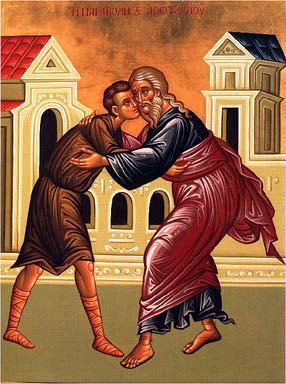
Troparion Tone 8
The doors of repentance do Thou open to me, O Giver of life,
for my spirit waketh at dawn toward Thy holy temple,
bearing a temple of the body all defiled.
But in Thy compassion, cleanse it by the loving-kindness of Thy mercy.
Theotokion Tone 8
Guide me in the paths of salvation, O Theotokos,
for I have defiled my soul with shameful sins,
and have wasted all my life in slothfulness,
but by thine intercessions deliever me from all uncleanness.
Troparion Tone 6
Have mercy on me, O God, according to Thy great mercy
Glory to the Father and to the Son and to the Holy Spirit
And according to the multitude of Thy compassions, blot out my transgressions.
Both now and ever and unto ages of ages, Amen.
When I think of the multitude of evil things I have done, I, a wretched one,
I tremble at the fearful day of judgment;
but trusting in the mercy of Thy loving-kindness, like David do I cry unto Thee:
Have mercy on me, O God, according to Thy great mercy.
Kontakion of the Sunday of the Prodigal Son Tone 3
Having foolishly abandoned Thy paternal glory,
I squandered on vices the wealth which Thou gavest me.
Wherefore, I cry unto Thee with the voice of the prodigal:
I have sinned before Thee, O compassionate Father.
Receive me as one repentant,
and make me as one of Thy hired servants.
Protopresbyter Alexander Schmemann writes:
Together with the hymns of this day, the parable reveals to us the time of repentance as man's return from exile. The prodigal son, we are told, went to a far country and there spent all that he had. A far country! It is this unique defintion of our human condition that we must assume and make ours as we begin our approach to God. A man who has never had that experience, be it only very briefly, who has never felt that he is exiled from God and from real life, will never understand what Christianity is about. And the one who is perfectly "at home" in this world and its life, who has ever been wounded by the nostalgic desire for another Reality, will not understand what is repentance. (Great Lent: Journey to Pascha, p. 21)
Schmemann goes on to talk about how this sense of exile is essential to confession and repentance. We can, surely, engage in "cool and 'objective' enumeration of our sins and transgressions," in repentance "as the act of 'pleading guilty' to a legal indictment." But, Schmemann writes,
something very essential is overlookd--without which neither confession nor absolution have any real meaning or power. This "something" is precisely the feeling of alienation from God, from the joy of communion with Him, from the real life as created and given by God. It is easy indeed to confess that I have not fasted on prescribed days, or missed my prayers, or become angry. It is quite a different thing, however, to realize suddenly that I have defiled and lost my spiritual beauty, that I am far away from my real home, my real life, and that something precious and pure and beautiful has been hopelessly broken in the very texture of my existence. Yet this, and only this, is repentance, and therefore it is also a deep desire to re[t]urn, to go back, to recover that lost home. (Great Lent: Journey to Pascha, pp. 21-22)
Luke 15:11-32:
And he said, A certain man had two sons: And the younger of them said to his father, Father, give me the portion of goods that falleth to me. And he divided unto them his living. And not many days after the younger son gathered all together, and took his journey into a far country, and there wasted his substance with riotous living. And when he had spent all, there arose a mighty famine in that land; and he began to be in want. And he went and joined himself to a citizen of that country; and he sent him into his fields to feed swine. And he would fain have filled his belly with the husks that the swine did eat: and no man gave unto him. And when he came to himself, he said, How many hired servants of my father's have bread enough and to spare, and I perish with hunger! I will arise and go to my father, and will say unto him, Father, I have sinned against heaven, and before thee, And am no more worthy to be called thy son: make me as one of thy hired servants. And he arose, and came to his father. But when he was yet a great way off, his father saw him, and had compassion, and ran, and fell on his neck, and kissed him. And the son said unto him, Father, I have sinned against heaven, and in thy sight, and am no more worthy to be called thy son. But the father said to his servants, Bring forth the best robe, and put it on him; and put a ring on his hand, and shoes on his feet: And bring hither the fatted calf, and kill it; and let us eat, and be merry: For this my son was dead, and is alive again; he was lost, and is found. And they began to be merry. Now his elder son was in the field: and as he came and drew nigh to the house, he heard musick and dancing. And he called one of the servants, and asked what these things meant. And he said unto him, Thy brother is come; and thy father hath killed the fatted calf, because he hath received him safe and sound. And he was angry, and would not go in: therefore came his father out, and intreated him. And he answering said to his father, Lo, these many years do I serve thee, neither transgressed I at any time thy commandment: and yet thou never gavest me a kid, that I might make merry with my friends: But as soon as this thy son was come, which hath devoured thy living with harlots, thou hast killed for him the fatted calf. And he said unto him, Son, thou art ever with me, and all that I have is thine. It was meet that we should make merry, and be glad: for this thy brother was dead, and is alive again; and was lost, and is found.
February 26, 2005
On the Priesthood and the New Testament
[The following is the substance of a second email I sent to a correspondent who asked me what New Testament justification the Orthodox have for their understanding of the priesthood.]
The reason I answered the question on the Lord's Supper first is that, historically speaking, the functions of the offices/ministries of bishop, priest and deacon have flowed directly from an understanding of the Eucharist and not the Eucharist from that of the functions of these ministries. Once one understands that from the very time the New Testament was being written, from the first days of the Church, the bread and wine of the Lord's Supper were understood to be the Body and Blood of Jesus, it necessarily changes the way one looks at the New Testament evidence, such that it is, for these three ministries.
Another matter we must confront head-on with no dissembling is the simple fact that the New Testament does not really tell us all that much about these offices/ministries. We are not told, for example, whether the leadership of a local congregation must be one of a plurality of elders assisted by the deacons (which has been the typical Restoration Movement understanding), or whether one of those elders can serve in a full-time function as the primary pastor of the congregation, or even whether we can name an individual who is not an elder or deacon to lead the congregation on a full-time basis, whether we call that man—and it has always been a man among the independent Christian churches and among the a capella churches of Christ—a minister (a Latin synonym for the Hellenic deacon) or evangelist (which the New Testament says very little about), or even a pastor or teacher or pastor/teacher. To the degree that we dogmatize about these matters we are that much further from actually understanding what is “the New Testament pattern” for the Church.
That fact, that the New Testament is not all that clear about the functions of these various offices/ministries, is inescapably joined to another fact: If we are to properly understand what the New Testament does say about these things, we are going to have to look at the earliest history of the Church and the earliest Church writings to see what they say about these things and then offer reasonable inferences about what the New Testament says about these things in light of the later earliest historical realities.
That being said, I will limit my comments, as you asked, to the New Testament because there are, I think, suggestive elements in the New Testament that will lay the foundation for a case of understanding the New Testament polity of the Church as being the traditional historical threefold ministry of bishops, priests and deacons.
The normal texts that one looks at for the leadership roles in the Church are 1 Timothy 3:1-13 and Titus 1:5-9. We also look to Acts 20:28, 1 Peter 5:1-4, James 5:13-16 and Acts 6:1-7. From these texts we learn more about who an elder or deacon is than we do what an elder or deacon does. We know that an elder shepherds the church (Acts 20.28; 1 Peter 5.1-4), visits and prays for the sick (James 5.13-16), preaches and instructs (1 Timothy 5.17; Titus 1.9), shows hospitality (1 Timothy 3.2; Titus 1.8), gives proper care and leadership to his own household (1 Timothy 3.4-5; Titus 1.6), guards the church from those who would destroy it by sin, divisiveness, or a false gospel (Acts 20.28; Titus 1.9; cf. Matthew 18.15-20). What we know of the responsibilities of a deacon is even less: Cares for and leads his household well (1 Timothy 3.12), and perhaps provides food for needy widows (see Acts 6.1-7), assuming it is possible to equate the Acts 6 deacons with the 1 Timothy 3 deacons. I need not here answer the question as to whether the “women” of 1 Timothy 3 refers to deacon's wives or to deaconesses, and besides, even if it is the latter, the New Testament nowhere gives any specific function associated with such an office/ministry.
So there you have it. Nothing is said about elders and deacons in terms of the Lord's Supper or in any other more specific things with regard to their ministry. We do not know, on the basis of the New Testament alone, whether or not they had functions associated pretty closely with what we now understand to have been the case by the end of the first century; which is to say that the bishop presided over the liturgy of the Lord's Supper assisted by priests and the deacons (cf. the Epistles of Ignatios of Antioch c. A. D. 107). There is nothing in the New Testament that would forbid such functions, but very little that is suggestive of those functions as well.
I do think it important, before I get to the little that is suggestive of the roles of elder and deacon in the New Testament, to comment briefly on terminology. We both know how important it is in the Restoration Movement to use “Bible names for Bible things.” That is why we call it the “Lord's Supper” because this is what Paul calls it in the Corinthians passages. It is why our churches prefer the terminology “churches of Christ” or “Christian churches,” as these reflect, we think, the better New Testament terminology. And, it is why we call presbyteroi “elders,” because that is what the New Testament term means.
That being said, however, it is a bit disingenuous that we don't call our deacons “servants,” but instead transliterate the term. Also, though our Restoration Movement brethren object to the term “bishop” it is a perfectly good New Testament term. It is, in fact, what elders were called in Ephesus, “bishops.” In 1 Timothy 3, the office/ministry we usually call “elder” (presbyteros) is actually “overseer/bishop” (episkopos). So, too, in Acts 20:28, where Paul says of the elders of the assembly/church (as it says of them in v. 17) who have come out to meet him, “the Holy Spirit has made you overseers [bishops, episkopoi]” over the flock. And in 1 Peter 5:2, Peter says to the elders that they must “exercise the oversight” (i. e., they must be bishops) over the flock of God. And in fact, Jesus himself is called, in 1 Peter 2:25, our Chief Shepherd and Overseer (or Bishop). So, in point of fact, there are bishops all over the New Testament, though, as has already been said, what we know of their functions is limited--and I will also readily admit that the New Testament does not make enough of a distinction between episkopoi and presbyteroi to be dogmatic about such a distinction. That distinction came as a later historical development.
However, there are at least some important suggestions made by Paul in Romans 15 that I think may, if not absolutely settling the matter, bring more to light than we currently have. In Romans 15:16, Paul notes that by the grace of God it has been given to him to “work as a priest” in the service of the Gospel. This is a hapax legomena, the only time this verb is used in the New Testament. Etymologically it is made up of the words for priest (hieros) and work (ergeo). But this provides us little help. After all, what does it mean to “work, or serve, as a priest in the service of the Gospel"?
Earlier in that verse, Paul calls himself a “servant of Jesus Christ.” This word for servant is leitourgos (from which stem our word liturgy is related). This word leitourgos is only used three other times in the New Testament, once at Philippians 2:25 in which Epaphroditus is called by Paul, his “minister” of his need. It is used in Hebrews 1:7, where angels are said to be God's “servants” of fire. And it is used in Hebrews 8:2, where Jesus is called our leitourgos or servant of the sanctuary, the heavenly tabernacle not pitched by men. Indeed, when we look at the other related words to leitourgos, such as the verb, leitourgeo (I serve or minister), or leitourgia (service or ministry), leitourgikos (used only once of angels as ministering spirits in Hebrews 1:14), and leitourgos (used only once of the public servants in Romans 13:6), we see that the word group used in a somewhat generic sense of ministry and service. We do have an instance of the noun, leitourgia, used in Luke 1:23, to speak of Zachariah's priestly service. But there is also one instance of the verb, leitourgeo, in Hebrews 10:11 that is also suggestive. There it speaks of the priests of the old covenant standing day by day “offering sacrifices” (our verb leitourgeo). This of course, is contrasted with the once and for all sacrifice that Jesus offered of himself that is far better.
So, it seems that we do have some strong warrant for tying Paul's “working as a priest in the service of the Gospel” to the priestly ministry of Jesus himself whose once-for-all sacrifice of himself is the one offered in the true sanctuary in the holy of holies in heaven. I am not here tying the functions of bishops, priests or deacons to this verse in Roman 15 and the related verses in Hebrews. But I am saying that if Paul, whose ministry was of such a nature as I believe the New Testament to suggest, and if Paul was responsible for appointing elders in all the churches he established, and if the Lord's Supper is to be a continual observance in the Church, then one can, on the New Testament alone, build a strongly suggestive case that the episkopoi, presbyteroi and diakonoi served the Body and Blood of Christ in the elements of the bread and wine of the Lord's Supper.
It is, admittedly, only strongly suggestive. However, when one looks to the historical evidence, and especially to the earliest extrabiblical evidence we have (in 1 Clement and in the Epistles of Ignatios of Antoich), the case does become not only clear but unequivocal: bishops, priests and deacons were part of the original New Testament Church founded by the Apostles whose roles of service included their functions in the observance of the Lord's Supper.
February 25, 2005
On the Lord's Supper in the New Testament: A Reply to an Email Interlocutor
[The following is the substance of an email I sent to a correspondent who asked me what New Testament justification the Orthodox have for their understanding of the Lord's Supper.]
Now, as to the Eucharist. There are essentially four or five texts we may consider: the passage in John 6, the institution narratives (taken together as one), and two places in 1 Corinthians (chapters 10 and 11).
I think if we start with those last first, the others will become more clear.
Take a look at 1 Corinthians 10:16ff. Here Paul juxtaposes the participation in the Christian Eucharist with the sacrifices of Israel and those of the Gentiles. His point is that Christians cannot partake of both the Lord's Supper and the sacrifices of Judaism or those made to idols. But his reasoning is interesting. The Christians cannot do so precisely because there is a sharing in those sacrifices that apparently reflect actual and incompatible realities.
Note what he says in v. 16-17: "The cup of blessing which we bless, is it not the communion [koinonia] of the blood of Christ? The bread which we break, is it not the communion [koinonia] of the body of Christ? Because we, though many, are one bread and one body; for we all partake [metechomen] from the one bread." I will draw out the significance of this in a moment.
Then note v. 18: "Look at Israel according to the flesh: are not those who eat of the sacrifices partakers [koinonoi] of the altar?" Note the same word as used above.
Now look at vv. 20-21: "No, but that the things which the Gentiles sacrifice, they sacrifice to demons and not to God, and I do not desire that you should have fellowship [koinonous] with demons. You cannot drink the cup of the Lord and the cup of demons; you cannot partake [metechein] of the Lord's table and of the table of demons." Again, same words.
Here's the force of my argument/interpretation from those verses. The participation, the fellowship, in these things must be a reality, else the whole prohibition looses its force. That is, just as we participate in the Lord's Supper and that participation is a "real reality" so, too, is the participation in the now-obsolete Jewish sacrifices a real participation in the now-obsolete reality of animal sacrifices (i. e., that they cannot save forever) and the participation in demonic events a real participation in demonic reality. But if that is the case, then the partaking of the bread is a real fellowship in the Body of Christ, and the partaking of the cup is a real fellowship of the Blood of Christ. This koinonia is spoken of in terms of the unity of the Church, and it is the same sense of unity between bread and Body of Christ and wine and Blood of Christ.
When we turn to the next chapter, and read in light of these comments, it takes on fuller meaning. Note 1 Corinthians 11:27: "Therefore whoever eats this bread or drinks this cup of the Lord irreverently will be guilty of the body of the Lord and of the blood of the Lord." Now Paul has just given the institution narrative and quotes Jesus as saying, "For I received from the Lord that which I also delivered unto you: that the Lord Jesus, during the night in which He was betrayed, took bread; and having given thanks, He broke it and said, 'Take, eat; this is My body which has been broken for you; do this in remembrance of Me.' Likewise He also took the cup after supper, saying, 'This cup is the new covenant in My blood. This do, as often as you drink it, in remembrance of Me.'" Notice Paul didn't say anything about Jesus speaking metaphorically, there was no allegorical interpretation put on it. He merely takes Jesus at his word. Indeed, he, too, by quoting Christ, identifies the bread with his Body and the cup of wine with his Blood, as we see in v. 27 previously quoted.
At this point, any exegesis of the institution narratives in the Synoptics will simply reiterate what has already been said by way of interpretation. But I make this note: to deny that Jesus really meant the bread was in some mysterious way His Body and the wine similarly His Blood is to say more than what Jesus himself said. Jesus did not speak in terms of metaphor and simile--nothing in the text justifies such an interpretation. Indeed, one has to have a presupposition against such an identification to be able to make that hermeneutical claim. And it is indeed an interpretive claim. A claim I do not think fits what Scripture actually says.
Finally are the words in John 6:35 and 48, "I am the Bread of Life"; v. 51, "I am the living bread which came down from heaven. If anyone eats of this bread, he will live forever; and the bread that I shall give is My flesh, which I shall give for the life of the world," and vv. 53-58, "Then Jesus said to them, "Most assuredly, I say to you, unless you eat the flesh of the Son of Man and drink His blood, you have no life in yourselves. Whoever eats My flesh and drinks My blood has eternal life, and I will raise him up in the last day. For My flesh truly is food, and My blood truly is drink. He who eats My flesh and drinks My blood abides in Me, and I in him. Just as the living Father sent Me, and I live because of the Father, so he who feeds on Me will live because of Me. This is the bread which came down from heaven, not as your fathers ate the manna, and died. He that eats this bread shall live forever."
I have heard the interpretation that this is all metaphorical and not meant to be taken literally. And yet Jesus nowhere softens his statement by making it a metaphor. Indeed, when this passage is taken in conjunction with Jesus' words in the institution narratives, the implication is clear: he means the bread and wine to really be his Body and Blood in some way unknown to us, and that by feeding on these mystical elements of bread/Body and wine/Blood we will have the Life he promises because we are partaking of him who is Life.
And when one notes that historically up to the present that the first part of chapter 6, the feeding of the 5000, is interpreted Eucharistically, it is no wonder. We have Jesus' words at the end of the chapter, the verb "eucharisteo" in the feeding of the 5000, and the whole context of the New Testament Scriptures on these things.
So this is the, to me, decisive evidence from the New Testament that the Orthodox understanding of the bread and wine of the Lord's Supper being really the Body and Blood of Jesus is indeed a New Testament belief, and a more New Testament belief than the Zwinglian one I was taught in the Restoration Movement churches of my youth and young adulthood.
A-Voiding the Word: My Response to Kevin's Other Post
My dia-blog with Kevin on the Tradition continues.
I'm glad we do have points of agreement, so I am grateful to hear you say things like, "I wish everyone believed that the church's life was something given to it by Christ; that this life is no mere doctrinal concept. To this extent, we agree."
Unfortunately, while it is clear that you grasp the claims of the Orthodox Church, you mistake the actual force of those claims. For example, you say, in summarizing my points, "The Orthodox Church is the true church of Christ. It has a specific way of doing things, which it defines as its 'Tradition.' This, it claims, is given in infallible and unbroken form all the way from Christ. The proof of such a pedigree is found in the fact that it is this church that does these things." This is, indeed, true. The Orthodox Church claims to be the true Church of Christ, that very Body Christ Himself founded on the Apostles and Prophets. As such, the Church's Tradition is, then, that which is the Tradition of the Orthodox Church. All of this is consistent with my claims.
But just prior to that summation, you write, "This statement would be fine if 'Tradition' meant those beliefs and practices which exhibit the truths of the Gospel and are common to all those who profess the name of Christ. But it does not. It refers to the beliefs and practices of a specific denomination." Here you slip. In point of fact, if the Orthodox Church claims to be the Church of Christ, She is not merely just another denomination, but is the sole visible Body of Christ. If the Orthodox Church thought of herself as simply the most pure of, the most correct of all other denominations, then she could not claim to be the Body of Christ, but only one branch among many. This in fact is precisely what she rejects about Herself, that she is merely one among many more or less correct "options."
Similarly, you go on to extrapolate, apparently via logical categories, from the statement that if Orthodoxy and Orthodoxy alone has Life and is the Church, then no other denominations have any of this Life and are not the Church. This in fact is a distortion, nor is it logically required. It is true that the exclusivity of Orthodoxy's claims to being the Church, seems to require that all other Christian groups are not the Church, but it is not true that Orthodoxy claims all else are dead.
Think of it this way. That the Orthodox consider themselves the Church of Christ is an exclusive claim. It either is the case or it is not. If it is the case, then no other church can make the same claim. And, to the degree that Orthodoxy is that which she claims (the Church), she is only witnessing to the truth She has been given. Orthodoxy does not make her claim out of pride, but out of the utmost humility. For Her to reject Her claim is to reject Her Lord.
However, when it comes to the claims about Life, the same dynamic operates (i. e., that this Life has been given to Her as a charge to keep), but the same conclusion of exclusivity does not operate. For the Body is the Body and not the Head. The Body has life only insofar as it is connected to the Head. But this property of Life does not inhere in the Body per se, but only by way of union. Thus, it is God who always is the source of Life. It is the Holy Trinity Who makes alive, and who are we to gainsay that which He enlivens? The Church does not dispense Life, or rather only does so in the way that Her Lord has given Her to do. But that she does so is only at the behest of Her Lord and through His very own Life and Power. So, does God enliven those who believe on the name of the Church's Lord but yet who are outside Her doors? We can only offer a charitable and humble, "This is the Lord's doing and we are made humble in our own eyes." That is to say, that the Orthodox Church is the Church, which charge can be given no other body of Christians does not logically entail that there is no Life anywhere outside the Church's doors. For God is everywhere, and everywhere God is there is Life for those who will accept it.
You then go on to state what you cannot substantiate on the basis of Scripture alone:
I am saying that Scripture sets the parameters both of the Gospel and of the Church. I am saying that Scripture gives no warrant whatsoever for a particular church to say, "plus all the things that we've been doing," and then call this, "Life." Even more, I am saying that Christ has given no such authorization. It is unthinkable that the One whom Scripure so fully reveals in the simplicity of the Gospel should have entrusted extra conditions for Life to a particular church with no indication that he had done so, no indication of what these conditions are, and no way of determining which church has this extra-Biblical but oh so essential truth.
Where does Scripture say that it does these very things? What do you make then of the authorization of Christ given to the Church to bind and to loose in Matthew 18:18-20? Doesn't the very context there give the Church quite broad parameters in the matters of discipline to bind and to loose? What about St. Paul's words in 1 Timothy 3:15 in which the Church is called the "pillar and ground of the truth?" Where in all of Scripture does Scripture say this about itself? What else can one make of Ephesians 4:16 where St. Paul indicates that it is in and among the very constituent members of the Body that it builds itself up into love into Him Who is the Head? Doesn't this indicate that the Church has within Herself all that is necessary for maturing into the fullness of Christ? (Not, of course that She has this of Her own self, but that it is both given to Her in and by Her Lord and held and given back to Her Lord fivefold.) But where does it say in Scripture that Scripture has this capacity to bring the whole Church into full maturity in Christ? And doesn't this all logically entail that the Church will necessarily incarnate these things in ways that must be "in addition" to what the Scriptures say? You'll have a hard time arguing otherwise.
You then say, "I have seen particular churches throughout history fall into heresy or some other sin far too often to think that it can't happen to any other church." And this is indeed a great danger. But now let me ask you this? How do you know what is and isn't heresy? Why, for example, don't you reject the Trinity? I know you can infer it from Scripture. But you can also infer Arianism. How are we to decide between these two interpretations?
Furthermore, name one heresy that the Orthodox Church as a whole has espoused.
You then follow your statement on heresy with, "The only defense against this, and only sure way by which the Church will triumph agaisnt the gates of Hell, is to know the will of God as it has been given in Scripture." But in point of fact, isn't it the case that churches and groups have fallen into heresy precisely on the basis of their interpretation of the "will of God as it has been given in Scripture"? This is the largest problem with your entire thesis: you fail to take into account that there is never a case in which the Scripture is not interpreted. Or, to state it in the affirmative: every encounter with Scripture is interpretation.
In fact, I'm willing to bet that you read the Scripture almost exclusively in translation. Which means that you always encounter Scripture with two layers of interpretation between you and it: a) first your own presuppositions and worldviews and b) those of the translators. Even if you read the Scriptures in the original languages you will never divest yourself of a).
So it will always be the case that we will be asking the question, "Whose interpretation?" and "On what authority?" If you just naively assume that your interpretative methods are better than the Church's, your interpretation better than Hers, you have not merely voided the Word, you have avoided it by enshrining your own mind and thinking over it--even if done naively and without malice.
Finally, you are right to note that if the Orthodox Church is the Church of Christ, then She is the pillar and ground of the Truth, She has been led by the Spirit into all Truth (John 16:13), then She cannot be in error, She is, in a word, infallible.
But your final conclusion is both illogical and deeply offensive: "It is a church that has outgrown the need both for humility and for repentance. I can think of nothing more devastating to the soul." I wonder that you have the courage to say such a thing of a body of Christians who preceded you, who gave you your Bible, who gave you the standard of orthodox doctrine that you use every day, who kept and guarded the mystery of the Holy Trinity for you so that each day you can pray in His name, a body of Christians who have been persecuted and killed for the Pearl of Great Price they have been charged to keep. Though Orthodoxy claims to be the Church, she does not judge those outside her bounds as having outgrown the need for humility and repentance.
That being said, it is not a wonder that even in Her deep humility, Her sorrowful repentance, the very claim She has been given Her by Her Lord is offensive to you. It is a bracing jolt. It offended me when I first came across it. And it turned me off to Orthodoxy on my first very superficial encounters many years ago now. But there is no help for that. She cannot take out the sting without draining Herself of the Truth that is Hers.
Tradition and Scripture Continued: My Response to Kevin
Kevin continues our dialogue on Scripture. And I am duty-bound to respond--besides, he's very polite, a good arguer, and we apparently both find this an interesting exchange. Now, let's hope I can continue to do justice to the honorable parameters of our discussion.
(Justification from Properly Exegeted Scriptures--was "Sufficiency of Oral Transmission")
You are right to note my failure to take account of your backing off of your thesis. And in fact, you make such distancing even more explicit when you write, "I am willing to extend this necessity for oral transmission of the Tradition for as long as the entire canon had not been made available." But then you go on to claim that this does not entail an argument that Tradition is not limited specifically to the content of Scripture (which you clarify is both OT and NT, though we may quibble over OT canonical matters).
But I'm afraid that here you leave yourself open to the great weakness of your claim: what exactly is the "content" of the Scripture? I'll stipulate, for the sake of our argument here, that the canon of the Scriptures is the Protestant 66. Is the content nothing more and nothing less than the verifiable propositions of (that which can be explicitly enjoined from) the Scriptures? Or is it also that which can be reasonably inferred from them? You have indicated in previous comments that you accept "examples of tradition justified from Scripture properly exegeted (and where they are not, such as Nicea II, we are required to ignore them)." But this simply leaves you wide open to the simple fact that if there is no contradiction between Tradition and Scripture--which is to say, Tradition is "justified from Scripture properly exegeted"--then you have no case. You must accept all those things you now think to be extra or additional.
I know, I know, you will stress the phrase "properly exegeted"--and I note that you dismiss Nicea II quite handily, but I suspect you have not read St. John of Damascus' three treatises on the icons, nor the work of St. Theodore the Studite on the same matter, because both of these illumined gentleman do a great deal of "proper Scripture exegeting."
But this really is the final rub, isn't it? Difference in interpretation. I believe it entirely possible--though I am far from wholly competent to do it--to go through the Tradition and show its complete consonance in its entirety with properly exegeted Scripture. I know that there are some big issues in which this has already most ably been done: the nature of the Lord's Supper, the necessity of an episcopal polity itself grounded in and on the reality that is the Lord's Supper, the role of Mary, the nature of proper Christian worship, the communion of all the saints, and so forth.
But I suspect, which you indicate by graciously passing over the issues of asking the intercessions of the sainst in your response, that such justifications would not satisfy you because you would claim that "proper exegesis" has not been done. I am not without standing to ask: How do you know? Because that's not the way you, or your denomination, or your denomination historically, or any other evangelical interprets Scripture? But how do these know? And why should not the fact that the entire Church historically understood the Scriptures this way count in light of your (presumably) contrary interpretations?
What if I want to use an allegorical interpretation as my primary exegetical tool? What if I decide the historical-grammatical is best? Or, what if I just want to go with what the Bible "says to me"? On the basis of your argument, how can you gainsay me? There's nothing in Scripture that enjoins a particular interpretative method. And if we "justify from properly exegeted Scripture" a particular interpretive method we have only begged the question.
No, your argument has to be narrowed to the fact that Tradition is limited to the explicit (propositional?) content of Scripture. But then you have only checkmated yourself.
(Cessationism and Not Adding/Deleting--was "Sufficiency of Scripture for faith and practice")
Since the extent of the OT canon is not necessary for the main argumentative points I wish to make, for the sake of this specific discussion, I'll simply stipulate, as I did above, the Protestant 66. So I'll not here take the time to substantiate my claims, and concede the limit.
Your cessationist intepretation of 1 Corinthians 13 is, and I mean no offense, fanciful in the extreme. "To teleion" does not mean the completed canon. The gender of the noun does not match the typical feminine of "e graphe," and nothing in the context could be construed to actually refer to the Scriptures. More to the point, when St. Paul speaks of the Scriptures, he means the Old Testament, not the completed canon. There is nothing in the context to justify such a cessationist interpretation, and indeed, your uncertainty in your exegesis--"it appears," "is a bit more illusive," "it might be," "whatever it is," "the general idea"--does not lead to the dogmatic affirmation that "Scripture teaches its own sufficiency." Besides all that, the fact that you affirm that this is the "cessationist" intepretation only begs the question: Why should I, or any other Christian, accept it? If I interpret "to teleion" as the Parousia, the coming age, who would you be to argue against it? Indeed, wouldn't a better reading of v. 12 be that of the coming age? But I've dealt with exegesis above, so I'll move on.
You mentioned the Revelation passage, itself an echo of that from Deuteronomy, and agreed that in context the prohibition against adding and deleting was primarily about Revelation but could be taken to refer to the whole of Scripture. And I would agree with that. But it's a stretch to say: Don't add to this book, or Don't add to this canonical list, and then to go on to say, Don't add any traditions either. First you would have to prove that was the original intent of the author, otherwise you're begging the question. Second, you would have to prove that the addition of traditions that are "justified from a proper exegesis of Scripture" are not adding to the Scripture.
As a bit of an aside here, I found the riposte of the following absolutely and cleverly hilarious:
In the absence of an argument that would necessitate the validity of such a an oral tradtion beyond what was needed to supplement incomplete scripture, my claim that extra-Biblical traditions are invalid is not circular. Rather, your own attempt to justify a post-canonical practice by a narrower pre-canonical necessity is a red herring.
Well said! But let me add that you still commit a logical fallacy: assuming the absence of a proof for the opposing position as proof of your position. Touche!
To continue:
(The Foundation of Tradition and Scripture in the Holy Spirit--was "Limiting the Tradition to the Body of Scripture")
When you write, "Tradition is not the foundation of Scripture nor is the reverse true," you miscontrue what I said. You quoted me accurately, but substantiating the Scripture from the Tradition they had received from St. Paul is not the same thing as founding Scripture on Tradition. Scripture is, as I've said all along, part of the Tradition, not different from it, nor parallel to it. It's all one cloth, with Scripture woven in over here, the Liturgy here, the Creeds here, and so forth. The whole of Tradition itself is founded in the Holy Spirit, and here I agree with you completely.
A brief reply to your comment, "The scriptural warrant for Sunday worship is found in Apostolic practice as recorded in Acts." There is only one verse in Acts 20 that could possibly be construed as sanctioning the normal practice of Sunday as the primary day of worship. And even that verse is not explicit that this was the purpose for the meeting. But let's grant that it is explicit about the day and it's primacy for worship. We still have only the evidence that it was true of this particular congregation and not that it was a widespread practice in the Church. In other words, we get the primacy of Sunday from the extra-biblical Tradition--but of course not in contradiction to Scripture!
(The Stable Content of Tradition--was, "Obsolescence of Tradition Based on Completed Canon")
You write of the attestation of Paul's apostleship and say, "Arguably, these may be categorized as holy Tradition, but their function at the time does nothing to demonstrate the fuller tradition that you wish to advocate for today." But there is no distinction between that which you agree "may be categorized as holy Tradition" and something else you call the "fuller tradition." Your construing it in this way implies that Tradition is little more than centuries of accretion upon accretion.
I suspect, though you haven't said so, that you think icons to have been something added to the Tradition sometime shortly before the end of the eighth entury A. D. But in point of fact, we have evidence of iconography dating back to the catacombs and first century practice. Or perhaps you think the whole doctrine about "Body and Blood of Jesus" in the Eucharist to have been a later addition, but once again, the New Testament makes these explicit claims (and these are attested to as early as the letters of St. Ignatios at the end of the first century/beginning of the second century A. D.). I could go on. In point of fact, the content of the Tradition has been pretty much stable from the time of the Apostles. Specific practices that exhibit that content do change and grow and subside dynamically through history, culture and languages, but the content remains the same. We may now have specific rules by which an icon is painted and displayed, but what it is and that it is venerated hasn't changed in 2000 years. We may now serve the Communion in a gold chalice with a spoon, but the fact that it's the Body and Blood of the Lord hasn't changed in 2000 years.
In any case, thank you again, for your continued dialogue.
I'll answer your other reply to my own account of Scripture and Tradition in another post. (We'll probably have to combine these posts somehow to avoid further confusion and repetition!)
[Note: I edited the post for spelling and grammar about 9:00 am, and added one or two clarifying phrases for what were otherwise periphrastic nouns/pronouns.]
February 24, 2005
The Psalter According to the Seventy (CD)
I received in the mail yesterday, from Orthodox Christian Recorded Books, the Psalter According to the Seventy on a set of four CDs (scroll down the page).
From the jacket on the case:
The present recording is entirely 'read' or chanted in accordance with the way it is chanted during the divine services of the Russian Orthodox Church. There are separate tracks for each kathisma and each stasis, making it easy for the listener to forward through the recording to a favorite section of the Psalter. The reader names each psalm throughout so that the listener who is listening outside the context of the services, can be aware of exactly which psalm is being read . . . .
Each CD is about an hour and ten or fifteen minutes (the fourth is only about a half hour) long. The sound quality is excellent!
The Russian chant is essentially monotonic, which is an incredible aid to meditating on the Psalms.
The text can be found here. (Note: The psalster is divided according to the reading of the Kathismata according to each weekday--Kathisma 1, beginning with Psalm 1, is found at the end of Saturday; which is Saturday evening, or the liturgical beginning of the week.)
(I should note that Orthodox Christian Recorded Books provides "a special 20% discount to visually impaired persons.")
February 23, 2005
My Account of Scripture and Tradition
[As is no doubt obvious from the previous week's posts, this reflection has come out of the exchange I've had on the relationship between Scripture and Tradition. I'm thankful to Kevin who has pushed me to more concretely express my thoughts on the matter.]
The Tradition is that way of Life whose content and shape is Christ and was given by Christ to the Apostles and from the Apostles to the Christians to whom they gave it, and so on in unbroken succession down to the present age. This Life was and is no mere doctrinal concept but was and is Life, which is to say, it is all that makes a human being truly and fully human. So this Life given by Christ is His own, and is a way of living as much as it is the Life that makes living possible. As a way of Life it entails certain beliefs, concepts and wills. But it is not merely or purely psychic, or mental/volitional, but is, indeed, everything about what it means to be really and truly and fully human: speech and acts and all that we do with our bodies, as well as all our thoughts, emotions, words, and willing.
That Tradition was always present in full—nothing needed ever to be added to it, nor could anything ever be taken from it—from the very moment Christ ascended into Heaven and gave the gift of the Spirit to His Church. Because that Tradition was, and is, a way of Life, whose entire essence and content is Christ, it is a dynamic thing, always the same, yet ever concretely lived in specific ways of life. It does not change or adapt in its essence, since Christ Himself, Who is the Life of the Church, is the same yesterday, today and forever. But just as the exact same Gospel can be communicated in a thousand different languages without change or alteration, so this way of Life was and is expressed concretely in every place and people and language on earth. Because this Tradition is filled with the Life of Christ himself, it carries His authority, and is thus infallible. But this Tradition is not, nor ever could be, separable from the Church, for the Church Herself is the Body of Christ, and is filled with Christ in whom is the fullness of the Godhead. The Church's Life, the Tradition, is thus not Her own but is always and only that which Christ gives her. Thus the Scriptures are not separate or separable from the Life of the Church, from Her Tradition, for the Scriptures are the Word of God, out-breathed by God in the Church, to the Church, for the Church. The Church wrote the Scriptures by the hand of God, and this Word given in and to and for Her is Her Life, for it is the Word of God. But Life is not opposed to Life, for it is all the same Life, which is to say, Christ. Christ is the shape and content of the Old Testament and the New Testament, and He is the shape and content of the Liturgy, the decrees of the Ecumenical Councils, the teachings of the Church Fathers, the lives of His Saints, and so forth. The Church knows what is Life and what is not Life in all these things, for She knows the Lord Who calls Her by name and recognizes His voice. Thus, that which She takes up to Herself as Her Life is, indeed, Life.
It is true that the Scriptures have a unique place in the Life of the Church and are given special prominence, and this is due to their unique quality of being out-breathed by God. But while their authority may have a different shape than the authority of the Liturgy, or of the Creeds, or of the Councils, on account of their uniqueness, the quality of that authority remains the same, which is the Life of Christ, for all authority in heaven and on earth is His, and all things have been given Him by the Father. And it is because this authority the Scriptures have is of the Life of Christ that the Scriptures do not stand as an opposing authority to the rest of Tradition. For if it is true that the Scriptures are unique in their being out-breathed by God, it is still the Church that recognizes in them Her Master's Voice, and claims them for Herself as what they really are: the Word of God. The Church does not make them Scripture so much as she recognizes them as such. Yet we must always speak of both realities as, in fact, true. The Scriptures were so out-breathed and the Church did discern them as such. Both historical realities must always be held together in the Truth as true. For even if the Scriptures were so out-breathed of God as they are, and yet the Church did not discern them as such, we would still be reliant on the Church to transmit to us the content of the Scriptures. The Church is ever the one who tells us what is this Scripture which is the out-breathed of God, given in the Church, to the Church, and for the Church.
According to Tradition, the Scriptures have a unique place in the Life of the Church, given their unique out-breathed status. Apart from the Tradition, this is something we would not know of ourselves. Indeed, we know this precisely because of how the Scriptures function, as a manifestation of what they really are, in the Life of the Church. The Scriptures are given prominence in the Life of the Church, in her Doctrine and her piety. In fact, certain of those Scriptures themselves are given additional prominence. Each Sunday we read from the New Testament Acts and Epistles, and we read from the Gospels. And to the Gospels are given a special prominence over the rest of the Scriptures, for they, unique above all the Scriptures, are a verbal icon of Christ. Now in a certain sense all the Scriptures are a verbal icon of Christ, for He is their content and the key to understanding them. But the Gospels focus uniquely on the Life of our Lord and are recognized as worthy of special attention. Still and all, we do not read from St. John Chrysostom's Commentary on Matthew in the place of the Gospel of Matthew. Not because St. John is in opposition to the Gospel, or not worthy of contemplation, or has no authority, but because the Gospel of Matthew is unique, both in its authorship/Authorship and in its place in the Tradition.
In other words, in the classical conception of Tradition, there is no opposition, nor need there be, between Scripture and Tradition, and precisely because there is no opposition, each way of Life that is the Tradition (Liturgy, Scripture, Creed, etc.) can be given its due place and honor. We do not honor Scripture but disparage the Creed. Rather we honor Scripture as the Scripture and the Creed as the Creed, and both as the way of Life given the Church by and in and through Christ.
February 22, 2005
My Reply to Kevin re: Tradition and Scripture
[See the start of this thread and comments here.]
Let me take your points as you've presented them.
(Asking the intercessions of the “dead.”)
The Church has always interpreted Hebrews 12:1 (on the basis of the faithful of the Old Testament who have died and gone before us spoken of in chapter 11) as that the many witnesses are the “dead” who are alive in Christ God. Furthermore, Revelation 8:3-4 speaks of the prayers of the saints going up as incense before the Lord. In context, it is probably best to interpret these saints as the martyrs of 6:9-11 and 7:13-17. And while it is true that the content of their prayers are not manifest (except maybe for the justice of God to be realized as pace chapter 8, if the dead who are alive in Christ are witness to our struggles in the race set before us, it seems reasonable to conclude that they pray for us as well. After all, in this life they were charged by the Apostle Paul to offer “supplications, prayers, intercessions, and thanksgivings . . .on behalf of all men, on behalf of kings and all those who are in authority, that we may lead a tranquil and quiet life in all godliness and dignity. For this is good and acceptable before God our Savior, who desires all men to be saved and to come to the full knowledge of the truth” (1 Timothy 2:1-4). On what basis would they be free of this obligation simply because they are now with God in the heavenlies? These intercessions do not in anyway negate Christ's mediation, for these prayers are offered precisely on the basis of such mediation, as Paul goes on to say, “For there is one God and one Mediator between God and men, the Man Christ Jesus, who gave Himself a ransom for all, the testimony in due time . . .” (1 Timothy 2:4-5). We no more short circuit Christ's mediation to us by asking the prayers of our presently alive Christians brothers and sisters, than we do asking those who've gone before us, absent from the body but present with the Lord (2 Corinthians 5:8), to pray for us.
More to the point, asking the intercessions of those who've gone before us is a practice directly testifying to the victory of Christ over death, that is to say, a faith in the Resurrection. It would seem that, despite good intentions, to forbid the invocations of the saints who've gone before us precisely because they have died is to deny the present reality of Christ's victory over the last enemy. It means death is stronger than Christ. But Paul has something to say about that: Romans 8:37-39.
(Sufficiency of Oral Transmission)
As you acknowledge, your argument depends upon your own assumptions. You then think to bolster your claims by asserting that I assume the efficacy of oral transmission, thus invalidating my own claims.
But I see that you continue to fail to deal with the actual historical evidence I present. You seem to assume that since the NT Scriptures were written down within the first two generations of the Church (from, presumably, A.D. 50s-90s), that all had ready access to those Scriptures. This is not the case. In point of fact, for the first several centuries in the Church, the bulk of Christ's Body was illiterate, nor of sufficient means to own the entirety of the Old and New Testament Scriptures. At most, a particular local Church would have copies of one of the canonical Epistles written to them, as well as other canonical writings associated with them. Thus we can presume that the Church in Ephesus would have had the epistle to the Ephesians (if we assume the ascription to be genuine), perhaps the letters to Timothy who was their bishop, and the Gospel of the John, to whom Tradition ascribes to the Apostle, and whom himself was a leader at Ephesus. This in itself would have been a rich storehouse. And it does seem that the body of Paul's Epistles did circulate widely and early. Nonetheless, your argument requires that all the OT and NT Scriptures be available to all the Churches within the first generation or two of the Church. If they weren't then most of what they had to go on was the Tradition. And, in fact, this state of affairs held true for some time, especially for those Churches far outside the geographical communications with the major urban centers. The Scriptures the early Christians received was mostly that which they heard as the Liturgy and in the Liturgy.
So, in the end, the argument from history must be greater than your argument from silence and assumptions. Indeed, if oral transmission is insufficient to ground Apostolic Truth for two millennia, it would hardly be scandalous to say that it insufficient to ground such for two centuries. And yet, for two centuries, the Churches of God had slightly differing canons of what constituted God's NT Scripture, and nearly all were without the entire Church's full canon. Yet, mirabile dictu, without the Scriptural evidence necessary from your own argument to substantiate your claims, they were guided surely and rightly to the full canon and to the fullness of the Aposotlic Faith.
(Sufficiency of Scripture for faith and practice)
I agree with much of what you have to say, except for this claim: “I find it rather ironic that it is the Protestant church that has not tampered with the traditional canon as recognized by the ancient Jewish church.” It's clear that you have not studied the history of OT canonization, nor of the recent history of the recovery of the Dead Sea Scrolls and their contents. These resources are readily available, so I will simply summarize here: The OT canon as most all Protestants use (less the so-called “Apocrypha” or “Deuterocanon”) was not promulgated till at or after the council of Jamnia c. A.D. 90-ish (if I recall correctly), itself a reaction to Christianity. The almost-exclusive use of the LXX by the Apostles (itself readily attested by the NT), gives tangential support to the fuller canon, but even more to the point, the early Church itself readily and often used these texts, and included them in their copies of the Scriptures. Not until Martin Luther and other Reformers threw them out, in reaction to the real and perceived excesses of the Roman Church, did any part of the Church reject them. Again, history and Church practice is on the side of the fuller OT canon.
But to the point of your argument, that Scripture itself is “ sufficient for the faith and practice of the Church” cannot be in any way justified from Scripture itself. I need not prove Scripture to be insufficient in itself, because a) it creates a false dichotomy between Scripture and Tradition which I don't accept, and b) I'm not denying the sufficiency of Scripture but rather pointing out to you that your argument does not work on its own terms. I need prove nothing if your argument cannot stand on its own. And it clearly does not. So, on your own terms, you cannot claim what you do about Scripture.
Furthermore, your argument falls apart when you admit, “I have no problem with non-Apostles transmitting apostolic Tradition, even if such transmission is oral. Given the incomplete status of Scripture at the time, this would have been necessary. Conversely, given that Scripture is now both complete and sufficient, I would argue that if it's not in Scripture, then whatever is being transmitted is not apostolic Tradition.” You are caught in an irresoluble dilemma, for if oral transmission is fine until the completion of the canon, then it must be fine afterwards. That you assume it is fine before but invalid after is a circular argument which is invalid. Furthermore, you either do not mean by “completion of Scripture” the writing of the last canonically received text (presumably John's Gospel), because even if Scripture were then complete, it would make no practical difference to those who did not have the complete canon. So you must mean that the completion is when the final canon was authorized, but then you have oral Tradition, for the most part, for some three centuries after the start of the Church. But if oral Tradition is good for a few hundred years, it must be good for longer than that.
But once again, this is not a claim you can even substantiate from your premise of Scripture alone being the Tradition, because Scripture alone does not ever say that.
(Fallibilty and Infallibility)
The infalliblity of the Church founded upon the claims of Scripture itself, and thus should be authoritative for you. Cf. the following:
Matthew 18:15-20: Here Jesus speaks of the Church judging certain disciplinary matters. And whatever the Church decides, Jesus says, “Assuredly I say to you, whatever you bind on earth shall have been bound in heaven, and whatever you loose on earth shall have been loosed in heaven. Again, assuredly I say to you that if two of you agree on earth about anything that they may ask, it will be done for them by My Father in heaven. For where two or three are gathered together in My name, I am there in their midst." The decision, then, is an infallible one; i. e., “bound/loosed in heaven and on earth.”
1 Timothy 3:15: Perhaps the most explicit reference in Scripture of the Church's authority vis a vis the truth: “the house of God, which is the church of the living God, the pillar and bulwark of the truth.” Why is the Church called something Scripture never is? Because, primarily of John 14:6: Jesus calls himself, “the Truth.” The Church is the Body of Christ, and therefore by her participation in the Truth (Christ), is herself, as a whole, “the pillar and bulwark of the Church.” This is not to downplay or mitigate the authority of Scripture, for Scripture, too, participates in the divine Life, as it is “out-breathed” from God. Again, I need not resort to false dichotomy. I own both the infallibility of Scripture and of the Church. You, however, are forced by your own argument to deny the Church's infallibility so as to make way for the sole infalliblity of the Scriptures. Yet Scripture itself witnesses to this infalliblity, this grounding of Truth in and on the Church as she eternally participates in Christ.
How does the fallibility of men become the infalliblity of the Church? In short, the mystery of divine Grace, but Christ himself indicates that it is by the participation in Christ that the Church, as a whole (remember it is the “whole church” in Matthew 18) that individually fallible members are gifted in the Church as the Church with infallibility. That is, they teach not their own opinions and private interpretations (2 Peter 1:20ff), but the mind of the Church, which has put on the mind of Christ (cf. Philippians 2:5; Ephesians 4:13-15).
(Limiting the Tradition to the Body of Scripture)
The point I was trying to make, however, is that the Tradition they received, they received prior to the completion of the inscripturation of Scripture. That these points later were inscripturated does not invalidate my case, so much as strengthen it. It was by oral transmission of the Tradition that they received these things. And when they received these written Scriptures, how were they to verify their authority and divine origin? By way of the Tradition; i. e., Tradition substantiated itself in Scripture. This process, by the way went on long after the “closing” of the inscripturation process, as the testing of various books for inclusion in the canon went on for a few centuries. So, if we must force ourselves into stating these things according to the setup of your argument, it is the Tradition that is the foundation of the Scripture, not the other way around. This, at least, is the historical record.
Furthermore, the Tradition cannot be coextensive to the Scripture since there are many more things necessary for faith and belief than are clearly enjoined in Scripture. There is little to no warrant, on the basis of Scripture alone, for assigning to Sunday the day of the primary gathering of Christians for worship (a note you ignored in my previous post). Or if there is, there is much more warrant for believing that the elements of bread and wine become the Body of Christ in the Eucharist and the grace of God toward salvation is given to the recipients of baptism in the baptismal act. Yet how many Protestants deny these very things? (I do not know if you are one of them.)
But more to the point, there is no warrant in Scripture itself, and on this your whole argument hangs, that Tradition is coextensive with itself. Book-chapter-and-verse me, my friend, on that one.
(Obsolescence of Tradition Based on Completed Canon)
You still fail to make valid arguments.
Premise 1: If Scripture is incomplete, then Tradition is necessary.
Premise 2: Scripture is complete.
Conclusion: Tradition is unnecessary.
But here you have denied the antecedent (i. e., Scripture is not incomplete), which is an invalid argument.
You also, frankly, create a false dilemma, that one must choose between a completed canon and an oral Tradition that speaks to both those things Scriptures do address, and those they don't.
By the way, your claim that we know Paul's apostleship was part of the Tradition via Scripture is true, but it is not true of those who knew Paul prior to inscripturation. They knew Paul's apostleship was from God via holy Tradition, not Scripture.
February 20, 2005
Anglicans, Bishops, Heretics, Diocesan Boundaries and Nicea
[Please note: My opinions and conclusions here are likely to offend my Anglican brothers and sisters. Out of charity I note this so that my friends, Anglican brothers and sisters whom I love and for whom I pray each day, can simply skip this post and avoid the offense.]
One has to pretty much be completely unaware of the Episcopal Church, or of the issues of the validation of same sex behavior and the blessing of same sex unions in the general arena of religion, not to be aware of what has transpired in the Anglican Communion since the Episcopal Church's General Convention in 2003 where explicit permission (which was technically just short of the denomination's official authorization) was given for the practicing of homosexual behavior and the blessings of gay and lesbian unions. Since that time, those advocating such validations and blessings have attempted to paint the discourse in terms in reductionist terms (that it's just about sex, those opposed are homophobes, and so forth) while the opponents of such things have attempted to paint the discourse in maximalist terms (that it's about the authority of Scripture and the Tradition, that these are heretical movements worth "impaired commuion" and so on). Advocates of the validation of same sex behavior and the blessing of such unions want to point out that their opponents are guilty of hypocrisy: conservatives and traditionalists decry homosexual behavior and unions, but are more than willing to violate what has been canon law since Nicea: bishops don't cross diocesan boundaries. Thus, same sex advocates charge, the conservatives and traditionalists are hypocrites, willing to violate one form of Traditional ecclesiastical law so as to accomplish their agenda to uphold one narrow aspect of the Church's moral law.
But it would seem that the Windsor Report, which puts this understanding of the violation of diocesan boundaries to the fore in this debate has it wrong. Not only are conservatives and traditionalists justified in crossing diocesan boundaries, according to Dr. Robert Sanders, they are obligated to do so.
First of all, we can have done with the tortuous handlings of Scripture which attempt to do away with the prohibition of same sex behavior and same sex unions. Not only because these interpretations are so incoherent and do not stand up to closer scrutinty (for which see the voluminous work Robert Gagnon has done to eviscerate all these arguments--which is to say, at the end of the day, Scripture and Tradition are clear: same sex behavior is a violation of God's will and thus no same sex unions can be blessed), but more to the point, the licit or illicit nature of these acts and unions are not the point under consideration. Rather, what we must consider is whether diocesan boundaries must remain sacrosanct, even in the face of the heresy. As we will see, diocesan boundaries, though important, are not sacrosanct.
Ted Olsen, in his "Still Fighting Over Nicaea" writes:
The problem with the Windsor Report's reference to the canons of Nicaea, some conservatives have responded, is that it focuses on the wrong heretics.The Arians, who denied the full divinity of Christ, were spotlighted at the Council of Nicaea, and most of the council's work focused on accurately defining Jesus' nature. But the 20 canons adopted, in addition to setting the date of Easter and regulating aspects of church life, deal with two other heretical groups.
The first are the Cathari, or Novatians. (This is the group referenced in the eighth canon, which the Windsor Report references.) While condemned as heretics, followers of Novatian were doctrinally orthodox. Novatian, in fact, had written one of the church's important works on the Trinity. This, then, was a group that could say the Nicene Creed with pride.
Indeed, pride was the issue: Novatians were outraged at how easily those who had lapsed under persecution had been received back into the church once the pressure lifted. They were also upset with lax church attitudes toward the twice-married. The solution, as they saw it, was to appoint rival bishops to "compromised" sees, which earned them a reputation as schismatics condemned by the rest of the church. At Nicaea, the Novatian bishop Acesius was personally criticized by Emperor Constantine, who had been more conciliatory with those who denied orthodox theology.
If a Novatian wanted to return to the church's good graces, the Council of Nicaea ruled, all they had to do was to "profess in writing that they will observe and follow the dogmas of the Catholic and Apostolic Church." Novatian priests could stay priests. Novatian bishops had to be under the local orthodox bishop, but in many cases didn't even have to step down in rank (whether a Novatian bishop retained the title of bishop or became a priest was up to the local orthodox bishop). It's important that the ex-Novatian "be evidently seen to be of the clergy," the Council decided, so long as "there may not be two bishops in the city."
Canon 8, however was markedly different from the other one dealing with heretics: Canon 19, which addressed the Paulianists. These followed the bishop of Antioch, Paul of Samosata, who was known both for heresy and an opulent lifestyle. He expressly rejected the deity of Christ, whom he considered an "ordinary man" inspired by the Word of God.
A Paulianist returning to orthodoxy had to do much more than simply offer a letter professing fealty to the church. "They must by all means be rebaptized," the council declared. Even clergy "found blameless and without reproach" had to go through ordination again. Clergy found unfit were deposed. Deaconesses were laicized. In short, they held a place between heretic and unbeliever. The church may have welcomed repentant Paulianists, but it was with a reluctant handshake, not with open arms.
So the question for today is applicability. Many orthodox Anglicans in the West see the Episcopal Church (USA) not just as wayward, but as apostate. Bishops who deny the authority of Scripture and declare that God has changed his mind on matters of sexual ethics, they say, are heretics, not just schismatics. The repentance of the Paulianists is in order, not the assurances of the Novatians. Anglican liberals may find parallels between Novatian rigors on remarriage and today's conservative emphasis on sexual ethics, but that doesn't mean that the Anglican Mission in America or other groups offering "alternative oversight" are schismatics, let alone heretics.
But, as Olsen notes, we should have done with the notion that diocesan boundaries are sacrosanct. If a bishop is in heresy (moral or dogmatic), then the faithful need an Orthodox bishop and lines must be crossed. In the Olsen article above, he refers to an essay by Dr. Robert Sanders, "The American Anglican Council : Nicea and the "Invasion" of Bishops in Other Dioceses". In it, Dr. Sanders writes:
When one reads the acts of the Council of Nicea, several facts become readily apparent. First, it was understood that bishops belonged to the order of the Church. That is to say, all Christians were to be under the oversight of a bishop. Further, there was to be only one bishop in each diocese, or only one ruling bishop. Third, bishops were not to officiate in dioceses other than their own, except perhaps, by invitation. There is, however, a critical exception to these three conclusions . . .In regard to bishops, all the foregoing applies only to orthodox and morally sound bishops. Heretical bishops, morally lapsed bishops, do not belong to the Church. The faithful are not to receive Holy Communion from them nor accept their Episcopal oversight. Such bishops are outside the Church. This is utterly obvious from the canons and creed accepted by Nicea.
He proceeds to offer similar commentary as Olsen summarizes above. He then goes on to point out:
Not long after Nicea, a number of bishops embraced the Arian heresy. The orthodox were not allowed to come under their oversight. Among other things, that is what “anathematize” entails. Nevertheless, the order of the church presumed that every believer be under the oversight of a bishop. As a result, geographical areas were divided, containing both orthodox and Arian bishops, with the orthodox avoiding the communions celebrated by priests and bishops of Arian persuasion.
So what does Nicea teach us? According to Dr. Sanders:
It teaches us that believers need to come under the oversight of bishops, that they cannot receive from heretical bishops, and therefore, orthodox bishops must officiate in dioceses headed by heretical bishops. In short, if Nicea means anything, there must be a network.
The way forward here, then, is clear: orthodox must not only get out from under their heretical bishops and seek orthodox oversight, but orthodox bishops are obligated by their charism to provide oversight for orthodox beleaguered by heretical hierarchs. Indeed, not only that, orthodox bishops must anathematize, and therefore exommunicate until such time as they publicly repent and repudiate their heresies in writing, the heretical bishops.
Although his conclusion is directed to Anglicans, it seems we can discern a more general relevance as well:
It is a miserable fact that Christendom is divided into so many churches, sects, and parties. It is tragic that the Episcopal Church may well be in the process of division, adding more wounds to the body of Christ. These wounds exist because Christians are sinful. We teach false doctrine and live immoral lives. We cannot hide from this. The wounds of Christ tell us who we are. The one thing Christians cannot do is to deny these wounds exist, and even worse, to use the wounds themselves to deny the wounds. This is what the revisionists would have us do. They will use the Holy Eucharist to achieve a false unity based upon nothing but a vague sense of inclusion, bringing us together beneath a cross without cost, a cross without truth, a cross without sacrifice, and a Jesus without wounds. No, if we are divided -- and our divisions are not superficial, the very substance of the faith is at stake -- then we must set forth a crucified Christ by not celebrating Eucharists with those who deny the historical faith and morals of the universal Church. Only then can we be faithful to Christ crucified. Anything less profanes his broken body and spilt blood. That, above all, is why we must have a network.
Whether this were the third or fourth century A. D. or our own era, there is just no way around a simple historical fact: Scripture and the Tradition have repudiated the validity of same sex practices and therefore cannot bless such unions. This is disputed, of course, and the Anglican method of ecclesiology has no real way to handle the current crisis unless it does a very un-Anglican thing: take a stand on disputed doctrines. Those of us who have watched all these machinations for years, and for some of us these machinations compelled us to leave Anglicanism, and especially in the last two years, have no real hope, based on past primatial behavior, that anything of real consequence will be done. These matters likely will be pushed out once again to other committees who will study the matters that should be studied so that another commission can meet to discuss the studies and draw no conclusion other than that more study and dialogue needs to happen.
But this will not only not solve the crisis, it will only exacerbate it. Advocates of same-sex unions have wanted time to study how to maintain unity in the midst of this. They decry the so-called "rush to judgment" of some who want clear lines drawn. But the rush to judgment was made in August 2003 when all dialogue and communication was done away with as the Episcopal Church made up its collective mind to divorce itself from the consensus of the Communion and go its own way. The ECUSA hierarchy has been on record in just the past few months that they will not stop doing what General Convention 2003 said they could do if they wanted. Conservatives and traditionalists have said strong and fiery things. But no one is yet holding their breath over what the Anglican primates will do.
February 18, 2005
Sir Mix-a-Lot, Stand Aside! Baby Got Book!
Sir Mix-a-lot in Latin ain't got nuthin' on this Christian brutha!
So, do all you Christian guys out there find yourself strangely attracted to women with large Bibles? Southpaw is with ya. Cuz, fellas: Baby Got Book!
Here's the music video (opens in Quick Time)
[From Tripp via email, who got it from Tracy.]
Here are the lyrics:
Intro
Oh my goodness, Becky, look at her Bible
It is so big
She looks like one of those preacher guys girlfriends
But... you know... Who understands those preacher boys
They only talk to her because she looks like Mother Teresa, ok?
I mean her Bible... it's just so big
I can't believe it's so huge
Ugh! It gross!
Look, she's just so... righteous
Verse 1
I like big Bibles and I can not lie
You Christian brothers can't deny
That when a girl walks in with a KJV
And a book mark in Proverbs
You get stoked
Got her name engraved
So you know that girl is saved
It looks like one of those large ones
With plenty o' space in the margins
Oh baby, I wanna read witcha
Cause your Bible's got pictures
My minister tried to console me
But that Book you got makes ("M-m-me so holy")
Ooh, momma-mia
You say you want koinonia
Well, bless me, bless me
And teach me about John Wesley
I saw her praying
While I was DJing
She got grace...pretty face
She ain't goin' down to the bad place
I'm tired of heathen guys
Sayin' they like pocket-size
Ask the average Christian to take a look
She's gotta pack much Book
So...Fellas (Yeah), fellas (Yeah)
Has your girlfriend got the Book (Oh yeah!)
Well, read it (Read it!), read it (Read it!), read that Holy Book
Baby got Book
Chorus
(NIV with a ribbon bookmark)
Baby got Book
(NIV with a ribbon bookmark)
Verse 2
I like 'em leather and bound
It's 50 pounds
I just can't understand
How it is, some weenie
Wants the Bible on CD
She wanna get you saved
Amen! Double up! A-men!
I ain't talkin' about a paraphrase
Cuz Paul wouldn't use those anyways
I like 'em real thick and red-lettered
You can't find nothin' better
Southpaw's in love
Bibles that big are unheard of
So I'm sittin' here thinkin' "What if...
I find me a girl that shows midriff?"
You can have those bimbos
I'll keep those chicks that do devos
A word to the Christian sistas
I can't resist ya
I'll do God's time witcha
But I gotta be straight when I say I wanna pray
Til the break of day
Baby, got it goin' on
Like the wife in Pro-verbs 31
We just might get engaged
When we finish reading this page
Cuz it's worn and it's torn
And I know this girl's reborn
So ladies (yeah), ladies (yeah)
Do you wanna save people from Hades (yeah)
Then read it...'til the pages fall out
Even white preachers got to shout
Baby got Book
Chorus
(Thompson Chain with big red letters)
Baby got Book
Yeah baby
When it comes to a good book
Stephen King's resume just can't compare
39 + 27 = 66 books
And if you're Catholic...there's even more
Verse 3
So your girlfriend quotes Bill Hybels
But does she got a big Bible?
Cuz that little things she's got won't start a revival
My Bible study don't want none,
Unless you got Book, hun
...You can read Clancy or Grisham
But please don't loose this Book
Some brothers wanna play that hard role
And tell you that Book's too old
So they toss it and burn it
And I pull up quick to just learn it
So your girl likes paperback?
Well I ain't down with that
Cuz my girlfriend's hot her Bible's rockin'
And she's got good doctrine
To the atheist chicks who try to dis
You ain't it Miss Priss
Give me a Christian, I'm insistin'
And I'll greet her with some holy kissin'
Some pervert tried to chase
But he didn't make it past first base
She's quick to resist temptation
And she loves a new translation
So ladies who were lost and found
If you want the triple-six thrown down
Dial 1-800-READS-A-LOT
And teach me about those Psalms
Baby got Book
Chorus
(NIV with a ribbon bookmark)
Baby got Book
(Thompson Chain with big red letters)
(Bible college knowledge but she still got Book)
Our Father Among the Saints, Leo, Pope of Rome
Troparion of St Leo Tone 3
Thou wast the Church's instrument/ in strengthening the Church's teaching of true doctrine;/ thou didst shine forth from the West like a sun/ and didst dispel the heretics' error./ O righteous Leo, entreat Christ our God to grant us His great mercy.
Kontakion of St Leo Tone 3
From the throne of thy priesthood, O glorious one,/ thou didst stop the mouths of the spiritual lions;/ thou didst illumine thy flock with the light of the knowledge of God/ and with the inspired doctrines of the Holy Trinity./ Thou art glorified as a divine initiate of the grace of God.
Catholic Encyclopedia article on St. Leo
From the OCA website:
Saint Leo I the Great, Pope of Rome (440-461), received a fine and diverse education, which opened for him the possibility of an excellent worldly career. He yearned for the spiritual life, however, and so he chose the path of becoming an archdeacon under holy Pope Sixtus III (432-440), after whose death St. Leo was chosen as Bishop of Rome in September 440.These were difficult times for the Church, when heretics assaulted Orthodoxy with their false teachings. St. Leo combined pastoral solicitude and goodness with an unshakable firmness in the confession of the Faith. He was in particular one of the basic defenders of Orthodoxy against the heresies of Eutyches and Dioskoros, who taught that there was only one nature in the Lord Jesus Christ. He was also a defender against the heresy of Nestorius.
He exerted all his influence to put an end to the unrest by the heretics in the Church, and by his letters to the holy emperors Theodosius II (408-450) and Marcian (450-457), he actively promoted the convening of the Fourth Ecumenical Council, at Chalcedon in 451, to condemn the heresy of the Monophysites.
At the Council at Chalcedon, at which 630 bishops were present, a letter of St. Leo to the deceased St. Flavian, Patriarch of Constantinople (447-449) was read. St. Flavian had suffered for Orthodoxy under the "Robber Council" of Ephesus in the year 449. In the letter of St. Leo the Orthodox teaching about the two natures [the divine and the human] in the Lord Jesus Christ was set forth. All the bishops present at the Council were in agreement with this teaching, and so the heretics Eutyches and Dioskoros were excommunicated from the Church.
St. Leo was also a defender of his country against the incursions of barbarians. In 452, by the persuasive power of his words, he stopped Attila the Hun from pillaging Italy. Again in the year 455, when the leader of the Vandals [a Germanic tribe], Henzerich, turned towards Rome, he persuaded him not to pillage the city, burn buildings, nor to spill blood.
He knew the time of his death beforehand, and he prepared himself, with forty days of fasting and prayer, to pass from this world into eternity.
He died in the year 461 and was buried at Rome. His literary and theological legacy is comprised of 96 sermons and 143 letters, of which the best known is his Epistle to St. Flavian.
February 17, 2005
No, You Do NOT Have a Right to Depart from the Tradition
Can it be any clearer?
For many deceivers entered into the world, those not confessing Jesus Christ coming in the flesh; this is the deceiver and the antichrist. Keep on looking to yourselves, in order that ye might not lose that which we wrought, but that ye might receive a full reward. Everyone who transgresseth and abideth not in the teaching of the Christ hath not God; the one abiding in the teaching of the Christ, this one also hath the Father and the Son. If anyone come to you and bring not this teaching, cease receiving him into the house and saying to him fare-thee-well, for the one who saith to him fare-thee-well partaketh in his evil works. (2 John 7-11, Orthodox New Testament, © 2004 Holy Apostles Convent)
Not only does one not have the right to introduce teachings which are not the doctrine of Christ, but others do not have the obligation to be hospitable to one's teachings if one does. Note also how closely tied is union with God and Christ to believing the right doctrine about Christ.
Things that make ya go, "Hmmmm . . . "
Briefly, How I See the New Testament Church in Orthodoxy
[Note: A member of my heritage churches and I have struck up an email conversation in the last few days. In the most recent exchange I was asked, "Briefly, how do you 'see' the New Testament church in Orthodoxy?" My reply follows.]
I'm not sure that the way I understand the Church in Orthodoxy is any different than what the New Testament itself says of the Church. In fact, it has been my consideration of several verses I either innocently ignored or whose implications I never fully traced when I was formally a member of the Restoration Movement churches, that has led me to the following, very brief, very incomplete set of essential characteristics of the Church.
First, in the Church is the fullness of Christ, which means, in the Church is the fullness of the divinity. The Church, then, is not merely a human institution, it is a divine one. Consider the following verses:
“For in Him dwelleth all the fullness of the divinity bodily, and ye are made full in Him, Who is the head of all principality and authority . . .” (Colossians 2:9-10).*“And He put in subjection all things under His feet, and gave Him to be head over all things to the Church, which is His body, the fullness of Him Who filleth all things in all” (Ephesians 1:22-23).
Note that the fullness of God, which we experience in Christ, is found in the Church. In the Colossians reference above, the “ye” indicates the second person plural in the Greek. Paul is speaking of the Church at Colossae as being made full in Him (Christ), in Whom Himself the fullness of the divinity dwelt bodily. The Ephesians reference is even more explicit.
Christ cannot be separated from his Body, nor His Body from him. They are one. Thus:
“There is one body, and one Spirit, even as ye also were called in one hope of your calling; one Lord, one faith, one baptism; one God and Father of all, Who is over all, and through all, and in you all” (Ephesians 4:4-6).
This oneness of the Church, the Church's unity, is necessarily indivisible. It is inconceivable that the Body in which the fullness of God dwells could be divided, that the unity which obtains eternally in the Head could fail to obtain in the Body which is eternally connected to the Head. If there were ever to be a separation of Head from Body, the Church would cease to exist. And Christ's words would come to naught:
“And I say also to thee that thou art Peter, and upon this rock I will build My Church, and the gates of hades shall not prevail against her” (Matthew 16:18).
Consider also Jesus' own prayer:
“And I do not make request for these only, but also for those who shall believe in Me through their word: in order that all may be one, even as Thou, Father, art in Me, and I in Thee, that they also may be one in Us, that the world might believe that Thou didst send Me forth” (John 17:20-21).
This is a radical unity that is rooted fully and essentially in the unity of the Holy Trinity. It is a unity not of dogma (though dogma is fundamentally necessary), but is rather a unity of Person, a unity accomplished first and foremost in Christ. If the Holy Trinity can be divided, then I suppose the Church can be divided. But since the former could never be true, the latter cannot be true as well. (So, of the divisions that exist, they are fallings away from the Body, and thus are not divisions in the Body. I'm admittedly utilizing here a terminology that is not so clearly defined in the New Testament; cf. St. Paul in 1 Corinthians 11.)
Thus, the Church of the New Testament cannot be divided, nor can it ever cease to exist. The Church after all, is “God's house”:
“So then ye are no longer strangers and sojourners but fellow citizens of the saints and of the household of God, who were built up on the foundation of the apostles and prophets, Jesus Christ Himself being the cornerstone, in Whom every building, being joined together, increaseth to a holy temple in the Lord, in Whom ye also are being built up together for a dwelling place of God in the Spirit” (Ephesians 2:19-22).
The foundation of this house is the apostles and prophets (perhaps the OT prophets and the apostles, or at least the apostles and prophets of the New Testament). On this foundation, God is building his home in which he dwells. God's home is the Church. God's life and immortality is imparted in Christ to the Church, since He dwells there. If you want to seek and find God, look for Him in the Church, which is in Christ.
And since the Church has the fullness of God, since the Church is essentially one in and with God (though is not herself God), since the Church is God's home, it is not surprising that the Church has God's wisdom and declares it:
“. . . the house of God, which is the Church of the living God, pillar and stay of the truth” (1 Timothy 3:15).
and:
“. . . in order that the much-variegated wisdom of God might be made known to the principalities and to the authorities in the heavenlies through the Church, according to the purpose of the ages which He made in Christ Jesus our Lord . . .” (Ephesians 3:10-11).
In other words, the entity that “holds down the fort” on truth is the Church. If you want the truth, seek the Church, in whom is the Truth. It is in and through the Church that God declares his surprising and “much-variegated” wisdom. If you want wisdom, seek the Church which is in Christ.
You can well understand that I was not exactly taught these things as a Restoration Movement Christian, or, perhaps more accurately, these things were not put together in their full implications for me. It was in the process of study and reflection in which I was engaged through the summer and autumn of 2002 that these considerations came more fully to light. So having “discovered” these things, as it were, in my own studies, when I read and heard in Orthodoxy these same things, and when Orthodoxy spoke of the Church and of itself, I had a strong inkling that the New Testament Church I had been trained all my life to seek and to labor for was right there.
Of course, the whole connection between the Church of the New Testament and Orthodoxy is easily traced from the New Testament and the much-neglected-by-the-Restoration-brotherhood history of the Church.
*All New Testament citations are from The Orthodox New Testament, © 2004 Holy Apostles Convent.
The Siren Song of Postmodernism: Why Christians Are Obligated to Reject It
I beseech you therefore, brethren, by the mercies of God, to present your bodies a living sacrifice, holy, well-pleasing to God, your rational worship. And cease being fashioned according to this age, but be transfigured by the renewing of your mind, in order for you to put to the test what is the good and well-pleasing and perfect will of God. (Romans 12:1-2, Orthodox New Testament*)
For the weapons of our warfare are not of the flesh, but mighty of God to the pulling down of strongholds, overthrowing reasonings and every high thing which lifteth itself up against the knowledge of God, and bringing into captivity every thought to the obedience of the Christ, and holding fast in readiness to avenge all disobedience, whenever your obedience should be fulfilled. (2 Corinthians 10:4-6)
Beloved, cease believing every spirit, but keep putting the spirits to the test, if they are of God; because many false prophets have gone out into the world. In this know ye the Spirit of God: Every spirit which confesseth that Jesus Christ hath come in the flesh is of God; and every spirit which confesseth not that Jesus Christ hath come in the flesh is not of God. And this is that spirit of antichrist, which ye have heard that it is coming, and now already is in the world. (1 John 4:1-3)
Introduction
Postmodernism is the term given to a diverse, though related, set of disciplines, philosophical paradigms, and even worldviews, that are said to be, as a whole, the successor to modernism. We are said to be now in the “postmodern era.” Postmodern themes generally revolve around sociopolitical, epistemological, and philosophical concepts such as relativism, diversity, pluralism, deconstruction, sociopolitical liberation, the hermeneutics of suspicion, the decentering of privileged texts and narratives, classes and sexual orientations, the hegemony of reason as a tool for the oppressor, and so on. Just as skepticism critiqued the presumption of rational inquiry, postmodernism is largely a movement of critique, seeking to end what it takes to be the hegemony of reason by exploiting reason's inherent self-contradictions. Postmodernists tend to accept much of the modernist tenets from Immanuel Kant's conclusions in his Critique of Pure Reason, but they do so subversively, to undo the project of reason from within. More to the point, Friedrich Nietzsche is the postmodern prophet, who, having been relegated to relative obscurity for much of the first half of the twentieth century, with the advent of deconstructionism in the last quarter of the twentieth century was propelled into one of the major forces for postmodernism.
Postmodernism is a confluence of disciplines and theories from Karl Marx's dialectical materialism, Soren Kierkegaard's subjectivity of truth, Nietzsche's will to power, Martin Heidegger's existentialism, Claude Levi-Strauss' anthropological structuralism (which gave rise to a multi-faceted poststructuralism) are all the progenitors of what was first called, if I remember correctly, “postmodern” by Jean Francois Lyotard in his 1979 book The Postmodern Condition.
It took a bit more than a decade and a half for evangelicals (and then their mainline cousins) to jump on to the postmodern bandwagon. Since evangelicalism was stuck for most of the twentieth century in the modernist wars, either fighting modernism on its own terms in anti-modernism, or seeking to defend Christianity in modernist terms, it took some time for them to see the benefits that postmodern critiques provided for Christian apologetic. But having seen these benefits, it didn't take them long to accelerate their own acceptance of postmodernism. That acceleration was due primarily to evangelicalism's innate ability to market ideas and practices, and, adopting postmodern terminology as its own, the strong movement in evangelicalism to see postmodernism as inherently friendly to the Faith, the transformation from postmodern antagonists to postmodern converts was complete.
For the record, I, too, was once an advocate of postmodern tenets. I, too, could see the strategic benefits of the postmodern critique. The postmodern mind might relativize all narratives, but I at first thought that to be a blessing in disguise as it meant that Christianity should then able to compete horizontally with other ideas. No one could disparage my Christian narrative on its face lest they contradict postmodernism's central tenets. But it soon occurred to me, neither could I then promote my narrative over theirs. It soon became clear that postmodernism's path was to end in a Nietzschean will to power. Politics and force would triumph over truth.
Thus it is my contention that Christians, no matter their sincerity, no matter their intent, cannot espouse postmodernism without ultimately deconstructing their own faith. Postmodernism's essential nature is to be corrosive. It matters not to postmodernism whether it eats away at reason, and modernism, or faith, and Christianity. In other words, Christians, for the sake of the Gospel and their own salvation, must reject postmodernism as necessarily of the spirit of antichrist.
A Brief Historical (Meta)Narrative
It will be helpful, first, to situate historically this “postmodernism.” (Warning: metanarrative ahead.)
Philosophy, at least in the West, is generally accorded to have begun in the Mediterranean with the sixth century, with thinkers who came to be called, unimaginatively, the Pre-Socratics. These men began the radical quest to know the world as it was and on its own terms. They sought to understand what were the basic building blocks of metaphysical reality, what was the stuff of which the cosmos, the ordered universe, was composed. Their philosophical progeny, Socrates, Plato, and Aristotle, took up their assumptions, critiqued their conclusions, and developed the science of knowing and essential reality to an awe-inspiring degree. It was taken for granted that the cosmos was an ordered and orderly reality to which humans were uniquely fitted. Though humans shared certain characteristics of being with plants and animals, humans were unique in that they alone, of all living things, reasoned. It was evident to Plato, Aristotle and indeed all of classical and late antiquity, the ancient skeptics notwithstanding, even into the medieval era that reality was there and could be known, if we were but attentive to it.
This classical ideal lent itself to the cultural and philosophical phenomenon known as the Renaissance, that flourishing of human achievement in Europe that paved the way for the Protestant Reformation and the emergence of the Enlightenment, or modern, era.
The so-called “postmodern era” is not very recent, really. One can trace its origins directly to Rene Descartes in the seventeenth century, though many consider Descartes to be the father of the Enlightenment (or modernism as a philosophy and worldview). It was Descartes, after all, that reduced metaphysical knowledge to little more than method, and methodological doubt proved to be not a foundation but the undoing of knowledge.
Indeed, just when the Enlightenment seemed to have established itself in the eighteenth century, along came Scotsman David Hume and revived the skeptical arguments of Sextus Empiricus' Outlines. Hume's attack on reason woke Prussian Immanuel Kant from his dogmatic slumbers and so to rescue reason from the skeptics' attacks, he disconnected it from essential reality and bound it forever in the realm of appearances. By then, reason, and modernism with it, was philosophically dethroned. In the nineteenth century, the so-called “masters of suspicion,” Karl Marx and Friedrich Nietzsche (and later Sigmund Freud, who also spanned the twentieth century), finished off reason as a “going concern” for good. All that was left was the revolution in class warfare and the will to power.
By the time the twentieth century arrived, reason had been reduced to language, and language itself limited to games and structures which had rules that could be manipulated and self-contradictions which could be exploited. Michel Foucault deconstructed the power grid inherent in social arrangements, structures which necessarily self-perpetuated, even under the guise of reform. And Jacques Derrida, unleashing the genie from the bottle, reduced text to surface and argument to play. He was making metaphysical arguments regarding language and reality, which means he would inevitably be misused by English departments in colleges across the country. But once loosed, the liberator would not be coddled into domesticity and ultimately Foucault was reaffirmed: truth is merely the power wielded by the powerful. The Enlightenment began with a Frenchman, and therefore it is fitting that two Frenchmen were not merely somewhat responsible for its radical deformation. They may not have begun such a radical metastasizing, but they most definitely accelerated it.
With this sketch in mind, I will now proceed to offer my reservations with the falsely called “postmodernism.”
Problems with (So-Called) “Postmodernism”
Let's start first with the fact of “postmodernism” being a misnomer. Postmodernism is not “post” anything. And anyway how could one whose perspective is necessarily limited to the now know that modernism has died, and this postmodernism is a different thing? Indeed, when one considers further the tenets of postmodernism, one sees that postmodernism accepts the tenets of modernism on their face. Postmodernism itself is merely the outworking of modernism's internal and inherent contradictions. Postmodernism exploits these contradictions. Essentially postmodernism is a critique, it is not a science. It does not, because it cannot, organize the data of knowledge into an organized body of information. But this is not a step beyond modernism so much as it is modernism's own collapse upon itself. And, in any case, the postmodernist hermeneutics of suspicion were explicated and catalogued long before by the ancient skeptics such as Sextus Empiricus in his Outlines of Pyhrronism--except that Pyhrronian skeptics were much more consistent than postmodernists.
But if postmodernism is fundamentally the collapse of modernism, if it cannot offering anything but a critique, in what way can Christians utilize postmodernism without the knife turning back on themselves and slicing off the hand of the wielder?
Postmodernism, then, necessarily divorces narrative from truth because truth is not discoverable. There is no foundation on which a discovery of truth can be built. On every point reason fails. It fails to offer a foundation that meets its own criteria. It fails to offer a defense of itself that is not mere assertion. And it fails to eliminate the circle by which it authorizes its own authority. But if truth is not discoverable, than any account (i. e., a narrative) that attempts to deliver truth to its adherents is necessarily doing nothing more than offering a play of words. No narrative can be true because truth is not discoverable. (This, of course, is postmodernism's own inherent contradiction, along the lines of “all truth is relative.”) Truth is tantamount to ideology. The Gospel narrative, then, is nothing more than the play of words which we may freely re-author ourselves. It is ideology.
But if the Gospel narrative cannot fundamentally be connected with truth, Christians have no story to tell. The relativization of all narratives can potentially get Christians a hearing in the postmodern agora, but it can give no impetus for belief. It may or may not be found entertaining, but the spirit of carnival need only make ephemeral webs of connections, points of ever-shifting coherence. It never need anchor or found itself on anything, for there are no foundations.
But if narratives are divorced from truth, then postmodernism necessarily divorces truth from being. It may well be that there is truth out there. It may well be that being really is. But reason cannot, as Kant has shown, “get at” these things. We are condemned always to merely dancing along the surface. All we have are appearances. But appearances are not real. They deceive us. They are merely that screen which blocks us from “real truth” and “real being.” Truth, then, is not, in the radical sense of “is.” It is an appearance, an illusion. Something we can never “get to.”
But if narratives are radically separated from truth, then the Gospel is not true in any meaningful sense. It is a play, it is a kaleidoscope of colors, but is ever shifting and never still. We can never “capture” its meaning, and so the Gospel is nothing more than mere appearance.
So postmodernism empties being of content. The self is not a deep foundation on which is built our identity. Rather, the self itself is constructed. The self indeed does not exist per se, it is the flattened surface of the body on which is built a concept that has not meaning. The self, then, is nothing but the body, this fleshly thing to which we may do what we will, a storehouse of cascading experiences, ever moving, never at rest. We mark our bodies with ink and scars. Our bodies serve as little more than tools. We are our bodies, but not in any transcendent sense, for there is nothing deeper to the body save an amalgamation of mostly mechanical processes. Our body is a canvas, a framework, on w hich we may do experiments, for experiments are nothing more than planned experiences. Our body is malleable clay, and so, too, are our identities. We are what we make of our bodies.
But this is utterly incompatible with the Christian dogma of Christ's Body, from which we derive our understanding of our own bodies. If there is nothing deeper to the body than surface, then Christ's own Body was nothing more than body. Christ's self was not transcendent. His self was not God, or if God, god only of the belly, which is to say, only the permeable and corruptible excretory processes of the body. For postmodernism, God, or “god,” can be no more transcendent than a good shit. But with postmodernism we have quickly and necessarily descended to blasphemy.
Postmodernism divorces truth from narrative and being, self from transcendence. It can only then replace truth with politics. This makes utter sense if the self is engineered by us via the manipulation of the body, then it is only a step, and a necessary one, to say that the self is socially constructed. This can only result in the fundamental manipulation of the body politic. For if the self is socially constructed, so, too, is society. Here tribalism reigns, but the tribal boundaries are ever-shifting allegiances, and the “tribe” itself constructed on ideologies. Thus one is a Marxist in economics, a feminist in politics, and an atheist in theology. The project is reconstruction, but not along the lines of any meaningful paradigm. We may raze the present society, only to later demolish what we have built on its ashes. Indeed, having begun to construct one city, we may simply abandon that project and begin where we are at with another. Bricolage is not an art, but a method, or if an art, it is merely technique.
But if tribes are constructed, if our social identity is nothing more than what has been enscribed on our bodies, Christian allegiance to the Body of Christ is meaningless. Indeed, the identity of “Christian” is an identity of our own making. We make of the Church what we will, which is to say, the Church is nothing more than the accumulation of fragmentation. It is not, cannot be, a whole. It is not a Body, but a plurality of bodies. Bodies socially arranged as we will, but with nothing deeper underneath such arrangements than our own ideologies.
But if the self is nothing but social engineering, nothing but politics, then politics itself must be devoid of any meaningful allegiance, for such allegiances must always be shifting, unanchored as they are and must be from anything transcendent
But this makes of Christian unity nothing more than pragmatic promotion of Christianity's ideologies. We are one so long as we are united in the construct of the social self we want to achieve. But when we differ on what self must be constructed, there is nothing left but competition and conflict. That is to say, truth becomes little more than will to power. We will our fluctuating wills to social control and authority. We manipulate (literally) others. We may as freely promote their ideology as forbid them to speak of it. And tie those prohibitions to the manipulation of the body through incarceration and economic penalty.
But the way of Christ is not the will to power, but the way of kenosis, and the two ends could be no more diametrically opposed. Indeed, in postmodernist politics, kenosis itself is empty and littler more than manipulation by passive aggression. Postmodern kenosis is the ideology of victimhood.
For all these reasons, as well as others I could delineate, postmodernism necessarily corrodes the Gospel. It necessarily opposes the Gospel. It is antichrist, not because it denies Christ came in the flesh, but because it asserts that Christ was nothing more than flesh.
Conclusion
I have given the most broad, more theological implications to the problems of postmodernism noted above. But it is not difficult to get even more specific.
The postmodern church's a la carte style of engagement with the past makes a mockery of the Church's history, for it assumes that the life of the Church can be reduced to bricolage. The postmodern church claims that such borrowing is fundamentally an attempt to make real the Christian faith today, an attempt to reach out to those who are put off by the historic Church, but yet who are seeking for something deeper than the postmodern condition. However one does not free ideological captives from ideology through more ideology. And what else is the self-referential piecing together of items of the Tradition than ideology? It is a making to fit one's own presuppositions that which is Other. It is not a reception of the Other as Other. It is a construction of the Other in one's own image.
But fundamentally the espousal of postmodern themes, though rooted in good intentions, cannot but distort the Gospel. Postmodernism is an alien “tradition,” an alien mind. It is not the Church's mind. There are surface similarities (tribe as community, epistemological humility, the body as incarnation), but these similarities are actually contradictions. It may be that Christians are merely trying to learn the language of the time so as to communicate the timeless Gospel. But postmodernism is not a language. It is a polemic, a tactic. Christians may learn the polemic, may come to understand the tactic, but only so as to defeat it, not so as to accept it.
For the sake of their faith and the Faith, for their bodies and the Body, Christians must reject postmodernism.
*All New Testament citations are from The Orthodox New Testament, © 2004 Holy Apostles Convent.
February 16, 2005
Blogging and Copyright
Perhaps as backlash for their growing power and influence in the last several months, some bloggers have been contacted by news outfits with "cease and desist" letters for using copyrighted content from their online sites as well as linking to their sites.
As this involves fair use copyright law, all bloggers, even us lowly 70-a-day'ers, ought to be up to date on it. A good place to begin is the Chilling Effects Clearinghouse. Nerf-Coated world gives this nice little summary of Fair use law. About. com has 14 Copyright Tips for Bloggers, as well as asks 4 Basic Questions About Copyright and Weblogs.
Read, mark and inwardly digest.
February 15, 2005
You Can Go Your Own Way . . .
. . . or why getting what you want is its own judgment.
My reading this morning was, in part, from Romans 1 and 2. This passage caught my attention and reflection.
᾿Αποκαλύπτεται γὰρ ὀργὴ Θεοῦ ἀπ᾿ οὐρανοῦ ἐπὶ πᾶσαν ἀσέβειαν καὶ ἀδικίαν ἀνθρώπων τῶν τὴν ἀλήθειαν ἐν ἀδικίᾳ κατεχόντων, διότι τὸ γνωστὸν τοῦ Θεοῦ φανερόν ἐστιν ἐν αὐτοῖς· ὁ γὰρ Θεὸς αὐτοῖς ἐφανέρωσεν. τὰ γὰρ ἀόρατα αὐτοῦ ἀπὸ κτίσεως κόσμου τοῖς ποιήμασιν νοούμενα καθορᾶται, ἥ τε ἀΐδιος αὐτοῦ δύναμις καὶ θειότης, εἰς τὸ εἶναι αὐτοὺς ἀναπολογήτους, διότι γνόντες τὸν Θεὸν οὐχ ὡς Θεὸν ἐδόξασαν ἢ εὐχαρίστησαν, ἀλλ᾿ ἐματαιώθησαν ἐν τοῖς διαλογισμοῖς αὐτῶν, καὶ ἐσκοτίσθη ἡ ἀσύνετος αὐτῶν καρδία· φάσκοντες εἶναι σοφοὶ ἐμωράνθησαν, καὶ ἤλλαξαν τὴν δόξαν τοῦ ἀφθάρτου Θεοῦ ἐν ὁμοιώματι εἰκόνος φθαρτοῦ ἀνθρώπου καὶ πετεινῶν καὶ τετραπόδων καὶ ἑρπετῶν. Διὸ καὶ παρέδωκεν αὐτοὺς ὁ Θεὸς ἐν ταῖς ἐπιθυμίαις τῶν καρδιῶν αὐτῶν εἰς ἀκαθαρσίαν τοῦ ἀτιμάζεσθαι τὰ σώματα αὐτῶν ἐν αὐτοῖς, οἵτινες μετήλλαξαν τὴν ἀλήθειαν τοῦ Θεοῦ ἐν τῷ ψεύδει, καὶ ἐσεβάσθησαν καὶ ἐλάτρευσαν τῇ κτίσει παρὰ τὸν κτίσαντα, ὅς ἐστιν εὐλογητὸς εἰς τοὺς αἰῶνας·For the wrath of God is being revealed from heaven upon all ungodliness and unrighteousness of men, who hold back the truth in unrighteousness, because that which is known of God is manifest in them; for God manifested it to them. For the invisible things of Him from the creation of the world are clearly seen, being perceived by the things which are made, both His eternal power and divinity, so that they are without excuse, because, having known God, they glorified Him not as God, nor were thankful, but were brought to nought in their reasonings, and their heart, void of understanding was darkened; asserting to be wise, they became foolish, and changed the glory of the incorruptible God into a likeness of an image of corruptible man, and of birds, and of quadrupeds, and of creeping things. Wherefore God also gave them up to uncleanness in the desires of their hearts, that their bodies be dishonored among themselves, who exchanged the truth of God for the lie, and reverenced and worshipped the creature beyond Him Who created, Who is blessed to the ages. Amen. (Romans 1:18-25), Orthodox New Testament*
The word used in verse 24 above and in v. 26 ("For this reason God gave them up to passions of dishonor.") and 28 ("And even as they did not approve to have God in full knowledge, God gave them up to a reprobate mind, to do things which are not fitting"), is παρέδωκεν (aorist active indicative third person plural), from παραδίδωμι, I give up or hand over. (A related noun, παράδοσις, is the word "tradition.")
Three times the text indicates that God "gave them up" to their own desires, passions and their own minds. A look at the text in question clearly reveals that this is the wrath of God being visited upon them. Not disordered lives and bodily penalties (though the text acknowledges these consequences in addition), but rather God's judgment on them is to give them what they want. They know better, for God's power and divinity is evident to them from the created order. But instead, they "hold back this truth," they "exchanged the truth of God for a lie," and they are ungrateful.
God "is long-suffering toward us, not willing to have any perish, but to have all come to repentance" (2 Peter 3:9), and his patience with us is great. Furthermore, he will not forcibly remove a person's free will. And so there comes a time when, though he is the Father who has gone out to look for his prodigal children, he realizes that for this particular prodigal child, a line has been crossed, free will has been given full rein. The prodigal has chosen to never return; his decision is set. God's judgment then is not a punishment so much as it is a ratification of a stubborn desire on our part to reject the manifest evidence of God's eternal power, divinity and the "law written in [our] hearts" (Romans 2:15). He says to us, in effect, "You can go your own way." And we then are "brought to nought in [our] reasonings, and [our] heart, void of understanding [is] darkened; asserting to be wise, [we] became foolish."
It is not hard to see the relevance of this text. Ours is a society that has stubbornly rejected the manifest truth about God, let alone his revelation in Jesus Christ. We have, I think it fair to say, been given up to our desires. As such we are darkened in our understanding, our reasonings have been nullified, we are fools.
We claim that an unborn child is not human and can therefore with impunity be suffocated, burned, dismembered and killed on demand. We claim, by our actions, that the point of human existence is sexual pleasure; we think by it to gain intimacy, connection, union. So we use sexual pleasure pervasively. In a damnable and damning "man's paradise," women and children are taught to present themselves sexually, in their dress, in their own aggressive initiation of sex. We use sexual pleasure to sell nearly all our products. And yet we dare to be troubled that our youngest children are sexualized, turned into objects, abused, and their innocence and souls ripped out of them. We have not progressed in our treatment of children from the ancient world: they are still our slaves and chattel, mere economic products that are meant to please us, renters whom we are desparate to turn into our consumerist clones as soon as we can. Our minds are darkened, void of understanding. We proclaim freedom, but all our precious reasoning is undone as we chain ourselves and our disciples to a bondage of unimaginable proportions.
Is God going to sweep away our nation with plagues and locusts? Some think so. But I rather suppose we are already trampling the grapes of wrath ourselves. What else but the punishment of God--that is to say, the delivering of us up to our own chosen desires, passions and darkened thoughts--could explain our psychoses and hysteria? We trample people to death at Christmas time to buy on sale the newest video recorder. We have lost the capacity for rational moral judgment, thinking it a matter of fundamental human rights to be able to spend billions of dollars on the most violent and virulent of pornographic media and yet object when our government sets aside some tens of millions of dollars to more fully fund sex education materials that stress the benefits of sexual abstinence.
Welcome to depravity of mind. Welcome to your own little preview of hell.
*All New Testament citations are from The Orthodox New Testament, © 2004 Holy Apostles Convent.
February 14, 2005
Scriptures and the Church Fathers: Resources
Orthodox Christians are most definitely blessed with a plethora of resources for gaining the Church's understanding of the Holy Scriptures. Below I list several of these resources (in a rather idiosyncratical random order).
Orthodox Study Bible
Though only available currently in the New Testament and Psalms, later this year (July is the projected date), the entire Christian Old Testament (including the so-called "Apocrypha") along with the New Testament will be available through Conciliar Press. (Our parish's own, Fr Patrick, translated the book of Exodus and wrote the study notes for Exodus and the Psalms.)
The text of the Orthodox Study Bible is a "boilerplate" of the New King James Version, corrected and/or augmented according to the traditional Greek text of the Church's Scriptures. The study notes are of a similar nature and format as one will find in Protestant Bibles, such as the NIV Study Bible, but of course with citations from the Church Fathers and reflecting the historic Church's mind on various biblical passages. There are plenty of topical studies which take up an entire page scattered at appropriate places throughout the text. There are also headers on the pages indicating which feast days certain passages are associated with. The appendices include articles by his grace, Bishop Kallistos (Timothy) Ware, forms for Morning and Evening Prayer (in contemporary English) and a lectionary.
The Orthodox Study Bible is clearly geared more for those who've come from Protestantism into Orthodoxy and as an evangelistic tool to explain various aspects of the Orthodox Faith than it is for lifelong Orthodox or those wishing for an in-depth presentation of the Church's mind on particular texts, at least it is in its current New Testament and Psalms edition. I'm not sure what sort of revisions are being done to the study notes in light of the production of the entire Bible. Also, the citations from the Fathers and other explanatory notes are frequently extremely brief, since the formatting (notes at the bottom of the page under the biblical text) does not allow for lengthy quotes.
The Bible and the Holy Fathers for Orthodox, ed. by Johanna Manley
This large one-volume text is arranged according to the Orthodox lectionary, with the Gospel and Epistle readings the Sundays of the year (and Old Testament when called for--New King James Version for all but the "Apocrypha," which are taken from the New Jerusalem Bible). For every lection there is at least one commentary by a Church Father, or, occasionally, a recognized Orthodox writer from the modern era, such as Bishop Kallistos Ware and St. Justin Popovich. It is an amazing treasure trove of patristic commentary on the biblical texts, including the Matins Gospels and the lections for both the Great Feasts and general feasts and saints' days. It also contains a topical index, so that one can trace an idea as it is woven through different biblical texts and the Church Fathers, as well as a concordance of church fathers and other helps.
Although it is not a book one is going to tote to Church under one's arm, or toss in a bookbag (a wheelbarrow, maybe), still as a one-volume resource for the home or dorm room, it is invaluable. Unfortunately, I cannot find it on Amazon or at Light and Life, and not even the publisher, SVS Press, offers it online that I could find, though the latest printing is 2003, and I bought my copy less than a year ago at the NAPS conference at Loyola from the SVS booktable.
Orthodox New Testament, tr. by Dormition Skete and Holy Apostles Convent
On Saturday, I received in the mail the fourth (May 2004) edition of the two-volume Orthodox New Testament that I had ordered from Dormition Skete and Holy Apostles Convent. I had purchased the "pocket-sized" edition from Eighth Day Books in Wichita, Kansas, when I was home over Christmas, which contains only the text of the New Testament, and had so fallen in love with the at-times quirky translation that I decided to put my pennies together and order full New Testament with patristic commentary. I am glad I did.
The first volume contains the Gospels (the Evangelistarion), the second the Acts, Epistles and the Revelation (the Praxapostolos). Both volumes contain an identical preface, which is largely composed of a patristic exhortation to read the Scriptures as well as a brief rationale for the translation and commentary. The appendices to the two volumes are somewhat similar in terms of the manuscript background and the principles of translation that are offered, but in terms of the specific manuscripts discussed, each appendix is geard toward it's volumes contents (so the manuscripts discussed in volume one have to do with the Gospels, that in volume two the Acts, Epistles and Revelation). Volume also one has a helpful chronological Gospel harmony.
But the chief feature of the set, aside from the translation, is the commentary set in endnotes to each of the New Testament books. This commentary ranges from scholarly (though accessible) discussion of some of the more important manuscript questions (though, strangely, some of the more obvious ones are either barely acknowledged or brushed aside altogether), to extended commentary from various Church Fathers on a patricular passage. The commentary to the Gospel of Luke alone runs more than one hundred pages, that of John more than ninety.
Clearly, the two-volume format of the New Testament and commentary do not make it conducive to portability. If one happens to be studying a single New Testament book, say in a Sunday School class or Bible college class, then one might carry the particular volume needed. Otherwise, like The Bible and the Holy Fathers for Orthodox these volumes will be more for one's home or study.
That being said, if one likes the translation itself, the "leatherette" edition of the entire New Testament without endnotes, commentary or appendices, is a very handy edition to toss into one's purse or briefcase. I've more than once pulled it out of my bag to read on the bus. However, the key attraction to the Orthodox New Testament is the commentary and appendices, so if that is what one is after the pocket-sized edition is not going to meet that need.
Ante-Nicene and Nicene and Post-Nicene Fathers
Another resource that should be kept in mind are the venerable, Ante-Nicene Fathers and the Nicene and Post-Nicene Fathers, Series I and Nicene and Post-Nicene Fathers, Series II. And while one can get the entire set (38 volumes) for only a few hundred dollars from various vendors, one can also get the entirety on a CD-Rom, with various searchable capacites for $35.
Clearly the key feature here is the breadth (and in the case of some fathers, depth) of representation. There is just an entire life's worth of reading in this library. Not everything is here. And there are modern translations for individual works that far surpass the translations here, but sometimes quantity wins out over quality. You can read all of a work in its entire context, with often helpful introductions and notations that clarify difficult passages (and which scholarly work, though done in the nineteenth century, has not always been superceded by present-day scholarship).
It is possible to buy some individual volumes at the links given above. But if one is looking at buying even a good dozen of the 38 volumes, one may as well look at spending just a bit more to get the whole set.
Ancient Christian Commentary on Scripture
The last resource I'll mention is the Ancient Christian Commentary on Scripture. This is a projected twenty-eight volume commentary on all of the Scripture, from Old Testament and "Apocrypha" to the New Testament. Half of the volumes have now been completed (which includes all but four of the New Testament books, John, Acts, Hebrews and Revelation, the latter two commentaries set for release this year in July and December, respectively). (A CD-Rom containing twelve of the commentaries is set for release this year in May, but I suspect such a resource, though a steal compared to the price of twelve individual volumes, will be pricey). The basic structure is similar to that of The Bible and the Holy Fathers for Orthodox and the Orthodox New Testament: to have significant comments from the Church Fathers on most of the Scripture passages.
The methodology of the series is to take excerpts from patristic commentaries on certain biblical passages, as well as to take references to certain passages from homilies and treatises, and present a sort of florigelia or catena of connected patristic quotes on a passage. This methodology has a long and honored history, despite whatever limitations it imposes on one's reading of the Church Fathers (brief excerpts divorced from the context of a particular Father's broader thought and argument). The editors do, however, take an eclectic approach, including writings from early Christian leaders that became suspect or were judged to be heretical due to deficiencies in their teaching. This does not necessarily negate the passages included in the ACCS--after all not all of Origen's writings were condemned--but it does require discernment.
One of biggest drawbacks of the series is this excerpted, eclectic approach. One gets, indeed, an historical breadth as to how the various Christian writers handled the passages, but may be misled that all the writings stand on equally authoritative footing. Such is not the case. That being said, the editors have been, thus far, judicious in their selections (I've read through several of the volumes in their entirety).
Another huge drawback is the price. Each volume runs about $40 (though you can obtain a subscription membership, for a much reduced price of one of the volumes and a commitment to buy further volumes, which reduces the retail price by 20%), and with nearly thirty volumes expected, this will not be a small investment. However, I have found them quite useful and helpful, particularly when read devotionally (for which purpose they are an excellent resource). And since I buy the volumes as they are published, I pay out only about $35 (with shipping costs) three or four times a year--though the last time I received a volume was several months ago. In this way, I can obtain the entire set in a very reasonable way for my budget.
St. Valentine's Day Extra
In addition to the self-written lyrics in the previous Fatherhood Chronicles post, I snuck these into another card for Anna. These lyrics do have music . . . and a singer.
Car door slams, it's been a long day at work
I'm out on the freeway and I'm wondering if it's all worth
The price that I pay, sometimes it doesn't seem fair
I pull into the drive and you're standing there
And you look at me
And give me that come-here-baby smile
It's all gonna be alright
You take my hand
You pull me close and you hold me tight
[Chorus:]
It's the sweet love that you give to me
That makes me believe we can make it through anything
'Cause when it all comes down
And I'm feeling like I'll never last
I just lean on you 'cause baby
You're my better half
They say behind every man is a good woman
But I think that's a lie
'Cause when it comes to you I'd rather have you by my side
You don't know how much I count you to help me
When I've given everything I got and I just feel like giving in
And you look at me
And give me that come-here-baby smile
It's all gonna be alright
You take my hand
Yeah you pull me close and you me tight
[REPEAT CHORUS]
Well, you take my hand
Yeah you pull me close and I understand
It's the sweet love that you give to me
That makes me believe that we can make it through anything
Oh baby, it's the sweet love that you give to me
That makes me believe we can make it through anything
'Cause when it all comes down
And I'm feeling like I'll never last
I just lean on you 'cause baby
You're my better half
Oh, oh baby you're my better half
Ooh, hey baby you're my better half
The Fatherhood Chronicles LXI
St. Valentine's Day and This Married Life
Our Valentine's Day celebrations began last night. Anna has been hankering after some seafood for some days, and so after she and Sofie had a lengthy Sunday afternoon nap, the three of us headed to Red Lobster. When we got there, I just knew we were headed for certain disaster: The wait time was sixty minutes. Sofie is normally pretty good in restaurants, but I could only imagine what she would do with sixty minutes to kill and no toys, no snacks, and a thousand and one non-baby-proof distractions. But Anna cautioned patience, and so we began to wait.
As it turns out, the lobster tank kept Sofie occupied, and though she moved about restlessly a handful of times, we were able by just calling her name to keep her within the reach of a quick lunge and grab. In the end, we only waited for forty minutes. To add to the thus-far good atmosphere, we ended up with a corner booth.
Although we had to wait several minutes before one of the waitstaff brought some drinks and biscuits, Sofie did really well. And indeed she did great for the whole dinner. She exhibited typical 18-month-old restlessness, but otherwise ate pretty well and didn't get too obstinate when we told her to quit climbing over the back of the booth to try to pat the man's head behind us.
The wife and I were able to enjoy a nice, peaceful meal with our daughter.
And to top it off, when we got home, she went right to sleep. Oh, joy of joys! No fighting, no crying, just some prayers, some hymns and then some baby heavy breathing!
This morning, before work, I gave Anna and Sofie their cards. Anna also got a box of chocolates and some pregnancy-related magazines.
I love my women!
And to give evidence of that, I offer here, despite potential public humiliation at my extremely poor attempt at "songwriting," the following ditty I stuck in Anna's card:
This Married Life
(Some lyrics in search of some music. I'm thinking a little bit country in the key of Tim McGraw.)
From the first time that I saw you
I think my heart had a clue
A blue-eyed beauty framed in sunlight
I couldn't take my eyes off you
And what started as a mistake
A mismade match gone right
Has made this man's heart a real home
In this married life
Refrain
So every time at night when I pray
And shut off the bedroom light
When I crawl in bed beside you
And feel your heart beat next to mine
I say a silent, heartfelt prayer
With grateful tears in these eyes
And I humbly thank the Lord
For this married life
Those early years we spent together
Were much harder than we thought
There were days and nights we wondered
If it all was lost
But we stuck it out together
Cried some tears and gave our love
Looking back I can't help thinking
Angels helped us from above
Refrain
For ten years it was the two of us
Holding tight and staying strong
Then heaven took us by surprise
And wisdom sang a brand new song
I had said I wanted two kids
You said, "How 'bout four?"
And looking at our blue-eyed darling
I know this heart can't wait for more
Refrain
[Clifton D. Healy, 1-9 February 2005, Chicago]
February 12, 2005
Christians, Jews and Muslims and the "God of Abraham"
Over at Blogodoxy, in a post, "Confronting Islam," one of the Blogodoxers, Closer, reflects on the confrontation between Islam and Christianity. Though Closer's thoughts are broad, the more narrowly theological reply to his post points out the stark contrast between Islamic monotheism and Christian Trinintarianism. I want to bring those same thoughts over here and expand on them.
It is commonplace in our world to refer to the "three Abrahamic faiths" of, in historical order, Judaism, Christianity and Islam. It is as though, because these three faiths claim Abraham as an ancestor, at least in the religious sense, then somehow all three faiths derive from a single source and are therefore merely developments from the same root. And, indeed, so goes the thinking, if only the three faiths can get back to their common root, or at least acknowledge that they're merely "kissin' cuzin's" and therefore family, the world would be filled with peace and harmony.
Part of this thinking depends upon the understanding that each of these faiths describe themselves as monotheism faiths. But the monotheism of each faith is very different from the others, especially Judaism and Islam over against Christianity.
Another part of the thinking stems from the neurotic tendencies of modernist, Enlightenment thought to attempt to reduce everything to a perceived essence. Therefore, if all three faiths claim to be monotheistic and to have Abrahamic origins, voila! They're all essentially related. Indeed, they all, so the ecumenical thinking goes, really worship the same God
But we would do well not to forget the words of the Forerunner and Baptist, John:
καὶ μὴ δόξητε λέγειν ἐν ἑαυτοῖς, πατέρα ἔχομεν τὸν ᾿Αβραάμ· λέγω γὰρ ὑμῖν ὅτι δύναται ὁ Θεὸς ἐκ τῶν λίθων τούτων ἐγεῖραι τέκνα τῷ ᾿Αβραάμ.And do not presume to say to yourselves, 'We have Abraham as our father,' for I tell you, God is able from these stones to raise up children for Abraham. (Matthew 3:9 [ESV])
Abrahamic origins, so Christianity claims, does not mean that one has the faith necessary to claim some sort of covenant relationship with God.
More to the point, if the monotheism of these three faiths is radically opposed, then there can be no "synthesis" without each of the faiths giving up their own distinct claims. So are these different versions of monotheism really so radically different? Let's see what each claims.
From the JewishEncyclopedia.com article, "Christianity in its Relation to Judaism":
The idea of a Trinity, which, since the Council of Nice, and especially through Basil the Great (370), had become the Catholic dogma, is of course regarded by Jews as antagonistic to their monotheistic faith and as due to the paganistic tendency of the Church . . . .
The Jewish rejection of the Trinity may be a complex matter, since Christians use the Jewish Scriptures as their own, and redefine the monotheism the Jews derive from the same Scriptures.
Still, the Jewish rejection of the divinity of the Son of God and of Trinitarianism makes it impossible that Jews and Christians are speaking about the same God, because Jewish belief explicitly rejects what Christianity claims about God. There can be no reconciliation here without Jews giving up their monotheistic understandings or Christians giving up their Trinitarian understandings.
What about Islam? From the Qur'an:
It is not befitting to (the majesty of) Allah that he should beget a son. Glory be to Him! When He determines a matter, He only says to it, "Be", and it is. (Surah 19:35)
and:
They do blaspheme who say: "God is Christ the son of Mary." But Christ said: "O Children of Israel! worship God, my Lord and your Lord." Whoever joins other gods with Allah,--Allah will forbid him the Garden and the Fire will be his abode. There will for the wrong-doers be no one to help.They do blasphem who say: God is one of three in a Trinity: for there is no god except one God (Allah). If they do not desist from their word (of blasphemy), verily a grievous penalty will befall the blasphemers among them. (Surah 5:72-73)
and:
O People of the Book! commit no excesses in your religion; nor say of Allah anything but the truth. Christ Jesus the song of Mary was (no more than) a Messenger of Allah, and His Word, which He bestowed on Mary, and a Spirit proceeding from Him: so believe in Allah and His Messengers. Do not say "Trinity": desist: it will be better for you: for Allah is One God: glory be to Him (far Exalted is He) above having a son. To Him belong all things in the heavens and on earth. And enough is Allah as a Disposer of affairs. (Sura 4:171)
If explaining the dichotomy between Jewish monotheism and Christian Trinitarianism, since both utilize the same Scriptures, is a complex matter, it is hardly difficult to see the explicit rejection of the Trinity by Islam in the very Qur'an itself. Clearly there can be no compromise here. Muslims must either give up their central theological tenet--absolute unitarianism--or Christians must give up their Trinitarian belief.
It's possible that one might argue that Mohemmed did not understand the Trinity, thinking it to be tritheism, and therefore if only he, and modern-day Muslims, understood it properly they could acknowledge it as compatible with their own monotheism. But this fails to take into account that Muslims do not claim the Qur'an is a record of Mohammed's understanding of the Trinity but was delivered straight from God himself. It also fails to acknowledge the reality that more nuanced understandings of Trinitarianism are not going to persaude Muslims to revise their own monotheistic understandings. Radical monotheism which necessarily must reject Trinitarianism is the core of Islamic faith.
The only sort of reconciliation to these otherwise unresolvable conflicts is to claim that one or more of these faiths worship God in ignorance. That is to say, despite their best intentions, Jews and Muslims still worship the same God as the Christians, they just overemphasize one essential aspect of the Godhead. They may have the monotheism wrong in total, but they have it right in general and therefore, deep down, worship the same God as Christians.
But this interpretive framework necessarily assumes that Christians in the end have it right, and these other two faiths are mistaken, naively, innocently so, but still wrong. Because if one is going to mush these three faiths together in one ecumenical soup, it will have to include Christianity, which being much more complex in its theology will also necessarily have to claim the more advanced development. One can hardly see how this will sit well with Jews and Muslims.
The only other route is to only speak about that which the three faiths have in common. But aside from a nominal monotheism, it's hard to see exactly what theological tenets about God they do have in common. And in any case, for Christians to not speak of their Trinitarian understandings is to bowlderize their faith and thus to preach a different Gospel.
Finally, when it comes down to it, all three faiths claim their understandings of God are via direct and divine revelation. Since they all contradict, then if the God they all worship is one God, he is a liar and contradicts himself willy-nilly, first preaching monotheism to the Jews, Trinitarianism to the Christians, and then reverting back to radical monotheism with Muslims. But this is extremely patronising and disrespectful to all three faiths. It assumes a position outside all three faiths that one can stand in and judge objectively, and therefore truly, about these faiths. But then, if that is the case, this destroys the authority upon which all three faiths are built and gives to this "outside perspective" an infallibility it cannot prove but only assume.
In short, the only respectful and loving thing to do is for all three faiths to emphasize the tenets of their faith which divide, divisions it is necessary to maintain if they are to maintain their faith. And if this means that each adherent to their respective faith must say that the other adherents do not worship the same God, then in love this is what we must do. Better a clear and unequivocal witness to one's own faith, than a watered-down politicized version that is not faith at all.
But just because we must maintain these divisions for the sake of our respective faiths, it does not follow that we must dissociate ourselves from our neighbors. Each faith has tenets, based on its core beliefs, which demand an obligation to the poor, the outcast. These tenets are precisely why Christians put themselves at risk, and were even executed, for protecting and rescuing Jews from Hitler's satanic regime. It is why Christians here in the U. S. rightly assert the rights of Muslims to be free of discrimination and persecution, why Christians rightly condemn the destruction of mosques. It is also why Muslims rightly condemn the violence done to Christians and Jews in the name of Islam. And it is fundamentally in maintaining our distinctive differences in faith, even if this means that we worship three different gods, that we will also be better able to maintain loving and respectful discourse with one another and act toward one another with love, respect and dignity.
February 11, 2005
The Fatherhood Chronicles LX
Sofe and the Dance of Miriam
This morning, as I was getting ready for work--and after having fed Sofie her breakfast, changed her diaper (a poopy, ugh!), and we "read" a couple of board books--she proceeded to grab two of her wooden puzzle pieces (a circle and a square) that each have a large knob on them. These pieces are about a half-inch think, and roughly about three or four inches wide. And they make great, I mean great wooden cymbals.
Sofie decided it was time to sing and dance before the Lord (I'd already given her her blessing). So there she was moving her feet (her happy dance), stomping, turning in circles, and singing at the top of her lungs, all the while clapping her "cymbals" together. It wasn't just for a couple of minutes. It wasn't just in one room of the house. She followed me back to the bedroom--dancing, stomping, turning, clapping her cymbals and singing--where I gave Anna a kiss goodbye, and right there danced mightily before us and the Lord (and the icon of the ancestors of God, Joachim and Anna).
Since I'm her doting father, I couldn't help but thinking her jibber-jabber sing-song was simply a translation of Miriam's song:
Then Miriam the prophetess, the sister of Aaron, took a tambourine in her hand, and all the women went out after her with tambourines and dancing.And Miriam sang to them: "Sing to the LORD, for he has triumphed gloriously; the horse and his rider he has thrown into the sea."
The Lord has triumphed gloriously, baby girl. And our God ordains praise from the mouths of infants and children.
February 10, 2005
St. Benedict of Nursia and the Twelve Steps of Humility
In the seventh chapter of St. Benedict of Nursia's holy Rule, the Father of Monks elucidates the steps of humility. Humility is a recurring theme of the saint's Rule. It is the basis on which monks are distinguished from one another (2,21), rather than on the basis of favoritism or noble birth. It is why, for momentous decisions to be made in the monastery, the younger brothers are to have a say (3,3), since "the Lord often reveals what is better to the younger." Indeed, the brothers are to all "express their opinions with all humility, and not presume to defend their own views obstinately." Humility is among the tools for good works the saint discusses in the fourth chapter (4,42-42): "If you notice something good in yourself, give credit to God, not to yourself, but be certain that the evil you commit is always your own and yours to acknowledge." Humility is the foundation of, and is expressed in, the obedience to the authority of those God has placed over us, as St. Benedict notes in chapter 5. And it is the backbone of the restraint of speech that our Father in God calls his brothers to in chapter 6.
This humility, the saint says, is the ladder to which we ascend into heaven, but only by first descending. The sides of this ladder are our body and our soul, which are joined together by the twelve rungs St. Benedict will enumerate in chapter 7. In other words, humility is not merely an attitude of mind, a feeling of one's soul, a disposition of one's heart, it is, indeed, also what one does with one's body, as evidenced in the rules concerning food and drink in chapters 39-41, as well as the specific manner in which an erring brother is received back into the community (chapter 29). Humility, indeed, is precisely why prayers are to be short and brief (chapter 20).
So let us see how it is that, with body and soul humbled, we may ascend to the Lord.
The first step of humility, then, is that a man keeps the fear of God always before his eyes (Ps 35 [36]:2) and never forgets it. He must constantly remember everything God has commanded, keeping in mind that all who despise God will burn in hell for their sins, and all who fear God have everlasting life awaiting them. While he guards himself at every moment from sins and vices of thought or tongue, of hand or foot, of self-will or bodily desire, let him recall that he is always seen by God in heaven, that his actions everywhere are in God's sight and are reported by angels at every hour (7,10-13).
For many, these words are precisely all that's wrong with Christianity. But such a sentiment is deeply mistaken. First of all, there is nothing illegitimate about being fearful of the risks and consequences of certain behaviors. If I am standing on the precipice of a hundred foot ledge, I am not wrong to fearfully contemplate the consequences of stepping off the ledge with nothing but the clothes on my back and nothing soft on which to fall.
For some, the sheer notion that God would judge someone is a contradiction of the idea they have that God is a God of love. But one would counter, how is it love to force someone to do that which they have, for all their lives, willfully chosen not to do: love God in return? No, judgment is nothing less than God's full and gracious love which respects us so much he will ratify our free decisions to reject his love for all eternity.
Secondly, it must be kept in mind that this ladder is, in its overall dynamic, progressive. Which is to say, though we begin in fear, we will not end in fear.
Though the ladder of humility is progressive, it may be too much to suggest that each step is strictly successive to its predecessor. But one still detects a general tenor of graduating proficiency as one progresses from the fear of God in the first step to that of the second:
The second step of humility is that a man loves not his own will nor takes pleasure in the satisfaction of his desires . . . (7,31)
I do not think it accidental that St. Benedict puts in front of us the truth of coming judgment before he asks of us to give up our will and desires. We are likely, if we think God's love precludes his judgment, to think that God is little more than a doting grandfather who blesses all our wants and excuses all our faults. But there is no progress in the life of faith and sanctification if we are not shaken from our grip on our own will and desire. More to the point, it is precisely our own will and desires which are likely to lead us astray. Indeed, we have as our very own example, the Lord himself, whose entire life, eternal and earthly, is bound up with setting aside his will for the doing of his Father's will. "I have come," he says, "not to do my own will, but the will of the Father."
And having given up our own will and desires, the third step comes naturally:
The third step of humility is that a man submits to his superior in all obedience for the love of God, imitating the Lord of whom the Apostle says: He become obedient even to death (Phil 2:8). (7,34)
Again, we are not here subjecting ourselves to unhealthy psychological tricks. Humility is not the same things as low self-esteem. Indeed low self-esteem is precisely the antithesis of humility, for low self-esteem is just another more insidious and therefore dangerous form of pride. Low self-esteem is an inability to love ourselves as we are and as God loves us, but is, rather, an obsession with a self that does not measure up to its own exalted notion of itself. Low self-esteem may well be demonically engendered by the cruelty of parents and siblings, of peers and the psychoses of an incurably sick society, but it is, for all that, still pride turned inward.
So, having given up our own will and desires, we now at last can submit to the discernment of another, a father in God whom we can trust to bring us to God. (For St. Benedict's requirements regarding the abbot's character and ministry, cf. chapters 2 and 64; as well as for the deans, chapter 21; the cellarer, chapter 31; the prior, chapter 65; and the porter, chapter 66, of the Rule.)
But submission to another is never an easy road, so:
The fourth step of humility is that in this obedience under difficult, unfavorable, or even unjust conditions, his heart quietly embraces suffering and endures it without weakening or seeking escape. (7,35-36)
Who said the road of humility would be easy? But here again we bristle. We demand our rights, demand justice. But we forget the perfect example of our Lord how did not insist on his "rights" as God, but humbled himself and became as one of us. Our Lord was treated with the basest of injustices, yet he opened not his mouth, he did not call legions of angels to his side. He embraced suffering, he did not weaken, did not seek to escape.
But it is not always the case that we are treated unjustly. Perhaps we have indeed been given a task beyond our strength. The saint gives loving instruction in these matters in chapter 68 of the Rule:
A brother may be assigned a burdensome task or something he cannot do. If so he should, with complete gentleness and obedience, accept the order given him. Should he see, however, that the weight of the burden is altogether too much for his strength, then he should choose the appropriate moment and explain patiently to his superior the reasons why he cannot perform the task. This he ought to do without pride, obstinacy or refusal. If after the explanation the superior is still determined to hold to his original order, then the junior must recognize that this is best for him. Trusting in God's help, he must in love obey. [emphasis added]
This is perfectly keeping with the sentiment of the Prologue to the Rule, which in exhorting us to strictness of discipline in order to gain the heights of the Gospel life, recognizes the difficulty of the task, and encourages us: "What is not possible to us by nature, let us ask the Lord to supply by the help of his grace" (Prol. 41).
And if we do not insist on our rights, but embrace suffering, if we have given up our will and desires, if we have crucified pride, it follows then that we will have no need for concealing our sins.
The fifth step of humility is that a man does not conceal from his abbot any sinful thoughts entering his heart, or any wrongs committed in secret, but confesses them humbly. (7,44)
Here we must have the image of the loving physician of souls. If we conceal an infection, or a serious symptom, our physician cannot cure our ill, but indeed may misdiagnose our specific malady. And left untreated such an infection, such a cancer, can only eat away out our spiritual vitality, undoing the work we have done and that which God has done in us. Confession is the balm of the soul. The lancing is painful, but the healing is sweet.
Having confessed our sins and embraced suffering, what need will we have for seeking the highest positions and most envied of tasks?
The sixth step of humility is that a monk is content with the lowest and most menial treatment, and regards himself as a poor and worthless workman in whatever task he is given, (7,49)
This evaluation of ourselves as "poor and worthless" workmen has less to do with self-flagellation and more to do with the true assessment humility allows us to make of ourselves. What after all do we really have to offer the Lord? Even our best efforts are nothing more than what is required of us. All of it, every single thing we do, even the things we do with every fiber of our being engaged in the deepest felt and acted love we can muster for our Lord is, in the end, only our duty.
But very often we do not offer our best or our lovingest. We give grudgingly, with gritted teeth, handing over our deeds, but looking with longing back to the city on which rains fire. More to the point, we often do not give at all. We bite and devour, we seek to destroy, to acquire and hoard.
"Poor and worthless"? Yes, says humility. Yes.
The seventh step of humility is that a man not only admits with his tongue but is also convinced in his heart that he is inferior to all and of less value, humbling himself (7,51-52)
Of course. We have as our example among the greatest of Apostles, St. Paul, the chief of sinners. We pray these very words at the Liturgy each time Eucharist is served. We are the chief of sinners. But not in comparison to others. It is not, as my priest has chuckled, as though having been Christian for some time we've lost our status as chiefest of sinners to some of the new rookies who've just come on board. Oh, no, this comparison goes only one way, between myself and the Incarnate Lord. And in comparison to this most holy man and God, I am indeed darkest sin and blackest vice.
But lest we give way to despair here, we remember that we are bounded by grace, and that we are not yet at the ladder's end. So we continue.
The eighth step of humility is that a monk does only what is endorsed by the common rule of the monastery and the example set by his superiors. (7,55)
Tradition. Of course. Humility demands our adherence to Tradition. After all, what is our singular, limited perspective to that of the myriad of saints across time and place, in both heaven and earth? But, one might object, do we not have the Holy Spirit, too? Indeed. And does not the saint himself require that the most junior of the monks be allowed to offer counsel for serious matters affecting the monastery? Yes, of course. God does, indeed, speak through whom he will. And even the mouths of infants declare his praise.
But this is not a gift that humility seeks or takes to itself. For humility knows that our hearts are deceitful above all things, that we are quite adept at masking the truth about ourselves to ourselves, and even more that our inner voice is too often mistaken for that of the Lord. We must have the Tradition lest we deceive ourselves and are led astray into pain and torment and final judgment.
The next three steps all have to do with silence. Silence features regularly in the Rule. Indeed, all of chapter 6, on the restraint of speech, is given to it.
Let us follow the Prophet's counsel: I said, I have resolved to keep watch over my ways that I may never sin with my tongue. I was silent and was humbled, and I refrained even from good words (Ps 38 [39]:2-3). Here the Prophet indicates that there are times when good words are to be left unsaid out of esteem for silence. For all the more reason, then, should evil speech be curbed so that punishment for sin may be avoided. Indeed, so important is silence that permission to speak should seldom be granted even to mature disciples, no matter how good or holy or constructive their talk, because it is written: In a flood of words you will not avoid sin (Prov 10:19); and elsewhere, The tongue holds the key to life and death (Prov 18:21). Speaking and teaching are the master's task; the disciple is to be silent and listen. Therefore, any requests to a superior should be made with all humility and respectful submission. We absolutely condemn in all places any vulgarity and gossip and talk leading to laughter, and we do not permit a disciple to engage in words of that kind.
Ours is a culture psychotically afraid of silence. Noise, both mental and physical, visual and auditory, surrounds us. We drive with our radios on. We move about our homes, eat and play, sometimes even sleep, with the television on. And if it isn't noise, it's images. We are confronted with advertising on billboards, storefronts, the sides of buses, overhead on the subway. Bumper stickers, pins and buttons on backpacks. Everywhere there is stimulus: our eyes and ears are bombarded by noise.
And nearly all of it is empty. We talk about our sports teams, and scores and statistics; we relive the plot of the most popular television drama; we argue politics; we advocate mutual funds--and none of it gets connected to any whole, or any life worth living. We fritter away our lives on trivia, and fail to know why we are so restless and empty.
It would seem that St. Benedict has saved these last admonitions for the end, precisely because we need to be shaped and formed by the mortification of our wills in obedience, we need to be filled by the richness of Tradition.
The ninth step of humility is that a monk controls his tongue and remains silent, not speaking unless asked a question, (7,56)
The tongue, St. James tells us, is a restless evil, who can tame it? The discipline of silence is, in some ways, the most difficult one, and perhaps not one that is most fully realized until one has become more proficient in the life of Christ. After all, silence is so readily given to passive agression. This "silence" is not holy, but an anger which seeks to hurt and pain those against whom it is directed. But if one has given up one's own will and desires, if one has learned obedience, if one is filled by the Tradition, passive agression is more difficult to manage, and so silence can be more real, richer, healing.
Silence reduces the barriers to the truth about ourselves. We are confronted with our frantic restlessness, afraid to stop and look and listen. But humility calls us to silence, to know the truth about ourselves, and there in the silence of our heart to meet the God who loves us and will not abandon us, even when we abandon ourselves.
The tenth step of humility is that he is not given to ready laughter, for it is written: Only a fool raises his voice in laughter (Sir 21:23). (7,59)
Ours is an entertainment world, a world of meaningless and vain talk. In our laughter we seek our own gratification. In our laughter we push away those who sorrow and mourn, those who cannot laugh. If there is to be godly laughter, perhaps it can only take place when one has shut out the glittering vanity of entertainment living and been silent, actively encountering all that Providence brings our way. In refusing laughter we choose to actively embrace the sorrowing and the suffering, we give them hospitality by giving them our silent attention.
Wisdom is known by her children. And her children, says the saint, are not full of vain laughter, but of silence.
The eleventh step of humility is that a monk speaks gently and without laughter, seriously and with becoming modesty, briefly and reasonably, but without raising his voice, as it is written: "A wise man is known by his few words." (7,60-61)
Having mastered and been mastered by silence, having embraced all of reality, including the sorrow and the suffering, no longer driven by our desires or the demands of our own will, we are at last ready to speak. But it is measured speech, speech that is weighed, since our Lord himself affirmed we will give account for every careless word we utter, the insult, the vain laugh, the endless bloviation. The children of wisdom are known for their few words, which is to say, they're known for their silence. Wise men speak because there is a need to speak, and not because there is silence. Wise men dwell first in silence, and out of refusing to speak they at last learn how to speak.
And having finally scaled the ladder beginning with the fear of God and working our way through silence, we come at last to the final step: the life of humility.
The twelfth step of humility is that a monk always manifests humility in his bearing no less than in his heart, so that it is evident at the Work of God, in the oratory, the monastery or the garden, on a journey or in the field, or anywhere else. Whether he sits, walks or stands, his head must be bowed and his eyes cast down. Judging himself always guilty on account of his sins, he should consider that he is already at the fearful judgment, and constantly say in his heart what the publican in the Gospel said with downcast eyes: Lord, I am a sinner, not worthy to look up to heaven (Luke 18:13). And with the Prophet: I am bowed down and humbled in every way (Ps 37 [38]:7-9; Ps 118 [119]:107). (7,62-66)
There are those who are humble and it pains them so. And then there are those who are humble and go nearly unnoticed. But they leave an immistakable fragrance, an odor of sanctity. We hear their silence when they're gone, and drink in its sweet harmony when they are present. It is humility which sings its song in all they do, the wisdom of knowing that all we are given, all that we are, is nothing but the mercy of a God who loves us and gave himself for us. They are continually struck dumb by that realization. The God whose glory is greater than anything that can be imagined, humbled himself and became poor so that we who are so much less than we imagine, and who exalt ourselves, might at last become humble, and in our poverty might be made rich by his humble condescension, all of grace, shining with beauty.
Now, therefore, after ascending all these steps of humility, the monk will quickly arrive at that perfect love of God which casts out fear (1 John 4:18). Through this love, all that he once performed with dread, he will now begin to observe without effort, as though naturally, from habit, no longer out of fear of hell, but out of love for Christ, good habit and delight in virtue. All this the Lord will by the Holy Spirit graciously manifest in his workman now cleansed of vices and sins. (7,67-70)
And so what began in fear has ended in love. But this is true of all the life in Christ. We progress always from fear to love, from judgment to mercy. And when we are nothing but love, then we have been made to be like him.
February 09, 2005
The End of the Unseen Warfare
Christians do not engage in this battling of the passions merely for the sake of askesis. And we certainly don't do so on the basis of some sort of "works righteousness," as though by our efforts alone we can make any real change in ourselves. It's like asking a person covered in grime and dirt and grit to clean to a dazzling whiteness a bunch of oil-soaked rags with the scourings of a grease trap. It's ludicrous.
Yet, our Lord expects us to fast. St. Paul says we are saved for the very purpose of doing good works, which God has already prepared for us to do. So we Christians fast and pray and give alms. And we do it toward one and only one final end. In a word, theosis, or, to use another turn of phrase, hypostatic union with God in Christ.
This union effects the transfiguration of soul and body. We do not believe that salvation is merely, or even mostly, about a declared change of status, though certainly our status is changed once we begin to be saved. Rather salvation is a transformation of our souls and spirits, as well as our bodies. We fast, we deny the body certain natural goods, not because we want to punish the body, but because we must, by God's energetic grace, free the body from slavery to its own passions and lusts and desires. We must teach the body that there is greater, more lasting food, indeed, the bread of immortality, of which it must partake. And in the consumption of the Body and Blood of Jesus, we take into ourselves in a reality utterly mystical, which is to say, utterly more real than earthly food, which transfigures us in body and soul. Because Christ's body has been santified in his Resurrection, and through his body, ours, our bodies must participate in this sanctification he has wrought. We do so through the means he has given us: fasting, prayer and almsgiving, sacraments of Baptism and Chrismation, consumption of the Holy Gifts in the Eucharist, and so forth.
And so, as we increase in "spiritual" virtues, our bodies themselves are also divinized. Though cloaked in, to mortal sight, ugliness and wretchedness, these bodies carry the treasure of the Holy Spirit, as it were, in humble clay jars. And through the weakness of the mortal tabernacle, the deification of soul and body is revealed in these clay vessels. This is why not a few saints' bodies have remained incorrupt after their death. The "principle of theosis" was at work transfiguring not only their souls but their physical bodies as well.
I am unnecessarily stressing the bodily aspect of theosis here only to make the point of the totality of transformatioin that the struggle in the unseen warfare brings through the transforming grace of the Holy Trinity. We are not only persons who do not covet, or bite and devour one another, our bodies take their food, quite literally, from union in Christ Jesus with the God and Father of All. We fast because it teaches our body truths it does not, and maybe cannot, learn any other way. But our fasting is not merely about bodily transformation. Ours must not be the fasts condemned by Isaiah and our Lord. But neither can our fasting be only about inner transformation. We are whole persons.
It is as whole persons that we are united to God in Christ. And in that union, we are united to one another here in the Church Militant, as well as to the saints who live as the Church Triumphant, for we are all one Church. Our union is accomplished when our local Liturgies are made to ascend to the heavenly of heavenlies and there our dozens of worshippers are joined simultaneously in a timeless reality with all the other Faithful around the world and in heaven.
This is why we keep vigil over our thoughts, why we mortify our will in obedience to another, why we fast and pray. We seek the end of all this warfare in union with God and his saints.
Anglicanism and Orthodoxy
My friend and brother, Father Jeff, referred (in his comments to the post regarding Father George Florovsky's The Limits of the Church) to the documentation on Anglicanism and Orthodoxy provided by the fine folks at Project Canterbury.
Given that some comments were made vis a vis the Anglican Communion and especially the Episcopal Church, I thought it would be helpful, for the Orthodox unfamiliar with where Father Jeff is coming from in terms of the once-thought-possible rapprochement between Anglican and Orthodox, to post these resources.
It may seem strange to Orthodox (especially the formally Protestant Orthodox) today whose only experience of Anglicanism is limited to the Episcopal Church of the last three decades to even contemplate that at one time mutual recognition between these two bodies was in the air. But such indeed was once the case in the early first few decades of the last century.
The conclusions drawn then, however, were that there remained, even then, too many obstacles to full reunion in the Faith. (There was some talk of the acceptance of clerical orders by economy by certain prelates, but this was not the full recognition of the validity of Anglican orders on the part of the entire Orthodox Churches that was sought.) And in the subsequent decades, especially since the last third of the 20th century, the trajectory of the Episcopal Church from the common faith held with Orthodox has only grown. It was with the consecration of V. Gene Robinson as a bishop in the Episcopal Church that all these related issues were crystallized in one point (i. e., it was never, nor is now, just about Robinson's unrepentant homosexual behavior), and the Orthodox would hardly consider any reunion with Anglicans until these issues of ecclesiological order, submission to the Tradition (all seven councils and their related canons, the appropriate address to the Holy Trinity and the Persons of the Trinity in the liturgy, etc.) and to Scripture, and adherence to the Church's norms on sexual morality--among other things--are fully dealt with via repentance and episcopal teaching and synodal action.
It is ever the more confusing for Orthodox when even otherwise "conservative" or "traditional" bishops fail to speak unequivocally to the people they shepherd about these matters. (Thank God my former bishop, his grace Peter of Springfield, is not so vague on these matters.) One ends up with a patchwork quilt of "faithfulness"--here is a (small-o) orthodox parish and their priest, but the parish just down the way is heretical; here is an "orthodox" bishop but who fails to teach clearly and unequivocally about the truth of the Christian faith, yet next him in the House of Bishops is a hierarch who is being rumored to be brought up on charges for, of all things, adhering to the faith once for all delivered to the saints, and they both share communion with someone the likes of heresiarch Spong.
Those looking outside into Anglicanism would do well to avail themselves of the notion that one heretic does not make an Anglo-Catholic priest in the deep South a heretic. But Anglicans would also do well to remember, they serve and worship in a fractured and chaotic body of churches that the rest of the world does not know how to take.
February 08, 2005
Battling the Passions
Start here, then go here, and then go here.
As I noted before, this whole series started from thinking about New Year's resolutions. In my case, to focus on battling the passions. There are four sources of my thinking here. St. John Cassian's, Monastic Institutes (especially Book V, two lengthy excerpts of which I have posted on my companion blog, here and here), Benedict of Nursia's holy Rule (especially Chapters 39-41, which I will post on my companion blog tomorrow), St. Theophan the Recluse's The Spiritual Life and How to be Attuned to It (especially Letters 53-63) , and Blessed Hieromonk Seraphim Rose's ascetical practices.
Among the first steps to battling the passions is to crucify one's will. As St. Benedict writes in his holy Rule:
The second step of humility is that a man loves not his own will nor takes pleasure in the satisfaction of his desires; rather he shall imitate by his actions that saying of the Lord: I have come not to do my own will, but the will of him who sent me (John 6:38). Similarly we read, "Consent merits punishment; constraint wins a crown."The Rule of St. Benedict 4,31-33
For monastics and clergy, this crucifixion already has some built in structure, as each monk or cleric submits in obedience to his superior. But for the lay Christian, this must be the mutual submission of which Paul writes in Ephesians 5:21, especially for spouses. For example, in battling the passion of gluttony (about which more in a moment), one can voluntarily agree with one's spouse that one will submit to the strictures (assuming them to be healthy) of that spouse. My wife, for example, may prohibit me from drinking soda, or may require I drink ten glasses of water a day, or limit myself to two cups of coffee a day. Or, if I must battle the passion of lust, I allow my wife to set the computer ratings to weed out certain sites, and allow her to set the password. Having mortified my will on this or another matter by my obedience to her, I take an important step in battling the passions, which is to recognize I cannot fight the passions on my own strength or on willpower alone.
Another of the beginning steps (one should not necessarily think of these as strictly linear) is the vigilance of thoughts. As St. Theophan notes, the passions
do not belong to our nature, but are alien to it. They do not remain inside the gap [between body and soul] however; instead, they pass right into both body and soul and place the spirit itself--the consciousness and the free will--under thir power; and in this way rule the entire person. When they work in collusion with demons, the demons rule through them over the person, who nevertheless thinks that he himself is in control. (The Spiritual Life and How to be Attuned to It, p. 225)
The saint goes on to note the progression of an act. It starts with a passionate thought, which, if it is not crucified, proceeds to a feeling, something like an attraction, providing hospitality to the thought to linger. From there, feeling gives birth to desire, which, being volitional, creates a resolution to act. From the resolution to act proceeds premeditation on how to carry out the act, and from there the act is accomplished. At the level of thoughts and feelings, one has not sinned. Indeed, even if one allows the thought to linger and to become a desire, one still has not sinned, though one is unwisely dancing with temptation. But from the resolution to act, the guilt increases as the procession to an act goes forward, until one is faced with the consequences of one's now-accomplished action. As our Lord himself said, if one looks on a women, with the intention of lusting after her, one has already committed the deed and is guilty.
Thus the Recluse says, the passionate warfare must be a vigilant battle against passionate thoughts. These passionate thoughts attack us through hearing and through sight, mainly. So our battle against them must be in the constant praying of the Jesus prayer, or the filling of one's minds with the words of the Scriptures, the hymns of the liturgy, or other Christian contemplation. If the mind, is constantly occupied with the things of God, it will not give way to passionate thoughts. However, we are not always so vigilant, and a passionate thought creeps in. It is here that we must cut it off ruthlessly, through our own prayers and the intercession of the saints.
The passions attack us on all fronts, through our God-given appetites for food and sex, as well as through our inner desires. But one is hard pressed, especially if one is only just beginning the intentional unseen warfare, to fight such battles on all fronts. One is more likely to suffer defeat taking on all comers, than choosing one's battles carefully. Indeed, more to the point, there is a progress in proficiency in the unseen warfare, as St. John Cassian notes.
In his list of vices (of which there are eight: gluttony, lust, avarice, anger, despondency, accidie or sloth, vainglory and pride), the first two (gluttony and lust) are primarily bodily temptations. And the fight against these vices and their corresponding passions in us is the suitable training ground for warriors in the unseen conflict as they prepare to take on the more challenging "spiritual" vices of anger and pride. St. John writes:
So that [i. e., the battling of the passion of gluttony] is our first trial, our first probation . . . .
And:
This is the most fundamental principles in all our efforts, that the fleshly desires be first quenched. No one who has not gained control of his own body can compete legitimately [in these "spiritual" contests against anger and greed].
So the first step in battling the passions is to conquer gluttony. Those who know me know how a propos this is for me.
It is improtant to realize however that there is more than one form of gluttony. If we are to be vigilant against this passion, we must be aware of how many fronts on which it fights us.
Now there are three types of gluttony: one is a compulsion to anticipate the regular time of eating; another is wanting to fill the stomach with excessive amounts of any sort of food; the third is delighting in the more delicate and rare dishes. A monk therefore must take threefold care against these: firstly he must wait for the proper time of meals; then he must not yield to overeating; thirdly he should be happy with any sort of common food.
How does one battle gluttony? According to St. John Cassian, the primary way is thus:
The common goal of perfect virtue for all is that in eating the food which we need to sustain our bodies, we check ourselves while still hungry.
This is in concurrence with what St. Benedict says in his rule. He provides for his monks two kinds of cooked food at each meal, and perhaps a third dish of fresh fruits and vegetables. There is to be no meat of four-footed animals, only half a bottle of wine, and one pound of bread per day. The father of monks writes:
Above all overindulgence is avoided, lest a monk experience indigestion. For nothing is so inconsistent with the life of any Christian as over-indulgence. Our Lord says: Take care that your hearts are not weighed down with overindulgence (Luke 21:34). (RB 39,7-8)
All these sorts of practices are similarly borne out in the ascetical life of the Blessed Hieromonk Seraphim Rose. Hieromonk Ambrose, spiritual son of Father Seraphim writes:
So far as I know, he kept only the usual monastic fast, which included the Fast of the Angels on Mondays. I was present at many, many meals over the years at the monastery. He always ate whatever was on his plate but never reached for seconds. Of course he never ate between meals, and always observed the monastic practice of never having food in his cell. Sometimes, when he was alone at the monastery (which wasn't often), he skipped meals, but this probably had more to do with being an "absent minded professor" than with any ascetic practice. In my home he ate normally, not skimping, but also never having seconds. I once asked him if he had any favorite food, favorite dishes, and he said that he didn't. When I asked the other monks they said they never had any idea of a favorite food, that he never spoke of food at all.
All these principles that we can take up and arm ourselves with against gluttony, can be transposed, under the wise guidance of one's spiritual father, to the other passions, whether it be the next "bodily" passion of lust, or the other "spiritual" passions St. John Cassian lists.
On Relics (For Tripp Again)
First go to A Few Remarks on the Traditional Procedure for the Recognition of Saints in Orthodoxy.
And here are some excerpts from a couple of online articles. The point is that incorrupt relics are tied in mystical participation to the Resurrection of Christ, from which their whole theosis arises.
From Why Relics?:
The veneration of saints is vital to the life of the Holy Orthodox Church, because the existence of saints affirms that it is truly possible to fulfill the Christian vocation --- to become conformed to the image of Christ --- because every Christian is called to be a saint, for Christ commanded us to be perfect as our heavenly Father is perfect.The theology of the icon is in part also the theology of the veneration of saints' relics and their frequent incorruption --- in essence, that the body participates in the process of transfiguration / sanctification / deification / theosis --- different words for the same process of salvation.
The veneration of saints' relics and their frequent incorruption affirm that the physical world indeed does have the potential for being transfigured and resurrected, as it participates in the restoration of humanity to the beauty of the Divine Image and Likeness. That the physical world participates in the process of sanctification is a fundamental element of Orthodox spiritual theology, and is an underlying principle in both the theology of icons and the theology of the veneration of saints' relics. In this, Orthodoxy diverges to some extent from Roman Catholic theology, and diverges enormously from Protestant theology, which vehemently denies the possibility of the deification (theosis) of humans or the sanctification of the material world. However, it is exactly these very principles (of theosis and sanctification of the physical world), that are manifested and achieved during the years of ascetic and spiritual experiences practiced by so many of the saints, that accounts for the widespread occurrence of the incorruption of saints' bodies. Basically, the saints bodies were so transfigured and deified by their sanctity, that even after their souls separated from their bodies, the elevated sanctity of their bodies remained, so that their flesh did not decompose, and their bodies exude a sweet fragrance. However, even for most of the saints, to whom the gift of incorruption was not given, their bones still exude the miraculous power of the first-fruits of the resurrection and of the Kingdom of God.
Incorruption of relics, like icons, affirm that the physical world indeed DOES have the potential for being transfigured and resurrected, as it participates in the restoration of humanity to the beauty of the Divine Image and Likeness. The sanctified and transfigured bodies of the saints, (whether or not they are incorrupt), are so powerful that numerous miracles occur by means of the saint's relics, or even by being annointed with oil from the lamps burning by their relics, or from soil from the ground where the saints are or were buried. Of course, most of the saints were also vehicles of miracles while they were yet in their bodies, and this miraculous grace continues to flow from them after their repose.
The physical world was created good and the process of the transfiguration of the world, which is the end purpose of the Orthodox Christian life and struggles, is part of the process of the transfiguration and salvation of each person. The incorruption of saints' bodies and the miracles performed through the relics of saints is a foretaste or firstfruits of the restoration of the world to the way in which God created it.
St. Justin Popovich, The Place of Holy Relics in the Orthodox Church:
The holiness of the Saints--both the holiness of their souls and of their bodies--derives from their zealous grace- and virtue-bestowing lives in the Body of the Church of Christ, of the God-Man. In this sense, holiness completely envelopes the human person--the entire soul and body and all that enters into the mystical composition of the human body. The holiness of the Saints does not hold forth only in their souls, but it necessarily extends to their bodies; so it is that both the body and the soul of a saint are sanctified. Thus we, in piously venerating the Saints, also venerate the entire person, in this manner not separating the holy soul from the holy body. Our pious veneration of the Saints' relics is a natural part of our pious respect for and prayerful entreaty to the Saints. All of this constitutes one indivisible ascetic act, just as the soul and body constitute the single, indivisible person of the Saint. Clearly, during his life on the earth, the Saint, by a continuous and singular grace- and virtue-bestowing synergy of soul and body, attains to the sanctification of his person, filling both the soul and body with the grace of the Holy Spirit and so transforming them into vessels of the holy mysteries and holy virtues. It is completely natural, again, to show pious reverence both to the former and to the latter, both to soul and body, both of them holy vessels of God's grace. When the charismatic power of Christ issues forth, it makes Grace-filled all the constituent parts of the human person and the person in his entirety. By unceasing enactment of the ascetic efforts set forth in the Gospels, Saints gradually fill themselves with the Holy Spirit, so that their sacred bodies, according to the word of the holy Apostle, become temples of the Holy Spirit (I Corinthians 6:19; 3:17), Christ dwelling by faith in their hearts (Ephesians 3:17) and by fruitful love also fulfilling the commandments of God the Father. Establishing themselves in the Holy Spirit through grace-bestowing ascetic labors, the Saints participate in the life of the Trinity, becoming sons of the Holy Trinity, temples of the Living God (II Corinthians 6:16); their whole lives thus flow from the Father, through the Son, in the Holy Spirit. By piously venerating the holy relics of the Saints, the Church reveres them as temples of the Holy Spirit, temples of the Living God, in which God dwells by Grace even after the earthly death of the Saints. And by His most wise and good Will, God creates miracles in and through these relics. Moreover, the miracles which derive from the holy relics witness also to the fact that their pious veneration by the people is pleasing to God.
Archpriest Vasily Demidov, On the Veneration of the Holy Relics and Remains of the Saints:
"God made not death: neither hath He pleasure in the destruction of the living" (Wisdom 1:13). "God created man for incorruption and made him to be an image of His own eternity" (Wisdom 2:23). Corruption appeared after the fall. "Through the hatred of the devil death entered he world" (Wisdom 2:24). "Righteousness is immortal, but injustice causeth death" (Wisdom 1:15). "For the wages of sin is death; but the gift of God is eternal life through Jesus Christ our Lord (Rom. 6:23). As a result of the fall, the fate of man was altered. After death, his dust returned to the earth from which it had been taken, and his spirit returned to God Who had bestowed it (Eccl. 12:7). Therefore, the bodies of all men, both righteous and sinful, are interred in the earth. But the bodies of certain "friends of God," in accordance with His will, escape the universal corruption and remain, at times whole, at times partially intact. Death is the common rule for all that live. However, the words of the Bible point out to us the exceptions to this law. Enoch and Elias, born on earth and subject to the common law of death, did not die; but having conquered the law of death, they were transported to the Kingdom of Heaven while yet in the body. The accounts of their translation and present state are recorded in Genesis 5:4 and III Kings 2. In the course of so great a time these righteous men have remained in that degree of growth in which they were taken up, in accordance with the special Providence of God. They have teeth, a stomach, reproductive members, even though they have no need of food or wives. . . .As the struggles of Christians are not the same, but of various sorts, so also their glorification after death may take many forms. "There is one glory of the sun, and another glory of the moon, and another glory of the stars; for one star differeth from another star in glory" (I Cor. 15:41). Gifts of grace are also given to people in different degrees, although they flow from the same source. "Now there are diversities of gifts, but the same Spirit... Who worketh all in all" (I Cor. 12:4, 6).
According to the testimony of the ancient, apostolic Church, "We receive the witness of men" (I St. John 5:9). The relics of the prophets Isaiah, Jeremiah, Obadiah, Zachariah and several of the apostles remained incorrupt. The relics of the holy Prophet Elisha, as we see from the Fourth Book of Kings, were preserved as bones.
Christians of the second century reverently gathered the remains of those who were martyred for Christ—Ignatius the God-bearer, Polycarp of Smyrna, Irenaeus of Lyons—and they constructed churches over them when freedom was given to Christianity; they erected altars and tables of oblation, and celebrated the Eucharist over their graves. By the word "relic" the ancient Christians always understood either an entire body preserved incorrupt or a portion thereof, or even the bones of the holy Saints, since the executioners quite often cut the Christians they had slaughtered in pieces, throwing them to the wild beasts to be devoured. What remained of the bodies of the martyrs, the Christians gathered with profound reverence and with hymns of prayer, often bribing those on guard with gold, and at such gatherings the annals and accounts of the heroes who endured torture and death for the name of Christ were read. Russian Christians, emulating the ancient forms of worship of the Greek Christians, have prayerfully honored their own ascetics who strove in the arena of life to receive a crown (I Cor. 9:24-25), and have glorified them, for the Holy Scriptures say: "I will... honor them that honor Me" (I Kings 2:30).
A Russian chronicler, narrating his account of the construction of the Cathedral of the Dormition in Moscow (A.D. 1472), reports the following: "They found [Metropolitan] Jonah to be incorrupt; but Photius had decayed in part, and Cyprian had decayed completely, leaving only bones."
On Death (For Tripp)
A very nice summary, with patristic citations, can be found at: Free Will and Death
Below are several lengthy citations from Sts. Athanasios (On the Incarnation of the Word), John Chrysostom (Homilies on Genesis and on Romans), and John of Damascus (An Exact Exposition of the Orthodox Faith).
St. Athanasius, On the Incarnation of the Word
For He brought them into His own garden, and gave them a law: so that, if they kept the grace and remained good, they might still keep the life in paradise without sorrow or pain or care besides having the promise of incorruption in heaven; but that if they transgressed and turned back, and became evil, they might know that they were incurring that corruption in death which was theirs by nature: no longer to live in paradise, but cast out of it from that time forth to die and to abide in death and in corruption. Now this is that of which Holy Writ also gives warning, saying in the Person of God: “Of every tree that is in the garden, eating thou shalt eat: but of the tree of the knowledge of good and evil, ye shall not eat of it, but on the day that ye eat, dying ye shall die.” But by “dying ye shall die,” what else could be meant than not dying merely, but also abiding ever in the corruption of death?(3.4-5)
Thus, then, God has made man, and willed that he should abide in incorruption; but men, having despised and rejected the contemplation of God, and devised and contrived evil for themselves (as was said in the former treatise), received the condemnation of death with which they had been threatened; and from thenceforth no longer remained as they were made, but were being corrupted according to their devices; and death had the mastery over them as king. For if, out of a former normal state of nonexistence, they were called into being by the Presence and loving-kindness of the Word, it followed naturally that when men were bereft of the knowledge of God and were turned back to what was not (for what is evil is not, but what is good is), they should, since they derive their being from God who IS, be everlastingly bereft even of being; in other words, that they should be disintegrated and abide in death and corruption. For man is by nature mortal, inasmuch as he is made out of what is not; but by reason of his likeness to Him that is (and if he still preserved this likeness by keeping Him in his knowledge) he would stay his natural corruption, and remain incorrupt; as Wisdom says: “The taking heed to His laws is the assurance of immortality;” but being incorrupt, he would live henceforth as God, to which I suppose the divine Scripture refers, when it says: “I have said ye are gods, and ye are all sons of the most Highest; but ye die like men, and fall as one of the princes.”For God has not only made us out of nothing; but He gave us freely, by the Grace of the Word, a life in correspondence with God. But men, having rejected things eternal, and, by counsel of the devil, turned to the things of corruption, became the cause of their own corruption in death, being, as I said before, by nature corruptible, but destined, by the grace following from partaking of the Word, to have escaped their natural state, had they remained good. For because of the Word dwelling with them, even their natural corruption did not come near them, as Wisdom also says: “God made man for incorruption, and as an image of His own eternity; but by envy of the devil death came into the world.” But when this was come to pass, men began to die, while corruption thence-forward prevailed against them, gaining even more than its natural power over the whole race, inasmuch as it had, owing to the transgression of the commandment, the threat of the Deity as a further advantage against them.(4.4-5.2)
What the saint is saying above is not that death and corruption are the per se intended state of man, but rather that man does not have in himself the principle of life. That is to say, we are not inherently immortal, but are only living and immortal insofar as we remain in communion with God. Only God is truly immortal and alive in se. For man all his life and immortality is contingent. It is thus "natural" to man to be alive and immortal in that this is God's intended will for man. But insofar as man rejects God's will, he cuts himself off from that life and immortality, and thus, not having life and immortality in himself "naturally" succumbs to death and corruption, which is "unnatural" in that it is not God's will for man.
For this purpose, then, the incorporeal and incorruptible and immaterial Word of God comes to our realm, howbeit he was not far from us before. For no part of Creation is left void of Him: He has filled all things everywhere, remaining present with His own Father. But He comes in condescension to shew loving-kindness upon us, and to visit us. And seeing the race of rational creatures in the way to perish, and death reigning over them by corruption; seeing, too, that the threat against transgression gave a firm hold to the corruption which was upon us, and that it was monstrous that before the law was fulfilled it should fall through: seeing, once more, the unseemliness of what was come to pass: that the things whereof He Himself was Artificer were passing away: seeing, further, the exceeding wickedness of men, and how by little and little they had increased it to an intolerable pitch against themselves: and seeing, lastly, how all men were under penalty of death: He took pity on our race, and had mercy on our infirmity, and condescended to our corruption, and, unable to bear that death should have the mastery—lest the creature should perish, and His Father’s handiwork in men be spent for nought—He takes unto Himself a body, and that of no different sort from ours. For He did not simply will to become embodied, or will merely to appear. For if He willed merely to appear, He was able to effect His divine appearance by some other and higher means as well. But He takes a body of our kind, and not merely so, but from a spotless and stainless virgin, knowing not a man, a body clean and in very truth pure from intercourse of men. For being Himself mighty, and Artificer of everything, He prepares the body in the Virgin as a temple unto Himself, and makes it His very own as an instrument, in it manifested, and in it dwelling. 4. And thus taking from our bodies one of like nature, because all were under penalty of the corruption of death He gave it over to death in the stead of all, and offered it to the Father—doing this, moreover, of His loving-kindness, to the end that, firstly, all being held to have died in Him, the law involving the ruin of men might be undone (inasmuch as its power was fully spent in the Lord’s body, and had no longer holding-ground against men, his peers), and that, secondly, whereas men had turned toward corruption, He might turn them again toward incorruption, and quicken them from death by the appropriation of His body and by the grace of the Resurrection, banishing death from them like straw from the fire. (8)
For the Word, perceiving that no otherwise could the corruption of men be undone save by death as a necessary condition, while it was impossible for the Word to suffer death, being immortal, and Son of the Father; to this end He takes to Himself a body capable of death, that it, by partaking of the Word Who is above all, might be worthy to die in the stead of all, and might, because of the Word which was come to dwell in it, remain incorruptible, and that thenceforth corruption might be stayed from all by the Grace of the Resurrection. Whence, by offering unto death the body He Himself had taken, as an offering and sacrifice free from any stain, straightway He put away death from all His peers by the offering of an equivalent. For being over all, the Word of God naturally by offering His own temple and corporeal instrument for the life of all satisfied the debt by His death. And thus He, the incorruptible Son of God, being conjoined with all by a like nature, naturally clothed all with incorruption, by the promise of the resurrection. For the actual corruption in death has no longer holding-ground against men, by reason of the Word, which by His one body has come to dwell among them. And like as when a great king has entered into some large city and taken up his abode in one of the houses there, such city is at all events held worthy of high honour, nor does any enemy or bandit any longer descend upon it and subject it; but, on the contrary, it is thought entitled to all care, because of the king’s having taken up his residence in a single house there: so, too, has it been with the Monarch of all. For now that He has come to our realm, and taken up his abode in one body among His peers, henceforth the whole conspiracy of the enemy against mankind is checked, and the corruption of death which before was prevailing against them is done away. For the race of men had gone to ruin, had not the Lord and Saviour of all, the Son of God, come among us to meet the end of death. (9)
St. Chrysostum, Homilies on Genesis (Gen 2:4b-3:24)
(Homily 13, pp 173-174) Not so, however, in the case of the human person: first its body is created from the dust, and afterwards the power of life is given to it, and this is the being of the soul. Accordingly Moses said about the beasts. "Its blood is its life." [ Lev 17:11 ] But in the case of the human person its being is incorporeal and immortal, and has a great superiority over the body, to the same extent as incorporeal form surpasses the corporeal.
(Homily 15, pp. 202-203) . . . up till that time [the Fall] they were living like angels in paradise and so they were not burning with desire, not assaulted by other passions, not subject to the needs of nature, but on the contrary were created incorruptible and immortal . . .
(Homily 16, p. 221) The former tree [of knowledge of good and evil] brought death, death entering the scene after the Fall, remember, whereas the latter [the "tree" of the Cross] endowed us with immortality; one drove us from paradise, the other led us up to heaven;
(Homily 17, p. 246) I mean, how could we avoid the appearance of ingratitude if, while he who is God and immortal does not decline to take on himself our mortal nature and earthly character, free us from the ancient curse of death, lead us to highest heaven, honor us with his ancestral home and deem us worthy of being honored by all the heavenly host, whereas we are not ashamed to requite him in just the opposite way, glueing our immortal soul (so to say) on to our body and thus ensuring that it becomes earthly, perishable and impotent?
(Homily 17, pp. 7-8) When God gave Adam the command [to not eat from the tree of knowledge of good and evil], he bade him abstain from nothing, with the single exception of that tree, and when he presumed to taste it he received the sentence of death; he made this clear to him in giving him the command in case he should break it, though he had given him no express instructions about the tree of life. I mean, since he created him immortal. as I see it and you can understand, it would have been possible for Adam, if he had wanted, to partake of that tree along with the others, a tree that was able to provide him with endless life--hence he was given no instruction about it.
St. John Chrysostom, Homilies on Romans, Homily X (Romans 5:12-6:4)
[Romans 5:12] As the best physicians always take great pains to discover the source of diseases, and go to the very fountain of the mischief, so doth the blessed Paul also. Hence after having said that we were justified, and having shown it from the Patriarch, and from the Spirit, and from the dying of Christ (for He would not have died unless He intended to justify), he next confirms from other sources also what he had at such length demonstrated. And he confirms his proposition from things opposite, that is, from death and sin. How, and in what way? He enquires whence death came in, and how it prevailed. How then did death come in and prevail? "Through the sin of one." But what means, "for that all have sinned?" This; he having once fallen, even they that had not eaten of the tree did from him, all of them, become mortal.
[Romans 5:13] And yet sin and grace are not equivalents, death and life are not equivalents, the Devil and God are not equivalents, but there is a boundless space between them.
In other words, there is no dualism here: on the one side sin and opposite to it grace. Grace is the greater and more power. So also life over death.
[Romans 5:17] What he says, amounts to this nearly. What armed death against the world? The one man's eating from the tree only. If then death attained so great power from one offence, when it is found that certain received a grace and righteousness out of all proportion to that sin, how shall they still be liable to death? And for this cause, he does not here say "grace," but "superabundance of grace." For it was not as much as we must have to do away the sin only, that we received of His grace, but even far more. For we were at once freed from punishment, and put off all iniquity, and were also born again from above (John iii. 3) and rose again with the old man buried, and were redeemed, justified, led up to adoption, sanctified, made brothers of the Only-begotten, and joint heirs and of one Body with Him, and counted for His Flesh, and even as a Body with the Head, so were we united unto Him! All these things then Paul calls a "superabundance" of grace, showing that what we received was not a medicine only to countervail the wound, but even health, and comeliness, and honor, and glory and dignities far transcending our natural state. And of these each in itself was enough to do away with death, but when all manifestly run together in one, there is not the least vestige of it left, nor can a shadow of it be seen, so entirely is it done away.
St. John Chrysostom, Homilies on Romans, Homily XI (Romans 6:5-18)
[Romans 6:12] He does not say, let not the flesh live or act, but, "let not sin reign," for He came not to destroy our nature, but to set our free choice aright. Then to show that it is not through any force or necessity that we are held down by iniquity, but willingly, he does not say, let it not tyrannize, a word that would imply a necessity, but let it not reign. For it is absurd for those who are being conducted to the kingdom of heaven to have sin empress over them, and for those who are called to reign with Christ to choose to be the captives of sin, as though one should hurl the diadem from off his head, and choose to be the slave of a frantic woman, who came begging, and was clothed in rags. Next since it was a heavy task to get the upper hand of sin, see how he shows it to be even easy, and how he allays the labor by saying, "in your mortal body." For this shows that the struggles were but for a time, and would soon bring themselves to a close. At the same time he reminds us of our former evil plight, and of the root of death, as it was from this that, contrary even to its beginning, it became mortal. Yet it is possible even for one with a mortal body not to sin. Do you see the abundancy of Christ's grace? For Adam, though as yet he had not a mortal body, fell. But thou, who hast received one even subject to death, canst be crowned. How then, is it that "sin reigns?" he says. It is not from any power of its own, but from thy listlessness. Wherefore after saying, "let it not reign," he also points out the mode of this reigning, by going on to say "that ye should obey it in the lusts thereof." For it is not honor to concede to it (i.e. to the body) all things at will, nay, it is slavery in the extreme, and the height of dishonor; for when it doth what it listeth, then is it bereft of all liberties; but when it is put under restraints, then it best keeps its own proper rank.
[Romans 6:14] What then is this statement? It is this; that our body, before Christ's coming, was an easy prey to the assaults of sin. For after death a great swarm of passions entered also. And for this cause it was not lightsome for running the race of virtue. For there was no Spirit present to assist, nor any baptism of power to mortify. (John vii. 39.)
St. John of Damascus, Exact Exposition of the Orthodox Faith, Book II, Chapter 12:
Now this being the case, He creates with His own hands man of a visible nature and an invisible, after His own image and likeness: on the one hand man's body He formed of earth, and on the other his reasoning and thinking soul He bestowed upon him by His own inbreathing, and this is what we mean by "after His image." For the phrase "after His image" clearly refers to the side of his nature which consists of mind and free will, whereas "after His likeness "means likeness in virtue so far as that is possible.Further, body and soul were formed at one and the same time, not first the one and then the other, as Origen so senselessly supposes.
God then made man without evil, upright, virtuous, free from pain and care, glorified with every virtue, adorned with all that is good, like a sort of second microcosm within the great world. another angel capable of worship, compound, surveying the visible creation and initiated into the mysteries of the realm of thought, king over the things of earth, but subject to a higher king, of the earth and of the heaven, temporal and eternal, belonging to the realm of sight and to the realm of thought, midway between greatness and lowliness, spirit and flesh: for he is spirit by grace, but flesh by overweening pride: spirit that he may abide and glorify his Benefactor, and flesh that he may suffer, and suffering may be admonished and disciplined when he prides himself in his greatness: here, that is, in the present life, his life is ordered as an animal's, but elsewhere, that is, in the age to come, he is changed and-to complete the mystery-becomes deified by merely inclining himself towards God; becoming deified, in the way of participating in the divine glory and not in that of a change into the divine being.
But God made him by nature sinless, and endowed him with free will. By sinless, I mean not that sin could find no place in him (for that is the case with Deity alone), bat that sin is the result of the free volition he enjoys rather than an integral part of his nature; that is to say, he has the power to continue and go forward in the path of goodness, by co-operating with the divine grace, and likewise to turn from good and take to wickedness, for God has conceded this by conferring freedom of will upon him. For there is no virtue in what is the result of mere force.
The soul, accordingly, is a living essence, simple, incorporeal, invisible in its proper nature to bodily eyes, immortal, reasoning and intelligent, formless, making use of an organised body, and being the source of its powers of life, and growth, and sensation, and generation, mind being but its purest part and not in any wise alien to it; (for as the eye to the body, so is the mind to the soul); further it enjoys freedom and volition and energy, and is mutable, that is, it is given to change, because it is created. All these qualities according to nature it has received of the grace of the Creator, of which grace it has received both its being and this particular kind of nature. (emphasis added)
St. John of Damascus, Exact Exposition of the Orthodox Faith, Book III, Chapter 1
Man, then, was thus snared by the assault of the arch-fiend, and broke his Creator's command, and was stripped of grace and put off his confidence with God, and covered himself with the asperities of a toilsome life (for this is the meaning of the fig-leaves); and was clothed about with death, that is, mortality and the grossness of flesh (for this is what the garment of skins signifies); and was banished from Paradise by God's just judgment, and condemned to death, and made subject to corruption.
February 07, 2005
Archpriest George Florovsky and "The Limits of the Church"
Fr. Florovsky's essay, "The Limits of Church," was mentioned in the comments to my earlier post, and discussion of it was encouraged. So I thought I would get the ball rolling. (You should read the essay, as my summary may inadvertently miss important points and/or misconstrue Florovsky's argument.)
Fr. Florovsky is delineating two different, though not contradictory or irreconcilable, approaches to the limits of the Church, the first, more clear and defined is St. Cyprian of Carthage, the second, less clear, perhaps, is St. Augustine of Hippo. From these, then, develop two perspectives regarding the canonicity of the sacraments of schismatics and heretics, and thus of the reality of the grace which may inhere in those sacraments. (These matters have fundamental importance on how the Church is to receive schismatics and heretics.)
The first perspective, which Fr. George derives from St. Cyprian, is that from within the Church and which takes the Church's objective boundaries (sacraments performed by bishops and clergy in valid apostolic succession, the canon of the Scriptures, the dogmas of the Church, etc.) as the recognized limits of the Church. The point, for the saint, is that the sacraments of the schismatics and heretics are graceless. Fr. George writes:
The whole meaning and the whole logical stress of his reasoning lay in the conviction that the sacraments are established in the Church. That is to say, they are effected and can be effected only in the Church, in communion and in communality. Therefore every violation of communality and unity in itself leads immediately beyond the last barrier into some decisive 'outside'. To St Cyprian every schism was a departure out of the Church, out of that sanctified and holy land where alone there rises the baptismal spring, the waters of salvation, quia una est aqua in ecclesia sancta (Epist. lxxi, 2).
It needs to be noted that for St. Cyprian, the locus of the dynamic energies of the sacraments was in the union (synodality, sobornost) of the Church. Schismatics and heretics violated that unity and love, and therefore their sacraments were invalid.
For St. Augustine, however, the perspective is not from the Church looking out but from the (purportedly) sacramental act looking into the Church. That is to say, insofar as the act itself is valid, it is valid despite the fact that it is done by schismatics and heretics. The saint also bases his thought on the unity of the Church, as does St. Cyprian, but the schismatics and heretics, though they violate the bond of peace (via their divisions), do not necessarily violate the bond of the Holy Spirit. So in their sacramental acts, He who validates the act is the Holy Spirit through Church herself, via the bond of the Spirit, if not via the bond of unity and peace.
The distinction, though it is not a deeper difference, is that between validity (canon) and the reality (sacrament). The externality of the act may itself be invalid, an act that takes place outside the objective limits of the Church, but the reality of it is made grace-full by the Church who extends her life-giving reality given her in the Spirit by acceptance of the sacramental act. And it is precisely because of this that the sacraments cannot be seen as "magical" per se. As Fr. Florovsky writes, how these schismatic and heretical sacraments operate outside the Church's objective boundaries are a mystery:
One thing remains obscure. How does the activity of the Spirit continue beyond the canonical borders of the Church? What is the validity of sacraments without communion, of stolen garments, sacraments in the hands of usurpers? Recent Roman theology answers that question by the doctrine of the validity of the sacraments ex opere operato. In St Augustine this distinction does not exist, but he understood the validity of sacraments performed outside canonical unity in the same sense. In fact ex opere operato points to the independence of the sacrament from the personal action of the minister. The Church performs the sacrament and, in her, Christ the high priest. The sacraments are performed by the prayer and activity of the Church, ex opere orantis et operantis ecclesiae. It is in this sense that the doctrine of validity ex opere operato, must be accepted. For Augustine it was not so important that the sacraments of the schismatics are 'unlawful' or 'illicit' (illicita); much more important is the fact that schism is a dissipation of love. But the love of God can overcome the failure of love in man. In the sects themselves - and even among the heretics - the Church continues to perform her saving and sanctifying work. It may not follow, perhaps, that we should say that schismatics are still in the Church. In any case this would not be precise and sounds equivocal. It would be truer to say that the Church continues to work in the schisms in expectation of that mysterious hour when the stubborn heart will be melted in the warmth of God's prevenient grace, when the will and thirst for communality and unity will finally burst into flame. The 'validity' of sacraments among schismatics is the mysterious guarantee of their return to Catholic plenitude and unity.
But one ought not take from this that Fr. George, nor Augustine, were arguing some sort of "Branch theory" of ecclesiology, that even though grace can operate among the schismatics and heretics, then it's all the same anyhow; one need not join oneself to the one Church, since one can "get by" in the schisms. Instead, Fr Florovsky concludes:
It is necessary to hold firmly in mind that in asserting the 'validity' of the sacraments and of the hierarchy itself in the sects, St Augustine in no way relaxed or removed the boundary dividing sect and communality. This is not so much a canonical as a spiritual boundary: communal love in the Church and separatism and alienation in the schism. For Augustine this was the boundary of salvation, since grace operates outside communality but does not save. (It is appropriate to note that here, too, Augustine closely follows Cyprian, who asserted that except in the Church even martyrdom for Christ does not avail.) For this reason, despite all the 'reality' and 'validity' of a schismatic hierarchy, it is impossible to speak in a strict sense of the retention of the 'apostolic succession' beyond the limits of canonical communality. . . .From this it follows without a doubt that the so-called 'branch' theory is unacceptable. This theory depicts the cleavages of the Christian world in too complacent and comfortable a manner. The onlooker may not be able immediately to discern the schismatic 'branches' from the Catholic trunk. In its essence, moreover, a schism is not just a branch. It is also the will for schism. It is the mysterious and even enigmatic sphere beyond the canonical limits of the Church, where the sacraments are still celebrated and where hearts often still burn in faith, in love and in works. We must admit this, but we must remember that the limit is real, that unity does not exist.
Although I was not familiar with this essay prior to my previous series of posts on the Tradition, it seems that my posts unconsciously followed in line with the general tenor of Fr. George's essay, though not, perhaps, in all its particulars.
Marriage: Primarily About Procreation? Allan Carlson Says, "The Early Church Thought So"
In the December issue of "The Family in America," and the article "Marriage and Procreation: On Children as the First Purpose of Marriage," family historian, Allan Carlson, is making the case that the dissolution and attacks on marriage did not begin with LGBT activism on gay marriage, but rather that the assault on marriage began much earlier in the 20th century with the easing of divorce laws, legalization of contraception, and the revisionist Constitutional interpretation of a "right to privacy," and that gay activists have only now decided that the deformed thing we currently call marriage (easy to get out of, only about sexual pleasure, and bounded only by one's own "right" to absolute privacy) is something that appeals to them.
But there was another historical era in which marriage suffered from extreme societal deformation: the first centuries B.C. and A. D., and from that context, Christians built a renewal of marriage that was to last some nineteen hundred years. Carlson notes:
Nearly two thousand years ago, what would become Western Christian Civilization began to take form in a time of great sexual disorder. The moral and family disciplines of the old Roman Republic were gone, replaced by the intoxications of empire. Slave concubinage flourished in these years. Divorce by mutual consent was easy, and common. Adultery was chic, and widespread. Homosexuality was a frequent practice, particularly in man-boy sexual relations. There was a callous disregard for infant life, with infanticide a regular practice. Caesar Augustus, worried about the plummeting Roman birthrate, even implemented the so-called "Augustan Laws" in 18 B.C., measures that punished adultery, penalized childlessness, and showered benefits on families with three or more children. These laws may have slowed, but did not reverse, the moral and social deterioration.Between 50 and 300 AD, and out of this same chaos, the Fathers of the Christian Church crafted a new sexual order. Procreative marriage served as its foundation. Importantly, they also built this new order in reaction to the Gnostic heresies which threatened the young church; indeed, which threatened all human life.
The Gnostic idea rose independent of Christianity, but I am concerned here with so-called Christian Gnosticism. The Gnostics drew together myths from Iran, Jewish magic and mysticism, Greek philosophy, and Chaldean mystical speculation. More troubling, they also appealed to the freedom from the law as proclaimed by Christ and Paul. In this sense, they were antinomians; that is, they believed that the Gospel freed Christians from obedience to any law, be it scriptural, civil, or moral. The Gnostics claimed to have a special "gnosis," a unique wisdom, a "secret knowledge" denied to ordinary Christians. They appealed to unseen spirits. They denied nature. They developed a mélange of moral and doctrinal ideas. But virtually all Gnostics did share two views: they rejected marriage as a child-related institution; and they scorned procreation. . . .
Carlson then walks through several Jewish, biblical and early patristic sources, and then concludes:
All of these sources led the early Church Fathers to one conclusion: the purpose of marriage is procreation. While also celebrating lifelong chastity, they refused to abandon the need for children. As Justin explained in the mid-2nd Century: “We Christians either marry only to produce children, or, if we refuse to marry, are completely continent.” Two centuries later, John Chrysotom taught that “there are two reasons why marriage was instituted, that we may live chastely and that we may become parents.” In the year 400, Augustine, the Bishop of Hippo, wrote the book, The Good of Marriage. He argued that God desired man’s perpetuation through marriage. Offspring, he insisted, were the obvious and first “good” of marriage (the other two being fidelity and symbolic stability or sacrament). As Augustine explained:What food is to the health of man, intercourse is to the health of the human race, and each is not without its carnal delight which cannot be lust if, modified and restrained by temperance, it is brought to a natural use [i.e., procreation].
Augustine also insisted that the act of procreation included “the receiving of [children] lovingly, the nourishing of them humanely, the educating of them religiously.”
This is a far cry even from conservative, "traditional" accounts given of marriage in much of present-day U. S. Christianity and marriage counselling in general. No, even modern Christianity accepts, for the most part, the rationale of sexual pleasure as binding source of intimacy in a marriage, and therefore as the primary function of marriage, and thus also accepts contraception and, implicitly, all the anthropology that goes with it, and though most conservative and evangelical Christians would verbally reject easy divorce, statistically speaking, they do not live any differently than non-Christians.
Carlson opines that it is probably too late to do anything legislatively to dramatically turn back the clock on the destruction of marriage--though he does think there are important incremental things that can be done. But just as Christians changed the culture's understanding of marriage apart from legislation in the first few centuries of the Church, so may they do so today.
They just have to take on the Christian understanding of marriage--rejecting the secularized version they now accept--and live what God intends for man and woman.
February 06, 2005
More on Tradition
From the Very Rev. Leonid Kishkovsy's lecture at the 22nd Annual Fr. Alexander Schmemann Memorial Lecture, "Orthodox Today: Tradition or Traditionalism?," given 30 January 2005:
A central affirmation of Orthodoxy is faithfulness to Tradition. This is true in every setting and context. Orthodox Churches and Orthodox Christians in the various "new worlds" of Orthodoxy in Western Europe, North and South America, and Australia are as committed to Tradition as are the Orthodox in the historic centers of Orthodoxy in Europe and the Middle East. The common ground between those who are born and raised in Orthodox families and communities and those who convert to the Orthodox faith is adherence to Tradition. Tradition is also the common ground on which Orthodox Christians of today stand with Orthodox Christians who lived in preceding centuries. . . .Orthodox Tradition’s role in the life of the Church is primarily the Holy Spirit’s witness to Christ. As a sign and expression of the presence of the Holy Spirit in the Church, Tradition gives to us freedom in Christ’s Truth. It liberates Orthodox Christians from ideological or intellectual or spiritual captivity. It equips us as Orthodox Christians to resist co-optation by any narrow perspective, way of life, or ideology. It gives the freedom to engage some philosophies and world views in dialogue, to identify the poison contained in some world views, and to acquire learning and knowledge in order to bring this knowledge to the service of the Gospel. . . .
The great and insidious enemy of Truth and Tradition is reductionism. This is so because in the reductionist mode it is easy to take a truth, an element or dimension of Tradition, and give them such an emphasis that the wholeness, the catholicity, of Truth and Tradition are violated and diminished. This style of Orthodoxy offers the possibility to be totally self-assured of one’s radical adherence to Truth and Tradition, while in reality acquiescing in a partial and distorted Tradition.
The temptation to reductionism is acute in the world today. We see it in political life. We see it in academic life. We see it in religious life. It is certainly present in the Christian world. Orthodox are sometimes insightful in debunking the various secular reductionisms. We are less perceptive in noting the reductionisms to which we ourselves are inclined, the simplifications into which we ourselves so easily fall. . . .
The living Tradition unites us with those who went before us in the community of the Orthodox faith. It unites us with one another in fidelity to the apostolic faith. And it orients us towards God’s future, as we follow Christ. And our fidelity to Tradition protects us from the dead ends and idolatries of liberalism and traditionalism through the gift of freedom in Christ’s Truth.
The aphorism of Professor Jaroslav Pelikan, found in his five-volume history under the title The Christian Tradition, is a vivid image of the Tradition/traditionalism polarity, offering us a challenge and criterion for life in the spirit of the Orthodox Tradition: “Tradition is the living faith of the dead; traditionalism is the dead faith of the living.”
February 04, 2005
Whole Cloth Faith, or Don't Pull on That Thread
I still feel the need to clarify, at least for myself, a response to the query as to why, if we're all Christians anyway, anyone would need to become Orthodox, even if Orthodoxy is the "fullest expression of Christianity." The easy answer is to fall back into the so-called "ortho-fundamentalist" response and simply state that no one outside the Orthodox Church is, strictly speaking, Christian. But I have yet to see that that answer itself is actually an Orthodox answer. On the other hand, the "God will save us by our own individual lights" response is somehow less than satisfying as well because it so easily plays into the pluralistic relativism of our modern Christian culture (which itself just mirrors the secular culture).
It would be much more satisfying to go toe-to-toe in respectful debate with the former conservative church of Christ preacher I once knew each of us defending the thesis that ours was the only true Church. At least there we would have clear markers agreed upon in advance. But in the end it would be wholly artificial and academic. And though in this dialogue we both would clearly communicate with one another--thus making it a successful dialogue--neither of us would likely move from our own positions.
I still don't know if I've lit on a way of expressing why becoming Orthodox is such a fundamental necessity, nor whether my way of expressing that reality will be either persuasive or clarifying. But I'll give it a shot.
The best way I can think of to express it is this: Orthodoxy is all of one cloth. You cannot become convinced of Orthodox beliefs and not also take on all of the life that Orthodoxy gives and obligates one to in those beliefs. This was exemplified for me in a response by one of my professors to my biography of Blessed Hieromonk Seraphim Rose that I happened to have on my desk in my office when the professor stopped by. He expressed bewilderment as to why someone who wanted to become Orthodox (and he claimed to know a little about Orthodoxy) would take on a new name, grow a beard and become a monk. Wouldn't it be much more simple, and authentic, if one simply took on the beliefs and that was that? Why the "dressing up" and "playacting"?
It seems to me that Father Seraphim crystallizes quite well what I'm trying to express here. Father Seraphim knew that on becoming Orthodox he not only had to take on new beliefs, but had to take on a new life. So he began to follow the Church's fasting rules. He ceased to have sexual relations with his gay partner, who himself was also Orthodox and had brought Father Seraphim to Orthodoxy, despite that partner's assurances that homosexual practices and Orthodoxy were compatible. Father Seraphim knew that on becoming Orthodox he wasn't just falling in line on correct beliefs, he was falling in line on correct living as well.
And I should clarify something important here. Father Seraphim was received into Orthodoxy by chrismation, and not only that but was received into the Orthodox Church in the very traditionalist Russian Orthodox Church Abroad. His baptism, then, was accepted as valid, and was "filled up" by the sacrament of chrismation. Thus he himself, and his bishop, accepted that he was a Christian when he became Orthodox.
But also of importance, when Father Seraphim took on the Orthodox way of life, he did so as a Russian Orthodox believer. That is to say, the Orthodoxy Father Seraphim lived was richly embued with the many centuries of Russian experience as Orthodox. His Orthodoxy was Orthodoxy, but it was incarnated as a Russian Orthodoxy. So he learned Russian and Slavonic--and became so fluent in Russian that he was mistaken for a native speaker. His saint exemplars were Russian saints. He knew that Tradition was a living thing, a thing one received from a living person and a living community and which life one emulated and took on as one's own. Did Father Seraphim appreciate other traditions? Definitely. Indeed, one of his important tasks was the search for reliable information on saints of the pre-Schism West, and he translated St. Gregory of Tours' Vita Patrum toward that end. But you could no more take away the Russian traditions from Father Seraphim's Orthodoxy anymore than you could the very substance of the Orthodox Faith. It didn't make specific Russian traditions on par with, say, the Nicene Creed or the Holy Eucharist. But it did mean there was no other way to take on Orthodoxy than by way of the living tradition wherein one was received into the Orthodox Church.
In other words, Orthodoxy is a whole cloth. One cannot pick and choose and cobble together an idiosyncratic Orthodoxy that suits one's own personal tastes. "Oh, I'll make the sign of the cross, but I won't venerate icons." Or: "I really like the hours of prayer, but I want to keep my traditional Buddhist meditative practices, too." Orthodoxy is not a religion a la carte. It is whole cloth. One does not pick and choose, because the moment one starts to pick at a thread and pull, the whole starts to unravel. One cannot be Orthodox from the bleachers. One has to strap on the pads and get down in the mud, to sweat and strive with fellow Orthodox as Orthodox.
Please don't misunderstand: it's not as though one is stuck in the narrow ethnic expression of Orthodoxy wherever one happens to be, or that one can never take on any traditions and cultural practices from other Orthodox. Especially here in America at this time in the growth of Orthodoxy in our country, we are in an artificial situation of uncanonical jurisdictions. If the Russian revolution would not have happened, we would already have been well on the way to establishing an American Orthodox Church, which, though our initial customs would have been much more Russian, would eventually take on unique aspects of the various regional cultures in America. (Koliva with Lousiana Hot Sauce, maybe? Heaven forfend!)
But I do want to stress that when one likes the way a coat looks and feels, one doesn't just go around wearing the left sleeve only. That's not really wearing the coat. You may like all of the coat, you may be convinced that the coat is the best thing going and that anyone who truly wanted to be warm would wear the coat, but until you put the whole thing on, you're just walking around uncommitted and not really actually clothing yourself in the coat. And if you start picking at that thread you think is loose and ought to go, you'll end up unravelling the whole thing and have nothing with which to shield oneself from the cold.
February 03, 2005
Conversion, Terminology and Orthodoxy
I've been thinking about Christopher's reply to my post on convertitis:
I think we should drop the word "convert" from our vocabulary. Too often, this gives the impression, even to ourselves, that we've joined a different religion. The fact is that we believe that this Tradition we've embraced is the fullness of the Christian tradition. Contra some untraditional traditionalists, western Christians are, in fact, Christians. I did not become a Christian when I became Orthodox.
I'm extremely sympathetic to this view. Despite how frequently I use the terms "convert" or "conversion" to describe my journey from the Restoration Movement churches of my youth through Anglicanism to Orthodoxy, I almost never do so without that experience of an inner twinge. There are certain things about calling oneself an "Orthodox convert" that just seem to communicate the wrong things. After all, I never spoke about my becoming an Episcopalian as a "conversion." If I speak about my journey to Orthodoxy in this way, don't I run the risk of either seeming to claim that my family or friends aren't Christian, or that Orthodoxy itself is perhaps not Christian--at least in the way Christianity is known and experienced in the U. S. setting (which is the only setting I have any experience of)?
I very much take Chris' point. And for the record, I do not think my non-Orthodox friends and family are not Christian, nor, I hope, would my non-Orthodox friends and family think that somehow I've ceased to become Christian by becoming Orthodox. And it's probably a good thing that I find another way to communicate what I'm saying than by using the terms "convert" and "conversion" to speak of my present experiences in Orthodoxy.
Still, I'd like to make a case for the use, at least occasionally, of the terms "convert" and "conversion."
Our english word "conversion" comes from the Latin conversio or conversatio, which is translated "way or manner of life," or "monastic life." And even our English word carries this connotation, for when we think of someone "converting" we think of them "turning their life around" and taking on new practices.
And if there's anything that's true, it is that the way of Life in Christ that is given us in the Tradition is a way of life in marked contrast to not only the secular U. S. society in which we live, but even a marked contrast to the way of life of much of Protestantism.
Don't misunderstand. I know that conservative evanglical Protestantism still adheres to much of the beliefs and articles of Faith handed down from the Apostles to our own day. Doctrines like the Trinity, the divine and human nature of Christ, the foundation of our salvation in his death, burial and resurrection, the reality of the Kingdom of God, and so on. I don't in any way impugn the apostolic beliefs of my Protestant brothers and sisters, and the courageous stand they often take against a society and culture out to marginalize, ridicule and oppress them. And as Evan, I think, responded on one of the posts, there may well come a day when these Protestant brothers and sisters of mine will be some of the few non-Orthodox allies we have. May the Lord keep us all faithful.
But beliefs are not exactly the same thing as a way of life. They are necessary to a particular lifeway, but they are not sufficient on their own to produce that lifeway. That is what Tradition is for. It not only says, "Here's what you are to believe" but also "Here's how you live what you believe." I learned an awful lot about fasting when I was a young man in Bible college. And I sort of cobbled together a way of fasting that sort of made sense and sort of helped me. But in reality, it is the lifeway of fasting given by the Tradition that has brought my belief and my life together as one. (I don't know why I keep mentioning fasting, as opposed to other more important Christian practices, but it is an easy example to use. Please forgive me.)
I could go on and proliferate further examples, and no doubt many readers of this post could provide better ones. But my point here is that, in this process of becoming Orthodox that I have been in for a couple of years now, it's not so much that I've changed many of my core beliefs--though certainly I've had to do some of that--but it is most definitely the case that I have had to change my way of living.
This is the "heart" of Orthodoxy: one must experience a "conversion," a change in one's manner of living. I can't do it on my own. Indeed, it is incredibly dangerous to my spiritual state if I were to try to take on Orthodox living on my own. No matter how much I read, no matter how close to correct are the practices I might be able to take on, I still would be missing that most essential of ingredients: the mentoring of the Holy Church of God. A mentoring that not only gives right beliefs and proper practices, but most importantly, brings them together in a living unity which we call salvation. One does not learn how to be saved from books. One learns how to be saved by living with those who themselves know how to live their salvation with fear and trembling. And one can only live deeply and meaningfully with those faith mentors by becoming part of their family.
This is why, for my friend Tripp, if he takes the time to read this, I need to become Orthodox. It's not enough to cobble a little bit here, a little bit there from various traditions in the Church. It's not enough to believe rightly on "the biggies" of the Faith's vital doctrines. Christianity is a way of life, and Orthodoxy has preserved that way of life intact, without alteration, change, division or separation over the last two thousand years. The Orthodox will teach me how to be a Christian, in the fullest, most real possible meaning of that word.
It is in this sense, then, that I am a convert. Pray, then, for me, a sinner who needs conversion.
Bootlegging Steve Taylor
UPDATE: Let me add this important qualification and clarification to what I've written here and in the comments to this post: I have no clear understanding as to what the law allows or prohibits in this circumstance (see Steve Taylor's comments below). But let me say that I do not advocate breaking the law, nor do I advocate getting for free what the record companies and Steve have a right to generate revenue from. If you can find Steve's albums in a record store, then buy it and delete and destroy any copies you have downloaded from the site linked below. Nothing of what I say here should be construed as an invitation or exhortation to violate any person's or business' right to legitimately market and sell a product.
*******************
Back in the day, a youngun in high school, and fresh from a life-altering repentance and rededication to my Christian faith, I was a Steve Taylor fan. So bootleg* sites like this one do my heart real, real good.
Who could forget the classics Lifeboat (with the inimitable Mrs. Aryan), I Blew Up the Clinic Real Good, and Jesus is for Losers? (Oh, and the The Lament Of Desmond R.G. Underwood-Fredrick IV is none too bad 'tall, nope.) [Note: All links open in MP3.]
Listen and learn wisdom, y'all.
*For those of you ethical watchdogs out there that are concerned with my advocation of seemingly illegal activity, I offer this quote from Mr. Taylor himself, at the June 2003 Cornerstone festival:
One of the problems with the record industry is, in my situation, I've had albums on three different labels. I have no control over what happens to those albums or how and if they get re-packaged or released. I've made attempts to try to license them back from labels to try to put them out myself have been met with stone faces. So I have no idea if they'll be re-issued or re-packaged. Personally, if you want to get them off the Internet, I have no problem with that, go ahead. They are not available, have at [i]t.
February 02, 2005
Converts, Convertitis, and the Holy Tradition
Evan, in a reply to yesterday's post, writes:
How many among you, at least of those who write on the Internet, are recent converts? If tradition is so important to you, shouldn't you be silent before it for a while longer, to grow up into its 2000-year history, before you are so quick to judge those lacking it.
Let's just put it baldly: Evan's right. We should be silent, pray the Jesus prayer on our prayer ropes, fast, and give alms. Very little more than that, which is to say, very little else than loving God and loving our neighbor as ourselves is necessary.
Still, for me and others of my kind, blogging does help me get into that process of immersing myself in, by forcing me to contemplate more fully on, the Tradition that claims me. I think the series of posts set off last week by the Kreeft lecture I linked to is one obvious example of how that is working for me. At least that's true for the most part right now, so long as I do not forget the most basic immersion of all: the daily struggle for theosis in the life and worship of the Church--which is 99% of the time not blogging, but changing my daughter's poopy diapers, asking my wife's forgiveness when, for the umpteenth time I've said or done something in anger, and so forth.
Yet Evan raises a very important point, and one we Orthodox converts (or, rather, in my case, still-on-the-way-to-converting Orthodox convert) would do well to square up to our claims about the Tradition. Karl helps frame a response when he comments on another post:
Frankly, it is new to all of us. Tradition is a deep well we never exhaust. Every day, we can enter into its life which is full of vigor, drama, and freshness. Just another paradox of the "traditionalist" life.
Which means, quite frankly, that we will never not be converts, and Evan's proposed "gag rule" will never not apply. It will be generations before our families can be said to have an Orthodox heritage, or at least one of any depth. Must we then remain silent about our faith? For some of us, working out our faith with fear and trembling will involve thinking aloud in public. The blog is great for that, and more to the point, it helps keep us honest when criticisms such as Evan's keep bringing us home to the main point.
That being said, it is precisely because of the various failures of our former religious communities and their ways of life, that has been part of the impetus of our turn to Orthodoxy. In my own case, a realization that the Restoration Movement Plea didn't go far enough (that an embrace of the New Testament Church we were trying to restore necessitated an embrace of the Church of history) was initially what set me on the path I'm at today. The realization of that lack led me to, amost at the same time, a turn toward Benedictine monasticism and a more biblical (and Traditional) understanding of what actually happens in the Lord's Supper. This in turn led me to Anglicanism, before the failures of Anglicanism pointed me toward Orthodoxy. If I am critical of the Stone-Campbell Movement, or of Anglicanism, I am so as one who has been an insider. And if I am critical it is not without also a profound gratitude for what these two traditions have given me. I think the same is true of my fellow Ortho-converts.
So are we converts overly critical of our heritage traditions? Perhaps. But only because we have taken these things so seriously. And if our criticisms sting, assuming that, for the sake of discussion, one can at least factor out our human sinfulness, perhaps they sting because they hit close to home.
Still, I regret to say that of all people it tends to be us converts to Orthodoxy that often give the Faith a bad name. We have, as Father Seraphim Rose would put it, zeal without knowledge. Too many of us (and we know what email groups and chatrooms I'm talking about here) head off into "supercorrectness" and like the Pharisees strain out a gnat to swallow a camel. A good way to tell a recent convert to Orthodoxy is to find someone who can wax eloquent on the filioque one moment, and the next flip off the guy who just cut him off in traffic. Much head, little heart.
This convertitis is something almost all converts to Orthodoxy become infected with at one point or another. It manifests itself, as Father Seraphim noted, in an overreliance on the Church canons and rubrics, and the external adherence to the way of Life in Christ. It knows too much and loves too little. And if left untreated, this convertitis can prove fatal.
But the only cure for convertitis is further immersion in the Tradition, which is not to say knowledge of the Tradition, but the living of the Tradition. Here, in my own experience, but also on the counsel of Father Seraphim, the lives of the saints are indispensable.
For one who is extremely cognizant of the fasting rules of the Church (a "label reader"), it is of some importance that they be faced with the "fools for Christ" the stories of whose lives have been preserved by the Church. These "fools" would go through their village during Lent purposefully and publicly consuming all sorts of Lenten "no-no's" like meat and milk--to "prove" to their fellow villagers that they (the "fools") were the worst sinners of all. But God would not let their sanctity be hidden, and even in their lifetimes some of them were known for the holiness.
I know for myself, I am one who is tempted by the dark beauty of human reason and intellect. A bookish sort, I am too, too tempted to the sort of things St. Nicetas was tempted to. I need someone like St. Alexander of Comana to bring me up short. Or, better, yet, Tripp's beloved Br. Lawrence.
We Protestant converts, especially, tend to be tempted too much to this head knowledge over heart loving. But, individual giftedness and temperment aside, that has a lot to do with the emphasis on knowledge and information in Protestantism. How many seminars, classes, and five steps to Christian happiness programs have we endured? Even the pragmatic-oriented teaching is more about information than the day to day living of it. If this is how we've been trained and discipled all our life, we are bound to bring this into Orthodoxy as well.
And that is precisely why we would do well to pray more, fast more, and give alms more, and talk/blog less. But given our human weakness, as this post reveals, we will likely still do a lot of blogging. Pray for us, then, as we are all still sinners.
The Beautiful Work of God in Mary and the Threads to Tradition
Douglas is presently writing a multiple series of posts on the Theotokos and what the Church teaches about her. To whet your appetite, I give you here his beautiful words:
How strange and mighty God's humility and love for us, that He should suspend His plan for the salvation of the world from the single thread of Mary's free will, that her "yes" would mean the re-creation of the world! So great is God's infinite love for us that He saves us not by forcing himself upon us, not by compulsion, but through the willing cooperation of a young girl who in uniting herself to His will becomes the Mother of God in Jesus Christ and through Him raises up a nation of kings and priests to God.
He also has some good words on the Tradition:
So follow the threads.You know that the Holy Scriptures are inspired by God. How is it that we have received the sacred texts? How were they defined and passed down to us?
You know that the Nicene Creed witness to the truths at the root of Christian faith and identity. How is it that these things teachings were won and preserved for us?
You know that Christ was both fully Man and fully God. How is it that the Church meditated upon this mystery? The complexities here are enormous: how is it that we arrived at any ‘orthodox’ consensus whatsoever?
You believe that Father is not the Son and the Son is not the Spirit, but yet that these three are all One God. How is it that we are given to believe in such an apparent contradiction? This is not explicit in Scripture, after all: when and how was this defined?
You believe that God’s power is present in the Eucharist and in Baptism. Why do you believe this if it is nothing but a ‘mere’ symbol? From its very beginnings how did the Church understand the mystery and power of God’s hand in the sacraments?
I submit that if you follow these threads in prayer and study you will find that in the end they will lead you to Orthodoxy. I found, as one among countless thousands, an incredible joy in the discovery.
Women Work the Kitchen, Men the Garage
Hmmm, seems there's scientific evidence that gives good reaons for why Women Work the Kitchen, Men the Garage.
I dare you to read it. Really. Tripp-le dog dare ya (Tripp)!
February 01, 2005
Breakthrough?
Well, maybe not. But Tripp's comments to yesterday's post at least opened up a thread of the conversation that hasn't yet been discussed.
For those who don't want to go to the comments of the post I'll summarize: Tripp, who said he misspoke and since corrected himself, at first made a direct line of comparison between traditionalists (those of us--in Orthodoxy, Roman Catholicism, and certain Anglicans--who accept, affirm and try to live the Tradition in whole) and Falwell and the politicos in the SBC.
As I want to make clear, Tripp corrected himself. But it was a fascinating point to me, or at least one I hadn't considered. To those who espouse women's ordination, the validation of same sex behavior and the blessing of such unions, legal abortion, and other similar social matters, we traditionalists look an awful lot, I suppose, like the fundamentalists Jerry Falwell, Pat Robertson, and Tim LaHaye, and like the socially and politically conservative evangelicals like James Dobson, Franklin Graham, and Chuck Colson, et. al.
But as I expressed in my reply to Tripp, and which I'd like to expand on here, such resemblances are no deeper than the surface. We oppose abortion, the validation of homosexual acts, women's ordination and such just like they do. But that's where the similarities end. Aside from their genuine love and devotion to the Lord, many uniquely fundamentalist beliefs we find repugnant, indeed, even antithetical to the Christian Faith. Indeed, conservative evangelicals and fundamentalists would consider us traditionalists enemies of the Gospel, truth be known, as they send their missionaries overseas to lands that knew the Christian faith for centuries before their Calvinist, Lutheran, Anabaptist and Dissenting forebears ever came to be.
First and foremost, we oppose things like abortion and women's ordination for completely different reasons than the conservative evangelicals and fundamentalist Christians. For us, the way of life handed down by Jesus to his Apostles knows nothing of these things, and that is why we do not accept them. They are foreign to the Church's experience. And, indeed, the Church has clearly rejected them as practices compatible with Life in Christ. For conservative evangelicals and fundamentalists, these things are wrong because they have constructed an interpretation of Scripture such that "the Bible says" these things are wrong. Our stance is founded on and in the two thousand year old mind and life of the Church. Theirs on an interpretation, which, however sincerely held today, may give way to a new sincerely held interpretation tomorrow.
No, there are no deep similarities between us traditionalists and the fundamentalists and conservative evangelicals. Where are their icons? Where are their weekly (and oftener) observances of the Lord's Supper? Where is their belief that the bread and wine become the Body and Blood of the Lord? Where are their bishops in apostolic succession? Where are those missing books they've excised from their Scriptures? We reject their Darby-ite dispensational premillennial theology, their belief-only, non-sacramental soteriology, their ecclesia reformata semper reformanda est ecclesiology, and their sola scriptura rule of faith.
Please don't misunderstand. We do not question the depth or sincerity of their faith in Christ or their love and devotion to their Lord and ours. There are many aspects of their faith walk, however much we may disagree with important aspects of it, their sacrifice and service, that put some of us to shame. Beyond that, these were once our home communities and many are still our friends. We do not reject them as somehow not Christian, or question their salvation. We have enough to do to ensure that the good work done in us by God is not begun in vain, that we end our life well and fully in the Faith. And many of us converts to Orthodoxy and Roman Catholicism first came to faith as evangelicals or fundamentalist Christians.
But there is no other substantive comparison between traditionalists (Orthodox, Roman Catholic, and Anglican) and fundamentalists or their conservative evangelical brethren.
In fact, from our vantage point, socially and politically liberal Protestants have much more in common with their conservative and fundamentalist Protestant opponents than do we traditionalists. Both liberal and fundamentalist Protestants advance their agendas and causes on the back of their own interpretations of Scripture. They practice essentially the same hermeneutic, but allow different premises to shape their conclusions. Even when they sincerely try to let the Tradition have a voice in their interpretations, it is mrely one voice among many, and if it does not fit their presuppositions, it is ignored along with all the rest they reject.
Not only that, but both socially and politically conservative evangelicals and fundamentalist and their socially and politically liberal Protestant opponents even practice the same form of social transformation, that of political enforcement, albeit they are mirror images of one another. Whether it is the American Family Association's grassroots political action alerts or the Episcopal Church's political efforts at General Convention 2003, both agendas share the same spirit and the same dynamic--both are impatient of God's timing and seek to achieve by humans means what they claim is of the Spirit.
But, insofar as our atraditionalist Protestant friends think we're pretty much like their fundamentalist Protestant opponents, it may well be I have missed something significant here and there is a deeper difference than similarity of biblical hermeneutics and political activity that I see uniting Protestants of all stripes.
Tripp, I am sure, will help me see that deeper difference.
What Do You Mean By "Dialogue"?
Some of my respondents and extra-blog-ical correspondents have expressed exasperation, irritation and outright hostility to the tone of many of my posts having to do with disputed moral and theological issues (abortion, women's ordination, well, the whole gamut). Frequently the idea is expressed that my tone does not allow for dialogue.
And that, if anything, is today's cardinal sin.
But there are two ends to which dialogue can be put, and it is helpful if we distinguish between them. The older and most basic idea is simply the communication of one's ideas and convictions for the purpose of understanding. I've been trying to do this very thing over the last week as I've reflected on the Tradition, what we Orthodox mean by it, and more to the point what we do not mean by it. And, if some of the comments I've received are any indicator, I think understanding has happened. My interlocutors and respondents may not be persuaded of my case, which is fine. I wasn't out to persuade so much as to state and to clarify my beliefs.
There is, however, another end toward which persons pursue dialogue, and this understanding is the operant definition in present day discourse. Here dialogue means not just communication and understanding but rather change and compromise. Here, no matter how well-stated the various positions, no matter how much clarity of understanding has been obtained, no matter how well done has been the weighing and evaluating of arguments, if the members of the dialogue haven't changed their views, even incrementally, by the end of the exercise, then "dialogue" hasn't really taken place.
This is done, of course, in the name of unity amidst diversity, claiming the modern virtues of tolerance and respect. In point of fact, however, there is no greater intolerance and disrespect shown than that against those who refuse to give up their convictions and beliefs and join with the rest in the name of unity.
But this end to which dialogue is directed depends fundamentally on a notion of epistemology and morality that is weak and self-destructive: relativism. Only if all participants can give up their respective beliefs as fundamentally and incorrigibly true can participants in such a dialogue achieve any sort of unity. But then if they do that, it is not dialogue that has happened but proselytization, in this case proselytization to a single epistemological and moral premise of the relativity of all truth and knowledge claims. I'll refrain from commenting how contradictory this claim itself is.*
But if two participants come to a dialogue, one of whom believes in the relativity of truth and therefore understands dialogue to be a process of the abandonment of one's absolutist claims, and the other comes to the dialogue as a devout believer in the absolute nature of truth, and therefore understands dialogue as a process of communication and understanding, only one of them will come away from the dialogue frustrated and exasperated. And it won't be the absolutist.
*But maybe this will help:
All truth is relative.
Relative truth by definition cannot be shown to hold true in all times, all places and among all rational beings.
The first statement is a statement of truth.
Therefore that first statement cannot be shown to hold true in all times, all places and among all rational beings.
Therefore that first statement is false.
Therefore some truth is absolute.
Good News for Orthodox: ROCOR and Moscow Patriarchate Head for Reunion
Seeing as how, temporally and according to precedent, the Americas owe their Orthodox beginnings from the Russian Church, the following is very good news, indeed. St. Herman of Alaska, patron of the Americas, pray for us!
RUSSIAN CHURCH HAS CHANCE TO REUNITE IN 12-18 MONTHS (via Jim's Neepeople)
MOSCOW, January 31 (RIA Novosti's Olga Lipich) - The Russian Orthodox Church Outside of Russia, or ROCOR, and the Russian Orthodox Church of the Moscow Patriarchate may regain their unity in a matter of twelve to eighteen months. Achievements of a ROCOR Bishops' Synod, which gathered in New York City last week, allow to expect this long-awaited reunion.The Synod determined to convene a 4th ROCOR Ecumenical Council within next year's first half, to represent the clergy and the laity, the ROCOR reports on its official web site. The Cathedral of Our Lady the Joy of All Afflicted, in San Francisco, Calif., will host the council.
Symbolically, preserved in the cathedral are the relics of St. John of Shanghai and San Francisco. Ioann Maximovich by secular name, the now canonized priest of profound wisdom is specially venerated by the Russian community abroad. In his lifetime, Father John insisted on the two parts of the Russian Church to reunite as soon as the aggressive godless regime fell in Russia.
The upcoming Ecumenical Council will be a public ecclesiastical forum, say ROCOR spokesmen. The agenda will certainly include reunion prospects. The ROCOR Bishops' Synod will be able to make a canonical decision to merge with the Russian Orthodox Church after the council.The Moscow Patriarchate met ROCOR synodal resolutions with profound satisfaction.
"Our identical ad hoc commissions will carry on their work on schedule," with the nearest joint session due next spring, says Archpriest Nikolai Balashov, Secretary for Contacts of Orthodox Churches on the Moscow Patriarchate Department of External Church Relations.
As the Russian Orthodox Church and the Russian Church Outside Russia were establishing their commissions for a rapprochement, they determined not to publish documentary achievements of their team efforts unless both Parties agreed on such publications, added the Secretary. The Russian Orthodox Church has not tackled the matter to this day as ROCOR has not come up with a respective request. "Now, it has addressed us on the issue," said our informant.
Basic matters on which the two commissions are elaborating joint stances were determined as early as May 2004, when Metropolitan Laurus, Primate of the Russian Orthodox Church Outside of Russia, was visiting Moscow.
"These are Church-State relations, stances on non-Orthodox Christian denominations and interdenominational Christian organizations, the canonical status of ROCOR within a reunited Russian Local Orthodox Church, and canonical terms of Church unity reinstated," says Father Nikolai Balashov.
The Russian Orthodox Church split early in the 20th century as the result of the Bolshevik Revolution and the Civil War in Russia.