January 31, 2006
Sam I Am
Judge Samuel Alito has just been confirmed by Senate vote 58-42.
Sen. Chafee (RI) broke Republican ranks and voted No.
Four Democrats (Tim Johnson [SD], Robert Byrd [WV], Ben Nelson [NE], and Kent Conrad [ND]) broke ranks and voted Aye with 54 Republicans.
Roll call vote is up here.
(It has come to my attention that on 23 Oct. 1987 Judge Robert Bork's confirmation was rejected 58-42. Oh, the symmetry of history!)
The Boondocks
This little ditty has been running through my brain of late, due to my hearing it on the radio as I travel to and from my teaching gigs.
I feel no shame
I'm proud of where I came from
I was born and raised in the boondocks
One thing I know
No matter where I go
I keep my heart and soul in the boondocks
The whole song runs:
(Chorus:)
I feel no shame
I'm proud of where I came from
I was born and raised in the boondocks
One thing I know
No matter where I go
I keep my heart and soul in the boondocks
And I can feel
That muddy water running through my veins
And I can hear that lullaby of a midnight train
It sings to me and it sounds familiar
(Chorus)
And I can taste
That honeysuckle and it's still so sweet
When it grows wild
On the banks down at old camp creek
Yeah, and it calls to me like a warm wind blowing
(Chorus)
It's where I learned about living
It's where I learned about love
It's where I learned about working hard
And having a little was just enough
It's where I learned about Jesus
And knowing where I stand
You can take it or leave it, this is me
This is who I am
Give me a tin roof
A front porch and a gravel road
And that's home to me
It feels like home to me
(Chorus)
I keep my heart and soul in the boondocks
You get a line, I'll get a pole
We'll go fishing in the crawfish hole
Five-card poker on a Saturday night
Church on Sunday morning
(2x)
You get a line, I'll get a pole
We'll go fishing in the crawfish hole
(Down in the boondocks)
Five-card poker on a Saturday night
Church on Sunday morning
Say a little prayer for me
January 30, 2006
The Fatherhood Chronicles XCIII
The Awakening to Salvation
It's late (getting close to midnight) and I should be going to bed, but I'm up feeling overwhelmed to the point of tears by God's goodness to me in my wife and daughters. I've been saved three times over, and thrice more every day.
Words fail me to speak of the mystery of God's love in the love of my wife. It was just a bit more than a dozen years ago when I, a single young man new out of college, feeling his singleness and loneliness, knelt in a church to pray. It was silent all around me as I expressed briefly and simply my need to God. In his mercy he brought me to the Lord's prayer, "Nevertheless . . ." and I yielded whatever was left of my dreams for my own family and home to him with whom they could only be safe. I could not have known, nor did I, that a week later I would quite by chance, and certainly in the face of human efforts aimed at another end, meet my wife.
Thirteen years ago, I did not know that I had met the one God would use to work my salvation. And truth be known, even now, in the heat of quarrel or the exhaustion of the night, I too often fail to remember. But the quarrels pass, and the anger, the stress of shaping a home abates for a moment, and my memory is renewed, and, too, the love in this heart.
And could it have been already more than two years ago that Sofie was sent to us? If the mystery of Anna's love is great, great too is the mystery of the love of my daughter. We had grown accustomed to looking elsewhere when news of her impending arrival first reached us. And that news brought a rush of confusing feelings. But, too, it brought ever more to our attention the great mystery of prayer, the intercessions of the Mother of God, and the life and witness of the Church. A month and a half before we learned of Sofie's advent, which news came to us in the Advent of the year, I had knelt and prayed in a monastery chapel, before a statue of the Virgin, and relinquished again my hopes and aspirations for the future. I wanted only one thing: ever greater union with my wife in God and in his Church.
And then Sofie arrived, bringing with her greater wisdom than I had yet known, opening my eyes to the reality of love, that it grows ever larger the more that it is given wholly away. I learned that the giving of love to a daughter only increases the love for one's wife and the mother of that daugther. I learned that parenting is an askesis, a plowing of the soul, in which God churns up furrows in one's chest, painfully loosening up the soil of a heart grown hard, readying it for irrigation and planting. I marvelled at the faith in God that lives in the heart of a child of Christian parents, and I thrilled at tiny fingers clumsily making the sign of the Cross.
And then, yes, and then love increased yet more. Delaina was born, and I held her, still damp and wrinkled, in my arms. What can I tell of the joy of becoming a father twice over? Who could ever deserve one daughter, let alone two? But it is not that I deserve such love, rather it is that I need it if I am ever going to be saved. I arrive home from work and am greeted by the joyous cry of "Daddy!" and the impact of a two-foot toddler throwing herself against me, wrapping her arms around one leg and saying, with emphasis, "My daddy!" Then I look over at my wife, and there is our six-month-old, held aright in my wife's lap, bouncing up and down and holding her arms out to me. Me! My daughters want me, their daddy.
What kind of man could I be and this would not melt the stone of my heart? And yet there are moments my stony heart fails to remember the soft kisses of my wife, does not call to mind the ferocious hugs of a girl named Wisdom, and for a moment does not recollect the light of a daughter's eyes which are just like mine. It is horrible that this happens, and when I come to myself I know the shame and regret. But those moments of amnesia, brought on by a wife's exhausted rebuke, by one daughter's tantrum or by another daughter's inarticulate upset, is remedied precisely by these very occasions themselves, and it is in the midst of these moments that the salvation for which I long can be found. I must dive foursquare into the seeming darkness if I would know the light of love.
It is easy, too easy, to fail to remember these things.
But in moments like this, when it is quiet in the home, when I am tired from the day, but cannot yet unwind, I am given a chance to reflect while she sleeps, and my daughters rest too, watched over by unseen essences of fire who do His bidding. And in these moments, I am graced to see more clearly than before, but not yet as clearly as I will one day see it, that in the love of these three, my God loves me and saves me.
Pope John Paul II One Miracle Closer to Beatification
According to this Reuters report, a miracle attributed to John Paul II's intercessions has been significantly substantiated, with more investigation to come.
VATICAN CITY, Jan 30 (Reuter) - The Vatican may have found the "miracle" they need to put the late Pope John Paul one step closer to sainthood -- the medically inexplicable healing of a French nun with the same Parkinson's disease that afflicted him.Monsignor Slawomir Oder, the Catholic Church official in charge of promoting the cause to declare the late Pope a saint of the Church, told Reuters on Monday that an investigation into the healing had cleared an initial probe by doctors.
Oder said the "relatively young" nun, whom he said he could not identify for now, was inexplicably cured of Parkinson's after praying to John Paul after his death last April 2. . . .
He said Church investigators would now start a more formal and detailed probe of the suspected miracle cure.
The process that could lead to sainthood for John Paul began in May when Rome archdiocese published an edict asking Catholics to come forward with evidence "in favor or against" John Paul's reputation of holiness.
One proven miracle is required after John Paul's death for the cause to lead to beatification.
It must be the result of prayers asking the dead Pope to intercede with God. Miracles are usually a physical healing that doctors are at a loss to explain.
Another miracle would be necessary between beatification and eventual sainthood.
Our Fathers Among the Saints, the Three Hierarchs Basil, Gregory and John
Troparion of the Three Great Hierarchs Tone 1
Let all who love their words come together and honour with hymns/ the three luminaries of the light-creating Trinity:/ Basil the Great, Gregory the Theologian,/ and renowned John of golden speech,/ who have enlightened the world with the rays of their divine doctrines,/ and are mellifluous rivers of wisdom/ who have watered all creation with streams of divine knowledge;/ they ever intercede with the Trinity for us.
Kontakion of the Three Great Hierarchs Tone 2
Thou hast taken the sacred and divinely inspired heralds,/ the crown of Thy teachers, O Lord,/ for the enjoyment of Thy blessings and for repose./ For Thou hast accepted their sufferings and labours above every burnt offering,/ O Thou Who alone dost glorify Thy Saints.
From the OCA website:
During the eleventh century, disputes raged in Constantinople about which of the three hierarchs was the greatest. Some preferred St Basil (January 1), others honored St Gregory the Theologian (January 25), while a third group exalted St John Chrysostom (November 13).Dissension among Christians increased. Some called themselves Basilians, others referred to themselves as Gregorians, and others as Johnites.
By the will of God, the three hierarchs appeared to St John the Bishop of Euchaita (June 14) in the year 1084, and said that they were equal before God. "There are no divisions among us, and no opposition to one another."
They ordered that the disputes should stop, and that their common commemoration should be celebrated on a single day. Bishop John chose January 30 for their joint Feast, thus ending the controversy and restoring peace.
ECUSA: Jesus Sez, "Suffer the Little Children to Come Unto Me . . . Except If They're in the Womb"
[Note to my Anglican friends: If the title hasn't already tipped you off, you will be offended by what follows. Stop reading here.]
Earlier we learned that the ECUSAn Executive Council, legitimized ECUSA's relationship with the Religious Coalition for Reproductive Choice. Now, the ECUSAn Diocese of Washington wants to beatify the late SCOTUS Justice Thurgood Marshall (first resolution; pdf file).
Without regard for his personal safety and with immense energy, he tore down the barriers which had kept generation of African Americans from taking their rightful place in society. Thurgood Marshall was the author of major social changes from which everyone benefits. He died on January 24, 1993. . . . (emphasis added)
Well, not exactly everyone benefits from the social changes he helped to engineer. I'm thinking of his signing with the majority court in the Roe v. Wade decision. In fact, if this website, is accurate, Justice Marshall was instrumental in extending the right to an abortion into the third trimester, paving the way for partial birth abortion. Too bad for the unborn baby, er, I mean the non-person fetus thingy.
And apparently Justice Marshall thought his service as SCOTUS justice was more important than his service as a parishioner in a local parish.
Thurgood Marshall believed very strongly in the Constitutional principle of the separation of church and state. Consequently, once he became a Supreme Court Justice, he attended church very infrequently Concerned that he would develop partisan political views which affect his judgment as a Justice . . . . (emphasis added)
But, hey, ECUSAn Grace Cathedral thinks Justice Marshall was all that.
Before he died, Thurgood joined John Glenn as the only living Americans to have a clerestory window dedicated to them at Grace Cathedral in San Francisco.
So, apparently, being a Saint in the Episcopal ChurchTM means rarely having to go to Eucharist on Sunday mornings.
'Kay.
It must also mean that you can align yourself with the majority decision in the Roe v Wade case, and still be considered a Saint in the Episcopal ChurchTM.
Indeed, given the way things are going, forget the documented miracles, it appears that qualifications for sainthood in ECUSA include two or more documented votes or judicial decisions for legalizing abortion on demand.
But if that weren't bad enough, it seems that Jesus approved of all that Justice Marshall did by giving him infallible insight into truth and justice. Check out the collect for Justice Marshall (pdf file):
Eternal and Ever-Gracious God, you blessed your servant Thurgood with special gifts of grace and courage to understand and speak the truth as it has been revealed to us by Jesus Christ. Grant that by his example we may also know you and seek to realize that we are all your children, brothers and sisters of Jesus Christ , whom you sent to teach us to love one another; who lives and reigns with you and the Holy Spirit, one God for ever and ever. Amen. (emphasis added)
So, Justice Marshall's judicial vote to legalize abortion on demand, and his efforts to get it extended through the third trimester, means he understood and spoke the truth "as it has been revealed to us by Jesus Christ."
Apparently I missed it, but Jesus gave an exception clause to his demand to "Suffer the little children to come unto me"--except if they happen not to be born yet.
Ichabod.
January 29, 2006
Zacchaeus Sunday
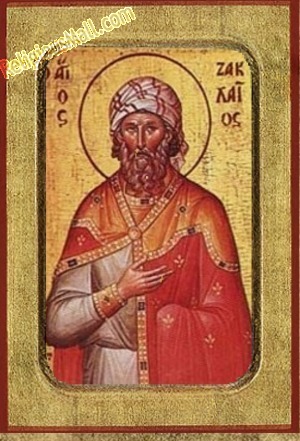
I don't know why it is but this year, like last year, and the last couple of years, this particular Sunday takes me by surprise. I'm going along, minding my own business, then bam Zacchaeus jumps out from behind the sycamore tree and says: "Great and Holy Lent is around the corner." Next week, the Sunday of the Publican and Pharisee, begins the Lenten Triodion, the three-week "ramp up" to Forgiveness Vespers and Great Lent. Gradually, the Church will wean herself of dairy products, olive oil, wine, and meat and eggs. We will be confronted with our hypocritical judgmentalism in the Pharisee and our need for humble repentance in the tax collector. We will be forced to let go the rigidity of the elder son, and own up to our own sinful wanderings in the prodigal son. We will face the last Judgment and our deeds to the least of these in whom Christ is present. And we will seek, give and receive the forgiveness of all in our local parish, and among our family and friends, even our enemies.
With such a preparation, we are then ready to face the testing of Great Lent, and to find in that testing and its culmination, Zacchaeus' desire, our heart's desire: to see Christ himself. This desire is awakened in us today. May we fan it to flame in the coming days.
Luke 19:1-10
And Jesus entered and passed through Jericho. And, behold, there was a man named Zacchaeus, which was the chief among the publicans, and he was rich. And he sought to see Jesus who he was; and could not for the press, because he was little of stature. And he ran before, and climbed up into a sycomore tree to see him: for he was to pass that way. And when Jesus came to the place, he looked up, and saw him, and said unto him, Zacchaeus, make haste, and come down; for to day I must abide at thy house. And he made haste, and came down, and received him joyfully. And when they saw it, they all murmured, saying, That he was gone to be guest with a man that is a sinner. And Zacchaeus stood, and said unto the Lord: Behold, Lord, the half of my goods I give to the poor; and if I have taken any thing from any man by false accusation, I restore him fourfold. And Jesus said unto him, This day is salvation come to this house, forsomuch as he also is a son of Abraham. For the Son of man is come to seek and to save that which was lost.
January 28, 2006
Our Father Among the Saints, Ephraim the Syrian
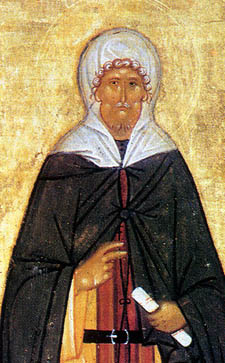
Troparion of St Ephraim Tone 8
By a flood of tears you made the desert fertile,/ And your longing for God brought forth fruits in abundance./ By the radiance of miracles you illumined the whole universe./ O our holy father Ephraim, pray to Christ our God to save our souls!
Kontakion of St Ephraim Tone 2
O Ephraim, as a lover of silence/ thou didst ever forsee the hour of reckoning and bitterly lament;/and by thy words thou wast indeed a teacher, O righteous one./ Wherefore, O father of all the world,/ thou dost rouse the slothful to repentance.
The Saint Ephrem the Syrian Library
An article on St. Ephrem's prayer by Protopresbyter Alexander Schmemann
From the OCA website:
Saint Ephraim the Syrian, a teacher of repentance, was born at the beginning of the fourth century in the city of Nisibis (Mesopotamia) into the family of impoverished toilers of the soil. His parents raised their son in piety, but from his childhood he was known for his quick temper and impetuous character. He often had fights, acted thoughtlessly, and even doubted God's Providence. He finally recovered his senses by the grace of God, and embarked on the path of repentance and salvation.Once, he was unjustly accused of stealing a sheep and was thrown into prison. He heard a voice in a dream calling him to repent and correct his life. After this, he was acquitted of the charges and set free.
The young man ran off to the mountains to join the hermits. This form of Christian asceticism had been introduced by a disciple of St. Anthony the Great, the Egyptian desert dweller Eugenios.
St. James of Nisibis (January 13) was a noted ascetic, a preacher of Christianity and denouncer of the Arians. St. Ephraim became one of his disciples. Under the direction of the holy hierarch, St. Ephraim attained Christian meekness, humility, submission to God's will, and the strength to undergo various temptations without complaint.
St. James transformed the wayward youth into a humble and conrite monk. Realizing the great worth of his disciple, he made use of his talents. He trusted him to preach sermons, to instruct children in school, and he took Ephraim with him to the First Ecumenical Council at Nicea (in the year 325). St. Ephraim was in obedience to St. James for fourteen years, until the bishop's death in 338.
After the capture of Nisibis by the Persians in 363, St. Ephraim went to a monastery near the city of Edessa. Here he saw many great ascetics, passing their lives in prayer and psalmody. Their caves were solitary shelters, and they fed themselves with a certain plant.
He became especially close to the ascetic Julian (October 18), who was of one mind with him. St. Ephraim combined asceticism with a ceaseless study of the Word of God, taking from it both solace and wisdom for his soul. The Lord gave him a gift of teaching, and people began to come to him, wanting to hear his counsel, which produced compunction in the soul, since he began with self-accusation. Both verbally and in writing, St. Ephraim instructed everyone in repentance, faith and piety, and he denounced the Arian heresy, which at that time was causing great turmoil. Pagans who heard the preaching of the saint were converted to Christianity.
He also wrote the first Syriac commentary on the Pentateuch (i.e. "Five Books") of Moses. He wrote many prayers and hymns, thereby enriching the Church's liturgical services. Famous prayers of St. Ephraim are to the Most Holy Trinity, to the Son of God, and to the Most Holy Theotokos. He composed hymns for the Twelve Great Feasts of the Lord (the Nativity of Christ, the Baptism, the Resurrection), and funeral hymns. St. Ephraim's Prayer of Repentance, "O Lord and Master of my life...", is recited during Great Lent, and it summons Christians to spiritual renewal.
From ancient times the Church has valued the works of St. Ephraim. His works were read publicly in certain churches after the Holy Scripture, as St. Jerome tells us. At present, the Church Typikon prescribes certain of his instructions to be read on the days of Lent. Among the prophets, St. David is the preeminent psalmodist; among the Fathers of the Church, St. Ephraim the Syrian is the preeminent man of prayer. His spiritual experience made him a guide for monastics and a help to the pastors of Edessa. St. Ephraim wrote in Syriac, but his works were very early translated into Greek and Armenian. Translations into Latin and Slavonic were made from the Greek text.
In many of St. Ephraim's works we catch glimpses of the life of the Syrian ascetics, which was centered on prayer and working in various obediences for the common good of the brethren. The outlook of all the Syrian ascetics was the same. The monks believed that the goal of their efforts was communion with God and the acquisition of divine grace. For them, the present life was a time of tears, fasting and toil.
"If the Son of God is within you, then His Kingdom is also within you. Thus, the Kingdom of God is within you, a sinner. Enter into yourself, search diligently and without toil you shall find it. Outside of you is death, and the door to it is sin. Enter into yourself, dwell within your heart, for God is there."
Constant spiritual sobriety, the developing of good within man's soul gives him the possibility to take upon himself a task like blessedness, and a self-constraint like sanctity. The requital is presupposed in the earthly life of man, it is an undertaking of spiritual perfection by degrees. Whoever grows himself wings upon the earth, says St. Ephraim, is one who soars up into the heights; whoever purifies his mind here below, there glimpses the Glory of God. In whatever measure each one loves God, he is, by God's love,satiated to fullness according to that measure. Man, cleansing himself and attaining the grace of the Holy Spirit while still here on earth, has a foretaste of the Kingdom of Heaven. To attain to life eternal, in the teachings of St. Ephraim, does not mean to pass over from one realm of being into another, but rather to discover "the heavenly," spiritual condition of being. Eternal life is not bestown on man through God's one-sided efforts, but rather, it constantly grows like a seed within him by his efforts, toils and struggles.
The pledge within us of "theosis" (or "deification") is the Baptism of Christ, and the main force that drives the Christian life is repentance. St. Ephraim was a great teacher of repentance. The forgiveness of sins in the Mystery of Repentance, according to his teaching, is not an external exoneration, not a forgetting of the sins, but rather their complete undoing, their annihilation. The tears of repentance wash away and burn away the sin. Moreover, they (i.e. the tears) enliven, they transfigure sinful nature, they give the strength "to walk in the way of the the Lord's commandments," encouraging hope in God. In the fiery font of repentance, the saint wrote, "you sail yourself across, O sinner, you resurrect yourself from the dead."
St. Ephraim, accounting himself as the least and worst of all, went to Egypt at the end of his life to see the efforts of the great ascetics. He was accepted there as a welcome guest and received great solace from conversing with them. On his return journey he visited at Caesarea in Cappadocia with St. Basil the Great (January 1), who wanted to ordain him a priest, but he considered himself unworthy of the priesthood. At the insistence of St. Basil, he consented only to be ordained as a deacon, in which rank he remained until his death. Later on, St. Basil invited St. Ephraim to accept a bishop's throne, but the saint feigned madness in order to avoid this honor, humbly regarding himself as unworthy of it.
After his return to his own Edessa wilderness, St. Ephraim hoped to spend the rest of his life in solitude, but divine Providence again summoned him to serve his neighbor. The inhabitants of Edessa were suffering from a devastating famine. By the influence of his word, the saint persuaded the wealthy to render aid to those in need. From the offerings of believers he built a poor-house for the poor and sick. St. Ephraim then withdrew to a cave near Edessa, where he remained to the end of his days.
January 27, 2006
Your Prayers
Been having some dizziness over the past two days. Saw the doc today. They're going to treat it as a sinus/ear/cold/virus thing for a week. No obvious culprits. Initial neurological/reflex exams were fine. A little hand trembling when trying to touch doc's finger and then my nose with my own index finger as he moved aforementioned medical personnel finger around. Don't know if the hand trembling is anything. I've had a bit of it for much of my adult life. My dad has a touch of it. Anywho: After a week, if things haven't cleared up, they'll schedule an MRI.
Don't know why, but that phrase "we'll schedule an MRI" was quite ominous. Never had one. Know it's going to be about my head. Yada yada yada.
Would appreciate yer prayers.
January 26, 2006
Uh-oh, Hill!
Gallup's new poll, Hillary/Condi Polarize Electorate, is out. And I haven't seen or heard a thing about it in the news. It doesn't take a conspiracy theorist to come up with a short list of reasons why. Quoting from the poll summary (emphases added):
A new CNN/USA Today/Gallup poll finds the two women who are most frequently mentioned as potential presidential candidates of their respective parties are each opposed by about half the electorate. Among registered voters, 48% would consider voting for New York Sen. Hillary Rodham Clinton for president in 2008, including 16% who say they would "definitely" vote for her. Fifty-one percent say they would "definitely" not vote for Clinton.
Think about that for a minute. Just more than half the electorate would "definitely not" vote for Hilary.
Rice, who has explicitly and repeatedly stated she will not run for president, has better results.
Slightly more positive feelings are found for Secretary of State Condoleezza Rice. Fifty-two percent would consider voting for her for president, including 14% who would "definitely" commit. Forty-six percent say they would "definitely" not vote for Rice.
The rest of the poll results break pretty much as one might expect. More Republicans (89%) would definitely not vote for Clinton than Democrats oppose Rice (65%).
In some surprising results, more independents (50%) oppose Rice than oppose Clinton (41%). But what's even more suprising is:
About the same number of each party say they would definitely not vote for their own party's female candidate -- 19% of Republicans "definitely" against Rice, and 20% of Democrats "definitely" against Clinton.
Things are not looking good for Hillary. Just more than half of registered voters would not vote for Hillary, and nearly one-fifth of her presumed Democratic base would not vote for her. Ouch.
And if anything, the last two election cycles have demonstrated that you cannot win elections with only eighty percent of your base.
Disclaimer: Hillary has neither explicitly said she's not running for President, nor declared her candidacy. But very few people think she's not seriously considering running and/or has plans to run.
These numbers have to have her thinking much harder about it all.
January 25, 2006
Papal Encyclical: Deus Caritas Est
His Holiness, Pope Benedict XVI's newest encyclical has been promulgated: Deus Caritas Est (here's the Latin).
From the excerpts I've read, it is fully emblematic of Pope Benedict's keen mind and pious heart.
Book of Daniel to be Replaced by . . . Yet Another Law & Order Franchise
While the good news is that NBC has cancelled "The Book of Daniel"--and good riddance to One of the Crappiest Shows EverTM--the not so good news is we get yet another Law & Order franchise.
So, what to replace BofD with in that time slot?
On Friday, January 27, the show will be replaced with an episode of "Law & Order."
Of course. Among the different franchises there's gotta be oh, say, three or four hundred episodes no one has ever seen. But of course, they won't show that one. They'll show the one where the detectives nab the wrong guy the first time, and then a witness recants on the stand, and the DA's office is forced to do some backroom shady activities to force an emotional confrontion with the defendent in court in which he gets angry and confesses. Fade to credits.
Okay, but then what?
The Friday, February 3rd, the network will air a 2 hour edition of Dateline NBC beginning at 9 p.m.
This must be the one in which some teen got murdered and the killer couldn't be found. I think I've seen this one.
Then? The Winter Olympics of course! Rock on!
But that's only good every four years. Then what?
Following the Winter Olympics the Friday 10 p.m. time period will contain a new legal drama entitled "Conviction" from the producer of "Law & Order".
You don't say? Is that the one in which they get the wrong guy only to find out he's an evil mastermind who's been playing them through the whole show, but then trips himself up on the stand in the courtroom in an emotional confrontation with the DA?
I think I've seen that one.
(Full disclosure. I watch Law & Order occasionally. Mostly the Wednesday flagship. It's the one I like the most, though I do happen to be a Vincent D'onofrio fan (am ambivalent about the return of Chris Noth/Mr. Big). And I usually like the original Law & Order show. But ever since Jill Hennesey left, I've lost most of my will to watch. And no, Crossing Jordan--Yet Another Crappy ShowTM--only makes it worse!)
Our Father Among the Saints, Gregory of Nazianzus, Archbishop of Constantinople, the Theologian
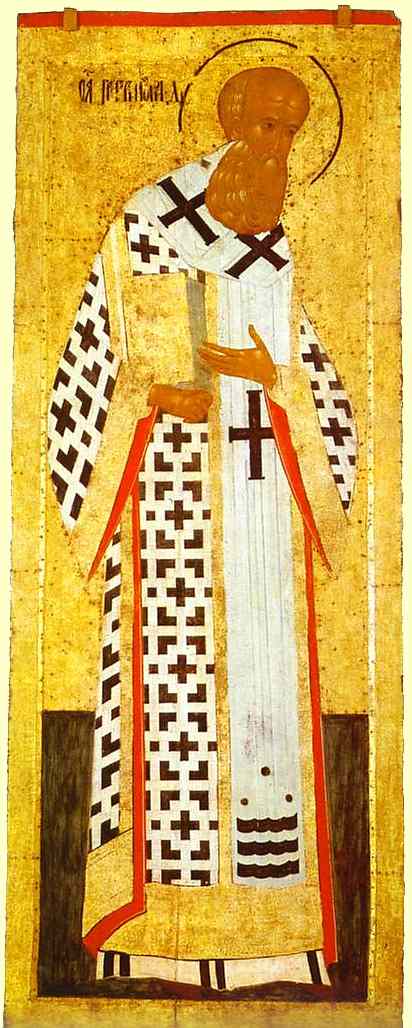
Troparion of St Gregory the Theologian Tone 1
The shepherd's pipe of thy theology/ conquered the philosophers' trumpets;/ for since thou didst search out the depths of the Spirit,/ beauty of speech was added to thee./ Intercede with Christ our God that our souls may be saved,/ O Father Gregory.
Kontakion of St Gregory the Theologian Tone 3
With thy theologian's speech thou didst dispel the philosopher's cobwebs,/ O glorious Gregory;/ and thou dost adorn the robe of Orthodoxy woven for the Church from on high./ Wearing this, she cries out with us thy children:/ Rejoice, O Father, most excellent mind of theology.
From the Prolog:
Gregory was born in Nazianzus of a Greek father and a Christian mother. Before his baptism, he studied in Athens along with Basil the Great and Julian the Apostate. Gregory often prophesied that Julian would become an apostate and a persecutor of the Church which actually happened. Gregory was especially influenced greatly by his good mother Nonna. When he completed his studies, Gregory was baptized. St. Basil consecrated him as bishop of Sasima, and Emperor Theodosius the Great summoned him to fill the vacant archepiscopal throne of Constantinople. He wrote numerous works of which his most famous are those concerning theology for which he is called The Theologian. Especially known because of its depth is his work: Homilies on The Holy Trinity. Gregory wrote against the heretic Macedonius who erroneously taught that the Holy Spirit is a creation of God and, Gregory also wrote against Appolinarius who erroneously taught that Christ did not have a human soul but that His divinity was in lieu of His soul. Additionally Gregory wrote against Emperor Julian the Apostate, his one-time colleague in school. In 381 A.D., when a debate began regarding his election as archbishop, he withdrew on his own and issued a statement: "Those, who deprive us of our archepiscopal throne cannot deprive us of God." After that, he left Constantinople and went to Nazianzus and there lived a life of solitude and prayer, writing worthwhile books. Even though he was in poor health throughout his entire life, nevertheless, Gregory lived to be eighty years old. His relics were later transferred to Rome. A reliquary containing his head reposes in the Cathedral Church of the Assumption in Moscow. He was, and remains, a great and wonderful light of the Orthodox Church as much by his meekness and purity of character as well as for the unsurpassable depth of his mind. He died in the Lord in the year 390 A.D.
First Theological Oration (XXVII): Against the Eunomians (excerpts from this oration are posted on my companion blog: here, here, here, here, and here)
Second Theological Oration (XXVIII)
Third Theological Oration (XXIX): The First on the Son (this is also posted on my companion blog)
Fourth Theological Oration (XXX): The Second on the Son
Fifth Theological Oration (XXXII): On the Holy Spirit
From the OCA website:
Saint Gregory the Theologian, Archbishop of Constantinople, a great Father and teacher of the Church, was born into a Christian family of eminent lineage in the year 329, at Arianzos (not far from the city of Cappadocian Nazianzos). His father, also named Gregory (January 1), was Bishop of Nazianzus. The son is the St. Gregory Nazianzus encountered in Patristic theology. His pious mother, St. Nonna (August 5), prayed to God for a son, vowing to dedicate him to the Lord. Her prayer was answered, and she named her child Gregory.When the child learned to read, his mother presented him with the Holy Scripture. St. Gregory received a complete and extensive education: after working at home with his uncle St. Amphilochios, an experienced teacher of rhetoric, he then studied in the schools of Nazianzos, Caesarea in Cappadocia, and Alexandria. Then the saint decided to go to Athens to complete his education.
On the way from Alexandria to Greece, a terrible storm raged for many days. St. Gregory, who was just a catechumen at that time, feared that he would perish in the sea before being cleansed in the waters of Baptism. St. Gregory lay in the ship's stern for twenty days, beseeching the merciful God for salvation. He vowed to dedicate himself to God, and was saved when he invoked the name of the Lord.
St. Gregory spent six years in Athens studying rhetoric, poetry, geometry, and astronomy. His teachers were the reknowned pagan rhetoricians Gymorias and Proeresias. St. Basil, the future Archbishop of Caesarea (January 1) also studied in Athens with St. Gregory. They were such close friends that they seemed to be one soul in two bodies. Julian, the future emperor (361-363) and apostate from the Christian Faith, was studying philosophy in Athens at the same time.
Upon completing his education, St. Gregory remained for a certain while at Athens as a teacher of rhetoric. He was also familiar with pagan philosophy and literature.
In 358 St. Gregory quietly left Athens and returned to his parents at Nazianzus. At thirty-three years of age, he received Baptism from his father, who had been appointed Bishop of Nazianzus. Against his will, St. Gregory was ordained to the holy priesthood by his father. However, when the elder Gregory wished to make him a bishop, he fled to join his friend Basil in Pontus. St. Basil had organized a monastery in Pontus and had written to Gregory inviting him to come.
St. Gregory remained with St. Basil for several years. When his brother St. Caesarius (March 9) died, he returned home to help his father administer his diocese. The local church was also in turmoil because of the Arian heresy. St. Gregory had the difficult task of reconciling the bishop with his flock, who condemned their pastor for signing an ambiguous interpretation of the dogmas of the faith.
St. Gregory convinced his father of the pernicious nature of Arianism, and strengthened him in Orthodoxy. At this time, Bishop Anthimos, who pretended to be Orthodox but was really a heretic, became Metropolitan of Tyana. St. Basil had been consecrated as the Archbishop of Caesarea, Cappadocia. Anthimos wished to separate from St. Basil and to divide the province of Cappadocia.
St. Basil the Great made St. Gregory bishop of the city of Sasima, a small town between Caesarea and Tyana. However, St. Gregory remained at Nazianzos in order to assist his dying father, and he guided the flock of this city for a while after the death of his father in 374.
Upon the death of Patriarch Valentus of Constantinople in the year 378, a council of bishops invited St. Gregory to help the Constantinople Church, which at this time was ravaged by heretics. Obtaining the consent of St. Basil the Great, St. Gregory came to Constantinople to combat heresy. In the year 379 he began to serve and preach in a small church called "Anastasis" ("Resurrection"). Like David fighting the Philistines with a sling, St. Gregory battled against impossible odds to defeat false doctrine.
Heretics were in the majority in the capital, Arians, Macedonians, and Appolinarians. The more he preached, the more did the number of heretics decrease, and the number of the Orthodox increased. On the night of Pascha (April 21, 379) when St. Gregory was baptizing catechumens, a mob of armed heretics burst into the church and cast stones at the Orthodox, killing one bishop and wounding St. Gregory. But the fortitude and mildness of the saint were his armor, and his words converted many to the Orthodox Church.
St. Gregory's literary works (orations, letters, poems) show him as a worthy preacher of the truth of Christ. He had a literary gift, and the saint sought to offer his talent to God the Word: "I offer this gift to my God, I dedicate this gift to Him. Only this remains to me as my treasure. I gave up everything else at the command of the Spirit. I gave all that I had to obtain the pearl of great price. Only in words do I master it, as a servant of the Word. I would never intentionally wish to disdain this wealth. I esteem it, I set value by it, I am comforted by it more than others are comforted by all the treasures of the world. It is the companion of all my life, a good counselor and converser; a guide on the way to Heaven and a fervent co-ascetic." In order to preach the Word of God properly, the saint carefully prepared and revised his works.
In five sermons, or "Theological Orations," St. Gregory first of all defines the characteristics of a theologian, and who may theologize. Only those who are experienced can properly reason about God, those who are successful at contemplation and, most importantly, who are pure in soul and body, and utterly selfless. To reason about God properly is possible only for one who enters into it with fervor and reverence.
Explaining that God has concealed His Essence from mankind, St. Gregory demonstrates that it is impossible for those in the flesh to view mental objects without a mixture of the corporeal. Talking about God in a positive sense is possible only when we become free from the external impressions of things and from their effects, when our guide, the mind, does not adhere to impure transitory images. Answering the Eunomians, who would presume to grasp God's Essence through logical speculation, the saint declared that man perceives God when the mind and reason become godlike and divine, i.e. when the image ascends to its Archetype. (Or. 28:17). Furthermore, the example of the Old Testament patriarchs and prophets and also the Apostles has demonstrated, that the Essence of God is incomprehensible for mortal man. St. Gregory cited the futile sophistry of Eunomios: "God begat the Son either through His will, or contrary to will. If He begat contrary to will, then He underwent constraint. If by His will, then the Son is the Son of His intent."
Confuting such reasoning, St. Gregory points out the harm it does to man: "You yourself, who speak so thoughtlessly, were you begotten voluntarily or involuntarily by your father? If involuntarily, then your father was under the sway of some tyrant. Who? You can hardly say it was nature, for nature is tolerant of chastity. If it was voluntarily, then by a few syllables you deprive yourself of your father, for thus you are shown to be the son of Will, and not of your father" (Or. 29:6).
St. Gregory then turns to Holy Scripture, with particular attention examining a place where it points out the Divine Nature of the Son of God. St. Gregory's interpretations of Holy Scripture are devoted to revealing that the divine power of the Savior was actualized even when He assumed an impaired human nature for the salvation of mankind.
The first of St. Gregory's Five Theological Orations is devoted to arguments against the Eunomians for their blasphemy of the Holy Spirit. Closely examining everything that is said in the Gospel about the Third Person of the Most Holy Trinity, the saint refutes the heresy of Eunomios, which rejected the divinity of the Holy Spirit. He comes to two fundamental conclusions. First, in reading Holy Scripture, it is necessary to reject blind literalism and to try and understand its spiritual sense. Second, in the Old Testament the Holy Spirit operated in a hidden way. "Now the Spirit Himself dwells among us and makes the manifestation of Himself more certain. It was not safe, as long as they did not acknowledge the divinity of the Father, to proclaim openly that of the Son; and as long as the divinity of the Son was not accepted, they could not, to express it somewhat boldly, impose on us the burden of the Holy Spirit" (Or. 31:26).
The divinity of the Holy Spirit is a sublime subject. "Look at these facts: Christ is born, the Holy Spirit is His Forerunner. Christ is baptized, the Spirit bears witness to this... Christ works miracles, the Spirit accompanies them. Christ ascends, the Spirit takes His place. What great things are there in the idea of God which are not in His power? What titles appertaining to God do not apply also to Him, except for Unbegotten and Begotten? I tremble when I think of such an abundance of titles, and how many Names they blaspheme, those who revolt against the Spirit!" (Or. 31:29).
The Orations of St. Gregory are not limited only to this topic. He also wrote Panegyrics on Saints, Festal Orations, two invectives against Julian the Apostate, "two pillars, on which the impiety of Julian is indelibly written for posterity," and various orations on other topics. In all, forty-five of St. Gregory's orations have been preserved.
The letters of the saint compare favorably with his best theological works. All of them are clear, yet concise. In his poems as in all things, St. Gregory focused on Christ. "If the lengthy tracts of the heretics are new Psalters at variance with David, and the pretty verses they honor are like a third testament, then we also shall sing Psalms, and begin to write much and compose poetic meters," said the saint. Of his poetic gift the saint wrote: "I am an organ of the Lord, and sweetly... do I glorify the King, all atremble before Him."
The fame of the Orthodox preacher spread through East and West. But the saint lived in the capital as though he still lived in the wilderness: "his food was food of the wilderness; his clothing was whatever necessary. He made visitations without pretense, and though in proximity of the court, he sought nothing from the court."
The saint received a shock when he was ill. One whom he considered as his friend, the philosopher Maximos, was consecrated at Constantinople in St. Gregory's place. Struck by the ingratitude of Maximos, the saint decided to resign the cathedra, but his faithful flock restrained him from it. The people threw the usurper out of the city. On November 24, 380 the holy emperor Theodosius arrived in the capital and, in enforcing his decree against the heretics, the main church was returned to the Orthodox, with St. Gregory making a solemn entrance. An attempt on the life of St. Gregory was planned, but instead the assassin appeared before the saint with tears of repentance.
At the Second Ecumenical Council in 381, St. Gregory was chosen as Patriarch of Constantinople. After the death of Patriarch Meletios of Antioch, St. Gregory presided at the Council. Hoping to reconcile the West with the East, he offered to recognize Paulinus as Patriarch of Antioch.
Those who had acted against St. Gregory on behalf of Maximos, particularly Egyptian and Macedonian bishops, arrived late for the Council. They did not want to acknowledge the saint as Patriarch of Constantinople, since he was elected in their absence.
St. Gregory decided to resign his office for the sake of peace in the Church: "Let me be as the Prophet Jonah! I was responsible for the storm, but I would sacrifice myself for the salvation of the ship. Seize me and throw me... I was not happy when I ascended the throne, and gladly would I descend it."
After telling the emperor of his desire to quit the capital, St. Gregory appeared again at the Council to deliver a farewell address (Or. 42) asking to be allowed to depart in peace.
Upon his return to his native region, St. Gregory turned his attention to the incursion of Appolinarian heretics into the flock of Nazianzus, and he established the pious Eulalios there as bishop, while he himself withdrew into the solitude of Arianzos so dear to his heart. The saint, zealous for the truth of Christ continued to affirm Orthodoxy through his letters and poems, while remaining in the wilderness. He died on January 25, 389, and is honored with the title "Theologian," also given to the holy Apostle and Evangelist John.
In his works St. Gregory, like that other Theologian St. John, directs everything toward the Pre-eternal Word. St. John of Damascus (December 4), in the first part of his book AN EXACT EXPOSITION OF THE ORTHODOX FAITH, followed the lead of St. Gregory the Theologian.
St. Gregory was buried at Nazianzos. In the year 950, his holy relics were transferred to Constantinople into the church of the Holy Apostles. Later on, a portion of his relics was transferred to Rome.
In appearance, the saint was of medium height and somewhat pale. He had thick eyebrows, and a short beard. His contemporaries already called the archpastor a saint. The Orthodox Church, honors St. Gregory as a second Theologian and insightful writer on the Holy Trinity.
"O glorious Father Gregory, Your knowledge has overcome the pride of false wisdom. The church is clothed with your teaching as a robe of righteousness. We your children celebrate your memory crying out: Rejoice, O father of unsurpassable wisdom!" [Kontakion].
January 24, 2006
The Rumors Are Apparently True: Book of Daniel "Gone Like a Freight Train, Gone Like Yesterday . . ."
I'd heard the rumors, but have seen no official confirmation of it. The nearest I've come is this post on the Book of Daniel Message Boards:
Unfortunately, due to many reasons, "The Book of Daniel" will no longer be aired on NBC on Friday nights. I just wanted to say "thank you" to all of you who supported the show. There were many wonderful, talented people who contributed to it's success - and I do mean success. Whatever the outcome, I feel that I accomplished what I set out to do: A solid family drama, with lots of humor, that honestly explored the lives of the Webster family. Good, flawed people, who loved each other no matter what... and there was always a lot of "what"! I remain proud of our product, proud of my association with Sony, NBC Universal, and NBC, who all took a chance on a project that spoke to them, and proud to have made an impact on so many of your lives.Thanks for watching.
Sincerely,
Jack Kenny
Creator, The Book of Daniel
I'm sure that LLL folks will decry the influence and "dramaphobia" of the RRR Volken.
But I think if everyone will just cool their jets a bit, take some deep breaths, and imbibe some good stout, we'll all come to realize what a truly crappy show it was in the first place.
It was cancelled because it was crap, advertisers knew it was crap, and did not fork over the money to pay for such crap.
[channeling Dennis Miller]But then again, I could be wrong. [/channeling Dennis Miller]
(Pssst. For the blogpost title see here.)
Fr. Lawrence Farley: Reading Over the Shoulders of the Fathers
In “Reading Over the Shoulders of the Fathers”—A Call for an Orthodox Approach to Scripture (pdf file), Fr. Lawrence Farley writes:
The much needed ‘return to the Fathers’, Fr. Alexander Schmemann said, “means, above all, the recovery of their spirit, of the secret inspiration which made them true witnesses of the Church” (quoted in Liturgy and Tradition, p. 84f). That is, what is needed is a return to the mind-set, the inner attitude and spiritual world-view of the Fathers.This return to the Fathers is nowhere needed more than in a return to their view and veneration of the Divine Scriptures. The Church is now suffering from a low and deficient view of the Scriptures, one gained from the liberal world of western Academia, one which feels itself free to dissent from the received meaning and interpretation of the Scriptures in favour of more modern and politically-correct views.
In the writing of ostensibly Orthodox authors, in casual conversations with some clergy, in letters to the editor in our Orthodox journals, one can often find evidence of this alienation from the attitude of the Fathers. In one article, supporting references to the Scriptures are pilloried as “biblical literalism”, in another, Pauline use of the Old Testament is discounted as “rabbinic exegesis”, in yet another, one is warned against “the hazards of appealing too quickly to patristic testimony”. Anyone who is a convert from liberal protestantism, can easily identify the common disease which produced all the above citations: a low view of the Scriptures in which they are praised as sources and authorities but ultimately discounted as products of their age rather than as living oracles of Truth.
When one steeps oneself in the literature of the Fathers, one is aware of entering a different world, of breathing a different air. For the Fathers, the Scriptures spoke with the voice of God and an apt citation of a Scriptural text (read and interpreted, of course, through the Tradition of the Church) was seen as bringing all godly controversy to an end. This was not “proof-texting” (which involves the use of Scripture separated from Holy Tradition). Rather, it was an awareness of Scripture as a locus and carrier of that Holy Tradition and therefore as a reliable arbiter in all Christian disputes.
A casual reading of the Fathers will confirm that this was their approach. Consider the words of St. Clement of Rome: “You well know that nothing unjust or fraudulent is written in the Scriptures”. Or the words of St. Irenaeus: “the Scriptures of certain[t]y perfect, since they were spoken by the Word of God and by His Spirit”. Or the words of St. Hippolytus: “those who [do] not believe that the Holy Scriptures were spoken by the Holy Spirit...are unbelievers”. Or Origen: “With complete and utter precision the Holy Spirit supplied the very words of Scripture through His subordinate authors...according to which the wisdom of God pervades every divinely-inspired writing, reach[es] out to each single letter”. The Fathers did not adhere to a view of dictation, which would reduce the human authors of Scripture to merely passive conduits of the Divine Word. They knew full well that these were human documents, subject to the normal human variants of style and didactic purpose. Nonetheless, they were also very aware that these same human documents were vehicles for the Spirit of God, containing, as Divine Oracles, God’s timeless and transcendent Truth, and thus not subject to error.
According to the Fathers, how should we read the Scriptures today? I would point out two components of an Orthodox and patristic approach to the Divine Scriptures.
We should read the Scriptures in the Church. That is, we should interpret the Scriptures guided by our Holy Tradition as preserved in the interpretations of the Fathers. As Origen expresses it, “That alone is to be believed as the truth which is in no way at variance with ecclesiastical and apostolic Tradition”. This does not mean a rejection of all the fruit of modern commentary and criticism. It does mean a selective use of such modern work. The plumb-line of Tradition is to be hung against new work: only such as is consistent with Tradition is be accepted.
We should read the Scriptures on our knees. That is, we should come to the Scriptures as humble learners to be taught, not as judges to teach and correct. Humility is the pre-condition for everything in the Christian life, especially in our reading of the Scriptures. In this as in all things, “God resists the proud, but gives grace to the humble” (James 4:6).
We are often exhorted to be diligent in reading the Scriptures. This is a valuable exhortation—but one that must be supplemented with another: read the Scriptures as the Fathers read them. We must open our Bibles as opening the oracles of God—reading, as it were, over the shoulders of the Fathers. Only then can we gain true and eternal benefit for our souls.
Our Mother Among the Saints, Xenia of St. Petersburg, Fool for Christ
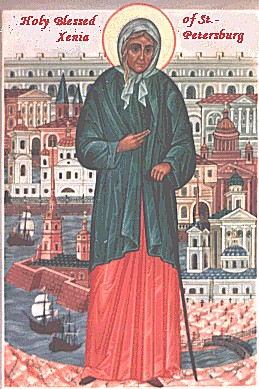
Troparion of St Xenia of St Petersburg Tone 8
Christ the Lord has shown forth in thee a new mediatress and intercessor for our race;/ thou didst will to endure evil in thy life and didst lovingly serve both God and man./ We zealously run to thee in misfortune and sorrow,/ we hope in thee and cry from our hearts:/ Put not our hope to shame, O blessed Xenia.
Another Troparion of St Xenia of St Petersburg Tone 5
Having lived as a stranger in the world, O Xenia,/ thou didst outwit the deviser of evil/ by thy pretended foolishness./ Thou didst receive from God/ grace to foresee and foretell things to come./ Now thou hast been translated from earth/ and art numbered with the choirs of Angels.
Kontakion of St Xenia of St Petersburg Tone 4
Thou didst give thy wealth to the poor, O Xenia,/ and accept poverty out of love for Christ;/ and having lived in a manner rivalling the Angels/ thou wast counted worthy/ of glory on high.
January 23, 2006
The Church Fathers and Ancient Councils on Abortion
[Note: This is also posted here.]
The Canons of the Council of Ancyra (which canons were accepted and received by the ecumenical synods)
Canon XXI.
Concerning women who commit fornication, and destroy that which they have conceived, or who are employed in making drugs for abortion, a former decree excluded them until the hour of death, and to this some have assented. Nevertheless, being desirous to use somewhat greater lenity, we have ordained that they fulfil ten years [of penance], according to the prescribed degrees.
The Constitution of the Holy Apostles
Book VII.
Concerning the Christian life, and the Eucharist and Initiation into Christ
Sec. I
III. Thou shall not slay thy child by causing abortion, nor kill that which is begotten; for "everything that is shaped, and has received a soul from God, if it be slain, shall be avenged, as being unjustly destroyed."
The Didache
(The Teaching of the Twelve Apostles)
CHAP. II.--The Second Commandment: Gross Sin Forbidden
And the second commandment of the Teaching; Thou shalt not commit murder, thou shalt not commit adultery, thou shalt not commit paederasty, thou shalt not commit fornication, thou shalt not steal, thou shalt not practise magic, thou shalt not practise witchcraft, thou shalt not murder a child by abortion nor kill that which is begotten.
Athenagoras of Athens
Apology for the Christians
Chap. XXXV.--The Christians Condemn and Detest All Cruelty
What man of sound mind, therefore, will affirm, while such is our character, that we are murderers? For we cannot eat human flesh till we have killed some one. The former charge, therefore, being false, if any one should ask them in regard to the second, whether they have seen what they assert, not one of them would be so barefaced as to say that he had. And yet we have slaves, some more and some fewer, by whom we could not help being seen; but even of these, not one has been found to invent even such things against us. For when they know that we cannot endure even to see a man put to death, though justly; who of them can accuse us of murder or cannibalism? Who does not reckon among the things of greatest interest the contests of gladiators and wild beasts, especially those which are given by you? But we, deeming that to see a man put to death is much the same as killing him, have abjured such spectacles. How, then, when we do not even look on, lest we should contract guilt and pollution, can we put people to death? And when we say that those women who use drugs to bring on abortion commit murder, and will have to give an account to God s for the abortion, on what principle should we commit murder? For it does not belong to the same person to regard the very foetus in the womb as a created being, and therefore an object of God's care, and when it has passed into life, to kill it; and not to expose an infant, because those who expose them are chargeable with child-murder, and on the other hand, when it has been reared to destroy it. But we are in all things always alike and the same, submitting ourselves to reason, and not ruling over it.
The Epistle of Barnabas
Chap. XIX.--The Way of Light
The way of light, then, is as follows. If any one desires to travel to the appointed place, he must be zealous in his works. The knowledge, therefore, which is given to us for the purpose of walking in this way, is the following. Thou shalt love Him that created thee: thou shalt glorify Him that redeemed thee from death. Thou shalt be simple in heart, and rich in spirit. Thou shalt not join thyself to those who walk in the way of death. Thou shalt hate doing what is unpleasing to God: thou shalt hate all hypocrisy. Thou shalt not forsake the commandments of the Lord. Thou shalt not exalt thyself, but shalt be of a lowly mind. Thou shalt not take glory to thyself. Thou shalt not take evil counsel against thy neighbour. Thou shalt not allow over-boldness to enter into thy soul. Thou shalt not commit fornication: thou shalt not commit adultery: thou shalt not be a corrupter of youth. Thou shalt not let the word of God issue from thy lips with any kind of impurity. Thou shalt not accept persons when thou reprovest any one for transgression. Thou shalt be meek: thou shalt be peaceable. Thou shalt tremble at the words which thou hearest. Thou shalt not be mindful of evil against thy brother. Thou shalt not be of doubtful mind as to whether a thing shall be or not. Thou shalt not take the name of the Lord in vain. Thou shalt love thy neighbour more than thine own soul. Thou shalt not slay the child by procuring abortion; nor, again, shalt thou destroy it after it is born. Thou shalt not withdraw thy hand from thy son, or from thy daughter, but from their infancy thou shalt teach them the fear of the Lord.
St. Basil the Great
Letter CLXXXVIII.: (Canonica Prima.) To Amphilochius, concerning the Canons.
VII. On the other hand acts done in the attacks of war or robbery are distinctly intentional, and admit of no doubt. Robbers kill for greed, and to avoid conviction. Soldiers who inflict death in war do so with the obvious purpose not of fighting, nor chastising, but of killing their opponents. And if any one has concocted some magic philtre for some other reason, and then causes death, I count this as intentional. Women frequently endeavour to draw men to love them by incantations and magic knots, and give them drugs which dull their intelligence. Such women, when they cause death, though the result of their action may not be what they intended, are nevertheless, on account of their proceedings being magical and prohibited, to be reckoned among intentional homicides. Women also who administer drugs to cause abortion, as well as those who take poisons to destroy unborn children, are murderesses. So much on this subject.
The Canons of St. Basil
Canon II
Let her that procures abortion undergo ten years' penance, whether the embryo were perfectly formed, or not.
Canon VIII
But the man, or woman, is a murderer that gives a philtrum, if the that takes it die upon it; so are they who take medicines to procure abortion; and so are they who kill on the highway, and rapparees.
St. Jerome
Letter XXII: To Eustochium
13. Some go so far as to take potions, that they may insure barrenness, and thus murder human beings almost before their conception. Some, when they find themselves with child through their sin, use drugs to procure abortion, and when (as often happens) they die with their offspring, they enter the lower world laden with the guilt not only of adultery against Christ but also of suicide and child murder.
St. John Chrysostom
Commentary on the Epistle to the Romans
XXIV: You see how drunkenness leads to whoredom, whoredom to adultery, adultery to murder; or rather to a something even worse than murder. For I have no name to give it, since it does not take off the thing born, but prevent its being born.(2) Why then dost thou abuse the gift of God, and fight with His laws, and follow after what is a curse as if a blessing, and make the chamber of procreation a chamber for murder, and arm the woman that was given for childbearing unto slaughter?
Tertullian
Treatise on the Soul
Chap. XXXVII.--On the Formation and State of the Embryo. Its Relation with the Subject of this Treatise
Now the entire process of sowing, forming, and completing the human embryo in the womb is no doubt regulated by some power, which ministers herein to the will of God, whatever may be the method which it is appointed to employ. Even the superstition of Rome, by carefully attending to these points, imagined the goddess Alemona to nourish the foetus in the womb; as well as (the goddesses) Nona and Decima, called after the most critical months of gestation; and Partula, to manage and direct parturition; and Lucina, to bring the child to the birth and light of day. We, on our part, believe the angels to officiate herein for God. The embryo therefore becomes a human being in the womb from the moment that its form is completed. The law of Moses, indeed, punishes with due penalties the man who shall cause abortion, inasmuch as there exists already the rudiment of a human being, which has imputed to it even now the condition of life and death, since it is already liable to the issues of both, although, by living still in the mother, it for the most part shares its own state with the mother.
The Canons of the Council in Trullo (The Quinisext Council)
Canon XCI.
Those who give drugs for procuring abortion, and those who receive poisons to kill the foetus, are subjected to the penalty of murder.
The Amicus Curiae Submitted to the Supreme Court by the Holy Orthodox Church
The Holy Orthodox Church respectfully submits this brief amicus curiae on behalf of itself and its members.INTEREST OF AMICUS CURIAE
The Holy Orthodox Church was founded by Jesus Christ and the Apostles, and bears witness to that continuous and unbroken faith. The precepts of the Orthodox Christian faith mandate the protection of innocent human life, especially that of unborn children. The Church regards abortion as murder, and as such, takes a very active role in opposing legalized abortion. That the issue of abortion has both a moral and a legal dimension to it, is indisputable. However, this cannot in any way be equated to an assertion that the two aspects are disparate, or unrelated. Rather, the two have historically been intertwined; it must be recognized that laws have traditionally been positive expressions of moral norms.
The Framers of the Constitution discerned a divine presence not only in daily living, but as reflected in the Constitution itself. "It is impossible for any man of pious reflection not to perceive in it a finger of that Almighty hand which has been so frequently and signally extended to our relief in the critical stages of the revolutionary." That is, a law must of its very nature have a moral component to it, which cannot be divorced from the law itself.
Legal precepts, particularly those of constitutional proportions, simply cannot be judged in a vacuum. This notion not only predates the Constitution; it is at the very heart of our civilization. The foundations of our morality can be found in the dawn and early morning light of the Judeo-Christian tradition, of which the Orthodox Church is a unique custodian. From its inception nearly two thousand years ago, it has never deviated from its condemnation of abortion, based on numerous scriptural references and the teaching of the Holy Fathers of the Church. The Church regards the Roe v. Wade decision as a gruesome turn on the road of judicial activism, having resulted in a holocaust which has claimed at least twenty million innocent lives.
STATEMENT OF THE CASE AND STATEMENT OF FACTS
Amicus curiae adopts the statement of the case and the statement of the facts as set out in the Appellants’ Brief.
SUMMARY OF ARGUMENT
In this case, the Holy Orthodox Church seeks to restore to our nation's law the highest principle which a civilized society can espouse—the recognition that all human life is sacred. In Roe v. Wade, 410 U.S. 113 (1973), the Supreme Court relied heavily upon its presentation of historic Christianity's teaching and practices. The assertions made in Roe were erroneous, and have no foundation in the church's traditions. Rather than being ambivalent, or even condoning abortion, as suggested by the Roe Court's opinion, historic Christianity has always condemned abortion as murder, without regard for any distinctions as to fetal development or viability.
The Roe Court also blurred the factual question of when life begins with the distinct legal question of what constitutional value attends to that life. The resulting confusion has tied the hands of legislators, and elevated abortion to the status of a near-absolute right. Unless this Court takes judicial notice, the factual question of when life begins is properly a subject for legislative findings. The strictly legal question of a life's constitutional value is the clear issue before this Court, as the State of Missouri has made an appropriate factual determination.
Science and history both mandate a conclusion that human life and constitutional personhood are coextensive, and any other result is without foundation in American jurisprudence. Consequently, the Holy Orthodox Church urges this Court to overrule Roe v. Wade, and accord full constitutional protection to all human life beginning at conception.
Read it all at the link above.
Office for the Victims of Abortion
The Order of the Office of Prayer and Supplication for the Victims of Abortion
Prayed to our Lord and God and Savior Jesus Christ
(The Priest and Deacon take their places before the Icon of Christ placed in the center of the Temple or other suitable place. The Priest is vested in Riassa and Epitrachilion and the Deacon in Sticharion and Orarion.)
Priest:
Blessed is our God always, now and ever, and unto ages of ages.
People:
Amen.
Reader:
Holy God, Holy Mighty, Holy Immortal, have mercy on us.
Holy God, Holy Mighty, Holy Immortal, have mercy on us.
Holy God, Holy Mighty, Holy Immortal, have mercy on us.
Glory to the Father, and to the Son, and to the Holy Spirit.
Now and ever, and unto the ages of ages. Amen.
All-Holy Trinity, have mercy on us. O Lord, cleanse us from our sins. O Master, pardon our transgressions. O Holy One, visit and heal our infirmities for Thy Name's sake.
Lord, have mercy. Lord, have mercy. Lord, have mercy.
Glory to the Father, and to the Son, and to the Holy Spirit.
Now and ever, and unto the ages of ages. Amen.
Our Father, who art in heaven, hallowed be Thy Name. Thy Kingdom come. Thy will be done, on earth as it is in heaven. Give us this day our daily bread, and forgive us our trespasses, as we forgive those who trespass against us, and lead us not into temptation, but deliver us from evil.
Priest:
For Thine is the Kingdom, and the power, and the glory: of the Father, and of the Son, and of the Holy Spirit. Now and ever, and unto the ages of ages.
Reader:
Amen.
Come, let us worship God, our King.
Come, let us worship and fall down before Christ, our King and our God.
Come, let us worship and fall down before the very Christ, our King and our God.
Psalm 143
Reader:
Hear my prayer, O Lord; give ear to my supplications. In Thy faithfulness answer me in Thy righteousness. Enter not into judgment with Thy servant; for no man living is righteous before Thee. For the enemy has pursued me; he has crushed my life to the ground; he has made me sit in darkness like those long dead. Therefore my spirit faints within me; my heart within me is appalled.
I remember the days of old, I meditate on all that Thou hast done; I muse on what Thy hands have wrought. I stretch out my hands to Thee; my soul thirsts for Thee like a parched land. Make haste to answer me, O Lord! My spirit falls! Hide not Thy face from me, lest I be like those who go down into the pit. Let me hear in the morning of Thy steadfast love, for in Thee I put my trust. Teach me the way I should go, for to thee I lift up my soul.
Deliver me, O Lord, from my enemies! I have fled to Thee for refuge. Teach me to do Thy will, for Thou art my God! Let Thy good spirit lead me on a level path! For Thy Name's sake, O Lord, preserve my life! In Thy righteousness bring me out of trouble! And in Thy steadfast love cut off my enemies, and destroy all my adversaries. For I am Thy servant.
Glory to the Father, and to the Son, and to the Holy Spirit:
now and ever, and unto the ages of ages. Amen.
Alleluia, Alleluia, Alleluia, Glory to Thee, O God.
Alleluia, Alleluia, Alleluia, Glory to Thee, O God.
Alleluia, Alleluia, Alleluia, Glory to Thee, O God.
The Great Litany
Deacon:
In peace, let us pray to the Lord.
People:
Lord, have mercy.
Deacon:
For the peace from above, and for the salvation of our souls, let us pray to the Lord.
People:
Lord, have mercy.
Deacon:
For the peace of the whole world, for the good estate of the holy churches of God, and for the union of all, let us pray to the Lord.
People:
Lord, have mercy.
Deacon:
For this holy temple, and for those who with faith, reverence, and the fear of God enter herein, let us pray to the Lord.
People:
Lord, have mercy.
(The following two petitions for the Orthodox Episcopate and the civil authorities are general petitions. These might be appropriate to use at a pan-Orthodox service where various Ecclesiastical jurisdictions are represented, and for services within the United States. Otherwise, the petitions commonly utilized by the officiating clergy to commemorate their ruling hierarchs and their civil government would more correctly be inserted here and substituted for those which appear below)
Deacon:
For the holy Orthodox Patriarchs, and for all Orthodox Bishops; for the venerable Priesthood, the Diaconate in Christ; for all the clergy and the people, let us pray to the Lord.
People:
Lord, have mercy.
Deacon:
For the President of the United States and for all the civil authorities, and for our armed forces in defence of peace and freedom everywhere, let us pray to the Lord.
People:
Lord, have mercy.
Deacon:
That He will aid them and grant them victory over every enemy and adversary, let us pray to the Lord.
People:
Lord, have mercy.
Deacon:
For this city, for every city and country, and for the faithful who dwell therein, let us pray to the Lord.
People:
Lord, have mercy.
Deacon:
For seasonable weather, for abundance of the fruits of the earth, and for peaceful times, let us pray to the Lord.
People:
Lord, have mercy.
Deacon:
For travelers by land, by sea, and by air; for the sick and the suffering; for captives and for their salvation, let us pray to the Lord.
People:
Lord, have mercy.
Deacon:
For our deliverance from all affliction, wrath, danger, and necessity, let us pray to the Lord.
People:
Lord, have mercy.
Deacon:
That He will not remember the transgressions of His people, but will turn away all His righteous wrath which He has stirred up against us, let us pray to the Lord.
People:
Lord, have mercy.
Deacon:
That He will bless the good intentions of His servants who strive to rescue His children from violent death, and allow them to begin successfully and to finish without obstacle, through the power and grace of the most Holy Spirit, let us pray to the Lord.
People:
Lord, have mercy.
Deacon:
That He will guide the hands of His servants to complete their work successfully, let us pray to the Lord.
People:
Lord, have mercy.
Deacon:
That He will bless His servants with the grace of the most Holy Spirit, and make their efforts well pleasing in His sight, let us pray to the Lord.
People:
Lord, have mercy.
Deacon:
That He will assign a guardian angel to banish from this effort every enemy and obstacle, whether visible or invisible, let us pray to the Lord.
People:
Lord, have mercy.
Deacon:
That this work may be ordered in wisdom and may end in perfection, by the grace of the Holy Spirit, let us pray to the Lord.
People:
Lord, have mercy.
Deacon:
Help us, save us, have mercy on us, and keep us, O God, by Thy grace.
People:
Lord, have mercy.
Deacon:
Calling to remembrance our most holy, most pure, most blessed and glorious Lady, the Birth-giver of God and ever-virgin Mary, with all the saints, let us commend ourselves and one another, and all our life unto Christ, our God.
People:
To Thee, O Lord.
Priest:
For unto Thee is due all glory, honor, and worship: to the Father, and to the Son, and to the Holy Spirit. Now and ever, and unto the ages of ages.
People:
Amen.
God Is the Lord (in the Second Tone)
Deacon:
God is the Lord and has revealed Himself to us! Blessed is He that comes in the Name of the Lord.
O give thanks unto the Lord, for He is good; for His mercy endures forever.
People (in Tone 2):
God is the Lord and has revealed Himself to us! Blessed is He that comes in the Name of the Lord.
Deacon:
All nations surrounded me, but in the Name of the Lord I destroyed them.
People:
God is the Lord and has revealed Himself to us! Blessed is He that comes in the Name of the Lord.
Deacon:
I shall not die, but live; and recount the works of the Lord.
People:
God is the Lord and has revealed Himself to us! Blessed is He that comes in the Name of the Lord.
Deacon:
The stone which the builders rejected has become the chief cornerstone; this is the Lord's doing, and it is marvellous in our eyes.
People:
God is the Lord and has revealed Himself to us! Blessed is He that comes in the Name of the Lord.
Troparion (in Tone 2)
People:
We bow before Thy most pure image, O Good One, Begging Thee to forgive us our sins, O Christ our God. Thou willingly didst ascend the cross in the flesh, To free us from Satan's snare.
For this we thank Thee Lord, and we cry to Thee: Thou hast filled all things with joy, O Saviour, When Thou camest to save the world.
Psalm 51
Reader:
Have mercy on me, O God, according to Thy loving kindness; according to the multitude of Thy tender mercies blot out my transgressions. Wash me throughly from my iniquity and cleanse me from my sin, for I acknowledge my transgression and my sin is ever before me: against Thee, Thee only have I sinned and done that which is evil in Thy sight; that Thou might be justified in Thy word, and prevail when Thou art judged. For behold, I was shapen in iniquity, and in sin did my mother conceive me.
Behold, Thou hast required truth in the inward parts; the unclear and hidden things of Thy wisdom Thou shalt reveal unto me. Purge me with hyssop, and I shall be clean; wash me, and I shall be whiter than snow. Make me to hear of joy and gladness, that the bones which Thou hast broken might rejoice. Turn away Thy face from my sins, and blot out all my iniquities.
Create in me a clean heart, O God, and renew a right spirit within me. Cast me not away from Thy presence, and take not Thy Holy Spirit from me. Restore unto me the joy of Thy salvation, and guide me with a princely spirit. Then shall I teach transgressors Thy ways, and sinners shall be converted unto Thee. Deliver me from blood-guiltiness, O God, Thou God of my salvation, and my tongue shall sing aloud of Thy righteousness.
O Lord, open my lips, and my mouth shall show forth Thy praise. For if Thou hadst desired sacrifice, I would have given it, but Thou dost not delight in burnt offerings. The sacrifice of God is a contrite spirit, a broken and a contrite heart, O God, Thou shalt not despise. Do good, O Lord, in Thy good will unto Sion, and build Thou the walls of Jerusalem. Then shalt Thou be pleased with the sacrifice of righteousness, with burnt offerings and whole burnt offerings. Then shall they offer bullocks upon Thine altar.
(The Canon may be sung here, followed by the Refrains. Or the Refrains alone are sung three times. The Deacon censes before the Icon during the Refrains:)
Priest:
Glory to Thee, our God, glory to Thee!
Choir:
Glory to Thee, our God, glory to Thee!
Priest:
Glory to the Father, and to the Son, and to the Holy Spirit.
Choir:
Now and ever, and unto ages of ages. Amen.
(The Priest and Choir sing the Refrains three times.
The Third Ode of the Canon follows, and then the following hymn.
If there is no Canon, the hymn follows the singing of the Refrains.
The Deacon censes at the Icon during the Refrains.)
Choir:
Deliver us from evil O Merciful One For we run to Thee in our afflictions. O Lord Jesus Christ, save our souls.
(Following the hymn, the Priest and Choir repeat the Refrains three times as above. The Deacon censes before the icon.)
Litany
Deacon:
Let us say with our whole soul and with our whole mind, let us say:
People:
Lord, have mercy. Lord, have mercy. Lord, have mercy.
Deacon:
O Lord Almighty, the God of our fathers we beseech Thee, hearken and have mercy.
People:
Lord, have mercy. Lord, have mercy. Lord, have mercy.
Deacon:
Have mercy on us, O God, according to Thy great mercy, we beseech Thee, hearken and have mercy.
People:
Lord, have mercy. Lord, have mercy. Lord, have mercy.
(The following is a general petition for the Orthodox Hierarchs, and should be modified as needed to reflect local usage.)
Deacon:
Again we pray for the holy Orthodox Patriarchs and for all Orthodox Bishops; for Priests, Deacons, and all other clergy, and for all our brotherhood in Christ.
People:
Lord, have mercy. Lord, have mercy. Lord, have mercy.
Deacon:
Again we pray for mercy, life, peace, health, salvation, and visitation for the servants of God who strive against the evil of abortion, and for the pardon and remission of their sins.
People:
Lord, have mercy. Lord, have mercy. Lord, have mercy.
Deacon:
Again we beg Thee, O Lord, to hear our prayer, and have mercy on Thy servants who strive to save the lives of Thy innocent children. In Thy grace and bounty, fulfill their petitions and forgive all their transgressions, whether voluntary or involuntary. Accept their sacrifice of praise upon Thy heavenly altar; protect them from every visible and invisible enemy; deliver them from all misery, sickness, and affliction; grant them health and length of days, we pray Thee, O Lord, hearken and have mercy.
People:
Lord, have mercy. Lord, have mercy. Lord, have mercy.
For Children in Danger of Death by Abortion
Deacon:
Again we pray for the children of God condemned to death by the unjust judgement of men: that the Lord our God would soften the hearts of those who seek their violent destruction, and rescue those who are being led forth to the slaughter, we diligently pray Thee, O Lord, hearken and have mercy!
People:
Lord, have mercy. Lord, have mercy. Lord, have mercy.
For Rescuers Who Have Been Imprisoned
Deacon:
Again we pray for all who have fallen into the hands of the godless civil authority for the sake of God's children, and who languish in courts and prisons: that the Lord our God may look upon them with compassion; that He may comfort, strengthen and preserve them; and that He may deliver them speedily from bondage and oppression, let us all say: O Lord, hearken and have mercy.
People:
Lord, have mercy. Lord, have mercy. Lord, have mercy.
Deacon:
By Thine infinite power, O Lord, our God, move to compassion and mercy the hearts of those who hold Thy servants in cruel captivity; restrain them from doing harm or permitting evil to befall Thy servants, but rather cause them to relent and to release them; free the captives whole and unharmed, O Lord, and bestow Thy mercy upon them, let us all say: hearken quickly and graciously have mercy!
People:
Lord, have mercy. Lord, have mercy. Lord, have mercy.
Deacon:
Thy vile enemies, O Lord, have annihilated Thy children and defiled Thy churches, and have imprisoned Thy faithful servants. Look down from heaven, therefore, and behold, and forsake us not utterly, but quickly cleanse the land of Thy people of the wickedness of those who oppose Thee, with humble heart we entreat Thee, our God Who art mighty in strength and wondrous in wisdom: O Compassionate One, hearken and have mercy!
People:
Lord, have mercy. Lord, have mercy. Lord, have mercy.
Deacon:
Again we pray for all those here present, who await from Thee Thy great and abundant mercy.
People:
Lord, have mercy. Lord, have mercy. Lord, have mercy.
Priest:
For Thou art a merciful God, and lovest mankind, and unto Thee do we send up glory: to the Father, and to the Son, and to the Holy Spirit. Now and ever, and unto the ages of ages.
People:
Amen.
(If the Canon is being sung, it continues now. After the Sixth Ode the Refrains are repeated. If the Canon is not sung, the Refrains alone are repeated by Priest and Choir as before, again three times. The Deacon censes as before.)
Priest:
Glory to Thee, our God, Glory to Thee!
Choir:
Glory to Thee, our God, Glory to Thee!
Priest:
Glory to the Father, and to the Son, and to the Holy Spirit.
Choir:
Now and ever, and unto ages of ages. Amen.
(The Priest and Choir sing the Refrains three times, and the Deacon censes. The Akathist Hymn may be sung at this time, if desired. At the completion of the Akathist, or following the Refrains if there is no Akathist:)
The Prokeimenon
Deacon:
Let us attend
Priest:
Peace be unto all.
Deacon:
Wisdom! Let us Attend!
The Prokeimenon in the fourth tone:
Lord, we will walk in the light of Thy countenance and exult in Thy Name forever.
Choir:
Lord we will walk in the light of Thy Countenance and exult in Thy Name forever.
Deacon:
I will sing of Thy mercy, O Lord, forever; with my mouth I will proclaim Thy faithfulness to all generations.
Choir:
Lord, we will walk in the light of Thy Countenance and exult in Thy Name forever.
Deacon:
Lord, we will walk in the light of Thy countenance.
Choir:
And exult in Thy Name forever.
Deacon:
Let us pray to the Lord,
People:
Lord, have mercy.
Priest:
For holy art Thou, O our God, who rests in the saints, and unto Thee do we send up glory: to the Father, and to the Son, and to the Holy Spirit. Now and ever, and unto the ages of ages.
People:
Amen.
Deacon:
Let everything that has breath praise the Lord!
Choir:
Let everything that has breath praise the Lord!
Deacon:
Praise God in His sanctuary; praise Him in His mighty firmament.
Choir:
Let everything that has breath praise the Lord!
Deacon:
Let everything that has breath.
Choir:
Praise the Lord.
The Gospel Reading
Deacon:
And that we may be accounted worthy to hear the Holy Gospel, let us pray to the Lord, our God.
People:
Lord, have mercy. Lord, have mercy. Lord, have mercy.
Deacon:
Wisdom! Let us attend! Let us hear the Holy Gospel!
Priest:
Peace be unto all.
People:
And to thy spirit.
Priest:
The reading is from the Holy Gospel according to St. Luke.
People:
Glory to Thee, O Lord, Glory to Thee.
Deacon:
Let us attend!
Priest:
At that time, Jesus told them a parable, to the effect that they ought always to pray and not lose heart. He said, "In a certain city there was a judge who neither feared God nor regarded man; and there was a widow in that city who kept coming to him and saying, `Vindicate me against my adversary,' For a while he refused; but afterward he said to himself, `Though I neither fear God nor regard man, yet because this widow bothers me, I will vindicate her, or she will wear me out by her continual pleadings.'
And the Lord said, "Hear what the unrighteous judge says, And will not God vindicate his elect, who cry to him day and night? Will he delay long over them? I tell you, he will vindicate them speedily. Nevertheless, when the Son of man returns, will he find faith on earth?"
People:
Glory to Thee, O Lord, glory to Thee.
(If the Canon is being sung, the Seventh, Eighth, and Ninth Odes are sung, along with the refrains as the Deacon censes. If the Canon is not being sung, the Refrains are repeated again three times by the Priest and Choir.)
Priest:
Glory to Thee, our God, glory to Thee!
Choir:
Glory to Thee, our God, glory to Thee!
Priest:
Glory to the Father, and to the Son, and to the Holy Spirit.
Choir:
Now and ever, and unto ages of ages. Amen.
(As the Deacon censes, the Priest and Choir sing the Refrains three times. And then all sing the Hymn to the Theotokos in Tone 6:)
People:
It is turly meet to bless you, O Theotokos,
Ever blessed and most pure,
And the Mother of our God.
More honorable than the Cherubim,
And more glorious beyond compare than the Seraphim:
In virginity you gave birth to God the Word.
True Theotokos, we magnify you.
Reader:
Holy God, Holy Mighty, Holy Immortal, have mercy on us.
Holy God, Holy Mighty, Holy Immortal, have mercy on us.
Holy God, Holy Mighty, Holy Immortal, have mercy on us.
Glory to the Father, and to the Son, and to the Holy Spirit.
Now and ever, and unto the ages of ages. Amen.
All-Holy Trinity, have mercy on us. O Lord, cleanse us from our sins. O Master, pardon our transgressions. O Holy One, visit and heal our infirmities for Thy Name's sake.
Lord, have mercy. Lord, have mercy. Lord, have mercy.
Glory to the Father, and to the Son, and to the Holy Spirit.
Now and ever, and unto the ages of ages. Amen.
Our Father, who art in heaven, hallowed be Thy Name. Thy Kingdom come. Thy will be done, on earth as it is in heaven. Give us this day our daily bread, and forgive us our trespasses, as we forgive those who trespass against us, and lead us not into temptation, but deliver us from evil.
Priest:
For Thine is the Kingdom, and the power, and the glory: of the Father, and of the Son, and of the Holy Spirit.
Now and ever, and unto the ages of ages.
People:
Amen.
The Augmented Litany
Deacon:
Have mercy on us, O God, according to Thy great goodness, we pray Thee, hearken and have mercy.
People:
Lord, have mercy. Lord, have mercy. Lord, have mercy.
Deacon:
Again we pray that the Lord our God will hear the voice of us sinners and protect His servants from all tribulation, wrath, danger, necessity, and from every ill of soul and body, and grant them health and length of days: we beseech Thee, O Lord, hearken and have mercy.
People:
Lord, have mercy. Lord, have mercy. Lord, have mercy.
Deacon:
Again we pray that the Lord our God will preserve this city and this holy habitation and every city and country from pestilence, famine, earthquake, flood, fire, the sword, the invasion of enemies, civil war, and sudden death and that our good God, who loves mankind, will be graciously favorable and easy to be entreated and will turn away from us all the wrath stirred up against us, and deliver us from all His righteous chastisement which impends against us, and have mercy on us.
People:
Lord, have mercy. Lord, have mercy. Lord, have mercy.
Deacon:
Again we pray that the Lord will hearken unto the prayers of us sinners, and have mercy on us.
People:
Lord, have mercy. Lord, have mercy. Lord, have mercy.
Priest:
Hear us, O God our Saviour, the hope of all the ends of the earth and of those far off upon the sea, and show mercy, show mercy O Master, upon us sinners. For Thou art a merciful God, and lovest mankind, and unto Thee do we send up glory: to the Father, and to the Son, and to the Holy Spirit. Now and ever, and unto the ages of ages.
People:
Amen.
Deacon:
Let us pray to the most holy Theotokos.
People:
Most holy Theotokos, save us!
Priest:
O Mother of God, our queen and our hope, the refuge of the abandoned and the intercessor for those who have gone astray; the joy of all who sorrow and the protectress of the needy; you see our poverty, our affliction and misery. Help us who are weak; feed us who are hungry; intercede for us with your Son and our God, and may He deal with us as He pleases. For we have no other hope, no other intercessor, no other consolation except you, O Virgin Theotokos. Protect us beneath your veil, now and ever, and unto the ages of ages.
People:
Amen.
Deacon:
Let us pray to the Lord.
People:
Lord, have mercy.
Priest:
O most merciful, all gracious and compassionate Lord Jesus Christ our Savior, Son of God: we entreat Thee, most gracious Master: look with compassion upon Thy children who have been condemned to death by the unjust judgement of men. And as Thou hast promised to bestow the heavenly kingdom on them born of water and the Spirit, and who in blamelessness of life have been translated unto Thee; and Who said, "Suffer the little children to come unto me, for of such is the kingdom of heaven" - we humbly pray, according to Thy unfailing promise: grant the inheritance of Thy kingdom to the multitude of spotless infants who have been cruelly murdered in the abortuaries of this land; for Thou art the resurrection and the life and the repose of all Thy servants and of these innocents, O Christ our God.
Turn the hearts of those who seek to destroy Thy little ones. We beseech Thee to pour forth Thy healing grace upon them, that they may be convicted in their hearts and turn from their evil ways. Remember all of them that kill our children as on the altars of Moloch, and render not unto them according to their deeds, but according to Thy great mercy convert them: the unbelieving to true faith and piety, and the believing that they may turn from evil and do good.
O Holy Master, Almighty Father and pre-eternal God, Who alone made and directs all things; Who rises up quickly against the evil of the impious ones; who, by providence, teaches Thy people preservation of justice and the obliteration of evil on earth; Who condescends to raise up warriors for the protection of the people of God: we entreat Thee with compunction, that as Thou didst give David power to defeat Goliath, and as Thou didst condescend through Judas Maccabeus, to seize victory from the arrogant pagans who would not call on Thy Name; so too, grant protection to us, Thy servants against the enemies rising against us as we go forth to do spiritual battle against the evil one and those who do his will rather than Thine.
For Thou art a merciful God, and lovest mankind, and unto Thee do we send up glory: to the Father, and to the Son, and to the Holy Spirit. Now and ever, and unto the ages of ages.
People:
Amen.
The Dismissal
Deacon:
Wisdom!
Priest:
Most holy Theotokos, save us.
Choir:
More honorable than the Cherubim,
And more glorious beyond compare than the Seraphim.
In virginity you gave birth to God the Word.
True Theotokos, we magnify you.
Priest:
Glory to Thee, O Christ, our God and our hope, glory to Thee.
Choir:
Glory to the Father, and to the Son, and to the Holy Spirit:
now and ever, and unto ages of ages. Amen.
Lord, have mercy. Lord, have mercy. Lord, have mercy.
Master (Father), bless!
Priest:
May (He Who rose again from the dead,) Christ our true God, through the prayers of His holy, immaculate, and all blameless Mother, (.......), and of all the saints, have mercy on us and save us.
People:
Amen.
January 22, 2006
A Cure for What Ails Ya
I finally came down with what my daughters have had. So--
I'm ensconced on the couch, with plenty of blankets and medicinal teas--
And watching Pittsburgh chew up and spit out the Denver Broncos of the first half.
(Chicago Confreres: I will likly be sending an email invitation later.)
January 21, 2006

St. Maximos Confessor: from Ambiguum 7 (II)
From my other blog, Wisdom!: Readings from the Fathers of the Church:
The mystery hidden from the ages (Col 1:26) and from the nations is now revealed through the true and perfect incarnation of the Son and God. For he united our nature to himself in a single hypostasis, without division and without confusion, and joined us to himself as a kind of first fruits. This holy flesh with its intellectual and rational soul came from us and is ours. He deemed us worthy to be one and the same with himself according to his humanity. For we were predestined before the ages (cf Eph 1:11-12) to be in him as members of his body. He adapted us to himself and knitted us together in the Spirit as a soul to a body and brought us to the measure of spiritual maturity derived from his fullness. For this we were created; this was God's good purpose for us before the ages. But this renewal did not come about through the normal course of things, it was only realized when a wholly new way of being human appeared. God had made us like himself and allowed us to participate in the very things that are most characteristic of his goodness. Before the ages he had intended that man's end was to live in him, and to reach this blessed end he bestowed on us the good gift of our natural powers. But by misusing our natural powers we willingly rejected the way God had provided and we became estranged from God. For this reason another way was introduced, more marvelous and more befitting of God than the first, and as different from the former as what is above nature is different from what is according to nature. And this, as we all believe, is the mystery of the mystical sojourn of God with men. For if, says the divine apostle, the first covenant had been blameless, there would have been no occasion for a second (Heb 8:7). It is clear to all that the mystery accomplished in Christ at the end of the age (Heb 9:26) shows indisputably that the sin of our forefather Adam at the beginning of the age has run its course.
(in Paul M. Blowers and Robert Louis Wilken, trs., On the Cosmic Mystery of Jesus Christ, pp 70-71)
Our Father Among the Saints, Maximos the Confessor
Troparion of St Maximos the Confessor Tone 3
Through thee the Spirit poured forth/ streams of teaching for the Church;/ thou didst expound God the Word's self emptying,/ and shine forth in thy struggles as a true Confessor of the Faith;/ holy Father Maximos, pray to Christ our God to grant us His great mercy.
Kontakion of St Maximos the Confessor Tone 8
O faithful, let us acclaim the lover of the Trinity,/ great Maximos who taught the God-inspired Faith,/ that Christ is to be glorified in two natures, wills and energies:/ and let us cry to him: Rejoice, O herald of the Faith.
From the Prolog
Maximus was a Constantinopolian by birth and, at first, a high-ranking courtier at the court of Emperor Heraclius and, after that, a monk and abbot of a monastery not too far from the capitol. He was the greatest defender of Orthodoxy against the so-called Monothelite heresy which proceeded from the heresy of Eutyches. That is to say: As Eutyches claimed that there is only one nature in Christ [Monophysitism], so the Monothelites claimed that there is only one will in Christ [Monothelitism]. Maximus opposed that claim and found himself as an opponent of the emperor and the patriarch. Maximus did not frighten easily but endured to the end in proving that there were two wills as well as two natures in Christ. Because of his efforts, a council was held in Carthage and another in Rome. Both councils anathematized the teachings of the Monothelites. The suffering of Maximus for Orthodoxy cannot be described: he was tortured by princes, deceived by prelates, spat upon by the masses of the people, beaten by soldiers, exiled, imprisoned, until finally, with a severed tongue and hand, he was condemned to exile for life in the land of Skhemaris [near Batum on the Black Sea] where he spent three years in prison and gave up his soul to God in the year 666 A.D.
St. Maximos the Confessor: Selections from the Chapters on Knowledge
Maximos Confessor: Selections from the Mystagogy
St Maximos the Confessor: On Deification
From OCA website:
Saint Maximus the Confessor was born in Constantinople around 580 and raised in a pious Christian family. He received an excellent education, studying philosophy, grammar, and rhetoric. He was well-read in the authors of antiquity and he also mastered philosophy and theology. When St. Maximus entered into government service, he became first secretary (asekretis) and chief counselor to the emperor Heraklios (611-641), who was impressed by his knowledge and virtuous life.St. Maximus soon realized that the emperor and many others had been corrupted by the Monothelite heresy, which was spreading rapidly through the East. He resigned from his duties at court, and went to the Chrysopolis monastery (at Skutari on the opposite shore of the Bosphorus), where he received monastic tonsure. Because of his humility and wisdom, he soon won the love of the brethren and was chosen igumen of the monastery after a few years. Even in this position, he remained a simple monk.
In 638, the emperor Heraklios and Patriarch Sergius tried to minimize the importance of differences in belief, and they issued an edict, the "Ekthesis" ("Ekthesis tes pisteos" or "Exposition of Faith), which decreed that everyone must accept the teaching of one will in the two natures of the Savior. In defending Orthodoxy against the "Ekthesis," St. Maximus spoke to people in various occupations and positions, and these conversations were successful. Not only the clergy and the bishops, but also the people and the secular officials felt some sort of invisible attraction to him, as we read in his Life.
When St. Maximus saw what turmoil this heresy caused in Constantinople and in the East, he decided to leave his monstery and seek refuge in the West, where Monothelitism had been completely rejected. On the way, he visited the bishops of Africa, strengthening them in Orthodoxy, and encouraging them not to be deceived by the cunning arguments of the heretics.
The Fourth Ecumenical Council had condemned the Monophysite heresy, which falsely taught that in the Lord Jesus Christ there was only one nature (the divine). Influenced by this erroneous opinion, the Monothelite heretics said that in Christ there was only one divine will ("thelema") and only one divine energy ("energia"). Adherents of Monothelitism sought to return by another path to the repudiated Monophysite heresy. Monothelitism found numerous adherents in Armenia, Syria, Egypt. The heresy, fanned also by nationalistic animosities, became a serious threat to Church unity in the East. The struggle of Orthodoxy with heresy was particularly difficult because in the year 630, three of the patriarchal thrones in the Orthodox East were occupied by Monothelites: Constantinople by Sergios, Antioch by Athanasios, and Alexandria by Cyrus.
St. Maximus traveled from Alexandria to Crete, where he began his preaching activity. He clashed there with a bishop, who adhered to the heretical opinions of Severus and Nestorius. The saint spent six years in Alexandria and the surrounding area.
Patriarch Sergios died at the end of 638, and the emperor Heraklios also died in 641. The imperial throne was eventually occupied by his grandson Constans II (642-668), an open adherent of the Monothelite heresy. The assaults of the heretics against Orthodoxy intensified. St. Maximus went to Carthage and he preached there for about five years. When the Monothelite Pyrrhus, the successor of Patriarch Sergius, arrived there after fleeing from Constantinople because of court intrigues, he and St. Maximus spent many hours in debate. As a result, Pyrrhus publicly acknowledged his error, and was permitted to retain the title of "Patriarch." He even wrote a book confessing the Orthodox Faith. St. Maximus and Pyrrhus traveled to Rome to visit Pope Theodore, who received Pyrrhus as the Patriarch of Constantinople.
In the year 647 St. Maximus returned to Africa. There, at a council of bishops Monotheletism was condemned as a heresy. In 648, a new edict was issued, commissioned by Constans and compiled by Patriarch Paul of Constantinople: the "Typos" ("Typos tes pisteos" or "Pattern of the Faith"), which forbade any further disputes about one will or two wills in the Lord Jesus Christ. St. Maximus then asked St. Martin the Confessor (April 14), the successor of Pope Theodore, to examine the question of Monothelitism at a Church Council. The Lateran Council was convened in October of 649. One hundred and fifty Western bishops and thirty-seven representatives from the Orthodox East were present, among them St. Maximus the Confessor. The Council condemned Monothelitism, and the Typos. The false teachings of Patriarchs Sergius, Paul and Pyrrhus of Constantinople, were also anathematized.
When Constans II received the decisions of the Council, he gave orders to arrest both Pope Martin and St. Maximus. The emperor's order was fulfilled only in the year 654.St. Maximus was accused of treason and locked up in prison. In 656 he was sent to Thrace, and was later brought back to a Constantinople prison.
The saint and two of his disciples were subjected to the cruelest torments. Each one's tongue was cut out, and his right hand was cut off. Then they were exiled to Skemarum in Scythia, enduring many sufferings and difficulties on the journey.
After three years, the Lord revaled to St. Maximus the time of his death (August 13, 662). Three candles appeared over the grave of St. Maximus and burned miraculously. This was a sign that St. Maximus was a beacon of Orthodoxy during his lifetime, and continues to shine forth as an example of virtue for all. Many healings occurred at his tomb.
In the Greek Prologue, August 13 commemorates the Transfer of the Relics of St. Maximus to Constantinople, but it could also be the date of the saint's death. It may be that his memory is celebrated on January 21 because August 13 is the Leavetaking of the Feast of the Transfiguration of the Lord.
St. Maximus has left to the Church a great theological legacy. His exegetical works contain explanations of difficult passages of Holy Scripture, and include a Commentary on the Lord's Prayer and on Psalm 59, various "scholia" or "marginalia" (commentaries written in the margin of manuscripts), on treatises of the Hieromartyr Dionysios the Areopagite (October 3) and St. Gregory the Theologian (January 25). Among the exegetical works of St. Maximus are his explanation of divine services, entitled "Mystagogia" ("Introduction Concerning the Mystery").
The dogmatic works of St. Maximus include the Exposition of his dispute with Pyrrhus, and several tracts and letters to various people. In them are contained explanations of the Orthodox teaching on the Divine Essence and the Persons of the Holy Trinity, on the Incarnation of the Word of God, and on "theosis" ("deification") of human nature.
"Nothing in theosis is the product of human nature," St. Maximus writes in a letter to his friend Thalassios, "for nature cannot comprehend God. It is only the mercy of God that has the capacity to endow theosis unto the existing... In theosis man (the image of God) becomes likened to God, he rejoices in all the plenitude that does not belong to him by nature, because the grace of the Spirit triumphs within him, and because God acts in him" (Letter 22).
St. Maximus also wrote anthropological works (i.e. concerning man). He deliberates on the nature of the soul and its conscious existence after death. Among his moral compositions, especially important is his "Chapters on Love." St. Maximus the Confessor also wrote three hymns in the finest traditions of church hymnography, following the example of St. Gregory the Theologian.
The theology of St. Maximus the Confessor, based on the spiritual experience of the knowledge of the great Desert Fathers, and utilizing the skilled art of dialectics worked out by pre-Christian philosophy, was continued and developed in the works of St. Symeon the New Theologian (March 12), and St. Gregory Palamas (November 14).
January 20, 2006
The Joy of Discovery
Back in late spring of 2003, I was reading a translation of Aristotle's De Anima, specifically III.4-5 on human thinking, and ran across a footnote that tied DA III.5 to the Metaphysics XII.7, 9. That is to say, human thinking episodically thinks the same thing as divine thinking (when each is thinking the form of a thing).
Which seems straightforward enough. But III.5 is terribly obscure, for it talks about imperishable thinking, and of course thinking is an activity of the soul, and yet in DA Bk I, Aristotle clearly notes that when a body dies the soul ceases to be. So how could imperishable thinking cease to be on the death of the body? Or, conversely, how could imperishable thinking not cease to be on the death of the body? And if it ceased to be, how could it be imperishable?
That is only one of the troubling questions. For DA III.5 is also the notorious "active intellect" (or as some call it the "maker mind") passage. Is the active intellect that brings potential intellect into full being-at-work (i.e., "actuality") an aspect of the human intellect, and therefore of the human soul? Or is it external to the human soul (is it, say, the divine intellect)?
And finally there is the vexing question of the relationship between theoria, which is the most divine of human intellectual activity and is a thinking of the forms, and phronesis, which is the sort of human intellectual activity that enables one to choose to act virtuously. And as Aristotle notes, eudaimonia, happiness, comes about through a life of virtue in accordance with reason (intellect).
But Aristotle tease out a seemingly contentious relationship between theoria and the life of virtue in Nicomachean Ethics X, which would seem to split human intellectual activity between the divine (theoria) and the mundane (the life of virtue). One could have the best, divine contemplation, but one usually and most often has to settle for the second best, the life of virtue, since we are inescapably social-communal animals.
And in fact EN VI seems to present a sharp distinction, even an apparent separation, between intellect (nous) and practical judgment (phronesis), the former having to do with universals--which can found true knowledge, the latter having to do with particulars and choices--upon which knowledge is impossible to found. (Very Ur-Kantian!)
But I had had an intuition that I should try (precisely because of EN X) to see if there weren't an ethical dimension to thinking the forms. I just could not come up with any sort of reconciliation.
But then I was reading an article for my dissertation proposal and came across an almost throw-away comment by the author, about how in EN VI is another passage which unites intellect and practical judgment in the activity of the intellect which derives out of practical judgment's ultimate particular the very universal thing one needs to know (a la the practical syllogism of EN VII) to make a deliberate and voluntary choice to act virtuously in a specific instance.
This opens up further investigation.
Ah, the joy of serendipitous discovery.
Where's the Baby? (Or How to Make an Entire Baby Disappear in the Space of a Sentence)
The Religious Coalition for Reproductive Choice (those folks ECUSA's Executive Council are ga-ga over) has a link on its home page titled "If you are pregnant." Once you get to the page, the title becomes "Considering Abortion? Clarifying What You Believe"
Their opening paragraphs runs thusly (see if you can follow the disappearing baby):
There is no doubt that a welcomed, loved child is a gift from God and a blessing to a joyful family. Yet, not every pregnancy is welcomed. Women and their families who are dealing with unwelcome or problem pregnancies often have religious, spiritual, and theological questions. If you are pregnant or think you are facing an unintended pregnancy and have spiritual concerns you want to address as you consider your options, please consider reading the following: . . .
That was pretty fast. You may have missed it.
Sentence 1:
"There is no doubt that a welcomed, loved child is a gift from God and a blessing to a joyful family."
Now watch carefully as the baby disappears.
Sentence 2:
"Yet, not every pregnancy is welcomed."
Whoops. There she went. And the baby never returns.
Sentence 3:
"Women and their families who are dealing with unwelcome or problem pregnancies often have religious, spiritual, and theological questions."
Sentence 4:
"If you are pregnant or think you are facing an unintended pregnancy and have spiritual concerns you want to address as you consider your options, please consider reading the following: . . ."
How to make a baby disappear in the space of a sentence.
Amazing.
ECUSA Advocates Abortion
In a single sentence in this summary of what happened at the recent meeting of the Executive Council of the Episcopal Church in the USA, is noted that Executive Council
Approved the Episcopal Church's membership in the Religious Coalition for Reproductive Choice.
This report gives a fuller account.
The Executive Council of the Episcopal Church has approved the Church’s membership in the Religious Coalition for Reproductive Choice (RCRC), an organization whose literature states its “primary role is educating the public to make clear that abortion can be a moral, ethical, and religiously responsible decision.”The vote during the Jan. 9-12 meeting held in Des Moines, Iowa, came upon a recommendation from the Executive Council’s Committee on National Concerns. John Vanderstar, an Executive Council member from the Diocese of Washington who proposed the resolution, said it was intended to clarify the Church’s relationship to the organization. . . .
At the 2003 General Convention, resolution D045 asked that the Church withdraw from the RCRC. The House of Deputies in Minneapolis voted to refer the resolution to the Standing Commission on National Concerns, but the House of Bishops did not act, effectively killing the proposal. [nice metaphor that! cdh] . . .
Mr. Vanderstar noted the vote by Executive Council did not change the Church’s position on abortion, which has been an “unequivocal opposition to any federal or state legislation that would interfere with a woman's right to make a decision on terminating a pregnancy.” He said the vote to approve membership in the RCRC was taken “so as to lay to rest any suggestion that [Executive Council’s] 1978 action tainted that membership.”
Given that the historic Church has always condemned abortion and places those who practice or procure it under heavy penance (see here), it seems clear that from the perspective of the historic Church ECUSA endorses sin and murder.
Further implications are likewise as clear.
To My Chicago Area Confreres
Just putting up a notice (Tripp and Trish, Justin and Mae, Denise and Mitch, fellow Blogodoxers and Blogodoxer wives) that IF the Steelers make it to Super Bowl XL, I will be hosting a SBXL party at the Healy casa. (The wife has been warned, but I'm not sure she's taking it seriously.)
On the other hand, if Pittsburgh doesn't go to the XL, you may have to come over and stage an intervention and lock up the medicine cabinet. ;-) (This guy has Denver over Pittsburgh. Ah, but never fear, this guy has Pittsburgh over Denver 21-17. This guy has Pittsburgh over Denver 24-17. And this guy has Pittsburgh over Denver 17-14.)
Oh, and by the way: Pittsburgh over Seattle by three. There. There's my SBXL prediction. (Please God, no bad ref calls against the Steelers in the last five minutes of the Denver-Pittsburgh game this weekend!)
Last Night's Class
Well, last night's class went well. It was overshadowed somewhat by the realization that the bookstore got one of my books--in my opinion the most important one--wrong. Instead of Joe Sachs' translation of Aristotle's Nicomachean Ethics, they ordered the Sir David Ross translation. Which, if the bookstore is going to make a mistake, at least it provided a reputable alternative. But . . . Sir David's translations still perpetuates the problem of Latinate Aristotelianism, something Sachs' translation helps us to avoid. So, I'm making inquiries.
My talk on philosophy as a way of life went well, I suppose. My interpretation of the reactions of the students ranged from interested to mildly curious to incomprehension. That said, I did not sense that I had lost any of the class members' attention. It was, however, a big mistake to try to talk from a manuscript instead of from notes or memory (like I normally do). It did get a bit preachy, and toward the end I abandoned the text.
One interesting note: even though I expressly told them that none of the material I would be sharing with them would find its way to a quiz, and that they should be free to simply listen or to listen and take notes as they wished, nearly all of them took notes, and I got several clarificatory questions throughout the lecture.
Overall, though, I'm very pleased with it, and will revise it into note form. It may become my stock first day of class lecture for intro to philosophy and for ethics. (I should do it for my business ethics class just to confuse the puddin' out of 'em.)
You Might Be Emergent If . . .
My friend, and fellow gadfly over at the GCM boards, David, sent the following link to me via email and suggested it was something that ought to be posted.
I agreed. Take a look . . . if you dare!
You Know You're Orthodox If . . .
Memoirs of a Catechumen has a great post up (from last Nov) You know you're Orthodox if...:
- On Wednesdays and Fridays you eat Japanese food.
- You are more comfortable standing in church than sitting.
- You can suck/vacuum up the crumbs of bread out of your hand without coughing.
- You can sing ison to any song (and you know what an ison is… LoL).
- Lent to you means peanut butter, tofu, soy, lots and lots of pita bread and hummus, and services at least five times a week.
- You’re used to skipping breakfast on Sundays.
- On your first encounter with long words, you pronounce them stressing the ‘next to the next to last’ syllable.
- You wonder why the Pope crosses himself backwards when you see him on TV.
- You wear comfortable shoes to church, because you know you’ll be standing a long, long time.
- To you, a ‘topless’ gal is one without a headscarf.
- You get great deals on Easter candy.
- You spend time figuring out the best way to remove smoke stains from your ceiling and wax from your walls.
- When you see a shopping-mall Santa, your first instinct is to hold out your hands to get his blessing.
- Before you pray, you say a prayer.
- You don’t flinch when someone throws water at you.
- When you first tell people who ask what religion you are, at first they think you’re Jewish. Oy!
- You’re experienced at removing wax from clothing.
- The service routinely starts at least 15 minutes late and lasts 2 ½ hours — and nobody around you complains.
- You consider any service two hours or under short/regular.
- You know you’re in an Orthodox church when the priest says, “Let us complete our prayer to the Lord”, and there’s still half an hour to go.
- At the end of Holy Week, you have rug burns on your forehead.
- Your Easter isn’t Easter without an all-night party (featuring 10 dishes of sausage with cheese).
- Your priest is married.
- You have seen all members of clergy in purple robes.
- You can differentiate between the eight different chanting tones.
- You typically celebrate a feast day by observing strict fasting.
- You celebrate feast days the night before.
- You can say "Lord have mercy" 40 times without making a mistake.
Really? I'm So Shocked
Yeah, but those faint traces of dispensational-left-behindedness sorta make me wince.
You scored as Amillenialist. Amillenialism believes that the 1000 year reign is not literal but figurative, and that Christ began to reign at his ascension. People take some prophetic scripture far too literally in your view.
What's your eschatology? created with QuizFarm.com |
January 19, 2006
Our Father Among the Saints, Mark Evgenikes, Archbishop of Ephesus

Troparion of St Mark of Ephesus Tone 3
Holy Mark, in thee the Church has found a zealot/ by thy confession of the sacred Faith;/ for thou didst champion the Fathers' doctrine/ and cast down the pride of boastful darkness./ Pray to Christ our God for those who honour thee,/ that we may be granted the forgiveness of sins.
Kontakion of St Mark of Ephesus Tone 3
As one clad in invincible armour,/ thou didst cast down the pride of the Western rebellion;/ thou didst become an instrument of the Comforter/ and shine forth as Orthodoxy's defender./ Therefore we cry to thee: Rejoice, O Mark, boast of the Orthodox.
From the OCA website:
Saint Mark Eugenikos, Archbishop of Ephesus, was a stalwart defender of Orthodoxy at the Council of Florence. He would not agree to a union with Rome which was based on theological compromise and political expediency (the Byzantine Emperor was seeking military assistance from the West against the Moslems who were drawing ever closer to Constantinople). St. Mark countered the arguments of his opponents, drawing from the well of pure theology, and the teachings of the holy Fathers. When the members of his own delegation tried to pressure him into accepting the Union he replied, "There can be no compromise in matters of the Orthodox Faith."Although the Orthodox delegation signed the Tomos of Union, St. Mark was the only one who refused to do so. When he returned from Florence, St. Mark urged the inhabitants of Constantinople to repudiate the dishonorable document of union. He died in 1457 at the age of fifty-two, admired and honored by all.
Cf. St. Mark of Ephesus and the False Union of Florence: Part III from His Life
From St. Mark of Ephesus: A True Ecumenist:
When the foundations of Byzantium were crumbling, diplomats redoubled their efforts to find a possibility of union with Western powers for a battle against the common adversary of Christianity, Islam. Attempts were made to conclude treaties with the Turks, but these were unsuccessful. The only hope lay in the West. For this it was necessary above all to make peace with the Vatican.A Council was convened in 1437, which established a committee of Latin and Greek theologians with the Pope and the Byzantine Emperor acting as heads. The Pope, Eugenius IV, had a very exalted idea of the papacy and aimed at subjecting the Orthodox Church to himself. Prompted by the straitened circumstances of Byzantium, the Emperor pursued his aim: to conclude an agreement profitable for his country. Few gave thought to the spiritual consequences of such a union. Only one delegate, the Metropolitan of Ephesus, St. Mark, stood in firm opposition.
In his address to the Pope at the opening of the Council, St. Mark explained how ardently he desired this union with the Latins- but a genuine union, he explained, based upon unity of faith and ancient Liturgical practice. He also informed the Pope that he and the other Orthodox bishops had come to the Council not to sign a capitulation, and not to sell Orthodoxy for the benefit of their government, but in order to confirm true and pure doctrine.
Many of the Greek delegates, however, thought that the salvation of Byzantium could be attained only through union with Rome. More and more became willing to compromise the eternal Truth for the sake of preserving a temporal kingdom. Furthermore, the negotiations were of such unexpectedly long duration that the Greek delegates no longer had means to support themselves; they began to suffer from hunger and were anxious to return home. The Pope, however, refused to give them any support until a "Union" had been concluded. Taking advantage of the Situation and realizing the futility of further debates, the Latins used their economic and political advantage to bring pressure on the Orthodox delegation, demanding that they capitulate to the Roman Church and accept all her doctrines and administrative control.
St. Mark stood alone against the rising tide which threatened to overturn the ark of the true Church. He was pressured on all sides, not only by the Latins, but by his fellow Greeks and the Patriarch of Constantinople himself. Seeing his persistent and stouthearted refusal to sign any kind of accord with Rome under the given conditions, the Emperor dismissed him from all further debates with the Latins and placed him under house arrest. By this time St. Mark had fallen very ill (apparently suffering from cancer of the intestine). But this exhausted, fatally ill man, who found himself persecuted and in disgrace, represented in his per son the Orthodox Church; he was a spiritual giant with whom there is none to compare.
Events followed in rapid succession. The aged Patriarch Joseph of Constantinople died; a forged document of submission to Rome was produced; Emperor John Paleologos took the direction of the Church into his own hands, and the Orthodox were obliged. to renounce their Orthodoxy and to accept all of the Latin errors, novelties, and innovations on all counts, including complete acceptance of the Pope as having "a primacy over the whole earth." During a triumphant service following the signing of the Union on July 5, 1439, the Greek delegates solemnly kissed the Pope's knee. Orthodoxy had been sold, and not merely betrayed, for in return for submission, the Pope agreed to provide money and soldiers for the defense of Constantinople against the Turks. But one bishop still had not signed. When Pope Eugenius saw that St. Mark's signature was not on the Act of Union, he exclaimed, "And so, we have accomplished nothing!"
The delegates returned home ashamed of their submission to Rome. They admitted to the people: "We sold our faith; we bartered piety for impiety!" As St. Mark wrote: "The night of Union encompassed the Church." He alone was accorded respect by the people who greeted him with universal enthusiasm when he was finally allowed to return to Constantinople in 1440. But even then the authorities continued to persecute him. At length he was arrested and imprisoned. But whatever his condition a n d circum stances, he continued to burn in spirit and to battle for the Church.
Finally he was liberated and, following his example, the Eastern Patriarchs condemned the False Union and refused to recognize it. The triumph of the Church was accomplished-through a man exhausted bydisease and harrassed by the wiles ofmen, but strong in the knowledge of our Saviour's promise: "...I will Build My Church; and the gates of hell shall not prevail against it. (Matt. 16:18)
St. Mark died on June 23, 1444, at the age of 52. This great pillar of the Church was a true ecumenist, for he did not fear to journey to Italy to talk with the Roman Catholics, but more importantly, neither did he fear to confess the fullness of the truth when the time came
The following is the concluding section of the Saint's encyclical letter on the subject of the false union. It is as meaningful and vital today as it was 500 years ago: "Therefore," St. Mark writes, "in so far as this is what has been commanded you by the Holy Apostles,-stand aright, hold firmly to the traditions which you have received, both written and by word of mouth, that you be not deprived of your firmness if you become led away by the delusions of the lawless. May God, Who is All-powerful, make them also to know their delusion; and having delivered us from them as from evil tares, may He gather us into His granaries like pure and useful wheat, in Jesus Christ our Lord, to Whom belongs all glory, honor, and worship, with His Father Who is without beginning, and His All-holy and Good and Life- giving Spirit, now and ever and unto the ages of ages. Amen."
By the prayers of St. Mark, O Christ our God, and all Thy Holy Fathers, Teachers and Theologians, preserve Thy Church in Orthodox confession and lead many into a knowledge of the Truth, unto the ages!
Our Father Among the Saints, Macarios the Great

Troparion of St. Makarios Tone 1
Dweller of the desert and angel in the body/ you were shown to be a wonder-worker, our God-bearing Father Macarius./ You received heavenly gifts through fasting, vigil, and prayer:/
healing the sick and the souls of those drawn to you by faith./ Glory to Him who gave you strength! Glory to Him who granted you a crown!/
Glory to Him who through you grants healing to all!
Kontakion of St. Makarios Tone 4
The Lord placed thee in the house of discipline/ as a star enlightening the ends of the earth;/ thou didst settle in the desert as in a city/ and receive from God the grace to work miracles./ We venerate thee, Macarios, Father of Fathers.
From the OCA website:
Saint Makarios the Great of Egypt was born around 331 in the village of Ptinapor in Egypt. At the wish of his parents he entered into marriage, but was soon widowed. After he buried his wife, Makarios told himself, "Take heed, Makarios, and have care for your soul. It is fitting that you forsake worldly life."The Lord rewarded the saint with a long life, but from that time the memory of death was constantly with him, impelling him to ascetic deeds of prayer and penitence. He began to visit the church of God more frequently and to be more deeply absorbed in Holy Scripture, but he did not leave his aged parents, thus fulfilling the commandment to honor one's parents.
Until his parents died, St. Makarios used his remaining substance to help them and he began to pray fervently that the Lord might show him a guide on the way to salvation. The Lord sent him an experienced Elder, who lived in the desert not far from the village. The Elder accepted the youth with love, guided him in the spiritual science of watchfulness, fasting and prayer, and taught him the handicraft of weaving baskets. Having built a separate cell not far from his own, the Elder settled his disciple in it.
The local bishop arrived one day at Ptinapor and, knowing of the virtuous life of the monk, ordained him against his will. St. Makarios was overwhelmed by this disturbance of his silence, and so he went secretly to another place. The Enemy of salvation began a tenacious struggle with the ascetic, trying to terrify him, shaking his cell and suggesting sinful thoughts. St. Makarios repelled the attacks of the devil, defending himself with prayer and the Sign of the Cross.
Evil people slandered the saint, accusing him of seducing a woman from a nearby village. They dragged him out of his cell and jeered at him. St. Makarios endured the temptation with great humility. Without a murmur, he sent the money that he got for his baskets for the support of the pregnant woman.
The innocence of St. Makarios was manifested when the woman, who suffered torment for many days, was not able to give birth. She confessed that she had slandered the hermit, and revealed the name of the real father. When her parents found out the truth, they were astonished and intended to go to the saint to ask forgiveness. Though St. Makarios willingly accepted dishonor, he shunned the praise of men. He fled from that place by night and settled on Mt. Nitria in the Pharan desert.
Thus human wickedness contributed to the prospering of the righteous. Having dwelt in the desert for three years, he went to St. Anthony the Great, the Father of Egyptian monasticism, for he had heard that he was still alive in the world, and he longed to see him. Abba Anthony received him with love, and Makarios became his devoted disciple and follower. St. Makarios lived with him for a long time and then, on the advice of the saintly abba, he went off to the Skete monastery (in the northwest part of Egypt). He so shone forth in asceticism that he came to be called "a young Elder," because he had distinguished himself as an experienced and mature monk, even though he was not quite thirty years old.
St. Makarios survived many demonic attacks against him. Once, he was carrying palm branches for weaving baskets, and a devil met him on the way and wanted to strike him with a sickle, but he was not able to do this. He said, "Makarios, I suffer great anguish from you because I am unable to vanquish you. I do everything that you do. You fast, and I eat nothing at all. You keep vigil, and I never sleep. You surpass me only in one thing: humility."
When the saint reached the age of forty, he was ordained to the priesthood and made the head of the monks living in the desert of Skete. During these years, St. Makarios often visited with St. Anthony the Great, receiving guidance from him in spiritual conversations. Abba Makarios was deemed worthy to be present at the death of St. Anthony and he received his staff. He also received a double portion of the Anthony's spiritual power, just as the prophet Elisha once received a double portion of the grace of the prophet Elias, along with the mantle that he dropped from the fiery chariot.
St. Makarios worked many healings. People thronged to him from various places for help and for advice, asking his holy prayers. All this unsettled the quietude of the saint. He therefore dug out a deep cave under his cell, and hid there for prayer and meditation.
St. Makarios attained such boldness before God that, through his prayers, the Lord raised the dead. Despite attaining such heights of holiness, he continued to preserve his unusual humility. One time the holy abba caught a thief loadng his things on a donkey standing near the cell. Without revealing that he was the owner of these things, the monk began to help tie up the load. Having removed himself from the world, the monk told himself, "We bring nothing at all into this world; clearly, it is not possible to take anything out from it. Blessed be the Lord for all things!"
Once, St. Makarios was walking and saw a skull lying upon the ground. He asked, "Who are you?" The skull answered, "I was a chief priest of the pagans. When you, Abba, pray for those in hell, we receive some mitigation."
The monk asked, "What are these torments?" "We are sitting in a great fire," replied the skull, "and we do not see one another. When you pray, we begin to see each other somewhat, and this affords us some comfort." Having heard such words, the saint began to weep and asked, "Are there still more fiercesome torments?" The skull answered, "Down below us are those who knew the Name of God, but spurned Him and did not keep His commandments. They endure even more grievous torments."
Once, while he was praying, St. Makarios heard a voice: "Makarios, you have not yet attained such perfection in virtue as two women who live in the city." The humble ascetic went to the city, found the house where the women lived, and knocked. The women received him with joy, and he said, "I have come from the desert seeking you in order to learn of your good deeds. Tell me about them, and conceal nothing."
The women answered with surprise, "We live with our husbands, and we have not such virtues." But the saint continued to insist, and the women then told him, "We married two brothers. After living together in one house for fifteen years, we have not uttered a single malicious nor shameful word, and we never quarrel among ourselves. We asked our husbands to allow us to enter a women's monastery, but they would not agree. We vowed not to utter a single worldly word until our death."
St. Makarios glorified God and said, "In truth, the Lord seeks neither virgins nor married women, and neither monks nor laymen, but values a person's free intent, accepting it as the deed itself. He grants to everyone's free will the grace of the Holy Spirit, which operates in an individual and directs the life of all who yearn to be saved."
During the years of the reign of the Arian emperor Valens (364-378), St. Makarios the Great and St. Makarios of Alexandria was subjected to persecution by the followers of the Arian bishop Lucius. They seized both Elders and put them on a ship, sending them to an island where only pagans lived. By the prayers of the saints, the daughter of a pagan priest was delivered from an evil spirit. After this, the pagan priest and all the inhabitants of the island accepted holy Baptism. When he heard what had happened, the Arian bishop feared an uprising and permitted the Elders to return to their monasteries.
The meekness and humility of the monk transformed human souls. "A harmful word," said Abba Makarios, "makes good things bad, but a good word makes bad things good." When the monks asked him how to pray properly, he answered, "Prayer does not require many words. It is needful to say only, "Lord, as Thou wilt and as Thou knowest, have mercy on me." If an enemy should fall upon you, you need only say, "Lord, have mercy!" The Lord knows that which is useful for us, and grants us mercy."
When the brethren asked how a monk ought to comport himself, the saint replied, "Forgive me, I am not yet a monk, but I have seen monks. I asked them what I must do to be a monk. They answered, 'If a man does not withdraw himself from everything which is in the world, it is not possible to be a monk.' Then I said, 'I am weak and cannot be as you are.' The monks responded, 'If you cannot renounce the world as we have, then go to your cell and weep for your sins.'"
St. Makarios gave advice to a young man who wished to become a monk: "Flee from people and you shall be saved." That one asked: "What does it mean to flee from people?" The monk answered: "Sit in your cell and repent of your sins."
St. Makarios sent him to a cemetery to rebuke and then to praise the dead. Then he asked him what they said to him. The young man replied, "They were silent to both praise and reproach." "If you wish to be saved, be as one dead. Do not become angry when insulted, nor puffed up when praised." And further: "If slander is like praise for you, poverty like riches, insufficiency like abundance, then you shall not perish."
The prayer of St. Makarios saved many in perilous circumstances of life, and preserved them from harm and temptation. His benevolence was so great that they said of him: "Just as God sees the whole world, but does not chastize sinners, so also does Abba Makarios cover his neighbor's weaknesses, which he seemed to see without seeing, and heard without hearing."
The monk lived until the age of ninety. Shortly before his death, Sts. Anthony and Pachomios appeared to him, bringing the joyful message of his departure to eternal life in nine days. After instructing his disciples to preserve the monastic Rule and the traditions of the Fathers, he blessed them and began to prepare for death. St. Makarios departed to the Lord saying, "Into Thy hands, O Lord, I commend my spirit."
Abba Makarios spent sixty years in the wilderness, being dead to the world. He spent most of his time in conversation with God, often in a state of spiritual rapture. But he never ceased to weep, to repent and to work. The saint's profound theological writings are based on his own personal experience. Fifty Spiritual Homilies and seven Ascetic Treatises survive as the precious legacy of his spiritual wisdom. Several prayers composed by St. Makarios the Great are still used by the Church in the Prayers Before Sleep and also in the Morning Prayers.
Man's highest goal and purpose, the union of the soul with God, is a primary principle in the works of St. Makarios. Describing the methods for attaining mystical communion, the saint relies upon the experience of the great teachers of Egyptian monasticism and on his own experience. The way to God and the experience of the holy ascetics of union with God is revealed to each believer's heart.
Earthly life, according to St. Makarios, has only a relative significance: to prepare the soul, to make it capable of perceiving the heavenly Kingdom, and to establish in the soul an affinity with the heavenly homeland.
"For those truly believing in Christ, it is necessary to change and transform the soul from its present degraded nature into another, divine nature, and to be fashioned anew by the power of the Holy Spirit."
This is possible, if we truly believe and we truly love God and have observed all His holy commandments. If one betrothed to Christ at Baptism does not seek and receive the divine light of the Holy Spirit in the present life, "then when he departs from the body, he is separated into the regions of darkness on the left side. He does not enter into the Kingdom of Heaven, but has his end in hell with the devil and his angels" (Homily 30:6).
In the teaching of St. Makarios, the inner action of the Christian determines the extent of his perception of divine truth and love. Each of us acquires salvation through grace and the divine gift of the Holy Spirit, but to attain a perfect measure of virtue, which is necessary for the soul's assimilation of this divine gift, is possible only "by faith and by love with the strengthening of free will." Thus, the Christian inherits eternal life "as much by grace, as by truth."
Salvation is a divine-human action, and we attain complete spiritual success "not only by divine power and grace, but also by the accomplishing of the proper labors." On the other hand, it is not just within "the measure of freedom and purity" that we arrive at the proper solicitude, it is not without "the cooperation of the hand of God above." The participation of man determines the actual condition of his soul, thus inclining him to good or evil. "If a soul still in the world does not possess in itself the sanctity of the Spirit for great faith and for prayer, and does not strive for the oneness of divine communion, then it is unfit for the heavenly kingdom."
The miracles and visions of Blessed Makarios are recorded in a book by the presbyter Ruphinos, and his Life was compiled by St. Serapion, bishop of Tmuntis (Lower Egypt), one of the renowned workers of the Church in the fourth century. His holy relics are in the city of Amalfi, Italy.
Teaching My First Class of the Spring 06 Semester and Gearing Up for Tonight
Last night's class went well. I have to confess: I know I came off as cranky on going over the syllabus policy on grades and on academic integrity. But hopefully my delicious wit and stories about my daughters won them over. And there seemed some good attention and responsiveness to the lecture. It was a full class. If I recall correctly, I only had two absences, and it's possible that both those absences will show next week and/or I'll have late enrollees to take their place. Multiply each quiz and paper by 40. *sigh*
Tonight is my ethics class. I'm really happy with the changes I made in the course last semester and my efforts to sharpen things up this term. We'll still use the same basic texts, but I'm really looking forward to it. In fact, tonight I'll give them the "philosophy as a way of life" lecture (click on the "Continue reading . . . " link). It will probably be a lot different than what they're used to. I expect to be met with gen Y/millennial cynicism (there might even be some gen X/boomer cynicism in there)--at least initially. But if I keep the theme going all term, I think I can reasonably hope for good results at the end of term.
I'll let you know how it goes.
(And by the way, if the first 3/4 of the following lecture looks familiar to some of my readers, it should: I cribbed it from my posts this summer on philosophia as a way of life.)
Lecture: Philosophy as a Way of Life
(Instructor: Clifton D. Healy)
Philosophy is normally the English word that translates the Greek philosophia, which itself means "love of wisdom," or, better in this context, "friendship with wisdom." I have avoided using "philosophy," using instead the (transliterated) Greek equivalent, philosophia so as to also avoid the academic and professionalized connotations that latch on to "philosophy." For present day understandings of philosophy are generally those exhibited by first year undergraduates on the completion of their intro course: a bunch of opposing arguments on a whole lot of topics resulting in no definitive answer to questions that are largely irrelevant to my daily life.
But philosophia in the ancient world was something else altogether. There were, of course, competing arguments between and among the various schools on various topics. But all the schools shared at least the choice of a way of life centered around the pursuit of wisdom for the purpose of the transformation of the soul. Platonists might posit reality as the realm of ideas, while Epicureans might hold a naturalistic monism, but both held that one's beliefs and actions should be conformed to these realities. Aristotelians might posit a life of virtue in pursuit of the ultimate end of eudaimonia (i.e., happiness, or human flourishing, well-being), while Stoics might adhere to a vision of life in which the pursuit of quietude of soul, ataraxia, was gained by a ruthless search for conformity of the self to reality without illusions, but both sought a transformation of the soul. Though the Stoic conception of the Logos differed from the Platonic idea of the Good, they shared the conviction that there was an ordered principle pervasive through the cosmos. To be sure, there were convictions and arguments that put one at odds with one's own school. One could not hold to atomistic monism and claim to be a faithful Aristotelian, nor could one be convinced of and argue for Platonic ideas and be a Pyrrhonian skeptic. Some beliefs and practices put one at odds with one's school and called into question one's commitments. Even so, the various schools had their commitments attendant upon the choice to become a disciple of a particular school.
Broadly speaking, then, the ancient philosophiai shared these basic components: A pre-reflective choice for a particular way of life embodied in a particular school; a community engaged in that particular way of life which formed the fundamental institution of that philosophia; an orientation to a singular principle which ordered the cosmos (a Logos-orientation); the practice of dialogue, a body of shared doctrines, and, usually, a set of more or less standard texts that played a role supplementary to the practice of dialogue and the body of shared doctrine; and the search for the transformation of the soul through the practice of "soulish exercises" (or askeses) that furthered the communal structures and practices.
A potential Aristotelian disciple, for example, would happen by chance one day to go by the Lyceum and overhear a lecture or dialogue open to the public. There he would find a community of juniors and seniors (or disciples and masters) engaged in conversation over some matter of consideration--say the nature of pleasure. One might argue Speusippus' viewpoint, another Empedocles', but the community might settle on a position that rejects them both. These conversations would be based on, or perhaps captured in, a set of lecture notes written by Aristotle or another one of the community. But these texts, though later held in importance, were not the singular authority in the school, but shared in the authority of the community's own gathered deliberations.
The would-be disciple might first find himself somewhat lost among all the arguments, questions and counter-arguments, but would be attracted by the way of life exhibited by the community and reflected in their gathered search for wisdom. He would quickly see that the community was oriented around one particular principle of reality, and together engaged in communal and personal practices that both reinforced and furthered the first principles upon which community life was based and which also resulted in the personal transformation of the soul. These considerations would not at first be systematically ordered in the potential disciple's mind such that he objectively considered all these things and measured them against rival schools. Rather, he would find himself attracted to the way of life presented to him, choose to enter that way of life, and would subsequent to that choice reflectively order these considerations in his own mind. It was only from the place of conviction, not the nowhere of unaligned objectivity, that he would be able later to evaluate competing schools, but, even more importantly, would be able to engage reality in such a way so as to transform his soul. That is to say, the ancient philosopher knew that reality could not be engaged apart from pre-reflective convictions.
-----------------
When looking at the six historical schools of philosophy in antiquity--Platonism, Aristotelianism, Cynicism, Epicureanism, Stoicism, and Skepticism--one is quite impressed with the absence of a particular mental condition that one takes for granted today. Becoming a disciple of one or another of these ancient schools was not a matter of first calmly, rationally and unbiasedly weighing the merits of all of them and then settling on that one which had the most objectively rational claim to truth. Rather, becoming a disciple of one or another of these schools entailed first an existential choice, following which one's mind viewed reality through the philosophic lenses of one's respective school. Certainly each school argued, on the basis of reason and truth, for its superiority over the others. Certainly a disciple might become an adherent of one school, only to leave it later for another, or even several others, as did St. Justin the Philosopher (namely, Stoicism, Aristotelianism, Pythagoreanism, and Platonism; cf. The Dialogue with Trypho, ch. 2). And just as certainly, one became a disciple, in part, on the basis of good reasons. But this quest for the view from nowhere, absent all presuppositions and preconceptions, was not part of the ancient disciple's mental framework. Rather, knowing that he came with presuppositions and preconceptions, the disciple sought to be transformed in his thinking and living by the way of life of a particular school so that he might more surely and more completely unite himself with wisdom. In other words, the ancient disciple came to a school not to judge it as true or not, but to first learn from it. If that school's way of life "lived well" for the disciple, he was apt to continue with it. If, for whatever reason, a particular way of life did not live well, or another beckoned more winsomely, a disciple would leave it for another, for that more beautiful way of life.
For the "friend of wisdom," becoming a disciple of a particular philosophia naturally and logically entailed transformation of the soul and the rigorous asketical demands a particular philosophia made on one's own choices and behaviors. It was not a matter of seeking comfort or confirmation of one's present way of living. The disciple intuitively, if not consciously, grasped that if he had the truth, if wisdom was his, then he wouldn't be seeking out this particular philosophia. Rather, conscious of his own lack of wisdom, conscious of his need of inner transformation, the philosophic disciple came to the Academy, or the Lyceum, or the Garden, or the Stoa, ready not to judge but to listen, ready not to demand but to submit to demand, ready to find not the fulfillment of personal desires but the remaking from the inside-out that wisdom, Sophia, brought to those ready to learn and live.
The ancient disciple knew, too, that even if the greatest happiness, as in Aristotle's Nicomachean Ethics X.7, was in the act of intellectual contemplation, of union with the divine intellect, such happiness was gained by way of rigorous and life-long askeses, soulish disciplines that made one ever more capable of both receiving wisdom and maintaining the transformation that wisdom brought. What were these askeses, these disciplines of the soul, differed from school to school. But each was a daily and lifelong practice that brought home the principle dogmas of the particular school in such a way that one's behavior and thinking were united in the transforming center of wisdom. For Aristotle, this was the habitual practice of the virtues and of close attention to reality. For the Stoics this was the daily practice of divesting oneself of illusion so as to conform oneself with that which is (as can been seen in the journaling left to us in Marcus Aurelius' Meditations). For the Platonists and Pythagoreans it was a paedegogy, inculcated from youth, that trained body for death and the soul for union with the One, or the Good, in the contemplation of the One, or number. And so forth.
--------------------
The transmission of a philosophia from one generation to the next was, of necessity, fundamentally personal. One did not need to study texts to gather the requisite knowledge on how to live one's philosophia, one just simply imitated one's teacher or master. The genuine transmission of the tradition of a philosophia was not accomplished by exegesis, but by dialogue and common life. Very few of the originators of various schools left any substantive writings. Socrates did not. We have nothing Zeno wrote initiating Stoicism. So, too, for Pyrrho of Ellis. If the tradition of a philosophia was the whole of a way of living, including beliefs and the understanding of sacred texts, then the transmission of that tradition could have only taken place personally in an unbroken, and thus living, chain of relation.
The ancient Hellenic philosophiai understood this, and this is why Plato's Academy, as a primary example, was in existence for more than a millennium (from 387 B.C. until A.D. 529 when Justinian closed down the schools). The leadership of the Academy--aside from practical matters such as organization and funding--was passed down personally (though voted on, it seems, by the members of the Academy): from Plato to his nephew Speusipus (which some speculate was the reason for Aristotle opening his own school in the Lyceum) to Xenocrates and so forth. Indeed, even though the beliefs and doctrines of the Academy changed over that millennium (thus reflected into the various "eras" of the Academy: Old, Middle and New), the continuity from Plato to A.D. 529 was maintained via the personal way of life passed down from one generation of Socrates' disciples to the next. In fact, Plato's followers, such as Aristotle, and others, have made references to Plato's teachings such that there seems to have been not only Plato's published works but certain so-called "unwritten doctrines" that one would know only from personal contact with Plato and his school. This is bolstered by the reference in the Seventh Letter (341c), which is generally thought to have been penned by Plato himself, though not all scholars agree on this, where he states,
There is no writing of mine about these matters [which Plato taught Dion], nor will there ever be one. For this knowledge is not something that can be put into words like other sciences; but after long-continued intercourse between teacher and pupil, in joint pursuit of the subject, suddenly, like light flashing forth when a fire is kindled, it is born in the soul and straightway nourishes itself. [tr. by Glenn R. Morrow, in Plato: Complete Works, ed. by John M. Cooper, (Hackett: 1997)]
Admittedly, the notion of Plato's unwritten doctrines is viewed askance by modern scholarship, in part because it seems "unwritten doctrines" is a phrase pregnant enough to generate dozens of theories. But that this was a fairly broad belief in the ancient world is likewise true. Still, even if various theories regarding Plato's unwritten doctrines founder, the notion of personal transmission of a philosophia remains. In other words, the philosophia Plato had received from his teacher, Socrates, could not be passed on merely in texts. It could only be done so personally, in the teacher-student relationship. Not that there weren't texts. There most definitely were. But even Plato's texts are dialogues, not treatises, in which the various characters personally spur one another toward wisdom and embody this as a way of life.
--------------------
You may have taken this class simply to fulfill a course requirement. You may have taken this class because it was the least bad of your available options. More positively, you may have taken this course because you have an interest in the subject matter specifically or a curiosity about philosophy more generally. You may not have taken this course realizing that you would be forced to examine your own life. This is, after all, a college course, not a tent revival or the taping of a Dr. Phil show. We don't do that sort of thing here. No, we're simply here to get a particular grade so we can get our degree and get on with our real life after we graduate. We only read these dusty, musty old dead thinkers' books because it's required to get the sort of grade we want (and if we can still get that grade by not reading any of the books, so much the better!).
You might very well still succeed in keeping this class on that level. But I will do my best to disabuse you of that simplistic and, ultimately, subhuman way of looking at yourself. And looking squarely at yourself is what I'm going to do my best to foster. It is my intent that by encountering the authors and ideas that we will read and read about, and through our discussing these things together in this class, that minimally you will leave my class feeling restless about the current state of your life, but hopefully also with the intense curiosity to learn more, to discover what's really real, and to conform your life to that ultimate reality.
That sounds rather preachy, I know. Relax. We won't have an altar call, we won't require a profession of any pillars of faith, nor will we be ordering song books. No, I simply hope to change the direction of your gaze from the dancing shadows on the cave wall to the dimly perceived light causing those shadows. That is to say, I want to turn your heads. From there, it is my conviction that, the light will be enough to draw your gaze, and having captured your attention, such light will inform and transform your soul.
Ours is a society full of those dancing shadows. We are a society of shallow individuals. We talk about clothes for the body, but we do not talk about disciplines for the soul. We talk about bling, but we do not talk about light. We talk about "living the good life" but fail to think very hard about what that good life is and about whether our conception of the good life is merely an illusion, a dancing shadow. We talk about being our own man or woman, but we have very little idea even what it means to be human. Our society's attention is almost exclusively focused on the body. We rarely talk about the soul. And when we do, it is shallow and mostly useless salon chatter.
In this class you will be forced--unless I am a very poor instructor--to question nearly everything our society says. I hope even to force you to confront your own personal beliefs. You will, in your struggle to understand the thinkers we will confront, learn to recognize what is illusion and shadow, even if we will not come to a final definition of what is light and real. And that is the first step toward wisdom. Socrates was accounted by the Oracle at Delphi as the wisest of men. Not because he knew more than any other man about reality. Rather he was wisest of all because he knew that he was ignorant. By removing illusion and shadow we can begin to recognize we don't know very much. And finally realizing our ignorance, we can become receptive to true Sophia, true Wisdom.
So, if we can learn to discover our own ignorance, if we can learn to pay attention, to be fully conscious human beings, to be receptive to true Wisdom, we will have gone a long way to learning what it means to be human. And in a sociopolitical world of consumption, domination, automation, and soullessness, that is no small thing at all.
January 18, 2006
Pragmata Paedegogia
Today the Spring 2006 semester starts officially for me at 7:00pm as I open up with my class on "being human" (the class formerly known as "introduction to philosophy"--I still call it my "120" class when it is now a 180 level class). Tonight we'll go over the syllabus. I'll answer questions and attempt to be charming. Then we dive into chapter one of Stevenson and Haberman's Ten Theories on Human Nature, on Confucianism. We'll still probably not take the entire allotted time and will dismiss before 9:30. I'll be missing having dinner with my wife and daughters, and putting the girls to bed. *Sigh* Sixteen more Wednesday's of such missing out.
Tomorrow night it's my ethics class, which will look a heckuva lot like last semester's ethics class, though taken at a much more leisurely sixteen-week pace, instead of eight. Hopefully I'll have ironed out most of the wrinkles. (And that's another sixteen Thursday nights of missing out on dinner and bedtime.)
And then next Monday I begin yet another semester of teaching logic. Whee. Whoopie. I decided to try to get myself excited about it by revising the syllabus and cutting out some chapters. But once the excitement wore off, I realized I'd have to write three more lectures than I otherwise would have. *Sigh* redux. (And let's add yet another sixteen Monday nights of missing dinner and bedtimes. That's a bit more than a month and a half all told. That's a bunch of missing dinners and bedtimes.)
--------------------
On another front--i.e., my dissertation proposal--I've taken a much more focused and concerted stance toward gettin' thuh dern thing dun!
Back in the spring (March-May to be exact), I hunkered down and cranked out five incomplete papers and one incomplete master's thesis. (The quality was not quite up to respectable standards--though I got a surprising B+ on my Hegel paper, and another surprising A for my directed reading on ancient skepticism.) Very minimal planning went into that multi-project effort. I had a deadline (a fluid due-date for Delaina's birth), and a simple daily method (rise at 3am and type till Sofie gets up). In the end I wrote the better part of more than a hundred pages, and got everything done and turned in before Anna even had hints of labor.
Stoked by my success, I thought that it would be a relatively simple task (if nonetheless filled with hard work) to repeat those efforts this time on my dissertation proposal. I considered that the length of the proposal couldn't be any longer than one of my seminar papers. It would simply be a matter of crafting a good proposal and discussing it with the two professors I had in mind (one of whom would end up chairing my dissertation committe).
Funny how having an infant daughter changes the dynamics of one's early mornings! Sofie continued to sleep to five-thirty or six, but a newborn doesn't accomplish that trick. Sleep deprivation really put the kibbosh on my repeating the successful methods of the spring. End result: no dissertation proposal written; no ABD designation.
So I have rediscovered my daily planner. My planner has been with me since the spring of 1994 when I began working as a territorial sales rep for MCI's Small Business group. Me and door-to-door business sales were not in any way shape or form a match (gee ya think?), so MCI and I parted ways. But I kept the planner.
Unfortunately, my disciplined use of that planner has waxed and waned over the last decade. As a local church minister and grad student, for about two years it was my anchor. But after leaving the local church, I hit a tough spot (emotionally, spiritually and financially), and I did more reading about planning than I did planning and implementing it. And except for various periods of two or three months at a time over the next years, that was pretty much the state of affairs for me and my daily planner.
But, having experienced my dissertation proposal project failure of last semester, and realizing that a dissertation proposal is not exactly like having multiple unrelated writing projects, and furthermore, remembering I shell out about thirty bucks a year to maintain my infrequent use of that planner--I decided that I would get my, ahem, crap together and not only get more value out of my planner expenses, but get this dissertation proposal thing done forthwith.
They (whoever they is) say that if you do something every day for twenty-one days that on the twenty-second day it will be harder not to do it than to do it. That is to say, the beginnings of a habit will have been formed. By the end of this week I will have hit that three-week mark with regard to using a daily planner, but I can already say that it is much easier to refer to my planner first thing in the morning as well as throughout the day than it was on 30 December 2005.
I can also say that this discipline is proving useful in breaking down such a large project as even writing a dissertation proposal into smaller steps, each with deadlines. Already, I am further ahead, just in planning out my proposal project, than I was even a couple of weeks ago.
There have been side benefits as well (small household tasks Anna has been driven to distraction reminding me over now accomplished; a lot more reading accomplished, and a lot more of it relevant to both dissertation and personal curiosity).
But don't mistake me. I'm not a one-man seminar, let alone advocate, of using a planner. Only geeky nerds, one-time of the corporate world, like me would ever even fixate on such a thing as I've done. But, hey, if it works . . . even if only long enough to get my proposal done . . . well, that ain't small taters.
Close to Home
Heather Wilhelm brings to light an evil governmental action in her National Review Online article. Sand Springs, as you will know, is a suburb of Tulsa, Oklahoma, and only about a half hour drive from the Hominy and Cleveland area. My wife's homeland.
For seven years, Reverend Roosevelt Gildon has preached the gospel at the Centennial Baptist Church in Sand Springs, Oklahoma. His congregation, around 50 strong, is like a small family. The elderly members, and those without cars, often walk to Sunday services.“Rosey,” as his friends call him, figured he’d go on preaching in the tidy steel structure for years to come. That was, until the government told him they were taking his church away.
Since the Supreme Court's controversial Kelo decision last summer, eminent domain has entered a new frontier. It’s not just grandma’s house we have to worry about. Now it’s God’s house, too. “I guess saving souls isn’t as important,” says Reverend Gildon, his voice wry, “as raking in money for politicians to spend.” The town of Sand Springs, Oklahoma, has plans to take Centennial Baptist — along with two other churches, several businesses, dozens of small homes, and a school — and replace them with a new “super center,” rumored to include a Home Depot. It’s the kind of stuff that makes tax collectors salivate. It’s also the kind of project that brakes for no one, especially post-Kelo. “I had no idea this could happen in America,” says Reverend Gildon, after spending Monday morning marching in the Sand Springs Martin Luther King Day parade.
This unholy takeover goes back to Sand Springs’s controversial “Vision 2025” project, which emerged in 2003. The plan includes, according to its website, the “largest set of public redevelopment projects in the history of Tulsa County.” The money earmarked for Sand Springs was supposedly meant to focus on redeveloping an abandoned industrial area for big box retailers and other stores. One problem: Centennial Baptist Church isn’t abandoned, and unlike some of the other buildings in its neighborhood, it is in pristine condition. More importantly, the church doesn’t want to sell — and they have good reasons. “After I heard the news, we started looking to see if we could move,” Gildon said. “I just don’t think we can afford it. It’s too expensive. And if we can’t move, and they take our building, what happens to the church? If we leave, who is going to minister to the black community in Sand Springs?”
Reverend Gildon is a practical man. He’s not a firebrand, and he’s not looking for a fight. He just loves God and loves his church, and wants to continue serving his community. Unfortunately, local officials would rather have an extra parking lot for a new Bed Bath & Beyond.
It makes sense on one level. Churches don’t generate any tax revenue for the government to spend. They don’t “stimulate” the economy. They often, much to their peril, occupy prime, envied real estate. With the supercharged powers granted by Kelo, be very, very afraid.
Read the rest at the link above.
January 17, 2006
Why Orthodoxy? XVII
Protestant Christians normally see the Church as comprised of individuals--all the individuals who are Christians add up to this thing called the Body of Christ. Protestants necessarily deny that any one group of Chrisitans can claim to be the one Church. "Churchiness" if you will does not extend to congregations or denominations except by way of the individual Christians in those congregations or denominations--if it does at all. In other words, for Protestant Christians, the Church is coterminus with individual Christians.
And, to be fair, when one looks at the New Testament there is no other option presented: If one were a Christian one necessarily was a member of the Church. The two realities were (and are) one act of salvation. In the New Testament there is no talk of a visible versus an invisible Church. One did not speak of spiritual unity over against visible divisions. There was no program to make the Church visibly unified so that the world could be evangelized. In the New Testament there was no ecumenism or ecumenical bodies like the World Council of Churches. In the New Testament, the Church's visible unity and its spiritual or divine foundation of Trinitarian unity were bound together.
But Satan sowed discord. And the ecclesial situation 2000 years later does not resemble the New Testament very much. There are now thousands upon thousands of Protestant schisms. And if Protestants are going to claim to be part of the New Testament Church, they are going to have to significantly alter the simple New Testament ecclesiology. So now we have talk of a visible unity over against a spiritual unity. We have the invisible Church which is the true Church. And none of this, ironically, is New Testament ecclesiology.
So (he says after that long windup) to say that the one true Church is by definition the Orthodox Church is to say that Protestants and Roman Catholics are not visibly part of the Church. And for Protestants especially, that's the equivalent of saying they're not Christians.
In light of the modern situation of innumerable schisms among various Christian bodies, the Orthodox, as I understand it--and any time I use the phrase "as I understand it" check with your local Orthodox parish priest--have affirmed that the nature of the Church has been dogmatized but not the situation of those who come to faith in Christ outside the visible boundaries of the Orthodox Church. Thus, while Protestants are not, according to the Orthodox, visibly part of the one Church of God, it is not the case, according to Orthodox, that Protestants are not going to be saved. (Indeed, neither is it the case that all Orthodox will be saved. Sadly, some will be damned.)
So, after yet more long winding up I come to the point of this post--or rather the question with which I've often been confronted by interlocutors:
If it is possible to be saved outside the visible boundaries of the Orthodox Church, then why become Orthodox?
It's a fair question and a good one. From Protestant evangelical eyes, if one is going to be saved without having to become Orthodox, then, really, what sort of urgency is there? It would be different if one came to believe one's own salvation was predicated upon becoming Orthodox specifically. By all means, damn the torpedoes, full steam ahead! But if no real salvific crisis hinges upon becoming Orthodox, isn't it then just simply a matter of pragmatics and preferences? If A will get you to C by its own, why go by way of B?
And this is a fairly typical Protestant minimalism, with functionality at the forefront.
But . . .
Let's look at it from a different perspective. Let's look at it from the standpoint of marriage. If doing A means that my marriage will be good and that my spouse and I will not get a divorce, wouldn't that be good enough? But if doing B in addition to doing A means that my marriage will be great and that far from getting a divorce, my relationship with my spouse will be such that it inspires, encourages and builds up other couples and ensures healthy development of our children, and so on, would anyone balk at saying one should do both A and B?
Now, let's look at that Protestant question about becoming Orthodox again, this time translated into our marriage hypothesis.
If doing A gets me to C (good marriage, no divorce), why add B (great marriage, inspires, encourages, edifies others, results in well-developed children)?
Does it really make sense to ask that question now?
For those of us Protestants who are on the way to Orthodoxy, this is what that Protestant question looks like. I know I'm one of those seemingly genetically wired to look at the arguments for Orthodoxy, and to go with the facts and the Truth. And I do not want to deny the importance of the truth of the Orthodox claims. But I am also trying to make sense for my Protestant friends and readers why anyone would be willing to do such a strange thing as become Orthodox and bring his family with him if he can? Especially if it's possible to attain the goal without all the extras.
Doing A is minimalism, functionalism. Focus on my individual relationship with Jesus. Study the Bible, stick with Bible-oriented preaching and teaching. No sacraments. No liturgy. No spiritual disciplines.
Sure one gets saved, but it's like munching on a rice cake (without any added flavorings).
Doing B is all that A is plus sacraments, liturgy, the disciplines, saints' days and feast days, the union of soul and body in salvation, a Church with a biography that goes all the way back.
One gets saved, and one feasts on the tastiest of steaks (or for you herbivores, the best spinach lasagna ever).
Why Orthodoxy?
Because for some of us, being a Christian isn't just about getting saved or getting by. We want a faith that is full and rich and has all the bells and smoke and history and romance and tragedy and adventure. For some of us, greedy spiritual beggars that we are, we want it all.
OLIC on the Non-Orthodox
Hosts Steven Robinson and Bill Gould are beginning to tackle another important question over at Our Life in Christ: What about the non-Orthodox?
The first installment began this week.
Part I (mp3 link)
I'll update weekly as other programs are added.
Give a Listen
[Updated: Part 3 added]
Hosts Steven Robinson and Bill Gould do a great job of discussing the issue of new (Protestant) converts to Orthodoxy over at Our Life in Christ.
The programs are a response to Sam Torode's August 2005 article, It's All About Jesus: A convert to Orthodoxy reconsiders evangelicalism.
Part 1 (mp3 file)
Part 2 (mp3 file)
Part 3 (mp3 file)
Listen and be edified.
Our Holy and Godbearing Father, Anthony the Great
Troparion of St Anthony the Great Tone 4
Thou didst follow the ways of zealous Elijah,/ and the straight path of the Baptist, O Father Anthony./ Thou didst become a desert dweller/ and support the world by thy prayers./ Intercede with Christ our God that our souls may be saved.
Kontakion of St Anthony the Great Tone 2
Thou didst abandon the world's tumult and live in silence,/ and emulate the Baptist, O Anthony./ Wherefore we acclaim thee with him,/ thou summit of the Fathers.
The Life of St. Antony (Nicene and Post-Nicene Fathers, series II, v. IV)
Life of St. Anthony (St. Antony Orthodox Mission)
Life of St. Anthony (Medieveal Sourcebook)
From the OCA website:
Saint Anthony the Great is known as the Father of monasticism, and the long ascetical sermon in The Life of St. Anthony by St. Athanasios (Sections 16-34), could be called the first monastic Rule.
He was born in Egypt in the village of Coma, near the desert of the Thebaid, in the year 251. His parents were pious Christians of illustrious lineage. Anthony was a serious child and was respectful and obedient to his parents. He loved to attend church services, and he listened to the Holy Scripture so attentively, that he remembered what he heard all his life.
When St. Anthony was about twenty years old, he lost his parents, but he was responsible for the care of his younger sister. Going to church about six months later, the youth reflected on how the faithful,in the Acts of the Apostles (4:35), sold their possessions and gave the proceeds to the Apostles for the needy.
Then he entered the church and heard the Gospel passage where Christ speaks to the rich young man: "If you would be perfect, go, sell what you possess and give it to the poor, and you will have treasure in heaven; and come follow Me" (Mt 19:21). Anthony felt that these words applied to him. Therefore, he sold the property that he received after the death of his parents, then distributed the money to the poor, and left his sister in the care of pious virgins in a convent.
Leaving his parental home, St. Anthony began his ascetical life in a hut not far from his village. By working with his hands, he was able to earn his livelihood and also alms for the poor. Sometimes, the holy youth also visited other ascetics living in the area, and from each he sought direction and benefit. He turned to one particular ascetic for guidance in the spiritual life.
In this period of his life St. Anthony endured terrible temptations from the devil. The Enemy of the race of man troubled the young ascetic with thoughts of his former life, doubts about his chosen path, concern for his sister, and he tempted Anthony with lewd thoughts and carnal feelings. But the saint extinguished that fire by meditating on Christ and by thinking of eternal punishment, thereby overcoming the devil.
Realizing that the devil would undoubtedly attack him in another manner, St. Anthony prayed and intensified his efforts. Anthony prayed that the Lord would show him the path of salvation. And he was granted a vision. The ascetic beheld a man, who by turns alternately finished a prayer, and then began to work. This was an angel, which the Lord had sent to instruct His chosen one.
St. Anthony tried to accustom himself to a stricter way of life. He partook of food only after sunset, he spent all night praying until dawn. Soon he slept only every third day. But the devil would not cease his tricks, and trying to scare the monk, he appeared under the guise of monstrous phantoms. The saint however protected himself with the Life-Creating Cross. Finally the Enemy appeared to him in the guise of a frightful looking black child, and hypocritically declaring himself beaten, he thought he could tempt the saint into vanity and pride. The saint, however, vanquished the Enemy with prayer.
For even greater solitude, St. Anthony moved farther away from the village, into a graveyard. He asked a friend to bring him a little bread on designated days, then shut himself in a tomb. Then the devils pounced upon the saint intending to kill him, and inflicted terrible wounds upon him. By the providence of the Lord, Anthony's friend arrived the next day to bring him his food. Seeing him lying on the ground as if dead, he took him back to the village. They thought the saint was dead and prepared for his burial. At midnight, St. Anthony regained consciousness and told his friend to carry him back to the tombs.
St. Anthony's staunchness was greater than the wiles of the Enemy. Taking the form of ferocious beasts, the devils tried to force the saint to leave that place, but he defeated them by trusting in the Lord. Looking up, the saint saw the roof opening, as it were, and a ray of light coming down toward him. The demons disappeared and he cried out, "Where have You been, O Merciful Jesus? Why didn't You appear from the very beginning to end my pain?"
The Lord replied, "I was here, Anthony, but wanted to see your struggle. Now, since you have not yielded, I shall always help you and make your name known throughout all the world." After this vision St. Anthony was healed of his wounds and felt stronger than before. He was then thirty-five years of age.
Having gained spiritual experience in his struggle with the devil, St. Anthony considered going into the Thebaid desert to serve the Lord. He asked the Elder (to whom he had turned for guidance at the beginning of his monastic journey) to go into the desert with him. The Elder, while blessing him in the then as yet unheard of exploit of being a hermit, decided not to accompany him because of his age.
St. Anthony went into the desert alone. The devil tried to hinder him, by placing a large silver disc in his path, then gold, but the saint ignored it and passed by. He found an abandoned fort on the other side of the river and settled there, barricading the entrance with stones. His faithful friend brought him bread twice a year, and there was water inside the fort.
St. Anthony spent twenty years in complete isolation and constant struggle with the demons, and he finally achieved perfect calm. The saint's friends removed the stones from the entrance , and they went to St. Anthony and besought him to take them under his guidance. Soon St. Anthony's cell was surrounded by several monasteries, and the saint acted as a father and guide to their inhabitants, giving spiritual instruction to all who came into the desert seeking salvation. He increased the zeal of those who were already monks, and inspired others with a love for the ascetical life. He told them to strive to please the Lord, and not to become faint-hearted in their labors. He also urged them not to fear demonic assaults, but to repel the Enemy by the power of the Life-Creating Cross of the Lord.
In the year 311 there was a fierce persecution against Christians, in the reign of the emperor Maximian. Wishing to suffer with the holy martyrs, St. Anthony left the desert and went to Alexandria. He openly ministered to those in prison, he was present at the trial and interrogations of the confessors, and accompanying the martyrs to the place of execution. It pleased the Lord to preserve him, however, for the benefit of Christians.
At the close of the persecution, the saint returned to the desert and continued his exploits. The Lord granted the saint the gift of wonderworking, casting out demons and healing the sick by the power of his prayer. The great crowds of people coming to him disrupted his solitude, and he went off still farther, into the inner desert where he settled atop a high elevation. But the brethren of the monasteries sought him out and asked him to visit their communities.
Another time St. Anthony left the desert and arrived in Alexandria to defend the Orthodox Faith against the Manichaean and Arian heresies. Knowing that the name of St. Anthony was venerated by all the Church, the Arians said that he adhered to their heretical teaching. But St. Anthony publicly denounced Arianism in front of everyone and in the presence of the bishop. During his brief stay at Alexandria, he converted a great multitude of pagans to Christ.
People from all walks of life loved the saint and sought his advice. Pagan philosophers once came to Abba Anthony intending to mock him for his lack of education, but by his words he reduced them to silence. Emperor Constantine the Great (May 21) and his sons wrote to St. Anthony and asked him for a reply. He praised the emperor for his belief in Christ, and advised him to remember the future judgement, and to know that Christ is the true King.
St. Anthony spent eighty-five years in the solitary desert. Shortly before his death, he told the brethren that soon he would be taken from them. He instructed them to preserve the Orthodox Faith in its purity, to avoid any association with heretics, and not to be negligent in their monastic struggles. "Strive to be united first with the Lord, and then with the saints, so that after death they may receive you as familiar friends into the everlasting dwellings."
The saint instructed two of his disciples, who had attended him in the final fifteen years of his life, to bury him in the desert and not in Alexandria. He left one of his monastic mantles to St. Athanasios of Alexandria (January 18), and the other to St. Serapion of Thmuis (March 21). St. Anthony died peacefully in the year 356, at age 105, and he was buried in the desert by his disciples.
The Life of the famed ascetic St. Anthony the Great was written by St. Athanasios of Alexandria. This is the first biography of a saint who was not a martyr, and is considered to be one of the finest of St. Athanasios' writings. St. John Chrysostom recommends that this Life be read by every Christian.
"These things are insignificant compared with Anthony's virtues," writes St. Athanasios, "but judge from them what the man of God Anthony was like. From his youth until his old age, he kept his zeal for asceticism, he did not give in to the desire for costly foods because of his age, nor did he alter his clothing because of the infirmity of his body. He did not even wash his feet with water. He remained very healthy, and he could see well because his eyes were sound and undimmed. Not one of his teeth fell out, but near the gums they had become worn due to his advanced age. He remained strong in his hands and feet.... He was spoken of everywhere, and was admired by everyone, and was sought even by those who had not seen him, which is evidence of his virtue and of a soul dear to God."
The following works of St. Anthony have come down to us:
Twenty Sermons on the virtues, primarily monastic (probably spurious).
Seven Letters to various Egyptian monasteries concerning moral perfection, and the monastic life as a spiritual struggle.
A Rule for monastics (not regarded as an authentic work of St. Anthony).
In the year 544 the relics of St. Anthony the Great were transferred to Alexandria, and after the conquest of Egypt by the Saracens in the seventh century, they were transferred to Constantinople. The holy relics were transferred from Constantinople in the tenth-eleventh centuries to a diocese outside Vienna. In the fifteenth century they were brought to Arles (in France), to the church of St. Julian.
Somewhat Surprised by This Result
You are a Stoic.
Stoicism is a school of philosophy commonly associated with such Greek philosophers as Zeno of Citium, Cleanthes, or Chrysippus and with such later Romans as Cicero, Seneca, Marcus Aurelius, and Epictetus. Organized at Athens in 310 BC by Zeno of Citium and Chrysippus, the Stoics provided a unified account of the world that comprised formal logic, materialistic physics, and naturalistic ethics. Later Roman Stoics emphasized more exclusively the development of recommendations for living in harmony with a natural world over which one has no direct control. Their group would meet upon the porch of the market at Athens, the stoa poecile. The name stoicism derives from the Greek stoa, meaning porch.
The Stoic philosophy developed from that of the Cynics whose founder, Antisthenes, had been a disciple of Socrates. The Stoics emphasized ethics as the main field of knowledge, but they also developed theories of logic and natural science to support their ethical doctrines.
Holding a somewhat materialistic conception of nature they followed Heraclitus in believing the primary substance to be fire. They also embraced his concept of Logos which they identified with the energy, law, reason, and providence found throughout nature.
They held Logos to be the animating or 'active principle' of all reality. The Logos was conceived as a rational divine power that orders and directs the universe; it was identified with God, nature, and fate. Human reason and the human soul were both considered part of the divine Logos, and therefore immortal.
The foundation of Stoic ethics is the principle, proclaimed earlier by the Cynics, that good lies in the state of the soul itself, in wisdom and restraint. Stoic ethics stressed the rule "Follow where Reason leads"; one must therefore strive to be free of the passions love, hate, fear, pain, and pleasure.
Living according to nature or reason, they held, is living in conformity with the divine order of the universe. The four cardinal virtues of the Stoic philosophy are wisdom, courage, justice, and temperance, a classification derived from the teachings of Plato.
A distinctive feature of Stoicism is its cosmopolitanism. All people are manifestations of the one universal spirit and should, according to the Stoics, live in brotherly love and readily help one another. They held that external differences such as rank and wealth are of no importance in social relationships. Thus, before the rise of Christianity, Stoics recognized and advocated the brotherhood of humanity and the natural equality of all human beings. Stoicism became the most influential school of the Greco-Roman world and produced a number of remarkable writers and personalities.
Which Hellenistic School of Philosophy Would You Belong To?
brought to you by Quizilla
January 16, 2006
From My Dad via Email
TO ALL THE KIDS WHO WERE BORN IN THE 1930's 40's, 50's, 60's and 70's !!
First, we survived being born to mothers who smoked and/or drank while they carried us.
They took aspirin, ate blue cheese dressing, tuna from a can, and didn't get tested for diabetes.
Then after that trauma, our baby cribs were covered with bright colored lead-based paints.
We had no childproof lids on medicine bottles, doors or cabinets and when we rode our bikes, we had no helmets, not to mention, the risks we took hitchhiking.
As children, we would ride in cars with no seat belts or air bags.
Riding in the back of a pick up on a warm day was always a special treat.
We drank water from the garden hose and NOT from a bottle.
We shared one soft drink with four friends, from one bottle and NO ONE actually died from this.
We ate cupcakes, white bread and real butter and drank soda pop with sugar in it, but we weren't overweight because . . . WE WERE ALWAYS OUTSIDE PLAYING!!
We would leave home in the morning and play all day, as long as we were back when the streetlights came on.
No one was able to reach us all day. And we were O.K.
We would spend hours building our go-carts out of scraps and then ride down the hill, only to find out we forgot the brakes. After running into the bushes a few times, we learned to solve the problem.
We did not have Playstations, Nintendo's, X-boxes, no video games at all, no 99 channels on cable, no video tape movies, no surround sound, no cell phones, no personal computers, no Internet or Internet chat rooms..........WE HAD FRIENDS and we went outside and found them!
We fell out of trees, got cut, broke bones and teeth and there were no lawsuits from these accidents.
We ate worms and mud pies made from dirt, and the worms did not live in us forever.
We were given BB guns for our 10th birthdays, made up games with sticks and tennis balls and although we were told it would happen, we did not put out very many eyes.
We rode bikes or walked to a friend's house and knocked on the door or rang the bell, or just yelled for them!
Little League had tryouts and not everyone made the team. Those who didn't had to learn to deal with disappointment. Imagine that!!
[And yes, this was my and my friends' childhood!]
January 15, 2006
The Authority of the Church and Human Sinfulness II
In my previous post I addressed the criticism that the Church cannot be infallible because the Christians who are the Church are themselves fallible. I showed how this criticism committed the fallacy of composition (that the whole has the same essential characteristic or characteristics as its parts). I also addressed how this criticism was both inconsistent (e.g., that the individual Christian, being fallible, then has no authority to promote or assert his own fallible interpretations of Scripture) and incoherent (e.g., that somehow fallible Christians could in someway be judged by other fallible Christians to have attained a level of holiness or maturity such that they could promote their Scriptural interpretations). And I finally noted that some of the concrete evidences on which is based the claim that the Church is fallible (such as the Crusades and the Inquisition) are drawn from historical realities that are far too complex (including the actual nature of the Roman Catholic Church's pronouncements on the Crusades and Inquisition, whether acts of individuals could be attributed to the group and the addressing of the question as to whether any Christian group whose members commit sinful acts is, in fact, the Church). As intuitive as the criticism that the Church cannot be infallible if its members are fallible might seem, clearly it is illogical, inconsistently held, incoherent, and far far too simplistic of historical realities.
2. The Standard of Proof and the Strength of the Argument
But disproving a criticism is not the same as proving one's own thesis. If the Church is to be proven infallible, it will have to be on the terms of its argument and not on the basis of the elimination of criticisms, important as is the latter. But if fallible Christians lack the authority to pronounce on the fallibility of the Church, how could fallible Christians make any substantive claims as to the Church's infallibility? Clearly we would have to have a source recognized as infallible, other than the Church, which could substantiate the claims that the Church is likewise infallible. The Scriptures are that infallible source, and they do lay out the foundation for the claim that the Church is infallible.
Setting the Standard of Proof
First, let us acknowledge that the infallibility of the Scriptures is not itself something that is claimed by the Scriptures. We have the text from 2 Timothy 3:16 which claims that every Scripture is God “out-breathed” (or inspired), but no specific claims that Scripture is infallible. Nonetheless, we take the Scriptures to be infallible precisely because of texts such as 2 Timothy 3:16 which claim the inspiration of God for every Scripture. (I will not here detail the argument that 2 Timothy 3:16 applies specifically to the Old Testament and only by extension to the New Testament.)
I point this out because critics of the infallibility of the Church do take the Scriptures to be inspired. They propose then a burden that Scripture directly and explicitly claim infallibility for the Church. And yet the infallibility for the Scriptures that they uphold is not itself directly and explicitly claimed for the Scriptures. So, if the infallibility of the Church can be evidenced on the same level and standard of proof that the infallibility of the Scriptures is evidenced, then we can confidently claim infallibility for both the Scriptures and the Church.
This evidence is easily had.
The Argument for the Infallibility of the Church
Let us first note the unity that Christ himself claims for the Church and the Holy Trinity.
"And I do not make request for these only, but also for those who shall believe on Me through their word; in order that all may be one, even as Thou, Father, art in Me, and I in Thee, that they also may be one in Us, that the world might believe that Thou didst send me forth. And the glory which Thou has given Me I have given them, in order that they may be one, even as We are one: I in them, and Thou in Me, that they may be perfected into one, and that the world may know that Thou didst send Me forth, and didst love them even as Thou dist love Me. Father, I will that they also, whom Thou hast given Me, be with Me where I am, in order that they may behold the glory, that which is Mine, which Thou gavest Me; for Thou didst love Me before the foundation of the world." (John 17:20-24)
Let us note the different sorts of unity that obtain, according to Christ: that between the Father and the Son (and we may extrapolate, among the Holy Trinity), that between Christ and his Church (all “those who shall believe in Me through [the Apostles'] word”), and that between the Apostles and those who shall believe in Christ through the apostolic message. In other words, there is the unity of the Holy Trinity, the unity of Christ and his Church, and the unity of his Church itself. And all such unity is predicated upon that between the Father and the Son.
Let us go on to note further implications of this unity.
There is one body, and one Spirit, even as also you were called in one hope of your calling; one Lord, one faith, one baptism; one God and Father of all, Who is over all, and through all, and in you all. But to each of us was given grace according to the measure of the gift of the Christ. Wherefore, He saith, "Having ascended on high, He led captivity captive," and "gave gifts to men." Now that He ascended, what it is except that He also descended first into the lower parts of the earth? The One Who descended is the same also Who ascended above all of the heavens, in order that He might fill all things. And He gave some to be apostles, and some prophets, and some evangelists, and some shepherds and teachers, for the perfecting of the saints, to the work of ministering, to the building up of the body of the Christ, until we all might come to the unity of the faith, and of the full knowledge of the Son of God, to a perfect man, to the measure of the stature of the fullness of the Christ; in order that we may no longer be infants, tossed to and fro by waves, and carried about with every wind of teaching, by the sleight of men, in craftiness toward the systematizing of error; but speaking the truth in love, we might grow up into Him in all things who is the head-- the Christ; from Whom all the body, being joined and knit together by what every juncture supplieth, according to the energy of every single part in measure, maketh for itself the increase of the body, to the building up of itself in love. (Ephesians 4:4-16)
Note once again that the one Body is not divided and is in unity with the Head, or Christ. Note that the charismatic grace given each member results in an increase and growth in the Body into the Head, such that the Church attains the “measure of the stature of the fullness of the Christ” which entails no longer being tossed to and fro on the winds of doctrine. If one is not subject to being tossed to and fro on the winds of doctrine, then one is not subject to error and one is infallible.
“And He put in subjection all things under His feet, and gave Him to be head over all things to the Church, which is His body, the fullness of Him Who filleth all things in all” (Ephesians 1:22-23).
The Ephesians reference is explicit. His body is “the fullness of Him Who filleth all things in all.” This is important, for of that fullness of the Godhead is surely the quality of infallibility. And if the fullness of the Godhead indwells (by grace) the Church, the Church (by grace) shares or participates in that infallibility.
“And He is the head of the body, the Church, Who is the beginning, the firstborn from the dead, that in all things He might come to hold first place. For all the fullness was pleased to dwell in Him . . . . For I wish you to know how great a struggle I have for you, and for those in Laodicea, and for as many as have not seen my face in the flesh, that their hearts might be comforted, having been knit together in love and unto all wealth of the full assurance of understanding, to a full knowledge of the mystery of God the Father, and of the Christ, in Whom are hid all the treasures of wisdom and knowledge. . . . For in Him dwelleth all the fullness of the divinity bodily, and ye are made full in Him, Who is the head of all principality and authority . . .” (Colossians 1:18-19a; 2:1-3, 9-10; emphasis added).
Note that the fullness of God, which we experience in Christ, is found in the Church. In the Colossians reference above, the “ye” indicates the second person plural in the Greek. Paul is speaking of the Church at Colossae as being made full in Him (Christ), in Whom Himself the fullness of the divinity dwelt bodily.
Note also that these have already been knit together “unto all the wealth of the full assurance of understanding, to a full knowledge of the mystery of God the Father and of the Christ.” And note that this fullness of Christ which indwells the Church is also the locus of “all the treasures of wisdom and knowledge.”
And since Christ's full divinity fills His Body, the Church, it is the case that God dwells in the Church, the Body is His dwelling place.
“So then ye are no longer strangers and sojourners but fellow citizens of the saints and of the household of God, who were built up on the foundation of the apostles and prophets, Jesus Christ Himself being the cornerstone, in Whom every building, being joined together, increaseth to a holy temple in the Lord, in Whom ye also are being built up together for a dwelling place of God in the Spirit” (Ephesians 2:19-22).
The foundation of this house is the apostles and prophets. On this foundation, God is building his home in which he dwells. God's home is the Church. God's life and immortality is imparted in Christ to the Church, since He dwells there. And since the Church has the fullness of God, since the Church is essentially one in and with God (though is not herself God), since the Church is God's home, it is not surprising that the Church has God's wisdom and declares it:
“. . . in order that the much-variegated wisdom of God might be made known to the principalities and to the authorities in the heavenlies through the Church, according to the purpose of the ages which He made in Christ Jesus our Lord . . .” (Ephesians 3:10-11; emphasis added).
If the Church were fallible, God could not reliably declare His “much-variegated wisdom” through it. In fact, in a claim that is nowhere in the Scriptures made of those Scriptures, the divinely inspired written revelation of God declares a relationship between God's house (the Church, the Body of Christ) and the truth:
“. . . the house of God, which is the Church of the living God, pillar and stay of the truth” (1 Timothy 3:15).
It is the Church that is the pillar and stay of the Truth. The same Church that wrote and preserved the Holy Scriptures and infallibly declares their meaning.
So, we have seen that God's fullness indwells the Church in Christ. That the Church is no longer tossed to and fro on the winds of doctrine. That the Church has and declares God's “much-variegated wisdom,” because she has the fullness of Christ in Whom are hid all the treasures of wisdom and knowledge. That the Church has attained to the full knowledge of the mystery of God the Father and of the Christ. That the Church is the pillar and stay of the Truth. These are the explicit statements of Scripture about the Church. The only reliable conclusion, the only reasonable implication is that the Church must share, in Christ, the quality of infallibility.
The Only Other Alternative: The “Infallible” Interpreter
Critics of the infallibility of the Church necessarily must commit a logical fallacy in asserting their claim: that the fallible characteristic of the individual members of the Church necessarily inheres as an essential quality of the whole of the Church. We have seen that this cannot be the case. Yet, it is also the case, that individual fallible Christians want to abrogate to themselves an authority they deny to the Church: the authority to gainsay that with which they disagree and to declare that their interpretations of Scripture and their pronouncements about Christian belief are authoritative. I ask: Whence the foundation for such an authority? How does a fallible interpreter infallibly interpret the Scriptures? And if there are innumerable contradictions between fallible interpreters, how are other fallible interpreters to discern and to determine which is the true interpretation and which the false? There is one and only one standard in such a case: that which seems right in their own eyes. And on such a basis have resulted the tens of thousands of schisms among Christians to this day. And let it be noted that there is no Scriptural warrant, absolutely none, for an individual Christian to abrogate to themselves such an authority.
On the other hand, Scripture is clear where such an authority does lie: the Body of Christ.
Now, it will likely be argued that mine is just one more interpretation among innumerable others. Don't I violate the very standard I set by offering my interpretation? My answer, as hubristic as it may seem is an unequivocal “No.” I think a reasonable and as unbiased as possible a reader in examining the texts I have set forth for the argument will conclude that the “interpretive activity” in relation to these texts has been minimal. I have, I maintain, done next to no interpretive work. I have set forth the various Scriptures, noted their explicit prima facie readings, and drawn that evidence together to what I think is a fairly inescapable conclusion. It is a simple tactic I have chosen. To deny my argument, critics will have to deny the explicit prima facie readings of the texts. And their own criticisms will be the worse for it. It is far less convincing and persuasive to say “This may be what the text says, but it is not what it means.”
I submit that what the text says is in fact what it means. And that it means the Church is infallible. The burden of proof otherwise is now on the critics of the Church's infallibility.
January 13, 2006
Octopus v Shark (This Rocks!)
For your Friday afternoon viewing pleasure.
(Opens in webbrowser and video applet starts running.)
Whew!
(But darn if that Nestorian thing doesn't bug me to no end!)
You scored as Chalcedon compliant. You are Chalcedon compliant. Congratulations, you're not a heretic. You believe that Jesus is truly God and truly man and like us in every respect, apart from sin. Officially approved in 451.
Are you a heretic? created with QuizFarm.com |
The Authority of the Church and Human Sinfulness I
There is a discussion thread over at the message boards I frequent on the question of how and whether one can know if one's reading of the Scripture is correct, or whether a change in historic Christian practice can be predicated upon that notion that the Holy Spirit demands this change. The discussion is centering on the question of authority and whether the Church can claim the authority to correctly interpret the Bible vis a vis the individual Christian reader.
Many of the criticisms of the Church's authority center upon the notion that individual Christians are sinful, and that entities like the Roman Catholic Church have sanctioned the Crusades or the Inquisition, and therefore, the Church lacks any credible authority because, after all, Christians are the Church. In fact, among Protestants in particular, though non-Christians as well, this is one of the primary criticisms against the so-called “institutional Church” having any sort of authority over and above that of the individual, or of authority being vested in any visible earthly body of Christians.
But this criticism fails in two general ways: by virtue that the criticism itself is false and wrongly argued, as well as by virtue of what the Scripture actually says about the Church and the consequences of those claims. In this post I will address the failures of the criticism itself.
1. The Failure of the Criticism
This resort to the sinfulness of the members of the Church (the so-called “hypocrite defense”) presumes that no body of Christians can truthfully and really claim, let alone exercise, authority (in any this-worldly sense) over the beliefs and practices of individuals because the same Church or Christian group that would so exercise that authority is itself made up of fallible sinners and such an authority would be compromised by those fallible sinners.
This criticism fails in a number of ways, a few of which I wish to highlight.
a. It Commits the Fallacy of Composition
First, and most tellingly, it commits the logical fallacy of composition, which states that because individual parts (or members) of a whole have a certain characteristic or characteristics then the whole must have that characteristic or characteristics as well. An example of this fallacy can be illustrated as follows: Since the seats of our Toyota 4Runner are covered with cloth, the entire vehicle is covered with cloth. Thus, it is not the case that simply because individual Christians are sinful, or commit sinful acts, that therefore the Church as a whole is sinful or can commit sinful acts.
This is abundantly clear, even if we still have a sense that the Church as a whole has moral culpability for the sins of her members.
But let us examine that intuition by away of analogical illustration. Let us assume two parents, Fred and Mary, both of whom are devout Christians and who have raised a son, Robert, in the most Christian way possible, being consistently and healthily loving as well as fair and consistent in discipline. Robert has been provided with the absolutely best possible parenting we could imagine, his developmental needs (physical, intellectual, emotional, spiritual, social, etc.) having been met in all possible ways while growing up. We should not suppose Fred and Mary to have been perfect parents, nor that they never committed any sins. Simply that they have done the best that anyone could possibly have done to raise and nurture Robert. Robert, on his 22nd birthday, decides freely to commit the act of murder and stabs his girlfriend to death.
The question: Is there any moral justification for holding Fred and Mary responsible for Robert's acts? Are those acts in any way justifiably morally attributed to Fred and Mary?
We may find ourselves hesitant to answer that question. After all, no one is perfect, and surely Fred and Mary made some mistakes along the way, so that while Robert is, indeed, responsible for his own actions, nonetheless, some culpability is to be laid at his parents' doorstep.
But is it?
Let's further stipulate that Fred and Mary have other children, that Robert was the second born, and that all his other siblings live exemplary Christian lives, and that those of Fred and Mary's children who are married and themselves have children are making the very same sort of parents that Fred and Mary have been, and that prior to leaving home to live, study and work on his own Robert exhibited no obvious tendencies to the horrific act he has committed. In light of this, don't we now have a sense that Robert's actions really are his own and are not to be attributed to his parents? Isn't that former lingering suspicion that somehow, in some way Fred and Mary are to be blamed for Robert's actions now much less strong?
I suggest that if we do indeed have a weakening intuition with regard to the culpability of Robert's parents for his own actions, it is the proper moral intuition we should have. It is right to recognize all the social and familial factors that go into a person's development and character, but it is right as well to recognize that morally speaking we own our own actions. And if this is so, how much more is it the case for the “family” of the Church vis a vis the sinful acts of her individual members?
So I suggest that to attribute to the Church the moral actions of her individual members, while it is not an illegitimate moral intuition in itself, is predicated upon a logical falsehood, and when confronted with similar existential analogies, we ourselves recognize the fallacy of such a criticism.
b. It is Inconsistently Held and Incoherent
Having noted the logical fallacy of such a criticism, let me also reiterate that there is a legitimate moral intuition we have that human sinfulness is, in fact, a proper basis for questioning the spiritual authority of a group claiming such authority. If a group is, indeed, responsible for the furtherance of the sinful acts of its members either by command, approval, or failure to condemn, then we have a proper sense, morally speaking, that the authority of the groups is compromised.
But if this intuition is, in fact, legitimate, it is not to be extended only to groups but also to individuals, unless a justification can be made that it applies only to groups and not to individuals. That is to say, if it applies to groups, it also applies to individuals.
But if it applies to individuals, doesn't that mean that no individual Christian could ever exercise any authority (to teach or to preach, say, or to declare his or her interpretation of Scripture) since all Christians are sinful?
One reaction would be that we ought not apply such a blanket prohibition, but recognize that authority is by degree and that the more a person's life conforms to Christ's (or, alternatively, to the Scriptures), the more authority they have to teach, to preach and to declare their interpretation of Scripture. But this, too, immediately raises problems: 1) Who, among sinful individual Christians, is competent to make a determination as to those matters, 2) Where is such a line between competing relative authorities, who declare two or more contradictory things, to be drawn (and again, who could make that determination), and 3) Why wouldn't such a standard of authority-by-degree not also apply to any particular group of Christians? If we can trust Pastor Bob who lives an exemplary life over Preacher Joe who is a known womanizer, would it not also make sense that we could trust, say, the Orthodox Church, over the collective consensus of the Restoration Movement churches (or vice versa)?
No, this criticism fails—whatever we may say as to the legitimacy of the moral intuition on which it is based—not only because it is an illogical fallacy, but because it is inconsistently held, and in fact is itself incoherent.
c. The Objective Bases on Which the Criticism is Based Are Much Too Complex and Thus the Criticism Does Not Follow
The objective bases on which such a criticism is based is usually directed at the groups who make the claim. Thus, when Roman Catholics claim that theirs is the only true Church, Protestant and certain other critics bring up the Crusades and the Inquisition.
The difficulty with such a charge is that it does not examine, nor does it acknowledge both the extremely complex historical circumstances that gave rise to various Crusades, it does not even acknowledge any of the motivations attendant upon Rome's encouragement of or directive for engaging in the various Crusades. Nor does it adequately address the nature of the Crusades and whether individual actions of Crusaders necessarily reflect the Crusade itself (the compositional fallacy again) and so on. (And these same comments could be said of the Inquisition.)
For example, when the Pope issues a directive, is he always and essentially acting as/for the Roman Catholic Church? Can a Pope ever be in error and would such error, if it could happen, obviate the claims of the Roman Catholic Church to be, in fact, the one true Church?
Furthermore, the Crusades/Inquisition criticism fails to also address the question as to whether Rome's claim to be the one true Church is, in fact, true. To a Protestant, the claim is false from the get-go, and the Crusades/Inquisition criticism is self-evident. But it isn't, really. Certainly not on its face, and Orthodox have much to say as to Rome's claims. So if, in fact, Rome is not the one true Church, wouldn't this make such criticisms irrelevant? Some would say, well, if Rome is not the one, true Church, surely she is part of it in some way, and wouldn't her actions reflect on the rest of the Church? But of course this goes back to the compositional fallacy and it also further evidences the complexity of the matter at hand.
So, the supposedly historical and objective bases on which the criticism of a church (such as Rome or Orthodoxy) having authority over the beliefs and practices of an individual believer are so complex that until such realities are carefully attended to, the claim that the Crusades or the Inquisition obviates the claims of Rome (and any other body) to authority over the individual Christian's beliefs and practices is a non sequitor.
This is not to say that this particular problem necessarily invalidates the criticism. It only manifests that the criticism has not been well founded and cannot stand on its own.
One could add to this particular set of objections to the criticism against any one Christian body claiming authority over an individual Christian's beliefs and practices other objections as well. One could argue that the assertion of the primacy of the individual Christian over his own beliefs and practices is just the same thing against which he objects only reversed. After all, if a group cannot be trusted with authority because its members are sinful, how much more can an individual not be trusted, or trust himself, because he, too, is sinful?
Clearly, then, this criticism cannot obviate the claims that the Church has, by divine grace, authority to declare God's will and Gospel teaching, even over that of an individual's own beliefs and practices. In an upcoming post, I will provide biblical evidence and argument as to why this has been given to the Church and not to individual Christians.
January 12, 2006
Pro-Choice Criticisms of Roe
Timothy P. Carney is compiling Pro-choice Criticisms of Roe.
Interesting.
January 11, 2006
St. Maximos Confessor: from Ambiguum 7
It is evident that every person who participates in virtue as a matter of habit unquestionably participates in God, the subtance of the virtues. Whoever by his choices cultivates the good natural seed shows the end to be the same as the beginning and the beginning to be the same as the end. Indeed the beginning and the end are one. As a result he is in genuine harmony with God, since the goal of everything is given in its ultimate goal. As to the beginning, in addition to receiving being itself, one receives the natural good by participation: as to the end, one zealously traverses one's course toward the beginning and source without deviation by means of one's good will and choice. And through this course one becomes God, being made God by God. To the inherent goodness of the image is added the likeness (cf. Gen 1:26) acquired by the practice of virtue and the exercise of the will. The inclination to ascend and to see one's proper beginning was implanted in man by nature.
In such a person the apostolic word is fulfilled: In him we live and move and have our being (Acts 17:28). For whoever does not violate the logos of his own existence that pre-existed in God is in God through diligence; and he moves in God according to the logos of his well-being that pre-existed in God when he lives virtuously; and he lives in God according to the logos of his eternal being that pre-existed in God. On the one hand, insofar as he is already irrevocably one with himself in his dispositions, he is free of unruly passions. But in the future age when graced with divinization, he will affectionately love and cleave to the logoi already mentioned that pre-existed in God, or rather, he will love God himself, in whom the logoi of beautiful things are securely grounded. In this way he becomes a "portion of God," insofar as he exists through the logos of his being which is in God and insofar as he is good through the logos of his well-being which is in God; and insofar as he is God through the logos of his eternal being which is in God, he prizes the logoi and acts according to them. Through them he places himself wholly in God alone, wholly imprinting and forming God alone in himself, so that by grace he himself is God and is called God. By his gracious condescension God became man and is called man for the sake of man and by exchanging his condition for ours revealed the power that elevates man to God through his love for God and brings God down to man because of his love for man. By this blessed inversion, man is made God by divinization and God is made man by hominization. For the Word of God and God wills always and in all things to accomplish the mystery of his embodiment.
(in Paul M. Blowers and Robert Louis Wilken, trs., On the Cosmic Mystery of Jesus Christ, pp 58-60)
A Revealing Look at Abortion
I'm a little slow on catching up to current events, I realize, but in a late-November article in the L. A. Times, Stephanie Simon gives an incredibly revealing and insightful article on an abortion clinic in Arkansas: Offering Abortion, Rebirth (link requires free subscription). (See also Simon's commentary giving a behind the scenes account of the article here.)
After a brief biographical introduction to the abortionist (his own term for himself), Dr. Harrison, Ms. Simon gives an account of the days activities, the patients, and the views of the doctor and one of his nurses.
It is a few minutes before 11 a.m. when Harrison raps on the door of his operating room and walks in.His Fayetteville Women's Clinic occupies a once-elegant home dating to the 1940s; the first-floor surgery looks like it was a parlor. Thick blue curtains block the windows and paintings of butterflies and flowers hang on the walls. The radio is tuned to an easy-listening station.
An 18-year-old with braces on her teeth is on the operating table, her head on a plaid pillow, her feet up in stirrups, her arms strapped down at her sides. A pink blanket is draped over her stomach. She's 13 weeks pregnant, at the very end of the first trimester. She hasn't told her parents.
A nurse has already given her a local anesthetic, Valium and a drug to dilate her cervix; Harrison prepares to inject Versed, a sedative, in her intravenous line. The drug will wipe out her memory of everything that happens during the 20 minutes she's in the operating room. It's so effective that patients who return for a follow-up exam often don't recognize Harrison.
I find it telling that Versed is administered and that patients rarely have substantive recollections of the abortion. I'm not implying that their decisions to have abortions are not free and informed. I just find it telling that it is apparently necessary to wipe out the patient's memory of the abortion.
The account Simon gives of the abortion is disturbing by very virtue of its stark and unadorned telling.
Harrison glances at an ultrasound screen frozen with an image of the fetus taken moments before. Against the fuzzy black-and-white screen, he sees the curve of a head, the bend of an elbow, the ball of a fist."You may feel some cramping while we suction everything out," Harrison tells the patient.
A moment later, he says: "You're going to hear a sucking sound."
The abortion takes two minutes. The patient lies still and quiet, her eyes closed, a few tears rolling down her cheeks. The friend who has accompanied her stands at her side, mutely stroking her arm.
When he's done, Harrison performs another ultrasound. The screen this time is blank but for the contours of the uterus. "We've gotten everything out of there," he says.
As the nurse drops the instruments in the sink with a clatter, the teenager looks around, woozy.
Absolutely chilling.
Next Simon begins to give a recounting of the reasons and motivations of some of the patients for their decisions to abort their unborn children.
"It was a lot easier than I thought it would be," she says. "I thought it would be horrible, but it wasn't. The procedure, that is."She is not yet sure, she says, how she is doing emotionally. She feels guilty, sad and relieved, all in a jumble.
"There's things wrong with abortion," she says. "But I want to have a good life. And provide a good life for my child." To keep this baby now, she says, when she's single, broke and about to start college, "would be unfair."
The reasons and motivations, however, are not merely economic ones.
A high school volleyball player says she doesn't want to give up her body for nine months. "I realize just from the first three months how it changes everything," she says.Kim, a single mother of three, says she couldn't bear to give away a child and have to wonder every day if he were loved. Ending the pregnancy seemed easier, she says — as long as she doesn't let herself think about "what could have been."
By law, Harrison's staff must offer patients two pamphlets from the state. One lists adoption services and groups that provide free diapers, day-care subsidies and other aid. The second contains photos of the fetus at various stages of development.
Patients don't have to accept either pamphlet. Most wave them away, their minds made up.
For the few women who arrive ambivalent or beset by guilt, Harrison's nurse has posted statistics on the exam-room mirror: One out of every four pregnant women in the U.S. chooses abortion. A third of all women in this country will have at least one abortion by the time they're 45.
"You think there's room in hell for all those women?" the nurse will ask.
Aside from the screwed up soteriology and metaphysics, it's clear that the nurse is not offering an unbiased and objective look at the facts and information. The nurse is clearly trying to override the patient's initial moral hesitations.
If the woman remains troubled, the nurse tells her to go home and think it over.
In other words: If the nurse's advocacy for abortion doesn't overcome the patient's moral hesitations, then they relent.
"If they truly feel they're killing a baby, we're not going to do an abortion for them," says the nurse, who asked not to be identified for fear protesters would target her.
Darn rigid moralists!
But notice the confused and casuistric rationale for when a baby becomes, well, a baby.
The 17-year-old in for a consultation this morning assures the nurse that she does not consider the embryo inside her a baby."Not until it's developed," she says. "That would be about three months?"
"It's completely formed about nine weeks," the nurse tells her. "Yours is more like a chicken yolk."
The girl, who is five weeks pregnant, looks relieved. "Then no," she says, "it's not a baby." Her mother sits in the corner wiping her tears.
I suspect the mother's moral compass has not been distorted and it is revealing itself to Simon.
Harrison draws his own moral line at the end of the second trimester, or 26 weeks since the first day of the woman's last menstrual period. Until that point, he will abort for any reason."It's not a baby to me until the mother tells me it's a baby," he says.
But Harrison refuses to end third-trimester pregnancies, even if the fetus is severely disabled. Some premature infants born at that stage, or even a few weeks earlier, can survive. Harrison believes they may be developed enough to feel pain in utero. Just a handful of doctors around the nation will abort a fetus at this stage.
"I just don't think it should be done," says Harrison, who calls the practice infanticide.
At least Dr. Harrison does agree that the sensation of pain equals sentience. But his anthropology is still severely confused.
There is another picture of moral rationalizing by one of the patients.
Amanda, a 20-year-old administrative assistant, says it's not the obstacles that surprise her — it's how normal and unashamed she feels as she prepares to end her first pregnancy."It's an everyday occurrence," she says as she waits for her 2:30 p.m. abortion. "It's not like this is a rare thing."
Amanda hasn't told her ex-boyfriend that she's 15 weeks pregnant with his child. She hasn't told her parents, either, though she lives with them.
"I figured it was my responsibility," she says.
She regrets having to pay $750 for the abortion, but Amanda says she does not doubt her decision. "It's not like it's illegal. It's not like I'm doing anything wrong," she says.
"I've been praying a lot and that's been a real source of strength for me. I really believe God has a plan for us all. I have a choice, and that's part of my plan."
God's plan is for her to kill her unborn baby.
But it gets worse.
His first patient of the day, Sarah, 23, says it never occurred to her to use birth control, though she has been sexually active for six years. When she became pregnant this fall, Sarah, who works in real estate, was in the midst of planning her wedding. "I don't think my dress would have fit with a baby in there," she says.The last patient of the day, a 32-year-old college student named Stephanie, has had four abortions in the last 12 years. She keeps forgetting to take her birth control pills. Abortion "is a bummer," she says, "but no big stress."
January 10, 2006
Our Father Among the Saints, St. Gregory, Bishop of Nyssa
Troparion of St Gregory of Nyssa Tone 3
Thou hast shown forth thy watchfulness/ and wast a fervent preacher of godliness:/ by the wisdom of thy teachings thou dost gladden the Church's faithful./ Righteous Father Gregory,/ entreat Christ our God to grant us His great mercy.
Kontakion of St Gregory Tone 1
Watchful with the eyes of thy soul/ and a vigilant shepherd for the world,/ with wisdom and thy fervent intercession thou didst drive off heretics like wolves,/ keeping thy flock unharmed.
From the OCA Website:
Saint Gregory, Bishop of Nyssa, was a younger brother of St. Basil the Great (January 1). His birth and upbringing came at a time when the Arian disputes were at their height. Having received an excellent education, he was at one time a teacher of rhetoric. In the year 372, he was consecrated by St. Basil the Great as bishop of the city of Nyssa in Cappadocia.
St. Gregory was an ardent advocate for Orthodoxy, and he fought against the Arian heresy with his brother St. Basil. Gregory was persecuted by the Arians, by whom he was falsely accused of improper use of church property, and thereby deprived of his See and sent to Ancyra.In the following year St. Gregory was again deposed in absentia by a council of Arian bishops, but he continued to encourage his flock in Orthodoxy, wandering about from place to place. After the death of the emperor Valens (378), St. Gregory was restored to his cathedra and was joyously received by his flock. His brother St. Basil the Great died in 379.
Only with difficulty did St. Gregory survive the loss of his brother and guide. He delivered a funeral oration for him, and completed St. Basil's study of the six days of Creation, the Hexaemeron. That same year St. Gregory participated in the Council of Antioch against heretics who refused to recognize the perpetual virginity of the Mother of God. Others at the opposite extreme, who worshipped the Mother of God as being God Herself, were also denounced by the Council. He visited the churches of Arabia and Palestine, which were infected with the Arian heresy, to assert the Orthodox teaching about the Most Holy Theotokos. On his return journey St. Gregory visited Jerusalem and the Holy Places.
In the year 381 St. Gregory was one of the chief figures of the Second Ecumenical Council, convened at Constantinople against the heresy of Macedonius, who incorrectly taught about the Holy Spirit. At this Council, on the initiative of St. Gregory, the Nicean Symbol of Faith (the Creed) was completed.
Together with the other bishops St. Gregory affirmed St. Gregory the Theologian as Archpastor of Constantinople.
In the year 383, St. Gregory of Nyssa participated in a Council at Constantinople, where he preached a sermon on the divinity of the Son and the Holy Spirit. In 386, he was again at Constantinople, and he was asked to speak the funeral oration in memory of the empress Placilla. Again in 394 St. Gregory was present in Constantinople at a local Council, convened to resolve church matters in Arabia.
St. Gregory of Nyssa was a fiery defender of Orthodox dogmas and a zealous teacher of his flock, a kind and compassionate father to his spiritual children, and their intercessor before the courts. He was distinguished by his magnanimity, patience and love of peace.
Having reached old age, St. Gregory of Nyssa died soon after the Council of Constantinople. Together with his great contemporaries, Sts. Basil the Great and Gregory the Theologian, St. Gregory of Nyssa had a significant influence on the Church life of his time. His sister, St. Macrina, wrote to him: "You are reknowned both in the cities, and gatherings of people, and throughout entire districts. Churches ask you for help." St. Gregory is known in history as one of the most profound Christian thinkers of the fourth century. Endowed with philosophical talent, he saw philosophy as a means for a deeper penetration into the authentic meaning of divine revelation.
St. Gregory left behind many remarkable works of dogmatic character, as well as sermons and discourses. He has been called "the Father of Fathers."
An excerpt from a biography by James Kiefer:
Gregory of Nyssa was born in Caesarea, the capital of Cappadocia (central Turkey) in about 334, the younger brother of Basil the Great and of Macrina (19 July), and of several other distinguished persons. As a youth, he was at best a lukewarm Christian. However, when he was twenty, some of the relics of the Forty Martyrs of Sebaste (10 March) were transferred to a chapel near his home, and their presence made a deep impression on him, confronting him with the fact that to acknowledge God at all is to acknowledge His right to demand a total commitment. Gregory became an active and fervent Christian. He considered the priesthood, decided it was not for him, became a professional orator like his father, married, and settled down to the life of a Christian layman. However, his brother Basil and his friend Gregory of Nazianzus persuaded him to reconsider, and he became a priest in about 362. (This did not affect his marriage.)His brother Basil, who had become archbishop of Caesarea in 370, was engaged in a struggle with the Arian Emperor Valens, who was trying to stamp out belief in the deity of Christ. Basil desperately needed the votes and support of Athanasian bishops, and he maneuvered his friend Gregory into the bishopric of Sasima, and (in about 371) his brother Gregory into the bishopric of Nyssa, a small town about ten miles from Caesarea. Neither one wanted to be a bishop, neither was suited to be a bishop, and both were furious with Basil.) Gregory did not get along well with his flock, was falsely accused of embezzling church funds, fled the scene in about 376, and did not return until after the death of Valens about two years later.
In 379, Basil died, having lived to see the death of Valens and the end of the persecution. Shortly thereafter, Macrina died. Gregory was with her in the last few days of her life. Afterwards, he took to writing sermons and treatises on theology and philosophy. His philosophy was a form of Christian Platonism. In his approach to the Scriptures, he was heavily influenced by Origen, and his writings on the Trinity and the Incarnation build on and develop insights found in germ in the writings of his brother Basil. But he is chiefly remembered as a writer on the spiritual life, on the contemplation of God, not only in private prayer and meditation, but in corporate worship and in the sacramental life of the Church.
The St. Gregory of Nyssa Homepage
St Gregory of Nyssa, Dogmatic Treatises, Select Writings and Letters (Nicene and Post-Nicene Fathers, Second Series, v. 5)
McGuckin Review
[Note: The following is a book review I just submitted to the Stone-Campbell Journal. They previously published another review of mine (on Kevin Giles' The Trinity and Subordinationism, the list is here, but the link takes you to another review. I talk about Giles' book on my blog here). This review may get further edits, but here's the submitted draft.]
John Anthony McGuckin, ed. The Westminster Handbook to Origen Louisville, KY: Westminster John Knox Press, 2004. 228 pp
McGuckin’s edited work, The Westminster Handbook to Origen, is a very consistent and concise tool introducing the reader to the life and thought of Origen. In fact, it is rather remarkable the depth of the information available in just over two hundred pages. There are two introductory chapters detailing the life of Origen and a brief survey of contemporary scholarly work on Origen. This is then followed by nearly eighty separate articles—arranged like encyclopedia articles—on various aspects of Origen’s thought, most notably on the pre-existence of souls, on the recapitulation of all things and universal salvation, and on his cosmology of various degrees of fallenness of created beings (from angels to humans to Satan), as well as his identification with the practice of allegorical interpretive practice. (An alphabetized list of articles follows the two introductory chapters and precedes the articles themselves.)
The strengths of this work are clearly evident in the foregoing summary. If one has very little knowledge of Origen, this work will give one a breadth of awareness of Origen’s life and thought, and issues related to them, as well as some depth in particular aspects of Origen’s thought (such as the ones noted above). More importantly, this work will serve to correct certain misunderstandings (or caricatures) of Origen and his thought. For example, it appears that Origen did not castrate himself such as legend seems to indicate. I recall certain of my former instructors referring to Origen as, in the catchphrase, the “origin of all heresies.” An obvious hyperbole, to be sure, and based upon posthumous anathemas against doctrines that derived from his thought or implications of it. But while Origen’s thought does, in fact contain extremely problematic tenets (such as the pre-existence of souls), McGuckin and the other authors do a fine job of demonstrating his fidelity to the apostolic faith.
If there are any weaknesses to the text, they are minor. One could have wished for a bit more discussion on the later conciliar anathematizations of doctrines arising from Origen’s thought and to what degree Origen's thought fell under such condemnations. One would have like to have seen explored a greater description of Origen’s influence on later thinkers such as Gregory of Nyssa and Maximos the Confessor (though these influences are briefly noted). But this would have added to the length of the book, and may well have compromised its conciseness. Further, these are admittedly concerns which do not address the primary interest of the book.
Since McGuckin and the other authors do such a fine job of situating Origen in his historical and doctrinal context, Stone-Campbell readers of the book will find much to satisfy their interest concerning early Christianity, particularly as Origen’s uniqueness provides counterpoints to the developing clarification of apostolic, or New Testament, Christian thought. Of special interest may well be the articles dealing with Origen’s use of allegorical interpretive practice (among his other interpretive practices), and how such allegorical interpretation did not result in bizarre flights of fancy, but actually helped Origen remain faithful to authorial intent and biblical coherence.
Given the above, this handbook is eminently suited to educated readers who have an interest in the thought of early Christianity, or in Origen in particular, especially as such figures as Origen played fundamental roles in the clarification of the apostolic deposit of faith. It could be quite useful in an introductory theology class, or, suitably facilitated, could provide helpful education in a selective adult Sunday School class.
Clifton D. Healy
Loyola University Chicago
January 09, 2006
Some Unorganized Thoughts on Reading St. Maximos the Confessor
Just as the trio of works--Metropolitan John Zizioulas' Being as Communion, Panayiotas Nellas' Deification in Christ, and Christos Yannaros' Freedom of Morality--which I read in the autumn of 2003 and after, served to help me see the utter coherence of Orthodox theological thought, my reading of St. Maximos the Confessor's works are helping me to see the utter unity of Orthodox theological thought with the Christian way of living.
I first read St. Maximos in the context of some online debates on free will, first through Joseph Farrell's Free Choice in St. Maximos the Confessor, and then through Farrell's translation of The Disputation with Pyrrhus. Just recently, as preparation for my philosophy class on the human being, I read the Paul Blowers'/Robert Wilken translation of some of St. Maximos' seminal works in On the Cosmic Mystery of Christ, which I finished last week. I'm now much more slowly working through the Classics of Western Spirituality text translated by George Berthold Maximos the Confessor: Selected Writings. And in the wings is Andrew Louth's Maximos the Confessor.
But reading St. Maximos, I have passed through the stages of a resource for philosophical debate, to a clarification of the Chalcedonian definition, to a picture of what human living is supposed to be like. The Berthold translation of works is definitely helping me to move in that direction. Reading St. Maximos not only helps sweep the cobwebs and detritus from my mind, so that I can begin to think Christianly about Christ and human beings, but more importantly, he inflames my heart to want to live the life fulfilled in Christ and which Christ energizes and fulfills in his Adamic brothers and sisters.
I have already been found by my two patron saints, and am not "on the lookout" for another. But definitely St. Maximos is one to invoke for faithful thinking and faithful living of that faithful thinking.
Nice Link on "New Paul"
To return from my wanderings out in the fields of sarcasm and irony, let me offer this link I recently came across:
The Paul Page: Dedicated to the New Perspective on Paul
Haven't evaluated it. Caveat lector.
God Quietly Phasing Holy Ghost Out Of Trinity
From, where else, The Onion:
God Quietly Phasing Holy Ghost Out Of Trinity
February 26, 2003 | Issue 39:07
HEAVEN--Calling the Holy Trinity "overstaffed and over budget," God announced plans Monday to downsize the group by slowly phasing out the Holy Ghost. "Given the poor economic climate and the unclear nature of the Holy Ghost's duties, I felt this was a sensible and necessary decision," God said. "The Holy Ghost will be given fewer and fewer responsibilities until His formal resignation from Trinity duty following Easter services on April 20. Thereafter, the Father and the Son shall be referred to as the Holy Duo."
Your Own Historical Jesus
[Note: In honor of the really, really bad TV show "The Book of Daniel" that premiered Friday, I was prompted to pull out of the archives this little humorous piece I wrote from the inspiration from AKMA's historical Jesus class.]
(With apologies to Depeche Mode)
Historical Jesus
Refrain:
Your own historical Jesus
No one to hear your prayers
No one who cares
Your own historical Jesus
No one to hear your prayers
No one is there
Jewish unknown?
Jesus Seminar clone?
Flesh and bone?
Is Schweitzer alone?
Is Crossan a deceiver?
Funk'll make you a believer
Gnostic Thomas is best
Put Q to the test
Mark's second best
Nothing to confess
Jesus won't deliver
You know he's no forgiver
Reach out and vote pink
Reach out and vote pink
Your own historical Jesus...
Jewish unknown?
Jesus Seminar clone?
Flesh and bone?
Is Schweitzer alone?
Is Crossan a deceiver?
Funk'll make you a believer
Jesus won't deliver
You know he's no forgiver
Your own historical Jesus
January 08, 2006
January 06, 2006
The Holy Theophany of Our God and Savior Jesus Christ
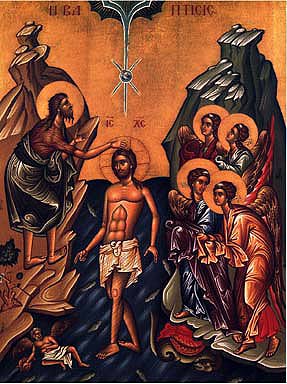
Troparion of the Theophany Tone 1
When Thou wast baptized in the Jordan, O Lord,/ the worship of the Trinity made its appearance./ For the voice of the Father bore witness to Thee/ when He called Thee His beloved Son./ And the Spirit in the form of a dove/ confirmed the truth of the word./ O Christ our God, Who hast appeared and hast enlightened the world,/ glory to Thee!
Kontakion of the Theophany Tone 4
Thou hast appeared today to the world,/ and Thy light, O Lord, has been signed upon us/ who with full knowledge sing to Thee./ Thou hast come, Thou hast appeared,/ O Unapproachable Light.
Titus 2:11-14; 3:4-7
For the grace of God that bringeth salvation hath appeared to all men, Teaching us that, denying ungodliness and worldly lusts, we should live soberly, righteously, and godly, in this present world; Looking for that blessed hope, and the glorious appearing of the great God and our Saviour Jesus Christ; Who gave himself for us, that he might redeem us from all iniquity, and purify unto himself a peculiar people, zealous of good works. But after that the kindness and love of God our Saviour toward man appeared, Not by works of righteousness which we have done, but according to his mercy he saved us, by the washing of regeneration, and renewing of the Holy Ghost; Which he shed on us abundantly through Jesus Christ our Saviour; That being justified by his grace, we should be made heirs according to the hope of eternal life.
Matthew 3:13-17
Then cometh Jesus from Galilee to Jordan unto John, to be baptized of him. But John forbad him, saying, I have need to be baptized of thee, and comest thou to me? And Jesus answering said unto him, Suffer it to be so now: for thus it becometh us to fulfil all righteousness. Then he suffered him. And Jesus, when he was baptized, went up straightway out of the water: and, lo, the heavens were opened unto him, and he saw the Spirit of God descending like a dove, and lighting upon him: And lo a voice from heaven, saying, This is my beloved Son, in whom I am well pleased.
From the OCA website:
Theophany is the Feast which reveals the Most Holy Trinity to the world through the Baptism of the Lord (Mt 3:13-17; Mk 1:9-11; Lk 3:21-22). God the Father spoke from Heaven about the Son, the Son was baptized by the St. John the Forerunner, and the Holy Spirit descended upon the Son in the form of a dove. From ancient times this Feast was called the Day of Illumination and the Feast of Lights, since God is Light and has appeared to illumine "those who sat in darkness," and "in the region of the shadow of death" (Mt 4:16), and to save the fallen race of mankind by grace.In the ancient Church it was the custom to baptize catechumens at the Vespers of Theophany, so that Baptism also is revealed as the spiritual illumination of mankind.
The origin of the Feast of Theophany goes back to Apostolic times, and it is mentioned in The Apostolic Constitutions (Book V:13). From the second century we have the testimony of St. Clement of Alexandria concerning the celebration of the Baptism of the Lord, and the night vigil before this Feast.
There is a third century dialogue about the services for Theophany between the holy martyr Hippolytus and St. Gregory the Wonderworker. In the following centuries, from the fourth to ninth century, all the great Fathers of the Church: Gregory the Theologian, John Chrysostom, Ambrose of Milan, John of Damascus, commented on the Feast of Theophany.
The monks Joseph the Studite, Theophanes and Byzantios composed much liturgical music for this Feast, which is sung at Orthodox services even today. St. John of Damascus said that the Lord was baptized, not because He Himself had need for cleansing, but "to bury human sin by water," to fulfill the Law, to reveal the mystery of the Holy Trinity, and finally, to sanctify "the nature of water" and to offer us the form and example of Baptism.
On the Feast of the Baptism of Christ, the Holy Church proclaims our faith in the most sublime mystery, incomprehensible to human intellect, of one God in three Persons. It teaches us to confess and glorify the Holy Trinity, one in Essence and Indivisible. It exposes and overthrows the errors of ancient teachings which attempted to explain the Creator of the world by reason, and in human terms.
The Church shows the necessity of Baptism for believers in Christ, and it inspires us with a sense of deep gratitude for the illumination and purification of our sinful nature. The Church teaches that our salvation and cleansing from sin is possible only by the power of the grace of the Holy Spirit, therefore it is necessary to preserve worthily these gifts of the grace of holy Baptism, keeping clean this priceless garb, for "As many as have been baptized into Christ, have put on Christ" (Gal 3:27).
January 05, 2006
Eve of Theophany Ninth Hour Readings
Isaiah 49:8-15
Thus saith the LORD, In an acceptable time have I heard thee, and in a day of salvation have I helped thee: and I will preserve thee, and give thee for a covenant of the people, to establish the earth, to cause to inherit the desolate heritages; That thou mayest say to the prisoners, Go forth; to them that are in darkness, Shew yourselves. They shall feed in the ways, and their pastures shall be in all high places. They shall not hunger nor thirst; neither shall the heat nor sun smite them: for he that hath mercy on them shall lead them, even by the springs of water shall he guide them. And I will make all my mountains a way, and my highways shall be exalted. Behold, these shall come from far: and, lo, these from the north and from the west; and these from the land of Sinim. Sing, O heavens; and be joyful, O earth; and break forth into singing, O mountains: for the LORD hath comforted his people, and will have mercy upon his afflicted. But Zion said, The LORD hath forsaken me, and my Lord hath forgotten me. Can a woman forget her sucking child, that she should not have compassion on the son of her womb? yea, they may forget, yet will I not forget thee.
Titus 2:11-14, 3:4-7
For the grace of God that bringeth salvation hath appeared to all men, Teaching us that, denying ungodliness and worldly lusts, we should live soberly, righteously, and godly, in this present world; Looking for that blessed hope, and the glorious appearing of the great God and our Saviour Jesus Christ; Who gave himself for us, that he might redeem us from all iniquity, and purify unto himself a peculiar people, zealous of good works. But after that the kindness and love of God our Saviour toward man appeared, Not by works of righteousness which we have done, but according to his mercy he saved us, by the washing of regeneration, and renewing of the Holy Ghost; Which he shed on us abundantly through Jesus Christ our Saviour; That being justified by his grace, we should be made heirs according to the hope of eternal life.
Luke 3:1-18
Now in the fifteenth year of the reign of Tiberius Caesar, Pontius Pilate being governor of Judaea, and Herod being tetrarch of Galilee, and his brother Philip tetrarch of Ituraea and of the region of Trachonitis, and Lysanias the tetrarch of Abilene, Annas and Caiaphas being the high priests, the word of God came unto John the son of Zacharias in the wilderness. And he came into all the country about Jordan, preaching the baptism of repentance for the remission of sins; As it is written in the book of the words of Esaias the prophet, saying, The voice of one crying in the wilderness, Prepare ye the way of the Lord, make his paths straight. Every valley shall be filled, and every mountain and hill shall be brought low; and the crooked shall be made straight, and the rough ways shall be made smooth; And all flesh shall see the salvation of God. Then said he to the multitude that came forth to be baptized of him, O generation of vipers, who hath warned you to flee from the wrath to come? Bring forth therefore fruits worthy of repentance, and begin not to say within yourselves, We have Abraham to our father: for I say unto you, That God is able of these stones to raise up children unto Abraham. And now also the axe is laid unto the root of the trees: every tree therefore which bringeth not forth good fruit is hewn down, and cast into the fire. And the people asked him, saying, What shall we do then? He answereth and saith unto them, He that hath two coats, let him impart to him that hath none; and he that hath meat, let him do likewise. Then came also publicans to be baptized, and said unto him, Master, what shall we do? And he said unto them, Exact no more than that which is appointed you. And the soldiers likewise demanded of him, saying, And what shall we do? And he said unto them, Do violence to no man, neither accuse any falsely; and be content with your wages. And as the people were in expectation, and all men mused in their hearts of John, whether he were the Christ, or not; John answered, saying unto them all, I indeed baptize you with water; but one mightier than I cometh, the latchet of whose shoes I am not worthy to unloose: he shall baptize you with the Holy Ghost and with fire: Whose fan is in his hand, and he will throughly purge his floor, and will gather the wheat into his garner; but the chaff he will burn with fire unquenchable. And many other things in his exhortation preached he unto the people.
Eve of Theophany Sixth Hour Readings
Isaiah 12:3-6
Therefore with joy shall ye draw water out of the wells of salvation. And in that day shall ye say, Praise the LORD, call upon his name, declare his doings among the people, make mention that his name is exalted. Sing unto the LORD; for he hath done excellent things: this is known in all the earth. Cry out and shout, thou inhabitant of Zion: for great is the Holy One of Israel in the midst of thee.
Romans 6:3-11
Know ye not, that so many of us as were baptized into Jesus Christ were baptized into his death? Therefore we are buried with him by baptism into death: that like as Christ was raised up from the dead by the glory of the Father, even so we also should walk in newness of life. For if we have been planted together in the likeness of his death, we shall be also in the likeness of his resurrection: Knowing this, that our old man is crucified with him, that the body of sin might be destroyed, that henceforth we should not serve sin. For he that is dead is freed from sin. Now if we be dead with Christ, we believe that we shall also live with him: Knowing that Christ being raised from the dead dieth no more; death hath no more dominion over him. For in that he died, he died unto sin once: but in that he liveth, he liveth unto God. Likewise reckon ye also yourselves to be dead indeed unto sin, but alive unto God through Jesus Christ our Lord.
Mark 1:9-15
And it came to pass in those days, that Jesus came from Nazareth of Galilee, and was baptized of John in Jordan. And straightway coming up out of the water, he saw the heavens opened, and the Spirit like a dove descending upon him: And there came a voice from heaven, saying, Thou art my beloved Son, in whom I am well pleased. And immediately the spirit driveth him into the wilderness. And he was there in the wilderness forty days, tempted of Satan; and was with the wild beasts; and the angels ministered unto him. Now after that John was put in prison, Jesus came into Galilee, preaching the gospel of the kingdom of God, And saying, The time is fulfilled, and the kingdom of God is at hand: repent ye, and believe the gospel.
Eve of Theophany Third Hour Readings
Isaiah 1:16-20
Wash you, make you clean; put away the evil of your doings from before mine eyes; cease to do evil; Learn to do well; seek judgment, relieve the oppressed, judge the fatherless, plead for the widow. Come now, and let us reason together, saith the LORD: though your sins be as scarlet, they shall be as white as snow; though they be red like crimson, they shall be as wool. If ye be willing and obedient, ye shall eat the good of the land: But if ye refuse and rebel, ye shall be devoured with the sword: for the mouth of the LORD hath spoken it.
Acts 19:1-18
And it came to pass, that, while Apollos was at Corinth, Paul having passed through the upper coasts came to Ephesus: and finding certain disciples, He said unto them, Have ye received the Holy Ghost since ye believed? And they said unto him, We have not so much as heard whether there be any Holy Ghost. And he said unto them, Unto what then were ye baptized? And they said, Unto John's baptism. Then said Paul, John verily baptized with the baptism of repentance, saying unto the people, that they should believe on him which should come after him, that is, on Christ Jesus. When they heard this, they were baptized in the name of the Lord Jesus. And when Paul had laid his hands upon them, the Holy Ghost came on them; and they spake with tongues, and prophesied. And all the men were about twelve. And he went into the synagogue, and spake boldly for the space of three months, disputing and persuading the things concerning the kingdom of God. But when divers were hardened, and believed not, but spake evil of that way before the multitude, he departed from them, and separated the disciples, disputing daily in the school of one Tyrannus. And this continued by the space of two years; so that all they which dwelt in Asia heard the word of the Lord Jesus, both Jews and Greeks. And God wrought special miracles by the hands of Paul: So that from his body were brought unto the sick handkerchiefs or aprons, and the diseases departed from them, and the evil spirits went out of them. Then certain of the vagabond Jews, exorcists, took upon them to call over them which had evil spirits the name of the LORD Jesus, saying, We adjure you by Jesus whom Paul preacheth. And there were seven sons of one Sceva, a Jew, and chief of the priests, which did so. And the evil spirit answered and said, Jesus I know, and Paul I know; but who are ye? And the man in whom the evil spirit was leaped on them, and overcame them, and prevailed against them, so that they fled out of that house naked and wounded. And this was known to all the Jews and Greeks also dwelling at Ephesus; and fear fell on them all, and the name of the Lord Jesus was magnified. And many that believed came, and confessed, and shewed their deeds.
Mark 1:1-8
The beginning of the gospel of Jesus Christ, the Son of God; As it is written in the prophets, Behold, I send my messenger before thy face, which shall prepare thy way before thee. The voice of one crying in the wilderness, Prepare ye the way of the Lord, make his paths straight. John did baptize in the wilderness, and preach the baptism of repentance for the remission of sins. And there went out unto him all the land of Judaea, and they of Jerusalem, and were all baptized of him in the river of Jordan, confessing their sins. And John was clothed with camel's hair, and with a girdle of a skin about his loins; and he did eat locusts and wild honey; And preached, saying, There cometh one mightier than I after me, the latchet of whose shoes I am not worthy to stoop down and unloose. I indeed have baptized you with water: but he shall baptize you with the Holy Ghost.
Eve of Theophany First Hour Readings
Isaiah 35:1-10
The wilderness and the solitary place shall be glad for them; and the desert shall rejoice, and blossom as the rose. It shall blossom abundantly, and rejoice even with joy and singing: the glory of Lebanon shall be given unto it, the excellency of Carmel and Sharon, they shall see the glory of the LORD, and the excellency of our God. Strengthen ye the weak hands, and confirm the feeble knees. Say to them that are of a fearful heart, Be strong, fear not: behold, your God will come with vengeance, even God with a recompence; he will come and save you. Then the eyes of the blind shall be opened, and the ears of the deaf shall be unstopped. Then shall the lame man leap as an hart, and the tongue of the dumb sing: for in the wilderness shall waters break out, and streams in the desert. And the parched ground shall become a pool, and the thirsty land springs of water: in the habitation of dragons, where each lay, shall be grass with reeds and rushes. And an highway shall be there, and a way, and it shall be called The way of holiness; the unclean shall not pass over it; but it shall be for those: the wayfaring men, though fools, shall not err therein. No lion shall be there, nor any ravenous beast shall go up thereon, it shall not be found there; but the redeemed shall walk there: And the ransomed of the LORD shall return, and come to Zion with songs and everlasting joy upon their heads: they shall obtain joy and gladness, and sorrow and sighing shall flee away.
Acts 13:25-32
And as John fulfilled his course, he said, Whom think ye that I am? I am not he. But, behold, there cometh one after me, whose shoes of his feet I am not worthy to loose. Men and brethren, children of the stock of Abraham, and whosoever among you feareth God, to you is the word of this salvation sent. For they that dwell at Jerusalem, and their rulers, because they knew him not, nor yet the voices of the prophets which are read every sabbath day, they have fulfilled them in condemning him. And though they found no cause of death in him, yet desired they Pilate that he should be slain. And when they had fulfilled all that was written of him, they took him down from the tree, and laid him in a sepulchre. But God raised him from the dead: And he was seen many days of them which came up with him from Galilee to Jerusalem, who are his witnesses unto the people. And we declare unto you glad tidings, how that the promise which was made unto the fathers.
Matthew 3:1-11
In those days came John the Baptist, preaching in the wilderness of Judaea, And saying, Repent ye: for the kingdom of heaven is at hand. For this is he that was spoken of by the prophet Esaias, saying, The voice of one crying in the wilderness, Prepare ye the way of the Lord, make his paths straight. And the same John had his raiment of camel's hair, and a leathern girdle about his loins; and his meat was locusts and wild honey. Then went out to him Jerusalem, and all Judaea, and all the region round about Jordan, And were baptized of him in Jordan, confessing their sins. But when he saw many of the Pharisees and Sadducees come to his baptism, he said unto them, O generation of vipers, who hath warned you to flee from the wrath to come? Bring forth therefore fruits meet for repentance: And think not to say within yourselves, We have Abraham to our father: for I say unto you, that God is able of these stones to raise up children unto Abraham. And now also the axe is laid unto the root of the trees: therefore every tree which bringeth not forth good fruit is hewn down, and cast into the fire. I indeed baptize you with water unto repentance: but he that cometh after me is mightier than I, whose shoes I am not worthy to bear: he shall baptize you with the Holy Ghost, and with fire.
January 04, 2006
Truer Words . . .
A great comment by Mark Steyn:
The great thing about multiculturalism is that it doesn't involve knowing anything about other cultures--the capital of Bhutan, the principal exports of Malawi, who cares? All it requires is feeling good about other cultures. It's fundamentally a fraud, and I would argue was subliminally accepted on that basis. Most adherents to the idea that all cultures are equal don't want to live in anything but an advanced Western society. Multiculturalism means your kid has to learn some wretched native dirge for the school holiday concert instead of getting to sing "Rudolph the Red-Nosed Reindeer" or that your holistic masseuse uses techniques developed from Native American spirituality, but not that you or anyone you care about should have to live in an African or Native American society. It's a quintessential piece of progressive humbug.
Amen.
[Fill in the Blank] Is NOT a Culture--It's a Market Trend
I'm going to rant a bit on a pet peeve of mine: the claim that we must evangelize (or translate the Gospel to/in) the various "cultures" of our American society, be it hip-hop, postmodern, NASCAR, boomers, and so forth.
First of all, let's get clear on what a culture is: It is an incarnated way of life that is constructive of language, traditions, foods, architecture, literature, social cohesion, and legacy. It is not, primarily, an identity. It is definitely not a "lifestyle." Rather, all these so-called "cultures" blathered about at the local church growth conference are nothing more than the capitalist invention of a market to be exploited. Human persons made in the image of God are called to settle their identity in an illusion, a fantasy, created by entrepeneurs and exploited in our consumerist society.
All one needs to do to see the difference is to compare the so-called culture of, say, "hip-hop" to the very real instantiation of culture in, say, Romanian sarmale. The former is not a real culture but a marketed "lifestyle" that is destructive of real human fulfillment. "Hip hop" does not produce a real language (it only produces "slang" or, to be overly generous, a bastardization of American dialect), any real traditions, any foods, architecture, literature, and so forth. The same can be said of boomers, postmoderns, and so on. However, instantiated in the Romanian dish, sarmale, is the very earth of the country, the history of a people in all the fulness of their culture.
So, there is no need to "translate" the Gospel into these pseudo-"cultures." Rather, it is to bring these pseudo-"cultures" face-to-face with their emptiness in view of the revelation of God in Christ.
Thus, the abomination of "hip-hop" Eucharists, or the mis-intentioned postmodern "seeker services" are an utter failure first of all to understand what, precisely, is culture. And they are a failure to come to grips with the fact that it is not the Gospel that must be made "relevant" to various marketing sectors of our society, but that the marketing sectors of our society need to be revealed as the demonic disfiguration of human personality that they are.
The Narnia Movie
During the week following Christmas, I saw the movie "The Chronicles of Narnia: The Lion, the Witch and the Wardrobe" for which I had prepared myself by re-reading C. S. Lewis' The Lion, the Witch, and the Wardrobe (and went on to read the rest of the series, which I am finishing by starting The Last Battle today).
To cut to the quick: I thought it was good, not great, and I enjoyed it, but not as much as I wanted to.
Disappointments: failing to clearly identify Father Christmas, fording the ice stream as it melts (unnecessary and stupid), tried to be too much like Peter Jackson's "The Lord of the Rings."
Quibbles: no blood when Aslan is killed, left out Mr. and Mrs. Beaver's full to-and-fro as they prepare to escape the dam when the White Witch's wolves come to take them, didn't fully/accurately represent Professor Kirke's conversation with Peter and Susan about Lucy's "story" of Narnia.
Loves: above all the sacrifice of Aslan (and overall the mastery of expression, accomplished via CGI, and voicing, by Liam Neeson, given to Aslan), Lucy, the voicing of Mr. Beaver, the characterization of Mr. Tumnus, Tilda Swinton as the White Witch.
I will probably see each new installment as it comes out. But I will not purchase the DVDs. Nor will I have my children watch the movies until they are first heavily innoculated with the original books through bedtime and personal reading.
January 03, 2006
Soteriology Diablog between Various Interblogolocutors
The list has been updated: 03 January 06 at 10:30am CDT. And the date/time stamp has been changed to move it up the main page. [Thanks to David for the email tip.]
Update: Kevin has responded further to Chris' "Choice and Necessity" with his "Divine Freedom and Human Nature." Chris has responded with his "Divine Decisions, Human Nature, and Merry Christmas." See last two links in the list below (by clicking on "Continue reading 'Soteriology Diablog between Various Interblogolocutors'").
Here's all the posts (so far as I know) in the diablog on soteriology and free will:
- Summary of Free Will Issues and Questions (my summary of the philosophical issues involved in free will)
- A Note on Free Will (Perry's summary of the philosophical issues involved in free will)
- Faith, Free Will and Salvation: The Heresy of Monergism (my initial post)
- God Saves His Enemies (Darren's reply)
- A Matter of the Will (Kevin's reply to my initial post)
- Man Was Not Created To Be Perfect (Darren's reply to Kevin's "A Matter of the Will")
- The Clarification of the Incarnation (my reply to Darren's "God Saves His Enemies")
- Salvation and Christ's Human Will (Darren's reply to my "The Clarification of the Incarnation")
- How Human Was Jesus? (my reply to Darren's "Salvation and Christ's Human Will" and Kevin's post, "A Matter of the Will" above)
- What to Do? (Kevin's reply to my "How Human Was Jesus?")
- Perry replies to Kevin's "What to Do?" in the comments to that post.
- Soteriological Sidebar: Trinitarian Personhood Contra Kevin's Essence of God (my narrow reply to one aspect of Kevin's "What to Do?", namely Trinitarian Personhood)
- Jesus Christ and the Mark of Original Sin (Darren's reply to my "How Human Was Jesus?" and Kevin's "A Matter of the Will")
- And Never the Twain Shall Meet: The Irredeemable Qualities of Darren's and Kevin's Soteriological Reflections (my reply to Darren's "Jesus Christ and the Mark of Original Sin" and Kevin's "What to Do?")
- Fallen Nature or Lack Thereof (Kevin replies to Darren's "Man Was Not Created To Be Perfect" and "Jesus Christ and the Mark of Original Sin")
- Human Nature and Sinful Nature (Darren replies to Kevin's "Fallen Nature or Lack Thereof")
- Nature of Persons (Kevin responds to my "Soteriological Sidebar: Trinitarian Personhood Contra Kevin's Essence of God")
- Synergies of Christ (Kevin reponds to Perry's comments on the post "What to Do?")
- Perry has responded to Kevin's "Synergies of Christ" in the comments to that post.
- Soteriological Sidebar II: Nominal and Real Personhood (my reply to Kevin's "Nature of Persons")
- St. John Cassian: On Grace and Free Will (a further development of some of my thinking from my first post, "Faith, Free Will and Salvation: The Heresy of Monergism," specifically related to St. John Cassian's thirteenth Conference)
- Till...God's Great Judgment Seat (Kevin replies to my "And Never the Twain Shall Meet: The Irredeemable Qualities of Darren's and Kevin's Soteriological Reflections")
- Reformed theology and freedom of the will (Chris responds to Kevin's "Fallen Nature or Lack Thereof")
- Responding to John's "Straw Man" Challenge (My reply to a challenge on John Hendryx's Monergism.com website)
- Real Union and Legal Talk (Kevin replies to Perry's comments on his "Synergies of Christ")
- Till . . . We Have Faces (my reply to Kevin's "Till . . . God's Great Judgment Seat")
- Of Wills, Words, and the Monarche (Kevin's reply to my "Soteriological Sidebar II: Nominal and Real Personhood")
- Soteriological Sidebar III: The Father's Personal Existence Precedes the Divine Essence (my reply to Kevin's "Of Wills, Words, and the Monarche")
- Appetites and Inclinations (Kevin's reply to Chris' "Reformed theology and freedom of the will")
- Choice and Necessity (Chris' reply to Kevin's, "Appetites and Inclinations")
- Masks and Modes (Kevin's reply to my "Till.. We Have Faces")
- Synergy In Christ (Daniel is not formally part of the diablog, but his paper, linked through the blogpost listed here, and in pdf format, definitely touches on the discussion.)
- Personhood Backwards and Forwards and Monergism's Essence (my reply to Kevin's "Masks and Modes")
- Motives for the Fall (Kevin's reply to Chris' "Choice and Necessity")
- Divine Freedom and Human Nature (Kevin's further reply to Chris' "Choice and Necessity")
- Divine Decisions, Human Nature, and Merry Christmas (Chris' reply to Kevin's "Divine Freedom and Human Nature")
January 01, 2006
The Circumcision of Our Lord and Savior Jesus Christ
Troparion of the Feast Tone 1
Thou Who art by nature God, didst without change take human form,/ O most compassionate Lord,/ and in fulfilling the Law of Thine own will didst receive circumcision in the flesh,/ to banish hades and roll away the veil of our passions./ Glory to Thy goodness; glory to Thy compassion;/ glory to Thy condescension, O Word.
Another Troparion of the Feast Tone 1
Thou Who sittest with the Father/ on a fiery throne in the heights/ wast pleased to be born of a Virgin through the Divine Spirit on earth./ Wherefore Thou wast circumcised as a man on the eighth day./ Glory to Thine all-gracious will; glory to Thy providence;/ glory to Thy condescension, O only Lover of mankind.
Kontakion of the Feast Tone 3
In undergoing clrcumcision/ the Lord of all has circumcised the sins of mortal men./ On this day He gives salvation to the world./ And the Hierarch Basil, the Creator's lightbearer/ and Christ's mystic, rejoices in the highest.
Colossians 2:8-12
Beware lest any man spoil you through philosophy and vain deceit, after the tradition of men, after the rudiments of the world, and not after Christ. For in him dwelleth all the fulness of the Godhead bodily. And ye are complete in him, which is the head of all principality and power: In whom also ye are circumcised with the circumcision made without hands, in putting off the body of the sins of the flesh by the circumcision of Christ: Buried with him in baptism, wherein also ye are risen with him through the faith of the operation of God, who hath raised him from the dead.
Luke 2:20-21, 40-52
And the shepherds returned, glorifying and praising God for all the things that they had heard and seen, as it was told unto them. And when eight days were accomplished for the circumcising of the child, his name was called JESUS, which was so named of the angel before he was conceived in the womb. And the child grew, and waxed strong in spirit, filled with wisdom: and the grace of God was upon him. Now his parents went to Jerusalem every year at the feast of the passover. And when he was twelve years old, they went up to Jerusalem after the custom of the feast. And when they had fulfilled the days, as they returned, the child Jesus tarried behind in Jerusalem; and Joseph and his mother knew not of it. But they, supposing him to have been in the company, went a day's journey; and they sought him among their kinsfolk and acquaintance. And when they found him not, they turned back again to Jerusalem, seeking him. And it came to pass, that after three days they found him in the temple, sitting in the midst of the doctors, both hearing them, and asking them questions. And all that heard him were astonished at his understanding and answers. And when they saw him, they were amazed: and his mother said unto him, Son, why hast thou thus dealt with us? behold, thy father and I have sought thee sorrowing. And he said unto them, How is it that ye sought me? wist ye not that I must be about my Father's business? And they understood not the saying which he spake unto them. And he went down with them, and came to Nazareth, and was subject unto them: but his mother kept all these sayings in her heart. And Jesus increased in wisdom and stature, and in favour with God and man.
From the OCA website:
The Circumcision of the Lord: On the eighth day after His Nativity, our Lord Jesus Christ, in accordance with the Old Testament Law, accepted circumcision, which was decreed for all male infants as a sign of the Covenant of God with the Forefather Abraham and his descendants (Gen 17:10-14, Lev 12:3). Upon the performing of this ritual the Divine Infant was given the name Jesus, as the Archangel Gabriel declared on the day of the Annunciation to the Most Holy Theotokos (Lk 1:31-33, 2:21). The Fathers of the Church explain that the Lord, the Creator of the Law, accepted circumcision in order to give people an example how faithfully the divine ordinances ought to be fulfilled. The Lord was circumcised so that later no one would doubt that He had truly assumed human flesh, and that His Incarnation was not merely an illusion, as certain heretics (Docetists) taught.In the New Testament, the ritual of circumcision gave way to the Mystery of Baptism, which it prefigured (Col 2:11-12). Accounts of the Feast of the Circumcision of the Lord continue in the Eastern Church right up through the fourth century. The Canon of the Feast was written by St. Stephen of the St. Sabbas Monastery (October 28 and July 13).
Together with circumcision, which the Lord accepted as a sign of God's Covenant with mankind, He also received the Name Jesus (Savior) as an indication of His service, the work of the salvation of the world (Mt 1:21; Mk 9:38-39, 16:17; Lk 10:17; Acts 3:6, 16; Phil 2:9-10). These two events, the Circumcision and Naming, remind Christians that they have entered into a New Covenant with God and "are circumcised with a circumcision made without hands, in putting off the body of the sins of the flesh by the circumcision of Christ" (Col 2:11). The very name "Christian" is a sign of mankind's entrance into a New Covenant with God.