December 27, 2005
The Truth About Christmas, the Twelve Day Feast
These links have already been going around the internet, but I thought it would be helpful for the perhaps one reader of my blog who hasn't encountered them to be exposed to them.
First, a couple of excellent articles as to why the choice of 25 December for the celebration of the birth of our Lord God and Saviour Jesus Christ was NOT the coopting of a pagan holiday.
First from Dr. William Tighe, and his Touchstone article from December 2003: Calculating Christmas.
The idea that the date was taken from the pagans goes back to two scholars from the late seventeenth and early eighteenth centuries. Paul Ernst Jablonski, a German Protestant, wished to show that the celebration of Christ’s birth on December 25th was one of the many “paganizations” of Christianity that the Church of the fourth century embraced, as one of many “degenerations” that transformed pure apostolic Christianity into Catholicism. Dom Jean Hardouin, a Benedictine monk, tried to show that the Catholic Church adopted pagan festivals for Christian purposes without paganizing the gospel.In the Julian calendar, created in 45 B.C. under Julius Caesar, the winter solstice fell on December 25th, and it therefore seemed obvious to Jablonski and Hardouin that the day must have had a pagan significance before it had a Christian one. But in fact, the date had no religious significance in the Roman pagan festal calendar before Aurelian’s time, nor did the cult of the sun play a prominent role in Rome before him.
There were two temples of the sun in Rome, one of which (maintained by the clan into which Aurelian was born or adopted) celebrated its dedication festival on August 9th, the other of which celebrated its dedication festival on August 28th. But both of these cults fell into neglect in the second century, when eastern cults of the sun, such as Mithraism, began to win a following in Rome. And in any case, none of these cults, old or new, had festivals associated with solstices or equinoxes.
As things actually happened, Aurelian, who ruled from 270 until his assassination in 275, was hostile to Christianity and appears to have promoted the establishment of the festival of the “Birth of the Unconquered Sun” as a device to unify the various pagan cults of the Roman Empire around a commemoration of the annual “rebirth” of the sun. He led an empire that appeared to be collapsing in the face of internal unrest, rebellions in the provinces, economic decay, and repeated attacks from German tribes to the north and the Persian Empire to the east.
In creating the new feast, he intended the beginning of the lengthening of the daylight, and the arresting of the lengthening of darkness, on December 25th to be a symbol of the hoped-for “rebirth,” or perpetual rejuvenation, of the Roman Empire, resulting from the maintenance of the worship of the gods whose tutelage (the Romans thought) had brought Rome to greatness and world-rule. If it co-opted the Christian celebration, so much the better.
It is true that the first evidence of Christians celebrating December 25th as the date of the Lord’s nativity comes from Rome some years after Aurelian, in A.D. 336, but there is evidence from both the Greek East and the Latin West that Christians attempted to figure out the date of Christ’s birth long before they began to celebrate it liturgically, even in the second and third centuries. The evidence indicates, in fact, that the attribution of the date of December 25th was a by-product of attempts to determine when to celebrate his death and resurrection. . . .
At this point, we have to introduce a belief that seems to have been widespread in Judaism at the time of Christ, but which, as it is nowhere taught in the Bible, has completely fallen from the awareness of Christians. The idea is that of the “integral age” of the great Jewish prophets: the idea that the prophets of Israel died on the same dates as their birth or conception.
This notion is a key factor in understanding how some early Christians came to believe that December 25th is the date of Christ’s birth. The early Christians applied this idea to Jesus, so that March 25th and April 6th were not only the supposed dates of Christ’s death, but of his conception or birth as well. There is some fleeting evidence that at least some first- and second-century Christians thought of March 25th or April 6th as the date of Christ’s birth, but rather quickly the assignment of March 25th as the date of Christ’s conception prevailed.
It is to this day, commemorated almost universally among Christians as the Feast of the Annunciation, when the Archangel Gabriel brought the good tidings of a savior to the Virgin Mary, upon whose acquiescence the Eternal Word of God (“Light of Light, True God of True God, begotten of the Father before all ages”) forthwith became incarnate in her womb. What is the length of pregnancy? Nine months. Add nine months to March 25th and you get December 25th; add it to April 6th and you get January 6th. December 25th is Christmas, and January 6th is Epiphany.
Christmas (December 25th) is a feast of Western Christian origin. In Constantinople it appears to have been introduced in 379 or 380. From a sermon of St. John Chrysostom, at the time a renowned ascetic and preacher in his native Antioch, it appears that the feast was first celebrated there on 25 December 386. From these centers it spread throughout the Christian East, being adopted in Alexandria around 432 and in Jerusalem a century or more later. The Armenians, alone among ancient Christian churches, have never adopted it, and to this day celebrate Christ’s birth, manifestation to the magi, and baptism on January 6th.
Western churches, in turn, gradually adopted the January 6th Epiphany feast from the East, Rome doing so sometime between 366 and 394. But in the West, the feast was generally presented as the commemoration of the visit of the magi to the infant Christ, and as such, it was an important feast, but not one of the most important ones—a striking contrast to its position in the East, where it remains the second most important festival of the church year, second only to Pascha (Easter). . . .
Thus, December 25th as the date of the Christ’s birth appears to owe nothing whatsoever to pagan influences upon the practice of the Church during or after Constantine’s time. It is wholly unlikely to have been the actual date of Christ’s birth, but it arose entirely from the efforts of early Latin Christians to determine the historical date of Christ’s death.
And the pagan feast which the Emperor Aurelian instituted on that date in the year 274 was not only an effort to use the winter solstice to make a political statement, but also almost certainly an attempt to give a pagan significance to a date already of importance to Roman Christians. The Christians, in turn, could at a later date re-appropriate the pagan “Birth of the Unconquered Sun” to refer, on the occasion of the birth of Christ, to the rising of the “Sun of Salvation” or the “Sun of Justice.”
Dr. Gene Edward Veith and his World Magazine article Why December 25? draws heavily fom Dr. Tighe's work.
And finally, Terry Mattingly reveals why we've lost the twelve-day feast.
It took time for the nativity feast to become the 12-day Christmas season. Today, Christmas has become something else altogether.Easter traditions developed first, with Holy Week events on specific days of the week and a firm link to the Jewish Passover. A nativity date was harder to pin down and, over time, conflicting traditions created tensions. The Second Council of Tours clarified matters in 567, establishing Dec. 25 as the nativity date and Jan. 6 as Epiphany.
The council took another diplomatic step and proclaimed the 12 days between the feasts the holy season of Christmas--the biggest party in Christendom.
This act linked believers in East and West and offered a symbolic alternative to competing pagan festivals in the marketplace. Drawing a parallel with Easter, it also made sense for a reflective season of prayer and fasting to precede Christmas. This became Advent in the West and Nativity Lent in the East.
That was then. This is now.
[Most] assume that Christmas equals "The Holidays," the marketing season between Thanksgiving and Dec. 25, which is followed by a festival of returned gifts and football games. Most do not know that there is more to the 12 days of Christmas than a song about a partridge, a pear tree and other bizarre gifts.
Times change. A few generations ago, department stores stayed open until midnight on Christmas Eve, a tradition seen in many old Christmas movies.
"Why did they do that? Because people were out doing the shopping that we start doing in October," said Walsh. "The days before could get pretty intense, but that's the way things were. Christmas was still Christmas. That really didn't change until Christmas got sucked into the whole industrialized-commercialized complex that is modern life."
This happened for many reasons. The Puritan revolution in England played a major role, with its rejection of anything Catholic. Many liturgical and cultural traditions were weakened and never fully recovered, even if they were later celebrated by writers such as Charles Dickens. This had a major impact in the American colonies, where Christmas celebrations were frowned upon or in some cases banned.
At the same time, explosive growth of English cities during the industrial revolution uprooted millions of ordinary people, breaking centuries of ties binding families to churches, land, farms, shops and kin, said Walsh. Quaint traditions that united villages were hard to move to slums in London, Birmingham and Manchester. And what about New York City and the American frontier? Modern suburbs do not have a church in a public square at the center of town. Most don't have a public square at all and the true community center is the shopping mall. While many people complain that lawyers and activists have "taken Christ out of Christmas," the truth is more complex than that. The reality is that almost everyone, including church people, is skipping the 12-day Christmas season.
There is no time. There is no place. There is no season.
Only the churches can make the countrt-cultural change and return to the Tradition.
December 25, 2005
The Blessed and Holy Nativity of our Lord God and Savior Jesus the Christ
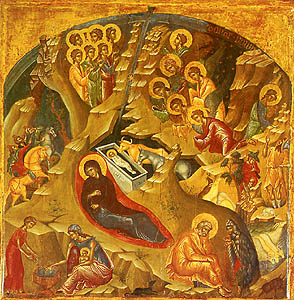
"Then the angel said to her, 'Do not be afraid, Mary, for you have found favor with God. And behold, you will conceive in your womb and bring forth a Son, and shall call His name Jesus. He will be great, and will be called the son of the Highest; and the Lord God will give Him the throne of his father David. And He will reign over the house of Jacob forever, and of His kingdom there will be no end.' . . . 'The Holy Spirit will come upon you, and the power of the Highest will overshadow you; therefore, also, that Holy One who is to be born will be called the Son of God.'" (Luke 1:30-33, 35 NKJV)
"So it was, that while they were there, the days were completed for her to be delivered. And she brought forth her firstborn Son, and wrapped Him in swaddling cloths, and laid Him in a manger, because there was no room for them in the inn." (Luke 2:6-7 NKJV)
"Then the angel said to them, 'Do not be afraid, for behold, I bring you good tidings of great joy which will be to all people. For there is born to you this day in the city of David a Savior, who is Christ the Lord." (Luke 2:10-11 NKJV)
"So all this was done that it might be fulfulled which was spoken by the Lord through the prophet, saying: 'Behodl, the virgin shall be with child, and bear a Son, and they shall call His name Immanuel' which is translated, 'God with us.'" (Matthew 1:22-23 NJKV; cf. Isaiah 7:14)
"And Mary said:
'My soul magnifies the Lord,
And my spirit has rejoiced in God my Savior.
For He has regarded the lowly state of His maidservant;
For behold, henceforth all generations will call me blessed.
For He who is mighty has done great things for me,
And holy is His name.
And His mercy is on those who fear him
From generation to generation.
He has shown strength with His arm;
He has scattered the proud in the imagination of their hearts.
He has put down the mighty from their thrones,
And exalted the lowly.
He has filled the hungry with good things,
And the rich He has sent away empty.
He has helped His servant Israel,
In remembrance of His mercy,
As He spoke to our fathers,
To Abraham and to his seed forever."
(Luke 1:46-55 NKJV)
More honorable than the cherubim, and more glorious beyond compare than the seraphim, thou who without stain barest God the Word, and art truly Theotokos, we magnify thee.
Troparion:
Thy Nativity, O Christ our God,
has shone to the world as the light of wisdom.
For by it those who worshipped the stars
were taught by a star to adore Thee,
the Sun of Righteousness,
and to know Thee, the Orient from on high.
O Lord, glory to Thee.
Kontakion:
Today the Virgin gives birth to the Transcendent One,
and the earth offers a cave to the Unapproachable One.
Angels with Shepherds glorify Him,
the wise men journey with the star;
since for our sake the eternal God was born as a little child.
December 22, 2005
Jesus the Bastard?
Episcopal priest and mother of two, Chloe Breyer, speculates about the illegitimacy of Jesus in her Slate.com article, The Earthly Father - What if Mary wasn't a virgin? [H/T: T-19]
The allegations as to Jesus' illegitimate birth go way, way back, to the Jewish leaders of the first century, and the anti-Christian polemicist, Celsus. Such charges have been revived in our day via the "historical Jesus" quest and its postmodern manifestation in the Jesus Seminar. The claim is that Mary was pregnant with Jesus by another man than her betrothed, Joseph--in one accounting by Panthera, a Roman soldier. The Christians, then, to cover over this embarrassing detail for one who was supposed to be the Son of God, claimed a miraculous virgin birth.
But what's at stake in all this? Why does the Creed insist on asserting the virginity of Mary? Is this just a bunch of dogmatic fundamentalism? Is it really necessary to Christian faith to believe in the virginity of Mary? Is this a core Gospel doctrine? What would it really matter if we allowed some good-hearted quibbling on Mary's virginity?
After all, if Orthodoxy insists on a virginal conception so as to safeguard Jesus' divinity by excluding human paternity, then, according to Rev. Breyer:
The illegitimacy tradition, by contrast, holds that the Holy Spirit supplemented, rather than replaced, Jesus' human paternity.
And isn't that sort of what the Holy Spirit does for us?
Therein lies the most important of two immediate problems for those who want to deny Mary's virginal conception: Jesus then becomes just like us. Period. Full stop. Just: Like us. This is the problem that makes this some other Gospel than the one received from the Apostles: it means Christ is not by nature God. He is only God by adoption. And if he is not really God by nature, we are not really saved.
More on the implications in a moment.
First a little background on how a minister, claiming the Christian faith, can boldly argue for the legitimacy of this as an alternative form of Christian faith. Breyer gets the bulk of her ruminations here from Dr. Jane Schaberg's 1987 book (excerpts of which can be found here).
In 1987, Schaberg, a biblical studies professor at the University of Detroit Mercy, published The Illegitimacy of Jesus. Her central argument was that Matthew and Luke's Gospels originally told of an illegitimate conception rather than a miraculous virgin one.
Breyer then rehearses the "few short passages in two of the four Gospels" which provide the sources for the virginal conception of Mary.
In Matthew, an angel appears to Joseph, who is perplexed about his fiancee's pregnancy. Should he divorce Mary or have her stoned her to death, as the law of Deuteronomy requires? "Joseph, Son of David," says the angel, "Do not be afraid to take Mary as your wife, for the child conceived in her is from the Holy Spirit. She will bear a son and you are to name him Jesus." The angel then goes on to quote the Hebrew prophet Isaiah. "Look, the virgin shall conceive and bear a son, and they shall name him Emmanuel." (In fact, "virgin" comes from Matthew's use of a Greek mistranslation; the Hebrew in Isaiah reads "young girl.") The version in Luke is similar.
One first of all notes the simple assertion that parthenos "mistranslates" the Hebrew. Of course Rev. Breyer fails to note that the texts of the Greek Septuagint, from which Matthew takes his citation of Isaiah, are generally a millennium older than our Hebrew manuscripts. She also fails to note that of all the instances of "almah" in the Hebrew, of which there are seven, none refer to a married woman or one who has had sexual relations. In fact, in Gen 24, both "almah" (young woman, v. 43) and "bethulah" (virgin, v. 16) are applied to Rebecca. And the Septuagint translates "almah" in Gen 24:43 with "parthenos" just as it does in Isaiah 7:14.
But this is the necessary method of operation for those who are offering interpretations alternative to and opposing the tradition: first instill skepticism and doubt. Call "parthenos" of Isaiah 7:14 a mistranslation--which also calls into question the inspired nature of the biblical text--and the wedge of doubt has been set.
Breyer continues:
So far, the Scripture sounds pretty clear. But the infancy narratives from Matthew and Luke must be squared with some startling silences, alternative Greek translations, and a couple of snide comments from Jesus' hometown critics. Paul never mentions the virgin conception and in Galatians describes Christ as "born of a woman." John's Gospel says nothing on the subject of Jesus' conception. And Mark describes the shocked response of the synagogue-goers of Jesus' hometown of Nazareth when Jesus as an adult returns to preach and teach as God's chosen one. The Nazareth Jews presumably would have known better than anyone about the irregular timing of Jesus' birth. "Is not this the carpenter, the son of Mary?" his parents' neighbors ask one another. Since Jewish men of the time were identified in relationship to their father, Schaberg and other scholars take this remark as an insinuation about Jesus' parentage—one that was so offensive that the later Evangelists Luke, Matthew, and John changed it.
Note that this alternative interpretation has exploited the opportunity that "silence" affords to fill in the gaps. There is no evidence whatsoever in silence. It is just that: silence.
So, two Gospels mention it, as do the earliest accounts we have outside the Scriptures. But because two Gospels don't mention, nor does St. Paul, then one apparently is justified in flatly contradicting the explicit evidence of the other Gospels, for the sake of a speculation.
And there's more. When Mary responds to the angel's good tidings in Luke, one translation of her speech is, "How can this be, I do not know a man?" But in the Greek, the word for man is anthropos, which also means "husband." Schaberg suggests that if this is the meaning Luke intended, the text could imply that Jesus had a human father who was not Joseph. Finally, in the Magnificat, Mary's song of praise and thanksgiving to God, she says, "God has lifted up his humble maidservant." The Greek word for "humble" is the same one that the Septuagint (the old Greek version of the Hebrew Bible) uses to describe the rape of Dinah in Genesis and other incidents of sexual violation. From this, Schaberg discerns the possibility that Mary's "humility" could be "humiliation" from a sexual assault.
Here is the second tactic after one exploits the silences. Note secondary meanings, and assert them as primary ones. I haven't done a linguistic check on the use of "humility" in the Septuagint, but I suspect it is used of more than just persons violated sexually. No matter: it's a possible meaning. And since it is possible, it must be legitimately viable.
But this is tantamount to saying that, since the statement "Clifton claimed that God had made him rich with many blessings" could mean that God had made me financially wealthy, then it must be the fact that I'm financially wealthy. (Won't Anna be surprised!) Or since "blue" can mean sad, one could suggest that saying "The sky is blue" means the heavens are sad. To claim, in the face of the evidence and the history, that it's possible that Jesus was not conceived virginally, is to make possibility tantamount to lunacy.
But of course, it's all just conjecture. No harm in a little speculating right?
Admittedly, Schaberg's conjecture that the Gospel writers were obliquely conveying an illegitimacy tradition—one in which Mary was the victim of rape or seduction—is just that: conjecture. It lacks positive corroboration within the Gospels or other Christian writings. Schaberg acknowledges that she cannot prove that early Christians read the infancy narratives in the way she proposes. Still, if the Gospel writers did assume that their readers knew of an illegitimacy tradition, their words could support a figurative, rather than literal, reading of the angel's annunciation. It seems rash to rule out that historical possibility when theologically it works so well.
Ah, but here's the thing: Theologically it doesn't work so well. In fact, it doesn't work at all.
For the Gospel is about each of us being made one with God through Jesus Christ (John 17:20-26), to become partakers of the divine nature (2 Peter 1:3-4). God is utterly holy and other. Even if human beings were not sinful, God's holiness would utterly set him apart from us. We would be and are always other than God, we are creatures and he is the Creator. But Jesus says we are to be one with God. And St. Peter claims we are to be partakers of the divine nature. The only way for this union to happen is for humanity and divinity to be fully united in the Person of Jesus Christ. If Jesus was not virginally conceived by the Holy Spirit, then he is not fully God. If he is fully but only a man who has been granted God's likeness but not his essence, then not even he can unite us to God, for even Jesus remains always wholly other than God as a creature. If Jesus is fully man, then there is no one in whom we can be united to God.
Only the virgin conception allows for Jesus to be both essentially, by nature, God and essentially, by nature, man. Only the virgin conception allows for Jesus to bring union to the human and divine natures. And only in our union with Jesus, who is both God and man, can we have union with God.
Secondly, if Jesus is wholly humanly begotten, and is not therefore God in essence or nature, and if he was only adopted by God through the Holy Spirit, then humanity is not really fallen or sinful. We can, as we are, be adopted by God--though not united to him. Human nature does not need to change, since it can be adopted by God, as he did in Jesus Christ. But if human nature need not change, then we are ever condemned to our sinfulness and to our mortality and death.
Breyer then asks a series of questions:
Can a loyal Christian believe that Christ was not born of a biological virgin?
No. It removes any possibility of union with God in Christ.
Perhaps it's worth posing a different question: Why is church authority so intent upon Mary's virginity as a historical fact?
Because it is the only Gospel which saves us and does not leave us in sin and death.
Would Jesus be any less God's son if he had an earthly father?
Yes, because he would lack the nature and essence of God the Father.
The central message of the Gospel is that God raised up and redeemed his servant from death by crucifixion—the Roman style of execution reserved for the lowest of the low. Why couldn't God have sent the same message of divine solidarity with the world's outcasts by making a Messiah out of a man whose conception was also taboo?
Because divine solidarity does not happen by fiat, but by participation. And only Jesus is the perfect union of God and man in which we can have that participation.
Good news to remember at this time of the year. I may be getting ahead of myself liturgically, but in light of the examination of the heresy examined above perhaps I may be forgiven:
Christ is born! Glorify Him!
December 21, 2005
My New Favorite Time-Waster: Ted Ferguson Bud Light Daredevil
Only a few months ago, my favorite time waster was "Terry Tate: Office Linebacker."
Now, my favorite time waster is "Ted Ferguson: Bud Light Daredevil."
Check out Ted's Latest Stunts
Guys, you will thoroughly empathize with the "Listening" stunt. But for sheer danger, the "John Tesh" stunt is tops.
There's even a documentary: "Under The Helmet" (only one episode so far).
December 20, 2005
The Fatherhood Chronicles XCII
First there was this.
Sofie at about four months, Christmas 2003.
Now there're these.
Delaina at about five months, Christmas 2005
But If It's Secular, Then . . . ?
According to this AP report, a Pennsylvania judge has ruled that teaching Intelligent Design is unconstitutional.
Okay, fine. I happen to think that local school boards ought be free to teach whatever the heck they want, assuming a democratic representation of the parents of those school children, and the local parental will be duly manifested through the school board. So if the local parental will is to teach ID, or the flat earth, or what have you, then so be it. You can always move your kid to another school (that is to say, you ought be able so to do), or teach them from home.
But here's something from the news article that struck me (emphasis added):
The plaintiffs challenging the policy argued that intelligent design amounts to a secular repackaging of creationism, which the courts have already ruled cannot be taught in public schools.
I'm sorry, but isn't the point that creationism cannot be taught is because it is religious, not because it is creationism per se? Therefore if there is a secular, non-religious theory of origins, on what separation grounds can it be rejected? To reject it because it's not up to scientific snuff, sure, go with it. But to reject it because it's . . . well, not religious? Isn't that a moot point?
Yer tax dollars at work.
The Role of Father as Family Protector
From an interview with James Stenson, The Role of Father as Family Protector, on men's duties.
It's important that we see the role of a father's protection in a broad sense, not just as physical protection from harm.When we look at the very important ways a man protects his family, we can better understand the dire effects in today's families caused by the man's absence -- either physical or moral -- in family life.
So, what are the different forms of this manly protection?
First of all, a family man devotes his manly powers to protect his wife from anyone who would threaten her. It seems to be a natural instinct among males, to protect the women in their lives -- wife, mother, sisters, daughters -- from outsiders' aggression.
For instance, if a man were standing next to his wife in a crowd and some male stranger turned to speak loudly and angrily toward her, the husband would instantly rise in rage to her defense. Adrenaline would rush through his blood, his muscles would tighten and his first impulse would be to rearrange the aggressor's face.
No self-respecting man would stand by and let anyone treat his wife with disrespect. He would take swift action to defend her.
Related to this physical protection is another aspect of a man's protectiveness, one that fathers today often fail to understand. A man permits no one to threaten or upset his wife -- and this includes their own children.
A hugely important part of a father's job is to defend his wife against their children's rudeness, insolent disobedience and impulsive aggression. This protection counts most to his wife when the children are small -- under 7 years of age -- and later when they enter adolescence. A man will permit no one to disrespect his wife, including -- and even especially -- at home.
A man also defends his family through what he earns in his work. That is, he doesn't just provide for his family; he protects them from poverty. He shelters them, takes care of their needs for a roof, food and clothing. While Dad has a job, the family feels secure. Even in a two-income home, it seems, children sense that Dad is the main provider, and therefore the family's main protector.
Moreover, he protects his children from forces that threaten them here and now: drugs, bullies, criminals, unjust aggressors of all types and potential disasters arising from their inexperience and impulsive mistakes -- such as dashing out into traffic or playing with matches. . . .
For instance, if a father glanced out his living room window and spotted a male stranger chatting with his small daughter, coyly beckoning to her, he would swiftly lunge into defensive action. He'd race out the door, stride aggressively toward the stranger, then confront the man and demand to know what he wanted. With muscles taut, he would stand between his daughter and this potential aggressor, physically shielding her from harm.
Another example: When his teen-age daughter is being picked up for a date, a father goes out of his way to size up the young man she's going out with. He wants to meet him -- insists on meeting him -- to look him in the eye and intuitively size up his intentions and his worth. A father senses a duty to assess any young male who approaches his daughter. An unspoken message seems to pass between them: "She's my daughter. Treat her nicely, kid, or else ..."
But most of all -- and this is crucially important -- a father protects his children by strengthening their judgment and will so they can later protect themselves. In the lives of his children, he asserts loving leadership toward responsible, competent adulthood.
It is a father's mission -- the challenge that brings out the best in him -- to form in his children the powers and attitudes they will need to succeed in life, to strengthen them so they in turn can later protect themselves and their own loved ones.
So, in his children's eyes a great father is a lifelong leader and teacher. His protective, empowering lessons about right and wrong live on in the inner lives of his children, long after they've left home for good, and indeed long after he has passed to his eternal reward. A great father never stops being a father, for he lives on as a great man in the hearts of his children. . . .
A father strengthens his children's competence. He forms lifelong healthy attitudes to work, along with serious habits of work. Without a father's leadership in this arena, his kids can have trouble grasping the connection between effort and results, between standards and achievement.
If he fails here, his children may never outgrow the dominant attitude of childhood -- that life is play -- and remain stuck in a permanent adolescence.
He teaches respect for rightful authority. He insists that his children respect and obey him and their mother. His wife sets most of the moral tone for the household -- what's right and wrong in family life -- and he enforces it.
Being smart and far-seeing, he knows that when children fail to respect their parents, they can later clash with all other forms of rightful authority: teachers, employers, the law, God's law and their own conscience.
A father teaches his children ethics and gives final form to their lifelong conscience. That is, he shows his sons and daughters how to comport themselves justly and honorably in the world outside the home.
In his children's eyes, he is an expert on fair dealings and personal integrity in the workplace and community. He shows his kids how their mother's moral teachings carry over later to life outside the home: telling the truth, keeping one's word, putting duty first, deferring to others' rights and feelings. . . .
A father builds healthy self-confidence in children. His presence around the home as a physically strong man leads his children -- daughters especially -- to feel safe, securely protected and therefore self-confident.
As a father, he corrects and encourages, and he helps his children to learn from their mistakes. In this way, he leads his children to form a realistic sense of their strengths and limitations.
Youngsters who receive this protective fatherly love, along with self-knowledge and experience with problem-solving at home, eventually form a lifelong self-confidence.
A father leads his children to adult-level sound judgment and shrewdness. He helps them to use their brains like responsible adults: to frame questions and answers logically, to think ahead and foresee consequences, to assess people's character and values, and to know malarkey when they see it.
A father provides an attractive example of responsible masculinity. He acts as a model for his sons' growth into manhood. And he conveys to his daughters -- most often unconsciously -- the traits they should look for in judging the character of men their age, especially suitors for marriage.
In countless subtle ways, Dad forms a pattern for manly character in each of his sons and, indirectly, for the kind of man each daughter will someday marry. . . .
Men who live as great husbands and fathers enjoy the lifelong love and deepest respect from their children. They have a unity of life -- the welfare of their families -- and therefore a peace of mind throughout their lives.
Their powers, their work accomplishments, their friendships with other men all come together to give their life meaning and a profound happiness.
One is tempted to cite the whole thing. Go and read the rest at the link above.
[H/T: Mere Comments]
December 19, 2005
Still Looks Protestant to Me
ECUSAn Canon theologian (Dio. Ft. Worth), Rev. Dr. John Heidt, a member of Forward in Faith, North America (a group opposed to women's ordination and other recent innovations in ECUSA) in a recent post, thinks he's Dispensing with the Branch Theory. By his own admission, Fr. John has five earned degrees from Yale, Nashotah and Oxford. I . . . um, well, let's just say I won't be pulling out my sheepskins for comparison. So, taking on the good Reverend Doctor should be accompanied by much bowing and scraping.
But I nonetheless find his ecclesiology problematic.
Fr. John begins:
Back in the heyday of Anglo-Catholic triumphalism most everyone accepted and taught the “branch” theory of the church. First invented by William Palmer in the 1830s, the Catholic Church was pictured as a great river flowing out from Our Lord, going along quite smoothly until it hits a rock in 1054 and divides in half between East and West. Then within the West it hits a small snag and an English tributary goes off on its own in a parallel direction. Still one church, but now divided into three branches. In the West new rivers also spring up, rivers bearing similarities to the main stream but no longer part of it; separated brethren like Methodists and Presbyterians, Christian Scientists and, dare I say it, even Lutherans. The Anglican stream however, remains part of that original Catholic river and not a new creation come up from a Protestant spring because it has the apostolic succession and proclaims the common teaching of the undivided church.
Fr. John notes that this theory
was a model of the church that seemed great for evangelizing frustrated Protestants and disillusioned Roman Catholics, but in the end it could not withstand the critical assault of scholars or the new wave of liberal sentiment. In 1976 the Episcopalian ark of salvation, floating serenely down the Anglican branch of the Catholic river, was torpedoed by simple majority vote.
That vote was the vote to ordain women to the priesthood.
If Episcopalians were dispensing with valid sacramental apostolic succession and with the common teaching of the undivided Church, then the conclusion becomes rather obvious.
The image of the church as a river with its various branches is too pat, too simple to fit the facts. Neither the Eastern Orthodox nor Roman Catholics have ever accepted it, each claiming that they alone are the fullness of the Catholic Church. The theory takes no account of schismatics who still have the succession, or of heretical teaching on the part of medieval popes or recent bishops. It fails to take our divisions seriously; and it is most unkind towards many of our ecumenical partners.
So . . .
Without the branch theory to support us, we were left without any ecclesiology at all, . . . .We now need a model of the church which preserves all the essential Catholic doctrines and practices we once defended through the branch theory and which can restore our self-confidence as a legitimate province of the whole Catholic Church. We do not need to invent a new model but resurrect an old one, a truly biblical model which has always been a part of our Anglican tradition but which, I think, has never been allowed to transform our thinking sufficiently to meet the demands of the present moment. We need to rediscover the church as the Mystical Body of Christ.
This doesn't mean "spiritual" or "invisible" but sacramental. As in baptism.
So where then are we to find this visible and mystical Sacrament of Christ? Where is the true Church? If, as we have always acknowledged in our baptismal rites, all baptized people are members of Christ’s Mystical Body then the true church is where ever the baptized are gathered together claiming the name of Jesus: in solemn high mass and local study group, in village church and gothic cathedral, on street corners and TV platforms - wherever two or three are gathered together in His name.
Now let us recognize that the good Reverend Doctor is not far of the mark. Both the Orthodox the Roman Catholic Churches (and as I understand it--always check with your local priest or bishop) recognize Trinitarian baptism done outside the known eccelsial boundaries of the Church (while also admitting that these decisions in the particular are ever under the mystical grace of the bishops who hold the keys). It is acknowledged in this that these baptisms do, in some ineffable way, establish a connection between the person so baptized and Christ.
That connection, however, is ineffable precisely because it is not happening in the normal way. It is rather like--if I may so speak--one whose birth takes place under a confusion as to the child's patriarchy. One may take the word of the mother--whom one would rightly assume would know--but if those visible markers of the norm (a marriage publicaly sanctified, a marital license, the father himself) are absent, one errs on the side of grace, knowing that the Spirit moves we know not where. But even so erring, we also shore up the lack of norms by sort of public or otherwise formal adoption.
But (again as I understand it--always check with your local priest or bishop) to complete this spiritual birth and seal the new Christian's patriarchy demands a completing act: the anointing with holy oil in the chrismation. But this oil, because it is a sacrament, comes from the life of the Church. So the completion unites the baptized to the Church's Life, who is Christ, by the tangible application of that which partakes of that Life, the Holy Chrism. A person outside the known ecclesial boundaries of the Church who has been baptized, may very well be saved on that last great day, because he has been united somehow to Christ and thus to Christ's Church. But this is not the same thing as saying that by virtue of his extra-ecclesial baptism that he is united to the Church and thus to Christ.
And given the plurality of schisms and divisions, what, actually, may we say of the Church? Here Fr. John turns away from catholicity toward Protestantism. But not first before both affirming an orthodox understanding of schism, then all but eradicating the distinctions.
The Body of Christ is not divided; rather, individual people, though baptized, are separated in various degrees from the church and from one another. All are members of the church but not all to the same degree or in the same way; some are limbs lopped off and others fail to function through disease or spiritual ignorance. No one member has the whole truth; we are all implicit heretics. It’s only when we take our individual or denominational heresies as orthodoxies that we get into trouble.
In the end, Fr. John succumbs to the amorphous invisible church of Protestantism: "we are all implicit heretics." This begs the question that all are part of the Church to begin with. And if we are, then whither the Branch theory? But rather than reject the Branch Theory, he has only intensified it, making each individual Christian a tiny tributary off the "main branch" of the Church, which is constituted by these individual believers.
Needless to say, two important groups cannot go along fully with Fr. John's closing comments:
When baptized folk gather together to study the bible that is good. When they gather together for prayer and praise, not leaving the bible behind, that is better. When they celebrate the Holy Eucharist that is good. When they celebrate the Holy Eucharist ministered by priests in apostolic succession that is better still. When they stand to proclaim the creeds then too they are acting as the visible Body of Christ on earth, and, when they believe in their hearts what they proclaim, this Body of Christ becomes visible to the world. . . .Though we dare not become Roman Catholic if it means denying our present catholicity, perhaps the day will come when we can remain Anglican and also be Roman Catholic and perhaps Eastern Orthodox and even Methodist, not by seeking our lowest common denominator but by embracing the highest. And when that day comes the world shall know that we are one even as the Father and the Son are one.
Those two groups are the Orthodox, and the Roman Catholic Church, whose Pope he claims as his own. They cannot embrace this ecclesiology precisely because it is not the ecclesiology believed always, everywhere and by all. They cannot embrace this ecclesiology precisely because they claim to be that Church from which Fr. John and his co-religionists have separated themselves in their refusal to give up their avowedly schismatic Anglicanism.
At least this much, however, we affirm with the good Reverend Doctor: let us dispense with the Branch Theory.
The Astonishing Christ
Let me commend to your listening attention (all links mp3 and will open in your mp3 player):
The Astonishing Christ (Session I)
The Astonishing Christ (Session II)
The Astonishing Christ (Session III)
[H/T Journeyman James and Huw]
Iranian President: "I Will Stop Christianity in This Country"
According to a report from Compass Direct, Convert Stabbed to Death, an Iranian convert was martyred for the faith. And the Iranian president is reported to have called for the eradication of Christianity.
November 28 (Compass) – An Iranian convert to Christianity was kidnapped last week from his home in northeastern Iran and stabbed to death, his bleeding body thrown in front of his home a few hours later.Ghorban Tori, 50, was pastoring an independent house church of convert Christians in Gonbad-e-Kavus, a town just east of the Caspian Sea along the Turkmenistan border.
Within hours of the November 22 murder, local secret police arrived at the martyred pastor’s home, searching for Bibles and other banned Christian books in the Farsi language. By the end of the following day, the secret police had also raided the houses of all other known Christian believers in the city.
According to one informed Iranian source, during the past eight days representatives of the Ministry of Intelligence and Security (MOIS) have arrested and severely tortured 10 other Christians in several cities, including Tehran. All the detainees have since been released. . . .
[Tori] is the fifth Protestant pastor assassinated in Iran by unidentified killers in the past 11 years. Three of the five were former Muslims, under Iranian law subject to the death penalty for having committed apostasy.
Tori's murder came just days after Iran's new hard-line President Mahmoud Ahmadinejad called an open meeting with the nation's 30 provincial governors. During the session, an Iranian source told Compass, Ahmadinejad declared that the government needed to put a stop to the burgeoning movement of house churches across Iran.
"I will stop Christianity in this country," Ahmadinejad reportedly vowed.
"This was apparently a green light from the president of Iran to go out and start killing Christians,"? the source said.
"Less About Worshipping God"
Uh, yeah. This is a problem.
First, let's note that the title wholly misses the point: Church goes back to roots to revamp its style
What is this about going back to its roots? Facing pews:
An outside observer recently took note of the re-configuration of the pews - with worshippers now facing each other rather than a priest at the pulpit - and declared, "This looks like the Quakers.""Well, I suppose it does," [Senior Warden and Head of the Vestry, Anne] Kime said, laughing.
"It's getting back to what was done before, at one time. So it's very old, but very contemporary at the same time."
Very old = Reformation England and the Quakers. Got it.
Going back to the roots is also about a priest hangin' wit' da peeps:
Then the priest decided to come down from "the pedestal" to sit with the worshippers."He wants to be a member of the congregation now. He doesn't want to be above everyone," said Kime. "So we've taken out the pulpit and the lecturn."
The new he's-one-of-us approach has been generally well-received at every service, she said.
"Jesus never sat up on high, He was down with the people," Kime noted. "Why should the priest have any more importance than anyone else?"
"As Dean Giles would say, we're supposed to be a community, worshipping together," she added. "And when you're sitting looking at the back of someone's head in front of you, and a priest up on high, you're not much of a community."
So, where did Kime & Co. get their ideas?
To help loosen things up theologically and cosmetically, St. Dunstan's turned to Anglican clergyman Richard Giles, Dean of Philadelphia Cathedral.In "Re-pitching The Tent" and other books, Giles candidly wrote about making liturgy more relevant, and a "ruthless reassessment of every detail" concerning classical church architecture.
"People did not worship in buildings originally, they were outside," Kime noted. "The building shouldn't matter at all. Dean Richard Giles' (attitude) is 'What what can we do to make the church more interesting so that outsiders will want to come and worship here?'"
Note that: "ruthless reassessment". Hmmm. Getting back to one's roots apparently means cutting oneself off from them.
No joke:
As is the case with many progressive Protestant and non-denominational churches, the St. Dunstan's service is now somewhat less about worshipping God than it is re-inventing spirituality in terms of contemporary culture's needs.
And there you have it. Turning away from worship of God to worship of contemporary man.
'Nuff said.
[H/T MCJ]
Protestant Church Calendar Problem
Terry Mattingly has a good article up online: Church calendar Christmas Crunch.
You know all the ruckus about megachurches being closed on Christmas, a Sunday, this year? Seems its been a problem all along.
"Going to church on Christmas Eve or Christmas Day was something the Catholics did and all the people in those other churches that followed the church calendar," said John Witvliet, director of the Calvin Institute of Christian Worship at Calvin College."For most Protestants, Christmas was about being with your family. Churches weren't open on Christmas, but nobody thought much about it -- unless Christmas fell on a Sunday. Then things could get complicated."
This is precisely what happened this year, of course, when some of America's largest evangelical churches made headlines by canceling their Sunday services on Christmas Day, urging the faithful to stay home with their families. The New York Times, the Chicago Tribune and many other news organizations said this was an ironic decision in a year when conservatives were attacking any merchants and government leaders who refused to "put Christ back in Christmas."
It seemed, said Witvliet, that "part of the problem was that headline that everyone was using -- 'Churches Close On Christmas.' That just seemed so counter-intuitive to people who have never really given much thought to the problems that churches have year after year trying to negotiate their Christmas schedules so that things work out for their families. ...
"But this is old news. This problem has been getting worse for decades."
And how did the problem arise?
Like it or not, the old Christmas traditions built on extended families and small, neighborhood churches have been shredded by decades of interstate highways, divorces, Thanksgiving shopping blitzes, mass media, secular parties and cheap airplane tickets.Modern clergy find it hard to get the numbers to add up.
How is a church music minister going to handle a difficult Christmas cantata when only one or two tenors or sopranos remain in town? What are elementary-grade Sunday school leaders supposed to do when most of their Nativity pageant angels, shepherds and wise men have been air-lifted to distant zip codes to visit various grandparents or ski resorts?
Well, you just change the liturgical date for Christmas to match your parishioners jam-packed schedules.
Those Christmas concerts that used to be scheduled for Sundays around Dec. 22 or 23 began drifting earlier and earlier in the month. At many churches, organizations and, especially, Christian schools the Christmas season is all but over by Dec. 15 or 16 or earlier. All that's left is frantic shopping and the rites of travel, food, family, fellowship and television. "At some point, the whole month of December turns into Christmas and people just do what they have to do to jam everything in there," said Witvliet.
And the traditional Christmas observation? Fuhgeddabowdit.
And what about observing the traditional Christmas season itself, which begins on Dec. 25th and continues through Epiphany on Jan. 6th?"Even talking about the traditional 12 days is like asking people to run uphill against everything that's going on around them," said Witvliet. "Most of what happens in the church today is, sadly, being driven by the calendar of the shopping mall. That's how people order their lives."
Media Bias Is Real (Oh, Come On, You Knew It Was True!)
Media Bias Is Real, Finds UCLA Political Scientist:
While the editorial page of The Wall Street Journal is conservative, the newspaper's news pages are liberal, even more liberal than The New York Times. The Drudge Report may have a right-wing reputation, but it leans left. Coverage by public television and radio is conservative compared to the rest of the mainstream media. Meanwhile, almost all major media outlets tilt to the left.These are just a few of the surprising findings from a UCLA-led study, which is believed to be the first successful attempt at objectively quantifying bias in a range of media outlets and ranking them accordingly.
"I suspected that many media outlets would tilt to the left because surveys have shown that reporters tend to vote more Democrat than Republican," said Tim Groseclose, a UCLA political scientist and the study's lead author. "But I was surprised at just how pronounced the distinctions are."
"Overall, the major media outlets are quite moderate compared to members of Congress, but even so, there is a quantifiable and significant bias in that nearly all of them lean to the left," said co‑author Jeffrey Milyo, University of Missouri economist and public policy scholar.
The results appear in the latest issue of the Quarterly Journal of Economics, which will become available in mid-December.
Read the rest at the link above.
December 17, 2005
Memory Eternal
Remember, O Lord, the soul of Thy departed servant.
Bernie Delane Sykes died on this day in 2004 at 2:30 pm (Central time) after a three and a half year battle with the aftereffects of hemorrhagic pancreatitis. Born 3 July 1971, he was 33 years old.
Give, O Lord, to Thy servant , Delane, eternal rest, and memory eternal!
December 16, 2005
Again, Your Prayers
Tomorrow is the anniversary of my brother-in-law, Delane's death. I will put up a post commemorating the date tomorrow.
It is heartbreaking to see my wife grieve, however quietly and gently, and to hear her tell of her mother's own grief over the loss of her son.
Dear Lord, help us, save us, have mercy upon us and keep us, O God, by thy grace.
Oh Lord, have mercy. Have mercy.
Wonderful Gifts
We met with Father Patrick last night at the end of which meeting Father gave me two items that he'd collected on his visit to Alaska earlier this year. He'd told me about the gifts earlier, shortly after he returned home, but I haven't seen him outside of services (except for one meeting), and just kept forgetting to ask him about them. Last night I remembered.
Father Patrick was able to visit the grave of our American patron saint, Father Herman of Alaska. He took away from it a pine cone from right where the grave is located, and a stone from the beach where St. Herman would embark in his kayak out onto the open sea. I am grateful, and even more so that Father made a point to collect these things for me and our Father Deacon (who received his own relics). Of course, these items went immediately to our icon "corner" (our faux mantlepiece on the east wall of our apartment). They sit in front of my paper icon of St. Herman.
That's what I love about Orthodoxy, the whole tangible reality of the faith. The sanctity of the spirit passes to the body and to those objects associated with the sanctified spirit. Oil in a vigil lamp burning at the grave site of the holy one itself becomes holy, itself partakes of the sanctification. A stone worn smooth by endless years of weather, against which it is just possible the kayak carrying St. Herman on his many adventures scraped is granted a foretaste of that for which it voiceless groans with all creation. The pine cone, nourished by the water drawn up from the earth which cradles the holy body of our Father Herman, drinks in that blessedness that only God gives.
And now these humble objects, otherwise overlooked and ignored, become "graced" and carry that grace to a small mantle in Chicago in a humble apartment of a small family.
Wonder. Full.
The Contradictions Aren't Addressed
Have you seen the New York magazine's article, The New Underground Abortion Railroad: Destination NYC? It's meant to be a fluffy, warm-the-cockles-of-yer-liberal-progressive-heart story, a sort of abortion advocate pat-self-on-back memo, about a group of abortion advocates who provide overnight housing for girls and women seeking late-term abortions. But the contradictions come through in glaring technicolor.
Consider this paragraph giving a brief description of the group's origins. Don't miss that last sentence and its concluding parenthetical note:
Five years ago, Catherine Megill, a then-23-year-old counselor at a Manhattan abortion clinic, heard about a patient who couldn’t afford a hotel and was going to be sleeping on the street unless someone offered her a couch. Megill offered, and later she began asking friends to do the same. By mid-2001, her project had a name, Haven, and a half-dozen volunteers. It now has about 100 members and is the only group of its kind in the country. “You’ve heard of ‘armchair liberalism,’ ” goes the recruiting pitch. “But have you given any thought to ‘futon liberalism’?” Some 2,000 women have late-term abortions in New York City every year. This year, Haven members have opened their homes to 125 of them (including a 10-year-old).
Ten year old?! Late-term abortion?! Would this possibly involve a failure to report statutory rape? Perhaps someone did report the rape, and that's why the little girl was there. The article doesn't say anything more about it. But the article strongly gives the notion of a "don't-ask-don't-tell" policy among Haven volunteers. It also gives the strong impression that most clients want anonymity and secrecy.
There are more contradictions.
Late-term abortion is serious, hard-core. At 24 weeks, a fetus is at the same stage of development as those gruesome images shown on pro-lifers’ protest placards. “The last woman I hosted showed me her sonogram,” says Jennifer, a 26-year-old host who lives in Carroll Gardens. “Then she pointed out that the fetus was a boy. God! I didn’t know what to say.”Every once in a while, after hosting a guest, I have bad dreams about sick babies. I have to remind myself that my dreams are just dreams, and that they’re less important than my guests’ realities.
I can only guess that both these Haven volunteers' reactions are nothing more than their consciences trying to force on their reason the reality of what is happening. The author of the article at least voluntarily stifles that stirring of conscience for rationalization.
She's right about one thing, though. Late term abortion is serious business. As is all abortion. We would do well to explore and exploit these existential contradictions so that the light of truth can expose the evil act that abortion is.
Aw, Shucks. They Did It Again.
Well, once again the webelves over at CaNN have linked to a handful of my posts.
Just scroll down and look for the graphic "Emergent-cy." Yep. They linked each of this week's em church postings.
Now, I realize that this is shameless, narcissistic self-aggrandizement on my part to mention this.
So, let me try to undo such distasteful behavior by noting that if you don't bookmark CaNN you just simply aren't trustworthy. Oh, okay, you can save them in your RSS feed like I do. But really if you want to take your Christianity to the next level--and what self-respecting postmodern purpose-driven Christian doesn't want to take it to the next level?--then you need to read CaNN every day.
As an added bonus you get to be part of the vast global chicken dinner conspiracy.
Seriously.
(Oh, and by the way, they accept donations.)
Not All "Fundamentalists" Are Alike: Something to Think About
Ever hear the one about the American Christian fundamentalist who walks into one of the major news network offices and gets mistaken for a member of al Qaeda? Oh, yeah, that's right. It's not funny.
It's also not true. Not all Christians are fundamentalists, but to be a Muslim and to confess the Koran is to be fundamentalist. Or so one man claims.
Scott Gilbreath asks Is the Koran the Muslim Bible?
He first cites a Charles Moore:
Mohammed was probably illiterate, and . . . the Koran was therefore dictated by him from memory after he had received it in visions. It is not his teaching: it is the unmediated word of God: The Holy Koran differs from any other religious text in that it was not written or edited by any human author; no word has been added to it or subtracted from it.What this means is that all Muslims are what we call fundamentalist in a way that no Christian, not even the most literalist, can quite be. One man, the Prophet, was given the perfect truth in one form, and so the truth, and the form, are absolute. To question the status of the Koran as described above is to insult God.
Scott himself continues:
This accounts for the well-known fact among religious scholars that Islam has no accepted counterpart to the biblical criticism employed by academics studying Judaism and Christianity. Scholars engaging in criticism of the Koran must live and work in Western academic environments.
Here's another difference: Christian fundamentalists don't riot and kill innocent bystanders when they here a false report of a Bible being flushed down the toilet.
'Nuff said.
December 15, 2005
Subject: virus warning
[From my mom via email]
There is a dangerous virus being passed electronically, orally and by hand.This virus is called Worm-Overload-Recreational-Killer (WORK). If you receive WORK from any of our colleagues, your boss or anyone else via any means DO NOT TOUCH IT. This virus will wipe out your private life completely.
If you should come into contact with WORK put your jacket on and take 2 good friends to the nearest pub. Purchase the antidote known as Work-Isolator-Neutralizer-Extractor (WINE).
The quickest acting WINE type is called
Swift-Hitting-Infiltrator-Remover-All-Zones (SHIRAZ) but this is only available for those who can afford it, the next best equivalent is Cheapest-Available-System-Killer (CASK). Take the antidote repeatedly until WORK has been completely eliminated from your system.
Forward this warning to 5 friends. If you do not have 5 friends you have already been infected and WORK is controlling your life.
Update 25-05-05: After extensive testing it has been concluded that Best-Equivalent-Extractor-Remedy (BEER) may be substituted for WINE but may require a more generous application.
Next Semester's Teaching Load
Well, I finalized things yesterday with Loyola, so my teaching load looks a bit like this come January:
Mon: Phil 105 Logic (Oakton Community College/Des Plaines) 6:30-9:20
Wed: Phil 180 Being Human (Loyola University Chicago/Lake Shore) 7:00-9:30
Thur: Phil 106 Ethics (Oakton Community College/Skokie) 6:30-9:20
I've recently changed up my Ethics course to come at it in a more Pierre Hadot/Philosophy-as-a-Way-of-Life sort of approach. It seemed to work fairly well the first go 'round this semester, and I'll be able to fine tune it for next term.
I'm excited to be able to teach a 180 course at Loyola again. It's been since spring 2004 that I last taught it. I also like the change in focus for the Loyola curricula toward a more specific look at human personhood rather than a survey of philosophers--though I'm still pretty much free to go about it however I want. I've tentatively settled on the following required texts:
Stevenson and Haberman, Ten Theories on Human Nature (Oxford)
Aristotle, On the Soul (Green Lion Press)
Camus, The Myth of Sisyphus (Vintage)
Freud, Civilization and Its Discontents (Vintage)
And (here's what may be a surprise):
St. Maximus the Confessor, On the Cosmic Mystery of Jesus Christ (SVS Press).
I've wanted to be able to present a robust and fairly concise Christian account of human personhood, but the easiest text to revert to is the selections from St. Thomas' Summa, and frankly that's too much like Aristotle, even with the Christian differences. Besides being robust and fairly concise, the St. Maximus text will also gain by being new. Not that very many of my students come with any acquaintance of St. Thomas mind you, but Loyola is, after all, a Jesuit institution. 'Course the newness could be a weakness as well.
We'll see. I'll be turning in my book order before we head out to see family over the Christmas feast. I'll decide by then. In the meantime, I've been looking over the St. Maximus text, and my fellow parishioner Dr. Rhodes uses it for one of his religion classes, so I'll get his input as well.
Seraphim Sez: Play Nice Y'All (Yeah, It's an Em Church Post)
Seraphim, as usual, reminds me to play nice. And if anyone has the street cred to ask this (not that he should need it), it's Seraphim.
I suppose my dilemma is twofold: [A] If we cannot be critical (and I'm not saying Seraphim is saying we can't) of the em church, then there can be no open dialogue between those of us in Orthodoxy (or the Roman Catholic Church) and the em church. Furthermore, they are certainly critical, if not of us, at least of those things that are integral to our beliefs; such as the absolute and nonnegotiable belief in the full humanity and full deity of Jesus, the Sacraments, the perpetual virginity of our Most Holy Lady, and so on. But mostly, if all we can do is lob niceties each other's way, then both of us are being fake and hypocritical. True relationship demands truth, and truth obligates us to be critical where that is warranted. But . . .
If one is critical, then one is perceived to be and often called judgmental, or thought to not be playing nice, or elevating truth over love, or what have you.
So, the first horn of the dilemma is that if one cannot be critical there's no real anything going on: no relating, no truth, no love.
Other horn:
[B] But if one is going to be critical, one ought be accurate and truthful. So when we read or otherwise conversate with em churchers and we see instance after example of near-denial of the central tenets of the faith AND yet we are supposed to give acknowledgement that this is what the Holy Spirit is doing--and we are critical of that . . . then we are told that this is not characteristic of the entire em church movement, that the em church movement is much more diverse than that, and so on. It's rather like nailing Jell-O to the wall.
So, in sum: We can't be critical because that's not nice. But we also can't be critical because our criticisms don't apply to the entire em church movement.
Nice gig if you can get it, I suppose.
I just find this sort of thing unworkable. For em churchers to (as it appears to me) hide behind a "that's not true of the whole movement" disclaimer is, I think, disingenuous. For what we see of the movement is precisely the things we criticize. If the em church is truthfully not generally like that, then a vocal minority is stealing the press and creating false images, and there ought be some vocalizations out there to the extent, "This is only a minority of the em church phenomenon." On the other hand, if the the things we criticize the em church for are, in fact, generally true, then our criticisms ought be acknowledged to hold true for the em church in general. It remains then for those who are the exceptions to say, "We're not like that," in which case one wonders whether they ought label themselves as "emergent."
Don't get me wrong. I'm not against the search, for pity's sake. I know about the search. I've lived the search. By all means, genuinely, really, wholeheartedly strike out going you know not wither and search. But don't institutionalize the search . . . for Christ's sake. Get rid of the conferences, the books, the marketings, the media and tech budget, the labels, the jargon, the no-caps. Just search. Search the hell out of it. And if you're reaching out to those who are searching, then don't sell them into a slavery of labels, marketing and external identities, built on copycatting the secular pop culture. Let them leave postmodernism, progressivism, activism and all other isms that are standing in for the only true and worthy object of their search.
For Christ's sake.
December 14, 2005
Some Free Will Reading
Back in May, when I was finishing up my paper on free will (pdf file), due to the press of time and urgency, I only quickly and partially engaged the texts that I was utilizing for my paper. (Which in part accounts for why, even by my own estimations, this is not evidence of my best work.)
In the last week I have set about to rectify that problem. I recently completed Peter van Inwagen's classic libertarian free will text An Essay on Free Will. And I have just picked up Timothy O'Connor's Persons and Causes: The Metaphysics of Free Will, for a much more leisurely read. I'm saving the best to last: Robert Kane's The Significance of Free Will, which I hope to get to by the end of the week.
It was my first encounter with van Inwagen's text, I'm a bit shamed to say. But it was an enjoyable one. I admit to having read rather quickly over his specific modal argumentatioin, but the outline of his argument is quickly summarized. It is contained in the two things he spends the majority of the book proving:
1. Determinism is incompatible with free will.
That is to say, compatibilism is not an option. Determinism and free will are mutually excluding truths, in terms of human volition/action. Either we have free will and it is up to us to freely act in accordance with our deliberations, or determinism is true and all our acts are the necessary consequences of past events and the natural laws that obtain.
Now, he does not pretend to settle the issue as to whether or not free will is irrefutably proven to be true. But he does, it seems to me, to make the excellent case that compatibilism cannot be true.
2. Moral responsibility requires free will.
While there are several accounts, along the lines of Frankfurt-style counterexamples, that argue for a compatibilist account of moral responsibility, the fact of the matter is, there are no real advocates for moral responsibility if determinism is true. But van Inwagen shows that moral responsibility is not predicated upon the outcome of acts (i.e., whether or not one could have done otherwise) but upon the volitional aspect behind human action. Part of that demonstration has to do with the argumentative weaknesses of Frankfurt-style counterexamples, but it also banks heavily on everyday intuitive language and behavior.
I think this summary quite nicely accounts for libertarian free will. By eliminating compatibilism, it really quite nicely lays out the true options. (It also heavily undercuts Reformed Calvinism as a bonus). And by grounding moral responsibility in free will it clarifies what it is one can be morally responsible for.
But of course laying out the libertarian free will case is not the end of the matter. It also matters that one be able to defend indeterminist and incompatibilistic free will against skeptical charges (that indeterminism and free will are just as exclusive of one another as are determinism and free will; i.e., that the agent's acts are up to chance and not the agent's control), and to provide some sort of account which will recommend it to the prevailing naturalistic mindset. O'Connor's and Kane's books set out to do just that.
What Christ Accomplished on the Cross
This article by Hieromonk Damascene, Blessed Hieromonk Seraphim's biographer, is an excellent read:
What Christ Accomplished on the Cross
[H/T Fr. Joseph's comment.]
Is This a Conversation?: More on Em Church
Well, it's happened. I've been pulled in (not involuntarily, mind you) to a conversation about the em church. I'm not sure if em churchers would consider my previous posts as a "conversation" in the sense they like to speak of (though having gotten autobiographical in yesterday's post, I think I'm getting close). But I am at least engaging in a series of comments and responses. Perhaps it will soon approximate a conversation.
You can see some reaction to my first post at the Open Source Theology blog, in yesterday's The Emergent Response. Andrew, an em church respondent to that first post of mine, and to whom I more fully responded in this post, faults persons like myself who are critical of the em church for not being more open and for being too judgmental. Perhaps. Or perhaps its just that, as I pointed out yesterday, some of us have "been there, done that" and are warning others away from the very real and present dangers.
Let me say that this post will unfold in two parts, the first of which will be a strong, perhaps even felt to be harsh, response to some of the reaction to my first post. I respond in this way to demonstrate how this reaction only serves to further justify the criticisms folks like myself level against em church believers.
But after this first response, I want to get constructive. So, if my readers wish to skip the first part, they can scroll down.
I think it safe to say that my first post didn't seem to engender any concomitant open self-reflection on the part of em churchers. "PastorPete" in the aforelinked post highlighting the emergent response to the Pontificator's and my critiques, writes:
As the emerging church continues it’s upheaval, which I’m sure we all feel is a good thing, it will be important for us to remember that we’re shaking people’s foundations. That’s a scary thing. Condemnation and/or demeaning are rather common defense mechanisms.
This, of course, presumes that our response is merely a psychological one. This is simply laughable. Without having done any legitimate psychoanalysis on any of us, this reduces--and thus dismisses--our criticisms as psychological defense mechanisms and thus inherently irrational. And if it is irrational, then it need not be seriously entertained. Therapeutically healed, perhaps, but discountable.
It is also insufferably self-important. The author takes on the self-righteous role of prophetic reformer--which assumes that Orthodoxy, for example, needs any reform. He thinks that the em church--which is wholly a late modern, Western, white and mostly affluent, Protestant phenomenon--is somehow unsettling the Roman Catholic Church or the Eastern Orthodox Churches. Forgive me, but I do not think His Holiness Pope Benedict XVI or any of the Orthodox Patriarchs have gotten the memo.
That specific Roman Catholics like Al Kimel, or specific wannabe Orthodox like myself--both of whom come from late modern, American, white and mostly affluent Protesantism--know about the em church and reflect critically on the phenomenon does not mean the em church is more widely known or feared.
With regard to the Orthodox and Catholic (and Reformed, Methodist, Baptist, if they got wind of this) it seems to me, they feel that we aren’t taking seriously all the work and thought that has been done by Christians up to this point. They seem to feel that we’re starting over rather than reading differently what’s been written. It’s very judgmental to label the emergent church so quickly. And I, for one, resent the assumption that I would neglect two thousand years of Christian soul-searching. At the same time, they are right to point out that a lot of thought has, indeed, been put into these matters. Perhaps the emergent church is being too flippant with the tradition. Especially when it comes to issues so central as Jesus’ divinity/humanity.
Perhaps folks like myself get the impression that the em church is discounting 2000 years of tradition because it writes things like the following (all from the Open Source Theology blog's main page):
The marks of a renewed theology
The "Non-Canon-Based" Canon
Jesus vs. Christ - what do/should emergents call him?
Jesus is God... yes & no!
If theology must be renewed, doesn't that entail the old stuff is wrong? If we must look for a non-canon based canon, doesn't that reject the Church's tradition of the canon? If we quibble over whether it is more authentic to call Jesus Christ or Jesus, doesn't that discount the 2000 year worship life of the Church in which Christ is used ubiquitously? If we must reanswer the question of whether or not Jesus is God, what does that do to the Council of Chalcedon, and indeed the Councils of the first millennium of the Church?
If those of us who are criticizing the em church as generally dismissive of the 2000 year biography of the Church are wrong in our criticism, where is the counterevidence disproving our contentions?
"PastorPete" concludes his post:
I wonder, what do you all hear as the real issues behind the Catholic and Orthodox responses? How would you respond to clarify the emergent position? And, what is at stake for them and others that they resist these emerging ideas?
Notice the em church "resistance" to taking our criticisms at face value. Instead of simply acknowledging and dealing with what it is we actually say, we are subject to condescending psychologizing bracketing that obviates any need to actually listen to what we say. Unfortunately, the further comments to "PastorPete's" post run along the same lines to the original post.
Is this a conversation?
I do not mean to strike so harsh a tone here. And I suppose it can be partially explained as a reaction to my first post and to some of the comments on Al's blog and mine. But considering the gripe against us is the alleged unfairness of our criticisms, I can only say that the response to those criticisms justify them even further.
But let's move on to something constructive.
Em churchers, like my respondent Andrew, have proffered that they seek to take the best out of all the traditions of the Church to forge a new way forward. I know that in the case of Orthodoxy--and I suspect the Roman Catholic Church as well--one cannot approach the Tradition as a buffet line, taking a little here, a little there, and topping it off with one's favorite dessert. If one takes one thing, in Orthodoxy, and attempts to really engage it in a deep and meaningful way--and not just faddishly or superficially--one will be forced to engage the whole of the Orthodox faith.
Take for example the fairly widespread (as I understand it) practice of the use of icons in em church spirituality and worship. It is one thing to see icons as "religious art," or as "devotional aids" and to bring these in to one's own particular practices and disciplines. This is a very superficial, and ultimately false, way of taking icons as one aspect of the Tradition.
No, icons are ancient, stretching back to the first days of the Church. Icons are part and parcel of the historical life of the Church, not something optional and superfluous. Icons have been a part of the life of the Church always and everywhere the Church is. There is, of course, no command to use icons. But just as we need no command to breathe or to eat, neither do we need such commands regarding icons. They simply are part of what it means to live as a Christian. But icons are also part and parcel of the conciliar life of the Church of the first millennium. That is to say, as evidenced by III Nicea (the Seventh Ecumenical Council), icons are inextricably woven together with the essential and nonnegotiable docrtine of the Incarnation. And all seven of the Councils of the first millennium dealt with the Incarnation, and Christology more generally, in some way, making the Incarnation the central doctrine of the Gospel. And thus also making icons a central practice of the life of a Christian.
But if one takes on the use of an icon, and with it the dogmatic and conciliar life of the Church, one cannot but inescapably come face to face with the Sacraments, the Theotokos, the Divine Liturgy, and on and on. In Orthodoxy you cannot take out one thread without unravelling the whole tapestry. It is all one cloth.
To "use" an icon, then, is not to incorporate a piece of religious art or to utilize a devotional aid, though in very partial and incomplete ways, icons can be seen as religious art and devotional aids. No, icons and the reality that they are are much thicker than that. If one takes up an icon, one takes up the whole of it--the Incarnation, the conciliar Church, the dogma of the Incarnation, indeed, the whole of the life of the Church. And if one takes up these things in taking up an icon, one will find nearly everything the em church takes as foundational being utterly swept away.
If the em church truly seeks to be what it claims it is seeking to be, then it will either forego any use of icons that does not take on its full contextual use and understanding, or it will fully embrace icons, and with it the Church that gave them to us.
December 13, 2005
I Know About "The Journey": A Personal Account
Andrew, one of the commenters on the em church post I critiqued earlier yesterday, tagged me with being scornful of em churchers (and presumably other such folk). It is often remarked by em churchers against those of us who criticize the em church phenomena and its attendent structures and presuppositions that we somehow fail to understand them. We are, it is implied if not outright alleged, to be rigidly modernist and binary. And we also fail, so goes the claim, to see that God is at work in this postmodern milieu, and come very nearly close to denying the work of the Holy Spirit--an unforgivable blasphemy one might recall.
Well, this may well be true of other critics of the em church, but if I may be so bold: it is not true of me. I offer as evidence two examples of my love-affair, however brief and fittingly provisional, with postmodernism, both papers I wrote in seminary. The first paper, Deconstruction: Derrida, Theology, and John of the Cross, written in all my tenderness as a first year, indeed first semester, graduate student in seminary, is surely proof enough. A man who quotes Depeche Mode and St. John of the Cross alongside an examination of Jacques Derrida's Of Grammatology, if he hasn't earned the right to call himself postmodern is very near so as to be indistinguishable! The other paper, Dietrich Bonhoeffer: Postmodernity and Christ the Center, written the following semester may not be so obvious, but since it concludes with "Therefore, I recommend Bonhoeffer and his theology as seedbed for postmodern theology and faith" I think it counts.
Having come from a conservative Restoration Movement Bible college education, one can imagine how I went through my modern/anti-modern stages, and, as I recount elsewhere, the realization of the weaknesses and failures of modernism (under an anti-modernist critique) helped me to see the failures of both. My only option, intellectually, then was to examine postmodern thought. I did. And I espoused it for several years.
But as happened with the previous two "modernisms" I had consciously owned, I quickly came to see the emptiness and uselessness of postmodernism. I saw its pretensions, its blindspots and its fascist inclinations. Although my first blush of infatuation with postmodernism led me to strongly believe in its usefulness as a tool for propagating the faith, I realized one does not use a tool and remain unaffected by its purpose. Despite its protestations otherwise, postmodernism has a teleology, and one who attempts to wield it, even with the best of intentions, cannot but be dragged along in time to its ultimate nihilistic end.
I came out of postmodernism--if that is an accurate way to describe such things--by falling in love with something else. I rather suppose that's the only way one ever makes any lasting committed changes, whether they be marital, spiritual, or fanatical. It is not the love, per se, but the object of one's love. One is not, as per the Romantics, transfigured by love but by the object of that love. And not all transfigurations are ones of glory and beauty. We may be made cruel and capricious by loving the wrong person or thing just as much as we may be made humble and meek.
I fell in love, to state it baldly, with the New Testament Church. Not the legendary idol of my upbringing in the Restoration Movement churches, but with the real, live, blood-pulsing incarnate New Testament Church. Only such a love, located outside the context of the fights of modernism and its stepchildren, coudl accomplish this. And as with all loves, I did not then know Her for what She was. She was to me a mixture of my own fantasy, mistaken opinions and judgments, and real life. But the more time I spent getting to know Her--admittedly at first in a distant, detached way--the more real She became. And the more desirable.
If I spell out to you the ultimate teleology of the postmodernism the em churches imbibe, I will be--I know because I have been--dismissed with prejudice. It will not matter that what I say is true, nor that I have experienced it personally myself. I at least have this advantage: I have been there and back. Many, perhaps most, em churchers have not. My arguments, if they carry any effectivness, only do so because they are coupled with authentic experience. I can argue against postmodernism because I have lived it.
Thankfully, I need not do so. Nor do I need argue over exclusive ecclesiology--though I do, and too too often. I need not argue for the legitimacy of Orthodoxy's claims. I need only to keep pressing one thing: come and see.
December 12, 2005
Pomo/Em Church Jesus: A Reply to Andrew
Andrew, one of the respondents I quoted in my previous post ("Why the Pomo/Emergent Church is Extremely Dangerous"), gave a lengthy reply/defense in the comments to that post. I thought I would engage his comments in a separate post.
Andrew begins:
Clifton, I hope you don't mind me posting a bit of a defence of the 'Jesus is God' discussion on Open Source Theology. I don't want to address every point you have raised in your lengthy and detailed article, but I do want to make some general comments and respond to your criticism of my own relatively minor contribution to the discussion.1. The 'emerging church' tends to regard itself not as a clear fixed position but as a fluid, searching conversation. I realize that can sound slippery and evasive, but I would say that many, if not most, of the people who are engaged in this conversation are driven both by a need to to be honest about their state of belief and by a deep loyalty to the Jesus who is revealed in the scripture. The complexity and messiness of the conversation is explained by that tension. We are simply trying to understand things better. If we are going to confess before the world that Jesus is God, we want to know what we are saying - not as a matter of unthinking parroting of tradition, but in all the richness, complexity and ambiguity of the confession. This is where many believers find themselves in this postmodern, post-Christendom moment, and we have to find some way of moving forward with integrity.
I am sympathetic to your comments here. I do, in fact, know something of what it means to be part of a delimited body of believers (one rather knows, I suspect, whether one's church is an emergent congregation or not), but which body of believers have very few hard and fast confessional beliefs. My own background is the Restoration Movement churches (specifically, the instrument using "independent" Christian churches), and our identity was largely predicated upon a hermeneutic or an ecclesial method than it was on a confession. It seems to me that the em church believers are strikingly analogous to that.
Furthermore, I readily admit that I have no scientifically reliable data to prove my contention that the views expressed on the Open Source Theology blog are typical of em church believers. At best I can only offer my personal anecdotal evidence that my encounters with the writings, online and in print, of em church believers is wholly consistent with my contention (or vice versa). I would not be surprised if a person found such a contention question begging. In my defense, however, the counter-examples to my contention are much rarer, it seems to me.
In any case, the substance of your first point seems to me to be that em church believers are concerned to have and to do "authentic" theology. With this I have no quarrel, however strange at times the conclusions (even if provisional) of such theological wrestlings may seem to me. What I do strongly object to is the false dichotomy you have presented between either confession as "unthinking parroting of tradition" or "all the richness, complexity and ambiguity of the confession." Surely you can understand why I might object to what appears to me to be an unwarranted prejudicing of the issue in the favor of the em church apologetic.
I rather suppose this is precisely the problem I was trying to elucidate in my criticism: the failure to adequately come to grips with the actual life and thought of the Church through time and space. Or, to say it differently, the "richness, complexity and ambiguity" that you espouse as paradigmatic is not opposed to the simultaneous living of the tradition. To borrow Pelikan's well-worn axiom: Traditionalism is the dead faith of the living; Tradition is the living faith of the dead. I am becoming an Orthodox Christian precisely because the living faith of the Tradition, in all its richness, complexity and ambiguity, is not available to me anywhere else.
If we may take the Chalcedonian definition as a point in particular: What about Chalcedon is the "unthinking parroting of tradition"? By the same token, in what way does Chalcedon fail to manifest all the richness, complexity and ambiguity of the confession." And yet, what em church believer readily and wholeheartedly espouses Chalcedon? I don't doubt that there are em churchers who do, after much throat clearing and footnotes perhaps. But what about ready and wholehearted affirmation of Chalcedon is in any way an "unthinking parroting of tradition"?
You go on:
2. The very diverse views expressed in the 'Jesus is God' post are not necessarily all consistent with any emerging 'consensus'. It is an open conversation - that is simply the nature of the thing; we do not pretend to be in any sense normative or definitive for emerging theology.
It is this notion of "emergence" that at once prejudices the discussion in favor of the em church apologetic and simultaneously fails to account for any content to the term. What is an "emerging theology"? Whence it's origins? If it arises from the "ruins" of the critique of modernist Christian theology, how can one know that one has truly sifted truth from error? If it is "emerging" from the surrounding culture, what does this say about em church ecclesiology? And correlatively, how does one know that it is Christian? Does it even matter that it is Christian?
Let's grant the lack of a consensus. I happen to think this claim to a lack of consensus is a bit disingenuous, for I do happen to think there is broad consensus which privileges a so-called "postmodern" epistemology and anti-metaphysic, with the jargonish discourse to support such concepts, over any substantive truth claims (or metanarratives that purport to be objectively or absolutely true). But let us for now stipulate such an inchoate "theology."
In what sense, one is pressed to ask, can em church believers speak in any meaningful way of the Gospel? Don't mistake. I am not in any way opposed to the particularity of the Gospel which distinguishes between communities and (small t) traditions. But I fail to see how, if such a plurality of "gospels" fails to reach any sort of singular consensus St. Paul's words in Galatians anathematizing those who preach a different gospel retain any meaning any longer. And if the gospel is inescapably plural, then I do not see how it can engender any ecclesial identity beyond the several individuals who happened to meet this past Sunday, which several individuals will differ from those who happen to meet next week, such that not even a local community retains any norming identity, and church just happens to be whatever it is now.
The above criticism notwithstanding, the intention stated in the following point is one I wholly affirm as well.
3. Any particular post should be understood in the context of the whole site (and for that matter of the whole emerging conversation). You could, for example, have a look at 'The marks of a renewed theology'. I can't really speak on behalf of the whole 'emerging community', but for myself at least the intention is to be more, not less, biblical.
I would only press you on what it means for an emerging theology to be biblical. It is a polyvalent term that I'm not sure is adequately grounded in any meaningful or coherent context--for such an intention is predicated upon a particular hermeneutic. And I do not see that the (so-called) "postmodern" hermeneutic is, in any way, ecclesial, and therefore how it can in any meaningful way make an emergent theology biblical.
You next disagree with my contention of semantic or functional equivalence between "Jesus is God" and "Jesus is Lord."
4. I would still disagree that 'Jesus is God' and 'Jesus is Lord' are semantically or functionally equivalent, but this requires a more careful response. The objection that Christians were pressured into confessing that 'Caesar is Lord' rather than 'Caesar is God' seems to me trivial given the pervasiveness of an ideology of imperial divinity. I could be completely wrong in suggesting that the cultic-political context was significant for the development of the slogan 'Jesus is God', but it surely makes good historical sense to suppose that something like this was in the background. And please notice that I did not say that it was 'simply rhetorical context' - you have added the word 'simply'. We can recognize the rhetorical context without diminishing the theological significance of the statement.
I did misattribute the term "simply" to your contention, and for that I ask your pardon. It was, ironically, a rhetorical slip on my part.
It seems that my remarks on "Jesus is Lord" were abbreviated enough to fail to adequately convey what I mean. I meant, and mean, that the pneumatic expression "Jesus is Lord" is, in fact, in the biblical context, a real and absolute claim to divinity, even identity with God. This is abundantly clear when one takes into account that the Church's Old Testament was the Septuagint, and the use of kurios in the ecclesial text and thus its usage in the New Testament.
I don't deny that the demand to say "Caesar is Lord" was tantamount to a claim to divinity. In fact, that was precisely my point.
What I was objecting to was the notion that somehow "Jesus is God" is not a biblical proposition. In fact, it is.
5. As far as I can tell, you have misunderstood my point about opacity and transparency. I should have taken more trouble to explain. Apologies. At issue here is whether the different discourses we use to speak about Jesus are open to each other - so for example, can we see, beneath or behind the simple summary statements, something of the more complex narratives out of which they emerged and which they encapsulate. Equally, as we work through the difficult narrative or theological arguments, are we able to perceive the simple devotional or evangelistic statements that give practical and pastoral and prophetic force and clarity to our beliefs.
I grant that I very likely misunderstood your argument regarding opacity. But if so, I'm not sure that the above clarification really necessitates an alteration of my comments.
To say it another way, in light of your clarification: what sense does it make to say that a particular discourse or set of discourses is "opaque" to another discourse or set of discourses? Opacity is a metaphor, of course, describing the absence of a capacity for a set of terms in one located discourse to be meaningfully used (or transcribed, translated) into terms of another located discourse. You highlighted in the response I criticized in the previous post such discourses as historical, eschatological-apocalyptic, confessional-doxological, theological, mystical, and evangelistic. It's not clear to me that it makes any sense to say that the historical discourse about theology or the Gospel is "opaque" to, say, the evangelistic discourse. After all, a discourse is merely a structured vocabularly oriented around formalized concepts. I'm not sure what sense it makes to say that concepts (or words) are opaque to one another, in part because I cannot make sense of what it might mean for a discourse to be hermetically sealed off from another discourse such that there was no possibility of transparency of any meaning between the two. For if such transparancy were, in fact, impossible, I'm not sure I could even conceive that such was impossible. In place of such a conception would be a cipher. Which is to reiterate in different words what I said before: if such things were, in fact, opaque, we could not know it.
Nor even if such claims to discursive opacity did make sense is it obvious that such claims are true. I can see how one might confess that these concepts and jargon speak to different things, but even evangelistic claims (Jesus is God) are grounded in historical discourse (Jesus was a man who lived in this place and time as attested to by these documents and witnesses, which documents and witnesses are variously supported by these archaeological finds).
6. I really don't understand why critics of the emerging church feel that they have to adopt such a scornful, alarmist and judgmental tone of voice.
I readily grant that the title of my previous post is alarmist, and it does make a judgment (though whether that means it is judgmental might be a matter over which we could quibble). I do not think it or my post is scornful. In any case, I did not intend to scorn.
But that my post and its concomitant title make a judgement is inescapable, nor is it necessarily unChristian. We are called to test the spirits. Since the Holy Spirit is the one who gives it us to say that Jesus is Lord, and given that Jesus is Lord is an equivalent claim to confessing that Jesus is God, then to test the claims that question the meaning of that confession is wholly within my responsibilities as a Christian.
Further, if my judgment is right--and though I think that it is, I also grant it is not an infallible judgment--then any alarmist tone to my post is not only consonant with such judgment, it is necessary.
However, if my words conveyed any scorn, that I deeply regret, and for it I apologize and ask your forebearance.
Pray for me a sinner.
Why the Pomo/Emergent Church Is Extremely Dangerous
If the post here (H/T: Pontifications) and its many responses are typical of emergent "christology" (and I suspect they are), then the so-called "emergent church" is not a work of the Holy Spirit. For the Spirit Himself gives it us to say, "Jesus is Lord" (1 Corinthians 12:3). (Note: The Holy Spirit also gives it us to say "Abba, Father" [Romans 8:15 and Galatians 4:6; cf. Mark 14:36], demonstrating that declarations denying the patriarchy of God are utterly void of any claim of Holy Spirit origin and authority.)
Here are the comments of the author of the post:
Some people avidly assert that Jesus is God and tend to be suspicious of anyone who has reservations about that statement. In some circles that phrase is practically a shibboleth.
Note that from the get-go, the author has psychologized the issues. Instead of it being a matter of someone being rationally critical of those who waffle on the truth of the claim "Jesus is God" we have people who are "suspicious." And of course, this is presented as a problem.
Personally I am not comfortable with that statement because I think it condenses a complex truth so laconically that it leaves itself open to significant misunderstanding. But on the other hand I reject the opposite statement (viz. "Jesus is not God") because I believe Jesus is uncreated, self-existent, transcendent, worthy of divine honour, etc.
Note this second strategy: the "principled hedge." I'm not comfortable with it--but won't go so far as to deny it. Once again, we have a psychological statement, not a truth claim. And notice the locus of the mental discomfort: it purportedly does not preserve the complexity of the issue. There is a subtle psychologism here, as well, for, after all, adults deal with complex realities, children deal with simplistic ones.
And the third strategy: the affirmation of a denial. But, logically speaking, to deny that Jesus is not God does not necessarily entail the affirmation that Jesus is God.
In short, the author has thus far confessed nothing save his own psychological states.
Finally, we do get a confession. But are these confessions really any less "simplistic" than "Jesus is God"? What is the author saying when he claims God is "uncreated"? "Self-existent"? "Transcendent"? "Worthy of divine honour"? Aren't all these concepts shorthand for utterly complex realities that we cannot fathom? Isn't the author being just as simplisitc albeit with more words? In what way is the confession that Jesus is "uncreated, self-existent, transcendent, worthy of divine honour, etc." a truthful improvement on "Jesus is God"?
He goes on:
I am struggling to get a handle on why it is unsatisfactory to say "Jesus is God", and I would like to be able to explain it more articulately to people who glibly say "Jesus is God" as though it were a simple, self-explanatory definition that needs no circumscribing. Maybe it is contrary to the principles of emergent theology to try to analyse and define things systematically, but I am hoping your responses to this thread may give me some useful new insights for my own spiritual growth and also to help me communicate effectively with others.
It seems to me that the author's problem is not the simplicity of the claim "Jesus is God," but precisely its (to borrow a phrase) irreducible complexity.
Now I suppose some plausible claim as to simplistic reduction--which could render the proposition "Jesus is God" as modalistic--might be entertained for a moment. But only for a moment, and in any case, that is not the direction this author is taking the question.
But notice what that author and the first sixteen (of twenty-three as of this post) responses entirely bypass: the "definition" of Chalcedon.
For it [the Christology of the Fathers] opposes those who would rend the mystery of the dispensation into a Duad of Sons; it repels from the sacred assembly those who dare to say that the Godhead of the Only Begotten is capable of suffering; it resists those who imagine a mixture or confusion of the two natures of Christ; it drives away those who fancy his form of a servant is of an heavenly or some substance other than that which was taken of us, and it anathematizes those who foolishly talk of two natures of our Lord before the union, conceiving that after the union there was only one.Following the holy Fathers we teach with one voice that the Son [of God] and our Lord Jesus Christ is to be confessed as one and the same [Person], that he is perfect in Godhead and perfect in manhood, very God and very man, of a reasonable soul and [human] body consisting, consubstantial with the Father as touching his Godhead, and consubstantial with us as touching his manhood; made in all things like unto us, sin only excepted; begotten of his Father before the worlds according to his Godhead; but in these last days for us men and for our salvation born [into the world] of the Virgin Mary, the Mother of God according to his manhood. This one and the same Jesus Christ, the only-begotten Son [of God] must be confessed to be in two natures, unconfusedly, immutably, indivisibly, inseparably [united], and that without the distinction of natures being taken away by such union, but rather the peculiar property of each nature being preserved and being united in one Person and subsistence, not separated or divided into two persons, but one and the same Son and only-begotten, God the Word, our Lord Jesus Christ, as the Prophets of old time have spoken concerning him, and as the Lord Jesus Christ hath taught us, and as the Creed of the Fathers hath delivered to us. (Definition of Chalcedon)
First of all, let us notice the author's (and presumably the pomo-oriented emergent folk's) deep aversion to "circumscribing" God. This is healthy. But notice that the "definition" of Chalcedon does not really "define" God. For to define something is to delimit it, to classify it as a this and not a that, to discuss that which is essential about that thing. Definition then, is utterly and absolutely inapplicable to God. For his essence is not accessible to us, and to delimit or classify him is to presumably have exhaustive knowledge about God such that we can place him in a set of things which have been tested by counter-example.
No, the historic Church has resolutely refused to define God. All she has been able to do is to declare, on the basis of the revelation in Christ, what God is not, and thus, by extension, we can only say what Christ is not. Or, rather, any positive declarations about God or Christ are circumscribed by what we cannot say about God or Christ. Notice the pronouncement from Chalcedon above. All of the positive declarations about who Christ is are bounded by the negative declarations. Christ is one Person, goes the positive affirmation, but we first start with the negative: Christ is not a duad of Sons, and this is reiterated again when it declares Christ the Word to be one Person, not separated or divided into two Persons. Christ is consubstantial with us humans, but he is not sinful. Christ is the union of two natures, but those natures are not confused, mixed, divided or separated. Always and everywhere our positive declarations about God are bounded by those propositions declaring what God is not. If we say God is one divine nature or essence, we must also say that God is not a monad. If we say God is a triad of Persons, we must also say that God is not three Gods.
So the Pomo/Emergent Church fear of circumscribing God is utterly baseless and founded on a quite mistaken notion from postmodernist populist drivel. We can never exhaust the meaning of "Jesus is God" so as to circumscribe him, and as the history of the Church has shown us, the best we can do is to declare that which cannot be said about Jesus.
Notice also how the emergent discussion, especially exemplified in the responses to the post, hinges on a false dichotomy: that between careful declarations and confessions of faith (i.e., "theology") and real world living. It is the Gnostic mind/spirit-body split all over again. Here's a taste of some of the responses.
Respondent Vincent-Olivier writes:
My opinion on this is that the "Jesus is God" proposition is innapropriate (or inconfortable [i.e., "uncomfortable"--cdh]) because "is" is used here as an identity and, in the case of "Jesus is God", two of the properties of identity are violated :1. "Jesus is God" violates transitivity because if the hypostatic union ("Jesus is God" and "Jesus is man like any man") is true, then there must be some thruth [sic] in the "God is man" and "Man is God" statements;
2. Identities also imply symmetry, which means that if you accept "Jesus is God, then "God is Jesus" must also be true. And "God is Jesus" definitely sounds awkward in a orthodox point of view.But, hey, if you accept the outcomes of the two properties over the "Jesus is God" statement, then there is no problem.
Re: "problem" 1. In point of fact, it is precisely the case that since the proposition "Jesus is God" is true, that it is also true, on the basis of the hypostatic union, to say "God is [a] man." Jesus did not divest himself of his humanity when he ascended into heaven (if he did we are not saved). Similarly, it is also true to say "[A] man is God." Notice I have introduced the indefinite particle prior to "man" in both statements. This is necessary because the respondent makes a claim regarding the hypostatic union that is predicated upon an equivocation of the term "man." For man is both a particular noun and a generic one. It stands in quite nicely for "human" (generic) as much as it does for (that) "man" (particular). But to speak more correctly, in God becoming (that) man, Jesus, he did not become all men, he became human; that is to say, he united the divine nature to human nature. But in that God became human, human nature is now deified in Christ. So it is as true to say that in Christ, God became a man and that man is God, AND that God became human and human became god. And we, insofar as we unite our personal hypostases (unique existents of human nature) to Christ, we, too, become gods, as Jesus said in John 10:34 (or "deified," made partakers of the divine nature [2 Peter 1:3-4]).
Why the respondent has problems with saying "God is Jesus"--unless it be from superficial fears of modalism--I have no idea. But it is, nonetheless true.
But there are more responses like that one. The respondent Andrew notes, incorrectly:
‘Jesus is God’, in the first place, is not a biblical statement so there is no biblical context within which to interpret it. It arose, presumably, either as a confessional statement or as a summary of a complex theological debate. In either case, in order to understand how it functions rhetorically we would need to bring into focus the rhetorical context in which it was used. For example, as resistance to the ‘confession’ that ‘Caesar is god’; or as a redefinition of the perceived nature of God; or as a slogan marking the culmination of conciliar debate. In other words, it is a mistake to read it as a purely logical statement of identity. The narrative substructure is not superseded by the more convenient encapsulation but must remain a visible and dynamic part of its meaning.
In point of fact, the biblical narrative or context does indeed provide precisely this formulation: Jesus is Lord. Oh, most assuredly, I understand that "Jesus is Lord" and "Jesus is God" are two different sentences. But they are not two different meanings. And the claim "Jesus is Lord" is quite precisely, and even more exactly, the same claim as "Jesus is God"--which is made abundantly clear by the biblical context Andrew has seemed to have either forgotten or ignored. In fact, using Andrew's "rhetorical" contextualizing of the claim, it was not the claim "Caesar is god" that Christians were called to repeat, but "Caesar is Lord." Nor was it simply rhetorical context. It was wholly existential, and not merely a resistance to a definition of the perceived nature of God.
The respondent Andrew goes on to say:
We are stuck with the fact that we have no simple, single coherent account of who Jesus was in relation to God. We have layered accounts: a historical layer, an eschatological-apocalyptic layer, a confessional-doxological layer, a dense, tangled theological layer, a mystical layer, a practical, reductive evangelistic layer, and so on. I suppose the challenge we face is to allow these layers of discourse about Jesus to be much more transparent to each other. I don’t think that in the long run we will be helped by simplistic evangelistic summaries that are opaque to history or narrative or confession or theolog
Ah, yes, the claim "Jesus is God" is forever inaccessible to us. All we have are opaque layers, which we must somehow make more transparent to other layers. But if these "simplistic evangelistic summaries" are inherently opaque, on what grounds is predicated their opacity? Their simplicity? Their historical context? Their theology? Their mysticism? Their confessionalism-doxologicalism? Their practical reductive evangelisticity? (I admit that last is a neologism.) All of these together?
The next question is, how does one render transparent that which is opaque? Either one must knock a whole through it, or must make it so thin that light can get through. Which is to say, one must alter the nature of the thing. But on what basis can we do that? Aren't our own claims that these things are opaque really just meaningless exhalations? What do we mean when we say something is "opaque"? And if it is opaque to us, how can we know it's nature is opaque, or even really say anything meaningful--such as "The claim is meaningless or opaque"--about it? Perhaps the opacity lies within us? Perhaps we are the ones who must be made transparent?
No, criticisms such as Andrew's sound smart and wise, but in reality such claims are nothing more than solipsism.
Note that the following respondent rejects any traditional or (small-o) orthodox understanding of the claim "Jesus is God" and at the same time claims to be part of the church (uses "we"):
In a literal sense I would say "no". The "fully man, fully God" view is more than I can intellectually accept. But I do equate Jesus with God in the following ways:1. Jesus was someone in agreement with God’s objectives so when I say I believe Jesus and agree with him I am agreeing with God. So in that way Jesus = God.
2. You could say Jesus and God are one and the same in a similar way that my wife and I are one and the same. I feel we are inseparable and bound through mutual vows for all time.
3. Jesus is the "son of God" meaning he is someone speaking on behalf of God or conducting business as a representative of God or in the authority of God as a son would represent his father in his absence during a business transaction.
4. I see Jesus as a person embodying the nature of God’s character. I don’t accept the notion of him being a literally physical offspring of God. A person being a physical offspring of the spiritual force is very "greek/roman god-like" and not really something I could accept.
5. God is love and Jesus was definitely a walking exhibit of love so in that way you could say Jesus is God. I also think that any of us could be said to be "God" in this way. What I mean by that is an extension of how Jesus showed us to love God by serving others. So for us the "others" we serve become like a surrogate for God as we serve them and we become like a surrogate for God to those we serve. In the same way Jesus said, "whatever you do for the least of these you have done for me". So in this way God is more than a being living "out there in heaven" and Jesus is so much more than the man that lived in the first century because he continues to live and serve through us as we live and serve for him.I think when we speak of Jesus as the "incarnation" of God or "physical body" of God it is similar to the metaphor of the church being the body of Christ. We are Christ’s body when we live out his vision and mission just as Jesus was God’s body as he delivered God’s message and God’s love in a physical way.
Whether the respondent consciously grasps this or not, in rejecting as true on its face the claim "Jesus is God," he has just presented a Jesus none of the early martyrs knew, an Arian Jesus, in some respects, a Gnostic Jesus in others.
Respondent 17, David Richards, finally interjects the Chalcedonian proclamation, with which there are, at present, no real engagements.
It is this largely unreflective adoption of postmodern sensibilities coupled with either an almost wholesale ignorance of the biography of the Church or a conscious rejection of it that makes the Pomo/Emergent Church such a danger to unwitting Christians. P/EC'ers and their disciples reject the historical life of the Church as unsuitable for present day Christian life. When one asks why one gets talk of therapy: Christians have been hurt by the "institutional church" (that ubiquitous bogeyman that never quite gets defined), or non-Christians seekers are looking for a more fulfilling way of engaging spirituality or god (vaguely intuited and thus the lower-case "g"). But P/EC'ers buy into this socially constructed criticism of the Church (notice how I am using one of their weapons against them), and thus are no more authoritative than the "institutional church" they criticize. That is to say, instead of bypassing authority, P/EC'ers simply substitute their own, though that authority is utterly blind.
And being blind, it apparently cannot see its Christological errors, because it will not learn its history. And not seeing its Christological errors, it cannot but also fail to see its ecclesiological ones. Thus it claims to offer the Church, but such offers are empty and void. If P/EC'ers cannot claim without hesitation that "Jesus is Lord," or "Jesus is God," then they share no part with those martyrs who died with that confession on their lips or the saints who lived that life for us all.
What the--?!!!
Never in a million years would I have guessed it! (Must be the fatherhood thing.)
| Androgynous You scored 80 masculinity and 70 femininity! |
| You scored high on both masculinity and femininity. You have a strong personality exhibiting characteristics of both traditional sex roles. |
 |
My test tracked 2 variables How you compared to other people your age and gender:
|

| Link: The Bem Sex Role Inventory Test written by weirdscience on Ok Cupid, home of the 32-Type Dating Test |
[H/T: Huw]
December 08, 2005
Your Prayers
As some of my readers may remember, my brother-in-law, Delane Sykes, died last year. The anniversary of his death is a week from this Saturday (on the 17th). This is proving to be a very difficult time for Anna's mom, Mary, and for Anna and all the family.
Please pray for their comfort and consolation.
It's That Time of Year, er, Semester
Monday night I got my first raft of final papers. Last night I got another load more. Tonight I administer my first final examinations (an eleven-pager for my logic class). Next Monday I give another final. And my final final is a week from Friday on the 16th.
Pray for my wife.
(Oh, and for me, too. That there is a bunch o' gradin'!)
Anne Rice Interview
Christianity Today has an Interview with a Penitent, vampire novelist Anne Rice.
The first part of the interview provides some (to me) new biographical information. The last part is, if you've read her postscript to her novel (as I did standing in the bookstore the other day), familiar.
It's all good. Go and read.
Does Orthodoxy Really Think It Is the True Church
This article by Reader Timothy Copple addresses the question: Does Orthodoxy Really Think It Is the True Church. Copple writes:
When Peter Guilquest gave a talk at our church around the beginning of 1997, he commented that the question he was most often asked was how the Orthodox Church could consider itself "The Church". Indeed, this is not only a common question among inquirers to Orthodoxy, but a critical question to understand Orthodoxy itself. If there is one subject that Protestants have the hardest time coming to grips with, it is this claim of Orthodoxy to be The Church.Within Protestant denominations, there is a wide cross section of ideas when it comes to what the Church is. It can be summarized in two general basic views.
First, the most common understanding is that the Church in its essence is spiritual, is primarily built by adding to its numbers people who believe in Jesus Christ as the Son of God as their personal savior and who have their names written in the Lamb's book of Life spoken of in Revelations. This Church is one, connected by their devotion to Jesus Christ, and will only be fully manifested as such in the last days when Jesus Christ will return for His Church. Until then, the visible manifestation of the Church on Earth is divided by differing theologies on various points, various governing bodies and groups which in and of themselves are known to not be the fullness of the Church. They are only partially the Church in as much as there are true Christians in them, in as much as their theology reflects true Biblical theology, and to the degree that God can be seen to work in and through a particular group bearing the name "Christian".
Secondly, there are some groups who bear the name "Christian", while in the minority, consider themselves to be the Church and the sole people who will be "saved" in the end. To be part of the Church and to be saved one must join their group or participate in their rituals. This is the basic antithesis to the other view that no one group can claim to be "The Church".
Within these broad categories, various groups will "draw the line" at different points, excluding some groups that others might include. It is a mixed bag and there are no hard and fast rules as to where one might find the "Church" on earth. Part of this comes from a very personalized relationship with Christ in many quarters of Protestantism, so much so that a corporate Body is a secondary, and in some cases, an unnecessary issue.
It should be evident to most Orthodox, if they readily understand this divergence, why it so goes against most Protestants to say that the Orthodox Church is the fullness of The Church. On the one hand, to say that goes against the Protestant foundation of what it means to be the Church and is usually interpreted as "you are on the outside and will not be saved unless you join our group." For the others who believe they are the Church, it is like two children saying "I'm the Church," "No, I'm the Church!"
These reactions, while understandable for one coming from a Protestant background, are reacting to Protestant understandings superimposed upon Orthodoxy, and not upon Orthodoxy's understanding of itself. So it is critical that we look at what the Orthodox understanding is.
Copple elucidates that view later in the article:
The Church, at its essence, rest upon the reestablishing of our relationship with God the Father via what God the Son has done and its application to our lives via God the Holy Spirit. To use the vine and branches allegory in John 15, we become connected or in communion with the Vine as a branch. The whole concept of what "Church" means rest upon this communion, this fellowship that we have with God in Trinity. . . .t naturally follows that if I am in communion with God in this fashion, and others are also in communion with Him, that I am thus in communion with each person who is connected to Christ in this fashion. As a branch on the Vine, I also am one with every other branch on the Vine. Notice, however, that the emphasis is on the communion with individual persons. There is a unity, denoted here by the words "fellow citizens" and "members of the household of God." St. Paul in many places makes a point of speaking of the "one" body of Christ. We cannot get away from the fact that for those who are connected to Christ, there necessitates a unity to be evident among them. If not, then the reality of one body does not exist spiritually either.
It is this point specifically that must be kept in mind. We have a tendency to separate the spiritual from its physical manifestation. Whether this is a product of secularization or personal disconnect; we need to come to the point of realizing that the spiritual and physical are deeply connected. A lack of unity outwardly reflects a lack of unity inwardly. If there is unity on the spiritual level, then it will manifest itself on the outward level. Those united to God and thus each other would not allow worldly values and influences to keep us divided and separate. It is Satan's design that we stay at odds because He knows that this pulls people away from this oneness in God. It must become clear that the more we see outward disunity, we know this reflects the inner image of our condition and our internal separation from Christ and His Body.
But it must be kept in mind that this is not a one-to-one correspondence. We are not saying here that this one group is 50% the Church because there is 50% unity. Rather, those individuals who are connected with Christ will reflect that unity. The less of that we see, the less we see of the Church as a visible reflection. . . .
It must become clear, if we are to remain true to Biblical theology, that the visible Church is to be an image, an icon of the reality as it is in heaven. We know that there are tares among the wheat. We know that in the last day there will be a more fuller manifestation of the Church which will be pure, without spot or wrinkle. There is also a valid sense in which the inner spiritual reality of the Church within each person is not defined by the specific instances of disunity that might be experienced on the outside. An image is not an image if it is totally incongruous with its reality even if we realize it will not be an exact replication of the image. Therefore, it is only Biblical that the body of people who reflect that unity will be the Church in its fullness. They will know we are Christians by our love, which is the highest form of unity as one body, indeed, the very real manifestation of it. . . .
Jesus Christ, who is the cornerstone, holds the whole thing together, provides its support. In another place St. Paul likens Christ as the foundation itself. Here, however, we see him placing the Apostles as the foundation along with the prophets. It is upon these specific people in the history of our race which God has placed all the other members and saints down through history. Yes, there have been those who have laid other foundations, who have built new buildings. There is only one foundation, one building, one household which are a continuous group of people who are in full communion with each other, from St. Peter to the present. The simple fact is that if we are not in communion with this same group of people, we are not in communion with Christ. To state it more plainly, if my faith and communion is not linked to that of St. Peter's, then neither am I in the same church as St. Peter and one of us is in trouble. I am sure it isn't St. Peter.
This concept of "being built upon" is reflective of the fact that we are dealing with a continual linage, a visible discipleship. This is at the root of apostolic succession. For it was not too long before groups sprang up who taught different things and the only way to verify who was teaching the correct doctrine and life were those who derived their teaching from the apostolic fountain. While this is no guarantee that any particular person will teach the right thing, one can have much more confidence that they were teaching the same things as the Apostles did than the guy who had not been trained in that teaching, but had come up with something from somewhere that seemed to resemble it in some ways. While one can say that such a lineage is no guarantee against false teaching, accurate and faithful teaching requires that it be in that lineage. Not only that, but having the Apostolic teaching widely known among many people prevented deviations from it even when someone within the apostolic succession taught something wrong.
This is not to say that those outside the body don't have any truth. Yet, we know from experience when people attempt to recreate something that is complex by instructions that are incomplete or not clear (i.e. subject to interpretation), that it often gets warped from the original, even with the best of intentions. The primary reason for the rise of heretical teachings is pride, a pride that refuses to submit to the teaching of all those who have preceded them. Satan uses our pride to bend the truth a little, just enough that we miss the true target and meaning.
This unity within the community, which constitutes the Church, is also a unity in teaching. As St. Paul said, we have "one faith." (Eph. 4:5) It is a unity of love in communion. If one begins to place themselves in any other "household", they are also no longer being placed where Jesus is the cornerstone. It will be on a different foundation than the one already laid. Yes, there may be some good stones in such a building. Yes, it may perform many wonderful functions. But the fact of the matter will be it is separate from the building that Jesus Christ Himself started. Without connection to Jesus Christ, no matter how much truth such a building may contain, it is not "The Church." . . .
Jesus Christ began not by writing a book, nor by giving lectures on theological doctrines to the masses. Rather, He gathered around Him a few people and "taught" them by transmitting to them not just some things to believe, but His heart and life. He created "disciples" who not only were taught what He believed, but took on His life, His methods, and His inner spiritual peace. Constantly throughout the New Testament the Gospel is reflected as not just something to believe in an intellectual sense, but a life to be lived, a method of healing the soul, a transformation of our character and who we are.
This must be kept in mind, for when we begin talking about the Church, those gathered to exist as the Body of Christ, we must realize that first and foremost this is not an organization bound by laws and bylaws or by a "cause" or by some political system. It is a group of people bound together by Jesus Christ through the Holy Spirit into a manner of life that is "not of this world." Therefore, it is imperative that the Church be concrete and real even in this fallen world, else what one ends up with is abstract ideas, doctrines and absolutes which fail to incarnate themselves into our lives as Jesus Christ envisioned.
It is in this understanding that we come to see the essence of what Orthodoxy means when it says it is "The Church". It simply means that it is the continuation of that manner of life, that method of healing the soul, that unbroken communion which began with Jesus Christ and the Apostles. It is this that the Orthodox Church claims it is when it says it is the Church. Not a boundary built with membership roles, but with the Book of Life. Not a group defined by a set of doctrines, but a life to which our doctrines reflect the truth therein. It is not defined by an organizational structure, but by a common communion in the unity of the Spirit reflected in a unity around the bishop. It is the joining of Heaven with Earth in individual persons within a community, who make up the one Body of Christ.
There is much more. Go read it all.
December 07, 2005
It's a Wonderful Life, the Condensed Version
It's a Wonderful Life: in 30 seconds with bunnies.
Go. Watch. Laugh. Cry. Enjoy.
Churches Closed for Christmas?!
Back in the day, I was (at the tender age of 27) the "senior" (which is to say, the only) pastor of a small rural Illinois Restoration Movement congregation. It was Christmas Day 1994, and we were open for business. In fact, if I'm not mistaken, we had a baptism that afternoon.
It seemed to me, even then, absolutely contradictory to cancel worship services because of Christmas. Yet, that is what some prominent members had suggested to me and the elders and deacons. (I won't comment whether those members were part of the leadership.) I held out for keeping the services on Christmas morning. After all, we wouldn't have even thought about doing it for Easter. But Christmas . . . well, it apparently was far more important to some to celebrate opening gifts that totaled several hundred dollars per household, than to take an hour (an hour! mind you) out of the day to come together as Christians and worship the King whose birth we celebrate on Christmas Day. That'll teach the kids some important lessons. The gifts you can buy with money are more important than the priceless gift of God's grace. I'm not sure if our parish children got the message but we sent it anyway. Jesus is Lord. We worship him on Sundays as the gathered body of Christ. That is what Christmas is about.
Well, it's another one of those years on which Christmas falls on a Sunday, and what are prominent churches doing around the nation? Yep. They're closing up shop.
Here are a couple of links noting the phenomenon:
Megachurches in Lexington, other cities decide to cancel services on Christmas
Evangelical churches such as suburban Willow Creek will close on Christmas so members can focus on family
Some Megachurches to close on Christmas
I suppose in one way, it shouldn't be too surprising. These churches wouldn't likely have Christmas day worship services if Christmas fell on a weekday, anyway. So not having worship services this Christmas day would be par for the course.
The difference, however, is that for Christian churches Sunday is always to be a day of worship. Been that way for oh, say, 2000 years. To cancel worship--and to do so precisely because of a holiday set aside to celebrate one of the central tenets of the Christians faith--well, that's not just counterintuitive, it's downright secular, even pagan.
Yep. I've said it.
May the leaders of these churches who made this decision get large lumps of coal on Christmas day.
The Christmas Special That Almost Wasn't
From USATODAY.com comes an interesting article about The Christmas classic that almost wasn't. That's right, the November 1965 "A Charlie Brown Christmas."
When CBS bigwigs saw a rough cut of A Charlie Brown Christmas in November 1965, they hated it."They said it was slow," executive producer Lee Mendelson remembers with a laugh. There were concerns that the show was almost defiantly different: There was no laugh track, real children provided the voices, and there was a swinging score by jazz pianist Vince Guaraldi.
Mendelson and animator Bill Melendez fretted about the insistence by Peanuts creator Charles Schulz that his first-ever TV spinoff end with a reading of the Christmas story from the Gospel of Luke by a lisping little boy named Linus.
"We told Schulz, 'Look, you can't read from the Bible on network television,' " Mendelson says. "When we finished the show and watched it, Melendez and I looked at each other and I said, 'We've ruined Charlie Brown.' "
Good grief, were they wrong. The first broadcast was watched by almost 50% of the nation's viewers. "When I started reading the reviews, I was absolutely shocked," says Melendez, 89. "They actually liked it!" . . .
Schulz, who died in 2000, never doubted the power of his tale of Charlie Brown's quest for the true meaning of Christmas amid the garish trappings of a commercialized holiday. "It comes across in the voice of a child," says Jeannie Schulz, the wife of the cartoonist, whose friends called him Sparky. "Sparky used to say there will always be a market for innocence."
Peter Robbins, now 49, was the voice of Charlie Brown. "This show poses a question that I don't think had been asked before on television: Does anybody know the meaning of Christmas?"
Parents like Molly Kremidas, 39, who grew up adoring A Charlie Brown Christmas, watch it with their kids. "It's the values in the story," says Kremidas, of Winston-Salem, N.C. She'll watch tonight with daughter Sofia, 6. "Would there be any programs for children on today that could get away with talking about the real meaning of Christmas? I don't think so." . . .
On paper, the show's bare-bones script would seem to offer few clues to its enduring popularity. Mendelson says the show was written in several weeks, after Coca-Cola called him just six months before the program aired to ask if Schulz could come up with a Peanuts Christmas special.
Charlie Brown, depressed as always, can't seem to get into the Christmas spirit. His friend and nemesis Lucy suggests that he direct the gang's Christmas play. But the Peanuts crew is focused on how many presents they're going to get, not on putting on a show.
"Just send money. How about tens and twenties?" says Charlie's sister Sally as she dictates a letter to Santa Claus.
Charlie goes to find a Christmas tree to set the mood. He returns with a scrawny specimen that prompts his cohorts to mock him as a blockhead. In desperation, Charlie asks if anyone can explain to him what Christmas is all about.
"Sure, I can," says his friend Linus, who proceeds to recite the story of the birth of Jesus from the book of Luke in the King James Version of the Bible. "And suddenly, there was with the angel a multitude of the heavenly host praising God, and saying, 'Glory to God in the Highest, and on Earth peace, and goodwill toward men,' " Linus says. "And that's what Christmas is all about, Charlie Brown." . . .
What makes A Charlie Brown Christmas the "gold standard" in [professor of television and popular culture at Syracuse University, Robert] Thompson's view is that it somehow manages to convey an old-fashioned, overtly religious holiday theme that's coupled with Schulz's trademark sardonic, even hip, sense of humor.
While Schulz centers the piece on verses from the Bible, laced throughout are biting references to the modern materialism of the Christmas season. Lucy complains to Charlie that she never gets wants she really wants. "What is it you want?" Charlie asks. "Real estate," she answers.
"A key element in all of Schulz's work is his sense of man's place in the scheme of things in a theological sense as well as a psychological sense," says Thomas Inge, an English and humanities professor at Randolph-Macon College who edited a series of interviews with Schulz released in 2000. "Then there's this slightly cynical attitude that makes everything work."
Parents say the combination of humor and bedrock values is what draws them and their children to the show. "It does provide a balance, but it's a balance that we as a society have forgotten about," says Patrick Lemp, 43, of West Hartford, Conn. He'll watch tonight with son Brendan, 13.
"This is one of the last shows that actually comes out and talks about the meaning of Christmas. As a society, we're taking religion out of a lot of the trappings of the holiday. This one is different." . . .
Much about A Charlie Brown Christmas was revolutionary for network TV, even beyond its religious themes.
The voices of children had not been used before in animation, a technique Mendelson, Melendez and Schulz all wanted to try.
"Lee didn't want to use Hollywood kids. He wanted the sound of kids who didn't have training," says Sally Dryer, 48, who did the voice of Violet — the little girl who mocks Charlie Brown for not getting any Christmas cards. In later specials, she was Lucy's voice.
Mendelson sent tape recorders home with all his employees in Burlingame, Calif. Dryer, then 8, was chosen because her sister worked for the Mendelson crew. Robbins and Christopher Shea, the voice of Linus, were the only children with professional acting experience in the cast.
The show was also novel in that it used no laugh track, an omnipresent device in animated and live-action comedies of the era. Schulz strongly believed that his audience could figure out when to laugh.
Perhaps the most enduring aspect of the show has been its score — a piano-driven jazz suite that was absolutely unheard-of for children's programming in 1965.
Guaraldi, the composer and pianist, was best known for a 1962 hit called Cast Your Fate To the Wind. Mendelson liked it so much that he hired Guaraldi to score a documentary about Schulz that never aired. When the Christmas program was sold, parts of that music were incorporated.
The driving tune that the Peanuts children keep dancing to in the special, called Linus and Lucy, has become a pop staple that's been recorded countless time in the intervening decades. . . .
The song that opens the program, Christmas Time is Here, was written only for piano by Guaraldi, but Mendelson decided to add words to appease other network concerns. When he found his songwriter friends in California were all tied up, Mendelson wrote the words himself on the back of an envelope.
"So now it's a standard," says Mendelson, now 72. "Who knew? I tell people that I'm old and I'm lucky."
Jazz pianist George Winston, recorded a 1996 tribute album to Guaraldi, who died in 1976. He says that when he plays Guaraldi tunes at concerts, young children come up later and say, "Hey, that's the Peanuts music!"
Says Winston: "Vince made a stamp on our popular culture that will never go away. For an artist, that's the ultimate tribute." . . .
Jeannie Schulz, who was the artist's second wife when they married in 1973, says their five children, 25 grandchildren and two great-grandchildren see the show as a holiday tradition as well.
"The reason it's endured is because of its simplicity and its very basic honesty to real life," she says. "Who would have thought this would last 40 years? How did that happen?"
For many viewers, it is the speech by Linus from Luke near the end that packs the biggest emotional wallop.
Christopher Shea was just 7 when he did the part and credits Melendez's coaching and his mom's doctorate in 17th-century British literature for Linus' lilting eloquence with a Biblical text.
Shea, who now lives in Eureka, Calif., with two daughters, 11 and 16, answers quickly when asked why the special has proved so enduring. "It's the words," he says.
Shea says that for years, in his teens and 20s, he didn't quite understand his soliloquy's impact.
"People kept coming up to me and saying, 'Every time I watch that, I cry,' " he says. "But as I got older, I understood the words more, and I understood the power of what was going on. Now I cry, too."
December 06, 2005
Pre-Release Narnia Fix (Is it a Pre-Fix?)
Go here and click on trailers and clips. Wow.
(By the way, for LOTR movie fans, there'll be a lot of WETA deja vu.)
St. Nicholas Stuff
Today is the feast day of St. Nicholas. It was fun putting some "gold" coins (i.e., chocolate wrapped in gold foil) in Sofie's slippers and pointing out to her that St. Nicholas had visited and left a gift. I asked her if she remembered St. Nicholas visiting our Church on Sunday and handing her a stocking. With typical Sofie exuberance she said, "Oh, yes! St. Nich'las!" I told her St. Nicholas was in heaven with Jesus but that he helps us with his prayers for us.
I love Sofie's growing comprehension of our faith traditions. It is such a joy to participate with her and observe her participation in things that fill her with happiness.
I sent a link to coloring pictures and other ready-to-print activities for Sofie and other kids from the St. Nicholas website. I'll tell Sofie some more stories about St. Nicholas when I get home from work this evening, but I'll save this one for when she's a bit older (she's two, after all, and she is being taught that we musn't hit):
In 325 Emperor Constantine convened the Council of Nicaea, the very first ecumenical council. More than 300 bishops came from all over the Christian world to debate the nature of the Holy Trinity. It was one of the early church's most intense theological questions. Arias, who was from Egypt, was teaching that Jesus the Son was not equal to God the Father. This was known as the Arian controversy and it shook the very foundations of Christianity. Arias argued his position forcefully and at great length. The assembly listened in total silence and did not interrupt the presentation.As Arias continued to present his case vigorously, Nicholas became more and more upset. Finally, Nicholas could contain himself no longer-what he saw as essential to Christian belief was under attack. An outraged Nicholas got up, crossed the room, and slapped Arias in the face! The other bishops were shocked. It was simply unbelievable that a bishop would lose control and be so hotheaded in such a solemn assembly. Arias' supporters demanded that Nicholas be brought to Constantine for discipline. Constantine, acknowledging that it was illegal for anyone to strike another in his presence, said that in this case, however, it was the bishops themselves who must determine the punishment.
The bishops decided to strip Nicholas of his bishop's garments, chain him, and throw him into jail. That way Nicholas would not participate in the rest of the meeting. When the Council was over a final judgment would be made. So a shackled Nicholas was put into jail.
Nicholas was surely ashamed of his outburst and prayed for forgiveness, though he did not waver in his belief that Arias was wrong. During the night, Jesus with Mary his Mother appeared to Nicholas, asking, "Why are you imprisoned?" "Because of my love for you," he replied. Jesus then gave the Holy Scriptures to Nicholas. Mary went away and returned with bishop's garments, including the stole, so Nicholas would be dressed with proper dignity in the robes of his office. At peace, Nicholas studied the Scriptures throughout the night.
When the jailer came to check on him in the morning, he found the chains loose on the floor and Nicholas, dressed in bishop's robes, quietly reading the Scriptures. When this was reported to Constantine, the emperor asked that Nicholas be freed. Nicholas was fully reinstated as Bishop of Myra.
The Council of Nicaea agreed with Nicholas' views, deciding the question against Arias. The work of the Council produced the Nicaene Creed which to this day many Christians use when they stand and say what they believe.
Our Father Among the Saints Nicholas the Wonderworker Archbishop of Myra in Lycia
Troparion Tone 4
The truth of things revealed thee to thy flock as a rule of faith,/ a model of meekness, and a teacher of temperance./ Therefore thou hast won the heights by humility,/ riches by poverty./ Holy Father Nicholas, intercede with Christ our God that our souls may be saved.
Kontakion Tone 3
Thou wast a faithful minister of God in Myra,/ O Saint Nicholas./ For having fulfilled the Gospel of Christ,/ thou didst die for the people and save the innocent./ Therefore thou wast sanctified as a great initiator of the grace of God.
Saint Nicholas, the Wonderworker, Archbishop of Myra in Lycia is famed as a great saint pleasing unto God. He was born in the city of Patara in the region of Lycia (on the south coast of the Asia Minor peninsula), and was the only son of pious parents Theophanes and Nonna, who had vowed to dedicate him to God.As the fruit of the prayer of his childless parents, the infant Nicholas from the very day of his birth revealed to people the light of his future glory as a wonderworker. His mother, Nonna, after giving birth was immediately healed from illness. The newborn infant, while still in the baptismal font, stood on his feet three hours, without support from anyone, thereby honoring the Most Holy Trinity. St. Nicholas from his infancy began a life of fasting, and on Wednesdays and Fridays he would not accept milk from his mother until after his parents had finished their evening prayers.
From his childhood Nicholas thrived on the study of Divine Scripture; by day he would not leave church, and by night he prayed and read books, making himself a worthy dwelling place for the Holy Spirit. Bishop Nicholas of Patara rejoiced at the spiritual success and deep piety of his nephew. He ordained him a reader, and then elevated Nicholas to the priesthood, making him his assistant and entrusting him to instruct the flock.
In serving the Lord the youth was fervent of spirit, and in his proficiency with questions of faith he was like an Elder, who aroused the wonder and deep respect of believers. Constantly at work and vivacious, in unceasing prayer, the priest Nicholas displayed great kind-heartedness towards the flock, and towards the afflicted who came to him for help, and he distributed all his inheritance to the poor.
There was a certain formerly rich inhabitant of Patara, whom St. Nicholas saved from great sin. The man had three grown daughters, and in desparation he planned to sell their bodies so they would have money for food. The saint, learning of the man's poverty and of his wicked intention, secretly visited him one night and threw a sack of gold through the window. With the money the man arranged an honorable marriage for his daughter. St. Nicholas also provided gold for the other daughters, thereby saving the family from falling into spiritual destruction. In bestowing charity, St. Nicholas always strove to do this secretly and to conceal his good deeds.
The Bishop of Patara decided to go on pilgrimage to the holy places at Jerusalem, and entrusted the guidance of his flock to St. Nicholas, who fulfilled this obedience carefully and with love. When the bishop returned, Nicholas asked his blessing for a pilgrimage to the Holy Land. Along the way the saint predicted a storm would arise and threaten the ship. St. Nicholas saw the devil get on the ship, intending to sink it and kill all the passengers. At the entreaty of the despairing pilgrims, he calmed the waves of the sea by his prayers. Through his prayer a certain sailor of the ship, who had fallen from the mast and was mortally injured was also restored to health.
When he reached the ancient city of Jerusalem and came to Golgotha, St. Nicholas gave thanks to the Savior. He went to all the holy places, worshiping at each one. One night on Mount Sion, the closed doors of the church opened by themselves for the great pilgrim. Going round the holy places connected with the earthly service of the Son of God, St. Nicholas decided to withdraw into the desert, but he was stopped by a divine voice urging him to return to his native country. He returned to Lycia, and yearning for a life of quietude, the saint entered into the brotherhood of a monastery named Holy Sion, which had been founded by his uncle. But the Lord again indicated another path for him, "Nicholas, this is not the vineyard where you shall bear fruit for Me. Return to the world, and glorify My Name there." So he left Patara and went to Myra in Lycia.
Upon the death of Archbishop John, Nicholas was chosen as Bishop of Myra after one of the bishops of the Council said that a new archbishop should be revealed by God, not chosen by men. One of the elder bishops had a vision of a radiant Man, Who told him that the one who came to the church that night and was first to enter should be made archbishop. He would be named Nicholas. The bishop went to the church at night to await Nicholas. The saint, always the first to arrive at church, was stopped by the bishop. "What is your name, child?" he asked. God's chosen one replied, "My name is Nicholas, Master, and I am your servant."
After his consecration as archbishop, St. Nicholas remained a great ascetic, appearing to his flock as an image of gentleness, kindness and love for people. This was particularly precious for the Lycian Church during the persecution of Christians under the emperor Diocletian (284-305). Bishop Nicholas, locked up in prison together with other Christians for refusing to worship idols, sustained them and exhorted them to endure the fetters, punishment and torture. The Lord preserved him unharmed. Upon the accession of St. Constantine (May 21) as emperor, St. Nicholas was restored to his flock, which joyfully received their guide and intercessor.
Despite his great gentleness of spirit and purity of heart, St. Nicholas was a zealous and ardent warrior of the Church of Christ. Fighting evil spirits, the saint made the rounds of the pagan temples and shrines in the city of Myra and its surroundings, shattering the idols and turning the temples to dust.
In the year 325 St. Nicholas was a participant in the First Ecumenical Council. This Council proclaimed the Nicean Symbol of Faith, and he stood up against the heretic Arius with the likes of Sts. Sylvester the Bishop of Rome (January 2), Alexander of Alexandria (May 29), Spyridon of Trimythontos (December 12) and other Fathers of the Council.
St. Nicholas, fired with zeal for the Lord, assailed the heretic Arius with his words, and also struck him upon the face. For this reason, he was deprived of the emblems of his episcopal rank and placed under guard. But several of the holy Fathers had the same vision, seeing the Lord Himself and the Mother of God returning to him the Gospel and omophorion. The Fathers of the Council agreed that the audacity of the saint was pleasing to God, and restored the saint to the office of bishop.
Having returned to his own diocese, the saint brought it peace and blessings, sowing the word of Truth, uprooting heresy, nourishing his flock with sound doctrine, and also providing food for their bodies.
Even during his life the saint worked many miracles. One of the greatest was the deliverance from death of three men unjustly condemned by the Governor, who had been bribed. The saint boldly went up to the executioner and took his sword, already suspended over the heads of the condemned. The Governor, denounced by St. Nicholas for his wrong doing, repented and begged for forgiveness.
Witnessing this remarkable event were three military officers, who were sent to Phrygia by the emperor Constantine to put down a rebellion. They did not suspect that soon they would also be compelled to seek the intercession of St. Nicholas. Evil men slandered them before the emperor, and the officers were sentenced to death. Appearing to St. Constantine in a dream, St. Nicholas called on him to overturn the unjust sentence of the military officers.
He worked many other miracles, and struggled many long years at his labor. Through the prayers of the saint, the city of Myra was rescued from a terrible famine. He appeared to a certain Italian merchant and left him three gold pieces as a pledge of payment. He requested him to sail to Myra and deliver grain there. More than once, the saint saved those drowning in the sea, and provided release from captivity and imprisonment.
Having reached old age, St. Nicholas peacefully fell asleep in the Lord. His venerable relics were preserved incorrupt in the local cathedral church and flowed with curative myrrh, from which many received healing. In the year 1087, his relics were transferred to the Italian city of Bari, where they rest even now (See May 9).
The name of the great saint of God, the hierarch and wonderworker Nicholas, a speedy helper and suppliant for all hastening to him, is famed in every corner of the earth, in many lands and among many peoples. In Russia there are a multitude of cathedrals, monasteries and churches consecrated in his name. There is, perhaps, not a single city without a church dedicated to him.
The first Russian Christian prince Askold (+ 882) was baptized in 866 by Patriarch Photius (February 6) with the name Nicholas. Over the grave of Askold, St. Olga (July 11) built the first temple of St. Nicholas in the Russian Church at Kiev. Primary cathedrals were dedicated to St. Nicholas at Izborsk, Ostrov, Mozhaisk, and Zaraisk. At Novgorod the Great, one of the main churches of the city, the Nikolo-Dvorischensk church, later became a cathedral.
Famed and venerable churches and monasteries dedicated to St. Nicholas are found at Kiev, Smolensk, Pskov, Toropetsa, Galich, Archangelsk, Great Ustiug, Tobolsk. Moscow had dozens of churches named for the saint, and also three monasteries in the Moscow diocese: the Nikolo-Greek (Staryi) in the Chinese-quarter, the Nikolo-Perervinsk and the Nikolo-Ugreshsk. One of the chief towers of the Kremlin was named the Nikolsk.
Many of the churches devoted to the saint were those established at market squares by Russian merchants, sea-farers and those who traveled by land, venerating the wonderworker Nicholas as a protector of all those journeying on dry land and sea. They sometimes received the name among the people of "Nicholas soaked."
Many village churches in Russia were dedicated to the wonderworker Nicholas, venerated by peasants as a merciful intercessor before the Lord for all the people in their work. And in the Russian land St. Nicholas did not cease his intercession. Ancient Kiev preserves the memory about the miraculous rescue of a drowning infant by the saint. The great wonderworker, hearing the grief-filled prayers of the parents for the loss of their only child, took the infant from the waters, revived him and placed him in the choir-loft of the church of Holy Wisdom (Hagia Sophia) before his wonderworking icon. In the morning the infant was found safe by his thrilled parents, praising St. Nicholas the Wonderworker.
Many wonderworking icons of St. Nicholas appeared in Russia and came also from other lands. There is the ancient Byzantine embordered image of the saint, brought to Moscow from Novgorod, and the large icon painted in the thirteenth century by a Novgorod master.
Two depictions of the wonderworker are especially numerous in the Russian Church: St. Nicholas of Zaraisk, portrayed in full-length, with his right hand raised in blessing and with a Gospel (this image was brought to Ryazan in 1225 by the Byzantine Princess Eupraxia, the future wife of Prince Theodore. She perished in 1237 with her husband and infant son during the incursion of Batu); and St. Nicholas of Mozhaisk, also in full stature, with a sword in his right hand and a city in his left. This recalls the miraculous rescue of the city of Mozhaisk from an invasion of enemies, through the prayers of the saint. It is impossible to list all the grace-filled icons of St. Nicholas, or to enumerate all his miracles.
St. Nicholas is the patron of travelers, and we pray to him for deliverance from floods, poverty, or any misfortunes. He has promised to help those who remember his parents, Theophanes and Nonna.
St. Nicholas is also commemorated on May 9 (The transfer of his relics) and on July 29 (his nativity).
December 05, 2005
December 02, 2005
The Fatherhood Chronicles XC
Fatherhood is True Manhood: The Exceptions
Having established the reality of the norm of fatherhood for men, and for all humankind, it is now time to consider the exceptions. But, really, what sort of exceptions are there? There are, in fact, only two. The rest are not, actually, exceptions.
If a couple is infertile, then clearly, a man will not be able to procreate. (We reject as immoral and unChristian such things as IVF and surrogacy.) This, surely, is an exception to the norm. And yet not even this exception prohibits a man from becoming a father, for he may surely adopt a plurality of children and become father to them, and in so doing he will find himself accomplishing that end for which he is a man.
The other exception we may consider as such is the scenario in which the wife and potential mother will risk significant debilitation or even death from the pregnancy. By risk, of course, I mean more than the normal risks entailed by all mothers, for in our fallen world, no pregnancy is without some risk. Rather, I mean that it is known--because the wife and potential mother has a particular condition or set of conditions--that the risk of significant debilitation and death are much higher and more certain than what is normal. It would be cruel and unmanly for a husband to insist on biological fatherhood in such a scenario. But once again, this does not irrevocably bar him from fatherhood, for adoption can once again remedy that which a fallen world has marred for him.
So, what have we seen? We have seen that the two very real and very painful conditions in which biological fatherhood is denied to a husband, do not, actually provide the sort of exceptionalism which would free him from the obligation and blessing of fatherhood.
But, one is quick to ask, what about the celibate? What about the monastics? What about those who wish to focus on the eschaton and the coming of the Kingdom and renounce marriage for prayer and discipline in community?
First, let us note some things. Most men normally seek marriage and fatherhood. Of those who do not seek fatherhood, many seek marriage. And of those who seek neither fatherhood nor marriage, most seek sexual intercourse. In other words, those men who refuse fatherhood but seek the enjoyment of the marital act are engaging in two active perversions: the perversion of the sexual act away from one of its essential ends in procreation, and the perversion of manhood away from its essential end in fatherhood. They have reduced sexual intercourse to genital stimulation, and manhood to copulation. (I will return to these thoughts and the objections they raise in a moment.) But in all these men here noted, none of them seek monasticism.
Secondly, let us note that monasticism is a special form of renunciation. It is a renunciation of marital and familial ties, it is a renunciation of social and political ties, it is a living death to self in an intensified way. Nor is it simply a renunciation, but it is also an embrace; a tenacious grasping of the eschatological aspects of present Christian existence, the living out of the fully realized Kingdom when none will marry nor be given in marriage, and in which, we are instructed by the fathers, sexual intercourse and procreation will cease. Thus the monastic is not renouncing fatherhood, per se, but this present age. He is not embracing childlessness, per se, but the future Kingdom which is both now and not yet. And further, let us note, monasticism is a charism of grace, a spiritual gift that the Holy Spirit allocates to whom he will. So the invocation of the monastics as childless men does not, in fact, prove an exception to the norm of fatherhood completing true manhood, but reinforces the norm in the most radical of ways, by pointing to its eschatological fulfillment in the Kingdom.
We have noted that Jesus is no exception to the norm of human fatherhood precisely because of his perichoretic union with the Father of all. He is not the Father, but is one with the Father, and in that unity, the Fatherhood of God completes and fulfills his manhood.
No, what I am addressing is that perversion of Christian manhood that our culture promotes, which is primarily that sexually active males can escape the end of their manhood in fatherhood. For a man to enjoy all the benefits of marriage, but to renounce procreation, is a perversion. Let us note that procreation is not the only end of marriage and sexual intercourse. The sanctified pleasure, recreation and love a couple gives and receives in conjugal union is God-honoring. The spiritual and emotional union experienced in the marital act is purposefully designed by the Creator for the stability and permanence of the marital bond and the home built around it. But procreation is not just an incidental consequence of sex. It is as wholly an end, a purpose of sex as is God-honoring pleasure and spiritual and emotional union. The "one flesh" the couple becomes is, in part, the flesh of their child. In all their sexual intercourse, then, the couple must be open to procreation, even if, in one specific moment the other ends of the marital act are sought with more focus and intentionality. Men are meant to be fathers. Women are meant to be mothers. This is the fundamental fact of the Christian understanding of manhood.
But what, it may be asked, about those men who want children but think it wiser to wait for them? What about economic stability in the home and familial provision, the maturity of the marriage, overpopulation, and so forth? All of these share, if I may risk a categorical judgment, a tendency toward salvation by works and a failure, however small, of faith. Do we mistake who it is that really provides for us? Do we really forget that it is not by the provision of our own hands, but by the grace of God's shining love that all our needs are met? Do we think that the successful parenting of our children really rests on our own ability to be perfect parents? And if we are not ready to parent a child, are we ready for marriage? And do we really think the issue of overpopulation is really anything else but the Pelagian notion that we can do anything about the productivity of the planet (or, conversely, its destruction) through our own efforts? Does He not sustain all things by His Word? Is it not in Him, that all things hold together? And would not the raising of children committed to the Lordship of Christ make permanent changes in the just and equitable allocation of the planet's resources?
No, again and again we come back to the norm of fatherhood for men, and that it is always already God who sustains us as fatherly men, and completes us as men by making us fathers.
December 01, 2005
Study: Still a Statistically Significant Link between Abortion and Breast Cancer
In the Winter 2005 issue of the Journal of American Physicians and Surgeons comes a controversial article: Induced Abortion as an Independent Risk Factor for Breast Cancer: A Critical Review of Recent Studies Based on Prospective Data (pdf).
Here's the abstract.
Although many case-control studies, based mostly on retrospective collection of data, have shown a statistically significant increase in breast cancer risk after induced abortion, especially before the first full-term pregnancy (FTP), this risk is denied by the National Cancer Institute and many researchers. The conclusions of ten recent studies based on prospective data collection are cited to buttress this position. These studies are examined in detail, with a focus on methodologic aspects. Collectively, these studies are found to embody many serious weaknesses and flaws, including cohort effects, substantial misclassification errors due to missing information in databases, inadequate follow-up times, inadequately controlled effects of confounding variables, and frank violations of the scientific method. These recent studies therefore do not invalidate the large body of previously published studies that established induced abortion as a risk factor for breast cancer.Breast cancer incidence is increasing, as predicted from earlier studies. Disclosure of the probable contribution of induced abortion to the increase in risk should be part of the informed consent process for abortion.
According to a WND article discussing this study:
The basic biology underlying the ABC link boils down to the fact that breast cancer is linked to reproductive hormones, particularly estrogen. At conception, a woman's estrogen levels increase hundreds of times above normal – 2,000 percent by the end of the first trimester. That hormone surge leads to the growth of "undifferentiated" cells in the breast as the body prepares to produce milk for the coming baby.Undifferentiated cells are vulnerable to the effects of carcinogens, which can give rise to cancerous tumors later in life. In the final weeks of a full-term pregnancy, those cells are "terminally differentiated" through a still largely unknown process and are ready to produce milk. Differentiated cells are not as vulnerable to carcinogens.
However, should a pregnancy be terminated prior to cell differentiation, the woman is left with abnormally high numbers of undifferentiated cells, therefore increasing her risk of developing breast cancer.
Spontaneous abortions, or miscarriages, are not generally associated with increased risk, since they generally occur due to insufficient estrogen hormones to begin with.
Although this basic biological explanation remains undisputed, establishment cancer organizations and the medical community at large continue to deny or downplay the ABC link, using studies such as those criticized by Brind.
Abortion provider Planned Parenthood claims on its website that there is no ABC link, stating, "Attempts to prove [the cell differentiation] theory … have failed."
The Fatherhood Chronicles LXXXIX
Fatherhood is True Manhood
I'm going to say it bluntly and without equivocation: If one wants to become a real man, one will only do so through being married for life to one woman and by fathering with her a plurality of children.
Let us leave aside the little niceties of the only real exception which is our culture's first defense against this axiom, namely that of the infertile couple. Let us also lay aside as a first defense the twaddle that the childless couple exists as a special class of missionary service to Christ. I am being blunt here. I am not attempting to massage feelings, for this is necessary surgery in our death-loving culture, and, well, feelings be damned.
All the objective elements one can bring to bear on the matter (natural, religious, cultural, historical, and so forth) lead to one and only one inescapable conclusion: humans are so ordered in their existence that marriage, procreation and childrearing are the norms to which all humanity must be ordered. No exceptions. All--all--humanity, married or not, procreative or not, must be ordered toward the establishment of the primacy of the marital, procreative, multi-generational household over all other sociocultural and national-political structures and institutions, for on this household all--all--these other extraneous institutions depend.
I offer no other proof for the previous two paragraphs than the obvious and empirical facts of history and biology, with the correlative emphases of nearly all major world religions. If one cannot see the truths of the previous two paragraphs in these lights, then one is morally and spiritually blind.
But it is a testament to the pervasity and perversity of moral and spiritual blindness in our culture that my statements will be experienced as a most brutal slap in the face. Not just among the secularist and secularized among those reading these words, but even more certainly, and sadly, among those who claim the name of Christ.
Think about it. When reading the "offensive" words, what was your first, primary and most immediate reaction? May I suggest it was to offer exceptions? Even the most generous among my readers, those who accept the fundamental truths expressed above, will likely have said, "Amenbut . . ." and gone on to think of infertile couples, couples who chose to not procreate for "missional" purposes, and so forth. That is to say, we think of the exceptions as part of the norm. But they are not. They are, in fact, exceptions. They are not normal. This is why the infertile couple experiences such pain at their plight. They intuit, indeed know, that infertility is abnormal. That is why the "missionally childless" couple starts first with texts like 1 Corinthians 7 and not with Genesis 1, or, more tellingly, with Luke 1.
And so, when I say that apart from marriage to one woman for life and the fathering of children a man cannot become a man in the fullest sense, I mean it. A voluntarily childless husband is a contradiction. For the telos, the end or purpose of a single man is marriage, and the telos, the end of being a husband is fatherhood. To stop the process of becoming a man at marriage leaves the male incomplete, not fully formed. There is more yet to become. The pronouncement of the good of creation did not stop with the creation of animalkind and humankind. The "very good" of humanity was not merely marriage. Rather, there was more contained in that "very good"; namely, fruitfulness and multiplication.
We need not be distracted by the rather senseless debate on whether the Lord's "Be fruitful and multiply" is a blessing or a command. Such false dichotomies, thankfully, are put to rest in the reality God himself shapes and forms. If it is a command, it is simultaneously a blessing. If it is a blessing, then there is an obligation to be shaped by it, for no one can safely resist that which God himself wants to give. If we are commanded to honor our father and mother, then we are also blessed in the doing of it. And it is no small detail to note that the first command with a blessing is also the one so intimately and inextricably linked with the blessing-command to be fruitful and multiply.
But the greatest proof that only in fatherhood is a male made complete is that we do not have merely a God in heaven. We have a Father. God is not analogous to us fathers, we are analagous to him. The reality of God's fatherhood is not dimly reflected in us human fathers, but rather the dim reality of us human fathers shines fully in the face of Him whom the Spirit gives it us to call "Father." If fatherhood were not essential, indeed, absolutely essential, to true manhood, then we could dispense with calling God "Father." Or, rather, that is backward. If Jesus had not come to reveal God to us, and to reveal him as Father, then fatherhood would be not only absolutely nonessential to manhood, it would be meaningless. For man was created in the image of God. And Jesus, in perfecting and fully realizing that image of God in man, is united as Second Person of the Trinity with Him Who is the Father of all. Jesus' humanity, in union with his divinity, itself also is one with the Father, and in that union, realizes fatherhood for us men in a way that transcends us. We will never be united to God in nature as Christ is, but we will be united to his Fatherhood in Christ, and for us men, our own fatherhood will thus be purified and perfected.
So fatherhood is not just essential to manhood, it is essential to all of mankind. All humankind, even and especially mothers, find their fulfillment and completion in the Fatherhood of God. For the image of God in whom humankind was fashioned, is fundamentally that of Father. The loss of fatherhood anywhere degenerates and diminshes all human beings, mothers especially, everywhere. The loss of God as Father is heresy, from which flows surrogates of salvation that are sterile and ultimately damning. And the loss of human fatherhood eliminates that metaphorical and metaphysical connection to the only God who can save.
Inventing a Whole New Class
R. V. Young's The Gay Invention, in the recent issue of Touchstone is an important piece to consider.
For thousands of years, until the late 1800s, our ancestors were completely oblivious to the existence of a fundamentally distinct class of human beings. Indeed, during the long period of Greco-Roman antiquity and more than a millennium and a half of Christian civilization, man did not even have a name for this class.Or so asserts an almost universal assumption fixed in the language almost everyone uses: that “heterosexuals” and “homosexuals” are two permanently and innately different kinds of human being, and that “sexual orientation” constitutes a difference comparable to the difference between male and female. Widespread acceptance of “homosexuality” and associated terms thus biases discussion of the subject before an argument is even formulated.
What might be called the philological evidence calls this notion into question. If it were true, someone would long ago have given this class a name. That no one did until very recently suggests that the notion is not true.
He goes on to (rightly) debunk the notion that the ancient Greeks accepted homosexuality as normal or customary. And demonstrates that the use of "gender" for "sex" is only a few decades old.
I won't spoil the article for you by quoting the conclusion. You need to read it for yourself.