November 30, 2005
Firefox 1.5 Is Now Available
I'm sure I'm behind the times, here, but the new version of Firefox is out. Go here.
My Quixotic Quest: Replace "Multi-tasking" with "Mothering"
When computer-lingo "multi-tasking" made it into the common vocabulary to refer to the activity of doing a plurality of tasks simultaneously, mothers around the industrialized world raised an eyebrow and tossed out an ironic "Is that what they're calling it now?"--while packing up the kids' lunch and soothing the baby on a bouncing hip . . . and phoning work to let them know they were running late.
Normally one gives credit to the originators of a practice, even if a johnny-come-lately has better marketing and becomes more well-known for it. So here is my quixotic quest: Let's give mothers their due credit for inventing the practice, if not the term, of multi-tasking. I think the most appropriate form of credit would be to replace "multi-tasking" with the term "mothering."
Think about it. "Multi-tasking" is so patriarchal. It's all about men and their silly little task-oriented focus. It's also not very warm. If you say it with a sensuous French accent, it even sounds sinister. In redneck, it just sounds silly. But "mothering"? Now that brings out a whole new set of connotations--in any accent. And I figure, if it's mothers who invented "multi-tasking" the least we can do is give them a less manly word.
So the next time a boss has an employee that is still stuck on one-thing-at-a-time project management, he should tell the employee to "Get with it. You've got to learn to mother." Or an already-skilled individual (formerly known as an expert "multi-tasker") who has reached his or her capacity to do more than one thing at once can fend off further tasks by simply admitting, "Look, I'm mothering to my capacity right now. I can't mother one more task." Entire business conventions could be oriented around the theme. I can imagine the seminar titles at the next business conference: "Doing More: The Art of Mothering" and "The Workplace in the Twenty-first Century: Just Like Mom Used to Do." It would sure bring a whole new meaning to the term "productivity."
November 29, 2005
None So Blind As Those Who Will Not See
From the UK Times this article: Fifty babies a year are alive after abortion.
A GOVERNMENT agency is launching an inquiry into doctors’ reports that up to 50 babies a year are born alive after botched National Health Service abortions.The investigation, by the Confidential Enquiry into Maternal and Child Health (CEMACH), comes amid growing unease among clinicians over a legal ambiguity that could see them being charged with infanticide.
The Royal College of Obstetricians and Gynaecologists, which regulates methods of abortion, has also mounted its own investigation.
Its guidelines say that babies aborted after more than 21 weeks and six days of gestation should have their hearts stopped by an injection of potassium chloride before being delivered. In practice, few doctors are willing or able to perform the delicate procedure.
For the abortion of younger foetuses, labour is induced by drugs in the expectation that the infant will not survive the birth process. Guidelines say that doctors should ensure that the drugs they use prevent such babies being alive at birth.
In practice, according to Stuart Campbell, former professor of obstetrics and gynaecology at St George’s hospital, London, a number do survive.
“They can be born breathing and crying at 19 weeks’ gestation,” he said. “I am not anti-abortion, but as far as I am concerned this is sub-standard medicine.”
There's a crease in the conscience there. Maybe the light of truth will one day shine through it.
The number of terminations carried out in the 18th week of pregnancy or later has risen from 5,166 in 1994 to 7,432 last year. Prenatal diagnosis for conditions such as Down’s syndrome is increasing and foetuses with the condition are routinely aborted, even though many might be capable of leading fulfilling lives. In the past decade, doctors’ skill in saving the lives of premature babies has improved radically: at least 70%-80% of babies in their 23rd or 24th week of gestation now survive long-term.
Did I really read that part in bold print? Do they not see the inherent contradictions?
Abortion on demand is allowed in Britain up to 24 weeks — more than halfway through a normal pregnancy and the highest legal limit for such terminations in Europe. France and Germany permit “social” abortions only up to the 10th and 12th weeks respectively.Doctors are increasingly uneasy about aborting babies who could be born alive. “If viability is the basis on which they set the 24-week limit for abortion, then the simplest answer is to change the law and reduce the upper limit to 18 weeks,” said Campbell, who last year published a book showing images of foetuses’ facial expressions and “walking” movements taken with a form of 3-D ultrasound.
The Department of Health was alerted three months ago to the issue of babies surviving failed terminations. In August clinicians in Manchester published an analysis of 31 such babies born in northwest England between 1996 and 2001.
“If a baby is born alive following a failed abortion and then dies (because of lack of care), you could potentially be charged with murder,” said Shantala Vadeyar, a consultant obstetrician at South Manchester University Hospitals NHS Trust, who led the study.
A systematic investigation of data collected through the CEMACH indicated that there are at least 50 cases a year nationwide in which babies survive abortion attempts.
“First sight of our data suggests this is happening,” said Shona Golightly, the agency’s research director. She said official confirmation of the figures would be available next year.
It is not known how many babies who survive attempted abortions go on to live into adulthood.
Hi-ho!
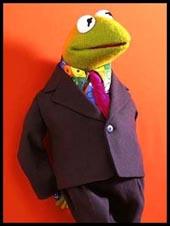
You are Kermit the Frog.
You are reliable, responsible and caring. And you
have a habit of waving your arms about
maniacally.
FAVORITE EXPRESSIONS:
"Hi ho!" "Yaaay!" and
"Sheesh!"
FAVORITE MOVIE:
"How Green Was My Mother"
LAST BOOK READ:
"Surfin' the Webfoot: A Frog's Guide to the
Internet"
HOBBIES:
Sitting in the swamp playing banjo.
QUOTE:
"Hmm, my banjo is wet."
What Muppet are you?
brought to you by Quizilla
For Proverbs 31 See My Wife
[Note: I clearly created a misunderstanding. Anna is not pregnant again. I've re-written the post. Geez. Can I screw up or what?!]
My wife. God love her. What an amazing woman. Get ready to hate her.
She's a mom . . . of two; with stair steps less than two years apart. She keeps our house running: shops at the grocery store and Target; researches most purchases online before buying a product (especially bigger ticket items); runs Sofie to storytime at the library, Gymboree and French classes (and procures the scholarships for these activities without which we couldn't do them), as well as to play group and the Church's mom's meetings and outings; pays--er, I mean, juggles and pays--the bills; does laundry and the dishes; and bakes.
That's not the whole list, of course, but you get the picture. Don't hate her yet? How 'bout this?
Our Christmas shopping is nearly done, and nearly all the cards are addressed and stamped and waiting for messages and signatures.
Yep, she's a wonder woman.
I'm in awe.
And love.
November 28, 2005
Your Prayers
Well, the flying-reverse-stomach-flow illness has hit the Healy home. Delaina tangled with it last night, though after I anointed her with oil from the vigil lamp of St. John of Shanghai and San Francisco's tomb, and asked his intercessions with those of our Most Holy Lady, Delaina's color returned and she has kept everything down.
Now Sofie is three more shades of pale and a bit less energetic than her normally frenetic self. I have also anointed her and asked the Saint's and the Theotokos' prayers.
Your prayers for restoration of health in our home will be appreciated.
Also, I myself've been feeling a lot less than perky . . . and I still have a goodly stack of ethics papers to grade before six p.m. tonight--and write a lecture on part one of Pierre Hadot's What Is Ancient Philosophy?, on which I'm supposed to talk tonight in class. Neither of these are optional or can be postponed given the three-class-sessions to go for my Monday night ethics class (one of which includes administering the final exam).
Whew.
November 26, 2005
"Not of This World": A Review
[Note: I have, since 2002, read Blessed Hieromonk Seraphim's biography each year. Beginning sometime in the autumn, in September or October, I read a chapter or two most everyday. In 2002, my first exposure to Fr. Seraphim was through the first edition of his biography, authored by Hieromonk Damascene Christenson, Not of This World. In 2003, shortly after the release of the new edition of the biography and again in 2004, I have read Father Seraphim Rose: His Life and Works. Having read both, there is a clear difference between the two. Many of the controversial parts, involving largely the words, recollections and later behavior of Fr. Seraphim's monastic brother, Abbot Herman, have been excised in the new biography to be replaced by much fuller and richer accounts of Fr. Seraphim's own word and works. This year, however, I decided to go back and re-read the original edition of the biography. Rather than write a review of it myself, I decided to allow Fr. Seraphim's spiritual son Hieromonk Ambrose (Fr. Alexey) Young's words to measure the first edition of the biography, Not of This World.]
Hieromonk Ambrose (Alexey) Young's review of Not of This World.
Without doubt, the late Hieromonk Seraphim (Rose) was a most remarkable American convert. He was a contributing editor for Orthodox America and editor of The Orthodox Word; he was also the author of many books, and the translator and/or editor of many other works, in both English and Russian. In addition, he wrote scores of articles on a wide variety of church subjects, and composed services to four saints. His death in 1982, at the early age of forty-eight, brought this prolific career to an abrupt close. Those who were privileged to know Fr. Seraphim personally, as this writer did for more than twelve years, also saw something of Fr. Seraphim "the man": the spiritual director, the monk, and-in his last few years-the priest and confessor. His brilliant and even splendid intellect was combined with a rare soul and a peaceful outward personality that was self-effacing, quiet, still-a personality that, frankly, loathed controversy and conflict. Especially would he have disliked the controversy generated by his biography.
Many of us-his spiritual children and his readers-had long wished for a biography of Fr. Seraphim. Some, assuming that such a work would be only a straightforward account of his remarkable life and thought, were asked to share our personal memories for such a study. Last summer [1993--cdh], Not of This World: The Life and Teachings of Fr. Seraphim Rose, was published. And, indeed, the biographer, Fr. Damascene (Christensen) has managed to integrate a massive amount of material. He narrates Fr. Seraphim's life skillfully, and we learn many things about Fr. Seraphim-especially his pre-Orthodox life-that we did not know before. This, in spite of the fact that Fr. Damascene himself hardly knew Fr. Seraphim, and was only baptized at the time of Fr. Seraphim's death. The book is also filled with photographs that help to make the man and his times come to life. Not of This World is, however, both a treasure and a disappointment, a joy and a sadness, an inspiration and a scandal. The purpose of this review is to examine these contradictions.
Some may ask: how can this reviewer-Fr. Alexey Young-possibly give an objective evaluation of Not of This World? After all, as a spiritual son of Fr. Seraphim (and co-worker with him on a number of projects), Fr. Alexey is perhaps too close to his subject. Also, Fr. Alexey was for many years closely associated with the St. Herman of Alaska Skete (where Fr. Seraphim lived) in Platina, California. The third, and, perhaps the most serious criticism of all: five years ago Fr. Alexey left the Russian Church Abroad, and he is no longer in a position to speak with any credibility.
May I say forthrightly that it is precisely because of these objections that I am in a position to write an honest review of this biography. First, while I knew the man, trusted him, and believed he achieved righteousness, I was not blind to his weaknesses-nor would he have wanted me to be. Fr. Seraphim had a horror of "guru-ism." He never demanded blind or unquestioning obedience, and he would have been appalled by statements such as one printed on the back of the book jacket: "Without Fr. Seraphim we'd all be dead." In a letter to me he once described himself, in an obviously understated way, as only an "elder brother," one who had taken a few more steps along the path than I had.1 He often made suggestions but always added, "do what you think is best." He himself always preserved a kind of polite but definite "distance" between himself and others, so that it was possible for us to view him objectively. He was not a cold or arrogant men, yet he did not permit any kind of what we would now call "co-dependance" between himself and others.
Secondly, I was an outside witness to a number of the events described in this book; most of those I did not personally see, were described to me by Fr. Seraphim himself, either in person or by letter. Although the St. Herman Skete was a very important influence in my life, I found it impossible to support the transient whims and peculiar ecclesiology of the Skete's then-Abbot, Fr. Herman (Podmoshensky), when, after Fr. Seraphim's death, he entered into an almost paranoid combat with his ruling hierarch, Archbishop Anthony of San Francisco and Western America. Fr. Herman was ultimately suspended and then defrocked by the Russian Church Abroad-after a series of provocations by Fr. Herman that would have horrified Fr. Seraphim, and which would never have been tolerated, had he lived. Thirdly, my own departure from the Russian Church Abroad to another jurisdiction had nothing to do with Fr. Herman and the Skete's troubles, nor did I follow him into his present ecclesiastical affiliation. Nor was I rejecting the priceless spiritual formation I so generously received in the bosom of the Church Abroad. In fact, in my present-day contacts with clergy and laity of other jurisdictions, I gladly and proudly defend the Church Abroad when she is criticized.
Lastly, since the book's appearance last summer, I have been contacted by a score of people around the country who, not having known Fr. Seraphim, but seeing that I am quoted in the biography many times, have asked my opinion of the book and its accuracy. I have felt an urgent responsibility to speak truthfully and set the record straight.
In a certain sense, this biography is actually three books in one. The first concerns Fr. Seraphim's early life and his intellectual and spiritual development up to the time of his conversion to Orthodoxy (approximately 250 pages). The second deals at length with his life as an Orthodox Christian -as a layman, monk, priest, writer, and teacher (more than six hundred pages). The last and, blessedly, shortest section (about 150 pages) concerns events that occurred after his repose-primarily Fr. Herman's activities and troublesome new directions. The word is not hagiography, but biography, and so it naturally contains much material of a personal and even seemingly trivial nature-in order to "fill out" the man as completely as possible, especially in his youthful, formative years.
Before discussing these three sections, it is important to note that this biography is at its best when Fr. Seraphim is allowed to speak for himself. Since he left behind a considerable body of published work, was a prolific letter-writer, and also kept a private journal, we can know something of what he was experiencing, thinking, and feeling about many things, both in his own life and in the larger life of the Church.2 In these parts of the book-and they are many-we recognize the Fr. Seraphim we knew and so warmly remember.
But, unfortunately, there are also a number of critical places where we do not hear Fr. Seraphim's "voice"; nor do we really hear the voice of Fr. Damascene, the author, either. Instead, we are subject to the views and interpretations of Fr. Herman, the co-founder of the St. Herman Skete and Fr. Seraphim's monastic brother-and not all these ideas were shared by Fr. Seraphim. Anyone who knows Fr. Herman can quickly identify these passages-and, unfortunately, there are many. Fr. Herman's speaking and writing style is quite distinctive, a style not at all shared by the author or Fr. Seraphim, who wrote and spoke in a very unsentimental and lean manner. Perhaps these sections were simply dictated to Fr. Damascene, who then edited and corrected them, incorporating them into the text. In any case, what we get in some passages is not the unadorned Fr. Seraphim, but Fr. Herman's own version of him.
Fr. Damascene's use of pseudonyms for certain people-usually bishops and other leading figures in the Church Abroad whom Fr. Herman does not happen to like-is unscholarly, childish, and offensive. One can understand that it would be appropriate to change the names of less important individuals, to protect their privacy, but to do this with well-known, public figures makes no sense, since most readers know, or can easily discover, who these people really are. Frankly, it is cowardly to change the names of only those who are being criticized, slandered, and held up to ridicule. In some ways, the first part of this book is the most important and the most positive. It is refreshing-especially for those who knew the mature Fr. Seraphim only in his last years-to see that as a boy and young man he had a girlfriend, favorite pets and music; he participated in sports, he both smoked and sometimes drank too much-like so many young people. On a broader level, his is the story of a young man, typically American, middle-class, generically Protestant, who very much reflected the anxious post-World War II soul-searching of many of his generation, and even many today in the post-Vietnam generation. In fact, most who read this section will find in it a disturbing mirror of their own overly-intellectual, skeptical, and self-destructive lives. It is precisely this that is so inspiring and encouraging for the modern reader: he can see how a man (the future Fr. Seraphim) can go from the darkness of intellectual pride and agnosticism (at times even atheism) to simple hope and belief.
In his early twenties, he was influenced by the philosopher and writer, Guenon, from whom he learned the meaning and disastrous effect of "modernism" on Western civilization and became convinced "that the upholding of ancient tradition was valid and not just a sign of being unenlightened, as the modernists would claim. Whereas the modern mentality viewed all things in terms of historical progress, Guenon viewed them in terms of historical disintegration."3 This discovery actually prepared him for his later encounter with Orthodox Christianity, a traditional religion with a very old but very functional world-view.
When, finally, he discovered True Christianity in his late twenties, he saw quite quickly and lucidly that because Orthodoxy is the Living Truth, it is also "all-or-nothing"-"a scandal and insult to the 'wisdom' and instincts of 'this world'."4 He particularly saw this in the person of Blessed Archbishop John Maximovitch, with whom he came into frequent contact, but who was regarded by a few as a "scandal" precisely because he took Orthodox Christianity so literally and lived it so uncompromisingly.5
Whereas this first section of the biography is instructive and encouraging, the second is sometimes inspiring but is, at times, deeply troubling and bewildering. Inspiring because it deals with Fr. Seraphim's actual entrance into the Church and his ever-deepening discovery of Orthodox piety and practice, patristics and spirituality and-above all-his encounter with and deep love for the rich monastic tradition of Russian Orthodoxy, in particular the Optina and Valaam traditions, which became a constant source of spiritual consolation and encouragement. The events surrounding the founding of The Orthodox Word and the establishment of the St. Herman of Alaska Skete in the mountain wilds of northern California are informative and fascinating.
It was during this period, also, that Fr. Seraphim "hit his stride" in terms of using his intellectual and pastoral talents for the greater good of the Church. He was able to identify and understand the "convert phenomenon" but, more than this, began to realize that the most important thing about controversies and problems in the Church (a constant temptation for converts, especially) is how to understand and view them from the calm perspective of eternity, without being drawn into passionate arguments for this or that figure, "party," or ideology. These are extremely valuable insights and principles by which we can and should live today-and they are all contained in this book. The tragedy, however, is that in the last several months or so of Fr. Seraphim's life, his monastic partner and "inspirer," Fr. Herman, began to go in a quite different direction, a direction that ultimately took him, after Fr. Seraphim's death right out of the Church.
Much is made in this biography of the "oneness of mind" that existed between Frs. Herman and Seraphim. Undoubtedly this did exist, especially in their early years together. They certainly shared a common vision of what their life and work should be, and out of this came a constant and fruitful stream of edifying books, articles, translations, etc. many of which have become widely known, and some of which have been translated into other languages (particularly Russian). Because of their shared commitment, many-possibly hundreds-converted to the Faith.
This biography does not tell us, however, that in the last years this fabled "oneness of mind" began to break down significantly. Substantive disputes about the future of the Skete and its work occurred with more and more frequency as Fr. Herman developed a more idiosyncratic and flamboyant attitude that grieved and worried Fr. Seraphim. He told me and others about this himself.
On one occasion, about six months before he died, he said that he was never happier than when Fr. Herman was off on one of his many "trips"-for then, he said, "we have peace, quiet, and order at the Skete." Clearly, something had gone wrong. One of their disagreements concerned the question of establishing a monastery in Alaska, on St. Herman's own island. Although the book says that Fr. Seraphim gave his permission for this on his deathbed, the facts are actually quite different. Regrettably, we must now speak of this episode in detail.
About three months before Fr. Seraphim died, Fr. Herman came to see me at my home. He was in an extremely agitated state. He took me aside and said that he and Fr. Seraphim had just had a "terrible fight." "Fr. Seraphim," he said, "doesn't understand me! I don't know what will happen, now, in the future." He explained that the argument concerned a possible future monastic establishment in Alaska, a venture that Fr. Herman was eager to pursue, but one for which Fr. Seraphim refused to give his blessing, although he did bless Fr. Herman to spend Pascha on Spruce Island, which he did.
Is it possible that Fr. Seraphim on his deathbed finally did give his blessing to proceed with this plan, as the biography maintains? It is very unlikely-for two reasons: first, shortly after Fr. Seraphim was admitted to the hospital he was put on life-support systems, including a respirator-which meant that he was unable to talk. He was also in and out of consciousness-as all of us who were there can testify. Secondly, and more serious: several months later Fr. Herman himself told me that the very last words spoken to him by Fr. Seraphim were: "I'm finished with you. Damn you!" Fr. Seraphim's uncharacteristically angry words bespeak a mind deeply troubled over Fr. Herman's general behavior and suggest that there was more going on than any of us suspected at the time. Needless to say, none of this is in the biography.
This work contains an enormous, almost obsessive, amount of "anti-bishop" talk. Much of this is petty and gossipy and seems to bespeak some kind of unresolved psychological conflict with authority figures on Fr. Herman's part. None of these nasty remarks come from Fr. Seraphim himself, however. It appears to be an interpolation by the author and/or Fr. Herman. Nor did I ever hear during Fr. Seraphim's lifetime any such talk at the Skete-except, once, around 1973, from Fr. Herman. I had written a series of articles called "What is a Bishop?" Fr. Herman urged that I not write any more such articles. When I asked why, he only replied: "We shouldn't make so much of bishops. They can get 'big heads'."
I thought very little about this at the time because, in all of my own publication and missionary work, both Fathers had always spoken well of Archbishop Anthony (who also spoke very appreciatively of them to me!). Furthermore, they always insisted that I do nothing without his blessing. But in 1987, on the only occasion I saw Fr. Herman after 1984, when I asked him if he had gone under a bishop of another jurisdiction, he replied tartly: "Who needs bishops? All they do is cause trouble. They are the enemy of the Holy Spirit!" When I said that he sounded like an Old Believer he responded, "I don't need a bishop!" (As it happened, however, he had already secretly left the Russian Church Abroad and placed himself under the uncanonical and completely unrecognized "Bishop" Pangratios. Interestingly, a few years later when he visited Russia, he did not disdain to accept an award from the Patriarch of Moscow.)
Many of the alleged "encounters" between Vladika Anthony and the Fathers-often described as angry attempts on the Archbishop's part to control and "squash" them-are simply exaggerations or outright misrepresentations. Fr. Seraphim himself told me about many specific occasions when Vladika visited the Skete, was "pleased" with them and their work, and was happy to be with them, even if only briefly, in their seclusion and peace.
At other times he mentioned minor and normal disagreements or misunderstandings with their ruling hierarch-but these were always worked out and there was never any sense of enmity in those days, such as this book portrays. Naturally,the Archbishop had an appropriate responsibility for pastoral oversight, and he wished to be consulted and kept informed about various projects and plans. There may even have been times when he did not completely understand certain goals and aspirations of the Fathers. But this is all quite normal, as anyone who has worked for an employer in the world knows.
In any case, the portrayal of Vladika Anthony as some kind of "ecclesiastical monster" or tyrant does not ring true to anyone who knows him. His own repeated, sincere, and long-suffering attempts to make peace with Fr. Herman for more than four years after Fr. Seraphim's death-all of which were angrily rejected by Fr. Herman-bear witness to Vladika's true character and need no further defense or explanation.
Similarly, although Fr. Damascene's book is filled with sly remarks and attacks against the Church Abroad, I never heard any criticism of the Synod from Fr. Seraphim. Quite the contrary. Although he did caution against putting too much trust in the outward, external "institution" of the Church, Fr. Seraphim wrote the following to me on October 18/31, 1972: "Our [Synod of] bishops on the whole are better than any others we know about, and probably no different from the bishops of the last 2000 years, through whom the Holy Spirit has led His Church." He went on to write that we must "become the bishops' best helpers-for we are working together with them in the true service of the Church's 'organism,' the Body of Christ. If we thereby sometimes suffer misunderstandings and offenses from each other (and we are guilty of this, not just bishops!), the Church gives us the spiritual means to forgive and overcome these." This is a radically different view from that given in this biography.
The final chapters, which deal with the sad and, frankly, terrible events that occurred after Fr. Seraphim's repose, and which have no business being in this biography, are a disservice to his memory, and are nothing more than a one-sided apologia for Fr. Herman's decision to leave the Church. By "one-sided" is meant that he (through the author) simply does not tell the whole truth. For example, no mention is made of the fact that charges of a moral nature were brought against him about eighteen months after Fr. Seraphim's death. The Archbishop treated these accusations against Fr. Herman with utmost discretion, with all his heart he did not want not believe them and did not press these particular charges against Fr. Herman. (It is a fact, however, that Fr. Herman's alleged problems in this area actually surfaced shortly before Fr. Seraphim's death, and were known to him, undoubtedly contributing to the overwhelming sense of sadness that precipitated his final illness and repose, and which may explain his last words to Fr. Herman.)
The narrative leads the reader to conclude that Fr. Herman left the Church Abroad because his hierarch "persecuted" him and wanted to "seize" the Skete and its property-something he had supposedly long coveted. Not only is this not true, but the actual charges against Fr. Herman concerned legitimate matters of "insubordination and disobedience," and it was for these that he was ultimately defrocked.6
In general, this self-serving one-sidedness demonstrates the way in which many incidents have been exaggerated, distorted, and made to serve the private ideology of Fr. Herman. It is a poison that came into full "flower" only after Fr. Seraphim's death, when he was no longer present to provide the needed "balance" to Fr. Herman's exuberant personality-a personality that gave so much to the Church in his healthier, obedient days, and which was greatly valued by so many, but which later came to possess the ugly qualities that he is now so quickly to ascribe to others in the Church Abroad or, indeed, to anyone who does not completely agree with him.7
Finally, what can be said about this biography of Fr. Seraphim? As was pointed out earlier, where Fr. Seraphim is allowed to speak for himself, in lengthy quotations from his writings, the book is magnificent because Fr. Seraphim-his mind, his soul-was so rare, so wonderful and "good" a human being. In this sense, it is an important work. But the biography is extremely flawed because it has been made to serve the interests of Fr. Herman's own bitterness, and to justify or excuse his grave and unresolved personal problems. The average reader, who does not know all of the principal people involved, will have difficulty sorting this out, if he even can do so at all.
Archpriest Alexey Young
NOTES:
1. Fr. Alexey saved twelve years of Fr. Seraphim's letters of spiritual direction, written to him both as a layman and, later, as a priest. Orthodox America is now preparing these letters for publication.
2. N.B: While we can trust the accuracy of all those things published before Fr. Seraphim's death, we cannot be sure, for obvious reasons, that the excerpts in this book from his private journal are his original and unedited thoughts and jottings. Nor, because of Fr. Herman's present anti-Synod bias (which manifests itself only after Fr. Seraphim's death), can we now ever be sure of this.
3. Christensen, Monk Damascene, Not of This World: the Life and Teachings of Fr. Seraphim Rose.
4. Ibid.
5. The relics of Blessed Archbishop John (who will be canonized by the Church Abroad in the summer of 1994-the same jurisdiction and hierarchy that, according to this biography, "persecuted" him!) were recently found to be whole and incorrupt. Unfortunately, Vladika John's struggles are wrenched out of their proper context and given a meaning they actually did not have at the time-a literary "technique" that occurs frequently in this book. For further information about the alleged "treatment" of Vladika John, see a review of this biography by Novice Sergey in Orthodox Life, Vol. 43, No. 5.
6. For the full text of the Ecclesiastical Court's decision, see Orthodox Life, op. cit.
7. In a letter Fr. Herman wrote to a layman in Britain during this time, he said that even Fr. Alexey Young had "betrayed" him. In fact, on the last occasion I visited him at the Skete, in 1984, I begged him on my knees and in tears to make his peace with the Archbishop and not jeopardize all of the work he and Fr. Seraphim had done.
It's Beginning to Look a Lot Like Bacchanalia . . . Everywhere You Go
Welcome to the pagan holiday that celebrates the sin of aquisitiveness and purposefully entices the passions. Of course, it attempts to highjack the Christian holiday first by celebrating it for four weeks prior to the Christian holiday itself, and then by manipulating its religious adherents--known as consumers--by manufacturing emotions and having them seek out pure illusion. But it is truly an anti-Christian celebration in that its sole focus is wholly antithetical to Christian belief.
Let's take a look at its annual ritual.
Shopper Fights With Security Guards At Orlando Wal-Mart
One man told reporters that the laptops were being thrown into the air and people rushed toward them, collapsing on each other. Another man described the scene as crazy."It was absolutely pandemonium in there. They were throwing laptops twenty feet in the air, and people were collapsing on each other to grab them. It was ridiculous," said shopper Brian Horwitz.
"A guy came on top of me and hit my head," said Wal-Mart shopper, Jennifer Harris. "When he did it bounced against the other two people. I got hit on both of my ears."
Some people weren't fazed in the least. Many customers simply carted their stuff out of the store and passed right by the man in handcuffs, without any reaction.
Shopping season off to a wild start
The holiday shopping season kicked off Friday with a near-riot at the Wal-Mart in Mountain View as early-morning bargain hunters jostled with each other to get their hands on discounted laptop computers.Police were eventually called to calm unruly shoppers who climbed over a display case and shouted in a desperate effort to get their hands on one of a couple-of-dozen Hewlett-Packard notebook computers -- on sale for just $22 off the regular price of $400.
While such Homer Simpson-like behavior wasn't the norm across the Bay Area, it gives new meaning to the so-called door-buster sale campaigns retailers used to lure the buying masses at the start of the season, which represents about a quarter of their annual sales.
More stores than ever opened at 5 a.m., including Kohl's, Mervyns, Fry's Electronics, J.C. Penney and Wal-Mart. They enticed shoppers with promises of eye-popping discounts on portable DVD players, jewelry, laptops and LCD TVs.
Even Apple Computer jumped into the special Black Friday discounting frenzy. In an unusual move, the Cupertino company dropped prices of its new iMac G5 and its PowerBook G4 by $101.
After the Mountain View Wal-Mart opened at 5 a.m., hundreds of shoppers stormed inside, many charging the electronics department, where HP Pavilion laptop computers were selling for $378 for six hours only. The model normally sells for at least $400, according to Hewlett-Packard.
Customers sprinted to the counters, some leaping over them into the area where panicked clerks stood. A nearby display case was crunched to the ground, broken, witnesses said.
``I heard a mother yelling at her child saying, `I told you, you needed to be aggressive, you needed to get that!' '' recalled shopper Debbie Pavao, of Santa Clara. ``And you could hear this young child saying, `But Mom, but Mom!' . . . The child couldn't have been more than 10 or 11.''
Within minutes, police showed up and order was restored. No arrests or injuries were reported.
A manager at the Mountain View store, who would only give her first name as Marilyn, downplayed the ruckus, calling it ``just a normal blitz day.'' . . .
By 8 a.m., the parking lots at Westfield Valley Fair in Santa Clara were jammed and late-to-the-mall shoppers were circling for open spaces like sharks.
Shoppers, weighed down by multiple bags, slowed only for quick breathers or a bite to eat before resuming the hunt.
``It's tradition,'' said Trieu Nguyen, who showed up at the mall with his fiance, Katherine Chan, 26, before 6 a.m. He actually began his holiday shopping Tuesday, when he bought her an iPod nano.
``The alarm rang at 4 a.m.,'' said Chan, recalling the start of the shopping day like a bad memory.
Shoppers find sales worth fighting for
Here's a look back at two decades of buyers behaving badly, as chronicled in various media reports:# December 2004 - Two women and a teenage girl are arrested after they get into a fight over a parking space near a Toys "R" Us in West Hartford, Conn. One woman threw an orange peel at the other woman's car.
# December 2002 - A 41-year-old man is arrested after stealing another motorist's parking space, yelling at the driver and eventually spraying him with Mace at a mall in Connecticut.
# November 2002 - Shoppers stampede a Riverside, Calif., Wal-Mart store, running over a 35-year-old woman and fracturing her foot and hip.
# November 1998 - Frantic "Furby" shoppers bite one woman and knock another down at a Wal-Mart in O'Fallon, Ill.
# December 1996 - A Wal-Mart employee in New Brunswick, Canada, is sent to the hospital after a crowd of 300 "Tickle Me Elmo" shoppers tramples him.
# December 1993 - Drivers abandon their cars in the streets outside a Toronto shopping center, eager to get to the day-after-Christmas sales. A police officer said he ran out of $20 parking-ticket slips ticketing the vehicles.
# December 1992 - A 24-year-old clerk at a Toronto Sport Shoppe in Canada is kicked, punched and bitten by a group trying to grab products from shelves. Four people were arrested, and the clerk was sent to the hospital.
# November 1983 - A 75-year-old man is knocked down by shoppers trying to get to Cabbage Patch dolls at a Jefferson Ward store in North Miami Beach, Fla. That same month, shoppers in Washington, D.C., offer bribes to store clerks for access to the dolls.
November 25, 2005
Holy and Great Martyr Catherine the All-Wise of Alexandria
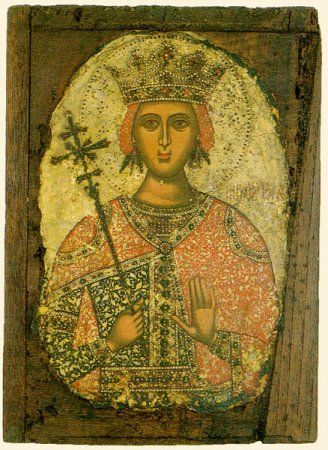
Today is the third anniversary of my foray into the blogging world. I did not realize it at the time, but I had begun blogging on the feast day of St. Catherine, patron saint of philosophers. Providence is frequently surprising.
So, today, in celebration of my third blogging anniversary, we will celebrate the feast of St. Catherine.
For a little bit about her life and why some churches celebrate St. Catherine's day on the 24th, read this piece from the Greek Orthodox Archdiocese Online Chapel:
Saint Catherine, who was from Alexandria, was the daughter of Constas (or Cestus). She was an exceedingly beautiful maiden, most chaste, and illustrious in wealth, lineage, and learning. By her steadfast understanding, she utterly vanquished the passionate and unbridled soul of Maximinus, the tyrant of Alexandria; and by her eloquence, she stopped the mouths of the so-called philosophers who had been gathered to dispute with her. She was crowned with the crown of martyrdom in the year 305. Her holy relics were taken by Angels to the holy mountain of Sinai, where they were discovered many years later; the famous monastery of Saint Catherine was originally dedicated to the Holy Transfiguration of the Lord and the Burning Bush, but later was dedicated to Saint Catherine. According to the ancient usage, Saints Catherine and Mercurius were celebrated on the 24th of this month, whereas the holy Hieromartyrs Clement of Rome and Peter of Alexandria were celebrated on the 25th. The dates of the feasts of these Saints were interchanged at the request of the Church and Monastery of Mount Sinai, so that the festival of Saint Catherine, their patron, might be celebrated more festively together with the Apodosis of the Feast of the Entry of the Theotokos. The Slavic Churches, however, commemorate these Saints on their original dates.
A fuller account of her life can be found here.
Troparion of Great Martyr Katherine Tone 5
Let us praise Katherine, protectress of Sinai,
Bride of Christ and our helper.
With the sword of the Spirit she silenced the wisdom of the wicked.
She is crowned as a martyr and asks mercy for us all.
Kontakion of Great Martyr Katherine Tone 2
You lovers of martyrs raise a chorus now
in honour of wise Katherine.
She preached Christ in the stadium
and spat on the knowledge of philosophers.
Holy and Great Martyr, All-Wise Catherine, pray for us that we may take captive every thought to the obedience of Christ, and pray that we may be made worthy of the Kingdom of Heaven.
The Fatherhood Chronicles LXXXVIII
The Simple Joys Parenthood Offers on Days Off
For probably another ten or fifteen years the singular joy of sleeping in on days off, vacations and holidays is gone. 'Course Anna insists that if I get up at 4:30 or 5:00 on weekday/workday mornings and 6:00 or 6:30 on days off/vacation/holiday mornings then technically I have slept in.
I beg to differ. (And in any case, this is from the one who does sleep in till nine or ten when I'm home in the mornings! Oh well, she's a tired momma and needs the rest.)
So, a daddy learns that sanity requires taking pleasure in other things that being home in the morning affords.
Here, then, is my greatest days-off indulgence: Staying in my jammies till noon and sippin' coffee all morning.
(So, um, if you come by our house unannounced on such a morning, you've been forewarned.)
November 24, 2005
Warm Thanksgiving Wishes to Everyone
Good Afternoon! I just wanted to wish everyone well. I pray you are able to enjoy this day with friends and loved ones.
"Let them give thanks to the Lord for his mercies, and for his wondrous works for the sons of men." (Psalm 106 [107]:8, 15, 21, 31 LXX)
November 23, 2005
The Fatherhood Chronicles LXXXVII
Breakfast Time is Daddy-Daughters Time!
I've always loved breakfast. To the best of my knowledge, as a kid I never missed one. At our home, breakfast was good stuff. None of that sugary, chocolate-covered, rainbow-flavored crap. We're talkin' real, honest to goodness breakfast, just like God ordained in creation. Mom or Dad, depending upon Dad's shift schedule, would make us the day's menu: Oatmeal--often with raisins and cinamon; eggs (sometimes scrambled with cheddar cheese) and bacon; pancakes; Malt-O-Meal; cracked wheat--man, it just don't get better'n that. Yes, we also had boxed cereal, but once again, this was the good stuff: Wheaties, cornflakes, Grape-Nuts . . . you get the picture.
Then there was the whole cereal-box-reading ritual of breakfast. My sisters and I, when we ate boxed cereal, would each have our own boxes, usually, but not always, the box out of which our respective cereals had come. Occasionally, we were a box or two short, so the box(es) would have to be passed around the table. Sometimes minor disputes arose over who got to read what box, or read what box first. But given the o-dark-early nature of these repasts, there was not a lot of energy devoted to such conflicts.
Well, now I'm a daddy. And I must confess, I love making breakfast for my daughters. Yes, that's daughters, plural. Delaina has reached the rice-cereal milestone. So, what's on the menu? What do you think? Oatmeal and raisins for Sofie and me. Gerber rice cereal for Delaina.
There's no box reading yet, but occasionally I will read the Scriptures for the day. We always pray before the meals: O Lord Jesus Christ, bless the food and drink of Thy servants, for Thou art holy, now and ever and unto ages of ages. It's a short prayer, and Sofie now reminds us to hold hands and say "Our Father" (which is her term for praying, even when we don't pray the "Our Father" specifically). In fact, one morning I had prepared Sofie's breakfast, we prayed and then I busied myself fixing my lunch, and then my own breakfast. When I sat down, Sofie reached out her hand for me to hold it and said, "Daddy? Our Father?" So we prayed again.
Delaina, for her part prays by simply smiling and cooing.
I still love breakfast time.
Good Frolicking Fun in the Fields of Logic
Over on the Grace-Centered Message boards I frequently visit, there's been a thread initiated by some anti-fundamentalists over age of earth issues, specifically a critique of young earth creationism. It's been very entertaining to watch the two main protagonists (or antagonists as the case may be) swagger through the posts on the thread with what I consider to be a bad case of o'erweening braggadocio.
The person who initiated the thread is very much in line with the definition of an internet troll. Try as I might I just could not resist feeding the trolls. Thus the thread has grown to an astronomical nearly 300 replies (at the time of this post here on my own blog). That's what happens when you feed trolls.
Part of my inability to resist that troll-feeding urge is the thread initiator's dogged and blinkered unwillingness to admit that his argument is fallacious. Here is his argument, which he calls the "Goliath of GRAS":
Major premise:If God's word (the text) says
everything began over a period
of six days, is interpreted by some to mean it was six 24-hour days occurring a few thousand years ago, and there is empirical evidence that things are actually much older than
a few thousand years, then the
interpretation of the text by some is wrong.Minor premise:
God's word (the text) says everything began over a period of six days, is interpreted by some to mean it was six 24-hour days occurring a few thousand years ago, and there is
empirical evidence that things are actually much older than a few thousand years.Conclusion:
The interpretation of the text by some is wrong.
He then goes on to claim:
Before trying to criticize the logic of the above, I would just first have you note that the logical construction of the argument has been rather thoroughly vetted. The argument has survived all attempts to destroy its validity.
Perhaps. That is, until now.
I have written to him my demonstration of the fallacious equivocation of his argument:
P1: Whether or not the earth was created in six 24-hour days is irrelevant to the age of the earth; or, cosmological origins of the universe are not necessarily essentially connected to questions about the age of the universe.
P2: Your argument (Goliath of GRAS) explicitly utilizes terms and concepts in your premises that have no necessary connection to age of the earth positions (specifically in your argument, young earth): namely, six-24-hour-day creation.
P3: Your premises establish equivocation into your argument by juxtaposing a specific creationist account (six-24-hour-day creation) of cosmological origins with a specific position on the age of the earth (young earth).
P4: Your conclusion further establishes this equivocation, for it is not clear what is wrong about the interpretation you are criticizing; is it the six-24-hour-day creation or the young age of the earth, or both?
C: Therefore, I have conclusively demonstrated once and for all that your argument as it stands is an invalid argument in that it suffers the fallacy of equivocation. Since your argument is invalid the truth of your conclusion cannot be guaranteed.
Part of the, perhaps untoward, pleasure I derive from such encounters is the pulling back of the curtain on self-proclaimed great and mighty Oz's.
Update: I'm a sadist
The chest thumping by the argument intiator and his confederate continues apace, so I made my critique a little more direct and clear:
As part of the cleaning up process from my devastation of the Goliath argument, let me clarify those things regarding logic that the argument initiator and his confederate seem not to grasp.
First, I have demonstrated that the so-called Goliath commits the fallacy of equivocation. A fallacy of equivocation occurs when a word or phrase is used bivalently, that is to say, with two different meanings in the argument.
That equivocal word in the argument is the word "interpreted" (from the P1 and P2) and "interpretation" (from the P1 and the Conclusion). Specifically, what is equivocal about it is that its contents mean one thing in the premises and another in the conclusion.
Let's look at the premises again and replace some terms with "x", "y" and "z" to demonstrate to everyone what I mean.
P1: If God's word (the text) says X, is interpreted by some to mean it was Y [and] Z, and there is empirical evidence that things are actually non-Z, then the interpretation of the text by some is wrong.
"x" = "everything began over a period of six days"
"y" = "six 24-hour days"
"z" = "occurring a few thousand years ago"
"non-z"= "much older than a few thousand years"
Please note that I have inserted an "[and]" into this premise. Why? Because the specifics of the origins of the earth, or cosmos (six-24-hour-day creation) are irrelevant to questions of the age of the earth. And, in fact, both the argument initiator and his confederate agree that cosmological origins are irrelevant to this discussion.
The argument initiator insists on inserting this irrelevant fact into his premises for reasons that I can perhaps guess at but which, nonetheless, remain unclear.
What is clear is that he has not--and I happen to think, cannot--justify the joining of both those terms in a single term ("interpretation") while only disproving one aspect of the term (i.e., young earth age).
The same weaknesses occur in the second premise.
P2: God's word (the text) says X, is interpreted by some to mean it was Y [and] Z, and there is empirical evidence that things are actually non-Z.
"x" = "everything began over a period of six days"
"y" = "six 24-hour days"
"z" = "occurring a few thousand years ago"
"non-z"= "much older than a few thousand years"
So, by the time argument initiator comes to his conclusion, he effectively sweeps up Y into his conclusion along with Z.
C: The interpretation of the text by some is wrong.
But notice, the only thing that argument initiator claims to have proven wrong in his argument is Z: the earth is only a few thousand years old.
So his conclusion banks on an equivocal use of the term(s) "interpreted"/"interpretation" to effectively claim the disproving of two aspects of an interpretation, one having to do with cosmological origins, the other having to do with earth age. But, in fact, the argument initiator has not disproven the cosmological origin aspect of the interpretation he is working with, and therefore his conclusion is invalid.
It is for this reason that his entire argument is invalid and his conclusion cannot be guaranteed.
Goliath still remains on the ground with a big stone of Truth lodged between his beady little eyes.
November 21, 2005
The Presentation of the Most Holy Theotokos and Ever-Virgin Mary in the Temple
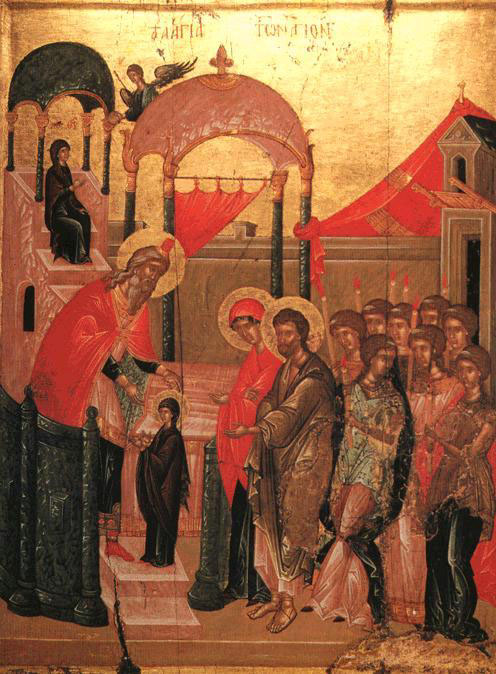
Troparion of the Mother of God Tone 4
Today is the prelude of God's goodwill/ and the prophecy of the salvation of men./ The Virgin appears openly in the temple of God/ and foretells Christ to all./ So let us cry to her with loud voices:/ Rejoice, thou who art the fulfillment/ of the Creator's providence.
Kontakion of the Mother of God Tone 4
The most pure Temple of the Saviour,/ the most precious bridal chamber and Virgin,/ the sacred treasury of the glories of God,/ today enters into the house of the Lord,/ bringing with her the grace that is the Divine Spirit./ And the Angels of God sing of her:/ This is the heavenly tabernacle.
If a tree is known by its fruit, and a good tree bears good fruit (Mt. 7:17; Lk. 6:44), then is not the Mother of Goodness Itself, She who bore the Eternal Beauty, incomparably more excellent than every good, whether in this world or the world above? Therefore, the coeternal and identical Image of goodness, Preeternal, transcending all being, He Who is the preexisting and good Word of the Father, moved by His unutterable love for mankind and compassion for us, put on our image, that He might reclaim for Himself our nature which had been dragged down to uttermost Hades, so as to renew this corrupted nature and raise it to the heights of Heaven. For this purpose, He had to assume a flesh that was both new and ours, that He might refashion us from out of ourselves. Now He finds a Handmaiden perfectly suited to these needs, the supplier of Her own unsullied nature, the Ever-Virgin now hymned by us, and Whose miraculous Entrance into the Temple, into the Holy of Holies, we now celebrate. God predestined Her before the ages for the salvation and reclaiming of our kind. She was chosen, not just from the crowd, but from the ranks of the chosen of all ages, renowned for piety and understanding, and for their God-pleasing words and deeds.In the beginning, there was one who rose up against us: the author of evil, the serpent, who dragged us into the abyss. Many reasons impelled him to rise up against us, and there are many ways by which he enslaved our nature: envy, rivalry, hatred, injustice, treachery, slyness, etc. In addition to all this, he also has within him the power of bringing death, which he himself engendered, being the first to fall away from true life.
The author of evil was jealous of Adam, when he saw him being led from earth to Heaven, from which he was justly cast down. Filled with envy, he pounced upon Adam with a terrible ferocity, and even wished to clothe him with the garb of death. Envy is not only the begetter of hatred, but also of murder, which this truly man-hating serpent brought about in us. For he wanted to be master over the earth-born for the ruin of that which was created in the image and likeness of God. Since he was not bold enough to make a face to face attack, he resorted to cunning and deceit. This truly terrible and malicious plotter pretended to be a friend and useful adviser by assuming the physical form of a serpent, and stealthily took their position. By his God-opposing advice, he instills in man his own death-bearing power, like a venomous poison.
If Adam had been sufficiently strong to keep the divine commandment, then he would have shown himself the vanquisher of his enemy, and withstood his deathly attack. But since he voluntarily gave in to sin, he was defeated and was made a sinner. Since he is the root of our race, he has produced us as death-bearing shoots. So, it was necessary for us, if he were to fight back against his defeat and to claim victory, to rid himself of the death-bearing venomous poison in his soul and body, and to absorb life, eternal and indestructible life.
It was necessary for us to have a new root for our race, a new Adam, not just one Who would be sinless and invincible, but one Who also would be able to forgive sins and set free from punishment those subject to it. And not only would He have life in Himself, but also the capacity to restore to life, so that He could grant to those who cleave to Him and are related to Him by race both life and the forgiveness of their sins, restoring to life not only those who came after Him, but also those who already had died before Him. Therefore, St. Paul, that great trumpet of the Holy Spirit, exclaims, "the first man Adam was made a living soul, the last Adam was made a quickening spirit" (1 Cor. 15:45).
Except for God, there is no one who is without sin, or life-creating, or able to remit sin. Therefore, the new Adam must be not only Man, but also God. He is at the same time life, wisdom, truth, love, and mercy, and every other good thing, so that He might renew the old Adam and restore him to life through mercy, wisdom and righteousness. These are the opposites of the things which the author of evil used to bring about our aging and death.
As the slayer of mankind raised himself against us with envy and hatred, so the Source of life was lifted up [on the Cross] because of His immeasurable goodness and love for mankind. He intensely desired the salvation of His creature, i.e., that His creature would be restored by Himself. In contrast to this, the author of evil wanted to bring God's creature to ruin, and thereby put mankind under his own power, and tyrannically to afflict us. And just as he achieved the conquest and the fall of mankind by means of injustice and cunning, by deceit and his trickery, so has the Liberator brought about the defeat of the author of evil, and the restoration of His own creature with truth, justice and wisdom.
It was a deed of perfect justice that our nature, which was voluntarily enslaved and struck down, should again enter the struggle for victory and cast off its voluntary enslavement. Therefore, God deigned to receive our nature from us, hypostatically uniting with it in a marvellous way. But it was impossible to unite that Most High Nature,Whose purity is incomprehensible for human reason, to a sinful nature before it had been purified. Therefore, for the conception and birth of the Bestower of purity, a perfectly spotless and Most Pure Virgin was required.
Today we celebrate the memory of those things that contributed, if only once, to the Incarnation. He Who is God by nature, the Co-unoriginate and Coeternal Word and Son of the Transcendent Father, becomes the Son of Man, the Son of the Ever-Virgin. "Jesus Christ the same yesterday and today, and forever" (Heb. 13:8), immutable in His divinity and blameless in His humanity, He alone, as the Prophet Isaiah prophesied, "practiced no iniquity, nor deceit with His lips" (Is. 53: 9). He alone was not brought forth in iniquity, nor was He conceived in sin, in contrast to what the Prophet David says concerning himself and every other man (Ps. 50/51: 5). Even in what He assumes, He is perfectly pure and has no need to be cleansed Himself. But for our sake, He accepted purification, suffering, death and resurrection, that He might transmit them to us.
God is born of the spotless and Holy Virgin, or better to say, of the Most Pure and All-Holy Virgin. She is above every fleshly defilement, and even above every impure thought. Her conceiving resulted not from fleshly lust, but by the overshadowing of the Most Holy Spirit. Such desire being utterly alien to Her, it is through prayer and spiritual readiness that She declared to the angel: "Behold the handmaiden of the Lord; be it unto Me according to thy word" (Lk. 1:38), and that She conceived and gave birth. So, in order to render the Virgin worthy of this sublime purpose, God marked this ever-virgin Daughter now praised by us, from before the ages, and from eternity, choosing Her from out of His elect.
Turn your attention then, to where this choice began. From the sons of Adam God chose the wondrous Seth, who showed himself a living heaven through his becoming behavior, and through the beauty of his virtues. That is why he was chosen, and from whom the Virgin would blossom as the divinely fitting chariot of God. She was needed to give birth and to summon the earth-born to heavenly sonship. For this reason also all the lineage of Seth were called "sons of God," because from this lineage a son of man would be born the Son of God. The name Seth signifies a rising or resurrection, or more specifically, it signifies the Lord, Who promises and gives immortal life to all who believe in Him.
And how precisely exact is this parallel! Seth was born of Eve, as she herself said, in place of Abel, whom Cain killed through jealousy (Gen. 4:25); and Christ, the Son of the Virgin, was born for us in place of Adam, whom the author of evil also killed through jealousy. But Seth did not resurrect Abel, since he was only a foretype of the resurrection. But our Lord Jesus Christ resurrected Adam, since He is the very Life and the Resurrection of the earth-born, for whose sake the descendents of Seth are granted divine adoption through hope, and are called the children of God. It was because of this hope that they were called sons of God, as is evident from the one who was first called so, the successor in the choice.This was Enos, the son of Seth, who as Moses wrote, first hoped to call on the Name of the Lord (Gen. 4:26).
In this manner, the choice of the future Mother of God, beginning with the very sons of Adam and proceeding through all the generations of time, through the Providence of God, passes to the Prophet-king David and the successors of his kingdom and lineage. When the chosen time had come, then from the house and posterity of David, Joachim and Anna are chosen by God. Though they were childless, they were by their virtuous life and good disposition the finest of all those descended from the line of David. And when in prayer they besought God to deliver them from their childlessness, and promised to dedicate their child to God from its infancy. By God Himself, the Mother of God was proclaimed and given to them as a child, so that from such virtuous parents the all-virtuous child would be raised. So in this manner, chastity joined with prayer came to fruition by producing the Mother of virginity, giving birth in the flesh to Him Who was born of God the Father before the ages.
Now, when Righteous Joachim and Anna saw that they had been granted their wish, and that the divine promise to them was realized in fact, then they on their part, as true lovers of God, hastened to fulfill their vow given to God as soon as the child had been weaned from milk. They have now led this truly sanctified child of God, now the Mother of God, this Virgin into the Temple of God. And She, being filled with Divine gifts even at such a tender age, ... She, rather than others, determined what was being done over Her. In Her manner She showed that She was not so much presented into the Temple, but that She Herself entered into the service of God of her own accord, as if she had wings, striving towards this sacred and divine love. She considered it desirable and fitting that she should enter into the Temple and dwell in the Holy of Holies.
Therefore, the High Priest, seeing that this child, more than anyone else, had divine grace within Her, wished to set Her within the Holy of Holies. He convinced everyone present to welcome this, since God had advanced it and approved it. Through His angel, God assisted the Virgin and sent Her mystical food, with which She was strengthened in nature, while in body She was brought to maturity and was made purer and more exalted than the angels, having the Heavenly spirits as servants. She was led into the Holy of Holies not just once, but was accepted by God to dwell there with Him during Her youth, so that through Her, the Heavenly Abodes might be opened and given for an eternal habitation to those who believe in Her miraculous birthgiving.
So it is, and this is why She, from the beginning of time, was chosen from among the chosen. She Who is manifest as the Holy of Holies, Who has a body even purer than the spirits purified by virtue, is capable of receiving ... the Hypostatic Word of the Unoriginate Father. Today the Ever-Virgin Mary, like a Treasure of God, is stored in the Holy of Holies, so that in due time, (as it later came to pass) She would serve for the enrichment of, and an ornament for, all the world. Therefore, Christ God also glorifies His Mother, both before birth, and also after birth.
We who understand the salvation begun for our sake through the Most Holy Virgin, give Her thanks and praise according to our ability. And truly, if the grateful woman (of whom the Gospel tells us), after hearing the saving words of the Lord, blessed and thanked His Mother, raising her voice above the din of the crowd and saying to Christ, "Blessed is the womb that bore Thee, and the paps Thou hast sucked" (Lk. 11:27), then we who have the words of eternal life written out for us, and not only the words, but also the miracles and the Passion, and the raising of our nature from death, and its ascent from earth to Heaven, and the promise of immortal life and unfailing salvation, then how shall we not unceasingly hymn and bless the Mother of the Author of our Salvation and the Giver of Life, celebrating Her conception and birth, and now Her Entry into the Holy of Holies?
Now, brethren, let us remove ourselves from earthly to celestial things. Let us change our path from the flesh to the spirit. Let us change our desire from temporal things to those that endure. Let us scorn fleshly delights, which serve as allurements for the soul and soon pass away. Let us desire spiritual gifts, which remain undiminished. Let us turn our reason and our attention from earthly concerns and raise them to the inaccessable places of Heaven, to the Holy of Holies, where the Mother of God now resides.
Therefore, in such manner our songs and prayers to Her will gain entry, and thus through her mediation, we shall be heirs of the everlasting blessings to come, through the grace and love for mankind of Him Who was born of Her for our sake, our Lord Jesus Christ, to Whom be glory, honor and worship, together with His Unoriginate Father and His Coeternal and Life-Creating Spirit, now and ever and unto ages of ages. Amen.
November 18, 2005
This is Life! In Redneck
This is my blog.
This hyar is mah blog in redneck. Shet mah mouth!
Hilarious Update:
This is my other blog: Wisdom! Readings from the Fathers of the Church
This is my other blog in redneck: Wisdom! Fry mah hide!: Readin's fum th' Pappys of th' Church
Adventures in Logic 105
Last night in my logic class we were studying inductive arguments by analogy. Given that there was an inductive argument from Hume on cosmological design in the class exercises, I decided to spend some time in class illustrating inductive arguments by analogy via intelligent design.
In very simple form, an analogical argument looks something like this:
P1. A and B have a similar property S.
P2. A has property P.
C. B has property P.
The task, then, is to demonstrate the connection between properties S and P.
Generally, that will run something like this:
P1. A has property S.
P2. A has property P.
P3/C1. All S are P.
P4. B has property S.
C2. B has property P.
So, the intelligent design argument ran something like this:
P1. Machines have purposively connected parts.
P2. Machines are produced by intelligence.
P3/C (P1+P2). All things having purposively connected parts are produced by intelligence.
P4. The cosmos has purposively connected parts.
C2. The cosmos is produced by intelligence.
P4 is the one premise about which there may be some disagreement. The warrant for the premise essentially comes from the knowledge of the way the universe presently is, and the fact that the possible variations in many of the things that are as they are (the distance of the earth from the sun, the size of the sun, the composition of gases from the atmosphere, the magnetic field, etc. AND the relationship of all these specific conditions to one another) that would still support life as we know it are so infinitesimally small, that even given the current consensus on the age of the universe, the mathematical odds of just this sort of life coming into being are not only mathematically implausible, but, approach almost certain impossibility.
Of course, being an argument by analogy, it does not have the certainty in the conclusion that a deductive syllogism whose premises are true and argument sound does. But it can be fairly persuasive nonetheless.
And the kids enjoyed it. One person even seemed quite thoughtfully mulling over whether to alter his own opinion on cosmological origins.
Math Trick
My dad sent this in an email:
1. Grab a calculator. (you won't be able to do this one in your head)
2. Key in the first three digits of your phone number (NOT the area
code)
3. Multiply by 80
4. Add 1
5. Multiply by 250
6. Add the last 4 digits of your phone number
7. Add the last 4 digits of your phone number again.
8. Subtract 250
9. Divide number by 2
Do you recognize the answer?
The Culture of Death: "No Breeders" and Their Philosophy
First, Gregory Dicum's article to the SFGate, Is having a child -- even one -- environmentally destructive? starts off with a pretty blunt assertion:
"We can't be breeding right now," says Les Knight. "It's obvious that the intentional creation of another [human being] by anyone anywhere can't be justified today."Knight is the founder of the Voluntary Human Extinction Movement, an informal network of people dedicated to phasing out the human race in the interest of the health of the Earth. Knight, whose convictions led him to get a vasectomy in the 1970s, when he was 25, believes that the human race is inherently dangerous to the planet and inevitably creates an unsustainable situation.
Clearly, then, we must not breed. Right?
According to Knight, there are other ways people can have kids in their lives. "Adoption, foster-parenting, stepparenting -- there are a lot of opportunities for people who really do want to get involved with children." Knight himself is a substitute high school teacher in Portland, as befits his patient but forcefully clear demeanor.Knight takes care to point out that VHEMT isn't anti-child.
No, of course not!
Many of its members are parents.
Darn hypocrites!
Some of its members are children.
Fly, you fools!
In many ways, the idea of reducing the world's population is as much about human quality of life as it is about the health of the planet."May we live long and die out," says Naomi Thompson, quoting the VHEMT slogan. Thompson, who is in her late 20s and works as an analyst for Wells Fargo in San Francisco, has also concluded that childbearing is irresponsible. "It's not about wanting to kill people, but it's selfish to have a kid at this point when so many aren't getting the love and attention that they deserve."
Right. Let's swat flies with 2000 lb. bombs. How 'bout, and oh I'm just spit-ballin' here, we, oh, say, just simply give the "so many" the love and attention they do deserve? Newsflash: "Non-breeding" won't bring more love into the world.
"I really do love kids," she continues.
Sure ya do, sweetie! And I love black mold--which is why I don't have any around.
(Thompson and Knight say they were raised in large, happy families.) "I know it might seem odd for someone who really likes kids to have this stance on breeding --
Is that what they're calling it nowdays? Those crazy kids.
--women are mothering, nurturing people, and I definitely have that in me. But women in this society feel a lot of pressure to have babies, and I would like to see more people expressing that by adopting instead."
Gosh. Isn't it just terrible? Women feeling pressure to be mothers. Horrible. Standby. It gets even more disturbing.
"Nobody will come right out and say that this [population growth] is unsustainable, you can't do this," says Knight. "If you really are serious about the environment and your impact, zero is the optimal number of offspring that we should be producing."But the Brunes are sanguine. "We brought a new person into the world," says Mary Brune, "and we hope that she'll be one more soldier on the front lines who's going to fight for the Earth when she grows up."
Knight says even if little Olivia [Brune] becomes the "firecracker radical activist" her father hopes, it's going to be extremely difficult for her to overcome the environmental original sin she embodies. (emphasis added)
A fifteen month old girl is the embodiment of sin? This isn't the concept of ancestral sin of the Scriptures and the Christian Faith: this is the ascription of positive evil to the mere existence of a little toddler who didn't cause her own existence.
The above is just to illustrate the extremes in our narcissistic society, (like No Kidding!) where children are more and more being seen as robot-like-consumers (at best) or positive hindrances and evils to self-fulfillment (at worst).
Says Albert Mohler, in his Touchstone article, Rebel Without an Issue:
Modern Americans are determined not only to liberate sex from marriage, and not only to separate sex from the realities of male and female, but to liberate sex from procreation.This rebellion against parenthood is nothing less than an absolute revolt against God’s design. The Scripture points to barrenness as a great curse and children as a divine gift. The Psalmist declares: “Behold, children are a gift of the Lord, the fruit of the womb is a reward. Like arrows in the hand of a warrior, so are the children of one’s youth. How blessed is the man whose quiver is full of them; they will not be ashamed when they speak with their enemies in the gate” (Psalm 127:3–5).
“Make love, not babies” expresses a worldview the Scripture rejects. Marriage, sex, and children are part of one package. To deny any part of this wholeness is to reject God’s intention in creation—and his mandate revealed in the Bible. You can’t make love (though you can have sex) if you refuse to make babies.
The Scripture does not even envision married couples who choose not to have children. The shocking reality is that some Christians have bought into this lifestyle and claim that childlessness is a legitimate “lifestyle option” for Christians. The rise of modern contraceptives and sterilization surgery has made this possible for the first time in human history. But though willed childlessness may have been made possible by the contraceptive revolution almost every American thinks a perfect blessing, it remains a form of rebellion against God’s design and order.
Whoopsie! II: Katrina Blowback
The folks at The American Thinker, opine on the after effects of Katrina:
The Los Angeles Times describes the vast changes underway in Louisiana politics as a result of the population dislocations in the wake of Hurricane Katrina. In a nutshell, much of the Democratic base in New Orleans has not come home, changing the balance of power in the state from pretty even to decidedly Republican.As a result, the amount of pork flowing from the state legislature to New Orleans is diminished. And eventual redistricting will further enhance the power of Republicans, whose districts have gained population. Democrats are in despair.
The GOP could well pick up one or two more seats in the House of Representatives, and Democrat Mary Landrieu may have trouble holding onto her seat, not to mention hapless Governor Blanco.
While press coverage of the Hurricane aftermath did hurt President Bush and the GOP, there are definite signs that a blowback is underway. The questionable behavior of some refugees, with stories of lap dances and luxury goods purchased with aid dollars and other outrages, is having an effect. And in the long run, the swing of Louisiana into the solidly red column could be the most lasting political effect.
November 17, 2005
The Journey to Antioch XIV
With a dash of romance to spice it up!
It has been almost a year and a half since I last posted on my journey to Antioch, that is to say, my journey to Orthodoxy. There are good reasons for that. When one writes a narrative, even an autobiographical one, markers are needed to advance the plot. But such markers that one can write and can be read must be in some way distinctive, markable. There needs to be a clear "before" and "after." That's hard to do when the way God normally works on hearts and lives is by invisibly small incremental steps. Those incremental steps have been happening. But they have been hard to discern even after the fact.
Tuesday night was one of those incremental steps. Lately, Anna has been asking more questions about the Orthodox Church, and Tuesday night there was a bunch of them. But I'm getting ahead of myself.
Being parents of a twenty-eight-month old and a four-month old, we have hit that "haven't been out on the town in ages" epoch of marriage. I seem to recall that Olivia babysat Sofie for us something like a year ago when we went to a party in the neighborhood. And one of us has stayed home with the girls while the other went out. Anna typically goes to Target to restock supplies. I recently went to a manly man gathering of several of the manly men of the parish. Well, Tuesday night Anna secured the babysitting services of Sarah and we went all of four or five blocks from home to eat at an Italian restaurant in the neighborhood.
As we hit the sidewalk I reached out my hand and said to Goodwife Healy, "If'n we're gonna be on a date 'n all, we're gonna hold hands." She laughed and replied, "That's right. We aren't holding any babies, carrying any diapers bags or pushing any strollers!" So we walked and held hands all the way to the restaurant. Very nice.
Through the meal we talked about all sorts of stuff, like, um, what was going on--or not as the case may be--with my dissertation proposal. Gulp. But we also talked quite a bit about Orthodoxy. What about prayers to the saints? What about those Christians not in the Orthodox Church? What about sponsors and godparents? How does all that work? She wanted a history of the Orthodox Church. Where did it come from, where has it been all these centuries? She is open to it all. She hasn't found any thing that would cause any real problems, but she just wants to understand it. Well, there is one problem. Formal membership in any church. Why is it necessary? If one is a Christian, why does it matter? Why isn't one a member of every church simply by virtue of being a Christian?
Understandable that. We both come from your typical branch theory/spiritual Church Protestantism. We also both come from a shared history of some pretty awful treatment by fellow Christians where we served. These are things that take time to wrestle with.
But it was a good talk. The Lord is bringing greater unity of faith in our home.
And, really, Anna is just plain a remarkable woman. God knew I needed the finest if I was ever going to be saved. I've got it. May I never ever forget it.
Orthodoxy and Closed Communion
In an article, Koinonia and Eucharistic Unity (pdf file; may require subscription to journal server), Peter C. Bouteneff makes some cogent points as to why Orthodox do not practice open communion.
The issue of eucharistic sharing continues to burn in the hearts of Christians who are yet disunited; as well it should. The Eucharist—as rite, as event—is both intensely corporate (ecclesial) and also deeply personal. It is a sign and builder of unity between Christians; at the same time, while a gift of God, it is an act of personal devotion in which the total self is given and the divine is received. The inability of all people who confess Jesus Christ as God and Savior to participate together from a common cup is something that is impossible to take lightly. The pain of division is felt in proportion to the extent to which one experiences a degree of unity among Christians, a unity despite differences at the level of both doctrine and practice which are often very serious. This something that unites us despite our divisions is what those who participate in the ecumenical movement have come to call koinonia. . . .Orthodox and Protestants approach doctrine in different ways. To say that Protestantism, post-Schleiermacher, gives a profound importance to perception and feeling is a stereotype, but one with a grain of truth. In any event one would be well grounded in saying that Protestants emphasize scripture over doctrine, for doctrine, unlike scripture, is seen as a limited, human construct. This is not to suggest that Protestants do not hold strictly to their respective confessional documents. But there are fewer tenets which are put into the category of dogma, or nonnegotiable truth. One of the clear signs of this fact, to an Orthodox believer, is the quite wide theological diversity that exists within some of the Protestant families, about which I will have more to say below. Another indication is the fact that intra-Protestant church union and church fellowship agreements of recent decades have been enabled in some instances by a certain suspension of doctrine and practice, notably in the areas of ministry and succession. To Orthodox sensibilities, this shows that koinonia has triumphed over dogma.
Orthodox are less apprehensive of dogma. This is partly because scripture and dogma, or more broadly scripture and tradition, are seen as contiguous: scripture arises out of tradition and forms a part of it, and the totality of tradition is seen as not merely human but a living dialogue, taking place within the church, between human persons and the Holy Spirit. Orthodox have also been more inclined to subject perceptions and feelings to the mind (I also have more to say below about the Greek word nous), and especially to the “mind of the church,” as expressed through the scriptures and the rest of the church’s tradition.
It seems to me that somewhere within this dynamic lies a significant portion of the bewilderment, and even offense, which characterize our different approaches to eucharistic sharing. Many Protestants express their puzzlement at why the Orthodox do not just lay aside some of their proscriptive teachings on the basis of a koinonia that is plain for anyone to see. Similarly, Orthodox are perplexed at the apparent facility of Protestant eucharistic sharing, amazed to see some of the steps taken in order to achieve church agreements (e.g., as mentioned above, in issues of ministry and episcope). And it appears that little can help this mutual bewilderment, other than to name it for what it is, and continue trying to understand each other.
The koinonia we know (which is both real and imperfectly realized) and its reflection in the sacramental life of the churches come into sharp focus in the relationship between baptism and the Eucharist. This relationship is rich on many levels. The Orthodox see these two sacraments as inextricably linked; some even speak of the two (together with chrismation or anointing) as virtually one sacrament. When we baptize and anoint, whether a forty-day-old infant or a forty-year-old adult, the next immediate sacramental action is the Eucharist. Baptism and Eucharist are linked also in that the one is a prerequisite for the other: in order to receive the Eucharist in our church, one needs to be a baptized Orthodox Christian. The Eucharist is a sacrament of the baptized, a sacrament of those who have entered into the life in Christ and into the faith of the church through the ages. Moreover, it is the sacrament of those who have entered into a specific community of faith—by this is meant not only the community of the parish, but the community of the church with which that parish incarnates and identifies.
Given the connection between baptism and Eucharist, the question is quite justly raised, and is the subject of contemporary ecumenical study: if the churches recognize each other’s baptism—in other words, if we believe that we share a common baptism— why do we not share in the common eucharistic fellowship? What is different between baptism and Eucharist, other than the simple fact that the latter one is repeatable and the former is not, which justifies an apparently different perception and discipline? The answer to that question lies within the areas of recognition, ecclesiastical identity, and ecclesiastical unity.
First, one needs to explore the nature of the recognition of common baptism, for it would be entirely erroneous to say that we recognize a common baptism among all Christians. Here it must be acknowledged that within the Orthodox Church there is a certain variety of views on baptism performed outside its canonical boundaries.” There are Orthodox communities who, following a strict Cyprianic approach (adopted in the early third century and not retained with any consistency since then), rebaptize all who enter the Orthodox Church, no matter whence they have come. Yet the mainstream position, so far as it is testified, for example, by Orthodox service books (euchologia), follows rather the approach of St Basil’s late fourth century Canonical Epistle, which prescribes entry by baptism only for those, such as Manichaeans, Gnostics, or Marcionites, with a radically different conception of God.
But even this abstention from rebaptism does not indicate recognition of a common baptism. Yes, for most Orthodox churches, baptism performed with water and with the invocation of the Father, the Son, and the Holy Spirit (thus named) is understood as an entry into life in Christ, whether performed at the hands of a Protestant, Roman Catholic, or Orthodox priest. Therefore converts from other churches (baptized as described above) are not rebaptized but, depending on the tradition from which they have come, are received with one or more of the following rites: an Orthodox confession of faith, a renunciation of previous error, the rite of anointing with chrism. What these rites of entry indicate is that baptism outside the Orthodox Church is indeed recognized as a real and effective entry, but—and this is significant—one which requires a completion. It is thus a partial recognition, based not only on the conviction that God does not turn away from the request made in all faith, but also on the impossibility of affirming with certitude that, through a baptism outside the Orthodox church, one has entered into precisely the same reality, not to speak of the same community of faith.
As is well known, we Orthodox identify our church with the one holy, catholic, and apostolic church. We further hold that there is but one church of Christ, and that there is no division within this body, but only from it. And yet there are different extents of separation. As the dictum goes, we know where the Holy Spirit is, but we do not know where the Holy Spirit is not. So here again, while acknowledging a certain range of views from exclusivist to inclusivist, most contemporary Orthodox theologians who have considered the question from within the canonical Orthodox churches acknowledge sacramental reality outside the canonical boundaries of their church. This holds for both baptism and the Eucharist, and not by virtue of a simplistic notion of oikonomia.
If one looks closely, the understanding and pastoral practice surrounding baptism outside the Orthodox Church is thus in fact quite the same as for the Eucharist. In both cases there may (or may not) be a recognition of sacramental grace. But in neither case would one concelebrate the rite, for there is the crucial question of ecclesiastical identity involved: into which church, into which faith community is this a baptism? And while of course Christ is the ultimate minister of the Eucharist, who is its earthly minister? Moreover, in neither case would one consider the rites performed according to different confessions as interchangeable.
The Eucharist is bound together with ecclesiastical identity. Shared or concelebrated Eucharist would be indicative of a unity that in fact does not exist, testifying to a confused ecclesiastical identity. The same thing could be said about concelebrating baptism (could one call it “baptismal sharing”?). Such a rite would simply make no sense until we are visibly one church. If baptism signifies entry into the church through entry into a particular faith community, a joint baptism into churches which are yet divided would be a completely schizophrenic exercise.
Having thus set out the dogmatic, however imperfectly, I turn now to what I have referred to as the phenomenological. As convinced as one may or may not be by the Orthodox positions on the church and the sacraments, the question still follows: Are the differences in our faith and life not mere details? Are we not, finally, one in Christ? The walls of division surely do not reach heaven and do not touch eternity. Then why can we not, at least in special cases, set the strict teaching aside and receive together from one cup, at the eucharistic celebration, which, as the eschatological rite par excellence, is the very real foretaste of heaven and of eternity?
This question comes both from the mind and the heart, perhaps especially from the heart. It is important to state once again that an honest and sensible person of any confession asks this question with earnestness; no such person is immune to the pain stemming from the impossibility of partaking together in the eucharist. I recall how Alexander Schmemann, who was very close to my family, talked with us on his return from the enthronization ceremony of Pope John Paul I. There was an enormous celebration of the Eucharist, at which all the Roman Catholic clergy were communing, but from which he had to abstain. “I felt like the lowest worm,” he said. The question, the challenge of why we cannot share, comes out of a longing ultimately to share in the Eucharist.
When Protestants ask Orthodox why they do not share the eucharist, I often sense not only pain but a sense of outrage. The conviction seems to be that what is really at the root of Orthodox inability to share across the confessions is finally closed-mindedness, closed-heartedness, sectarianism, and triumphalism. That assumption, while understandable in the face of the insensitivity with which we Orthodox often present our views, is in itself very sad and painful to behold.
A related approach goes thus: “We invite you Orthodox to share in our Eucharist. Why can you not accept? And further, why can you not invite us too? Clearly this is not our problem but yours. We are open; you are closed. You exclude us.” Using the categories set out above, one can say that this approach represents a spurning of the dogmatic in favor of the phenomenological. It assumes that no teaching about the church, no understanding of the Eucharist, is important enough to justify forbidding us to share, on the basis of koinonia, if not human graciousness. At the same time, it also shows how very differently we understand what the Eucharist is in the first place. And it is on the level of the radical difference in what we mean by the whole concept of Eucharist and church that we need to approach this issue, rather than on the level of accusations of exclusiveness, elitism, or closed-mindedness. . . .
The Orthodox position on the Eucharist is such that intercommunion and eucharistic hospitality are completely foreign concepts: there is eucharistic communion where there is shared ecclesiastical identity; these are of a piece with each other. If we are in communion with a church, we are of the same church, for, as it is often said, Eucharist constitutes the sign, the crown, of an existing unity. . . .
So let us ask the question again: is the Eucharist a sign of unity or a builder of unity? There need not be any confusion on this matter: we ought simply to admit that it is both. True, the Orthodox, particularly in the context of inter- Christian relations, stress the character of the Eucharist as sign or mark of an existing or achieved unity. At the same time, it is undeniable that in partaking in the Eucharist within the Orthodox church, we also experience a building up of unity between us, as persons and as local communities. But there is only one appropriate context for this unitive function of the Eucharist, namely a clear, expressed bond of already-existing unity—that is, membership in the same church. An analogy can be drawn with a similarly intense, unifying phenomenon: sexual union. Sexual union is not only the sign of unity between persons, it also builds that union. But if we view this rightly, it is something whose unitive fruits we enjoy and are given properly to realize only from within a specific permanent covenantal relationship, namely, marriage. . . .
In some ways, “dogmatic” and “phenomenological” are just fancy words to designate the mind and the heart. Some may then think that what has been said can be summarized as “you either follow your mind, obeying the teachings of the church, or your follow your heart, and lay aside these teachings.” But this potential divorce between mind and heart is ultimately in itself a distortion, something artificial. The mind, after all, especially if we consider it in terms of the way the Greeks understood nous, is the self-transcending element of the human person; it is the seat not merely of the academic exercise but also of prayer, of intuition, of intercourse with God. If we listen to the church’s great teachers on the life of prayer we know that the mind and the heart are to work as a unity.
Furthermore, the teachings of the church are not true because they are dogmas. If we are persons who believe in the holy church—as we confess in our creeds—it is the reverse: they attain the status of dogma precisely because they are true. Seen this way, respect for the doctrine of the church is not the submission of the mind to an arbitrary authority, but a free obedience of the whole person to the church, which he or she confesses as holy and true.
November 16, 2005
Whoopsie! Caught on Tape (For Political Junkies)
The good ol' boys over at the GOP website have put together a pretty damning video.
Check it out (Opens in Windows Media Player)
Kansas: Meteorite Paradise
In Kansas, meteorite hunter finds a gem
And you thought Kansas was just flatlands, wheatfields and Dorothy!
November 15, 2005
O Sapientia
[Note: Today's post is the first of a series of reflections for this year on the "O Antiphons" sung during the forefeast, or the week prior to, the Nativity of Our Lord and Savior, Jesus Christ. Huw will also be blogging reflections on the "O Antiphons" (his invitation is here).]
O Sapientia,
quae ex ore Altissimi prodiisti,
attingens a fine usque ad finem fortiter,
suaviterque disponens omnia:
veni ad docendum nos viam prudentiae.
O Wisdom,
who proceeds from the mouth of the Most High,
reaching out mightily from end to end,
and sweetly arranging all things:
come to teach us the way of prudence.
John M Neale and Henry S. Coffin render these verses in the well-known hymn:
O come, O Wisdom from on high,
who orders all things mightily,
to us the path of knowledge show,
and teach us in her ways to go.
CHORUS: Rejoice! Rejoice! Emmanuel shall come to thee, O Israel!
Wisdom and order are the hallmarks of this created world, and of God's dealings with us. Prudence, prudentia, or, in Greek, phronesis, is, according to the ancient world, that practical knowledge that grasps the first principles, knows those things that are universally true, and weaves them together with intimate knowledge of the particularities of experience to produce a beautiful way of life. This Wisdom from on high, who lives this way of phronesis, though, is not some impersonal divine intellect thinking the thoughts which give reality to the universe. Nor is this some deity distant from his handiwork, content to fashion, or pass on to the fashioner the task of making, this world, only to settle back for eternity in blissful contemplative rest.
No, this God, this Wisdom from on high, not only speaks the universe into existence, but, clothes himself with creation, indeed, with the particularly human. He does not merely tell us the way, he shows us the way.
Christianity is ever and always a way of life, not a summary of precepts. There are things to know and to believe, but such knowledge and belief are only the threads of the tapestry of a beautiful life, a life crafted from the particulars. Wisdom became a man. Not everyman, but this man Jesus, born of Mary, raised by Joseph, lived and died in a specific place and time. This Wisdom was embodied so that not only might we know the way, we could follow him who is the Way. We not only know the God-man, Jesus the Christ, but he has been seen, he has been touched, he has been heard. He is life. The life he lives is light. And when we follow him, we embody by grace that light which he is. We are illumined.
Now seeing that to which we were formerly blind, we acknowledge a terrible grace and beauty to all that is around us. We live in the meantime, and time is so frequently very mean. But illumined by grace, the translucent veil of the glory which is and which is to come, the glory that is his, we see that the bitter is bounded by sweet, chaos with order, randomness with arrangment.
Wisdom from on high, teach us the way, show us the way. Arrange all things most sweetly for mercy for us and not for judgment. Come, Lord Jesus.
Colossians 2 and the Nativity Fast
A friend contacted me privately to ask me about these verses that are assigned from the lectionary today:
If then ye died with Christ from the elements of the world, why, as if living in the world, do ye subject yourselves to regulations--"Do not touch, neither taste, nor handle," which things are all for corruption in the using--according to the injunctions and teachings of men, which things indeed are having a reputation of wisdom in self-devised worship, and humility of mind, and unsparing treatment of the body, not showing any honor for gratification of the flesh? If ye then were raised with the Christ, be seeking the things above, where the Christ is seated at the right of God. Be minding the things above, not the things on the earth. For ye died, and your life hath been hidden with the Christ in God. (Colossians 2:20-3:3)
Knowing, as he does, that the Nativity Fast begins today, he asked me how Orthodox reconcile these verses from Colossians with their fasting practices.
Given that Pentecost is a movable feast, and thus the enumeration of the weeks after Pentecost will vary each year when one reaches the Nativity Fast, it is surely serendipitous that these are the verses with which we begin the Fast this year.
My reply, slightly edited, was the following:
For Orthodox who coordinate their fixed feast/fast days with the civil calendar, today is, indeed, the beginning of the Nativity Fast. (Orthodox who follow the Church's calendar for fixed feast/fast days will begin their Nativity Fast in about two weeks on the 28th.) You rightly note the items from which one is to abstain during this time--though as a matter of pastoral economy, the personal rule of each Orthodox will vary according to the direction and counsel of his or her spiritual father and of their own prayer and reflection. Generally the sick, elderly, pregnant or nursing mothers, or perhaps persons with other serious concerns (such as, perhaps, eating disorders) are generally gently encouraged not to maintain a strict fast, for health reasons, or in some cases they may positively be forbidden to fast. In such cases their spiritual father would doubtless have discerned that to adhere to a fast would harm their health or might even damage them spiritually. The practice of fasting is not a magical charm toward instant maturity in the faith.
But how does one reconcile the Orthodox fasting practices with this text in Colossians.
First of all, our Lord himself said, "When you fast . . ." not "if you fast . . ." implying quite distinctly that his followers would fast. And, indeed, we see this of the early Christians in Acts, when St. Paul and St. Barnabas were set aside for their ministry in 13:2-3; and when St. Paul and the Churches he had planted installed their presbyters in 14:23. St. Paul mentions that the foregoing of sexual intercourse in marriage is to be accompanied with prayer and fasting in 1 Corinthians 7:5, and he also references his own frequent fastings (2 Corinthians 6:5; 11:27), though in context, these are likely involuntary fastings (being without food due to persecution, hardship or circumstance). In fact, St. Paul mentions the rough treatment he gives his body so that he not be disqualified from the prize of salvation (1 Corinthians 9:26-27).
So, clearly, however we may want to handle Colossians 2, we need to do so in the context of these verses.
Thus, I would say, in short, that Colossians 2 does not forbid fasting, but the wrong sort of fasting. If we look again at the text, we see that the wrong sort of fasting is that which has a reputation for ethelothreskeia--that is, "self-willed worship." And note, also, that it is according to the traditions of men and not that which has come down to the Church from Christ and his apostles. In other words, ethelothreskic fasting is the sort of fasting in which we focus on the self and on external appearances and reputation. Christ demanded that our fasting be in secret and not for a show, but ethelothreskic fasting is all about reputation, honor and appearance, the self-satisfaction that comes from self-mastery. It does not focus on the things above, on our life which is hid in Christ in God. True fasting, as we know from Isaiah, is to care for the widow and the orphan, and is done secretly.
Most of all, Christian fasting is not self-directed. It is received from the Church through her ministers. One does not settle on a fasting rule on one's own, but always under the direction and authority of one's priest or spiritual father, who, as a spokesman of the Church, binds and looses.
So, not all fasting is wrong or unhelpful for our growth in Christ. Only that which is self-directed and self-gratifying.
Domesticating Men
According to an article in the Harvard Gazette, Marriage lowers testosterone:
A man's testosterone levels drop significantly when he holds an infant. Even holding a baby doll can decrease levels of the male virility hormone.Married men, whether fathers or not, have markedly lower testosterone levels than single males, according to one of the first studies of how the hormone changes when men marry and become fathers. Results of the study, done by a team of Harvard University anthropologists, increase our knowledge of human biology and may have implications for so-called "male menopause."
Researchers have long suspected that levels of the hormone largely responsible for fighting, competing, and mating decrease when men settle down and start a family. Other studies have shown that testosterone begins to decline shortly after marriage, but surges upward when unions end in divorce.
"It makes sense," notes Peter Ellison, professor of anthropology. "Lower levels of testosterone may increase the likelihood that men will stay home and care for their wives and kids, while decreasing the likelihood they will go out drinking with the guys and chase other women." . . .
Go ahead, play that marriage "emasculates" men card. There. Feel better. If one thinks parenting is "women's work" then let's do a comparison between a "man's day at the office" and a "woman's day with the kids." I can tell you this: I'll take one of the twelve hours days of hard labor at my late grandfather's farm than an eight-hour day chasing rug rats and saying "No" three hundred and forty-three times for the exact same request.
Furthermore, we are designed to be parents. It is the norm. It is most good and pleasing to be normal.
"These results suggest that testosterone levels involve a trade-off between mating and parenting efforts," says Gray. "Single men invest only in mating, while fathers decrease their mating efforts in favor of parenting." . . .
Not sure about this "mating vs. parenting" thing, but I do know that I have absolutely no time--and no energy whatsoever, let alone any inclination--to go "skirt chasing."
So, does this decrease in testosterone become the equivalent of menopause?
If testosterone levels flatten out at age 60, does that mean males undergo a menopause? "No," answers Ellison. "Male testosterone lessens with age but there's no discrete end. No cliff that it falls off as when women use up their finite supply of eggs. For men in places like Boston, the testosterone drop is greater because the starting point is higher."One physician puts it this way: "Men don't have menses to pause."
November 14, 2005
Our Father Among the Saints, Gregory Palamas
Troparion of St Gregory of Palamas Tone 8
Light of Orthodoxy, Pillar and Teacher of the Church,/ adornment of monks and champion of theologians,/O Gregory, wonderworker, boast of Thessalonica,/ preacher of grace, pray that our souls may be saved.
Kontakion of St Gregory Palamas Tone 8
Organ of wisdom, clear trumpet of theology,/ Gregory of divine speech, we praise thee./ As thou dost stand before the Primordial Mind direct our minds to Him that we may cry:/ Rejoice, O Gregory, herald of grace!
Gregory Palamas - An Historical Study
Introduction to Saint Gregory Palamas (from Saint Gregory Palamas Monastery)
A Homily on the Dormition of Our Supremely Pure Lady Theotokos and Ever-Virgin Mary
St Gregory Palamas: On the Holy Icons
Knowledge of God according to St. Gregory Palamas (from Orthodox Psychotherapy, Chapter Six)
St. Gregory Palamas and the Tradition of the Fathers by Fr. George Florovsky
The Teaching of Gregory Palamas on Man by Panayiotis Christou
Light to the World: The Life of Saint Gregory Palamas (1296--1359) (from AGAIN magazine)
A life of the saint from the OCA site:
Saint Gregory Palamas, Archbishop of Thessalonica, was born in the year 1296 in Constantinople. St. Gregory's father became a prominent dignitiary at the court of Andronicus II Paleologos (1282-1328), but he soon died, and Andronicus himself took part in the raising and education of the fatherless boy. Endowed with fine abilities and great diligence, Gregory mastered all the subjects which then comprised the full course of medieval higher education. The emperor hoped that the youth would devote himself to government work. But Gregory, barely twenty years old, withdrew to Mount Athos in the year 1316 (other sources say 1318) and became a novice in the Vatopedi monastery under the guidance of the monastic Elder St. Nicodemus of Vatopedi (July 11). There he was tonsured and began on the path of asceticism. A year later, the holy Evangelist John the Theologian appeared to him in a vision and promised him his spiritual protection. Gregory's mother and sisters also became monastics.After the demise of the Elder Nicodemus, St. Gregory spent eight years of prayerful effort under the guidance of the Elder Nicephorus, and after the latter's death, Gregory transferred to the Lavra of St. Athanasius (July 5). Here he served in the trapeza, and then became a church singer. But after three years, striving for a greater degree of spiritual perfection, he resettled in the small skete of Glossia. The head of this monastery began to teach the youth the method of concentrated spiritual prayer and mental activity, which was gradually appropriated and cultivated by monastics, beginning with the great desert ascetics of the fourth century: Evagrius Pontikos and St. Macarius of Egypt (January 19).
Later on, in the eleventh century in the works of St. Simeon the New Theologian (March 12), those praying in outward manner received detailed instruction in mental activity, and it was implemented by the Athos ascetics. The experienced use of mental prayer (or prayer of the heart), requiring solitude and quiet, is called "Hesychasm" (from the Greek "hesychia" meaning calm, silence), and those practicing it were called "hesychasts." During his stay at Glossia the future hierarch Gregory became fully embued with the spirit of hesychasm and adopted it as an essential part of his life. In the year 1326, because of the threat of Turkish invasions, he and the brethren retreated to Thessalonica, where he was then ordained to the holy priesthood.
St. Gregory combined his priestly duties with the life of a hermit. Five days of the week he spent in silence and prayer, and only on Saturday and Sunday did the pastor come out to his people. He celebrated divine services and preached sermons. For those present in church, his teaching often evoked both tenderness and tears. Sometimes he visited theological gatherings of the city's educated youth, headed by the future patriarch, Isidore. After he returned from a visit to Constantinople, he found near Thessalonica the locale of Bereia, a place suitable for solitary life. Soon he gathered here a small community of solitary monks and guided it for five years. In 1331 the saint withdrew to Mt. Athos and lived in solitude at the skete of St. Sava, near the Lavra of St. Athanasius. In 1333 he was appointed Igumen of the Esphigmenou monastery in the northern part of the Holy Mountain. In 1336 the saint returned to the skete of St. Sava, where he devoted himself to theological works, continuing with this until the end of his life.
But amidst all this, in the 1330s events took place in the life of the Eastern Church which put St. Gregory among the most significant universal apologists of Orthodoxy, and brought him reknown as the teacher of hesychasm.
In about the year 1330 the learned monk Barlaam had arrived in Constantinople from Calabria, in Italy. He was the author of treatises on logic and astronomy, a skilled and sharp-witted orator, and he received a university chair in the capital city and began to expound on the works of St. Dionysius the Areopagite (October 3), whose "apophatic" ("negative", in contrast to "kataphatic" or "positive") theology was acclaimed in equal measure in both the Eastern and the Western Churches. Soon Barlaam journeyed to Mt. Athos, where he became acquainted with the the hesychasts' manner of spiritual life. Saying that it was impossible to know the essence of God, he declared mental prayer a heretical error. Journeying from Mt. Athos to Thessalonica, and from there to Constantinople and later again to Thessalonica, Barlaam entered into disputes with the monks and attempted to demonstrate the created, material nature of the light of Tabor (i.e. at the Transfiguration). He ridiculed the teachings of the monks about the methods of prayer and about the uncreated light seen by the hesychasts.
St. Gregory, at the request of the Athonite monks, countered at first with verbal admonitions. But seeing the futility of such efforts, he put his theological arguments in writing. Thus appeared the "Triads in Defense of the Holy Hesychasts" (1338). Towards the year 1340 the Athonite ascetics, with the assistance of the saint, compiled a general reply to the attacks of Barlaam, the so-called "Hagiorite Tome." At the Constantinople Council of 1341 in the church of Hagia Sophia St. Gregory Palamas debated with Barlaam, focusing upon the nature of the light of Mount Tabor. On May 27, 1341 the Council accepted the position of St. Gregory Palamas, that God, unapproachable in His Essence, reveals Himself through His energies, which are directed towards the world and are able to be perceived, like the light of Tabor, but which are neither material nor created. The teachings of Barlaam were condemned as heresy, and he himself was anathemized and fled to Calabria.
But the dispute between the Palamites and the Barlaamites was far from finished. To these latter belonged Barlaam's disciple, the Bulgarian monk Akyndinos, and also Patriarch John XIV Kalekos (1341-1347); the emperor Andronicus III Paleologos (1328-1341) was also inclined toward their opinion. Akyndinos, whose name means "one who inflicts no harm," actually caused great harm by his heretical teaching. Akyndinos wrote a series of tracts in which he declared St. Gregory and the Athonite monks guilty of causing church disorders. The saint, in turn, wrote a detailed refutation of Akyndinos' errors. The patriarch supported Akyndinos and called St. Gregory the cause of all disorders and disturbances in the Church (1344) and had him locked up in prison for four years. In 1347, when John the XIV was replaced on the patriarchal throne by Isidore (1347-1349), St. Gregory Palamas was set free and was made Archbishop of Thessalonica.
In 1351 the Council of Blachernae solemnly upheld the Orthodoxy of his teachings. But the people of Thessalonica did not immediately accept St. Gregory, and he was compelled to live in various places. On one of his travels to Constantinople the Byzantine ship fell into the hands of the Turks. Even in captivity, St. Gregory preached to Christian prisoners and even to his Moslem captors. The Hagarenes were astonished by the wisdom of his words. Some of the Moslems were unable to endure this, so they beat him and would have killed him if they had not expected to obtain a large ransom for him. A year later, St. Gregory was ransomed and returned to Thessalonica.
St. Gregory performed many miracles in the three years before his death, healing those afflicted with illness. On the eve of his repose, St. John Chrysostom appeared to him in a vision. With the words "To the heights! To the heights!" St. Gregory Palamas fell asleep in the Lord on November 14, 1359. In 1368 he was canonized at a Constantinople Council under Patriarch Philotheus (1354-1355, 1364-1376), who compiled the Life and Services to the saint.
November 12, 2005
Victor Davis Hanson, "A War Like No Other" Ch 10 (excerpts)
My absolute favorite living classicist, Victor Davis Hanson, has allowed National Review Online, for which he is a regular columnist, to excerpt chapter 10 from his recently published book, A War Like No Other, an examination of the Peloponnesian War and its effects. The excerpts are in five parts.
Part I
Part II
Part III
Part IV
Part V
It's darn good stuff, folks. Go to it.
November 11, 2005
Why Orthodoxy? XV
I have spoken at some length of my meandering journey from my heritage churches of the Restoration Movement, to the Anglican churches, and finally to my long, lingering look at Orthodoxy. And there is an ever growing number of reasons as to why I should, need to, become Orthodox.
But last night on the way home from teaching, I was trying to identify the single motivating impulse that started me on this journey. Clearly one of the early desires was a search after the historic New Testament Church, with a more full and stable body of doctrine and discipline.
Still, if I can think with any clarity about this, it seems to me that long before I even knew the Orthodox Church existed, before I encountered Anglicanism, before all of this, the first step of the journey began with a simple wish.
I wanted to pray better.
I had pretty much grown up with the Protestant evangelical paradigm of Bible reading, prayer, going to worship and giving offerings. Ever since I was a junior in high school (and even intermittently prior to that), I woke up each day, read a chapter or two from the Scriptures, said a prayer, and went about my day. I went to church and tried to give. To this day, I still do these things. These are the fundamentals.
But aside from this structure, my prayers were formless, my thoughts simply bounced off my own skull. And anyway, for who knows whatever reason, I wanted more. By the mid-point of my Bible college education, I was struggling for help. Something different.
I'd already made the acquaintance of Richard Foster's book, The Celebration of Discipline. But it ended up being more of the same: I was the standard by which such things were measured. If I fasted or not, it was up to me. Any rationale for such activity was whatever I needed or wanted it to be.
Somehow, and the particulars are no longer clear to my memory, I became acquainted with medieval Benedictine monasticism. I was here introduced to the daily office. Later I would encounter St. Benedict himself and his holy Rule. I also was introduced to the Carmelites, St. John of the Cross and St. Teresa of Avila. I read St. Ignatius' Spiritual Exercises. Here were entire lives devoted to nothing but the praise and worship of God. And to this I was irrevocably drawn.
From there the two primary catylsts for my journey--the seeking out of the historic New Testament Church, and the search for a liturgy-theology grounded in that Church--were set and guided me into and back out of Anglicanism, and finally to Orthodoxy.
Along the way, I discovered prayerbook worship, the quotidian practice of the office, and the way liturgy is meant to shape and form one's spirit, soul, mind and body. I went from my own sense of lack and emptiness, through ever-greater fulfillment, until I arrived at what I know is my home and final destiny.
To this day, my continuing paradigm of Orthodox experience remains one of the first images I retain from one of the first worship services I attended. It was a "deacon's mass" at All Saints, where I now attend with my family. The undending refrain of praise, glorification and worship of the All-Holy Trinity told me at long last that I had found that toward which my heart had set me some seventeen or eighteen years before.
From President's Speech Today
From the transcript of President Bush's speech today:
And our debate at home must also be fair-minded. One of the hallmarks of a free society and what makes our country strong is that our political leaders can discuss their differences openly even in times of war.When I made the decision to remove Saddam Hussein from power, Congress approved it with strong bipartisan support.
I also recognize that some of our fellow citizens and elected officials didn't support the liberation of Iraq. And that is their right, and I respect it.
As president and commander in chief, I accept the responsibilities and the criticisms and the consequences that come with such a solemn decision.
While it's perfectly legitimate to criticize my decision or the conduct of the war, it is deeply irresponsible to rewrite the history of how that war began.
Some Democrats and anti-war critics are now claiming we manipulated the intelligence and misled the American people about why we went to war.
These critics are fully aware that a bipartisan Senate investigation found no evidence of political pressure to change the intelligence community's judgments related to Iraq's weapons programs.
They also know that intelligence agencies from around the world agreed with our assessment of Saddam Hussein.
They know the United Nations passed more than a dozen resolutions, citing his development and possession of weapons of mass destruction.
Many of these critics supported my opponent during the last election, who explained his position to support the resolution in the Congress this way: "When I vote to give the president of the United States the authority to use force, if necessary, to disarm Saddam Hussein, it is because I believe that a deadly arsenal of weapons of mass destruction in his hands is a threat and a grave threat to our security."
That's why more than 100 Democrats in the House and the Senate, who had access to the same intelligence, voted to support removing Saddam Hussein from power.
The stakes in the global war on terror are too high and the national interest is too important for politicians to throw out false charges.
These baseless attacks send the wrong signal to our troops and to an enemy that is questioning America's will.
As our troops fight a ruthless enemy determined to destroy our way of life, they deserve to know that their elected leaders who voted to send them to war continue to stand behind them.
Our troops deserve to know that this support will remain firm when the going gets tough.
And our troops deserve to know that, whatever our differences in Washington, our will is strong, our nation is united and we will settle for nothing less than victory.
Oh. My.
Episcopal bishop, Gene Robinson has been in Britian recently discussing the issue of homosexuality. In an interview he was asked to reflect on the processes surrounding his election to his episcopate and the ramifications of all that on the Anglican Communion. He doesn't answer the question as to whether he would have done it differently, but one rather supposes from his comments, that he would not have.
The article then notes:
He acknowledges that he could be wrong and maybe should not even be speculating, but his personal view is that he does not see the American Church moving backwards. "I can't be unmade a bishop," he said.
First of all, one is a bit taken aback by such a blunt statement. If one remembers a bit of the Church's history, one is quite aware of how the saints (like St. John Chrysostom) actually fled from their priestly or episcopal ordination. One gets the feeling that St. John would not have stood up to his bishop or the patriarch and claim, "I can't be unmade a priest." (One rather supposes that like St. Gregory, he might rather have wished he could have been.)
But rather than just impugn Robinson's humility--and that would be my "eye-beam" against his "speck" anyway--I suppose I must ask the rather offensive question as to whether he has ever been made a bishop. Can the sacrament of ordination rest upon one who has been divorced, and, further, whom the Church discerns to be living in an unrepentant sinful manner--whether or not Robinson and his supporters understand his sexual behaviors to be sinful?
I suppose if Robinson had not been made a bishop in the first place--all the pomp and circumstance notwithstanding--then his statement is actually true. He can't be unmade a bishop if he never was made one.
But then, the Anglican communion is a muddle on ordination, with some factions asserting that no woman nor a man engaging in unrepentant homosexual behavior could even be made a priest or bishop. And others saying all of them can. And still others trying to stake out the middle.
That confusion alone is enough for one such as myself to have left the Anglicans. If they cannot square away their ordination theology, how can they have a sacramental one at all?
November 10, 2005
What Happens When One Becomes a Orthodox Catechumen?
I'm going to surprise my readers by actually posting about something I know nothing about. (Or, then again, maybe that's not a surprise at all!)
Really, it's more of a question.
I've been an Orthodox wannabe for nigh on three-and-a-half years. I'm not a catechumen. I hope one day to be a catechumen, preferrably with my wife and family by my side.
Nor am I asking a question about the formalities of the process. My priest is a ready resource for that.
What I'm curious about is what the experience is like of moving from inquirer to catechumen in the Orthodox Church. Do any of my readers want to comment about that? Please do so in the comments.
November 09, 2005
The Pontificator's Laws
Former Anglican priest, now Roman Catholic, and always (small-c) catholic, Al Kimel has helpfully listed the Pontificator's Laws. They are as follows:
- Pontificator's First Law (old version)
When Orthodoxy and Catholicism agree on something over against Protestantism, Protestantism loses. - Pontificator's First Law (new version)
When Orthodoxy and Catholicism agree, Protestantism loses. - Pontificator's Second Law
When the Bible alone is our authority, the Bible ceases to be our authority. - Pontificator's Third Law
It’s one thing to read Scripture and the Fathers; it’s quite another thing to read Scripture through the Fathers. - Pontificator's Fourth Law
A church that does not understand itself as the Church, outside of which there is no salvation, is not the Church but a denomination or sect. - Pontificator's Fifth Law
When it comes to doctrine, earlier is better, except when it’s not. - Pontificator's Sixth Law
When the Church Fathers and the Rabbis of the Talmud agree on a commandment of God, odds are God spoke it. - Pontificator's Seventh Law
Justification by faith is not a theory of salvation; it is the verbal and sacramental enactment of salvation.
Fr. Seraphim (Rose) of Platina: Excerpts from His Biography and Transcribed Talks Online
As my readers know, I have two patron saints--due primarily to God's grace, but secondarily to my own spiritual incompetence and utter need for extra help!--St. Benedict of Nursia, father of western monasticism and Bl. Hieromonk Seraphim (who has not been formally glorified yet). The life of St. Benedict is found in St. Gregory's Dialogues, Bk. II. Other information on St. Benedict can be found here. On his becoming my patron: here.
My other patron saint's life is quintessentially found in Hieromonk Damascene's biography of Blessed Hieromonk Seraphim Rose, Father Seraphim Rose: His Life and Works. It is the definitive life of Fr. Seraphim. On his becoming my patron: here and here.
The Orthodox Christian Information Center has a handful of excerpts from the biography.
Super-Correctness - Chapter 63
Pastoral Guidance - Chapter 84
Orthodoxy of the Heart - Chapter 86
Simplicity - Chapter 87
Converts - Chapter 88
Hope - Chapter 99
Transcribed talks of Father Seraphim online
Signs of the End Times (This talk is part of Father Seraphim's lectures on CD)
The Search for Orthodoxy
In Step With Sts. Patrick and Gregory of Tours
Raising the Mind, Warming the Heart
The Orthodox World-View
The Royal Path: True Orthodoxy in an Age of Apostasy
The Holy Fathers of Orthodox Spirituality: The Inspiration and Sure Guide to True Christianity Today Part I, Part II, Part III
How to Read the Holy Scriptures Part I, Part II, Part III
Fr. Seraphim (Rose) of Platina and the Jesus Prayer
Outside the Church services, Fr. Seraphim would strive to remember God by saying the Jesus Prayer throughout the day, whether while working, resting, or taking a walk. The brothers were reminded to do likewise. From the very beginning of the skete's existence, Fathers Seraphim and Herman had instituted the traditional monastic practice of saying the Jesus Prayer aloud whenever entering a room. This practice had been followed by the monks of ancient times in order to foil the tricks of demons, who were known to enter the cells of desert-dwellers without warning.
We have already mentioned that Fathers Seraphim and Herman, in the tradition of Bishop Nektary, carried out the private "Optina Five-hundred" cell rule of prayer in addition to the regular Church services. Fr. Seraphim performed this rule primarily at night, before the icon corner in his cell, with its blue oil lamp burning softly before the Vladimir Icon of the Mother of God. He kept a stump in his cell, which, as he noted in his Chronicle, was "in remembrance of St. Seraphim's stump, for Jesus Prayer." During his times of private devotions, he would pour out his heart before our Lord Jesus Christ, and also before His Most Pure Mother, for whom, as we have seen, he had an especially great love. Only the dwellers of heaven know how often he sighed, wept, and prostrated himself before the holy images in the silent solitude of his forest cell.
--Father Seraphim Rose: His Life and Works, 605
November 08, 2005
Church Fathers and Contraception
While many conservative, evangelical, Roman Catholic and Orthodox Christians affirm the evil of abortion, fewer of those who condemn the practice of abortion also understand the problem of contraceptive practices. I present here a handful of quotes from the Church Fathers on the topic.
First, from St. John Chrysostom. Many passages in the Fathers link contraception to abortion, as does this one:
Why sow where the ground makes it its care to destroy the fruit? where there are many efforts at abortion? where there is murder before the birth? for even the harlot thou dost not let continue a mere harlot, but makest her a murderess also. You see how drunkenness leads to whoredom, whoredom to adultery, adultery to murder; or rather to a something even worse than murder. For I have no name to give it, since it does not take off the thing born, but prevent its being born. Why then dost thou abuse the gift of God, and fight with His laws, and follow after what is a curse as if a blessing, and make the chamber of procreation a chamber for murder, and arm the woman that was given for childbearing unto slaughter? St. John Chrysostom, Homily 24 on the Epistle to the Romans (emphasis added)
St. John also talks about the consequences of greed and materialism, and the desire to be childless:
Yet is the covetous man much more fierce even than this, assailing all like hell, swallowing all up, going about a common enemy to the race of men. Why, he would have no man exist, that he may possess all things. And he stops not even at this, but when in his longing he shall have destroyed all men, he longs also to mar the substance of the earth, and to see it all become gold; nay, not the earth only, but hills also, and woods, and fountains, and in a word all things that appear.And to convince you that not even yet have we set forth his madness, let there be no man to accuse and frighten him, but take away the terror of the laws in supposition awhile, and thou wilt see him snatching up a sword, laying violent hands on all, and sparing none; neither friend, nor kinsman, nor brother, nor even his very parent. Nay rather, in this case there is not even need of supposing, but let us ask him, if he is not for ever framing to himself such imaginations, and if he does not in thought range among all men to destroy them; both friends and kinsmen, and even his very parents. Nay rather there is no need even to ask, because in truth all men know that they who are under the power of this disease are wearied even of their father's old age; and that which is sweet, and universally desirable, the having children, they esteem grievous and unwelcome: many at least with this view have even paid money to be childless, and have maimed their nature, not only by slaying their children after birth, but by not suffering them even to be born at all. St. John Chrysostom, Homily 28 on Matthew 5(emphasis added)
St. Jerome speaks of "chemical contraception," but once again in a linkage with abortion:
Some go so far as to take potions, that they may insure barrenness, and thus murder human beings almost before their conception. Some, when they find themselves with child through their sin, use drugs to procure abortion, and when (as often happens) they die with their offspring, they enter the lower world laden with the guilt not only of adultery against Christ but also of suicide and child murder. St. Jerome, Letter XXII:13. To Eustochium (emphasis added)
I have also collected several citations of the Church Fathers on abortion at this link: The Church Fathers and Ancient Councils on Abortion
Note what Lactantius says about those who expose their children because "they cannot afford them":
Therefore let no one imagine that even this is allowed, to strangle newly-born children, which is the greatest impiety; for God breathes into their souls for life, and not for death. But men, that there may be no crime with which they may not pollute their hands, deprive souls as yet innocent and simple of the light which they themselves have not given. Can any one, indeed, expect that they would abstain from the blood of others who do not abstain even from their own? But these are without any controversy wicked and unjust. What are they whom a false piety compels to expose their children? Can they be considered innocent who expose their own offspring as a prey to dogs, and as far as it depends upon themselves, kill them in a more cruel manner than if they had strangled them? Who can doubt that he is impious who gives occasion for the pity of others? For, although that which he has wished should befall the child -- namely, that it should be brought up -- he has certainly consigned his own offspring either to servitude or to the brothel? But who does not understand, who is ignorant what things may happen, or are accustomed to happen, in the case of each sex, even through error? For this is shown by the example of OEdipus alone, confused with twofold guilt. It is therefore as wicked to expose as it is to kill. But truly parricides complain of the scantiness of their means, and allege that they have not enough for bringing up more children; as though, in truth, their means were in the power of those who possess them, or God did not daily make the rich poor, and the poor rich. Wherefore, if any one on account of poverty shall be unable to bring up children, it is better to abstain from marriage than with wicked hands to mar the work of God. Lactantius, Divine Institutes, Book VI.20 (emphasis added)
Note what St. Cyril of Jerusalem says regarding the emphasizing of the pleasurable aspects of sex at the expense of the procreative:
But let those also be of good cheer, who being married use marriage lawfully; who make a marriage according to God's ordinance, and not of wantonness for the sake of unbounded license; who recognise seasons of abstinence, that they may give themselves unto prayer; who in our assemblies bring clean bodies as welt as clean garments into the Church; who have entered upon matrimony for the procreation of children, but not for indulgence. Catechetical Lectures 4.25 (emphasis added)
November 07, 2005
The Fatherhood Chronicles LXXXVI
. . . And This Is Why I'm Pretty Much a Pushover as a Dad!
Sofie is the elder, in white, Delaina the bald one in pink. Ain't they just precious? (You know they are!)
[Note: If pics don't show up, it means my free pic-storage is getting hit too much this hour. Check back in a bit.]
November 05, 2005
Sola Scriptura's God-Like Individual Interpreter and Orthodoxy's Communal Apostolic Witness
The Pontificator in a recent post cites Anglican John Stott on a ubiquitous rule in Protestantism:
In his book Evangelical Truth (2002), John Stott states the popular rule: "Whenever equally biblical Christians, who are equally anxious to understand the teaching of Scripture and to submit to its authority, reach different conclusions, we should deduce that evidently Scripture is not crystal clear in this matter, and therefore we can afford to give one another liberty."?
The Pontificator is narrowly considering the purported catholicity of Anglicanism. I, however, want to leapfrog from Stott's comment to the Protestant dogma of sola scriptura and its primary problem and fallacy: private interpretation.
We read in 2 Peter 1:20:
Knowing this first, that every prophecy of Scripture cometh not out of private explanation
While this verse is used to prohibit idiosyncratic interpretations of the Scriptures, it is important to keep in mind the context of this verse:
For we did not follow fables which have been cleverly devised, but we became eyewitnesses of that One's majesty and made kn own to ou the power and coming of our Lord Jesus Christ. For having received from God the Father honor and glory, there was borne along by the magnificent glory such a voice to Him, "This is My Son, the Beloved, in Whom I am well pleased." And we heard this voice which was borne along from out of heaven, when we were with Him in the mount, the holy one. And we have this prophetic word made more sure, to which ye do well to take heed, as to a lamp shining in a squalid place, until the day should dawn and the morning start should arise in your hearts. Knowing this first, that every prophecy of Scripture cometh not out of private explanation, for prophecy was not brought about at any time by the will of man, but holy men of God spoke while borne along by the Holy Spirit. (2 Peter 1:16-21)
That is to say, the Gospel is not something received individually, nor just from any source. The Gospel is always already received only from the apostolic witness, which witness itself was communal. St. Peter was not alone in witnessing the Transfiguration. The prophecies of Scripture which spoke of Christ were explained, not on the basis of individual interpretation of the events of Christ's life, but by the communal apostolic witness of that life.
Scripture is always framed and interpreted by the apostolic witness, not only the Old Testament, but the New Testament as well. As St. Peter goes on to write in this epistle:
But false prophets arose among the people, as also there shall be false teachers among you, who shall introduce privily heresies of destruction, even denying the Master Who bought them, and bring upon themselves swift desctruction. (2 Peter 2:1)
And:
This second epistle, beloved, I now write to you, in which I stir up your sincere mind to be mindful of the words which were spoken before by the holy prophets, and of the commandment of us, the apostles of the Lord and Savior . . . . and be deeming that the long-suffering of the Lord is salvation, even as also our beloved brother Paul, according to the wisdom which was given to him, wrote to you, as also in all his epistles, speaking in them concerning these things, in which are some things hard to be understood, which the unlearned and unstable twist, as they do also the rest of Scriptures, to their own destruction. (2 Peter 3:1, 15-16)
That is to say, the private, or even secret, teachings interpreted from the Scriptures that do not conform to the apostolic exegesis, are to be rejected. Biblical hermeneutics is a public, communal and apostolic exercise. There is an historical witness to such an exegesis. And when we substitute our own judgment of what Scripture means for that public apostolic witness, we violate this Petrine norm.
In part, Protestants must advocate for private interpretation because their dogma of sola scriptura requires it. If all belief and practice must be justified or substantited from the Scriptures, then necessarily Tradition is either eliminated altogether or it is relegated to a position not only beneath Scripture but also beneath that of the individual interpreter.
But if the individual interpreter is, ultimately, the final arbiter of the meaning of Scripture, then it necessarily follows that the Scriptures must be perspicacious, that is to say, the individual interpreter must be able to clearly understand all those things it is necessary to understand (cf. the Westminster Confession I.VII).
However, note, if you will, the account of the Ethiopian eunuch:
And Philip ran up and heard him reading the Prophet Esias, and said, "So then dost thou really understand what thou readest?" But he said, "No. How can I, unless someone should guide me?" And he besought Philip to come up and sit with him. (Acts 8:30-31)
Or, recall, if you will, Apollos:
And a certain Jew, by name Apollos, an Alexandrian by birth, an eloquent man, came down to Ephesus, being mighty in the Scriptures. This man, having been instructed in the way of the Lord, and being fervent i nspirit, was speaking and teaching accurately the things concerning the Lord, knowing only the baptism of John. And this one began to speak boldly in the synagogue. And after Aquila and Priscilla heard him, they took him to themselves, and set forth the way of God to him more accurately. (Acts 18:24-26)
Indeed, not even the Apostles themselves, relied on their own interpretations of the Scriptures:
And He said to them, "These are the words which I spoke to you while I was yet with you, that it is needful for all the things to be fulfilled, which were written in the law of Moses, and in the prophets, and in the psalms concerning Me." Then He thoroughly opened their mind to understand the Scriptures. (Luke 24:44-45)
We can see that proper interpretation of Scripture is necessary for those converting, for the converted, and for the Apostles. We can also see that such a proper interpretation comes down from Christ himself, to the community of his apostles and the Church, in a communal witness. Being regenerate does not guarantee one any more certainty or clarity of private interpretation than it does of the unregenerate. St. Apollos needed his private interpretation on baptism corrected so that it conformed to the apostolic witness from St. Paul guarded and kept by Sts. Priscilla and Aquila. But even being an Apostle does not guarantee one certainty and clarity of private interpretation. Even the apostolic witness is a communal enterprise. As St. Paul writes:
But even if we, or an angel from out of heaven, should preach a gospel to you besides that Gospel we preached to you, let such a one be anathema. As we have said before, and now again I say, if anyone preach a gospel to you besides what ye received, let such a one be anathema. (Galatians 1:8-9)
The point of all this has been to demonstrate that the elevation of private interpretation of the Scriptures to an authority greater than that of the communal apostolic witness is contrary to the life of the Church, and to the explicit Scripture itself. The point has not been to eliminate individual reading, wrestling and coming to understand the Scripture. These are indispensable to the life of the Christian. But such individual reading, wrestling and coming to understand the Scriptures must be bounded and shaped by the apostolic tradition. There is a public record throughout these two thousand years of what the Church has received from the Apostles. If our private interpretations do not conform to that record of Faith, then we must abandon such private interpretations for the fullness of the apostolic tradition.
This is where the "rule" that Stott expresses above runs to ground. For perspicacity will always ultimately be in the eye of the interpreter. To determine that in Scripture which is or is not clear on salvific matters is not for the individual to make. Take a look at Protestantism and the matter of baptism. If there ought be anything so clear, in matters of salvation, to the individual, it ought be baptism. But there is no unanimity among Protestants on the matter. Liberty then becomes not freedom but slavery. One might posit something like the liberty of conscience, but such freedom is bought at the price of bondage to ignorance. The circle of perspicacity grows ever smaller as the Gospel is whittled down to nothing more than personal preference. Though the rule Stott expresses might have enjoyed a certain plausibility, even among evangelicals, earlier in the prior century, surely the last few decades have witnessed the utter incompetency of this rule to do anything so important as witness to let alone establish a common faith.
No, we need something far less frail, far less prejudiced and far less prone to the passions than the individual interpreter. We need, bluntly, Tradition to set us right.
Nor is it a matter of setting the Tradition over against the Scripture. Sola scriptura advocates like to pull this rhetorical move. They will accuse Orthodox of making Tradition more authoritative than the Scripture. On the contrary, quite the opposite. For Orthodox the Scripture has all the authority and esteem that Protestants give to it. Orthodox too understand the Bible to be infallible, the written revelation of God. They too understand that all dogmatic pronouncements must be consonant with Scripture. Nor do they think Tradition to have a higher place than Scripture--because the Scripture is Tradition. It is not the whole of it, but it is Tradition, that which has been received and passed on.
No, the primary difference between sola scriptura advocates and Orthodox is not their views on Scripture, it is not their views on Tradition, even though there are admittedly some important distinctions between those views. Rather, the primary difference between Orthodox and sola scriptura advocates is their views on the individual interpreter. Sola scriptura advocates hold the individual interpreter to a level of competency and authority that we do not. Which is ironic. For many sola scriptura advocates will heartily set forth the total depravity of man, and criticize the Tradition as being founded on human (fallible) tradition. Yet they reserve to the individual interpreter all the authority and inspiration of the original apostles. The individual Christian is better able to interpet the Scripture, they will claim, than the inherited interpretations of the apostolic community over two millennia. For sola scriptura advocates, the individual interpeter is, indeed, god-like in his ability to interpret the written revelation of God.
Orthodox don't think so. Rejecting total depravity, affirming the human capacity for synergy with the work of God, Orthodox yet hold a rather dim view of the individual interpreter's ability to accurately interpret the Scriptures. Best always to submit one's interpetation to the canon of the Tradition. For as St. Peter clearly indicates in his epistle, when individual teachings depart from that of the apostolic witness, heresies result. There have been enough heresies through the centuries. No need to add any more.
November 03, 2005
Orthodoxy and the Reluctant Spouse
I might have titled this post, "Orthodoxy and the Responsibility of the Gung-ho Converting Spouse to His [N.B.: males predominate in this category] Reluctant Non- or Not-Yet-Converting Spouse." But, however much the title "Orthodoxy and the Reluctant Spouse" may not capture the essence of this post, it is a reminder that when a husband is converting to Orthodoxy, the focus of his prayers and acts should always reflect the dignity of, and his love for, his wife. I cannot speak to the issues of a wife converting to Orthodoxy and her reluctant husband. Nor can I speak of the converting husband and a wife who has no religious interests whatsoever. I can only speak from one particular reality: a husband who has been converting to Orthodoxy and a deeply faithful Christian wife who has not been ready to do so.
And that's the last comment I will make regarding my wife and Orthodoxy.
For just as when it comes to Ephesians 5 and the roles of husbands and wives, I have my own text, and it does not begin with "Wives, subject yourselves to your own husbands as to the Lord." Similarly, in converting to Orthodoxy, my responsibility is to repent of my sins and misdeeds. It is not to convert my wife. See, I've got a little eye trouble. There's this beam sticking out of it, and it makes it hard to see that little speck in my wife's eye. In fact, that "little speck" is probably not even there. I can't tell for sure. It's hard to see around this log.
In any case, my text, in addition to that in Ephesians 5, is from St. Peter:
Husbands, likewise, live together according to knowledge as with a weaker vessel, with the wife, showing her honor as also a fellow heir of the grace of life, in order that your prayers may not be hindered. (1 Peter 3:7)
Converting to Orthodoxy is always already, through and through, all about prayer. If I have done or am doing anything that does not explicitly manifest in my actions that my wife is a fellow heir of the Kingdom, a Queen, does not manifest honor toward her, then my conversion is a sham. My prayer goes no higher than the ceiling and is as empty as my own breath. If I am not becoming a better husband and father as I convert, then I am not converting, I am just going through the motions.
I regret to say, I convict myself with my own words. I have lived them imperfectly at best. If my wife were basing her evaluation of Orthodoxy on me, she would be justified in rejecting it. Still, in God's mercy, if there have been more times that I have demonstrated what it means to be a Christian husband and father than before encountering Orthodoxy, then she may find it possible to trust this Orthodox Church toward which I am so drawn.
But a husband who has been converting to Orthodoxy has the deepest of desires to share that union of heart and mind with his wife, and wants, therefore, to share with his wife that Pearl of Great Price which he has found. This is exceedingly difficult, not the least of which reasons is because even in his sole focus and joy on the good of Orthodoxy, he cannot but help cast a negative light upon his wife's own religious body (even if he shares with her a membership in that body). No fervent, faithful wife wants to hear about how some strange and exotic group of Christians has caused her own religious group to pale in comparison in the eyes of her lover. So the converting husband must necessarily temper his excitment and fervor so as not to create a stumbling block for his wife.
The tempering of his fervor, though painful, however, is just what Orthodoxy requires. This is a journey for the long haul, not for endless cycles of short bursts of enthusiasm. Fervor that is subdued and quiet burns hottest longest. Painful as it is, this is necessary for growth and maturity.
But of course, wanting to share this joy in the deepest union with his wife, a converting husband will have recourse to prayer. This is the most natural and most dangerous of all recourses. It is right and good that a converting husband pray that his reluctant wife join him in this Orthodox Faith and life (and let us admit that labelling one's spouse as "reluctant" is tantamount to a positive injustice against her, but one finds oneself needing to put down some sort of markers to make sense of things). But this prayer, however good and right, is also a danger to him, for the movement from "nevertheless, Thy will be done" to the use of God as a tool to exert his own will is thinly visible and often not detectable at all.
And this is why God often ordains for a converting husband that his wife be reluctant, for there are many selfish, self-centered cancerous growths in him that must be cut off and cauterized. And God has so ordained that marriage work that sort of salvific surgery.
Ultimately, the converting husband is faced with a deep, deep mystery: the conversion of a particular human soul. The potential convert may find himself converting alone, when he would desparately wish it otherwise. Other times he may find himself surprised and blown away by the sudden realization of God's handiwork in the answer to his deepest prayers. There is no formula here. There is always and only the grace of God.
And whether the converting husband's wife turns from reluctance to embrace or not is, in the end, immaterial to his own salvation. He is called to his own particular texts in Ephesians 5 and 1 Peter 3. To her own master she stands or falls. As does he. If he is truly converted, somehow that grace will not be ineffectual for his wife and family, even if the effects can never been known on this side of the translucent veil.
Orthodoxy as Fulfillment III
[Previous posts: Part I and Part II]
- The Orthodox Church is the fulfillment of my search for a living askesis.
As a Restoration Movement Protestant Christian, I had a history-less Church. I had doctrine that was incomplete. But most importantly, I had no way to live an embodied faith.
It is really difficult to capture that for Protestant readers. The ready reply is that acting on one's faith is an embodied faith. And while some charitable Protestant readers might grant me the points on history and minimalist doctrine, the ascription to my Protestant background of an incapacity to embody one's faith might seem the beam talking to the speck.
But there is an ineffable difference between a faith that is turned into a code of conduct and a faith that is incarnate. As a Restoration Movement Protestant, the only sacrament I accepted was baptism. And even then, my Restorationist brothers and sisters and I resisted calling it a sacrament. Such a label was too Catholic. We did not believe, for the most part, that material things carried grace. We intuitively understood that baptism was an exception to our anti-sacramental stance, but we did not know precisely why.
So, we did not have much of a place for the body in our doctrinal understandings. Sexual sins were not so much a violation of the sanctity of the Holy Spirit's home (the Christian's body) as they were a violation of a code of conduct. Our understanding of forgiveness was the removal of debt, or the restoration of a relationship. And because we did not have a place for the body in our doctrine, we did not have a place for askesis in our living.
Ours was a faith to be believed, with obligatory conduct codes, but we did not understand that faith and its obligatory conduct as something we did with our bodies. We confessed the Cross, but we did not sign ourselves with it. We confessed the Incarnation, but we did not venerate icons. We confessed the Lord's Supper, but we did not consume Christ's Body and Blood.
So, lacking this understanding of a fully embodied faith, rejecting the Mysteries, or Sacraments (except for baptism), divorcing our doctrine from the living tangible Church, we had propositions and codes of conduct. Our “embodiment” of our faith, was simply the logical and moral conclusions to our doctrinal syllogisms. We had behavior. But we did not have the body.
On coming to Orthodoxy, then, it was a stark contrast as to how material the Faith really is. There is incense, oil, bread, wine, water, wood, gold and silver, icons, vestments. In fact, there are the saints themselves in all their bodily theosis. The Faith is not only touched and tasted, it is ingested. The Incarnation happened once for all in Palestine. But the Incarnation continues where Christ sits at the right hand of God. It continues in the visible, tangible existence of the Church, the Body of Christ. And it continues when the Holy Spirit is called down upon the elements and Christ's brothers and sisters eat His flesh and drink His blood, just as he commanded. It is the body that connects faith and doing. It is the Body that connects Christian with Christ. We are saved in the Body and saved in a body. Here is the missing link of my Christian heritage.
And it's fulfillment.