October 31, 2005
Orthodoxy as Fulfillment II
[Previous post: Part I]
- The Orthodox Church is the fulfillment of the doctrine in which I'd been raised and educated.
There is an oversimplification of Orthodox doctrine which runs something like this: Orthodox hold to the ancient, unchanged doctrine of the apostles without addition (Roman Catholicism) or subtraction (Protestantism). Orthodox claim that with purgatory, the immaculate conception (based on the dogma of original sin as original guilt), and, preeminently, the filioque, among others, the Roman see has added unauthorized dogma to the Faith. Orthodox also claim that Protestant rejection of the sacraments, icons, apostolic succession, among others, the Protestants have committed unauthorized subtractions from the whole of the apostolic faith. These additions and subtractions, according to Orthodox, result in a distortion of the faith and in schism from the Church who holds to that faith in its entirety.
As I said, this is an oversimplification. But like such generalizations it does hold germs of truth. And, in point of fact, when I first came to Orthodoxy and began to investigate what it is and its claims and arguments for those claims, I began to realize that far from radically altering what it was I believed, I would have to flesh it out.
I had a faith contained more or less in a body of propositions and codes of conduct. I'm not sure when I began to believe that I should go back to the historic Church to really determine what the Bible meant, but it was a couple years prior to coming into contact with Orthodoxy in the summer of 2000. It began with a book of daily readings from the Church Fathers, which I used in my daily devotionals beginning in autumn 1996. But it didn't reach conscious fruition until late 1999 when I began conscientiously to seek the mind of the Fathers.
At first my method was to try to understand what the Fathers said, and then to justify that within the framework of (what I interpreted from) Scripture. Infant baptism? Sure, since Scripture could plausibly be said to have instances of it. Sacramental Lord's Supper? Sure, since I already had such an understanding of baptism, and I'd long been bothered by the hermeneutical inconsistencies of affirming what I did about baptism, but rejecting the same hermeneutical base for what I believed about the Lord's Supper. Bishops? Sure, since the word itself is all over the New Testament and the historical data made sense in light of the New Testament. And so it went.
While I should note that this approach—conforming the Tradition to my own biblical interpretations—is dangerously wrongheaded, for Protestant converts like myself, it is, perhaps, almost inevitable. We Restoration Movement Protestants are, or used to be, raised with a propositional faith, and our transition to the Faith of the Ancient Church will be by propositional stages. One ought normally to be suspicious of those Protestant converts who are ready to accept the dogmae of Orthodoxy wholesale without investigation. I say normally, because God saves us where we're at. But he can also bring us, in his grace, to where we need to be. It's a matter of the heart more than it is of the mind, and once one's heart is ready, the intellect can follow. Some of us have hearts that are much more stony than others.
So, for a time, my movement toward Orthodoxy was a matter of adding propositional content to my faith. I quite literally did not believe enough, I had to fill up what was lacking in my faith. In this sense, Orthodoxy was a direct fulfillment of my already deeply held beliefs. I did not need to come to a more serious conviction about the place and authority of the Scriptures. But I did have to understand that place and authority as one manifestation of the singular Tradition. I did not have to come to an understanding of the person and role of Jesus as the fully human and fully divine Mediator. But I did have to come to understand why that was important in my salvation. It was not merely that Jesus' death as the God-man was God taking his own medicine, turning away the wrath of God from sinful humanity. It was precisely the means by which we would be united to God, body and soul.
But not merely a filling up of a lack, Orthodoxy is the fulfillment of my Protestant doctrinal beliefs in that they require a move from proposition to disposition. My Protestant faith had a most difficult time moving from propositional truths to living application. These most often could not get past being simply new codes of conduct. Belief A resulted in an obligation to Conduct B. But I was quite literally without any knowledge or recourse as to how to move from A to B. I knew that I was saved by grace through faith, and not through my own works. I knew that God worked in me both to will and to do his good pleasure. But day after day I could not find a way to move from head belief to a heart that willed the code of conduct that my belief demanded. Ironically, for one who would have argued wholeheartedly against works-based salvation, the only thing I knew was to place yet another burden of laws upon my “grace-filled” faith. I could not go the way of antinomianism, for I had read St. Paul's condemnation of such in Romans 6. But the alternative was just as impossible.
In Orthodoxy, however, I have seen the fulfillment of my Protestant doctrine. I am, in part, called to certain propositional beliefs. I also am, in part, called to specific acts and behaviors. And I know, as I did in my Protestant doctrine, that God works the transformation within me. But now I know that he does so through his life as manifested in his Son through his Church and, in part, in and through the Mysteries of his energetic grace, especially the Eucharist.
As a history-less Protestant, I needed the historical Life of the Church. As a biblical reductionist Protestant, I needed the Tradition of the Church. And as a Protestant seeking the fulfillment of his faith and conduct, I need the holy and life-giving askesis that the Church offers via her union with the holy and life-giving Spirit proceeding from the Father and sent by the Son, one holy and ineffably perfect Trinity in whose energies is my only salvation.
[Next: the fulfillment of a living askesis.]
October 28, 2005
Oh Yeah . . . That's a Problem in ECUSA! Right.
The ECUSAn Diocese of Vermont is set for its convention next week, and has posted a list of Proposed Resolutions [H/T: MCJ, T-19, Webelves] About half the way down this page is a resolution addressing a most critical and pervasive problem in ECUSA--cue sting--BIBLICAL . . . LITERALISM! (Run! Hide! Aiiaee! Save the children!)
You've got to read it to belive it:
A Resolution to Support the Episcopal Coalition to Abolish Biblical Literalism (ECABL)Resolved, That the 173rd Convention of the Episcopal Diocese of Vermont support the creation of the Episcopal Coalition to Abolish Biblical Literalism (ECABL), provide funding for ECABL for a period of three years (2006-2008) at a minimum of $1.00 each year, and receive a report from ECABL regarding its activities while it is supported by the Episcopal Diocese of Vermont; and be it further
Resolved, That we of the Episcopal Diocese of Vermont support every effort to free our Episcopal and Anglican Church from the slavery of Biblical Literalism which might be used to separate us from our sisters and brothers made in the image of God and used to marginalize persons who may be different from us: persons of color, women, and gay and lesbian persons; and be it further
Resolved, That we call upon the 75th General Convention of the Episcopal Church to support all international efforts to free the church from the slavery of Biblical Literalism, especially as it is used to marginalize persons different from us: persons of color, women, and gay and lesbian persons; and be it further
Resolved, That we call upon the 75th General Convention of the Episcopal Church to support all international efforts to celebrate the United Kingdom's Abolition of Slave Trade Act Bicentenary (1807-2007); and be it further
Resolved, That the Episcopal Diocese of Vermont support efforts in the State of Vermont to celebrate the 230th anniversary (1777 to 2007) of Vermont being the first state to abolish slavery.
Why, it's so easy. Just get rid of all the people that Jack Spong has deemed to be homophobic, and you've cured this pandemic of--cue sting--BIBLICAL . . . LITERALISM. (One finds oneself needing to write this vewy scawy phenawmenawn in all-cap italics.)
Since--cue sting--BIBLICAL . . . LITERALISM is not exactly a rampant ideology in ECUSA, what, one wonders is the rationale for attempting to stamp it out?
Here is the rationale (hint: think slavery-homosexuality analogies):
Historic Anglicanism has been based on the authority of Scripture, Tradition, and Reason, and the use of these authorities leads to wise, healthy, and holy Biblical Literacy (for example, in William Wilberforce's Evangelical understanding that human slavery is antithetical to God's Word as revealed in Scripture). It is also true that Biblical Literalism has been used to support unjust and immoral positions by the Episcopal Church (including within our diocese when our own first Bishop, John Henry Hopkins, used Holy Scripture to support the practice of slavery even after the Emancipation Proclamation).We are a diocese that embraces its diversity and has been able to learn from past mistakes. The fact that we live peacefully and respectfully with Civil Unions and Holy Unions while not all agreeing is an "outward and visible sign" of God's work with us and our work on these issues together with God.
This resolution asks that we continue that work by looking through the "lens" of how Biblical Literalism can harm the Christian faith and be used to deny human rights to various classes of people who are different and how Biblical Literacy can help us clarify what God's Word is for today's Christians.
I confess, I'm a bit confused. Is one to use the Bible to oppose slavery, or to promote it? Which one is the--cue sting--BIBLICAL . . . LITERALISM? Since the Bible tells us to love our neighbor as ourself it is--cue sting--BIBLICAL . . . LITERALISM to promote that or not? How does one avoid--cue sting--BIBLICAL . . . LITERALISM by affirming we are to love our neighbors as ourself as the Bible says but deny the other parts of what the Bible says, like its 100% consistent condemnation of homosexual behavior? Is adultery now okay since to condemn it is apparently--cue sting--BIBLICAL . . . LITERALISM!? After all, we wouldn't want to marginalize adulterers.
October 27, 2005
I Always Knew There was a Strauss-Bloom-Guillen Tie to the White Sox
In a groundbreaking, and brief, article, Abe Socher makes Arden Koeffler's "Strauss Guides Sox From Grave" available online.
Although he is often given credit for the current neo-conservative ascendancy in Washington, Leo Strauss' greatest posthumous triumph may be in the current success of the Chicago White Sox. Under controversial rookie manager Ozzie Guillen, the White Sox won their first World Series since 1917 yesterday. It was their first appearance in the World Series since 1959.Friends and biographers describe Leo Strauss' move from the New School of Social Research in New York to the University of Chicago as an epochal event in the political philosopher's life and thought. "It's really not a coincidence that Strauss published his first truly American book, Natural Right and History, after he moved to Chicago and became a White Sox fan . . . . "He used to say I love America, but I hate those fuerschluginer Yankees." . . .
In fact during the 1950s Strauss frequently took his students from the University of Chicago's Hyde Park campus to nearby Comiskey Field on the south side of Chicago. By the mid-50s he was holding seminars there with his best students, including Harvey Mansfield (whom he apparently never forgave for the move to Boston), Allan Bloom and others.
These seminars, held near the outfield bullpen, eventually attracted the notice of ace pitcher Early Wynn, who brought them to the attention of Manager Al Lopez. "By the time we really hit our stride in '59," Catcher Sherm Lollar would later remember, "everybody was going to them seminars--me, Al, Early, Turk [Lown], Larry Doby, Nellie Fox, and on down the line. That's where we learned to balance power, strategy and pitching, by reading Plato, Xenophon, Al Farabi and all those guys. I still remember the presentation that Klu [slugger Ted Kluszewski], Bubba Phillips and Earl Torgeson put together on Machiavelli. It really opened our eyes."
After Strauss died the back-channel connection between the proto-neo-conservatives at the University of Chicago's Committee on Social Thought and the management of the White Sox appeared to die with him. But it was revived by Allan Bloom in the 1980s, when he met White Sox manager Tony La Russa at a party commemorating the anniversary of the publication of Rousseau's Emile. La Russa introduced Bloom to Chicago's most promising shortstop since "Little Looey" Aparicio had played on the Strauss-Lopez teams of the 1950s. That was current White Sox manager Ozzie Guillen. While the extent of Bloom's influence on Guillen remains a matter of speculation, there is no doubt that his team is a throwback to the Straussian clubs of the late 1950s and early 1960s. When pressed about Straussian influence the usually ebullient Guillen was circumspect. "We're just glad to be here," he said, "the kind of questions you're asking, that's not for the masses, man."
October 26, 2005
Icons
Any person who is on the road to becoming Orthodox will have to eventually come to grips with the place of icons and the practice of their veneration. There are, of course, many biblical and theological arguments to be made in favor of the practice and its theology. Two important such arguments are St. John Damascene's account of icons and St. Theodore the Studite's important work on icons.
But there are historical arguments as well. After all, even the most intransigent of Protestant iconoclasts has to reckon with the weight of history, especially when a belief or practice goes right back to the apostles. And Orthodox are always ready to affirm that icons and their veneration have apostolic foundations. In fact, not only are icons an ancient practice, both Jews and Christians practiced iconography--though surely with different theologies.
Evidence of this ancient practice goes back to the third century--for both Christians and Jews--and the site of Dura Europos. There, in the early 1920s, was discovered a very well preserved synagogue with extensive iconography, as well as a home that had been converted to a Christian temple (or what we today would call a church building). Both sites date back to as early as AD 230s. That is to say, the first third to half of the third century. Which implies that the practice of iconography at least dated from the second century, and to within the lifetimes of the disciples of the Apostles.
And that is just another way to say that icons go all the way back.
For an informative site that provides evidence for the early use of icons in both Christianity and Judaism, you can see photos here. (See also here.) Be sure to read this article, on a Sepphoris' synagogue's iconography, as well.
Gotta love archaeology.
October 25, 2005
Blogging the O Antiphons
Huw has offered his invitation to once again mark the Nativity Fast with blogging meditations on the O Antiphons. I did this last year and it was very helpful in many ways.
Here's the schedule Huw lays out for us:
15 Nov (First day of the fast) O Sapientia
20 Nov O Adonai
25 Nov O Radix
30 Nov O Clavis
05 Dec O Oriens
10 Dec O Rex
15 Dec O Emmanuel
20 Dec O Virgin
And here's the "rules" (such as they are):
So the invite is this - anyone want to join me in writing the meditations on their own blog? One blog on each of 8 days spaced far enough apart, I think. Just write your own meditation based on the Antiphon - poetry (even one haiku) or maybe only an icon or a picture with a text from the Fathers or the scriptures. Or, just post the antiphon itself. What ever you'd like.
Orthodoxy as Fulfillment I
I have recorded my peregrine spiritual journey elsewhere (see also here and here), so I will not attempt to recreate yet another account of my Orthodox journey. Rather, I want to simply speak to some of the things that Orthodoxy means to me, who am still as yet just outside the doors. I've expressed these ideas before, but I want to revisit them again today.
- The Orthodox Church is the fulfillment of my search for the historic New Testament Church
I grew up in history-less churches. Intent as we were about restoring the beliefs and practices of the New Testament Church, we ignored the seventeen hundred years between the close of the New Testament era/first century and the rise of the Restoration Movement churches at the beginning of the nineteenth. We didn't even pay too much attention to our own history. What was important was doctrine, interpreting the Bible correctly. History primarily served as a foil to prove our contention that we were correcting the errors of the historic Church.
Ironically, it was through a Church history class taught at one of my heritage churches' Bible colleges, that I awoke to the supreme problem with this view: the notion that we could ever really know what the New Testament Church believed and practiced without consulting that New Testament Church. That is to say, the view that the New Testament Church was wholly contained in the New Testament did extreme violence to Jesus' promise of the prevalence of the Church over the gates of hell and his promise to be with Her always till the end of the age. Contrary to the “Constantinian-apostasy” and “trail-of-blood” ecclesiastical history that I'd grown up with, the Church, I discovered in my class, did not, actually, apostasize after the last of the apostles died, nor during Constantine's reign. Nor did Jesus' promise fail. The Church has continued to this day. This, of course, was something I obviously had to believe if I wanted to believe myself part of that Church. But the full implications of it—that there was a flesh-and-blood group of people whose history and doctrine could be traced directly back to the Apostle Paul (such as the Church at Thessaloniki)—would take some time to sink in.
Still, to even acknowledge that there was a living, breathing New Testament Church in our day—and not just some doctrinal, theoretical construct built on particular interpretations of the Scriptures—led to the only logical question I could ask: Where is that Church?
That question led me, ultimately, to the Incarnation. Ecclesiology is Christology. If God himself thought it important to take on human history as intrinsic to the Person of the Son, if God did not think it too great a thing to wrap all his divinity in the weakness of human flesh and blood, then who was I to ignore the history, the flesh and blood reality, of the Church? I began to realize that the absence of personal history is the absence of real identity. I could not claim to be part of the Church if I cut off from my faith and practice the history that was essential to that Church. Then, like an adopted child seeking his origins, there was awakened in me a deep hunger for that real identity that could only be fulfilled by the Church that was not only doctrinally but, as importantly, historically connected to the New Testament Church. I began to realize that my identity as a “New Testament Christian” was a construct. It was an empty frame with only bits and pieces inside. That relative emptiness needed to be filled, that identity needed to be made real.
And like many adopted children, I found myself not disparaging or disrespecting my adopted mother, the Restoration Movement churches, but nonetheless dealing with the truth: my adopted mother had raised me well and given me great and lasting gifts. But my origins as a Christian must necessarily lie elsewhere. I needed to shift the incomplete picture of who I thought myself to be to the reality of what I needed to be: a child of Mother Church.
For most of my life, I was a Christian cut off from the rest of the Church. Our group of churches largely did not acknowledge other denominations since we viewed much of their doctrine and practice as not in conformity with the New Testament. This changed quite a bit as I became an adult and our churches began to cooperate more often and more widely with other church groups. But I was also cut off from the Church of history. There was this vast emptiness between myself and my churches and that New Testament Church we believed once existed in purity, and which purity we now sought to restore.
But such a church was still primarily a doctrine, an idea. We often referred to the New Testament as a “blueprint” for our faith and practice. The Church, in my understanding, was not so much a real, live entity as it was a propositional standard. This, of course, was precisely how we could “restore” it. Ideas can always be “restored.” This well-meant, if anemic, understanding of the Church served me well for much of my life. But it could not teach me to pray. It could not teach me how to live and to struggle. It could not in fact, live such prayer and such struggle for me. It could not lead me by example. It was, after all, an idea.
In my discovery of Mother Church, however, I have found not an idea, not a doctrine, but the warm maternal love of a home, the household of faith. Here there is a family related by blood. Over there is the “eccentric grandmother,” fool-for-Christ Xenia. There are the family doctors, Cosmas and Damian. There is the plucky Great Martyr Katherine. And there is the brilliant Confessor, Maximus. But there are plenty of children about, just like in a real home: the children martyrs of the Boxer Rebellion, Lucy of Sicily, the Holy Innocents. And just like the homes we know, there is always Good Food about.
The restoration of my ecclesial maternal ties has not yet been completed. But I have met my Ecclesial Mother. And I am forever grateful to my adopted Restoration Movement mother who raised me to seek Her. I must now devote the rest of my life getting to know Her.
[Next: the fulfillment of doctrine.]
October 23, 2005
Let's Talk Seamless Garment, Shall We?
Proponents of the Consistent Life Ethic oppose abortion, captial punishment, economic injustice, assisted suicide and euthanasia, and unjust (or some, even all) war. Normally, advocates of the "seamless garment" criterion are religiously conservative and so, one would I think rightly presume, would be proponents of (so-called) traditional marriage. As though there were any other sort.
Interestingly, however, the public rhetoric one hears from the criterion of the seamless garment says very little about marriage. Proponents of the CLE will even take to task their otherwise co-laborers against abortion who also happen to own up to advocating the death penalty. It seems to me, however, that if one wants a seamless garment argument between abortion and the death penalty (as well as, perhaps the other issues), one is merely going to perpetuate complete ineffectiveness in addressing these issues unless one also addresses some of the fundamental causes of abortion and the death penalty: sex outside the bonds of marriage, single mother/fatherless homes, and divorce. The statistics on the death penalty are in: persons sitting on death row come largely from homes that did not exhibit the traditional form of marriage and its necessary foundations of chastity, fidelity, and faith. And according to abortion advocates' own statistics, the vast preponderence (67%) of women obtaining abortion have never married.
Don't misunderstand: I'm not claiming that the seamless garment criterion does not include advocacy of marriage. It's just that one doesn't hear much about it. It's always the juxtaposition of abortion and the death penalty, and if one believes that all life is sacred one must necessarily be opposed to both. I think this argument has serious philosophical and biblical exegetical flaws. But that's beside the point. Rather, if one wants to advocate against the death penalty and against abortion, one will not be effective by enacting or striking down laws, or enacting a fair procedural mechanism. No, to fight against abortion, against the death penalty, against economic poverty, one must resolutely and unflaggingly fight for the marriage that God himself created.
For from the home flow the goods or the ills of society. If one wants to talk about seamless garments, start with the home. Repent of our--that is to say, Christians'--ungodly divorces, our use of chemical contraception and the whole mentality of being able to "afford" to start a family, our rampant and idolatrous consumerism, and our feeble and superficial faith that runs pell-mell after the world in the name of "relevance."
Until our faith is consonant with that once for all delivered to the saints, and until that faith permeates every area of our lives, but especially our homes, then talk of a seamless garment amounts to covering a rotting corpse with a hanky. Only a seamless robe of righteousness by faith in Christ, transfiguring our souls and bodies, will heal and transform our cities, counties, states and nation.
Books, Again
Through an unexpected, and very welcome, occurrence of a financial refund, after taking care of some obligations, Anna and I each allowed ourselves a treat. That meant for me an order, with free shipping, from Light & Life Publishing.
This past week I received in the mail:
- Hieromonk Damascene Christenson, Christ the Eternal Tao
- Nicholas Cabasilas, The Life in Christ
- David and Mary Ford, Marriage as a Path to Holiness
- Hieromonk Ambrose (Fr. Alexey) Young, A Man is His Faith
I'm particularly keen on all of them, though for different reasons.
Fr. Damascene's book, on recommendation from several co-bloggers, demonstrates how Chinese philosophy served as a paedegogos for the Chinese, as Hellenic philosophy did for the Greeks. There are also some (tantalizingly few) tidbits from Fr. Seraphim's papers on Chinese philosophy tucked away in brief comments in-text and footnotes.
Cabasilas' book, a library copy of which I'd scanned and read brief snippets, is amazing. It presents an Orthodox sacramental theology that will, I feel certain, produce a sea change in my current faith and practice. For that very reason, I am not ready to read it yet. It would be far too painful for me, since I cannot yet partake of the Holy Mysteries.
The Fords' book is primarily an account of the lives of married saints organized around the monthly ecclesial calendar. I've already discovered a rich treat. The holy ancestors of God have served, in my prayers, as Anna's and my marital patrons, not the least of which practical reasons is that their feast day is a mere two days' prior to our wedding date. But through the Ford's book, I also discovered the following saints for 11 September: Demetrius and Evanthia.
Demetrius was a philosopher. He was also the ruler of a city in Asia Minor. One day, his wife Evanthia and his son Demetrianus were praying in a pagan temple, when a great earthquake occurred. The earthquake toppled the temple, and they were buried in the rubble.Saint Cornelius the Centurion (September 13), the first Gentile brought into the Christian faith by Saint Peter (Acts 10 and 11), rescued them, and then brought them to the Christian faith. He filled their hearts and minds with the teachings of Christ, and the whole family became shining examples and models of the Word of Truth.
In time they all suffered persecution for their faith. They died of starvation inflicted on them by those who hated the Christians.
Finally, Fr. Ambrose's book on the life of Ivan Kireyevsky. Kireyevsky's life came to my attention while reading Blessed Hieromonk Seraphim's biography (see ch. 71, "An Orthodox Survival Course" [especially pages 620ff] in Father Seraphim Rose: His Life and Works). In fact, Fr. Seraphim helped Fr. Ambrose write this biography by translating portions of Kireyevsky's writings from the Russian. (There is also a life of Ivan Kireyevsky written by Dr. I. M. Kontzevitch in the St. Herman Press book on Elder Macarius, Elder Macarius of Optina, which life by Kontzevitch originally appeared in another work by him on the Optina monastery and its history.) One such passage From Kireyevsky's works translated by Fr. Seraphim appears in Fr. Seraphim's own biography:
The chief distinguishing feature of Orthodox thought is that it seeks, not to arrange separate concepts in accordance with the demands of faith, but rather to elevate reason itself above the usual level--to strive to elevate the very source of understanding, the very means of thinking up to sympathetic agreement with faith. (cited in Father Seraphim Rose: His Life and Works 618)
And, of course, all of these will have to wait for probably a couple more months, as I've already got tons of stuff on my plate right now. Not the least of which is a dissertation proposal to finish and defend.
October 22, 2005
Philosophy 181: Ethics Course Description
My eight week ethics course starts up Monday night. Here's the course description:
This course is designed to introduce you to the philosophical inquiry into moral human behavior, primarily as understood from authors in the West, from Aristotle to Kant to Mill and beyond. Some of the questions this class will address are: What sort of life ought humans to live? What sort of community most actualizes what it means to be human? What sort of ethical ways of life have been most helpful and/or enduring? Many more will be raised by your own reading and by class discussion to further challenge your own conclusions and your understandings of the philosophers and the ethical models we will read and read about. The emphasis of the class will be to understand the various ethical models we will encounter, and philosophical ethical inquiry itself, as specific ways of living, and not merely as intellectually stimulating exercises; and, more generally, to see that general philosophical inquiry is, itself, a way of life. By the end of the course through reading, class participation, quizzes, and writing you will be able to articulate some of the most important ideas held by various historical figures, and some of their most important implications, as well as have developed a framework within which to both articulate and incarnate your own views of some of these important ideas, and answers to some of the questions, we will discuss.
There's still time to enroll, though I think there's only one open slot left.
Here are the texts:
Aristotle, Nicomachean Ethics, tr by Joe Sachs (Focus, 2002)
Pierre Hadot, What Is Ancient Philosophy?, tr by Michael Chase (Belknap, 2004)
Immanuel Kant, Grounding for the Metaphysics of Morals, tr by Mary Gregor (Cambridge, 1997)
John Stuart Mill, Utilitarianism, ed. by George Sher (Hackett, 1979)
Sextus Empiricus, Outlines of Pyrrhonism, tr by R. G. Bury (Prometheus, 1990)
October 19, 2005
Anna's Birthday and the 40th Day of Grandma's Repose
Today is Anna's birthday. Happy birthday, sweetie! Many years!
It is also the fortieth day of my Grandma Christine's repose:
For forty days the newly departed is prayed for by the priest at the Liturgy, and particles of the prosphora sent up to him are placed in the chalice, the rest being cut up and shared by the sisters, who then remember her prayerfully. It is a custom to serve a pannikhida on the ninth day, and more importantly on the fortieth, when, by popular belief, the soul is conducted to the habitation prepared for it, where it will stay until the Dread Judgment.
May Grandma's memory be eternal. (See also St. John the Wonderworker's sermon, Life After Death.)
Our Holy Father Among the Saints, the Priest John, of Kronstadt
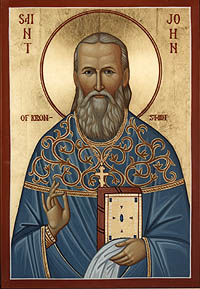
Troparion of St John of Kronstadt Tone 4
With the Apostles thy message has gone out to the ends of the world,/ and with the Confessors thou didst suffer for Christ;/ thou art like the Hierarchs through thy preaching of the Word;/ with the Righteous thou art radiant with God's grace./ The Lord has exalted thy humility above the heavens/ and given us thy name as a source of miracles./ O wonderworker living in Christ forever,/ have mercy on those in trouble/ and hear us when we call to thee with faith, O our beloved shepherd John.
Another Troparion of St John of Kronstadt (composed by Archbishop Maximovich of San Francisco) Tone 4
O Wonderworker living in Christ forever,/ with love have mercy on those in danger;/ hear thy children who call upon thee with faith;/ be compassionate to those who hope for aid from thee,/ O Father John of Kronstadt, our beloved shepherd.
Kontakion of St John of Kronstadt Tone 4
Thou wast chosen by God in infancy/ and in childhood received the gift of learning./ Thou wast called to the priesthood in a vision during sleep/ and didst become a wonderful shepherd of Christ's Church./ Pray to Christ our God/ that we may all be with thee in the Kingdom of heaven,/ O Father John, namesake of grace.
A life of St. John of Kronstadt, with an essay by Protopresbyter Michael Pomazansky on St. John's worldview
October 18, 2005
The Holy Apostle and Evangelist, Luke the Physician
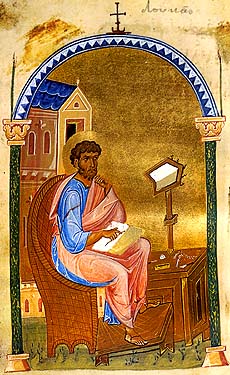
Troparion of St Luke Tone 3
Holy Apostle and Evangelist Luke,/ intercede with our merciful God,/ that He may grant to our souls/ the forgiveness of our sins.
Kontakion of St Luke Tone 2
Let us praise holy Luke, the star of the Church,/ herald of piety and proclaimer of mysteries;/ for the Word Who alone knows the secrets of hearts/ has chosen him with Paul/ as a teacher of the nations.
Orthodox Church in America website:
The Holy Apostle and Evangelist Luke, was a native of Syrian Antioch, a companion of the holy Apostle Paul (Phil 1:24, 2 Tim 4:10-11), and a physician enlightened in the Greek medical arts. Hearing about Christ, Luke arrived in Palestine and fervently accepted the preaching of salvation from the Lord Himself. Included among the Seventy Apostles, St. Luke was sent by the Lord with the others to preach the Kingdom of Heaven during the earthly life of the Savior (Lk 10:1-3). After the Resurrection, the Lord Jesus Christ appeared to Sts. Luke and Cleopas on the road to Emmaus.
The Apostle Luke took part in the second missionary journey of the Apostle Paul, and from that time they were inseparable. At a point when all his coworkers had left the Apostle Paul, the Apostle Luke stayed on with him to tackle all the work of pious deeds (2 Tim 4:10-11). After the martyric death of the First-Ranked Apostles Peter and Paul, St. Luke left Rome to preach in Achaia, Libya, Egypt and the Thebaid. In the city of Thebes, he finished his life in martyrdom.
Tradition ascribes the painting of the first icons of the Mother of God to St. Luke. "Let the grace of Him Who was born of Me and My mercy be with these Icons," said the All-Pure Virgin in beholding the icons. St. Luke also painted icons of the First-Ranked Apostles Peter and Paul. The Gospel of St. Luke was written in the years 62-63 at Rome, under the guidance of the Apostle Paul. St. Luke in the preliminary verses (1:3) spells out exactly the aim of his work: he recorded in greater detail the chronological course of events in the framework of everything known by Christians about Jesus Christ and His teachings, and by doing so he provided a firmer historical basis of Christian hope (1:4). He carefully investigated the facts, and made generous use of the oral tradition of the Church and of what the All-Pure Virgin Mary Herself had told him (2:19, 51).
In the theological content of the Gospel of Luke the teaching about the universal salvation made possible by the Lord Jesus Christ stands out first of all, and the universal significance of the preaching of the Gospel.
The Holy Apostle also wrote in the years 62-63 at Rome, the Acts of the Holy Apostles. The Acts, which is a continuation of the four Gospels, speaks about the works and the fruits of the holy Apostles after the Ascension of the Savior. At the center of the narrative is the Council of the holy Apostles at Jerusalem in the year 51, a Church event of great critical significance, which resulted in the distancing of Christianity from Judaism and its independent dispersion into the world (Acts 15:6-29). The theological objective of the Book of Acts is that of the Dispensation of the Holy Spirit, actualized in the Church founded by the Lord Jesus Christ, from the time of the Ascension and Pentecost to the Second Coming of Christ.
October 17, 2005
Kansans: We Mock Your Semiautomatic Handgun and Your Dressing Up to Rob a Store
Although not necessarily known for their cantankerousness or rowdiness, Kansans are not to be messed with. Heck, we even require gun ownership in some parts. And it definitely means you can't dress up like an idiot and try to rob a store, or you will be mocked and ridiculed by old ladies like the dumb fool you are (all emphases added):
A man who tried to rob Wholesale Beauty Club at 4800 W. Maple on Saturday around 3 p.m. got laughed out of the store.He wore an "old man" Halloween mask, a black hoodie, black jeans and black gloves. He even had a semiautomatic handgun, according to the 19-year-old who reported the incident.
He demanded money but got laughed at by customers.
An elderly lady reportedly said, "Don't do this while I'm here."
The man got mad and walked out of the store as customers continued laughing.
His race could not be determined, and reports of his height varied from 5-foot-10 to 6-foot-5, according to the police report.
Either way, police said, "they thought he was a joke."
Of course, when you start by robbing a beauty supply store, you just know it's going to all go wrong from there.
Rush: On American Conservatism
At the risk of being forever tainted by the epithet "dittohead," I wanted to post Rush's piece from today's OpinionJournal on American conservatism.
I love being a conservative. We conservatives are proud of our philosophy. Unlike our liberal friends, who are constantly looking for new words to conceal their true beliefs and are in a perpetual state of reinvention, we conservatives are unapologetic about our ideals. We are confident in our principles and energetic about openly advancing them. We believe in individual liberty, limited government, capitalism, the rule of law, faith, a color-blind society and national security. We support school choice, enterprise zones, tax cuts, welfare reform, faith-based initiatives, political speech, homeowner rights and the war on terrorism. And at our core we embrace and celebrate the most magnificent governing document ever ratified by any nation--the U.S. Constitution. Along with the Declaration of Independence, which recognizes our God-given natural right to be free, it is the foundation on which our government is built and has enabled us to flourish as a people.
We conservatives are never stronger than when we are advancing our principles. And that's the nature of our current debate over the nomination of Harriet Miers. Will she respect the Constitution? Will she be an originalist who will accept the limited role of the judiciary to interpret and uphold it, and leave the elected branches--we, the people--to set public policy? Given the extraordinary power the Supreme Court has seized from the representative parts of our government, this is no small matter. Roe v. Wade is a primary example of judicial activism. Regardless of one's position on abortion, seven unelected and unaccountable justices simply did not have the constitutional authority to impose their pro-abortion views on the nation. The Constitution empowers the people, through their elected representatives in Congress or the state legislatures, to make this decision.Abortion is only one of countless areas in which a mere nine lawyers in robes have imposed their personal policy preferences on the rest of us. The court has conferred due process rights on terrorists detained at Guantanamo Bay and benefits on illegal immigrants. It has ruled that animated cyberspace child pornography is protected speech, but certain broadcast ads aired before elections are illegal; it has held that the Ten Commandments can't be displayed in a public building, but they can be displayed outside a public building; and the court has invented rationales to skirt the Constitution, such as using foreign law to strike down juvenile death penalty statutes in over a dozen states.
For decades conservatives have considered judicial abuse a direct threat to our Constitution and our form of government. The framers didn't create a judicial oligarchy. They created a representative republic. Our opposition to judicial activism runs deep. We've witnessed too many occasions where Republican presidents have nominated the wrong candidates to the court, and we want more assurances this time--some proof. The left, on the other hand, sees the courts as the only way to advance their big-government agenda. They can't win national elections if they're open about their agenda. So, they seek to impose their policies by judicial fiat. It's time to call them on it. And that's what many of us had hoped and expected when the president made his nomination.
Some liberal commentators mistakenly view the passionate debate among conservatives over the Miers nomination as a "crackup" on the right. They are giddy about "splits" in the conservative base of the GOP. They are predicting doom for the rest of the president's term and gloom for Republican electoral chances in 2006. As usual, liberals don't understand conservatives and never will.
The Miers nomination shows the strength of the conservative movement. This is no "crackup." It's a crackdown. We conservatives are unified in our objectives. And we are organized to advance them. The purpose of the Miers debate is to ensure that we are doing the very best we can to move the nation in the right direction. And when all is said and done, we will be even stronger and more focused on our agenda and defeating those who obstruct it, just in time for 2006 and 2008. Lest anyone forget, for several years before the 1980 election, we had knockdown battles within the GOP. The result: Ronald Reagan won two massive landslides.
The real crackup has already occurred--on the left! The Democratic Party has been hijacked by 1960s retreads like Howard Dean; billionaire eccentrics like George Soros; and leftwing computer geeks like Moveon.org. It nominated John Kerry, a notorious Vietnam-era antiwar activist, as its presidential standard-bearer. Its major spokesmen are old extremists like Ted Kennedy and new propagandists like Michael Moore. Its great presidential hope is one of the most divisive figures in U.S. politics, Hillary Clinton. And its favorite son is an impeached, disbarred, held-in-contempt ex-president, Bill Clinton.
The Democratic Party today is split over the war and a host of cultural issues, such as same-sex marriage and partial birth abortion. It wants to raise taxes, but dares not say so. It can't decide what message to convey to the American people or how to convey it. And even its once- reliable allies in the big media aren't as influential in promoting the party and its agenda as they were in the past. The new media--talk radio, the Internet and cable TV--not only have a growing following, but have helped expose the bias and falsehoods of the big-media, e.g., Dan Rather, CBS News and the forged National Guard documents. Hence, circulation and audience is down, and dropping.
The American left is stuck trying to repeat the history of its presumed glory years. They hope people will see Iraq as Vietnam, the entirety of the Bush administration as Watergate and Hurricane Katrina as the Great Depression. Beyond looking to the past for their salvation, the problem is that they continue to deceive even themselves. None of their comparisons are true. Meanwhile, we conservatives will continue to focus on making history.
October 14, 2005
Reading the Bible Like a Catholic (and as an Orthodox)
Al Kimmel, recently received into the Catholic Church from ECUSA, has written a post, "Finding Eucharist in the Bible" in which he takes to task a Protestant blogger who rejects the Church's teaching on the Eucharist because "it's not in the Bible." Says the erstwhile "Fr. Al":
The problem, of course, is that Steve is reading the Scripture as a Protestant and not as a catholic. A catholic doesn’t come to the Bible with a blank slate, as if one can simply read the text and determine what the Church believes and teaches. A catholic reads the Bible within the context of the Holy Tradition and most especially within the eucharistic liturgy itself. Why does the catholic Christian connect the words of Jesus in John 6 to the bread and wine of the Eucharist? Because the Eucharist, itself instituted by Jesus, identifies the offered bread and wine with the Body and Blood of Christ. Hence the significance of the priestly recitation of the dominical words over the offered bread and wine. The catholic Christian, in other words, interprets the Scripture by the Eucharist and the Eucharist by the Scripture. As St Irenaeus wrote, “Our teaching is in accord with the Eucharist and the Eucharist, in its turn, confirms our teaching” (Adv. haer. 4.18.5).
Of course, most Protestants will roll their eyes at this "circularity." To which Al replies succinctly:
At this point, of course, the Protestant will accuse the catholic of violating sola Scriptura. Yep.
Love it. Al continues:
I am struck by Steve’s easy dismissal of the beliefs of “hundreds of million” of Catholic and Orthodox Christians. The catholic conviction of the real presence (or real identification, as I prefer) has been consistently confessed and believed by catholic Christians for two thousand years. Yet here is the Protestant accusing the Church catholic of tinkering, tweaking, retrofitting, and gerrymandering the Scriptures. On what basis does he decide that his interpretation of Scripture is superior to the interpretation of the Church? By his private judgment. This, and this alone, is the ground of his conviction. He can’t even invoke Martin Luther, the father of Protestantism, to support him.In disputes like this, it is appropriate to invoke the solemn authority of Pontificator’s First Law: “When Orthodoxy and Catholicism agree, Protestantism loses.” Perhaps Pontificator needs to formulate a new law: “When an interpretation of Scripture violates Pontificator’s First Law, it just can’t be right.”
Amen.
The Rule of Scriptural Interpretation: Antiquity, Ubiquity, Consensus
In my interaction with other bloggers, I find myself coming again and again to the Protestant dogma of sola scriptura. As can be seen on this blog, this is something about which I've thought often and wrote about almost as often.
But one problem of sola scriptura that I touched on in a previous post has to do with the lack of consensus that sola scriptura can generate. Given both that Scripture is always interpreted and that sola scriptura cannot generate a single (set of) interpretive practice(s), it is left to each successive generation of sola scriptura advocates to reinterpret the Scriptural texts anew. But here an inescapable dilemma arises: If they appeal to the Tradition to authorize their interpretation, then they privilege the Tradition over Scripture, but all forms of sola scriptura necessarily assert the primacy of Scripture over the Tradition--for even where Tradition agrees with Scripture, it is Scripture which authorizes the Tradition. But if they appeal to their own idiosyncratic interpretations, they privilege the authority of their interpretation over both the Scripture and the Tradition.
So what is the ancient Christian standard for biblical interpretation? St. Vincent of Lerins tells us:
[4.] I Have often then inquired earnestly and attentively of very many men eminent for sanctity and learning, how and by what sure and so to speak universal rule I may be able to distinguish the truth of Catholic faith from the falsehood of heretical pravity; and I have always, and in almost every instance, received an answer to this effect: That whether I or any one else should wish to detect the frauds and avoid the snares of heretics as they rise, and to continue sound and complete in the Catholic faith, we must, the Lord helping, fortify our own belief in two ways; first, by the authority of the Divine Law, and then, by the Tradition of the Catholic Church.[5.] But here some one perhaps will ask, Since the canon of Scripture is complete, and sufficient of itself for everything, and more than sufficient, what need is there to join with it the authority of the Church's interpretation? For this reason,-because, owing to the depth of Holy Scripture, all do not accept it in one and the same sense, but one understands its words in one way, another in another; so that it seems to be capable of as many interpretations as there are interpreters. For Novatian expounds it one way, Sabellius another, Donatus another, Arius, Eunomius, Macedonius, another, Photinus, Apollinaris, Priscillian, another, Iovinian, Pelagius, Celestius, another, lastly, Nestorius another. Therefore, it is very necessary, on account of so great intricacies of such various error, that the rule for the right understanding of the prophets and apostles should be framed in accordance with the standard of Ecclesiastical and Catholic interpretation.
[6.] Moreover, in the Catholic Church itself, all possible care must be taken, that we hold that faith which has been believed everywhere, always, by all. For that is truly and in the strictest sense "Catholic," which, as the name itself and the reason of the thing declare, comprehends all universally. This rule we shall observe if we follow universality, antiquity, consent. We shall follow universality if we confess that one faith to be true, which the whole Church throughout the world confesses; antiquity, if we in no wise depart from those interpretations which it is manifest were notoriously held by our holy ancestors and fathers; consent, in like manner, if in antiquity itself we adhere to the consentient definitions and determinations of all, or at the least of almost all priests and doctors. (St. Vincent of Lerins, The Commonitory, Ch. II)
But since sola scriptura advocates will not be impressed by a standard explicated by a fifth century Christian, let's examine the consonance of this tradition with the Scriptures themselves.
Our paradigm for this is clearly Acts 15. They were, indeed, guided by the Holy Spirit to consensus. In fact, if you look at the hallmarks of how to discern the proper faith it is clear: antiquity, or the original teaching and experience of the apostolic Church (vv. 7ff), which was also confirmed by the Scriptures; ubiquity, or the prevalance of the teaching or practice everywhere (vv. 7-9 and 12), which was the original practice not just of Peter and the Jerusalem Church, but of Sts. Paul and Barnabas and the Gentile Church; and consensus, that which is believed by all (vv. 25, 28). Note especially that even in the midst of much dispute (v. 7), Sts. Peter, James, Paul and Barnabas, and all of the apostolic leadership, reached agreement, and this went out for the belief and practice of all the Churches.
So, how can we tell the true apostolic teaching? That it has been believed always (antiquity), everywhere (ubiquity), and by all (consensus). These three things demonstrate a teaching or practice to be apostolic and therefore authoritative and infallible.
I have seen--and myself personally known--the anxiety of "getting it right" with regard to Christian faith. Thankfully, I no longer have to run on that endless treadmill.
October 13, 2005
Gnostic Ecclesiology?
George Barna has a new book out, Revolutionary, and gives an interview: A Faith Revolution Is Redefining “Church,” According to New Study. In it he describes new developments in individual Christian spirituality and personal relationship to a local church. There are very, very disturbing trends, to be sure. But there is at least one incredibly significant positive.
“These are people who are less interested in attending church than in being the church,” [George Barna] explained. “We found that there is a significant distinction in the minds of many people between the local church – with a small ‘c’ – and the universal Church – with a capital ‘C’. Revolutionaries tend to be more focused on being the Church, capital C, whether they participate in a congregational church or not.”
It's no secret that an external emphasis on doing certain practices and faithful attendance is endemic among all Christian groups, east and west. There's no need for Orthodox to bash on Protestants and Catholics for a "juridical" mindset that focuses on external compliance. Orthodox can fall as easily into that trap as anyone else. After all Galatians and Ephesians were written to Orthodox Christians. (You get the point.) And insofar as these so-called "revolutionaries" are moving toward an emphasis on the internal aspects of the faith, this is a good thing. The fact that they are looking beyond denominational borders and looking for more catholicity is a good thing.
But these goods are not unmixed. The internal can become a quest for ever-greater emotional highs and "spiritual feelings." And this exodus from the local church for an amorphous "catholicity" not only misunderstands biblical and apostolic catholicity, but betrays a Gnostic conception of the Church.
“A common misconception about revolutionaries,” he continued, “is that they are disengaging from God when they leave a local church. We found that while some people leave the local church and fall away from God altogether, there is a much larger segment of Americans who are currently leaving churches precisely because they want more of God in their life but cannot get what they need from a local church. They have decided to get serious about their faith by piecing together a more robust faith experience. Instead of going to church, they have chosen to be the Church, in a way that harkens back to the Church detailed in the Book of Acts.”
Unfortunately, one cannot be the Church apart from the local body. That is the fatal misunderstanding to this new quest. This disembodied, need-meeting "church" is hardly the Church detailed in the book of Acts.
Using survey data and other cultural indicators he has been measuring for more than two decades, Barna estimates that the local church is presently the primary form of faith experience and expression for about two-thirds of the nation’s adults. He projects that by 2025 the local church will lose roughly half of its current “market share” and that alternative forms of faith experience and expression will pick up the slack. Importantly, Barna’s studies do not suggest that most people will drop out of a local church to simply ignore spirituality or be freed up from the demands of church life. Although there will be millions of people who abandon the entire faith community for the usual reasons – hurtful experiences in churches, lack of interest in spiritual matters, prioritizing other dimensions of their life – a growing percentage of church dropouts will be those who leave a local church in order to intentionally increase their focus on faith and to relate to God through different means.That growth is fueling alternative forms of organized spirituality, as well as individualized faith experience and expression. Examples of these new approaches include involvement in a house church, participation in marketplace ministries, use of the Internet to satisfy various faith-related needs or interests, and the development of unique and intense connections with other people who are deeply committed to their pursuit of God.
Most of which is disincarnate ecclesiology, or the Gnostic version of Church, a church without a body, that's focused on me and my needs and what I want to be doing.
[Barna] suggested that most Revolutionaries go through predictable phases in their spiritual journey in which they initially become dissatisfied with their local church experience, then attempt to change things so their faith walk can be more fruitful. The result is that they undergo heightened frustration over the inability to introduce positive change, which leads them to drop out of the local church altogether, often in anger. But because this entire adventure was instigated by their love for God and their desire to honor Him more fully, they finally transcend their frustration and anger by creating a series of connections that allow them to stay close to God and other believers without involvement in a local church.
Schisms have always been generated by the schismatic's "love for God and other believers"--but it is a love that is not fueled by the Spirit but by agendas and self-interest. The Donatists loved God and his Church so much they were willing to split it in half. Be wary of those so passionate for God and others that they abandon the place where God and others congregate.
“It would be wrong to assume that all Revolutionaries have completely turned their back on the local church,” [Barna] stated. “Millions of Revolutionaries are active in a local church, although most of them supplement that relationship with participation in a variety of faith-related efforts that have nothing to do with their local church. The defining attribute of a Revolutionary is not whether they attend church, but whether they place God first in their lives and are willing to do whatever it takes to facilitate a deeper and growing relationship with Him and other believers. Our studies persuasively indicate that the vast majority of American churches are populated by people who are lukewarm spiritually. Emerging from those churches are people dedicated to becoming Christ-like through the guidance of a congregational form of the church, but who will leave that faith center if it does not further such a commitment to God. They then find or create alternatives that allow that commitment to flourish.”
The "revolutionaries'" demand: Make me Christ like or I'm leaving. Where is the stability? Where is the patience to work and to toil at the life of faith?
How do most Revolutionaries justify calling themselves devoted disciples of Christ while distancing themselves from a local church? “Many of them realize that someday they will stand before a holy God who will examine their devotion to Him. They could take the safe and easy route of staying in a local church and doing the expected programs and practices, but they also recognize that they will not be able to use a lackluster church experience as an excuse for a mediocre or unfulfilled spiritual life. Their spiritual depth is not the responsibility of a local church; it is their own responsibility. As a result, they decide to either get into a local church that enhances their zeal for God or else they create alternatives that ignite such a life of obedience and service. In essence, these are people who have stopped going to church so they can be the Church.”
These folks will have to learn that we will not be judged on the quality of our spiritual life, whether we are mediocre or have been unfulfilled. We will be called to answer whether or not we've built one another up in love. One doesn't build up his fellow believers by abandonig them on the selfish quixotic quest of self-actualization.
Of course, I could add the Orthodox dig that they should leave their Protestant churches to find the fullness of the faith in the Orthodox Church. But if they don't learn patience and stability in their own congregations, they are not likely to become Orthodox for any of the right reasons.
October 12, 2005
The Fatherhood Chronicles LXXXV
What a morning. I woke--wide-eyed, mind-racing awake, mind you--at three a.m. My normal start is five a.m., but I needed to get up at four today to do some school work. So after laying awake for a bit, I realized it wasn't going to do me any good to try to roll over and sleep for only another forty-five minutes, so I shrugged (mentally) and got up anyway. Yep, I'm suffering for it now. Just like I did on the over-hot bus this morning--I almost missed my stop from dozing!
But what a glorious, wonderful morning. It used to be great having daddy-daughter times in the mornings with Sofie. But on days like today, I get the double-dose. Glory.
It started with Delaina waking up about four. She was wide-awake, but wanted to be held. So I held her, said morning prayers, and she fell asleep in my arms. I wasn't as attentive in my prayers as I try to be, but I think this once God understood and accepted my "inattention" as another form of prayer. So, I took Delaina back to bed, and then did some more work.
Then Sofie got up. She is a "get up and cuddle till I wake up" sort of girl, which I have to confess, Daddy enjoys. So she shuffled out of her bedroom about a quarter of six, hair scattered like Thing 2 (she calls the Dr. Seuss stuffed toy "Monkey") which she held in one hand. She was all toasty warm from bed and in her fleece jammies. She lay her head on my shoulder with a "Lubby Daddy" and I melted, as I always do.
Yep. Who needs coffee when you've got daughters!
Archpriest George Florovsky on St. Gregory Palamas and the Essence-Energies Distinction in God
From Fr. George Florovsky, St Gregory Palamas and the Tradition of the Fathers (also here):
Actually the whole teaching of St. Gregory presupposes the action of the Personal God. God moves toward man and embraces him by His own "grace" and action, without leaving that φος απροσιτον [light unapproachable], in which He eternally abides. The ultimate purpose of St. Gregory's theological teaching was to defend the reality of Christian experience. Salvation is more than forgiveness. It is a genuine renewal of man. And this renewal is effected not by the discharge, or release, of certain natural energies implied in man's own creaturely being, but by the "energies" of God Himself, who thereby encounters and encompasses man, and admits him into communion with Himself. In fact, the teaching of St. Gregory affects the whole system of theology, the whole body of Christian doctrine. It starts with the clear distinction between "nature" and "will" of God. This distinction was also characteristic of the Eastern tradition, at least since St. Athanasius. It may be asked at this point: Is this distinction compatible with the "simplicity" of God? Should we not rather regard all these distinctions as merely logical conjectures, necessary for us, but ultimately without any ontological significance? As a matter of fact, St. Gregory Palamas was attacked by his opponents precisely from that point of view. God's Being is simple, and in Him even all attributes coincide. Already St. Augustine diverged at this point from the Eastern tradition. Under Augustinian presuppositions the teaching of St. Gregory is unacceptable and absurd. St. Gregory himself anticipated the width of implications of his basic distinction. If one does not accept it, he argued, then it would be impossible to discern clearly between the "generation" of the Son and "creation" of the world, both being the acts of essence, and this would lead to utter confusion in the Trinitarian doctrine. St. Gregory was quite formal at that point.If according to the delirious opponents and those who agree with them, the Divine energy in no way differs from the Divine essence, then the act of creating, which belongs to the will, will in no way differ from generation (γενναν) and procession (εκπορευειν), which belong to the essence. If to create is no different from generation and procession, then the creatures will in no way differ from the Begotten (γεννηματος) and the Projected (προβληματος). If such is the case according to them, then both the Son of God and the Holy Spirit will be no different from creatures, and the creatures will all be both the begotten (γεννηματα) and the projected (προβληματα) of God the Father, and creation will be deified and God will be arrayed with the creatures. For this reason the venerable Cyril, showing the difference between God's essence and energy, says that to generate belongs to the Divine nature, whereas to create belongs to His Divine energy. This he shows clearly saying, "nature and energy are not the same." If the Divine essence in no way differs from the Divine energy, then to beget (γενναν) and to project (εκπορευειν) will in no way differ from creating (ποιειν). God the Father creates by the Son and in the Holy Spirit. Thus He also begets and projects by the Son and in the Holy Spirit, according to the opinion of the opponents and those who agree with them. (Capita 96 and 97.)St. Gregory quotes St. Cyril of Alexandria. But St. Cyril at this point was simply repeating St. Athanasius. St. Athanasius, in his refutation of Arianism, formally stressed the ultimate difference between ουσια [ousia, essence] or φυσις [physis, substance], on the one hand, and the βουλησις [boulesis, will], on the other. God exists, and then He also acts. There is a certain "necessity" in the Divine Being, indeed not a necessity of compulsion, and no fatum, but a necessity of being itself. God simply is what He is. But God's will is eminently free. He in no sense is necessitated to do what He does. Thus γεννησις [gennesis, generation] is always κατά φυσιν [kata physin, according to essence], but creation is a βουλησεος εργον [bouleseos ergon, energy of the will] (Contra Arianos III. 64-6). These two dimensions, that of being and that of acting, are different, and must be clearly distinguished. Of course, this distinction in no way compromises the "Divine simplicity." Yet, it is a real distinction, and not just a logical device. St. Gregory was fully aware of the crucial importance of this distinction. At this point he was a true successor of the great Athanasius and of the Cappadocian hierarchs.
October 11, 2005
Discernment About Blogging Needed
A trusted Orthodox brother has kept me attentive to whether or not this blog is a good thing for me. Another brother has shared some of his reasoning as to why he stopped blogging. Both of these men, even as they offer encouragement and positive response relative to specific posts, are keeping me attentive to the question of the future life of this blog.
If the first brother had not offered his incisive questioning, I doubt whether it would have occurred to me to seriously consider exiting the blogosphere. If the second brother had not shared what he did regarding his reasons for his blogging absence, I doubt whether it would have occurred to me to seriously consider whether some of my thoughts regarding the utility of this blog might not be the seedbed of pretension and self-deception.
Clearly, this is a matter about which I need to consider several important things. Discernment is needed. Anyone got an extra bottle of it lying around?
The PhD and the Point of Philosophy
Mary Midgley's Proud not to be a doctor (hat tip to Jason), is a good reminder of what the heck I'm doing at Loyola anyway.
I am not saying that the PhD training isn't useful. It provides the indispensable skills of the lawyer. It shows you how to deal with difficult arguments, which is necessary in dealing with hard subjects. But that close work doesn't help you to grasp the big questions that provide its context - the background issues out of which the small problems arose. I think there ought to be a corrective course after the PhD - a course in bypassing details to look at the whole landscape. It's hard to do this on your own. Today's academic system, which forces people to write articles without having time to think properly about them, makes this harder. . . .Institutions which have to examine people train their students in fighting mock battles, and that emphasis on competition has increased out of all measure. No doubt it produces good lawyers. But the philosophers of the past were not just lawyers. They were volcanic phenomena, eccentric thinkers who located new problems and grappled with the issues of their age. Many worked outside universities. Indeed, a number - Hobbes, Berkeley, Mill, Nietzsche - growled explosively about the bad influence that universities have on thought. Today, as more people are being channelled into higher education, is it perhaps time that we looked into this?
October 10, 2005
The Fatherhood Chronicles LXXXIV
Changes and Sameness
With the onset of the autumnal weather, out came the fall decorations (including some Halloween items like the string of pumpkin lights currently adorning the railing of our front porch). Also with this seasonal change in schematic decor came a little bit of my wife's OCD with regard to "minimalizing" in our home. Unfortunately, such an impulse was frustrated by two large factors: we're a books home and the books ain't going anywhere anytime soon; and we're a toys home, and not even Anna can bring herself to part with some of the girls' toys. But she did manage to rearrange some of the furniture and to get rid of two end tables. That means, for me, that "my chair" (in which I do much of my reading, grading papers, and falling asleep) has moved across the room from the northwest corner to the northeast corner and the wall whereon are our icons and the faux mantle on which sits other icons, the vigil lamp, prayer ropes and other devotional detritus.
It certainly feels different to sit there with the icons quite literally looming down on you. Brings you to attention in a way you might not otherwise be brought. But such attentiveness is a good thing. Oh, and my view of the television is now blocked--and that is another good thing for those times when one of us has a desire for entertainment or football and the other has a desire for (always relative) "silence."
But in the midst of this difference was a bit of the sameness. This morning, after praying morning prayers and reading the Scriptures and the Rule, I was doing some reading on the Fathers, and Anna brought Delaina out to me. I sat there holding her for probably half an hour before I looked at the clock and realized I needed to start getting ready for the day. There in the morning silence, with the lamp down low and the vigil lamp burning, I smiled at her and she smiled back. It reminded me of the same sorts of mornings with Sofie when she was only three months old. I signed the cross on her and thanked God for his goodness to me.
And after many months, Sofie has decided that I can again be the sole parent responsible for putting her to bed. For the past three months, with the upheaval surrounding Delaina's birth, hosting family, and travel, Sofie's bedtime routine has been much more irregular than regular, though we fight to maintain the bedtime liturgy. We read stories just like we used to (though now we often do two books instead of just one, and they revolve around Click, Clack, Moo: Cows that Type, We're Going on a Bear Hunt, Kitten's First Full Moon, or Knuffle Bunny, in that order of preference). We pray just like we used to. And Sofie, most of the time, kisses the icons just like we used to. But now we play classical music instead of Daddy singing Church hymns. And now I sit by her bedside for a few minutes while Bach plays, instead of rocking her and putting her in her crib.
Except for last night. Last night Sofie wanted to be rocked. It had been so long, I'd forgotten how big she'd gotten. She no longer fits comfortably cradled in my arms across my lap. She's getting too tall. But we rocked while the music played and she eventually just melted into sleep. I put her to bed, in her "big girl bed" (a toddler bed we've borrowed from a family at church), signed the cross over her and walked quietly out of the room.
Just like we used to do.
Open Theism and the Essence-Energy Distinction
Clark Pinnock's 1994 book, The Openness of God (which I read back in seminary shortly after it came out), is considered by many the first shot fired in the open theism debates which have rocked much of the evangelical world.
Open theism (also, open view theism, openness theology, and other similar variations) subscribes to the following tenets:
According to openness theology, the triune God of love has, in almighty power, created all that is and is sovereign over all. In freedom God decided to create beings capable of experiencing his love. In creating us the divine intention was that we would come to experience the triune love and respond to it with love of our own and freely come to collaborate with God towards the achievement of his goals. We believe love is the primary characteristic of God because the triune Godhead has eternally loved even prior to any creation. Divine holiness and justice are aspects of the divine love towards creatures, expressions of God's loving concern for us. Love takes many forms-it can even be experienced as wrath when the lover sees the beloved destroying herself and others.Second, God has, in sovereign freedom, decided to make some of his actions contingent upon our requests and actions. God elicits our free collaboration in his plans. Hence, God can be influenced by what we do and God truly responds to what we do. God genuinely interacts and enters into dynamic give-and-take relationships with us. That God changes in some respects implies that God is temporal, working with us in time. God, at least since creation, experiences duration.[1] God is everlasting through time rather than timelessly eternal.
Third, the only wise God has chosen to exercise general rather than meticulous providence, allowing space for us to operate and for God to be creative and resourceful in working with us. It was solely God's decision not to control every detail that happens in our lives. Moreover, God has flexible strategies. Though the divine nature does not change, God reacts to contingencies, even adjusting his plans, if necessary, to take into account the decisions of his free creatures. God is endlessly resourceful and wise in working towards the fulfillment of his ultimate goals. Sometimes God alone decides how to accomplish these goals. Usually, however, God elicits human cooperation such that it is both God and humanity who decide what the future shall be. God's plan is not a detailed script or blueprint, but a broad intention that allows for a variety of options regarding precisely how these goals may be reached. What God and people do in history matters. If the Hebrew midwives had feared Pharaoh rather than God and killed the baby boys, then God would have responded accordingly and a different story would have emerged. What people do and whether they come to trust God makes a difference concerning what God does-God does not fake the story of human history.
Fourth, God has granted us the type of freedom (libertarian) necessary for a truly personal relationship of love to develop. Again, this was God's decision, not ours. Despite the fact that we have abused our freedom by turning away from the divine love, God remains faithful to his intentions for creation and this faithful love was manifested most fully in the life and work of Jesus.
Finally, the omniscient God knows all that can be known given the sort of world he created. The content of divine omniscience has been debated in the Christian tradition; between Thomism and Molinism for example. In the openness debate the focus is on the nature of the future: is it fully knowable, fully unknowable or partially knowable and partially unknowable? We believe that God could have known every event of the future had God decided to create a fully determined universe. However, in our view God decided to create beings with indeterministic freedom which implies that God chose to create a universe in which the future is not entirely knowable, even for God. For many open theists the "future" is not a present reality-it does not exist-and God knows reality as it is.
This view may be called dynamic omniscience (it corresponds to the dynamic theory of time rather than the stasis theory). According to this view God knows the past and present with exhaustive definite knowledge and knows the future as partly definite (closed) and partly indefinite (open). God's knowledge of the future contains knowledge of that which is determinate or settled as well as knowledge of possibilities (that which is indeterminate). The determined future includes the things that God has unilaterally decided to do and physically determined events (such as an asteroid hitting our moon). Hence, the future is partly open or indefinite and partly closed or definite and God knows it as such. God is not caught off-guard-he has foresight and anticipates what we will do.
Our rejection of divine timelessness and our affirmation of dynamic omniscience are the most controversial elements in our proposal and the view of foreknowledge receives the most attention. However, the watershed issue in the debate is not whether God has exhaustive definite foreknowledge (EDF) but whether God is ever affected by and responds to what we do. This is the same watershed that divides Calvinism from Arminianism.
[1] It is not essential for open theists to take a stand on whether or not God was temporal prior to creation. Even if God was eternally temporal God did not experience metric (measured) time until the creation. See Nicholas Wolterstorff's discussion in God and Time: Four Views, ed. Gregory Ganssle (Downers Grove, ILL: InterVarsity Press, 2001), p. 233.
- Dr. John Sanders
Open theists primarily, it seems to me, are trying to reconcile two things, God's omniscient foreknowledge with human libertarian freedom. Unfortunately, they are doing so within a theological paradigm that is inimical to their efforts, for it creates further problems over those they are apparently solving.
The problematic definitional paradigm is what is called definitional divine simplicity. This understanding of God posits that since God is simple he cannot have parts, he cannot be divided. Thus any qualities or characteristics that God has must be indentical to his essence or nature. That is to say, God doesn't just have love, he is love. And if this is true--that all God's qualities are identical to his nature or essence--then all his qualities are themselves identical to one another: God's love is his foreknowledge is his omnipotence, etc. Thus, what God knows God must, in omnipotential essence, bring about. If God foreknows those who will be saved and be damned, then those who will be saved and will be damned must be saved or damned without failure--else God is not omnipotent. But if the saved and damned must be saved and damned, they are so apart from anything contingent to God's nature, for this would mean that something external to God was more powerful than God and could frustrate his omnipotence. Critics of open theism, then, rightly (at least within their own paradigm) point out that open theism must necessarily deny to God either his omniscience or his omnipotence if they, open theists, are, indeed, going to maintain libertarian free will.
And, in fact, that is something like what open theists do. That is to say, they do not actually deny God's omniscience, but rather redefine it in such a way so that God can only know that which it is possible to know. Since future human choices are undetermined and free, God cannot know them, since it is not possible to know them.
Now, as can be seen from above, open theists recognize that this opens up a rather smelly can of worms, so they are forced into admitting that some things God does infallibly foreknow since he has predestined them, but others he does not foreknow since he has left that to human libertarian freedom. His knowledge of the future is definite, but not exhaustive. And of course they also must clarify the relationship between God and time, since if God is timeless the future is not future to him, but all times are present to him. But this would mean that God does, indeed, know all that can be known of the (to us) future choices and acts of human beings, specifically what they are (though they are as yet unknown to us). But then if God does foreknow them he must predestine them and must omnipotently bring them about.
Now, let me admit that this is a very superficial synopsis of some of the questions to/criticisms of open theism and open theist responses. As will be seen in the links below and in the scholarly literature, there are significant and sophisticated philosophical and theological positions taken and defended. It is not my intent to engage them here.
But I do think that the primary problem in all this is the reliance upon definitional divine simplicity by all the participants in the debate. The resolution to this problem, for those concerned with human libertarian freedom, is not to redefine foreknowledge and omniscience per se, nor to reformulate God's relationship to time. Rather, the resolution is to abandon definitional divine simplicity.
There is another ancient view of God's simplicity which understands that simplicity not to be definitional but to be symbolic--that is to say, the verbal icon of a great mystery. God is, indeed, one and without parts. But that is not to say that God's nature and God's qualities are not really, though ineffably, distinguishable. We may take our clue from the historically orthodox understanding of the Trinity: God is both one nature or essence (ousia) and three Persons (hypostaseis); his plurality does not eliminate his unity, his unity does not prohibit his personality. Thus God is simple, but that simplicity is complex. God has "qualities," but is without division or parts, for each quality is both distinguishable from his nature and is fully his nature. Just as the Son is distinguishable from the Father and yet both Father and Son are fully God, so love is an eternal manifestation of God's essence in a divine "characteristic," a manifestation that is distinguishable from his essence, but in which God fully is as well. And given this distinguishability, God's love is not the same thing as his omnipotence, is not the same thing as his foreknowledge, is not the same thing as his omniscience, and yet all of them fully manifest the divine nature while being distinguishable from it and from one another.
The technical theological vocabularly is usually summed up in St. Gregory Palamas' energy-essence distinction, though St. Gregory of Nyssa utilized a nature-power vocabulary, and St. Maximos the Confessor utilized Logos-logoi. (It should be noted that these distinctions of terminology were related to the specific issues with which each of theses saints and Fathers were concerned. But it is ot be noted that the same consensus on the distinction between God's essence and his "qualities" goes back to the earliest testimonies of the Church and is traceable through the millennium represented by St. Gregory-St. Maximos-St. Gregory Palamas, and on through to the present among the Orthodox Churches.)
So, how does this work into the open theism debate? Open theists rightly intuit that there is a problem in the definitional understanding of God's divine simplicity. They are right to note that God's divine sovereignty is not antithetical to human libertarian freedom. But where open theists fail is to fall back on a redefinition of omniscience, foreknowledge and omnipotence. For those who hold the essence-energy distinction in God, we affirm that is is possible for God to will two (or more) eternal and unqualified goods at the same time (for example, his judgment and his mercy). That is to say, he can both know the (to us) future exhaustively and at the same time will human libertarian freedom.
How is this so? We need only look at Jesus in the Garden of Gethsemane, wherein he both wills his human nature's good of existence (if it be possible, let this cup pass from me) and his divine nature's good of cosmic salvation (nevertheless not my will but thine be done). That is to say, Jesus, in his mode of existence as both human and divine, perfectly united his human will with his divine will, thus actualizing two eternal goods: personal human existence which finds its end in God and cosmic salvation.
Thus, open theism's argument with definitional divine simplicity is on target. Unfortunately, the only resolution to definitional divine simplicity is simply to abandon it for the historically orthodox understanding of God as a unity of distinguishable energies in one essence.
[Note: Here are some other links to open theism. Some of the links on the pages and indices below are expired, but most remain.]
Pro
Open Theism Information Site
Omniscience and the Openness of God
Contra
Open theism
Pro et contra
Open Theism Index
October 09, 2005
October 08, 2005
The Problems of Biblical Reductionism III
3. The Problem of Time and Consensus
Even if, for the sake of charitable discussion, we can ignore the problem of the canon and the problem of hermeneutical authority, in the end, biblical reductionism, or the dogma of sola scriptura, fails to answer the question, By what criterion/-ia does one determine the truth among competing and contradictory interpretations, both presently and through history? That is to say, why does sola scriptura, if it is in fact necessary to Christian faith and practice, fail to achieve and maintain holy consensus over time?
Adherents of sola scriptura, by necessity, are forced to not only admit diversity of belief and opinion but to affirm it and celebrate it. They must do so because sola scriptura necessarily results in divergent, contradictory and mutable doctrines, doctrines which not only contradict contemporaneous beliefs but historical ones as well. I do not mean to give the impression that the Christian faith must be a monochromatic, rigid, verbatim recitation of formulaic confessions. But there is a difference between the diversity of orthodox expression exemplified by St. James' insistence on the necessity to faith of works, and St. Paul's rejection of works as the basis of salvation; or St. Gregory of Nyssa's expression of the plurality of the Godhead in terms of dynamis, and St. Gregory Palamas' expression of such plurality in terms of energeia--and the pseudo-diversity that contradicts, such as between those Christians who insist that the Eucharistic elements really do become the Body and Blood of Jesus, and those who do not; or those who insist on the sacramental essence of baptism and those who do not. One form of diversity is shaped by the consensus of the mind of Christ in the Church, the other is shaped by private interpretation elevated to co-authority with the Scriptures. Diversity is no excuse for contradiction, and contradiction is the pervasive milieu of sola scriptura.
As St. Paul writes in the Ephesian letter:
And He gave some to be apostles, and some prophets, and some evangelists, and some shepherds and teachers, for the perfecting of the saints, to the work of ministering, to the building up of the body of the Christ, until we all might come to the unity of the faith, and of the full knowledge of the Son of God, to a perfect man, to the measure of the stature of the fullness of the Christ, in order that we may no longer be infants, tossed to and fro by waves, and carried about with every wind of teaching, by the sleight of men, in craftiness toward the systematizing of error; but speaking the truth in love, we might grow up into Him in all things Who is the head--the Christ, from Whom all the body, joined and knit together by what every juncture supplieth, according to the energy of every single part in measure, maketh for itself the increase of the body, to the building up of itself in love.(Ephesians 4:11-14)
Clearly, then, the contradictions in doctrine and practice among those who adhere to the dogma of sola scriptura mean that sola scriptura cannot achieve the unity of faith, the consensus of the mind of Christ, that is one of the essential characteristics of the Church, as St. Paul here expressly notes. If this consensus does not exist, then the claims of those lacking that consensus to be the Church are suspect.
Some will argue that the picture here in Ephesians 4 is an eschatological one, pointing usually to 1 Corinthians 13:9-12; or, to say it a bit more accurately, the unity of faith St. Paul refers to in Ephesians 4 will not be fully realized until the appearing of Christ. Until then we see in a glass darkly.
But this merely illustrates the problem of time for the dogma of sola scriptura. We should remind ourselves of Jesus' words to his Apostles:
“But whenever that One, the Spirit of truth, should come, He will guide you into all the truth; for He shall not speak from Himself, but whatsoever He shall hear He shall speak; and He shall announce the coming things to you. That One shall glorify Me, for He shall receive of Mine and shall announce it to you.” (John 16:13-14)
Here Jesus promises his Apostles revelation of all the truth by the Holy Spirit. We can only assume that the promise to the Apostles was fulfilled. But if the promise was fulfilled, then unity of faith was a reality for the apostolic Church. The question we must ask then, in light of all the contradictions of belief and practice among present-day Christians, is, what happened to that unity of faith? If it no longer exists, then we must assume that the Church no longer exists. But if we cannot ascribe to the belief that the Church no longer exists, then we must also maintain that neither has the unity of faith been lost.
Sola scriptura fails to realize the unity of the faith that is an essential characteristic of the Church. It fails both in terms of consensus, and in terms of time. For either it must deny the consensus of the faith to which Scripture clearly testifies as a fulfilled reality for the Church, or it must deny that the unity of the faith of the Church can be maintained over time. So, either heresy and schism must be stronger than the faith of the Church, or time must be stronger.
And, in fact, this is precisely one presumption upon which sola scriptura rests: that the pure faith of the Church, and thus its consensual unity, was lost subsequent to the time of the Apostles. (Though it must be recognized that adherents of sola scriptura differ among themselves when and to what extent this Church lost the purity of her faith and thus consensus with the apostolic teaching.) But all this is just another way to say that the unity of the Faith was lost, and with it an essential characteristic of the Church. And in any case, the onus is upon sola scriptura adherents to demonstrate that their idiosyncratic doctrines are, in fact, the mind of the Church. They can only do so by either appealing to the Scriptures apart from or by privileging their idiosyncratic interpretations over any historic consensus of the Church, and thus force upon the Scriptural texts, and themselves, conformity to private interpretation. To the extent that sola scriptura adherents justify their own interpretations by appeal to the historic consensus of the Church, they simply give witness to the unity of the faith, the consensus of the mind of Christ, that has remained through time.
Conclusion
As I have argued from the beginning: The primary problem with sola scriptura is that it is not to be found anywhere within Scripture, nor, I might add here, within any testimony of the Church of the first millennium, prior to the Great Schism. It is thus a dogma that is extra-scriptural and extra-traditional and either refutes itself on its own terms, or begs the question of the authority of the one asserting the dogma as a norm for all Christians.
But even if we accept sola scriptura on its face for the sake of discussion, I have shown that there are three other problems fatal to the dogma of sola scriptura: the canon, hermeneutical authority, and consensus over time. Since sola scriptura cannot resolve these problems, it cannot provide an authoritative voice to the Church of the will of God. It is, then, simply a polemical tool in the hands of those who wield it to set aside the authority of the Church, which is to say, the presence of the Holy Spirit in the Church, who led the apostles into all the truth. It is also to deny the perseverance of the Church and her Faith through time. For these reasons, and its own internal contradictions, sola scriptura is not a Christian doctrine.
Note: The previous two installments are The Problems of Biblical Reductionism I and The Problems of Biblical Reductionism II
And the following are some other of my recent musings on Scripture and Tradition.
October 07, 2005
The Problems of Biblical Reductionism II
2. The Problem of Hermeneutics
Biblical reductionists, or adherents of sola scriptura, cannot answer, and for the most part do not even try to answer, an extremely important question: What hermeneutical method is the "biblical" one? That is to say, since the Bible is never uninterpreted, what is the right way to interpret it, and on what authority can this claim be made?
In the narrow view of sola scriptura, where every belief and practice must be founded on explicit or inferential biblical precedent, this is mostly a matter of inconsistency; these adherents do not practice fully what they preach. For surely, if there were ever an inescapably essential belief and practice that must be established on the basis of Scripture alone, it would be that of the proper way to interpret Scripture. In the broader view of sola scriptura, where beliefs and practices must not contradict Scripture but where there is otherwise latitude if they do not, this is far less of a practical problem, or one of inconsistency per se. But it remains a problem for all positions along the spectrum of sola scriptura in that it ultimately elevates not Scripture itself but the private interpreter or his group over the Tradition and over Scripture itself. That is to say, biblical authority rests, necessarily for sola scriptura adherents, on the interpretation an individual or group derives from the Scripture.
In the narrow view of sola scriptura all of Tradition is seen as antithetical to Scripture in that Tradition is understood as originating in man, while Scripture has divine origins. Thus, to adhere to Tradition, especially when such beliefs or practices are not clearly enunciated or directly inferred from Scripture is tantamount to elevating human opinion over divine revelation. But as I noted in the previous post, sola scriptura adherents, especially those who hold the narrow view, cannot escape that they are necessarily adhering to extra-scriptural Tradition (which in their view would be mere human opinion) in the acceptance of the canon of Scripture. In the broader view of sola scriptura Tradition is seen as necessarily subordinate to Scripture, or rather, to the interpreter's (or his group's) explanation of Scripture; for while many beliefs and practices which are not clearly enunciated in Scripture or directly inferred from it (such as the use and veneration of icons) may well be allowed and even encouraged, it is Scripture, or, rather, its interpretation, that sets the bound for Tradition, and not Tradition for the understanding of Scripture.
By on the one hand cutting off Scripture from Tradition and on the other hand subordinating Tradition to Scripture, the private interpreter or his interpretive group is elevated over Tradition, and, by corollary, even over Scripture. For in the final analysis, Scripture means what the interpreter or his group takes it to mean. For objective evidence of this assertion, one may simply note the plethora of distinctive and contradictory “study Bibles” each parsing Scripture through their own interpretive grid.
This is precisely why Scripture itself disallows private interpretation, as we read in 2 Peter 1:20:
Knowing this first, that every prophecy of Scripture cometh not out of private explanation, (2 Peter 1:20)
“Private” here is the Greek idios, which refers to one's own, what we might call “idiosyncratic,” individualistic. And “explanation” translates a New Testament hapax legomena, epilusis, which occurs only about three dozen times in the extant literature, mostly in various fragmentary texts, though two primary instances are in Aeschylus, Seven Against Thebes line 130 (where it indicates a release from fear), and here in 2 Peter (where it means an explanation).
Some object here noting that we cannot but help reading and working to understand the Scriptures for ourselves, and that this will necessitate “privately” interpreting the Scriptures. And in any case, this text isn't talking about reading the Scriptures per se but about proclaiming Christological prophecies. So this text isn't really about forbidding individuals interpreting the texts on their own, but forbidding private prophetic utterances regarding the Christ. But let's note the full context:
For we did not follow fables which have been cleverly devised, but we became eyewitnesses of that One's majesty and made known to you the power and coming of our Lord Jesus Christ. For having received from God the Father honor and glory, there was borne along by the magnificent glory such a voice to Him, “This is My Son, the Beloved, in Whom I am well pleased.” And we heard this voice which was borne along from out of the heaven, when we were with Him in the mount, the holy one. And we have the prophetic word made more sure, to which ye do well to take heed, as to a lamp shining in a squalid place, until the day should dawn and the morning star should rise in your hearts: Knowing this first, that every prophecy of Scripture cometh not out of private explanation, for prophecy not brought about at any time by the will of man, but holy men of God spoke while borne along by the Holy Spirit. (2 Peter 2:16-21)
Notice the plural “we” that is used throughout. Notice that the author (which I assume to be St. Peter) pointedly affirms that he (and the others with him, namely, James and John) were eyewitnesses of the Transfiguration. Note that he enjoins upon his readers the authority of his eyewitness account (“ye do well to take heed”), and that this eyewitness account was not some sort of idiosyncratic fantasy, or the assertion of personal authority, but the divine revelation of God prophesied and now fulfilled in the apostolic community.
In other words, this text is all about authority, specifically apostolic authority. And note that this authority is received and transmitted. No single individual can claim this authority but it must be manifested in the apostolic community. The principle of hermeneutics in the Church, the proper method of interpretation, is to have this mind that is in Christ, to have the unity of the faith and not to be carried about by every wind of doctrine. It is to submit ourselves and all our lives to Christ our God as he has revealed himself to his disciples, as far as they were able to bear it, and from whom we receive both the revelation and its meaning.
In other words, the Faith (here summarized in the Transfiguration) is received from approved men (the apostles) into the community formed, shaped and led by them. Individuals, no matter how charismatic or forceful, do not have the authority to provide their own idiosyncratic determinations of God's revelation.
To say it bluntly and clearly: there is no private interpretation in the Church, but all interpretation must be submitted to and through the apostolic community. Sola scriptura adherents, however, necessarily and inescapably violate this norm. They do so either by cutting off Scripture from Tradition, or they do so by subordinating Tradition to the Scripture, making Tradition coextensive with the interpreter's (or his group's) explanation of Scripture.
In other words, on the historic Church's view, there is one single thing, which we term Tradition, and Scripture is one manifestation of that single Tradition. There is no subordination of Scripture to Tradition or Tradition to Scripture, but both are expressions of the authority of the apostolic community, the instantiation of the divine life of the Spirit in the Church. Scripture means what the Church, the apostolic community, says it means, not because the Church is the official institution of the religion, nor because the Church wrote the Scriptures, but because the one divine mind of Christ permeates all, the Church, the Scriptures and the Tradition. It is all one single expression of the Truth that Christ is.
The dogma of sola scriptura necessarily cannot instantiate this mind of Christ, for it is not found in it, either in the Scriptures or in the Tradition. Which is why sola scriptura can only foster private, idiosyncratic interpretation, which relies on the personal authority or force of the interpreter or his group. It is also why sola scriptura can offer no solution to the problem of discrepant and contradictory interpretations.
[Next: 3. The Problem of Time and Consensus]
October 06, 2005
The Problems of Biblical Reductionism I
Introduction
By the "problem of biblical reductionism" I mean the narrowing of dogmatic and pragmatic authority to the text of the Scriptures. It is an attempt to guard against the "traditions of men," but is ultimately self-defeating and self-refuting. Its primary instantiation is in the dogma of sola scriptura.
I will say it clearly and bluntly: the Protestant dogma of sola scriptura is an invention of men; it is not from God. Indeed, the human tradition of sola scriptura is a hindrance to faith and salvation. This is true for many of the variations of sola scriptura one finds, whether the more open form which accepts historical traditions of the Church so long as they don't go against Scripture (or, rather, against a particular interpretation of Scripture), or the more narrow form which demands that every belief and practice be justified by explicit propositions or inferential arguments from Scripture.
The primary problem with sola scriptura is that the dogma itself is not to be found anywhere within Scripture. If sola scriptura is taken in its more narrow form, then it is an extra-Scriptural dogma, and thus is self-refuting. If sola scriptura is taken in its broader form, it is question-begging circularity since it first must assume what it later concludes.
But there are three other problems that are fatal to the dogma of sola scriptura: the definition of what exactly is scriptura, i.e., the extent of the biblical canon; the question of hermeneutical methodology, i.e., the problem of proper interpretation of the Scripture on which sole basis we are to form dogma and practice; and the lack of a criterion (or of criteria) through which to decide disputed interpretations. Since sola scriptura cannot answer the questions of canon, interpretive methodology and interpretive criterion/-ia, the dogma of sola scriptura cannot do that which it is intended to do: to provide an authoritative voice to the Church of the will of God. It is, then, simply a polemical tool to criticize and neutralize the Tradition of the Church with which sola scriptura adherents disagree.
1. The Problem of the Canon
The question sola scriptura cannot answer is: What, precisely, is the Bible? That is to say, what books make up the Bible?
There are very few explicit references in Scripture in which particular books claim (for themselves or other books) divine inspiration. St. Paul in 2 Timothy 3:14-17 claims that all Scripture is inspired (“God-out-breathed”), but does not otherwise list those books (and does not claim that 2 Timothy itself is part of that Scriptural canon.) St. Peter seems pretty clearly to include St. Paul's letters in with the rest of Scripture (2 Peter 3:15-16). But once again, we do not have a list of letters that are considered part of the canon of Scripture. Should we also include the epistle to the Laodiceans (Colossians 4:16)?
This scenario is exacerbated, for us in the positivist modern world, in that the canon of Scripture was largely assumed more than it was codified. We know that some books, such as the Shepherd of Hermas, quite popular in the early Church but which we do not now consider canonical, were viewed alongside what we now know as canonical New Testament books as having similar authority. Other books that we now view as canonical, such as the Revelation, were in dispute for centuries.
This is further illustrated by the place (or lack thereof) in our own Bibles today of the so-called “Apocrypha” or “Deuterocanonicals”--the books of Tobit, Judith, the books of Maccabees (two, three or four?), the additions to Esther and Daniel, Baruch and the Letter of Jeremiah, the books of Esdras, Psalm 151, the prayer of Manasseh, Ecclesiasticus and Wisdom. For most of the Church, and for most of the first millennium and a half of the life of the Church, these books were viewed as part of the Scriptures. Indeed, some of our earliest codices of complete Scriptures bind them with the rest of the (undisputed) Old Testament books and the New Testament.
The, to us, seeming uncertainty of the extent of the canon is further aggravated by the fact that neither in the East nor in the West did an ecumenical synod decree about the canon for more than a millennium—though individuals, such as St. Athanasios, and local synods did enumerate the canon, and the consensus of the Church on the canon is clear and settled by the fourth century: all of the (undisputed) Old Testament, most of the so-called “apocrypha” (with 3 and 4 Maccabees and 2 Esdras remaining in some doubt), and all of the New Testament. Both Origen and St. Jerome indicate that the “apocrypha” are not found in the Hebrew canon and themselves hold them in some doubt, but both include them in their editions of the Scriptures--thus testifying to their acceptance by and use in the Church as a whole.
It wasn't until Luther's and other Reformational polemical attacks on the “apocrypha” that they were ever held as not being part of the Scripture. But Luther's own credibility on the matter is suspect as he, himself, based on his own subjective criteria, rejected the apostolic authority of Hebrews, Jude, and Revelation, though he thought they were "fine" books, and placed them at the end of his New Testament. The epistle of James, however, Luther stated is "flatly against St. Paul and all the rest of Scripture." So Luther rejects a book that had never been in serious doubt in the early Church--and on no other authority than his own personal understanding of the Gospel.
In fact, in the original 1522 preface to his New Testament, Luther further opined on the New Testament canon:
John's Gospel is the one, tender, true chief Gospel, far, far to be preferred to the other three and placed high above them. So, too, the Epistles of St. Paul and St. Peter far surpass the other three Gospels -- Matthew, Mark, and Luke.In a word, St. John's Gospel and his first Epistle, St. Paul's Epistles, especially Romans, Galatians and Ephesians, and St. Peter's first Epistle are the books that show you Christ and teach you all that is necessary and good for you to know, even though you were never to see or hear any other book or doctrine. Therefore St. James' Epistle is really an epistle of straw, compared to them; for it has nothing of the nature of the Gospel about it.
(I should note that Luther apparently removed these words in his 1545 preface, but it is clear that he hardly moved away from this opinion in general. I should also note that other Reformers rejected Luther's judgments on the canonicity of the books he rejects.)
Luther illustrates quite perfectly the polemical nature of sola scriptura. The dogma cannot determine the extent of the canon, and ultimately, its use is to restrict those texts that go against one's own theological positions. The “apocrypha” are rejected in the Reformation, in part, because they can be used to support prayers for the dead. But if we can reject the “apocrypha” as canonical, then we can reject the support for the teaching of prayers for the dead. But once one buys into such a paradigm, it will work out to its logical conclusion, as Luther demonstrates. By rejecting, or simply ignoring and downplaying the importance of, biblical texts that oppose one's theological positions, one must eventually box oneself into a narrow Marcionite prison of presuppositions.
Sola scriptura adherents simply fail to acknowledge that the canon is not derived from sola scriptura but from the received authority of the Tradition of the Church. They then use the Tradition (the canon) and a polemical device (sola scriptura) to oppose those aspects of the Tradition they misunderstand or with which they disagree.
That the question of the canon cannot be settled by the dogma of sola scriptura, and the fact that sola scriptura adherents absolutely depend upon the traditional New Testament canon is not only a delicious irony, but the utter defeat of their dogma of sola scriptura.
[Next: 2. The Problem of Hermeneutics]
October 05, 2005
Protopresbyter Thomas Hopko: Now Is the Time for American Orthodox Unity
Protopresbyter Thomas Hopko, in the October 2005 issue of the Antiochian Archdiocesan news magazine, The Word writes an article titled, "Making Unity Happen" (pp. 21-22) [pdf file]. From the article, these prophetic and (one fervently hopes) future-telling words (all emphases below added):
In successive weeks in July I attended the 14th All-American Council of the Orthodox Church in America and the 47th Convention of the Antiochian Orthodox Christian Archdiocese of North America. I was an observer at the OCA Council in Toronto, whose theme was Our Church and the Future, and also served as guardian for two of our grandchildren, who participated in the youth program, Becoming What You Are. At the AOCA Convention in Detroit I gave two talks on the convention theme, “Be not conformed to this world, but be transformed by the renewal of your mind” (Romans 12:2). I also delivered the main address at the Grand Banquet. A main point in my presentations was that Orthodox unity in North America will happen when our churches prove that they are “not conformed to this world” by sacrificing their pride, power, prestige, possessions and pleasures for the sake of being united in one church. . . .
An amazing thing happened at the final Divine Liturgies at both assemblies that was certainly planned by God. It was exactly the same thing, and was completely spontaneous. During Holy Communion, while the hundreds of priests and people were partaking of Christ’s Body and Blood, choirs of young people at both liturgies led the communicants in singing the entire Polyeleon (Psalm 136) in the lively Greek melody (sometimes called “Athonite”). And at both liturgies, immediately after the festive psalm, the same youngsters led the faithful in singing the Carpathian folk hymn consisting of Christ’s words, “A new commandment I give to you, that you should love each other even as I have loved you …” (John 13:34-35). This remarkable coincidence was clearly orchestrated by the Lord Himself. It was His message, delivered through His children, that His churches should act at all times and in every way to “become what they are” when they partake of Holy Communion.A high point of the OCA Council was a taped video message by Bishop Basil of Wichita of the AOCA. The popular hierarch spoke about the common history of the two churches in North America. He emphasized the need for the OCA to continue to serve as a catalyst for the unity of all Orthodox churches in the new world. And he stressed the necessity of strengthening relations between the two churches that would result in their eventual unification, and that of Orthodoxy as a whole in North America. Bishop Basil’s message, like the forceful words on Orthodox unity by Metropolitans Herman and Philip, were received with enthusiastic applause.
The two assemblies in July demonstrated beyond any doubt that “the hour has come” for the Orthodox Church in America and the Antiochian Orthodox Christian Archdiocese of North America to glorify God, and to have God glorified in them, by dying to themselves as distinct ecclesiastical entities in order to be raised into one church body. (See John 13:31-32.) The two churches share a common history in North America from the time of Saint Tikhon and Saint Raphael. Changing the changeable in ethnic traditions and interests, their committed members are exactly the same kind of people. Both churches have a significant number of converts to Orthodoxy among their clergy and laity. The seven Antiochian bishops include three born in America, one of whom is a convert to Orthodoxy, the only one not of Arabic origin. The Orthodox Church in America hierarchy includes nine bishops born in the USA, one born in Canada, one in Mexico, one in Bulgaria and one in Romania. Eight of the thirteen OCA bishops are converts to Orthodoxy. Two of the OCA’s hierarchs, one being the metropolitan and the other a convert, are of Slav/Russian heritage. Two are of Romanian nationality, one being a convert. And one each are of Bulgarian, Albanian and Serbian blood. What an impressive synod these bishops could form to govern a unified Orthodox Church in North America!
We can imagine a first assembly of this new church body. The primate would be chosen by lot from two candidates, one presented by each of the churches. A suitable person (for example, someone like the elder Archimandrite Roman Braga) would pick his name from a chalice after an All-night Vigil, Divine Liturgy and Service of Prayer. If deemed necessary and permitted by the Patriarchate of Antioch, an Arabic-speaking archbishop from North America could continue to sit on the Patriarchal Synod in Damascus as long as this was required and desired. The bishops of the church’s regional dioceses would have different cities for their titles and cathedrals. They would continue at first to govern their flocks mostly as they now do, especially when ethnic considerations must be honored for pastoral reasons. They would implement plans for working in harmony with each other, and with the Orthodox hierarchs and churches still governed from abroad. Little by little, with prudence, patience and many sacrifices, the church’s various ministries would be unified as conditions demanded and allowed. Funding of church activities and projects would slowly and gradually be combined. Church properties would remain in control of their present owners until common ownership could be achieved. Their use by all Orthodox Christians would be governed by the bishops in the respective dioceses, and by all the governing bishops in the church’s common synod.
The Orthodox Church in North America would, of course, continue to support Orthodox churches, institutions and missions around the world, especially those closest to its members. North American support for Orthodox work abroad would grow greater and more effective as the churches in the new world became more deeply unified and united. All Orthodox churches in the United States, Canada
and Mexico would be invited to join in the common work of the new church according to their convictions and circumstances. No Orthodox would be excluded. All Orthodox would be welcome.In his report to the AOCA Convention, and in his printed message in the convention book, Metropolitan Philip declared that “nothing will happen unless we make it happen.” Thousands of Orthodox believers in North America agree with him. Certainly those who participated in the assemblies in Toronto and Detroit demonstrated that they do. And they also demonstrated in word and deed that the time has finally come for the Orthodox Church in America and the Antiochian Orthodox Christian Archdiocese of North America to make unity happen between them for God’s glory and the good of God’s people. May the Lord, with whom all things are possible, grant that this unity be actualized at their next assembly convened in common in 2008.
October 04, 2005
The TNIV's Androgynous Jesus; or, One Pretty Big Reason to Avoid the TNIV Like the Plague
If one looks up Hebrews 2:5-17 at the TNIV (that's "Today's New International Version" or the updated/revised NIV for you non-evangelical folks out there) website, one immediately reads the section heading covering these verses:
Jesus Made Like His Brothers and Sisters
Not really all that cringe-worthy on the face of it, though one is not necessarily wrong to chafe at the pc-fetish of gender inclusion that's running rampant among modern Bible translations.
But when one reads verse 17, the cringes naturally and necessarily follow:
For this reason he had to be made like his brothers and sisters in every way, in order that he might become a merciful and faithful high priest in service to God, and that he might make atonement for the sins of the people. (emphasis added)
Hmmm. Oh really? And how was Jesus made exactly male and female at the same time?
"Oh, no no no!" Someone will exclaim, rising to the TNIV's defense. "It's not sexual or gender-oriented. It's just simply pointing to his humanity."
Yes, and apparently it's a humanity to which sex/gender was only metaphorical, making him androgynous.
But never mind that the high priest in Israel had to be a man (not a woman or a metaphorical man-woman), and if Jesus was not a man he could not fulfill biblical prophecy to be a high priest (hint: a pretty big theme in Hebrews)--rather, if Jesus was neither man nor woman, then he wasn't human.
And if Jesus wasn't human, we aren't saved.
I'll give the TNIV folks the benefit of the doubt--that they were just too drunk on pc-gender inclusive fumes to have even an iota of a freakin' clue what sort of Christological heresies their paraphrasing of this verse gives rise to.
But we sure don't have to buy such a horrid translation.
(For more TNIV translation problems--admittedly, some of these are more axe-grinding polemics than real problems--go here.)
[Update: Oh, dear! It looks as though the New Revised Standard Version, God's Word and the New Living Translation all do the same thing. More translations to be avoided. It looks like the New American Standard Bible, the (old) Revised Standard Version, or the English Standard Version are just about the least problematic translations out there. And only the RSV is available with the complete canon.]
Breathing Easier About This Christmas' Narnia?
CT interviews Micheal Flaherty, head of Walden Media (who produced "Holes" and "Because of Winn-Dixie") tells about the "insane" pressure to get LWW just right.
[CT] Why the partnership with Disney for The Lion, the Witch, and the Wardrobe?Flaherty: Because the marketing and distribution of films is such an enormous undertaking. With this film, we have full creative control, while Disney is in control of the marketing and distribution. They're certainly proving that there was no better studio to take this and really create a great franchise with it. We couldn't be happier with the job that they've done.
[CT] But hiring the filmmakers and making all the big decisions is all Walden?
Flaherty: All Walden. And that was all in place before we closed any deal with Disney.
[CT] Many evangelicals boycotted Disney for a while. And Narnia is very dear to that audience, so there's some irony that Disney is involved. Was that discussed before you partnered with Disney?Flaherty: What was discussed was that we just need to make a faithful adaptation of this book. That's our sole prerogative. We wanted a guarantee that we had control over that, and Disney really understood that. Everyone was on the same page in terms of making a faithful adaptation out of this.
[CT] So if people have gripes about the film adaptation, they should come to Walden, not Disney.
Flaherty: Absolutely. We're trying to build a brand for Walden as something that parents, pastors, teachers and librarians are really comfortable with. So if they see our logo on a movie poster, they'll know that they're going to get a certain experience. We hope that with Holes and Winn-Dixie, people are starting to get an idea. . . .
[CT] I read somewhere that nobody affiliated with this movie is allowed to spit without Douglas Gresham's permission. Is that an accurate description of his creative control on this film?
Flaherty: That quote is sort of a mischaracterization of how it works, because it's such a great collaboration between everybody. I don't think anyone lords approvals over anybody else. I think whoever said that, what they were trying to say was that nobody wants to move forward with this if Douglas doesn't feel comfortable with it.
[CT] Do you think he feels a lot of pressure of being the conscience of C. S. Lewis, of actually representing him in this process?
Flaherty: What's awesome about the production is that everybody feels that pressure. Everybody knows this is a monumental responsibility. Everyone knows that that book is a little lower than angels, and that we have to be as close to perfect as humanly possible. That's where we raised the bar to. . . .
[CT] Another Walden film, Charlotte's Web, is coming out next year. The director said that when people hear it's going to be made into a movie, they typically say, "Wow, that's great." But their second reaction is, "Don't screw it up." If they're saying that about Charlotte's Web, how much louder is the "don't-screw-it-up" voice for Narnia?
Flaherty: Oh, it's amplified, particularly from teachers and librarians and parents. They really rightly feel ownership over the property. So you don't want to disappoint those people on so many different levels, artistically, business-wise. It just doesn't make any sense.
[CT] But does that feel just a whole lot bigger here?
Flaherty: Without a doubt. As Lucy peers into the wardrobe, Christians worldwide will be peering at this film, with the highest of expectations
[CT] Because it's not just librarians and parents, it's this whole subculture.
Flaherty: It's my pastor. Do you know what I mean? It's every accountability partner I have. I mean it's … Yes, the pressure is insane.
[CT] When I heard they were making The Lord of the Rings into movies, I remember thinking, Don't screw it up. But I also decided that if I got hung up on every jot and tittle, every single line of dialogue, I wouldn't be giving myself a chance to enjoy the films. Once I got over that, well, I absolutely love those movies; Peter Jackson got the big things right. Do people need to approach Narnia the same way? Should we insist on every single detail just as Lewis wrote it, or should we mainly be concerned that you got the big things right?
Flaherty: I think it's the latter. But at the same time, with it not sounding like a cop-out, it's just two different mediums—books and film. There's no other way around it. Holes and Winn-Dixie are incredibly faithful adaptations, but there's still things you need to do to bring the story to life. Ditto with Narnia. We didn't lift dialogue 100 percent from the book and put it into the script. But I'm confident in saying that people should have properly high expectations that this will be the faithful adaptation they had hoped and prayed for.
[CT] Probably the biggest concern for Christians is that Aslan isn't dumbed down to just an awe-inspiring lion, but that he remains an apparent Christ figure.
Flaherty: I think that's evident to some people in the book, and it's not evident to others. If it's evident to you in the book, it's going to be evident to you in the film. I think that's the officially sanctioned diplomatic answer! (laughs)
[CT] What did you learn from Peter Jackson and the Lord of the Rings films that you might apply to the Narnia franchise?
Flaherty: The biggest thing we learned from Peter was the importance of a visionary director who had an insane love for the property. So that's what we got with [Narnia director] Andrew Adamson, who consumed all seven of these books and read them millions of times. And for decades, he has been envisioning and dreaming of how he would bring those to the screen.
I'm breathing a bit easier. A bit.
Infant Baptism, Voluntary and Involuntary Sins, and (Inherited?) Guilt
Christian Confessor, Sara of Rawlpindi, Pakistan
According to this report:
On Sept. 5, APMA [a reporting agency] stated, [Sara] Tabasum went out late one night to buy some loaves of bread. She was reportedly abducted by her former neighbors and two other men. According to APMA, "They put a piece of cloth soaked in some intoxicant on her mouth, after which she fainted."When Tabasum regained consciousness she found herself in Bibis [her former neighbors'] house, where three men reportedly including Babar Bibi, raped her.
Tabasum was reportedly told that by Perveen Bibi that she could be "saved" if she embraced Islam and married one of Perveens Muslim brothers.
According to APMA, "On refusing, Sara was beaten badly during captivity and shifted to another house ... where five persons raped her. She was repeatedly asked by Perveen and other men to embrace Islam and recite (the) Islamic creed to save herself from the misery. Perveens husband Babar even told her that they (had) killed her brother Suleman, and her mother (had) also embraced Islam. (With that in mind), it would be better for her to become (a) Muslim now, otherwise she could be killed or made (a) ‘prostitute."
Tabasum refused to renounce her faith and embrace Islam, APMA reported. She was subsequently taken to another house, where she was reportedly assaulted by seven people.
Finally on Sept. 20, APMA reported a deal was made to sell Tabasum to a gang, and it was at this point while being transported to another location that she jumped out of the vehicle and escaped.
Each time I pray for others, per the liturgy of intercessions, I pray for "the captives." Of late I have added "especially those persecuted for the faith and those who will be tortured, maimed and killed for Christ this day." This is a reminder of how crucially important praying such intercessions are for us who face no persecution at all. May the Lord have mercy on all his sons and daugthers called to suffer for his Gospel.
Orthodoxy, Chalcedonian and Non-Chalcedonian
Many Christians are familiar with the East-West Schism symbolically dated to A.D. 1054. Many are not familiar with the earlier separation of brethren over the heresy of Monophysitism (that Christ had only one nature) and the Chalcedonian Council with its definition of Christ having two natures.
As is being recognized, and has for some time, the Monophysite schism was one of misunderstanding and not one of substance. That is to say, the non-Chalcedonians do, in fact, understand the Person of Christ in the way the Church has always taught, but that hesitation and misunderstanding over some of the terminology has wrought not insignificant harm.
To assist in understanding some of the issues involved, take a look at the website Orthodox Unity - Supporting the Joint Commission and especially the First Agreed Statement of 1989:
We have inherited from our fathers in Christ the one apostolic faith and tradition, though as Churches we have been separated from each other for centuries. As two families of Orthodox Churches long out of communion with each other we now pray and trust in God to restore that communion on the basis of the common apostolic faith of the undivided church of the first centuries which we confess in our common creed. What follows is a simple reverent statement of what we do believe on our way to restore communion between our two families of Orthodox Churches.Throughout our discussions we have found our common ground in the formula of our common Father, St. Cyril of Alexandria : mia physis hypostasis (he mia hypostasis) tou Theou Logou sesarkomene, and in the dictum that "it is sufficient for the confession of our true and irreproachable faith to say and to confess that the Holy Virgin is Theotokos" (Hom : 15, cf. Ep. 39).
Great indeed is the wonderful mystery of the Father, Son and Holy Spirit, one True God, one ousia in three hypostases or three prosopa. Blessed be the Name of the Lord our God, for ever and ever.
Great indeed is also the ineffable mystery of the Incarnation of our Lord Jesus Christ, for us and for our salvation.
The Logos, eternally consubstantial with the Father and the Holy Spirit in His Divinity, has in these last days, become incarnate of the Holy Spirit and Blessed Virgin Mary Theotokos, and thus became man, consubstantial with us in His humanity but without sin. He is true God and true Man at the same time, perfect in His Divinity, perfect in His humanity. Because the one she bore in her womb was at the same time fully God as well as fully human we call the Blessed Virgin Theotokos.
When we speak of the one composite (synthetos) hypostasis of our Lord Jesus Christ, we do not say that in Him a divine hypostasis and a human hypostasis came together. It is that the one eternal hypostasis of the Second Person of the Trinity has assumed our created human nature in that act uniting it with His own uncreated divine nature, to form an inseparably and unconfusedly united real divine-human being, the natures being distinguished from each other in contemplation (theoria) only.
The hypostasis of the Logos before the incarnation, even with His divine nature, is of course not composite. The same hypostasis, as distinct from nature, of the Incarnate Logos, is not composite either. The unique theandric person (prosopon) of Jesus Christ is one eternal hypostasis Who has assumed human nature by the Incarnation. So we call that hypostasis composite, on account of the natures which are united to form one composite unity. It is not the case that our Fathers used physis and hypostasis always interchangeably and confused the one with the other. The term hypostasis can be used to denote both the person as distinct from nature, and also the person with the nature, for a hypostasis never in fact exists without a nature.
It is the same hypostasis of the Second Person of the Trinity, eternally begotten from the Father Who in these last days became a human being and was born of the Blessed Virgin. This is the mystery of the hypostatic union we confess in humble adoration - the real union of the divine with the human, with all the properties and functions of the uncreated divine nature, including natural will and natural energy, inseparably and unconfusedly united with the created human nature with all its properties and functions, including natural will and natural energy. It is the Logos Incarnate Who is the subject of all the willing and acting of Jesus Christ.
We agree in condemning the Nestorian and the Eutychian heresies. We neither separate nor divide the human nature in Christ from His divine nature, nor do we think that the former was absorbed in the latter and thus ceased to exist.
The four adverbs used to qualify the mystery of the hypostatic union belong to our common tradition - without commingling (or confusion) (asyngchytos), without change (atreptos), without separation (achoristos) and without division (adiairetos). Those among us who speak of two natures in Christ, do not thereby deny their inseparable, indivisible union; those among us who speak of one united divine-human nature in Christ do not thereby deny the continuing dynamic presence in Christ of the divine and the human, without change, without confusion.
Our mutual agreement is not limited to Christology, but encompasses the whole faith of the one undivided church of the early centuries. We are agreed also in our understanding of the Person and Work of God the Holy Spirit, Who proceeds from the Father alone, and is always adored with the Father and the Son.
Take a look, also, at this article, "Monophysitism Reconsidered" by Fr. Matthias F. Wahba of St. Antonius Coptic Orthodox Church. From the text:
It is evident that both the Chalcedonians and non-Chalcedonians agree on the following points:1- They all condemn and anathematize Nestorius, Apollinarius and Eutyches.
2- The unity of the divinity and humanity of Christ was realized from the moment of His conception, without separation or division and also without confusing or changing.
3- The manhood of Christ was real, perfect and had a dynamic presence.
4- Jesus Christ is one Prosopon and one Hypostasis in real oneness and not mere conjunction of natures; He is the Incarnate Logos of God.
5- They all accept the communicatio idiomatum (the communication of idioms), attributing all the deeds and words of Christ to the one hypostasis, the Incarnate Son of God.
I have very much to learn.
October 03, 2005
A Great Patristics Resource
I came across this while searching for some information for a friend:
The North American Patristic Society: Internet Resources
It is a compendium of online texts and resources for reading and studying the Fathers. Good stuff.
Isn't It Ironic?
A few days ago, I mused on the future of this ol' blog. The dynamic within which I blog has changed in the last few weeks. If I ever do pull the plug on this blog, it will take some time to download, reformat and save a lot of things I want to keep. I could announce today that I'm killing this blog, but it would take me till next year to save all the files still of interest to me. I'm not sure if that's a good thing. Then, too, there's a ton of linked resources on my blog that I would not want to lose, so I'd have to create something like a favorites folder just for those specific files.
Anywho . . .
I did get a couple of online comments noting the helpfulness of my musings to the individuals who posted those comments, and I received more comments privately by way of email.
Here's the irony: Most of those who responded to me about the blog's helpfulness are those who are turning toward Orthodoxy. I am not yet Orthodox, and yet, despite my sins and weaknesses, my own searchings and musings, my own findings and arguments are helping others find that pearl of great price that is the Orthodox Church.
I am not a pragmatist. I don't believe, either, that the ends justify the means. A dear older brother in the Faith--a self-styled "poor, ol' dog"--keeps me honest with his serious and concerned questions as to whether this blog is good for me.
But if the truth of Orthodoxy can shine through the weaknesses and failings of such a blog as mine, then perhaps it is an indication that this blog has not quite yet outlived its usefulness to God, and that, at least for the short term, I should continue doing that which I have been doing.
I would appreciate your further prayers, and your comments both pro and con, public and private.
NCC Finally Acknowledges Antiochian Withdrawal
The Christian Post has an 30 September article on the NCC and the Antiochian withdrawal (which took place back in July, more than two months ago) from said ecumenical group: NCC Speaks Out About Withdrawal of Orthodox Church from Group (HT: Journeyman James).
After nearly two month of silence and following a letter of inquiry by its largest member, a top leader from the National Council of Churches expressed concern over the withdrawal of one of its Orthodox constituents.Bishop Thomas Hoyt, President of the NCC, wrote in a Sept. 26 letter to United Methodist Bishop Ann Sherer that he was “saddened” by the unexpected decision of the Self-Ruled Antiochian Orthodox Church . . .
But Bishop Hoyt's abiding sorrow is tempered somewhat by the fact that, well, after all, those Antiochian Orthodox didn't really do all that much in the NCC.
. . . “which has only modestly participated in council activities over the years,” according to the United Methodist News Service.
Is it just me, or is Hoyt being petty? After all, he thought the Antiochians were in the NCC's political hip-pocket. Said Hoyt:
"Indeed, in June, when the general secretary (Bob Edgar) received from Metropolitan Philip a congratulatory letter about the NCC statement concerning the war in Iraq, we dared to hope a new level of participation might be forthcoming," Hoyt wrote to Sherer, the president of the United Methodist Commission on Christian Unity and Interreligious Concerns. "We were dismayed, therefore, when, without consultation apparently, the Antiochians took the decision to withdraw their membership."
So why, after all, did those deadbeat Antiochians leave?
“Unfortunately, the NCC USA started to adopt an agenda and positioning that appeared to depart from the primary purpose of spreading and witnessing the gospel of Jesus Christ,” Father George Kevorkian, Assistant to Metropolitan Philip Saliba - the denomination's senior cleric – told the Christian Post in early August. “It seems to have taken a turn toward political positioning.”According to Kevorkian, the primary reason for the withdrawal was the politicization of the Council, evidenced in a June fundraising letter sent out by Rev. Edgar. In that letter, the General Secretary asked churches and member denominations to fight “right wing attacks.”
“It is the broader-based representation of the NCC leadership that became a repress,” Kevorkian explained. “The action we took began when the core leadership started to develop and document political positions.”
But wasn't Metropolitan PHILIP's and the Archdiocese's opposition to the war an indication that they were Bush-haters just like most of the NCC? Hmph. Guess not. Maybe they have principled reasons for leaving. And given that the NCC is living off the fumes of endowments now, and that the Orthodox Church in America seriously considered leaving at its summer conference . . . well, the Methodist contingent is seeing the handwriting on the wall.
"We believe the impact of this loss to the council will become apparent over the coming months and years, and we implore the council leadership to take immediate steps to understand this action and reach out to leadership within the Antiochian Orthodox Christian Archdiocese," the letter [from the United Methodist Church's commission on Christian unity to Bishop Hoyt] stated.
There are still several Orthodox involved with the NCC, however.
Current NCC Orthodox members include: Coptic Orthodox Church in North America, Greek Orthodox Archdiocese of America, Malankara Orthodox Syrian Church, Orthodox Church in America, Orthodox Church in the U.S.A., Serbian Orthodox Church in the U.S.A. and Canada, Syrian Orthodox Church of Antioch, Ukrainian Orthodox Church of America and the Standing Conference of Canonical Orthodox Bishops in America.
Lord willing, they will follow Metropolitan PHILIP's lead.