September 30, 2005
Orthodox Mindset
Nine Things for Understanding Orthodoxy
Energy in Orthodox Theology
Patristic Psychology
Models of triform Christianity
Four Online Works by Alexander Kalomiros
Figures of Things Celestial, offers a theological basis for iconography (Note: html formatting problems on the page make it less than nice-looking, but still quite readable.)
River of Fire, offers an Orthodox soteriology
Against False Union (or as a Word doc file here), offers a criticism of ecumenism
The Touchstone (sequel to Against False Union)
The Fatherhood Chronicles LXXXIII
On Monasticism
The late M. Scott Peck, who died of cancer this past weekend, said about marriage that it is a monastery of two. If one has read the Rule of St. Benedict, one immediately can agree.
Our parish, well before it became Orthodox, once had a vowed community of celibate brothers. And given that we are largely a convert parish comprised of many former evangelical Protestants, it is probably not too remarkable that one often hears some of the men pining after monasticism. In fact, it has been but a few weeks ago that during coffee hour one parish member and myself asserted that if (or perhaps when) our life circumstances were to change and we found ourselves widowed and without children to raise and care for we would hi ourselves to a monastery and seek admittance.
Speaking for myself, such comments are temptations to sheer hubristic delusions, however sincere the longing. Fatherhood itself is its own rule, and marriage a most holy askesis. What St. Benedict says to his brothers is equally applicable to my own "little monastery":
This, then, is the good zeal which monks must foster with fervent love: They should each try to be first to show respect to the other (Rom 12:10), supporting with the greatest patience one another's weaknesses of body or behavior, and earnestly competing in obedience to one another. No one is to pursue what he judges better for himself, but instead what he judges better for someone else. . . . Let them prefer nothing whatever to Christ, and may he bring us all together to everlasting life. (Rule 72:1-7, 11-12)
No, it does no good to long for something imaginary when the reality is right here and right now. Behold, now is the day of salvation, now is the time of repentance.
[T]he Lord waits for us daily to translate into actions, as we should, his holy teachings. Therefore our life span has been lengthened by way of a truce that we may amend our misdeeds. (Rule Prologue 35-36)
And each day there is much I have to amend. It is a most daunting task, an unbearably great and weighty calling to be made both a husband and a father. In the one I am called to image the incarnate God, to offer my life as a sacrifice so as to present my wife and daughters to the Lord, holy and blameless. In the other I am called to image Him Who is the fount of divinity and of all Life. It is an ineffably fearsome thing and an unbearable joy. I can not do it. But he can energize such a reality in me.
We must, then, prepare our hearts and bodies for the battle of holy obedience to his instructions. What is not possible to us by nature, lest us ask the Lord to supply by the help of his grace. (Rule Prologue 40-41)
Our Father Among the Saints, Gregory, Illuminator of Armenia
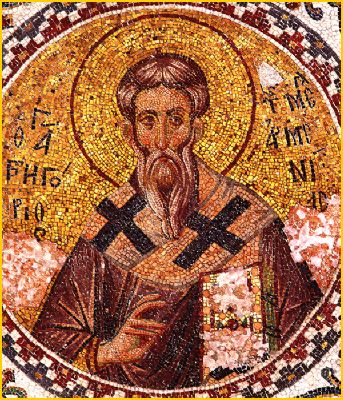
Troparion of St Gregory Tone 3
Thou didst sow the knowledge of God in the hearts of the faithful,/ by cultivating the Faith;/ made radiant by the wounds of martyrdom/ thou didst shed thy light on all./ O Hierarch Gregory, pray to Christ our God to grant us His great mercy.
Kontakion of St Gregory Tone 2
Let us the faithful praise Hierarch Gregory/ who is a shepherd, teacher and enlightener;/ and he is an athlete for the Truth./ He intercedes with Christ our God that we may be saved.
--A Life of Saint Gregory, from Christian History and Biography
September 29, 2005
Fr. Seraphim (Rose) of Platina: On the Mind of the Fathers
"Spiritual life does not mean being in the clouds while saying the Jesus Prayer or going through the various motions. It means discovering the laws of this spiritual life as they apply to one's own position, one's situation. This comes over the years by attentive reading of the Holy Fathers with a notebook, writing down those passages which seem most significant to us, studying them, finding how they apply to us, and, if need be, revising earlier views of them as we get a little deeper into them, finding what one Father says about something, what a second Father says about the same thing, and so on. There is no encylopedia that will give you that. You cannot decide you want to find all about some one subject and begin reading the Holy Fathers. There are a few indexes in the writings of the Fathers, but you cannot simply go at spiritual life in that way. You have to go at it a little bit at a time, taking the teaching in as you are able to absorb it, going back over the same texts in later years, reabsorbing them, getting more, and gradually coming to find out how these spiritual texts apply to you. As a person does that, he discovers that every time he reads the same Holy Father he finds new things. He always goes deeper into it."
--Father Seraphim Rose: His Life and Works, 466
September 28, 2005
The Fatherhood Chronicles LXXXII
Being Saved by My Wife and Daughters
I can't believe it's been a bit over two months since I last devoted any blog-attention to fatherhood--though appropriately the last Fatherhood Chronicle was a posting of some pictures of Delaina's birth.
It has been clear to me again, recently--regrettably, I lose sight of this too often--that my salvation is going to happen through my marriage to Anna and my being father to Sofie and Delaina. Not in spite of it. It's not as though there is my salvation, to which is appended these other relationships and roles. But rather in these very relationships and roles themselves is where I will find salvation. Christ saves me in them not out of them.
This is hard to remember when my helplessness gives rise to anger. I went through this with Sofie when she was but a couple or three months old. I'm going through it again. Delaina is not comforted by me. It is the feel, the smell, the sound of Anna that Delaina needs when she is fussy or distressed, and in which she finds comfort. Like Sofie, Delaina is having a tough time learning how to fall asleep (though unlike Sofie she is a better night sleeper). This means that on Monday nights, when Anna is out at her exercise class and I'm home with the girls, when Delaina hits bed time I'm dealing with a crying, and eventually angry, infant. That crying went on for forty-five minutes last week and half an hour this week.
It is an incredibly helpless feeling for a father, especially when he knows that momma would make all the difference in the world, but momma just ain't home right now. In me, that helplessness nearly always creates anger. I find myself snapping short-temperedly at Sofie, who herself is distressed because her sister is crying. Last week we all ended up sitting in the rocker, Sofie on one knee giving her daddy "lubbies" (hugs), her head resting on my shoulder and my arm around her hugging her, and Delaina crooked in one arm. Sofie eventually fell asleep, as did Delaina in gently subsiding waves of crying. And even ol' dad soon dozed, head back.
The entire scenario was one in which I had to consciously take hold of myself and resist the anger, battling against it. And in the subsequent calm of tired rest I was once again taught that vital and essential lesson: here in my arms is my salvation.
September 27, 2005
Jesus the Logician
Dallas Willard makes some extremely important points about Jesus the Logician.
Few today will have seen the words "Jesus" and "logician" put together to form a phrase or sentence, unless it would be to deny any connection between them at all. The phrase "Jesus the logician" is not ungrammatical, any more than is "Jesus the carpenter." But it 'feels' upon first encounter to be something like a category mistake or error in logical type, such as "Purple is asleep," or "More people live in the winter than in cities," or "Do you walk to work or carry your lunch?"
Sort of brings to mind the presidential debates of the 2000 election season in which then-Governor Bush proclaimed Jesus as the philosopher who had the most impact on him.
There is in our culture an uneasy relation between Jesus and intelligence, and I have actually heard Christians respond to my statement that Jesus is the most intelligent man who ever lived by saying that it is an oxymoron. Today we automatically position him away from (or even in opposition to) the intellect and intellectual life. Almost no one would consider him to be a thinker, addressing the same issues as, say, Aristotle, Kant, Heidegger or Wittgenstein, and with the same logical method.
This is most true in academic philosophy in the secular university (and, not infrequently true of the Christian seminary, too). Perhaps one might refer to him in a philosophy of religion class, but not in a logic or epistemology class, nor in an ethics class. Yet at least with regard to the latter, Jesus had some extremely critical ethical things to say.
Now this fact has important implications for how we today view his relationship to our world and our life--especially if our work happens to be that of art, thought, research or scholarship. How could he fit into such a line of work, and lead us in it, if he were logically obtuse? How could we be his disciples at our work, take him seriously as our teacher there, if when we enter our fields of technical or professional competence we must leave him at the door? Obviously some repositioning is in order, and it may be helped along simply by observing his use of logic and his obvious powers of logical thinking as manifested in the Gospels of the New Testament.
Is Jesus Lord or not? Do all the treasures of wisdom and knowledge inhere in him (Colossians 2:3) or not?
Willard answers in the affirmative.
Now when we speak of "Jesus the logician" we do not, of course, mean that he developed theories of logic, as did, for example, Aristotle and Frege. No doubt he could have, if he is who Christians have taken him to be. He could have provided a Begriffsschrift, or a Principia Mathematica, or alternative axiomatizations of Modal Logic, or various completeness or incompleteness proofs for various 'languages'. (He is, presumably, responsible for the order that is represented through such efforts as these.)He could have. Just as he could have handed Peter or John the formulas of Relativity Physics or the Plate Tectonic theory of the earth's crust, etc. He certainly could, that is, if he is indeed the one Christians have traditionally taken him to be. But he did not do it, and for reasons which are bound to seem pretty obvious to anyone who stops to think about it. But that, in any case, is not my subject here. When I speak of "Jesus the logician" I refer to his use of logical insights: to his mastery and employment of logical principles in his work as a teacher and public figure.
So what is unique to Jesus' use of logic?
Not only does Jesus not concentrate on logical theory, but he also does not spell out all the details of the logical structures he employs on particular occasions. His use of logic is always enthymemic, as is common to ordinary life and conversation. His points are, with respect to logical explicitness, understated and underdeveloped. The significance of the enthymeme is that it enlists the mind of the hearer or hearers from the inside, in a way that full and explicit statement of argument cannot do. Its rhetorical force is, accordingly, quite different from that of fully explicated argumentation, which tends to distance the hearer from the force of logic by locating it outside of his own mind.Jesus' aim in utilizing logic is not to win battles, but to achieve understanding or insight in his hearers. This understanding only comes from the inside, from the understandings one already has. It seems to "well up from within" one. Thus he does not follow the logical method one often sees in Plato's dialogues, or the method that characterizes most teaching and writing today. That is, he does not try to make everything so explicit that the conclusion is forced down the throat of the hearer. Rather, he presents matters in such a way that those who wish to know can find their way to, can come to, the appropriate conclusion as something they have discovered--whether or not it is something they particularly care for.
"A man convinced against his will is of the same opinion still." Yes, and no doubt Jesus understood that. And so he typically aims at real inward change of view that would enable his hearers to become significantly different as people through the workings of their own intellect. They will have, unless they are strongly resistant to the point of blindness, the famous "eureka" experience, not the experience of being outdone or beaten down. . . .
Today, by contrast, we commonly depend upon the emotional pull of stories and images to 'move' people. We fail to understand that, in the very nature of the human mind, emotion does not reliably generate belief or faith, if it generates it at all. Not even 'seeing' does, unless you know what you are seeing. It is understanding, insight, that generates belief. In vain do we try to change peoples' heart or character by 'moving' them to do things in ways that bypass their understanding. . . .
Paying careful attention to how Jesus made use of logical thinking can strengthen our confidence in Jesus as master of the centers of intellect and creativity, and can encourage us to accept him as master in all of the areas of intellectual life in which we may participate. In those areas we can, then, be his disciples, not disciples of the current movements and glittering personalities who happen to dominate our field in human terms. Proper regard for him can also encourage us to follow his example as teachers in Christian contexts. We can learn from him to use logical reasoning at its best, as he works with us. When we teach what he taught in the manner he taught it, we will see his kind of result in the lives of those to whom we minister.
May we all, I especially, seek to emulate our Lord in our conversations and dialogues with others.
And how might we bring this about?
Here I have only been suggestive of a dimension of Jesus that is commonly overlooked. This is no thorough study of that dimension, but it deserves such study. It is one of major importance for a healthy faith in him. Especially today, when the authoritative institutions of our culture, the universities and the professions, omit him as a matter of course. Once one knows what to look for in the Gospels, however, one will easily see the thorough, careful and creative employment of logic throughout his teaching activity. Indeed, this employment must be identified and appreciated if what he is saying is to be understood. Only then can his intellectual brilliance be appreciated and he be respected as he deserves.An excellent way of teaching in Christian schools would therefore be to require all students to do extensive logical analyses of Jesus' discourses. This should go hand in with the other ways of studying his words, including devotional practices such as memorization or lectio divina, and the like. It would make a substantial contribution to the integration of faith and learning.
While such a concentration on logic may sound strange today, that is only a reflection on our current situation. It is quite at home in many of the liveliest ages of the church.
This certainly brings a new perspective to my teaching of logic on Thursday nights!
Be sure to read the entire article linked above.
September 26, 2005
Logismoi, Guarding the Intellect, and Unifying Heart and Mind in the Jesus Prayer
I finished reading Fr. Anthony Coniaris' Confronting and Controlling Thoughts According to the Fathers of the Philokalia (Light and Life: 2004) this weekend. It is a modern primer on the intellect, the heart, thoughts, the unity of mind and heart, and the Jesus Prayer. Fr. Anthony combines a wealth of citations from the Philokalia, mixed with his own summations and some modern-day (and well-used) parables and applications. In terms of tone, this makes for an uneven work. But it is a useful work, or at least it has proven so for me. If one wants the pure air of the Philokalia, or the compilation, Writings from the Philokalia on Prayer of the Heart, and one's spiritual father or priest has given his blessing, then it is available for those who desire it. For the rest of us who aren't even beginners, Fr. Anthony's book is a useful and practical introduction.
I have already noted, in a previous post, some of the helpful patristic gems from the book. This morning, I want to continue sharing what I have gleaned.
Our minds, and definitely my own, are awash in a miasma of thoughts. Fr. Anthony notes:
Research at the University of Minnesota has revealed that the average human being has about 4000 distinct thoughts in a sixteen-hour day. This means that over a life span of seventy years a person has a total of about one hundred million thoughts. According to the church fathers the majority of these thoughts (logismoi) are not positive but negative due to our fallen nature. (Confronting and Controlling Thoughts According to the Fathers of the Philokalia 36)
Four thousand distinct thoughts a day--and somehow I am to unite these in unceasing prayer. St. Theophan both describes my present reality and the goal I deeply desire:
[Thoughts] continue to jostle in your heart like mosquitoes. To stop this jostling, you must bind the mind with one thought, the thought of God only. An aid to this is a short prayer, which helps the mind to become simple and united: it develops feeling towards God and is engrafted with it. . . . Together with this short prayer, you must keep your thought and attention toward God. (Confronting and Controlling Thoughts According to the Fathers of the Philokalia 30)
And if I can keep my mind-heart turned ever toward God, such a reality is most sweet.
St. Martyrius elaborated, "You should remember God at every moment, then your mind will become heaven." (Confronting and Controlling Thoughts According to the Fathers of the Philokalia 43)
The present reality of my thoughts, however, is one fraught with sin and the passions, and the disordered soul. It is a constant, moment-by-moment struggle, not only against the thoughts arising from my own sinfulness and habits, but also those arising from the demonic.
St. Thalassios states:
There are three ways through which thoughts arise in you: through the senses, through the memory, and through the body's temperament. Of these the most irksome are those that come through the memory. (Confronting and Controlling Thoughts According to the Fathers of the Philokalia 47)
In addition, the Fathers teach that logismoi can come from the Holy Spirit, and also from the demons. St. Hesyhios:
The provocation comes first, then our coupling with it, or the mingling of our thoughts with those of the wicked demons. Third comes our assent to the provocation, with both sets of intermingling thoughts contriving how to commit the sin in practice. Fourth comes the concrete action--that is the sin itself. If, however, the intellect is attentive and watchful, and at once repulses the provocation by counter-attacking and gainsaying it and invoking the Lord Jesus, its consequences remain inoperative; for the devil, being a bodiless intellect, can deceive our souls only by means of fantasies and thoughts. . . .Intellect is invisibly interlocked in battle with intellect, the demonic intellect with our own. So from the depths of our heart we must at each instant call on Christ to drive the demonic intellect away from us and in His compassion give us the victory. (Confronting and Controlling Thoughts According to the Fathers of the Philokalia 62)
Fr. Anthony summarizes the progression as: a suggestion (prosbole), a dialogue (syndiasmos), consent (synkatathesis), and finally, the act and captivity, passion or obsession (Confronting and Controlling Thoughts According to the Fathers of the Philokalia 63).
So, I must remain always vigilant (the discipline of wacthfulness or nespsis) if I am to experience the union of mind and heart, the union with the Holy Trinity, and the transformation of body and soul. St. Symeon the New Theologian writes:
In short, if you do not guard your intellect you cannot attain purity of heart, so as to be counted worthy to see God (cf. Matt 5:18). Without such watchfulness you cannot become poor in spirit, or grieve or hunger and thirst after righteousness, or be truly merciful, or pure in heart, or a peacemaker, or be persecuted for the sake of justice (cf. Matt 5:3-10). To speak generally, it is impossible to acquire all the other virtues except through watchfulness. (Confronting and Controlling Thoughts According to the Fathers of the Philokalia 82)
And St. Hesychios adds:
Watchfulness and the Jesus Prayer, as I have said, mutually reinforce one another; for close attentiveness goes with constant prayer, while prayer goes with close watchfulness and attentiveness of intellect. (Confronting and Controlling Thoughts According to the Fathers of the Philokalia 98)
In particular, we should guard our thoughts by guarding the senses. St. Nicodemos of the Holy Mountain writes:
St. Isaac has noted, the enemy is standing and observing day and night directly against our eyes to detect which entrance of our senses will be opened for him to eneter. Once he enters through one of our senses because of our lack of vigilance, then this devious shameless dog attacks us further with his own arrows. We must also struggle to protect our senses because it is not only through curious eyes that we fall into the sin of desire and commit fornication and the adultery of the heart, as the Lord noted. There is also the fornication and the adultery of the sense of hearing, the sense of smell, the sense of taste, the sense of touch, and all of the senses together. (Confronting and Controlling Thoughts According to the Fathers of the Philokalia 69)
As St. Hesychios teaches us how to combat the logismoi:
The name of Jesus should be repeated over and over in the heart as flashes of lightning are repeated over and over in the sky before the rain. Those who have experience of the intellect and of inner warfare know this very well. We should wage this spiritual warfare with a precise sequence: first, with attentiveness; then, when we perceive the hostile thought attacking, we should strike at it angrily in the heart, cursing it as we do so; thirdly, we should direct our prayer against it, concentrating the heart through the invocation of Jesus Christ, so that the demonic fantasy may be dispersed at once. (Confronting and Controlling Thoughts According to the Fathers of the Philokalia 98-99)
Having vanquished such thoughts, however, we must not relax our vigilance, but we must remain on guard. St. Theophan the Recluse writes:
After every thought has been banished from the soul by the memory of God's presence, stand at the door of the heart and watch carefully everything that enters or goes out from there. (Confronting and Controlling Thoughts According to the Fathers of the Philokalia 69)
This seems an impossible and daunting task, but St. Philotheos of Sinai said:
Be extremely strict in guarding your intellect. When you perceive an evil thought, rebut it and immediately call upon Christ to defend you; and while you are still speaking, Jesus in His gentle love will say, "Behold, I am by your side ready to help you." (Confronting and Controlling Thoughts According to the Fathers of the Philokalia 64)
And St. John the Dwarf adds:
I sit in my cell and I am aware of evil thoughts coming against me, and when I have no more strength against them, I take refuge in God by prayer and I am saved from the enemy. (Confronting and Controlling Thoughts According to the Fathers of the Philokalia 75)
This is a great comfort. I have a very simple yet powerful tool against which to fight the battle of impure thoughts: the name of the Lord himself and his promise to be with me always, even unto the ages of ages.
But as I confessed previously, I am torn. I have been greatly concerned about my use of the Jesus Prayer. I know it is to be prayed reverently and fearfully, not lightly or inattentively. Herein is my dilemma: my prevailing state of mind in prayer is chaotic thoughts and lack of attention. To pray the Jesus Prayer in this context is to risk praying inattentively, to, apparently, invoke the Lord's name in vain.. But apart from praying the Jesus Prayer, is there any other way to unite one's thoughts in the heart? It is like not being able to begin because I cannot accomplish that which is necessary and which I so greatly desire.
Abbot Nazarius has said about the Jesus Prayer that we should practice it always and everywhere:
The head and beginning of all virtues, is, to the extent possible, unceasing prayer to our Lord Jesus Christ, which is called, by way of abbreviation, the Prayer of Jesus; the Apostle says concerning it: Pray without ceasing (I Thes. 5:17). That is, one must call upon the Name of God always, whether we be conversing, sitting, walking, working, eating, or doing anything else. At every time and in every place it is fitting to call upon the Name of God. For by this means, writes Chrysostom, the temptation of the enemy is consumed. Beat the warriors, says St. John Climacus, with the Name of Jesus, and a stronger weapon you shall not find either in heaven or on earth. Praye is the banishment of sorrow and dejection, the germination of meekness and angerlessness, the offering of joy and thanksgiving; and innumerable good things are acquired through prayer. (Abbot Nazarius of Valaam: Little Russian Philokalia vol. I [St Herman Press: 1983] 66)
And he lived this in his own life.
The Blessed Elder was meek and humble, and his heart was aflame with love toward God, so much so that at no time would he cease to say the mental Jesus Prayer, constantly going over the knots in the prayer rope in his hand. "Let us pray with the spirit and let us pray with the understanding also, " he wrote to a nun. "Let us enter into the words of St. Paul: I had rather speak five words with my understanding than ten thousand words in a tongue (I Cor. 14:15, 19). I am unable to express how fortunate we are that we have become worthy to utter these five words. What joy! Lord Jesus Christ have mercy on me a sinner. Just think! O Lord! Whose Name am I pronouncing? That of the Creator, the Founder of everything, before Whom all heavenly powers tremble! Lord Jesus Christ, Son of God! Thou has shed Thy blood for me, hast saved me, hast come down to earth. . . . Put your understanding and your heart together, close your eyes, raise your mental eyes to the Lord. . . . O sweetest and dearst Lord Jesus Christ, Son of God . . . ." (Abbot Nazarius of Valaam: Little Russian Philokalia vol. I [St Herman Press: 1983] 22)
But still, there is the deep concern that I not engage in vain babbling, that I do not carelessly pray the Jesus Prayer without attention. Yet, if I do not at least begin to pray the Prayer, how can I begin to gather my thoughts to attention and unceasing prayer?
Archimandrite Sophrony, disciple of St. Silouan, provided me the encouragement I needed, as he writes in His Life is Mine (SVS Press: 1977):
Often when we would pray the Jesus Prayer the mind is besieged by inopportune thoughts of every kind which distract the attention from the heart. Our prayer seems fruitless because the mind is not participating in the invocation of the Lord's Name and only our lips continue mechanically to repeat the words. But there is meaning in this influx of untimely thoughts: our prayer becomes as it were a shaft of light focused on the dark places of our inner life, revealing to us the passions or attachments occupying the soul. We learn what we have to fight against: we see the iniquities that sway us. And then we call all the more urgently on the Name of God, and our repentance is intensified, Lord Jesus Christ, Son of God, have mercy upon me. (cited in Confronting and Controlling Thoughts According to the Fathers of the Philokalia 101)
I have come to see my very praying of the Jesus Prayer itself as a training in doing the very thing I am called to do. The irreverence is not in the mere inattentiveness. I am a sinner bound by the passions I have invited into my heart and mind and soul and flesh. I have a mind that knows only the habit of chasing after unfruitful thoughts. So, though I am careful to pray the Prayer in moments when I can give such attention as I am able (while I am walking, on the bus or the el, as I am waiting in line; not while I am driving or speaking with my wife and daughters), I also recognize that it is part of the discipline that I chase after this wandering mind and return it to focus on Jesus and to offer such attention and devotion as I can now offer. By God's grace, and in time, each moment of attention will be followed by another moment, and another, until I learn, pray God, before I die, to keep that attention always on the Lord, and learn, at last, to pray without ceasing.
(Please note: That one should always discuss these matters with one's spiritual father or priest. My own unworthy words and sinful example are to be ignored in favor of the pure wisdom of Christ in the Church the and example of the holy saints and elders and fathers the Lord has given us.)
September 23, 2005
Nathan Fights the Little Fights
Nathan, over at Fighting the Little Fights has done a five-part blog on his attraction and move to Orthodoxy. Go read it all. Some very good stuff.
Why Orthodoxy?
Why Orthodoxy? Part II
Why Orthodoxy? Part III
Why Orthodoxy? Part IV
Why Orthodoxy? (Final)
September 22, 2005
Thoughts and Knowledge Falsely So Called
I have begun reading one of the books I purchased at Eighth Day Books on my trip home: Fr. Anthony Coniaris, Confronting and Controlling Thoughts According to the Fathers of the Philokalia (Light and Life Publishing, 2004). (Note: all quotes will be from Fr. Anthony's book.)
To borrow the title of a blog out there in the 'sphere, it is a holy whapping. When I read the words of St. John of Kronstadt, it nearly brings tears to my eyes. I stand convicted and laid bare. This is me:
St. John of Kronstadt talks about people who "call prayer that which is not prayer at all: for instance, a man goes to church, stands there for a time, looks at the icons or at other people, and says that he has prayed to God; or else he stands before an icon at home, bows his head, says some words he has learned by heart, without understanding, and without feeling, and says that he has prayed--although with his thoughts and his heart he has not prayed at all, but was elsewhere, with other people and other things, and not with God."
Dear Lord, forgive me. In the words of the Liturgy, "help me, save me, have mercy on me, and keep me, O God, by thy grace." (This, by the way, is a prayer much-prayed as I go about the day. An "arrow-prayer.")
I have been, in my life, especially in the very beginning of my journey toward liturgy, the daily office and the historic Church, back in 1989-1990, a great connosieur of spiritual literature. I took great satisfaction in that I was much unlike, so I thought, my school and ministerial colleagues, who were either focused on rationalistic doctrine or pragmatic techniques for numerically growing their parishes. Not me. No, I cultivated the inner man.
There was some pride in this, of course, but there was much sincerity. I tried very hard to live what I learned, and persaude others to do so. There were the texts of Richard Foster, Thomas a Kempis, Madame Guyon, St. John of the Cross, St. Teresa of Avila, St. Ignatius of Loyola. Yes, in 1991 I even read The Way of a Pilgrim. These things did help my prayer life. But it was almost entirely intellectualized or emotionalized. It was not real spiritual knowledge, largely because I did not move such knowledge from my head to my heart. As St. Maximus the Confessor says:
When a man has not received knolwedge by grace, even though he calls a particular thing spiritual, he does not know its true character from experience. For mere learning does not produce a state of spiritual knowledge
Such knowledge is unattainable by me in my own natural gifts. I cannot save myself. Nor can I attain to spiritual knowledge on my own effort.
A soul can never attain the knowledge of God unless God Himself in His condescension takes hold of it and raises it up to Himself. For the human intellect lacks the power to ascend and to participate in divine illumination, unless God Himself draws it up--in so far as this is possible for the human intellect--and illumines it with rays of divine light. (St. Maximus the Confessor)
Thus, any talk of progress is foolish. I am not responsible for, nor able to actualize, anything like progress in the faith. I am called to pray, to work out my salvation with fear and trembling. But I cannot move myself, or grow myself, or accomplish this union of my mind in my heart.
That does not mean I must sit passively by and wait for it to happen. God works in me both to will and to do his good pleasure, but I am to work out this salvation he is accomplishing in me.
I have quickly discovered the hard truth that this is a rigorous battle in and with the whole man, body and soul. Praying the Jesus Prayer is not just about the spirit. It is about the entirety of who I am. I will only be healed when the intellect, the chief intuitive organ which both knows and experiences God in his energies, is enshrined in the heart, adoring the Lord who is to reign from there, and bringing the whole soul and body into union, and into union with God in Christ.
Our heart is, therefore, the shrine of the intelligence and the chief intellectual organ of the body. When, therefore, we strive to scrutinize and to amend our intelligence through rigorous watchfulness, how could we do this if we did not collect our intellect, outwardly dispersed through the senses, and bring it back within ourselves--back to the heart itself, the shrine of the thoughts? . . . Do you see, then, how greatly necessary it is for those who have chosen a life of self-attentiveness and stillness to bring their intellect back and to enclose it within their body, and particularly within that innermost body within the body that we call the heart. (St. Gregory Palamas)
"Let us attend" is the exhortation in the Liturgy. If I must be called to attend to the heavenlies that are present to me in the worship of the Church, how much more so throughout my entire day? Let us attend. I will say it again: I am finding that this bringing the mind into the heart is, well, exceedingly difficult.
You must descend with your mind into your heart. At present your thoughts of God are in your head. And God Himself is, as it were, outside you, and so your prayer and other spiritual exercises remain exterior. Whilst you are still in your head, thoughts will . . . always be whirling about like snow in winter, or clouds of mosquitos in summer. . . . All our inner disorder is due to the dislocation of our powers, the mind and the heart each going its own way. The mind must come to an intitial concord with the heart, growing eventually into a union of the mind with the heart. (St. Theophan the Recluse)
My life in God has been lived largely in my head. I do not know what it means to focus my attention in prayer. My thoughts do buzz about like gnats. In my prayers I am elsewhere with other people. This morning as I was praying the Jesus prayer so as to, as St. Theophan the counsels, warm my heart for prayer, I finished and I was stung by how often and how quickly my mind strayed. Before I could finish the first word of the prayer, I was thinking about work, or about the logic class I teach tonight. I would force myself to attend again to the words, but even before the next couple of words were out of my mouth, once again my mind was off with my wife and daughters, wondering if Sofie would be getting up soon or Anna would bring Delaina to me to watch. When I was done with the Prayer, I was almost in tears. I was physically invoking the almighty Lord of the Universe, him who gave his life for me, and I could not watch with him for even a few seconds. I ignored him for other thoughts.
O Jesus, save me.
September 21, 2005
The Mind in the Heart
Fr. Roman Braga, priest of the Dormition of the Mother of God Orthodox Monastery, has said:
Prayer is something to be practiced; you do not speak about it. It works mysteriously. (On Prayer of the Heart: Excerpts from Exploring the Inner Universe, by Fr. Roman Braga)
He was speaking about a movement of intellectuals in Romania who sought to renew the practice of the Jesus Prayer, but surrounded it with a whole theology and intellectual activity. Fr. Roman, himself a prisoner in the Soviet Communist gulags, and in solitary confinement for several years, notes that the Prayer is not about theories or theologies, but about practice.
I’m ashamed to say that I was forced to find myself in prison. I had some ideas about prayer . . . , but it was mostly theory about what prayer is; but there in those difficult moments I confess that I started to recite the Jesus Prayer and practiced it intensely. Only then was I able to discover how beautiful the interior life of man is. I liked it very much. A couple of months before I discovered this, I thought that I would go crazy because the solitude was a total break from the world with which I had been so much involved. And you know that our culture is oriented outside ourselves; it is a cosmological knowledge directed toward existence outside ourselves. Now I needed a method to find myself, to liberate myself from the slavery of the books, because there were no books there. It is not an exaggeration to say that in freedom we become slaves of the books; we do not have time even to know who we are because we are made out of quotations....
So I struggle to reflect on the Jesus Prayer, to talk about it but not to theorize on it. To pray and not to theologize.
But to do so I must, as the Fathers teach, descend with my intellect into my heart. Here is the beginning of my problem. For I do not know how to do this. If I think too hard about doing it--if I'm asking myself as I pray, "Is my mind in my heart?"--I immediately turn my attention away from praying the prayer. As St. Ignatius writes:
[T]he Jesus Prayer should be recited loud enough that you can hear yourself, without any hurry, and by locking the mind into the words of the prayer. (St. Ignatius Brianchaninov, "On Practicing the Jesus Prayer")
So, I focus on the words. Which means I am chasing my mind all over the place to lock it into, to focus it on, the name of Jesus and his mercy to me.
St. Theophan the Recluse tells me that this placing of the mind in the heart can remain with me all day, in all I do.
It is wrong to think, as some do, that prayer of the heart requires that one sit somewhere hidden away and by this means contemplate God. There is nowhere one needs to hide but in one's own heart, and having established oneself there look upon the Lord before you, as if He were at your right hand, as did King David. (Prayer of the Heart: the duty of those living in the world)
But despite my efforts--walking to the busstop or sitting on the el--I lose whatever momentary focus, whatever fleeting reality of placing my mind in my heart, that I might have gained in my morning prayers. St. Theophan does give me one aid in keeping that union of mind and heart: what Blessed Hieromonk Seraphim called "pain of heart."
Everyone has had the experience that when someone is pained at heart over something, it doesn't matter if he finds himself in the merriest company, he hears nothing, he sees nothing; instead, he sits alone with himself in his heart. If this is true of earthly concerns then why shouldn't it be possible also in spiritual life? When someone is afflicted by pain of heart relating to this worldly life, what can distract him from dwelling on this pain in the solitude of his heart? It follows that one need only establish this [inner] solitude m order to be alone. and from this point it is not tar Stir up the fear of God, and you will experience the most contrite pain of heart which will cement the attention and the feelings to the "one thing needful," and in this way we shall come and appear before the face of God. Here, then, is solitude!
I dare not say that there has even yet been a nanosecond of reality to the descending of my mind in my heart. How could I know such a thing, as prayerless as I am? How could one who has lived so long in his mind speak meaningfully of the prayer of the heart? It is not only foolishness, it is deadly pride. So I stay silent and struggle on, with the hope that St. Theophan gives:
The spiritual life is a life in God, and God shows particular care for those who seek it. Only be zealous--and you will find everything necessary nearby.
Thirty-eight Years Ago . . .
. . . the Lord saw fit to inflict me on my parents, poor souls. But hopefully mine's a life that's a tribute to them, despite my many flaws and sins.
My gift, on this day, is having sturdy parents like them, two wonderful sisters, a radiant and loving wife, and two beautiful daughters. My treasure chest is full and overflowing.
September 20, 2005
Struggle
I have had it pretty easy these last few years when it comes to the daily practice of the Faith. My investigation into Orthodoxy has been one of growing understanding, feelings of blessedness, a growing love and devotion to the Holy Trinity, the Church and the Mother of God. I certainly have had the waxing and waning of feelings and motivations to pray, and I have had periods of time when I have consistently failed to pray. I have had similar experiences and feelings when I was still a Restoration Movement Christian in Bible College, and as an Anglican.
I have also had moments of ongoing and deep pain as has been my lot these days, such as when my parents' marriage finally dissolved during my last couple of years of college, the same time that Grandpa Healy died. And I have had times of great financial need, as the time when the campus ministry I served ran out of funds to pay me, and I moved back to Kansas where I was doing temp work in Lawrence.
But I have not experienced quite the unremitting opposition within myself to all things of the Faith that I am now experiencing and have for some few months. It is not that I find the things of our Faith distasteful. Indeed, my desire for these things is greater than it has been. But there is in me this great struggle just to pray.
Blessed Hieromonk Seraphim has written of the struggle to live one's faith:
[T]he less you think of spiritual life in the abstract and the more you are just struggling in the labors of daily life, praying according to your strength . . . the better for you. Orient yourself towards zealous Orthodoxy, and then just struggle from day to day, and God will give you wisdom. (Letters from Father Seraphim, p. 133)
Readers of my blog will recognize that I have groused about how my faith is often so much of the mind that it does not get down to the heart. I have prayed since this past spring that through the prayers of Blessed Hieromonk Seraphim and the Great Martyr Katherine that I would be able to unify my mind in my heart. Perhaps it is time for these prayers to start being answered. And all I have is now, this present moment in which to work these things out. I do not have the luxury of time. I cannot wait till my mornings are regularly free of childrearing obligations and noise and distratction. I cannot wait till I finally become Orthodox. I cannot wait till I am more mature in the faith. I must work out my faith with fear and trembling now, for now is the day of salvation. Fr. Seraphim also writes:
"We are told by the Holy Fathers," Eugene [Fr. Seraphim] explained elsewhere, "that we are supposed to see in everything something for our salvation. If you can do this, you can be saved."In a pedestrian way, you can look at something like a printing press which does not operate. You are standing around and enjoying yourself, watching nice, clean, good pages come out printed, which gives a very nice sense of satisfaction, and you are dreaming of missionary activity, of spreading more copies around to a lot of different countries. But in a while it begins to torture you, to shoot pages right and left. The pages begin to stick and to tear each other on top. You see that all those extra copies you made are vanishing, destroying each other, and in the end you are so tense that all you can do is sort of stand there and say the Jesus Prayer as you try to make everything come out all right. Although that does not fill one with a sense of satisfaction (as would watching the nice, clean copies come out automatically), spiritually it probably does a great deal more, because it makes you tense and gives you the chance to struggle. But if instead of that you just get so discouraged that you smash the machine, then you have lost the battle. The battle is not how many copies per hour come out: the battle is what your soul is doing. If your soul can be saved while producing words that can save others, all the better; but if you are producing words that can save others and are all the time destroying your own soul, it's not so good." (Father Seraphim Rose: His Life and Works, p. 380)
One of the things that I have begun much more intentionally and regularly to do is to pray the Jesus Prayer. Fr. Patrick, The Way of a Pilgrim and many Fathers counsel me to disregard the esoteric, all the breathing exercises, all the surface experiences and focus on the simplicity of praying the prayer with attention.
[T]he Jesus Prayer should be recited loud enough that you can hear yourself, without any hurry, and by locking the mind into the words of the prayer. (St. Ignatius Brianchaninov, "On Practicing the Jesus Prayer")
Indeed, quoting St. Isaac, St. Ignatius writes,
"Mental prayer," [St. Isaac the Syrian] continues, "is the result of much vocal prayer, and mental prayer leads to the prayer of the heart." (St. Ignatius Brianchaninov, "On Practicing the Jesus Prayer")
So, I say the Jesus Prayer. I try to locate my mind in my heart, but what do I know of these things? I followed St. Theophan the Recluse's counsel and said the Jesus Prayer several times prior to my morning prayers this morning. I did, indeed, find my attention much more focused than yesterday when I just prayed morning prayers. Is the focus, the warmth in my heart really the fruit of my labors? Who knows? It is more likely my own self-deception inventing feelings and experiences. Mine is not to wonder about these things. It is only for me to pray the prayer and try to do that which I have no personal knowledge of. I simply trust in God, trust in the prayers of Blessed Hieromonk Seraphim that I not be misguided and be led to the true practice of the prayer. I can lead no one. I am no one's example. Everyone should seek the counsel of their parish priest and spiritual father and disregard my own words.
But I struggle on. Blessed Hieromonk Seraphim, pray for me a sinner.
More resources on the Jesus Prayer and making a prayer rope:
Jesus Prayer Area on Monachos.net
The Jesus Prayer, a pamphlet by Fr. Steven Peter Tsichlis
How to tie an Orthodox Prayer Rope
September 19, 2005
Death
22 March 2004: My step-grandfather, Wilbur Yelton
17 December 2004: My brother-in-law, Delane Sykes
5 July 2005: My former parishioner, James Anderson
10 September 2005: My grandmother, Christine Healy Yelton
So many deaths of late.
This past weekend, aside from the sheer physical brutality of driving a total of sixteen hours (twelve to Siloam for the funeral followed about an hour later with four to El Dorado for the burial), with 45 minutes of sleep in the encompassing thirty-six hours, was extremely difficult. Grandma's funeral was very respectfully done, and I was able to offer my prayers and to grieve.
It was a blessing to spend the following couple of days, though too too short, with family. Except for my mom, no one had made Delaina's acquaintance, so the juxtaposition of death and the celebration of new life was quite stark. Since my birthday is coming, my family took the opportunity to celebrate it with me. It was nice to have the attention and well-wishes.
But I return to a storm-filled Monday morning with lots of rain and grey clouds. It certainly fits my underlying mood.
But I did not and am not succumbing to the inertia of darkness. I am trying to fight through the listlessness and inner ennui to do my prayers. And though I awoke with only a few hours of sleep under my belt (having got in about midnight last night), I did manage to struggle to say morning prayers, and I am working hard to pray the Jesus prayer regularly.
If this emptiness in me is to be filled, it can only be filled by meeting Him who overflows it on the pathway of prayer.
Recent Gifts and Acquisitions
On my recent trip home, I was treated to a "surprise" (and early) birthday party at my sister's--since my family won't be with me on my birthday. Sofie saw the cake earlier in the day and kept exhorting all of us to sing "Happy to you!" with all the energy a two year old can muster. She also enjoyed helping daddy blow out his candles.
Through outright gifts or cash-enablement I was able to get some nice items.
I bought the following at Eighth Day Books:
- St. Seraphim of Sarov (Little Russian Philokalia vol. 1)
- Saint Seraphim, Wonderworker of Sarov and His Spiritual Inheritence
- Blessed Paisius Velichkovsky: The Man Behind the Philokalia
- Confronting and Controlling Thoughts According to the Fathers of the Philokalia
Plus an icon of St. Euphrosynos, and a new prayer rope.
My mom also got me something I'd been wanting to buy for a long time: a good pair of boots. After looking, yet again, at the offerings at Sheplers there in Wichita, I finally settled on this pair of boots. She also got me a couple pair of jeans, and made me a pot of coffee for the return trip home yesterday.
September 14, 2005
The Elevation of the Precious And Lifegiving Cross

Troparion Tone 1
O Lord, save Thy people/ and bless Thine inheritance./ Grant victory over their enemies to Orthodox Christians,/ and protect Thy people with Thy Cross.
Kontakion Tone 4
O Christ our God,/ Who wast voluntarily lifted up on the Cross,/ grant Thy mercies to Thy new people named after Thee./ Gladden with Thy power Orthodox Christians/ and give them victory over their enemies./ May they have as ally/ that invincible trophy, Thy weapon of peace.
From a sermon of St. John the Wonderworker:
Before the time of Christ, the cross was an instrument of punishment; it evoked fear and aversion. But after Christ's death on the Cross it became the instrument of our salvation. Through the Cross, Christ destroyed the devil; from the Cross He descended into hades and, having liberated those languishing there, led them into the Kingdom of Heaven. The sign of the Cross is terrifying to demons and, as the sign of Christ, it is honored by Christians.
"O Lord, save Thy people and bless Thine inheritance. Grant victory unto Orthodox Christians over their adversaries, and by the virtue of Thy Cross, preserve Thy community."
The beginning of this prayer is taken from the twenty-seventh Psalm. In the Old Testament the word "people" designated only those who confessed the true faith, people faithful to God. "Inheritance" referred to everything which properly belonged to God, God's property, which in the New Testament is the Church of Christ. In praying for the salvation of God's people (the Christians), both from eternal torments and from earthly calamities, we beseech the Lord to bless, to send down grace, His good gifts upon the whole Church as well, and inwardly strengthen her.
The petition for granting "victory to kings" (Grant victory to Orthodox Christians over their adversaries) (ie: to the bearers of Supreme authority), has its basis in Psalm 143, verse 10, and recalls the victories of King David achieved by God's power, and likewise the victories granted Emperor Constantine through the Cross of the Lord.
This appearance of the Cross made emperors who had formerly persecuted Christians into defenders of the Church from her external enemies, into "external bishops," to use the expression of the holy Emperor Constantine. The Church, inwardly strong by God's grace and protected outwardly, is, for Orthodox Christians, "the city of God." Heavenly Jerusalem has its beginning. Various calamities have shaken the world, entire peoples have disappeared, cities and states have perished, but the Church, in spite of persecutions and even internal conflicts, stands invincible; for the gates of hell shall not prevail against her (Matt. 16:18).
Today, when world leaders try in vain to establish order on earth, the only dependable instrument of peace is that about which the Church sings:
"The Cross is the guardian of the whole world; the Cross is the beauty of the Church, the Cross is the might of kings; the Cross is the confirmation of the faithful, the Cross is the glory of angels and the wounding of demons." (Exapostilarion of the Exaltation of the Cross)
From the Orthodox Church in America website:
The pagan Roman emperors tried to completely eradicate from human memory the holy places where our Lord Jesus Christ suffered and was resurrected for mankind. The Emperor Hadrian (117-138) gave orders to cover over the ground of Golgotha and the Sepulchre of the Lord, and to build a temple of the pagan goddess Venus and a statue of Jupiter.
Pagans gathered at this place and offered sacrifice to idols there. Eventually after 300 years, by Divine Providence, the great Christian sacred remains, the Sepulchre of the Lord and the Life-Creating Cross were again discovered and opened for veneration. This took place under the Emperor Constantine the Great (306-337) after his victory in the year 312 over Maxentius, ruler of the Western part of the Roman empire, and over Licinius, ruler of its Eastern part. In the year 323 Constantine became the sole ruler of the vast Roman empire.
In 313 he had issued the Edict of Milan, by which the Christian religion was legalized and the persecutions against Christians in the Western half of the empire were stopped. The ruler Licinius, although he had signed the Edict of Milan to oblige Constantine, still fanatically continued the persecutions against Christians. Only after his conclusive defeat did the 313 Edict of toleration extend also to the Eastern part of the empire. The Holy Equal-to-the-Apostles Emperor Constantine, having gained victory over his enemies in three wars with God's assistance, had seen in the heavens the Sign of the Cross, and written beneath: "By this you shall conquer."
Ardently desiring to find the Cross on which our Lord Jesus Christ was crucified, St. Constantine sent his mother, the pious Empress Helen (May 21), to Jerusalem, providing her with a letter to St. Makarios, Patriarch of Jerusalem.
Although the holy empress Helen was already in her declining years, she set about completing the task with enthusiasm. The empress gave orders to destroy the pagan temple and the statues in Jerusalem. Searching for the Life-Creating Cross, she made inquiry of Christians and Jews, but for a long time her search remained unsuccessful.
Finally, they directed her to a certain elderly Hebrew by the name of Jude who stated that the Cross was buried where the temple of Venus stood. They demolished the pagan temple and, after prayer, they began to excavate the ground. Soon the Tomb of the Lord was uncovered. Not far from it were three crosses, a board with the inscription ordered by Pilate, and four nails which had pierced the Body of the Lord.
In order to discern on which of the three crosses the Savior was crucified, Patriarch Makarios alternately touched the crosses to a corpse. When the Cross of the Lord touched the dead one, he came to life. Having beheld the raising of the dead man, everyone was convinced that the Life-Creating Cross was found.
Christians came in a huge throng to venerate the Holy Cross, beseeching St. Makarios to elevate the Cross, so that even those far off might reverently contemplate it. Then the Patriarch and other spiritual leaders raised up the Holy Cross, and the people, saying "Lord have mercy," reverently prostrated before the Venerable Wood. This solemn event occurred in the year 326.
During the discovery of the Life-Creating Cross another miracle took place: a grievously sick woman, beneath the shadow of the Holy Cross, was healed instantly. The elder Jude and other Jews there believed in Christ and accepted Holy Baptism. Jude received the name Kyriakos and afterwards was consecrated Bishop of Jerusalem.
During the reign of Julian the Apostate (361-363) he accepted a martyr's death for Christ (see October 28). The holy empress Helen journeyed to the holy places connected with the earthly life of the Savior, building more than 80 churches, at Bethlehem the birthplace of Christ, and on the Mount of Olives where the Lord ascended to Heaven, and at Gethsemane where the Savior prayed before His sufferings and where the Mother of God was buried after her death.
Saint Helen took part of the Life-Creating Wood and nails with her to Constantinople. The holy emperor Constantine gave orders to build at Jerusalem a majestic and spacious church in honor of the Resurrection of Christ, also including under its roof the Life-Giving Tomb of the Lord and Golgotha. The temple was constructed in about ten years. St. Helen did not survive until the dedication of the temple, she died in the year 327. The church was consecrated on September 13, 335. On the following day, September 14, the festal celebration of the Exaltation of the Venerable and Life-Creating Cross was established.
Another event connected to the Cross of the Lord is remembered also on this day: its return to Jerusalem from Persia after a fourteen year captivity. During the reign of the Byzantine emperor Phokas (602-610) the Persian emperor Khozroes II in a war against the Greeks defeated the Greek army, plundered Jerusalem and captured both the Life-Creating Cross of the Lord and the Holy Patriarch Zachariah (609-633).
The Cross remained in Persia for fourteen years and only under the emperor Heraklios (610-641), who with the help of God defeated Khozroes and concluded peace with his successor and son Syroes, was the Cross of the Lord returned to the Christians.
With great solemnity the Life-creating Cross was transferred to Jerusalem. Emperor Heraklios in imperial crown and royal purple carried the Cross of Christ into the temple of the Resurrection. With the emperor went Patriarch Zacharios. At the gates by which they ascended Golgotha, the emperor suddenly stopped and was not able to proceed farther. The holy Patriarch explained to the emperor that an angel of the Lord was blocking his way. The emperor was told to remove his royal trappings and to walk barefoot, since He Who bore the Cross for the salvation of the world from sin had made His way to Golgotha in all humility. Then Heraklios donned plain garb, and without further hindrance, carried the Cross of Christ into the church.
In a sermon on the Exaltation of the Cross, Saint Andrew of Crete (July 4) says: "The Cross is exalted, and everything true gathers together, the Cross is exalted, and the city makes solemn, and the people celebrate the feast".
September 12, 2005
Your Prayers
There are so many who need our prayers, and I feel a bit sheepish asking for the prayers of those who happen to stop by here, but I ask for them nonetheless.
I am surprised at the strength of the sorrow I am feeling. I knew I would be sad, but did not think it would take so much attention to get through my work day without crying every hour. It just comes and goes. I got the message about Grandma when I got home from the Liturgy and immediately prayed the memorial prayers (pdf file) for her, frequently having to stop and collect myself. Yet this morning I prayed the Trisagion prayers for the dead with relative calm.
Yet, how must my father feel! He's gotten choked up with me on the phone, but has otherwise remained calm in our conversations. He broke down at Wilbur's funeral last year. As sad as I feel about losing Grandma, it will just break me to see my father crying over his own mother's death.
And there are the family who will be grieving and yet having to drive. My uncle Roger and his wife, Marla, will be driving from Colorado (near Denver). My cousin Julie and her husband will be driving a few hours up to Siloam Springs from southern Arkansas. My second cousin, Kay, will also be driving from Colorado, from a small town two hours further north of Denver. I will be driving through the night Wednesday from here in Chicago so I can make the funeral in Siloam Thursday morning. My sisters and Dad will be driving from Wichita, and picking up Anna and the girls in Tulsa on the way. (Anna and the girls went home to visit family over the weekend.)
Grandma's brother, Bill, will not be able to make the trip from Arizona, but was able recently to spend a great week with Grandma before she fell ill. Grandma's sister, Bessie, is too ill to make the drive with her daughter, Kay. She is grieving terribly, not only for losing her sister, but for being unable to go to the funeral.
And there is my aunt, LaVaun, who will be playing host to us. It looks as though Anna and the girls will be staying at Grandma's house. I probably won't make it in till seven or eight in the morning, with the funeral at 9:30.
I saved a red carnation from the bed of flowers on which we venerated the Cross this past Sunday. I will place it, with my prayers, with Grandma's body in the casket.
September 11, 2005
Paraklesis
The heart is deceitful above all things, and desperately wicked; who can know it? . . .Heal me, O Lord, and I shall be healed; save me, and I shall be saved; for Thou art my praise. (Jeremiah 17:9,14)
This is where I began. This is where I remain. A heart void and empty. Clung to, more than clinging to, by Him who ought to be the center. St. Ephraim's prayer rings true.
No one can heal my disease except He Who knows the depths of the heart.--St. Ephraim the Syrian, A Spiritual Psalter
That is something. I am utterly liable to deception, to prelest, the distortion of extreme navel gazing that is the wont of those brought up in twentieth century Protestantism. Having no paradigm except experience--since the foundation of our salvation is judged in terms of a crisis experience: the gospel of the altar call--we ever fret over our experience, eyes trained for the slightest movement of emotion and feeling. But this is deception: for one cannot take a measurement against an ever-moving standard.
So: perhaps I am deceived in my own evaluation of an empty heart. Maybe mine is merely blindness to that which, rather, to him who, is there. Who am I to claim competence to judge myself? And ultimately, why should my judgement matter?
My heart is deceitful and desparately wicked. It lies, even in its convictions.
But even if, by some chance and not by personal competence, I have come to the truth, if indeed there is something to this notion that my heart is empty, well, then, it is empty. With what will I fill it? Not with feelings of fullness, for this is mere vanity. No, if it is to be filled, it will and must be filled by him for whom it must be prepared. And I cannot make him to enter. His presence, as is my perception of it, is a grace. Which means none of my acts, none of my bargaining, none of my feelings, will make it happen. He will enter and fill this heart as and when he has a notion to. Indeed, perhaps he is already there.
I can but ask and seek and knock. The rest is him. No, not even this. Even my asking and seeking and knocking is him. He both precedes me and awaits me.
I see none of this. I hear none of his still small voice. I taste and feel absolutely nothing. All that confronts me is a darkness, a sense of emptiness. I have no comfort. Or if there is a comfort, it is that all this sense, all this nothingness is a nothing. I cannot see him unless he reveals himself. But my not seeing does not nor ever could encompass his absence, and so nothing of his presence, either.
Is this a dark night? No. Nothing so dramatic or romantic. It simply is. And I am in the midst of it.
What am I to do? Nothing more nor less than what I have always been called to do. To worship the Almighty and All-Holy Trinity, by any means to hand, beginning with this faithless and deceitful heart.
So, I pray. I do not pray well. Distracted by present loneliness and loss, by the ephemeral cares and concerns of the moments present and imagined, I lose the trail of the scarlet thread of prayer. But I return to it, and keep going.
I pray the memorial prayers for my grandmother, and find there encouragement.
The earth, O Lord, is fully of Thy mercy; teach me Thy statutes. . . .Thou art good, O Lord, and in Thy goodness teach me Thy statutes. (Psalm 118[119]:64,68)
Amen. Amen.
Memory Eternal
Remember, O Lord, the soul of Thy departed handmaiden.
My grandmother, Mabel Rosetta (Christine) Healy, died last night, Saturday, 10 September, about 11:20 p.m. With her when she died was her daughter and son-in-law, LaVaun and Duane Thomas. Grandma was born 27 June 1920. She was eighty-five years old when she died.
Funeral services are set for Thursday morning in Siloam Springs, Arkansas, with burial to follow later that evening in Eldorado, Kansas.
Give, O Lord, to Thy handmaiden, Christine, eternal rest, and memory eternal!
4384 Days of Ineffable Bliss
Of course, when you realize that amounts to 378,777,600 seconds, or 6,312,960 minutes or 105,216 hours . . .
Well, it can sound like a long time.
In any case, twelve years ago, the most beautiful woman in the world hooked up with this ol' doofus. She's been wonderin' why ever since.
If ya ask me, its gotta be luuuuv.
Happy anniversary to my bestest half.
Our Father Among the Saints, Euphrosynos the Cook
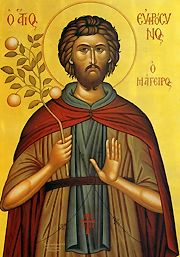
Troparion Tone 4
Thou didst live righteously in great humility, / in labors of asceticism and in guilelessness of soul / O righteous Euphrosynos. / Hence, by a mystical vision, thou didst demonstrate most wondrously the heavenly joy which thou hadst found. / Do thou make us worthy to be partakers thereof by thine intercessions.
From the OCA website:
Saint Euphrosynus the Cook was from one of the Palestinian monasteries, and his obedience was to work in the kitchen as a cook. Toiling away for the brethren, St. Euphrosynus did not absent himself from thought about God, but rather dwelt in prayer and fasting. He remembered always that obedience is the first duty of a monk, and therefore he was obedient to the elder brethren.The patience of the saint was amazing: they often reproached him, but he made no complaint and endured every unpleasantness. St. Euphrosynus pleased the Lord by his inner virtue which he concealed from people, and the Lord Himself revealed to the monastic brethren the spiritual heights of their unassuming fellow-monk.
One of the priests of the monastery prayed and asked the Lord to show him the blessings prepared for the righteous in the age to come. The priest saw in a dream what Paradise is like, and he contemplated its inexplicable beauty with fear and with joy.He also saw there a monk of his monastery, the cook Euphrosynus. Amazed at this encounter, the presbyter asked Euphrosynus, how he came to be there. The saint answered that he was in Paradise through the great mercy of God. The priest again asked whether Euphrosynus would be able to give him something from the surrounding beauty. St. Euphrosynus suggested to the priest to take whatever he wished, and so the priest pointed to three luscious apples growing in the garden of Paradise. The monk picked the three apples, wrapped them in a cloth, and gave them to his companion.
When he awoke in the early morning, the priest thought the vision a dream, but suddenly he noticed next to him the cloth with the fruit of Paradise wrapped in it, and emitting a wondrous fragrance. The priest, found St. Euphrosynus in church and asked him under oath where he was the night before. The saint answered that he was where the priest also was. Then the monk said that the Lord, in fulfilling the prayer of the priest, had shown him Paradise and had bestown the fruit of Paradise through him, " the lowly and unworthy servant of God, Euphrosynus."
The priest related everything to the monastery brethren, pointing out the spiritual loftiness of Euphrosynus in pleasing God, and he pointed to the fragrant paradaisical fruit. Deeply affected by what they heard, the monks went to the kitchen, in order to pay respect to St. Euphrosynus, but they did not find him there. Fleeing human glory, the monk had left the monastery. The place where he concealed himself remained unknown, but the monks always remembered that their monastic brother St. Euphrosynus had come upon Paradise, and that they in being saved, through the mercy of God would meet him there. They reverently kept and distributed pieces of the apples from Paradise for blessing and for healing.
Our holy monastic father Euphrosynus was born of simple parents although he surpassed even those of noble lineage in good works. For there are many who are devoid of good works, despite their noble birth, and so are cast down into Hades while the simple in their humility are lifted up to paradise by God as was the godly Euphrosynus. Because of his virtuous life he was translated to paradise, as we will see, and was shown to be an inhabitant there.Euphrosynus lived in a monastery where he served the brethren, laboring in the kitchen and serving them with great humility and submissiveness as though they were not men but God Himself. He labored in obedience day and night, but he never left off praying and fasting. His patience was inexpressible. He bore much abuse and disparagement and suffered frequent vexations. Scorched by the material fire of the cookstove, he was warmed by the spiritual fire of the love of God, and his heart burned with longing for the Lord. While passing his days preparing food for the brethren, he at the same time prepared a table for himself in the kingdom of God by his virtuous life, where he would eat his fill with those of whom it is said, Blessed is he that shall eat bread in the kingdom of God. He served the Lord secretly so that he might be rewarded by Him openly, even as it came to pass.
The Lord's reward to His servant was made manifest in the following manner. A certain priest who lived in the same monastery prayed fervently to the Lord that He reveal to him the things which are prepared for them that love Him. One night he had a vision. It seemed to him that he was standing in a garden, and as he considered the unutterable beauty of this garden, he saw Euphrosynus, the monastery's cook, walking by. The priest approached him and asked, "Brother Euphrosynus, what is this place? Can this be paradise?"
"It is paradise, Father," answered Euphrosynus.
Again the priest inquired, "How is that you are here?"
Euphrosynus the cook replied, "This is the dwelling place of God's elect, and by God's great goodness I have made my abode here as well."
The priest asked, "Do you have authority over all these beautiful things?"
Euphrosynus replied, "As far as I am able, I distribute to others the things you see here."
The priest inquired, "Can you give me some portion of these things?"
"By the grace of my God, take what you desire," Euphrosynus said.
The priest then pointed to some apples and asked for them. Euphrosynus took three apples, placed them in a kerchief, and gave them to the priest, saying, "Take what you have requested and delight therein."
At that moment, the semantron was struck for Matins, and the priest awoke and came to himself. He thought that he had been dreaming, but when he stretched out his hand to pick up his handkerchief, he found in it the three apples that he had received from Euphrosynus in the vision. They gave off an ineffable fragrance. Amazed, he arose from his couch, placed the apples on the bed, and went to church where he found Euphrosynus standing together with the brethren at the morning service. Approaching Euphrosynus, the priest implored him to reveal where he had been that night.
Euphrosynus replied, "Forgive me, Father; I have been in that place where we saw one another."
The priest said, "You must reveal God's greatness, so that the truth is not concealed!"
But the wise Euphrosynus humbly answered, "You, Father, implored the Lord to reveal to you the reward given to His chosen. The Lord was pleased to make this known to your godliness through me, wretched and unworthy as I am, and thus, we found ourselves together in paradise."
The priest inquired, "What did you give me, Father, in paradise when I spoke with you?"
"I gave you the three fragrant apples which you have placed on your bed in your cell," answered Euphrosynus. "But forgive me, Father, for I am a worm and not a man."
When Matins had finished, the priest summoned the brethren and showed them the three apples from paradise, and he told them exactly what had occurred. All smelled the ineffable fragrance emitted by those apples and discerned their spiritual sweetness, and they marvelled at what they were told by the priest. They hurried to the kitchen to reverence the servant of God, but they could not find him. When Euphrosynus left the church, he hid from the glory of men, and no one knew where he had gone. It is pointless to inquire into his whereabouts, for if he had access to paradise, where could he not have hidden himself?
The brethren divided the apples among themselves and distributed pieces of them as a blessing to many, especially to those who were in need of healing. Whoever ate of these apples was healed of his infirmities, and thus, all received great benefit from the holy and venerable Euphrosynus. The account of the vision was written down not only on scrolls but also in the hearts of those who were told of it, and all who heard thereof strove to increase their labors and please God.
By the prayers of the venerable Euphrosynus, may the Lord deem us also worthy to dwell in paradise. Amen.
September 09, 2005
Increasingly Sad
I am deeply sad this afternoon, and have been increasingly so throughout the day. Barring a remarkable turn around toward health, my grandmother will die soon.
Grandpa Healy, Grandma's first husband, died 10 February 1991. (Her second husband, Wilbur Yelton, died a year ago March.) Now I face losing my grandmother, who is in her eighties. When she dies--even if her life is spared for now--I will have lost half my grandparents. I still have my mother's parents. But there will no longer be any Healy grandparents.
I feel so empty saying that.
My grandmother is such a beautiful, strong and radiant woman. She is (partially) of Cherokee lineage, a devout Christian woman, of virtuous character, noble. So many memories.
Yes. I am very sad.
September 08, 2005
The Nativity of the Theotokos
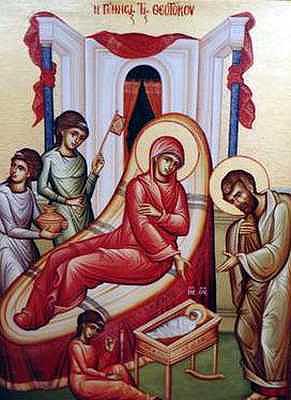
Troparion of the Mother of God Tone 4
Thy Nativity, O Mother of God,/ has brought joy to all the world;/ for from thee arose the Sun of Righteousness, Christ our God,/ Who, having dissolved the curse, has given His blessing,/ and having abolished death, has granted us life eternal.
Kontakion of the Mother of God Tone 4
Joachim and Anna were freed from the reproach of childlessness/ and Adam and Eve from the corruption of death, O Immaculate One, by thy holy nativity./ And thy people, redeemed from the guilt of sin,/ celebrate thy birth by crying to thee:/ The barren woman gives birth to the Mother of God and the nurse of our life.
St. Andrew of Crete: Sermon on the Nativity of the Virgin Mary
From the Orthodox Church in America website:
In addition to the celebration of the Annunciation, there are three major feasts in the Church honoring Mary, the Theotokos. The first of these is the feast of her nativity which is kept on the eighth of September.The record of the birth of Mary is not found in the Bible. The traditional account of the event is taken from the apocryphal writings which are not part of the New Testament scriptures. The traditional teaching which is celebrated in the hymns and verses of the festal liturgy is that Joachim and Anna were a pious Jewish couple who were among the small and faithful remnant-"the poor and the needy"-who were awaiting the promised messiah. The couple was old and childless. They prayed earnestly to the Lord for a child, since among the Jews barrenness was a sign of God's disfavor. In answer to their prayers, and as the reward of their unwavering fidelity to God, the elderly couple was blessed with the child who was destined, because of her own personal goodness and holiness, to become the Mother of the Messiah-Christ.
Your nativity, 0 Virgin, has proclaimed joy to the whole universe. The Sun of Righteousness, Christ our God, has shone from you, 0 Theotokos. By annulling the curse he bestowed a blessing. By destroying death he has granted us eternal life. (Troparion)By your nativity, 0 most pure virgin, Joachim and Anna are freed from barrenness; Adam and Eve from the corruption of death. And we, your people, freed from the guilt of sin, celebrate and sing to you: The barren woman gives birth to the Theotokos, the Nourisher of our Life. (Kontakion)The fact that there is no Biblical verification of the facts of Mary's birth is incidental to the meaning of the feast. Even if the actual background of the event as celebrated in the Church is questionable from an historical point of view, the divine meaning of it "for us men and for our salvation" is obvious. There had to be one born of human flesh and blood who would be spiritually capable of being the Mother of Christ, and she herself had to be born into the world of persons who were spiritually capable of being her parents.
The feast of the Nativity of the Theotokos, therefore, is a glorification of Mary's birth, of Mary herself and of her righteous parents. It is a celebration as well of the very first preparation of the salvation of the world. For the "Vessel of Light," the "Book of the Word of Life," the "Door to the Orient," the "Throne of Wisdom" is being prepared on earth by God himself in the birth of the holy girl-child Mary.
The verses of the feast are filled with titles for Mary such as those in the quotations above. They are inspired by the message of the Bible, both the Old and New Testaments. The specific Biblical readings of the feast give indications of this.
At the Vespers the three Old Testamental readings are "mariological" in their New Testamental interpretation. Thus, Jacob's Ladder which unites heaven and earth and the place which is named "the house of God" and the "gate of heaven" (Genesis 28:10-17) are taken, to indicate the union of God with men which is realized most fully and perfectly-both spiritually and physically-in Mary the Theotokos, Bearer of God. So also the vision of the temple with the "door 'to the East" perpetually closed and filled with the "glory of the Lord" symbolizes Mary, called in the hymns of the feast "the living temple of God filled with the divine Glory." (Ezekiel 43:27-44:4) Mary is also identified with the "house" which the Divine Wisdom has built for himself according to the reading from Proverbs 9:1-11.
The Gospel reading of Matins is the one read at all feasts of the Theotokos, the famous Magnificat from St. Luke in which Mary says: "My soul magnifies the Lord and my spirit rejoices in God my Saviour, for he has regarded the low estate of his handmaiden, for behold, henceforth all generations will call me blessed."(Luke 1:47)
The epistle reading of the Divine Liturgy is the famous passage about the coming of the Son of God in "the form of a servant, being born in the likeness of man" (Philippians 2:5-11) and the gospel reading is that which is always read for feasts of the Theotokos- The woman in the crowd glorifies the Mother of Jesus, and the Lord himself responds that the same blessedness which his mother receives is for all "who hear the word of God and keep it." (Luke 11:27-28)
Thus, on the feast of the Nativity of the Theotokos, as on all liturgical celebrations of Christ's Mother, we proclaim and celebrate that through God's graciousness to mankind every Christian receives what the Theotokos receives, the "great mercy" which is given to human persons because of Christ's birth from the Virgin.
September 07, 2005
Audio of St. John the Wonderworker's Voice
From the St. John the Wonderworker website comes a brief (about three minute) excerpt from one of St. John's sermon, which can be accessed here (opens in Windows Media). It's in Russian, so unless you can understand spoken Russian, it will be unintelligible. But it's incredible to hear the voice of a 20th century saint.
September 06, 2005
Apostasy
It seems to me that there are three fundamental ways that one may fall away from the faith: rational doubts, hedonism, or the empty heart. It is true that all apostasy is an act of the will, confirmed over time and hardened into a disposition of soul. But the precipitating cause is not always sheer will.
I have had intellectual questions about the faith, but I do not think I can say that I have ever really doubted the goodness of God, nor his existence. I learned some fifteen years ago that the intellect is not the last refuge of our soul, nor such a cold gruel the end of our cravings. But when we are squeezed by the unpleasant and racked by the painful, these mental question marks arise. We say and pray all sorts of things when in distress and pain, but these are not usually cries of rebellion so much as pleas for help, the disguised longing for that which we know we cannot do without. With Job we demand an accounting of our Creator, but like Job we are satisfied to kneel in silence among the ashes. He is here. And we come to know that that is all that matters.
Similarly, I have certainly been tempted as have all Christians by the immediate gratifications of my senses and my intellect. Like many, I have said and done shameful things. But the acrid bite of the bitter bile of guilt these acts produced destroys any lasting emanations of the pleasant. Whether from conscience or the conviction of the Spirit, or both, I have never been able to endure the apostasy centered in the flesh. Certainly such bondage has an inertia that makes repentance and amendment of life unbearably difficult, but the moments of pleasure are fleeting, the burn of the guilt enduring, and one is driven to repentance even if such repentance is short-lived and cyclical. Still, it is repentance of a sort; and who knows but that God will bring to life the feeble efforts of a shattered heart praying out one's guilt late at night in the silence of an empty house.
These apostasies have proven not to be the sort that have taken hold of me. At least not to this point. Perhaps they may one day. One is never free of them prior to the Parousia. It is, however, the third sort of apostasy--the empty heart--that confronts me now. And it is most terrible.
Imagine if you will a turning away in which there is no temptation, no suffering, no impetus external to oneself. Imagine the horrible reality that one turns from the anchor of all hope, the center of all being and of all joy, simply because there is nothing there in one's heart. Where there ought be the silken cord, visibly red, marking one's heart off from the tumbling of the walls of one's life, there is nothing. Where there ought be the latent burning within as one watches the nail-marked hands bless and break the bread, leading to recognition and union, there is nothing. Imagine all the pathways of one's mind have been channeled in such a way so as to conform to the content of Faith, but when springs of living water should flow up from the heart into such a mind, there is nothing.
If you can imagine that, then perhaps you can see that it would not take the long battering of the fallen world upon the heart, it would not take the siren song to rouse one to break the cords lashing the soul to the mast, it would indeed, take nothing at all to turn. To turn and to perish.
My mind is full of the content of truth. My hands and feet and lips are marked--albeit none too clearly--by the pathways of the Liturgy and the practice of that truth. But my heart is empty. Not even swept clean. Just void. And bearing nothing, it would take nothing to turn it. Nothing save a bare and unfettered choice so to do.
But I do not want to turn. I do not want this empty heart. I do not find the possibility of such an easy apostasy an easy thing to contemplate. Indeed, it is a horror.
But to fill this heart, I find myself resourceless. I know well how to train the mind. The practice of the faith is marked out, if my discipline is little formed. But how to fill a heart. No one has ever taught this to me.
September 02, 2005
Blessed Hieromonk Seraphim (Rose) of Platina
(It should be noted that icons of holy fathers do not receive the halo until they are canonized by synod. At this time, Fr. Seraphim has not been canonized, so strictly speaking the halo on this icon is premature.)
Troparian Tone 4
As a faithful ascetic of Saint Herman / you flowered as a spiritual rose in Platina / As an illuminator of Orthodoxy in America / your writings bring hope throughout the world / Having taught us the True Faith / O Blessed Seraphim / pray to God for us.
Kontakion Tone 4
Being one supremely devoted to the Mother of God / thou didst take up thine abode on a mountainside near Platina / and there thou didst crucify thy flesh, with its lusts and passions, through ascetic struggle / wherefore thou art become the first born American saint, / an inspiration and guiding star to American Orthodoxy. / Wherefore we cry unto thee, / save us by thy prayers, / O Seraphim our Holy Father.
A Prayer to Father Seraphim:
Oh, Our Holy Father Blessed Seraphim, you lived your life in accordance with the commandment of Christ to die to yourself, pick up your cross and follow Him. Having done so, you produced much fruit for God's harvest. Please pray to the Lord for us, your spiritual children, who live in an age of unbelief and hostility to absolute truth. Pray that Christ our God strengthen us and give us the wisdom and faith to survive the ordeals ahead. Pray for our family and friends, both living and dead. Pray that the inner eyes of our souls be opened to see the divine and true Gospel of our Lord, God and Savior Jesus Christ, that we might acquire the Holy Spirit within ourselves. Pray that we all might someday dwell in bliss with you and the other Saints in the Kingdom of Heaven. Pray to the Mother of God to entreat her Son to have mercy on our souls. For glorious and unending is the Kingdom of the Father and of the Son and of the Holy Spirit, both now and ever and unto the ages of ages. Amen.
An account of the death of Father Seraphim from his biography, Father Seraphim Rose: His Life and Works:
On the morning that followed the Transfiguration Vigil, Fr. Seraphim served what was to be his last Liturgy on earth. Soon afterwards he fell ill and could not come to the monastery services. It was not unusual for him to be sick, and when he was he never complained, so that it was difficult to know just how bad his condition was. This particular illness caused him acute stomach pains. He remained in his secluded cabin, keeping his pain to himself. The heat, which had abated during the summer pilgrimage, now grew stifling and increased his discomfort. The aforementioned John from the Santa Cruz fellowship, now a catechumen, went to ask him some questions about the Holy Scriptures. "I found him to be in so much pain that he could not think clearly," John recalls. "As usual, he listened patiently to my questions. He tried his best to be cheerful and not show his suffering, but finally he had to say that he just couldn't answer right then." (1014)
When Fr. Seraphim was examined at the hospital, the doctors found his condition to be quite serious. His blood had somehow clotted on the way to his intestines, and part of the intestines had already died and become gangrenous. . . .
Fr. Seraphim was immediately taken to an operating room, where the dead part of his intestines was removed. . . . (1015)
Having finished the first operation, the doctors thought that Fr. Seraphim would survive. Further tests, however, showed that the problem was not over: the blood had begun to clot again. The doctors immediately operated a second time, removing even more intestines, but they were coming across a great dilemma: if they used anticoagulants to prevent the blood from clotting, he would bleed to death internally, but if they did not use such drugs more and more tissue would die. A specialist in this rare disease was called in from San Francisco, but even he was at a lost to stop the damage. At this point doctors could give Fr. Seraphim only a two percent chance of recovery. (1016)
During Fr. Seraphim's week-long agony, it was manifest to Fr. Herman and others that he had indeed been purified, conquering his will and offering it as a burnt sacrifice to God. There was not a trace of anger or rebellion in him now, only devotion, love, contrition and repentance. Once before administering Holy Communion to him, Fr. Herman read the Gospel and then, holding the book over the dying man, began to bless him with it. Suddenly Fr. Seraphim, exerting every last bit of strength in his dying, convulsing frame, raised himself up to kiss that sublime Book that has given him life. . . . (1020)
At about 10:30 on Thursday morning the doctors announced that there was nothing more they could do. Fr. Seraphim, weakned beyond recovery during a week of suffering, had begun to have multiple organ failures. Within minutes the watch over the dying had ended, and a new life had begun for him. . . . (1022)
Fr. Seraphim reposed on August 20/September 2, 1982. He was only forty-eight years old. . . . (1022-1023)
Fr. Seraphim's body was placed in the middle of the monastery church, in a simple wooden coffin that had been built by Fr. Vladimir Anderson's son, Basil. There it was to remain until the burial. The Psalter began to be read around the clock in the church. The vigil had now become a vigil of prayer for the repose of Fr. Seraphim's soul. (1023)
In the three days between his death and his burial, Fr. Seraphim's unembalmed body never stiffened, nor did decay of any kind set in, even in the summer heat. There was no deathly pallor about him whatsoever; in fact, his coloring was literally golden. The skin remained soft and the body seemed to be, in the words of one monastery pilgrim, "one of a sleeping child." . . . Since incorruption has from ancient times been viewed as a sign of sanctity in the Orthodox Church, all those present felt that they were witness to a manifestation of God's grace. (1025)
Another account of his repose can be found here.
Accounts of miracles attributed to Blesssed Seraphim's intercessions can be found here.
An akathist to Father Seraphim can be found here.
Father Seraphim's biography.
Information to obtain the video of the 20th anniversary of Blessed Seraphim's repose, from The Father Seraphim Rose Foundation, is available here.
Transcribed talks of Father Seraphim online
Signs of the End Times (This talk is part of Father Seraphim's lectures on CD)
The Search for Orthodoxy
In Step With Sts. Patrick and Gregory of Tours
Raising the Mind, Warming the Heart
The Orthodox World-View
The Royal Path: True Orthodoxy in an Age of Apostasy
The Holy Fathers of Orthodox Spirituality: The Inspiration and Sure Guide to True Christianity Today Part I, Part II, Part III
How to Read the Holy Scriptures Part I, Part II, Part III
September 01, 2005
The Indiction of the Ecclesiastical Year
Happy New Year to all my Orthodox brothers and sisters!
Troparion of the New Year Tone 2
Lord of the universe who by Thy power hast established the times and seasons,/ bless this year with Thy goodness,/ preserve our rulers and keep Thy flock in peace,/ through the prayers of the Mother of God, and save us.
Kontakion of the New Year Tone 4
Creator and Lord of the ages,/ God of all, transcendent in essence: Bless this year./ Save all who worship and cry:/ Grant us a fruitful year,/ O Compassionate Redeemer.
Fr. Michael Harper here explains the Orthodox New Year:
It can be frustrating to move suddenly from the end, back to the beginning of something. But this is what Orthodox believers do as we move from August 31st - the last day of the old year, to September 1st, the first day of the new year.
It is part of the goodness of God, that He, who has no beginning and no ending, the Eternal Trinity, should take such care to give us a year which begins and ends, and then begins all over again. In our human and finite state we need fresh starts, and this is one of them. From the peaks of Pascha, Ascension, Pentecost, and Transfiguration, we move back to beginnings, the Nativity of the Mother of God, and then in December of the Son of God Himself. We start this wonderful cycle all over again. But the Holy Spirit, as we trust Him, will renew this new year to us, and give us a whole new understanding of it. . . .
It is significant that the last great feast of the old year is that of the Dormition of Mary, the Mother of God. Her human passing was to heaven's glory. And the first great feast of the new year is her Nativity. It is not that Mary is more important that Christ, around which most of the Calendar revolves. Mary is not God. She did not exist from eternity. But she is honoured in this way because she is our supreme example. She lived a life of complete obedience to God.
Another explanation is given here.