

September 14, 2004
"My Lord is more ready to pardon than you to sin, more able to forgive than you to transgress. My Master is more willing to supply your wants than you are to confess them." -- Charles Spurgeon (via Challies.com)
February 12, 2004
In chapter two of Desiring God, John Piper discusses one of the central doctrines of the faith -- conversion. He powerfully and successfully argues the necessity of being converted to Christ, and he presents a compelling case that to be truly converted is to become a Christian Hedonist. For Piper, the command of conversion is not simply "believe in the Lord Jesus" but rather "delight yourself in the Lord." The question is not "do you believe in Jesus?" but rather "do you treasure Jesus Christ more above everything else?"
There were a couple things that really stood out in my mind from this chapter.
One, I found it interesting that he spent so much time on the subject of conversion in a book clearly directed towards a Christian audience. He anticipated this, and offers this explanation:
We are surrounded by unconverted people who think they do believe in Jesus.
His second explanation, which I was pleasantly surprised to see, is that there are many direct commands Jesus (and other NT writers) gave to the question "what must I do to be converted?" besides "just believe." It is his belief that if a person is truly converted, they will have within them a "new taste" for the glory of God which will make them able to keep these commands.
The root of conversion is the birth of a new taste, a new longing, a new passion for the pleasure of God's presence.I found his idea of the "new taste" to be a great description of how a converted person is changed. He didn't take this angle on it, but I think most of us could say that even though we can't live up to God's standards, when we became Christians we began to want to live up to those standards. I want to be a godly man, husband, and father. I want to treat people well, and be righteous. To think of it another way, my will and my character are pointed in a different direction.
Also intriguing was Piper's discussion of the motivation for conversion. He discounts the professed conversion that comes as a result of the fear of hell, or from a begrudging sense of duty. He says:
Could there be any holy motivation to believe in Christ where there is no taste for the beauty of Christ?The answer is obvious, but who else is asking the question? Are we not surrounded by churches and pastors who are more than happy to "scare the hell out of people" to lead them to Christ?
He stated early in the chapter that his goals were to show the necessity of conversion, and to argue that conversion creates a Christian Hedonist (whether or not they use the label). I think he accomplishes these goals, and along the way, encourages the already converted to truly treasure Christ. There is a lot of meat in this chapter, including an excellent six-point discussion of our need for salvation and what God has done to meet that need. Overall, another excellent chapter laying the foundation for his ideal of Christian Hedonism.
January 31, 2004
This is the first of my chapter by chapter posts on John Piper's book Desiring God. Chapter 1 is entitled "The Happiness of God," and its premise is that God is God-centered and that He is completely satisfied in Himself:
The ultimate ground of Christian Hedonism is the fact that God is uppermost in his own affections:
The chief end of God is to glorify God and enjoy himself forever.
And so Desiring God gets off to a quick, jarring start. God is uppermost in his own affections? Piper correctly points out that we tend to think, or assume, that we are uppermost in God's affections. We often attempt to explain God's purposes with ourselves at the center.
Piper begins to explain his theory by discussing God's sovereignty, quoting Psalm 115:3, which says that "Our God is in the heavens, He does whatever He pleases." I can't imagine a Christian who would deny Piper's assertion that God has the right, power, and wisdom to do whatever He wants. The conclusion he draws from this is interesting, but it should have been obvious: If God can do anything He wants, and His purposes cannot be frustrated, He must be the happiest of all beings. Just the thought of a happy God is a bit different for me, after having spent a couple years in the Pentecostal/Charismatic tradition, where God is alternately presented as a cosmic ATM and a harsh judge waiting for the chance to take back your salvation and toss you out the back door into outer darkness. I love that Piper hangs all of Christian Hedonism on this foundation -- we can't expect to find joy in a joyless God, but since God is full of joy, He is a reliable source of joy for us.
Piper goes on to tackle the difficult question of evil in the world, and what place it has in God's plan. Far from being a God frustrated with a world full of evil gone wild, he states that God uses the evil of this world to fulfill His greater purposes. Referencing Job, Jeremiah, and the story of the crucifixion, Piper shows that "the evil Satan causes is only by the permission of God." As a further explanation, Piper describes two different lenses through which God views evil in the world. In the narrow view lens, he says, God sees sin as abhorrent and He is saddened by its damaging effects. In the wide view lens, through which God sees all of redemptive history, God sees sin and evil as tools by which to bring about His ultimate purposes. This is one of the most intriguing attempts to explain "the problem of evil" from a sovereignty-oriented perspective, and it seems to make a lot of sense.
In the latter half of the chapter, Piper discusses God's happiness in Himself, using the example of how God is well pleased in His Son Jesus, who is the exact image of His glory. Thinking of God's God-centeredness in relation to the Trinity was helpful to me in getting my head around the concept. Creation is an overflow of this happiness; it reflects God's glory and brings Him further happiness.
Finally, Piper discusses God's seeking of our praises. He quotes C.S. Lewis's discovery of why God wants us to praise -- not to fill some need within Himself, but because praise is the natural completion of our enjoyment of anything. Lewis correctly points out that the world is full of people praising all the things that they enjoy. If we find pleasure in God, that pleasure is made complete by praising Him. What a revelation of the many Psalms that exhort us to sing praises to God! It makes perfect sense, and I look forward to my own enjoyment of God to overflow in many constant praises.
"Oh Lord open my lips, and my mouth with shew forth your praise."This chapter is full of big concepts, and honestly reading it through a second time was a great help. Seeing God as perfectly happy within Himself, and seeing that happiness as a foundation for finding our happiness in Him was truly a revelation, and I look forward to seeing how the rest of the book builds on this foundation.
January 26, 2004
Over the course of ten weeks, our small group at Rock Creek is studying and discussing John Piper's book Desiring God: Meditations of a Christian Hedonist. We're taking it a chapter a week, and what I plan to do alongside that study and discussion is to post my thoughts on each chapter here on the weblog. As always, I welcome a good discussion and look forward to the possibility that my usually silent blog readers and I can have some engaging discussions about the book. My goal is to have my thoughts on each chapter posted by Wednesday afternoon of each week.
If you don't own the book and are interested in reading it (for free!), John Piper is offering the full text online.
January 9, 2004
The faith of a little child is an amazing, and inspiring thing to behold:
Out of the corner of my eye, I saw Luke steeple his fingers and bow his head for a split second. Surprised, I said, ''Sweetheart, what are you doing?'' He wouldn't tell me, but a few minutes later, he did it again. I said, ''You don't have to tell me, but if you want to, I'm listening.'' Finally he confessed, ''I was saying a little prayer for Daddy.''I was really surprised to see an article like this, written by a self-described athiest, in the New York Times. Maybe God has chosen to draw this woman to Himself through the faith He has given her child. It would be really interesting to talk to her a year from now and see what might have changed.
''That's wonderful, Luke,'' I murmured, abashed that we, or our modern world, somehow made him embarrassed to pray for his father in his own home. It was as if that mustard seed of faith had found its way into our son and now he was revealing that he could move mountains. Not in a church or as we gazed at the stars, but while we channel-surfed. I was envious of him.
I can't wait for the day when I see that kind of faith in my daughter Bailey. Of course, Genia and I will always teach her our beliefs about God, and we believe God will honor that and give her the gift of faith, so it shouldn't surprise us, but it will be a welcome and celebrated time in our lives.
January 4, 2004
I'm trying to ease my way back into blogging, so this post is basically just a link...
If you're a LOTR fan, take a few minutes to read Image and Faith by Ben Domenech, in which he discusses "the significant, clear, yet graceful images of a greater faith" in The Lord of the Rings. He identifies Gandalf as an image of the Holy Spirit, Aragorn as an image of the Kingship of God, and Frodo as an image of the Lamb of God.
October 25, 2003
One of the best group blogs around, the Boar's Head Tavern, recently had a lenghty discussion regarding the morality of music and whether certain types of instrumental music are inappropriate for use in worship. The discussion starts with this post which linked to an article entitled "A New Song" by Paul Proctor. Proctor asserts that music is moral:
Music, with or without lyrics, can be a very powerful force in our lives. That is why instrumentals alone can bring a tear to an eye or screams from a crowd before a single word is ever sung. Likewise, other emotions can easily be stirred by lyric-free melodies and rhythms resulting in joy, happiness, excitement, anger, bitterness, depression and rage. To say that music without lyrics is amoral is like saying music without lyrics is dispassionate. It's absurd.
What I have a big problem with is his implied conclusion that all rock music, be it "Christian" or "secular," is necessarily immoral. He says it's "just obvious." That's what I find absurd.
I switched the radio on yesterday afternoon in the car, and a Nickelback song was playing. It was, as is typical of their music, rather depressing. (Take that however you want to...) Next up was U2's "The Sweetest Thing." Before Bono even starting singing the first verse, my mood had been elevated by the sheer joyfulness the music of that song exudes. I was instantly reminded of the BHT discussion, and I had to agree with the general idea that lyric-free music can affect your emotions. I know I've said it before, but the opening of "Where the Streets Have No Name" absolutely stirs my soul. There are songs I know will cheer me up, make me sad, and even turn my thoughts heavenward before I hear a word of the lyrics.
In my experience, lyric-free music can lead to varying emotions. Does that necessarily make it moral? The same song won't affect everyone's emotions the same way. I have to think that personal taste, preferences, and mental biases come into play when anyone evaluates an artistic endeavor. Paul Proctor's essay implies that he thinks all rock music is immoral, and (therefore?) he probably does not have the same reaction to "Where the Streets Have No Name" as I do. Is one of us right, and the other wrong? Is beauty truly in the eye of the beholder when it comes to artistic expression? When I call Over the Rhine's music "beautiful and haunting" and Josiah calls it "pretentious drivel" and says the band is "Creed for people with college degrees," is there an objective standard to call upon? The BHT discussion took on this question of aesthetics, which has also been well spoken on by R.C. Sproul Jr. on his weblog. Sproul, along with many of the BHT fellows, assert that aesthetics are objective and not relative. I would like to agree, but what is our standard?
October 7, 2003
We had a short visit from a couple of Jehovah's Witnesses this morning. They spoke with us for a few minutes about whether God cares for us here on earth, the new heavens and the new earth, and how believers can know the truth about what the scriptures are teaching. They asked us a lot of questions but didn't really delve into any of the divergent teachings they hold from Christianity.
One thing that I hadn't heard before was their interpretation of Isaiah 65:17, that the "new heavens" is a "perfect heavenly kingdom, or government, that will rule over this earthly society of people." They proposed that this government would be what brought about the "peaceful new world" described in the tract they left with us.
I mentioned that I hadn't heard this interpretation before, and they asked what I had heard. I stumbled a bit but mentioned that different Christians have different theories about how to interpret prophecy, specifically Revelations. They then asked if I thought that God would give us some way to know the truth. Going further, they asked if God would be responsible for people having wrong beliefs if He didn't provide a way for us to know what true doctrine is. I assumed that this was going to be a launching point for them to say how the JW church or some prophet of theirs was that way. They actually decided to leave, sharing just one more scripture with us before leaving (John 4:23). They emphasized the word "truth" from the verse and mentioned that they would like to come back at another time and talk about how to know the truth.
I know about some of the larger errors of JW beliefs -- denying the full diety of Christ, denying the Trinity, etc., but I don't feel confident enough to really engage them and try to show them what the scriptures teach about these issues. I do feel like they were very sincere in their beliefs, and to an extent, I feel like it would be a disservice to not try and show them areas where they are being falsely taught and show them the truth. On the other hand, they've probably heard all of the objections before, and may even be trained in how to respond to those most common. Presenting my views could do more harm than good if I do it poorly, so I'm really not sure what to do. Any suggestions?
September 25, 2003
Via The Connexion I came across an interesting post on Martin Roth's Christian Commentary website. Should I Consult Christian Leaders before I Berate Them? deals with the question of discussing an issue privately with a Christian leader before publicly criticizing the leader, and specifically relates that question to the weblog format.
This interested me mainly because of the flurry of recent discussions in the Chattablogs universe regarding Douglas Wilson's comments on blogging.
If you missed all the drama, see the following posts from Josiah, Shannon, Ryan, and Christin. Basically, Douglas Wilson, a pastor, gave a brief (negative) commentary on bloggers in a recent column in his magazine. What ensued was a great deal of discussion on not only the validity of his statements, but his ministry and his public persona as evidenced through his writings. The question came up in one of the discussions if anyone who publicly disagreed with Wilson's statements made an effort to conact him to give any further explanation or to have a private discussion on the matter. Does it put any of his critics in the wrong if they did not make an effort to discuss it with him?
Martin Roth, in his essay, came to the following conclusion:
...I don't feel uncomfortable about criticising their public pronouncements, here on my website (which attracts just a minuscule fraction of the numbers of readers who are exposed to these leaders' press releases in the mainstream media). Nevertheless, I'm starting to think that as a matter of courtesy I should have consulted them.
It's an interesting question in the blogging age where anyone with internet access can fashion themselves a pundit and start sharing their views with the world. What are the ethics of blogging? What are the ethics of public criticism in general? Where do they meet? I agree with Roth's view that public pronouncements are generally open to public critique. If you are putting your views out into the public realm, expect that some of the public will analyze what you've said and respond to it. I also agree that, especially amongst Christian brothers and sisters, a measure of courtesy should be extended. One common response to Wilson's comments was that we blog for the sake of interaction, for the sake of conversation. If that is true, an invitation to join the conversation could have been extended to Wilson. We might have all profited from that.
September 22, 2003
JS Bangs on the Boar's Head Tavern gives the following description of Jesus:
Jesus was a hippie and a humanist. He beleived in nothing more than the rights of all people to live freely and tap their unlimited personal potential for good. He spend many nights getting stoned with the Twelve and talking about how the Good News and the Good Weed was, like, totally going to go to the nations. He never cleansed the temple, but instead held a love-in where he and his disciples linked arms and sang "We Will Overcome", and prayed for reductions in spear stockpiles. The statement, "I come not to bring peace but a sword" was later inserted by The Man, who was trying to suppress his groovy message. The Man also had Jesus executed because if his carefree ways spread to the youth, it would mean the breakdown of society. And after the resurrection, Jesus came to his disciples and told them to be chill, and to love all people equally and respect their belief systems because we're all, like, on a path to God.
That was complete sarcasm, in case you couldn't tell, but biting only because there are people who actually believe the bulk of that. As much as we all sometimes try to re-form Jesus into our own image or according to our own preferences, He doesn't change. He is the Son of God as recorded in the New Testament. He preached an exclusive claim as the only way to the Father in heaven, and He knew it would be divisive when He said it.
September 9, 2003
This sermon deals with the Christian's need to combine conviction and compassion. It specifically related this theme to the issue of homosexuality, but I was more impacted by it on a general level and how it applies to my life. The pastor, Mark Adams of Redland Baptist Church, argues that compassion and conviction must be in balance. In my few short years as a committed Christian, I have seen myself at both extremes, and I know I need to find the middle ground.
Adams states:
If for example you are a person with great conviction but no compassion, well you?ll become just like those love-less Pharisees and Sadducees, people who were so judgmental that their hearts became hardened to the point that they were no longer sensitive to the needs of others.
I think we have all crossed paths with people like this before. I used to be a person like this myself. When I first made a serious commitment to Christ, I had a great deal of conviction. Some, like avoiding premarital sex, were good and right. Some, like the belief that any consumption of alcohol is a sin, were not right. Extrabiblical convictions such as that can cause more trouble than the convictions clearly taught by scripture, but the main problem wasn't the truthfulness of my convictions. It was the way in which I handled them. I intended to be uncompromising and "sold out" but I came across as rude, judgemental, and arrogant. It almost cost me a couple of good friendships.
Adams continues:
And, on the other hand, if we are people of ONLY compassion with no real beliefs, no convictions, then we become people who are merely sentimental... people with no conscience -- no moral base-- people like those described in this morning's text who suppress the truth and as a result have, depraved minds and do what ought not to be done.
In the last year, I have noticed that I have gone a bit too far in this direction. It's not that I have lost a belief in core Biblical convictions, but I rarely express those convictions to other people. Am I valuing the love of my friends at the cost of my relationship with Christ? I would like to believe that I am living out the words of St. Francis of Assisi -- "Preach the gospel at all times. If necessary, use words." But the question then comes to my mind, when is it necessary?
The opinion of other people should not be the biggest factor in determining one's right place, but they can be an indicator. Am I seen by my friends as a person of conviction, compassion, both, or neither? Do they take seriously the fact that I call myself a Christian, or do they dismiss it because I do not speak up about my beliefs often enough? Did I present a skewed picture of Biblical Christianity when I obviously lacked compassion? I believe I did. But am I now presenting another false picture by a lack of stated conviction? I'm not sure, but I believe that my compassion has earned (or regained) the trust of others, which is certainly a good thing. However, if I see someone I care about walking the wrong path, am I being a poor steward of their trust and actually displaying a lack of love by not sharing my beliefs to guide them towards the right path?
Right now I feel like I have a lot more questions than answers, but my hope is that the answers will come. I desire to be a "good witness" whatever that means.
September 2, 2003
Jamey Bennett of RazorMouth has written a good column entitled God Gave Rest which discusses the Sabbath:
The Sabbath is a day to celebrate the resurrection of Christ, and the rest and freedom we?ve been given when Christ set us free. It is a day to eat until stuffed, to drink wine until the cheeks are ruddy red, and to laugh until the belly hurts. The Sabbath is a day to remember Christ crucifed and then leap for joy to remember Christ is risen.
That's something I needed to hear. I generally do look forward to attending church, worshipping, and hearing the Word preached on Sundays. I also enjoy the fellowship of spending time with Joel and April, and occasionally other friends, after church -- sharing a meal and conversation. I'm thankful for all of that, and yet I don't always remember to rest. I'll sit down at the computer and work on one project or another, thinking, "I need to get this done" which is really just saying "I need to make sure I have what I need" or, put more strongly, "I don't fully trust God to provide for my needs."
August 14, 2003
Rich from Dead Yet Living recently interviewed me, asking five probing questions. If you'd like to know a little more about me, read on. You can also have me interview you if you're interested.
This is a great idea I found out about on Dead Yet Living and I had to jump on the bandwagon. Here's how it works:
1. If you want to participate, leave a comment saying ?interview me.?Another not so official rule is that you do some research of the person you're interviewing, which makes for more interesting questions. My interviewer, Rich from DYL, followed this rule well.
2. I will respond by asking you five questions (not the same as you see here).
3. You will update your blog/site with the answers to the questions.
4. You will include this explanation and an offer to interview someone else in the same post.
5. When others comment asking to be interviewed, you will ask them five questions.
1. You've been married for three years. Were all the nay-sayers right? Why or why not?
Ah, those pesky nay-sayers! I can't imagine what the last three years of my life would have been like if Genia and I had followed "cultural wisdom" and waited until we were older and richer to get married. There's something fundamentally different about living your life while having a girlfriend and sharing your life with your wife. I'm a big believer in marriage. It's wonderful, and I wouldn't trade Genia for anything in this world. On the whole, we've had a pretty easy time of it. No major catastrophes or anything, just trying to figure out our place in the world and the Kingdom, and helping each other along the way. The biggest surprise and challenge we've had thus far was finding out Genia was pregnant. It was completely unplanned and the timing was flat out bizarre. To believe that God orders our steps is to believe that He likes messing with our "plans" sometimes. I was in the process of being accepted to Covenant College for the fall !
semester when we found out Bailey was coming.
2. In your FAQ you and your wife seem rather open about the fact that you have sex, which I guess is okay since you're married. Is this something you feel strongly about? Explain.
Well certainly the comment in the FAQ was lighthearted. (True, but lighthearted!) I'm not really the kind of person who talks about something that personal openly. The only person I can think of that I've had a real conversation about sex with is my brother, who is also married, and even that was weird. I'm pretty sure that wasn't what you were asking, though. Is sex something I feel strongly about? Sure. It's not the most important aspect of a marriage, but it is highly important. It's one huge thing you share with your wife that you don't share with any other person. It's a tangible way of affirming your bond as husband and wife. It can make you happy when you're sad. I'm saying too much...
3. What is your reaction when you find yourself "losing" a friend? You know, you just grow apart.
It's sad, but I understand that it's natural. People change and grow and move and all sorts of things happen. Sometimes there's a desire to try and get back what you had, but that doesn't happen in most cases. I think it's harder for me because I don't make friends easily.
4. What are your aspirations concerning your up and coming daughter? How are you striving to help these to come about?
There are so many things I want for Bailey. Most of all, I want her to love God. Of course that's the one that is most not up to me. I can encourage her to do so, read the Bible to her, pray with her, take her to church, and I will do all of those things, but it is up to the Holy Spirit to draw her. I want her to be a real disciple, something I don't currently see myself as, incidentally. I also want her to be intelligent and creative. She'll have some of that in her genes, and I'll encourage those things by reading to her, getting her involved in art and music, and finding a way to provide an excellent education for her. I want her to be a person who loves people tremendously. She'll get a caring and tender heart from her mother, I'm sure, and I'd like for us to teach her to put that love into action through service. Oh, and I want her to have her mother's beautiful green eyes. Not much I can do about that, though.
5. What is the most dire need of evangelicalism today?
I think I could safely say that it would be discipleship. Serious study of the Word of God and disciplined efforts to follow its teachings. That's the most dire need of my life. For the first few years of my faith, it seems like I was "blown by every breeze" and I really want to be grounded in knowledge of solid doctrine and practice. I think that could be said of many Christians.
If you'd like to ask a follow up question, post a comment and I'll answer it there. If you'd like for me to interview you on your blog, post a comment and I'll start working on questions.
July 20, 2003
Former member of Caedmon's Call and now solo artist Derek Webb has written about the issues addressed on his controversial solo album, She Must and Shall Go Free:
nearly all of the subject matter falls under the heading of idolatry, and more specifically idolatry in the church. i believe each of the things that we will discuss deal with and are symptoms of this fundamental and age old epidemic. unfortunately, our idolatry as a church has become a great deal of our identity over many years of church history. over the past year and a half i have seen the characteristics of the faithless israelites right here in our american churches. this has been seen most recently and clearly in the church's response to bruce wilkinson°s book 'the prayer of jabez' (which is the concern!He specifically addresses issues with the theology behind The Prayer of Jabez, a Christian subculture phenomenon that has gotten under my skin since the first time I heard what it was all about. It seemed like total bunk, and after reading Derek's commentary, my suspicions were confirmed.
of a at least a few of the songs on the record).
Another article worth reading is this interview with Derek regarding the new album.
June 5, 2003
The Internet Monk has another solid new article out called In Love With Jesus?, wherein he tackles the subject of romanticism in Christian worship and theology. The Monk examines how romanticism has crept into every facet of modern Evanglicalism, and at every turn shows how it is an inadequate paradigm compared to a scriptural view of Christianity and worship. Ultimately, he comes to the following conclusion:
Romanticism cannot express the essence of the Christian life accurately or Biblically. It's usefulness as a way of describing the Christian life has been greatly exaggerated, and based mostly on a wrong reading of the Song of Solomon. The theme of the Bride of Christ is important in the New Testament, but it never resulted in expressions of romanticism in the life and worship of the church. Instead, images like the bride resulted in higher esteem for the church as a redeemed community, not a more personalized and emotional individual experience for the believer. Romanticism is not a significant Biblical expression of praise, certainly not worthy of becoming a regular part of our worship, prayer and communication of the Gospel. As understood and experienced today, romanticism is a flawed metaphor for delighting in and loving God. It is vastly inferior to scripture's own description of love for God as seeking our joy in obedience to the Lord. "Come fall in love wit!
h Jesus," is not an invitation to faith that we should endorse or repeat.
June 4, 2003
After reading Grumblings From Fundamentalists over on Josh Claybourn's Blog I posted in the comments section regarding Bush's handling of the AIDS crisis in Africa and it quickly became an interesting debate. I'd like to post here my thoughts on that and how it relates to Christians and conservative politicians. Responses are more than welcome, of course.
I was stunned that a conservative would question Bush for signing the bill to send AIDS relief to Africa. I wondered if they realized how many people are dying there each year? How many children are born infected through no fault of their own and then end up orphans because their parents couldn't get the medications to stay alive? In my mind, Christians should absolutely be rallying around the initiatives to help out the AIDS crisis. "Whatsoever you do unto the least of these..." Some Christians, it seems, believe that someone who contracts AIDS through sexual behaviour is simply getting the natural consequence of their immorality. And while that is true in some cases, I think it is a much more complicated issue. I find it callous to write it off simply as the consequence of their sins and imply that we shouldn't do anything to help them because of the disease's correlation to sexual sin. I do not believe that Christ would refuse someone with AIDS who asked for healing if He!
were walking through Africa today. None of us are without sin. Just because we as American Christians tend to make a hierarchy of sins, with sex being at or near the top, is no excuse to ignore this tragedy. "If you have broken one point of the law, you have broken them all." Furthermore, because we are dealing with different cultures, they may not be taught the same things about sex and when it is or isn't morally right. I'm not advocating relativism, just making the point that we can't be too harsh in holding people to a standard they may not even be aware of. In fact, there are tribes in Africa that believe a man can be cured of AIDS by having sex with a virgin, which has led to many women and young girls being raped and infected.
For the political side of the issue, it is argued that conservatives hold as a base value that smaller government is better government. I agree with that - in general. I see this issue as a special case worthy of an exception. On a purely theoretical level, I can understand how $15 billion in tax dollars being spent on social programs isn't politically conservative, but I think it is simply to important to ignore. Also, in the grand scheme of the federal budget, $15 billion isn't even that much. I would be willing to speculate that if we investigated we could find more money being spent on less worthy causes overseas. I'm definitely more supportive of our tax dollars going to aid the African peoples than being spent on a war with Iraq. It is also argued that humanitarian causes are better handled by private charities. I also agree with that - in general. However, there has been no private charity that has been able to serve this need on the scale needed. Maybe if our governm!
ent was truly conservative -- much smaller and with much lower taxes -- there would be more support from private citizens and charities to address this great need. However, that is simply not the case, and a much smaller government and much lower taxes are not close enough to being a reality to justify putting off this crisis on those idealistic grounds.
For more information on the AIDS crisis in Africa, and why we should give our full support, visit www.datadata.org
June 1, 2003
I went to church today. We had family in town last week and couldn't make it, and the week before that I had to work, so it was nice to actually make it. I did have to go alone because Genia was working and that was a disappointment. It was a great service, though, especially since we celebrated communion, which is always special for me. We've been going to Rock Creek Fellowship (on Lookout Mountain) pretty much since we moved to Chattanooga in February, and I like it for the most part. I enjoy the worship and I really like the pastor, Eric Youngblood -- his zeal for Christ really encourages me, and he's just a really nice guy. The only downside is that we haven't found the people very welcoming. I can't think of anyone who has made an effort to speak to us or get to know us. There seem to be a lot of people there in our age range, and it just surprises me for a small church to not be more personally engaging. We're used to the idea of just going to church and leaving withou!
t speaking to anyone -- every Sunday was like that for us when we attended North Point in Atlanta. One thing we wanted in a church here was to be able to make some friends and have church feel like a family. It's really important to me now to get plugged in to a church and become active. It's one part of the Christian life that Genia and I have been very lax in, and it's something we need to change. Maybe we need to be proactive in trying to meet people in the church, but my personality just isn't outgoing in most situations. Genia has even told me that I sometimes come off to other people as rude or disinterested, but from my perspective I'm just shy and insecure, so I'm not sure what to do.
May 30, 2003
I've been interested in reading some of John Piper's work lately, and a recent post on Truth Becomes Lies alerted me to a new book he's written called Don't Waste Your Life. The best part is that Desiring God Ministries is giving the book away for free. Read the preface of the book and then request your free copy. It looks like a great book... I'll write more about it once I've gotten my copy.
May 19, 2003
Via Blogs4God I found an interesting article entitled If it Looks Like an Evangelical Skunk over at The Internet Monk which discusses art and the Evangelical Christian subculture. He mentions some specific criticisms of the subculture and the art being produced from within it, but the main point I got from it is contained in the following quotes:
Christians are not obligated to approve of all that comes sprouting forth from the evangelical subculture compost heap... we have an obligation, in the name of the integrity of truth, to call a skunk a skunk, even if he is carrying a Bible and singing "As the Deer."I think Christians should freely express their criticisms of the mediocrity and distortion that emerges from the evangelical ghetto, and not be the least ashamed to do so. If we critique ourselves, that only speaks more to our confidence in the truth. It also shows (surprise) humility to acknowledge none of us are beyond criticism. It is a general observation of mine that Christians are woefully afraid of engaging in criticism of their own sub-culture as if that meant they were criticizing Jesus. Believe me, Jesus did not come up with all that Y2K nonsense. Or the script for the Omega Code.
I certainly agree with the Monk and have occaisonally voiced my frustrations with Contemporary Christian Music in particular. Scott recently voiced a similar opinion. One of the things that bothers me about CCM is that the artistry seems to take a back seat to getting across a clear, nice, warm-fuzzy message. And the lyrics are nothing much to speak of. Most of it is the "Jesus is my girlfriend/boyfriend" type lyrics or a "don't worry, be happy" mentality. Even many of the songs that are supposedly about struggle are little more than "I made it through, and you can too." Did any of these people actually write songs when they were right in the middle of the trial, when they didn't understand what God was up to or if He was paying attention at all? Or is it just that the CCM culture will not all!
ow unanswered questions? Give me Peace on Earth by U2 any day. I can relate to that. And so could the Psalmist. The only CCM song I can think of in that vein is Silence by Jars of Clay, and I would almost guarantee it'll never be a single on Christian radio. The primary reason Jars of Clay is my favorite CCM group is because they are unafriad to be transparent, admit desperation, and cry out to God in a real way.
April 25, 2003
My friend Tom and I have channelled our U2 fanaticism into a new top ten list. It's the Top Ten Reasons Bono is Our Pontiff. Check it out!
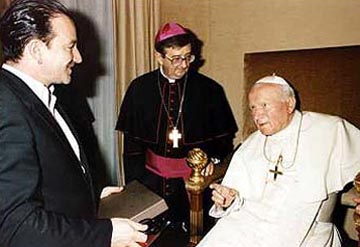
Bono: "Excuse me, what are you doing in my chair?"
April 14, 2003
And later this week, I'll be answering the question "What is the meaning of life?". Not really, it actually seems that I have more questions than answers. Of course, you do have to ask questions before you can get any answers, so I suppose I'm making progress. For a couple of weeks in our group Bible study, we started discussing "the will of God" or, more specifically, the different "wills" of God. The study we were using, written by my sister-in-law's father, a pastor, proposed the idea that God doesn't have a specific "perfect" will for individuals other than to follow his moral will and his sovereign will. It turned out that I'd been pondering such a concept in my own head for a while, and it makes a lot of sense. For a good explanation, go read Vexation #17: Are You in God's Will?. It's a very solid Biblical explanation of this idea.
Something else I've been pondering lately is Calvinism. This is due in part to the fact that Genia and I have been attending a Presbyterian church since we moved to Chattanooga. I am attracted to many of the aspects of the Reformed worldview -- see RazorMouth for excellent articles from a Reformed perspective on culture, politics, education, and of course, theology. However, I still have questions and issues with election, which is at the heart of the Reformed theology and worldview. Basically, Calvinism teaches that God specifically elected certain people from all nations for salvation, and that he specifically elected others for damnation. That's a tough pill at first glance, isn't it? I still haven't been convinced one way or the other, but I continue to look into it. One interesting Reformed concept is that God is "God-centered" instead of being "man-centered." This concept is best e!
xplained and promoted by John Piper's Desiring God Ministries. A weblog I frequently read called Truth Becomes Lies has an interesting post entitled "God's Glorious Conspiracy of Self-Exaltation" discussing this concept as well.
One final link, added at the last minute: Desiring God Ministries also has an interesting article discussing their concept of Christian Hedonism, and why they think being a Christian Hedonist is the way to live. Check it out, it's an interesting read.
March 6, 2003
No, no, I'm not talking about Britney Spears or Justin Timberlake. It's much worse than that. "God is My Boyfriend?", a new column brought to us by RazorMouth, discusses the lack of lyrical depth in the modern "praise and worship" genre. This is something that I've noticed firsthand, having worked for Family Christian Stores a few years ago, and having been a member of a couple Charismatic churchs that I felt left something to be desired in the area of worship lyrics.
While at Family, we were constantly barraged by new "worship" compilation cds, new "worship" groups, and the now-obligitory "worship album" by popular pop and rock artists. It was not uncommon to find a good track or two on most of the cds that came through, but on the whole, they don't approach the lyrical depth of the hymns. Many of my favorite worship songs now are actually hymns that have been put to modern music. One album I came across that still means a lot to me today is "All I Can Say" by David Crowder Band, which had several excellent songs and a truly unique sound.
As for corporate worship, Genia and I were members of two Charismatic style churches [that will go unnamed] -- both of which lacked something when it came to the choice of worship lyrics. The songs seemed to be very "me" focused and very simplistic. Another commonality was their penchant for repeating the same song or chorus over and over again until they had completely lost whatever relevance they may have started out with. When Genia and I first started attending North Point Community Church, it was refreshing how God-centered the songs were. They seemed much more focused on God's character and His redemption. Refreshing indeed. Now that we are in Chattanooga and searching for a church home, we have visited a couple of Presbyterian churches, both of which worshipped primarily through hymns. One church had a traditional music style and one had a contemporary style, but the words of the hymns rang so true and were so affecting -- I lov!
ed both worship services. Hymns are where it's at, for the most part!
February 25, 2003
This morning I came across an interesting column on The Internet Monk called "Why I'm Not a Preacher, and Why That's a Good Thing". The thesis statement of the column is that "we don't need more preachers, we need better ones," and I certainly agree, after reading what the author had to say. Another great point he makes is that unless you absolutely can't not become a preacher or pastor, then you probably aren't called to be one. He specifically references 1 Corinthians 9:16 and Jeremiah 20:9 to back up this claim. I agree with that as well... I know personally that I can't imagine not going into the ministry. Speaking of which, late last!
week I received my official acceptance letter from Covenant College. Now if I can just find $19,000 a year to pay for it...
December 5, 2002
There is a fascinating post at LocustEater that discusses thoughts on the marketing of Todd Beamer ("Let's Roll!") and Cassie Bernall ("Yes, I believe in God!"). The post discusses how these two have been manipulated for consumeristic purposes but also how the image of them being sold to Evangelical Christians is one that is in conflict with the true concept of grace. It's definitely worth a read.
September 25, 2002
Mel Gibson is set to direct a movie called The Passion which will tell the story of the last twelve hours of the life of Jesus Christ (obviously the pre-resurrection life). This is supposed to be a project very close to his heart as sources indicate he is a very devout Catholic. The only catch here is that he wants to have all the dialogue in Aramaic and Latin, and he does not want to use subtitles.
This article contains a few good quotes from Gibson about the project:
For me that's more real and hopefully I'll be able to transcend language barriers with filmic storytelling," Gibson said."It's very visual and it's about something that has ... affected civilisation in every possible way you can imagine," the 46-year-old actor, a devout Catholic, added.
"No-one wants to touch something in two dead languages. They think I'm insane, maybe I am," joked Gibson.
My guess is that the only way he can really do this is if he approaches it as if making a silent film. Whether it works or not, and whether he ends up subtitling it (as industry watchers predict), I'm going to want to see it.
September 19, 2002
A passage from Madaleine L'Engle's Walking on Water:
"I use story to explain the love of God, retelling Oscar Wilde's The Happy Prince. In that story, the statue prince gives himself away out of compassion, piece by piece--his gold finish, his sapphire eyes, the ruby in his sword. Finally, the mess that is left is thrown in the dump yard. This is what the gospel is to me--Jesus giving himself away, giving himself away."
I love that description. Maybe one day I'll be living that way myself.
Via @U2, I found a great article from a Christian magazine called Prism about why evangelical Christians should get on board with Bono's mission involving the AIDS crisis and Africa. It's called Why I Would Follow Bono Into Hell and it's excellent. It goes into a fair amount of detail about the singer's work and how it is Biblically valid and important for all Christians.
My favorite passage from the article is the last paragraph:
I believe in Bono because he offers me a living exemplar to diffuse the stereotypes that non-Christians inevitably hold of Christians (by simply dropping his name I can minimize the damage done by televangelist scandals or Harry Potter book burnings). I believe in Bono because he has shown me that the gospel can weave itself into the fabric of my daily life without making me act and speak like a Martian. I believe in Bono because he is first off the mark to poke fun at himself and laughs the loudest at his own mistakes. I believe in Bono because he has set up an effective mission outreach in the center of hell for the last twenty years. But ultimately, I believe in Bono because he says he believes in me and my ability to do the same, to leave this world in a better condition than when I first arrived. Follow Bono into hell? For those that have ears to hear, what other choice do we have?
As a tidbit for those still wondering "is he or isn't he?" the article does quote Franklin Graham talking about Bono's profession of faith. A profession of faith ws also given to a group of Washington leaders as they met about this same issue, as related in this article reprinted from Christianity Today.
In other Bono related news, YouTwo.net has a detailed description of the taping for this Friday's episode of Oprah, on which Bono is the primary guest. He'll be talking about DATA and the work he has been doing with that. He also discussed his religious background a bit, and, of course, gave Oprah his sunglasses at the end of the taping.
And finally, a short article that mentions 15 Christian music artists that have signed on to show a video Bono made to talk about the crisis in Africa and our Biblical mandate (over 2,000 scriptures!) to help with the plight of the poor. This link also included a link to watch the video. Enjoy!
September 16, 2002
I just finished reading an interesting column about a church leader who is starting a movie club at his church. Before you roll your eyes and start imagining people watching crap like Left Behind and then sitting through a sermon, go read the article. They're watching films like The Matrix, Chocolat, and Halloween. The intention isn't evangelism, but discussion of the themes, characters, motives, and messages. I think it's a great idea. Of course, the church Genia and I attend, although hip enough for an idea like this (Andy often inserts film clips or music clips into his messages), is far too large to make this work. However, I think it might be fun within a group of tight friends. We're always sitting around watching movies, but it's usually something light like the beloved Austin !
Powers or Airplane! -- maybe we should try watching something a little deeper.
September 11, 2002
A passage from Francis Schaeffer's book Sham Pearls for Real Swine:
"Only by giving the Bible a devotional spin when we read it, by taking isolated verses out of context and ignoring the raw whole, by filtering and interpreing, do we "civilize" it. Civilized, the Bible has become a devotional prop of middle-class values instead of being the rude challenge to false propriety it actually is."The Bible is a dangerous, uncivilized, abrasive, raw, complicated, aggressive, scandalous, and offensive book. The Bible is the literature of God, and literature — as every book-burner knows — is dangerous.The Bible is the drama of God; it is God's Hamlet, Canterberry Tales, and Wuthering Heights. The Bible is, among other things, about God, men, women, sex, lies, truth, sin, goodness, fornication, adultry, murder, childbearing, virgins, whores, blasphemy, prayer, wine, food, history, nature, poetry, rape, love, salvation, damnation, temptation, and angels.
"Today the Bible is widely studied but rarely read. If the Bible were a film, it would be R-rated in some parts, X-rated in others. The Bible is not middle class. The Bible is not "nice." The Bible's tone is closer to that of the late Lenny Bruce than to that of the hushed piety of some ministers."
I think that's a pretty fantastic description of the Bible.
September 9, 2002
Last week saw me getting political. This week I'm going theological.
For my admissions essay to Covenant, I'm writing about Martin Luther and the Reformation. Specifically, whether or not he was scripturally justified, and what scriptural principles affect my responsibility for social and church justice. The kicker is that the essay is only supposed to be 2 pages long. Granted, this is primarily aimed towards high school seniors so I'm guessing they don't want something as in-depth as what came to my mind when I read the question. But since I'm not from a Reformed (Presbyterian, Lutheran, etc.) church background, I have a lot of reading to do on the subject to sound intelligent when I write about it. Fortunately, this sort of thing is my bag, baby, so the research is fun.
The first good article I found online (thanks, Google!) was one by R.C. Sproul entitled Was Luther Wrong? The article goes extremely in-depth into the theological issues behind the Reformation, primarily the issue of sola fide, which means "faith alone." Basically, the Catholic church believes that a man is justified by Christ, through faith and works, and Reformed (and most evangelical churches) churches believe that a man is justified by Christ alone, through faith. The phrase I used in my headline, Simul Justus et Peccator, means "At the same time, just and sinner" -- we are justified by Christ while yet sinners. The article also goes deeply into the concept of "imputation" whereby our sin was imputed upon Christ (absolving us of their penalty) and Christ's righteousness is imputed upon us (bestowing upon us the benefits thereof).
It's a very long read (give yourself a good 45 minutes) but well worth it if you are at all interested in such things. Getting a fuller understanding of theology really helps me develop a greater appreciation for the grace of God and a greater love of Christ. My 3-4 years at Covenant are going to be amazing.
August 19, 2002
For the past week, my wife and I have begun to make plans for me to try and go back to college next fall and get a ministry related degree. This is a big deal for us because we'd been considering that a dream whose time was "indefinite" at best, but last Sunday really began to feel God calling us to move these plans up to next August. I've been struggling in my faith about it because I know that my high school and college records weren't so great, and this is a fairly selective school. I also know that it's very expensive.
Just about 10 minutes ago, I was reading a "Deeper Walk" article on RELEVANTmagazine.com about trusting God. It was an excerpt from Oswald Chambers and it was encouraging, but I must admit I was still living a bit in my fears.
I'm at work, and one of the ways we serve our clients is through an online chat program called LivePerson. It works basically like an IM. I was finished assisting this customer when the following interaction took place:
John: Thanks for chatting... have a great day.
Deirdre: I'm looking forward to pursuing it as soone as possible! By the way, anything you need prayer for? I'm not weird, I'm just trying to obey God. If not, it was great chatting with you and you have a great day too!
John: Well, to be honest, I'm hoping to go back to school in the fall for a ministry degree. Thanks for asking.
Deirdre: John you better watch out! I'm really excited now! I thought you might have signed off already so you just taught me some more patience!!! It is so in Jesus name! Thanks for being honest because it encouraged my obedience the more! Father, in the name of Jesus, we ask that you grant the request of this our brother! Etch in his heart your oracles and make him to be a vessel of honor used to PUT a difference between CLEAN and UNCLEAN! In JESUS matchless name, AMEN! Again John, thanks for encouraging your sister in the Lord! We WILL have a GREAT day now!!!!
John: Thank you again Deirdre!
He's there, everybody. And He's thinking about you.