August 25, 2005
Oral Tradition in the New Testament
[Note: The following is the other post I'd been working on for a few days prior to my previous announcement about a blog sabbath. Please note also, that I continue to do more focused daily reading in the Church Fathers, and am posting without commentary passages I've come across over at my companion blog. My family and I continue to covet your prayers.]
That there is not only solid evidence of oral tradition in the New Testament, but that Christians were commanded to hold to the oral tradition (along with the written tradition) is also based on solid evidence, and I will draw the immediate implications of these facts.
First, let's examine the evidence (all emphases below added).
We note the preaching of the Gospel has always been by oral peaching, even if literary forms of the Gospel are canonized in our Scriptures. So we are not surprised to hear St. Paul say to the Thessalonians:
Because of this we also give thanks to God unceasingly, so that when you received the word of God which you heard from us, you received not the word of men, but just as it truly is, the word of God, which also is at work in you who believe. (1 Thessalonians 2:13)
Indeed, the Apostolic transmission of this Gospel was essential to God's redemptive plan for the cosmos. The writer to the Hebrews exhorts his readers:
[H]ow shall we escape if we neglect so great a salvation, which in the beginning was spoken by the Lord, and was confirmed to us by those who heard Him (Hebrews 2:3)
St. John echoes this:
That which was from the beginning, which we have heard, which we have seen with our eyes, which we have gazed upon, and our hands have handled, concerning the Word of life--and the life was manifested, and we have seen, and bear witness, and we declare to you the eternal life which was with the Father and was manifested to us--that which we have seen and heard we declare to you, in order that you also may have fellowship with us; and indeed our fellowship is with the Father and with His Son Jesus Christ. And these things we write to you that our joy may be fulfilled. And this is the message which we have heard from Him and we announce to you, that God is light and in Him is no darkness at all. (1 John 1:1-5)
From the beginning of the world, God's redemption is communicated orally. Not only that, however, it is also transmitted from generation to generation orally. St. Paul writes:
The things which you learned and received and heard and saw in me, practice these things; and the God of peace shall be with you. (Philippians 4:9)
Note that St. Paul does not spell out in detail to the Church in Philippi all the things that they had “learned and received and heard and saw” in him here in his epistle to them. He presumes a certain content to their understanding, a content embodied by his way of life among them, that he need only note in summary here in his epistle. That is to say, there was an oral tradition in addition to his letter which he calls them to practice.
St. Paul goes on to say to St. Timothy:
Hold to the pattern of sound words which you have heard from me, in faith and love which are in Christ Jesus. (2 Timothy 1:13)
St. Paul doesn't say here, “Put into practice the Scriptures you have studied from your youth,” but enjoins upon them the things they hear and saw him say and do. Which is not to say that St. Paul would not want St. Timothy to put the Old Testament into practice; but it is to say that it was the oral tradition St. Timothy was to put into practice.
Note also that this exhortation, and the following one, are from the very same text that will later claim that all Scripture (the primary reference here is to the Old Testament) is “God-out-breathed,” and is profitable for the leaders of the Church in their ministry to Church members of teaching, reproof, correction and training in righteousness (3:16-17). Indeed, it is ironic that those who misinterpret these verses to teach the all-sufficiency of Scripture (over and against oral tradition), fail to reckon with the fact that St. Paul does not enjoin St. Timothy to “ask for the ancient paths of the Lord” (Jeremiah 6:16), but instead exhorts him to “hold to the pattern of sound words” which he had heard from St. Paul. He continues to exhort St. Timothy:
And the things which you have heard from me through many witnesses, commit these to faithful men who will be competent to teach others also. (2 Timothy 2:2)
Again: St. Timothy was not enjoined to write about it, nor to disseminate the Old Testament or St. Paul's letter, but to disseminate what he had heard. I don't deny the essentiality of the Scriptures, nor that Christians ought to hold to them and disseminate them. But I am pointing out that St. Paul commanded St. Timothy to do something quite specific: hold to the oral tradition and to pass it on.
Indeed, that this keeping of the oral tradition is important to the Christian way of life is further supported by the letter to the Hebrews. The author of Hebrews notes that the surpassing nature of the final revelation in Christ demands that we give earnest attention to that which we've heard:
On account of this we must give the more earnest heed to the things we have heard, lest we drift away. (Hebrews 2:1)
Here, the emphasis on the oral tradition is clear: The author of Hebrews is writing that which will later be canonized as Scripture (and, I would argue, is Scripture from its initial composition) and could refer to the Old Testament Scriptures. But he does not encourage his readers to give more earnest heed to the Scriptures, but to the oral tradition that they had received. And that failure to do so would be for them to drift away.
The key to this oral tradition was its antiquity; i. e., it predates all the New Testament writings and goes back to “the beginning.”
Brothers, I am not writing a new commandment to you, but an old commandment which you have had from the beginning. The old commandment is the word which you heard from the beginning. . . . Therefore let that which you heard from the beginning abide in you. If what you heard from the beginning abides in you, you also will abide in the Son and in the Father. (1 John 2:7, 24)
and:
This is love, that we walk according to His commandments. This is the commandment, that as you have heard from the beginning, that you should walk in it. (2 John 6)
Once again, adherence to the oral tradition is essential for the life of faith—doing so will enable us to abide in the Son and in the Father.
Not only does the final revelation of God in Christ begin with the oral declaration of St. John the Forerunner, it ends with the oral declaration of St. John the Revelator in the Apocalypse, as Jesus exhorts his Church in Sardis:
Remember therefore how you have received and heard, and hold fast, and repent. Therefore if you will not watch, I will come upon you like a thief, and by no means shall you know what hour I will come upon you. (Revelation 3:3)
The Church in Sardis was called back to the oral tradition. Once again, whether or not we hold to the oral tradition has eternal consequences. For not only is the oral word to be heard, it is to be lived:
Remember your leaders, who spoke the word of God to you, of whom considering the result of their conduct, imitate their faith. (Hebrews 13:7)
Indeed, we do this so that we may increase our diligence and avoid dullness:
But we desire that each one of you show the same diligence to the full assurance of hope until the end, lest you become dull, but become imitators of those who through faith and patience inherit the promises. (Hebrews 6:11-12)
In fact, imitation is a frequent exhortation from St. Paul to his readers:
Therefore I exhort you, be imitators of me. . . . Be imitators of me, just as I also am of Christ. . . . Therefore be imitators of God as beloved children. . . . Be fellow imitators of me, brothers, and look out for those walking this way, just as you have us for a pattern. . . . And you became imitators of us and of the Lord, in that you received the word in much tribulation, with joy of the Holy Spirit . . . . For you, brothers, became imitators of the churches of God which are in Judea in Christ Jesus, because you suffered the same things from your fellow countrymen, just as also they did by the Jews . . . (1 Corinthians 4:16; 11:1; Ephesians 5:1; Philippians 3:17; 1 Thessalonians 1:6; 2:14)
And what is it that the readers are to imitate? The oral tradition as lived by the Apostles and those leaders who themselves are passing on the oral tradition.
The implications are clear: Christians ought not merely hold to Scripture alone, but are also to hold to that which has been believed “always, everywhere, and by all” (St. Vincent of Lerins, Commonitory, 2). It is essential to our life in Christ to do so, and if we are not doing so, we must repent and return again to that which the Church heard and received from the beginning.
The challenge, however, is not necessarily that there was an oral tradition--it seems even sola scriptura adherents would agree to that--but rather that there was an oral tradition in addition to the written tradition, and, further, what the content is of that oral tradition.
Here, due to the presuppositions surrounding sola scriptura, I am forced to articulate my case--if I am to have any chance as to plausibility and persuasiveness--within presuppositional constraints I do not accept. If I argue for oral traditional content that is also clearly expressed in the Scripture, my interlocutors will reply, "Ah, but this is just what we are claiming: all oral tradition is confined within the written tradition (i.e., the Scriptures)." If I argue for oral traditional content that is not clearly expressed in Scripture, then my interlocutors will reply, "Ah, but since this is not in Scripture, it is merely the tradition of men." So, I'm sort of damned if I do, and damned if I don't.
However, despite this seemingly impossible scenario, I will, in fact, demonstrate that there is an oral tradition that is different from but in concert with the written tradition. To do so I will have to confine myself to the earliest witnesses, the ones closest in time to the Apostles. For the closer historically I can be to the Apostles, the more plausible will be my case that the oral tradition for which I am providing citations is connected to the Apostles. Furthermore, I will also have to demonstrate that the oral traditional content I am claiming as apostolic is believed "always, everywhere and by all." Since the earliest witnesses we have are few, demonstrating that at least two of these witnesses agree will have to at least plausibly suggest--if it cannot be conclusively proven due to the nature of the evidenciary limitations--that such beliefs were, indeed, held always, everywhere, and by all.
That being said, then, the following are some aspects of oral tradition which are not expressly stated or are obscure in the New Testament:
1. The extent of the canon of Scripture (Muratorian canon, citations by the Apostolic Fathers, St. Athansios' festal letter).
2. Triune baptism accompanied with fasting, both by the baptisand and by the sponsors (Didache 7, St Justin's First Apology 61).
3. Only one (Sunday) Eucharist celebrated by one president of the presbytery or bishop (1 Clement 41; St Ignatios to the Philadelphians 4).
4. Orderly succession of leadership from the apostles (1 Clement 44; St Irenaeus Against Heresies III.3).
5. A specific order of worship with specific prayers recited (Didache 9-10; St Justin's First Apology 65-67).
6. Eucharistic elements are sacramentally the body and blood of Jesus (St Ignatios to the Ephesians 20; St Ignatios to the Smyrnaens 7; St Justin's First Apology 66; St Irenaeus' Against Heresies V.2,2-3).
7. Closed communion (no unbaptized communicants) (Didache 9; St Justin's First Apology 66).
8. The Greek Old Testament (Septuagint) is the Christian Old Testament (as opposed to the Hebrew, or as it is later known, the Masoretic, text) (St Justin's Dialogue with Trypho 71-73; St Justin's Address to the Greeks 13; St Irenaeus' Against Heresies III.21).
Clearly this is not an exhaustive list, and some items (Triune baptism; Sacramental Eucharist) are expressly stated in the New Testament but about them there is present dispute. But it is, nonetheless, a list of substantive items.
And it shows, I think, even to adherents of sola scriptura, that the tradition of the Church is both more than merely the content of the Scriptures and is apostolic in origin.
Addendum
I have made reference above to St. Irenaeus' Against Heresies as a source for several of the items of the apostolic oral tradition. Some might wonder how it is that I can claim that St. Irenaeus, who wrote his work c. A.D. 185, can lay a claim to faithful transmission of the oral apostolic tradition. Let me cite one passage from Against Heresies to make this claim clear:
4. But Polycarp also was not only instructed by apostles, and conversed with many who had seen Christ, but was also, by apostles in Asia, appointed bishop of the Church in Smyrna, whom I also saw in my early youth, for he tarried [on earth] a very long time, and, when a very old man, gloriously and most nobly suffering martyrdom, departed this life, having always taught the things which he had learned from the apostles, and which the Church has handed down, and which alone are true. To these things all the Asiatic Churches testify, as do also those men who have succeeded Polycarp down to the present time,-a man who was of much greater weight, and a more stedfast witness of truth, than Valentinus, and Marcion, and the rest of the heretics. He it was who, coming to Rome in the time of Anicetus caused many to turn away from the aforesaid heretics to the Church of God, proclaiming that he had received this one and sole truth from the apostles,-that, namely, which is handed down by the Church. There are also those who heard from him that John, the disciple of the Lord, going to bathe at Ephesus, and perceiving Cerinthus within, rushed out of the bath-house without bathing, exclaiming, "Let us fly, lest even the bath-house fall down, because Cerinthus, the enemy of the truth, is within." And Polycarp himself replied to Marcion, who met him on one occasion, and said, "Dost thou know me? ""I do know thee, the first-born of Satan." Such was the horror which the apostles and their disciples had against holding even verbal communication with any corrupters of the truth; as Paul also says, "A man that is an heretic, after the first and second admonition, reject; knowing that he that is such is subverted, and sinneth, being condemned of himself." There is also a very powerful Epistle of Polycarp written to the Philippians, from which those who choose to do so, and are anxious about their salvation, can learn the character of his faith, and the preaching of the truth. Then, again, the Church in Ephesus, founded by Paul, and having John remaining among them permanently until the times of Trajan, is a true witness of the tradition of the apostles. (Against Heresies, Bk III.3,4, emphases added)
In other words, we have this chain of transferral of the apostolic tradition: the Apostle John to St. Polycarp to St. Irenaeus. If 2 Timothy 2:2 above can be delineated thus: St. Paul to St. Timothy to faithful men to others--then we may note that the transmission from the Apostle John to St. Irenaeus is three connections where 2 Timothy 2:2 notes four, thus being well within the literal apostolic exhortation (and of course within its intended meaning).
August 22, 2005
The First Edition of the New Testament
[Note: The following is a post I'd been working on for a few days prior to my previous announcement about a blog sabbath. Please note also, that I am doing more focused daily reading in the Church Fathers, and posting without commentary passages I've come across over at my companion blog. My family and I continue to covet your prayers.]
In my previous blogging about sola scriptura, one of my fellow parishioners emailed me about David Trobisch's The First Edition of the New Testament (Oxford: 2000). I was intrigued. He offered it to me as a gift. And I am extremely grateful. I present here something of a summary and review of Trobisch's argument.
First, a resume of the conventional “conservative” understanding of the formation of the canonical New Testament. Each individual book that would later form the canon was inspired from the moment of its writing. The canonization process was primarily a matter of the Church's recognition of that divine origin and authority. Over the period of about two and a half centuries from the consensus date of the composition of the last of the New Testament books, the early Church sifted through various early documents purporting to be divinely authoritative, eventually settling on the 27 we now recognize. There was no ecumenical council who declared these books to be canon, but a grassroots recognition as exemplified in the “Muratorian canon,” in the works used by early Christians such as Origen in their own writings, and St. Athanasios' festal letter (though this was later recognized by local councils in Rome, Hippo and Carthage), so that by A.D. 400, the canon of the New Testament was recognized universally.
Trobisch, however, wants to call this “consensus view” into question.
The thesis of this study is that the New Testament, in the form that achieved canonical status, is not the result of a lengthy and complicated collecting process that lasted for several centuries. The history of the New Testament is the history of an edition, a book that has been published and edited by a specific group of editors, at a specific place, and at a specific time. (6)
I have restrained myself from advancing a theory about where and when and who published the Canonical Edition. However, I hope this study will serve as an important step toward finding valid answers to these questions. In addition, I do not intend to challenge the current consensus that none of the writings included in the New Testament originated significantly later than 150 C. E. (7)
Indeed, this canonical edition was in place early and used widely.
At the end of the second century and in the beginning of the third, Irenaeus was reading this edition in Lyons; Tertullian read it in Carthage and Asia Minor; Clement had it in Alexandria, and Origen in Palestine. This particular edition, in other words, was read worldwide. (106)
A view such as this, that breaks with the received scholarship is going to have to argue cogently and clearly for such a position. Trobisch does just that. His argument falls into three parts: the manuscript evidence, internal evidence of a final redaction and internal evidence of the editor(s) addressing the readers. I will focus primarily on the manuscript evidence.
Manuscript evidence
Trobisch focuses on five key pieces of evidence in the manuscripts that, he argues, provides incontrovertible evidence of a final redaction of an editor (or group of editors) intent on publication of the volume. Those five pieces of evidence are: the widespread use of nomina sacra; the almost exclusive use of the codex; the arrangement of the writings into clearly demarcated groups, and the number of those writings; the titles of the works; and the title of the canonical edition.
nomina sacra
The nomina sacra are abbreviations of sacred words such as theos (God), huios (Son), christos (Christ), iesous (Jesus), and so forth. The manuscripts vary in how they abbreviate the original word, and have a horizontal line drawn across the word. That these are not intended to be abbreviations is evident from the fact that there is no standard shortening to which they adhere and that in many cases would take more time and effort (especially in drawing the horizontal line over the word) than would standard abbreviations. Neither are the nomina sacra an imitation of the Jewish Tetragrammaton (the four consonantal characters for the name of God, usually rendered in English YHWH, and always unpronounced, with the word Adonai, Lord, usually substituted in oral readings), since the Tetragrammaton was frequently written in Hebrew characters. Further the nomina sacra was not a consistent convention for the Tetragrammaton even in the Septuagint (the Greek Old Testament).
Furthermore, the nomina sacra exist in our earliest manuscripts and consistently throughout all our earliest New Testament writings. It is extremely unlikely that the nomina sacra was an agreed convention by all the New Testament writers since they wrote at such disparate times and places and under extremely variant circumstances.
Clearly then the nomina sacra are an intentional publishing convention.
use of the codex
Christians were alone among their contemporaries for devoting their important literature to the codex form. Trobisch charts a provisional graphic demonstrating the growth of the use of the codex from the first century onward. Among the users of the codex, Christians by far outnumbered their contemporaries. Indeed, our earliest copies of the New Testament are codices.
That the use of the codex was an intentional publishing convention is seen from its universality among the manuscript copies we have, dating back to our earliest copies, and that this was a unique characteristic of the “first edition of the New Testament” that set it apart from similar works of its day.
arrangement and number of writings
The oldest complete copies of the New Testament all show the complete list of 27 New Testament canonical books (or it can be determined, if they are incomplete, that they are almost certainly to have done so). The fourth century codex Siniaticus lists all twenty seven, in the groups of Gospels, Praxapostolos (Acts with the Catholic epistles), the Letters of Paul and the Apocalypse. Fourth century Vaticanus is incomplete but from various factors is considered to have had the New Testament 27. The fifth century codices Alexandrinus and Ephraemi Rescriptus had all twenty-seven books. All four of these early manuscripts are independent text traditions (different families of copies) and all of them contain the Septuagint—thus making them complete Christian Bibles. And although the arrangement of the books differ among the codices, both in the arrangement of the four groups (Gospels, Praxapostolos, Letters of Paul and Apocalypse) and works withing those groups, they all have the same four groupings and all groupings have the same works within them.
Given this consistent grouping of the New Testament books, this is almost surely an intentional publishing decision.
titles of individual works
That the titles of the individual New Testament books (e. g., “Gospel according to John”) were not original is almost universally accepted. But our earliest manuscripts contain these titles. These titles are awkward both in the grammatical constructions (“according to [author's name]”--kata plus accusative) and are not entirely accurate representations of the genre they entitle (gospel, praxapostolos), once again points to an intentional publishing decision.
title of the canonical edition
Finally, tucked away in 2 Corinthians 3 is the distinction made between the “old testament” and “new testament.” The joining of the Septuagint and the canonical New Testament in our early manuscripts, and the denomination of them as “old” and “new,” similarly represents an intentional publishing decision to give the entirety of the New Testament books a name and reflects a clear theological position on the relationship of the Hebrew Scriptures and the New Testament.
Internal evidence
implied authorship
Trobisch notes that the titles of individual works indicate who the authors are. The entire New Testament canon is put together in such a way so as to identify the authors. For example, the order of the catholic epistles matches the order of the list of the “pillars” of Galatians 2:9. The identity of Matthew is provided by the references to “Levi” in the other gospels, but by “Matthew” in the Gospel according to Matthew. Mark is identified in the Acts and in Paul's letters; which serves to connect Peter with Paul and all of Paul's letters. Trobisch goes into great details making all these connections. But his point is simple, the entirety of the canonical New Testament serves to authenticate the authorial titles of individual works with dozens of intricately connected references within the New Testament works itself.
That this preponderance of connections was an intentional publishing decision seems a very strong plausibility.
canonical New Testament arrangement mirrors Septuagint
The title of the canonical edition, noted in 2 Corinthians 3, is joined with the Greek Old Testament, and the arrangement of the New Testament canon is a mirror of the arrangement of the Old Testament canon. The Torah is the foundation of the Septuagint as the Gospels are for the New Testament. Just as the historical books of Joshua through Esther connect the Torah with the wisdom literature, so too does the Acts connect the Gospels with the Epistles; where the wisdom literature and the epistles together put into practice what is fundamentally revealed in the Torah and the Gospels. The prophetic literature of the Old Testament points to the coming of the Lord in his incarnation just as the Apocalypse points to the coming of the Lord in his glory.
That this was an intentional publishing decision, especially since the arrangement of the Septuagint differs markedly from the Hebrew Masoretic text, seems clear.
editorial note to the reader
The Gospel according to John ends (21:25) with a very clear address to the reader. There are other similar such notes scattered throughout the New Testament. There is Luke's acknowledgment of other Gospels in Luke 1:1-4. There is Peter's acknowledgment of Paul's writings as canonical Scripture (2 Peter 3:15-16). Paul himself acknowledges other of his own writings that are not present in our canon (the epistle to the Laodiceans, Colossians 4:16). All of these, and others Trobisch discusses, are an intentional publishing redaction intent to draw the reader's attention to the fact that what they hold in their hands is the canonical edition of the New Testament.
My extremely brief summary of Trobisch's argument does not do the book justice. His work is only a bit over a hundred pages long, but his evidence and argumentation are dense and tightly written.
I'm not competent to judge Trobisch's argument on its merits. I know just enough of some of the subjects he addresses (textual criticism, New Testament manuscripts, etc.) to both follow his argument and find it extremely persuasive.
I definitely recommend this book for your reading.
August 19, 2005
As Good a Time As Any
I rarely get personal on my blog. That is to say, my blog is not replete with a diary of what I did yesterday, how I feel at 3:28pm on a Friday, or what have you. Occasionally I will write about my feelings about my wife and daughters. And there are the Fatherhood Chronicles.
But that's about it. I'm a "life of the mind," guy, God help me. And so that's what my blog is about.
I say that simply to preface this:
This has been an excruciating summer, increasingly so as the summer has progressed. I won't list any details. There's no need to. But I've only been in a similar situation in my life once before, a bit more than a decade ago.
That's not to say there hasn't been great joy. Sofie's growth and development, and the love she is more and more able to express to us fills me with inarticulate happiness. Delaina's birth, her new-found voice of coos and gurgles, her beautiful smile, move me to tears. Some great work on papers and some good reading have been accomplished. My wife, Anna, and I, despite her own wrestlings with postpartum depression, have shared many laughs and happy moments. All good. And all make me almost unable not to be thankful.
But there is a thlipsis, a squeezing, that is most inconvenient. I have not wrestled with the darker emotions like this in years. My prayer life is nearly non-existent. Certain sorts of household needs appear to be going unmet.
My friend and workday-morning-ride pastor, he of the li'l red theological shortbus fame, has spoken to me a word. He said to check his word out with Father Patrick. I think I am on good ground supposing Father Patrick would reaffirm the good pastor's word.
So: I will not be giving my blog any attention for a bit. I have a couple of posts that are almost done which I will likely post over the weekend, if I decide to post them. And I will set up the main page so that the extra posts are bumped off. You can find everything in the archives links. (And hey, looking at the counter, I'll probably go over 100K in a few days.)
In the mean time, my family and I would appreciate your prayers.
The Good, the Beautiful and the True
Do we always search out the truth and then conform our reasoning to it later? Or do we find a position attractive, have an intuition as to its truth, and then follow the path of arguments so we arrive at that which we desired to begin with? I'd be a fool to insist on the first and deny the last. It is a combination of both. I think we do have an intuition that a particular conclusion is true, and find it beautiful and desirable. But I also think we legitimately can follow out the reasoning, examine the arguments, and submit the case to logical analysis. And if we still come out on the other end knowing it is true, our initial desire for it does not falsify the truth of it. If something is true, it is true no matter what road I took to get to it. If my pathway to it fails reason's strictures, I may not be able to demonstrate that it is true, and that would be a great loss. But it would still be true nonetheless.
Furthermore, truth by its nature is beautiful and desirable. Of course we will be attracted to it and our reason will want to struggle and scrape its way toward it. Reason will crawl on hands and knees, following this dead end trail, doubling back, slicing its hands on this jagged contradiction, will hang with sharply in-drawn breath over that abyss of non-sequitor, doggedly continuing on, even through darkness and paradox, until it at last comes to that which it has desired, that for which it has longed, that which gives it meaning and life. And once reason arrives at truth, once the desire for the good and the beautiful has been fulfilled, it will not cease being true, nor falsify reason's path.
August 18, 2005
How to Find the New Testament Church Today
I was asked today, about the authority of the Church in relation to the authority of the Scriptures.
I replied, "I am saying that the authority of the Scriptures derives from the authority of the Church via her union by grace with God in Christ. It is not a greater or lesser authority, but the same authority."
One respondent asked, "[W]hat is the 'church' that has this equal authority. Me? Dad? the elders? the Pope? Based on what?"
I replied, "That Church which was founded by Christ on his Apostles through the Holy Spirit, and which continues in direct descent to this day. These things are traceable through objective historical evidence."
The same respondent replied, "How is it recognized (specifically)? Where will I find that equal authoritative church this sunday (or saturday?)? When I get there, how do I determine that the equal authority to the bible is 1) speaking from the pulpit? 2) on the church board of elders? 3) all the people sitting in the pews? 4) someone in Rome provides the rules? Are we all equally authoritative then? (since we are the Church?)"
And here is my fuller answer to him:
If you're truly serious, let me suggest the following:
1. Start with the New Testament communities (such as Thessaloniki, Antioch, Ephesus and so forth). As best as you can determine who the New Testament describes as leaders there, apostles and/or their representatives.
2. Next, look at the earliest Christian writings outside the New Testament (e. g., 1 Clement, St. Ignatios' epistles, and so forth) and note two things: a) who were the leaders, and b) what did they teach?
3. Next, look at church historians (Eusebius, Sozomen, etc.) and continue asking these two questions about the various New Testament communities.
4. Work your way forward to today.
You could, of course, work your way backwards, but this would demand trying to figure out where to start. The advantage of my suggestion is that there is no bias, no presuppositions--you simply determine through historical research where is the living continuity in leadership and doctrine from the New Testament to today.
You will, of course, very soon run into the Church councils, and this will aid your research greatly for it will list those leaders and focus on the doctrines the entire Church has taught from the New Testament. You, of course, will be able to verify this fact from your own reading.
Now you may very well respond that this is a lot of work, would take too much time and so on. All of this is true.
But if you want to look into this yourself and not depend on someone else's biases and prejudices, this is the way to go.
Having completed this exercise, you will very easily and clearly be able to determine which group today is the Church and worthy of your trust.
The Essence of Scripture
The three global monotheistic faiths—Judaism, Christianity, and Islam—all have their Scriptures: the Hebrew Bible, the Christian Old and New Testaments, and the Koran. The Koran famously refers to Jews and Christians as the “People of the Book.”(cf. Suras 9:29; 29:46), and, indeed, all three faiths are known for their devotion to their Scriptures.
What is clear, however, is that both Judaism and Islam have a different relationship with their respective Scriptures than do Christians with theirs. Both Islam and Judaism focus explicitly on that actual text of their respective Scriptures such that the Masoretic text is well known for its scrupulosity in passing down the exact text of the Hebrew Bible, and Islam does not even acknowledge any versions of the Koran as being the Koran but are considered commentaries (by translation) on the Arabic text.
Christian Scriptures, on the other hand, though handled with reverence and fidelity, and though focused attention was given to the faithful transmission of the actual text, were nonetheless not handled with the same sort of scrupulosity. The Christian Scriptures are rich with varying text-type traditions, and the Christian Old Testament varies in the translation methods of the various Hebrew and Aramaic (in most cases) originals from quite loose paraphrase to wooden word-for-word translation. The Septuagint also contains noticeable differences from the Hebrew Bible's Masoretic text not just in the canon (including texts excluded by Jews after the advent of Christianity) but even in including portions of canonical books not included in the Masoretic text, and excluding verses included in the Masoretic text.
Furthermore, from the very beginning of Christianity, the translation of the original texts were considered as authoritative as the originals themselves. Thus the Latin Vulgate took hold in western Christianity, and various translations became the Bible for their respective language groups, such as Slavonic for Russia. Christian children memorized the Scriptures in their native languages, whereas Jewish boys had to learn to read and chant Hebrew for their bar mitzvah, and Muslims memorize the Arabic original.
That is to say, Christians have always viewed the essence of Scripture to be the meaning and not the words. Indeed, the Christian hermeneutical key for the Old Testament has never been what the original audience of Jews would have understood, however helpful this may be, but rather the interpretive key to the Old Testament has always been for Christians Christ himself.
As St. Paul writes in his epistle to the Corinthians:
Ye are our epistle, which hath been inscribed in hour hearts, known and read by all men, since it is manifest that ye are an epistle of Christ, ministered by us, which hath not been inscribed with ink, but with the Spirit of the living God, not in stony tablets, but in fleshy tablets of the heart.And we have such trust through Christ toward God: Not that we are sufficient of ourselves to reckon anything as of ourselves, but our sufficiency is of God, Who also made us fit ministers of a new covenant [diathekes], not of the letter, but of the Spirit; for the letter killeth, but the Spirit maketh alive. . . .
But their [i. e., the Israelite's] minds were hardened: For until this day, the same veil remaineth upon the reading of the old testament [diathekes], it not being revealed that in Christ the veil is being abolished. But until today, when Moses is being read, a veil lieth in their heart. But whenever it shall turn to the Lord, the veil is taken away. (2 Corinthians 3:2-7, 14-16)
Indeed, that the point of the Scriptures is their meaning, which is to say, is Christ, is also made evident in the epistle to the Hebrews:
God, Who of old, in many parts and in many ways spoke to the fathers through the prophets, did in these last of days speak to us through the Son, Whom He appointed heir of all things, by Whom also He made the ages . . . . (Hebrews 1:1-2)
Christ is the final revelation of God, in him is all of what God wants to say to us. We worship a living Word, not a written text. Indeed, many Christians today, actually misinterpret another passage from Hebrews; namely the one about the living and effective Word. Here is a different translation from what most Christians have read:
For the Logos of God is living and effective, and sharper than every two-edged sword, even going through as far as the dividing of both soul and spirit and of both joints and marrows. And there is no created thing not manifest before His face; but all things are fixed and laid bare to His eyes with Whom is our account. (Hebrews 4:12-13)
If one looks in the context of Hebrews four, the writer has not discussed written Scripture. In verse 10, the author speaks of the one who has entered his rest from his works, just as God did from his own. This is a clear reference to Jesus. Verse 11 exhorts us to enter into that rest which Jesus has obtained. And verse 12 talks about the “Word” (or Logos) of God. Clearly then verse 12 is talking about Jesus and not a written Scripture.
This is borne out by the way logos is used in Hebrews. There are twelve occurrences, which carry these respective meanings: a spoken word (2:2; 4:2; 5:11*; 7:28*; 13:7); an account rendered (4:13; 13:22); perhaps the Hebrews epistle itself (5:11*); God's oracles/revelation (5:13; 7:28*); and Christ himself (4:12; 6:1 [as subject of teaching]). Only in two instances (5:11 and 7:28) could logos be interpreted as referring to written Scriptures, but both of these interpretations depend upon the subsequent result and not the original event. That is to say, in Hebrews 5:11, the author is indicating that he has much more to teach them. This could be construed as the subject matter which follows, especially in chapter 7. But then this presumes that the Hebrews epistle is Scripture, something that the author himself never clearly intends about his own letter. And in Hebrews 7:28, the “word” is the word of the oath God spoke relative to the Messiah being a priest forever. This spoken word from God is written in the Psalm, which is received as Scripture, but it was originally that which God had spoken, or revealed, to his prophet. In other words, logos in Hebrews is never clearly used to refer to Scripture, and the context of Hebrews 4 is not referring to Scripture, so verse 12 refers to the Christ, not to a written body of Scripture.
So the essence of Scripture is Christ, and that essence is communicated to us through the meaning of the Scriptures and not the mere letters of the text. That this was the view of the early Church is also clear. We read in St. Justin:
For these words [of the Old Testament] have neither been prepared by me, nor embellished by the art of man; but David sung them, Isaiah preached them, Zechariah proclaimed them, and Moses wrote them. Are you acquainted with them, Trypho? They are contained in your Scriptures, or rather not yours, but ours. For we believe them; but you, though you read them, do not catch the spirit that is in them. (St. Justin the Philosopher, Dialogue with Trypho, Ch. 29)
In fact, St. Hilary of Poitiers wrote, "Scripturae enim non in legendo sunt, sed in intelligendo., or "For Scripture is not in the reading, but in the understanding." ad Constantium Aug. [to the Emperor Constantius], Bk II, Ch. 9). St. Jerome echoes this.
We ought to remain in that Church which was rounded by the Apostles and continues to this day. If ever you hear of any that are called Christians taking their name not from the Lord Jesus Christ, but from some other, for instance, Marcionites, Valentinians, Men of the mountain or the plain, you may be sure that you have there not the Church of Christ, but the synagogue of Antichrist. For the fact that they took their rise after the foundation of the Church is proof that they are those whose coming the Apostle foretold. And let them not flatter themselves if they think they have Scripture authority for their assertions, since the devil himself quoted Scripture, and the essence of the Scriptures is not the letter, but the meaning. Otherwise, if we follow the letter, we too can concoct a new dogma and assert that such persons as wear shoes and have two coats must not be received into the Church.(The Dialogue Against the Luciferians, ch. 28)
So, for Christians, what is important about the Scriptures is what they mean, how they reveal Christ and not the letters of the text.
Now don't mistake me. I do not mean to indicate that the practices of textual criticism or reliance on the Greek Old Testament and New Testament is inessential. On the contrary, if what is important is the meaning, then that meaning will be conveyed by words and to the best of our ability we should reconstruct the actual words of the originals from the copies we have available to us. But we need not fret over whether we have the exact wording of the original text. For the meaning of the texts is not going to be preserved in the mere letters of the text, but in the Christ who is revealed in them.
And it is this hermeneutical principle that will reveal to us the need for our Old Testament to conform to the Old Testament of the Church, which is not the Hebrew Bible as it is currently known. For the meaning of the Old Testament is preserved in that text that the Church received and which was her Bible. And that text was the Greek Old Testament. Once again, however, we need to fret over whether we have the exact same texts of the Septuagint that the apostles had—there is room for variations of Septuagint text-types. In any case, if we want to establish an authoritative “first edition” of the Christian Bible, we would do well to practice our textual criticism primarily via liturgical reconstruction of the biblical texts and not only the biblical codices.
To return to the primary point of this post, however, if the essence of the Scriptures is Christ, and is, therefore, their meaning, then it is going to be radically important that Christians “get right” the meaning of the text. This is not to imply that there is only one singular meaning of each text, for there are legitimately layers of meaning in the texts of Scripture. But to adequately access those layers, that meaning, it will be necessary to follow the proper hermeneutic.
But what is that proper hermeneutic? How do Christians get at the true meaning of the Scriptures? They do so through the mind of Christ. And where do we find this mind of Christ? According to 1 Corinthians 2:16, Ephesians 4:11-16 and 1 John 2:20-24; 3:23-4:6, that mind of Christ is found in the Church, the pillar and bulwark of the truth (1 Timothy 3:15). Therefore our interpretations of the Scriptures, if we would get the essence of the Scripture, must conform to what the Church has always said about them.
As St. Vincent of Lerins put it in the fifth century:
A General Rule for distinguishing the Truth of the Catholic Faith from the Falsehood of Heretical Pravity.I Have often then inquired earnestly and attentively of very many men eminent for sanctity and learning, how and by what sure and so to speak universal rule I may be able to distinguish the truth of Catholic faith from the falsehood of heretical pravity; and I have always, and in almost every instance, received an answer to this effect: That whether I or any one else should wish to detect the frauds and avoid the snares of heretics as they rise, and to continue sound and complete in the Catholic faith, we must, the Lord helping, fortify our own belief in two ways; first, by the authority of the Divine Law, and then, by the Tradition of the Catholic Church.
But here some one perhaps will ask, Since the canon of Scripture is complete, and sufficient of itself for everything, and more than sufficient, what need is there to join with it the authority of the Church's interpretation? For this reason,-because, owing to the depth of Holy Scripture, all do not accept it in one and the same sense, but one understands its words in one way, another in another; so that it seems to be capable of as many interpretations as there are interpreters. For Novatian expounds it one way, Sabellius another, Donatus another, Arius, Eunomius, Macedonius, another, Photinus, Apollinaris, Priscillian, another, Iovinian, Pelagius, Celestius, another, lastly, Nestorius another. Therefore, it is very necessary, on account of so great intricacies of such various error, that the rule for the right understanding of the prophets and apostles should be framed in accordance with the standard of Ecclesiastical and Catholic interpretation.
Moreover, in the Catholic Church itself, all possible care must be taken, that we hold that faith which has been believed everywhere, always, by all. For that is truly and in the strictest sense "Catholic," which, as the name itself and the reason of the thing declare, comprehends all universally. This rule we shall observe if we follow universality, antiquity, consent. We shall follow universality if we confess that one faith to be true, which the whole Church throughout the world confesses; antiquity, if we in no wise depart from those interpretations which it is manifest were notoriously held by our holy ancestors and fathers; consent, in like manner, if in antiquity itself we adhere to the consentient definitions and determinations of all, or at the least of almost all priests and doctors. (St. Vincent of Lerins, The Commonitory, Ch. II)
"Are they even Christian!?!?"
From the ECUSAn West Virginian contingent of the Stand Firm group comes this disturbing collection of quotes from ECUSAn hierarchs, clergy and lay leaders.
The post begins:
Many people who support the innovations of the National Episcopal Church, claim that theological differences are simply a matter of interpretation; that both sides believe in and love the Scriptures. This is simply not true! The following public statements are from some leading clerics and theologians who all support ECUSA’s new teachings. Decide for yourself if these people really believe in the Bible or not . . . . Are they even Christian!?!?
Read it all . . . if you dare.
[link via MCJ]
August 17, 2005
Temples of the Spirit
The sacramental understanding of the historic Church is predicated on, as is all Christian dogma and experience, the Incarnation. Matter matters because the God of matter became matter for our sake. This understanding extends to the human body. Christianity rejects the dualism of Plato, the Gnostics, the Manicheans, and Descartes that would in any way destroy the unity of the human body and human soul/spirit. (I here make no argument as to whether and in what way the human soul and human spirit are two separate things as 1 Thessalonians 5:23 seems to explicitly indicate.) The human body cannot be reduced to mere matter because a human person is the unity of body and soul/spirit. In fact, the Christian is indwelt by the Holy Spirit in both body and soul/spirit. The reality of the indwelling of the Holy Spirit in the body of the believer is evidenced by the numerous instances of the incorruption of the bodies of saints. And it is on this reality that is based the historic Christian prohibition against cremation.
The biblical case looks something like this. First, note that the body is referred to as the temple of the Spirit.
Know ye not that ye are God's temple, and that the Spirit of God dwelleth in you? If anyone corrupt the temple of God, God shall bring this same one to corruption, for the temple of God is holy, which ye are. (1 Corinthians 3:16-17)Or know ye not that your body is a temple of the Holy Spirit Who is in you, Whom ye have from God, and ye are not your own? For ye were bought with a price; glorify then God in your body and in your spirit, which are God's. (1 Corinthians 6:19-20)
That this is not merely a figurative manner of speaking about the relationship between the Christian body and the Holy Spirit is evidenced by 1 Corinthians 6 in which the prohibition against having sex with a prostitute is predicated precisely on the fact that the Holy Spirit really and metaphysically indwells the body of the believer.
Worship occurs in temples, and indeed, we are to worship God with our bodies, in a living sacrifice.
I beseech you therefore, brethren, by the mercies of God, to present your bodies a living sacrifice, holy, well-pleasing to God, your rational worship. (Romans 12:1)
Furthermore, the life of Jesus is made manifest in our bodies.
. . .always bearing about in the body the dying of the Lord Jesus, that the life also of Jesus might be made manifest in our body. For we, the living, are always being delivered to death on account of Jesus, that also the life of Jesus might be made manifest in our mortal flesh. (2 Corinthians 4:10-11)
And when we are sanctified it is as a whole person, soul/spirit and body.
Now may the God of peace Himself sanctify you wholly; and may your whole spirit and soul and body be preserved blameless at the coming of our Lord Jesus Christ. Faithful is the One Who calleth you, Who shall also bring it about. (1 Thessalonians 5:23-24)
In fact, the Spirit gives life to our mortal bodies and will redeem them.
But if the Spirit of the One Who raised Jesus from the dead dwell in you, the One who raised Christ from the dead shall also make alive your mortal bodies on account of the indwelling of His Spirit in you. . . . And not only so, but we ourselves groan within ourselves, eagerly awaiting adoption, the redemption of our body. (Romans 8:11, 23)
In fact, the Spirit is a deposit guaranteeing our redemption.
. . . in Whom [i. e., Christ] ye also, having heard the word of the truth, the Gospel of your salvation—in Whom having also believed, ye were sealed with the Holy spirit of promise, Who is an earnest of our inheritance until redemption of the preserved possession to the praise of His glory. (Ephesians 1:13-14)
One does not normally give back a promise or deposit, but retains it so as to claim that which has been promised or the fullness against which the deposit has been made.
Thus, not only is there no indication that the Holy Spirit leaves the body on death, and that the body ceases to become the temple of the Spirit when it becomes "temporarily" separated from the soul between death and the resurrection, in fact all the Scriptural evidence strongly indicates that the Holy Spirit remains indwelling in the body (as well as the soul/spirit) of the believer and in the resurrection will reunite soul/spirit and body.
Now, some will object to this construction of the biblical evidence.
1. The primary contention will be that there is no explicit Scripture that says unequivocally that the Holy Spirit continues to indwell the body of the believer after death.
But this objection only serves to reinforce the argument being made, for the Bible doesn't say that the Holy Spirit ever leaves the body, either. One cannot apply this objection to the argument without also falsifying the contention that the Holy Spirit does leave the body on death—for the Scripture does not say that either.
We know that the Bible says the body is the temple of the Holy Spirit. We know that the Bible says the Holy Spirit is a guarantee of our redemption. One does not normally give up a deposit prior to the acquisition of the guaranteed result. That's the point of the deposit. And we know that our bodies will be redeemed by the Spirit.
So, though the explicit words to the effect, "The Holy Spirit stays in the body after death," are not in Scripture, clearly the Scripture--on a prima facie reading--leads one to make that connection. And since the explicit words to the effect, "The Holy Spirit leaves the body after death," are also not in Scripture, one cannot appeal to this principle of Scriptural silence to prove that point. For in doing so, one also cuts against one's own case. Thus both positions must rest on connecting explicit Scriptures to one another to make the respective cases.
2. Another objection is a reductio ad absurdum: If the bodies of Christians consumed by lions or dying out in open fields are transformed into animal and plant food and into excrement and waste, then one is asserting the Holy Spirit resides in animal dung or in a rose or weed.
But this is a category mistake. The Holy Spirit doesn't just reside in mere matter, he indwells a human body. (This statement should be taken in the context of this present discussion and not in the context of the Sacramaments as a whole.) The humanness of our bodies is predicated upon the fact that they do not come without souls/spirits. This is why we are born as embodied souls, and why our souls and bodies will be reunited in the resurrection after death. Which is to say that simply because the material elements of the human body pass through the gullet of a lion, are converted to food, and pass out as excrement is in no way an indication that the Holy Spirit must reside in lion dung.
The reasons why are as follows:
1) First of all this is tantamount to the dualist heresy which opposes the Christian doctrine of the unity of the person as a soul/spirit and body; i. e., it views the body as merely the material elements of this universe and not as that which it actually is, the home of the human soul/spirit made in the image of God and the dwelling place of the Holy Spirit. But if the body is the home of the human soul/spirit made in the image of God and the dwelling place of the Holy Spirit, then clearly there is more than just material reality at work.
As I noted above, the human body is that with which we worship God, that through which the Holy Spirit ministers his life, that which will be redeemed (and not just our soul/spirit), and that through which the life of Jesus is revealed to the world. So if the human body is just merely material elements, then God uses those material elements to make real his Gospel. And if God has claim on our bodies, then there is every reason to suppose that he will not leave our bodies on our death, but will, in ways we cannot fully understand, continue leaving his seal/deposit in them for our future (to us now) redemption.
2) Secondly, for the objection to work, one must first assume that the Holy Spirit never indwells the body (which one must also first prove for it to be a part of one's argument), or that the Holy Spirit leaves the body at death (which is also something that one might assume, but would also have to first prove for it to be part of one's argument). But this has been answered in the response to the first objection above.
3) Furthermore, this objection rests on another unproven assumption: the vileness or disgustingness of the conversion of the material elements of the human body into other things (animal flesh, grass or flowers, rose or a weed), and with it the Holy Spirit indwelling those things. But if the reality of the human body transcends its mere materiality, then so to does it transcend this unproven assertion that the Holy Spirit by elemental conversion must reside in animal dung which was once a pre-digested human.
3. A third objection is that the indwelling in our bodies is merely a figure of speech.
I've already answered this in relation to 1 Corinthians 6 above, but there is a further response. Here, once again, the principle cuts both ways. If one reduces the indwelling of the Holy Spirit to merely a figure of speech, then not even our souls/spirits have the Holy Spirit, and we are left without any real union with God, which Jesus prayed for in John 17. The Christian faith then simply becomes reduced to a life of good moral living, somehow energized in us through a Spirit that has no contact with us.
4. Another objection contends that if the human person is, indeed, a unity of soul/spirit and body, then the body, upon death and the separation from it of soul/spirit, ceases to be a human body.
This objection ultimately fails because it presumes the loss of the humanness of the body through the lack of being indwelt by the human spirit/soul. But let's continue with that line of reasoning. Did Jesus' body cease to be his body once he died? Would it have been appropriate to cremate, dissolve in acid, or grind up into chunks the body that housed the Godhead fully? Why not? On this objection's reasoning, once Jesus died, his body ceased to be indwelt by the Holy Spirit, and therefore was no longer human (or, for that matter, divine), therefore we could presumably have done anything to it we wanted. It had no intrinsic value or Holy Spirit indwelling it. Right?
The problem, though, is that our salvation is accomplished in the body of Christ. Through the death of his body our sins were atoned for. Through the Resurrection of his body we have life in his name and bear his image. This does not at all deny the divinity of Christ, nor that he raised himself from the dead. Rather it is to affirm that inclusive of the spiritual aspect of our salvation is the bodily aspect. This bodily aspect of our salvation is predicated precisely on the Incarnation and the work of God done in Christ's physical and transfigured body. Therefore we could not do just anything we wanted with Christ's body.
Christ's body remained his body even in death, nor was that body ever sundered from the Holy Spirit, for it that were ever to have been so, God would have ceased dwelling in a human body, and the Incarnation would have been undone. (And, in fact, this is tantamount to adoptionist heretical Christologies.)
So, if the Holy Spirit continued to dwell in Christ's body even during his time in the tomb, then it must be the case that the Holy Spirit continues to dwell in the bodies of dead Christians, since Christ is the firstfruits of the Resurrection.
So, the body, if it is a human body, is not simply reducible to its material elements, for it is not merely a material shell housing the soul/spirit and indwelt by the Holy Spirit. It is an irreducible spiritual-physical/soulish-physical reality which transcends though is connected to mere material reality. Death is an abnormal state of affairs for the soul and body, requiring their “temporary” separation. And if the Holy Spirit indwells the whole person, then he indwells not just the soul/spirit but also the body. So in death when the soul/spirit is separated from the body, the Holy Spirit continues to indwell both and will reunite both in the resurrection.
August 16, 2005
Eric Jay, “From Presbyter-Bishops to Bishops and Presbyters”: A review and response
In our discussion on the now-silent thread Let Us Build Our Faith On Christ, Bobby Valentine inserted Eric Jay's article, “From Presbyter-Bishops to Bishops and Presbyters” into the discussion (right about here, scroll down about half-way). A resume of my points of contention at that point in the thread would be helpful.
I had argued that
1. The first century Church looked the way St. Ignatios and St. Clement describe. It's not a matter of interpretation of any NT passages. It is simply the case based on sheer historical record.2. If the first century Church looked the way St. Ignatios and St. Clement describe it, then the RM interpretation of what the first century Church looked like is just flat wrong.
3. Given 1 and 2, it's not the case that the NT and St. Ignatios and St. Clement contradict, but that the RM interpretation of the NT conflicts with St. Ignatios and St. Clement.
4. If the RM interpretation of the NT conflicts with the established facts of history, then the RM interpretation cannot be true, and if the RM interpretation of the NT is false, then it is a good idea to try to understand the NT in light of first century history.
To which Bobby responded:
The church structure reflected in Ignatius does not seem to be known in other second century writers. Eric G. Jay (Emeritus Professor of Theology @ McGill University in Toronto) has published a masterpiece of historical research on Christian ministry in the second century.[. . . snipped. . .]
Jay is from an episcopal background, as I recall. He surveys in considerable depth the Didache, Clement of Rome, Ignatius of Antioch, Polycarp, Hermas, Justin, Hegesippus, Irenaeus, Tertullian and Hippolytus . . . it is a model of fairness and objectivity. Throughout Jay is in conversation with Gregory Dix and his classic work on early christian ministry and concludes that in a number of places Dix is simply wrong.
In spite of the fact that Jay's conclusions are contrary to his own church structure he offers these fine words at the conclusion of his study,
"[i]This survey shows, I maintain, that for about a century and a half the church's ministry was basically prebyteral. There would, perhaps, be speedier progress in ecumenical conversations between episcopal and presbyterian churches if, on the one hand, this were frankly recognized, and if, on the other hand, the cogency of the needs which prom[p]ted the eventual emergence of the monepiscopate were acknowledged"[/i] (p. 162).
Bobby gave several more replies to my points, most of them oriented around Jay's article. Others in the thread also made criticisms. I responded with a rather broad series of connections between New Testament and Ignatian ecclesiology, which also received further comments/criticism. I resummarized my argument for the thread in this way:
In any case, the point of my post was not necessarily to provide a locked and tight case from the New Testament that an Ignatian model of Church polity is clearly stated in the New Testament.Rather, the point of my post was twofold: to underline verses almost no one ever talks about in RM interpretations of NT Church polity and to show that when one looks at all the evidence from the New Testament--instead of just merely combing verses for the terms bishop or elder--and all the evidence from the first century Christians (though of course I presented only two sources), then it becomes clear that there is continuity between the New Testament and St. Ignatios and that minimally what St. Ignatios describes as first century Church polity has at least an incipient foundation in the NT.
This is my problem with most scholarship I've read on these matters. They look for the obvious--always a good thing, of course--but they also miss the forest for the trees. There's a whole lot more there than the simple presence or absence of the terms bishop and elder and the explicit description of Church structure.
I wanted to describe the background at some length so as to get a feel for what had been stated and argued, and how Jay's article fit into that context. With this context in mind, I wish now to review and respond to Jay's article.
Bobby's citation of Jay above does not quite capture the full argument that Jay is making. But this is not to imply any distortion on Bobby's part, for Jay's concluding statement belies the carefully crafted conclusion to his survey that he had already constructed and which I here quote in full:
My contention has been that in the second century a development of the structure of the Christian ministry which had originated in the first century was brought to its conclusion. The single order of presbyters who were also called bishops becomes two distinct orders: monarchical bishop with ordaining power and presbyters. The stages were:1. The election by the local college of presbyters of a chairman or president. This must have occurred in many churches during the latter part of the first century. It was a natural step, arising from the need for a responsible leader for any group which existed for a serious purpose. There were analogies in the archisunagogos who directed the worship in the synagogues of Jewish communities and in the presiding officers of the gerousiai, senates, and multitudinous clubs and societies of the Graeco-Roman world. The functions alloted to the president of the Christian presbytery varied according to the need of the community. In Syria and Asia Minor conditions (schismatic tendencies and incipient heresy) led to the recognition of the president as the focus of the church's unity and the overseer of baptisms and eucharistic worship. As such he became known as “the bishop” (ho episkopos) prior to the writing of Ignatius' letters (c. 110-115).
In Rome at the end of the first century the president had not acquired the title of “bishop.” Apart from the responsibility of implementing pastoral and disciplinary decisions of the presbytery he appears to have had the important duty of communicating and maintaining good relations with other churches.
2. Gnosticism reached the height of its influence and popularity in the west. c. 150-180. The Gnostic claim to possess a corpus of truth derived secretly from the apostles through a succession of teachers was met by the assertion that the true doctrine of the apostles has been preserved in the church by a series of authoritative teachers in an unbroken line from from the apostles (Hegesippus, Irenaeus, Tertullian). These are the presidents of the presbyterates who have, in turn, received the apostolic “canon of truth” or “rule of faith” from their immediate predecessors in office. They are now styled “bishops.”
3. The final stage is indicated in the Apostolic Tradition of Hippolytus and must have been reached in Rome late in the second century. The bishop is now the sole ordainer, and he himself is consecrated, after election, by another bishop or other bishops. To allot to the church officer who was already acknowledged to be the guardian of the church's integrity of doctrine and worship the chief role in the continuance of that tradition by the consecration of those who were to succeed to this guardianship in the churches was but a small step and a seemingly logical one. It was eventually to lead to a different conception of apostolic succession from that taught by Irenaeus: namely, the tracing of a bishop's succession through his consecrators rather than through the predecessors in his see (kathedra). The bishop, as Hippolytus presents him, is the summa sacerdos, whose order is superior to that of all other ministers of the church by virtue of his consecration.(161-162; emphases added)
Immediately following this conclusion is the final paragraph originally cited by Bobby in the thread above.
With due allowance for lack of clarity regarding what is meant by the term monepiscopate, and quibbling over whether presbyteral or episcopal more correctly designates pre-late second century polity, I cannot but see that Jay supports the basic line of the argument I gave: which is, when one looks at the function of (what Jay designates as) the president of the presbyters, even as early as the late first century, the president was performing episcopal functions. Namely:
* the focus of the church's unity (Ignatios)
* the overseer of baptisms and eucharistic worship (Ignatios)
* the responsibility of implementing pastoral and disciplinary decisions of the presbytery (Clement)
* the important duty of communicating and maintaining good relations with other churches (Clement)
Indeed, Jay says quite clearly about the Ignatian churches:
It is likely that, a presbytery having been chosen, the advantages of having a single spokesman and arbiter in liturgical and disciplinary matters were soon realized. But monepiscopacy cannot have been achieved much before the year 90. (141; emphasis added)
This, however, seems to contradict his conclusion. He follows this immediately with:
The ministerial structure described in the Ignatian epistles is usually termed “monepiscopacy.” But it does not seem to have been the monepiscopacy of bishops whose authority is claimed by reason of succession from the apostles. (141)
And here is where the confusion focuses: what do we mean by monepiscopus? For though he has taken some care to reject any notion that a bishop functioned in Rome in the late first century, later, when he discusses Justin Martyr's writings, he notes:
There can be no doubt that in Rome, as elsewhere, the need for what Streeter calls a “president of the presbytery” became apparent at a very early stage. . . .. . . the practical advantages of choosing a president must have been clear to the presbyters of Rome. . . . The president would be expected to have a special care for the welfare, protection, and expansion of the Christian community; and as his responsibilities increased, so he would begin to be thought of as having a special status.
The president of the presbytery was probably the principal celebrant of the eucharist. But it is not likely that other presbyters were precluded from this sacramental function. From the beginning presbyters had celebrated the eucharist. (148, 149; emphasis added)
In fact, it was at “non-episcopal” Rome (pun intended) that the names of the presidents of the presbytery had been kept in local memory (and which Hegesippus compiled) (cf. 149)--very much in continuity with the later understanding of apostolic succession in the episcopate.
Jay later remarks:
The need for a president of the college of presbyters had been recognized before Irenaeus' day, certainly at Antioch and in Asia minor, and doubtless in Rome. Ignatius saw him as the center of the church's unity and guardian of the purity of its worship. In Rome, probably as early as Clement, he was seen as the local church's representative in relations with other churches. (153-154; emphasis added)
Jay wants to contend that presbyteral, and not episopcal is the proper term to mark pre-late second century Church polity. He does this by making the assumption that the terms presbyter and bishop are synonymous. But here is where such a focus on terms falters, and this has been my point from the beginning.
Even Jay is forced to admit that historically speaking many of the fundamental functions of that later ministry that he terms monepiscopus already existed before the end of the first century. Indeed, according to Jay's survey, the only later developments to the previously named functions are all simply developments of those functions: ordination and co-consecration (discipline and worship) and apostolic succession (doctrine and ecclesial representation).
In fact, in functional terms, one is on just as solid ground to refer to the “president of the presbytery” as a bishop as one is to call him the president, for the practice of such oversight is continuous with the first century/New Testament Church, which frequently uses the term bishop in the context of such oversight (Acts 20; 1 Timothy 3, 5; Titus 1).
So while on technically precise definitional grounds, I gladly concede that the monepiscopus was not exactly what the first century office was called, functionally speaking, the leadership of the Church by a bishop/president of the presbyters in the first century/New Testament Church is, even on Jay's account, unquestionable. Thus, my claims that the first century/New Testament Church polity was episcopal continue to be supported by the evidence.
August 15, 2005
The Dormition of our Most Holy Lady, the Mother of God and Ever-Virgin Mary
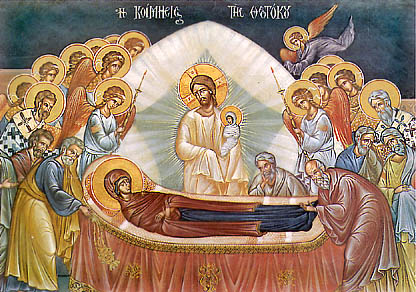
Troparion Tone 1
In giving birth thou didst preserve thy virginity;/ in falling asleep thou didst not forsake the world, O Theotokos./ Thou wast translated to life, O Mother of Life,/ and by your prayers you deliver our souls from death.
Kontakion Tone 2
Neither the tomb nor death could hold the Theotokos,/ who is sleepless in her intercessions and an unchanging hope in her mediations./ For as the Mother of Life she was transferred to life/ by Him Who dwelt in her ever-virgin womb.
From the OCA website comes this explanation of The Feast of the Dormition:
After the Ascension of the Lord, the Mother of God remained in the care of the Apostle John the Theologian, and during his journeys She lived at the home of his parents, near the Mount of Olives. She was a source of consolation and edification both for the Apostles and for all the believers. Conversing with them, She told them about miraculous events: the Annunciation, the seedless and undefiled Conception of Christ born of Her, about His early childhood, and about His earthly life. Like the Apostles, She helped plant and strengthen the Christian Church by Her presence, Her discourse and Her prayers.
The reverence of the Apostles for the Most Holy Virgin was extraordinary. After the receiving of the Holy Spirit on the day of Pentecost, the Apostles remained at Jerusalem for about ten years attending to the salvation of the Jews, and wanting moreover to see the Mother of God and hear Her holy discourse. Many of the newly-enlightened in the Faith even came from faraway lands to Jerusalem, to see and to hear the All-Pure Mother of God.
During the time of the persecution initiated by King Herod against the young Church of Christ (Acts 12: 1-3), the Most Holy Virgin and the Apostle John the Theologian withdrew to Ephesus in the year 43. The preaching of the Gospel there had fallen by lot to the Apostle John the Theologian. The Mother of God was on Cyprus with St. Lazarus the Four-Days-Dead, where he was bishop. She was also on Holy Mount Athos. St. Stephen of the Holy Mountain says that the Mother of God prophetically spoke of it: "Let this place be my lot, given to me by my Son and my God. I will be the Patroness of this place and intercede with God for it."
The respect of ancient Christians for the Mother of God was so great that they preserved what they could about Her life, what they could take note of concerning Her sayings and deeds, and they even passed down to us a description of Her outward appearance.
According to Tradition, based on the words of the Hieromartyrs Dionysios the Areopagite (October 3), Ignatios the God-Bearer (December 20), St. Ambrose of Milan (December 7) had occasion to write in his work "On Virgins" concerning the Mother of God: "She was a Virgin not only in body, but also in soul, humble of heart, circumspect in word, wise in mind, not overly given to speaking, a lover of reading and of work, and prudent in speech. Her rule of life was to offend no one, to intend good for everyone, to respect the aged, not envy others, avoid bragging, be healthy of mind, and to love virtue."
When did She ever hurl the least insult in the face of Her parents? When was She at discord with Her kin? When did She ever puff up with pride before a modest person, or laugh at the weak, or shun the destitute? With Her there was nothing of glaring eyes, nothing of unseemly words, nor of improper conduct. She was modest in the movement of Her body, Her step was quiet, and Her voice straightforward; so that Her face was an expression of soul. She was the personification of purity.
All Her days She was concerned with fasting: She slept only when necessary, and even then, when Her body was at rest, She was still alert in spirit, repeating in Her dreams what She had read, or the implementation of proposed intentions, or those planned yet anew. She was out of Her house only for church, and then only in the company of relatives. Otherwise, She seldom appeared outside Her house in the company of others, and She was Her own best overseer. Others could protect Her only in body, but She Herself guarded Her character."
According to Tradition, that from the compiler of Church history Nikephoros Kallistos (fourteenth century), the Mother of God "was of average stature, or as others suggest, slightly more than average; Her hair golden in appearance; Her eyes bright with pupils like shiny olives; Her eyebrows strong in character and moderately dark, Her nose pronounced and Her mouth vibrant bespeaking sweet speech; Her face was neither round nor angular, but somewhat oblong; the palm of Her hands and fingers were longish.
In conversation with others She preserved decorum, neither becoming silly nor agitated, and indeed especially never angry; without artifice, and direct, She was not overly concerned about Herself, and far from pampering Herself, She was distinctly full of humility. Regarding the clothing which She wore, She was satisfied to have natural colors, which even now is evidenced by Her holy head-covering. Suffice it to say, a special grace attended all Her actions." (Nicephoros Kallistos borrowed his description from St. Epiphanios of Cyprus (May 12), from the "Letter to Theophilos Concerning Icons."
The circumstances of the Dormition of the Mother of God were known in the Orthodox Church from apostolic times. Already in the first century, the Hieromartyr Dionysios the Areopagite wrote about Her "Falling-Asleep." In the second century, the account of the bodily ascent of the Most Holy Virgin Mary to Heaven is found in the works of Meliton, Bishop of Sardis. In the fourth century, St. Epiphanios of Cyprus refers to the tradition about the "Falling-Asleep" of the Mother of God. In the fifth century, St. Juvenalios, Patriarch of Jerusalem, told the holy Byzantine Empress Pulcheria: "Although in Holy Scripture there is no account about the circumstances of Her death, we know about them otherwise from the most ancient and credible Tradition." This tradition was gathered and expounded in the Church history of Nikephoros Kallistos during the fourteenth century.
At the time of Her blessed "Falling-Asleep", the Most Holy Virgin Mary was again at Jerusalem. Her fame as the Mother of God had already spread throughout the land and had aroused many of the envious and the spiteful against Her, who wanted to make attempts on Her life; but God preserved Her from enemies.
Day and night She spent at prayer. The Most Holy Mother of God went often to the Holy Sepulchre of the Lord, and here She offered up fevent prayer. More than once, enemies of the Savior sought to hinder Her from visiting her holy place, and they asked the High Priest for a guard to watch over the Grave of the Lord. But the Holy Virgin Mary, unseen by anyone, continued to pray in front of them.
In one such visit to Golgotha, the Archangel Gabriel appeared to Her and announced Her approaching transfer from this life to eternal life. In pledge of this, the Archangel gave Her a palm branch. With these Heavenly tidings the Mother of God returned to Bethlehem with the three girls attending Her (Sepphora, Abigail, and Jael). She summoned Righteous Joseph of Aramathea and other disciples of the Lord, and told them of Her impending Repose.
The Most Holy Virgin prayed also that the Lord would have the Apostle John come to Her. The Holy Spirit transported him from Ephesus, setting him in that very place where the Mother of God lay. After the prayer, the Most Holy Virgin offered incense, and John heard a voice from Heaven, closing Her prayer with the word "Amen." The Mother of God took it that the voice meant the speedy arrival of the Apostles and the Disciples and the holy Bodiless Powers.
The faithful, whose number by then was impossible to count, gathered together, says Saint John of Damascus, like clouds and eagles, to listen to the Mother of God. Seeing one another, the Disciples rejoiced, but in their confusion they asked each other why the Lord had gathered them together in one place. St. John the Theologian, greeting them with tears of joy, said that the time of the Virgin's repose was at hand.
Going in to the Mother of God, they beheld Her lying upon the bed, and filled with spiritual joy. The Disciples greeted Her, and then they told her how they had been carried miraculously from their places of preaching. The Most Holy Virgin Mary glorified God, because He had heard Her prayer and fulfilled Her heart's desire, and She began speaking about Her imminent end.
During the time of this conversation the Apostle Paul also appeared in a miraculous manner together with his disciples Dionysios the Areopagite, St. Hierotheos, St. Timothy and others of the Seventy Apostles. The Holy Spirit had gathered them all together so that they might be granted the blessing of the All-Pure Virgin Mary, and more fittingly to see to the burial of the Mother of the Lord. She called each of them to Herself by name, She blessed them and extolled them for their faith and the hardships they endured in preaching the Gospel of Christ. To each She wished eternal bliss, and prayed with them for the peace and welfare of the whole world.
Then came the third hour (9 A.M.), when the Dormition of the Mother of God was to occur. A number of candles were burning. The holy Disciples surrounded her beautifully adorned bed, offering praise to God. She prayed in anticipation of Her demise and of the arrival of Her longed-for Son and Lord. Suddenly, the inexpressible Light of Divine Glory shone forth, before which the blazing candles paled in comparison. All who it saw took fright. Descending from Heaven was Christ, the King of Glory, surrounded by hosts of Angels and Archangels and other Heavenly Powers, together with the souls of the Forefathers and the Prophets, who had prophesied in ages past concerning the Most Holy Virgin Mary.
Seeing Her Son, the Mother of God exclaimed: "My soul doth magnify the Lord, and my spirit hath rejoiced in God My Savior, for He hath regarded the low estate of His Handmaiden" (Lk 1:46-48) and, rising from Her bed to meet the Lord, She bowed down to Him, and the Lord bid Her enter into Life Eternal. Without any bodily suffering, as though in a happy sleep, the Most Holy Virgin Mary gave Her soul into the hands of Her Son and God.
Then began a joyous angelic song. Accompanying the pure soul of the God-betrothed and with reverent awe for the Queen of Heaven, the angels exclaimed: "Hail, Full of Grace, the Lord is with Thee, blessed art Thou among women! For lo, the Queen, God's Maiden comes, lift up the gates, and with the Ever-Existing One, take up the Mother of Light; for through Her salvation has come to all the human race. It is impossible to gaze upon Her, and it is impossible to render Her due honor" (Stikherion on "Lord, I Have Cried"). The Heavenly gates were raised, and meeting the soul of the Most Holy Mother of God, the Cherubim and the Seraphim glorified Her with joy. The face of the Mother of God was radiant with the glory of Divine virginity, and from Her body there came a sweet fragrance.
Miraculous was the life of the All-Pure Virgin, and wondrous was Her Repose, as Holy Church sings: "In Thee, O Queen, the God of all hath given thee as thy portion the things that are above nature. Just as in the Birth-Giving He did preserve Thine virginity, so also in the grave He did preserve Thy body from decay" (Canon 1, Ode 6, Troparion 1).
Kissing the all-pure body with reverence and in awe, the Disciples in turn were blessed by it and filled with grace and spiritual joy. Through the great glorification of the Most Holy Theotokos, the almighty power of God healed the sick, who with faith and love touched the holy bed.
Bewailing their separation from the Mother of God, the Apostles prepared to bury Her all-pure body. The holy Apostles Peter, Paul, James and others of the Twelve Apostles carried the funeral bier upon their shoulders, and upon it lay the body of the Ever-Virgin Mary. St. John the Theologian went at the head with the resplendent palm-branch from Paradise. The other saints and a multitude of the faithful accompanied the funeral bier with candles and censers, singing sacred songs. This solemn procession went from Sion through Jerusalem to the Garden of Gethsemane.
With the start of the procession there suddenly appeared over the all-pure body of the Mother of God and all those accompanying Her a resplendent circular cloud, like a crown. There was heard the singing of the Heavenly Powers, glorifying the Mother of God, which echoed that of the worldly voices. This circle of Heavenly singers and radiance accompanied the procession to the very place of burial.
Unbelieving inhabitants of Jerusalem, taken aback by the extraordinarily grand funeral procession and vexed at the honor accorded the Mother of Jesus, complained of this to the High Priest and scribes. Burning with envy and vengefulness toward everything that reminded them of Christ, they sent out their own servants to disrupt the procession and to set the body of the Mother of God afire.
An angry crowd and soldiers set off against the Christians, but the circular cloud accompanying the procession descended and surrounded them like a wall. The pursuers heard the footsteps and the singing, but could not see any of those accompanying the procession. Indeed, many of them were struck blind.
The Jewish priest Athonios, out of spite and hatred for the Mother of Jesus of Nazareth, wanted to topple the funeral bier on which lay the body of the Most Holy Virgin Mary, but an angel of God invisibly cut off his hands, which had touched the bier. Seeing such a wonder, Athonios repented and with faith confessed the majesty of the Mother of God. He received healing and joined the crowd accompanying the body of the Mother of God, and he became a zealous follower of Christ.
When the procession reached the Garden of Gethsemane, then amidst the weeping and the wailing began the last kiss to the all-pure body. Only towards evening were the Apostles able to place it in the tomb and seal the entrance to the cave with a large stone.
For three days they did not depart from the place of burial, praying and chanting Psalms. Through the wise providence of God, the Apostle Thomas was not to be present at the burial of the Mother of God. Arriving late on the third day at Gethsemane, he lay down at the tomb and with bitter tears asked that l he might be permitted to look once more upon the Mother of God and bid her farewell. The Apostles out of heartfelt pity for him decided to open the grave and permit him the comfort of venerating the holy relics of the Ever-Virgin Mary. Having opened the grave, they found in it only the grave wrappings and were thus convinced of the bodily ascent of the Most Holy Virgin Mary to Heaven.
On the evening of the same day, when the Apostles had gathered at a house to strengthen themselves with food, the Mother of God appeared to them and said: "Rejoice! I am with you all the days of your lives." This so gladdened the Apostles and everyone with them, that they took a portion of the bread, set aside at the meal in memory of the Savior ("the Lord's Portion"), and they exclaimed : "Most Holy Theotokos, save us". (This marks the beginning of the rite of offering up the "Panagia" ("All-Holy"), a portion of bread in honor of the Mother of God, which is done at monasteries to the present day).
The sash of the Mother of God, and Her holy garb, preserved with reverence and distributed over the face of the earth in pieces, have worked miracles both in the past and at present. Her numerous icons everywhere pour forth signs and healings, and Her holy body, taken up to Heaven, bears witness to our own future life there. Her body was not left to the vicissitudes of the transitory world, but was incomparably exalted by its glorious ascent to Heaven.
The Feast of the Dormition of the Most Holy Theotokos is celebrated with special solemnity at Gethsemane, the place of Her burial. Nowhere else is there such sorrow of heart at the separation from the Mother of God, and nowhere else such joy, because of Her intercession for the world.
The holy city of Jerusalem is separated from the Mount of Olives by the valley of Kedron on Josaphat. At the foot of the Mount of Olives is the Garden of Gethsemane, where olive trees bear fruit even now.
The holy Ancestor-of-God Joachim had himself reposed at 80 years of age, several years after the Entry of the Most Holy Theotokos into the Temple (November 21). St. Anna, having been left a widow, moved from Nazareth to Jerusalem, and lived near the Temple. At Jerusalem she bought two pieces of property: the first at the gates of Gethsemane, and the second in the valley of Josaphat. At the second locale she built a tomb for the members of her family, and where also she herself was buried with Joachim. It was there in the Garden of Gethsemane that the Savior often prayed with His disciples.
The most-pure body of the Mother of God was buried in the family tomb. Christians honored the sepulchre of the Mother of God, and they built a church on this spot. Within the church was preserved the precious funeral cloth, which covered Her all-pure and fragrant body.
The holy Patriarch Juvenalios of Jerusalem (420-458) testified before the emperor Marcian (450-457) as to the authenticity of the tradition about the miraculous ascent of the Mother of God to Heaven, and he sent to the empress, St. Pulcheria (September 10), the grave wrappings of the Mother of God from Her tomb. St. Pulcheria then placed these grave-wrappings within the Blachernae church.
Accounts have been preserved, that at the end of the seventh century a church had been built atop the underground church of the Dormition of the Most Holy Theotokos, and that from its high bell-tower could be seen the dome of the Church of the Resurrection of the Lord. Traces of this church are no longer to be seen. And in the ninth century near the subterranean Gethsemane church a monastery was built, in which more than 30 monks struggled.
Great destruction was done the Church in the year 1009 by the despoiler of the holy places, Hakim. Radical changes, the traces of which remain at present, also took place under the crusaders in the year 1130. During the eleventh to twelfth centuries the piece of excavated stone, at which the Savior had prayed on the night of His betrayal disappeared from Jerusalem. This piece of stone had been in the Gethsemane basilica from the sixth century.
But in spite of the destruction and the changes, the overall original cruciform (cross-shaped) plan of the church has been preserved. At the entrance to the church along the sides of the iron gates stand four marble columns. To enter the church, it is necessary to go down a stairway of 48 steps. At the 23rd step on the right side is a chapel in honor of the holy Ancestors-of-God Joachim and Anna together with their graves, and on the left side opposite, the chapel of St. Joseph the Betrothed with his grave. The right chapel belongs to the Orthodox Church, and the left to the Armenian Church (since 1814).
The church of the Dormition of the Theotokos has the following dimensions: in length it is 48 arshin, and in breadth 8 arshin [1 arshin = 28 inches]. At an earlier time the church had also windows beside the doors. The whole temple was adorned with a multitude of lampadas and offerings. Two small entrances lead into the burial-chamber of the Mother of God. One enters through the western doors, and exits at the northern doors. The burial-chamber of the All-Pure Virgin Mary is veiled with precious curtains. The burial place was hewn out of stone in the manner of the ancient Jewish graves and is very similar to the Sepulchre of the Lord. Beyond the burial-chamber is the altar of the church, in which Divine Liturgy is celebrated each day in the Greek language.
The olive woods on the eastern and northern sides of the temple was acquired from the Turks by the Orthodox during the seventh and eighth centuries. The Catholics acquired the olive woods on the east and south sides in 1803, and the Armenians on the west side in 1821.
On August 12, at Little Gethsemane, at the second hour of the night, the head of the Gethsemane church celebrates Divine Liturgy. With the end of Liturgy, at the fourth hour of the morning, he serves a short Molieben before the resplendent burial shroud, lifts it in his hands and solemnly carries it beyond the church to Gethsemane proper where the holy sepulchre of the Mother of God is situated. All the members of the Russian Spiritual Mission in Jerusalem, with the head of the Mission presiding, participate each year in the procession (called the "Litania") with the holy burial shroud of the Mother of God.
The rite of the Burial of the Mother of God at Gethsemane begins customarily on the morning of August 14. A multitude of people with hierarchs and clergy at the head set off from the Jerusalem Patriarchate (nearby the Church of the Resurrection of Christ) in sorrowful procession. Along the narrow alley-ways of the Holy City the funeral procession makes its way to Gethsemane. Toward the front of the procession an icon of the Dormition of the Most Holy Theotokos is carried. Along the way, pilgrims meet the icon, kissing the image of the All-Pure Virgin Mary and lift children of various ages to the icon. After the clergy, in two rows walk the black-robed monks and nuns of the Holy City: Greeks, Roumanians, Arabs, Russians. The procession, going along for about two hours, concludes with Lamentations at the Gethsemane church. In front the altar, beyond the burial chamber of the Mother of God, is a raised-up spot, upon which rests the burial shroud of the Most Holy Mother of God among fragrant flowers and myrtle, with precious coverings.
"O marvelous wonder! The Fount of Life is placed in the grave, and the grave doth become the ladder to Heaven..." Here at the grave of the All-Pure Virgin, these words strike deep with their original sense and grief is dispelled by joy: "Hail, Full of Grace, the Lord is with Thee, granting the world, through Thee, great mercy!"
Numerous pilgrims, having kissed the icon of the Dormition of the Most Holy Theotokos, following an ancient custom, then stoop down and go beneath it.
On the day of the Leave-taking of the feast (August 23), another solemn procession is made. On the return path, the holy burial shroud is carried by clergy led by the Archimandrite of Gethsemane. . . .
Today flowers are blessed in church, and people keep them in their homes. During times of family strife or illness, the flower petals are placed in the censer with the incense, and the whole house is censed. See the Prayer at the Sanctification of any Fragrant Herbage.
There is also this helpful article from Christianity Today and Christian History and Biography.
August 13, 2005
Translation of the Relics of Our Holy Father Among the Saints, Maximos the Confessor
Troparion of St Maximos Tone 3
By an outpouring of the Holy Spirit/ thou didst pour forth Christ's sacred teachings./ Thou didst expound with divine authority the self-emptying of God the Word/ and wast radiant in thy confession of the True Faith./ Glorious Father Maximos, pray to Christ our God to grant us His great mercy.
Kontakion of St Maximos Tone 2
O Maximos divinely inspired champion of the Church,/ sure and illumined exponent of Orthodoxy,/ thou harp and trumpet of godliness,/ divine and holy adornment of monks:/ cease not to intercede for us all.
Translation of the relics of St Maximus the Confessor
Commemorated on August 13
Saint Maximus the Confessor was born in Constantinople around 580 and raised in a pious Christian family. He received an excellent education, studying philosophy, grammar, and rhetoric. He was well-read in the authors of antiquity and he also mastered philosophy and theology. When St. Maximus entered into government service, he became first secretary (asekretis) and chief counselor to the emperor Heraclius (611-641), who was impressed by his knowledge and virtuous life.
St. Maximus soon realized that the emperor and many others had been corrupted by the Monothelite heresy, which was spreading rapidly through the East. He resigned from his duties at court, and went to the Chrysopolis monastery (at Skutari on the opposite shore of the Bosphorus), where he received monastic tonsure. Because of his humility and wisdom, he soon won the love of the brethren and was chosen igumen of the monastery after a few years. Even in this position, he remained a simple monk.
In 638, the emperor Heraclius and Patriarch Sergius tried to minimize the importance of differences in belief, and they issued an edict, the "Ekthesis" ("Ekthesis tes pisteos" or "Exposition of Faith), which decreed that everyone must accept the teaching of one will in the two natures of the Savior. In defending Orthodoxy against the "Ekthesis," St. Maximus spoke to people in various occupations and positions, and these conversations were successful. Not only the clergy and the bishops, but also the people and the secular officials felt some sort of invisible attraction to him, as we read in his Life.
When St. Maximus saw what turmoil this heresy caused in Constantinople and in the East, he decided to leave his monstery and seek refuge in the West, where Monothelitism had been completely rejected. On the way, he visited the bishops of Africa, strengthening them in Orthodoxy, and encouraging them not to be deceived by the cunning arguments of the heretics.
The Fourth Ecumenical Council had condemned the Monophysite heresy, which falsely taught that in the Lord Jesus Christ there was only one nature (the divine). Influenced by this erroneous opinion, the Monothelite heretics said that in Christ there was only one divine will ("thelema") and only one divine energy ("energia"). Adherents of Monothelitism sought to return by another path to the repudiated Monophysite heresy. Monothelitism found numerous adherents in Armenia, Syria, Egypt. The heresy, fanned also by nationalistic animosities, became a serious threat to Church unity in the East. The struggle of Orthodoxy with heresy was particularly difficult because in the year 630, three of the patriarchal thrones in the Orthodox East were occupied by Monothelites: Constantinople by Sergius, Antioch by Athanasius, and Alexandria by Cyrus.
St. Maximus traveled from Alexandria to Crete, where he began his preaching activity. He clashed there with a bishop, who adhered to the heretical opinions of Severus and Nestorius. The saint spent six years in Alexandria and the surrounding area.
Patriarch Sergius died at the end of 638, and the emperor Heraclius also died in 641. The imperial throne was eventually occupied by his grandson Constans II (642-668), an open adherent of the Monothelite heresy. The assaults of the heretics against Orthodoxy intensified. St. Maximus went to Carthage and he preached there for about five years. When the Monothelite Pyrrhus, the successor of Patriarch Sergius, arrived there after fleeing from Constantinople because of court intrigues, he and St. Maximus spent many hours in debate. As a result, Pyrrhus publicly acknowledged his error, and was permitted to retain the title of "Patriarch." He even wrote a book confessing the Orthodox Faith. St. Maximus and Pyrrhus traveled to Rome to visit Pope Theodore, who received Pyrrhus as the Patriarch of Constantinople.
In the year 647 St. Maximus returned to Africa. There, at a council of bishops Monotheletism was condemned as a heresy. In 648, a new edict was issued, commissioned by Constans and compiled by Patriarch Paul of Constantinople: the "Typos" ("Typos tes pisteos" or "Pattern of the Faith"), which forbade any further disputes about one will or two wills in the Lord Jesus Christ. St. Maximus then asked St. Martin the Confessor (April 14), the successor of Pope Theodore, to examine the question of Monothelitism at a Church Council. The Lateran Council was convened in October of 649. One hundred and fifty Western bishops and thirty-seven representatives from the Orthodox East were present, among them St. Maximus the Confessor. The Council condemned Monothelitism, and the Typos. The false teachings of Patriarchs Sergius, Paul and Pyrrhus of Constantinople, were also anathematized.
When Constans II received the decisions of the Council, he gave orders to arrest both Pope Martin and St. Maximus. The emperor's order was fulfilled only in the year 654.St. Maximus was accused of treason and locked up in prison. In 656 he was sent to Thrace, and was later brought back to a Constantinople prison.
The saint and two of his disciples were subjected to the cruelest torments. Each one's tongue was cut out, and his right hand was cut off. Then they were exiled to Skemarum in Scythia, enduring many sufferings and difficulties on the journey.
After three years, the Lord revaled to St. Maximus the time of his death (August 13, 662). Three candles appeared over the grave of St. Maximus and burned miraculously. This was a sign that St. Maximus was a beacon of Orthodoxy during his lifetime, and continues to shine forth as an example of virtue for all. Many healings occurred at his tomb.
In the Greek Prologue, August 13 commemorates the Transfer of the Relics of St. Maximus from Lazika on the southeast shore of the Black Sea to Constantinople, to the Monastery of the Theotokos at Chrysopolis (where he had been the igumen), across the Bosphoros from Constantinople. This transfer took place after the Sixth Ecumenical Council.
August 13 could also be the date of the saint's death, however. It is possible that his main commemoration was moved to January 21 because August 13 is the Leavetaking of the Feast of the Transfiguration of the Lord.
St. Maximus has left to the Church a great theological legacy. His exegetical works contain explanations of difficult passages of Holy Scripture, and include a Commentary on the Lord's Prayer and on Psalm 59, various "scholia" or "marginalia" (commentaries written in the margin of manuscripts), on treatises of the Hieromartyr Dionysius the Areopagite (October 3) and St. Gregory the Theologian (January 25). Among the exegetical works of St. Maximus are his explanation of divine services, entitled "Mystagogia" ("Introduction Concerning the Mystery").
The dogmatic works of St. Maximus include the Exposition of his dispute with Pyrrhus, and several tracts and letters to various people. In them are contained explanations of the Orthodox teaching on the Divine Essence and the Persons of the Holy Trinity, on the Incarnation of the Word of God, and on "theosis" ("deification") of human nature.
"Nothing in theosis is the product of human nature," St. Maximus writes in a letter to his friend Thalassius, "for nature cannot comprehend God. It is only the mercy of God that has the capacity to endow theosis unto the existing... In theosis man (the image of God) becomes likened to God, he rejoices in all the plenitude that does not belong to him by nature, because the grace of the Spirit triumphs within him, and because God acts in him" (Letter 22).
St. Maximus also wrote anthropological works (i.e. concerning man). He deliberates on the nature of the soul and its conscious existence after death. Among his moral compositions, especially important is his "Chapters on Love." St. Maximus the Confessor also wrote three hymns in the finest traditions of church hymnography, following the example of St. Gregory the Theologian.
The theology of St. Maximus the Confessor, based on the spiritual experience of the knowledge of the great Desert Fathers, and utilizing the skilled art of dialectics worked out by pre-Christian philosophy, was continued and developed in the works of St. Simeon the New Theologian (March 12), and St. Gregory Palamas (November 14).
August 12, 2005
Today's Father Reardonism
"If God didn't want three-point sermons, He wouldn't have given so many three-point Scriptures."
Father Patrick Henry Reardon
Psalm 12 [13]: A Psalm of Compline, Prayed in the Beginning of the Night
For the End: A Psalm of David
How long, O Lord, wilt Thou utterly forget me? * How long wilt Thou turn Thy face away from me?
How long shall I take counsel in my soul with grievings in my heart by day and by night? * How long shall mine enemy be exalted over me?
Look upon me, hear me, O Lord my God; * enlighten mine eyes, lest at any time I sleep unto death.
Lest at any time mine enemy say: I have prevailed against him. * They that afflict me will rejoice if I am shaken;
but as for me, I have hoped in Thy mercy. * My heart will rejoice in Thy salvation.
I will sing unto the Lord, Who is my benefactor, * and I will chant unto the name of the Lord Most High.
August 11, 2005
2 Timothy 3:16-17 and the "Man of God"
Why the phrase “man of God” in 2 Timothy 3:16-17 does not refer to every Christian generally but to Church leaders specifically.
Earlier, I examined 2 Timothy 3:16-17 to show why Scripture cannot be said to claim for itself all-sufficiency. Here are the verses once more:
Every Scripture is God-inspired and profitable for teaching, for reproof, for correction, for instruction which is in righteousness, in order that the man of God may be perfect, equipped for every good work (2 Timothy 3:16-17)
Thanks to a comment from Perry Robinson to me, I was compelled to look at this phrase in 2 Timothy 3:17, “man of God.” The phrase occurs more than sixty times in the Scriptures, more than forty of them in 1-2 Kings, where they refer most often to Elijah, Elisha, and the unnamed prophet out of Judah of chapter 13. In all “man of God” refers to the prophets--all instances of the phrase are to named prophets or unnamed but specific prophets--nearly fifty times, Moses (eight times), David (three times), the angel that appeared to Samson's parents (twice), to the son of Igdaliah (Godolias in the LXX), a Levitical priest (once), to St. Timothy (once at 1 Timothy 6:11), and to the unspecified “man of God” in our text under consideration, though contextually its most proximate target would be St. Timothy.
From this follows 4 observations and a corollary:
1. “Man of God” is never used in Scripture to refer to the people of God generally, but to specific persons.
2. “Man of God” always refers to a prophet, priest, King or Church leader, never to the general people of God. Since this is so for every other occurrence, then even 2 Timothy 3:17, though it does not name a specific person, contextually can only refer to a Church leader.
3. We know from passages such as Acts 15:35; 18:11; 20:20, 28-31; Romans 12:7; Colossians 1:28; Ephesians 4:11; 1 Timothy 3:2; 2 Timothy 2:24; 4:2; Titus 1:10-14 and Hebrews 13:7 that teaching and correction was an essential part of Church leadership (though Colossians 3:16 could be construed more broadly to apply to Church members generally, and 1 Corinthians 14:26 to those with the charism of teaching, which only the more emphasizes teaching and correction as essential to Church leadership).
4. Given 1-3, then, St. Paul is telling St. Timothy that Scripture is useful for Church leaders “for teaching, for reproof, for correction, for instruction which is in righteousness.” Whatever else we may say about Scripture and Christians generally, this specific verse is not for application to Christians generally, but to Christian leaders specifically.
5. As a corollary to 4--especially in light of such verses as Acts 15:1; 20:28-31; Colossians 2:22; Titus 1:10-14--when Christians who are not Church leaders make use of Scripture, they should ensure that their teaching conforms to the teaching of the Church leadership.
As I have indicated in my arguments elsewhere, Church leaders are responsible for the faithful transmission of the tradition of the Apostles, which ultimately means that all Scriptural interpretation, especially that of the laity, must conform to what the Church has always taught and believed from the beginning.
So, given my previous argument regarding 2 Timothy 3:16-17, that it does not claim the all-sufficiency of Scripture, and given this argument that the verses only apply to Church leaders specifically, it is now indisputable that Protestants cannot appeal to these verses for Scriptural all-sufficiency, for not only do the verses not make this claim (as I've previously proven), neither are they useful for any Christian generally, but for Church leaders particularly, and so even if their all-sufficiency were provisionally granted, it would not apply to all Christians indiscriminately, and therefore would violate the purported claim to be all-sufficient.
Islam a Christian Heresy?
We are used to thinking of Islam as a religion separate from, though related to, Judaism and Christianity. Indeed, even many Christians appeal to a common heritage between these three faiths, all being so-called "Sons of Abraham." But it would appear that Islam is not simply a separate faith that grew up out of its own soil. Rather, it would appear that it is a form of Christian heresy; and, indeed, this was how it was viewed by the Christians who knew Islam in its earliest days.
Let's first look at Church historian Sozomen. Writing in the early part of the fifth century, about two hundred years prior to the rise of Islam, Sozomen notes:
This is the tribe which took its origin and had its name from Ishmael, the son of Abraham; and the ancients called them Ishmaelites after their progenitor. As their mother Hagar was a slave, they afterwards, to conceal the opprobrium of their origin, assumed the name of Saracens, as if they were descended from Sara, the wife of Abraham. Such being their origin, they practice circumcision like the Jews, refrain from the use of pork, and observe many other Jewish rites and customs. If, indeed, they deviate in any respect from the observances of that nation, it must be ascribed to the lapse of time, and to their intercourse with the neighboring nations. Moses, who lived many centuries after Abraham, only legislated for those whom he led out of Egypt. The inhabitants of the neighboring countries, being strongly addicted to superstition, probably soon corrupted the laws imposed upon them by their forefather Ishmael. The ancient Hebrews had their community life under this law only, using therefore unwritten customs, before the Mosaic legislation. These people certainly served the same gods as the neighboring nations, honoring and naming them similarly, so that by this likeness with their forefathers in religion, there is evidenced their departure from the laws of their forefathers. As is usual, in the lapse of time, their ancient customs fell into oblivion, and other practices gradually got the precedence among them. Some of their tribe afterwards happening to come in contact with the Jews, gathered from them the facts of their true origin, returned to their kinsmen, and inclined to the Hebrew customs and laws. From that time on, until now, many of them regulate their lives according to the Jewish precepts. Some of the Saracens were converted to Christianity not long before the present reign. They shared in the faith of Christ by intercourse with the priests and monks who dwelt near them, and practiced philosophy in the neighboring deserts, and who were distinguished by the excellence of their life, and by their miraculous works. It is said that a whole tribe, and Zocomus, their chief, were converted to Christianity and baptized about this period, under the following circumstances: Zocomus was childless, and went to a certain monk of great celebrity to complain to him of this calamity; for among the Saracens, and I believe other barbarian nations, it was accounted of great importance to have children. The monk desired Zocomus to be of good cheer, engaged in prayer on his behalf, and sent him away with the promise that if he would believe in Christ, he would have a son. When this promise was confirmed by God, and when a son was born to him, Zocomus was initiated, and all his subjects with him. From that period this tribe was peculiarly fortunate, and became strong in point of number, and formidable to the Persians as well as to the other Saracens. Such are the details that I have been enabled to collect concerning the conversion of the Saracens and their first bishop. (Ecclesiastical History 6.38)
Note what Sozomen details: a dependence upon the Jewish faith, and then a coversion of some of the Saracens to Christianity. This happened more than two centuries prior to the rise of Islam.
Now take a look at St. John of Damascus, who lived, in the eighth century, in a city and region dominated by Islam. In his work, The Fount of Knowledge, and the section on heresies, he writes:
There is also the superstition of the Ishmaelites which to this day prevails and keeps people in error, being a forerunner of the Antichrist. They are descended from Ishmael, who was born to Abraham of Agar, and for this reason they are called both Agarenes and Ishmaelites. They are also called Saracens, which is derived from [in Greek] Sarras kenoi, or destitute of Sara, because of what Agar said to the angel: “Sara has sent me away destitute.” These used to be idolaters and worshipped the morning star and Aphrodite, whom in their own language they called Khabar, which means great. And so down to the time of Heraclius they were very great idolaters. From that time to the present a false prophet named Mohammed has appeared in their midst. This man, after having chanced upon the Old and New Testaments and likewise, it seems, having conversed with an Arian monk, devised his own heresy. Then, having insinuated himself into the good graces of the people by a show of seeming piety, he gave out that a certain book had been sent down to him from heaven. He had set down some ridiculous compositions in this book of his and he gave it to them as an object of veneration. (St. John of Damascus, The Fount of Knowledge, "On Heresies," 101)
Sozomen has already noted the dependence of certain of the Saracens on the law of Moses and a strong exposure to Christianity. St. John confirms this in his account, and even notes that Mohammed met an Arian (some say Nestorian) monk. Perhaps Islam is, after all, Christian heresy.
This Christian heresy, of course, has slaughtered untold numbers of Christians throughout its history, and is a source for the current fanatical terrorism being committed in our world.
Addendum
From the Qur'an:
It is not befitting to (the majesty of) Allah that he should beget a son. Glory be to Him! When He determines a matter, He only says to it, "Be", and it is. (Surah 19:35)
and:
They do blaspheme who say: "God is Christ the son of Mary." But Christ said: "O Children of Israel! worship God, my Lord and your Lord." Whoever joins other gods with Allah,--Allah will forbid him the Garden and the Fire will be his abode. There will for the wrong-doers be no one to help.They do blaspheme who say: God is one of three in a Trinity: for there is no god except one God (Allah). If they do not desist from their word (of blasphemy), verily a grievous penalty will befall the blasphemers among them. (Surah 5:72-73)
and:
O People of the Book! commit no excesses in your religion; nor say of Allah anything but the truth. Christ Jesus the son of Mary was (no more than) a Messenger of Allah, and His Word, which He bestowed on Mary, and a Spirit proceeding from Him: so believe in Allah and His Messengers. Do not say "Trinity": desist: it will be better for you: for Allah is One God: glory be to Him (far Exalted is He) above having a son. To Him belong all things in the heavens and on earth. And enough is Allah as a Disposer of affairs. (Sura 4:171)
Islam rejects the divinity of Jesus, just like Arianism.
Islam rejects the Holy Trinity, just like Sabellianism/modalism.
Islam rejects that Mary is the birthgiver of God, just like Nestorianism.
Yep. It's all rotten with heresy.
See also this account at Fr. Joseph's Orthodixie.
August 10, 2005
A Little FYI on Recent Posts
I have been posting several things of late that have grown out of discussions taking place over at Grace-Centered Message Forums. No doubt both of my regular readers picked up on the sola scriptura references and framework for these discussions. It is true, my heritage churches were/are "Bible only" folks.
I have found the challenges to present Orthodoxy in this specific framework to be a great blessing. I hope that the two of you (Hi, mom! Hi, Tripp!) who read my stuff (Right, mom? Mom?) are as blessed by reading them as I have been by thinking through them.
Be aware, however, that their usefulness is very limited. As my Orthodox brother, Richard, frequently, and rightly, points out: rational arguments will not make one a Christian.
Why Oral Apostolic Tradition is Accurate and Trustworthy
Advocates for sola scriptura argue that Christians need a written record since oral tradition is so given to inaccuracies and therefore untrustworthy. Aside from the fact that anthropological studies have demonstrated the extremely accurate fidelity of oral traditions in cultures for whom such traditions are central to their culture (unlike literate cultures such as ours), there is a very accessible way to demonstrate both the accuracy and trustworthiness of the oral apostolic tradition.
If one were to compare contemporary Christian writers, who were separated by significant geographical distance, and were writing before the full canonization of the Christian Scriptures, and even during the period when there was some dispute over which books were Scripture, and also during the period when many heresies had arisen, and if those writers provided a summary of the Christian faith, then one can readily compare whether or not the oral apostolic tradition is accurate and trustworthy. As St. Irenaeus of Lyon writes:
As I have already observed, the Church, having received this preaching and this faith, although scattered throughout the whole world, yet, as if occupying but one house, carefully preserves it. She also believes these points (of doctrine) just as if she had but one soul, and one and the same heart, and she proclaims them, and teaches them, and hands them down, with perfect harmony, as if she possessed only one mouth. For, although the languages of the world are dissimilar, yet the import of the tradition is one and the same. For the Churches which have been planted in Germany do not believe or hand down anything different, nor do those in Spain, nor those in Gaul, nor those in the East, nor those in Egypt, nor those in Libya, nor those which have been established in the central regions of the world. But as the sun, that creature of God, is one and the same throughout the whole world, so also the preaching of the truth shineth everywhere, and enlightens all men that are willing to come to a knowledge of the truth. Nor will any one of the rulers in the Churches, however highly gifted he may be in point of eloquence, teach doctrines different from these (for no one is greater than the Master); nor, on the other hand, will he who is deficient in power of expression inflict injury on the tradition. For the faith being ever one and the same, neither does one who is able at great length to discourse regarding it, make any addition to it, nor does one, who can say but little diminish it.(St. Irenaeus of Lyons, Against Heresies, Bk I, Ch. X, Par. 2)
Now, the historical period that would be ideal, in my view, would be the end of the second century, or beginning of the third. My reasons that this period would be ideal are these:
1. Although all of the New Testament books had been written, historical evidence indicates that not only did not all Christian communities have all of the New Testament books, but that some considered certain books divinely authoritative that others did not, some of which in fact did make it into the New Testament canon (e. g., Revelation) and some of which in fact did not (e. g., Shepherd of Hermas). Thus, given these canonical discrepancies, it would be theoretically possible for there to be equally discrepant practices and beliefs among these far-flung contemporary Christian groups.
2. Furthermore, given 1, there would need to be a great reliance on oral apostolic tradition, all the more so, if, as scholars generally assume, the vast majority of Christians at the end of the second century (and generally throughout history) were illiterate and entirely dependent on oral tradition.
3. Thus, given 1 and 2, if oral tradition is inaccurate and untrustworthy, if one selects contemporary communities in geographically distant locales, it would stand to reason that there would potentially be great discrepancies among the central beliefs that they hold.
I will demonstrate that 3 is false, and that therefore the claim by sola scriptura advocates that oral tradition is unreliable is unfounded.
My three representative writers will be St. Irenaeus of Lyons, in western Europe; Tertullian of Carthage in northern Africa; and Origen of Alexandria, also in northern Africa to the west of Carthage. Lyons is definitely significantly geographically distant from northern Africa, though Alexandria and Carthage are near enough to be geographically linked via trade routes. Furthermore, Alexandria was well known for number of Christian heresies arising from teachers resident there. Indeed, certain doctrines espoused by Origen were later condemned by ecumenical council. And Tertullian himself later embraced the sectarian heresy of Montanism. So this should be enough thrown in the mix to give one a reason to think there would be great discrepancy in the faith of these three men.
Since St. Irenaeus can be considered an orthodox standard against which to judge the others, I will cite him first.
The Church, though dispersed through our the whole world, even to the ends of the earth, has received from the apostles and their disciples this faith: (She believes) in one God, the Father Almighty, Maker of heaven, and earth, and the sea, and all things that are in them; and in one Christ Jesus, the Son of God, who became incarnate for our salvation; and in the Holy Spirit, who proclaimed through the prophets the dispensations of God, and the advents, and the birth from a virgin, and the passion, and the resurrection from the dead, and the ascension into heaven in the flesh of the beloved Christ Jesus, our Lord, and His (future) manifestation from heaven in the glory of the Father "to gather all things in one," [Ephesians 1:10] and to raise up anew all flesh of the whole human race, in order that to Christ Jesus, our Lord, and God, and Saviour, and King, according to the will of the invisible Father, "every knee should bow, of things in heaven, and things in earth, and things under the earth, and that every tongue should confess" [Philippians 2:10-11] to Him, and that He should execute just judgment towards all; that He may send "spiritual wickednesses," [Ephesians 6:12] and the angels who transgressed and became apostates, together with the ungodly, and unrighteous, and wicked, and profane among men, into everlasting fire; but may, in the exercise of His grace, confer immortality on the righteous, and holy, and those who have kept His commandments, and have persevered in His love, some from the beginning (of their Christian course), and others from (the date of) their repentance, and may surround them with everlasting glory.(St. Irenaeus of Lyons, Against Heresies, Bk I, Ch. X, Par. 1)
Next, let's look at Tertullian, who later abandoned the faith.
Now, with regard to this rule of faith-that we may from this point acknowledge what it is which we defend-it is, you must know, that which prescribes the belief that there is one only God, and that He is none other than the Creator of the world, who produced all things out of nothing through His own Word, first of all sent forth; that this Word is called His Son, and, under the name of God, was seen "in diverse manners" by the patriarchs, heard at all times in the prophets, at last brought down by the Spirit and Power of the Father into the Virgin Mary, was made flesh in her womb, and, being born of her, went forth as Jesus Christ; thenceforth He preached the new law and the new promise of the kingdom of heaven, worked miracles; having been crucified, He rose again the third day; (then) having ascended into the heavens, He sat at the right hand of the Father; sent instead of Himself the Power of the Holy Ghost to lead such as believe; will come with glory to take the saints to the enjoyment of everlasting life and of the heavenly promises, and to condemn the wicked to everlasting fire, after the resurrection of both these classes shall have happened, together with the restoration of their flesh. This rule, as it will be proved, was taught by Christ, and raises amongst ourselves no other questions than those which heresies introduce, and which make men heretics. (Tertullian, Prescription Against Heretics, Ch. 13)
And finally, Origen, who, although some of his doctrines were later condemned, was nontheless a significant influence on orthodox Christian writers such as St. Maximus the Confessor.
The particular points clearly delivered in the teaching of the apostles are as follow:-First, That there is one God, who created and arranged all things, and who, when nothing existed, called all things into being-God from the first creation and foundation of the world-the God of all just men, of Adam, Abel, Seth, Enos, Enoch, Noe, Sere, Abraham, Isaac, Jacob, the twelve patriarchs, Moses, and the prophets; and that this God in the last days, as He had announced beforehand by His prophets, sent our Lord Jesus Christ to call in the first place Israel to Himself, and in the second place the Gentiles, after the unfaithfulness of the people of Israel. This just and good God, the Father of our Lord Jesus Christ, Himself gave the law and the prophets, and the Gospels, being also the God of the apostles and of the Old and New Testaments.
Secondly, That Jesus Christ Himself, who came (into the world), was born of the Father before all creatures; that, after He had been the servant of the Father in the creation of all things-"For by Him were all things made" [John 1:3]-He in the last times, divesting Himself (of His glory), became a man, and was incarnate although God, and while made a man remained the God which He was; that He assumed a body like to our own, differing in this respect only, that it was born of a virgin and of the Holy Spirit: that this Jesus Christ was truly born, and did truly suffer, and did not endure this death common (to man) in appearance only, but did truly die; that He did truly rise from the dead; and that after His resurrection He conversed with His disciples, and was taken up (into heaven).
Then, Thirdly, the apostles related that the Holy Spirit was associated in honour and dignity with the Father and the Son. But in His case it is not clearly distinguished whether He is to be regarded as born or innate, or also as a Son of God or not: for these are points which have to be inquired into out of sacred Scripture according to the best of our ability, and which demand careful investigation. And that this Spirit inspired each one of the saints, whether prophets or apostles; and that there was not one Spirit in the men of the old dispensation, and another in those who were inspired at the advent of Christ, is most clearly taught throughout the Churches.
After these points, also, the apostolic teaching is that the soul, having a substance and life of its own, shall, after its departure from the world, be rewarded according to its deserts, being destined to obtain either an inheritance of eternal life and blessedness, if its actions shall have procured this for it, or to be delivered up to eternal fire and punishments, if the guilt of its crimes shall have brought it down to this: and also, that there is to be a time of resurrection from the dead, when this body, which now "is sown in corruption, shall rise in incorruption," and that which "is sown in dishonour will rise in glory."[1 Corinthians 15:42-43](Origen, De Principiis, Preface, Pars. 4-5)
One can easily note the striking similarity on doctrinal points as well as verbal formulations (even in translation, and from different original languages) of these three writers.
All that remains is to juxtapose these teachings against the Scriptures to note, even on sola scriptura terms, the apostolic origin of these teachings, and therefore their divine authority.
Now, let me readily admit that my stress on the oral apostolic tradition might well be compromised by the following facts.
1. All three of my representatives are literate, indeed, Origen is recognized as a brilliant genius. These men themselves were not dependent wholly on oral tradition for their summations, but could recall those apostolic writings they had themselves read.
2. St. Irenaeus and Origen both cite Scripture directly, thereby demonstrating that they relied on the apostolic writings.
These facts would seem to obviate my claims that oral apostolic tradition was both accurate and trustworthy, for it seems clear that these men were not using oral apostolic tradition but the apostolic writings themselves.
But here's why such facts do not, contrary to my sola scriptura interlocutors, obviate my claims for the accuracy and trustworthiness of the oral apostolic tradition.
These men are offering summations of the faith, which requires not merely the direct reliance on Scripture, but an interpretive framework by which they can select and emphasize those different texts (and they use different texts to make the same points). Furthermore, which books were deemed Scripture was itself not always a certainty, and this required some sort of incipient canon handed down through oral apostolic tradition. That the Gnostic heretics in Alexandria emphasized different canonical and non-canonical texts, and interpreted them in a vastly different way from our writers is both obvious and evidence that our writers were not just operating from private interpretations but from a tradition that they themselves had received.
Now, it may well be that some other explanation(s) than oral apostolic tradition accounts for this consonance, but it's hard to know what that could be. One could not appeal to private interpretation, for that would be belied by the heresies that also arose from private interpretation. One could suppose that God worked directly on the minds of these men in separate locales to sum up the faith just in the way they did, but one wonders how this differs in essence from direct inspiration, and one is also hard pressed to justify that explanation in the face of Origen's heresies, and Tertullian's later abadonment of the faith. One also wonders why such direct inspiration is not more readily at work today, given the increasing discrepancies among Christian bodies to sum up the faith.
No, given the facts, the best explanation which does not involve special pleading (direct inspiration) or manifest contradiction (private interpretation) is going to be that these men relied on the oral apostolic tradition, which had been faithfully and carefully transmitted throughout out varying geographical, religious and cultural locales.
Thus, oral apostolic tradition is accurate and trustworthy, and the fact that Scripture itself commands us to attend to both oral and written apostolic tradition (2 Thessalonians 2:15) is enough to bolster this contention on its own in sola scriptura terms.
*Please note that I am indebted for my references to St. Irenaeus, Origen and Tertullian above in a passing reference by Eric Jay in his article “From Presbyter-Bishops to Bishops and Presbyters.”
August 09, 2005
An Argument Summary
A summation of my argument(s) thus far.
1. In this post, I laid out the Scriptural evidence and my argument for my assertion that the Church is united to God's divine nature in Christ, through the union of the humanity and divinity in the Person of Christ.
2. As a further argument from 1, I have argued that since the Church participates in the divine nature of God, by grace, through union with Christ, the Church has divine authority to declare God's will and her knowledge about God is authoritative due to her participation in God's divinity through Christ (for example, this authority was manifested through the ministry of the apostles and prophets on whom the Church was built, and who were themselves members of Christ's Body, the Church).
3. I have also made two counter arguments against sola scriptura: namely that the Scriptures themselves enjoin upon us the necessity of adhering to the oral apostolic tradition, and that the Scriptures do not claim to be all-sufficient.
4. Given 1-3 above, then, the Church, as "pillar and bulwark of the Truth" (1 Timothy 3:15), has the authority to speak God's will about Scripture (for example, as to what books are Scripture and as to Scripture's proper meaning), and to speak about those things Scripture does not address (for example, as to gathering every Sunday for worship and the celebration of the Lord's Supper).
5. Given 1-4, then, what the Church says about Scripture and about what Scripture does not address, the Church in her declarations will not contradict Scripture, nor will Scripture contradict the Church, for their source is the same, for the Church is being built up into the full man and the head which is Christ (Ephesians 4:11-16), and she cannot contradict herself without becoming something other than herself (given 1 above).
Why 2 Timothy 3:16-17 Does Not Teach the All-Sufficiency of Scripture
I present here a brief sketch as to why 2 Timothy 3:16-17 does not teach the all-sufficiency of Scripture.
Every Scripture is God-inspired and profitable for teaching, for reproof, for correction, for instruction which is in righteousness, in order that the man of God may be perfect, equipped for every good work (2 Timothy 3:16-17)
Sola scriptura advocates frequently utilize these verses to both prove the divine origin and authority of the Scriptures as well as that all that Christians need are the Scriptures, and either we need not feel bound to follow traditions not explicitly enjoined in or necessarily inferred from the Scriptures or, more strongly, we must not do anything that is not explicitly enjoined in or necessarily inferred from the Scriptures. Christians need nothing more than the Scriptures.
By “Scriptures” of course, sola scriptura adherents mean the (relatively late) Protestant canon of sixty-six books (minus the so-called “Apocrypha”), and, more pointedly, they mean the New Testament Scriptures. Thus, the sixty-six books of the Protestant canon are “all-sufficient” and we either do not need tradition, or even must reject all extrascriptural tradition.
But is St. Paul making a claim for the all-sufficiency of Scripture? The answer is no, and here's why.
1. The “Scriptures” to which St. Paul refers here in 2 Timothy 3:16 has already been identified previously as what we would call the Old Testament just one verse prior in 2 Timothy 3:15. That St. Paul cannot mean the New Testament Scriptures is clear in that the Scriptures St. Timothy was taught in his youth could only have been the Old Testament since no New Testament book would have been written in St. Timothy's youth. St. Paul first encountered St. Timothy on his second missionary journey (c. AD 50-53), and at this time it is possible for only one to three New Testament books to have been written, depending on how one dates them (perhaps Galatians and 1-2 Thessalonians), and St. Timothy could not have studied these in his youth.
2. St. Paul does not claim that the Old Testament Scriptures are all-sufficient, and, indeed, if they were, then the New Testament would have been superfluous. What he says is that the Old Testament Scriptures are “profitable” (ophelimos) for four purposes (teaching, reproof, correction, and instruction which is in righteousness), which purposes result in an “adult” (“perfect” here is artios which indicates complete, full-grown, prepared) Christian, who has been equipped for every good work. But that they are not all-sufficient is clear: the Old Testament does not tell us about baptism for the remission of sins and the gift of the Holy Spirit; nor does it tell us about the Lord's Supper; nor about the necessity for all Christians everywhere to gather on Sunday to worship and celebrate the Lord's Supper (nor does the New Testament explicitly teach this last practice for that matter)--three of the most important practices of the Church and without which the Church and the faith would not be what they are.
3. Given 1 and 2, it cannot be the case that St. Paul, though he does not explicitly state the all-sufficiency of Scripture, he at least implies it.
As an aside, also in this same chapter, St. Paul refers to the names of two men who opposed Moses. Jewish tradition identifies these two as the Egyptian magicians who opposed Moses (though the text here in St. Paul does not clearly state this). This is one example of what many take to be a clear use of tradition in Scripture (the other is in Jude 9, where the archangel Michael argued with the devil over the body of Moses). Sola scriptura advocates explain that it is not necessary to appeal to tradition for these facts, that the Holy Spirit could quite well have revealed these facts to St. Paul and St. Jude directly. This is certainly true that this could be the case. But it does involve some circularity of reasoning that makes such an explanation suspect.
In any case, appealing to tradition to explain 2 Timothy 3:8 is not necessary to my main argument above.
So, since St. Paul does not make any claims about the New Testament in these verses, and since manifestly the Old Testament is not in itself all-sufficient, St. Paul cannot mean that Scripture is all-sufficient for Christian faith and practice.
Especially given the fact that St. Paul enjoins upon the Thessalonian Church to adhere to the entirety of the apostolic tradition, both oral and written, as it comes from St. Paul's ministry (2 Thessalonians 2:15), then to claim that St. Paul in 2 Timothy 3:16-17 is teaching the all-sufficiency of Scripture is a false teaching and must be rejected.
2 Thessalonians 2:15 and the Necessity of Oral Apostolic Tradition
I here present a brief sketch as to why “tradition” in 2 Thessalonians 2:15 is necessarily apostolic oral tradition, and why we must adhere to oral apostolic tradition as it has been handed down to us.
So then, brethren, be standing firm and holding fast the traditions which ye were taught, whether by word or by our epistle. (2 Thessalonians 2:15)
1. The Church at Thessaloniki had been disturbed by a letter purporting to have been from St. Paul claiming that the day of the Lord had already come (2 Thessalonians 2:2).
2. St. Paul tells them not to be disturbed “by a spirit, a word, or an epistle (seemingly) from us” (2 Thessalonians 2:2).
3. After describing some particulars about the man of lawlessness, he asks the Thessalonians whether they remember, when he was last with them, that he had spoken these things to them (2 Thessalonians 2:5).
4. He continues speaking about the man of lawlessness and the spirit of delusion the Lord will send on those who persist in their unbelief, and then gives thanks that the Thessalonians are not of that sort but are the first fruits of sanctification, and then exhorts them to “hold to the traditions you were taught, whether by word or by letter” (2 Thessalonians 2:15).
Four interesting observations are in order:
1. The written word was not necessarily a guarantee of apostolicity; a fraudulent document going out in St. Paul's name had misled and confused the Thessalonians.
2. The Thessalonians had the apostolic traditions which they had been taught through St. Paul's apostolic ministry, and they were to use that to compare anything that disturbed or shook their mind (i. e., anything that was “new” or out of concert with the apostolic tradition), and the entirety of that apostolic tradition was not only St. Paul's letter to them, but also his spoken word.
3. That the teaching of “the man of lawlessness” is not contained anywhere else in canonical letters of St. Paul clearly entails that this tradition was that which St. Paul had given them orally while ministering to them.
4. The unity of oral apostolic tradition and Scripture is clearly presumed; i. e., oral apostolic tradition and Scripture are not opposed to one another, and, in fact, are essentially the same since they are manifestations of the authority of a single source: the apostolic ministry.
Now some sola scriptura adherents will argue that since St. Paul's teaching regarding the lawless one has been preserved in 2 Thessalonians, and since that letter has been received by the Church as canonical, that this obviates oral apostolic tradition. This conclusion, however is false, and here's why.
First and foremost, St. Paul's counsel to adhere to oral and written apostolic tradition is, itself, certified in the same canonical text that supposedly obviates apostolic tradition. This is simply self-contradictory. In other words, Scripture itself enjoins upon the Thessalonians that they hold to the oral apostolic tradition St. Paul had delivered to them. Clearly Scripture cannot be used to obviate oral apostolic tradition.
Secondly, this begs the question that sola scriptura advocates assert but do not prove: namely, that the Scriptures (which necessarily, on their terms, include the New Testament) are all-sufficient. Scripture nowhere asserts this (the spooftexting of 2 Timothy 3:16-17 notwithstanding), but more importantly the sheer logic of history denies it: the complete canon of Scriptures were not available to all Christians for many decades (to estimate on the highly conservative end) after Pentecost, since the New Testament was not complete until the end of the first century. Unless sola scriptura advocates are willing to argue that a partial New Testament canon is also all-sufficient (since various Churches in the first century would have only some copies of St. Paul's letters, and not all the New Testament canonical books would have been available to all Churches till, minimally, well into the second century, perhaps a century after Pentecost), then they are forced to admit that the Church operated for decades after the death of the last Apostle, and for perhaps as long as a century after the death of most of the Apostles, before there was any realistic opportunity for Churches to have most, though perhaps not all, of the completed canon of the Scriptures. This means the Churches did not have direct access to the Apostles themselves, nor of their writings, for perhaps as long as a hundred years (again, estimating very conservatively, I happen to think it was much longer), and therefore were without anything that was “all-sufficient” to guide them in their faith.
Clearly, the Churches had to operate on oral apostolic tradition for many decades, even for as long as a century (I would argue longer even than that).
If, therefore, sola scriptura cannot withstand the test of canonical Scripture as well as historical fact, it is a false teaching and should be rejected.
August 06, 2005
The Holy Transfiguration of Our Lord and Savior Jesus Christ
Matthew 17:1-9
And after six days Jesus taketh Peter, James, and John his brother, and bringeth them up into an high mountain apart, And was transfigured before them: and his face did shine as the sun, and his raiment was white as the light. And, behold, there appeared unto them Moses and Elias talking with him. Then answered Peter, and said unto Jesus, Lord, it is good for us to be here: if thou wilt, let us make here three tabernacles; one for thee, and one for Moses, and one for Elias. While he yet spake, behold, a bright cloud overshadowed them: and behold a voice out of the cloud, which said, This is my beloved Son, in whom I am well pleased; hear ye him. And when the disciples heard it, they fell on their face, and were sore afraid. And Jesus came and touched them, and said, Arise, and be not afraid. And when they had lifted up their eyes, they saw no man, save Jesus only. And as they came down from the mountain, Jesus charged them, saying, Tell the vision to no man, until the Son of man be risen again from the dead.
Troparion Tone 7
Thou wast transfigured on the mount, O Christ God,/ revealing Thy glory to Thy disciples as far as they could bear it./ Let Thine everlasting light shine upon us sinners/ through the prayers of the Theotokos, O Giver of Light, glory to Thee.
Kontakion Tone 7
Thou wast transfigured on the mountain, O Christ our God,/ and Thy disciples beheld Thy glory as far as they were capable,/ that when they should see Thee crucified,/ they might know that Thy suffering was voluntary/ and might proclaim to the world/ that Thou art indeed the reflection of the Father.
An explanation of the festal icon:
In the icon of the Feast of the Transfiguration, Christ is the central figure, appearing in a dominant position within a circular mandorla. He is clearly at the visual and theological center of the icon. His right hand is raised in blessing, and his left hand contains a scroll. The mandorla with its brilliant colors of white, gold, and blue represent the divine glory and light. The halo around the head of Christ is inscribed with the Greek words O on, meaning "The One Who is".
Elijah and Moses stand at the top of separate mountain peaks to the left and right of Christ. They are bowing toward Christ with their right hands raised in a gesture of intercession towards Him. Saint John Chrysostom explains the presence of these two fathers of the faith from the Old Testament in three ways. He states that they represent the Law and the Prophets (Moses received the Law from God, and Elijah was a great prophet); they both experienced visions of God (Moses on Mount Sinai and Elijah on Mount Carmel); and they represent the living and the dead (Elijah, the living, because he was taken up into heaven by a chariot of fire, and Moses, the dead, because he did experience death).
Below Christ are the three Apostles, who by their posture in the icon show their response to the transfiguration of Christ. James has fallen over backwards with his hands over his eyes. John in the center has fallen prostrate. Peter is kneeling and raises his right hand toward Christ in a gesture expressing his desire to build the three booths. The garments of the Apostles are in a state of disarray as to indicate the dramatic impact the vision has had on them.
The icon of the feast directs our attention toward the event of the Transfiguration and specifically to the glory of God as revealed in Christ. This event came at a critical point in the ministry of our Lord, just as He was setting out on His journey to Jerusalem. He would soon experience the humiliation, suffering, and death of the Cross. However, the glorious light of the Resurrection was revealed to strengthen His disciples for the trials that they would soon experience.
The feast also points to the great and glorious Second Coming of our Lord and the fulfillment of the Kingdom of God when all of creation will be transfigured and filled with light.
From the OCA website comes this explanation of the feast:
The transfiguration of Christ is one of the central events recorded in the gospels. Immediately after the Lord was recognized by his apostles as "the Christ [Messiah], the Son of the Living God," he told them that "he must go up to Jerusalem and suffer many things ... and be killed and on the third day be raised" (Mt 16). The announcement of Christ's approaching passion and death was met with indignation by the disciples. And then, after rebuking them, the Lord took Peter, James, and John "up to a high mountain" -- by tradition Mount Tabor -- and was "transfigured before them."... and his face shone like the sun, and his garments became white as snow and behold, there appeared to them Moses and Elijah, talking with him. And Peter said to Jesus, "Lord, it is well that we are here; if you wish I will make three booths here, one for you and one for Moses and one for Elijah." He was still speaking when lo, a bright cloud overshadowed them, and a voice from the cloud said, "This is my Beloved Son, with whom I am well pleased; listen to him." When the disciples heard this, they fell on their faces with awe. But Jesus came and touched them, saying, "Rise, and have no fear." And when they lifted up their eyes, they saw no one but Jesus only. And as they were coming down the mountain, Jesus commanded them, "Tell no one the vision, until the Son of Man is raised from the dead" (Mt 17:1-92, see also Mk 9:1-9; Lk 9:28-36; 2 Peter 1:16-18).
The Jewish Festival of Booths was a feast of the dwelling of God with men, and the transfiguration of Christ reveals how this dwelling takes place in and through the Messiah, the Son of God in human flesh. There is little doubt that Christ's transfiguration took place at the time of the Festival of Booths, and that the celebration of the event in the Christian Church became the New Testamental fulfillment of the Old Testamental feast in a way similar to the feasts of Passover and Pentecost.
In the Transfiguration, the apostles see the glory of the Kingdom of God present in majesty in the person of ChriSt They see that in him, indeed, all the fullness of God was pleased to dwell," that "in him the whole fulness of deity dwells bodily" (Col 1:19, 2:9). They see this before the crucifixion so that in the resurrection they might know who it is who has suffered for them, and what it is that this one, who is God, has prepared for those who love him. This is what the Church celebrates in the feast of the Transfiguration.Thou wast transfigured on the mount. 0 Christ God, revealing Thy glory to Thy disciples as they could bear it. Let Thine everlasting light shine upon us sinners. Through the prayers of the Theotokos, O Giver of Light, glory to Thee (Troparion).On the mountain wast Thou transfigured, 0 Christ God, and Thy disciples beheld Thy glory as far as they could see it; so that when they would behold Thee crucified, they would understand that Thy suffering was voluntary, and would proclaim to the world that Thou art truly the Radiance of the Father (Kontakion).
Besides the fundamental meaning which the event of the Transfiguration has in the context of the life and mission of Christ, and in addition to the theme of the glory of God which is revealed in all of its divine splendor in the face of the Saviour, the presence of Moses and Elijah is also of great significance for the understanding and celebration of the feast. Many of the hymns refer to these two leading figures of the Old Covenant as do the three scripture readings of Vespers which tell of the manifestation of the glory of God to these holy men of old (Ex 24:12-18; 33:11-34:8; 1 Kings 19:3-16).
Moses and Elijah, according to the liturgical verses, are not only the greatest figures of the Old Testament who now come to worship the Son of God in glory, they also are not merely two of the holy men to whom God has revealed himself in the prefigurative theophanies of the Old Covenant of Israel. These two figures actually stand for the Old Testament itself: Moses for the Law and Elijah for the Prophets. And Christ is the fulfillment of the Law and the Prophets (Mt 5:17).
They also stand for the living and dead, for Moses died and his burial place is known, while Elijah was taken alive into heaven in order to appear again to announce the time of God's salvation in Christ the Messiah. Thus, in appearing with Jesus on the mount of Transfiguration, Moses and Elijah show that the Messiah Saviour is here, and that he is the Son of God to whom the Father himself bears witness, the Lord of all creation, of the Old and New Testaments, of the living and the dead. The Transfiguration of Christ in itself is the fulfillment of all of the theophanies and manifestations of God, a fulfillment made perfect and complete in the person of Christ. The Transfiguration of Christ reveals to us our ultimate destiny as Christians, the ultimate destiny of all men and all creation to be transformed and glorified by the majestic splendor of God himself.
There is little doubt that the feast of the Transfiguration of Christ belonged first to the pre-Easter season of the Church. It was perhaps celebrated on one of the Sundays of Lent, for besides certain historical evidence and the fact that today Saint Gregory Palamas, the great teacher of the Transfiguration of Christ, is commemorated during Lent, the event itself is one which is definitely connected with the approaching death and resurrection of the Saviour.... for when they would behold Thee crucified, they would understand that Thy suffering was voluntary (Kontakion).
The feast of the Transfiguration is presently celebrated on the sixth of August, probably for some historical reason. The summer celebration of the feast, however, has lent itself very well to the theme of transfiguration. The blessing of grapes, as well as other fruits and vegetables on this day is the most beautiful and adequate sign of the final transfiguration of all things in Christ. It signifies the ultimate flowering and fruitfulness of all creation in the paradise of God's unending Kingdom of Life where all will he transformed by the glory of the Lord.
August 04, 2005
Did Chesterton Really Say This?
Dennis L asks:
When Man ceases to worship God he does not worship nothing but worships everything.What is the correct quote and where (which GKC work) does it come from?
The Quotemeister responds. You'll be surprised, I think.
August 02, 2005
Theosis in the New Testament
[Note: Once again, the message boards I have been frequenting of late, has evoked some theologizing from me. (Quick! Hide the kids! Shut the blinds! Lock the doors!) One of the board members asked me to address the notion of theosis in our discussion of what the New Testament Church really is. My answer follows. It has been lightly edited to reflect a different audience.]
Thanks for the suggestion. Actually, I have tried to steer clear of any technical jargon (unless only technical jargon can adequately convey the proper meaning) when it comes to these discussions. My primary intent is to, as the proverb goes, address the rest of Scripture we don't underline, to unleash a straightforward reading of the text, since I believe that should be sufficient.
That was probably a shade too naive, given that one must also address presuppositions.
In any case, theosis is the New Testament doctrine that salvation, union with God, entails a transfiguration of our persons to conform with the logic of the Incarnation. Which is to say, just as Jesus joined humanity to his divinity, we, by grace in Christ, join divinity to our humanity. As St. Paul writes to the Galatians:
For as many as were baptized into Christ, ye put on Christ (Galatians 3:27)
We don't just clothe ourselves with parts of Christ, his righteousness here, his humility there, but with the whole of Christ. And one cannot separate out his righteousness and his humility from his very Person. Nor can one separate out Christ's divinity and his humanity.
I have already pointed out 2 Peter 1:3-4, but the verses bear repeating:
"Inasmuch as His divine power hath freely given to us all the things for life and piety, through the full knowledge of Him Who called us by glory and virtue, by which He hath freely given to us the very great and precious promises, that through these ye might become partakers of the divine nature, having escaped the corruption which is in the world by desire." (2 Peter 1:3-4)
Here we are given the promise that our salvation is fundamentally a participation in the divine nature of God. (I will leave aside for now the later patristic clarification regading God's essence and energies.)
I have also already addressed Colossians 2:9-10 and Ephesians 1:22-23, but they also bear repeating:
“For in Him dwelleth all the fullness of the divinity bodily, and ye are made full in Him, Who is the head of all principality and authority . . . .” (Colossians 2:9-10)
Once again, if the fullness of divinity dwells in Jesus bodily, and if we are made full in Him, then it logically follows that His fullness dwells in us, and that means we share in His divinity, we are, as St. Peter tells us, partakers of the divine nature.
“And He put in subjection all things under His feet, and gave Him to be head over all things to the Church, which is His body, the fullness of Him Who filleth all things in all.” (Ephesians 1:22-23)
Once again, the Church, of which we are members, is the fullness of Him who fills all things in all. Clearly Scripture means we have the fullness of Christ in us (as the Church, and personally as members of the Church). And if Christ's fullness dwells in us, this must mean His divinity, which means we partake of the divine nature.
But it's not only these verses that speak of this. This is a consistent theme of Scripture. I note again, Jesus' words in his "high priestly prayer":
"And I do not make request for these [the Apostles] only, but also for those who shall believe on Me through their word; in order that all may be one, even as Thou, Father, art in Me, and I in Thee, that they also may be one in Us, that the world might believe that Thou didst send Me forth. And the glory which Thou hast given Me I have gien them, in order that they may be one, even as We are one: I in them, and Thou in Me, that they may be perfected into one, and that the world may know that Thou didst send Me forth, and didst love them even as Thou didst love Me. (John 17:20-23; emphasis added)
In other words, the union of God in Christ was more than merely a communication of "character and disposition," and so, too, is that union with us. The difference, of course, is immeasurable: Christ is the Second Person of the Godhead, we are not. That, however, does not erase the strong and clear wording of His prayer, that we as whole persons, will be joined to God in Christ and partake of the divine union, the divine nature. We will be/are by grace what Christ is by nature.
But there are other equally clear passages. Note 1 John 3:2:
"Beloved, now we are children of God, and it was not yet made manifest what we shall be; but we know that if He should be made manifest, we shall be like Him; for we shall see Him as He is." (1 John 3:2; emphasis added)
Some may object, and quibble over St. John's use of "like" (homoioi), meaning God stays God and we stay human, and nothing at all divine characterizes us even in eternity, I would simply point them to John 1:16:
"And of His fullness we all received; grace for grace . . . ." (John 1:16)
Whose fullness? Christ's. Does it mean his fullness, er, except for the divine part? Of course not. Christ's fullness includes his divinity. We participate in the divinity of Christ.
But note also that this isn't just in St. Peter's epistle, or St. John's epistle and Gospel, or a couple of letters to the Colossians and Ephesians. St. Paul also reiterates this doctrine to the Corinthians--whom of any of the Churches of the New Testament would seem far from a model for partaking of the divine nature.
"But we all, with unveiled face reflecting as a mirror the glory of the Lord, are being transformed into the same image from glory to glory, even as from the Lord, the Spirit." (2 Corinthians 3:18; emphasis added)
Now I know that some will emphasize the "reflecting part." But St. Paul immediately follows with the fact that we will be transformed into the image we are reflecting. Others will emphasize the "glory" part, as though we will not become partakers of the divine nature, but "only" of God's glory. But then the obvious question is: can you separate God's glory from his nature? Indeed, isn't it pretty well established biblical fact that "glory" is often a circumlocution for the very nature of God?
No, the evidence is overwhelming, and the New Testament is clear, our salvation involves union with God, but that union cannot be accomplished apart from our being transfigured with God's divine nature.
Nowhere does the New Testament claim that we become God. But we do, through the communication of God's divinity to us in the Person of Christ and in our union with Him in His Body the Church, become "gods." In fact, this is Jesus' own very point in reverse in John 10:34-36.
Jesus answered them, "Is it not written in you law, 'I said, "Ye are gods"'? If He called them gods, to whom the word of God came to pass--and the Scripture is not able to be broken--do ye say of Him, Whom the Father sanctified and sent forth into the world, 'Thou blasphemest,' because I said, 'I am God's Son'? (John 10:34-36)
That is to say, Jesus claims that Scripture itself referred to Israel as "gods," and since Scripture cannot be broken it was entirely biblical for Jesus to call Himself God's Son. But note: making "gods" only figurative, takes away the force of what Jesus is saying about Himself (which is something we the readers know about Him that the Jewish leaders did not). That is to say, if Jesus' claim is true because Israel was called "gods," then if Jesus is really God, Israel (and by implication the new Israel) are really "gods."
Now, before anyone goes all Joseph-Smith-Mormon-screaming-hysterical or Shirly-Maclaine-New-Age-God/Goddess-screaming-hysterial on me, none of this in any way indicates we become God, or gods in the same way that God is God. We are, if you will, and stating it in a very crass, non-technical way, "godlets."
Truly, the main point is that of union with God. But if we are going to be one with God, we must become like Him, we must come to share in His divinity. But as is also clear from the New Testament, we can only do this in Christ--Who unites human and divine in His Person--and only through His Body the Church. We are not inherently "gods," "godlets," or, worse blasphemy "God(s)". We are only so through grace.
Conversely, if we reject the union of God Christ makes real for us, we do not simply become "bad, bad humans," we become demonic, the monstrous distortion of the image of God into anti-christs.
Why “Blood” and “Flesh” in John 6 is Meant to be Understood "Literally"
[Note: The following is a response I composed to the discussion going on at the thread entitled, The Blood of Christ, and is posted as a new thread here.]
First of all, let me offer this disclaimer: I do not like the term “literally.” First and foremost, the way the term is often used is a fundamental mistake with regard to what metaphors really are and, more importantly, do (literally!). Metaphors are what they are precisely because there is something really real that they convey and which gives them their meaning. When one says that “Jesus is the gate of the sheep” one does not intend (forgive the crassness), that his limbs are wood, his innards barbed wire, and he has a latch sticking out his side. (Yes, I realize these are anachronistic to Jesus' day, but one ought get my point.) Rather, one means that the thing a gate does (the reality it conveys) is the same thing Jesus does: provide ingress and egress for the sheep. The “literal” reality of the gate is identical with the “literal” reality of who Jesus is. Metaphors (as the etymology suggests) are bridges from one referent to another on the basis of a commonly shared reality.
Secondly, the terms “metaphor” and “literally” are misunderstood and misused. “Literally” is intended to mean some sort of real physical reality only. “Metaphor” is intended to mean something that's only theoretically, or conceptually, true. Thus, when one hears “Jesus is not literally the gate of the sheep” they mean by that that he is not made of wood and barbed wire. But this conveys both too much and too little. Too much in the sense that “literally” ends up conveying the notion that the meaning is somehow constrained to physical reality, when that physical reality is what it is only because the full metaphysical reality which metaphor and referent share precedes, fulfills and completes it. Too little in that “metaphor” is usually used to dismiss any tangible connection between referents. The connection is “merely” conceptual.
One can see, I hope, how it is that I do not like the term “literally,” but that is how the question usually is framed: Are Jesus' words in John 6 meant to be understood figuratively or literally?
The answer is, quite simply: Both. It's not an either/or scenario, but a both/and. There is a “literal” (or metaphysical) reality which fills and completes what the symbols represent. In fact, it makes no sense whatsoever to speak of these symbols as merely or only figurative. If there were no reality behind the metaphor, it wouldn't be a metaphor.
So, my argument is that “blood” and “flesh” in John 6 cannot be merely or only figurative. That is to say, “blood” and “flesh” have no metaphorical meaning unless they also have a “literal,” or really real, meaning.
First, let's observe that St. John's Gospel abounds with metaphors that must have a “literal” (or really real) meaning.
“You must be born again.” “I am the light of the world.” “I am the way, the truth and the life.” Would any of us deny that the metaphor for being born again has a very real reality behind it, and shares with biological birth a very important reality: namely the making of a new person? Would any of us deny that Jesus and light share a very real reality (illumination)? Would any of us deny that Jesus is not really life and truth? Then clearly the consistent pattern in St. John's Gospel is to use one referent to stand for another by way of the common reality they share. These are metaphors in the truest sense: they bridge one referent to another.
Secondly, let's observe that the overall context of St. John's Gospel, as well as the context of John 6 is deeply Eucharistic, that is to say, evocative of the Lord's Supper, and that this requires a reading of John 6 that understands “flesh” and “blood” as Eucharistic.
Of the seven specific signs noted in St. John's Gospel (turning the water to wine 2:1-11; curing the nobleman's son 4:46-54; healing the paralytic 5:1-15; feeding the 5000 6:1-14; walking on water 6:15-21; giving sight to the blind man 9:1-41; and raising Lazarus from the dead 11:38-44), two of them occur in John 6. Furthermore, the two signs that occur in John 6 are tied specifically to the Passover (verse four), and both are evocative of the Exodus: the eating of manna in the wilderness and the crossing of the Red Sea.
One should also note that the Passover is highlighted in John 13:1 at the beginning of the following chapters which give Jesus' discourse at the Last Supper. Note also that in John 6:11 we have the verb for give thanks eucharisteo, and although the language of John 6 lacks the full liturgical form that the Synoptics offer (took, blessed, broke, gave), we do have the “took,” “gave thanks,” and “gave/distributed.” Note also that St. John's Gospel lacks the “institution narrative” that the Synoptics offer. John 6 nicely provides that element to his own Gospel, even if the events reported in John 6 are not the historical Last Supper events. In fact, given St. John's penchant for describing one reality with another, it makes perfect sense that John 6 is intended by St. John to be the “institution narrative” for his Gospel. Indeed, given that the Synoptics and St. Paul preserve the account of the Last Supper as the institution of the Eucharist, it would seem odd if St. John's Gospel did not have some similar account, as important as this clearly was to the New Testament Church.
Thus the consumption of Jesus' Body and Blood here in John 6, fits in perfectly with the earlier writings of St. Paul in 1 Corinthians 10 and 11. That is to say, literarily, though the events St. John is narrating really happened historically, he is using them in his Gospel functionally as a Eucharistic/Lord's Supper narrative.
Thirdly, the “flesh” and “blood” to which Jesus refers functions as a sign (semeion) of his Person.
In St. John's Gospel “sign” (semeion) occurs seventeen times (the verb semaino three times in 12:33, 18:32, and 21:19). Of those seventeen times, four occur in John 6. It always indicates a revelation of the Person of Jesus, or an authentication of the revelation of Jesus. The first occurrence in John 6 (verse two) indicates a large crowd followed him because of his “signs” he was doing upon the sick. In the second occurrence (verse 15), the sign of the feeding of the 5000 conveyed to the crowd an authentication of Jesus as the Prophet foretold to come into the world. In the third occurrence (verse 26) Jesus upbraids the crowd because they did not seek a sign (that is to say, they didn't seek the true revelation of Himself), but bodily satisfaction. In the final occurrence--which significantly sets up the discussion on “flesh” and “blood”--the crowd asks for a sign by which Jesus can be believed. And while Jesus is known to have refused to give a sign to those who demanded it (Matthew 12:39//Mark 8:12//Luke 11:29; and Matthew 16:4), here there is no explicit refusal. Indeed, in context, the sign he gives the crowd is his flesh and blood.
Fourthly, the contrast in John 6:27 is not between physical and spiritual (or, crudely, “literal” and “metaphorical”), but between perishable and everlasting.
Work not for the food which perishes, but for the food which abides unto everlasting life, which the Son of Man will give to you; for upon Him God the Father has set His seal." (John 6:27)
Indeed, if we truly believe the Incarnation, we know that in Jesus there is no separation or division between the physical and the spiritual. That is to say, because of the Incarnation, matter matters.
Similarly, the contrast in John 6:63 is not between literal or figurative, but between flesh and spirit.
Therefore many of His disciples, when they heard this, said, "This is a hard saying; who can hear it?" And Jesus, knowing in Himself that His disciples were murmuring about this, He said to them, "Does this offend you? What then if you should see the Son of Man ascending where He was before? It is the Spirit who makes alive; the flesh profits nothing. The words that I speak to you are spirit, and they are life. (John 6:60-63)
Now lest anyone take this as proof that this is a spiritual reality and not a physical one, note that Jesus contrasts the reality of drinking his blood and eating his flesh with his own Ascension into heaven. And clearly his Ascension was both a bodily and a spiritual reality. In other words, Jesus is saying, if consuming his flesh and blood is offensive, how much more offensive his Ascension to heaven, revealed as truly God's Son. And if his Ascension is a bodily and spiritual reality, then, to preserve the offense of both, the “flesh” and “blood” we are to consume of Him is also material and spiritual.
But note the offense of the Jews: the discerned it in merely physical, bodily, material terms--which would truly be repugnant. Jesus is emphasizing that the reality is not merely physical, bodily, material, but that it is also and necessarily spiritual. Just like his Ascension. Indeed, apart from the spiritual, that is to say, the divine, the material reality is nothing. And all of this is predicated upon belief versus offense, faith versus rejection. Thus, “flesh” here does not contrast with spirit in the sense of physical versus spiritual but in the sense of human versus divine, doubt and skepticism versus belief and faith.
Finally, the bread of heaven, whom Jesus is, is appropriated by the consumption of Jesus' flesh and blood; and Jesus lets the offense of it stay, without apology, or explanation.
Therefore the Jews were contending with one another, saying, "How can this Man give us His flesh to eat?" Then Jesus said to them, "Most assuredly, I say to you, unless you eat the flesh of the Son of Man and drink His blood, you have no life in yourselves. Whoever eats My flesh and drinks My blood has eternal life, and I will raise him up in the last day. For My flesh truly is food, and My blood truly is drink. He who eats My flesh and drinks My blood abides in Me, and I in him. Just as the living Father sent Me, and I live because of the Father, so he who feeds on Me will live because of Me. This is the bread which came down from heaven, not as your fathers ate the manna, and died. He that eats this bread shall live forever." (John 6:52-58)
This is perhaps the most telling of all. Jesus is well known to have explained to his disciples the spiritual realities behind his parables, which he did not do with the crowds. Here the crowds object to Jesus' saying, and when he is alone with his disciples, does he then explain that he did not mean it literally? No, indeed, he maintains the offense: “You won't leave also, will you?” For it is precisely the offense of the reality, that we must bodily and spiritually consume the flesh and blood of Jesus, that provokes either faith or rejection.
And, regrettably, it still does so today, even among those who claim the name of Him Who revealed these things to us.