June 30, 2005
Christianity as Philosophia and Modern Society
If Christianity is, indeed, a philosophia, then it will also have three important components: a distinct discourse and discursive method, or a way of speaking and thinking; this discourse will be rooted in a fundamental principle (or principles), or logos(-oi); around which are built specific "soulish exercises," or askeses, which serve to inculcate the fundamental principle(s) and to further the communal discourse. Though a defense of a particular philosophia in antiquity was part of that way of life, apologia was not necessarily a dominant feature of such discourse, and in any case was meant as a defense more than as a proselytizing method. Proselytization of converts occurred via the public nature of the way of life in which a particular philosophia was lived. Would-be disciples "dropped in" as it were on the dialogoi and instruction that went on in the Academy, the Lyceum, the Stoa and the Garden, that were embodiments of their respective philosophiai, and in an existential pre-theoretical choice, attracted by the beauty and goodness they perceived in that particular philosophia, entered the community as a disciple.
This was true as well, with regard to Christianity. The public display of the Christian philosophia was primarily centered on the way of life they shared: care of the poor, the orphans and the widows; mutual love exhibited in the concrete life shared among them, for example, the sharing of possessions and care for the sick; the devotion to the apostles' teaching and to the gathered worship (though not on public display was the portion of the Liturgy dealing with Holy Eucharist), and other visible demonstrations of Christian lived faith.
Christianity certainly has fundamental principles: the Holy Trinity, God the Father, the incarnate Logos, and the Holy Spirit. And the discourse rooted in these principles is also distinct: sin, repentance and judgment; grace, new creation and resurrection; and so forth. This discourse has its own forms: liturgy, preaching, confession, catechesis, etc.. And this way of life has its own askeses which further this way of life: fasting, prayer, almsgiving, confession of sin, the Sacraments, and others.
Modern society, too, has its own philosophiai, though these are far less formal than the schools of antiquity. Think for example of modern Western consumerist society. It has its organizing principle: the “free” market and capitalist economies; its discourse: Gross National Domestic Product, inflation, unemployment, income, sale, discount, and so forth; and its askeses: advertising, shopping venues, and entertainment. I claim that these are not formalized, but that is only to say, there is not an overall philosophia that is articulated (the “consumerist way of life” say) in a systematic way. But that is not to say that certain aspects of this informal philosophia are not formalized; advertising, for example, is extremely formalized, as is consumer spending patterns (induced by such gimmicks as semi-annual, holiday, and seasonal sales, and the behavior modification and manipulation that accompanies these contrived sales). There is a particular outlook and thinking, and public discourse if you will, that is shaped by these economic principles and their respective askeses such that one finds ones identity strongly associated with particular buying decisions (which also feed into other consumer driven mythologies and identifications such as buying organic foods and environmentally friendly products).
Concomitant with such consumerism is the cult of celebrity and its religious ascetical component of entertainment. Much of what drives consumerism is the notion of entertainment (think of the mutliform uses to which home computers are put, as well as the uses to which most technological advancement is put) and the manipulative power of celebrity, both in identification as well as in consumer endorsements.
One may very well identify other modern day philosophiai, though in the affluent West, one is hard pressed to find one more influential, if less formally conceptualized. But clearly this identification of consumerism as the West's primary philosophia clarifies and juxtaposes some extremely important implications.
One can very well note at least two important realizations: consumerism is both an anti-christ, preaching a demonic and rival philosphia to that of Christianity, and consumerism is an extremely powerful and potent philosophia which is both its own way of life and parasitic upon others. Not even Christianity is immune from its influence.
Consumerism is anti-christ and demonic precisely because it opposes nearly every major principle of Christianity. It is thoroughly monistic in its materialism; there is no other reality than economic production. It replaces love of God and neighbor with quantitative manipulation of human beings and utter servitude to self-interested profitability. And instead of self-denying sacrifice for the good of one's neighbor is substituted passive acceptance of any and all forms of self-gratification. (I should note that in speaking of consumerism and identifying one of its principles as capitalism, I am not saying that Marxist, or other forms of, socialism aren't as equally anti-christian and demonic. These, though of a different form, are consumerisms just as insidious as the Western capitalist variety.)
Clearly, consumerism is its own way of life as can be objectively observed pervasively throughout Western society. But it is parasitic as well: it will infect its host and drain away its life, assimilating the lifeless shell into itself. One need look no further than the cult of celebrity and marketing that is rife in modern Western Christianity. All that is left of these hollowed out husks of what may once have been Christian is a thin veneer covering over a way of life that is exactly identical to godless consumerism.
One must be clear here: consumerism is not the same things as consumption. The difference is that between consumption as a way of life, and consumption subsumed within a way of life. All humans consume, and necessarily so. Not all consumption must be strictly utilitarian, either; for utilitarianism is its own philosphia. The wasteful plenitude of beauty crafted into life and the universe is testimony enough for the proper place of non-utilitarian consumption, such as that of celebration.
But the philosophia that is Christianity is at diametrical odds with the philosophia of pervasive consumerism. This is easily told by simply comparing the opposing ways of life. A consumerist will not fast, unless such a fast is for self-gratification such as weight loss. A consumerist will not pray, unless such prayer is simply the self-hypnotic mantra utilized to acquire those things one wants. A consumerist will not give alms, unless such giving will decrease the amount of taxes owed or the amount of tax refunded. Worship for a consumer is entirely subjective and focused on the gratification of the self. Christian worship is utterly objective and focused on the Holy Trinity. A consumerist seeks for security in this life, and measures such in terms of portfolios, insurance policies and possessions. A Christian places all his trust in the Holy Trinity he has never seen, nor will see apart from holiness. These comparisons do not presume to assert that there are no subjective benefits that sometimes come from fasting, prayer and almsgiving, nor that the subjective gratification that one often receives from true worship is somehow to be deplored, nor that a Christian cannot make godly use of his finances, insurance policies and possessions. But he knows that all these benefits are undeserved and not to be sought in themselves and that all wealth and possessions are matters of stewardship and are as transitory as the morning fog. To be sure, the Christian way of life is attacked on all sides by consumerism's structures and disciples and its pernicious capacity as a parasite, and Christians do well to handle such consumerist tools and products with a great deal of wisdom and perspicacity. And this can only be done if a Christian is thoroughly formed in and supported by the Christian philosophia.
This formation and support can only come from the Christian philosophia that is still lived in the community directly descended from the apostles. Only that philosophia that has been handed down by one living generation to the next and that can be organically traced to Christ through his apostles is the Christian philosophia, and therefore only that one which can make real both the living of the Christian faith and the combating of the philosophiai, especially that of consumerism in the West, that would suck the life out of the individual Christian and his community, leaving only an empty shell, a thin veneer that is Christian in name only.
I have spent the entirety of this post dealing with the opposition between the Christian philosophia and the philosophia of consumerism. In my next reflection on this series I will think about what it means to proselytize (or in Christian terminology, to evangelize) within the rubrics of a philosophia.
[The remainder of the posts in this series can be found here.]
June 29, 2005
The Fatherhood Chronicles LXXIV
No New News on the Pregnancy Front--er, Sort Of
There are developments, of course, but as I try to keep this PG-rated and below (and I doubt my wife wants all the particulars blogged!--you can read about those things here), for all practical purposes things are the same as last evening. Contractions are intermittent, sometimes regular at about 20 minutes apart, but until they are regularly 5 minutes apart, we're not going to the birthing center.
I did go in to work (I'm getting ready to leave for lunch here in a moment). Gotta save that special and rare paid time off. And I anticipate being here all day.
In addition to my mom flying in Thursday night, Anna's mom, Mary, her sister, Jessi, and Jessi's son, Tyler, are driving up today from Oklahoma, and we expect them in sometime this evening.
Thanks for the prayers, and keep 'em coming.
June 28, 2005
The Fatherhood Chronicles LXXIII
Update (6:00pm): Well, Anna's on her way back from the midwife. She's dilated 2-3cm and 60% effaced. By the midwife's calculations, this baby could arrive in the next day or two, as the Lord allows. (Now, do I take off work tomorrow, or take my chance and go in for one more day?)
Is Something Happening?
Anna called just a little bit ago. She says she's feeling "crampy," which she remembers feeling before going into early (middle? I forget) labor with Sofie. She said she felt that way last night, but that she figures it was a result of all the walking she'd done yesterday. (This weekend she's spent a bit of time downtown at the American Library Association Summer Conference, visiting with one of her classmates from library school--and my favorite of her library school friends--Amy. What's not to like in a friend of your wife who can go toe-to-toe with you quoting movie lines from Austin Powers and The Big Lebowski?! Of course, Ardis is also a favorite of my wife's friends.)
Anywho . . . As Providence would have it, Anna rescheduled her midwife appointment (so she could spend time with Amy) from this morning to this evening about five. We'll see what the midwife says.
We're . . . I'm . . . remaining calm--but getting excited!
Keep us in your prayers, please.
True Philosophia and the Offense of Christianity
Contemporary Christians concerned about authentic Christianity usually see philosophy and Christianity as incompatible. They usually cite the following as their authority:
Βλέπετε μή τις ὑμᾶς ἔσται ὁ συλαγωγῶν διὰ τῆς φιλοσοφίας καὶ κενῆς ἀπάτης, κατὰ τὴν παράδοσιν τῶν ἀνθρώπων, κατὰ τὰ στοιχεῖα τοῦ κόσμου καὶ οὐ κατὰ Χριστόν· ὅτι ἐν αὐτῷ κατοικεῖ πᾶν τὸ πλήρωμα τῆς θεότητος σωματικῶς, καὶ ἐστὲ ἐν αὐτῷ πεπληρωμένοι, ὅς ἐστιν ἡ κεφαλὴ πάσης ἀρχῆς καὶ ἐξουσίας.Be wary lest there shall be anyone who leadeth you captive through philosophy and vain deceit, according to the tradition of men, according to the elements of the world, and not according to Christ. For in Him dwelleth all the fullness of the divinity bodily, and ye are made full in Him, Who is the head of all principality and authority. (Colossians 2:8-10; Orthodox New Testament)
It is true that some philosophy is, or rather that certain philosophiai are, indeed, incompatible with Christianty: those "according to the tradition of men" and "the elements of the world" and not "according to Christ." In other words, if Christianity itself is a philosophy, a philosophia, then philosophy per se is not hostile to Christianity, but certain philosophiai cannot be reconciled to the philosophia that is Christianity.
This is an important, though often overlooked, distinction. Philosophia is a quintessentially human activity: the attempt to search out that which is "really real," to speak meaningfully about it, and to live a life that conforms to that reality. We are exhorted by Solomon: "ראשׁית חכמה קנה חכמה ובכל־קנינך קנה בינה׃ Wisdom is the principal thing; therefore get wisdom: and with all thy getting get understanding" (Proverbs 4:7). Clearly, if that which is really real for the Christian is none other than the Holy Trinity, then all our attempts to search out this reality, to speak meaningfully of Him, and to live our life in conformity to Him is the most sacred of philosophia. Each Christian is a philosophos or philosophe, a "friend of Wisdom." Of course, the caveat is that no human can seek out the things of God apart from His divine revelation of Himself to us, and most especially His true being, so far as we can but barely speak in ways that approximate the truth, as Holy Trinity.
But there are rival philosphiai that compete for the allegiances of all persons. And in this sense, then, St. Paul warns us to beware those who "[know] not God through [their] wisdom" (1 Corinthians 1:21) and have "a form of piety, but [deny] the power of it" and are "always learning and never able to come to a full knowledge of the truth" (2 Timothy 3:5,7). Plato himself has said, "τὸν μὲν οὖν ποιητὴν καὶ πατέρα τοῦδε τοῦ παντὸς εὑρεῖν τε ἔργον καὶ εὑρόντα εἰς πάντας ἀδύνατον λέγειν Now to discover the Creator and Father of all is indeed a hard task, and having discovered him, to declare him to all men is quite impossible" (Timaeus 28c). So only that philosophy is sure with regard to the knowledge of God that comes from divine revelation and not simply human reason.
Indeed, this is offensive to those who wish to speak of God apart from His revelation of Himself. For
ποῦ σοφός; ποῦ γραμματεύς; ποῦ συζητητὴς τοῦ αἰῶνος τούτου; οὐχὶ ἐμώρανεν ὁ Θεὸς τὴν σοφίαν τοῦ κόσμου τούτου; ἐπειδὴ γὰρ ἐν τῇ σοφίᾳ τοῦ Θεοῦ οὐκ ἔγνω ὁ κόσμος διὰ τῆς σοφίας τὸν Θεόν, εὐδόκησεν ὁ Θεὸς διὰ τῆς μωρίας τοῦ κηρύγματος σῶσαι τοὺς πιστεύοντας.Where is the wise? Where is the scribe? Where is the disputer of this age? Did not God make foolish the wisdom of this world? For since in the wisdom of God, the world knew not God through its wisdom, it pleased God through the foolishness of the preaching to save those who believe. (1 Corinthians 1:20-21)
The wisest of the wise cannot know God precisely because God is not known outside His divine self-revelation, but further because "without [sanctification] no one will see the Lord" (Hebrews 12:14). This is why St. Paul, in another context, sets up the struggle not just as a battle of mere ideas, but one that results in opposite ways of living, between that of obedience to God and disobedience.
Εν σαρκὶ γὰρ περιπατοῦντες οὐ κατὰ σάρκα στρατευόμεθα· τὰ γὰρ ὅπλα τῆς στρατείας ἡμῶν οὐ σαρκικὰ, ἀλλὰ δυνατὰ τῷ Θεῷ πρὸς καθαίρεσιν ὀχυρωμάτων· λογισμοὺς καθαιροῦντες καὶ πᾶν ὕψωμα ἐπαιρόμενον κατὰ τῆς γνώσεως τοῦ Θεοῦ, καὶ αἰχμαλωτίζοντες πᾶν νόημα εἰς τὴν ὑπακοὴν τοῦ Χριστοῦ, καὶ ἐν ἑτοίμῳ ἔχοντες ἐκδικῆσαι πᾶσαν παρακοήν, ὅταν πληρωθῇ ὑμῶν ἡ ὑπακοή.For though we walk in the flesh, we do not war according to the flesh. For the weapons of our warfare are not of the flesh, but mighty through God to the pulling down of strong holds, overthrowing reasonings and every high thing which lifteth itself up against the knowledge of God, and bringing into captivity every thought to the obedience of Christ, and holding fast in a readiness to avenge all disobedience, whenever your obedience should be fulfilled. (2 Corinthians 10:3-6)
This is why, in part, St. Paul warns of being taken captive by philosophy: it is not merely that Christians do well to avoid heretical and false understandings, but that attendent on these false notions are ways of living incompatible with the Christian Faith. In the case of the Colossians above, those inimical ways of life involved:
Μὴ οὖν τις ὑμᾶς κρινέτω ἐν βρώσει ἢ ἐν πόσει ἢ ἐν μέρει ἑορτῆς ἢ νεομηνίας ἢ σαββάτων, ἅ ἐστι σκιὰ τῶν μελλόντων, τὸ δὲ σῶμα τοῦ Χριστοῦ. μηδεὶς ὑμᾶς καταβραβευέτω θέλων ἐν ταπεινοφροσύνῃ καὶ θρησκείᾳ τῶν ἀγγέλων, ἃ μὴ ἑόρακεν ἐμβατεύων, εἰκῇ φυσιούμενος ὑπὸ τοῦ νοὸς τῆς σαρκὸς αὐτοῦ, καὶ οὐ κρατῶν τὴν κεφαλήν, ἐξ οὗ πᾶν τὸ σῶμα διὰ τῶν ἁφῶν καὶ συνδέσμων ἐπιχορηγούμενον καὶ συμβιβαζόμενον αὔξει τὴν αὔξησιν τοῦ Θεοῦ. Εἰ οὖν ἀπεθάνετε σὺν τῷ Χριστῷ ἀπὸ τῶν στοιχείων τοῦ κόσμου, τί ὡς ζῶντες ἐν κόσμῳ δογματίζεσθε, μὴ ἅψῃ μηδὲ γεύσῃ μηδὲ θίγῃς, ἅ ἐστι πάντα εἰς φθορὰν τῇ ἀποχρήσει, κατὰ τὰ ἐντάλματα καὶ διδασκαλίας τῶν ἀνθρώπων; ἅτινά ἐστι λόγον μὲν ἔχοντα σοφίας ἐν ἐθελοθρησκίᾳ καὶ ταπεινοφροσύνῃ καὶ ἀφειδίᾳ σώματος, οὐκ ἐν τιμῇ τινι πρὸς πλησμονὴν τῆς σαρκός.Let no one therefore judge you in food, or in drink, or in part of a feast, or a new moon, or sabbath days, which are a shadow of things to come, but the body is of Christ. Let no one deprive you of the prize, delighting in humility of mind and religious worship of the angels, intruding into things which he hath not seen, in vain being puffed up by the mind of his flesh, and not holding the head, from Whom all the body, by the joins and ligaments being supplied and knit together, increaseth with the increase of God. If then ye died with the Christ from the elements of the world, why, as if living in the world, do ye subject yourselves to regulations--"Do not touch, neither taste, nor handle," which things are all for corruption in the using--according to the injunctions and teachings of men, which things indeed are having a reputation of wisdom and self-devised worship, and humility of mind, and unsparing treatment of the body, not showing any honor for gratification of the flesh? (Colossians 2:16-23)
Note here: These rival philosophies were not obvious demonic practices. No, they masqueraded as light. After all, isn't humility a quintessential Christian character trait? Isn't self-denial (fasting and asceticism) also thoroughly Christian? Aren't there festivals and sabbaths the Christians do well to observe (or, conversely, refrain from observing)?
But the point is that these things were rooted not in Christian discourse or living, but in ways of life and specific discourses that were inherently opposed to Christianity.
And this is precisely the point of Christianity's offense to the world: It calls its wisdom foolish, its holiness corruption and its religion false. Christianity's claims is that only the Church has the true philosophia. The understandings of St. Justin the Philosopher and St. Clement are still valid: Hellenic philosophiai were and are precursors to the Gospel. But, and here is the point both St. Justin and St. Clement strongly affirmed, these philosophiai are not THE philosophia of Christ. Each needs fulfillment in the Wisdom who is Jesus. This does not sit well with the secularist who places all his trust in human wisdom, nor with the consumerist materialist who gives thought only to the god of the belly, nor with Hindus, Buddhists, Muslims, or neopagans who all claim their own paths to God.
But offensive or no, it is Christianity's claim, her unequivocal claim to exclusive participation in the divinely revealed God.
[The remainder of the posts in this series can be found here.]
June 27, 2005
The Fatherhood Chronicles LXXII
So, starting with tomorrow, here are the feast days of the possible birthdates of our newest and yet-to-be-born baby (who's due date is tomorrow):
- 28 June: Forefeast of the Apostles; and Sts. Sergius and Herman, founders of Valaam Monastery
- 29 June: Sts. Peter and Paul
- 30 June: Synaxis of the 12 Apostles
- 1 July: Wonderworking Unmercenary Physicians Cosmas and Damian of Rome; Sts. Processus and Martinian of Rome
- 2 July: St. John of San Francisco, Wonderworker; and the Placing of the Tunic of the Mother of God in Blachernae
- 3 July: Martyr Hyacinthus
- 4 July: St. Andrew of Crete
- 5 July: St. Athanasios of Mt. Athos and the Uncovering of the Relics of St. Sergius of Radonezh
- 6 July: St. Sisoes the Great; Martyr Lucia and those with her
- 7 July: Great Martyr Kyriaka
- 8 July: Great Martyr Procopius of Caesarea
- 9 July: Hieromartyr Pancratius of Taormina
- 10 July: St. Anthony of the Kievan Caves, Founder of Monasticism in Russia; and the Holy 45 Martyrs at Nicopolis in Armenia
- 11 July: Great Martyr Euphemia; and St. Ogla, Isapostolos and Princess of Russia
(And let's hope Anna doesn't go the full two weeks over her due date!)
What a great lineup with a bunch of martyrs and monastics!
If I have my druthers, I'd love for the baby to be born tomorrow evening. But 2 July ain't a bad date either! A combination of a Marian feast and the feast of our patron. Oh, and mom will be here, too!
The Fatherhood Chronicles LXXI
Of your charity, I ask your prayers concerning the following:
- For my mother, Miriam, who flies in from Wichita on Thursday evening: for safety and convenience of travel, and for a good time here with us and her granddaughter and (potentially born) new grandbaby
- For Anna and our unborn baby: that the Lord would grant perfect health and wholeness to mother and child and that both would see a happy and safe birth; the baby's due date is tomorrow, and it would be wonderful if the baby could be born while my mom is here
- For Sofie as she becomes the older sibling and all the matters known and unknown that accompany that life-affecting change
- For Anna and I as we strive to raise our children in the faith once for all delivered to the saints; and that our children would soon be brought to "the laver of regeneration" (and Anna and I to chrismation)
June 26, 2005
The Sunday of All Saints
Troparion in Tone VIII
As a beautiful fruit of the sowing of Thy salvation, the lands of America doth offer to Thee, O Lord, all the Saints that have shone in her. By their prayers keep the Church and the world in profound peace, through the Theotokos, O Most-merciful One.
Kontaktion in Tone III
Today the choir of the saints who pleased God in the lands of America doth stand before us in church and invisibly doth pray for us to God. With them the angels glorify Him, and all the saints of the Church of Christ keep festival with them; and they all pray together for us to the eternal God.
The saints depicted in the icon (l to r) and their feast dates:
St. Herman of Alaska 9 August (glorification) and 12 December
St. John Maximovitch of Shanghai and San Francisco 2 July
St. Innocent of Alaska 31 March
St. Juvenaly 25 December (Synaxis of the First Martyrs of the American Land)
St. Patriarch Tikhon 18 October
St. Peter the Aleut 25 December (Synaxis of the First Martyrs of the American Land)
Biographies of the Saints of North America
June 24, 2005
Christianity as Philosophia versus Christianity as Grammatike
It has been my intent, in this series of reflections, to do two things: to draw a sharp distinction between how philosophy is understood in our (presumably late) modern context and how it was understood in antiquity, and to demonstrate the strong similarities between the ancient understanding of philosophy (as philosophia) and of Christianity's own understanding of itself as a philosophia, indeed as the true philosophia. In turn, I want to draw a sharp distinction between how Christianity is currently understood in our present-day context and how Christianity understood itself in antiquity.
Present-day Christianity is rife with grammatique, with grammarians rather than philosophers. I mean by this, a perspective that focuses on analysis, definition, and dogma rather then humility, obedience and repentance. Grammatique, as I am using this term here, should be seen as the technique of the grammarian, the hermeneutical orientation, the intellectualization of belief.
Grammatike is, in many ways, safer than philosophia. Socrates was not sentenced to die, after all, for grammar or inflammatory speeches, but for inculcating a way of life, an examined life, that was a threat to the conventional mode of living of the Athens of his day. The Apostles were persecuted for sake of the Word, not for words. The seven martyred brothers whom we celebrate today (the soldiers Orentius, Pharnacius, Eros, Firmus, Firminus, Cyriacus and Longinus) were martyred not for an intepretation of Scripture, but for failing to adhere to the way of life of the Roman military: sacrificing to the gods after a victory.
Once the perspective shifts from philosophia to grammatike, however, definition becomes paramount, hermeneutics and discourse are separated from virtue and struggle. Once this divorce happens, what it means to be Christian will inevitably shift from performance to concept, from the ecclesiola, the "little Church" in the home, to the academy and those with the skills to argue and define in plausibility. With this shift, what it means to be Christian amounts to what one defines Christianity to be, and apostolicity is rendered in rhetoric.
This is little more than gnosticism. A select cadre of hermeneuticians and lawyers are allowed to render the measurements for what Christianity is by virtue of its plausible content. Another group makes their arguments, and the jury of onlookers each decide whom they think is right. The intellect is tickled and reason satisfied, but there's little or no justification for why any of this makes any real difference.
But the Christianity that is philosophia, while it must give attention to words and interpretation, gives primary attention to the ways of living that have been passed down from grandparents to parents to children. The Councils of the ancient Church did not convene so as to define the doctrines that must be believed, but met because the way of life Christ had handed to the apostles--and the apostles to the rest of the Church--was being threatened by grammarians who were at work changing words and arguing definitions, the consequences of which grammatique would fundamentally alter the Christian way of life. Arius was not a threat merely because he interpreted Scripture differently from the Church, but because the consequences of his belief would change the prayers which sustained the Church in daily life and would radically gut the bowels of common liturgy.
Dogma and belief do not change, but not because the faithful retain, like automatons, a mere conformity to the exact words. After all, in the historic Church the Faith and its worship were translated into a multitude of languages and cultures. Rather, dogma and belief remain unchanged because they are guarded and preserved in a particular way of living that does not change in its substance. Dogma is "defined" for the sake of the life of the Faith, to the end of guarding the hidden treasure and keeping the great-priced pearl.
It is because Christianity is a way of life that its unity can be manifested. If one bases unity on mere words, then unity is subject to rhetoric, and can only be preserved in political power. To be sure, unity grounded in a way of life will be manifested in institutions and authority and hierarchy (even if such authority and hierarchy arise from mutual submission), but such things serve unity, rather than unity the institution.
Christian groups today remain fractured in large part because they have failed to maintain the historic way of life that marks out authentic Christianity. They have allowed their faith to become grammatical. This grammatique has its own way of life, of course, and that way of life is at odds with that of the ancient Church. Modern Christianity is awash with names--the origin of denominations--which seek to lay claim to the Faith of the Apostles. But one cannot lay claim to that which one does not have. That is to say, anyone can define terms and argue that one's beliefs fit those terms, and that therefore one is "apostolic." But if one wishes to claim a particular way of life, one must receive it from those who can give it. A way of life is not cobbled together from spare parts. Christianity is not bricolage. A way of life is an organic whole, each part serving the rest, the sum greater than its parts. To make it up anew is to create something alien, a knock-off of the real thing. There is no "reformation" or "restoration" of ancient Christianity, as though one can determine an original blueprint and tear out a wall here and install a new wing there. There is no tinkering with the Faith. There is only the receiving of it.
[The remainder of the posts in this series can be found here.]
The Nativity of the Prophet and Forerunner, John the Baptist
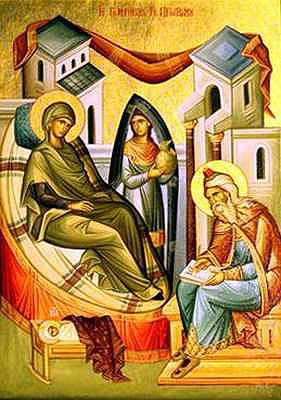
Troparion of the Forerunner Tone 4
O Prophet and Forerunner of the coming of Christ,/ we honour thee lovingly but cannot extol thee worthily;/ for by thy birth/ thy mother's barrenness and thy father's dumbness were unloosed;/ and the Incarnation of the Son of God is proclaimed to the world.
Kontakion of St John the Baptist Tone 3
The formerly barren one today gives birth to the Forerunner of Christ/ Who is the fulfillment of prophecy./ For the Prophet, Herald and Forerunner of the Word/ submitted to Him Whom the prophets foretold/ by laying his hand on Him in the Jordan.
Luke 1:24-25, 57-68, 76, 80
And after those days his wife Elisabeth conceived, and hid herself five months, saying, Thus hath the Lord dealt with me in the days wherein he looked on me, to take away my reproach among men. Now Elisabeth's full time came that she should be delivered; and she brought forth a son. And her neighbours and her cousins heard how the Lord had shewed great mercy upon her; and they rejoiced with her. And it came to pass, that on the eighth day they came to circumcise the child; and they called him Zacharias, after the name of his father. And his mother answered and said, Not so; but he shall be called John. And they said unto her, There is none of thy kindred that is called by this name. And they made signs to his father, how he would have him called. And he asked for a writing table, and wrote, saying, His name is John. And they marvelled all. And his mouth was opened immediately, and his tongue loosed, and he spake, and praised God. And fear came on all that dwelt round about them: and all these sayings were noised abroad throughout all the hill country of Judaea. And all they that heard them laid them up in their hearts, saying, What manner of child shall this be! And the hand of the Lord was with him. And his father Zacharias was filled with the Holy Ghost, and prophesied, saying, Blessed be the Lord God of Israel; for he hath visited and redeemed his people, And thou, child, shalt be called the prophet of the Highest: for thou shalt go before the face of the Lord to prepare his ways; And the child grew, and waxed strong in spirit, and was in the deserts till the day of his shewing unto Israel.
St. John Chrysostom: On Love of God and God's Love
For to have offended God is more distressing than to be punished. But now we are so wretchedly disposed, that, were there no fear of hell, we should not even choose readily to do any good thing. Wherefore were it for nothing else, yet for this at least, we should deserve hell, because we fear hell more than Christ. . . . But since we feel otherwise, for this reason are we condemned to hell: since, did we but love Christ as we should love Him, we should have known that to offend Him we love were more painful than hell. But since we love Him not, we know not the greatness of His punishment. And this is what I bewail and grieve over the most! And yet what has God not done, to be beloved of us? What hath He not devised? What hath He omitted? We insulted Him, when He had not wronged us in aught, but had even benefited us with blessings countless and unspeakable. We have turned aside from Him when calling and drawing us to Him by all ways, yet hath He not even upon this punished us, but hath run Himself unto us, and held us back, when fleeing, and we have shaken Him off and leaped away to the Devil. And not even on this hath He stood aloof, but hath sent numberless messengers to call us to Him again, Prophets, Angels, Patriarchs: and we have not only not received the embassy, but have even insulted those that came. But not even for this did He spew us out of His mouth, but like those slighted lovers that be very earnest, He went round beseeching all, the heaven, the earth, Jeremiah, Micah, and that not that He might weigh us down, but that He might speak in behalf of His own ways (Is. i. 2; Jer. ii. 12; iii. 12; etc.; Mic. vi. 1): and along with the prophets He went also Himself to those that turned aside from Him, being ready to submit to examination, and deigning to condescend to a conference, and drawing them that were deaf to every appeal into a disputation with Himself. For He saith, "O my people, what have I done unto thee, and wherein have I wearied thee? Answer me." (Mic. vi. 3.) After all this we killed the Prophets, we stoned them, we did them other cruel wrongs without number. What then? In their place He sent no longer Prophets, no longer Angels, no longer Patriarchs, but the Son Himself. He too was killed when He had come, and yet not even then did He quench His love, but kindled it even more, and keepeth on beseeching us, after even His own Son was killed, and entreating us, and doing all things to turn us unto Himself. And Paul crieth aloud, saying, "Now then we are ambassadors for Christ, as though God did beseech you by us: be ye reconciled to God." (2 Cor. v. 20.) None of these things however reconciled us. Yet not even then did He leave us, but keeps on both threatening hell, and promising a kingdom, that even so He may draw us unto Himself. But we be still in an insensible mood. What can be worse than this brutishness? For had a man done these things, should we not many times over have let ourselves become slaves to him? But God when doing so we turn us away from! O what listlessness! O what unfeelingness We that live continually in sins and wickednesses, if we happen to do any little good, like unfeeling domestics, with what a niggardly spirit do we exact it, and how particular are we about the recompense made, if what we have done has any recompense to come of it. And yet the recompense is the greater if you do it without any hope of reward. Why saying all this, and making exact reckoning, is language fitter for an hireling than a domestic of willing mind. For we ought to do everything for Christ's sake, not for the reward, but for Him. For this also was why He threatened hell and promised the kingdom, that He might be loved of us. Let us then so love Him as we ought to love Him. For this is the great reward, this is royalty and pleasure, this is enjoyment, and glory, and honor, this is light, this is the great happiness, which language (or reasoning) cannot set before us, nor mind conceive.
--St. John Chrysostom, Homily V on Romans
[This entry is also posted to my my companion blog.]
June 23, 2005
St. Ignatii Brianchaninov: On Fallen Human Nature
A profound and hidden mystery is the fall of man. It is quite impossible for a person to understand it by his own powers. This is because among the consequences of the fall is mental blindness, which prevents the mind from seeing the depths and darkness of the fall. Our fallen state deceptively appears to be a state of triumph, and the land of exile seems to be an exceptional field of progress and enjoyment. Gradually God discloses the mystery to those ascetics who serve Him sincerely and with all their soul.
What a different picture, brethren, and how terrible is the sight that meets our gaze when the mystery is disclosed to us! When by divine guidance the abysses of hell are laid bare in the depth of the heart, how is it possible not to be filled with fear! How can we not be filled with fear especially when our with weakness and infirmity is proved to us by countless bitter experiences! How is it possible not to be filled with horror at the thought that some deadly passion can lie hidden in the heart for a long time, then suddenly appear and ruin a person for ever! That is true. But whoever fears sin, whoever does not trust himself, is not in danger from sin.
--St. Ignatii Brianchaninov, Chapter 40 "Concerning Resentment or Remembrane of Wrongs," The Arena.
[This entry is also posted to my companion blog.]
June 22, 2005
The Fatherhood Chronicles LXX
Just What I Needed
Our mornings together are much, much shorter, now that Sofie is going to bed later in the evening and getting up after 6:30 in the mornings. Morning time is, of necessity, quality time instead of quantity time. This morning Sofie didn't get up till 6:45. I leave the house about 7:15, which didn't leave much daddy-daughter time. So we got up, I fixed her some breakfast and we ate breakfast together. (Her cute insistence that momma "Sih" with us at the table couldn't overcome very-pregnant-ready-to-deliver Anna's desire/need for more snoozing.)
After fixing my own lunch, and getting my gear ready to leave for work, and after she'd finished her cereal, Sofie wanted to go watch a "feevie" (video + movie), which we let her do in the mornings as I'm leaving. The twenty-three minute Baby Einstein "feevies" give Anna a few more minutes of blanket-time. I was holding Sofie in my arms as I put the DVD in the player and turned the TV on. But as I made ready to set her down on the couch, she gave me a big hug and said:
"I lubby."
The first time she has said that to me. *Sniff* (Damn. Still gets me.)
I'm still working off that high.
PhD EncouragementTM
I've been diving into Writing the Doctoral Dissertation 2e as a motivational tool.
Here's some encouraging news:
- 90% of dissertations are 110-450 pages
- 80% are 130-390 pages
- 50% are 170-300 pages
Considering I just wrote 170 pages in two months (granted, it was on six different writing projects), this is good, good news!
Want some more? 'Kay.
- 80% of dissertations require 12-20 actual work months (from start of topic search to completed draft of doctoral dissertation)
- 50% require 13.5-18 work months
- 5% require 11 or less work months
- Though 5% do require 22 or more work months (Yikes!)
All of which lends some credibility to this extremely attractive title: Completing Your Doctoral Dissertation or Master's Thesis in Two Semesters or Less, or, as the blurb puts it, "during two semesters, in fifty workdays or less." In fact, chapter 6 is entitled "Writing the Dissertation -- Twenty Workdays to go!"
After yesterday's panic attack, I got all focused and excited last night as I organized and planned out my literature review. I've got exactly sixteen items thus far (though a handful of tangential articles). More to get, of course, but that doesn't include the five ancient commentators I did a paper on last month, and it lays a pretty solid foundation.
I definitely feel better today.
Our Father Among the Saints, Alban, Protomartyr of Britain
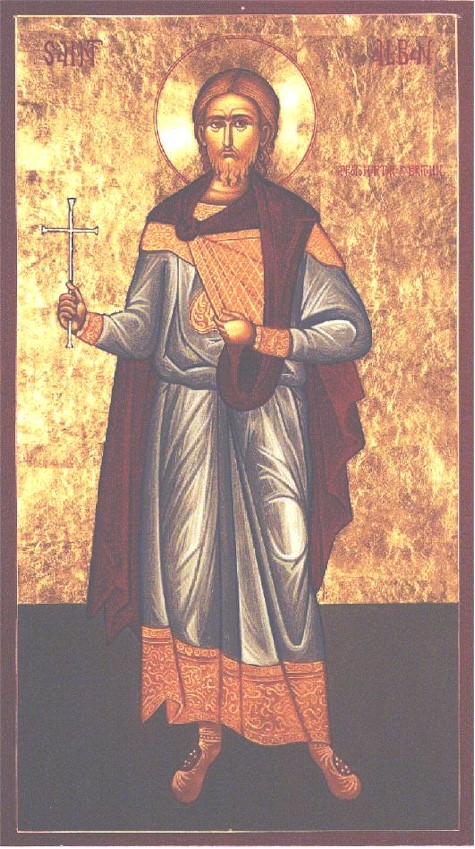
Troparion of St Alban Tone 4
Thy holy martyr Alban in his struggle/ has gained the crown of life, O Christ our God;/ for strengthened by Thee and with a pure heart/ he spoke boldly before wordly judges,/ giving up his sacred head to Thee, the Judge of all.
From Bede: Ecclesiastical History of England:
THE PASSION OF ST. ALBAN AND HIS COMPANIONS, WHO AT THAT TIME SHED THEIR BLOOD FOR OUR LORD. [A.D. 305.]AT that time suffered St. Alban, of whom the priest Fortunatus, in the Praise of Virgins, where he makes mention of the blessed martyrs that came to the Lord from all parts of the world, says
In Britain's isle was holy Alban born.
This Alban, being yet a pagan, at the time when the cruelties of wicked princes were raging against Christians, gave entertainment in his house to a certain clergyman, flying from the persecutors. This man he observed to be engaged in continual prayer and watching day and night; when on a sudden the Divine grace shining on him, he began to imitate the example of faith and piety which was set before him, and being gradually instructed by his wholesome admonitions, he cast off the darkness of idolatry, and became a Christian in all sincerity of heart. The aforesaid clergyman having been some days entertained by him, it came to the ears of the wicked prince, that this holy confessor of Christ, whose time of martyrdom had not yet come, was concealed at Alban's house. Whereupon he sent some soldiers to make a strict search after him. When they came to the martyr's house, St. Alban immediately presented himself to the soldiers, instead of his guest and master, in the habit or long coat which he wore, and was led bound before the judge.
It happened that the judge, at the time when Alban was carried before him, was standing at the altar, and offering sacrifice to devils. When he saw Alban, being much enraged that he should thus, of his own accord, put himself into the hands of the soldiers, and incur such danger in behalf of his guest, he commanded him to be dragged up to the images of the devils, before which he stood, saying, "Because you have chosen to conceal a rebellious and sacrilegious person, rather than to deliver him up to the soldiers, that his contempt of the gods might meet with the penalty due to such blasphemy, you shall undergo all the punishment that was due to him, if, you abandon the worship of our religion." But St. Alban, who had voluntarily declared himself a Christian to the persecutors of the faith, was not at all daunted at the prince's threats, but putting on the armour of spiritual warfare, publicly declared that he would not obey the command. Then said the judge, "Of what family or race are you?" "What does it concern you," answered Alban, "of what stock I am? If you desire to hear the truth of my religion be it known to you, that I am now a Christian, and bound by Christian duties." "I ask your name," said the judge; "tell me it immediately." "I am called Alban by my parents," replied he; "and I worship and adore the true and living God, who created all things." Then the judge, inflamed with anger, said, "If you will enjoy the happiness of eternal life, do not delay to offer sacrifice to the great gods." Alban rejoined, "These sacrifices, which by you are offered to devils, neither can avail the subjects, nor answer the wishes or desires of those that offer up their supplications to them. On the contrary, whosoever shall offer sacrifice to these images shall receive the everlasting pains of hell for his reward."The judge, hearing these words, and being much incensed, ordered this holy confessor of God to be scourged by the executioners, believing he might by stripes shake that constancy of heart, on which he could not prevail by words. He, being most cruelly tortured, bore the same patiently, or rather joyfully, for our Lord's sake. When the judge perceived that he was not to be overcome by tortures, or withdrawn from the exercise of the Christian religion, he ordered him to be put to death. Being led to execution, he came to a river, which, with a most rapid course, ran between the wall of the town and the arena where he was to be executed. He there saw a multitude. of persons of both sexes, and of several ages and conditions, who were doubtlessly assembled by Divine instinct, to attend the blessed confessor and martyr, and had so taken up the bridge on the river, that he could scarce pass over that evening. In short, almost all had gone out, so that the judge remained in the city without attendance. St Alban, therefore, urged by an ardent and devout wish to arrive quickly at martyrdom, drew near to the stream, and on lifting up his eyes to heaven, the channel was immediately dried up, and he perceived that the water had departed and made way for him to pass. Among the rest, the executioner, who was to have put him to death, observed this, and moved by Divine inspiration hastened to meet him at the place of execution, and casting down the sword which he had carried ready drawn, fell at his feet, praying that he might rather suffer with the martyr, whom was ordered to execute or, if possible, instead of him.
While he thus from a persecutor was become a companion in the faith, and the other executioners hesitated to take up the sword which was lying on the ground, the reverend confessor, accompanied by the multitude, ascended a hill, about 500 paces from the place, adorned, or, rather clothed with all kinds of flowers, having its sides neither perpendicular, nor even craggy, but sloping down into a most beautiful plain, worthy from its lovely appearance to be the scene of a martyr's sufferings. On the top of this hill, St. Alban prayed that God would give him water, and immediately a living spring broke out before his feet, the course being confined, so that all men perceived that the river also had been dried up in consequence of the martyr's presence. Nor was it likely that the martyr, who had left no water remaining in the river, should want some on the top of the hill, unless he thought it suitable to the occasion. The river having performed the holy service, returned to its natural course, leaving a testimony of its obedience. Here, therefore, the head of most courageous martyr was struck off, and here he received the crown of life, which God has promised to those who love Him. But he who gave the wicked stroke, was not permitted to rejoice over the deceased; for his eyes dropped upon the ground together with the blessed martyr's head.
At the same time was also beheaded the soldier, who before, through the Divine admonition, refused to give the stroke to the holy confessor. Of whom it is apparent, that though he was not regenerated by baptism, yet he was cleansed by the washing of his own blood, and rendered worthy to enter the kingdom of heaven. Then the judge, astonished at the novelty of so many heavenly miracles, ordered the persecution to cease immediately, beginning to honour the death of the saints, by which he before thought they might have been diverted from the Christian faith. The blessed Alban suffered death on the twentysecond day of June, near the city of Verulam, which is now by the English nation called Verlamacestir, or Varlingacestir, where afterwards, when peaceable Christian times were restored, a church of wonderful workmanship, and suitable to his martyrdom, was erected. In which place, there ceases not to this day the cure of sick persons, and the frequent working of wonders.
At the same time suffered Aaron and Julius, citizens of Chester, and many more of both sexes in several places; who, when they had endured sundry torments, and their limbs had been torn after an unheardof manner, yielded their souls up, to enjoy in the heavenly city a reward for the sufferings which they had passed through.
Anglican Chaplet of St. Alban
(based on Lectionary Lessons)
Cross: Do not be astonished, brothers and sisters, that the world hates you. We know that we have passed from death to life because we love one another. Whoever does not love abides in death. All who hate a brother or sister are murderers, and you know that murderers do not have eternal life abiding in them. We know love by this, that he laid down his life for us—and we ought to lay down our lives for one another. -- 1 John 3:13-16
Invitatory Bead: Almighty God, by whose grace and power your holy martyr Alban triumphed over suffering and was faithful even unto death: Grant to us, who now remember him with thanksgiving, to be so faithful in our witness to you in this world, that we may receive with him the crown of life; through Jesus Christ our Lord, who lives and reigns with you and the Holy Spirit, one God, for ever and ever.
Cruciform Bead: O taste and see that the LORD is good; happy are those who take refuge in him. -- Psalm 34:8
Week Beads: Psalm 34:1-7
1st: I will bless the LORD at all times; his praise shall continually be in my mouth.
2nd: My soul makes its boast in the LORD; let the humble hear and be glad.
3rd: O magnify the LORD with me, and let us exalt his name together.
4th: I sought the LORD, and he answered me, and delivered me from all my fears.
5th: Look to him, and be radiant; so your faces shall never be ashamed.
6th: This poor soul cried, and was heard by the LORD, and was saved from every trouble.
7th: The angel of the LORD encamps around those who fear him, and delivers them.
Exit Cross: ‘Do not think that I have come to bring peace to the earth; I have not come to bring peace, but a sword. For I have come to set a man against his father, and a daughter against her mother, and a daughter-in-law against her mother-in-law; and one’s foes will be members of one’s own household. Whoever loves father or mother more than me is not worthy of me; and whoever loves son or daughter more than me is not worthy of me; and whoever does not take up the cross and follow me is not worthy of me. Those who find their life will lose it, and those who lose their life for my sake will find it. ‘Whoever welcomes you welcomes me, and whoever welcomes me welcomes the one who sent me. Whoever welcomes a prophet in the name of a prophet will receive a prophet’s reward; and whoever welcomes a righteous person in the name of a righteous person will receive the reward of the righteous; and whoever gives even a cup of cold water to one of these little ones in the name of a disciple--truly I tell you, none of these will lose their reward.’ -- Matthew 10:34-42
June 21, 2005
True Philosophia: Christian Way of Life in Opposition to the Schools of Antiquity
I have been drawing strong identifications and similarities between the understandings of the philosophiai of the six ancient schools and that of the Christian philosophia. However, a caution is in order. Christianity is a philosophia in many of the same ways as the ancient schools. But it is also radically different. In this reflection I will highlight some of those differences and what that means to Christianity as a philosophia.
One of the clearest differences can be seen in St. Clement of Alexandria's Stromateis (or, Miscellanies):
He then, who of himself believes the Scripture and the voice of the Lord, which by the Lord acts to the benefiting of men, is rightly [regarded] faithful. Certainly we use it as a criterion in the discovery of things. What is subject to criticism cannot be a first principle. Therefore, as is reasonable, grasping by faith the indemonstrable first principle, and receiving in abundance, from the first principle itself, demonstration in reference to the first principle, we are by the voice of the Lord trained up to the knowledge of the truth. (Stromateis Bk 7 Ch 16)
St. Clement's "indemonstrable first principle" is a clear echo of Aristotle in the Posterior Analytics:
It follows that there can be no scientific knowledge of the first principles. (Posterior Analytics II.19 100b11)
That is to say, first principles are those things which we cannot demonstrate by argument, but are, indeed, those things that make argument possible. For example, how would one prove by demonstration the contention that knowledge is even possible? To prove the principle logically begs the question, for one already assumes that knowledge is possible in the very act of demonstration.
As the saint notes, one of the first principles of Christianity is that God has specifically revealed himself, first in the covenant with the Jews, which was fulfilled and completed in the Person and work of Christ. Part of this revelation involves the written Scriptures which also testify to the work that God has done among the Jews and the Church. So while one might argue that Scripture and the witness and life of the Church are, in fact, the revelation of God to all mankind, that God reveals himself to mankind cannot be proven: it is a first principle that is assumed, or taken on faith, and from which other demonstrations follow (i. e., that Scripture is part of God's revelation, for example).
It is precisely on the terms of first principles that Christianity differs from the other philosophical schools. For example, Christianity affirms that the cosmos is the special creation ex nihilo of the Holy Trinity. Epicureanism, by way of contrast, affirms that the cosmos is not created, it merely is, and that all reality is a natural monism (i. e., everything is composed of indivisible physical entities called atoms).
Furthermore, the tenor of the way of life consonant with these first principles will also fundamentally differ. I assert this in contention with Pierre Hadot in his Philosophy as a Way of Life where he affirms that the similarity of practices between the ancient philosophiai affirm a common end, namely an attentiveness to the present and the transformation of the soul. But while some might see enough similarity between Epicurean and Stoic ataraxia (or quietude of soul) but such similarity is superficial at best. For Epicurean ataraxia is one of a relaxation of tension, where as Stoic ataraxia is one of an active conformity to reality in the present moment, which is not relaxation but tensive praxis. Similarly, between the Platonic contemplation of the ideas and the Christian theosis is a great gulf of difference, even if both resort to memorization of sacred texts in the practice of conform mind, heart and act.
In other words, first principles give a radically different content to their end toward which a person's soul is oriented for transfiguration. St. Clement ties knowledge based on first principles to the forming of good men.
[F]irst, speculation; second the performance of the precepts; third, the forming of good men;--which, concurring, form the Gnostic. Whichever of these is wanting, the elements of knowledge limp. (Stromateis Bk 2 Ch 10)
Again, St. Clement links the comprehension of the "really real" with what he calls "good habits of conduct."
[P]hilosophy is an effort to grasp that which truly is, and the studies that conduce thereto. And it is not the rendering of one accomplishd in good habits of conduct, but the knowing how we are to use and act and labour, according as one is assimilated to God. (Stromateis Bk 2 Ch 9)
That is to say, those fundamental beliefs that organize the knowledge our mind gains through both sensory impressions as well as the noetic impressions communicated by Christ the Paedegogue through the master (the Gnostic, i. e., the mature Christian) to the student. Those beliefs, then, structure knowledge, which in turn is embodied in act. Thus despite the surface similarities of soulish exercises that Christians might share with others (Stoic self-analysis--a la Marcus Aurelius' Meditations--or observance of the hours of prayer with Jews and Muslims), the content of those exercise radically conform to the first principles and thus are fundamentally different from one another.
Christianity claimed to be true in a way that other philosophiai did not: on the basis of the direct revelation of God. This is not a principle that can be argued. It is either accept or not. But similarly neither could Epicureans argue for the truth of their first principle of naturalistic monism. Such a principle must also be accepted on faith.
The demonstration of the truth or falsity of these various ways of life, then, was predicated on something other than an objective demonstration of first principles. Rather the truth or falsity of a philosophia was argued existentially; that is to say, it is not only rationally coherent, but more to the point, it results in a tangible transformation of soul that fulfills the promise of the way of life it announces. Or, it was both rationally and pragmatically coherent, embodying a wholeness of thought and life that resulted in an active condition of soul (a hexis) empirically testifying to the transformation the particular way of life enacted on the soul.
In light of these things, then, according to ancient Christianity, what was important about the philosophia that is the Faith of the Church, was not primarily its capacity for rational explication and defense. Rather the fundamental quality of Christian philosophia was its fulfillment of the promise of generation the new man. The proof of the veracity of the faith was not its apologetic in rational terms, but its existential witness to the transforming grace which energizes its adherents.
This is radically important and something we ought not miss in our own day. Ours is not to prove Christianity true by way of rational argument. Ours is to witness to the truth of Christianity via the theosis Christ accomplishes in us by the Holy Spirit. Rational defenses of the faith, the commending of the faith as intellectual coherent and noetic generative, are not unimportant. But theirs is an importance that is secondary. We do not read, in the historical martyrologies of the Church, of conversions from the reading of St. Justin the Philosophers Apologies. We do, however, read time and time again, of accounts of non-Christians converted on the spot of the martyrdoms of the saints, more often than not being baptized in blood before they could be baptized in water. We know that the Stoic way of life accepted suicide by one's own hand if the conformity to the fundamental reality of the cosmos was too much for a Stoic adherent to bear. Not believing in the after life or in the care of the gods for the cosmos or their efficacy or justice in aiding mankind, a Stoic could without guilt commit suicide in the face of irresoluble despair. Not so, Christianity. Christianity presumed a cosmic struggle in which the Christian was engaged, and the imperative to wrestle against the spiritual forces at work in darkness was pervasive. Thus Christians endured in the face of torture and unutterable suffering, with joy and hymns in radical difference to Stoic resignation and suicide.
A philosophia proves its truth in its way of life. This is as true of Christianity as it is of any other philosophia. And Christianity further commends itself as only true, and all others false, precisely on its matyric form of witness.
[The remainder of the posts in this series can be found here.]
June 20, 2005
The Fatherhood Chronicles LXIX
My Best Father's Day Ever
Well, of course, there's been only two of them, but, hey: quality over quantity! Was there a day of absolute quiet and ample time for reading and quiet contemplation? No. Was there a significant chunk allotted so that I could finish my thesis? No. Any special dinners out or cards with money in them? No. Any power tools? Regrettably, no.
No, you see, my wife is just over a week away from her due date, so let's just say her attention is not (nor should it be) on making my Father's Day some sort of extravaganza. Furthermore, we are in the summer of poverty, wherein my classes to teach have dried up, and with them the extra income that makes life not just bearable but doable from an economic standpoint. Yep. Summer always brings out the financial ingenuity and haggling we've come to depend on in the Healy household.
So, no, this was no Father's Day Live Aid phenonemon.
But it was pretty cool for all that. You see, Anna took out some new books she had set aside and we took them to Borders for an exchange. When she does that it's usually so we can get Sofie some neat books, educational items, or book-character-related toys. But this Father's Day, all the exchange money was mine. And we had plenty. Anna got a frozen drink thingy and we got a book for Sofie. And I, oh, my dear readers, I was most wonderfully pleased. I picked up my favorite form of caffeinated-bean elixir: cafe au lait. My sure and certain eye picked out the Loeb edition of Aristotle's Posterior Analytics and the Topica. Oh, and yes, I would have retired to our humble abode a most happy young man, with but these two things, coffee and Aristotle. But, no, greater things awaited, for the piece de resistance was an eleven-dollar copy of a This is Spinal Tap DVD sweetly singing my name from the bargain bin. An impulse buy? But of course!
All this, yes, and we had a few bucks left over.
And though the nesting instinct is hard upon my beloved wife at the moment, I only had one honey-do list item to accomplish--vacuuming the interior of the 4Runner--which we did as a family. Well, there was also the getting the double-stroller in the car . . . as well as the infant car seat. Oh, and loading and unloading the dishwasher--but Anna and I did that together. Yes, and I had to take out the trash. Oh, and there was a load of laundry to hike down and back up our three flights of stairs. But really, no other honey-do items.
Yes, that, my readers and friends, is a most wonderful Father's Day.
Day of the Holy Spirit (Whit Monday)
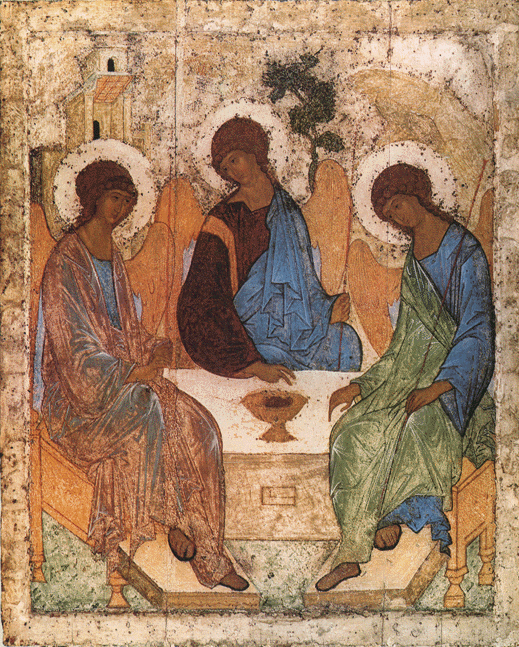
Ephesians 5:9-19:
(For the fruit of the Spirit is in all goodness and righteousness and truth;) Proving what is acceptable unto the Lord. And have no fellowship with the unfruitful works of darkness, but rather reprove them. For it is a shame even to speak of those things which are done of them in secret. But all things that are reproved are made manifest by the light: for whatsoever doth make manifest is light. Wherefore he saith, Awake thou that sleepest, and arise from the dead, and Christ shall give thee light. See then that ye walk circumspectly, not as fools, but as wise, Redeeming the time, because the days are evil. Wherefore be ye not unwise, but understanding what the will of the Lord is. And be not drunk with wine, wherein is excess; but be filled with the Spirit; Speaking to yourselves in psalms and hymns and spiritual songs, singing and making melody in your heart to the Lord.
From the GOArch website:
As it is the custom of the Church, on the day after every great Feast, to honour those through whom it came to pass our Lady on the day after the Lord's Nativity, Joachim and Anna after our Lady's Nativity, the holy Baptist the day after Theophany, and so forth, on this day we honour our God the All-holy Spirit, the Comforter promised by our Saviour to His disciples (John 14:16), Who descended upon them at holy Pentecost and guided them "into all truth" (ibid. 16:13), and through them, us.
The Christian Heresy of Islam
Citing William Dalrymple's, From the Holy Mountain: A Journey Among the Christians of the Middle East, Fr. Joseph notes that Islam is a Christian heresy.
From the hours of prayer and prayer posture to architecture, contends Dalrymple, Islam is an imitation of Christianity.
June 19, 2005
Pentecost and Trinity Sunday
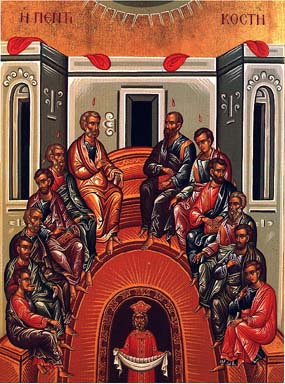
Troparion Tone 8
Blessed art Thou O Christ Our God / Who has revealed the fishermen as most wise / By sending down upon them the Holy Spirit / Through them Thou didst draw the world into Thy net / O Lover of Man, Glory to Thee!
Kontakion Tone 8
When the most High came down and confused the tongues, / He divided the nations; / But when he distributed the tongues of fire / He called all to unity. / Therefore, with one voice, we glorify the All-holy Spirit!
Acts 2:1-11:
And when the day of Pentecost was fully come, they were all with one accord in one place. And suddenly there came a sound from heaven as of a rushing mighty wind, and it filled all the house where they were sitting. And there appeared unto them cloven tongues like as of fire, and it sat upon each of them. And they were all filled with the Holy Ghost, and began to speak with other tongues, as the Spirit gave them utterance. And there were dwelling at Jerusalem Jews, devout men, out of every nation under heaven. Now when this was noised abroad, the multitude came together, and were confounded, because that every man heard them speak in his own language. And they were all amazed and marvelled, saying one to another, Behold, are not all these which speak Galilaeans? And how hear we every man in our own tongue, wherein we were born? Parthians, and Medes, and Elamites, and the dwellers in Mesopotamia, and in Judaea, and Cappadocia, in Pontus, and Asia, Phrygia, and Pamphylia, in Egypt, and in the parts of Libya about Cyrene, and strangers of Rome, Jews and proselytes, Cretes and Arabians, we do hear them speak in our tongues the wonderful works of God.
John 7:37-52; 8:12:
In the last day, that great day of the feast, Jesus stood and cried, saying, If any man thirst, let him come unto me, and drink. He that believeth on me, as the scripture hath said, out of his belly shall flow rivers of living water. (But this spake he of the Spirit, which they that believe on him should receive: for the Holy Ghost was not yet given; because that Jesus was not yet glorified.) Many of the people therefore, when they heard this saying, said, Of a truth this is the Prophet. Others said, This is the Christ. But some said, Shall Christ come out of Galilee? Hath not the scripture said, That Christ cometh of the seed of David, and out of the town of Bethlehem, where David was? So there was a division among the people because of him. And some of them would have taken him; but no man laid hands on him. Then came the officers to the chief priests and Pharisees; and they said unto them, Why have ye not brought him? The officers answered, Never man spake like this man. Then answered them the Pharisees, Are ye also deceived? Have any of the rulers or of the Pharisees believed on him? But this people who knoweth not the law are cursed. Nicodemus saith unto them, (he that came to Jesus by night, being one of them,) Doth our law judge any man, before it hear him, and know what he doeth? They answered and said unto him, Art thou also of Galilee? Search, and look: for out of Galilee ariseth no prophet. Then spake Jesus again unto them, saying, I am the light of the world: he that followeth me shall not walk in darkness, but shall have the light of life.
From the OCA website:
In the Old Testament Pentecost was the feast which occurred fifty days after Passover. As the passover feast celebrated the exodus of the Israelites from the slavery of Egypt, so Pentecost celebrated God's gift of the ten commandments to Moses on Mount Sinai.In the new covenant of the Messiah, the passover event takes on its new meaning as the celebration of Christ's death and resurrection, the "exodus" of men from this sinful world to the Kingdom of God. And in the New Testament as well, the pentecostal feast is fulfilled and made new by the coming of the "new law," the descent of the Holy Spirit upon the disciples of Christ.
When the day of Pentecost had come they were all together in one place. And suddenly a sound came from heaven like the rush of a mighty wind, and it filled all the house where they were sitting. And there appeared to them tongues as of fire, distributed as resting upon each one of them. And they were all filled with the Holy Spirit ... (Acts 2:1-4).The Holy Spirit that Christ had promised to his disciples came on the day of Pentecost (Jn 14:26, 15:26; Lk 24:49; Acts 1:5). The apostles received "the power from on high," and they began to preach and bear witness to Jesus as the risen Christ, the King and the Lord. This moment has traditionally been called the birthday of the Church.
In the liturgical services of the feast of Pentecost, the coming of the Holy Spirit is celebrated together with the full revelation of the divine Trinity: Father, Son, and Holy Spirit. The fulness of the Godhead is manifested with the Spirit's coming to man, and the Church hymns celebrate this manifestation as the final act of God's self-disclosure and self-donation to the world of His creation. For this reason Pentecost Sunday is also called Trinity Day in the Orthodox tradition. Often on this day the icon of the Holy Trinity -- particularly that of the three angelic figures who appeared to Abraham, the forefather of the Christian faith - is placed in the center of the church. This icon is used with the traditional pentecostal icon which shows the tongues of fire hovering over Mary and the Twelve Apostles, the original prototype of the Church, who are themselves sitting in unity surrounding a symbolic image of "cosmos," the world.
On Pentecost we have the final fulfillment of the mission of Jesus Christ and the first beginning of the messianic age of the Kingdom of God mystically present in this world in the Church of the Messiah. For this reason the fiftieth day stands as the beginning of the era which is beyond the limitations of this world, fifty being that number which stands for eternal and heavenly fulfillment in Jewish and Christian mystical piety: seven times seven, plus one.
Thus, Pentecost is called an apocalyptic day, which means the day of final revelation. It is also called an eschatological day, which means the day of the final and perfect end (in Greek eschaton> means the end). For when the Messiah comes and the Lord's Day is at hand, the "last days" are inaugurated in which "God declares: ... I will pour out my Spirit upon all flesh." This is the ancient prophecy to which the Apostle Peter refers in the first sermon of the Christian Church which was preached on the first Sunday of Pentecost (Acts 2: 1 7; Joel 2: 28-32).
Once again it must be noted that the feast of Pentecost is not simply the celebration of an event which took place centuries ago. It is the celebration of what must happen and does happen to us in the Church today. We all have died and risen with the Messiah-King, and we all have received his Most Holy Spirit. We are the "temples of the Holy Spirit." God's Spirit dwells in us (Rom 8; 1 Cor 2-3, 12; 2 Cor 3; Gal 5; Eph 2-3). We, by our own membership in the Church, have received "the seal of the gift of the Holy Spirit" in the sacrament of chrismation. Pentecost has happened to us.
The Divine Liturgy of Pentecost recalls our baptism into Christ with the verse from Galatians again replacing the Thrice-Holy Hymn. Special verses from the psalms also replace the usual antiphonal psalms of the liturgy. The epistle and gospel readings tell of the Spirit's coming to men. The kontakion sings of the reversal of Babel as God unites the nations into the unity of his Spirit. The troparion proclaims the gathering of the whole universe into God's net through the work of the inspired apostles. The hymns 0 Heavenly King and We have seen the True Light are sung for the first time since Easter, calling the Holy Spirit to "come and abide in us", and proclaiming that "we have received the heavenly Spirit." The church building is decorated with flowers and the green leaves of the summer to show that God's divine Breath comes to renew all creation as the "lifeÄcreating Spirit." In Hebrew the word for Spirit, breath and wind is the same word, ruah.
Blessed art Thou, O Christ our God, who hast revealed the fishermen as most wise by sending down upon them the Holy Spirit: through them Thou didst draw the world into Thy net. 0 Lover of Man, Glory to Thee (Troparion).When the Most High came down and confused the tongues, he divided the nations. But when he distributed the tongues of fire, he called all to unity. Therefore, with one voice, we glorify the All-Holy Spirit! (Kontakion)
The Great Vespers of Pentecost evening features three long prayers at which the faithful kneel for the first time since Easter. The Monday after Pentecost is the feast of the Holy Spirit in the Orthodox Church, and the Sunday after Pentecost is the feast of All Saints. This is the logical liturgical sequence since the coming of the Holy Spirit is fulfilled in men by their becoming saints, and this is the very purpose of the creation and salvation of the world. "Thus says the Lord: Consecrate yourselves therefore, and be holy, for I your God am holy" (Lev 11:44-45, 1 Pet 1:15-16).
Also from the OCA website:
In the Church's annual liturgical cycle, Pentecost is "the last and great day." It is the celebration by the Church of the coming of the Holy Spirit as the end - the achievement and fulfillment - of the entire history of salvation. For the same reason, however, it is also the celebration of the beginning: it is the "birthday" of the Church as the presence among us of the Holy Spirit, of the new life in Christ, of grace, knowledge, adoption to God and holiness.This double meaning and double joy is revealed to us, first of all, in the very name of the feast. Pentecost in Greek means fifty, and in the sacred biblical symbolism of numbers, the number fifty symbolizes both the fulness of time and that which is beyond time: the Kingdom of God itself. It symbolizes the fulness of time by its first component: 49, which is the fulness of seven (7 x 7): the number of time. And, it symbolizes that which is beyond time by its second component: 49 + 1, this one being the new day, the "day without evening" of God's eternal Kingdom. With the descent of the Holy Spirit upon Christ's disciples, the time of salvation, the Divine work of redemption has been completed, the fulness revealed, all gifts bestowed: it belongs to us now to "appropriate" these gifts, to be that which we have become in Christ: participants and citizens of His Kingdom.
THE VIGIL OF PENTECOST
The all-night Vigil service begins with a solemn invitation:
"Let us celebrate Pentecost, the coming of the Holy Spirit, The appointed day of promise, and the fulfillment of hope, The mystery which is as great as it is precious."
In the coming of the Spirit, the very essence of the Church is revealed:
"The Holy Spirit provides all, Overflows with prophecy, fulfills the priesthood, Has taught wisdom to illiterates, has revealed fishermen as theologians, He brings together the whole council of the Church."
In the three readings of the Old Testament (Numbers 11:16-17, 24-29; Joel 2:23-32; Ezekiel 36:24-28) we hear the prophecies concerning the Holy Spirit. We are taught that the entire history of mankind was directed towards the day on which God "would pour out His Spirit upon all flesh." This day has come! All hope, all promises, all expectations have been fulfilled. At the end of the Aposticha hymns, for the first time since Easter, we sing the hymn: "O Heavenly King, the Comforter, the Spirit of Truth…," the one with which we inaugurate all our services, all prayers, which is, as it were, the life-breath of the Church, and whose coming to us, whose "descent" upon us in this festal Vigil, is indeed the very experience of the Holy Spirit "coming and abiding in us."
Having reached its climax, the Vigil continues as an explosion of joy and light for "verily the light of the Comforter has come and illumined the world." In the Gospel reading (John 20:19-23) the feast is interpreted to us as the feast of the Church, of her divine nature, power and authority. The Lord sends His disciples into the world, as He Himself was sent by His Father. Later, in the antiphons of the Liturgy, we proclaim the universality of the apostles' preaching, the cosmical significance of the feast, the sanctification of the whole world, the true manifestation of God's Kingdom.
THE VESPERS OF PENTECOST
The liturgical peculiarity of Pentecost is a very special Vespers of the day itself. Usually this service follows immediately the Divine Liturgy, is "added" to it as its own fulfillment. The service begins as a solemn "summing up" of the entire celebration, as its liturgical synthesis. We hold flowers in our hands symbolizing the joy of the eternal spring, inaugurated by the coming of the Holy Spirit. After the festal Entrance, this joy reaches its climax in the singing of the Great Prokeimenon:
"Who is so great a God as our God?"
Then, having reached this climax, we are invited to kneel. This is our first kneeling since Easter. It signifies that after these fifty days of Paschal joy and fulness, of experiencing the Kingdom of God, the Church now is about to begin her pilgrimage through time and history. It is evening again, and the night approaches, during which temptations and failures await us, when, more than anything else, we need Divine help, that presence and power of the Holy Spirit, who has already revealed to us the joyful End, who now will help us in our effort towards fulfillment and salvation.
All this is revealed in the three prayers which the celebrant reads now as we all kneel and listen to him. In the first prayer, we bring to God our repentance, our increased appeal for forgiveness of sins, the first condition for entering into the Kingdom of God.
In the second prayer, we ask the Holy Spirit to help us, to teach us to pray and to follow the true path in the dark and difficult night of our earthly existence. Finally, in the third prayer, we remember all those who have achieved their earthly journey, but who are united with us in the eternal God of Love.
The joy of Easter has been completed and we again have to wait for the dawn of the Eternal Day. Yet, knowing our weakness, humbling ourselves by kneeling, we also know the joy and the power of the Holy Spirit who has come. We know that God is with us, that in Him is our victory.
Thus is completed the feast of Pentecost and we enter "the ordinary time" of the year. Yet, every Sunday now will be called "after Pentecost" - and this means that it is from the power and light of these fifty days that we shall receive our own power, the Divine help in our daily struggle. At Pentecost we decorate our churches with flowers and green branches - for the Church "never grows old, but is always young." It is an evergreen, ever-living Tree of grace and life, of joy and comfort. For the Holy Spirit - "the Treasury of Blessings and Giver of Life - comes and abides in us, and cleanses us from all impurity," and fills our life with meaning, love, faith and hope.
Father Alexander Schmemann (1974)
June 17, 2005
The Prevalence of Divorce Among Same-Sex Couples in Sweden
According to the summary of this policy brief (opens in Adobe; via the Institute for Marriage and Public Policy site):
A recent study offers the first systematic review of same-sex unions and divorce rates based on accurate national register data in Sweden from the 1990’s.The study found that gay male couples were 1.5 times as likely (or 50 percent more likely) to divorce as married opposite-sex couples, while lesbian couples were 2.67 times as likely (167 percent more likely) to divorce as opposite-sex married couples over a similar period of time. Even after controlling for demographic characteristics associated with increased risk of divorce, male same-sex couples were 1.35 times as likely (35 percent more likely) to divorce, and lesbian couples were three times as likely (200 percent more likely) to divorce as opposite-sex married couples.
This is despite the fact that heterosexual and same sex couples generally face the same risks of divorce:
In general, characteristics associated with increased risk of divorce appear very similar for same-sex and opposite-sex partners: Younger couples, less educated couples, couples with greater age differences, couples where one partner was foreign-born, or where one or both partners had been previously married, were more likely to divorce. For example, Swedish partners with only a secondary education or less were more than twice as likely to separate as couples where both partners had a university degree.
Note even the presence or absence of children in the couple's home family could explain the prevalence of divorce among same-sex couples.
The lower rates of children among same-sex couples did not explain this difference. Even among childless households, same-sex male partnerships experienced almost a 50 percent higher likelihood (1.49 times as likely) of divorce during the study period, while childless lesbian couples were three times as likely (200 percent higher likelihood) to break up as a married couple without children.One reason children may not reduce the divorce risk on same-sex couples is that these children are less likely to be children of both partners and more often "stepchildren" for one partner. The authors speculate that there may be an indirect effect from the possibility of procreation in reducing divorce risk in opposite-sex marriages: "To some extent, the disruption risks of childless heterosexual spouses might be reduced in anticipation of childrearing, i.e., when spouses stay together in order to fulfill their plans of parenthood."
Note:
See also these policy briefs from iMAPP.org on
sustained public resistance in the U.S. to same-sex marriage, and a decrease in support for SSM among college students
and
June 16, 2005
The Fatherhood Chronicles LXVIII
T-Minus 12 Days (or Thereabouts) and Counting
Anna's due date is in less than two weeks. All along we've sort of thought she might go early since this is the second baby. The midwife is acting pretty much like she'll go late since she did with Sofie. Oy. On the one hand, if the baby is late, it might be born on Delane's (Anna's late brother who died last 17 December) birthday, 3 July. That would be nice. And my mom would sure like that since she's flying up to see us over an extended Fourth of July trip and would be tickled to be here when the baby's born. On the other hand, even being born past the due date, Sofie was born on the eve of the Feast of the Dormition, and this baby's "scheduled to be born" on the eve of the Feast of the Apostles. It'd kinda be nice to keep the symmetry.
I remember this time two years ago, as I anticipated Sofie's birth. There was the knotty stomach that couldn't handle eating lunch. Frustrations with the well-meaning and the too-personal. And just overall flustered nervousness and anxiety.
Somewhat regretfully, this time around I've been so doggone busy writing papers that I lose touch with the stomach-flipping reality: I'm about to be a father . . . again. Of course, I won't be fighting all the same battles as I did before (though I have been fighting all the worrisome thoughts of things-gone-wrong). Because of that, and due to my experience of nearly two years of fatherhood, I recognize how incompetent I am to be a father, and how undeserving. There is so much more awe and tear-filled gratitude these days when I dwell on these things. I am such a screw-up, yet God is gracing me with yet another child. I'm as still captivated by the biological processes of the growing child in utero as ever, but ever more stricken silent at the wonder-filled gift and unutterable responsibility of it all.
If anyone were ever tempted to the heresy of Pelagianism, surely fatherhood and its graces and obligations would cure one of such a contagion. The whole birthing thing is out of my hands. No matter my support and love it would all happen apart from me anyway. These thirty-odd weeks I could only watch at this unfolding of the work of God. Still--can you believe this?!--despite my uselessness, God stoops down to join my fumbling about with his most graceful acts.
This surely must be the essence and mystery of human fatherhood, and it undoes me every time I think of it.
The Life That is Philosophia
Philosophy is normally the English word that translates the Greek philosophia, which itself means "love of wisdom," or, better in this context, "friendship with wisdom." I have avoided using "philosophy" in this series of reflections, using instead the (transliterated) Greek equivalent, philosophia so as to also avoid the academic and professionalized connotations that latch on to "philosophy." For present day understandings of philosophy are generally those exhibited by first year undergraduates on the completion of their intro course: a bunch of opposing arguments on a whole lot of topics resulting in no definitive answer to questions that are largely irrelevant to my daily life.
But philosophia in the ancient world was something else altogether. There were, of course, competing arguments between and among the various schools on various topics. But all the schools shared at least the choice of a way of life centered around the pursuit of wisdom for the purpose of the transformation of the soul. Platonists might posit reality as the realm of ideas, while Epicureans might hold a naturalistic monism, but both held that one's beliefs and actions should be conformed to these realities. Aristotelians might posit a life of virtue in pursuit of the ultimate end of eudaimonia, while Stoics might adhere to a vision of life in which the pursuit of quietude of soul, ataraxia, was gained by a ruthless search for conformity of the self to reality without illusions, but both sought a transformation of the soul. Though the Stoic conception of the Logos differed from the Platonic idea of the Good, they shared the conviction that there was an ordered principle pervasive through the cosmos. To be sure, there were convictions and arguments that put one at odds with one's own school. One could not hold to atomistic monism and claim to be a faithful Aristotelian, nor could one be convinced of and argue for Platonic ideas and be a Pyrrhonian skeptic. Some beliefs and practices put one at odds with one's school and called into question one's commitments. Even so, the various schools had their commitments attendant upon the choice to become a disciple of a particular school.
Broadly speaking, then, the ancient philosophiai shared these basic components: A pre-reflective choice for a particular way of life embodied in a particular school; a community engaged in that particular way of life which formed the fundamental institution of that philosophia; an orientation to a singular principle which ordered the cosmos (a Logos-orientation); the practice of dialogue, a body of shared doctrines, and, usually, a set of more or less standard texts that played a role supplementary to the practice of dialogue and the body of shared doctrine; and the search for the transformation of the soul through the practice of "soulish exercises" that furthered the communal structures and practices.
A potential Aristotelian disciple, for example, would happen by chance one day to go by the Lyceum and overhear a lecture or dialogue open to the public. There he would find a community of juniors and seniors (or disciples and masters) engaged in conversation over some matter of consideration--say the nature of pleasure. One might argue Speusippus' viewpoint, another Empedocles', but the community might settle on a position that rejects them both. These conversations would be based on, or perhaps captured in, a set of lecture notes written by Aristotle or another one of the community. But these texts, though later held in importance, were not the singular authority in the school, but shared in the authority of the community's own gathered deliberations.
The would-be disciple might first find himself somewhat lost among all the arguments, questions and counter-arguments, but would be attracted by the way of life exhibited by the community and reflected in their gathered search for wisdom. He would quickly see that the community was oriented around one particular principle of reality, and together engaged in communal and personal practices that both reinforced and furthered the first principles upon which community life was based and which also resulted in the personal transformation of the soul. These considerations would not at first be systematically ordered in the potential disciple's mind such that he objectively considered all these things and measured them against rival schools. Rather, he would find himself attracted to the way of life presented to him, choose to enter that way of life, and subsequent to that choice reflective order these considerations in his own mind. It was only from the place of conviction, not the nowhere of unaligned objectivity, that he would be able later to evaluate competing schools, but, even more importantly, would be able to engage reality in such a way so as to transform his soul. That is to say, the ancient philosopher knew that reality could not be engaged apart from pre-reflective convictions.
The way this maps on to Christianity ought be obvious.
In early Christianity, the potential disciple would be attracted to the community and its way of life first, and only later instructed in its doctrines. The commitment would be, for the most part, a pre-reflective existential choice predicated on the would-be disciple's unique experience. After some time spent in living with the Church and taking on specific practices of her way of living, the disciple would enter the catechumenate (or would, as part of the catechumenate, take on specific practices) where he would be more formally instructed in the doctrines of the Faith. And only after initiation, full commitment to Christ in baptism, would the disciplina arcana of Holy Baptism and Holy Eucharist be further explained. As can be seen from the catechetical lectures of St. Cyril of Jerusalem (delivered c. A.D. 347).
The Christian disciple would find in the community to which he'd attached himself, the communal practices of corporate worship in the Eucharist and the daily office, the having of all things in common, the devotion to the apostles' teachings, and the sharing of common life and faith from house to house. He would also be inculcated in the "soulish exercises" that would begin bringing about his transformation of soul: fasting, prayer, almsgiving, the hearing and memorizing of Scripture and hymns, the battle against the passions. He would find the community reflecting together on the Scripture (both the Greek Old Testament and the Apostolic Books), led by the bishop, and would conform to the authority manifested in the Church and the Holy Writings. All these components of the Christian way of life would be personally transmitted in the lives of the community from each living generation to the next, in unbroken communion. One did not need to consult mouldering papyrus scrolls to know what sort of life Christians lived, one simply joined the community.
It should be clear, too, that becoming a member of one of the philosophiai, whether pagan or Christian, entailed first a commitment and only later an understanding. One chose the philosophia before one understood it. One lived the life of a particular philosophia before one was taught it's doctrines. This is not to deny the very real work of the apologists or that Christians did not defend and explain their way of life to "seekers." But neither did they consider it necessary to fully explain the faith. In fact, it was more necessary to strictly guard the most important doctrines (Baptism, the Eucharist, the Trinity) from all but the fully initiated. Their faith was a way of life that was not an intellectual exercise, but something that must be lived. Indeed, only once the transformation of one's soul had begun in living the life of the community could one properly understand the doctrines of that community.
Christianity was about the faithful life as a transformation of the soul, not a course of conceptual objects to be mentally digested. Thus a child could live the way of Christian philosophia as well as the most gifted intellectual, and, indeed, perhaps could do so more effectively. And this is why heretics and schismatics were (and are) so inimical to the Faith; not that simply that they promoted a non-Christian gospel, but that they lived in such a way so as to undermine the particular way of life that is the Christian philosophia. The life that gives Life. Christian philosophia is absolutely exclusive: Jesus is the way, the truth, and the life; there is no other name under heaven, given to men, by which we may be saved. To promote a life other than the Christian way of living is to promote death, for no other way of life can give Life.
Arius might well argue that his interpretation best exegeted Scripture, but he could not point to the larger way of life of the Church to substantiate his claims. To be sure he cited authorities, as did all the heretics, but there was not the continuity of the Church's living to back it up. The Church could be swayed in opinions, and for some decades forms of Arianism were dominant in the majority of the Church, but such heresies were always ultimately judged by the way of life the Church kept. This, indeed, is the point of St. Athanasios' On the Incarnation, St. Basil's On the Holy Spirit and other Christian documents explicating the true way of life and faith over impostor heresies.
It is also precisely why the historic Church was, and is, suspicious of innovations. Make no mistake, the Divine Liturgy as it is now celebrated in its rich fullness was not in every detail that celebrated by Paul and the Church at Troas. The Tradition is not an ossified and desiccated relic, but a living and dynamic way of life, a way of life that adapts without substantive change to the various exigencies of history, geography and culture. But true innovations which depart from the way of life the Church has always lived will always ultimately be rejected, no matter the eloquence or elegance of the argument or its claim to biblical fidelity (a claim which only the Church can judge anyway). For ultimately it must always be consonant with the way the Church lives. And this is also why such adaptions are so incremental in the Church: everything must conform to the whole of her way of life.
[The remainder of the posts in this series can be found here.]
June 15, 2005
The Anscombe Society Webpage
I very much want to recommend to you the website of The Anscombe Society [link via Mere Comments]
Your Largely Unregulated Abortion Industry at Work: Former Kansas Abortionist Update
I'm not a big fan of World Net Daily, given the site's propensity to publish sensationalized versions of various reports. One must take such things with a grain of salt. But WND's report of the abortionist who lost his license (from yesterday's post) is backed up by sworn testimony from a police officer and photos from the investigation. Indeed, the WND story largely draws from the officer's testimony. (Warning: The full WND report linked above contains graphic descriptions of violation of medical standards, some of which I did not see fit to excerpt here on my blog.)
[Abortionist Krishna] Rajanna first came to the attention of police in September 2003 when he called police to investigate alleged employee theft.Detective William Howard of the Kansas City Police Department responded.
"I thought I had heard and seen every vile, disgusting crime scene, but was in for a new shock when I started this investigation," he would say later. Howard turned the matter over to the local district attorney and three state agencies. . . .
(Warning: The tesimony excerpted and linked below and the linked photos contain graphic depictions of violation of medical standards. Proceed only on your own discretion.)
Howard testified the clinic was dark, dingy, had poor lighting and smelled musty. There were dirty dishes in the break-room sink and on the table, trash everywhere, and roaches crawling on the countertops. Howard was afraid to sit down.Howard noted there were no hazardous waste containers anywhere. (An employee later testified Rajanna took home all contaminated, medical and biohazard waste for residential trash pick-up.)
As for the "procedure room," Howard's partner spotted dried blood on the floor and said the room looked "nasty."
Two dishwashers located next to the staff toilet served as sterilizers, according to employee testimony. Photographs show the toilet was bloody and functioned as a human waste disposal in the literal sense.
(You can read this police officer's testimony (pdf file) for yourself.)
Below are links to the photos of the violations the clinic engaged in. All links open in a pdf file. (Warning: The photos contained in the documents below should be considered graphic.)
Office
Refrigerator
Biohazard Area
Fire Exit
You would think that confronted with this egregious failure, the state would be amenable to considering legislation to at least ensure that this and every abortion clinic was up to normal health care standards? You would be wrong.
With Rajanna's case pending, abortion opponents won legislative approval of a bill requiring abortion clinics to obtain an annual license from the Department of Health and Environment, hire surgeons as their medical directors and report patient deaths to the state within a day. The measure also mandated that the department set standards for equipment, medical screenings, ventilation and lighting.But Gov. Kathleen Sebelius, an abortion-rights advocate, vetoed the measure, saying medical professionals – not legislators – should set standards.
That's the problem, though, isn't it? Medical professionals aren't setting the standards . . . or at least not enforcing them--until such grievious scenarios as this come to the public attention. But Rajanna had been practicing for ten years. How much longer would this have gone on were it not for Rajanna's own call to report a theft? Even if there is de jure regulation--which there is precious little of, nationally, and which the Kansas Governor seems afraid of--it all comes down to de facto enforcement.
June 14, 2005
The Need to Regulate the Abortion Industry
Just in case you weren't aware of the fact: abortion clinics are not regulated the same way that other medical facilities are regulated. In fact, they are largely unregulated. As noted in Citizen Magazine:
Twenty-three states have some kind of regulations for abortion clinics, each varying in degree of intensity and enforcement. Some of the strongest are found in South Carolina, Texas, Michigan and Arizona, where abortion facilities have to meet all or most of the health standards imposed by the state on hospitals and other freestanding clinics. Some were passed after reports of gross negligence; others have been around since Roe v. Wade, but have only recently been amended or enforced.
All that is background to note that it's a good thing Kansas is getting tougher on regulating abortion clinics. Note some of the details of this story: Kansas panel pulls license from doctor.
More than two months after disciplinary action forced him to close his Kansas City, Kan., abortion clinic, Krishna Rajanna has lost his license.The State Board of Healing Arts voted unanimously yesterday to revoke Rajanna’s license.
A board inspector made two surprise visits in March to Rajanna’s clinic, reporting that the facility was unclean and that Rajanna and his staff kept syringes of medications in an unlocked refrigerator. The inspector also reported finding a dead mouse in the hallway. . . .
Board members also noted that Rajanna had been previously disciplined, in 2000 and 2001, for not properly testing his patients for their blood types and for improperly labeling medications.
After duly noting the abortionist's whining about not having adequate time to respond to the surprise visits, and then noting that his clinic operated in a low-income neighborhood and charged patients reasonably for services no one esle would provide, the article ends appropriately enough:
But board members concluded that Rajanna’s clinic represented a danger and said that as a doctor he shouldn’t have needed the board’s prodding to keep a clinic clean and safe. . . .But board member Nancy Welsh, a Topeka-area doctor, said the board should not permit lesser standards of cleanliness and safety because a clinic’s patients are poor.
"Why do they deserve a dirty clinic?" she said.
I would argue no woman, including an unborn one, deserves an abortion.
OCA Position Paper on Withdrawal from NCC and WCC
This position paper on Orthodox Relations (pdf file) [hat tip: Stromata Blog] is scheduled to be presented at the upcoming 14th All-American Council of the Orthodox Church in America.
At the risk of having you bypass the entire paper--which you should read in full!--I want to cite the paragraphs of the conclusion, as they really hit upon the heart of the matter.
In the current Christian setting, both in the United States and globally, there are more Protestants and Pentecostals outside the ecumenical organizations such as the National Council of the Churches of Christ in the USA (NCC) and the World Council of Churches (WCC) than there are within these organizations. Furthermore, neither the NCC nor the WCC can count the Roman Catholic Church among their member churches. It should be noted, however, that the Catholic Church does hold membership in such ecumenical organizations as the Canadian Council of Churches and the Middle East Council of Churches, as well as participates in some aspects of the work of the NCC and the WCC, such as the commissions on Faith and Order, which engage in theological dialogue. It should also be noted that the majority of the Orthodox Churches participate in the WCC and the NCC.Nevertheless, for the most part the Orthodox Church in America participates in ecumenical organizations which represent a minority of Christians. Furthermore, the ecumenical organizations in which we participate, in their theological and social views, are oriented towards policies which are not in harmony with Orthodox views. Thus our participation and the participation of other Orthodox Churches lend credibility and legitimacy to ecumenical organizations which, in the public perception, are espousing beliefs often antithetical to the Orthodox convictions.
The most advisable course for the Orthodox Church in America would be eventually to withdraw from the NCC and the WCC. This movement towards withdrawal should not be motivated by any “fundamentalism” or “anti-ecumenism.” To the contrary, the announcement of our withdrawal should be framed in the context of a defense of the proper and necessary ecumenical vision. Those ecumenical streams or contexts which hold theological promise – for example, the Faith and Order streams of the NCC and the WCC – should be affirmed. And ecumenical Christian relations should be sought with conservative Christian bodies.
The Orthodox Church in America’s withdrawal from the NCC and WCC should also be done in consultation with the other Orthodox Churches which are members of these ecumenical organizations. The purposes of such consultation would be to discern the common mind of the Orthodox Churches. This means that some Orthodox Churches would continue to hold membership in the ecumenical organizations, some would withdraw, but the respective positions and motivations would be respected.
While such a policy by us would be seen by some as a voluntary “marginalization” of the Orthodox Church in America, it is important to remember that marginalization is a matter of perspective and interpretation. Another perspective would show us acting responsibly, with care and concern for the other Orthodox Churches, yet adhering firmly to principle and a realistic assessment of the prevailing ecumenical reality.
In following a policy of distancing itself from the ecumenical organizations and their liberal advocacy role, the Orthodox Church in America will need to exercise similar caution with regard to conservative Christian groups and movements. Political agendas are obviously present in conservative Christian organizations. Conservative Christians in the USA are similar to liberal Christian organizations in one specific quality – both can be politically-driven. For Orthodox Christians, this means that our alliances need to be formed on an issue-by-issue basis. Withdrawal from groups which are liberal advocacy groups, rather than religious bodies, should not be a pretext for joining organizations which are conservative advocacy groups, rather than religious bodies.
There are conclusions and implications to be drawn from the above recommendations. First, the Orthodox Church in America will need to expend considerable resources, time, and energy to maintain relationships of consultation and common action with other Orthodox Churches. Second, we will need to dedicate resources to discern in other Christian bodies, whether conservative or liberal, those persons and convictions which are in general harmony with Orthodox beliefs and convictions, in order to find a basis for common action in society. Third, the Orthodox Church in America will need to find the resources and people to do serious thinking about ethical, social, and political issues, so that the specifically Orthodox witness and perspective can be well-articulated, thus ensuring that the agendas of other Christian bodies, whether conservative or liberal, do not co-opt the Orthodox. Fourth, we will need to be in the forefront of Orthodox theological thinking on Christian unity. It is not enough to be “against” the distortions we see in the present ecumenical environment. It is important to present a vision of Christian unity we are “for.”
If the Orthodox Church in America fails to follow the recommendations enumerated above, it will indeed slide into a passive role, accepting a “marginalized” existence in Orthodox and ecumenical settings. This will mean the slow but sure re-orientation of the Orthodox Church in America towards a “sectarian” way of thought, and an abdication of the “catholicity” of the Orthodox faith.
At the risk of a redundancy, this gets a hearty "Amen!" from this Ortho-wannabe.
June 13, 2005
The Fatherhood Chronicles LXVII
Pre-birth Family Snaps
Anna wanted to have some pictures taken while she was still pregnant, so here we are!
I don't care who you are, ya gotta love this one:

And these are pretty dang cute, too, if I do say so myself!
June 10, 2005
The Transmission of Christian Philosophia
The transmission of a philosophia from one generation to the next was, of necessity, fundamentally personal. One did not need to study texts to gather the requisite knowledge on how to live one's philosophia, one just simply imitated one's teacher or master. The genuine transmission of the tradition of a philosophia was not accomplished by exegesis, but by dialogue and common life. Very few of the originators of various schools left any substantive writings. Socrates did not. We have nothing Zeno wrote initiating Stoicism. So, too, for Pyrrho of Ellis. If the tradition of a philosophia was the whole of a way of living, including beliefs and the understanding of sacred texts, then the transmission of that tradition could have only taken place personally in an unbroken, and thus living, chain of relation.
The ancient Hellenic philosophiai understood this, and this is why Plato's Academy, as a primary example, was in existence for more than a millennium (from 387 B.C. until A.D. 529 when Justinian closed down the schools). The leadership of the Academy--aside from practical matters such as organization and funding--was passed down personally (though voted on, it seems, by the members of the Academy): from Plato to his nephew Speusipus (which some speculate was the reason for Aristotle opening his own school in the Lyceum) to Xenocrates and so forth. Indeed, even though the beliefs and doctrines of the Academy changed over that millennium (thus reflected into the various “eras” of the Academy: Old, Middle and New), the continuity from Plato to A.D. 529 was maintained via the personal way of life passed down from one generation of Socrates' disciples to the next. In fact, Plato's followers, such as Aristotle, and others, have made references to Plato's teachings such that there seems to have been not only Plato's published works but certain so-called “unwritten doctrines” that one would know only from personal contact with Plato and his school. This is bolstered by the reference in the Seventh Letter (341c), which is generally thought to have been penned by Plato himself, though not all scholars agree on this, where he states,
There is no writing of mine about these matters [which Plato taught Dion], nor will there ever be one. For this knowledge is not something that can be put into words like other sciences; but after long-continued intercourse between teacher and pupil, in joint pursuit of the subject, suddenly, like light flashing forth when a fire is kindled, it is born in the soul and straightway nourishes itself. [tr. by Glenn R. Morrow, in Plato: Complete Works, ed. by John M. Cooper, (Hackett: 1997)]
Admittedly, the notion of Plato's unwritten doctrines is viewed askance by modern scholarship, in part because it seems "unwritten doctrines" is a phrase pregnant enough to generate dozens of theories. But that this was a fairly broad belief in the ancient world is likewise true. Still, even if various theories regarding Plato's unwritten doctrines founder, the notion of personal transmission of a philosophia remains. In other words, the philosophia Plato had received from his teacher, Socrates, could not be passed on merely in texts. It could only be done so personally, in the teacher-student relationship. Not that there weren't texts. There most definitely were. But even Plato's texts are dialogues, not treatises, in which the various characters personally spur one another toward wisdom and embody this as a way of life.
This means of personal transmission of the ways of life of the various philosophiai was also true of Christianity. Take for example the several exhortations of the Apostle Paul. We have his farewell to the Ephesian elders:
From Miletus he sent to Ephesus and called for the elders of the church. And when they had come to him, he said to them: "You know, from the first day that I came to Asia, in what manner I always lived among you, serving the Lord with all humility, with many tears and trials which happened to me by the plotting of the Jews; how I kept back nothing that was helpful, but proclaimed it to you, and taught you publicly and from house to house, testifying to Jews, and also to Greeks, repentance toward God and faith toward our Lord Jesus Christ. (Acts 20:17-21 NKJV)
He exhorts the Corinthians in two places to imitate him.
I do not write these things to shame you, but as my beloved children I warn you. For though you might have ten thousand instructors in Christ, yet you do not have many fathers; for in Christ Jesus I have begotten you through the gospel. Therefore I urge you, imitate me. For this reason I have sent Timothy to you, who is my beloved and faithful son in the Lord, who will remind you of my ways in Christ, as I teach everywhere in every church. (1 Corinthians 4:14-17)
Imitate me, just as I also imitate Christ. (1 Corinthians 11:1)
To St. Timothy, he writes:
But you have carefully followed my doctrine, manner of life, purpose, faith, longsuffering, love, perseverance, persecutions, afflictions, which happened to me at Antioch, at Iconium, at Lystra--what persecutions I endured. And out of them all the Lord delivered me. Yes, and all who desire to live godly in Christ Jesus will suffer persecution. But evil men and impostors will grow worse and worse, deceiving and being deceived. But you must continue in the things which you have learned and been assured of, knowing from whom you have learned them, and that from childhood you have known the Holy Scriptures, which are able to make you wise for salvation through faith which is in Christ Jesus. (2 Timothy 3:10-15)
In addition to St. Paul, there is also the author of the letter to the Hebrews:
But, beloved, we are confident of better things concerning you, yes, things that accompany salvation, though we speak in this manner. For God is not unjust to forget your work and labor of love which you have shown toward His name, in that you have ministered to the saints, and do minister. And we desire that each one of you show the same diligence to the full assurance of hope until the end, that you do not become sluggish, but imitate those who through faith and patience inherit the promises. (Hebrews 6:9-12)
Clearly the transmission of the Christian philosophia, the way of life, took place personally, from life to life, as the Christian way of living was lived and imitated.
This personal transmission of the philosophia also emphasizes another important point: one does not claim a philosophia apart from the living transmission of it. One does not reconstruct a tradition, rather, one receives it, guards it, and passes it on. A philosophia is not something for which we can mine ancient texts. It is not something the would-be disciple can somehow remanufacture in the privacy of his study late at night. He cannot go back to ancient texts and “start over.” The way a philosophic disciple is to live has to be received from those who are already living it. Philosophia cannot be gained by reading and interpreting texts and canons and creeds. One acquires a philosophia only from those who already have it.
In this way, ancient Christianity was a philosophia. The Church had her God-called apologists and her guardians of the faith. She had her doctors of the Church. But Christianity was not preserved on the basis of a fidelity to certain texts, even canonical ones, nor on requisite interpretations. After all, all texts must be interpreted, and heretics utilized the inspired texts as did the orthodox. But a way of life is received prior to any sort of coherent intellectual grasp of it. Indeed, an attempt to grasp a way of life by means of one's intellect alone instead of by simply “putting into practice” what one sees done by one's fellow disciples can positively alter and morph beyond recognition the way of life one is to live. That is to say, the transmission of tradition is first and fundamentally a pre-reflective embodiment of a way of living. And it was this that set off most heretics from the orthodox: not different beliefs per se, but rather that they lived differently. (That of course, included opposing beliefs, but the evidence for heterodoxy and heresy was empirical: heretics don't live like orthodox.)
Fidelity to a philosophia's tradition, then, is not simply the mouthing of the same liturgical and credal words. It's not parroting the same interpretations of Scriptures and canons. Fidelity to the tradition of Christian philosophia is primarily a lifestyle. If one wants to claim to be Christian, to be the Church, one must live in the way Christians have always lived and do things the way the Church has always done.
The question is obvious: How does one know one is living the Christian philosophia? So, too, is the answer.
[The remainder of the posts in this series can be found here.]
June 09, 2005
The Holy Ascension of Our Lord and Savior Jesus Christ into Heaven
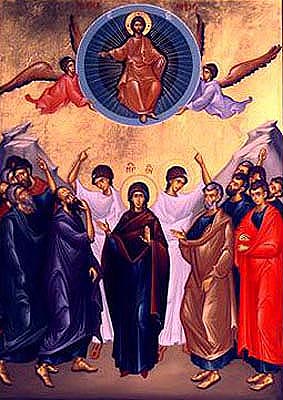
Troparion of the Holy Ascension Tone 4
Thou hast ascended in glory, O Christ our God, and gladdened Thy disciples with the promise of the Holy Spirit; and they were assured by the blessing that Thou art the Son of God and Redeemer of the world.
Kontakion of the Holy Ascension Tone 2
When Thou didst fulfil Thy dispensation for our sakes, uniting things on earth with the Heavens, Thou didst ascend in glory, O Christ our God, departing not hence, but remaining inseparable from us, and crying unto them that love Thee: I am with you, and no one can be against you.
Acts 1:1-12
The former treatise have I made, O Theophilus, of all that Jesus began both to do and teach, Until the day in which he was taken up, after that he through the Holy Ghost had given commandments unto the apostles whom he had chosen: To whom also he shewed himself alive after his passion by many infallible proofs, being seen of them forty days, and speaking of the things pertaining to the kingdom of God: And, being assembled together with them, commanded them that they should not depart from Jerusalem, but wait for the promise of the Father, which, saith he, ye have heard of me. For John truly baptized with water; but ye shall be baptized with the Holy Ghost not many days hence. When they therefore were come together, they asked of him, saying, Lord, wilt thou at this time restore again the kingdom to Israel? And he said unto them, It is not for you to know the times or the seasons, which the Father hath put in his own power. But ye shall receive power, after that the Holy Ghost is come upon you: and ye shall be witnesses unto me both in Jerusalem, and in all Judaea, and in Samaria, and unto the uttermost part of the earth. And when he had spoken these things, while they beheld, he was taken up; and a cloud received him out of their sight. And while they looked stedfastly toward heaven as he went up, behold, two men stood by them in white apparel; Which also said, Ye men of Galilee, why stand ye gazing up into heaven? this same Jesus, which is taken up from you into heaven, shall so come in like manner as ye have seen him go into heaven. Then returned they unto Jerusalem from the mount called Olivet, which is from Jerusalem a sabbath day's journey.
Our Father Among the Saints, Cyril, Abbot of White Lake Monastery
Troparion of St Cyril of the White Lake Tone 1
O Father Cyril, uprooting the thorns of passions/ thou didst blossom as a lily in David's wilderness,/ where thou didst gather a multitude of disciples/ and guide them as a father in the fear of God./ Glory to Him Who has strengthened thee; glory to Him Who has crowned thee;/ glory to Him Who through thee works healings for all.
Kontakion of St Cyril of the White Lake Tone 8 Thou didst scorn all ways and thoughts which dragged thee down/ and didst rejoice to yearn for the heavenward course./ With the Saints before the Trinity pray that thy flock may be preserved;/ for as we celebrate thy repose we cry to thee:/ Rejoice, O blessed Father Cyril.
From the Prolog:
Cyril was born and educated in Moscow of an aristocratic family. He was tonsured a monk in Simonov Monastery where he lived a life of asceticism to the amazement of the other monks. In order to conceal his virtues, he pretended insanity. He personally spoke to St. Sergius of Radonezh and received many beneficial instructions from him. Against his wishes he was elected abbot of Simonov monastery. He prayed constantly to the All-Holy Birth-giver of God to show him the way whereby he could, in silence, live a life of asceticism. One night he saw a great light and heard a voice: "Cyril, depart from here and go to the White Lake!" And indeed, he departed from the Simonov Monastery with one companion and went to the vicinity of the White Lake and there, in the dense pine forest, began to live a life of asceticism. In time, this wilderness was transformed into a large monastery. The Venerable Cyril received the great gift of miracle-working from God and cured the sick and worked many other miracles. He died in the year 1429 A.D. in his ninetieth year and took up habitation with the Lord Whom he ardently loved his entire life.
June 08, 2005
On the Earliest Christian Understanding of the Faith as Philosophia
I have, in my previous posts, been assuming a self-understanding of early Christianity as a philosophia, a way of life similar in many respects to the ancient philosophiai of the Six Schools (Platonism, Aristotelianism, Cynicism, Epicureanism, Stoicism, and Skepticism). But while this makes sense in an intuitive way, it may well be helpful to provide some evidence for this assumption. That is the purpose of this present post. I will here demonstrate that the earliest understandings of ancient Christianity, dating from the second century, is that the Faith was a philosophia, indeed, the only true philosophia, containing the whole of that Truth of which the other rival philosophiai possess only parts.
It seems perhaps likely that the early Christians who spoke of the Faith as a philosophia derived their notions not only from the ancient schools of philosophy but from their Jewish predecessors, Philo of Alexandria (20 BC-AD 50) and Josephus (AD 37-100). Two texts from Philo will be illustrative for us. The following, from the Life of Moses, is perhaps clearest of all.
[F]or it was invariably the custom, as it was desirable on other days also, but especially on the seventh day, as I have already explained, to discuss matters of philosophy; the ruler of the people beginning the explanation, and teaching the multitude what they ought to do and to say, and the populace listening so as to improve in virtue, and being made better both in their moral character and in their conduct through life; in accordance with which custom, even to this day, the Jews hold philosophical discussions on the seventh day, disputing about their national philosophy, and devoting that day to the knowledge and consideration of the subjects of natural philosophy; for as for their houses of prayer in the different cities, what are they, but schools of wisdom, and courage, and temperance, and justice, and piety, and holiness, and every virtue, by which human and divine things are appreciated, and placed upon a proper footing? (Life of Moses 2, 215-216)
He also speaks of the Essenes in terms of philosophia in On the Contemplative Life.
[B]ut the deliberate intention of the philosopher is at once displayed from the appellation given to them [the Essenes]; for with strict regard to etymology, they are called therapeutae and therapeutrides, either because they process an art of medicine more excellent than that in general use in cities (for that only heals bodies, but the other heals souls which are under the mastery of terrible and almost incurable diseases, which pleasures and appetites, fears and griefs, and covetousness, and follies, and injustice, and all the rest of the innumerable multitude of other passions and vices, have inflicted upon them), or else because they have been instructed by nature and the sacred laws to serve the living God, who is superior to the good, and more simple than the one, and more ancient than the unit . . . . (On the Contemplative Life 2)
Josephus speaks in two parallel passages from the Antiquities and the Wars of the various sects of Judaism as different though related sorts of philosophiai.
The Jews had for a great while had three sects of philosophy peculiar to themselves; the sect of the Essens, and the sect of the Sadducees, and the third sort of opinions was that of those called Pharisees . . . . But of the fourth sect of Jewish philosophy, Judas the Galilean was the author. (Antiquities of the Jews 18.2, 6)
For there are three philosophical sects among the Jews. The followers of the first of which are the Pharisees; of the second, the Sadducees; and the third sect, which pretends to a severer discipline, are called Essens. These last are Jews by birth, and seem to have a greater affection for one another than the other sects have. These Essens reject pleasures as an evil, but esteem continence, and the conquest over our passions, to be virtue. They neglect wedlock, but choose out other persons children, while they are pliable, and fit for learning, and esteem them to be of their kindred, and form them according to their own manners. They do not absolutely deny the fitness of marriage, and the succession of mankind thereby continued; but they guard against the lascivious behavior of women, and are persuaded that none of them preserve their fidelity to one man. (Wars of the Jews 2,8)
Whether or not Philo and Josephus had any direct influence on the early Christian writers who also conceive of Christianity as philosophia is perhaps impossible to determine with certainty. But that the understanding of Christianity as philosophia was widespread can be seen in the number of authors who do so. I begin first with St. Justin the Philosopher (AD 100-165).
But straightway a flame was kindled in my soul; and a love of the prophets, and of those men who are friends of Christ, possessed me; and whilst revolving his words in my mind, I found this philosophy alone to be safe and profitable. Thus, and for this reason, I am a philosopher. (Dialogue with Trypho 8)
St. Justin, in fact, is depicted in icons wearing the philosopher's robe, a distinctive form of dress that marked out his way of life.
Tatian (AD 110-180), too, though posthumously condemned as a heretic, understood Christianity as a philosophia, indeed as the way of life more ancient and true than all the other rival philosophies.
But now it seems proper for me to demonstrate that our philosophy is older than the systems of the Greeks. (Address to the Greeks 31)
Tatian makes this claim on the basis of much personal exploration and investigation.
The things which I have thus set before you I have not learned at second hand. I have visited many lands; I have followed rhetoric, like yourselves; I have fallen in with many arts and inventions; and finally, when sojourning in the city of the Romans, I inspected the multiplicity of statues brought thither by you: for I do not attempt, as is the custom with many, to strengthen my own views by the opinions of others, but I wish to give you a distinct account of what I myself have seen and felt. So, bidding farewell to the arrogance of Romans and the idle talk of Athenians, and all their ill-connected opinions, I embraced our barbaric philosophy. (Address to the Greeks 35)
That "barbaric" philosophy, of course, was the non-Greek philosophy derived from the Jews. St. Clement of Alexandria will say more for us about that below. But in commending the Christian philosophia, Tatian notes that it is a particular way of living, not just a set of intellectual data.
These things, O Greeks, I Tatian, a disciple of the barbarian philosophy, have composed for you. I was born in the land of the Assyrians, having been first instructed in your doctrines, and afterwards in those which I now undertake to proclaim. Henceforward, knowing who God is and what is His work, I present myself to you prepared for an examination concerning my doctrines, while I adhere immoveably to that mode of life which is according to God. (Address to the Greeks 42)
The saintly bishop of Sardis, Melito (d. AD c. 180), similarly describes Christianity as a philosophia. In his letter to the Stoic Emperor, Marcus Aurelius, he writes:
For our philosophy formerly flourished among the Barbarians [i.e., the non-Greeks]; but having sprung up among the nations under thy rule, during the great reign of thy ancestor Augustus, it became to thine empire especially a blessing of auspicious omen. For from that time the power of the Romans has grown in greatness and splendor. To this power thou hast succeeded, as the desired possessor, and such shalt thou continue with thy son, if thou guardest the philosophy which grew up with the empire and which came into existence with Augustus; that philosophy which thy ancestors also honored along with the other religions. (cited in Eusebius, Ecclesiastical History 4.26,7)
Near the end of the second century, or the beginning of the third, St. Clement of Alexandria (d. AD c. 215), tutor of Origen, wrote his Miscellanies (or, Stromateis), a great portion of the first book of which sets out to explicate the nature of true Christian belief and life. To do so, he is at pains to show both the preparatory nature of Hellenistic philosophy and its consonance with that which fulfills it, the Christian philosophy divinely revealed in the Logos, Christ.
Accordingly, before the advent of the Lord, philosophy was necessary to the Greeks for righteousness. And now it becomes conducive to piety; being a kind of preparatory training to those who attain to faith through demonstration. “For thy foot,” it is said, “will not stumble, if thou refer what is good, whether belonging to the Greeks or to us, to Providence.” (Pro[verbs] 3:23) For God is the cause of all good things; but of some primarily, as of the Old and the New Testament; and of others by consequence, as philosophy. Perchance, too, philosophy was given to the Greeks directly and primarily, till the Lord should call the Greeks. For this was a schoolmaster to bring “the Hellenic mind,” as the law, the Hebrews, “to Christ.” (Gal[atians] 3:24) Philosophy, therefore, was a preparation, paving the way for him who is perfected in Christ. (Stromateis I.5)
The saint recognized that these ancient schools each had portions of the truth, but that only in the Christian philosophy would the mature Christian (i.e., in St. Clement's terms, the true Gnostic) find the whole truth.
Since, therefore, truth is one (for falsehood has ten thousand by-paths); just as the Bacchantes tore asunder the limbs of Pentheus, so the sects both of barbarian and Hellenic philosophy have done with truth, and each vaunts as the whole truth the portion which has fallen to its lot. But all, in my opinion, are illuminated by the dawn of Light. Let all, therefore, both Greeks and barbarians, who have aspired after the truth, - both those who possess not a little, and those who have any portion, - produce whatever they have of the word of truth. . . . For we shall find that very many of the dogmas that are held by such sects as have not become utterly senseless, and are not cut out from the order of nature (by cutting off Christ, as the women of the fable dismembered the man), though appearing unlike one another, correspond in their origin and with the truth as a whole. For they coincide in one, either as a part, or a species, or a genus. . . . So, then, the barbarian and Hellenic philosophy has torn off a fragment of eternal truth not from the mythology of Dionysus, but from the theology of the ever-living Word. And He who brings again together the separate fragments, and makes them one, will without peril, be assured, contemplate the perfect Word, the truth. . . . He who is conversant with all kinds of wisdom, will be pre-eminently a gnostic [i. e., the mature Christian](Stromateis I.13)
Though Lactantius (AD c. 250-325)--himself a terrible theologian, more often inadvertently heterodox perhaps than sound--brings us into the third century, he echoes St. Clement's comments:
But different persons brought forward all these things, and in different ways, not connecting the causes of things, nor the consequences, nor the reasons, so that they might join together and complete that main point which comprises the whole. But it is easy to show that almost the whole truth has been divided by philosophers and sects. . . . But if there had been any one to collect together the truth which was dispersed amongst individuals and scattered amongst sects, and to reduce it to a body, he assuredly would not disagree with us. But no one is able to do this, unless he has experience and knowledge of the truth. But to know the truth belongs to him only who has been taught by God. For he cannot in any other way reject the things which are false, or choose and approve of those which are true; but if even by chance he should effect this, he would most surely act the part of the philosopher; and though he could not defend those things by divine testimonies, yet the truth would explain itself by its own light. . . . [N]o philosophy existed which made a nearer approach to the truth, for the whole truth has been comprised by these in separate portions. . . . Therefore the philosophers touched upon the whole truth, and every secret of our holy religion; but when others denied it, they were unable to defend that which they had found, because the system did not agree with the particulars; nor were they able to reduce to a summary those things which they had perceived to be true, as we have done above. (Divine Institutes 7.7)
From the above, then, it is absolutely clear that among the earliest self-understandings of Christianity was that of a, or rather the, philosophia. A set of beliefs that were true in a perfect way, and a way of life conducive to piety, or respectful concourse with God.
This understanding of Christianity (or as in some writers monasticism), as philosophia seems to have carried over into later Christianity (especially among St. John Chrysostom and the Cappadocians). But the point is this: early Christianity knew itself as a way of life similar, though superior, to any of the ancient philosophical schools.
June 07, 2005
Dark Night of the Soul and Other Spiritual Classics Available Online
John of the Cross' Dark Night of the Soul, translated by E. Allison Peers, is available online. So, too is Ascent of Mt. Carmel and Spiritual Canticle.
From that other well-known Carmelite, Teresa of Avila, you can read the following online: Life of Teresa of Jesus, Interior Castle, and Way of Perfection
Those with Russian and/or Orthodox predilections will be glad to know that The Brothers Karamazov is also available.
(For a full list of available works from this site, go here.)
Philosophia and the Modernist Myth of Objectivity
[Note: I have begun collecting these various posts on the theme of philosophia under a topical link: True Philosophia, the Way of Life. You can click on the link to see all the posts, present and future, gathered in reverse chronological order under this theme.]
When looking at the six historical schools of philosophy in antiquity--Platonism, Aristotelianism, Cynicism, Epicureanism, Stoicism, and Skepticism--one is quite impressed with the absence of a particular mental condition that one takes for granted today. Becoming a disciple of one or another of these ancient schools was not a matter of first calmly, rationally and unbiasedly weighing the merits of all of them and then settling on that one which had the most objectively rational claim to truth. Rather, becoming a disciple of one or another of these schools entailed first an existential choice, following which one's mind viewed reality through the philosophic lenses of one's respective school. Certainly each school argued, on the basis of reason and truth, for its superiority over the others. Certainly a disciple might become an adherent of one school, only to leave it later for another, or even several others, as did St. Justin the Philosopher. And just as certainly, one became a disciple, in part, on the basis of good reasons. But this quest for the view from nowhere, absent all presuppositions and preconceptions, was not part of the ancient disciple's mental framework. Rather, knowing that he came with presuppositions and preconceptions, the disciple sought to be transformed in his thinking and living by the way of life of a particular school so that he might more surely and more completely unite himself with wisdom. In other words, the ancient disciple came to a school not to judge it as true or not, but to first learn from it. If that school's way of life "lived well" for the disciple, he was apt to continue with it. If, for whatever reason, a particular way of life did not live well, or another beckoned more winsomely, a disciple would leave it for another, for that more beautiful way of life.
Modern religious seekers have, to a certain extent, lost this ancient view in two ways. In the first place, modern seekers seem more intent on staying the same than on the transformation of their own souls. If there is a sense of transformation that they seek it is more along the lines of being confirmed as the persons they already are; to become even more like what they are now, only without the stuff that currently displeases them about themselves. Secondly, modern religious seekers seem more intent on finding comfort than on the transformation of their souls. They seek escape more than askesis. If they seek a form of transformation it is not one that goes very deep toward the soul, but focuses on appearance and externals: losing weight, having a better job, becoming financially secure, having children that are respectful, obedient and successful, having a spouse that is affirming, supportive and loving. Religious seekers make demands on the institutions they encounter; they do not very often come to religious institutions seeking a demanding way of life.
Not so for the ancient disciple. For the "friend of wisdom," becoming a disciple of a particular philosophia naturally and logically entailed transformation of the soul and the rigorous asketical demands a particular philosophia made on one's own choices and behaviors. It was not a matter of seeking comfort or confirmation of one's present way of living. The disciple intuitively, if not consciously, grasped that if he had the truth, if wisdom was his, then he wouldn't be seeking out this particular philosophia. Rather, conscious of his own lack of wisdom, conscious of his need of inner transformation, the philosophic disciple came to the Academy, or the Lyceum, or the Garden, or the Stoa, ready not to judge but to listen, ready not to demand but to submit to demand, ready to find not the fulfillment of personal desires but the remaking from the inside-out that wisdom, Sophia, brought to those ready to learn and live.
The ancient disciple knew, too, that even if the greatest happiness, as in Aristotle's Nicomachean Ethics X.7, was in the act of intellectual contemplation, of union with the divine intellect, such happiness was gained by way of rigorous and life-long askeses, soulish disciplines that made one ever more capable of both receiving wisdom and maintaining the transformation that wisdom brought. What were these askeses, these disciplines of the soul, differed from school to school. But each was a daily and lifelong practice that brought home the principle dogmas of the particular school in such a way that one's behavior and thinking were united in the transforming center of wisdom. For Aristotle, this was the habitual practice of the virtues and of close attention to reality. For the Stoics this was the daily practice of divesting oneself of illusion so as to conform oneself with that which is (as can been seen in the journaling left to us in Marcus Aurelius' Meditations). For the Platonists and Pythagoreans it was a paedegogy, inculcated from youth, that trained body for death and the soul for union with the One, or the Good, in the contemplation of the One, or number. And so forth.
The analogies with historic Christianity are, to my mind, obvious. The ancient Christian disciple came seeking Him Who is Wisdom, Him Who is the Way, the Truth, the Life, not a set of spiritual laws or a body of coherent doctrine. The ancient disciple came to be changed, not confirmed in their present way of life. This process of becoming a disciple was not an intellectual one, or not primarily an intellectual one. Nor were seekers shielded from the more rigorous demands of Christianity first, only later to have explained to them the demanding nature of the Christian walk. Indeed, we know that in the earliest centuries of the Church, catechumens were first inculcated to this most rigorous and demanding way of living before they were sacramentally united to the Church and trained in the dogmas and doctrines of the Faith. One was first baptized, then, after baptism, one was given the explanation of what all that baptism, fasting, and prayer was meant for and whence it came.
This can only make sense. For if the Christian disciple in antiquity came seeking new life, it would not do to give him "mere" doctrine. If the Christian disciple in antiquity came seeking wisdom, it would not do to have him put off doing the very things one must do to gain that wisdom. If the Christian disciple came seeking life, it would not do to fail to show him how that life was lived and engage him in its practices. Life, after all, is not a concept but an act. If Christianity is a way of living, then to give a seeker everything but the very life that Christians live, would be to bear false witness. It would be giving serpents for fish, and stones for bread.
Make no mistake, no Christian disciple ever saved his own soul by his own deeds and merits. Nor did the historic Church ever teach such a thing. Salvation is by grace through faith. In this, the Christian philosophia was in diametrical opposition to the ancient philosophical schools. But salvation is not given apart from actions. The Church knew that a disciple worked out his salvation with fear and trembling, that every Christian was created for good works that the Holy Trinity had prepared in advance that he walk in them, that without works his faith was dead.
This is not to say that the ancient Church--or the other ancient philosophiai--did not engage in apologetics, of the answering of objections and intellectual challenges. Apologetical work was present in the Church from its beginning. But the ancient Church did not mistake apologetic for conversion. Conversatio is a way of living, and one coverts by changing the way one lives. Understanding the why's and wherefore's of this transformation was not unimportant. There is, after all, a singular, exclusive and unchanging content to the Christian Faith. And what one is convinced of will result in behavior in conformity with those convictions. But for the ancient schools, and for the Christian philosophia especially, one's convictions changed on the basis of one's changed behavior.
That is to say, our modern notion that one must objectively weigh all intellectual claims unbiasedly prior to making a decision about what one will or will not do is exactly backwards from the philosophiai of antiquity, and most especially of Christianity. Given the present sectarian schisms in Christianity and our manifest failure to commend the faith once for all delivered to the saints to our societies and their cultures, it seems to me that we would do well to abandon our own modernist mythology, or, rather, pathology, and adopt the more certain path of the historic Faith.
Top Ten Books Every Student Should Read While in College
Human Events Online, two years ago, contacted twenty-eight scholars to ask them what ten books every college student should read. They explain the weighting given to the compiled lists, and the rationale for each book. Here's the straight list:
- The Bible
- Alexander Hamilton, et al, The Federalist Papers
- Alexis de Tocqueville, Democracy in America
- Dante Alighieri, The Divine Comedy
- Plato, The Republic
- Aristotle, The Politics
- (tie) Aristotle, Nicomachaean Ethics
- (tie) St. Augustine, City of God
- St. Augustine, Confessions
- Edmund Burke, Reflections on the Revolution in France
And here are the honorable mentions, according to ranking:
- Natural Right and History by Leo Strauss
- The Conservative Mind by Russell Kirk
- A New Birth of Freedom: Abraham Lincoln and the Coming of the Civil War by Harry V. Jaffa
- Mere Christianity by C.S. Lewis
- The Illiad by Homer
- King Lear by William Shakespeare
- The Abolition of Man by C.S. Lewis
- Orthodoxy by G.K. Chesterton
- Aeneid by Virgil
- Hamlet by William Shakespeare
- Modern Times by Paul Johnson
- Oedipus Trilogy by Sophocles
- Ideas Have Consequences by Richard Weaver
- Idea of a University by John Henry Newman
- The Road to Serfdom by Friedrich von Hayek
- Animal Farm by George Orwell
- Gorgias by Plato
- A Humane Economy by Wilhelm Roepke
- The Public Philosophy by Walter Lippman
- The Roots of American Order by Russell Kirk
Help Me! I Can't Stop Myself
| You Know You're From Kansas When... |
|
You've been hit by enough tornados to know there is no such thing as Oz
A shotgun is your idea of instant messaging. You learned how to shoot a gun before you learned how to multiply You're ready to shoot the next person who asks about Toto & Dorothy You've had classes canceled for heat & snow in the same month You support the Chiefs through thick and thin. You have to travel 20 miles just to go to the nearest mall The only tourists you see are on the way to Colorado You know the meaning of Rock Chalk Jayhawk. Your closest neighbor is more than a mile away, and you can still see him from your front porch. The terms Sooners, Huskers and Missouri Tigers cause the hairs on the back of your neck to stand up straight and your blood pressure to rise. You are not surprised to find movie rentals, ammunition and bait all in the same store. You know everything goes better with Ranch. You know the real way to pronounce the name of Clintons state and the river... arKANSAS. You never met any celebrities. (Bob Dole isn't a celebrity, he's your neighbor.) You prefer the Little Apple over the Big Apple as a place to live. You had at least one summer job that was bucking bails or custom cutting. You understand the difference between 3.2 and 6 point, and more than once you've made a beer run to another state. You know in your heart that K-State can beat Oklahoma in You call that smell coming from the feed yards "money." You know that Mt. Oread is really only just a hill. Down south means Oklahoma. You can properly pronounce Basehor, Cimmeron, Schoenchen, Kechi, Chautauqua, Arkalalah, and Osawatomie. You really do think Sunflowers are beautiful. You went to skating parties as a kid. You'll pay for your kids to go to college...unless they want to go to OU or NU. Your earliest driving lessons were in a field while picking up hay. Your excuse for being late is the cows got out, and the boss accepts it MANY times Your main drag in town is two blocks long. You actually get these jokes and pass them on to other friends from Kansas. |
June 05, 2005
The Sunday of the Blind Man
With three years' hindsight, it may well be safe to say that the text in Ephesians 5 addressed to the husband was the catalyst that moved me toward the Orthodox Church. The infallible call to headship in the home converted my till-then intense interest in Orthodoxy to a resolved decision to become Orthodox and lead my family into the Church. Today, the Sunday of the Blind Man, marks three years of liturgical time (almost three years to the day: it was 9 June that Sunday in 2002) from the day I stepped foot inside All Saints Orthodox Church with the, to this day, still-unwavering resolve to bring myself and my family into the sacramental embrace of Holy Mother Church.
I'm not sure why this is the case. All my previous moves toward the historic Church had been oriented around theological and historical concerns. I wanted to be part of the Church that not only taught the faith of the Apostles but was the very Church the Apostles had founded. But standing there, three years ago, confessing my failures as a husband to my wife on a Saturday morning, with many theological and historical questions yet to be answered, I had an intuition that what I was looking for was not something to believe so much as a way to live--a way that was one whole cloth from sanctuary to home altar.
I say this not simply because my present concerns, as you no doubt can gather from the most recent entries, are oriented around Christianity as a way of life. Though I don't discount the interpretive influence of my present concerns, it is still the case that this intuition has been with me for the past few years. In going through my journals, for example, I remember remarking the sort of good-natured envy I felt for the Orthodox Jews I served as an employee of Skokie Public Library. Theirs was a distinctive dress, a distinctive diet, a distinctive mode of living tied up with their faith.
The Christianity I grew up with did not offer this. I certainly had distinctive beliefs--many of which, I'm grateful to say, Orthodoxy has fulfilled rather than I have had to give them up--but the mode of life in which we engaged, aside from some moral strictures that put us at odds from time to time with conventional society, was still very conventional. I tried manufacturing distinctiveness in my life, at least for a time in high school, by diving deep into the "Christian ghetto": CCM-label music only, reading books published only through Christian publishing houses, and adopting some "evango-speak" habits. But instead of producing a sense of substantive otherness, I only felt like an insipid copycat of conventional music, books, and jargonish slang (this was in the days of "valley girl" speak, God help us).
But three years ago--in fact it was the morning of 6 June when I read the Ephesians 5 passage--I was confronted with my sin, both willful and involuntary, in knowledge and in ignorance, and instinctively knew that the only place I could remedy it was in the Orthodox Church. So, after two days of painful introspection, I confessed my sins to my wife--who, as you may guess, was somewhat perplexed, though forgiving--and the next morning stepped foot in the temple at All Saints to hear these words proclaimed in the Liturgy:
Then he called for a light, and sprang in, and came trembling, and fell down before Paul and Silas, And brought them out, and said, Sirs, what must I do to be saved? And they said, Believe on the Lord Jesus Christ, and thou shalt be saved, and thy house. And they spake unto him the word of the Lord, and to all that were in his house. And he took them the same hour of the night, and washed their stripes; and was baptized, he and all his, straightway. And when he had brought them into his house, he set meat before them, and rejoiced, believing in God with all his house.
And:
When he had thus spoken, he spat on the ground, and made clay of the spittle, and he anointed the eyes of the blind man with the clay, And said unto him, Go, wash in the pool of Siloam, (which is by interpretation, Sent.) He went his way therefore, and washed, and came seeing. . . .Then again called they the man that was blind, and said unto him, Give God the praise: we know that this man is a sinner. He answered and said, Whether he be a sinner or no, I know not: one thing I know, that, whereas I was blind, now I see. . . .
Jesus heard that they had cast him out; and when he had found him, he said unto him, Dost thou believe on the Son of God? He answered and said, Who is he, Lord, that I might believe on him? And Jesus said unto him, Thou hast both seen him, and it is he that talketh with thee. And he said, Lord, I believe. And he worshipped him.
I came to worship, that day, 9 June, three years ago, feeling very much blind--though in my case it was from my own willful sinfulness. I think I can safely say that the weight of how I had failed to be the sort of head of my home that gives his life for the holiness of his own wife pressed unutterably heavy on me. Most painful of all was not only the fact that nearly ten years before I had attempted to force my wife into a church that later proved to violate nearly every single belief she (and I) held dear as Christians, but that the way I had done so had violated her trust and her freedom before God as her own moral agent. Those wounds did not heal quickly, and I do not even know for sure that they are today healed fully (though by the grace of God they have been healed substantially since that confession three years ago).
I knew not merely that I had been a most miserable sinner--as the stark and uncompromising liturgical texts put it--but indeed had failed my wife at that point most intimate: as spiritual head of our home. Though please God not maliciously, still, quite willfully, I had trampled on her sensibilities. It is little wonder then that my confession was met with forgiveness but also reserve. And it was right that it be so met. After all, I had proven quite untrustworthy.
Much of the ensuing events have been chronicled here. Though my repentance is ongoing and will not be complete till my own death, through the tender compassions of our Lord I have been the recipient of the most humbling and joyous of graces. Our Blessed Lady prayed and our daughter Sofie was the answer. And in that answer my wife found cause to join me at All Saints. And in our worship together at All Saints, my wife has found genuine love and friendship through the women of the parish. And the life of Christ that permeates the family that is All Saints Orthodox Church has given my wife answers to some questions and hope for answers to others.
I have been exhorted by well-meaning souls that if my wife is reluctant, that I should press to have her blessing to become Orthodox first, and she may find in that cause to join me later in her own time. But I am convinced at this point, that what God wants is a united entry into the Church. My reasons are based in part on my own sins. I cannot see how "going it alone" would do anything but reawaken tender feelings that have had some healing--since "going it alone" was precisely what I had done as an Episcopalian. Further, my impetus to solidly resolve to become Orthodox was based on a text that spoke to me of my call to be the spiritual head of my home. Being the head of my home involves laying down my life for the sake of my wife's own salvation and holiness. She must see my obedience to this, and somehow, "going it alone" would seem to me, at least, to nullify this daily sacrifice. This is not sacrifice for its own sake, of course. But there is woundedness that needs my own mortification if love is to be demonstrated rather than merely verbalized.
Finally, and more to the point, when I heard three years ago the texts I heard again today, I heard a promise:
Believe on the Lord Jesus Christ, and thou shalt be saved, and thy house. And they spake unto him the word of the Lord, and to all that were in his house. And he took them the same hour of the night, and washed their stripes; and was baptized, he and all his, straightway.
I believe that in God's merciful timing and solely by his grace when I become sacramentally Orthodox, with me will be all my own household. These three years have seemed long, to be sure. And the more time goes by, the greater is my longing to become Orthodox, and the more painful it is to be without the Sacraments. But this is all according to the plan of God, I am utterly convinced. Yes, of course, I may be mistaken. And if so, God will show me that, as he did three years ago, through his Church and her Scriptures. But thus far, everything has confirmed that this is my calling and my task. And on this liturgical day, for three years, I have had this calling renewed, and also the promises of greater things to come.
Lord, have mercy on me, a sinner.
June 03, 2005
The Way: Christianity as Philosophia
Though now known as "Christianity," the beliefs and practices of the followers of Jesus were not always grouped under that name. Indeed, "Christian" only appears thrice in the New Testament: once at Acts 11:26, where we are told that the disciples at Antioch were first called Christians, seemingly a derogatory term; once at Acts 26:28, where Agrippa asks if St. Paul wants to make him a Christian; and once at 1 Peter 4:16, where St. Peter exhorts us not to be ashamed to suffer because of being a Christian.
Rather, at least in the earliest days, Christians were known as followers of "the Way" (cf. Acts 9:2; Acts 18:25-26; Acts 19:9, 23; Acts 22:4; Acts 24:14, 22). It appears from the texts that this designation arose from the distinctive beliefs and practices of the early Christians. These early Christians are described at various points in Acts as follows in this specific passage:
And they continued steadfastly in the apostles' doctrine and fellowship, in the breaking of bread, and in prayers. Then fear came upon every soul, and many wonders and signs were done through the apostles. Now all who believed were together, and had all things in common, and sold their possessions and goods, and divided them among all, as anyone had need. So continuing daily with one accord in the temple, and breaking bread from house to house, they ate their food with gladness and simplicity of heart, praising God and having favor with all the people. And the Lord added to the church daily those who were being saved. (Acts 2:42-47 NKJV)
They also kept the daily hours of prayer (Acts 3:1), practiced liturgical worship and fasting (Acts 13:1), kept a festal calendar (Acts 18:21), held that only in Jesus is salvation found (Acts 4:8-12), as well as other distinctive beliefs and practices, such as the sacramental nature of the Lord's Supper (1 Corinthians 10:14-22; 11:17-34), and passed on their way of living from person to person (Acts 20:17-21).
In at least these general characteristics, Christianity was no different than the six ancient schools of philosophy (Platonists, Aristotelians, Cynics, Skeptics, Epicureans and Stoics). And all these together could be described as attempts to know reality as it is and to conform one's entire being to that reality. For a Platonist, then, as Socrates describes in the Phaedo, philosophia prepared the "friend of wisdom" for death, to cast off the body and free the soul to contemplate the Good unhindered. For an Aristotelian, philosophia was the life of contemplation in accord with the virtues, wherein one's intellect was united with the divine intellect that is the uncaused first cause and pure thinking. A Stoic studied reality so as to conform his life and thought to it, to put off all illusion so as to achieve ataraxia, or quietude of soul. I need not go through the remainder; the point should be clear. All of these schools of philosophy had distinctive beliefs that led to distinctive practices, each had a way of life that set them off from the rest of society. Philosophers, as can be attested by the iconic Socrates, were counter-cultural and often persecuted.
But it should be noted that philosophers in the ancient world were not part of a professional scholarly class. Epictetus, who left us a summation of Stoic thought in his Discourses was a slave; another famous stoic, Seneca, was a wealthy Roman nobleman. Socrates had been a decorated soldier, Aristotle the son of a court physician. Sextus Empiricus was a physician. None of these men were philosophers in today's sense of the word. But all of them sought philosophy as a way of life, involving a conversion from a non-philosophic way of life. As Socrates notes in the Apology, "The unexamined life is not worth living."
So, in this sense, Christianity is a philosophia, a way of life. It is not simply a set of doctrines. It is not simply a tool for social progress. It is a radical change of life, in conformity with wisdom, true reality, that normally puts one at odds with conventional society. Christians have distinct beliefs which result in distinct ways of living; and distinct ways of living that reinforce those beliefs.
Christians, for example, believe that God became man in Christ. And so they fast. Christians believe that God is holy, and so they confess their sins to one another. Christians believe that Christ died for our sins, and so they love one another. But similarly, because Christians fast as a community they believe the Church to be the Body of Christ. Because Christians confess their sins to the priest, they believe that God's uncreated grace is unmerited even as they work out their salvation with fear and trembling. Because Christians love one another, they believe purity of life and belief is to be maintained, even excommunicating the unrepentant for the salvation of the errant brother's soul.
Such a thumbnail sketch hardly does justice to the notion that Christianity is a philosophia, with unique doctrines and practices. But hopefully it at least pencils in the interrelation between belief and practice as a way of living.
This is extremely important to emphasize. For many Christians, of all stripes, seem to operate under a very different notion. Many otherwise intelligent people, believe Christianity to be primarily about doctrine and canon. Christian life, then, becomes a matter of proper exegesis. So long as one conforms to a specific interpretive grid (either of Scripture or canon or both), one is "Christian." The conformity of life to that grid, while important, is secondary. But this imbalance is idolatry. For Christians have not been called to follow a text, but the God-man, Jesus Christ. Christians have not been called to do certain things per se, but to conform their way of living to the life Jesus lives which then involves specific behaviors and prohibits others. Many seek salvation through exegesis: of having the right beliefs and external behaviors.
But the truth is that a way of life is about the integration of belief with behavior, often in paradoxical ways. We are called to be perfect as our heavenly father is perfect. But we also believe that if anyone claims he does not sin, he is a liar. We are called to forgive a brother seventy times seven. But we are also charged with excommunicating him if he is unrepentant.
Modern Christianity is not philosophic. It is Gnostic. As long as one has certain beliefs, so the thinking goes, one's lifestyle need not be extraconventional. One doesn't have to be "weird" to be a Christian. Indeed, by living conventionally, modern gnostics think, we can win more souls to the Lord. But the trajectories of those most conventional of churches, the mainline denominations, put the lie to this thinking. For, Christianity as the Way, as philosophia, demands a radical otherness. As St. Paul writes:
Yes, and all who desire to live godly in Christ Jesus will suffer persecution. (2 Timothy 3:12 NKJV)
If this was true of Socrates and the pagan philosophiai, indeed, if this was true of Christ, how much more is it true of Christian philosophia and the Christian philosophos and philosophe?
This transformation of the soul of Christian philosophia is all-encompassing, and makes radical demands. But it is characterized primarily by humility. When one takes on a philosophical school, one does not do so from the standpoint of the objective observer unbiasedly examining all contenders and settling on the one that one knows to be right. Rather, one enters that school and takes on the beliefs of that school and attempts to discern reality in light of the beliefs and practices of that school. If one is a Platonist, one will reject certain Skeptic presuppositions. If one is an Aristotelian, one will not agree with, nor live like, an Epicurean.
The difference, however, of the Christian philosophia is that it does claim to subsume all other philosophiai under its own claims. This is, perhaps, nicely illustrated in St. Justin the Philosopher's own life:
"I will tell you," said I, "what seems to me; for philosophy is, in fact, the greatest possession, and most honourable before God, to whom it leads us and alone commends us; and these are truly holy men who have bestowed attention on philosophy. What philosophy is, however, and the reason why it has been sent down to men, have escaped the observation of most; for there would be neither Platonists, nor Stoics, nor Peripatetics, nor Theoretics, nor Pythagoreans, this knowledge being one. I wish to tell you why it has become many-headed. It has happened that those who first handled it [i.e., philosophy], and who were therefore esteemed illustrious men, were succeeded by those who made no investigations concerning truth, but only admired the perseverance and self-discipline of the former, as well as the novelty of the doctrines; and each thought that to be true which he learned from his teacher: then, moreover, those latter persons handed down to their successors such things, and others similar to them; and this system was called by the name of him who was styled the father of the doctrine. Being at first desirous of personally conversing with one of these men, I surrendered myself to a certain Stoic; and having spent a considerable time with him, when I had not acquired any further knowledge of God (for he did not know himself, and said such instruction was unnecessary), I left him and betook myself to another, who was called a Peripatetic, and as he fancied, shrewd. And this man, after having entertained me for the first few days, requested me to settle the fee, in order that our intercourse might not be unprofitable. Him, too, for this reason I abandoned, believing him to be no philosopher at all. But when my soul was eagerly desirous to hear the peculiar and choice philosophy, I came to a Pythagorean, very celebrated-a man who thought much of his own wisdom. And then, when I had an interview with him, willing to become his hearer and disciple, he said, `What then? Are you acquainted with music, astronomy, and geometry? Do you expect to perceive any of those things which conduce to a happy life, if you have not been first informed on those points which wean the soul from sensible objects, and render it fitted for objects which appertain to the mind, so that it can contemplate that which is honourable in its essence and that which is good in its essence? 'Having commended many of these branches of learning, and telling me that they were necessary, he dismissed me when I confessed to him my ignorance. Accordingly I took it rather impatiently, as was to be expected when I failed in my hope, the more so because I deemed the man had some knowledge; but reflecting again on the space of time during which I would have to linger over those branches of learning, I was not able to endure longer procrastination. In my helpless condition it occurred to me to have a meeting with the Platonists, for their fame was great. I thereupon spent as much of my time as possible with one who had lately settled in our city, -a sagacious man, holding a high position among the Platonists,-and I progressed, and made the greatest improvements daily. And the perception of immaterial things quite overpowered me, and the contemplation of ideas furnished my mind with wings, so that in a little while I supposed that I had become wise; and such was my stupidity, I expected forthwith to look upon God, for this is the end of Plato's philosophy.
St. Justin then runs into an old man whose name he never learns who leads him from his Platonism to the true philosophia, Christianity. St. Justin continues:
"When he had spoken these and many other things, which there is no time for mentioning at present, he went away, bidding me attend to them; and I have not seen him since. But straightway a flame was kindled in my soul; and a love of the prophets, and of those men who are friends of Christ, possessed me; and whilst revolving his words in my mind, I found this philosophy alone to be safe and profitable. Thus, and for this reason, I am a philosopher. Moreover, I would wish that all, making a resolution similar to my own, do not keep themselves away from the words of the Saviour. For they possess a terrible power in themselves, and are sufficient to inspire those who turn aside from the path of rectitude with awe; while the sweetest rest is afforded those who make a diligent practice of them. If, then, you have any concern for yourself, and if you are eagerly looking for salvation, and if you believe in God, you may-since you are not indifferent to the matter. -become acquainted with the Christ of God, and, after being initiated, live a happy life."
Notice: what does the saint say is the end of Christian philosophy? To become acquainted with the Christ of God and to live a happy (eudaimonic, i. e., fully flourishing) life. Christianity is the way of life. It is thought and act united in the heart, divinized by grace.
June 02, 2005
The Early Church and the Lord's Supper: Wholly Sacramental from the Beginning
[The following is an email I sent to my seminary alma mater email group. There was a question as to the view of the early Church on the Lord's Supper. Since this is a Restoration Movement school, set on restoring first century Christianity, I emphasized the earliest possible writings of the Church Fathers.]
The early Church's view of the Lord's Supper was wholly sacramental. If one does not count John 6, and 1 Corinthians 10 and 11 as evidence--though this seems a contentious, question-begging discounting--clearly a fully formed sacramental understanding was in place prior to the end of the first century, as can be exemplified by those early Christian Fathers writing at the very beginning and through the end of the second century.
St. Ignatios of Antioch (c. AD 107):
If Jesus Christ shall graciously permit me through your prayers, and if it be His will, I shall, in a second little work which I will write to you, make further manifest to you [the nature of] the dispensation of which I have begun [to treat], with respect to the new man, Jesus Christ, in His faith and in His love, in His suffering and in His resurrection. Especially [will I do this] if the Lord make known to me that ye come together man by man in common through grace, individually, in one faith, and in Jesus Christ, who was of the seed of David according to the flesh, being both the Son of man and the Son of God, so that ye obey the bishop and the presbytery with an undivided mind, breaking one and the same bread, which is the medicine of immortality, and the antidote to prevent us from dying, but [which causes] that we should live for ever in Jesus Christ. (Eph. 20)
They abstain from the Eucharist and from prayer, because they confess not the Eucharist to be the flesh of our Saviour Jesus Christ, which suffered for our sins, and which the Father, of His goodness, raised up again. Those, therefore, who speak against this gift of God, incur death in the midst of their disputes. But it were better for them to treat it with respect, that they also might rise again. It is fitting, therefore, that ye should keep aloof from such persons, and not to speak of them either in private or in public, but to give heed to the prophets, and above all, to the Gospel, in which the passion [of Christ] has been revealed to us, and the resurrection has been fully proved. But avoid all divisions, as the beginning of evils. (Smyrn. 7)
St. Justin the Philosopher (c. AD 150):
And this food is called among us [the Eucharist], of which no one is allowed to partake but the man who believes that the things which we teach are true, and who has been washed with the washing that is for the remission of sins, and unto regeneration, and who is so living as Christ has enjoined. For not as common bread and common drink do we receive these; but in like manner as Jesus Christ our Saviour, having been made flesh by the Word of God, had both flesh and blood for our salvation, so likewise have we been taught that the food which is blessed by the prayer of His word, and from which our blood and flesh by transmutation are nourished, is the flesh and blood of that Jesus who was made flesh. For the apostles, in the memoirs composed by them, which are called Gospels, have thus delivered unto us what was enjoined upon them; that Jesus took bread, and when He had given thanks, said, "This do ye in remembrance of Me, this is My body"; and that, after the same manner, having taken the cup and given thanks, He said, "This is My blood;" and gave it to them alone. Which the wicked devils have imitated in the mysteries of Mithras, commanding the same thing to be done. For, that bread and a cup of water are placed with certain incantations in the mystic rites of one who is being initiated, you either know or can learn. (1st Apol. 66)
St. Irenaeus of Lyons (c. AD 180):
But how can they be consistent with themselves, [when they say] that the bread over which thanks have been given is the body of their Lord, and the cup His blood, if they do not call Himself the Son of the Creator of the world, that is, His Word, through whom the wood fructifies, and the fountains gush forth, and the earth gives "first the blade, then the ear, then the full corn in the ear." Then, again, how can they say that the flesh, which is nourished with the body of the Lord and with His blood, goes to corruption, and does not partake of life? Let them, therefore, either alter their opinion, or cease from offering the things just mentioned. But our opinion is in accordance with the Eucharist, and the Eucharist in turn establishes our opinion. For we offer to Him His own, announcing consistently the fellowship and union of the flesh and Spirit. For as the bread, which is produced from the earth, when it receives the invocation of God, is no longer common bread, but the Eucharist, consisting of two realities, earthly and heavenly; so also our bodies, when they receive the Eucharist, are no longer corruptible, having the hope of the resurrection to eternity. (Against Heresies 4:18:4-5)
But vain in every respect are they who despise the entire dispensation of God, and disallow the salvation of the flesh, and treat with contempt its regeneration, maintaining that it is not capable of incorruption. But if this indeed do not attain salvation, then neither did the Lord redeem us with His blood, nor is the cup of the Eucharist the communion of His blood, nor the bread which we break the communion of His body. For blood can only come from veins and flesh, and whatsoever else makes up the substance of man, such as the Word of God was actually made. By His own blood he redeemed us, as also His apostle declares, "In whom we have redemption through His blood, even the remission of sins." And as we are His members, we are also nourished by means of the creation (and He Himself grants the creation to us, for He causes His sun to rise, and sends rain when He wills). He has acknowledged the cup (which is a part of the creation) as His own blood, from which He bedews our blood; and the bread (also a part of the creation) He has established as His own body, from which He gives increase to our bodies. When, therefore, the mingled cup and the manufactured bread receives the Word of God, and the Eucharist of the blood and the body of Christ is made, from which things the substance of our flesh is increased and supported, how can they affirm that the flesh is incapable of receiving the gift of God, which is life eternal, which [flesh] is nourished from the body and blood of the Lord, and is a member of Him?-even as the blessed Paul declares in his Epistle to the Ephesians, that "we are members of His body, of His flesh, and of His bones." He does not speak these words of some spiritual and invisible man, for a spirit has not bones nor flesh; but [he refers to] that dispensation [by which the Lord became] an actual man, consisting of flesh, and nerves, and bones,-that [flesh] which is nourished by the cup which is His blood, and receives increase from the bread which is His body. And just as a cutting from the vine planted in the ground fructifies in its season, or as a corn of wheat falling into the earth and becoming decomposed, rises with manifold increase by the Spirit of God, who contains all things, and then, through the wisdom of God, serves for the use of men, and having received the Word of God, becomes the Eucharist, which is the body and blood of Christ; so also our bodies, being nourished by it, and deposited in the earth, and suffering decomposition there, shall rise at their appointed time, the Word of God granting them resurrection to the glory of God, even the Father, who freely gives to this mortal immortality, and to this corruptible incorruption, because the strength of God is made perfect in weakness . . . (Against Heresies 5:2:2-3)
One could, and perhaps also should, include the Didache (9, 14), c. AD 50 and St. Clement's first letter to the Corinthians (44), c. AD 90, though these two are less direct and clear as are the above.
Greek, Latin, and Classics Links Galore
I did some upgrading to my links over to the left on the main page here, adding a couple of links to existing sections, and adding a new section. Here's the lowdown.
Under Philosophy Links:
Under the Scriptures and Patristics Links:
A new section, Greek and Latin and General Classics Links, where I added the following:
- Greek Language and Linguistics Gateway
- Greek Resources
- Greek Grammar on the Web
- Herbert Weir Smyth, A Greek Grammar for Colleges
- LSJ Lexicon
- TEXTKIT: Greek and Latin Learning Tools
- Allen and Greenough's New Latin Grammar for Schools and Colleges
- Latinitas in tela totius terrae
- The Weather in Latin
- YLE Radio 1 - Nuntii Latini (News in Latin)
- Corpus Scriptorum Latinorum
- Latin Texts (Perseus)
- Lewis and Short Latin Lexicon
- Resources for Classical Education
- Classics Resources
- Maria Pantelia's Classics Resources
- Curculio
- Philoctetes: Heraclitus, Parmenides, Thales, Anaximander, Zeno
- Great Books Index
- The Internet Classics Archive
- Oxford University Press: Oxford Classical Texts
- Loeb Classical Library
June 01, 2005
St. Justin the Philosopher, Martyr
Troparion of St Justin Tone 4
O Justin, teacher of divine knowledge,/ thou didst shine with the rays of true philosophy/ and wast wisely armed against the enemy./ Confessing the truth thou didst contend with the martyrs:/ with them ever entreat Christ our God to save our souls.
Kontakion Tone 2
The whole Church of God is adorned with the wisdom of your divine words, O Justin;/the world is enlightened by the radiance of your life./By the shedding of your blood, you have received a crown./As you stand before Christ with the angels, pray unceasingly for us all!
An account of his martyrdom can be found here.
From St. Justin's first apology comes this account of the Eucharist and weekly Christian worship:
Chapter LXVI.-Of the Eucharist.And this food is called among us the Eucharist, of which no one is allowed to partake but the man who believes that the things which we teach are true, and who has been washed with the washing that is for the remission of sins, and unto regeneration, and who is so living as Christ has enjoined. For not as common bread and common drink do we receive these; but in like manner as Jesus Christ our Saviour, having been made flesh by the Word of God, had both flesh and blood for our salvation, so likewise have we been taught that the food which is blessed by the prayer of His word, and from which our blood and flesh by transmutation are nourished, is the flesh and blood of that Jesus who was made flesh. For the apostles, in the memoirs composed by them, which are called Gospels, have thus delivered unto us what was enjoined upon them; that Jesus took bread, and when He had given thanks, said, "This do ye in remembrance of Me, this is My body; "and that, after the same manner, having taken the cup and given thanks, He said, "This is My blood; "and gave it to them alone. Which the wicked devils have imitated in the mysteries of Mithras, commanding the same thing to be done. For, that bread and a cup of water are placed with certain incantations in the mystic rites of one who is being initiated, you either know or can learn.
Chapter LXVII.-Weekly Worship of the Christians.
And we afterwards continually remind each other of these things. And the wealthy among us help the needy; and we always keep together; and for all things wherewith we are supplied, we bless the Maker of all through His Son Jesus Christ, and through the Holy Ghost. And on the day called Sunday, all who live in cities or in the country gather together to one place, and the memoirs of the apostles or the writings of the prophets are read, as long as time permits; then, when the reader has ceased, the president verbally instructs, and exhorts to the imitation of these good things. Then we all rise together and pray, and, as we before said, when our prayer is ended, bread and wine and water are brought, and the president in like manner offers prayers and thanksgivings, according to his ability, and the people assent, saying Amen; and there is a distribution to each, and a participation of that over which thanks have been given, and to those who are absent a portion is sent by the deacons. And they who are well to do, and willing, give what each thinks fit; and what is collected is deposited with the president, who succours the orphans and widows and those who, through sickness or any other cause, are in want, and those who are in bonds and the strangers sojourning among us, and in a word takes care of all who are in need. But Sunday is the day on which we all hold our common assembly, because it is the first day on which God, having wrought a change in the darkness and matter, made the world; and Jesus Christ our Saviour on the same day rose from the dead. For He was crucified on the day before that of Saturn (Saturday); and on the day after that of Saturn, which is the day of the Sun, having appeared to His apostles and disciples, He taught them these things, which we have submitted to you also for your consideration.
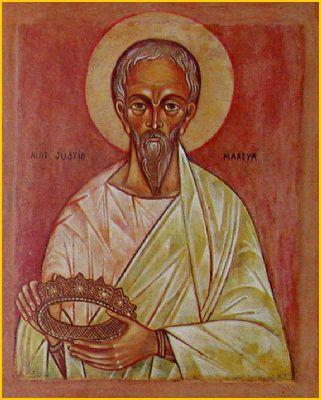
Christians: Grammarians or Philosophers?
In honor of St. Justin the Philosopher's feast day today, I wanted to ruminate on the difference between two types of Christianity. The difference, as I will put it, is that between grammarians and philosophers.
I draw the distinction this way. A grammarian is concerned with texts, propositions, logic, doctrinal formulas, systems, and canons. A grammarian's faith is oriented around exegesis and history as text. A grammarian is concerned, to be sure, with application. His is not necessarily, though most often is, the rational quest as an end in itself. But such application always serves the text; or, at least, what the grammarians strives to do with the text. The grammarian is rarely, if ever, surprised by the logic of his application, because such logic derives from his interpretation. Because the grammarian is primarily oriented toward exegesis, he is fundamentally concerned with tradition as datum, as evidence for or against his argument. For him, tradition lives insofar as it bears on the text. If it does not have to do with the text--even if that text is history--or if he cannot see the relation, then it is negligible, irrelevant.
Akin to the grammarian is the theologian. The theologian is concerned with God in the abstract. His god is the god of concepts and theories. The distilled god, separable from revelation, contemplated outside the context of contrite worship and the broken heart. His is the Babel god, the god of the tower, whom human reason may reach and describe.
A philosopher, on the other hand, is concerned with the divine formation of the soul, with disciplines and spiritual exercises, with history as a lived and living tradition. A philosopher knows that texts and canons and creeds are necessary to his faith, and he does not reject them or denigrate them, but he also knows that their value and purpose is precisely in and for the salvation of his soul. A philosopher may be, indeed, must be, rationally precise and cogent, but such rationality is not an end in itself but serves an end, which is theosis. If reason stumbles, the philosopher is not surprised or very concerned, for he knows that the God who gave reason cannot be circumscribed by it. If exegesis seems inconsistent, the philosopher is not worried overmuch. He is content to live that which has been passed down to him from living witnesses, themselves passing on what was lived for them, on back down the ages to the very day of split-fire and the restoration of tongues. The philosopher seeks theoria, but only through praxis, through the mortification of the flesh. The philosopher has no interest in expounding the meaning of virtue, except to point to the act and say, "Look."
Akin to the philosopher is the fool and the monk. The fool and the monk both live by way of revelation, the ongoing moment-by-moment personal experience that has been lived in uninterrupted transmission from creation. Both testify to the hidden God who has made himself known on this very day in the active word that generates life and makes things happen. The fool and the monk both know and witness to the inescapable reality that we know God only through brokenness and the death of self. They know the Cross is the midwife of the soul.
The temptation at this very point, of course, is to detail who are the grammarians and who the philosophers. But this is very grammatic. Instead, we ought seek out the fool, the monk, the philosopher, and live as they live. This is essentially philosophic and will be enough for us.
Conservative Syllabus
As a mirror to yesterday's "Conservative Index" of the 19th and 20th centuries' ten "most harmful" books, I present here an unscholarly list, in rough chronological order, of conservative must-reads of the 17th through 20th centuries taken from a survey of online conservative reading lists. (I've provided links to online texts. The rest can be checked out from your local library, or ordered online.)
- Alexander Hamilton, et. al., The Federalist Papers
- Alexis de Tocqueville, Democracy in America
- Friedrich Hayek, The Road to Serfdom (you might be interested in The Road to Serfdom in cartoons)
- Richard Weaver, Ideas Have Consequences
- William F. Buckley, Jr., God and Man at Yale
- Whittaker Chambers, Witness
- Russell Kirk, The Conservative Mind
- Milton Friedman, Capitalism and Freedom
- Barry Goldwater, The Conscience of a Conservative
- George H. Nash, The Conservative Intellectual Movement in America
Some honorable mentions:
Allan Bloom, The Closing of the American Mind
Edmund Burke, Reflections on the Revolution in France
James Burnham, Suicide of the West
Dinesh D'Souza, Letters to a Young Conservative
Milton and Rose Friedman, Free to Choose
Henry Hazlitt, Ecnomics in One Lesson
Russell Kirk, The Roots of American Order
John Locke, Second Treatise on Government
Roger Nisbet, The Quest for Community
Roger Scruton, The Meaning of Conservativism
Adam Smith, The Wealth of Nations
Ludwig von Mises, Human Action: A Treatise On Economics