February 29, 2004
Sunday of the Triumph of Orthodoxy
I have waited for this Sunday for more than a year. Last year, as Great Lent began, I eagerly anticipated this feast, but Anna and I were in Pittsburgh visiting her brother, Delane, and tensions over the Orthodox Church where high between us, so I didn't try to seek out the local Orthodox parish to observe the day.
Today, however, was different. We were home, so we could go to All Saints. We have been going to All Saints as a family now since September. And we just finished the first week of Great Lent. I was most definitely in need of the Divine Liturgy.
But first a little background on the feast:
The dominant theme of this Sunday since 843 has been that of the victory of the icons. In that year the iconoclastic controversy, which had raged on and off since 726, was finally laid to rest, and icons and their veneration were restored on the first Sunday in Lent. Ever since, that Sunday been commemorated as the "triumph of Orthodoxy."
Orthodox teaching about icons was defined at the Seventh Ecumenical Council of 787, which brought to an end the first phase of the attempt to suppress icons. That teaching was finally re-established in 843, and it is embodied in the texts sung on this Sunday. . . .
The name of this Sunday reflects the great significance which icons possess for the Orthodox Church. They are not optional devotional extras, but an integral part of Orthodox faith and devotion. They are held to be a necessary consequence of Christian faith in the incarnation of the Word of God, the Second Person of the Trinity, in Jesus Christ. They have a sacramental character, making present to the believer the person or event depicted on them. So the interior of Orthodox churches is often covered with icons painted on walls and domed roofs, and there is always an icon screen, or iconostasis, separating the sanctuary from the nave, often with several rows of icons. No Orthodox home is complete without an icon corner, where the family prays.
Icons are venerated by burning lamps and candles in front of them, by the use of incense and by kissing. But there is a clear doctrinal distinction between the veneration paid to icons and the worship due to God. The former is not only relative, it is in fact paid to the person represented by the icon. This distinction safeguards the veneration of icons from any charge of idolatry.
One of the customs observed in our parish is one in which each home brings an icon for each child. I'd purchased and had blessed, shortly after Sofie's birth, an icon of the Theotokos--with whom, by way of answer to prayer, Sofie has an intimate connection--so we brought that icon. The reason for this is that after the prayer before the ambo, but prior to the final blessing, the children of the parish all process around the nave with their icons. So there the Healy's were (momma first, then daddy after she handed Sofie off to me), Sofie in arms, trying to put the icon of the Theotokos in her mouth to chew on, processing around the church. It was pretty cool. One woman of the parish told me that seeing Sofie and Anna process with everyone else (at least for the first half) brought tears to her eyes, and great hope.
The liturgy served today was, of course, St. Basil's Liturgy. Wow. I mean, whoa-ho-ho-wow. I realized today that though I had celebrated Forgiveness Vespers last year, as well as praying the Great Canon once, and going to one Pre-Sanctified Liturgy, that I had never been to a Sunday Lenten Divine Liturgy. Man, I was just absolutely blown away!
First of all, three passages in particular spoke very directly to my need today. Right at the beginning of the anaphora, as the priest celebrates all that God has done, and the works he has wrought for us, there is this phrase: "for all things are thy servants." Then, just after we have responded to the priests prayer by singing "Holy, holy, holy, Lord of Sabaoth; etc." the priest continues "for in righteousness and true judgment hast thou orderd all things for us." And finally, in the petitions following the epiclesis, the priest asks that God would be mindful "of all thy people, and upon them all pour out thy rich mercy, granting to all their petitions which are unto salvation (emphasis added)."
The first reference is from Psalm 118:91 (LXX; 119:91 MT). This verse sustained me in the other dark hours of previous trials. Nothing is outside the authority and command of God. As the liturgy says, God in righteousness and true judgment has ordered all things for us. There is nothing that is not included in that. Pain, heartache, suffering, darkness and death. All things, all things, serve God and are ordered for our healing and wholeness. Ours is not a divided world, an evil part keeping God at bay. Even Satan, who blasphemes and denies God, who seeks to devour and consume God's children, is made to serve God. God takes all Satan's pomps and devices and sweeps them up into his wise and true workings of grace, so that the evil Satan intended is ultimately for us a cleansing fire of purification and tempering.
And indeed, we need not barter with God. He is good, we hear each week, and loves us. There is no need to persuade him of fulfilling all that which is good for us. He is already intending it. But it is a good directed to our wholeness and healing. The things we misjudge as good, which mar and disfigure us, God does not wish for us. Nor should we. But he stands ever ready to grant that which is for our healing, our salvation.
My heart leaps to these Gospel words, this ancient testimony of the saints who have gone before me and know the reality of which they speak. I am drawn toward the hope and promise of these holy words.
But I am also a small man, little of faith, and fearful. I hear God drawing out my faith from its tiny darkened corner. Dear Lord, grant to this sinner boldness to take you at your word.
February 22, 2004
The Journey to Antioch (Part VIII)
3. Orthodox Encounters June 2002 to the Present (Part C)
In July 2002, I began six months of reading and study, reflection and writing on the key questions to which I needed answers. Answers that would address not merely intellectual matters, but the issues of the life of faith. This project, though it did not begin quite so large as it ended, was much less about an academic study of, say, whether or not the Church had always believed that the elements of bread and wine become the Body and Blood of Christ in the Eucharist, but rather, if this is indeed the case, what am I then to do about it? So, what began as an anticipated handful of questions I might answer in a paper grew to eight related essays (three on the nature of the Church alone), totaling some ninety-two typescript pages and more than thirty thousand nine hundred words. I started the first essay on 31 July, and began the last essay on Christmas Eve (finishing it the day after New Year's Day). [Note: Those essays have been posted online and can be found here.]
The first two essays were intended to clear the ground and note the boundaries. In the first I noted that the competing and contradictory beliefs of the various Protestant bodies pointed out both the weaknesses of the Protestant paradigm and that the Truth had to be there amidst all the antagonistic notions. In the second essay I established the Protestant problem: that the New Testament clearly points to the visible unity of the Church, and that Protestantism has not only created more than twenty thousand schisms, but continues to add to them each week.
From there I could only resort to one sure thing: the Tradition of the Church, so the third essay highlighted how it is that the Tradition is essential to Christian belief. It is that Tradition which reveals both the antiquity of the office of the Bishop, but also underscores the New Testament teaching that the bread and wine of the Lord's Supper become the Body and Blood of Jesus Christ in the Church's Eucharist. The last three essays deal with the reality of the unity of the Church, that the Church is both the Body of Christ and by that, then, is the locus of our salvation, and finally that the criteria of the true Church would have to be both historical and doctrinal continuity with the Church of the New Testament.
But the months from July to the Christmas season were not merely about study, however, "real life" that study was. In mid-July, Anna and I worshipped for the first time at Northside Christian Church. This was a Disciples of Christ congregation just about a mile from our home. The Disciples churches had the same historical pedigree of the churches of which Anna and I had been members (and had served as ministers early on in our marriage), so there was some familiar ground. Plus Northside had one of the most well-done contemporary praise-band worship services I'd ever seen done, which was a key factor for my wife.
Anna and I worshipped there a few times a month for a couple of months. Both of us met with the husband-wife ministry team, and I myself met with the pastor a couple of times. But though one would think we had found our "compromise parish," early on even Anna had misgivings. In our first meeting with the pastors over lunch, we asked some direct questions about doctrine, morality and church discipline. We did not receive direct answers. And the answers that were finally forthcoming seemed to us to display a willingness to dilute the tougher teachings of the Church for the sake of something like "church growth."
By the first of October, the congregation had relocated to a rented movie theater in Bucktown and changed its name. We went once after the move, but the atmosphere felt to us less like worship and more like the sort of spectating one does in a theater, complete with snacks, soda and cupholders in the arms of the theater seats. We did not return. I took the move as a sign from God that this was not what he wanted for us.
The first Sunday in October, as it would turn out, was my last visit to the Divine Liturgy at All Saints until December. The following weekend I went to the Benedictine monastery of St. Gregory's Abbey, in Three Rivers, Michigan. It was to be, in a most significant way, an unlooked-for transformation.
[Next: 3. Orthodox Encounters June 2002 to the Present (Part D)]
Sunday of Forgiveness
Today is the Sunday of Forgiveness, the last day prior to Great Lent (which technically begins this evening during Vespers).
The Gospel (Matthew 6:14-21) for today reads:
For if ye forgive men their trespasses, your heavenly Father will also forgive you: But if ye forgive not men their trespasses, neither will your Father forgive your trespasses. Moreover when ye fast, be not, as the hypocrites, of a sad countenance: for they disfigure their faces, that they may appear unto men to fast. Verily I say unto you, They have their reward. But thou, when thou fastest, anoint thine head, and wash thy face; That thou appear not unto men to fast, but unto thy Father which is in secret: and thy Father, which seeth in secret, shall reward thee openly. Lay not up for yourselves treasures upon earth, where moth and rust doth corrupt, and where thieves break through and steal: But lay up for yourselves treasures in heaven, where neither moth nor rust doth corrupt, and where thieves do not break through nor steal: For where your treasure is, there will your heart be also.
Kontakion of the Sunday of Forgiveness Tone 2
O Thou Guide unto wisdom, Bestower of prudence, Instructor of the foolish, and Defender of the poor;
establish and grant understanding unto my heart, O Master.
Grant me speech, O Word of the Father;
for behold, I shall not keep my lips from crying unto Thee:
O Merciful One, have mercy on me who have fallen.
Protopresbyter Alexander Schmemann says, of today's Gospel:
Lent is the liberation of our enslavement to sin, from the prison of "this world." And the Gospel lesson of this last Sunday (Matt. 6:14-21) sets the conditions for that liberation. The first one is fasting--the refusal to accept the desires and urges of our fallen nature as normal, the effort to free ourselves from the dictatorship of flesh and matter over the spirit. To be effective, however, our fast must not be hypocritical, a "showing off." We must "appear not unto men to fast but to our Father who is in secret." The second condition is forgiveness--"If you forgive men their trespasses, your Heavenly Father will also forgive you." The triumph of sin, the main sign of its rule over the world, is division, opposition, separation, hatred. Therefore, the first break through this fortress of sin is forgiveness: the return to unity, solidarity, love. To forgive is to put between me and my "enemy" the radiant forgiveness of God Himself. To forgive is to reject the hopeless "dead-ends" of human relations and to refer them to Christ. Forgiveness is truly a "breakthrough" of the Kingdom into this sinful and fallen world. (Great Lent: Journey to Pascha, p. 28)
So in just a few short hours we will ask forgiveness of everyone in the parish, and give forgiveness in turn.
And then we will be prepared to go into the desert to be with our Lord, and to fight demons in his strength.
Gospel Tellings
This week has been an amazing preparation for Great Lent.
It began, rather innocuously enough, on last Sunday after Divine Liturgy. I had run back upstairs to catch Father so as to have him refill our bottle of holy water. Having accomplished my mission, Eva, who had taken up the baskets which had contained the antidoron, offered me one of the pieces remaining. I took it.
You should know that it has been my practice, up until Sofie's birth, to take home a piece of antidoron, when I could, to consume a bit each day through the week. But since Sofie's birth, my observance of Morning Prayer has been nonexistent--except for sporadic bursts here and there. During the previous months, I would take home antidoron, intending to follow the pious custom I'd been habituated to, but almost always failing to do so, with the result that I would almost unfailingly have dry, mouldy antidoron to deal with each week. So I stopped taking any antidoron home.
But I have, of late, been convicted of my lack of prayer, especially since Sofie is on a more regular schedule, and my lack is not a matter of attending to her needs so much as the inertia of lethargy. Eva's offering to me, then, was something like an act of faith. "Okay, God, clearly you want me to get back into the habit of prayer, and are offering me this blessed bread as symbol and incentive."
And as it turned out, by God's grace, I did observe Morning Prayer each day this week, and also midday prayers. (Though Evening Prayer was the almost non-existent practice.)
But this isn't about my prayer practice so much as it's about God's preparing me for Lent. Which brings us to Monday night and the Mel Gibson interview. It's been commented on elsewhere, and I even noted it earlier this week, so I'll just say that the bringing of the Gospel to a media where one does not expect to hear it in it's undiluted forthrightness was yet another encouragement to me.
The next instance was at the departmental colloquy on Wednesday at Loyola. Billed as a panel discussion of "religion without God?" (the question mark was original), one assumed one would go and hear talk about the death of metaphysics and the place for religion in light of that reality. And the first couple of speakers pretty much met everyone's initial expectations. But when Dr. Paul Moser, our department chair, came to his turn to speak, the entire dynamic changed. He recounted the tragedy that struck New Trier high school this week, as one of its students committed suicide. Dr. Moser asked, "What do we say to Alyssa's sister who found Alyssa hanging from the ceiling of her bedroom? What sort of everlasting hope can we give to her? And if our philosophy or our belief system cannot give it to her, then perhaps we would not be mistaken to find one that could?"
I knew by way of departmental gossip that Dr. Moser had, in recent years, come to a renewed Christian faith. But I had no idea that he was so bold as to engage in the holy practice of Christian polemic. (I only found at later that Dr. Moser maintains a website entitled "Idolaters' Anonymous." As he put it to me, the website annoys those who rely on their own wisdom.)
For the second time this past week, the Gospel had been preached in a context I least expected it.
The resultant email correspondence between Dr. Moser and myself was a continuation of that encouragement, and I hope in the near future to speak with him more.
But clearly all these things were portents of what is about to occur in Lent: God is coming to invade every nook and cranny of my life. My idle curiosity and TV leisure time? God invaded. My professional/academic world? God invaded. My religious world? God invaded. There is no area of my living in which the Gospel will not be spoken, and having been spoken will not claim and reclaim my life.
I expect it will be painful. But yet I have been given to face it with expectant anticipation.
God is good and loveth mankind.
And I can only say, "Glory to God in the highest."
February 21, 2004
A Project of Faithful Thinking IX
[Note: This entire series of posts can be read in a single html document here.]
Conclusion
In the present Western sociopolitcal context, and certainly here in the United States where I live, the greatest danger for faithful Christian thinking is that of Gnosticism, the divorcing of mind and thinking from the body and the will. This has many permutations, the lines between each of which are not always distinct. There are those seek to parse the Tradition either to dismantle it or to set in place a burden of law not even the Pharisees had the temerity to establish. There are those who are diligent to know and understand their faith in accord with all the generations of Christians gone before them, but fail also diligently to observe the practices of the Faith observed by these pioneers, whether that be in sexual chastity (an absolute necessity in our sexually saturated culture) or in the self-control of appetite and the stewardship of money, which so easily lead to the godless commodification of the treasures of faith. But there are also those who, having dismantled the faith, rush into behaviors and ideologies promoted by the non-Christian world, but with a zeal that only new converts espouse and lacking the genuine world-weariness of the profligate.
Faithful Christian thinking rejects this mind-body split, and for very good reason: God himself became man. In so doing, the unity of what it means to be human was strengthened and transformed. Mind, soul and body form a unity of thought, action and will, neither one divorced from the other, for in the dissolution of these bonds, all of us become less than truly human. Any project which would elevate one aspect of human nature over another, or any apart from dependence on the Holy Trinity is a project of dehumanization. Any project which would seek immortality apart from life in God, or wisdom and knowledge apart from Christ Jesus, is a project not only doomed to failure but also fated to enslave all those who adhere to its principles.
This is why the only true freedom of thought is faithful thinking, Christian thinking; thinking which arises from the imago dei, that Trinitarian image stamped upon our nature, which, however defaced, is not dissolved. It is this thinking which reinforces and promotes the full humanity of mankind through the personhood which reflects the undying light of the Face of God, Father, Son and Holy Spirit. It is this thinking which in love seeks to live in holy obedience to the will of the God which gives life to the thinking person.
In a fatal contradiction, many Christians today seek to cut themselves off from this long-established tradition of thought and life in the Church. They see the strictures of the Holy Tradition, of the imperatives of Scripture, the Word of God written, as stultifying, as a diminishment of the freedom we humans are rightly said to have as birthright. Yet the alternatives are not more life, but more death. Inevitably, such divorcement runs its full course, and mind is split from body, soul from mind, will from act. The old inimical heresy of Gnosticism, the only true alternative to Christian faith, does not die, but lives again, if such that it offers can be called life and is not some demonic parody.
Take away the foundation of the Trinity, and one loses all capacity for right, let alone faithful, thinking. Removing the truth of communal personhood only results in the splitting of what it means to be human. Diminishing the radical Personhood of the Truth, and the Faith becomes little more than doctrinal points to argue. Divorce knowledge from love and one can only enslave one's hearers and oneself to inhuman systems. Thinking is split and compartmentlized. Holiness of thought becomes incomprehensible because it is nonsystematic.
I have entitled this series of reflections "A Project of Faithful Thinking." I have done so primarily because it is that, a project, a foundation on which to build, but something which in itself is unfinished. These are touchstones, pointers, which demand greater explication, but which I do not now have the resources to accomplish.
But another reason this has been entitled the way it has is that it is a very personal project, thus the singular and indefinite article. I grew up in a Christian environment which stressed right doctrine, even (however unintended) at the expense of right living. I entered as an adult a Christian environment which stressed (however unintended) institutional loyalty over right belief. In both cases, the resultant thinking left subhuman wreckage. But in the last few years I have finally come home to the Faith which unites head and heart, mind and body, spirit and flesh and provides the groundwork for the sort of thinking that is most human, and does the most to both humanize and divinize those who believe its dogma and live its life. This series is a testimony to what I have gained, and a first deposit of that which I hope to give back.
In all the ways that these reflections align themselves with the Faith and Life of the Church, I give thanks to God. In any way, however small, in which these thoughts depart from the Way revealed by Christ God in his Body, may they be corrected and their errors destroyed and forgotten.
Soli Deo Gloria
February 20, 2004
A Project of Faithful Thinking VIII
Building on Christian Foundations for Faithful Thinking: Tracing the Implications
2. Christian Thinking is Holy Thinking
If it is the case that truly Christian thinking is, at its core, a partaking of the divine nature, and if Christian thinking, to be faithful, must be whole, and can only be whole insofar as it is in real communion with the Holy Trinity, then it clearly must also be the case that Christian thinking, if it is to be faithful, must be holy. For our God is a consuming fire, whom, without holiness, no one will see.
This, of course, means that the Christian cannot, in his thought life, sexually objectify a person (or lust after them). A Christian cannot use his powers of reason to plot revenge. Nor can the Christian willfully and with reflection engage the will toward greed or heresy. These guidelines are, or at least traditionally have been, rather obvious.
But it also means that faithful thinking reflects the Trinitarian image in which we humans have been made, and must manifest the likeness of God which is, as Christians, being renewed in us. Though the first action God took after creating mankind was to bless them, the first words of God to the humans he had made was a command, "Be fruitful." The first Gospel to come from our Lord's mouth, in his earthly ministry, was a command, "Repent." We always already are given a command when we approach God. "Be still." "Take off thy sandals." Our primary manifestation of holiness in thinking is obedience. "We take captive every thought to the obedience of Christ."
In what way do we sanctify our thinking? In what way do we manifest this holiness through obedience? By meditating on God's Law in the night watches. By filling our minds with whatsoever is pure, noble, good. We take on the mind of Christ, through the Holy Spirit, in the Church by hearing and heeding the Scriptures given us in and by the Church, and by taking to heart the truth the Holy Spirit has continued to guide the Church toward. The Church is the pillar and ground of the Truth and we take on the mind of Christ through the work of the Holy Spirit by taking on the mind of the Church as explicated by the holy Fathers.
This demands consciousness, attentiveness. In many ways, the chief characteristic of the Christian mind is wakefulness.
In the morning prayers of the Church, we entreat God to "enlighten the eyes of our understanding" and to "raise up our minds from the heavy sleep of indolence." Our Lord, in parable after parable says to us, "What I say to you I say to all, 'Watch!'" Holy thinking is attentive thinking, thinking which is fixated on the work God is doing. This is why the prayers of the Optina elders ask God to enable us to accept what comes to us each day as from God. "On this day the Lord has acted, I will rejoice and be glad in it." God is always already at work around us. Holy thinking works to perceive what it is that he is doing.
But this attentiveness means that our freedom of thought is limited. Or rather, that in the limitation of our thoughts to the Person and work of Christ and his Body the Church is the only way our thinking can truly be free. For it is in Christ we find all the treasures of wisdom and knowledge. We are not absolutely free to speculate on the natures and Person of Christ. Or rather, our speculation must be within the banks of the stream of Scripture and Church Dogma. To depart from the Church's mind is to cease to have Christ's mind, and therefore to abrogate any possibility of access to the Truth. If we go wrong on the Person of Christ, we can never go right on the Truth. Or at least our grasp of the Truth has become fatally compromised.
But holy thinking is not merely about the proper activity and scope of the intellect. St. Paul tells us to offer our bodies as living sacrifices, which is our reasonable worship; we are not to be conformed to the world, but transformed in the renewing of our mind. That is to say, holy thinking involves holy bodies. There is, as I have repeatedly asserted, no separation of mind and body in faithful Christian thinking. So to the degree that we would think faithfully, to the same degree we keep our bodies pure. This of course involves a rejection of gluttony and of other self-abuses, but it also involves, inescapably, sexual chastity. "Every other sin a man does is outside his body, but sexual immorality is a sin against one's own body." No Christian can think faithfully if they are not sexually chaste.
Once again, the all-encompassing aspects of salvation, the body and the mind, thinking and action, desire and the will, combine. Christian thinking is whole thinking. And it is obdient and holy thinking.
[Next: Conclusion]
February 19, 2004
The Journey to Antioch (Part VII)
3. Orthodox Encounters June 2002 to the Present (Part B)
Although she refrained from any critical remarks about my worshipping at the Orthodox Church for nearly a month, by the first of July 2002 Anna vigorously voiced her frustration and opposition. My continuing to worship at a Church she could not see fit to worship at was just like if I were taking a knife right through the midst of our family and dividing it in half. I had two weeks to decide what I was to do: continue to go to the Orthodox Church and wreak havoc on our home; or find a parish where we both could worship together as a family.
Needless to say, I was sat back hard on my heels. Anna had clearly, honestly, and tearfully expressed her deepfelt belief that my worshipping in an Orthodox Church was spiritually divisive, that it deeply wounded her that I would seem so callously to set aside her particular worship and church life needs, and that I should seriously consider what it was I was doing.
These deep feelings and hurt had been growing in Anna for some time. She could hardly be blamed. I had been adamant in my desire to be confirmed in the Episcopal Church some six years before. She had been against it, citing all the reasons of heresy and immorality for which I would eventually leave the Episcopal Church (though of course neither of us could have foreseen some of the particulars). I at that time had defended my stance, saying that God would bless my decision to be confirmed, that I was doing it for our family, and so forth. Though we reconciled enough that she gave her blessing four years later for me to seek ordination, she had sacrificed potential career opportunities in the narrowing of her employment choices so that I could go to seminary. Now here I was, having left the church I was so certain was going to be good for our family, having left the ordination process I was so certain God had called me to explore, and now I wanted to jump the fence and explore yet another greener ecclesiastical pasture.
No, clearly Anna had strong and legitimate reasons to be upset and resistant to my journey into Orthodoxy.
At first, her reaction both scared and angered me. I was concerned that perhaps this issue would test our marriage beyond the breaking point, and that I would do some boneheaded thing to put the finishing touches on nearly a decade of matrimony. And I was angry that my intent to investigate Orthodoxy as a specific fulfillment of the Holy Spirit's convicting me of my failure to be the husband I was called by God to be was being criticized in a way contrary to my intentions.
But I also had a sense that the either/or condition with which I had been presented was a false choice because it was no real choice. It pretty much came down to: choose Orthodoxy and my lifelong pursuit of the New Testament Church or choose my wife and our marriage. But after two weeks of prayerful reflection I finally decided to offer a different set of choices: we would together worship at a church with which she was comfortable, and I would from time to time (say once or twice a month) go to the Orthodox Church.
I knew that neither of us considered this compromise as ideal, still it served to reduce the tension and provide some breathing space. We ended up going to a Disciples of Christ congregation that had the sort of contemporary style of worship my wife enjoyed and felt best enabled her to worship in spirit and truth. Though I wanted her also to go to All Saints with me, she chose not to and so on those Sundays I went to Divine Liturgy, she stayed home.
Such a stopgap state of affairs could not go on indefinitely. I knew that if I were to have any hope of seeing the fulfillment of the promise I sensed I had been given, I would have to found my convictions about Orthodoxy on something other than my experience and purported preferences, on something other than reliance on "authorities" in books, and on something other than my reaction to the Episcopal Church.
It was my own heritage that pointed toward the beginning of a way forward. I would go back to the New Testament to find there the foundation of my transfigured belief and would support that biblical interpretation by the testimony of the early Christian witnesses, the Apostlic Fathers and their successors.
[Next:3. Orthodox Encounters June 2002 to the Present (Part C)]
February 18, 2004
Thank God, for Our Father in the Faith, St Leo the Great, Pope of Rome
Today being St. Leo's feast day, contemplate this from the Tome of Leo:
Accordingly while the distinctness of both natures and substances was preserved, and both met in one Person, lowliness was assumed by majesty, weakness by power, mortality by eternity; and, in order to pay the debt of our condition, the inviolable nature was united to the passible, so that as the appropriate remedy for our ills, one and the same "Mediator between God and man, the Man Christ Jesus," might from one element be capable of dying and also from the other be incapable. Therefore in the entire and perfect nature of very man was born very God, whole in what was his, whole in what was ours. By "ours" we mean what the Creator formed in us at the beginning and what he assumed in order to restore; for of that which the deceiver brought in, and man, thus deceived, admitted, there was not a trace in the Saviour; and the fact that he took on himself a share in our infirmities did not make him a par-taker in our transgressions. He assumed "the form of a servant" without the defilement of sin, enriching what was human, not impairing what was divine: because that "emptying of himself," whereby the Invisible made himself visible, and the Creator and Lord of all things willed to be one among mortals, was a stooping down in compassion, not a failure of power. Accordingly, the same who, remaining in the form of God, made man, was made man inthe form of a servant. For each of the natures retains its proper character without defect; and as the form of God does not take away the form of a servant, so the form of a servant does not impair the form of God. . . .
Accordingly, the Son of God, descending from his seat in heaven, and not departing from the glory of the Father, enters this lower world, born after a new order, by a new mode of birth. After a new order; because he who in his own sphere is invisible, became visible in ours; He who could not be enclosed in space, willed to be enclosed; continuing to be before times, he began to exist in time; the Lord of the universe allowed his infinite majesty to be overshadowed, and took upon him the form of a servant; the impassible God did not disdain to be passible Man and the immortal One to be subjected to the laws of death. And born by a new mode of birth; because inviolate virginity, while ignorant of concupiscence, supplied the matter of his flesh. What was assumed from the Lord's mother was nature, not fault; nor does the wondrousness of the nativity of our Lord Jesus Christ, as born of a Virgin's womb, imply that his nature is unlike ours. For the selfsame who is very God, is also very man; and there is no illusion in this union, while the lowliness of man and the loftiness of Godhead meet together. . . .
Troparion of St Leo Tone 3
Thou wast the Church's instrument/ in strengthening the Church's teaching of true doctrine;/ thou didst shine forth from the West like a sun/ and didst dispel the heretics' error./ O righteous Leo, entreat Christ our God to grant us His great mercy.
Kontakion of St Leo Tone 3
From the throne of thy priesthood, O glorious one,/ thou didst stop the mouths of the spiritual lions;/ thou didst illumine thy flock with the light of the knowledge of God/ and with the inspired doctrines of the Holy Trinity./ Thou art glorified as a divine initiate of the grace of God.
A Project of Faithful Thinking VII
Building on Christian Foundations for Faithful Thinking: Tracing the Implications
1. Christian Thinking is Whole Thinking
On the basis of the foundations for Christian thinking which I have laid out previously, it is clear that Christians cannot be faithful in their thinking and at the same time dichotomize it. That is to say, a Christian can neither dismiss the subjective aspects of knowing nor can they eschew objectivity. A Christian understands that no human being can have purely objective knowledge. We believe that as creations of God, ours is a contingent knowing, inescapably subjective per se.
But this subjectivity is balanced and transformed by the only being who can claim pure objectivity, the Holy Trinity. The Christian has access to the objectivity which God himself provides in and through the Holy Spirit and his testimony in the Church, the Scriptures and the life of the Church, also known as Tradition. There is no other focal point outside the Holy Spirit's work in the Body of Christ through which any of us can have access to unchanging Truth.
Our personal (note that I do not say individual) knowing is darkened by our fallenness. Our mortality and sinfulness ensures that even when we legitimately come to know aspects of the Truth we misinterpret, misconstrue and misunderstand. Cut off from God, it is not the case we cannot know anything of the Truth, for the vestigial consciences we carry are bound up with the image of God in which we've been created and bear witness of at least the Truth of our mortality and fallenness. But it is the case that we cannot come to grasp in any meaningful way these broken pieces of the picture scattered around us. For us to make sense of our subjective knowing, God must reveal himself to us.
So it is not surprising that for one like Nietzsche who proclaimed the "death of God," the implication is that our knowing is little more than the will to power. If all we have is our subjectivity, then there are no ultimate metanarratives, but only stories, shadows dancing on the cave wall.
Christians, however, must engage in whole thinking. We must ensure that the particular, that is to say, the personal, is not lost, since the Truth is the Person of Christ. In Christ there are no universal truths that are not also particular. There are no unchanging principles that are not also personal. That God is love does not indicate some cosmic life force that emanates like a grand vibration throughout the universe. Rather that God is love means he is inescapably Person. Because only Persons can love; cosmic principles just hum.
So our subjective, contingent, mortal and fallen human knowing must be anchored in, which is to say, hypostatically joined to, the objective, per se, immortal and divine knowing of the Trinity. In this union, our subjective personal experience is sanctified, redeemed, and made to partake in the gracious and energetic objective Personhood of the Trinity. In that sanctification our subjectivity is objective, and the objectivity of God is subjective. His Person divinizes our person.
We no longer, then, know in the same way. "Therefore, from now on, we regard no one according to the flesh. Even though we have known Christ according to the flesh, yet now we know Him thus no longer. Therefore, if anyone is in Christ, he is a new creation; old things have passed away, behold, all things have become new."
We have been transformed by the renewing of our mind. Science is not cut off from literature. Poetry is not cut off from philosophy. The laws of of the home are not cut off from international machinations. The spirit and soul are not cut off from the body. All knowing is unified in the Trinity, and therefore, human knowing must seek always to come to know the fullness of the Truth that is Christ God. Intellect is not cut off from will, so Christians will only come to know the Truth that is Christ God if they ever seek repentance from sin and death. We take captive every thought to the obedience of Christ. So we refuse to chase every vain and idle fantasy; refusing too to be concerned about how some marvel that we don't join in with them.
Our knowing is as much anchored in God, and as personal, when we meditate on God's law, as when we silently rock a child to sleep. Christian knowing embraces every nook and cranny of our lives, because that is as far as the Light which is the life of the world reaches.
Those who do not have Christ cannot but think in slices, though some think in larger slices than others. It is to Christians only that God has given the grace to unify their knowledge in and by the work of the Holy Trinity.
And if our thinking is whole, because participating in God, then our thinking also must be holy.
[Next: Tracing the Implications: Christian Thinking is Holy Thinking]
February 17, 2004
The Journey to Antioch (Part VI)
3. Orthodox Encounters June 2002 to the Present (Part A)
On 9 June 2002, I returned to All Saints Orthodox Church after a six-month absence.
The week before, through a serendipitous reference in my reading to the passage in Ephesians 5 on the relations of husbands and wives, I contemplated my responsibilities as a husband. According to the Scriptures, and my own conscience, I came up far short. Especially in the critical role of my obligations of leadership in my home in matters of faith.
As I've described, my first reactions to the new realities confronting me in the Episcopal Church and in seminary, as the 90s drew to a close and the new century and millennium began, were largely ones of anger and repulsion. I was angry that the church I thought I had joined had, in effect, ceased to exist more than two and a half decades before. I was angry that I had not seen the truth when I was being confirmed, and angry at those changes which had manifested themselves after my confirmation. I was also repulsed by the approval of immoral behavior and the ever-growing influence of heresy in the communications of the church, heresy which was never seriously or prominently addressed, let alone disciplined. No bishops or priests were brought up on presentments for preaching that which contradicted the explicit Faith of the historic Church. It seemed it was more important to uphold institutional unity, to hold on to property and endowments, to earn the esteem and approval of those outside the Church, than it was to stand firm in the Faith once for all delivered to the saints.
Clearly, then, my turn to Orthodoxy at first was more about greener pastures than about embracing Orthodoxy for what it was. But from the time I acquired an Orthodox prayerbook and the Septuagint psalter in January 2001, I began to relate to Orthodoxy on a deeper, more serious level. My exploration of the life and doctrine of the Church began to lay a solid foundation for change, so that by the time June 2002 came 'round, I was in a state in which I no longer evaluated the Orthodox Church on my terms and preferences. I was now prepared to listen to the Orthodox Church and, importantly, to begin to allow Orthodoxy to evaluate me.
It was fitting, then, that the Sunday of my return, 9 June, was the Sunday of the Blind Man (the Gospel reading being John 9:1-38), and that Epistle reading was Acts 16:16-34, and the conversion of the Philippian jailer. This was my first of a handful of "St. Anthony moments." As you remember, St. Anthony had gone to worship, heard the Gospel text to sell all he had and give it to the poor, and soon went into the desert to pray and wage spiritual warfare. Though certainly with more humble implications, nonetheless, the significance of these passages were not lost on me. Clearly I was blind, and in need of the illumination of God's Spirit. But I took the promise of St. Paul to the Philippian jailer as my own: "Believe on the Lord Jesus Christ, and thou shalt be saved, and thy house." As completely unrealizable as it seemed, I began to hope that one day me and my entire household would be Orthodox.
For I had come to believe, though I did not yet understand, that the Orthodox Church is the Church of the New Testament. If this were true, then not only by virtue of my growing up in the Stone-Campbell/Restoration Movement churches, but also on its own terms, I needed to lead my family into that Church, and to do so by way of example.
Immediately, that implication, and my new resolve to accomplish it, faced a strong and serious challenge: my wife was completely opposed to any such move.
[Next: 3. Orthodox Encounters June 2002 to the Present (Part B)]
February 16, 2004
A Suprising Lenten Exhortation: Aristotle on Becoming Virtuous
This, from the Nicomachean Ethics:
It is well said, then, that by performing just actions one becomes a just person and by performing temperate actions one becomes a temperate person, and no one is going to become good by not performing these actions. But most people do not perform them, but believe that by taking refuge in talk they are philosophizing and in that way will be people of serious stature, doing something similar to those sick people who listen to the doctors carefully but do none of the things they order. So just as they will be in no good condition in body if they treat themselves in this way, neither will those who philosophize in this way be in any good condition in soul. (1105b9-18)
I think I will memorize this quote and repeat it daily during Lent. It certainly, for me, summarizes the essence of repentance: put up or shut up.
February 15, 2004
Sunday of the Last Judgment
If there's something you don't hear much any more in affluent Western Christianity (Roman and Protestant, liberal and evangelical) it's the theme of the final judgment of all mankind.
Mainliners and liberals have pretty much jettisoned the whole concept of final judgment and hell. Evangelicals and conservatives--who haven't jettisoned the doctrine--seem to be more interested in therapeutic seeker services, which do not lend themselves to talking about the subject.
Ours is a too-tame Jesus. Our Jesus is the one who loves everyone. He's always smiling, and always exhorting us to "Look on the bright side of life" and to spend all our days in comfortable upper middle-class affluence. This is the WASP-ish "gentle Jesus meek and mild."
But it ain't the real Jesus. Nor is it a saving Jesus. I've been told that the subject Jesus discusses most of all is that of hell. Whether or not that is the case, this same Jesus who gave us the two great commandments, this same Jesus who exhorts all who are weary and heavy-laden to come to him, is also the same Jesus who says:
When the Son of man shall come in his glory, and all the holy angels with him, then shall he sit upon the throne of his glory: And before him shall be gathered all nations: and he shall separate them one from another, as a shepherd divideth his sheep from the goats: And he shall set the sheep on his right hand, but the goats on the left. Then shall the King say unto them on his right hand, Come, ye blessed of my Father, inherit the kingdom prepared for you from the foundation of the world: For I was an hungred, and ye gave me meat: I was thirsty, and ye gave me drink: I was a stranger, and ye took me in: Naked, and ye clothed me: I was sick, and ye visited me: I was in prison, and ye came unto me. Then shall the righteous answer him, saying, Lord, when saw we thee an hungred, and fed thee? or thirsty, and gave thee drink? When saw we thee a stranger, and took thee in? or naked, and clothed thee? Or when saw we thee sick, or in prison, and came unto thee? And the King shall answer and say unto them, Verily I say unto you, Inasmuch as ye have done it unto one of the least of these my brethren, ye have done it unto me. Then shall he say also unto them on the left hand, Depart from me, ye cursed, into everlasting fire, prepared for the devil and his angels: For I was an hungred, and ye gave me no meat: I was thirsty, and ye gave me no drink: I was a stranger, and ye took me not in: naked, and ye clothed me not: sick, and in prison, and ye visited me not. Then shall they also answer him, saying, Lord, when saw we thee an hungred, or athirst, or a stranger, or naked, or sick, or in prison, and did not minister unto thee? Then shall he answer them, saying, Verily I say unto you, Inasmuch as ye did it not to one of the least of these, ye did it not to me. And these shall go away into everlasting punishment: but the righteous into life eternal. (Matthew 25:31-46)
And so we pray:
Kontakion of the Sunday of the Last Judgment Tone One
When Thou, O God, wilt come to earth with glory, and all things tremble,
and the river of fire floweth before the Judgment Seat
and the books are opened and the hidden things made public,
then deliver me from the unquenchable fire,
and deem me worthy to stand at Thy right hand, O most righteous Judge.
To the extent we ignore or dismiss the clear teaching of Jesus, the Scriptures and the Tradition of the Church that there will be a final judgment of all mankind, to the same extent we lose both a real understanding of sin and the reality of the hope the Gospel provides. Religion has been indicted as an "opiate for the masses" by which the powerful propertied class keeps the wage labor class under control. And the dogma of the final judgment has been psychoanalyzed as something like the inability to handle the present realities of one's life and circumstances. Or, the picture of God in the final judgment gets caricatured as a vindictive God full of deep emotional problems. A truly loving God, after all, will accept everyone just as they are.
The only problem with these deeply flawed understandings is that they miss an important reality: the evil that lurks in the human heart and finds expression in our actions. The powerful still control the powerless, through economic and legal machinations. The inability to handle life's present realities has not gone away with the dismissal of religion. It has only put in place a new priesthood of therapists, professional and lay. And though the present-day "gospel" is one of a God who gives without asking anything in return is on everyone's lips, the same intolerance obtains. Those preaching tolerance and unconditional acceptance are the same ones who push out those who disagree with them. The tolerant preach dialogue, but only so that "the other" will ultimately change their mind and become like the "tolerant."
No, the true Gospel, the one which preaches God's love, the one that teaches of a God that respects each person enough to allow them the freedom to reject his love forever, it is only this Gospel which provides freedom and hope. And so we work out our salvation with fear and trembling, knowing that God himself works in us both to will and to do the good acts which he has stored up for us to do.
And it is the nature of these acts, which today get confused. As Protopresbyter Alexander Schmemann writes:
If God loves every man it is because He alone knows the priceless and absolutely uniqute treasure, the "soul" or "person" He gave every man. Christian love then is the participation in that divine knowledge and the gift of that divine love. There is no "impersonal" love because love is the wonderful discovery of the "person" in "man," of the personal and unique in the common and general. It is the discovery in each man of that which is "lovable" in him, of that which is from God.
In this respect, Christian love is sometimes the opposite of "social activism" with which one so often identifies Christianity today. To a "social activist" the object of love is not "person" but man, an abstract unit of a not less abstract "humanity." But for Christianity, man is "lovable" because he is person. There person is reduced to man; here man is seen only as person. The "social activist" has no interest in the personal, and easily sacrifices it to the "common interest." . . . Social activism is always "futuristic" in its approach; it always acts in the name of justice, order, happiness to come, to be achieved. Christianity cares little about that problematic future but puts the whole emphasis on the now--the only decisive time for love. The two attitudes are not mutually exclusive, but they must not be confused. . . . Christian love, however, aims beyond "this world." (Great Lent: Journey to Pascha, pp. 25-26)
The Fatherhood Chronicles XXXIII
I submit evidence of our trip to San Diego at the beginning of January. Here are pictures of the Healy family on the shores of the Pacific Ocean (the first is back of the Hotel Del Coronado, and the second is on the beach near the hotel).
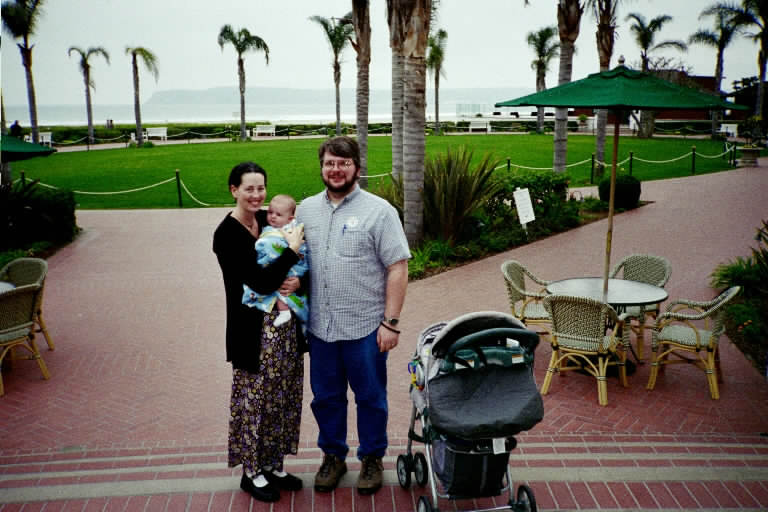
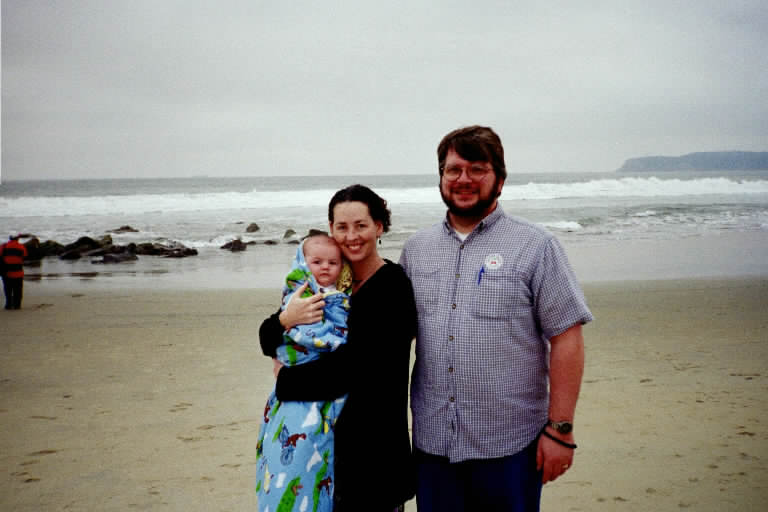
Here's my two lovely women on the beach near the Hotel Del Coronado.
Here's Daddy and Sofie on the whale watching boat. (Note the father-daughter baja's.)
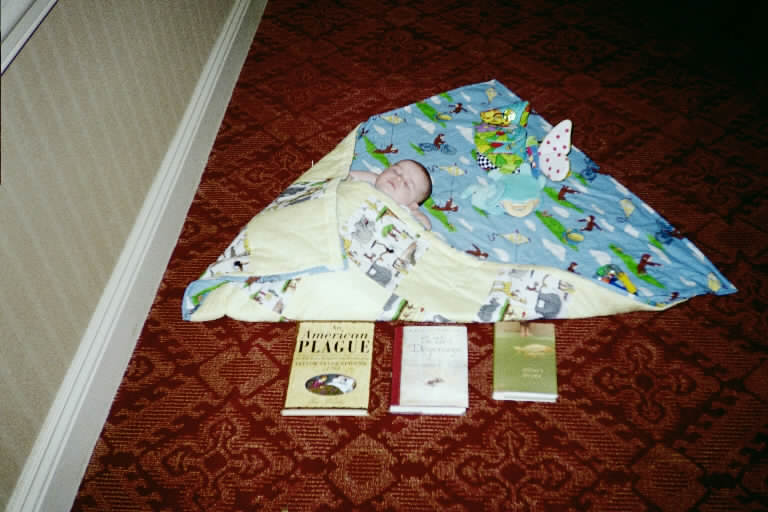
And here's sleeping Sofie, ex officio member of the 2004 Newbery Medal Award Committee, surrounded by the Newbery Medal Award book (Kate DiCamillo's The Tale of Desperaux [center]) and the two honor books (Jim Murphy's The American Plague [left] and Kevin Henkes' Olive's Ocean [right]).
February 14, 2004

Saturday of Meat-fare Week (Saturday of Souls)
1 Thessalonians 4:13-17
But I would not have you to be ignorant, brethren, concerning them which are asleep, that ye sorrow not, even as others which have no hope. For if we believe that Jesus died and rose again, even so them also which sleep in Jesus will God bring with him. For this we say unto you by the word of the Lord, that we which are alive and remain unto the coming of the Lord shall not prevent them which are asleep. For the Lord himself shall descend from heaven with a shout, with the voice of the archangel, and with the trump of God: and the dead in Christ shall rise first: Then we which are alive and remain shall be caught up together with them in the clouds, to meet the Lord in the air: and so shall we ever be with the Lord.
John 5:24-30
Verily, verily, I say unto you, He that heareth my word, and believeth on him that sent me, hath everlasting life, and shall not come into condemnation; but is passed from death unto life. Verily, verily, I say unto you, The hour is coming, and now is, when the dead shall hear the voice of the Son of God: and they that hear shall live. For as the Father hath life in himself; so hath he given to the Son to have life in himself; And hath given him authority to execute judgment also, because he is the Son of man. Marvel not at this: for the hour is coming, in the which all that are in the graves shall hear his voice, And shall come forth; they that have done good, unto the resurrection of life; and they that have done evil, unto the resurrection of damnation. I can of mine own self do nothing: as I hear, I judge: and my judgment is just; because I seek not mine own will, but the will of the Father which hath sent me.
Troparion Tone Four
O Thou Who by the depth of Thy wisdom dost provide all things out of love for man,
and grantest unto all that which is profitable,
O only Creator: grant rest, O Lord, to the souls of Thy servants;
for in Thee have they placed their hope,
O our Creator and Fashioner and God
Kontakion Tone Four
With the Saints grant rest, O Christ,
to the souls of Thy servants,
where there is neither pain, nor sorrow, nor sighing,
but life undending.
Remember, O Lord, Mark, Clifton, Ruth, Arlie, Ethel Mae, Charles, Glen and Mildred, Vincent, and Dean.
February 13, 2004
The Journey to Antioch (Part V)
2. Orthodox Enounters June 2000 through January 2002 (Part C)
After a couple of months actively engaging with Orthodoxy, I returned to my Anglican ethos and tried to find within it resources to overcome what I took to be its weaknesses and failure. I sought this mainly in traditional liturgical forms and pieties. I tried to use the 1928 prayer book and the Anglican Service Book. I read some of the Carolinian divines. But I found that this retreat into the Anglican past, good and holy though it was, did little more than emphasize that the Episcopal Church was, in my view, going further and further down a road I not only did not want to go, but one I was certain would end in destruction.
In January 2001 I began more fully to realize these things, so I took a very conscious step back toward Orthodoxy by purchasing an Orthodox prayer book and a translation of the Septuagint psalter. These soon became my sole means of personal prayer. I gave up the Anglican prayer book for good. Also that month, I again visited All Saints Orthodox Church.
During the next few months, my life was incarnate ambivalence. I had one foot pointing to the world of Orthodoxy, and one toward the Episcopal Church. I had grown increasingly unclear as to my diocesan status as an aspirant, and was coming to the conclusion that my search for holy orders was effectively over. I talked with my parish priest and he contacted the bishop. The three of us arranged a lunch meeting in May. That meeting even more firmly solidified the backing of my bishop, especially given we were of like mind on many current matters in ECUSA.
Still, despite being in limbo for some months, yet now having a clear green light, I was disappointed. Had the bishop cut me loose, my decision would have been clear and relatively easy. Now I was forced to do ever more thinking. ECUSA or Orthodoxy?
For Mother's Day, May 2001, and again in June, my wife graciously accompanied me to two Orthodox Liturgies. The first was at Sts Peter and Paul Orthodox Church in Glenview, the second was her first visit to All Saints. She was curious and asked some questions, but ultimately unimpressed. Eventually, she would become deeply resistant to Orthodoxy.
In the autumn of that year, I began my doctoral program in philosophy at Loyola University in Chicago. During that semester my own sense of vocation and the status of the Episcopal Church became clear to me. On Christmas Eve, I prayed and wrote a list of issues I had with the Episcopal Church. After two weeks of reflection and further prayer, I decided to stop the process of discernment to a vocation to the priesthood. On the Feast of Theophany 2002, I emailed my priest, and later contacted the bishop and my parish discernment committee. When I told Anna, there was visible and verbal relief. She summed it up in her response to me: "Good."
A week later I returned again to All Saints. I had lunch with Fr. Reardon and Khouria Denise. He answered a lot of my questions and gave me a prayer rule. I continued to study further about Orthodoxy. But the toll of the previous year and a half worked itself out in me. I soon went into a state of numbness and apathy. I stopped attending worship altogether. I rarely prayed. I felt stuck between. I had given up on the Episcopal Church and Anglicanism. There was no evangelical church that appealed to me. And with Anna's growing resistance to a new church journey, let alone the strange world of Orthodoxy, I didn't feel I could return to All Saints. So for six months, from January to June 2002, I was nowhere in terms of a church home. Orthodoxy still beckoned, and I knew my heart lay there. But I was out in the wilderness. Something eventually would have to give way.
And as you may suppose, it started with repentance.
[Next: 3. Orthodox Encounters June 2002 to the Present]
February 12, 2004
The Journey to Antioch (Part IV)
2. Orthodox Enounters June 2000 through January 2002 (Part B)
Having watched the Schaeffer video, I did some searching and found his book Dancing Alone at a local library, and checked it out and read it. More research led to two of Frederica Mathewes-Green's books, Facing East and At the Corner of East and Now. A few weeks later, on a trip home over the Fourth of July, I visited my favorite bookstore, Eighth Day Books, in Wichita, Kansas, and purchased the revised edition of Peter Gilquist's Becoming Orthodox as well as the book he edited, Coming Home, of personal accounts of how men from various Protestant backgrounds had become Orthodox priests. There would be many more like this.
This initial interest and burst of reading generated many sessions of surfing the web, looking for information on the Orthodox Church. From the books that I'd read, as well as many web links, I found the website of the Antiochian Orthodox Archdiocese of America, and through it's parish directory search got the information for All Saints Orthodox Church. I contacted the parish pastor, Archpriest Patrick Reardon, and was warmly invited to come worship at the Divine Liturgy.
At this point I had almost decided not to return to seminary, and, in fact, to leave the Episcopal Church altogether. I had discovered Orthodoxy, and in the space of about a month and a half had been so drawn to what I had learned of the Orthodox Church that I was now wondering if I shouldn't continue my Christian pilgrimage, leave Canterbury, as it were, and continue on to Antioch. In fact, I made a list of resolutions in which I began to attempt to appropriate the life of the faith of the Ancient Church. As far as I could then tell, it wasn't Anglicanism that had that life, but Orthodoxy. And so the last resolution was that if I ever left ECUSA, I would become Orthodox.
Of course, the question is properly raised: How could I so suddenly, having just started at seminary to discern a vocation to the priesthood in the Episcopal Church--and having uprooted my family and limited our employment and educational choices--even think of abandoning the Episcopal Church? Hadn't I spent about five years investigating Anglicanism before my confirmation? Hadn't I spent four years trying to further assimilate Anglo-Catholic traditions into my faith practice? Hadn't Anna and I worked hard to come to some compromise about the Episcopal Church, my confirmation being something she had been opposed to? Was I ready to throw all that away?
Not yet. My journal entries at the time were full of ambivalence. My initial picture of the Episcopal Church had been fueled and fed by Robert Webber's, Evangelicals on the Canterbury Trail. But the picture that book had presented was now a decade and more out of date. In fact, one may well question whether Webber's optimism of the place of evangelicals in ECUSA was either unfounded or misplaced. I now had a more realistic understanding of where the national church was and where it was headed. My questions now had less to do with whether or not I was called to the priesthood, but whether, if so called, I could serve without compromising my faith or putting my family at spiritual risk. Still, my parish priest was a significant influence through his friendship and pastoral mentoring. And my bishop was an example of godly leadership against the tide of rejection of biblical and traditional norms of faith and life.
And, given my experience of judging a church on the basis of reading alone, I was much less sanguine that reading a handful of books and surfing the internet was a solid basis for making a change that would involve scrapping the hard work and planning that had brought us to Chicago in the first place.
Still and all, Orthodoxy beckoned, so on 23 July 2000, I worshipped for the second time at an Orthodox Church. I went to the Divine Liturgy at All Saints.
I was absolutely blown away. Since Fr. Reardon was out of town that weekend, a deacon from another parish served the typika liturgy. The service was still foreign to me. And the differences in pious practices was evident. I genuflected whereas everyone else bowed. I crossed myself backwards (or was it the parishioners who were crossing themselves the "wrong" way?). I bowed at the Gloria Patri, whereas everyone else crossed themselves (though many also bowed). The singing was a capella, which would have called to mind some worship experiences in some of my heritage churches, except that the hymns sung were all unfamiliar to me. I recognized, of course, the Pater Noster, the Sursum Corda, the Nicene Creed (sans filioque) and a few other pieces of the Liturgy, but the rest of it was a jumble, despite the copies of the Liturgy (with explanation) in the pew.
But what wasn't foreign to me was the content of what I was hearing. At the seminary I had already been subjected to liturgies that eliminated the Fatherhood of God, that struck out the human maleness of Jesus, that replaced robust Trinitarianism with bland Sabellianist notions of a monochrome God, that nixed confession of my personal acts of sin, and that offered a running critique of the Tradition as patriarchal, oppressive, and, well, outdated. Here, however, all of that which had been denied me at the seminary liturgies was present in all its fullness. Here the Trinity was confessed in full, Father, Son, and Holy Spirit. Here Jesus' two natures, united in one Person, was confessed and expressly linked to the cause of our salvation. Here God was Father, fully and completely. Here our sins were confessed in a variety of ways. Here the Tradition was alive, fully vibrant, and salvific.
If I could have, I would have become Orthodox right then.
But, in God's wisdom, he has blessed me with a wife that frequently intervenes to bring me to a more level-headed and realistic path of action. Some time after worshipping at All Saints, I was still enthusiastic about the Orthodox Church, and in a conversation my wife and I were having, that intensity shone through. But she bluntly and firmly drew the conversation to a close by saying, "We're not changing churches again."
That accomplished God's purpose, which was to give me pause and to deeply consider the claims of Orthodoxy. It is not a coincidence, then, that I did not return to worship at All Saints for some six months. Nor is it a coincidence that I decided to return, after all, to seminary. I determined that I should try to enter more deeply into the Anglo-Catholic traditions I had known as a way of surviving the seminary experience.
But I did not stop my pursuit of and inquiry into the Orthodox Church.
[Next:2. Orthodox Enounters June 2000 through January 2002 (Part C)]
February 11, 2004
The Fatherhood Chronicles XXXI
Two sorts of things I never dreamed I would one day actually say.
1. "You know, a breastfed baby's poopy diaper smells amazingly a lot like hot buttered popcorn."
2. [A made-up ditty sung in an approximate falsetto, to my daughter Sofie, dressed in her Peter Rabbit sleeper with bunny faces and ears on the feet, at about 5:00 a.m.] "Are you a fluffy bunny?/Are you a fluffy bunny?/Are you a fluffy bunny?/Sofie honey/The bunny girl!"
The Journey to Antioch (Part III)
2. Orthodox Enounters June 2000 through January 2002 (Part A)
From my last couple of years Ozark Christian College (1990-1991) till my decision to leave the priestly vocation discernment process in ECUSA in January 2002, I was moving into, then back out of, Anglicanism. Although in those years I acquired icons and prayer ropes, there was no real assimilation of Orthodox worship and prayer, and only infrequent reading of Orthodox books. Indeed, my first visit to the Divine Liturgy took place in October 1998, at St. Mary's in Omaha, Nebraska, during a three-week stay while I was training with a company for which I had just been hired. I had already been an Episcopalian for two years, and so I went mostly out of curiosity. It was a beautiful and moving experience, but it still felt too foreign to me, especially now with my developing Anglo-Catholic ethos. I would not visit another Divine Liturgy until June 2000.
In the spring of 2000, I had begun attending an Episcopal seminary as part of a discernment process for a priestly vocation in the Episcopal Church. After a scant three months, I was shocked and angered. I had seen the Gospel mocked, godly Christian men and women ridiculed, and the Scriptures dismissed with a wave of the hand--all because these things spoke against, or these persons by their lives revealed the futility of, the majority's political agenda. I very nearly decided not to go back once the term ended. And in time I would come to the conclusion that the forms and structures of the national Episcopal Church, as well as a plurality of dioceses, had been so corrupted by heresy and the grab for power, had been so wed to a singular political agenda, that no reform was forthcoming. It would have risked the spiritual well-being of my family to have stayed. And in my mind I was called first to be a priest in my family, not to the institution that is the Episcopal Church.
But as it turned out, at the end of that first term, a serendipitous receipt of a postcard from Frank Schaeffer's Regina Orthodox Press, advertising a videotape of an interview on the program "Calvin Forum" (hosted by Bob Meyering) with Frank Schaefer, son of the famous Presbyterian theologian Francis Schaeffer, led to what has become a three-and-a-half-year (and counting) inquiry into Orthodoxy.
I purchased and watched the video. I recalled the Gilquist book I had read some nine years ago. And that old longing for the historic Church and its real presence was reawakened after the disillusionment I had recently experienced.
After watching the video, a chain of connection unrolled in the space of about a month which would put in place two very important factors: a disciplined study of Orthodoxy and a parish in which to experience the Orthodox faith and life. It is that latter reality that has made all the difference.
[Next: 2. Orthodox Enounters June 2000 through January 2002 (Part B)]
February 10, 2004
The Fatherhood Chronicles XXX
My daughter has been fighting a cold now for just more than a week. Whereas we thought she was getting better, today, she clearly felt worse. She didn't just fuss, which she does when she's tired or hungry, she cried. She also was very upset whenever she was separated from Anna. Just now I held her for a bit, but though I was mere inches from Anna, she began to express some disquiet and reached for her mom.
She may be getting some more teeth in. When Anna applied the teething gel and gave her some Tylenol, she instantly acted better, as though that had done the trick. But she isn't sleeping very well, nonetheless, and still has that (to her father) disquieting rattle in her chest.
The poor dear. She's not running a fever. She just plain doesn't feel good, and very little that momma and daddy can do is making her feel like her old self again.
I never knew how true it was that a sick and suffering child, especially one's own, is a reality that can undo the manliest of men. But I'm getting a better idea than I want.
Holy Theotokos, intercede with Christ our God for our daughter, Sofie.
February 09, 2004
The Journey to Antioch (Part II)
1. Encounters with Orthodoxy prior to June 2000
As has been told elsewhere, by the summer of 2000 I had looked outside my own heritage churches to find that longed-for connection to the historic Church and had made my way to Anglicanism in the belief that I had found it there.
But the search had antecedents that predated my Anglican investigations. The first event in which I can recall this longing began to manifest itself with the purchase at the college bookstore, in January 1987 between semesters of my freshman year at Ozark Christian College, of the Lightfoot and Harmer Greek and English single volume edition of the Apostolic Fathers. Here was my first attempt to find out what the early Church taught and believed. A seed had been planted as I spent the next semester reading through the Apostolic Fathers. I had no real understanding of what I was reading, but it both satisfied and intensified my longing for a connection to the New Testament Church.
The next event occurred about four years later. In the spring of 1991, just prior to my graduation from college, I prepared for a conditional baptism. I was seeking some certainty and authenticity about my baptism at age seven, especially in light of the fact that my life as an adolescent was godless and immoral. The preparation brought to my attention, for the first time, the Jesus Prayer, and aside from the Lord's Prayer, was my first experience with an ancient prayer of the Church. All my experience to this point had been oriented solely around extemporaneous praying.
In the summer of that year (1991) I read the first edition of Peter Gilquist's Becoming Orthodox. This was my first real and formal introduction to the Orthodox Church. During this time I had been investigating Anglicanism (and later that autumn, I would seriously consider, if only briefly, the Roman Catholic Church), so I cannot say how or why I chose to buy the book. Perhaps it was knowing that one of the persons noted in the book, now Fr. Gregory Rogers, was an alumnus of Lincoln Christian Seminary, where I later earned my M. A. in contemporary theology and philosophy. In any case, though it did allay my concerns related to Mary and the Tradition, it still seemed to me that Orthodoxy was too foreign, too ethnic for me. Which is ironic, considering that Gilquist's book recounts the journey of a couple thousand evangelicals to Orthodoxy. But there you have it. To me Orthodoxy was foreign.
A few months later, in the autumn, I read The Way of a Pilgrim and was reintroduced to the Jesus Prayer. But by this time I was more intent on assimilating ancient Christian spiritual disciplines in my life than in understanding Orthodoxy any further.
After that, my encounters with Orthodoxy were infrequent, though they continued to be bookish. I read Timothy Ware's The Orthodox Church in the autumn of 1992 and his The Orthodox Way in the summer of 1996. Daniel Clendenin's two books, from an evangelical Protestant perspective, helped to further clarify some points of concern in the spring of 1995. But although in the spring of 1993 I did purchase a few Orthodox prayer books and a small laminated icon, I was still very much the intellectual tourist. These items were being used to deepen my exploration and experience of, ironically enough, Anglicanism. I made no real use of these things, at least not on their own terms. I merely knew about them.
[Next: 2. Orthodox Enounters June 2000 through January 2002]
February 08, 2004
Sunday of the Prodigal Son
Unfortunately, today the entire Healy household was ill, so we did not go to Liturgy. I felt a bit alientated today, even missing out on the first meeting of the men's group, where we'll be studying St. Theophan the Recluse's The Spiritual Life.
And apparently, as Schmemann will note here in a moment, that alienation is part and parcel of the day.
Luke 15:11-32:
And he said, A certain man had two sons: And the younger of them said to his father, Father, give me the portion of goods that falleth to me. And he divided unto them his living. And not many days after the younger son gathered all together, and took his journey into a far country, and there wasted his substance with riotous living. And when he had spent all, there arose a mighty famine in that land; and he began to be in want. And he went and joined himself to a citizen of that country; and he sent him into his fields to feed swine. And he would fain have filled his belly with the husks that the swine did eat: and no man gave unto him. And when he came to himself, he said, How many hired servants of my father's have bread enough and to spare, and I perish with hunger! I will arise and go to my father, and will say unto him, Father, I have sinned against heaven, and before thee, And am no more worthy to be called thy son: make me as one of thy hired servants. And he arose, and came to his father. But when he was yet a great way off, his father saw him, and had compassion, and ran, and fell on his neck, and kissed him. And the son said unto him, Father, I have sinned against heaven, and in thy sight, and am no more worthy to be called thy son. But the father said to his servants, Bring forth the best robe, and put it on him; and put a ring on his hand, and shoes on his feet: And bring hither the fatted calf, and kill it; and let us eat, and be merry: For this my son was dead, and is alive again; he was lost, and is found. And they began to be merry. Now his elder son was in the field: and as he came and drew nigh to the house, he heard musick and dancing. And he called one of the servants, and asked what these things meant. And he said unto him, Thy brother is come; and thy father hath killed the fatted calf, because he hath received him safe and sound. And he was angry, and would not go in: therefore came his father out, and intreated him. And he answering said to his father, Lo, these many years do I serve thee, neither transgressed I at any time thy commandment: and yet thou never gavest me a kid, that I might make merry with my friends: But as soon as this thy son was come, which hath devoured thy living with harlots, thou hast killed for him the fatted calf. And he said unto him, Son, thou art ever with me, and all that I have is thine. It was meet that we should make merry, and be glad: for this thy brother was dead, and is alive again; and was lost, and is found.
Kontakion of the Sunday of the Prodigal Son Tone 3
Having foolishly abandoned Thy paternal glory,
I squandered on vices the wealth which Thou gavest me.
Wherefore, I cry unto Thee with the voice of the prodigal:
I have sinned before Thee, O compassionate Father.
Receive me as one repentant,
and make me as one of Thy hired servants.
Schmemann writes:
Together with the hymns of this day, the parable reveals to us the time of repentance as man's return from exile. The prodigal son, we are told, went to a far country and there spent all that he had. A far country! It is this unique defintion of our human condition that we must assume and make ours as we begin our approach to God. A man who has never had that experience, be it only very briefly, who has never felt that he is exiled from God and from real life, will never understand what Christianity is about. And the one who is perfectly "at home" in this world and its life, who has ever been wounded by the nostalgic desire for another Reality, will not understand what is repentance. (Great Lent: Journey to Pascha, p. 21)
That last, the nostalgia for another reality, is, thankfully, something I have known. I've always been one of those heroic fantasy genre readers (Conan, Tarzan, Lord of the Rings). But while these are pictures of another reality (and in Tolkien's case, Christian reality), they were for me escapist reality. It was more a matter of having present things ordered in the way that I want.
Lewis' Narnia stories, however, have evoked for me that Reality and its attendant nostalgia. To say it another way: they have given rise to that desire for Home, and the realization that I am far from that Home.
Schmemann goes on to talk about how this sense of exile is essential to confession and repentance. We can, surelly, engage in "cool and 'objective' enumeration of our sins and transgressions," in repentance "as the act of 'pleading guilty' to a legal indictment." But, Schmemann writes,
something very essential is overlookd--without which neither confession nor absolution have any real meaning or power. That "something" is precisely the feeling of alienation from God, from the joy of communion with Him, from the real life as created and given by God. It is easy indeed to confess that I have not fasted on prescribed days, or missed my prayers, or become angry. It is quite a different thing, however, to realize suddenly that I have defiled and lost my spiritual beauty, that I am far away from my real home, my real life, and that something precious and pure and beautiful has been hopelessly broken in the very texture of my existence. Yet this, and only this, is repentance, and therefore it is also a deep desire to re[t]urn [sic], to go back, to recover that lost home.
February 07, 2004
A Project of Faithful Thinking VI
Building on Christian Foundations for Faithful Thinking: Tracing the Implications
I will review briefly the previous points. I noted that all human knowledge ultimately must have to do with the reality that is the Holy Trinity. The Holy Trinity is the source of all reality, all existence, and all our human knowing is true and right only insofar as it is in genuine fellowship with the Trinity.
Similarly, since the Holy Trinity is the basis for all reality, then human knowing is ultimately personal communion, or, in neologistic terms, hypostatic koinonia. Human knowing is a partaking of, a joining in, the personal fellowship with the Trinity that grounds reality, as well as with one another. Human knowing is not so much mastery of information as it is loving God and loving one another.
This being so, then, Truth is personal. Jesus calls himself the Truth, and St. Paul says of our Lord, that "in him are hid all the treasures of wisdom and knowlege." We do not, in the end, know facts. We do not store bits and numbers in our minds. No, the beginning and the culmination of truth is the Person of the Christ. And insofar as we know him, we cannot be led astray.
But if Truth is personal, then ultimately knowledge is not so much the storage and retrieval of information, nor the ability to connect together relevant facts. Rather, in its most full sense, knowledge is love. Love of God, love of the Trinity; and love of our neighbor.
While I have, in the course of making these points, traced already some of the implications of them, I wanted here to begin more at length to address these implications. There will necessarily, then, be repetition with what has gone before, but also, I hope, some building on those previous comments. I will examine these implications via two main foci: 1. Christian Thinking is Whole Thinking; and 2. Christian Thinking is Holy Thinking.
[Next: Tracing the Implications: Christian Thinking is Whole Thinking]
February 06, 2004
The Journey to Antioch (Part I)
Introduction
In two previous essays ("Starting from Cane Ridge" and "The Road to Canterbury"), I described these two early periods of my faith journey in largely chronological order. For these two periods of my life there have been relatively clear and distinct time markers. I grew up in and trained for ministry among the Restoration Movement churches. Toward the end of that training, while still at college, I began to investigate the Anglican tradition. And though for a time these two faith traditions overlapped, still the pathways are fairly clear.
The road markers for my journey to Antioch, my inquiry into the Orthodox Church, however, are much more muddled, scattered here and there along previous roadways, seen now as portents of things to come, but known then as only so much new experience, as simple signposts which I was then unable to read. The relating of my investigations into Orthodoxy, then, runs scattershot at first through the stages of my experience in the Stone-Campbell/Restoration Movement churches just prior to becoming acquainted with Anglicanism, then through my initial searchcing in the Anglican tradition, and finally to the culmination of my experience in that tradition as I turned away from the Episcopal Church to finally look with focused attention at the Orthodox Church.
My experience of Orthodoxy can therefore be roughly charted along three time markers: the years prior to the summer of 2000, the months from June 2000 to January 2002, and then from June 2002 to the present. (The "gap" from January to June 2002 will be addressed in due course.)
[Next: 1. Encounters with Orthodoxy prior to June 2000]
February 05, 2004
The Path to Salvation: The Ardor of Zeal
I couldn't wait for the start of Great Lent (after Forgiveness Vespers on Sunday, 22 February) to begin reading St. Theophan the Recluse's The Path to Salvation. But I figured that a) spiritual reading is good almost any time and b) Lenten Triodion is as good as Great Lent itself.
I fear, however, that I've gone as far as I can go in the book.
The saint's introduction to his work notes that:
[I]n a Christian [growth] is a battle with oneself involving much labor, intense and sorrowful, and he must dispose his faculties for something for which they have no inclincation. Like a soldier, he must take every step of land, even his own, from his enemies by means of warfare, with the double-edged sword of forcing himself and opposing himself. Finally, after long labors and exertions, the Christian principles appear victorious, reigning without opposition; they penetrate the whole composition of human nature, dislodging from its demands and inclinations hostile to themselves, and place it in a state of passionlessness and purity, making it worhty of the blessedness of the pure in heart--to see God in themselves in sincerest communion with Him.
Such is the place in us of the Christian life. This life has three stages which may be called: 1) Turning to God; 2) Purification or self-amendment; 3) Sanctification. (The Path to Salvation, p. 23)
So far, so good. The faithful life is intense and serious work. I may not always give my faithful living the attention and effort the work of the Holy Trinity deserves (and I need to give), but I accept this truth about that nature of the work and think that I live it with some consistency.
Now on to chapter one.
Christian life is zeal and strength to remain in communion with God by means of an active fulfillment of His holy will, according to our faith in our Lord Jesus Christ, and with the help of the grace of God, to the glory of His most holy name.
The essence of Christian life consists in communion with God, in Christ Jesus our Lord . . . . The testimony of this life that is visible or can be felt within us is the ardor of the active zeal to please God alone in a Christian manner, with total self-sacrifice and hatred of everything which is opposed to this. And so, when this ardor of zeal begins, Christian life has its beginning. The person in whom this ardor is constantly active is one who is living in a Christian way. (The Path to Salvation, p. 27-28)
This is a strange saying. We here in the evangelical West think of the Christian life beginning with faith. Here the saint says it begins with zeal for holiness.
Of course, it's not that St. Theophan has no place for faith. Nor is he really saying that the Christian life can be had apart from faith. But in terms of the justification that is sanctification, zeal initiates the Christian life. And not just any zeal, but zeal that hates sin and death.
Just as salt, penetrating decomposing matter, preserves it from decomposition, so also the spirit of zeal, penetrating our whole being, banishes the sin which corrupts our nature both in soul and body; it banishes it even from the least of the places where it has settled in us, and thus it saves us from moral vice and corruption. (The Path to Salvation, p. 28)
Only true zeal both wishes to do good in all fulness and purity, and persecutes sin in its smallest forms. . . . [T]rue zeal to please God persecutes sin in its smallest reminders or marks, for it is zealous for perfect purity.(The Path to Salvation, p. 29)
This is the end of the first section of chapter one. And I now have enough to deal with through the rest of Lent. I'm afraid I can read no further.
Because, you see, I'm an ideas guy. Faith, for me, is first intellect, then action. Let's understand, say, the Incarnation (to the degree the human mind can). Let's trace out all the connections to other doctrines. Let's connect all those lines to the dailyness of one's life. Very INTJ, of course.
But zeal.
What was it that was said of our Lord? "Zeal for Thy house has consumed me." We're not talking about the excited, arm-pumping, Bible-waving emotion of the sweating televangelist. We're not even talking about the "afterglow" of a moving praise service or missionary presentation or godly sermon in which I make firm commitments to ammendment of life. This zeal is not reactionary. It is a motive force. It moves, in the power of the Spirit, regardless whether one's milieu is touchingly spiritual or hellishly secular.
And it is relentless. Utterly relentless. It hates sin and death. It hates them so much it will search into every nook and cranny of my guilt and shame, the dark hidden corners I don't even allow myself to acknowledge, let alone reveal to anyone else. And when it finds the least little taint of corruption, it will enlist the uncreated Trinitarian energies, the intercessions of the saints, the sacraments, and my own feeble and faltering will to eliminate it.
Dear God, I lack this zeal. Rather than hating sin, I allow it into my life. I keep it out of the main room--some of the time. But it has festooned the rest of my life, all the little closets under the stairs, the hidey-holes in the basement, the loose board in the attic, with its filth and stench. I have become accustomed to its presence, its darkness, and its stink. And so sin remains.
But it needs to be persecuted, cut, thrown out. According to the saint, only zeal can accomplish this. And only when zeal rises up within me will my Christian life begin. I've been playacting all this time. Hypocrites were, and are to this day, the professional actors of Greece. This is me. I'm a hypocrite. God forgive me. Brothers and sisters, forgive me.
Stung to the quick by this reading, I prayed a prayer I hardly understood, nor do I think I'm ready to have answered. "God, give me this zeal." Apart from it, growth in holiness seems a hopeless prospect. But the thought of its reality in my life frightens me to no end.
February 04, 2004
The Fatherhood Chronicles XXIX
Well, it's happened. Sofie has gotten her first illness. It's at least a cold, but we're going in to the doctor this morning to make sure that's all it is.
I'm heartbroken.
Seriously. Monday night, Sofie woke herself up with a dry, raspy cough. She cried because she didn't feel good. She coughed because she was crying (and congested). And so it went. What was worse was that her crying wasn't her normal, full-bodied, both-lungs-to-capacity crying. It was more a whimper. (I'm tearing up again as I write this.) As a dad I felt just one-hundred-percent useless and helpless.
My little girl was suffering, and I couldn't help her.
I did the only thing I could think of. Grabbing her up out of her co-sleeper, I carried her to our icon corner (newly-ignited vigil lamp still burning quietly), and prayed to the Holy Trinity. I also asked the intercessions of the Theotokos and my patron saints: "Heal my little girl." Then I dipped my finger in the oil from the vigil lamp and signed the cross on her forehead.
We called the pediatrician on-call--which calmed me down somewhat--and were "reassured" that there was pretty much nothing we could do. Run the humidifier. Watch that her symptoms didn't get worse. And bear her suffering with her.
Actually, he didn't say that last part. But if I read my job responsibilities from Ephesians 5:21ff correctly, that is what I am to do.
Sofie, for her part, continues to amaze us with her sweetness. Bad as she feels, she always has a smile for mommy and daddy. She plays like she normally does. No extra fussiness to speak of. Thankfully, her nap-times are longer and deeper. God is taking care of her. Her angel watches over her.
To think, this is only her first illness, and, apparently, little more than the common cold. This dad has some toughening up to undergo, that's for sure. In the meantime, pass me another hanky.
February 03, 2004
Vigil Lamp Supplies and the Tactile Nature of Prayer
Yesterday I received my Old Believer floats in the mail. (With enough wicking on order to last me the rest of my life. I ordered a bit much. But, hey, how was I to know? I've not been given any "vigil lamp" lessons.) They've been on the "to order" mental list for some time. Not quite a year ago I purchased a standing vigil lamp in which one could put either oil or a votive candle. For some time I've been wanting to use an oil lamp in my icon corner (which is actually the mantle of our non-functioning fireplace), but I was pretty sure the floating cork wick holders would be too big for my vigil lamp, so when I came across the "Old Believer floats" I was definite that that was what I needed. Still, I kept putting it off. I even tried to get advice from our priest on how to use oil in a vigil lamp, but he discouraged me from it saying that candles were plenty fine. And anyway, using oil was messy, one had to take care to trim the wick, and so forth. So candles it has been for more than a year.
But there's something about burning a cotton wick suspended in olive oil, that just isn't captured when using a candle. For one thing one cannot dip one's finger in the candle wax and anoint the forehead of one's family members "for the healing of soul and body" as one can with the olive oil of a vigil lamp. For another, the proper burning of a oil lamp emits a flame that does not flicker, but burns steady and a bit more dimly, something definitely more conducive to contemplation.
Through all the prayers said over the oil and its "passionless" flame, through the presence of the blessed icons, through the intermingling of the incense rising up as one prays, the olive oil takes on holiness. And that sanctification is for the healing of soul and body. The olive oil of a vigil lamp is sanctified, as is our food, by prayer as St. Paul says:
For everything created by God is good, and nothing is to be rejected if it is received with thanksgiving, for it is made holy by the word of God and prayer. (1 Tim. 4:4-5 ESV)
And being sanctified, becomes, itself, a tactile form of prayer, just like our bodies:
I appeal to you therefore, brothers, by the mercies of God, to present your bodies as a living sacrifice, holy and acceptable to God, which is your spiritual worship. (Romans 12:1 ESV)
This, the contemplation from the Prologue for 12 February, is how St. Nikolai Velimirovich puts it:
Matter is not evil of itself as certain Christian heretics, such as the Manicheans and other philosophers taught. Not only is matter not evil, but matter is not the sole conduit of evil, but in as much as matter is a conduit, so also is the spirit a conduit of evil. Every material thing is melancholic and even fearful because of man's sins, but matter is not evil. Matter is corruptible, weak and nothingness in comparison to the immortal spirit, but it is not evil of itself. And, if it were evil, would our Lord Christ have instituted Holy Communion of Bread and Wine and wold He call the Bread and Wine His Body and His Blood? If matter, by itself, is evil, how then, would men be baptized with water? How would the Apostle James have commanded that the sick be anointed with oil? How would Blessed Water [Holy Water] remain beyond spoiling and have miracle-working properties? How would the Cross of Christ have power? How would the garment of Christ transmit the healing power of the Savior by which the woman with the issue of blood was healed? How would the relics of the saints and icons have performed so many miracles and conveyed so much good to people from the kingdom of Grace? Therefore, how, then could good come to man through evil? No, no; matter is never evil of itself alone.
Don't misunderstand. I'm not suggesting an either/or situation: candles or oil. Nor am I at all suggesting that candles are not a tactile form of prayer, or that they somehow don't quite have the capacity to receive holiness as does olive oil. For goodness' sake, yesterday was the Feast of the Presentation, or, as it's known in some parts of the Church, Candlemas, and on that day, the candles used for worship for the coming year (or a fair representation of them) are blessed. (Though our parish, being small, we blessed the candles at the end of Liturgy Sunday.)
But throughout Scripture oil is rich with the symbolism of grace and mercy, healing and holiness. And even, unity. Remember this Psalm?
Behold now, what is so good or so joyous as for brethren to dwell together in unity? It is like the oil of myrrh upon the head, which runneth down upon the beard, upon the beard of Aaron, which runneth down to the fringe of his raiment. It is like the dew of Aermon, which cometh down upon the mountains of Sion. For there the Lord commanded the blessing, life for evermore. (Psalm 132 [133] Psalter According to the Seventy)
So perhaps you can understand how it is that I would prefer to use olive oil in my vigil lamp.
I still have a large pillar candle that I have been burning that will take some time to burn down to the base. So for now I will have twin lights illuminating my icons and symbolic of the light of God's revelation and his great grace and mercy.
It is the custom to keep a vigil lamp burning twenty-four hours a day. We're not yet ready for that in our home. But I can keep it burning all the time that I am at home. And lighting it and extinguishing it at the beginning of the day and before bed will be helpful reminders of the need for prayer at those times.
On a side note: All of this, by the way, reminds me of a song we used to sing at church camp and in Sunday School in the churches I grew up in. There were numerous verses to be sung, but this is the pertinent one:
Give me oil for my lamp,
Keep me burnin' for the Lord
Give me oil for my lamp I pray
Hallelujah!
Give me oil for my lamp,
Keep me burnin' for the Lord
Keep me burnin' till the break of day
Sing Hosanna
Sing Hosanna
Sing Hosanna to the King of Kings
Sing Hosanna
Sing Hosanna
Sing Hosanna to the King
And there you have it. A little glimpse into my spiritual formation.
February 01, 2004
Sunday of the Publican and the Phrasiee
Well, today was the first Sunday Sofie and daddy went to the Divine Liturgy solo. Momma wasn't feeling too well and needed some sleep, so off the two of us went.
Of course, being a dad I forgot to put the diaper bag in the car. But by God's grace (and the Theotokos' intercessions?) we did not have a poopy diaper emergency. Sofie was well behaved the whole time, and indeed fell asleep during Fr. Patrick's sermon.
Today being the first Sunday of the Lenton Triodion, we celebrated the Gospel of the Publican and the Pharisee.
Troparion of the Sunday of the Publican and the Pharisee Tone 8
The doors of repentance do Thou open to me, O Giver of life,
for my spirit waketh at dawn toward Thy holy temple,
bearing a temple of the body all defiled.
But in Thy compassion, cleanse it by the loving-kindness of Thy mercy.
Theotokion Tone 8
Guide me in the paths of salvation, O Theotokos,
for I have defiled my soul with shameful sins,
and have wasted all my life in slothfulness,
but by thine intercessions deliever me from all uncleanness.
Troparion Tone 6
Have mercy on me, O God, according to Thy great mercy
Glory to the Father and to the Son and to the Holy Spirit
And according to the multitude of Thy compassions, blot out my transgressions.
Both now and ever and unto ages of ages, Amen.
When I think of the multitude of evil things I have done, I, a wretched one,
I tremble at the fearful day of judgment;
but trusting in the mercy of Thy loving-kindness, like David do I cry unto Thee:
Have mercy on me, O God, according to Thy great mercy.
Kontakion of the Sunday of the Publican and the Pharisee Tone 4
Let us flee the bragging of the Phraisee,
and learn the humility of the Publican,
while crying out unto the Savior with groanings:
Be gracious unto us, O Thou Who alone dost already forgive.
Luke 18:10-14
Two men went up into the temple to pray; the one a Pharisee, and the other a publican. The Pharisee stood and prayed thus with himself, God, I thank thee, that I am not as other men are, extortioners, unjust, adulterers, or even as this publican. I fast twice in the week, I give tithes of all that I possess. And the publican, standing afar off, would not lift up so much as his eyes unto heaven, but smote upon his breast, saying, God be merciful to me a sinner. I tell you, this man went down to his house justified rather than the other: for every one that exalteth himself shall be abased; and he that humbleth himself shall be exalted.
And so begins the beginning of the Lenten season. As Protopresbyter Alexander Schmemann puts it:
[Great Lent] is indeed a school of repentance to which every Christian must go every year in order to deepen his faith, to re-evaluate, and, if possible, to change his life. It is a wonderful pilgrimage to the very sources of Orthodox faith--a rediscovery of the Orthodox way of life. (Great Lent: Journey to Pascha, p. 9)
Already, last week, the Sunday of Zachaeus, we have been pointed toward Great Lent, with Zachaeus' desire for Christ and repentance. Today's Gospel highlights the humility necessary for repentance. As Fr Schmemann writes:
The lenten season begins then by a quest, a prayer for humility which is the beginning of true repentance. For repentance, above everything else, is a return to the genuine order of things, the restoration of the right vision. (Great Lent: Journey to Pascha, p. 20)
It is not by coincidence that the Orthodox do not fast the week following the Sunday of the Publican and the Pharisee. The Pharisee prided himself on his twice-weekly fasting. To guard against the danger of comparing ourselves to others (and favorably) the Church says "Don't fast." Instead on Wednesday and Friday recall this Gospel text and remember the humility of the Son of God who became man that we might become god.
I mentioned to Anna last night, as we came home from running errands, that it was my goal to be at every Sunday Liturgy through Lent, and as many of the weekday services as possible (keeping in mind our Sofie's bedtime is at the time services usually begin). This Lent the theme is on taking on more spiritual practices than of giving up certain foods and drinks (though there is a bit of that, too). I have a few more weeks yet before Great Lent begins, so more time to prepare and think about and seek counsel on my Lenten practices. I'm given to planning to do too much (and not accomplishing half of it). So I'll definitely need the godly wisdom of our priest.