August 29, 2003
That Hideous Strength, Chs. 14-17
I don't know what it is but I always like the darker stuff of trilogies. For me, Empire was the best of the original Star Wars movies. I prefer Inferno to the rest of the Divine Comedy. Hamlet gets top spot over The Taming of the Shrew. And the third of C S Lewis' Space Trilogy is by far my favorite. I was somewhat sad to end it this week.
The denouement is appropriately dark and grisly. For those who grew up on Lewis' Narnia, the beheadings, disembowelings, and general terror and bloodiness of the Babel-like demise of N.I.C.E. is nightmarish and terrifying. And Lewis tells it so matter of factly, British understatement and all, that one is the more taken in and horrified.
What is interesting is that the human enemies of N.I.C.E. are possessed by the evil they have chosen to serve, but their possessions are as unique as their persons. Frost's scientific espousal of mere physicality is brought to its ultimate logical conclusion as he both dismembers his colleagues, and immolates himself. His is the most gruesome, because most materially graphic, of all the deaths. Jules dies as is appropriate for one puffed up by pride. The Fairy dies in the same torturous way in which she tormented her victims. And Winter's detached philosophical rejection of truth and goodness leads to the ever diminishing hold on reality.
Which is to say, each will be judged by their own words and deeds. Each will face the consequences of their own actions and choices. The unique allegiances of each will determine their eternal destinies.
Similarly, the salvation of the community of Logres finds its particular expressions in the singular personalities of those who've chosen the Truth of Love. I suppose being a new father, with newfound love for spouse and child, the salvation by domesticity wrought in the lives of Jane and Mark is especially touching. Mark comes to realize how he has objectified and dehumanized Jane. And he is ashamed. Lewis hints very strongly that Mark's salvation then comes through the person who knows anew. Jane had come to realize that she served an empty ideal of progressive feminism which was a chimera and nothing like real womanhood. Her salvation is wrought then in the acceptance of a husband who far from deserved her allegiance. One could describe the consummation that comes on the community of Logres, and that consummation is both erotic and metaphysical, but one risks losing the Gospel in the midst of misunderstanding about true eros. The salvation of Logres is not merely the focal point of individual orgasm. If you will pardon me, fucking is not sacramental. Rather the consummate and biblical knowing, the full giving of self to another, in the context of lifelong fealty and submission and obedience to God and one another, the physico-spiritual union of man and woman, this is the sacrament brought down by Venus at St Anne's.
We have lost this understanding of love.
Such fools as clergy who have abandoned their loyalty bandy about the orgasmic over the erotic. They claim incarnation in ejaculation; they ascribe to orgasm some mystical ecstasis. But they do not, nor apparently can, touch and know the true sacrament of eros. Their judgment comes not in some hateful intolerant demagogues carrying picket signs, nor necessarily in any sort of "visitation" in the form of STDs. Rather, their judgment comes in the logical conclusion of their choices, words and decisions. They know only the orgasmic, not the erotic. They miss out on love for sex. They know only lust, not the Lover. What they desire is their reward and damnation.
Conversely, for those who surrender body and soul to the will of the Beloved, is found in their own wedded beloved, far more than they could have ever have imagined. In this true sacrament of the knowing of man and wife, the sum is greater than the parts, because blessed and sustained by God.
August 27, 2003
The Fatherhood Chronicles XVI
Well, thanks to, I guess, exhaustion, and a Fisher Price Aquarium Wonders automatic baby swing, Daddy and Sofie got five straight hours of sleep out in our living room this morning. I can't tell you . . .
It brought to mind, this morning, the BTO song much-adapted:
Any sleep is good sleep
So I took what I could get
Yes I took what I could get
Of course, that leaves the (adapted) lines which follow:
And she looked at me with those big blue eyes and said:
"You ain't seen nothin' yet
D-d-d-daddy you just ain't seen nothin' yet"
And I'm going to stop now, because even with the change in lyrics and meaning, this brings up disturbing father-thoughts I shouldn't have to wrestle with for another sixteen years. Heck, twenty years.
But lack of sleep is only one of those things which can waylay you out of nowhere. There are other little experiences one is never quite prepared for. Take the ubiquitous diaper change. Of course, although I now know that changing poopy diapers is job one, I wasn't prepared for a little episode a few days ago. I mean, I knew that if we had a little boy, we'd have had to have been careful of the "Fire Hydrant Surprise" during diaper changes. But, well, we'll call this "Sofie and the Projectile Pooping Adventure."
So here I am, doing my fatherly duty, I've got the old diaper off, and immediately scooted the new diaper underneath. I was using the baby wipes to healthy and cleanly effect. When with no warning--I mean, no heads swiveling on necks, no passing gas--wham! This brownish yellow stream comes forth from the nether regions of my daughter, up over the strategically placed diaper and splats all over the front of the plastic baby wipes container. I was in shock. What just happened? I clean up as best I can (new diaper under tush first, clean baby wipe dispenser exterior, lay down burp rags over mess), and dang if it wasn't like "Ol' Faithful" once again. This time I had the presence of mind to cover her up with the diaper. When it was all said and done, a record four diapers had been used (including the final clean one).
I just couldn't believe my eyes. I mean, what sort of psi was locked up in my little girl that would send out this forceful poopy stream? I mean, if I had just squeezed her a little bit I really think she could have taken out the nursery room window. Convert that all to torque and my baby would have quite literally been turbo-charged.
Anyway, when I left to teach this morning (I'm at work now), my little Princess and her momma the Queen, were sleeping. (Me, I'm the Court Jester.) And I sure felt better. (Thanks go to Robert, Tripp, and Christopher for yesterday's encouragement.)
August 26, 2003
Rants and Various Sleep-Deprived Sundries
First: This really pisses me off. Pharmacy techs who will not, I repeat will NOT, get their lazy ten-dollar an hour backsides out from behind the counter and help a new father locate the vitamin-D supplement recommended for his daughter by the pediatrician. The conversation runs something like this:
"Excuse me, I'm having trouble locating--"
"What do you need?"
"Well, a liquid vitamin supplement for my twelve-day-old daughter--"
"Aisle seventeen."
"I'm sorry, but--"
"Aisle seventeen."
(I'm steaming now!) "Well, I was just on aisle seventeen and didn't find--"
"With" (Freakin' cutting me off again!!) "the children's vitamins."
(Mentally reciting the luo verb chart) "But I didn't see anything--"
"Then" (Again with the interruptions!) "we don't have it."
"Could you just come and help me locate where you're talking--"
"It's not in, try other pharmacy."
Bet on it!
Second: Undergraduate students who noisily began putting away their notes and books with five minutes remaining in class. "Oh. I'm far from finished, ladies and gentlemen." F's all the friggin' way around! (At least we graduates are more circumspect--and quiet--about it.)
Third: Anglo-American/analytic philosophy. Puh-leeeze! Could one take a more interesting topic (free will, agency and the self) and make it anymore boring? Hard determinism blah blah blah Newtonian physics blah blah blah Kant blah blah blah noumenal self phenomenal actions blah blah blah blah BLAH!! Several short assingments, a seminar paper and a final exam. (Final exam?!! for grad students?!! @#$$#@!!!)
No word yet on whether I'll be able to drop a class for a directed reading. Too bad I can't drop the Anglo. Drop kick it in to next week!
Grumpy. Hungry. Need much sleep.
The Fatherhood Chronicles XV
Sofie (and her parents) had a particularly difficult night last night. Take away four fingers off one hand, and the remainder on that hand will give you an idea how much sleep we got. Three a.m. and I had tried every possible thing I could to encourage Sofie to go to sleep. Finally, five came and Sofie, worn out, nursed and went to sleep.
I'm now at work. I leave here to go and teach. Then I head home to give Anna a break till I head to my evening class. Home by nine to give Anna some more break time, if I can.
Does it get better? If so, when?
And the thing of it is, Sofie had a great (relative to her first ten days) weekend. More alert during the day; more sleeping during the night. Then last night . . . wow.
I love this girl--and her momma--but boy she is wearing me out.
August 22, 2003
The Fatherhood Chronicles XIV
Sofie's first two nights home were fairly difficult for us new parents. All of us were getting used to one another. We needed to learn the difference between Sofie's "My diaper is wet and/or messy, and I HATE THAT!" cry, her "I have air in my tummy, and I HATE THAT!" cry, and her "FOOD! NOW!!" cry. All were heart-rending, but the last has a distinct urgency. The two or three nights following were a bit better. But last night was the absolute worst. Everything we had learned still worked, but Sofie slept for shorter periods. It seemed as though just as she'd been burped, changed, and laid down, she was restless and fussy again. Momma is exhausted. Daddy feels pretty useless.
It's probably a good thing, then, that my dad and stepmom are coming up today. Grandma Frances (my stepmom) is a stereotypical grandmother and just loves babies. And having been one of twelve siblings, raised five kids of her own, and regularly babysits her grandbabies, she's got some wisdom we'd like to take in.
Today is the last day of my vacation (not counting the weekend). On Monday my autumn begins with a bang: I'm taking three grad classes, teaching two undergraduate classes, and working half-time. I'm not ready. And I hate the thought of not being home all day with my wife and little girl. How do people do this?
August 20, 2003
The Fatherhood Chronicles XIII
We got some pictures developed yesterday, and I wanted to share them with everyone.
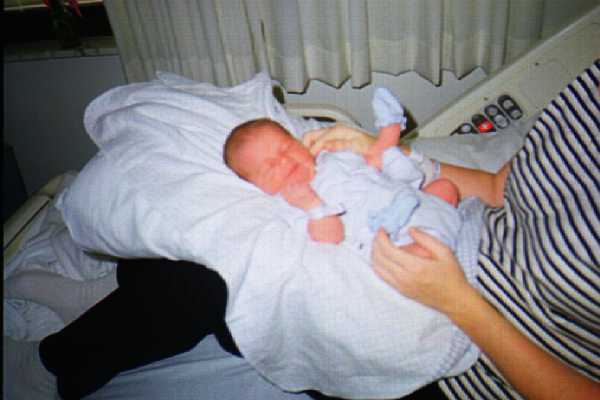
This is Sofie just as she's ready to go home from the hospital. A day and a half old.
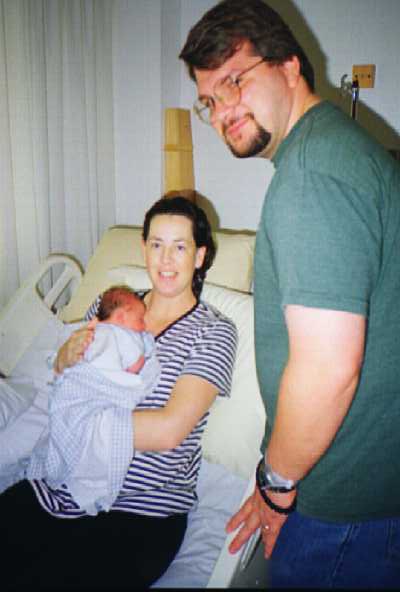
Here's the happy Healy family ready to head home.
Father Patrick blesses Sofie and Anna.
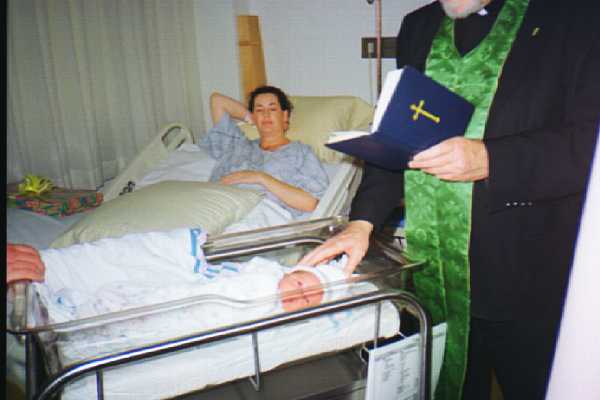
Father Patrick blesses Sofie.
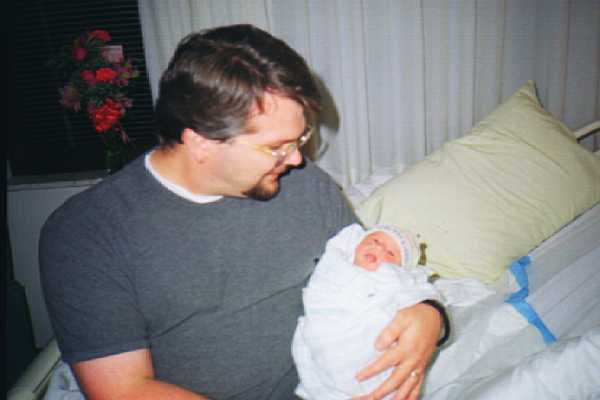
Daddy and his beautiful new daughter, less than a day old.
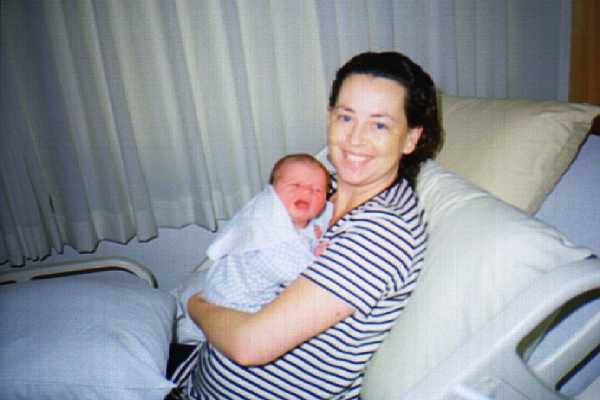
Momma and Sofie headed home.
I am a blessed, blessed man.
August 19, 2003
That Hideous Strength, Chs. 10-13
"I mean this," said Dimble in answer to the question she had not asked. "If you dip ainto any college, or schoool, or parish, or family--anything you like--at a given point in its history, you always find that there was a time before that point when there was more elbow room and contrasts weren't quite so sharp; and that there's going to be a time after that point when there is even less room for indecision and choices are even more momentous. Good is always getting better and bad is always getting worse: the possibilities of even apparent neutrality are always diminishing. The whole thing is sorting itself out all the time, coming to a point, getting sharper and harder. . . ." (p. 283)
One might well argue with Lewis whether Dark Age Britain was a place where one could be both Christian and develop knowledge about the elemental powers of the world. Lewis, is, after all, writing a fairy tale, and borrowing from Tolkien. But what is most certainly true, since the coming of Christ and the bringing forth by the Spirit of the Church, the Truth of the narrowing of choices, the Truth of the two paths and the two masters, has been becoming ever more real. If there is a narrow and squeezing path, the one of life, there is only one other path, the broad and level one leading to death. This is no melodrama. It is the stark reality of the Gospel. It is why we must repent. Which does not mean adding a bit here, a bit there, some of this, some of that, and icing it over with some "Christian" words. Christ is the stone on which we are broken, or underneath which we will be crushed. We either know his love as mercy or as judgment. We cannot know it as indifference.
While some Christian teachers would focus on various world events to foretell the scheduled events of the Apocaplyse, it seems to me that a look at the Christian world of thousands of denominations is perhaps a better barometer.
Take for example, the Great Schism. In the sixth century, when the council of Toledo introduced the filioque, one could perhaps afford to be somewhat tolerant of the innovation. But when combined with the Roman bishops' quest for political supremacy, with the ever-growing distance in language and culture, by Christmas Day 1054, such neutral choices were no longer available.
Or the Protestant Reformation. At the time, it was intended as, indeed, a reform. But with social and political retrenchments growing on both sides, excommunication surely came. By the time of Trent, it was no longer possible to be neutral.
One could bring up lesser, if not the less important, matters of our own recent days. In the Episcopal Church, one might have found it possible to be neutral on the sexuality issue. But this is no longer a possibility. For good or for ill, one must now choose one's allegiance across the divide of a non-celibate gay bishop.
In the evangelical world, the choices are more numerous because the divisions are so rife, and the consistencies of constituencies so inconsistent. But with the proliferation of choice, one's actual choices narrow. Simply because one can choose from dozens of Bible translations, worship styles, ecclesial polities, and ministries, one is finally faced with only one choice: the serving of self or God. In the evangelical world, the gospel of consumerism is laid over the true Gospel, and the clarion call of comfort drowns out the harsh trumpet of repentance.
This, I think, is what C. S. Lewis means through his Dr. Dimble. And I agree with the thought: we live in an age where neutrality is not only impossible, it's damning. If we cannot answer "Yes" that some decision will more clearly reveal the Lordship of Christ in our lives, then to make that decision will be to unmake ourselves. For the reality is that we are servants. It is given to us, in the multiple thousands of choices each day, to decide whom we will serve.
This, of course, is the recasting of the words of our Lord regarding the eschaton. And this is why he also asked, "When the Son of Man comes, will he find faith on the earth?"
August 18, 2003
The Fatherhood Chronicles XII: Fathers, "Poopy Diapers Are Job One" and Other Recently Learned Tidbits
Anna and Sofie are sleeping just now. Whew. It's been a rough first two nights at home. Well, not rough in terms of how Sofie's doing, but rough in that we are now of the tribe of the sleep-deprived. Due to one of Anna's medications, Sofie has been pretty gassy. Poor thing. So Daddy takes her and walks all up and down the apartment trying to get that air out of that little tummy. With numerous trial and error, I have discovered she prefers me balancing her with her chest on my hand, her butt about level with my sternum, and facing out. From "Wah" to "Coo" in five seconds. Who knew?
Sofie is her momma's girl, that's for sure. Day 3 of life (and first 24 hours out of the hospital), and Anna insisted we all go up to the Carter's outlet for their summer tent sale. "Honey . . ." I began to object. But the womenfolk ganged up on me, so it was haul Graeco Metro stroller, Kelty Kids baby "backpack," and Eric Carle "Very Hungry Caterpillar" diaper bag down to car, buckle in and head to Kenosha. Surprisingly, though, Sofie did quite well. We did have to stop at Gurnee for a feeding, but Sofie slept until after we returned home. Sofie: three-day old power shopper! (Egad.)
I have also discovered, and mind you this has been borne out by expert testimony, that fathers have a job, perhaps not the only job, but certainly the primary job. We do poopy diapers. We are fathers. This is what we do.
Sofie's first poopy diaper was changed by yours truly. And a right black tarry mess it was. Who knew that much gunk could come out of such a little body? And who knew that getting said mess out of otherwise cute little baby creases was tantamount to removing barnacles from a ship? But this new father perservered, and a clean pink bottom, ready for the new diaper was the glorious result. Sofie's next few poopy diapers were even more of this "baby asphalt." I mean, I was forewarned about this, but whew! Where did she hide it all?
I have also discovered that a new personage has emerged from my inner self. Alongside the contemplative theologian, pugnacious philosopher, and all around Scotch-drinking, pipe-smoking good ol' Kansas boy, has emerged Conan the Barbarian. Well, okay, or Thundarr or someone like that. I have reverted to primitive hunting man status. Grunt. These are my women. Grunt. Hurt them at your peril. Grimace. Glower. Grunt. I have to consciously resist the urge to stand outside our front door, broadsword in hand and challenge the UPS guy who dares to invade the sanctity of our home with something called a "parcel delivery." Crom! Demon dogs!
Along with these twin discoveries is another: I am absolutely and intensely interested in every bodily function of our little girl. I discuss the color and consistency of her bowel movements. I count the number of belches and farts--yes, my daintly little girl farts (I'm sooo proud!)--forecasting and calculating as though I'm discovering the existence of a new galaxy. The relationship between divine knowing and human knowing in Aristotle is blase compared to wondering if Sofie is crying because she is: a) hungry, b) gassy, c) call the pediatrician.
I could go on. But, I'll have to end here. Sofie is stirring, and I'm sure I've got a poopy diaper to take care of. And by golly, that better not be the UPS truck stopping in front of our apartment . . . Where's my warhammer?
August 16, 2003
The Fatherhood Chronicles XI
One thing I know: I am not worthy of this little girl
Sofie was, quite literally, the answer to the prayers of the Theotokos for Anna and me. I suppose that's why when I first started praying for our baby I almost immediately began using the feminine when remembering her to the Lord. This whole pregnancy has been for me "a marvelous work and a wonder," to borrow and sanctify a well-known title. It has brought out of me thoughts, feelings and actions I would never have dreamed, yet had always knew were in some way required. Women and baby girls make of us pliable men the best of gentlemen.
What I am now about to write, I don't know I have the words for. To start at the beginning, Sofie was born with the cord around her neck. This, as I am learning, is not entirely uncommon. Unfortunately, because Sofie at the last came more quickly than Anna's doctor could arrive, we had a resident ob-gyn, who, in an effort to untangle the cord from around Sofie, inadvertently drew it tighter. Quick as thought, one of the assisting nurses shoved forward and immediately drew Sofie free. But the very brief episode was enough to shock our little girl.
Although the birth plan called for me to cut the cord, and the ob-gyn resident asked if the father (me) was to cut the cord, the quick-thinking nurse said no. The cord was cut, and they took Sofie to the warming table. This is when my nightmare began.
Sofie was not responding, and was greyish. The nurses worked with her, but as the hours-long seconds ticked by this was having no discernible effect. I could see one nurse pushing on Sofie's chest. Another nurse, grim-faced, got on the phone. She spoke so softly that I could not hear. Within moments, a doctor, who I was to learn was from the neonatal ICU, came. Four medical personnel engulfed our baby, working with life-and-death intensity.
My heart was in my throat. Though I could not know for sure what was going on, I could tell it was dark and not yet joyful. Sofie was not crying, and the nurse kept pushing on her chest. I learned shortly after, her initial alertness scores were almost as low as they could be.
I thought only one thing: We are not leaving this hospital with a dead baby.
I cannot tell you, even as now I still tear up writing this, what thousands of deaths I died. I had only one wish: If this is the way it has to be, let it be me, not her. I will bear this for her. Let it be me.
I cannot recall these moments still without deep gasping tears. I woke this morning again to these images. Again, came the tears as though it was just happening. How can it be that a tiny little girl, whom I had known for only moments, I could love as though I'd loved her for a hundred lifetimes? Who could ever be so worthy of this?
These thoughts, of course, come precisely because we know how the story went. Sofie, it turns out, is like her father, quiet and contemplative. So her initial stillness was somewhat more of who she is than the great black fears her father had in those first moments. These were indeed, mere moments, and not the eternity they felt, and soon she was scoring a perfect test for alertness, breathing, color, and just pure godly vitality. A silent vitality, but brimming full of life nonetheless.
She has now passed her first day and a half, and if I may say so, is the most beautiful girl in the world. She sneezes and I am undone. She cries, and I am turning the world inside out to ease her distress. She looks at me, with those knit brows and semi-focused dark blue eyes, and I fall down endless depths of soul, swallowed whole and consumed. I am madly, passionately in love.
I was shocked to find that, learning Anna was pregnant with Sofie, I could unearth a new depth of love for Sofie's mom such as I'd never known. I did not know that those early years of marriage, with our yearning passion, could have been replaced by a love of such depths it could not be described. And here, forty-one weeks later, I am shocked yet again to discover that this sinner's heart can not only love her mother with a new-found love, but here, added to that, entwined and ever enlarging, is yet another love. Who could know this man's heart could contain so much love?
This sinner is far too unworthy of this. Five lifetimes could never discharge such a debt. But this one I've been given is a good place to start.
August 15, 2003
The Fatherhood Chronicles X
Sofie Ruth Healy was born at 6:40 p.m., yesterday 14 August, the forefeast of the Dormition. She weighed 7 lbs. 12.2 oz., and was a long 20 1/2 inches. She's the most beautiful baby in the world, dadgummit!
Momma (Anna) and Sofie are doing fine.
Great is the Lord, and greatly to be praised!
August 13, 2003
The Fatherhood Chronicles IX
I have not--no kiddin'--been this nervous since my last football game . . . which happened to have been the state regional championships . . . and we lost in regulation by one point.
I just wolfed down a slice of really greasy pizza. This was a very bad choice. Despite that it tasted wonderful!
Work is slow today. I continually find myself tapping my foot.
My wife sent out an email earlier today. It was a "broadcast" email to dozens of friends. But when it hit my mail box here at work, I only saw the subject line: "Baby is Coming." Here's my reply:
[Cliff resumes regular breathing. Heart is still beating 140 per min.]
Oh. My. Gosh. Honey, I saw the email heading and about fainted. Please, remember my ability to jump to wrong conclusions in sending out emails with that kind of heading!
Oh, and when I replied, it went to everyone.
And yes, I did think my wife was communicating to me via email. And yes, of course, I lost my mind.
I'm a wreck. I won't be sleeping tonight. At least I have a copy of the (abbreviated) Hours of the Church. How I'll negotiate praying the midnight office with five house guests, I don't know. Maybe a flashlight on the front porch will do the trick.
This kid must have my procrastination genes. C'mon, little one. Whacha waitin' fer?
Scripture, Church, Authority
The discussion over at Tripp's has prompted this post. Interestingly, Tripp started the whole brouhaha by opining on the recent developments in the Episcopal Church of the confirmation of the election of an openly gay bishop and on the legitimacy of homosexual behavior. But the discussion very very quickly "strayed" from the topic and landed square on the question of authority: who gets to decide whether or not actions which the Episcopal Church took or private consensual sexual acts between two persons (of whatever gender and orientation) are right? Actually, the conversation didn't stray at all. In fact, the conversation is dealing with the central issue. For it's not really about Robinson or homosexual acts. It's really about authority.
On the one hand you have the consistent witness and interpretation of the Scriptures by the Church. On the other hand you have those who would introduce a new interpretation of the Scriptures. These contradict one another. (Note: I'm not saying that all new interpretations contradict old ones. When there is no contradiction, there would apparently be no problem.) The Church's interpretation (I'm not at this point going to deal with question as to whether there is such a thing as uninterpreted Scripture) prohibits x. (X could be homosexual acts or the ordination of women to the priesthood, or could be a positive command.) The new interpretation says x is allowed (or in the case of a positive command, the new interpretation would abrogate it). These cannot both be true at the same time. If one is prohibited from doing a particular act, one cannot at the same time be allowed to do that act. If one is commanded to do an act, one cannot at the same time be free not to do that act.
So, which is the proper interpretation?
Here the onus of proof rests with the folks who would posit the new interpretation. This is not to say that the Church's interpretation need not be defended at all. The Church certainly does need to be ready to "give an answer" to those who would question it. But by reason of antiquity, which is to say, by reason of having been tested in many cultures, languages, ethnic groups, geographies, and histories, it has stood the test of millennia, which is not a small thing. It has been questioned and defended within the parameters of human reasoning and has stood the test. But what about the new interpretation?
Here, it seems, there are several routes, but one real question.
1. Proponents of the new interpretation may offer a new interpretive paradigm.
This is completely legitimate in itself. The Church has frequently reassessed the Scripture and its own Tradition from a new perspective. But here's the difference: these reassessments have not abrogated commands or prohibitions. A frequently used paradigm today is that of "Love" and the use of the two great commmandments to test interpretation. But this new paradigm is never adequately clarified. What do the proponents of the new mean by "Love"? Can "Love" contradict Truth? Can "Love" prohibit and disapprove of specific acts? Must "Love" accept any and every act? But this new paradigm, if it is to be Churchly, must continue in harmony with the apostles' teaching.
2. Proponents of the new interpretation may assert the continuing revelation of the Holy Spirit.
Here again, this is not entirely illegitimate. Jesus himself said the Spirit moves as it will. But what the new proponents are unclear about is what they mean by "revelation." Is revelation a completely new thing? Or is it a reinforcement of that which has always been believed, everywhere by all? Can this continuing revelation contradict itself? But if so, wouldn't this make God a liar? Will God contradict himself? Has God ever contradicted himself? If so, why? And what about those who now claim, in contradiction to the new interpretation, that their interpretation is the revelation of the Holy Spirit? Would God contradict himself in the same time period?
3. Proponents of the new interpretation may assert the development of human understanding.
Humans certainly have developed in their understanding of the physical processes of our planet, the human body, the stars. Some would posit we have a better understanding of the human mind, but I'm not so sure. Still, I'll not argue that particular point. But here's my question: so what? Why is human reason to be preferred over the established testimony of two thousand years (or more)? Is human reason, and our "new understandings" of x, such that what we now know will not be set aside for "greater understanding" later? On what basis can we trust human reason over the Church? More to the point, why set human reason in conflict with the Church's witness? Is it not the case that Faith and reason are compatible?
4. Proponents of the new interpretation may assert the personal accountability of apprehending the Faith.
Once again, this, too, is true. We are called each to apprehend, to the degree we are able, the Faith of the Church. This, of course, will vary according to our age, mental development and ability, and, even more, our development in sanctity. In fact, it could be argued that the personal apprehension of the Faith is revealed by one's holiness of life. In the Liturgy, at the offering of the Sacred Gifts, the priest chants, "Holy Things are for the holy." And Hebrews 12:14 asserts that without holiness no one will see the Lord. So the question then remains, may one propose an interpretation that contradicts that which has previously always been believed? And is the authority to assert that interpretation founded on holiness? And if holiness of life is revelatory of apprehension of the Faith, are those who hold to the Church's interpretation and who are now being killed for the Faith, who live in poverty, are these interpreters to be discredited over our more learned selves?
5. Proponents of the new interpretation may assert the historical limitations of either the Scripture or the Tradition or both.
Once again, true on its face. The Scriptures partake of the paradigm of Incarnation as does the Church and the Mysteries. Scripture is the union of the human and the divine, and the human will reveal itself as located in time and space. Since Scripture is part of the Tradition, this is similarly true of the Tradition. But does this limitation mean then that we may set aside a two-thousand year old interpretation for the new one? And on what basis? Isn't the new interpretation just as rife with human limitation? Aren't we just as historically limited? Why are our limitations less limiting than the Scripture's and the Church's?
In each and every case, what we are back to is the inescapable issue of authority. Proponents of new interpretations which contradict the received interpretation of the Church have only their own authority to offer. They must critique the Church, the Scriptures and the Tradition to offer their new interpretation and to provide themselves the authority to do so. But that authority falls prey to the same criticisms with which they critique the Tradition. Is the Church prey to sin and not to be believed? So are they. Is the Scripture full of historical limitations and prejudices? So are they. Is the Tradition full of assertion of self over Other? So are they. For every criticism they offer they, too, fall under it. If they take down authority, they have none to offer themselves.
I, for one, know I have no authority to claim anything. And that's a very, very good thing. Instead, I'll take the Church. I'll use my mind to apprehend what the Church says. I'll interpret Scripture in conformity with the Tradition and the holy men and women of God who, on the basis of their sanctity and martyrdom, have a lot more to say about what's truly of God's mind than I or anyone I know does.
August 12, 2003
Christos Yannaras: The Freedom of Morality
Yannaras' The Freedom of Morality is not for the average reader. One needs a decent grounding in both philosophy and theology. But if one can patiently come to grips with the point of the first chapter ("The Masks of Morality and the Ethos of the Person"), and its reinforcements in the next two, the remaining nine chapters will deepen and broaden one's thinking on Christian morals and anthropology.
At the risk of oversimplification, the theme of the book can be encapsulated in this passage:
In the life of the Church, God reveals Himself as the hypostasis of being, the personal hypostasis of eternal life. The personal existence of God is the comprehensive and exhaustive expression of the truth of being. It is not the essence or the energy of God which constitutes being, but His personal mode of existence: God as person is the hypostasis of being. (p. 16)
and the following:
The identification of being with the personal existence of God--an indentification with vital consequences for the truth of man and human morality--explains the revelation of the God of the Church, who is one and at the same time, trinitarian. The one God is not one divine nature or essence, but primarily one person: the person of God the Father. The personal existence of God (the Father) constitutes His essence or being, making it into "hypostases": freely and from love He beget the Son and causes the Holy Spirit to proceed. Consequently, being stems not from the essence, which would make it an ontological necessity, but from the person and the freedom if its love which "hypostasizes" being into a personal and trinitarian communion. God the Father's mode of being constitutes existence and life as a fact of love and personal communion. (p. 17-18)
It is here that one must start: God, in whose image and likeness man and woman were created. Yannaros continues:
. . . In the light of the truth about the trinitarian hypostasis of being, the Church is enabled to shed light on the mystery of human existence, and to give an ontological foundation to human morality.
Created "in the image" of God in Trinity, man himself is one in essence according to his nature, and in many hypostases according to his persons. Each man is a unique, distinct and unrepeatable person; he is an existential distinctiveness. All men have a common nature or essence, but this has not existence except as personal distinctiveness, as freedom and transcendence of their own natural predeterminations and natural necessity. The person is the hypostasis of the human essence or nature. He sums up in his existence the universality of human nature, but at the same time surpasses it, because his mode of existence is freedom and distinctiveness. (p. 19)
This is expanded by the following:
. . . Man's nature in general--mankind as a whole, as a biological species--can be defined objectively: it possess will, reason, intellect, etc. But each human person exercises his will and converses and thinks in a way that is unique, distinct and unrepeatable.
Consequently, the person is not an individual, a segment or subdivision of human nature as a whole. He represents, not the relationship of a part to the whole, but the possibility of summing up the whole in a distinctiveness of relationship, in an act of self-transcendence. (p. 21)
Humankind, therefore, is not merely biological, nor merely spiritual. But as the Incarnation teaches us is a hypostasis of spirit and flesh. We are not relegated to our mere biology. We are greater than our genes. But because we are enfleshed souls, we are greater than mere spirit as well. We are greater because the particular combination of body and soul (or spirit) which constitutes who we are is so constituted by love, and therefore by koinonia. We are sums greater than our parts.
There is hope here: the alcoholic may transcend his disease, the deeply sexual being may similarly be chaste, the powerfully spiritual need not be lost to chaos but may be grounded in the depth of God's love through the very body which gives it sustenance and which it also sustains.
We find that we need not be weighed down by the incessant demands of the flesh, nor that we must be cut loose from this world by the powerful call of the spirit. Instead, called into unique existence by God we can obey that which seems impossible: sexual acts may be limited by God's obligatory call yielding the freedom of holiness; the yearning ache for holiness can be instantiated by respect and loyalty to our forebears, living and dead.
This basic paradigm, this basis patristic doctrine of humankind, is fleshed out and enspirited in the ethoi of the "Fools for Christ," the Liturgy, the Eucharist and the sacraments, asceticism and virtue, ecclesiology and the canons, and, not least, iconography.
There are some weaknesses to Yannaras' work. His take on Protestant pietism, while true in the main, succumbs to mere polemic in some of the specifics. There are times when his Trinitarian anthropology sounds a bit too much like Heidegger and bit less than it should like St. Paul. But when kept within the clear paramaters of the anthropology he explicates from the Fathers and the Scriptures, these weaknesses can be seen for what they are and illustrate ways we may avoid the dangers of which Yannaras warns us.
These weaknesses may also be balanced by two other works in the same series: John D. Zizioulas' Being as Communion and Panayiotas Nellas' Deification in Christ. Indeed, these three works in themselves provide perhaps the most complete foundation in Christian thinking on Christ, salvation, the Church and humankind one can get from a mere handful of books.
The Fatherhood Chronicles VIII
T-Minus 48 Hours till Launch Sequence
Not ready for this. In the next forty-eight hours, or less, Anna will be in labor, and we'll be smack-dab in the start of parenthood. Houston, I repeat: not ready for this.
I mean, c'mon. There's no instruction manual. It's pretty much weather-forecasting by moistened finger held aloft. And everyone, so far, it seems, has conflicting opinions on what to do about various situations.
Some folks really make me wonder why they're parents. These are the "Bad News Hendersons." They so very much want to emphasize how little sleep we'll get, how bad sex will be afterwards (please no public responses on that!), how much more stress over money there will be. Geez! Remind me to call you folks just as I'm ready to jump!
Then there's the "Know-It-All Andersons." You're life is going to change. Yeah, I know. No, you don't know. Well, I mean I know but I don't know, you know? No, you don't know; you don't know at all. Oh, sure, I hear you: I can't know by way of experience, yet, but I think I have an idea. Nope, you have no idea; you have no clue. And so it goes. What's in it for these folks, anyway? Okay. So I'm a cretin. I couldn't find my backside with both hands, if I didn't get a little help. Sheesh.
And there's no warranty. I checked. If anything goes wrong, we fix it. Period. Kid doesn't want to go to sleep till midnight? Got a paper to write? Sorry, buddy, you're going to be up for a loooooong time. Oh, and the baby will wake again at two for a feeding. Babysitter cancel on you? Didn't find a sub to teach your class? Little Johnny (or Janey) will be catching his (or her) first Aristotle lecture safely ensconced in the carrier. Oh, and he'll (she'll) decide that just about the time you're really getting into the distinctions between voluntary, involuntary, and nonvoluntary actions it's time for a feeding. Can you hold a baby, feed him (or her), lecture and write on the chalkboard? Aiyaiyai!
Oh, and by the way, I have never been more of an audience to conversations on the bodily details involved with pregnancy and labor. Imagine if you will (true story here) that you're on the phone with your sister-in-law. Keep in mind that you've known this person since she was eleven. She's now a mom and has called (for the bazillionth time that day) to see if Anna's gone into labor yet. You tell her no, she's napping just now. The sister-in-law wants to know how Anna's doing. Just fine you say, remaining pleasantly, civilly vague. Oh, the sister-in-law says, I heard she's dilated another centimeter. Why, yes, that's true, you reply, not wanting to sound as though you'd really like to get off the phone right now. Sister-in-law sez: She told me--and here we enter the TMI zone--that she's feeling more pressure on her rectum. Um, yes, you reply, wishing you'd already gotten off the phone. Well, that probably means she's dilating more. That's what happened to me, man, the more pressure I felt on my rectum, the more dilated I was getting. At which point, having lost all hope of leaving the TMI zone, you are reduced to wimpering jelly.
*Sigh*
Well, the countdown has begun. I know by Thursday, I'll be a dad. Anna might go sooner; there's been a little progress. But it's more likely she'll be induced early Thursday morning. Oh, and we'll finally know if it's a boy or girl.
August 11, 2003
Fr. Seraphim Rose: Genesis, Creation and Early Man
Published posthumously, Genesis, Creation and Early Man is a compendium of the writings of Blessed Seraphim of Platina dealing with the patristic interpretation of Genesis 1-11 and the wider topic of evolution.
Hieromonk Damascene Christenson, editor of Blessed Seraphim's writings and author of his biography, provides a detailed preface describing the origin of these writings. Much of it was composed and delivered as part of an "Orthodox Survival Course" given in the late seventies and early eighties at St. Herman Monastery to new American Orthodox converts. This course was intended to give them a grounding not only in the content of the Faith, but in the development of the Christian mind.
This preface is followed by an introduction by Phillip E. Johnson, well-known critic of evolution. Dr. Johnson had contact with Fr. Seraphim, before the latter's blessed repose, and knew of and admired his work. His recommendation of Fr. Seraphim's writings on these topics is strong and full. Fr. Seraphim was gifted both with a brilliant mind, and a submissive one.
The remainder of the book is divided into five parts: a patristic commentary on Genesis 1-11 (alone worth the purchase of the book), a detailed critique of evolution and an explanation of the relationship between the Faith and true science and the dangers of evolutionary philosophy, a third part detailing the patristic dogma of creation, followed by the final two parts of questions and answers on matters of evolution and patristic dogma and selections from Blessed Seraphim's correspondence which touch on these matters as well.
This central body of the book is followed by an epilogue in which Hieromonk Damascene details the dangers of so-called "theistic, or Christian, evolution." And to the entire work are appended excerpts from Fr. Seraphim's notes on science, evolution and Christian philosophy, an outline of proposed studies dealing with evolution and patristic doctrine, a transcript of Fr. Seraphim's last talk on creation and evolution (given just weeks prior to his death), a critique of radiometric dating by famed scientist Curt Sewell, and, finally, an annotated bibliography on the various topics covered in this 700-plus page book. There are subject and scriptural indices as well.
Having read the entire book one comes away with some pretty clear points: Faith and true science are eminently compatible; Faith and evolution are not. Along with other well-known scientists, Fr. Seraphim utilized expertly Phillip Johnson's "wedge": revealing the dichotomy between the fact of science and the faith of evolution. Evolution is not science, it is philosophy, belief in which takes a leap of faith from fact to interpretation. The faith of evolution, then, banks on an etiology that necessitates nothing but time and chance. This faith is antithetical to the Faith of Christianity. Not even theistic evolution can successfully wed the two. It is a simple tale of two masters; and Fr. Seraphim contends one cannot serve both.
While scientific minds may gravitate towrds Dr. Michael Behe's writings, or those of Dr. Johnson, theological minds will find Blessed Seraphim's patristic commentary and his expert criticism of evolutionary philosophy more than amenable to their faith. For those too embarrassed to accept the biblical and patristic (though, Fr. Seraphim clearly contends, not fundamentlist) dogma of creation, this will provide enough stiffening agent to the theological backbone to wed reason and doctrine. Even those unpersuaded by Fr. Seraphim's critique will nonetheless find they have somewhat less confidence in their previous position.
That Hideous Strength, Chs. 5-9
Come heck or high water, Anna delivers this week. If she's not gone into labor by Thursday 6:00 a.m., she will be induced. So, it may very well be the case that I will not post a Lewis blog for next time. We'll see. Your prayers for the safety and health of mother and child are greatly appreciated.
This passage, in which Mark is asked to write fictitious news articles to mold and shape public opinion toward favoring N.I.C.E. (shades of the New York Times!), was striking, and carries the theme from last week's entry:
This was the first thing Mark had been asked to do which he himself, before he did it, clearly knew to be criminal. But the moment of his consent almost escaped his notice; certainly, there was no struggle, no sense of turning a corner. There may have been a time in the world's history when such moments fully revealed their gravity, with witches prophesying on a blasted heath or visible Rubicons to be crossed. But, for him, it all slipped past in a chatter of laughter, of that intimate laughter between fellow professionals, which of all earthly powers is strongest to make men do very bad things before they are yet, individiually, very bad men.
--That Hideous Strength, p. 130
And this passage, in which there is discussion among the Company organized against N.I.C.E. about whether they ought dissovle themselves:
"I am the Director," said Ransom, smiling. "Do you think I would claim the authority I do if the relation between us depended either on your choice or mine? You never chose me. I never chose you. Even the greate Oyeresu whom I serve never chose me. I came into their worlds by what seemed, at first, a chance; as you came to me--as the very animals in this house first came to it. YOu and I have not started or devised this: it has descended on us--sucked us into itself, if you like. It is, no doubt, an organisation: but we are not the organisers."
--That Hideous Strength, p. 198
Here again is drawn the theme of sin and redemption. This is not some great and romantic epic in which heroes and villains are clearly known by visage or accoutrement. This is the battle of the universe which takes place in a million and one daily humdrum decisions.
But note the symptomatic arena in which this battle takes place. On the one hand, Ransom's Company is very much Incarnational. Ransom has tasted paradise, and therefore incorruption works its physical way through his body. Yet, the redemption he bought in Perelandra was not without price, and he bears the physical sign of that in his heel, a painful wound that always bleeds.
On the other hand is the anti-Incarnational N.I.C.E. Theirs is a bodiless Head (where as in Christianity Head and Body are always joined in synergistic union). Theirs is a gnosticism that would alternately reduce humankind to mere matter, then reduce them further to mere intelligence. No body. No spirit. No union.
This same battle is that which is played out in our world. We have the choice day by day to affirm and live the Gospel of Incarnation--the sacrament that sanctifies soul and body. We serve a God who has united, in the Person of His Son, human nature and divine nature. In that union is our salvation. The antichrists around us, those who deny this union, reduce us to biochemical processes of sexual function, appetite, and stimulus and response. Here I am, nothing but flesh. But this house is empty and swept clean. Alternatively, the heresy of gnosticism plays its cards here, too. We have ideals, something like mental secret handshakes, the miasmic fog of semi-faith which divorces knowing from being. If we belch the right rhetoric, if we mimic the proper verbal allegiances, we, too, may consider ourselves "in the club." But this verbal flatulence is empty of body; we may think what we want, we may subsume humanity under labels and causes, we may find our place in the "tensive center." But this feast is merely the illusion of bread and wine. The hunger still remains.
Rest assured, this battle is nothing so great and glorious as those mythic lines from Homer, or the icy grey bleakness of the Norse Ragnarok. It is little more than the imperceptible turn from one allegiance to the consideration of another. The blurring of the line between dogma and soulcare. The removal of discernment from love. The failure to recognize the holy side of mercy. The relaxation in one's soul of boundaries once held dear. One never knows the corner has been turned, not because there is no corner, but because the process is so imperceptibly singular in its segments.
There is no vast middle in this battle. There is Christ and there is the denial of Christ. One cannot serve two masters. We understand this, but we never quite experience its reality till we recognize ourselves on the other side whence we've come. And when we retrace the journey, wondering how we got here, we see all the mindless, inattentive acts, all the semi-conscious choices, and we understand, it is in the unseen, quiet moments of daily life that we choose and unchoose our destiny.
Someone, nearer to us than our very selves, has said: What I say to you all I say to everyone, "Watch, therefore. For you do not know at what hour the Son of Man will return."
August 08, 2003
ECUSA GenCon 03: My Concluding Thoughts
For reasons which my family and close friends know, this will be my last public comments on this Convention for some time to come. Although it is pretty obvious that I haven't considered myself an Episcopalian for some time (how many times have I referred to myself as an "Orthodox wannabe"?), it is the last church home I have known. It occurred to me as I followed the high profile resolutions how many emotions and feelings I still have about the Episcopal Church. In many ways it was the first church home I chose as an adult. And the deep friendship I have with the parish priest who oversaw my entry into ECUSA remains a treasured gift. I had a bishop whose courageous actions and words, and deep abiding faith I admired and knew I could trust. I had a parish-supported askesis of prayer, fasting, liturgy and Scripture which made significant changes in my ecclesiology/Christology, sacramental understanding and overall faith. Martin Thornton's Benedictine three-fold askesis of Eucharist, office and private prayers was very much my own. I would never have known of such a tool if it weren't for the library at Trinity parish.
With so much for which to be thankful, this week was the emotional equivalent of watching a slow-motion car-wreck in which your loved one was a front-seat passenger: not in control of the direction of the vehicle, and unable to stop its destructive path. I couldn't help but post the news items, but did so with the heaviest of hearts. Like Fr. David and Jeff, I sincerely couldn't believe that the Episcopal Church was being forced to make a doctrinal and ecclesial judgment not through dialogue and contemplation but through political majority. The majority may have felt they "won" over the issue of homosexuality, but it is clearer than ever that the consequences of their decision will be deep, painful and long-lasting and involve the rest of the Anglican Communion, for which little public thought seems to have been given by the majority. I wasn't around for the women's ordination issue, but by all accounts of those who were, this one is different. I'm sorry, Barbara Harris, apparently you were wrong.
I have been blessed or cursed (depending on how you view it) with an active conscience. There are just some boundaries that I cannot cross without committing existential and theological suicide. There are decisions I've made some months ago, so though the pain of this recent week and a half is surprisingly strong and deep, it was not unlooked for, and medicine is being applied. In fact, unless my wife goes into labor overnight, I'll be going for a checkup tomorrow morning.
August 07, 2003
Personhood
It is becoming increasingly clear to me, as I watch developments in political philosophy, the developments in the churches regarding women's ordination, and in the most recent developments this week in the Episcopal Church, that there is great confusion about personhood.
In a real sense, beginning with Descartes, and with powerful impetus from Kant's moral philosophy, modernist thinking has understood personhood in terms of radical individuality. The "person" is the individual, the singular being. Because of this orientation of singularity, it is quite natural that in terms of political understanding, the individual is viewed primarily from the vantage point of rights.
Don't mistake me. It's not as though I'm not glad that the U. S. was founded on the notion of "inalienable rights." Although I need to think throug this a bit more clearly, at least at first glance, talk about rights insofar as it relates to the person seems potentially compatible (though with significant revision) with the Christian understanding of the person.
But here's an important weakness of the modernist understanding of personhood in terms of individuality: it cannot offer true communion because it establishes at the foundation of human relating an adversarial stance. My rights have to be balanced against someone else's rights. So long as you and I have pretty much the same understanding of what those rights are, the conflict inherent in our relationship is put in abeyance. But when one of us begins to understand our rights in a way different than the other, conflict arises. One must hierarchicalize rights. Is it a greater right to have autonomous control over what happens to one's body, or to live? Is it a greater right to exploit the bodies of women to sell products, or to communicate without restraint?
Though recent developments in political philosophy have brought class back into political consciousness, though under the rubric of group rights, this development merely exacerbates the tensions just noted. It multiplies them.
Another reason the modernist conception of the individual as person cannot deliver on communion, on relationship, is that one may only attain "community" by adding up discrete units. If I am an autonomous individual, I can have no connections, other than as a self-contained entity, with other autonomous individuals. Thus a community is little more than an agregate of "persons," who can be organized and delimited into subsets. So we have African Americans, Asian Americans, Hispanic Americans, gays, lesbians, straights, Jews, liberals, conservatives, Christians, Muslims. Each autonomous individual is simply regrouped with other individuals. But there is no community, no union, for the autonomy must be impermeable. This is the Kantian, as well as the legal, paradigm.
This modernist understanding of personhood is not changed in its essence even within postmodernist thought. If anything, it is strengthened. Though one might consider the discussion surrounding group rights as something of a postmodern development, it doesn't really change the equation. It is still individuals, just merely reorganized.
There is what one may, perhaps, call an ultramodern understanding of the person, in which autonomous walls are dismantled. But this understanding is problematic in that it first of all arises out of the conception of the autonomous individual and merely takes it to its logical conclusion, and that secondly the dissolution of the individual is never total in that relating is now understood in terms of power, as in Michel Foucault's Discipline and Punish.
The Christian understanding of personhood, founded on Scripture and the Tradition of the Church, is far different. Here there is personhood that is grounded in Trinitarian understanding. There is distinction but not one that divides. There is unity but not one that reduces everything to an impersonal essence. There is submission, but it is mutual. There is hierarchy, but it is not cancelled out by equality. There is absolute patriarchy, the foundation of being, but there is absolute communion. There is unity that is transcended by threeness, and threeness that does not degenerate into plurality. This is the image of God, in which humans were formed. And by the power of the Holy Spirit, this image can be restored to the likeness of God.
Regrettably, the present state of the Christian churches in the U. S., seem not to reflect the Christian understanding of personhood. Instead, there is the fundamental adversarial relationship of rights based on the autonomy of the individual. It would seem to me that koinonia will never be attained, or at least not fully, since we cannot deny the reality of true personhood, within this paradigm. It is why there is and will continue to be schism.
August 05, 2003
The Fatherhood Chronicles VII
Okay, two days to go till 3D-day (that's Delivery Due Date) and all my night fears are coming out into conscious daylight. What if the baby has something wrong with him/her that we haven't been able to detect yet? What if Anna has problems in the delivery? What if . . . ? And I won't even go into the darkest of these day-mares.
So I probably shouldn't be reading this glorious Gospel narrative of a husband's love for his wife and their hope in Christ in the face of her last days and her struggle against cancer.
Tripp counsels me to meditate on Luke 1-2. Hmmm. I've been here before.
I'm reluctant to share my fears with Anna. Goodness knows she has enough of her own. So prayer and meditation are in order.
Still, I skipped lunch today. My stomach just can't take it. It's in knots.
August 04, 2003
That Hideous Strength, Preface-Ch. 4
Obligatory Disclaimer till my wife delivers our first child: This may well be my last post on Lewis for a week or two. We'll see what the baby does. I'll stay up with the reading, so that when I can post, I'll be up with the schedule.
Oh the many things I love about That Hideous Strength: set in a college atmosphere, exposes the power-hungry agenda of modernist progressivism, the cosmic backdrop of ageless spiritual warfare . . . So many things.
I found two things of interest to me this week. The first involved the living reality of Jesus' words about the Gospel: that it divides parents from children, brothers from brothers, even, Paul notes, marriages. The Studdocks are one such marriage. They are lining themselves up for and against the Gospel, though they hardly know their actions as such. But this is the way of conversion and of apostasy and heresy. Very seldom do each happen suddenly, critically. Indeed, both are chronic states, taking a lifetime to fulfill their ends, though the telling fruit be borne sooner.
Jane Studdock thinks she is merely ringing up Mrs. Dimble because of the bad dreams she, Jane, is having. She does not know that such a simple action will have lasting consequences. For that one action will lead to a meeting with the Dimbles. Which will lead to a recommendation to go to St. Anne's to see Miss Ironwood. And that meeting itself reveals the choice that has already been made, as it were, by actions set in motion.
Similarly, Mark thinks himself doing little more than providing the best he can for his family, though admittedly perhaps more for himself. But more than that, he sincerely thinks himself to be advancing a great cause for his fellow humans. He cannot yet know that his simple action of accepting an invitation to the college's "Progressive Element" will set in motion actions that will unleash untold horrors on the world.
And neither Jane nor Mark can know that the paths they have chosen they might just as indiscernably forsake once underway. Conversion and apostasy are such slippery things. A small, unnoticed decision here, the attempt to advance one's well-intentioned cause there. And heaven or hell becomes a real-world consequence. But of course, Lewis knew this and wrote about it often.
The other point of interest is a brief exchange between Hingest and Mark Studdock:
"'I suppose there are two views about everything,' said Mark.
"'Eh? Two views? There are a dozen views about everything until you know the answer. Then there's never more than one.' . . ."
Hingest, of course, must be killed for such sentiments, and before the chapter is completed, he is--most brutally.
So long as there are innumberable opinions, we may feel safely ensconced in our own. Others may disagree; we may even face arguments fatal to our convictions. Ah, but so long as there are many opinions! After all, who could be so closed-minded as to insist on only one. How callous and uncaring. That is to say, until the Truth is known. Then there really is only one view on the matter. The rest are illusion.
August 03, 2003
Some Interesing Articles Relative to ECUSA GenCon 03
Erik Nelson, Why Defending Marriage is an Act of Social Justice
Douglas LeBlanc, Gay Rights Would Not Bless Ecuminism
Douglas LeBlanc, What in the World is God Doing?
August 02, 2003
An Online Debate on Paul, Romans 1 and Sexuality
Neil Elliott takes a position for homosexuality in his article The Apostle Paul on Sexuality
Robert Gagnon responds here.