January 04, 2007
Argument, Meet Coffin, Silver Bullet, Wooden Stake and Final Nail
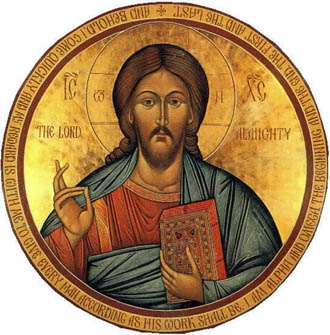 In my earlier post, I dealt with William J. Baldwin’s paper criticizing the use of icons. If I’d waited a few more days to finish St. Theodore’s third refutation of the iconoclast heresy, I would have had a much more impressive, almost one-to-one, point-by-point refutation of good ol’ Billy Baldwin’s “argument”.
As a reminder, here is Mr. Baldwin’s “devastating” syllogism with which he thinks he destroys the Orthodox practice of icon veneration:
The paradigm argument against icons takes the form of a syllogism:MP: Scripture prohibits making images of God.
mp: Christ is God.
Conclusion: Scripture prohibits making images of Christ.
Mr. Baldwin cleverly notes that one cannot equivocate on the term “God” (meaning it differently when applied to the first premise as when applied to the second premise). To do so would violate the Orthodox affirmation of the Nicene Creed.
So Mr. Baldwin then moves on to attempt to show that Orthodox are forced by their own theology and practice into Monophysitism or Nestorianism depending upon how they justify the veneration of icons. Baldwin revises the above syllogism into what he thinks looks like the Orthodox defense of icons:
MP: Scripture prohibited the making of images of God.
mp: Christ is God.
Conclusion: There is no longer any prohibition against making images of God as he has revealed himself in his Son.
Here Baldwin attempts to hoist the Orthodox on their own petard (though, actually, as we will see, it is not their own petard):
It's an amazing leap of logic from the premise (God has revealed himself once for all in his Son) to the conclusion (we may now make images of God). Yet the Orthodox do not seem to notice that they have leaped at all. They barely attempt to explain how to get from the premise to the conclusion. To them, the conclusion is obvious. And when they do attempt an explanation, they stumble into Nestorianism. This is almost inevitable. The only alternative is Monophysitism, of which they have an even greater horror. Yet one or the other error awaits them. To say that the Incarnation legitimizes icons is either to say that God's nature changed when he became a man and thus is now depictable. Or it is to say that God became depictable as a man but remained undepictable as God.
It’s almost as though St. Theodore foresaw Billy Baldwin’s paper, and wrote his third refutation in argumentative sequence. Or, it’s as if Baldwin channels the ancient iconoclasts. Take note of this from the third refutation:
An objection as from the iconoclasts: “If Christ is of two natures, when you claim to portray Him why do you not portray both natures from which and in which He is, if you are speaking the truth? But since one of the two is falsified, because the human circumscription does not contain the uncircumscribability of the divine nature, it is heretical to circumscribe Christ.”Answer: When anyone is portrayed, it is not the nature but the hypostasis which is portrayed. For how could a nature be portrayed unless it were contemplated in a hypostasis? For example, Peter is not portrayed insofar as he is animate, rational, mortal, and capable of thought and understanding; for this does not define Peter only, but also Paul and John, and all those of the same species. But insofar as he adds along with the common definition certain properties, such as a long or short nose, curly hair, a good complexion, bright eyes, or whatever else characterizes his particular appearance, he is distinguished from the other individual of the same species. Moreover, although he consists of body and soul, he does not show the property of soul in the appearance of his form: how could he, since the soul is invisible? The same applies to the case of Christ. It is not because He is man simply (along with being God) that He is able to be portrayed; but because He is differentiated from all others of the same species by His hypostatic properties. He is crucified and has a certain appearance. Therefore Christ is circumscribed in respect to His hypostasis, though uncircumscribable in His divinity; but the natures of which He is composed are not circumscribed. (3.A34)
St. Theodore nicely avoids the charge of monophysitism by noting that it is not either of Christ’s natures that are depicted in the icon, but, rather, his hypostasis (a term that is commonly translated as “person” though the rigorous will quibble over the accuracy of that term). That is to say, we do not confuse the divine nature with the human nature and then depict the human nature in the icon, therefore making an idol containing divinity. Strictly speaking natures are not depictable.
As the saint explains (my emphases added):
. . . The prototype is not essentially in the image [i.e., the nature is not literally in icon—cdh]. If it were, the image would be called prototype as conversely the prototype would be called image. This is not admissible, because the nature of each has its own definition. Rather, the prototype is in the image by the similarity of hypostasis, which does not have a different principle of definition for the prototype and for the image. Therefore we do not understand that the image lacks equality with the prototype and has an inferior glory in respect to similarity, but in respect to its different essence. The essence of the image is not of a nature to be venerated, although the one who is portrayed appears in it for veneration. Therefore there is no introduction of a different kind of veneration, but the image has one and the same veneration with the prototype, in accordance with the identity of likeness.It is not the essence of the image which we venerate, but the form of the prototype which is stamped upon it, since the essence of the image is not venerable. Neither is it the material which is venerated, but the prototype is venerated together with the form and not the essence of the image. But if the image is venerated, it has one veneration with the prototype, just as they have the same likeness. Therefore when we veneration the image, we do not introduce another kind of veneration different from the veneration of the prototype. (3.C1-2)
Clearly, Baldwin’s charge of monophysitism cannot stand—unless he wants to deny that the Orthodox hold the teachings of St. Theodore as normative for icon veneration—since the Orthodox do not confuse the divine and human natures in the iconographic depiction.
But neither does Baldwin’s charge of Nestorianism stand: there is no separation of the two natures. St. Theodore carefully distinguishes between the prototype and the icon, the natures and the hypostasis, and the relationship between the icon and prototype.
Every image has a relation to its archetype; the natural image has a natural relation, while the artificial image has an artificial relation. The natural image is identical both in essence and in likeness with that of which it bears the imprint: thus Christ is identical with His Father in respect to divinity, but identical with His mother in respect to humanity. The artificial image is the same as its archetype in likeness, but different in essence, like Christ and His icon. Therefore there is an artificial image of Christ to whom the image has its relation.. . . In their great foolishness the iconoclasts mix things which cannot be mixed and do not understand how to attribute to each origin its own properties, because of which Christ is both uncircumscribable and circumscribed. In respect to His coming forth from the uncircumscribable Father, since He is uncircumscribable, He would not have an artificial image: with what likeness can the Godhead be compared, for which the divine Scripture utterly forbids any representation? But in respect to His birth from a circumscribed mother, with good reason he has an image, just as His mother’s image is expressed in Him. But if He should not have an image, then He would not be from a circumscribed mother, and is of only one origin, namely the paternal—which destroys the divine economy. (3.B2-3)
Again: clearly Baldwin’s charge of Nestorianism cannot stand either. The natures are not separated, because they are united hypostatically, and it is that circumcribable hypostasis that is depicted in the icon.
Indeed, to put the point on it, St. Theodore affirms:
The fact that man is made in the image and likeness of God shows that the work of iconography is a divine action. But since an image can be copied from an image, inasmuch as Christ is man, though also God, He can be portrayed in an image, not in spirit but in body. But if He is portrayed in one of the two, then obviously He has an image exactly resembling Him which reveals the shared likeness. (3.B5)
And if the icon shares, relatively, in the union of the natures in the hypostasis, then the icon can receive the veneration which the hypostasis receives.
That which is similar in some degree to another thing shares its veneration to the degree in which it is similar. That which is similar in all ways shares the veneration fully. The Son is similar to the Father in all ways, as He has the same essence; therefore He has the same veneration. The image of Christ is similar to Him only in the likeness of His hypostasis; therefore it could share His veneration only in this respect.If he who has seen the image sees in it the likeness of the prototype, then he who venerates the image necessarily venerates in it the appearance of the prototype. But since the likeness is one, the veneration of both must also be one. (3.C12-13)
And this, in large measure, is Baldwin’s failure, as I noted in my previous post: he fails to properly delineate the relationship, both in point of difference and in point of union, between the icon and the image it portrays, or between the image and the prototype respectively:
The prototype and the image are one in hypostatic likeness, but two in nature: one entity is not split into two likenesses, so as thereafter to have no participation or relation with each other; nor is one and the same entity called by two names, so that at one time the prototype would be called image, and at another time the image would be called prototype. For the prototype would always be called prototype, just as the image would be called image, one never changing into the other. Although this is the fact, and although the number is dual, both have one likeness, and one name in accordance with the likeness: as for example the emperor’s image is also called emperor, yet there are not two emperors [cf. St. Basil the Great, On the Holy Spirit 18.45]. But if this is so, then also the image of Christ has one veneration with Christ its prototype. (3.D1)
As I said before, most hardboiled iconoclasts assert their simplistic and misinformed syllogisms in complete ignorance or disregard for the actual beliefs of the Orthodox.
There are other so-called “iconoclasts” who reject icons, but only because they do not understand them and the veneration given them. Once the Orthodox teaching is explained, very few of them remain locked into their iconoclasm.
And St. Theodore is as excellent a teacher of the Orthodox beliefs and practices regarding icons as one can get among the Church Fathers.
Holy father Theodore, pray for us.
January 01, 2007
And So the New Year Begins (plus St Theodore refutes Bill Baldwin)
While some Orthobloggers were busy with bathroom plumbery, yours truly was watching the first half of The Fellowship of the Ring (extended version, what else?!) as the civil year rolled over. I bid my wife happy new year, with a peck on the lips. The video finished and we both crawled into bed.
Today, I have read my alotment of St. Ephrem's Hymns, and am working on St. Theodore the Studite's second refutation of the iconoclasts (more on that in a moment), and will hopefully complete a goodly portion of W. D. Ross' introduction to his edition of the Greek text of Aristotle's Metaphysics.
Now, with regard to St. Theodore.
A couple of years ago, I came across William J. Baldwin's (oh, those Baldwin brothers!*) paper criticizing the use of icons, "Eastern Orthodoxy, Icons, and Christology ."
Here is Baldwin's primary thesis attacking icons:
Self-consciously Nicene and Chalcedonian, they must defend icons of Christ in a way that neither violates his divinity nor separates his natures. In my opinion they fail to make the case. What results is an implicitly anti-Nicene and anti-Chalcedonian Christology.The paradigm argument against icons takes the form of a syllogism:
MP: Scripture prohibits making images of God.
mp: Christ is God.
Conclusion: Scripture prohibits making images of Christ.To agree with the premises and reject the conclusion, one might argue that the syllogism equivocates on the word "God," using the term in one sense for the major premise and in another for the minor. In other words, Christ isn't God in the same sense that the invisible God is. The Orthodox have no desire to make such a claim. They insist on the validity of the Nicene Creed. At the incarnation, "[Christ] became a man, and thus He is at once fully God and fully man."
Alternatively, one might argue that Christ is God, but he is also a man. The images, then, represent his human nature only. . . .
It is Yahweh, the eternal I AM, who spoke from the burning bush, whose form was not seen. The Orthodox insist that he is the one whose image is seen in the icon.
The Orthodox specifically assert that, whatever an icon means, it doesn't mean that Christ is not very God of very God. And, whatever an icon does, it doesn't separate his natures. But then the dilemma remains. An icon of Christ is an image of his person; and the person of Christ is divine. Therefore the icon is an image of God.
Precisely, the Orthodox reply. They are suspicious of syllogisms in general; but if they revised the above syllogism, it might look like this:
MP: Scripture prohibited the making of images of God.
mp: Christ is God.
Conclusion: There is no longer any prohibition against making images of God as he has revealed himself in his Son.(And if the syllogism has a mystical feel to it, so much the better.) . . .
The Incarnation, they say, changes things. . . .
It's an amazing leap of logic from the premise (God has revealed himself once for all in his Son) to the conclusion (we may now make images of God). Yet the Orthodox do not seem to notice that they have leaped at all. They barely attempt to explain how to get from the premise to the conclusion. To them, the conclusion is obvious. And when they do attempt an explanation, they stumble into Nestorianism. This is almost inevitable. The only alternative is Monophysitism, of which they have an even greater horror. Yet one or the other error awaits them. To say that the Incarnation legitimizes icons is either to say that God's nature changed when he became a man and thus is now depictable. Or it is to say that God became depictable as a man but remained undepictable as God.
Now, although Baldwin allows a cite from St. Theodore (via a defense through a Daniel Clendenin citation), he fails to deal with St. Theodore's explicit defense of just this very criticism. That is to say, all Baldwin does is resurrect the iconoclast's attack on icons, and then either fails to note (and thus does sloppy research) or just simply ignores (and thus does dishonest research), St. Theodore's reply.
St. Theodore first affirms Chalcedon's formula of Christ's human and divine natures, and then goes on to the implications of Christ's humanity:
Neither one [i.e., nature] makes the other into something new, nor departs from what it was itself; nor is one changed into the other (for such a change would produce the confusion we have refused to admit); but He is one and the same in His hypostasis, with His two natures unconfused in their proper spheres. (1.3)For Christ did not become a mere man, but rather that He assumed man in general, or the whole human nature. It must be said, however, that this whole human nature was contemplated in an individual manner (for otherwise how could He be seen?), so that He is seen and described, touched and circumscribed, eats and drinks, matures and grows, works and rests, sleeps and wakes, hungers and thirsts, weeps and sweats, and whatever else one does or suffers who is in all respects a man. . . . For this is the novel mystery of the dispensation, that the divine and human natures came together in one hypostasis of the Word, which maintains the properties of both natures in the indivisible union. (1.4) (On the Holy Icons, tr. Catharine Roth, SVS 1981)
By attempting to assert that Orthodox worship the divine nature in the icon, Baldwin comes close to monophysitism by confusing the human and divine natures. Or, by denying the real humanity portrayed in the icon (by having it swallowed up in divinity) Baldwin comes close to docetism.
St. Theodore also writes concerning how Christ's divinity can be in the icon (and still preserve Chalcedonian Christology):
In the case of the Lord's body, because of the conjunction of natures, His divinity is conjointly both venerated and glorified, although it is subject to the circumscription of the flesh. How else could it be, since the flesh is tangible, graspable, and visible, and in no way takes on the alien properties of the uncircumscribable nature because of the union? Accordingly, as it is said, the flesh even suffered without the impassible essence sharing the suffering. But the case of the icon is entirely different. For where there is present not even the nature of the flesh which is portrayed, but only its relationship, much less could you say that thereis present the uncircumscribable divinity: which is located in the icon, and is venerated there, only insofar as it is located in the shadow of the flesh united with it. . . . Thus if one says that divinity is in the icon, he would not be wrong, since it is also in the representation of the cross and in the other sacred objects; but divinity is not present in them by a union of natures, for they are not the deified flesh, but by a relative participation, because they share in the grace and the honor. (1.12)
Baldwin's marked failure, just as it was of the iconoclasts, is the inabilty to distinguish between the prototype and the image. Citing St. Basil's On the Holy Spirit, St. Theodore writes:
Is not every image a kind of seal and impression bearing in itself the proper appearance of that after which it is named? For we call the representation "cross" because it is also the cross, yet there are not two crosses; and we call the image of Christ "Christ" because it is also Christ, yet there are not two Christs. It is not possible to distinguish one from the other by the name, which they have in common, but by their natures. In the same way the divine Basil says that the image of the emperor is called "the emperor," yet there are not two emperors, nor is his power divided, nor his glory fragmented; and that the honor given to the image rightly passes over to the prototype (and vice versa) [On the Holy Spirit 18.45] (1.8).
In other words, since the icon participates relatively in the prototype, the characteristics of the prototype are relatively present in the icon. So, if the Person of Christ is human and divine, then the depiction of Christ (who can only be depicted as a Person) in the icon preserves that union (without separation, confusion, division or admixture). While the flesh of Christ is deified by virtue of the union with his divinity, the icon is not divine in the way Christ's flesh is divine, but it participates, by way of relation, in the divinity which Christ's Person has and which is communicated to us in his flesh.
Baldwin has failed to account for the Orthodox teaching on the relationship between the image and the prototype, and in so doing, his "logic" necessarily results in his apparent docetism or his apparent monophysitism. In attempting to escape the Scylla of idolatry he has found himself caught in the Charybdis of a heretical Christology.
They say there is no new heresy, and Baldwin proves the saying right. By failing to heed the Orthodox teaching in toto, he has simply resurrected the old iconoclast heresies. Thankfully we have the Fathers to keep us on the straight course.
*So far as I know, the author is not related to any showbiz Baldwins.
December 14, 2006
Smut Peddling
I was looking for a recent icon of Blessed Hieromonk Seraphim (Rose) this morning to use as wallpaper for my PC desktop at work. I knew that I had posted it up on a blog I've got over at blogger.com, but I couldn't remember the URL for it. I eventually found it, got the jpeg and all was well. Unfortunately, the companion blog I set up over there is blocked by my employer's computer-blocking software. Apparently that blog is considered a sex site. Why? you ask. Well, there's only one post up on that site, and it's about the perpetual virginity of the Mother of God.
Right. Forget that combined with "virgin" are such things as "all-holy" and "spotless" and such.
Guess I'm smut peddling the Fathers' witness to the Theotokos' perpetual virginity.
December 13, 2006
That East West Thing
[For Tripp who double-dog dared me.]
There's been a dust-up at several places in the blog-o-sphere of late pitting Orthodox against Catholic, Orthodox against other Orthodox, and not-so-innocent bystanders against both over the purported fundamental differences between the (intentionally redundant) “Eastern Orthodox East” and the “Roman Catholic West.” Even my own priest, the inestimable Father Patrick Henry Reardon saw one of his own reflections given the once-over by a Roman Catholic commenter prominent on the erstwhile Anglican, now Roman Catholic, Pontificator's blog. (I'm not metablogging the links so as to remove any temptations for the rousing of the passions for those who will go and jump into the fray.)
I have to confess, I find myself a bit mystified at this.
Now some of my readers are at this point scratching their collective heads. Huh? After all, haven't I, myself, posted some remarks and entries basically to the point that Orthodoxy is better, that there's something fundamentally wrong with Western Christendom, and so on and so forth ad nauseam? Depending on the essence of the query, I should probably say, “Yup. Guilty.”
On the other hand . . .
I find myself—and I don't think I've really essentially changed on this so much—sort of stuck between what I take to be two extremes. There is the one side which asserts, “The Christian West is bad, and inherently so, ever since it schismed from the Christian East. Avoid and flee from all such Popery.” (And no, that's not potpourri, though one can flee from that too, if one likes.) And so things like the rosary and the stations of the cross and the “Western Rite” are all but anathematized. But then there is the other side that asserts something like “All those who assert that the Christian West is bad are themselves proponents of the phyletist heresy (or its equivlent).” And here the reaction is almost the opposite: just about anything that is pre-Vatican II is endorsed. One side rejects anything but the riassa, the other encsonces the biretta.
For those who object to us who point out criticisms of “Western Christianity” let me suggest that there is a fairly significant failure to see that our problem is not necessarily with the “Christianity on the books” (which high-level theological discussion can be instanced at blogs like Fr. Patrick's critic and the Pontificator's blog archives [Fr Al doesn't do comments any longer]), but with the “Christianity on the streets, in the pulpits and in the pews”--the very Christianity from which we've come and indeed from which we seek refuge. It is right and proper to assert and affirm the official declarations of the various religious bodies that we Orthodox converts criticize. After all, it is easy to construct straw men from anecdotal experience. But the one truth of Orthodoxy that has drawn this blogger right here is the fact that Orthodoxy is not a paper faith but a lived faith. Our problem, as converts from other religious bodies is not always or even necessarily that the “official” declarations of our various bodies were in stark opposition to the faith once for all delivered to the saints—but rather that the life of those various bodies was in such opposition. It may be difficult to substantiate fine theological points from the fact that Father So-and-so has consistently preached such-and-such from the pulpit (especially when said cleric's pronouncements are out of line with official declarations), but it sure makes a difference to the parishioner who comes to the local body for sustenance and encouragement. It may be technically correct to affirm that Father So-and-so can still administer the sacraments despite his informal heresy or immorality—but when one is seeking a lived faith, it is at minimum, disheartening. Indeed, even inimical to one's own lived faith.
Don't mistake. There is a natural pscyhological tendency for converts to “demonize” their past religious affiliations. Not everyone falls prey to this rather ubiquitous temptation. But many do. And while charity offers compassionate understanding, charity also asks for reason rather than emotion to lead the way. This reaction is normal, and, to a degree, a way to re-order one's inner world. Even so great a man as Father Seraphim Rose went from a very strong critic of Western, non-Orthodox Christianity to a much more compassionate pastor. He even went to great lengths to defend St Augustine against attacks from his fellow Orthodox, translated St Gregory of Tour's accounts of pre-Schism French saints, and encouraged the affirmation of the good in “Western” Christianity while pursuing the depths of “Eastern” Orthodox Christianity. But as can be seen from his life, what he was reacting against was a lived “Western” Christianity that was at odds with the Faith owned by all Christians through all of the Church's history.
That said, it seems to me that the opposite reaction is not very healthy, either. There are those, usually Orthodox, who take their co-religionist critics of the West to task, sometimes to the point of near-offense, affirming various Western feasts, clerical garb, liturgical traditions and so on, while at the same time critiquing the East with many of the same presuppositions and criticisms that “Western” Christians lob at their Eastern “opponents.” They look and talk like non-Orthodox who criticize Orthodoxy. One can dispense with offense at haberdashery, but ambulatory duck-sounding accusations will doubtless follow. One can frequently get the feeling—whether justified or not—that these Orthodox critics of their fellow Orthodox seek to confound and confuse rather than to clarify and edify.
It seems to me that both these reactions are wrong, though the substance of their respective errors is not the same. On the one hand, the converts who seek, largely unconsciously, to vilify their own pasts would do well to be subjected to a rigorous two-year criticism-fast post-chrismation by their parish priests. I, myself, who am not yet even a catechumen, can see what has happened in my own experience of the Orthodox life and faith over these last four and a half years, and know the difference two years of lived worship can make. One can hardly criticize one's past from one's newfound faith, when one has, usually, only just begun to live that new faith. One has to internalize such a faith by living it before one can offer real and edifying criticisms of one's own past religious adherence. Indeed, there is much one must come to understand about oneself (through the sacrament of confession and regular immersion in the liturgies of the Church), before one can understand one's past.
On the other hand, the critics of the critics seem to me to sometimes run the risk of becoming like the ten-year- old older brother who seeks to inculcate in his younger sibling the truth about Santa Claus. “It's for his own good,” is a useful justification if often more honored in the breach than in the observance. Some of these critics seem to take great delight in doing this sort of “good” for their co-religionists. But one wonders whether the critical critic's own soul is in a state wherein such a surgical tool of the soul is well-handled. A scalpel is, indeed, a useful tool, and it is indeed often fitting that the invasive tumor be excised. But the more pertinent question is whether the scalpel-wielder is the sort of surgeon that will truly heal, or merely maim or kill, the patient.
I know a few things—if I can be so bold—about the faiths from which I've journeyed to Orthodoxy. I know that these faiths differ in the life and in the paper versions. I'm much more concerned about the lived versions for it is these that have marked me. And having experienced the lives I've experienced, I think I have some authority (though not an infallible one to be sure) to speak on these things—even if my accounts differ from official declarations. But I also know that the heart is deceitful above all things, and one's memories are not videographic exact reproductions but are narratives wherein even exact replicas are colored by perspective and personality. This does not make such memories false, but it does highlight their lack of completeness. For there is only one intellect that can hold all such memories accurately and infallibly together in a comprehensive and exact truth.
And having spent now some four and a half years in parish Orthodoxy, I know a few things more about Orthodoxy than I did some sixteen hundred and more days ago. And one of the things I know is that none of us, cradle or convert, will ever know Orthodoxy in such a way that we will be infallible. And even if we could know Orthodoxy with a technical infallibility, Orthodoxy is not simply a propositional religion. It is primarily a lived one. Orthodoxy is a life, indeed, the Life. It is not just a set of dogmatic formulas, canons and liturgies. It is the way one rises in the morning, eats one's meals, blesses one's children, loves one's spouse, and retires in the evening. It is the way and manner and kind of food one eats. It is the prayers, the penitence, the mercy and the transformation of a life, heart, body and soul. Just when one might reach the level of expertise which grants one the authority to critique one's co-religionists, one's own faith and other faiths as well—well, one will have become the sort of saint that does not do those sorts of things.
I am a Western Christian who has embraced the Eastern Christian's way of living the faith. I have done so because I see the Western ways of living that faith—all such ones that are offered to me—are either deficient or in some cases even malevolent. Whether there is a substantive and real difference that can be demarcated between East and West, whether on paper or not, I do not know. I just know the difference which is crystallized for me when I hear, “Blessed is the Kingdom,” smell the incense, see the gold and the cross, and the chalice, and make the sign of the cross. I have said and seen and done similar things in other “Western” churches. And there is a difference. It is probably not a difference that can be articulated in rational internet debate. But then one often finds it impossible to rationally articulate in full much of one's lived existence. After all, how does one rationally justifiy one's love of one's spouse and children? How does one rationally justify one's love for Christ? To do so would be something else, I think, than living that love.
So I take my St. Benedict, my rosary and my “Western” self into this “Eastern” worship. And, whatever else I may from time to time do online, I don't bother myself over the technical fine points of the doctrine of development, the theological versus economical filioque, or whether pews are the sign of the antichrist. These are not needed. What is needed is a life. And I am given one that vivifies and deifies in a small converted Lutheran church house in Chicago, among other converts, who don't bother themselves about these things either.
Most of the time.
Lord hasten the day when such divisions shall cease and there will be one and only one life of infinite goods for your children to enjoy.
Vatican Confirms St Paul's Coffin Has Been Found
Vatican confirms St Paul's coffin has been found
VATICAN archaeologists have confirmed that St Paul was buried beneath the Roman church bearing his name.They said they have identified a Roman sarcophagus beneath the main altar and an epigraph: Paul apostle-martyr.
A small hole in the lid of the stone coffin, through which pilgrims would push pieces of fabric to touch the bones of the martyr, has been filled.
"I have no doubt that this is the tomb of St Paul, as revered by Christians in the fourth century," said Giorgio Filippi, the Vatican archaeologist who made the discovery, and who will present the results of his scientific tests on the remains of the saint on Monday.
St Paul's sarcophagus was found after five years of extensive excavations at the church, which is second only in size to St Peter's in Rome.
The announcement reinforces the move by the Vatican in recent years to present the Pope as the successor not only of St Peter, but also of St Paul the great missionary.
Paul of Tarsus was a Jew who campaigned against Christians until converted on the road to Damascus. Arrested on obscure charges, he insisted on his right as a Roman citizen to be tried in the capital of the empire.
He was acquitted, but was later a victim of Christian persecution in Rome, and was beheaded.
In the early fourth century Emperor Constantine built a church above his tomb outside the walls of the city.
"Our objective was to bring the remains of the tomb back to light for devotional reasons, so that it could be venerated and be visible," Dr Filippi said. He began looking for the tomb at the request of Archbishop Francesco Gioia, within whose jurisdiction the church falls.
In 2000 the archbishop was inundated with queries from pilgrims about the whereabouts of the saint, which eventually persuaded the Vatican that there was enough demand from tourists to warrant raising the sarcophagus to the surface so that it could be viewed properly.
November 25, 2006
Holy and Great Martyr Catherine the All-Wise of Alexandria
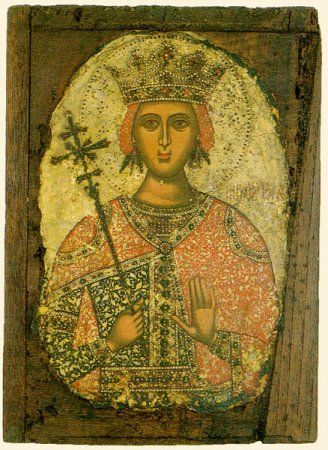
Today is the fourth anniversary of my foray into the blogging world. I did not realize it at the time, but I had begun blogging on the feast day of St. Catherine, patron saint of philosophers. Providence is frequently surprising.
So, today, in celebration of my fourth blogging anniversary, we will celebrate the feast of St. Catherine.
For a little bit about her life and why some churches celebrate St. Catherine's day on the 24th, read this piece from the Greek Orthodox Archdiocese Online Chapel:
Saint Catherine, who was from Alexandria, was the daughter of Constas (or Cestus). She was an exceedingly beautiful maiden, most chaste, and illustrious in wealth, lineage, and learning. By her steadfast understanding, she utterly vanquished the passionate and unbridled soul of Maximinus, the tyrant of Alexandria; and by her eloquence, she stopped the mouths of the so-called philosophers who had been gathered to dispute with her. She was crowned with the crown of martyrdom in the year 305. Her holy relics were taken by Angels to the holy mountain of Sinai, where they were discovered many years later; the famous monastery of Saint Catherine was originally dedicated to the Holy Transfiguration of the Lord and the Burning Bush, but later was dedicated to Saint Catherine. According to the ancient usage, Saints Catherine and Mercurius were celebrated on the 24th of this month, whereas the holy Hieromartyrs Clement of Rome and Peter of Alexandria were celebrated on the 25th. The dates of the feasts of these Saints were interchanged at the request of the Church and Monastery of Mount Sinai, so that the festival of Saint Catherine, their patron, might be celebrated more festively together with the Apodosis of the Feast of the Entry of the Theotokos. The Slavic Churches, however, commemorate these Saints on their original dates.
A fuller account of her life can be found here.
Troparion of Great Martyr Katherine Tone 5
Let us praise Katherine, protectress of Sinai,
Bride of Christ and our helper.
With the sword of the Spirit she silenced the wisdom of the wicked.
She is crowned as a martyr and asks mercy for us all.
Kontakion of Great Martyr Katherine Tone 2
You lovers of martyrs raise a chorus now
in honour of wise Katherine.
She preached Christ in the stadium
and spat on the knowledge of philosophers.
Holy and Great Martyr, All-Wise Catherine, pray for us that we may take captive every thought to the obedience of Christ, and pray that we may be made worthy of the Kingdom of Heaven.
November 16, 2006
How Can One Take Offense?
Russell Moore, in blogpost, "Egalitarian Orthodoxy?" at Touchstone's Mere Comments, notes a comment from the CBE blog which states:
I’ve heard it said that Willow Creek Community Church tries to target middle-class males of about my age precisely because we are the hardest group to reach. As the thinking goes, if you can win them over, reaching others should be a snap. Jews for Jesus makes the same claim about trying to evangelize Jews.I wonder who might be the hardest group of Christians to reach with the good news that in Christ there is neither male nor female (Gal 3:28), and the (to me) necessary corollary that God gifts both men and women for ministry. The (big-O) Orthodox may not be the hardest to reach, but I’m sure they’re in the top five. They’ve got a view of the church, its ministry, and its sacraments that isn’t just “high,” it’s stratospheric. And they’ve got a nearly 2,000-year track record of not ordaining women. If you can convince an Orthodox believer, you’re probably a long way towards convincing anybody else.
Clearly the author thinks Orthodoxy has a gender issue when it comes to ordaining women to Eucharistic ministry. If one were so inclined, one could almost take offense at this carefully worded criticism.
On the other hand, it is almost an unintended compliment.
At least I, for one, take it as such.
Of course, given that the author wholly misunderstands the Orthodox rejection of female ordination to Eucharistic ministry, one should really be given to reading this in the best possible light.
October 29, 2006
The Twentieth Sunday After Pentecost
I had two extremely moving experiences in worship today, one in conjunction with Fr Pat's sermon, and the other in conjunction with the fact that we stood at the front of the nave this morning.
First, Father Pat was emphasizing (per the Gospel this morning) the touch of God. Through the Incarnation and through the Sacraments, God touches us physically. And just as importantly, God invites us to touch him physically. Father called to mind the prohibition Christ gave to St. Mary Magdalene as she knelt and clasped his feet when he appeared to her after his resurrection. This was followed a week later by Christ's invitation to St. Thomas, "Put your hand in my side." Father pointed out that in the Sacraments we have a God who invites us, "Put your hand in my side." Touch me, the Lord invites. I felt a longing for that closeness. I nearly cried.
And then, today my wife and I tried to stand close to the front, for the sake of the girls and our management of their behavior. We were standing on the left side of the nave, which is to say, directly in front of the icon of the Theotokos. Today like no other day, that icon was alive for me. I cannot say how, but today I felt Our Lady's maternal presence in such a strong way. I would not have been surprised had she stepped down from the icon to join us bodily, so strongly did I feel her presence.
This may be, in part, due to the fact that I have been defending the Mother of Our Lord being aeiparthenos, ever-virgin, and have been given cause to meditate on the awesome mystery of her who was more physically close to the Lord than anyone who's ever lived on this earth. It is a fearsome and terribly wonderful thing to contemplate. He shared her blood, and she his. His flesh was her flesh, and she was deified by his.
What a Faith we have, a Faith I was not given fully until I found Orthodoxy. How can one not shed tears of gratitude?
October 28, 2006
Lessons from Limbo
Earlier this year, Fr. John Breck took on the news of the Roman Catholic change on the doctrine of limbo, and drew up some Lessons from Limbo.
He first sets up the difference between the Roman Catholic teaching on limbo and the Orthodox understanding of the state of unbaptized infants.
If the logic is defective, it is because the underlying presupposition is false. The consensus of Eastern patristic tradition, and of Orthodox theologians today, is that the “original sin” of Adam is not transmitted (sexually or by any other means) from generation to generation like an inherited disease. Rather, what we inherit or receive from creation of the “first man Adam” (who represents all of humanity) is the consequence of sin, namely mortality, death. “As sin came into the world through one man [Adam], and death through sin, so death spread to all men because all men sinned…” (Rom 5:12).
Fr. John then goes on to elucidate some important lessons from this entire episodes. Here is what he says is the most important:
Perhaps the most important lesson in all of this is that the Holy Spirit is calling and directing us constantly to return to the Gospel of Jesus Christ. Particular theologoumena, theological opinions, always need reassessing – not just for their specific content, but for the impact they might have on the lives of our faithful. (A case in point is the “toll houses,” spheres of purification through which deceased persons pass on their journey toward heaven. There is room, to be sure, for some such teaching within the Church – purification as an ongoing process, for example – as long as it does not become, as it so often does, distorted into a Gnostic image of purification through what amounts to torture, inflicted by powers more demonic than angelic.)The primary question, made clear by the history of “limbo,” is this: To what degree does any given teaching or exposition of the faith actually reflect the witness of Holy Scripture and the Church’s authentic Tradition? To the extent that it does, then it should be retained; where it does not, then the teaching needs to be reinterpreted so that it conforms faithfully to revealed Truth.
Because pious traditions – even erroneous ones – can have such a hold on the popular mind, it requires courage, patience and a great deal of prayerful discernment in order to make this continual reassessment of our various theological interpretations. Nevertheless, we should not fear the process. We should accept it as a function of the Church’s Living Tradition, given and sustained by the Spirit of Truth.
October 26, 2006
Lives of the Saints
Two excellent resources for following the daily feasts of our fathers and mothers in the faith:
Back & Forth to the Future
Robbert Webber & Co. have issued a A Call to an Ancient Evangelical Future. This hasn't escaped the notice of some of the writers at Touchstone Magazine, who have issued a critical response: Back & Forth to the Future
My two favorite excerpts. First by Wilfred McClay:
Well, in the first place, there is a word that is never used in this document. It is conspicuous in its absence. I kept waiting for it to appear, and it never did. That word is authority. Yes, the Scriptures are here described as an “authoritative” record, but that is merely sending an adjective to do a noun’s work.There is no locus of authority being proposed here. This omission is especially strange in light of the document’s expression of the “pressing” question: “Who gets to narrate the word?” This would seem to be precisely a question of authority. The document calls on Evangelicals to “restore the priority” of the biblical story in their lives, which the writers insist upon calling “God’s narrative.”
But who is to do the restoring? After all, the story does not tell itself (which is, of course, precisely one of the reasons literary scholars use the verb “narrate”). The history of the Church is a history of all the different, and sometimes violently conflicting, ways of telling the story. I have no doubt that both James Dobson and Stanley Hauerwas could each tell the story convincingly and faithfully. But I suspect their accounts would differ.
In short, there is no escaping from the need for structures of authority in the Church.
And Russell Moore:
A truly ancient Christianity doesn’t need to assert how ancient it is—or how countercultural. An ancient Christianity that takes seriously the faith of the Fathers will cause a stir in the culture and in the cubicles at InterVarsity Press—if for no other reason than because it says things such as the faith of the “Fathers.”It will believe the storyline of Scripture and judge the present order—all of it—against a Spirit-breathed norm. It will create a counterculture of people who aren’t counterculturally hip, on stage with Bono for the latest global warming consciousness-raiser, but who are countercultural because they, well, counter the prevailing culture.
If the Ancient/Future Evangelicals wish to counter this culture, they will be forced to do so in more than the generalities they’ve outlined. To take on consumerism, do you dare take on the dual-income family structure of contemporary Americanism? To take on the “culture of death,” do you dare speak bluntly about welcoming the gift of children, about the personhood of the embryo, about the way in vitro fertilization turns a child into a means?
To speak against “civil religion,” do you dare call for public prayers in the name of Jesus? To speak against “political correctness,” do you dare say that only in Jesus Christ is salvation found, thus fueling the evangelism of the world religions, including the Jewish people?
The roots of Halloween, we’re told, date back to a time when villagers sought to ward off evil spirits, witches, and ghosts by mocking them with mimicry. A bloodthirsty demon would retreat, it was thought, when he saw someone dressed in ghoulish costume. When reading documents such as A Call to an Ancient Evangelical Future, it is hard not to wonder whether this is not what’s going on among these Evangelicals: keeping the ancient Christian witness at bay by mocking it with mimicry.
October 24, 2006
The Silence of My "Orthodoxy"
I have, for some time, been a vocal proponent of Orthodoxy here on this blog. Some of it was precipitated by my own working out intellectually of some of the aspects of the ancient Faith that I just had no experience or exposure to: the Father as arche of the Trinity; theosis; new forms of prayer; the proper understanding of synergism; and so forth. I have had opportunity at one message board I still frequent to defend these things I have come to understand a bit better (though perhaps not adequately and never fully).
But I find myself at a curious place. I want to talk less and less about Orthodoxy. I am strangely more oriented around day to day living: how to fast (though I do precious little of it), the proper use and practice of the Jesus prayer, the integration of prayer in every aspect of my life from work to parenting to my marriage. I would rather listen to online exchanges than engage in one. And I want to do that less and less. I would rather do a lot more listening to Ancient Faith Radio and Our Life in Christ. And even more than that, I would rather simply sit in Church and look at the iconostasis and the candle on the altar.
Don't misunderstand. This is not some ego-elevating confession of a new mystical bent. I remember with some chagrin the days when I would have labelled myself a mystic (a la Evelyn Underhill). After all, the externals of my prayer life are far wimpier than they were earlier this year. I'm not doing a lot of "spiritual reading." You won't see me wax eloquent on Interior Castle. No, it's really much less glorious or romantic than that. I'd just rather shut up.
In part that's why I've not done a lot of blogging of late. Oh, sure, I'm busier than crap right now, and that's a lot of the reason why. But even in those odd moments when I sit down at the Chattablogs MT blogging page, there's just nothing to come out. I have no energy or desire to say much. I'm happy to pass on things such as the frivolities that make me laugh, other articles or posts that catch my attention and such. But I don't have anything else really to say.
I don't know what, if anything, that means. Nor do I necessarily think it's a significant development. It is what it is. And there it is.
New developments may unloose my tongue--er keyboard. So those of you who might welcome a bit more verbosity on my part, hang in there. To the rest of you, in the words of Depeche Mode, "enjoy the silence."
October 12, 2006
Another Answer to Blessed Seraphim’s Intercessions on My Behalf
As I noted in the previous post, a year ago, I asked Blessed Seraphim to pray for me that I would gain a correct understanding of the questions I had about the Jesus Prayer, and a correct practice. The answers to his intercessions for me continue.
Not a talismanThe Jesus Prayer is not some talisman. Its power comes from faith in the Lord, and from a deep union of mind and heart with Him. With such a disposition, the invocation of the Lord’s Name becomes very effective in many ways. But a mere repetition of the words does not signify anything.
--Theophan the Recluse
Mechanical repetition leads to nothing
Do not forget that you must not limit yourself to a mechanical repetition of the words of the Jesus Prayer. This will lead to nothing except a habit of repeating the prayer automatically with the tongue, without event thinking about it. There is of course nothing wrong with this, but it constitutes only the extreme outer limit of the work.
The essential thing is to stand consciously in the presence of the Lord, with fear, faith and love.
--Theophan the Recluse
The place of breathing techniques (i)
In the treatise of Simeon the New Theologian about the three forms of prayer, in the works of Nikephoros the Monk, and in the Century of Kallistos and Ignatios Xanthopoulos—all contained in the Philokalia—the reader will find instructions about the technique whereby the mind can be introduced into the heart with the aid of physical breathing—in other words, a mechanical method designed to help us achieve inner prayer. This teaching of the Fathers has created and continues to create many perplexities for its readers, although in fact there is really nothing difficult about it. We advise our beloved brethren not to try to practice this mechanical technique unless it establishes itself in them of its own accord. Many who have attempted to learn it by practical experienced have damaged their lungs and achieved nothing. The essential thing is for the mind to unite with the heart at prayer, and this is accomplished by divine grace, in its own time, determined by God. The mechanical method described in these writings is fully replaced by an unhurried repetition of the prayer, a brief pause after each prayer, quiet and steady breathing, and enclosing the mind in the words of the prayer. With the aid of such means we can easily achieve a certain degree of attention. Before long the heart begins to be in sympathy with the attention of the mind as it prayers. Little by little the sympathy of the heart with the mind begins to change into a union of mind and heart; and then the mechanical technique suggested by the Fathers will appear by itself. All the mechanical methods of a material character are suggested by the Fathers solely as aids for a quicker and easier attainment of attention during prayer, and not as something essential. The essential, indispensable element in prayer is attention. Without attention there is no prayer. True attention, given by grace, comes when we make our heart dead to the world. Aids always remain no more than aids. The union of the mind with the heart is a union of the spiritual thoughts of the mind with the spiritual feelings of the heart.
--Bishop Ignatii
[Igumen Chariton of Valamo, The Art of Prayer (Faber and Faber, 1966), pp 99-100, 104-105]
October 11, 2006
The Intercessions of Blessed Hieromonk Seraphim on My Behalf Regarding the Jesus Prayer
About a year ago, I was reading the Light and Life Publishing book, by Anthony Coniaris, Confronting and Controlling Your Thoughts According to the Fathers of the Philokalia. I posted a few times citing portions of the book and reflecting on my struggle to practice such oneness of mind and to practice the Jesus Prayer. I also read Blessed Hieromonk Seraphim’s translation of a couple of works of St. Paisius Velichkovsky, much of which dealt with the Jesus Prayer. (At the counsel of one of our parishioners, a man more mature than me, I deleted those posts.) I also spoke with our parish priest about the Jesus Prayer and practicing it.
It was difficult for me to make sense of some of what I was reading and the counsel I was receiving. I now see that such counsel was not essentially contradictory, but it felt to me as though I was being encouraged in two opposite directions, to both pursue and avoid the same things. I was quite confused.
But I knew better than to simply trust my own thoughts, or work toward my own conclusions on the matter. So I simply stood still, neither pursuing nor avoiding what I had been counseled on, and just maintaining my modest and irregular practice.
One thing I did do, however, was to ask the intercessions of one of my patrons, Blessed Hieromonk Seraphim, on my behalf, that I might be brought to both correct thought and correct practice on the matters that were confused in my own mind.
For the next several months, however, I shied away from reading certain books on the Jesus Prayer, did not post on it, and simply continued what I had been doing, doing it no more nor no less than had been the case. I had one book on my shelf, Igumen Chariton of Valamo’s The Art of Prayer (Faber and Faber), which I frequently was drawn to read, but hesitated to do so, because I did not think I was at a point in my life where I would be making useful gain of such reading. I was concerned that reading it apart from a state of readiness to both receive and to practice the teaching would end up being spiritually harmful to me.
Recently, I have sensed a change, not only in heart but in act, in which I have found myself more ready to receive and to practice whatever may be given me in reading Igumen Chariton’s book. And in so doing, I have at last, about a year later, received the answer to Blessed Seraphim’s prayers on my behalf.
I wanted to share that extended passage with my readers, but I do so without identifying in any way the specific questions I wanted resolved. Absolutely everything of this sort must be brought to one’s spiritual father. If the passage, of itself and out of any context of my own life, is helpful to others, it will be no surprise, for St. Theophan the Recluse is a well-recognized saint. But for my part this post is nothing more than a marker of an answer to prayer.
The Jesus Prayer, and the warmth which accompanies itTo pray is to stand spiritually before God in our heart in glorification, thanksgiving, supplication, and contrite penitence. Everything must be spiritual. The root of all prayer is devout fear of God; from this comes belief about God and faith in Him, submission of oneself to God, hope in God, and cleaving to Him with the feeling of love, in oblivion of all created things. When prayer is powerful, all these spiritual feelings and movements are present in the heart with corresponding vigour.
How does the Jesus Prayer help us in this?
Through the feeling of warmth which develops in and around the heart as the effect of this Prayer.
The habit of prayer is not formed suddenly, but requires long work and toil.
The Jesus Prayer, and the warmth which accompanies it, helps better than anything else in the formation of the habit of prayer.
Note that these are the means, and not the deed itself.
It is possible for both the Jesus Prayer and the feeling of warmth to be present without real prayer. This does indeed happen, however strange it may seem.
When we pray we must stand in our mind before God, and think of Him alone. Yet various thoughts keep jostling in the mind, and draw it away from God. In order to teach the mind to rest on one thing, the Holy Fathers used short prayers and acquired the habit of reciting them unceasingly. This unceasing repetition of a short prayer kept the mind on the thought of God and dispersed all irrelevant thoughts. They adopted various short prayers, but it is the Jesus Prayer which has become particularly established among us and is most generally employed; ‘Lord Jesus Christ, Son of God, have mercy upon me, a sinner!’
So this is what the Jesus prayer is. It is one among various short prayers, oral like all others. Its purpose is to keep the mind on the single thought of God.
Whoever has formed the habit of this Prayer and uses it properly, really does remember God incessantly.
Since the remembrance of god in a sincerely believing heart is naturally accompanied by a sense of piety, hope, thanksgiving, devotion to God’s will, and by other spiritual feelings, the Jesus Prayer, which produces and preserves this remembrance of God, is called spiritual prayer. It is rightly so called only when it is accompanied by these spiritual feelings. But when not accompanied by them it remains oral like any other prayer of the same type.
This is how one should think of the Jesus Prayer. Now what is the meaning of this warmth which accompanies the practice of the Prayer?
In order to keep the mind on one thing by the use of short prayer, it is necessary to preserve attention and so lead it into the heart: for so long as the mind remains in the head, where thoughts jostle one another, it has not time to concentrate on one thing. But when attention descends into the heart, it attracts all the powers of the soul and body into one point there. This concentration of all human life in one place is immediately reflected in the heart by a special sensation that is the beginning of future warmth. This sensation, faint at the beginning, becomes gradually stronger, firmer, deeper. At first only tepid, it grows into warm feeling and concentrates the attention upon itself. And so it comes about that, whereas in the initial stages the attention is kept in the heart by effort of will, in due course this attention, by its own vigour, gives birth to warmth in the heart. This warmth then holds the attention without special effort. From this, the two go on supporting one another, and must remain inseparable; because dispersion of attention cools the warmth, and diminishing warmth weakens attention.
From this there follows a rule of the spiritual life: if you keep the heart alive towards God, you will always be in remembrance of God. This rule is laid down by St. John of the Ladder.
The question now arises whether this warmth is spiritual. No, it is not spiritual. It is ordinary physical warmth. But since it keeps attention of the mind in the heart, and thus helps the development there of the spiritual movements described earlier, it is called spiritual—provided however, that it is not accompanied by sensual pleasure, however slight, but keeps the soul and body in sober mood.
From this it follows that when the warmth accompanying the Jesus Prayer does not include spiritual feelings, it should not be called spiritual, but simply warm-blooded. There is nothing itself bad about this warm-blooded feeling, unless it is connected with sensual pleasure, however slight. If it is so connected, it is bad and must be suppressed.
Things begin to go wrong when the warmth moves about in parts of the body lower than the heart. And matters become still worse when, in enjoyment of this warmth, we imagine it to be all that matters, without bothering about spiritual feelings or even about remembrance of God; and so we set our heart only on having this warmth. This wrong course is occasionally possible, though not for all people, nor at all times. It must be noticed and corrected, for otherwise only physical warmth will remain, and we must not consider this warmth as spiritual or due to grace. This warmth is spiritual only when it is accompanied by the spiritual impetus of prayer. Anyone who calls it spiritual without this movement is mistaken. And anyone who imagines it to be due to grace is still more in error.
Warmth which is filled with grace is of a special nature and it is only this which is truly spiritual. It is distinct from the warmth of the flesh, and does not produce any noticeable changes in the body, but manifests itself by a subtle feeling of sweetness.
Everyone can easily identify and distinguish spiritual warmth by this particular feeling. Each must do it for himself: this is no business for an outsider.
--Theophan the Recluse
[Igumen Chariton of Valamo, The Art of Prayer (Faber and Faber, 1966), pp 93-95]
September 09, 2006
There is an American Orthodoxy
Father Aris Metrakos has written a frank piece entitled There is an American Orthodoxy. Here's a resume of the article. Please go read it all.
A myth needs to be debunked. It goes like this: Orthodox unity is years away because there is no such thing as "American Orthodoxy". Call it an ecclesiastical instead of urban legend if you want. It's been in circulation for at least two decades among the Orthodox Christians of the United States and it keeps us frozen in a state of tribalism and territorialism that prevents us from planting Orthodoxy more firmly in America.This myth is advanced by people who focus on what the Church in the United States is not. Ok, so we don't have a 1500 year-old monastic tradition. It's also true that most of our people have never been to a vigil. And yes, the typical American churchgoer doesn't know Seraphim Rose from Pete Rose.
But to say that these "shortcomings" imply that there is no American Orthodox identity is like saying there is no such thing as American soccer because our fans don't pummel one another and our announcers don't scream "G-O-O-O-A-A-L!"
Positive Characteristics of American Orthodoxy
Two decades of involvement with the Church in the United States have convinced me that Orthodox unity is closer than we think. There is such a thing as American Orthodoxy. Here are some characteristics:
Father Aris goes on to list those characteristics:
- A Eucharistic Church
- A Parish Based Church
- A Sunday Morning Church
- An English Speaking Church
- No State Identity
- A Political Big Tent
- Formality, Not Imperialism (i.e., serious about liturgy, but not pretentious)
- Simple, Participatory Worship
- Pious, Not Pietistic
- Power to the Programs
- The Role of the Laity
But it's not all fluffy bunnies and playful kittens:
Negative Characteristics of American OrthodoxyIt's not all peaches and cream for America's lovers of smells and bells. If it were we wouldn't still be talking about unity, we'd be doing something about it. Following are some points that paint a picture of the dark side of Orthodoxy in the United States.
Here is that list of negatives.
- A Profound Inferiority Complex
- Arrogantly Ignorant
- Pathological Parochialism
Again: Go read it all.
August 09, 2006
The Brain Kid Thinks About Orthodoxy
Brain Kid's Recent thoughts sure feel familiar to me.
Godspeed, friend.
Dostoevsky and Memory Eternal
Donald Sheehan's DOSTOEVSKY AND MEMORY ETERNAL: An Eastern Orthodox Approach to the Brothers Karamazov [H/T: tmatt] is absolutely brilliant. The first two paragraphs draw you in and won't let you go till you've ingested it all.
Central to Eastern Orthodox Christendom is the singing, at the end of every Orthodox funeral, of the song known as "Memory Eternal" (in Church Slavonic: Vechnaya Pamyat). This song also concludes Dostoevsky's great, final novel, The Brothers Karamazov, when, following the funeral of the boy whom Alyosha Karamazov (and the circle of schoolboys around Alyosha) had deeply loved, Alyosha speaks to the boys about the funeral and about the meaning of the resurrection, with this brief song as their steady focus.My thesis is simply this: to know something of this song's meaning is to comprehend both the Eastern Orthodox faith and Dostoevsky's greatest novel.
Go spend a half hour with this essay/lecture.
July 24, 2006
How Russia Became Christian (Part II)
From CH&B;'s website, How Russia became Christian (Part II)
c. 987 -- Vladimir summoned together his boyars and the city elders, and said to them: "Behold, the Bulgars came before me urging me to accept their religion. Then came the Germans and praised their own faith; and after them came the Jews."Finally the Greeks appeared, criticizing all other faiths but commending their own, and they spoke at length, telling the history of the whole world from its beginning. Their words were artful, and it was wondrous to listen and pleasant to hear them. They preach the existence of another world. "Whoever adopts our religion and then dies," they said, "shall arise and live forever. But whosoever embraces another faith, shall be consumed with fire in the next world.' What is your opinion on this subject, and what do your answer?" The boyars and the elders replied, "You know, oh prince, that no man condemns his own possessions, but praises them instead. If you desire to make certain, you have servants at your disposal. Send them to inquire about the ritual of each and how he worships God."
Their counsel pleased the prince and all the people, so that they chose good and wise men to the number of 10, and directed them to go first among the Bulgars and inspect their faith. The emissaries went their way, and when they arrived at their destination they beheld the disgraceful actions of the Bulgars and their worship in the mosque; then they returned to their country.
Vladimir then instructed them to go likewise among the Germans, and examine their faith, and finally to visit the Greeks. They thus went into Germany, and after viewing the German ceremonial, they proceeded to Tsar'grad, where they appeared before the [Byzantine] emperor. He inquired on what mission they had come, and they reported to him all that had occurred. When the emperor heard their words, he rejoiced, and did them great honor on that very day.On the morrow, the emperor sent a message to the patriarch to inform him that a "Russian" delegation had arrived to examine their Greek faith, and directed him to prepare the church and the clergy, and to array himself in his sacerdotal robes, so that the Russes might behold the glory of the God of the Greeks. When the patriarch received these commands, he bade the clergy assemble, and they performed the customary rites.
They burned incense, and the choirs sang hymns. The emperor accompanied the Russes to the church, and placed them in a wide space, calling their attention to the beauty of the edifice, the chanting, and the pontifical services, and the ministry of the deacons, while he explained to them the worship of his God. The Russes were astonished, and in their wonder praised the Greek ceremonial. Then the Emperors Basil and Constantine invited the envoys to their presence, and said, "Go hence to your native country," and dismissed them with valuable presents and great honor.
Thus they returned to their own country, and the prince called together his boyars and the elders. Vladimir then announced the return of the envoys who had been sent out, and suggested that their report be heard. He thus commanded them to speak out before his retinue.
The envoys reported, "When we journeyed among the Bulgars, we beheld how they worship in their temple, called a mosque, while they stand ungirt. The Bulgar bows, sits down, looks hither and thither like one possessed, and there is no happiness among them… Their religion is not good."
"Then we went among the Germans, and saw them performing many ceremonies in their temples; but we beheld no glory there."
"Then we went to Greece, and the Greeks led us to the edifices where they worship their God, and we know not whether we were in heaven or on earth. For on earth there is no such splendor or such beauty, and we are at a loss how to describe it. We only know that God dwells there among men, and their service is fairer than the ceremonies of other nations, for we cannot forget that beauty. Every man, after tasting something sweet, is afterward unwilling to accept that which is bitter, and therefore we cannot dwell longer here."
Then the boyars spoke and said, "If the Greek faith were evil, it would not have been adopted by your grandmother Olga who was wiser than all other men." Vladimir then inquired whether they should all accept baptism, and they replied that the decision rested with him.
At this point Vladimir's religious search ceased for a year while he lay siege of the Byzantine city of Kherson. When he received a mysterious message that told him how to cut off the city defenders' water supply, Vladimir told God that, should he end up taking the city, he would be baptized in gratitude for God's help. Upon entering the city, he began negotiating with Byzantine Emperors Basil and Constantine for the hand of their sister Anna, thereby intending to cement his possession of the city and a peaceful co-existence with the Byzantine empire. But the two emperors delayed, insisting that he could have their sister only if he were baptized. He insisted that she bring priests with her to baptize him, and they agreed. She went to Kherson, where the narrative picks up:
c. 988—By divine agency, Vladimir was suffering at that moment from a disease of the eyes, and could see nothing, being in great distress. The princess declared to him that if he desired to be healed of this disease, he should be baptized with all speed, otherwise it could not be cured.
When Vladimir heard her message he said, "If this proves true, then of a surety is the God of the Christians great," and gave order that he should be baptized. The Bishop of Kherson, together with the princess's priests, after announcing the tidings, baptized Vladimir, and as the bishop laid his hand upon the him, he straightway received his sight. Upon experiencing this miraculous cure, Vladimir glorified God saying, "I have now perceived the one true God." When his followers beheld this miracle, many of them were also baptized.
The Chronicle alleges that this took place in Kherson, but that "those who do not know the truth say he was baptized in Kiev," or "in Vasil'ev, while still others mention other places." When the prince returned to Kiev, according to the Chronicle:
[H]e directed that the idols be overthrown, and that some should be cut to pieces and others burned with fire. He thus ordered that Perun [the chief idol of the Kievan pagans' pantheon] should be bound to a horse's tail and dragged down Borichev [Street] to the stream. He appointed 12 men to beat the idol with sticks, not because he thought the wood was sensitive, but to affront the demon who had deceived man in this guise, that he might receive chastisement at the hands of men. Great art thou, oh Lord, and marvelous are thy works! Yesterday he was honored of men, but today held in derision. While the idol was being dragged along the stream to the Dnieper, the unbelievers wept over it, for they had not yet received holy baptism. After they had thus dragged the idol along, they cast it into the Dnieper. But Vladimir had given this injunction, "If it halts anywhere, then push it out from the bank, until it goes over the falls. Then let it loose." His command was duly obeyed. When the men let the idol go, and it passed through the rapids, the wind cast it out on the bank, which since that time has been called Perun's sandbank, a name that it bears to this very day [whenever the chronicler was writing].
Thereafter Vladimir sent heralds throughout the whole city to proclaim that if any inhabitants, rich or poor, did not betake himself to the river, he would risk the prince's displeasure. When the people heard these words, they wept for joy, and exclaimed in their enthusiasm, "If this were not good, the prince and his boyars would not have accepted it." On the morrow, the prince went forth to the Dnieper with the priests of the princess and those from Kherson, and a countless multitude assembled. They all went into the water; some stood up to their necks, others to their breasts, and the younger near the bank, some of them holding children in their arms, while the adults waded farther out. The priests stood by and offered prayers. There was joy in heaven and upon earth to behold so many souls saved. But the devil lamented, "Woe is me! How am I driven out hence! … I am vanquished … and my reign in these regions is at an end."
The Chronicle's next several pages contain accounts of the people almost unanimously accepting this new Christian faith, and of Vladimir's oversight of the Christianization of his entire nation, including his initiating the education of the nation's children and in other ways encouraging the spread of the gospel of Christ throughout his realm.
The Russian Primary Chronicle was edited and translated by Samuel Hazzard Cross and Olgerd P. Sherbowitz-Wetzor (Medieval Academy of America: Cambridge, MS), 1953.
[Part I is here.]
July 21, 2006
In Memory of Jaroslav Pelikan (A Homily by Father John Erickson)
In Memory of Jaroslav Pelikan
A Homily Delivered at His Funeral Vigil Service
May 16, 2006
Dear Sylvia, dear Martin, Michael and Miriam, dear Pastor Pelikan, your long vigil is over. During these last weeks we here at the seminary have been singing the hymns of Pascha, hymns proclaiming the resurrection: “From death to life, from earth to heaven has Christ our God led us.” And during these weeks you have been keeping vigil around Jary. Now Christ has led him from death to life, from earth to heaven. As persons of faith, we rejoice. We know that Christ is risen. We know that He has destroyed the power of death. We know that on the last day God will raise up those who sleep in Him (cf I Thess 4). But what a sense of loss we also feel!On the first paschal morning Mary Magdalene felt a similar rush of conflicting emotions. As we read in John 20, she came to the tomb of Jesus to find His body gone. She turned and saw Jesus standing there, but she didn’t recognize Him and supposed He was the gardener. She asks, “Sir, if you have carried Him away, tell me where you have laid Him, and I will take Him away.” Jesus addresses her by name: “Mary.” She recognizes His beloved voice, and she reaches out to touch Him. But He says, “Do not touch me” – “Do not cling to me.” Don’t try to hold on to me.
Mary couldn’t hold onto Jesus as she had known him. All the more, we can’t hold onto those who now lie asleep in Him. We can’t hold onto Jary. We can’t know him now in the ways that we knew him in the past – as a devoted husband, a loving father, a proud grandfather, a dear brother, a teacher and mentor, a sage advisor, a witty conversationalist. A few weeks ago Michael summed up the situation that so many of us are in now. He said, “All my life, if I needed to know something, I could just ask my father, and he would know the answer. But I’m not going to be able to do that any more.” Like Michael, we can’t know Jary in the ways we once did. But we can recognize him and know him in new ways - ways no less real, and certainly more profound.
We are invited to see and know Jary not as he was, but as he is; not just as we remember him, not just he as he lives in our own feeble memories, but as he truly lives in God’s eternal memory. It’s right for us to reflect on what Jary has meant in our own lives. Let’s remember these things with joy. But at the same time we are challenged to see his life in a new perspective – to look for what God has accomplished through him, for what God is still accomplishing through him - and through all those who truly love Him.A story is not exhausted in the telling. A word once spoken continues to echo. A bell once struck continues to reverberate. So too, what we do and say in this life has a lasting impact. This is true for all of us, but certainly this is true in Jary’s case. What a lot he accomplished in the course of his life! What a lot he said! And what a lot he wrote! Nearly forty books and innumerable articles, touching on practically everything - from philosophy, literature, political science, legal theory, the visual arts and music, to education, the natural sciences and even sailing.
Jary traced many of his academic and religious interests to his Slavic background. His grandfather was born in Slovakia, a wonderful meeting-place of cultures and religious traditions, and after coming to the United States he became one of the founding fathers of the Slovak Synod of Lutherans. Jary’s father, also a Slovak Lutheran pastor, once told him that “he combined German Lutheran scholarship and Slavic Orthodox piety – and fortunately not the vice-versa.” One result of this happy coincidence of qualities was Jary’s remarkable academic career. It’s not necessary to review his scholarly accomplishments here. The list of his publications, academic appointments, honorary degrees, prizes, medals and citations only confirms what we already know: He was brilliant. But interwoven with his scholarship, and virtually inseparable from it, was a Christian faith as simple, as endearingly child-like, as it was profound. This is what Jary had to say in a brief autobiographical essay written just a few years before his death: “I was quite out of step with many in my generation, especially among theological scholars at universities, in never having had fundamental doubts about the essential rightness of the Christian faith, but having retained a continuing, if often quite unsophisticated, Slavic piety.”
Jary showed his appropriation of the basic tenets of the Christian faith in whatever he did or said or wrote. Consider the Christian doctrine of creation. In Genesis we read: “In the beginning God created the heavens and the earth…. And God saw everything that He had made, and behold it was very good.” Jary loved the beauty of God’s creation, and he also loved the fruits of human creativity. Great works of literature, for example. (Goethe was his favorite poet, I believe, though he also could recite reams of Schiller by heart.). Or music. His book Bach Among the Theologians is a classic. He loved the out-of-doors – hiking in Sleeping Giant State Park near his home in Connecticut, where he could tell you everything you ever needed to know about its flora and fauna – and then some! Or, back at the house, he enjoyed checking up on how the koi were doing in their fishpond. Jary could write hefty tomes on the creed, on the Christian doctrine of creation, on “one God the Father almighty, creator of heaven and earth…” But he also confessed this creed in his daily life, through his child-like wonder, through his joy in living things both great and small.
Besides being a person of deep faith, Jary was extraordinarily gifted. He – and those around him – recognized this early in his life. All of us know how people – even the most gifted – sometimes end up wasting their talents, accomplishing little or nothing in life. This was not to be the case with Jary. As a sincere Christian, he – and those around him – were determined that his many gifts be put to proper use: “To the glory of God, and in service to my neighbor” might have been his motto, just as it was Bach’s. In the autobiographical essay that I mentioned a few moments ago, Jary remarks on the influence that his mother had on the formation of his character. She had an “iron sense of duty” and a “loving determination” that her son not “get by on brains and glibness” – as she put it. Jary had brains and glibness. But he also had remarkable self-discipline and a strong sense of responsibility. This took many forms. For example, I understand that he would get up to listen to the short-wave radio at odd hours in order to keep up his skills in various exotic foreign languages. Through his joy in creation, Jary expressed his faith in one God, the creator of all. So also, through his faithful stewardship of the talents given to him, he showed his awareness that one day he would stand before that same God to account for his talents.
By his own admission, Jary was, first of all, a historian. In one of his typically pungent one-liners, he put it this way: “Everybody else is an expert on the present. I wish to file a minority report on behalf of the past.” But for him the study of the past was not just an academic exercise. He believed that there was a shape to history, and a vital center - Jesus Christ – that gave it meaning. He also believed that great figures from the past – church fathers like St. Athanasius, Basil the Great and St. John Chrysostom – had something to say to us today. Jary was a scholar, but – professedly, self-consciously, and sincerely – he was a Christian scholar. If you entered his study, he almost inevitably would point out two portraits, one of Adolf von Harnack, the great liberal Protestant historian of dogma, the other of Fr. Georges Florovsky, whom he described as “the last of my mentors and the one to whom I owe the most.” And Jary would offer this observation: “Harnack showed me what it was to be a scholar. Florovsky showed me what it was to be a scholar and a Christian at the same time.”
What Florovsky showed Jary, Jary showed us, through his books and through his life. He showed us that it’s possible to be a Christian and a scholar at the same time; that it’s possible to be Christian – indeed an Orthodox Christian - and a modern human being; that it’s possible to be engaged with the world, to address its most pressing questions, to be in dialogue with others, without lapsing into religious indifference or cynicism. Jary’s life as Christian scholar inspired those of us who were privileged to be his students, and it continues to inspire young scholars who are struggling to maintain their Christian identity in the midst of an increasingly hostile world. This past Sunday I phoned Leon Lysaght, like Jary a member of the seminary’s Board of Trustees, to tell him about Jary’s passing. Leon recounted to me an encounter he recently had with a graduate student who was studying in the field of late antiquity. The student confided that he had been making a journey to the Orthodox faith and expected to be chrismated within the next few weeks. Leon asked him how his spiritual journey might be related to his course of study. During his response the student used the expression “vortex of darkness” to describe the environment in his department. When asked to explain what he meant, the student gave as an example a comment made by one of the professors in the department. According to the student, the professor stated that the writings of John Chrysostom were very valuable “once you wade through all that Christian junk.” The student then went on to say that he and his small group of fellow Christians were sustained above all by the books of Jaroslav Pelikan: “He has been a beacon of light in the darkness,” the student said.
A beacon of light! That is what Jary was during his life with us. That is what he is now, as he stands before the throne of God: He gives inspiration to students who want to be not just scholars, but Christian scholars. He offers an example of faithful stewardship. He shows how love for the Creator is inseparable from delight in His creation. For all this we give thanks to God. Certainly right now we feel a sense of loss. We miss Jary! We want to hold on to him. But what God accomplished through Jary, He continues to accomplish in those who love Him and have faith in Him. May God grant us to be part of that blessed company!
- Fr. John H. Erickson, Dean
St. Vladimir’s Orthodox Theological Seminary
How Russia Became Christian (Part I)
From Christian History & Biography, How Russia became Christian:
c. 986—Vladimir was visited by Bulgars [from the region of Bulgaria] of Mohammedan faith, who said, "Though you are a wise and prudent prince, you have no religion. Adopt our faith, and revere Mohammed." Vladimir inquired what was the nature of their religion.They replied that they believed in God, and that Mohammed instructed them to practice circumcision, to eat no pork, to drink no wine, and after death, promised them complete fulfillment of their carnal desires. "Mohammed," they asserted, "will give each man 70 fair women. He may choose one fair one, and upon that woman will Mohammed confer the charms of them all, and she shall be his wife. Mohammed promises that one may then satisfy every desire, but whoever is poor in this world will be no different in the next." They also spoke other false things (which out of modesty may not be written down).
Vladimir listened [intently] to them, for he was fond of women and indulgence, regarding which he heard with pleasure. But circumcision and abstinence from pork and wine were disagreeable to him. "Drinking," said he, "is the joy of the Russes. We cannot exist without that pleasure."
Then came the Germans [of the Latin Church], asserting that they were come as emissaries of the pope. They added, "Thus says the pope: 'Your country is like our country, but your faith is not as ours. For our faith is the light. We worship God, who has made heaven and earth, the stars, the moon, and every creature, while your gods are only wood.' "Vladimir inquired what their teaching was. They replied, "Fasting according to one's strength. But whatever one eats or drinks is all to the glory of God, as our teacher Paul has said." Then Vladimir answered, "Depart hence; our fathers accepted no such principle."
The Jewish Khazars [members of the Khazar tribe were numerous in that region] heard of these missions, and came themselves saying, "We have learned that Bulgars and Christians came hither to instruct you in their faiths. The Christians believe in him whom we crucified, but we believe in the one God of Abraham, Isaac, and Jacob."
Then Vladimir inquired what their religion was. They replied that its tenets included circumcision, not eating pork or hare, and observing the Sabbath. The prince asked where their native land was, and they replied "in Jerusalem."
When Vladimir inquired where that was, they made answer, "God was angry at our forefathers, and scattered us among the Gentiles on account of our sins. Our land was then given to the Christians." The prince then demanded, "How can you hope to teach others while you yourselves are cast out and scattered abroad by the hand of God? If God loved you and your faith, you would not be thus dispersed…. Do you expect us to accept that fate also?"
Then the Greeks [as in Greek Orthodox] sent to Vladimir a scholar, who spoke thus: "We have heard that the Bulgarians came and urged you to adopt their faith, which pollutes heaven and earth. They are accursed above all men, like Sodom and Gomorrah, upon which the Lord let fall burning stones, and which he buried and submerged. The day of destruction likewise awaits these men, on which the Lord will come to judge the earth, and to destroy all those who do evil and abomination."
"For they moisten their excrement, and pour the water into their mouths, and anoint their beards with it, remembering Mohammed. The women also perform this same abomination, and even worse ones." Vladimir, upon hearing their statements, spat upon the earth, saying, "This is a vile thing."
Then the scholar said, "We have likewise heard how men came from Rome to convert you to their faith. It differs but little from ours, for they commune with wafers, called oplacki, which God did not give them, for he ordained that we should commune with bread. For when he had taken bread, the Lord gave it to his disciples, saying, 'This is my body broken for you.' Likewise he took the cup, and said, 'This is my blood of the New Testament.' They do not so act, for they have modified the faith."
Then Vladimir remarked that the Jews had come into his presence and had stated that the Germans and the Greeks believed in him whom they crucified. To this the scholar replied, "Of a truth we believe in him. For some of the prophets foretold that God should be incarnated, and others that he should be crucified and buried, but arise on the third day and ascend into heaven. For the Jews killed the prophets, and stills others they persecuted. When their prophecy was fulfilled, our Lord came down to earth, was crucified, arose again, and ascended into heaven …"
Vladimir then inquired why God should have descended to earth and should have endured such pain. The scholar then answered and said, "If you are desirous of hearing the story, I shall tell you from the beginning why God descended to earth." Vladimir replied, "Gladly would I hear it." Whereupon the scholar thus began his narrative: "In the beginning, God created heaven and earth on the firstday…"
Continuing in a description laced with Scripture references and interesting extra-biblical interpolations, this narrative continues for 12 pages, moving through the Creation, the Fall, the Flood, the calling of Abraham and Israel, the Egyptian captivity, the Exodus, the taking of the land of Canaan, the Davidic dynasty, the apostasy of Israel, the sending of the prophets with their messianic predictions, the life, death, resurrection and ascension of Christ, the coming of the Holy Spirit, and the spreading of the gospel throughout the world. The scholar concludes thus:
"Now that the apostles have taught men throughout the world to believe in God, we Greeks have inherited their teaching, and the world believes therein. God hath appointed a day, in which he shall come from heaven to judge both the quick and the dead, and to render to each according to his deeds; to the righteous, the kingdom of heaven and ineffable beauty, bliss without end, and eternal life; but to sinners, the torments of hell and a worm that sleeps not, and of their torments there shall be no end…"
As he spoke thus, he exhibited to Vladimir a canvas on which was depicted the Judgment Day of the Lord, and showed him, on the right, the righteous going to their bliss in Paradise, and on the left, the sinners on their way to torment.
Then Vladimir sighed and said, "Happy are they upon the right, but woe to those upon the left!" The scholar replied, "If you desire to take your place on the right with the just, then accept baptism!" Vladimir took this counsel to heart, saying, "I shall wait yet a little longer," for he wished to inquire about all the faiths. Vladimir then gave the scholar many gifts, and dismissed him with honor.
[Note: This is the first of two parts sent out by CH&B.; Part II is here.]
July 17, 2006
Alice Linsley: Why I Have Left Anglicanism for the Orthodox Church
Excerpted from Why I Have Left Anglicanism for the Orthodox Church:
Leaving Anglicanism has been a difficult decision and I believe that part of me will always be Anglican, but it is the part that embraces Orthodoxy. I can see how it was that the Anglicans and the Orthodox were once so close that they actually discussed being in communion. Of course all that changed with the ordination of women priests and the prayer book revisions in the USA, Canada and the UK. The classical Book of Common Prayer is something most Orthodox people would feel comfortable with because Thomas Cranmer’s liturgy is rooted deeply in the liturgy of St. Basil the Great, which is one of the liturgies used in Orthodoxy. Also, until recent decades most Anglican parishes offered Matins before the Sunday Eucharist, a custom the Orthodox Church has maintained.My journey to Orthodoxy began by visiting both Roman Catholic and Orthodox churches where I found a striking contrast. I discovered that the ECUSA 1979 liturgy has the same shape as the Post-Vatican Catholic liturgy and I was at first very comfortable with that. I was less comfortable at first with the Orthodox liturgy, but I was spiritually fed by the rich Psalmic material of the Orthodox Matins (also called “Orthos”), and shocked that I could stand for the better part of 2 hours and not be tired.
I have great appreciation for the Roman Catholic Church, although I am not moved by most of the Vatican II liturgical reforms. I admire the depth of Catholic scholarship, but am troubled by theological arguments designed to reinforce innovative papal claims. It seems to me that the Roman Church has backed itself into a corner and now feels it necessary to pontificate more boisterously than ever. I sense some arrogance there. I also sense some suspicion of mysticism, yet the western saints that I identify with are mostly mystics: John of the Cross, St. Teresa of Avila, Aiden and Cuthbert. They were people of humility, and it is their humility that convinces me that they are God’s friends. I know that the Orthodox Church is not perfect, but I find in it a healthy balance of intellect and kenosis, of spiritual strength and humility. It is a church that has suffered and through suffering has wrought holiness, and its saltiness has been preserved through a lively mysticism.
The liveliness of Orthodoxy has been sustained also by a healthy monasticism. Recently a friend of mine visited two monasteries, one right after the other. One was Anglo-Catholic and the other was Romanian Orthodox. She found the experiences to be as different as night and day and said that she would never return to the Anglo-Catholic monastery. In her words, “there is a dark spirit there now.” I’m not sure exactly what she meant, but at the Anglo-catholic monastery she experienced harshness instead of kindness and a judgmental attitude instead of generosity.
I’ve been asked how I see myself serving in the Orthodox Church. I am not sure. Perhaps as a teacher, or maybe I will take up the monastic life. In Orthodoxy I have felt more affirmed in my feminine role by the Church’s teachings. I appreciate the Orthodox emphasis on the role of women in the church, and am deeply moved when I hear of the “apostolic women” and the “holy myrrh-bearers.” In Orthodoxy there is also talk of spiritual mothers and holy virgins, and through veneration of the Theotokos, the most blessed state of womanhood is esteemed. The Orthodox Faith affirms the value of women’s contributions without distorting God’s design. Orthodoxy makes it clear that women do not need to serve as priests to contribute to the life of the Church. They need only to be humble, holy and prayerful. (In the Greek Othodox Church, the ancient order of deaconess is being restored under strict guidelines.)
Orthodoxy has preserved the teachings of and the traditions surrounding the fathers and mothers of Egypt, Syria and Palestine. For example, I had never heard of Saint Photini, the Samaritan women at Jacob’s well, until I began exploring Orthodoxy. In Orthodoxy Photini is a spiritual mother as are many others, even into contemporary times. I think of Princess Ileana of Romania who, as Mother Alexandra, founded the first Orthodox monastery for American women in Ellwood City, Pennsylvania. She began her repose in the Lord in 1991.
The Episcopal Church is so removed from the Church Fathers that the word “tradition” on revisionists’ lips causes me to shudder. ECUSA’s new gospel is madness, and this same madness is sweeping through the liberal mainline denominations. It is not the gospel of Jesus Christ once delivered to the Church. Many will be fooled by this counterfeit gospel, but in the end falsehood begins to stink like the rotten fruit it is.
As I read how people are being led astray, I am reminded of something St. Anthony of the Desert said that describes our day. He said, “A time is coming when men will go mad, and when they see someone who is not mad, they will attack him saying, ‘You are mad, you are not like us.’” . . .
The Church Fathers are part of that treasure and they form a strong foundation for the Church’s teaching. Having said that, I should add that I remain ignorant of the patristic writings. I attended a Lutheran Seminary where the Lutheran Confessions were emphasized over the early Church Fathers. About 6 months ago I began serious study of the patristic writings. I recently finished St. Basil’s tract On the Holy Spirit and found it very profound. I am now reading St. John of Damascus’ On Holy Images. These fathers have opened new horizons before me.
Consider how apt for our present conflict are these words of John of Damascus: “I see the Church which God founded on the Apostles and Prophets, its corner-stone being Christ His Son, tossed on an angry sea, beaten by rushing waves, shaken and troubled by the assaults of evil spirits. I see rents in the seamless robe of Christ, which impious men have sought to part asunder, and His body cut into pieces, that is, the word of God and the ancient tradition of the Church.”
The teachings of the Church on the qualifications for ordination are clear both in the Bible and in the Tradition. The two are interwoven and cannot be separated without destroying the cloth. Jesus alluded to this when he spoke of putting new wine in new wine skins and mending a torn garment properly. We are to preserve things. We must avoid foolish actions that result in tearing things apart. Orthodoxy has preserved the Tradition. That is why there is continuity going back to even before the time of the Apostles, to the prophets and to the patriarchs. This continuity is not as evident in the western Church where the apostolic tradition came to be read through Scholasticism rather than through the Fathers.
Leaving the Episcopal Church became necessary when I realized how it had destroyed the Tradition. Imagine if the Orthodox were told they could no longer pray Matins. Now add to this a contemporary liturgy required to be used in place of the liturgies of St. John Chrysostom and St. Basil. Now place a women at the altar posing as a priest. You can see that the continuity of the Faith once delivered has been destroyed.
Read it all at the link above.
May 24, 2006
Interesting Reading on Orthodoxy
This page--Articles on the Orthodox Christian Faith--is precisely what is says, a compendium of good, some very good, articles on Orthodoxy.
Two in particular:
May 09, 2006
Good Places on the Internet to Begin to Explore Orthodoxy
I was recently asked to give some resources for learning more about Orthodoxy from the internet. The following is a brief list.
Start with Orthodoxy in America which in addition to answering basic questions, also lists parishes near (relatively speaking) you.
Orthodox Christian Information Center is also a good site, but generally, it seems to me, takes a stronger position on some matters than do the global Orthodox Churches generally.
Our Life in Christ is an hour-long talk format web program that is absolutely excellent in exploring basic Orthodox belief and life. Check out the archives (and subscribe to the podcast).
For a taste of Orthodox hymnography, visit our parish's Ancient Faith Radio which offers webstreaming music, teaching and interviews.
For Orthodox liturgical texts, go here and trace the several links. For the primary worship service, and for a good basic understanding of Orthodox belief and life, look at the Divine Liturgy of St. John Chyrsostom.
For Orthodox theology, go here.
Of course, the absolute best place to start is regularly worshipping at the Orthodox parish nearest you and talking with its priest.
April 25, 2006
Check Out Fr Joseph's "Notes for Pascha and Bright Week"
Some of the tidbits from Notes for Pascha & Bright Week:
• We greet one another during the entire Paschal season (which lasts 40 days) with the words: "Christ is risen!" and the response to the greeting is: "Indeed, He is risen!" . . .• During Bright Week, our prayers in church and at home are sung and not read as we sing all week the feast of the risen Christ: Christ is risen!
• During Bright Week, our morning and evening prayers are replaced by the singing of the short service of the Hours of Pascha (see your prayer books or see below): Christ is risen!
• During Bright Week, we do not read from the psalter at home or in church for the prophecies have been fulfilled: Christ is risen! . . .
• During the Paschal season we begin all of our prayers at home and in church by singing the troparion of Pascha: "Christ is risen from the dead, trampling down death by death, and upon those in the tombs bestowing life!"
• During the Paschal season and extending to Pentecost, we do not pray "O Heavenly King, the Comforter, the Spirit of Truth..." for the Comforter comes on Pentecost. Christ is risen!
• And most important of all: "A Pascha worthy of all honor has dawned for us. Pascha! Let us embrace each other joyously!...This is the day of resurrection. Let us be illumined by the feast. Let us embrace each other. Let us call 'Brother' even those who hate us, and forgive all by the resurrection, and so let us cry: Christ is risen from the dead, trampling down death by death, and upon those in the tombs bestowing life!" "And unto us He has given eternal life. Let us worship His resurrection on the third day!"
Read the rest at the link above, especially the service of the Paschal Hours
Iconographer of the Famous "Holy Trinity" Andrei Rublev Remains Found
Remains of Russian painter found in monastery:
More than 500 years after he is thought to have died, Russian experts believe they have found the remains of the inspirational medieval icon painter Andrei Rublev, and intend to use them to build up a better idea of what he looked like.During the course of restoration work on a Moscow church located in the city's Andronikov Monastery, where Rublev is said to have died in 1430, the remains of two monks have been uncovered underneath the altar.
Experts believe it is "highly probable" that one of the men is Rublev, a monk whose icons are regarded as some of the finest pieces of religious art that have ever been created.
Scientists are now to run exhaustive tests on the bones to confirm their theory. The bones were found with a ceramic cup, the remains of small crucifixes that would have been worn around the neck, and leather sandals. . . .
His distinctive and hauntingly beautiful work decorates the walls of the Cathedral of the Annunciation in the Kremlin and several other churches across Russia. His most famous work, the Old Testament Trinity, hangs in Moscow's Tretyakov Art Gallery. . . .
The fact that the "Rublev remains" are of a man who was around 50 years old when he died came as a surprise, since he was thought to have lived well into old age. . . .
Rublev was first mentioned in historical texts in 1405, and his icons are revered by the Russian Orthodox Church, which posthumously canonised him in 1988. They are famed for their simplicity, their vivid colours, and, quite simply, their "Russianness
'Holy Fire' Ceremony Held in Jerusalem
'Holy Fire' Ceremony Held in Jerusalem:
Pilgrims celebrated the Orthodox Easter ''holy fire'' rite Saturday as a flame believed by some to be miraculously ignited illuminated thousands of torches and candles at Christianity's holiest site.Security was tight as visitors from around the world flocked to the Church of the Holy Sepulcher, where tradition says Jesus was crucified and buried. . . .
The Greek and Armenian Orthodox patriarchs in the Holy Land descended into the church's underground tomb to bring out the flame. Worshippers clutching bundles of unlit tapers and torches waited in the darkened church for the church leaders to emerge.
When they reappeared with lighted torches, church bells pealed. Worshippers cheered, shrieked "Christ, Christ," and ululated. The flames were passed around to the thousands of faithful and light and smoke filled the cavernous church within seconds.
The ritual dates back at least 1,200 years. The precise details of the flame's source are a closely guarded secret, but some believe it appears spontaneously from Christ's burial area as a message from Jesus on the eve of the Orthodox Easter that he has not forgotten his followers.
"My connection to Jesus is stronger, my connection to Jerusalem is stronger now," said Jeanette Gennetian, 66, of Watertown, Mass, a member of the Armenian Apostolic church.
April 18, 2006
The Prayer of St. Ephrem OLIC Podcast
Our Life in Christ has finished up the series on the Prayer of St. Ephrem the Syrian. Here are the mp3 links to each program dealing specifically with the prayer. I cannot recommend highly enough this entire series. It is the absolute best I have encountered not only from OLIC but from any other talk program of any kind.
April 13, 2006
Use of the Term Might Be a Bit Stuffy, But It's an Important Concept
From What is Prelest??:
The term prelest is a Russian word which has come into Englisg usage for lack of a precise equivalent, although it is often translated as "spiritual delusion ," "spiritual deception," or "illusion," accepting a delusion for reality in contrast to spiritual sobriety. Prelest carries a connotation of allurement in the sense that the serpent beguiled Eve by means of the forbidden fruit. (Apart from its spiritual context, the word in Russian is often used in a positive sense of something charming, "lovely.")
The site then quotes from St. Ignatius Brianchaninov and Archbishop Theophan of Poltava. First St. Ignatius:
Spiritual deception is the wounding of human nature by falsehood. Spiritual deception is the state of all men without exception, and it has been made possible by the fall of our original parents. All of us are subject to spiritual deception. Awareness of this fact is the greatest protection against it. Likewise, the greatest spiritual deception of all is to consider oneself free from it. We are all deceived, all deluded; we all find ourselves in a condition of falsehood; we all need to be liberated by the Truth. The Truth is our Lord Jesus Christ (John 8:32-14:6). Let us assimilate that Truth by faith in it; Let us cry out in prayer to this Truth, and it will draw us out of the abyss of demonic deception and self-delusion. Bitter is our state! It is that prison from which we beseech that our souls be led out ,that we may confess the name of the Lord(Ps. 141:8). It is that gloomy land into which our life has been cast by the enemy that hates and pursues us. It is that carnal-mindedness (Rom. 8:6) and knowledge Falsely so-called (I Tim. 6:20) wherewith the entire world is infected, refusing to acknowledge its illness, insisting, rather, that it is in the bloom of health. It is that "flesh and blood" which "cannot inherit the Kingdom of God"(I Cor. 15:50). It is that eternal death which is healed and destroyed by the Lord Jesus, Who is "the Resurrection and the Life" (John 11:25). Such is our state.
Archbishop Theophan expounds on this:
It is evident from these words of Isaac the Syrian that what we call prelest proper exists when a man starts trying to live above his capabilities. Without having cleansed himself of passions, he strives for a life of contemplation and dreams of the delights of spiritual grace. Thus the wrath of God befalls a man; because he thinks too highly of himself, God's grace is withdrawn from him and he falls under the influence of the evil one who actively begins to tickle his vainglory with lofty contemplation and [spiritual] delights...Briefly, the difference between "general prelest" and prelest in the particular sense of the word can, on the basis of the above. be expressed thus. General prelest is forgetting and not noticing one's sinfulness. That which we call prelest proper is attributing to oneself righteousness when it does not actually exist. If a man thinks he is righteous, then his righteousness is not divine, but diabolical, foreign to the grace of God and to humility. One should recall the famous saying of Abba Poemen the Great: "I prefer a man who sins and repents to one who does not sin and does not repent. The first has good thoughts, for he admits that he is sinful. But the second has false, soul-destroying thoughts, for he imagines himself to be righteous" (Bp. Ignatius, Patericon, 75).
April 12, 2006
On the Faith and Its Relation to Culture
From Ivan Kireyevsky's On the Nature of European Culture and on Its Relationship to Russian Culture:
Apart from ethnic differences, three historical circumstances gave the entire development of culture in the West its distinct character: the special form through which Christianity reached it; the peculiar aspect in which it inherited the civilisation of the ancient world; and, lastly, the particular elements that entered into the formation of statehood in the West.
Christianity was the soul of the intellectual life of the Western peoples, just as it was in Russia. But it was transmitted to Western Europe solely through the Latins.
Naturally, each patriarchate, each nationality, each country in the Christian world never ceased to preserve its individual personality, whilst continuing to participate in the general unity of the entire Church. Each people, owing to local, ethnic, or historical factors, developed some one aspect of intellectual activity; naturally, in its spiritual life as well and in the writings of its theologians, it was to retain this special character, its natural physiognomy, in a manner of speaking, but illuminated by a higher consciousness. Thus, the theologians of the Syrian lands appear to have paid most attention to the inner, contemplative life of those who have renounced the world. Theologians of Old Rome were especially concerned with the aspect of practical activity and the logical concatenation of concepts. The theological writers of enlightened New Rome (Constantinople) seem to have paid more attention than others to the relationship between Christianity and the particular disciplines that flourished around it, which at first warred against Christianity, then later submitted to it. The theologians of Alexandria, waging a double war — against paganism and against Judaism — and surrounded by philosophical, theosophical, and gnostic schools, concentrated above all on the speculative side of Christian doctrine.
These divergent paths led to a single common goal so long as those who followed them did not deviate from that goal. Everywhere, particular heresies sprang up, each closely related to the trend prevailing among the nation within which it arose; but they were all eliminated by the unanimity of the Universal Church, in which all the particular churches were united in one holy concord. There were times when entire patriarchates stood in danger of deviation, when a doctrine that was contrary to that preached by the Universal Church was nevertheless in conformity with the prevailing trend and the intellectual peculiarity of the nations comprising that particular church; but in those times of trial, when the particular church faced the irrevocable choice of either splitting away from the Universal Church or sacrificing its particular views, the Lord saved His Churches through the unanimity of the whole Orthodox Catholic world. The specific character of each particular church could have led it into a schism only if it separated from tradition and communion with the other Churches; so long as it remained faithful to the common tradition and the common covenant of love, each particular church, through the special character of its spiritual activity, only added to the common wealth and fullness of the spiritual life of all Christianity. Thus, the church of Old Rome also had what we might call its legitimate peculiarity before it broke away from the Universal Church. Once it split off, however, it was naturally bound to transform this peculiar character into an exclusive form through which alone the Christian doctrine could penetrate into the minds of the nations subordinated to it.
The civilisation of the ancient pre-Christian world — the second element that entered into the making of European culture — was until the mid-fifteenth century known to the West almost exclusively in that special form that it had assumed in pagan Rome; its other aspect, Greek and Asian civilisation, virtually did not reach Europe in its pure form almost until the very fall of New Rome (Constantinople). Yet, as is known, pagan Rome was far from representative of all pagan culture; it had merely held physical mastery over the world, whereas intellectual supremacy had belonged to the Greek tongue and Greek civilisation. Hence, to receive all the experience of the human mind, the entire heritage it had amassed through its efforts over the course of six thousand years, solely in the form given to it by civilisation of Old Rome meant to receive it in an utterly one-sided form, with the certain risk of imparting the same one-sidedness to the character of one's own civilisation. That is precisely what happened in Europe. And when, during the fifteenth century, exiles from the fallen East Roman Empire flocked to the West carrying their precious manuscripts with them, it was too late. True, European culture became newly animated, but its meaning remained the same: the mind and life of the European had already been given their special cast. Greek learning broadened the scope of knowledge and taste, stimulated thinking, gave minds flight and motion; but it was helpless to change the dominant orientation of the spirit.
Finally, the third element of Western culture — its polity — was characterized by the fact that hardly a single one of the nations of Europe attained statehood through a tranquil development of national life and national consciousness, where dominant religious and social concepts, embodied in social relations, are able to grow naturally, strengthen, and join into a general unanimity that is reflected in the harmonious wholeness of the social organism. On the contrary, owing to some strange historical accident, nearly everywhere in Europe social life arose violently out of a death struggle between two hostile races — out of the oppression of conquerors, out of the resistance of the conquered, and finally out of fortuitous settlements that brought a superficial end to the conflict between the two antagonistic, incommensurate forces.
These three elements peculiar to the West — the Latin Church, pagan civilisation of Old Rome, and a statehood arising out of the violence of conquest — were entirely alien to old Russia. Having accepted the Christian religion from the East Roman Empire, Russia was in constant communion with the Universal Church. The civilisation of the pagan world passed to it through Christian doctrine, without provoking a one-sided fascination with it, as the living remnant of some particular nation. It was only later, after it had become firmly grounded in Christian civilisation, that Russia began to assimilate the latest fruits of the learning and culture of the ancient world — at which point Providence, it would seem, saw fit to arrest the further progress of its intellectual development, thus possibly saving it from the one-sidedness that would inevitably have been its fate if its rationalistic education had begun before Europe had completed the cycle of its own intellectual development; for, not having yet achieved its final results, Europe could have drawn Russia all the more unconsciously and deeply into the limited sphere of its peculiar development. When Christianity penetrated into Russia, it did not meet with the immense difficulties that it had to overcome in Rome, Greece, and the European countries steeped in ancient Roman civilisation. The Slavic world did not present those insurmountable obstacles to the pure influence that Christian doctrine could exert on inner and social life, such as Christianity encountered in the self-contained civilisation of the classical world and the one-sided civilisation of the Western nations. In many respects, even the ethnic characteristics of Slavic life favoured the successful assimilation of Christian principles. . . .
April 11, 2006
Amalfion Western Rite Monastery on Mt Athos
In his Amalfion Western Rite Monastery on Mt Athos (pdf file), Fr Aidan Keller gives the history of a Benedictine monastery that existed on Mt. Athos from the tenth to the thirteenth centuries. A most fascinating read.
Online Book: The Orthodox Doctrine of the Person
This three-volume online book is interesting. I offer no evaluation. Always check with your priest and spiritual father.
The Orthodox Doctrine of the Person: Volume I
The Evagrian Ascetical System: Volume II
Hesychian Sobriety: Volume III
April 10, 2006
The Restoration of the Orthodox Way of Life
From the introductory paragraphs of the editor of The Restoration of the Orthodox Way of Life, by Archbishop Andrew of New-Diveyevo:
In recent years Archbishop Andrew, founder of New-Diveyevo Convent in Spring Valley, New York, where the memory of St. Seraphim is sacredly kept, has deservedly been given much honor, especially in 1971 on the 50th anniversary of his ordination as a priest, and in 1973 on his 80th birthday, when he was elevated to the rank of Archbishop. Many came to him just to receive his blessing, knowing of him as a kind of "last Russian Orthodox Elder," and hoping to obtain through him some contact with the genuine tradition of Orthodox spirituality which is fast dying out today. And to be sure, he was a living link with the Holy Fathers in a literal sense, for he was a disciple of the last two Optina Elders, Anatole and Nectarius, and it was under his epitrachilion that the last Elder, Nectarius, died in 1928. But it is not for this that he is most important to us today; it is rather for his teaching, received from these holy Elders, on how to survive as an Orthodox Christian in the anti-Christian 20th century.This teaching, while solidly Patristic, is not a teaching from books, but from life. . . . In every place where historical circumstances have driven him—Kiev, Berlin, Wendlingen, New York State—a close-knit Orthodox community has formed around him; and this is closer to a key to understanding his teaching. Such communities, rare today among Orthodox Christians, do not arise spontaneously, but only in especially favorable circumstances, if there is present a conscious Orthodox philosophy of life. This conscious Patristic philosophy is what, most of all, we can learn from Archbishop Andrew. Let us try to set down here the main points of this philosophy—which, of course, is not a "systematic" philosophy based on abstractions, but a living philosophy derived from Orthodox spiritual experience.
First, Orthodoxy is not merely a ritual, or belief, or pattern of behavior, or anything else that a man may possess, thinking that he is thereby a Christian, and still be spiritually dead; it is rather an elemental reality or power which transforms a man and gives him the strength to live in the most difficult and tormenting conditions, and prepares him to depart with peace into eternal life.Second, the essence of the true Orthodox life is godliness or piety which is, in the definition of Elder Nectarius, based on the etymology of the word, "holding what is God's in honor." This is deeper than mere right doctrine; it is the entrance of God into every aspect of life, life lived in trembling and fear of God.
Third, such an attitude produces the Orthodox Way of Life which is not merely the outward customs or behavior that characterize Orthodox Christians, but the whole of the conscious struggle of the man for whom the Church and its laws are the center of everything he does and thinks. The shared, conscious experience of this way of life, centered on the daily Divine services, produces the genuine Orthodox community, with its feeling of lightness, joy, and inward quietness. Non-Orthodox people, and even many not fully conscious Orthodox Christians, are scarcely able to imagine what this experience of community might be, and would be inclined to dismiss it as something "subjective"; but no one who has wholeheartedly participated in the life of a true Orthodox community, monastic or lay, will ever doubt the reality of this Orthodox feeling. When Archbishop Andrew tells of his lifelong—and successful—search to find and even create the lost "quietness" of his Orthodox childhood, he expresses the desire of everyone who has drunk deeply of Holy Orthodoxy to find the place, create the conditions, and acquire the state of soul wherein to live the full and authentic Orthodox life, one in mind and soul with other similar strugglers. Even if this ideal is seldom attained in practice, it still remains the Orthodox ideal.
Fourth, without a constant and conscious spiritual struggle even the best Orthodox life or community can become a "hothouse," an artificial Orthodox atmosphere in which the outward manifestations of Orthodox life are merely "enjoyed" or taken for granted, while the soul remains unchanged, being relaxed and comfortable instead of tense in the struggle for salvation. How often a community, when it becomes prosperous and renowned, loses the precious fervor and oneness of soul of its early days of hard struggles! There is no "formula" for the truly God-pleasing Orthodox life; anything outward can become a counterfeit; everything depends on the state of the soul, which must be trembling before God, having the law of God before it in every area of life, every moment keeping what is God's in honor, in the first place in life.
Fifth, the greatest danger to the Orthodox way of life in modern times is what Archbishop Andrew calls "humanism"—a general term encompassing the whole vast intellectual (and now also political) movement which has as its ultimate aim to destroy Christianity and replace it with a this-worldly, rationalistic philosophy in which man, in effect, becomes a god unto himself. The manifestations of humanism are many, from the Renaissance in the West and the heresy of the Judaizers in Russia in the 15th century and before, through the brazen atheism and Revolution of the 18th century, to Communism and every other philosophy in our own day which places the ultimate value in this world and leads men away from God. Humanism takes possession of men in various ways, not usually by a conscious intellectual conversion to it, but more often by laxness and unawareness in spiritual life. The Orthodox answer to this danger—whose ultimate end is the reign of Antichrist—is a conscious Orthodox philosophy of life.
Read the four excerpts of Abp Andrew's talks and writings at the link above.
April 06, 2006
St. Andrew Service Book Online
St. Andrew Service Book [pdf file] (less the Psalter), a service book of the Western Rite vicariate in the Antiochian Orthodox Archdiocese.
March 29, 2006
Why Protestants Converting to Orthodoxy Are Not Doing the Same Thing as Protestants Practicing Private Interpretation
Doug Wilson, classical education advocate, writes about an evangelical convert to Orthodoxy:
I recently heard a very nice gentleman give his testimony about his pilgrimage from various forms of evangelical Protestantism to Eastern Orthodoxy. He was obviously sincere, intelligent, well-read, and spiritually hungry for God, but I was really concerned about the central hinge in his argument. . . .After his talk, I presented my question to him in several different ways, and he did not seem to understand my question at first. But as we talked, he appeared to get what I was pursuing, but was still not able to answer the question. This was unfortunate because it is a question that everyone has to answer, and not just evangelical Protestants.
It goes like this. The problem he faced as an evangelical was caused by the various and contradictory doctrinal "grids" he had adopted over the course of his life, and at the end of the day he realized that all he had was a "just me and my Bible" approach. He didn't have "just the Bible" (what he thought was the doctrine of sola Scriptura), which sounded reliable, but rather he had the Bible and his own private understanding of it. So in his hunger for something outside himself, he began to read the early church fathers, and was bowled over by what he read. From this fascination with the church of the first millennium (which he did not think existed anymore), he finally came across Eastern Orthodoxy and identified it with what he had been reading.
But notice what happened. He moved from recognizing that private interpretation of the epistle of Romans was "inadequate," but then fully trusted himself to his private interpreation of Ignatius, Polycarp, Irenaeus, et al. He read these men and thought he had a reasonable idea of what the early church was like, and it was all done with "just me and Ignatius." . . .
When this gentleman had read the early fathers, he had taken them in a particular way. But just about every church father he mentioned I had also read and had come away with a different interpretation that he had. And the Roman Catholics have scholars who are no slouches when it comes to patristics, but they have a different take, a third one. This can be multiplied many times over. During the Reformation, the most notable patristic scholars in Europe were the Reformers, not the Roman Catholics. That emphasis is part of what the Reformers meant by ad fontes, back to the sources.
Now if we are not to trust the Bible because of "all the interpretations," it seems that it would follow that we are not to trust the church fathers either -- because there are so many interpretations. We are not to trust church history because there are so many interpretations. We have RC church historians, Mennonite church historians, Reformed church historians, and Baptist church historians. If the argument is sound, then we ought not to trust church history.
Okay, so we need an interpretive community. Fine. Which one? And who decides which one? At the end of the day, the searcher has to trust his own judgment when he is determining which interpretive community to trust. We have RCs, EOs, confessional Presbyterians, Copts, Armenian Orthodox, Byzantine Rite, Lutherans, and on and on, over the horizon. In other words, despite the effots to make it appear otherwise, no one of these communions is privileged when it comes to the basic hermenuetuical issues. These communions are not outside the interpretive clamor. They are not "above the fray." And the individual, in the presence of the God who will judge the hearts of men, is the one who has to decide.
To which the estimable Perry Robinson responds over on this thread:
Wilson is utterly confused. The question isn’t epistemic. It isn’t how canI know what the Bible means, but rather, how can I know what the Bible means with a specific and appropriate level of obligation? I cannot produce such obligation and neither can a group of people together making a decision. We lack something to produce formal theological statements sufficient to bind the conscience. So Protestants can get the interpretation right but still lack something that is requisite to produce binding and hence unrevisable theological statements.Consequently, the Catholic or Orthodox Christian just isn’t in the same boat. Granted that in picking Catholicism or Orthodoxy he uses his private judgment to KNOW the facts. What matters there are arguments. That is what makes one scholar better than another-if the arguments are good or not. But in the realm of doctrine and its consequent ability to bind the conscience, that goes far beyond the level of obligation of mere knowledge, because I am bound there even if I don’t know it to be true, agree with it or understand it. The level of normativity increases with doctrine, which is why meeting the conditions on knowledge is something lots of people can do, but meeting the conditions on doctrine is something only someone divinely authorized can do.
Growing up, I always felt that I was obligated to believe the Creed, even if I didn’t understand it. Even when argueing with the local Jehovah’s Witnesses when I was 14 and they could best me, I still l would not give up because I was bound by the church to believe the Trinity even if I didn’t understand it. And I think most lay people function this way, even in Protestant circles, even though on Protestant principles they aren’t entittled to.
And continues here (link added):
The Most Excellent Pontificator wrote,“If a Church cannot, in the name of the Holy Trinity, bind the conscience, mind, and heart of its members, then there is nothing else for us but private judgment. ”
That’s it. For Protestants everything is at the level of knowledge and nothing at the level doctrine. Everything is a matter of knowing with respect to theology. Doctrine just is nothing more for Protestants than an object, the access to which only requires that the conditions on knowledge be met because it is as a formal entity, a purely human creation. And nothing that is a human creation can bind the conscience and finally adjudicate disputes.
See also Perry's comments on ecclesial infallibility and the ensuing comments following the post.
March 28, 2006
A Treasure Trove of Orthodox Theology Online
From my friend Gabe, in an email, comes the site: Holy Trinity Orthodox School
Click on the button "Textbooks"--and enjoy the immense wealth.
March 24, 2006
March 23, 2006
Lent Thus Far
Compared to the previous experiences of Great and Holy Lent (2003, 2004, and 2005), this one is the most painful, and, I would easily guess, will be potentially the most profitable for me and my household when it has passed. Our "fasting," our ascetical disciplines for this Lent have been divinely prearranged--we, I, certainly would not have brought our present state upon myself and my family willingly. These eighteen days have been a great struggle, and last night, walking home from the el after teaching class, was some of the most intense I have felt.
I have had many things on my mind, and my wife and I are doing all in our power to resolve this present crisis. However helpless and desperate we feel, we are nonetheless resolved to energetic work and with as much wisdom as we can access.
Among the things on my mind, of course, has been the lessons of all this, these hard, painful, and agonizing lessons. I have, in God's Providence, been blessed to read the Unseen Warfare with my blogodoxical brothers, and one of those texts came to mind in the last twenty-four hours.
(d) And the fourth method of bringing to life a firm trust in God and of attracting His speedy help is to review in our memory all the instances of speedy divine help described in the Scriptures. These instances, which are so numerous, show us clearly that no one, who put his trust in God, was ever left confounded and with out help. 'Look at the generations of old,' says the wise Sirach, 'and see; did ever any trust in the Lord, and was confounded?' (Ecclesiasticus ii.10)----St. Theophan the Recluse and St. Nikodemos of the Holy Mountain, Unseen Warfare (SVS Press, 1987/2000), p 86
It goes without saying, of course, that I have finally been brought to realize how faithless I am. I find myself wanting to believe, but somehow resisting believing in these sorts of words:
The Lord hear thee in the day of affliction; the name of the God of Jacob defend thee. Let Him send forth unto thee help from His sanctuary, and out of Sion let Him help thee. Let Him remember every sacrifice of thine, and thy whole-burnt offering let Him fatten. The Lord grant thee according to thy heart, and fulfil all thy purposes. We will rejoice in Thy salvation, and in the name of the Lord our God shall we be magnified. The Lord fulfil all thy requests. Now have I known that the Lord hath saved His anointed one; He will hearken unto him out of His holy heaven; in mighty deeds is the salvation of His right hand. Some trust in chariots, and some in horses, but we will call upon the name of the Lord our God. They have been fettered and have fallen, but we are risen and are set upright. O Lord, save the king, and hearken unto us in the day when we call upon Thee. (A Psalm of David, [Psalm] 19.)
This is, of course, a Christological psalm, about the Christ. But that phrase--"Some trust in chariots, and some in horses"--strikes me. For I have been trusting in chariots and horses--my own efforts and ingenuity. I have, to my shame, not been characterized by what follows: "but we will call upon the name of the Lord our God."
Oh, of course, I am calling on the Lord now. But even now I find myself putting my trust in "chariots and horses"--first this hopeful resolution to our problems, now that one, or this one--always putting my hope in some particular thing or resolution of crisis than in the one that is the only one who will bring deliverance. It is not for me to dictate the terms or the means of any salvation the Lord will grant us.
Yes, I am utterly faithless.
But I nonetheless heed the Unseen Warfare and call to mind the Scriptures. And I do strongly relate to the emotions of a certain woman of the Gospels.
And Jesus went away from there and withdrew to the district of Tyre and Sidon. And behold, a Canaanite woman from that region came out and was crying, "Have mercy on me, O Lord, Son of David; my daughter is severely oppressed by a demon." But he did not answer her a word. And his disciples came and begged him, saying, "Send her away, for she is crying out after us." He answered, "I was sent only to the lost sheep of the house of Israel." But she came and knelt before him, saying, "Lord, help me." And he answered, "It is not right to take the children's bread and throw it to the dogs." She said, "Yes, Lord, yet even the dogs eat the crumbs that fall from their masters' table." Then Jesus answered her, "O woman, great is your faith! Be it done for you as you desire." And her daughter was healed instantly. (Matthew 15:21-28)
And there is Mark's account:
And from there he arose and went away to the region of Tyre and Sidon. And he entered a house and did not want anyone to know, yet he could not be hidden. But immediately a woman whose little daughter was possessed by an unclean spirit heard of him and came and fell down at his feet. Now the woman was a Gentile, a Syrophoenician by birth. And she begged him to cast the demon out of her daughter. And he said to her, "Let the children be fed first, for it is not right to take the children's bread and throw it to the dogs." But she answered him, "Yes, Lord; yet even the dogs under the table eat the children's crumbs." And he said to her, "For this statement you may go your way; the demon has left your daughter." And she went home and found the child lying in bed and the demon gone. (Mark 7:24-30)
These texts were called to my mind by Fr Patrick's sermon of a few weeks ago (mp3 file). And much of what he proclaims I drank into a thirsty heart.
But of course, there is also an account from the life of my patron, St Benedict,
Chapter Twenty-one: Of Two Hundred Bushels of Meal, Found Before the Man of God's [St. Benedict's] Cell.
At another time, there was a great dearth in the same country of Campania: so that all kind of people tasted of the misery: and all the wheat of Benedict's monastery was spent, and likewise all the bread, so that there remained no more than five loaves for dinner. The venerable man, beholding the monks sad, both rebuked them modestly for their pusillanimity, and again comforted them with a promise. "Why," said he, "are you so grieved in your minds for lack of bread? Indeed, today there is some want, but tomorrow you shall have plenty."And so it fell out, for the next day two hundred bushels of meal were found in sacks before his cell door, which almighty God sent them: but by whom, or what means, that is unknown to this very day: which miracle when the monks saw, they gave God thanks, and by this learned in want, not to make any doubt of plenty.
So, I wrestle with what it means, in quite particular ways, to place one's trust in God. Not in saying the right prayers, not in achieving a particular outcome to a struggle or crisis. Not in feelings of peace, or in rest from struggle. But in the God who is not tame, for whom none of my good works can change his disposition towards me, but whose acts toward me are (I can only attempt to believe this) always love and mercy.
A Prayer of Moses, the Man of God, [Psalm] 89.
Lord, Thou hast been our refuge in generation and generation. Before the mountains came to be and the earth was formed and the world, even from everlasting to everlasting Thou art. Turn not man away unto lowliness; yea, Thou hast said: Turn back, ye sons of men. For a thousand years in Thine eyes, O Lord, are but as yesterday that is past, and as a watch in the night. Things of no account shall their years be; in the morning like grass shall man pass away. In the morning shall he bloom and pass away, in the evening shall he fall and grow withered and dry. For we have fainted away in Thy wrath, and in Thine anger have we been troubled. Thou hast set our iniquities before Thee; our lifespan is in the light of Thy countenance. For all our days are faded away, and in Thy wrath are we fainted away; our years have, like a spider, spun out their tale. As for the days of our years, in their span they be threescore years and ten. And if we be in strength, mayhap fourscore years; and what is more than these is toil and travail. For mildness is come upon us, and we shall be chastened. Who knoweth the might of Thy wrath? And out of fear of Thee, who can recount Thine anger? So make Thy right hand known to me, and to them that in their heart are instructed in wisdom. Return, O Lord; how long? And be Thou entreated concerning Thy servants. We were filled in the morning with Thy mercy, O Lord, and we rejoiced and were glad. In all our days, let us be glad for the days wherein Thou didst humble us, for the years wherein we saw evils. And look upon Thy servants, and upon Thy works, and do Thou guide their sons. And let the brightness of the Lord our God be upon us, and the works of our hands do Thou guide aright upon us, yea, the work of our hands do Thou guide aright.
I am finding I have no faith, so I cannot offer any faith to God. But I can begin where I am, and offer all this faithlessness to him. It is all I have to give, and I give it with open hands.
This is my Lent thus far. But though I deeply covet your prayers, I will not ask for them now. It is too tempting for me right now to dwell in self-pity by asking for those prayers.
Instead, I will offer this prayer for you. It is not my prayer, because I have no faith to pray. Nor is it mine to give. In my offering, I am simply miming the reality: the Lord who gives it to you. But please accept it anyway. I do not hold on to it with closed fists. It is offered without condition.
The LORD bless thee, and keep thee:
The LORD make his face shine upon thee, and be gracious unto thee:
The LORD lift up his countenance upon thee, and give thee peace. (Numbers 6:24-26)
March 20, 2006
Original Sin According to St. Paul
From Dr. John Romanides' Original Sin According to St. Paul:
St. Paul does not say anywhere that the whole human race has been accounted guilty of the sin of Adam and is therefore punished by God with death. Death is an evil force which made its way into the world through sin, lodged itself in the world, and, in the person of Satan, is reigning both in man and creation. For this reason, although man can know the good through the law written in his heart and may wish to do what is good, he cannot because of the sin which is dwelling in his flesh. Therefore, it is not he who does the evil, but sin that dwelleth in him. Because of this sin, he cannot find the means to do good. He must be saved from "the body of this death."[ 210 ] Only then can he do good. What can Paul mean by such statements? A proper answer is to be found only when St. Paul's doctrine of human destiny is taken into account.
If man was created for a life of complete selfless love, whereby his actions would always be directed outward, toward God and neighbor, and never toward himself--whereby he would be the perfect image and likeness of God--then it is obvious that the power of death and corruption has now made it impossible to live such a life of perfection. The power of death in the universe has brought with it the will for self-preservation, fear, and anxiety,[ 211 ] which in turn are the root causes of self-assertion, egoism, hatred, envy and the like. Because man is afraid of becoming meaningless, he is constantly endeavoring to prove, to himself and others, that he is worth something. He thirsts after compliments and is afraid of insults. He seeks his own and is jealous of the successes of others. He likes those who like him, and hates those who hate him. He either seeks security and happiness in wealth, glory and bodily pleasures, or imagines that this destiny is to be happy in the possession of the presence of God by an introverted and individualistic and inclined to mistake his desires for self-satisfaction and happiness for his normal destiny. On the other hand, he can become zealous over vague ideological principles of love for humanity and yet hate his closest neighbors. These are the works of the flesh of which St. Paul speaks.[ 212 ] Underlying every movement of what the world has come to regard as normal man, is the quest for security and happiness. But such desires are not normal. They are the consequences of perversion by death and corruption, though which the devil pervades all of creation, dividing and destroying. This power is so great that even if man wishes to live according to his original destiny it is impossible because of the sin which is dwelling in the flesh [ 213 ]--"Who will deliver me from the body of this death?"[ 214 ]
To share in the love of God, without any concern for one's self, is also to share in the life and truth of God. Love, life and truth in God are one and can be found only in God. The turning away of love from God and neighbor toward the self is breaking of communion with the life and truth of God, which cannot be separated from His love. The breaking of this communion with God can be consummated only in death, because nothing created can continue indefinitely to exist of itself.[ 215 ] Thus, by the transgression of the first man, the principle of "sin (the devil) entered into the world and through sin death, and so death passed upon all men..."[ 216 ] Not only humanity, but all of creation has become subjected to death and corruption by the devil.[ 217 ] Because man is inseparably a part of, and in constant communion with, creation and is linked through procreation to the whole historical process of humanity, the fall of creation through on man automatically involves the fall and corruption of all men. It is through death and corruption that all of humanity and creation is held captive to the devil and involved in sin, because it is by death that man falls short of his original destiny, which was to love God and neighbor without concern for the self. Man does not die because he is guilty for the sin of Adam.[ 218 ] He becomes a sinner because he is yoked to the power of the devil through death and its consequences.[ 219 ]
St. Paul clearly says that "the sting of death is sin,"[ 220 ] that "sin reigned in death,"[ 221 ] and that death is "the last enemy that shall be destroyed."[ 222 ] In his epistles, he is especially inspired when he is speaking about the victory of Christ over death and corruption. It would be highly illogical to try to interpret Pauline thought with the presuppositions (1) that death is normal or (2) that at most, it is the outcome of a juridical decision of God to punish the whole human race for one sin, (3) that happiness is the ultimate destiny of man, and (4) that the soul is immaterial, naturally immortal and directly created by God at conception and is therefore normal and pure of defects (Roman scholasticism). The Pauline doctrine of man's inability to do the good which he is capable of acknowledging according to the "inner man" can be understood only if one takes seriously the power of death and corruption in the flesh, which makes it impossible for man to live according to his original destiny.
The moralistic problem raised by St. Augustine concerning the transmission of death to the descendants of Adam as punishment for the one original transgression is foreign to Paul's thoughts. The death of each man cannot be considered the outcome of personal guilt. St. Paul is not thinking as a philosophical moralist looking for the cause of the fall of humanity and creation in the breaking of objective rules of good behavior, which demands punishment from a God whose justice is in the image of the justice of this world. Paul is clearly thinking of the fall in terms of a personalistic warfare between God and Satan, in which Satan is not obliged to follow any sort of moral rules if he can help it. It is for this reason that St. Paul can say that the serpent "deceived Eve"[ 223 ] and that "Adam was not deceived, but the woman being deceived was in the transgression."[ 224 ] Man was not punished by God, but taken captive by the devil.
This interpretation is further made clear by the fact that Paul is insisting that "until the law sin was int he world, but sin is not imputed when there is no law. Nevertheless, death reigned from Adam to Moses, even over them that had not sinned after the similitude of Adam's transgression."[ 225 ] It is clear that Paul here is denying anything like a general personal guilt for the sin of Adam. Sin was, however, in the world, since death reigned even over them who had not sinned as Adam sinned. Sin here is obviously the person of Satan, who ruled the world through death even before the coming of the law. This is the only possible interpretation of this statement, because it is clearly supported elsewhere by Paul's teachings concerning the extraordinary powers of the devil, especially in Romans 8:19-21. St. Paul's statements should be taken very literally when he says that the last enemy to be destroyed is death [ 226 ] and that "the sting of death is sin."[ 227 ]
From what has been observed, the famous expression, eph'ho pantes hemarton,[ 228 ] can be safely interpreted as modifying the word, thanatos, which preceeds it, and which grammatically is the only word which fits the context. Eph'ho as a reference to Adam is both grammatically and exegetically impossible. Such an interpretation was first introduced by Origen, who obviously used it with a purpose in mind, because he believed in the pre-existence of all souls whereby he could easily say that all sinned in Adam. The interpretation of eph'ho as "because" was first introduced into the East by Photius,[ 229 ] who claims that there are two interpretations prevalent--Adam and thanatos--but he would interpret it dioti (because). He bases his argument on a false interpretation of II Corinthians 5:4 by interpreting eph'ho, here again, as dioti. But here it is quite clear that eph'ho refers to skensi (eph'ho skenei ou thelomen ekdysasthai). Photius is interpreting Paul within the framework of natural moral law and is seeking to justify the death of all men by personal guilt. He claims that all men die because they sin by following in the footsteps of Adam.[ 230 ] However, neither he nor any of the Eastern Fathers accepts the teaching that all men are made guilty for the sin of Adam.
From purely grammatical considerations it is impossible to interpret eph'ho as a reference to any word other than thanatos. Each time the grammatical construction of the preposition epi with the dative is used by Paul, it is always used as a relative pronoun which modifies a preceding noun [ 231 ] or phrase.[ 232 ] To make an exception in Romans 5:12 by making St. Paul use the wrong Greek expression to express the idea, "because," is to beg the issue. The correct interpretation of this passage, both grammatically and exegetically, can be supplied only when eph'ho is understood to modify thanatos--kai houtos eis pantas anthropous ho thanatos dielthen eph'ho (thanato) pantes hemarton--"because of which" (death), or "on the basis of which" (death), or "for which (death) all have sinned." Satan, being himself the principle of sin, through death and corruption involves all of humanity and creation in sin and death. Thus, to be under the power of death according to Paul is to be a slave to the devil and a sinner, because of the inability of the flesh to live according to the law of God, which is selfless love.
The theory of the transmission of original sin and guilt is certainly not found in St. Paul, who can be interpreted neither in terms of juridicism nor in terms of any dualism which distinguishes between the material and the allegedly pure, spiritual, and intellectual parts of man. It is no wonder that some Biblical scholars are at a loss when they cannot find in the Old testament any clear-cut support for what they take to be the Pauline doctrine of original sin in terms of moral guilt and punishment.[ 233 ] The same perplexity is met by many moralistic Western scholars when they study the Eastern Fathers.[ 234 ] Consequently, St. Augustine is popularly supposed to be the first and only of the early Fathers who understood the theology of St. Paul. This is clearly a myth, from which both Protestants and Romans need liberation.
It is only when one understands the meaning of death and its consequences that one can understand the life of the ancient Church, and especially its attitude toward martyrdom. Being already dead to the world in baptism, and having their life hidden with Christ in God,[ 235 ] Christians could not falter in the face of death. They were already dead, and yet living in Christ. To be afraid of death was to be still under the power of the devil--II Timothy 1:7: "For God hath not given us the spirit of fear, but of power, and of love, and of sound mind." In trying to convince the Roman Christians not to hinder his martyrdom, St. Ignatius wrote: "The prince of this world would fain carry me away, and corrupt my disposition toward God. Let none of you therefore, who are in Rome, help him."[ 236 ] The Cyprianic controversy over the fallen during times of persecution was violent, because the Church understood that it was a contradiction to die in baptism and then to deny Christ for fear of death and torture. The canons of the Church, although today generally ignored as an aid to understanding the inner faith of the ancient Church, still remain very severe for those who would reject their faith for fear of death.[ 237 ] Such an attitude towards death is not the product of eschatological frenzy and enthusiasm, but rather of a clear recognition of who the devil is, what his thoughts are,[ 238 ] what his powers over humanity and creation are, how he is destroyed through baptism and the mystagogical life within the body of Christ, which is the Church. Oscar Cullman is seriously mistaken in trying to make the New Testament writers say that Satan and the evil demons have been deprived of their power, and that now leur puissance n'est qu'apparente.[ 239 ] The greatest power of the devil is death, which is destroyed only within the body of Christ, where the faithful are continuously engaged in the struggle against Satan by striving for selfless love. This combat against the devil and striving for selfless love is centered in the corporate Eucharistic life of the local community--"For when you assemble frequently epi to auto (in the same place) the powers of Satan are destroyed and the destruction at which he aims is prevented by the unity of your faith."[ 240 ] Anyone, therefore, who does not hear the Spirit within him calling him tothe Eucharistic assembly for the corporate life of selfless love is obviously under the sway of the devil. "He, therefore, who does not assemble with the Church, has even by this manifested his pride and condemned himself..."[ 241 ] The world outside of the corporate life of love, in the sacraments, is still under the power of the consequences of death and therefore a slave to the devil. The devil is already defeated only because his power has been destroyed by the birth, life, death and resurrection of Christ; and this defeat is perpetuated only in the remnant of those saved before Christ and after Christ. Both those saved before Christ and after Him are saved by His death and resurrection, and make up the New Jerusalem. Against this Church the devil cannot prevail, and by this fact he is already defeated. But his power outside of those who are saved remains the same.[ 242 ] Satan is still "the god of this world,"[ 243 ] and it is for this reason that Christians must live as if not living in this world.[ 244 ] . . .
 It is clear that for St. Paul the bodily resurrection of Christ is the destruction of the devil, death, and corruption. Christ is the first fruits from the dead.[ 245 ] If there is no resurrection there can be no salvation.[ 246 ] Since death is a consequence of the discontinuation of communion with the life and love of God, and thereby a captivity of man and creation by the devil, then only a real resurrection can destroy the power of the devil. It is inaccurate and shallow thinking to try to pass off as Biblical the idea that the question of a real bodily resurrection is of secondary importance. At the center of Biblical and patristic thought there is clearly a Christology of real union, which is conditioned by the Biblical doctrine of Satan, death and corruption, and human destiny. Satan is governing through death, materially and physically. His defeat must be also material and physical. Restoration of communion must be not only in the realm of mental attitude, but, more important, through creation, of which man is an inseparable part. Without a clear understanding of the Biblical doctrine of Satan and his power, it is impossible to understand the sacramental life of the body of Christ, and, by consequence, the doctrine of the Fathers concerning Christology and Trinity becomes a meaningless diversion of scholastic specialists. Both Roman scholastics and Protestants are undeniably heretical in their doctrines of grace and ecclesiology simply because they do not see any longer that salvation is only the union of man with the life of God in the body of Christ, where the devil is being ontologically and really destroyed in the life of love. Outside of the life of unity with each other and Christ in the sacramental life of corporate love there is no salvation, because the devil is still ruling the world through the consequences of death and corruption. Extra-sacramental organizations, such as the papacy, cannot be fostered off as the essence of Christianity because they are clearly under the influence of worldly considerations and do not have as their sole aim the life of selfless love. In Western Christianity, the dogmas of the Church have become the object of logical gymnastics in the classrooms of philosophy. What is usually taken as natural human reason is set up as the exponent of revealed theology. The teachings of the Church concerning the Holy Trinity, Christology, and Grace, are no longer the accepted expressions of the continuous and existential experience of the body of Christ, living within the very life of the Holy Trinity through the human nature of Christ, in whose flesh the devil has been destroyed and against whose body (the Church) the gates of death (hades) cannot prevail.
FOOTNOTES
[ 210 ] Rom. 7:13-25
[ 211 ] Heb. 2:14-15
[ 212 ] Gal. 5:19-21
[ 213 ] Rom. 7
[ 214 ] Rom. 7:24
[ 215 ] Athanasius, op. cit, 4-5
[ 216 ] Rom. 5:12
[ 217 ] Rom. 8:20-22
[ 218 ] St. John Chrysostom, Migne, P.G.t. 60, col. 391-692; Theophylactos, Migne, P.G.t. 124, c. 404-405
[ 219 ] St. Cyrill of Alexandria, Migne, P.G.t. 74, c. 781-785, and especially c. 788-789; Theodoretos of Cyrus, Migne, P.G.t. 66, c. 800
[ 220 ] I Cor. 15:56
[ 221 ] Rom. 5:21
[ 222 ] I Cor. 15:26
[ 223 ] II Cor. 11:3
[ 224 ] I Tim. 2:14
[ 225 ] Rom. 5:13-14
[ 226 ] I Cor. 15:26
[ 227 ] I Cor. 15:56
[ 228 ] Rom. 5:12
[ 229 ] Amphilochia, heroteseis, 84, Migne, P.G.t. 101, c. 553-556
[ 230 ] Ecumenius, extracts from Photius, Migne, P.G.t. 118, c. 418
[ 231 ] Rom. 9:33; 10:19; 15:12; II Cor. 5:4; Rom. 6;21
[ 232 ] Phil. 4:10
[ 233 ] e.g., Lagrange, Epitre aux Romains, p. 117-118; Sanday and Headlam, Romans, p. 136-137
[ 234 ] A Gaudel, Peche Originel, Dictionaire de Theologie Catholique, t.xii, premiere partie
[ 235 ] Col. 3:3
[ 236 ] Rom. 7
[ 237 ] Canon 10, First Ecum. Council; Apostolic Canon 62; Canon 1, Council of Angyra, 313-314; Canon 1, Peter of Alexandria
[ 238 ] II Cor. 2:11
[ 239 ] Christ et le temps, p. 142
[ 240 ] St. Ignatius, Epistle to the Ephesians, ch. 13
[ 241 ] Ibid., ch. 5
[ 242 ] Eph. 2:12; 6:11-12; II Thes. 2:8-12
[ 243 ] II Cor. 4:4
[ 244 ] Col. 2:20-23
[ 245 ] I Cor. 15:23
[ 246 ] I Cor. 15:12-19
March 16, 2006
St. Gregory Palamas and Theosis
In his St. Gregory Palamas and the Tradition of the Fathers (also here and here and here as a pdf file), Fr. Georges Florovsky states:
Apart from life in Christ theology carries no conviction and, if separated from the life of faith, theology may degenerate into empty dialectics, a vain polylogia, without any spiritual consequence. Patristic theology was existentially rooted in the decisive commitment of faith. It was not a self-explanatory “discipline” which could be presented argumentatively, that is aristotelikôs, without any prior spiritual engagement. . . . “Theology” is not an end in itself. It is always but a way. Theology, and even the “dogmas,” present no more than an “intellectual contour” of the revealed truth, and a “noetic” testimony to it. Only in the act of faith is this “contour” filled with content. Christological formulas are fully meaningful only for those who have encountered the Living Christ, and have received and acknowledged Him as God and Saviour, and are dwelling by faith in Him, in His body, the Church. In this sense, theology is never a self-explanatory discipline. It is constantly appealing to the vision of faith.
It is this "vision of faith," this phronema, or mind of the Church, that is exemplified in St. Gregory Palamas--whom we will celebrate and whose prayers we will invoke this coming Sunday. Fr. Georges continues his article discussing St. Gregory and theosis--cdh.
What is the basic character of Christian existence? The ultimate aim and purpose of human life was defined in the Patristic tradition as theosis [divinization]. The term is rather offensive for the modern ear. It cannot be adequately rendered in any modern language, nor even in Latin. Even in Greek it is rather heavy and pretentious. Indeed, it is a daring word. The meaning of the word is, however, simple and lucid. It was one of the crucial terms in the Patristic vocabulary. It would suffice to quote at this point but St. Athanasius. Gegonen gar anthropos, hin hemas en heauto theopoiese. [He became man in order to divinize us in Himself (Ad Adelphium 4)]. Autos gar enenthropesen, hina hemeis theopoiethomen. [He became man in order that we might be divinized (De Incarnatione 54)]. St. Athanasius actually resumes here the favourite idea of St. Irenaeus: qui propter immensam dilectionem suam factus est quod sumus nos, uti nos perficeret esse quod est ipse. [Who, through his immense love became what we are, that He might bring us to be even what He is Himself (Adv. Haeres. V, Praefatio)]. It was the common conviction of the Greek Fathers. One can quote at length St. Gregory of Nazianzus. St. Gregory of Nyssa, St. Cyril of Alexandria, St. Maximus, and indeed St. Symeon the New Theologian. Man ever remains what he is, that is, creature. But he is promised and granted, in Christ Jesus, the Word become man, an intimate sharing in what is Divine: Life Everlasting and incorruptible. The main characteristic of theosis is, according to the Fathers, precisely "immortality" or "incorruption." For God alone "has immortality"—ho monos echon athanasian (I Tim. 6:16). But man now is admitted into an intimate "communion" with God, through Christ and by the power of the Holy Spirit. And this is much more than just a 'moral" communion, and much more than just a human perfection. Only the word theosis can render adequately the uniqueness of the promise and offer. The term theosis is indeed quite embarrassing, if we would think in "ontological" categories. Indeed, man simply cannot "become" god. But the Fathers were thinking in "personal" terms, and the mystery of personal communion was involved at this point. Theosis meant a personal encounter. It is that intimate intercourse of man with God, in which the whole of human existence is, as it were, permeated by the Divine Presence. [Cf. M. Lot-Borodine, "La doctrine de la deification dans I'Eglise grecque jusqu'au XI siecle," in Revue de l'histoire des religions, tome CV, Nr I (Janvier-Fevrier 1932), 5-43; tome CVI, Nr 2/3 (Septembre-Decembre 1932), 525-74; tome CVII, Nr I (Janvier-Fevrier 1933), 8-55.]
Yet, the problem remains: How can even this intercourse be compatible with the Divine Transcendance? And this is the crucial point. Does man really encounter God, in this present life on earth? Does man encounter God, truly and verily, in his present life of prayer? Or, is there no more than an actio in distans? The common claim of the Eastern Fathers was that in his devotional ascent man actually encounters God and beholds His eternal Glory. Now, how is it possible, if God "abides in the light unapproachable"? The paradox was especially sharp in the Eastern theology, which has been always committed to the belief that God was absolutely "incomprehensible"—akataleptos—and unknowable in His nature or essence. This conviction was powerfully expressed by the Cappadocian Fathers, especially in their struggle against Eunomius, and also by St. John Chrysostom, in his magnificent discourses Peri Akataleptou. Thus, if God is absolutely "unapproachable" in His essence, and accordingly His essence simply cannot be "communicated," how can theosis be possible at all? "One insults God who seeks to apprehend His essential being," says Chrysostom. Already in St. Athanasius we find a clear distinction between God's very "essence" and His powers and bounty: Kai en pasi men esti kata ten heautou agathoteta, exo de ton panton palin esti kata ten idian physin. [He is in everything by his love, but outside of everything by his own nature (De Decretis II)]. The same conception was carefully elaborated by the Cappadocians. The "essence of God" is absolutely inaccessible to man, says St. Basil (Adv. Eunomium 1:14). We know God only in His actions, and by His actions: Hemeis de ek men ton energeion gnorizein legomen ton Theon hemon, te de ousia prosengizein ouch hypischnoumetha hai men gar energeiai autou pros hemas katabainousin, he de ousia autou menei aprositos. [We say that we know our God from his energies (activities), but we do not profess to approach his essence—for his energies descend to us, but his essence remains inaccessible (Epist. 234, ad Amphilochium)]. Yet, it is a true knowledge, not just a conjecture or deduction: hai energeiai autou pros hemas katabainousin. In the phrase of St. John of Damascus, these actions or "energies" of God are the true revelation of God Himself: he theia ellampsis kai energeia (De Fide Orth. 1: 14). It is a real presence, and not merely a certain praesentia operativa, sicut agens adest ei in quod agit [as the actor is present in the thing in which he acts]. This mysterious mode of Divine Presence, in spite of the absolute transcendence of the Divine Essence, passes all understanding. But it is no less certain for that reason.
 St. Gregory Palamas stands in an ancient tradition at this point. In His "energies" the Unapproachable God mysteriously approaches man. And this Divine move effects encounter: proodos eis ta exo, in the phrase of St. Maximus (Scholia in De Div. Nom., 1: 5).
St. Gregory begins with the distinction between "grace" and "essence": he theia kai theopoios ellampsis kai charis ouk ousia, all’ energeia esti Theou [the Divine and Divinizing illumination and grace is not the essence, but the energy of God; Capita Phys., Theol., etc., 68-9]. This basic distinction was formally accepted and elaborated at the Great Councils in Constantinople, 1341 and 1351. Those who would deny this distinction were anathematized and excommunicated. The anathematisms of the council of 651 were included in the rite for the Sunday of Orthodoxy, in the Triodion. Orthodox theologians are bound by this decision. The essence of God is absolutely amethekte [incommunicable]. The source and the power of human theosis is not the Divine essence, but the "Grace of God": theopoios energeia, hes ta metechonta theountai, theia tis esti charis, all’ ouch he physis tou theou [the divinizing energy, by participation of which one is divinized, is a divine grace, but in no way the essence of God; ibid. 92-3]. Charis is not identical with the ousia. It is theia kai aktistos charis kai energeia [Divine and uncreated Grace and Energy; ibid., 69]. This distinction, however, does not imply or effect division or separation. Nor is it just an "accident," oute symbebekotos (ibid., 127). Energies "proceed" from God and manifest His own Being. The term proienai [proceed] simply suggests diakrisin [distinction], but not a division: ei kai dienenoche tes physeos, ou diaspatai he tou Pneumatos charis [the grace of the Spirit is different from the Substance, and yet not separated from it; Theophan, p. 940].
Actually the whole teaching of St. Gregory presupposes the action of the Personal God. God moves toward man and embraces him by His own "grace" and action, without leaving that phos aprositon [light unapproachable], in which He eternally abides. The ultimate purpose of St. Gregory's theological teaching was to defend the reality of Christian experience. Salvation is more than forgiveness. It is a genuine renewal of man. And this renewal is effected not by the discharge, or release, of certain natural energies implied in man's own creaturely being, but by the "energies" of God Himself, who thereby encounters and encompasses man, and admits him into communion with Himself. In fact, the teaching of St. Gregory affects the whole system of theology, the whole body of Christian doctrine. It starts with the clear distinction between "nature" and "will" of God. This distinction was also characteristic of the Eastern tradition, at least since St. Athanasius. It may be asked at this point: Is this distinction compatible with the "simplicity" of God? Should we not rather regard all these distinctions as merely logical conjectures, necessary for us, but ultimately without any ontological significance? As a matter of fact, St. Gregory Palamas was attacked by his opponents precisely from that point of view. God's Being is simple, and in Him even all attributes coincide. Already St. Augustine diverged at this point from the Eastern tradition. Under Augustinian presuppositions the teaching of St. Gregory is unacceptable and absurd. St. Gregory himself anticipated the width of implications of his basic distinction. If one does not accept it, he argued, then it would be impossible to discern clearly between the "generation" of the Son and "creation" of the world, both being the acts of essence, and this would lead to utter confusion in the Trinitarian doctrine. St. Gregory was quite formal at that point.
If according to the delirious opponents and those who agree with them, the Divine energy in no way differs from the Divine essence, then the act of creating, which belongs to the will, will in no way differ from generation (gennan) and procession (ekporeuein), which belong to the essence. If to create is no different from generation and procession, then the creatures will in no way differ from the Begotten (gennematos) and the Projected (problematos). If such is the case according to them, then both the Son of God and the Holy Spirit will be no different from creatures, and the creatures will all be both the begotten (gennemata) and the projected (problemata) of God the Father, and creation will be deified and God will be arrayed with the creatures. For this reason the venerable Cyril, showing the difference between God's essence and energy, says that to generate belongs to the Divine nature, whereas to create belongs to His Divine energy. This he shows clearly saying, "nature and energy are not the same." If the Divine essence in no way differs from the Divine energy, then to beget (gennan) and to project (ekporeuein) will in no way differ from creating (poiein). God the Father creates by the Son and in the Holy Spirit. Thus He also begets and projects by the Son and in the Holy Spirit, according to the opinion of the opponents and those who agree with them. (Capita 96 and 97.)
St. Gregory quotes St. Cyril of Alexandria. But St. Cyril at this point was simply repeating St. Athanasius. St. Athanasius, in his refutation of Arianism, formally stressed the ultimate difference between ousia [essence] or physis [substance], on the one hand, and the boulesis [will], on the other. God exists, and then He also acts. There is a certain "necessity" in the Divine Being, indeed not a necessity of compulsion, and no fatum, but a necessity of being itself. God simply is what He is. But God's will is eminently free. He in no sense is necessitated to do what He does. Thus gennesis [generation] is always kata physin [according to essence], but creation is a bouleseos ergon [energy of the will] (Contra Arianos III. 64-6). These two dimensions, that of being and that of acting, are different, and must be clearly distinguished. Of course, this distinction in no way compromises the "Divine simplicity." Yet, it is a real distinction, and not just a logical device. St. Gregory was fully aware of the crucial importance of this distinction. At this point he was a true successor of the great Athanasius and of the Cappadocian hierarchs.
March 15, 2006
The Ascetic Ideal and the New Testament
It is a well-known feature of the Reformation, and Protestantism in general, that it did away with monasticism. And in so doing, it did away with the core of Christian practice: the asketical disciplines. Archpriest Georges Florovsky wrote an essay on the New Testament and the inherently asketical nature of Christianity: The Ascetic Ideal and the New Testament (also here and here, and here as a pdf file). Almost the entire article is an examination of nearly every New Testament book to demonstrate that Chrsitianity is at its core an asketical religion. I have excerpted his main points. Go to the preceding links to explore his examination of specific NT books.--cdh
If the monastic ideal is union with God through prayer, through humility, through obedience, through constant recognition of one’s sins, voluntary or involuntary, through a renunciation of the values of this world, through poverty, through chastity, through love for mankind and love for God, then is such an ideal Christian? For some the very raising of such a question may appear strange and foreign. But the history of Christianity, especially the new theological attitude that obtained as a result of the Reformation, forces such a question and demands a serious answer. If the monastic ideal is to attain a creative spiritual freedom, if the monastic ideal realizes that freedom is attainable only in God the Father, God the Son, and God the Holy Spirit, and if the monastic ideal asserts that to become a slave to God is ontologically and existentially the path to becoming free, the path in which humanity fully becomes human precisely because the created existence of humanity is contingent upon God, is by itself bordered on both sides by non-existence, then is such an ideal Christian? Is such an ideal Biblical—New Testamental? Or is this monastic ideal, as its opponents have claimed, a distortion of authentic Christianity, a slavery to mechanical "monkish" "works righteousness"?
THE SIGNIFICANCE OF THE DESERT
When our Lord was about to begin his ministry, he went into the desert. Our Lord had options but he selected—or rather, "was lead by the Spirit," into the desert. It is obviously not a meaningless action, not a selection of type of place without significance. And there—in the desert—our Lord engages in spiritual combat, for he "fasted forty days and forty nights." The Gospel of St. Mark adds that our Lord "was with the wild beasts." Our Lord, the God-Man, was truly God and truly man. Exclusive of our Lord’s redemptive work, unique to our Lord alone, he calls us to follow him. "Following" our Lord is not exclusionary; it is not selecting certain psychologically pleasing aspects of our Lord’s life and teachings to follow. Rather it is all-embracing. We are to follow our Lord in every way possible. "To go into the desert" is "to follow" our Lord. It is interesting that our Lord returns to the desert after the death of St. John the Baptist. There is an obvious reason for this. "And hearing [of John the Baptist’s death] Jesus departed from there in a ship to a desert place privately" When St. Antony goes to the desert, he is "following" the example of our Lord—indeed, he is "following" our Lord. This in no way diminishes the unique, salvific work of our Lord, this in no way makes of our Lord God, the God-Man, a mere example. But in addition to his redemptive work, which could be accomplished only by our Lord, our Lord taught and set examples. And by "following" our Lord into the desert, St. Antony was entering a terrain already targeted and stamped by our Lord as a specific place for spiritual warfare. There is both specificity and "type" in the "desert." In those geographical regions where there a no deserts, there are places which are similar to or approach that type of place symbolized by the "desert." It is that type of place which allows the human heart solace, isolation. It is the type of place which puts the human heart in a state of aloneness, a state in which to meditate, to pray, to fast, to reflect upon one’s inner existence and one’s relationship to ultimate reality—God. And more. It is a place where spiritual reality is intensified, a place where spiritual life can intensify and simultaneously where the opposing forces to spiritual life can become more dominant. It is the terrain of a battlefield but a spiritual one. And it is our Lord, not St. Antony, who as set precedent. Our Lord says that "as for what is sown among thorns, this is he who hears the word, but the cares of the world and the deceit of riches choke(s) the word, and it becomes unfruitful." The desert, or a place similar, precisely cuts off the cares or anxieties of the world and the deception, the deceit of earthly riches. It cuts one off precisely from "this worldliness" and precisely as such it contains within itself a powerful spiritual reason for existing within the spiritual paths of the Church. Not as the only path, not as the path for everyone, but as one, fully authentic path of Christian life. . . .
THE WRITINGS BY ST. PAUL AND THE
INTERPRETATION OF THE REFORMATION
The writings by or attributed to St. Paul form a critical point in the entire great divide between the churches of the Reformation and the Orthodox and Roman Catholic Church. The Epistle to the Romans is one of the most important references of this controversy. This epistle and the Epistle to the Galatians formed the base from which Luther developed his doctrine faith and justification, a doctrine that he himself characterized in his preface to his Latin writings as a totally new understanding of Scripture. These two works continue to be the main reference points for contemporary theologians from the tradition of the Reformation. It was this new understanding of the Scriptures that the rejection of monasticism obtained in the Reformation In general it is not an exaggeration to claim that this thought considers St. Paul as the only one who understood the Christian message. Moreover, it is not St. Paul by himself nor St. Paul from the entire corpus of his works, but rather Luther’s understanding of St. Paul. >From this perspective the authentic interpreters of our Lord’s teaching and redemptive work are St. Paul, as understood by Luther, then Marcion, then St. Augustine, and then Luther. Marcion was condemned by the entire early Church. St. Augustine indeed does anticipate Luther in certain views but not at all on the doctrine of justification and Luther’s specific understanding of faith. It is more St. Augustine’s doctrine of predestination, irresistible grace, and his doctrine of the total depravity of man contained in his "novel" to quote St. Vincent of Lerins—doctrine of original sin that influenced Luther, who himself was an Augustinian monk.
The rejection of monasticism ultimately followed from the emphasis placed upon salvation as a free gift of God. Such a position is completely accurate but its specific understanding was entirely contrary to that of the early Church. That salvation was the free gift of God and that man was justified by faith was never a problem for early Christianity. But from Luther’s perspective and emphasis any type of "works," especially that of the monks in their ascetical struggle, was considered to contradict the free nature of grace and the free gift of salvation. If one was indeed justified by faith, then—so went the line of Luther’s thought—man is not justified by "works." For Luther "justification by faith" meant an extrinsic justification, a justification totally independent from any inner change within the depths of the spiritual life of a person. For Luther "to justify"—dikaion—meant to declare one righteous or just, not "to make" righteous or just*—it is an appeal to an extrinsic justice which in reality is a spiritual fiction. Luther has created a legalism far more serious than the legalism he detected in the Roman Catholic thought and practice of his time. Morever, Luther’s legalistic doctrine of extrinsic justification is spiritually serious, for it is a legal transaction which in reality does not and can not exist. Nowhere was the emphasis on "works" so strong, thought Luther, as in monasticism. Hence, monasticism had to be rejected and rejected it was. But Luther read too much into St. Paul’s emphasis on faith, on justification by faith, and on the free gift of the grace of salvation. St. Paul is directly in controversy with Judaism, especially in his Epistle to the Romans. It is the "works of the law," the law as defined by and interpreted by and practiced by Judaism in the time of St. Paul. Our Lord has the same reaction to the externalization and mechanical understanding of the "law." Indeed, the very text of the Epistle to the Romans revels in every passage that St. Paul is comparing the external law of Judaism with the newness of the spiritual understanding of law, with the newness of the revelation of God in Jesus Christ through the Incarnation, Death, and Resurrection of our Lord. God has become Man. God has entered human history and indeed the newness is radical. But to misunderstand St. Paul’s critique of "works," to think that St. Paul is speaking of the "works" commanded by our Lord rather than the Judaic understanding of the works of the "law" is a misreading of a fundamental nature. It is true, however, that Luther had a point in considering the specific direction in which the Roman Catholic merit-system had gone as a reference point similar to the Judaic legal system. As a result of Luther’s background, as a result of his theological milieu, whenever he read anything in St. Paul about "works," he immediately thought of his own experience as a monk and the system of merit and indulgences in which he had been raised.
It must be strongly emphasized that Luther does indeed protect one aspect of salvation, the very cause and source of redemption and grace. But he neglects the other side, the aspect of man’s participation in this free gift of Divine initiative and grace. Luther fears any resurgence of the Roman Catholic system of merit and indulgences, he fears any tendency which will constitute a truly Pelagian attitude, any tendency that will allow man to believe that man is the cause, the source, or the main spring of salvation. And here Luther is correct. Nygren’s Agape-Eros distinction is correct in this context, for any spirituality that omits Agape and concentrates only on Eros, on man’s striving to win God’s influence, is fundamentally non-Christian. But the issue is not that simple. Both extremes are false. God has freely willed a synergistic path-of-redemption in which man must spiritually participate. God is the actor, the cause, the initiator, the one who completes all redemptive activity. But man is the one who must spiritually respond to the free gift of grace. And in this response there is an authentic place for the spiritually of monasticism and asceticism, one which has absolutely nothing to do his the "works of the law," or with the system of merit and indulgences. . . .
THE LIFE OF THE EARLY CHURCH
The life of the early Church as described in the Acts of the Apostles is so clear that no analysis or presentation of texts is necessary to demonstrate that the essentials exist for a form of spirituality similar to that of monastic and ascetical Christianity. Mention should also be made of the life of St. John the Baptist: "It is on solid grounds that a student of monastic origins like Dom Germain Morin upheld his apparent paradox: it is not so much the monastic life which was a novelty at the end of the third century and the beginning of the fourth, but rather the life of adaptation to the world led by the mass of Christians at the time when the persecutions ceased. The monks actually did nothing but preserve intact, in the midst of altered circumstances, the ideal of the Christian life of early days ... And there is another continuous chain from the apostles to the solitaries and then to the cenobites, whose ideal, less novel than it seems, spread so quickly from the Egyptian deserts at the end of the third century. This chain is constituted by the men and women who lived in continence, ascetics and virgins, who never ceased to be held in honor in the ancient Church."
March 13, 2006
A Meditation on the Unseen Warfare, on False Judgment of Circumstances
I suppose that hubris comes not just to the academically inclined, but to potentially all persons, but it seems from my own life that academia breeds it in ways of which I am unaware in other vocations. Particularly the hubris of thought. That is to say: the o'erweening confidence in one's own mind and analytical abilities. After all, if one has spent something like eleven years (as in my own case) in formal pursuit of undergraduate and graduate academic degrees, one is going to quite naturally be forced to sharpen one's anaylitical capacities.
But one's analytical abilities begin to fail when one is confronted with crises of some level of suffering. The pain, fear and anxiety attendent upon such suffering make it extremely difficult to think clearly. And then, of course, is the fact that we are, necessarily, not reasoning from all the facts. The Holy Trinity has a perspective on our plight that we cannot have on our own. It is dangerous to rely wholly on one's own judgments in these circumstances. Thus we are exhorted, as our Father Deacon reminded me:
Trust in the Lord with all your heart, and do not rely on your own insight. In all your ways acknowledge him, and he will make straight your paths. Be not wise in your own eyes; fear the Lord, and turn away from evil. It will be healing to your flesh and refreshment to your bones. (Proverbs 3:5-8)
If my journey through Unseen Warfare began with a stinging rebuke about my own self-reliance, it continues that theme by demolishing my prideful self-confidence in my own thought.
[Note: all the following quotes are from Unseen Warfare, as edited by Nicodemus of the Holy Mountain and revised by Theophan the Recluse (SVS Press, 2000).]
As St. Theophan, and the others, explain:
The reason why we have wrong judgment of the things we mentioned earlier is that we do not look deeply into them to see what they are, but conceive a liking for them or a dislike of them from the very first glance, judging by appearances. These likes and dislikes prejudice our mind and darken it: and so it cannot form a right judgment of things as they really are. So, my brother, if you wish to be free of this prelest [spiritual deception] in your mind, keep strict attention over yourself; and when you see a thing with your eyes, or visualize it in your mind, keep a firm grip on your desires and do not allow yourself at the first glance to conceive a liking for the thing or a dislike for it, but examine it in a detached way with the mind alone. Unobscured by passion, the mind then remains in a state natural to it, which is free and pure, and has the possibility to know the truth and to penetrate into the depths of a thing, where evil is often concealed under a deceptively attractive exterior and where good is sometimes hidden under a bad appearance. (91)
It is wholly normal to dislike the pain. But if, in my natural response, I begin to give my desire to be free from pain the lead, it will impair my ability to dispassionately assess the circumstances from a godly viewpoint. Just as athletes must work through the pain of exhausted muscles if they are to increase their stamina and to grow, so, too, in this spiritual athletic contest, it may well be the case, and I am told often is, that I must not run from the pain but endure through it, knowing that in following our Lord the road to the Resurrection lies along the Via Dolorosa. Only by not giving way to my desire to avoid pain can I gain the dispassion necessary to accurately view the circumstances in God's light.
But if desire comes first and at once either likes a thing or turns away from it, your mind no longer has the possibility to know it rightly as it should. For if this predisposition, or rather this passion precedes every judgment, it enters within, becomes a wall between the mind and the thing and, obscuring the mind, makes it form its judgment from passion. In other words, it sees it not as it really is, which strengthens still more its original predisposition. The further this predisposition runs ahead, or the more it likes or dislikes a thing, the more it obscures the mind in relation to it, until it darkens the mind completely. Then the passion in relation to this thing reaches its ultimate limits, so that it appears to a man either as the most desirable or the most hateful of all the things he ever liked or disliked. Thus it happens that of when the rule I have indicated is not observed, that is, when desire is not restrained from forming likes and dislikes before a thing is properly examined, then both these powers of the soul--mind and will--always work wrongly, plunging ever deeper and deeper from darkness to darkness, and from sin to sin.So watch, my believed, with all attention and protect yourself from liking or disliking a thing out of passion, before you have had time to examine it properly in the light of reason and the just word of the Divine Scriptures, in the light of grace and prayer, and with the help of the judgment of your spiritual father; otherwise you may sin in taking for evil what is truly good, and for good what is truly evil. (91-92)
In other words, in my pain I quite naturally choose from my character, which is to say, I choose from passion, from wanting this or fearing that. I do not choose from faith, from peace and stability. I waver to and fro, ever unstable, a divided man.
Exacerbating this internal schism is the natural need for consolation which too often seeks out that which it wants to hear. There are lips from which we know we will hear that it's alright, that will reinforce our own passionate opinions, which are fueled by the desire to escape and to avoid further pain and suffering, by telling us to take it easy, to pamper ourselves. We will not often hear what is perhaps often what we must hear: stand firm and immovable where you are, do not seek to escape it.
Part of that move to pamper ourselves, to narcotize our souls against the pain is the seeking of noise, even if that noise is internal. In crisis and suffering, silence after all is lonely and ever more painful. We are confronted with the stark and bare realities of our circumstances. There is nowhere to run and hide. It is like being on a bare, windswept plain, naked and exposed under the watchful eyes of the heavens. So we turn on the television or the radio, even if we are not watching it or listening to the music. We immerse ourselves in ephemeral reading. We do not pray. We do not listen.
St. Theophan warns:
Just as it is necessary to guard the mind from ignorance, so is it equally necessary to protect it from the opposite, namely from too much knowledge and curiosity. For if we fill it with a quantity of information, ideas and thoughts, not excluding such as are vain, unsuitable and harmful, we deprive it of force, so that it is no longer able to understand clearly what is useful for our true self-correction and perfection. Therefore in relation to the knowledge of earthly things, which is not indispensable, even if it is permissible, your attitude should be as of one already dead. Always collect your mind within yourself, with all the concentration you can, and keep it free of thoughts about all worldly things.Let tales of the past and news of the present pass you by, and let all the changes in the world and its kingdoms be for you as though they did not exist at all. If anyone brings you such news, disregard it and turn it away from your heart and imagination. . . . Love to hear only of spiritual and heavenly things and to study them, and wish to know nothing in the world save our Lord 'Jesus Christ, and him crucified' (I Cor. ii.2), save His life and death and what He demands of you. . . .
All other enquiry and investigation is the offspring and food of self-love and pride. They are the nets and shackles of the devil; he sees the strength and firmness of will of those who pay attention to spiritual life, and strives to conquer their minds by means of such curiosity, in order to gain possession of their mind and will. for this purpose he is wont to suggest to them thoughts that are lofty, subtle and wondrous, especially to those who are sharp-witted and quick to make lofty speculations. Attracted by the pleasure of possessing and examining such lofty thoughts, they forget to watch over their purity of heart and to pay attention to a humble opinion of themselves and to true self-mortification; and so they are enmeshed in the bonds of pride and conceit; they make an idol of their own mind and thus, little by little, without realising it, they fall into the thought that they no longer need any advice or admonition from others, since they are accustomed in all cases to hasten to the idol of their own understanding and judgment. (92-93)
I hardly dare proffer my own wisdom, since I have none, but if I understand the Fathers correctly, what we need to know is counted on one hand. And part of God's intent in our suffering is to purge us of all that which is not Christ, so that we may know the one thing needful.
Therefore I tell you, do not be anxious about your life, what you will eat or what you will drink, nor about your body, what you will put on. Is not life more than food, and the body more than clothing? Look at the birds of the air: they neither sow nor reap nor gather into barns, and yet your heavenly Father feeds them. Are you not of more value than they? And which of you by being anxious can add a single hour to his span of life? And why are you anxious about clothing? Consider the lilies of the field, how they grow: they neither toil nor spin, yet I tell you, even Solomon in all his glory was not arrayed like one of these. But if God so clothes the grass of the field, which today is alive and tomorrow is thrown into the oven, will he not much more clothe you, O you of little faith? Therefore do not be anxious, saying, 'What shall we eat?' or 'What shall we drink?' or 'What shall we wear?' For the Gentiles seek after all these things, and your heavenly Father knows that you need them all. But seek first the kingdom of God and his righteousness, and all these things will be added to you. Therefore do not be anxious about tomorrow, for tomorrow will be anxious for itself. Sufficient for the day is its own trouble. (Matthew 6:25-34)
God provides us our shelter, our clothing, our food, "all these things." But his providence is in the whirlwind too. When evil threatens or befalls, it is for me to relinquish self-reliance, to cease thinking I can figure things out and save myself, to place my faith in his goodness, to seek first his Kingdom, and to say, "This too is God's providence."
May the most loving, good and gracious God make me a child in faith.
Lord have mercy.
March 11, 2006
The Fatherhood Chronicles XCVII
A Meditation on the Unseen Warfare, on Self-Reliance
Through the providence of God, I have had my attention pointedly focused on one deeply rooted fault: self-reliance. First it was through Tito Colliander's work, Way of the Ascentics. Now I am reading, with the blogodoxical brothers, Unseen Warfare. And once again, my nose is put in this mess of self-reliance. I claim not to be a Pelagian or even a semi-Pelagian. And certainly I know better. But my deceitful heart and my actions make a liar of me. And our recent struggles have brought this deceit out into the light.
[Note: all the following quotes are from Unseen Warfare, as edited by Nicodemus of the Holy Mountain and revised by Theophan the Recluse (SVS Press, 2000).]
I confess to having gone from one extreme to another. As a younger man, a recent graduate of Bible college, I had to learn to transition from dependence upon others to personal responsibility for my own choices and actions. That took some years to learn, but after two very difficult sets of personal circumstances in the five years after graduation, I slowly learned to be self-responsible.
But I am learning that that self-responsibility in terms of adult formation and character turns to self-reliance in matters of Faith and spirit on a knife edge. When self-responsibility becomes spiritual self-satisfaction and self-comfort a thin line has been crossed. I cease striving. I cease moving. I become idolatrously content. I have become shackled to my circumstantial status quo, to the world. I become a prisoner.
So St. Theophan, and with him St. Nicodemus and Fr. Lorenzo, says to me:
. . . if you really desire to be victorious in this unseen warfare and be rewarded with a crown, you must plant in your heart the following four dispositions and spiritual activities, as it were arming yourself with invisible weapons, the most trustworthy and unconquerable of all, namely: (a) never rely on yourself in anything; (b) bear always in your heart a perfect and all-daring trust in God alone; (c) strive without ceasing; and (d) remain constantly in prayer. (81)
I have violated all of these of late. I have become self-reliant, turning my focus to my own efforts and deeds. I look at what I have done and by that judge myself as succeeding or failing in the faith. I do not trust God, not even mildly, let alone wildly with bold daring. My "Yes, Lord" is always followed with "but, if." I am constantly hedging my faith so as not to be disappointed or pained. I have failed to believe wholly in God's goodness. I encounter these present trials and I grow despondent and do not strive. What is the use? I do not light the vigil lamp. I do not pray. I make excuses.
This is what comes of self-reliance. Utter and abject failure. I needed to be awakened. So I find myself saying in this mean time, without emotion I admit but nonetheless forcing it out: "Thank you God for this." I hope one day to feel that gratitude I intend to express. But right now I'm not sure I even understand what it is I'm saying. This is my consolation, though: faith is more than understanding.
Since the time of the transgression of our forefather, despite this weakening of our spiritual and moral powers, we are wont to think very highly of ourselves. Although our daily experiences very effectively proves to us the falseness of this opinion of ourselves, in our incomprehensible self deception we do not cease to believe that we are something, and something not unimportant. Yet this spiritual disease of ours, so hard to perceive and acknowledge, is more abhorrent to God than all else in us, as being the first offspring of our self-hood and self-love, and the source, root and cause of all passions and of all our downfalls and wrong-doing. It closes the very door of our mind or spirit, through which alone Divine grace can enter, and gives this grace no way to come and dwell in a man. And so it withdraws from him. (81-82)
Yes, I closed the door. I see that now. I did not know it, but it is clear on this side of grace. So I am darkened, ignorant, blind. I once prayed almost daily the morning prayer: Take not Thy Holy Spirit from me. Restore unto me the joy of Thy salvation. For a time I was negligent in this prayer. My lamp had not been trimmed. I found myself without oil. I pray it again, now, with or without wick or oil. I know only that it is mine to pray, daily.
And so, my brother, I offer you here four activities by means of which, with God's help, you may end by acquiring disbelief in yourself, and learn never to rely on yourself in anything.(a) Realise your nothingness and constantly keep in your mind the fact that by yourself you can do nothing good which is worthy of the kingdom of heaven. . . .
(b) Ask for God's help in this with warm and humble prayers; for this is His gift. . . .
(c) Accustom yourself to be wary and to fear your innumerable enemies whom you cannot resist even for a short time. Fear their long experience in fighting us, their cunning and ambushes, their power to assume the guise of angels of light, their countless wiles and nets, which they secretly spread on the path of y our life of virtues.
(d) If you fall into some transgression, quickly turn to the realisation of your weakness and be aware of it. For God allows you to fall for the very purpose of making you more aware of your weakness, so that you may thus not only yourself learn to despise yourself, but because of your great weakness may wish to be despised also by others. Know that without such desire it is impossible for this beneficent self-disbelief to be born and take root in you. . . .
I must add that not only when a man falls into some sin, but also when he is afflicted by some ill-fortune, tribulation or sorrow, and especially a grievous and long-drawn bodily sickness, he must understand that he suffers this in order to acquire self-knowledge, namely the knowledge of his weakness--and to become humble. (82-83, 84)
Lord have mercy. I know in part. I see in part. And what I see and know is the idolatry of self-reliance. I had become slothful, disobedient, prayerless. I needed this discipline, even though I have not yet learned to embrace it. Even though I still pull away from the purifying fire.
I do so because my faith is weak, and I do not yet trust in God as I should. I have an adult, calculating faith, much to small to fit, when I should have the faith of a child, which alone is roomy and allows freedom of movement.
Although, as we have said, it is very important not to rely on our own efforts in this unseen warfare, at the same time, if we merely give up all hope of ourselves and despair of ourselves without having found another support, we are certain to flee immediately from the battlefield or to be overcome and taken prisoner by our enemies. Therefore, together with complete renunciation of ourselves, we should plant in our heart a perfect trust in God and a complete confidence in Him. In other words we should feel with our whole heart that we have no one to rely on except God, and that from Him and Him alone can we expect every kind of good, every manner of help, and victory. . . .(85-86)
Already I want victory. Already I want rescue. Already I am tired of this discipline and find the thought of its continuance distasteful, even hopeless. I am blind. Is there a remedy? St. Theophan gives this medicine to a sin-sickened soul:
The following thoughts will help you to be grounded in this hope and, thereby, to receive help:(a) that we seek help from God, Who is Omnipotent and can do all that He chooses, and therefore can also help us.
(b) that we seek it from God, Who, being Omniscient and Wise, knows all in the most perfect manner, and therefore knows fully what is best for the salvation of each one of us.
(c) that we seek help from God, Who is infinitely Good and Who comes to us with ineffable love, always desirous and ready from hour to hour and from moment to moment to give us all the help we need for complete victory in the spiritual warfare which takes place in us, as soon as we run with firm trust to the protection of His arms.
And how is it possible that our good Shepherd, Who for three years went in search of sheep that had gone astray, calling so loudly that His throat became parched, and following ways so hard and thorny that He shed all His blood and gave up His life; how is it possible, I repeat, that now, if His sheep follow Him, turn to Him with love and call for His help with hope, He should fail to turn His eyes to the lost sheep, take it into His divine arms and, placing it among the heavenly angels, make a welcoming feast for its sake? If our God never ceases to search diligently and lovingly for the blind and deaf sinner (like the woman for the piece of silver in the Gospels), how is it possible to suppose that He would abandon him now when, like a lost sheep, he cries out calling for his Shepherd? And who will ever believe that God, Who, according to the Revelation, constantly stands at the door of a man's heart, and knocks, wishing to come in and sup with him (Rev. iii.20), and bestow His gifts upon him, who will believe that this same God should remain deaf and refuse to enter if a man opens to Him the door of his heart and invites Him in?
(d) And the fourth method of bringing to life a firm trust in God and of attracting His speedy help is to review in our memory all the instances of speedy divine help described in the Scriptures. These instances, which are so numerous, show us clearly that no one, who put his trust in God, was ever left confounded and with out help. 'Look at the generations of old,' says the wise Sirach, 'and see; did ever any trust in the Lord, and was confounded?' (Ecclesiasticus ii.10) (85-86)
Our God is an ever-present help in times of danger, our refuge. I see my problem. At least part of it. In becoming self-reliant I have begun to doubt the goodness of God. Oh, I say, I am afraid that this bad thing might happen, so I will do everything I can to avoid it. And when my efforts to avoid this other side of grace, this sparing mercy of God, become my efforts, my flight, my machinations, I reject not just this grace, which is God's energetic fellowship with me, I reject the God who is this grace. In my self-reliance, then, I am condemned to my self-willed solitude. If I will not cooperate with grace, then God will allow me my choice. If I do not have faith enough to trust him, then he will allow me my faith in myself. If I fear he is not good, he will release me to that fear, for it is what I have chosen instead of him. If my prayers are those of the vain babblers who attempt to control God's mercy and provision by their many words and their “correct theology,” then they will receive their reward, which is precisely that of many words and arid theology.
This abandonment of self for trust in God seems to my adult faith so wild, so insane, so crazy that I fear to do it. I fear that the headlong casting of myself into the arms of the heavenly Father will result in my falling and being dashed against the rocks of devastation.
My daughter does not think of things in this way. She does not have this fear. She has only a child's faith, knowing that when she asks me to throw her in the air I will always catch her. Indeed, she is bold. She does not wait for me to take her in my arms and toss her into the air and catch her. No, her undivided trust demands of me: “Catch me, Daddy.” I take her in my arms, toss her in the air, and her smile and laughter radiate joy and peace.
I am greatly in need of my daughter's faith. Teach me, little Wisdom, what it is to trust our God.
March 09, 2006
David Bradshaw, Christianity East and West: Some Philosophical Differences
Tonight I wish to sketch for you three different ways in which Christians have attempted to think philosophically about God. I have in mind not simply three different arguments or sets of beliefs about God, but three different styles of reasoning. Each has its own presuppositions, aims, and method. The first two were typical of western Europe during the Middle Ages. They survive today especially among Roman Catholics and others who highly value the Christian intellectual tradition. Their influence is not limited to those circles, however, for they helped form a certain conception of what a rational approach to the Christian faith should look like, and that conception is still the dominant one today among both Christians and nonbelievers. The third flourished primarily in the Byzantine Empire, and survives today among the Eastern Orthodox. It is the one that I especially wish to commend to you—partly because I am Orthodox, and partly because I think it is a way that the West today especially needs to recover. . . .
I have now described two ways in which Christians have attempted to think about God. One looks inward, to the soul; one looks outward, to the created world. It may seem that there is little left to say. Once we have looked both inward and outward, what is left?
In reply I will start from Scripture rather than from Plato. In Colossians 1:28-29, St. Paul speaks of Christ, "whom we preach, warning every man, and teaching every man in all wisdom; that we may present every man perfect in Christ Jesus: whereunto I also labour, striving according to his working, which worketh in me mightily." The Greek translated "striving according to his working, which worketh in me mightily" is agonizomenos kata ten energeian autou ten energoumenen en emoi en dunamei. Literally, it speaks of Paul striving according to the energeia of Christ that is "energizing" (acting or becoming actual) in him in power. What does this mean?
Energeia is a word invented by Aristotle. At the time of St. Paul, it generally meant the characteristic activity or operation of something. In speaking of God, it was also used to refer to special miracles or visitations of divine power. What is striking in the passage from Paul is that he speaks of the divine energeia being active within him. One might think--if one did not know Paul--that he is referring to a kind of divine possession, to God simply taking him over and using him to fulfill the divine will. But that is clearly not what he means. If we know anything about Paul, it is that he remained a unique and powerful personality throughout his career. The divine energeia does not submerge or override whatever it is that makes Paul who he is. In fact, in the passage quoted it seems that the divine energeia at work in Paul is also Paul's own energeia. After all, it is Paul, not God, who is said to be "striving."
So I take it that Paul is describing a kind of coalescence between his own activity and that of God. This has come about because of his submission to God's will, and especially his care and service on behalf of his fellow believers. Now I suggest that of all the things you know, you know nothing so well as your own activity. You know it because you perform it; it is your life, not in the sense of something you passively experience, but in the sense of that which you actively work out with whatever care and toil you can muster. In light of that, please consider the following question. What if your activity were also that of someone else? What if it were that of God—as appears to be the case here with St. Paul? What would follow? It would follow that you would know God. Not in His essence, of course; you would not be able to define what God is. But you would know Him in His activity, through what He does, because what He does and what you do would be one and the same. You would be able to say with Paul, "I am crucified with Christ: nevertheless I live; yet not I, but Christ liveth in me" (Gal. 2:20).
This is a third way in which there can be knowledge of God. It is not inward and meditative; nor is it outward and scientific, based on inference from effects to their cause. It is a way of knowing God by personally participating in the divine life. Precisely this sort of knowledge was the central preoccupation of the Greek Church Fathers. They spoke of it using the word that I have singled out in the passage from Colossians: energeia. For the Greek Fathers the goal of the Christian life is to "participate in the divine energeiai." It is not possible here to trace out all the ramifications of this view. I will mention two which seem to me of particular philosophical interest, and which present a clear contrast to both Augustine and Aquinas.
The first is at the level of philosophical theology. I mentioned earlier, in discussing Aquinas, that for Aquinas God is His own esse. In fact Aquinas holds a similar view about all the divine attributes: God is His own power, His own goodness, His own wisdom, and so forth, for no distinctions can be drawn within the divine being. Each attribute of God is identical to the divine essence itself. This is the "doctrine of divine simplicity." . . .
The Greek Fathers had a different view of what it means for God to be simple. Consider the following passage from St. Basil the Great.
We say that we know the greatness of God, His power, His wisdom, His goodness, His providence over us, and the justness of His judgment; but not His very essence (ousia) . . . . God, he [an opponent of Basil] says, is simple, and whatever attribute of Him you have reckoned as knowable is of His essence. The absurdities involved in this sophism are innumerable. When all these high attributes have been enumerated, are they all names of His essence? Is there the same mutual force in His awfulness and loving-kindness, His justice and creative power, His providence and foreknowledge, His bestowal of rewards and punishments? . . . . The operations (energeiai) are various, and the essence simple, but we say that we know our God from His operations, but do not undertake to approach near to His essence. His operations come down to us, but His essence remains beyond our reach.
Whereas Augustine and Aquinas identify God's essence with His attributes, St. Basil distinguishes them sharply. For St. Basil the attributes belong among the energeiai, which can be known because they "come down to us." The divine essence remains strictly beyond our reach. This is not to say that Basil does not believe that God is simple. He thinks that the essence of God is simple, but that this simple essence manifests itself through a real plurality of energeiai.
This difference between the eastern and western approaches to divine simplicity has an important bearing on what I said earlier about knowing God by participating in the divine life. There are at least two preconditions for our being able to share in the divine energeiai in the way described by St. Paul. One is that the energeiai must be distinct from the divine essence—for otherwise, in participating in them, one would take on the essential attributes of God Himself. The other is that the energeiai must somehow be available to us, or “come down to us,” as St. Basil puts it. Both of these preconditions are satisfied by the way St. Basil describes the relationship between the single, unknowable divine essence and the multitude of divine energeiai. It is far from clear than anything similar can be said on the view of simplicity taken in the West. Augustine and Aquinas could not hold that the purpose of human life is to participate in the divine energeiai because their philosophical theology has no room for the divine energeiai as something distinct from the divine essence. The doctrine of divine simplicity prevents it.
The second point I wish to make is about how the Greek Fathers view nature. In order to understand this one must understand the concept of "ascetic struggle." . . .
There is a close connection between ascetic struggle and the goal of participating in the divine energeiai. Fasting, prayer, almsgiving, soaking the mind in Scripture, guarding the thoughts, simply being with God in silence—all of these are good in themselves. They are forms of obedience to the divine commandments, and already, to that extent, a way of participating in the divine life. But they are also the particular form of obedience that has the greatest power to transform the soul. One might say that they are the way of sharing in the divine energeiai that penetrates most deeply into one’s very being. They have the power to make one who pursues them consistently the “new creature” spoken of by St. Paul—already a participant, in this present life, of the glory of the age to come. . . .
. . . We tend to think of nature as an autonomous system that can be understood largely in its own terms. It may need grace to complete or fulfill it, as Aquinas taught; nonetheless, as the very notion of "completion" shows, the starting point is nature. That is why Aquinas begins the Summa by discussing at length what can be known of God based on natural reason. I think it is fair to say--though I will not argue the point here--that this view of nature was a precondition for the rise of modern science. Historically its roots go back to the sharp dichotomy between nature and grace drawn by Augustine during the Pelagian controversy.
The view of Maximus is different. He does not think of nature as an autonomous system; it is more like a bush burning with divine fire, or a garment worn by God and shining with uncreated light. Another metaphor Maximus offers makes his view clearer. He says that physical things are to God as printed words are to their meanings. To study the physical world as an autonomous system would make as much sense as scrutinizing the marks on a piece of paper as if they were mere physical objects. The marks are not there to be studied in their own right, but to be read through, as it were, so as to discern the meaning behind them. If they seem to make no sense, then the solution is not to scrutinize them more and more closely; it is to learn the language in which they are written. The way one "learns the language," however, is not by intellectual effort. It is by purifying oneself from the passions through ascetic struggle and obedience to the divine commandments. . . .
The Eastern Fathers sometimes adopt an idiom that is strikingly reminiscent of Plato. They speak, not only of discerning the single Logos within the created world, but also of discerning the individual logos of each creature. The individual logoi are the “meanings” of things, their significance within the mind of God. They are also the eternal exemplars in accordance with which things are created. They thus play a role similar to that of the Forms in the philosophy of Plato. The difference is that, for the Fathers, each individual logos is part of an ordered discourse. The many logoi are the single divine Logos passed through the prism of God’s creative act and broken into innumerable separate beams. Their collective meaning is simply the Logos Himself as He is manifested in creation. As St. Maximus puts it, “the one Logos is many logoi, and the many logoi are one Logos.” The logoi are thus personal in a way that the Forms are not. They are God’s declaration of who He is and His call to all creatures to return to Him.
I hasten to add that the vision of God in the natural world is not the highest kind of vision. . . . Maximus and the other Fathers who discuss this subject hold that the vision of the uncreated light is the highest and purest form of participation in the divine energeiai. In beholding God in this way one also beholds the logoi, the "meanings," of created things, for all of creation may be seen in the Creator. Interestingly enough, this is precisely what Aquinas says about the vision of God enjoyed by the blessed in heaven. But whereas Aquinas holds that such a vision cannot be enjoyed in this present life, the Fathers insist that it can. It is the natural culmination of a life of ascetic struggle, obedience to the divine commandments, and participating in the divine activity. This does not mean that it necessarily follows from such practices, but only that God is more likely to grant it, freely and gratuitously, to those who have in this way been purified from the passions.
[The entire argument of the paper, including footnotes, can be read here (pdf file).]
March 08, 2006
Death to the World
Let me recommend to your reading the website: Death to the World - The Last True Rebellion.
Inspired by the life and writings of Blessed Hieromonk Seraphim (Rose) of Platina, it has several good articles.
I highlight the following:
Nihilism 101, an excerpt from the first chapter of Fr Seraphim's book, Nihilism
The Orthodox Revival in Russia as an Inspiration for American Orthodoxy, a talk given by Fr Seraphim given on September 1, 1980, at the University of California, Santa Cruz, during the West Coast Conference held in preparation for the one-thousandth anniversary of the baptism of Russia
The Last True Rebellion, an article based on Fr Seraphim's writings on nihilism and atheism
Note: There are also links to the eleven issues of their "Death to the World" zine here, all in pdf files.
As always, these writings are to be submitted to the mind of the Church in the person of one's priest or spiritual father.
March 07, 2006
The Other Side of Grace
Then the LORD God said, "Behold, the man has become like one of us in knowing good and evil. Now, lest he reach out his hand and take also of the tree of life and eat, and live forever--" therefore the LORD God sent him out from the garden of Eden to work the ground from which he was taken. He drove out the man, and at the east of the garden of Eden he placed the cherubim and a flaming sword that turned every way to guard the way to the tree of life. (Genesis 3:22-24)
The Orthodox fathers describe this as the sparing grace of God. Death as a sparing grace: we are saved from a worse fate. Death, hateful enemy that it is, is nonetheless God's mercy in judgment of our sin.
I might well ask in this mean time: of what is God sparing us?
Were I a theologian, that is to say, if prayed more, I might say: There is an awful wildness to God's grace. It is uncontrollable, terrifyingly powerful. It will cut and sever, purge and burn. It will bring tears from stone.
And if I were a true theologian, I would also say: Yet this grace is most tender and sweet. It heals. It soothes. It restores. And it will one day dry those eyes from which it drew forth those stinging tears.
But I am not a theologian. And I cannot explain this paradox.
I am just a man, a very weak one, who is trying to grow up to be a child. My faith does not fit. It is too small, too cramped. It is an adult faith trying to be put on the frame of child faith. And it is far too small.
I quail at the first instance of discipline. But I forget something very very important. While I narcissistically gaze at my navel and wonder "Why me?", I forget a so very important fact. Discipline is a sign of love. Indeed, not just of love, it is a mark of identification. In the mean times, God stamps on us the mark of discipline: "This one is my child."
We frequently read the "Faith Chapter", Hebrews 11, but we don't often realize that the faith chapter does not conclude with it's final verse, but with the whole of chapter twelve.
Therefore, since we are surrounded by so great a cloud of witnesses, let us also lay aside every weight, and sin which clings so closely, and let us run with endurance the race that is set before us, looking to Jesus, the founder and perfecter of our faith, who for the joy that was set before him endured the cross, despising the shame, and is seated at the right hand of the throne of God. Consider him who endured from sinners such hostility against himself, so that you may not grow weary or fainthearted. In your struggle against sin you have not yet resisted to the point of shedding your blood. (Hebrews 12:1-4)
We dare not forget those "tortured, refusing to accept release, so that they might rise again to a better life," those who "suffered mocking and flogging, and even chains and imprisonment," those who "were stoned . . . sawn in two . . . killed with the sword." Indeed, I have not resisted to the point of blood. I am not that child placed in the midst of the apostles, whom Jesus embraced, that God-bearer who longed to be ground like wheat in the teeth of the lions--and who got his wish. I am not yet "destitute, afflicted, mistreated," not yet can it be said of me, "of whom the world was not worthy." Nor, do I think that we will even find ourselves "wandering about in deserts and mountains, and in dens and caves of the earth (Hebrews 11:35-38).
So, it remains for me to know discipline. That is to say, it remains for me to realize I am God's son.
And have you forgotten the exhortation that addresses you as sons? "My son, do not regard lightly the discipline of the Lord, nor be weary when reproved by him. For the Lord disciplines the one he loves, and chastises every son whom he receives." (Hebrews 12:5-6)
This is love? Yes, I say through clenched teeth. Yes, truly it is. This smack athwart my spiritual behind is the loving hand of God pushing us out of our comfortable nest. This is a journey. Not a destination.
This pain is a sign in which to rejoice. Truly I need fear only the lack of such discipline.
It is for discipline that you have to endure. God is treating you as sons. For what son is there whom his father does not discipline? If you are left without discipline, in which all have participated, then you are illegitimate children and not sons. (Hebrews 12:7-8)
Not his son. Now that I am confronted with this over against these temporary inconveniences, now that one fear faces another, truly, truly, to be rejected as his son is the worse fate. There is mercy here. Such a mercy that I cannot fathom it, painful as it is.
Nor is it a pointless mercy, however random and meaningless the chaotic events of our sin-darkened lives. Love does not leave us the same. Love will hold our hand to the purifying fire if only so that we may know of whose parentage we are: The God who himself is holy fire.
Besides this, we have had earthly fathers who disciplined us and we respected them. Shall we not much more be subject to the Father of spirits and live? For they disciplined us for a short time as it seemed best to them, but he disciplines us for our good, that we may share his holiness. For the moment all discipline seems painful rather than pleasant, but later it yields the peaceful fruit of righteousness to those who have been trained by it.Therefore lift your drooping hands and strengthen your weak knees, and make straight paths for your feet, so that what is lame may not be put out of joint but rather be healed. Strive for peace with everyone, and for the holiness without which no one will see the Lord. (Hebrews 12:9-14)
This is a joyful sorrow. This is a holy love. This is the other side of grace.
Three Helpful Principles of Fasting
From Three Helpful Principles of Fasting: A Letter to a New Convert:
One quickly finds in Orthodoxy today that, when it comes to the more minor or secondary rules for practicing any given fast, there are a lot of different opinions as to what is proper practice. This can be quite confusing for the zealous convert. As in all things Orthodox, one must endeavor to walk the Royal Way of moderation, neither rigidly adhering to the law—and judging those who do not—nor modifying it to suit one's taste (all in the name of "oikonomia"). But this is not all that easy, as I have intimated to you in our past correspondence, because the "rules" for fasting seem to be different depending on which authority one consults. In other words, the fundamental basics are easy to discern and to follow—abstain from all animal products (with the exception of shell fish), olive oil, and wine (unless permitted on a specific day), etc.; but then comes the problem of the number of meals per day (one, two, or three?), the preparedness of it (cooked? "tasty"?, etc.), and whether canola oil or margarine should be disqualified on non-oil days, whether beer is considered a form of "wine," etc. Fretting over these details can really become a trap. Do not fall into it. As you know, what Fr. _____ advises is what is right for you, for he knows your soul and your weaknesses. It is best when the sanctifying practices of the Church are applied by an experienced guide, i.e., your Father-Confessor. . . .
What is one of the things Jesus said about the Law? It can be summed up in two phrases: Love God, and love your neighbor as yourself. In this vein, I would like to suggest that all of the ostensibly confusing rules about fasting, above and beyond the foundational "no animal products, olive oil, or wine" rule—as helpful, though as hard to obtain consensus on today, as they are—can be summed up in two phrases: Eat simply, and stop before satiety. What do I mean by this? First, eating simply means that one's food preparation should not be of the normal, non-fasting type: sumptuous, fattened, and designed to excite the palate. This only reinforces one's love for food. This does not mean that the preparation should result in food that is repugnant. Rather, it means that it should not inflame one's desire for more, nor incite one (e.g., overly spicy or rich-tasting recipes). It should be such that it is simple, meager, and life-sustaining. It is still permissible for the food to be interesting and pleasant to eat (after all, it is not a sin to enjoy food in moderation). . . .This leads to the matter of something to which I have already alluded: quantity. This is relative for each person. One man's buffet is another man's morsel. There are, however, general rules discernible from the Holy Fathers. Especially during a Fast or on the Wednesday and Friday regular fasts, one should simply eat to sustain life (which is a far smaller quantity of food than we think—one of the reasons for the three days of total abstinence to start off Lent: shrinking the stomach), which means stopping short of satiety at each meal. For you this may mean three small meals a day. For others it may mean one. It depends upon one's physical makeup, job, etc. It is a matter for one's Father-Confessor, as is all of this. . . .
I mentioned a third principle. This is really more of a litmus question you can ask to help determine whether you are walking on the Royal Way. It is, "Do I regularly feel 'light' and at peace in body, frequently a little hungry (i.e., a "humility in flesh," or a measure of bodily weakness)—but not overly distracted or continually troubled by hunger—and disposed towards prayer?" (Another similar question: "Is the food I am about to eat something I need for strength of body—that my soul might not be overly burdened with bodily needs—or am I eating out of mere pleasure or boredom?") On this matter St. Dorotheos of Gaza writes in his Discourses and Sayings:
Everyone who wants to purify himself of the sins of the whole year during these days must first of all restrain himself from the pleasure of eating. For the pleasure of eating, as the Fathers say, caused all man's evil. Likewise he must take care not to break the fast without great necessity or to look for pleasurable things to eat, or weigh himself down by eating and drinking until he is full.There are two kinds of gluttony. There is the kind which concerns taste: a man does not want to eat a lot but he wants it to be appetizing. It follows that such a person eats the food that pleases him and is defeated by the pleasure of it. He keeps the food in his mouth, rolling it round and round, and has not the heart to swallow it because he enjoys the taste. This is called fastidiousness (lairmagia). Another man is concerned about satisfying himself. He doesn't ask for fancy food nor does he care especially about whether the taste is nice or not, he only wants to eat and fill his stomach. This is gluttony. I will tell you how it gets this name: margainein means to rage furiously, to be mad; according to the profane, margos is the name given to the man who rages furiously or is mad. When this disease or mania for packing his belly full of food comes upon a man, therefore, it is called gastromargia, the madness of the stomach, whereas lairmargia is the madness of the palate. These must be guarded against and abandoned seriously by the man who desires to be cleansed of his sins. They accord not with the needs of the body, but with its vicious inclinations, and if they are tolerated, they lead a man into sin. As is the case with legitimate marital union and fornication, the practice is the same but the object is different. In the one case, there is copulation in order to raise a family, in the other, to satisfy a desire for pleasure. The same is true with feeding: in one case it is a question of the body's needs and in the other of eating for pleasure. The intention is what makes it a sin. A man eats to satisfy a need when he lays down how much he will take each day and, if what he has determined on overloads him, takes a little less, or if he is not overloaded and his body is weakened, adds a little. And so he estimates exactly his need, and he bases his conclusion not on pleasure but on preserving the strength of his body. And what he takes he receives with prayer, deeming himself unworthy of that comfort and he is not on the look out to see if others, as is likely, because of special need or necessity are given special attention, lest he himself hankers for that comfort or think it a trivial thing for the soul to be at rest.
If you can answer "yes" to this litmus question, you are on the right path. If "no"—if instead, you feel like most people feel much of the time: fuzzy-minded (especially in prayer), "heavy," not disposed towards moderation in food intake, lustful, irritable, etc.—, then you need to course-correct. It is as simple as that. Of course, this is not a question to ask yourself every hour. It is, rather, something to take stock of relatively frequently. It is helpful to keep a journal, especially if food is something that is a passion for you. The Holy Fathers have taught, as if with one voice, that the stomach is the gateway to the passions. Watchfulness in this area is, therefore, absolutely essential to spiritual progress. As St. Gregory Palamas once wrote, "[E]ven satiety with cheap foods prevents the cathartic mourning and the godly sorrow in the soul and the compunction which shapes firm repentance for salvation; for without a broken heart it is not possible to enter truly into repentance" (St. Gregory Palamas as a Hagiorite, by Metropolitan Hierotheos of Nafpaktos).
I hope this helps. Just remember the "two S's": simplicity and satiety. These "buzzwords," recalled whenever an opportunity to eat presents itself, will keep you in remembrance of the spirit of the Fast and guide you through the gray areas. It will help you to know whether you are keeping the Royal Way or living as a Pharisee in disguise. Your aim is to try at all times, even out of fasting periods, to divorce yourself from an attachment to, and love of, food. As St. Nicodemos once wrote, "the root of virtually all of life's faults lies in one's inordinate preoccupation with food" (A Handbook).
In closing I should add that proper fasting will likely take years of practice. I myself have a long way to go in this area. We will fall numerous times from the ideal that I have attempted to sketch out here. The important thing is not to focus on the success or failure of your efforts. This is a tactic of the devil. What God wants from us is the struggle. He wants us to "prepare a way for the Lord" in our hearts. And then what we sow, He waters. The increase of Grace that accompanies such plowing up of our heart's fallow ground (using the spade of fasting) is a gift from God and comes when He chooses to send it. This gift should not be our focus, lest we even rise up in anger that God has not given what is "owed to us." All we need do is be faithful in our struggle, endeavor to keep to the path as much as possible, and God will honor it all richly. He will meet us where we are. Do the best you can, confess weekly, and ask yourself often whether you are on the path. In this way your fasting struggles will bear much fruit.
March 06, 2006
The Fatherhood Chronicles XCVI
Lenten Trials and Testings
It is often remarked that Lent is a time of the year when the testings and trials of those participating in Lent increase, precisely because they are giving more attention to prayer, abstention from certain foods and fasting, and almsgiving--all the things the devil hates. These testings are sometimes external, with various circumstances occurring to try the Christian's faith, and sometimes internal, as various passions long ignored are brought to the fore to be dealt with, and sometimes, oftentimes a mix of both.
The Healy's began their Lenten trial a day early as we learned Saturday evening that our lease would not be renewed. There are other things that go with that, meaning some major changes in less than sixty days as we are to vacate the apartment by 30 April.
Just writing that brings a knot to my stomach as I contemplate everything for which I am responsible right now: providing food, shelter and clothing for my family, teaching, my dissertation proposal, being a model and example in terms of faith and worship, and just being the husband and father God has called me to be.
I look out at the next two months and I see, quite frankly, hopelessness. I know what needs to be done. I have been thinking for several weeks about different employment. And ironically, Anna and I had already started talking about moving closer to my job so as to cut down on my commute and spend more time at home, in the mornings especially. But it's that how that quite literally worries me. That and the deadline. I will not go into the personal details, but suffice it to say we just simply lack the resources to relocate. I don't see that changing in the next 56 days. And then there's the job situation. I know how long it takes to find a new job. I know the ups and downs of hopes and realities.
So. We are in high gear doing all the things we know to do. It helps that, doing something, and doing something specific and targeted like we are. Yet I see no way that this can happen, that we can make it work. And I am stuck. Stuck between what is clearly a lack of faith--else why the knotted stomach and worry?--and what is also a fearful reliance on the earthly alone--which earthly resources are fundamentally empty.
I am taking what lessons I can from my daughters, especially Sofie. There is a difference, of course. I am an adult, a husband a father, and God has given me specific obligations. But he is still the Father, and I am still his child. I see Sofie's utter trust in me. She is, of course, consciously oblivious to our, Anna's and my, anxiety, though no doubt she has some unconscious awareness of it and is internalizing it. All she is conscious of is that I am her daddy, she is my daughter and I can, do and will always provide everything I can for her, and will to do so much more than ever I can.
Ah, but right now I do not feel so much like that child of an infinitely greater and more loving father. I feel rather orphaned and alone. I said to Anna as the knowledge of all that had to be done in less than 60 days sunk in, "I want to believe that God has an even greater blessing in this for us, but right now I can't for the life of me see it."
I look at Sofie and she does not arise in the morning worried about whether there will be anything for breakfast. She simply knows from her past experience, and trusts from her love for me, that something will be there. She does not worry whether she will have a bed to sleep in and her toys to play with and her sister and mommy and daddy with her tomorrow or next week. She simply knows from her past experience, and trusts from her love for me, that these things will be so. And Delaina is even more fundamental as an example of childlike trust. She knows nothing else but this trust. Even when I held her and prayed this morning, in the silence and dark of our early morning home, even through my tears and sighs, she simply held on to me and smiled. She was with her daddy. She was content. "Seek first the Kingdom . . . and all these things shall be added to you."
It is this childlike faith I find so difficult. For I am an adult. I know the evil things that happen to innocent children. I know my own sins. I know my own ignorance and folly. I see that bad things happen to good people, and that God disciplines his children. And I see myself of deserving of losing everything I have. I know you have to work hard to keep up with your responsibilities. I know that you have to protect yourself against evil. I know the innocent as doves, wise as serpents quotient--even if I err on the side serpentine wisdom. God help me, it is so hard to be childlike.
But what do I know of God? I know that he provides for us. I know that some of my childish irresponsibility has been purged through previous trials, and wisdom has come from learning from past mistakes. I know that God's saint, John the Wonderworker, has achieved for us many things through his prayers on our behalf. So why is it so hard to trust God? I get no good from this worry. I cannot pray to God except with tears of fear and anxiety. I am confronted with my own faithlessness, and added to this is guilt. I do not pray as I should, love as Christ loves, give as the Father in heaven gives. Surely, instead of provision I deserve punishment.
Fear and faith, faith and fear. I could trust more easily if I knew this was as bad as it gets. But I don't know that. What if . . . ? We could, indeed, lose everything. I could indeed fail to provide for my children, my wife. I could fail utterly and utterly devastate those whom I love, my life, my loves, my blood, and sweat and hopes. I would deserve that, but surely my beloveds, my wife and my dear sweet ones, surely they would not deserve such devastation. And yet, I see it all around me.
Faith and fear.
I recently read in Nicholas Cabasilas' Commentary on the Divine Liturgy that the primary plea in the Liturgy, "Lord, have mercy" is all-encompassing, and that is why there are not more frequent and directly specific intercessions of the people in the Liturgy. All our requests and needs are bound up in the plea, "Lord have mercy." But it is a testimony to my struggle against relying on myself that I find it almost impossible to imagine not praying for any single specific petition but only praying "Lord have mercy."
[W]hy is it that, whereas the priest asks them to pray for so many different things, the faithful in fact ask for one thing only--mercy? Why is this the sole cry they send forth to God?In the first place, as we have already said, it is because this prayer implies both gratitude and confession. Secondly, to beg God's mercy is to ask for his kingdom, that kingdom which Christ promised to give to those who seek it, assuring them that all things else of which they have need will be added unto them [Matt. 6.33]. Because of this, this prayer is sufficient for the faithful, since its application is general. [Nicholas Cabasilas, Commentary on the Divine Liturgy, (SVS Press, 1960/2002), p. 47]
And that, it seems, is precisely what I must do. My Lenten test is to learn to trust God, and not to live a "works righteousness" sort of pseudo-faith. It appears that I will have ample opportunity to do just that--and perhaps to fail often. So perhaps one important part of my Lenten rule will include simply praying "Lord have mercy" over and instead of all my petitions. It is not that praying for specific petitions are wrong. Of course not. Jesus himself exhorts us to "Ask, and it will be given you" and encourages us to remember that God will give us those good things if we but ask him. Still, it seems this is my text for the next 56 days:
"And when you pray, do not heap up empty phrases as the Gentiles do, for they think that they will be heard for their many words. Do not be like them, for your Father knows what you need before you ask him. Pray then like this: "Our Father in heaven, hallowed be your name. Your kingdom come, your will be done, on earth as it is in heaven. Give us this day our daily bread, and forgive us our debts, as we also have forgiven our debtors. And lead us not into temptation, but deliver us from evil." . . ."Therefore I tell you, do not be anxious about your life, what you will eat or what you will drink, nor about your body, what you will put on. Is not life more than food, and the body more than clothing? Look at the birds of the air: they neither sow nor reap nor gather into barns, and yet your heavenly Father feeds them. Are you not of more value than they? And which of you by being anxious can add a single hour to his span of life? And why are you anxious about clothing? Consider the lilies of the field, how they grow: they neither toil nor spin, yet I tell you, even Solomon in all his glory was not arrayed like one of these. But if God so clothes the grass of the field, which today is alive and tomorrow is thrown into the oven, will he not much more clothe you, O you of little faith? Therefore do not be anxious, saying, 'What shall we eat?' or 'What shall we drink?' or 'What shall we wear?' For the Gentiles seek after all these things, and your heavenly Father knows that you need them all. But seek first the kingdom of God and his righteousness, and all these things will be added to you. "Therefore do not be anxious about tomorrow, for tomorrow will be anxious for itself. Sufficient for the day is its own trouble. (Matthew 6:7-13, 25-34)
May the man-befriending God grant me the wisdom of my daughters, and their innocent trust.
Lord, have mercy.
March 01, 2006
O Lord & Master of My Life
This week is Cheesefare Week (when the eating of meat is forbidden but the eating of dairy products is still allowed). Next week, after Forgiveness Vespers (actually there is a specific liturgical point in the Vespers service when) Holy and Great Lent begins. During Lent, every weekday, the Prayer of St. Ephraim is prayed. Orthodox anticipate this daily Lenten praying of St. Ephraim's prayer by praying it this week on Wednesday (today) and Friday. (Click here for a pdf file with printable cards of the Prayer of St. Ephraim.)
Orthodox priest, Fr. Joseph has once again posted his commentary on St. Ephraim's prayer: O Lord & Master of My Life .... Give it a good going over.
Fr. Alexander Schmemann's commentary on the prayer is also available online.
And while you're at it, go check out the Saint Ephrem the Syrian Library.
St. Ephraim's feast day is 28 January.
February 25, 2006
Tito Colliander, "Way of the Ascetics" II
The Holy Fathers say with one voice: The first thing to keep in mind is never in any respect to rely on yourself. The warfare that now lies before you is extraordinarily hard, and your own human powers are altogether insufficient to carry it on. If you rely on them you will immediately be felled to the ground and have no desire to continue the battle. Only God can give you the victory you wish.
This decision not to rely on self is for most people a severe obstacle at the very outset. It must be over come, otherwise we have no prospect of going further. . . .
We must empty ourselves, therefore, of the immoderately high faith we have in ourselves. Often it is so deeply rooted in us that we do not see how it rules over our heart. It is precisely our egoism, our self-centerdeness and self-love that cause all our difficulties, our lack of freedom in suffering, our disappointments and our anguish of soul and body.
Take a look at yourself, therefore, and see how bound you are by your desire to humour yourself and only yourself. Your freedom is curbed by the restraining bonds of self-love, and thus you wander, a captive corpse, from morning till eve. "Now I will drink," "now I will get up," "now I will read the paper." Thus you are led from moment to moment in your halter of preoccupation with self, and kindled instantly to displeasure, impatience or anger if an obstacle intervenes. . . .
Naked, small and helpless, you now pass on to the most difficult of all human tasks: to conquer your own selfish desires. Ultimately it is just this "self-persecution" on which your warefare depends, for as long as your selfish will rules, you cannot pray to the Lord with a pure heart: Thy will be done. If you cannot get rid of your own greatness, neither can you lay yourself o pen for real greatness. If you cling to your own freedom, you cannot share in true freedom, where only one will reigns.
The saints' deep secret is this: do not seek freedom, and freedom will be given to you. . . .
The holy Fathers' counsel is to begin with small things, for, says Ephraem the Syrian, how can you put out a great fire before you have learned to quench a small one? If you wish to set yourself free from great suffering, crush the small desires, say the Holy Fathers. . . .
Thus it does not pay to come to grips with the hard-to-master great vices and bad habits you have acquired without at the same time overcoming your small "innocent" weaknesses: your taste for sweets, your urge to talk, your curiosity, your meddling. For, finally, all our desires, great and small, are built on the same foundation, our unchecked habit of satisfying only our own will.
It is the life of our will that is destroyed. Since the Fall the will has been running errands exclusively for its own ego. For this reason our warfare is directed against the life of self-will as such. And it should be undertaken without delay or wearying. If you have the urge to ask something, don't ask! If you have the urge to drink two cups of coffee, drink only one! If you have the urge to look at the clock, don't look! If you wish to smoke a cigarette, refrain! If you want to go visiting, stay at home!
This is self-persecution; in this way does one silence, with God's help, one's loud-voiced will. . . .
There are three kinds of nature in man, as Nicetas Stethatos further explains: the carnal man, wo wants to live for his own pleasure, even if it hamrs others; the natural man, who wants to please both himself and others; and the spiritual man, who wants to please only God, even if it harms himself.
The first is lower than human nature, the second is normal, the third is above nature; it is life in Christ.
Therefore give yourself no rest, allow yourelf no peace until you have slain that part within you that belongs to your carnal nature. Make it your purpose to track down every sign of the bestial within you and persecute it relentlessly. For the flesh lusteth against the Spirit and the Spirit against the flesh (Galatians 5:17). . . .
We overcome after a fashion, perhaps, our serious and dangerous vices, but there it stops. The small desires we freely let grow as they will. We neither embezzle nor steal, but delight in gossiping; we do not "drink," but consume immoderate quantities of tea and coffee instead. The heart remains quite as full of appetites: the roots are not pulled out and we wander around in the tanglewoods that hve sprung up in the soil of our self-pity. . . .
Supress your ruinous weakness and your craving for comfort; attack them from every side! Crush your desire for enjoyment; do not give it air to breathe. Be strict with yourself; do not grant your carnal ego the bribes it is resitvely demanding. For everything gains strength from repetition, but dies if it is not given nourishment.
But take care not to bar the front entrance to evil and at the same time leave a back door ajar, through which it can cleverly slip in in another form.
How do you benefit if, for example you begin to sleep on a hard matress but instead indulge in warm baths? Or if you try to give up smoking but give free rein to your urge to prattle? Or if you deny your urge to prattle, but read exciting novels? Of if you stop reading novels but let loose your imagination and quiver in sweet melancholy?
All these are only different forms of the same thing: your insatiable craving to satisfy your own need for enjoyment. . . .
He who truly denies himself does not ask, Am I happy? or, Shall I be satisfied? All such questions fall away from you if you truly deny yourself, for by so doing you have also given up y our will for either earthly or heavenly happiness.
This obstinate will to personal happiness is the cause of unrest and division in your soul. Give it up and work against it: the rest will be given you without effort.
--Tito Colliander, Way of the Ascetics, pp. 4, 5, 12, 13-14, 15-16, 17, 18-19, 23
February 24, 2006
Resolution on Administrative Unity
[In re: my post yesterday. NOTE: Referenced photo, signatories and comments follow the text at the link below.]
Posted by from Bishop BASIL on 2/21/2006, 5:02 am
70.231.228.173
+The St Raphael Clergy Brotherhood
of the Diocese of Wichita and Mid-America
Antiochian Orthodox Christian Archdiocese of North America
Visit our Brotherhood's web site for helpful Liturgical Resources
www.networks-now.net/litresswraoc
Dear to Christ, Fathers and Brothers:
Blessings once again on this feast of St Blaise.
Below you will find (1.) a group photo of our guest speaker His Eminence ARCHBISHOP NATHANIEL with the members of our Diocesan Clergy Brotherhood who attended our 2006 Retreat this past week at the Spiritual Life Center in Wichita, KS, and (2.) the text of the Resolution on Administrative Unity which was sponsored by our Diocesan Council of Presbyters and approved by acclamation by our Clergy Brotherhood.
I am very pleased to inform you that this morning I received a telephone call from my brother in Christ, His Grace BISHOP JOSEPH of Los Angeles and the Diocese of the West, who informed me that he and his Diocesan Council of Presbyters and Clergy Brotherhood also unanimously endorsed this resolution during their annual Clergy Brotherhood Seminar which was held concurrently with our Clergy Brotherhood Retreat last week. This Resolution will now be sent to His Grace BISHOP MARK of Toledo and the Diocese of the Midwest for consideration by his Diocesan Council of Presbyters and Clergy Brotherhood during their Retreat, February 21st-24th. This means that by the end of this month, should it be blessed by God, this Resolution will be sent to METROPOLITAN PHILIP and the other members of our Archdiocesan Synod of Bishops accompanied by the names of the Diocesan Bishops and several hundreds of priests and deacons -- all members of formally established Diocesan Clergy Brotherhoods -- who have endorsed it.
Your prayers.
+ B A S I L
Bishop of Wichita and Mid-America
Antiochian Orthodox Christian Archdiocese of North America
The Saint Raphael Clergy Brotherhood
of the Diocese of Wichita and Mid-America
Annual Clergy Retreat and Assembly of the Brotherhood
February 7-10, 2006.
RESOLUTION ON ADMINISTRATIVE UNITY
Whereas:
We, the St. Raphael Clergy Brotherhood of the Diocese of Wichita and Mid-America, on behalf of the flock of Jesus Christ, entrusted to us by His Eminence, Metropolitan PHILIP, and from him through His Grace, Bishop BASIL, acknowledge and deplore the adverse condition of administrative disunity in the life of the Orthodox Church in North America;
And we further express our fervent desire for full, canonical unity of administration so that we, together with all our Orthodox brethren on this continent, may fulfill the apostolic, holy, and catholic witness of the One Church:
Be it therefore RESOLVED,
1.) We endorse with conviction Metropolitan PHILIP's challenge to the Standing Conference of the Canonical Orthodox Bishops in the Americas (SCOBA), made at the 2005 Archdiocesan Convention in Dearborn Heights, Michigan, wherein he stated, "For the past thirty-nine years of my episcopate, I have condemned the uncanonical and unorthodox chaos which exists in the Americas, against all Orthodox principles. I am challenging all members of SCOBA to put on the agenda of our next meeting [in Chicago during October 2006], the question of Orthodox Unity in North America, and we will see who wants to end this uncanonical chaos, and who does not;"
2.) We also ask our brethren of the Clergy Brotherhood of the Diocese of Los Angeles and the West to join us in this endorsement;
3.) We further ask our brethren of the Clergy Brotherhood of the Diocese of Toledo and the Mid-West to join us in this endorsement;
4.) And finally, we stand with His Eminence, Metropolitan PHILIP as he reaffirms his call to the Standing Conference of the Canonical Orthodox Bishops in the Americas that the Conference (SCOBA) will commit itself to the role of leadership in bringing administrative unity to the Church in North America.
Endorsed by acclamation by the Diocesan Clergy Brotherhood of Wichita and Mid-America:
+ BASIL, Bishop of Wichita and the Diocese of Mid-America
[From here.]
February 21, 2006
Lenten Reading: Tito Colliander's "Way of the Ascetics"
I want to recommend to my readers Tito Colliander's Way of the Ascetics (St. Vladimir's Seminary Press: 1960/2003).
It begins and ends much like St. Benedict's Rule. That in itself is a major attraction for me.
If you wish to save your soul and win eternal life, arise from your lethargy, make the sign of the Cross and say:In the name of the Father, and of the Son and of the Holy Ghost. Amen.
Faith comes not through pondering but through action. Not words and speculation but experience teaches us what God is. . . .
Arise, then; but do so at once, without delay. Do not defer your purpose till "tonight" or "tomorrow" or "later, when I have finished what I have to do just now." The interval may be fatal.
No, this moment, the instant you make your resolution, you will show by your action that you have taken leave of your old self and have now begun a new life, with a new destination and a new way of living. Arise, therefore, without fear and say: Lord, let me begin now. Help me! For what you need above all is God's help. Hold fast to your purpose and do not look back. (pp. 1, 2-3)
Therefore, if you wish to save your soul and win eternal life, arise moment by moment from your dullness, bless yourself with the sign of the Cross and say: Let me, Lord, make a good beginning, in the name of the Father and of the Son and of the Holy Ghost. Amen. (p. 101)
But there are other searching passages:
Now that we know where the battle we have just begun is to be fought, and what and where our goal is, we also understand why our warefare ought to be caled the invisible warfare. It all takes place in the heart, and in silence, deep within us; and this is another serious matter, on which the holy Fathers lay much stress: keep your lips tight shut on your secret! If one opens the door of the steam bath the heat escapes, and the treatment loses its benefit.Thus say nothing to anyone of your newly conceived purpose. Say nothing of the new life you have begun or of the experiment you are making and experiences you expect to have. All this is a matter between God and you, and only between you two. The only exception might be your father-confessor.
This silence is necessary because all chatter about one's own concerns nourishes self-proccupation and self-trust. (pp. 9-10)
And:
Hereafter you will consider that everything that happens to you, both great and small, is sent by God to help you in your warfare. He alone knows what is necessary for you and what you need at the moment: adversity and prosperity, temptation and fall. Nothing happens accidentally or in such a way that you cannot learn from it; you must understand this at once, for this is how your trust grows in the Lord whom you have chosen to follow. (p. 10)
I will post more excerpts later.
Although Way of the Ascetics, is available online (Way of the Ascetics; NOTE: Chapter four is missing), let me encourage you to purchase your own print copy.
Preferrably through Eighth Day Books.
February 15, 2006
St. Peter's Second Epistle and Heresy
The email daily devotions from Dynamis have been interesting this week. Here's a couple from Monday and yesterday.
The Struggle for Orthodoxy on 2 Peter 1:20-2:9:
Sin is the common denominator of all heresy, and the chief sin of every heretic is pride. Any study of heresies during the last two thousand years reveals that arrogant confidence in one's own ideas invariably draws one away from the "grace and truth"? which the Lord "declared"? (Jn. 1:17,18).As the Apostle Peter says: "private interpretation"? of the Scriptures with its roots in the "will of man"? underlies heretical teaching (2 Pet.1:20,21). For example, in the early fourth century, the Priest Arius, a pastor in Alexandria and a skillful preacher, would not accept the counsel of his Bishop. Instead, he persisted in explaining the nature and Person of the Lord Jesus his own way. He declared that the Lord was a creature, and not God. His Bishop said, "Now when Arius and his fellows made these assertions, and shamelessly avowed them, we being assembled with the Bishops of Egypt and Libya, nearly a hundred in number, anathematized both them and their followers."? Arius remained unbending and forced the famous First Council to be convened at Nicaea in AD 325 to repudiate the false teachings he was promoting so aggressively.
The case of Arius also illustrates the Apostle Peter's second point about heresy: that, without fail, error will deny the nature and essence of the Lord (2:1). St. Athanasios, in striking back at the Arian heresy, said, "But the Fathers...were forced to express more distinctly the sense of the words, 'from God.' Accordingly, they wrote 'from the essence of God...that all others might be acknowledged as creatures and the Word alone as from the Father.'"
The proceedings of various local councils prior to Nicaea, the First General Council, and of several subsequent Councils reveal that it was prerogative, status, and political advantage that fueled Arianism's advance far beyond the appeal of the heresy itself. St. Peter's point was affirmed: "By covetousness they will exploit you with deceptive words..."? (2:3). Greed for power and position follow naturally in the footsteps of arrogant self-will and pride.
The Allure of Heresy on 2 Peter 2:9-22:
In yesterday's Epistle (2 Pet. 1:20-2:9), St. Peter revealed that heresy originates in the sins of pride and greed for power and position. False teachers prefer their own ideas and ways of presenting what they believe to be truth. Worse, when they are able to attract others to their beliefs, they become even more deluded by the admiration and recognition of followers. As St. Peter notes: while they think they are free, in fact, they are "...slaves of corruption; for by whom a person is overcome, by him also he is brought into bondage" (vs.19). Such is the tragic state of those who teach heresy: "it would have been better for them not to have known the way of righteousness, than having known it, to turn from the holy commandment delivered to them" (vs. 21).Having spoken about the sins and desires that motivate heretics, St. Peter continues in the present portion from his Second Epistle to teach what attracts followers to heretics and their ideas. From the Apostle's insights, we may consider the steps we should follow to maintain the struggle for Orthodoxy; for no one, while in this life, is wholly free from sin, nor has entirely "...escaped the pollutions of the world through the knowledge of the Lord and Savior Jesus Christ" (vs. 20). May we ever be alert not to be "entangled in them and [be] overcome" (vs. 20)! In verses 10-18, St. Peter speaks of people who "walk according to the flesh in the lust of uncleanness," who "count it pleasure to carouse in the daytime," who have "eyes full of adultery and that cannot cease from sin," and who are captivated "through the lusts of the flesh, through lewdness." This is the common association between wrong theology and corrupt living. . . .
Such inverted teaching has arisen again in the present, with a host of rationalizations for the same lewdness, perversity, and indulgence plainly condemned in Scripture. The attraction of this approach for the unwary is a permissiveness that makes no demands for purity, holiness, or struggle. Orthodoxy teaches otherwise, as St. Thalassios describes: "the keeping of God's commandments generates dispassion. The soul's dispassion preserves spiritual knowledge."
In addition to blatant self-indulgence which attracts some into heresy, there is the further appeal of "self-will" and "freedom" which is promised by "despising authority" (vs. 10). If one chooses to be "free" of direction and authority, then the spiritual, moral, and reasonable safety provided by Holy Tradition and the Fathers is removed. Recall the current bumper stickers that call one to "Question Authority." Beloved Orthodox Christians, let us affirm and seek the godly protection and shelter of wise pastoral authority, following in the footsteps of the Holy Fathers.
Finally, St. Peter speaks to persons "who are barely escaping from those living in error" (vs. 18). He is referring to neophytes in the Faith - whether new converts or "cradle" Orthodox - those who have not assimilated the basics of the Faith and are not struggling to "put off the old man and put on the new man" (Eph. 4:22). These are vulnerable to being drawn into heresy.
February 01, 2006
Our First House Blessing
The Healy's had their first house blessing last night. We kept the girls up past their normal bedtimes so they could take part in it. I wasn't sure exactly what to expect, and neither was Anna. In fact, when Anna asked Father Patrick what would be going on, he replied that if he tried to explain it to her it would end up being insulting. It would be like trying to explain breakfast. She would know well enough what was going on.
Anna picked me up from work and we decided to splurge and eat out so as to reduce the clean up (of dishes and daughters) necessary prior to Father's arrival. On the way home from the restaurant, we told Sofie that Father Patrick was coming over. She squealed with delight, "Fadder Padig coming home!" A few moments later she made a comment about our "go to Church." To which we replied, that tonight the Church was coming to us.
When Father rang, I buzzed him in and Sofie and I opened the front door. She hollered down to him, "Hi, Fadder Padig!" Poor Father Patrick had to climb our three flights of stairs, and I felt like apologizing to him when he walked through the doorway. But he exercises daily on the treadmill, so it was not overly taxing for him.
After a few pleasantries, we gathered together in front of the icon "corner" (the mantle of our faux fireplace on the east wall), and the prayers began. Father was right. It was a very simple service. We prayed a litany, Father invoked the angelic hosts, led by St. Michael the Archangel, to our aid against all the hosts of darkness, and we were sprinkled with holy water and then processed through our entire apartment which was liberally sprinkled (doused rather!) with holy water. Father all the while prayed the psalms. We ended again before the icons and all venerated the cross.
Afterwards we stayed up late with Father Patrick having a most pleasant and enlightening conversation. Anna asked some "hard" questions about prayers for the dead, why non-Orthodox cannot take communion, and the baptism of infants. Being the brilliant woman that she is, she quickly grasped the rationale for each. She also spoke in terms of "when we become Orthodox," which was very heartening for me to hear. Having expressed my own pleasure at such an expression, let me hasten on to make sure I do not miscommunicate about her own relationship to Orthodoxy and her own inquiry. I do not want to give an impression that I am overdescribing my wife's place in her journey beyond her growing interest in Orthodoxy. She is on her own journey, and I must as her husband respectfully and patiently love her as she travels. When and if she becomes Orthodox will be her own decision. It is for me simply to love her no matter what she decides when she decides it.
May the Lord shower his grace on us in this coming year.
January 17, 2006
OLIC on the Non-Orthodox
Hosts Steven Robinson and Bill Gould are beginning to tackle another important question over at Our Life in Christ: What about the non-Orthodox?
The first installment began this week.
Part I (mp3 link)
I'll update weekly as other programs are added.
Give a Listen
[Updated: Part 3 added]
Hosts Steven Robinson and Bill Gould do a great job of discussing the issue of new (Protestant) converts to Orthodoxy over at Our Life in Christ.
The programs are a response to Sam Torode's August 2005 article, It's All About Jesus: A convert to Orthodoxy reconsiders evangelicalism.
Part 1 (mp3 file)
Part 2 (mp3 file)
Part 3 (mp3 file)
Listen and be edified.
January 09, 2006
Some Unorganized Thoughts on Reading St. Maximos the Confessor
Just as the trio of works--Metropolitan John Zizioulas' Being as Communion, Panayiotas Nellas' Deification in Christ, and Christos Yannaros' Freedom of Morality--which I read in the autumn of 2003 and after, served to help me see the utter coherence of Orthodox theological thought, my reading of St. Maximos the Confessor's works are helping me to see the utter unity of Orthodox theological thought with the Christian way of living.
I first read St. Maximos in the context of some online debates on free will, first through Joseph Farrell's Free Choice in St. Maximos the Confessor, and then through Farrell's translation of The Disputation with Pyrrhus. Just recently, as preparation for my philosophy class on the human being, I read the Paul Blowers'/Robert Wilken translation of some of St. Maximos' seminal works in On the Cosmic Mystery of Christ, which I finished last week. I'm now much more slowly working through the Classics of Western Spirituality text translated by George Berthold Maximos the Confessor: Selected Writings. And in the wings is Andrew Louth's Maximos the Confessor.
But reading St. Maximos, I have passed through the stages of a resource for philosophical debate, to a clarification of the Chalcedonian definition, to a picture of what human living is supposed to be like. The Berthold translation of works is definitely helping me to move in that direction. Reading St. Maximos not only helps sweep the cobwebs and detritus from my mind, so that I can begin to think Christianly about Christ and human beings, but more importantly, he inflames my heart to want to live the life fulfilled in Christ and which Christ energizes and fulfills in his Adamic brothers and sisters.
I have already been found by my two patron saints, and am not "on the lookout" for another. But definitely St. Maximos is one to invoke for faithful thinking and faithful living of that faithful thinking.
December 16, 2005
Wonderful Gifts
We met with Father Patrick last night at the end of which meeting Father gave me two items that he'd collected on his visit to Alaska earlier this year. He'd told me about the gifts earlier, shortly after he returned home, but I haven't seen him outside of services (except for one meeting), and just kept forgetting to ask him about them. Last night I remembered.
Father Patrick was able to visit the grave of our American patron saint, Father Herman of Alaska. He took away from it a pine cone from right where the grave is located, and a stone from the beach where St. Herman would embark in his kayak out onto the open sea. I am grateful, and even more so that Father made a point to collect these things for me and our Father Deacon (who received his own relics). Of course, these items went immediately to our icon "corner" (our faux mantlepiece on the east wall of our apartment). They sit in front of my paper icon of St. Herman.
That's what I love about Orthodoxy, the whole tangible reality of the faith. The sanctity of the spirit passes to the body and to those objects associated with the sanctified spirit. Oil in a vigil lamp burning at the grave site of the holy one itself becomes holy, itself partakes of the sanctification. A stone worn smooth by endless years of weather, against which it is just possible the kayak carrying St. Herman on his many adventures scraped is granted a foretaste of that for which it voiceless groans with all creation. The pine cone, nourished by the water drawn up from the earth which cradles the holy body of our Father Herman, drinks in that blessedness that only God gives.
And now these humble objects, otherwise overlooked and ignored, become "graced" and carry that grace to a small mantle in Chicago in a humble apartment of a small family.
Wonder. Full.
November 17, 2005
Orthodoxy and Closed Communion
In an article, Koinonia and Eucharistic Unity (pdf file; may require subscription to journal server), Peter C. Bouteneff makes some cogent points as to why Orthodox do not practice open communion.
The issue of eucharistic sharing continues to burn in the hearts of Christians who are yet disunited; as well it should. The Eucharist—as rite, as event—is both intensely corporate (ecclesial) and also deeply personal. It is a sign and builder of unity between Christians; at the same time, while a gift of God, it is an act of personal devotion in which the total self is given and the divine is received. The inability of all people who confess Jesus Christ as God and Savior to participate together from a common cup is something that is impossible to take lightly. The pain of division is felt in proportion to the extent to which one experiences a degree of unity among Christians, a unity despite differences at the level of both doctrine and practice which are often very serious. This something that unites us despite our divisions is what those who participate in the ecumenical movement have come to call koinonia. . . .Orthodox and Protestants approach doctrine in different ways. To say that Protestantism, post-Schleiermacher, gives a profound importance to perception and feeling is a stereotype, but one with a grain of truth. In any event one would be well grounded in saying that Protestants emphasize scripture over doctrine, for doctrine, unlike scripture, is seen as a limited, human construct. This is not to suggest that Protestants do not hold strictly to their respective confessional documents. But there are fewer tenets which are put into the category of dogma, or nonnegotiable truth. One of the clear signs of this fact, to an Orthodox believer, is the quite wide theological diversity that exists within some of the Protestant families, about which I will have more to say below. Another indication is the fact that intra-Protestant church union and church fellowship agreements of recent decades have been enabled in some instances by a certain suspension of doctrine and practice, notably in the areas of ministry and succession. To Orthodox sensibilities, this shows that koinonia has triumphed over dogma.
Orthodox are less apprehensive of dogma. This is partly because scripture and dogma, or more broadly scripture and tradition, are seen as contiguous: scripture arises out of tradition and forms a part of it, and the totality of tradition is seen as not merely human but a living dialogue, taking place within the church, between human persons and the Holy Spirit. Orthodox have also been more inclined to subject perceptions and feelings to the mind (I also have more to say below about the Greek word nous), and especially to the “mind of the church,” as expressed through the scriptures and the rest of the church’s tradition.
It seems to me that somewhere within this dynamic lies a significant portion of the bewilderment, and even offense, which characterize our different approaches to eucharistic sharing. Many Protestants express their puzzlement at why the Orthodox do not just lay aside some of their proscriptive teachings on the basis of a koinonia that is plain for anyone to see. Similarly, Orthodox are perplexed at the apparent facility of Protestant eucharistic sharing, amazed to see some of the steps taken in order to achieve church agreements (e.g., as mentioned above, in issues of ministry and episcope). And it appears that little can help this mutual bewilderment, other than to name it for what it is, and continue trying to understand each other.
The koinonia we know (which is both real and imperfectly realized) and its reflection in the sacramental life of the churches come into sharp focus in the relationship between baptism and the Eucharist. This relationship is rich on many levels. The Orthodox see these two sacraments as inextricably linked; some even speak of the two (together with chrismation or anointing) as virtually one sacrament. When we baptize and anoint, whether a forty-day-old infant or a forty-year-old adult, the next immediate sacramental action is the Eucharist. Baptism and Eucharist are linked also in that the one is a prerequisite for the other: in order to receive the Eucharist in our church, one needs to be a baptized Orthodox Christian. The Eucharist is a sacrament of the baptized, a sacrament of those who have entered into the life in Christ and into the faith of the church through the ages. Moreover, it is the sacrament of those who have entered into a specific community of faith—by this is meant not only the community of the parish, but the community of the church with which that parish incarnates and identifies.
Given the connection between baptism and Eucharist, the question is quite justly raised, and is the subject of contemporary ecumenical study: if the churches recognize each other’s baptism—in other words, if we believe that we share a common baptism— why do we not share in the common eucharistic fellowship? What is different between baptism and Eucharist, other than the simple fact that the latter one is repeatable and the former is not, which justifies an apparently different perception and discipline? The answer to that question lies within the areas of recognition, ecclesiastical identity, and ecclesiastical unity.
First, one needs to explore the nature of the recognition of common baptism, for it would be entirely erroneous to say that we recognize a common baptism among all Christians. Here it must be acknowledged that within the Orthodox Church there is a certain variety of views on baptism performed outside its canonical boundaries.” There are Orthodox communities who, following a strict Cyprianic approach (adopted in the early third century and not retained with any consistency since then), rebaptize all who enter the Orthodox Church, no matter whence they have come. Yet the mainstream position, so far as it is testified, for example, by Orthodox service books (euchologia), follows rather the approach of St Basil’s late fourth century Canonical Epistle, which prescribes entry by baptism only for those, such as Manichaeans, Gnostics, or Marcionites, with a radically different conception of God.
But even this abstention from rebaptism does not indicate recognition of a common baptism. Yes, for most Orthodox churches, baptism performed with water and with the invocation of the Father, the Son, and the Holy Spirit (thus named) is understood as an entry into life in Christ, whether performed at the hands of a Protestant, Roman Catholic, or Orthodox priest. Therefore converts from other churches (baptized as described above) are not rebaptized but, depending on the tradition from which they have come, are received with one or more of the following rites: an Orthodox confession of faith, a renunciation of previous error, the rite of anointing with chrism. What these rites of entry indicate is that baptism outside the Orthodox Church is indeed recognized as a real and effective entry, but—and this is significant—one which requires a completion. It is thus a partial recognition, based not only on the conviction that God does not turn away from the request made in all faith, but also on the impossibility of affirming with certitude that, through a baptism outside the Orthodox church, one has entered into precisely the same reality, not to speak of the same community of faith.
As is well known, we Orthodox identify our church with the one holy, catholic, and apostolic church. We further hold that there is but one church of Christ, and that there is no division within this body, but only from it. And yet there are different extents of separation. As the dictum goes, we know where the Holy Spirit is, but we do not know where the Holy Spirit is not. So here again, while acknowledging a certain range of views from exclusivist to inclusivist, most contemporary Orthodox theologians who have considered the question from within the canonical Orthodox churches acknowledge sacramental reality outside the canonical boundaries of their church. This holds for both baptism and the Eucharist, and not by virtue of a simplistic notion of oikonomia.
If one looks closely, the understanding and pastoral practice surrounding baptism outside the Orthodox Church is thus in fact quite the same as for the Eucharist. In both cases there may (or may not) be a recognition of sacramental grace. But in neither case would one concelebrate the rite, for there is the crucial question of ecclesiastical identity involved: into which church, into which faith community is this a baptism? And while of course Christ is the ultimate minister of the Eucharist, who is its earthly minister? Moreover, in neither case would one consider the rites performed according to different confessions as interchangeable.
The Eucharist is bound together with ecclesiastical identity. Shared or concelebrated Eucharist would be indicative of a unity that in fact does not exist, testifying to a confused ecclesiastical identity. The same thing could be said about concelebrating baptism (could one call it “baptismal sharing”?). Such a rite would simply make no sense until we are visibly one church. If baptism signifies entry into the church through entry into a particular faith community, a joint baptism into churches which are yet divided would be a completely schizophrenic exercise.
Having thus set out the dogmatic, however imperfectly, I turn now to what I have referred to as the phenomenological. As convinced as one may or may not be by the Orthodox positions on the church and the sacraments, the question still follows: Are the differences in our faith and life not mere details? Are we not, finally, one in Christ? The walls of division surely do not reach heaven and do not touch eternity. Then why can we not, at least in special cases, set the strict teaching aside and receive together from one cup, at the eucharistic celebration, which, as the eschatological rite par excellence, is the very real foretaste of heaven and of eternity?
This question comes both from the mind and the heart, perhaps especially from the heart. It is important to state once again that an honest and sensible person of any confession asks this question with earnestness; no such person is immune to the pain stemming from the impossibility of partaking together in the eucharist. I recall how Alexander Schmemann, who was very close to my family, talked with us on his return from the enthronization ceremony of Pope John Paul I. There was an enormous celebration of the Eucharist, at which all the Roman Catholic clergy were communing, but from which he had to abstain. “I felt like the lowest worm,” he said. The question, the challenge of why we cannot share, comes out of a longing ultimately to share in the Eucharist.
When Protestants ask Orthodox why they do not share the eucharist, I often sense not only pain but a sense of outrage. The conviction seems to be that what is really at the root of Orthodox inability to share across the confessions is finally closed-mindedness, closed-heartedness, sectarianism, and triumphalism. That assumption, while understandable in the face of the insensitivity with which we Orthodox often present our views, is in itself very sad and painful to behold.
A related approach goes thus: “We invite you Orthodox to share in our Eucharist. Why can you not accept? And further, why can you not invite us too? Clearly this is not our problem but yours. We are open; you are closed. You exclude us.” Using the categories set out above, one can say that this approach represents a spurning of the dogmatic in favor of the phenomenological. It assumes that no teaching about the church, no understanding of the Eucharist, is important enough to justify forbidding us to share, on the basis of koinonia, if not human graciousness. At the same time, it also shows how very differently we understand what the Eucharist is in the first place. And it is on the level of the radical difference in what we mean by the whole concept of Eucharist and church that we need to approach this issue, rather than on the level of accusations of exclusiveness, elitism, or closed-mindedness. . . .
The Orthodox position on the Eucharist is such that intercommunion and eucharistic hospitality are completely foreign concepts: there is eucharistic communion where there is shared ecclesiastical identity; these are of a piece with each other. If we are in communion with a church, we are of the same church, for, as it is often said, Eucharist constitutes the sign, the crown, of an existing unity. . . .
So let us ask the question again: is the Eucharist a sign of unity or a builder of unity? There need not be any confusion on this matter: we ought simply to admit that it is both. True, the Orthodox, particularly in the context of inter- Christian relations, stress the character of the Eucharist as sign or mark of an existing or achieved unity. At the same time, it is undeniable that in partaking in the Eucharist within the Orthodox church, we also experience a building up of unity between us, as persons and as local communities. But there is only one appropriate context for this unitive function of the Eucharist, namely a clear, expressed bond of already-existing unity—that is, membership in the same church. An analogy can be drawn with a similarly intense, unifying phenomenon: sexual union. Sexual union is not only the sign of unity between persons, it also builds that union. But if we view this rightly, it is something whose unitive fruits we enjoy and are given properly to realize only from within a specific permanent covenantal relationship, namely, marriage. . . .
In some ways, “dogmatic” and “phenomenological” are just fancy words to designate the mind and the heart. Some may then think that what has been said can be summarized as “you either follow your mind, obeying the teachings of the church, or your follow your heart, and lay aside these teachings.” But this potential divorce between mind and heart is ultimately in itself a distortion, something artificial. The mind, after all, especially if we consider it in terms of the way the Greeks understood nous, is the self-transcending element of the human person; it is the seat not merely of the academic exercise but also of prayer, of intuition, of intercourse with God. If we listen to the church’s great teachers on the life of prayer we know that the mind and the heart are to work as a unity.
Furthermore, the teachings of the church are not true because they are dogmas. If we are persons who believe in the holy church—as we confess in our creeds—it is the reverse: they attain the status of dogma precisely because they are true. Seen this way, respect for the doctrine of the church is not the submission of the mind to an arbitrary authority, but a free obedience of the whole person to the church, which he or she confesses as holy and true.
November 15, 2005
Colossians 2 and the Nativity Fast
A friend contacted me privately to ask me about these verses that are assigned from the lectionary today:
If then ye died with Christ from the elements of the world, why, as if living in the world, do ye subject yourselves to regulations--"Do not touch, neither taste, nor handle," which things are all for corruption in the using--according to the injunctions and teachings of men, which things indeed are having a reputation of wisdom in self-devised worship, and humility of mind, and unsparing treatment of the body, not showing any honor for gratification of the flesh? If ye then were raised with the Christ, be seeking the things above, where the Christ is seated at the right of God. Be minding the things above, not the things on the earth. For ye died, and your life hath been hidden with the Christ in God. (Colossians 2:20-3:3)
Knowing, as he does, that the Nativity Fast begins today, he asked me how Orthodox reconcile these verses from Colossians with their fasting practices.
Given that Pentecost is a movable feast, and thus the enumeration of the weeks after Pentecost will vary each year when one reaches the Nativity Fast, it is surely serendipitous that these are the verses with which we begin the Fast this year.
My reply, slightly edited, was the following:
For Orthodox who coordinate their fixed feast/fast days with the civil calendar, today is, indeed, the beginning of the Nativity Fast. (Orthodox who follow the Church's calendar for fixed feast/fast days will begin their Nativity Fast in about two weeks on the 28th.) You rightly note the items from which one is to abstain during this time--though as a matter of pastoral economy, the personal rule of each Orthodox will vary according to the direction and counsel of his or her spiritual father and of their own prayer and reflection. Generally the sick, elderly, pregnant or nursing mothers, or perhaps persons with other serious concerns (such as, perhaps, eating disorders) are generally gently encouraged not to maintain a strict fast, for health reasons, or in some cases they may positively be forbidden to fast. In such cases their spiritual father would doubtless have discerned that to adhere to a fast would harm their health or might even damage them spiritually. The practice of fasting is not a magical charm toward instant maturity in the faith.
But how does one reconcile the Orthodox fasting practices with this text in Colossians.
First of all, our Lord himself said, "When you fast . . ." not "if you fast . . ." implying quite distinctly that his followers would fast. And, indeed, we see this of the early Christians in Acts, when St. Paul and St. Barnabas were set aside for their ministry in 13:2-3; and when St. Paul and the Churches he had planted installed their presbyters in 14:23. St. Paul mentions that the foregoing of sexual intercourse in marriage is to be accompanied with prayer and fasting in 1 Corinthians 7:5, and he also references his own frequent fastings (2 Corinthians 6:5; 11:27), though in context, these are likely involuntary fastings (being without food due to persecution, hardship or circumstance). In fact, St. Paul mentions the rough treatment he gives his body so that he not be disqualified from the prize of salvation (1 Corinthians 9:26-27).
So, clearly, however we may want to handle Colossians 2, we need to do so in the context of these verses.
Thus, I would say, in short, that Colossians 2 does not forbid fasting, but the wrong sort of fasting. If we look again at the text, we see that the wrong sort of fasting is that which has a reputation for ethelothreskeia--that is, "self-willed worship." And note, also, that it is according to the traditions of men and not that which has come down to the Church from Christ and his apostles. In other words, ethelothreskic fasting is the sort of fasting in which we focus on the self and on external appearances and reputation. Christ demanded that our fasting be in secret and not for a show, but ethelothreskic fasting is all about reputation, honor and appearance, the self-satisfaction that comes from self-mastery. It does not focus on the things above, on our life which is hid in Christ in God. True fasting, as we know from Isaiah, is to care for the widow and the orphan, and is done secretly.
Most of all, Christian fasting is not self-directed. It is received from the Church through her ministers. One does not settle on a fasting rule on one's own, but always under the direction and authority of one's priest or spiritual father, who, as a spokesman of the Church, binds and looses.
So, not all fasting is wrong or unhelpful for our growth in Christ. Only that which is self-directed and self-gratifying.
November 03, 2005
Orthodoxy and the Reluctant Spouse
I might have titled this post, "Orthodoxy and the Responsibility of the Gung-ho Converting Spouse to His [N.B.: males predominate in this category] Reluctant Non- or Not-Yet-Converting Spouse." But, however much the title "Orthodoxy and the Reluctant Spouse" may not capture the essence of this post, it is a reminder that when a husband is converting to Orthodoxy, the focus of his prayers and acts should always reflect the dignity of, and his love for, his wife. I cannot speak to the issues of a wife converting to Orthodoxy and her reluctant husband. Nor can I speak of the converting husband and a wife who has no religious interests whatsoever. I can only speak from one particular reality: a husband who has been converting to Orthodoxy and a deeply faithful Christian wife who has not been ready to do so.
And that's the last comment I will make regarding my wife and Orthodoxy.
For just as when it comes to Ephesians 5 and the roles of husbands and wives, I have my own text, and it does not begin with "Wives, subject yourselves to your own husbands as to the Lord." Similarly, in converting to Orthodoxy, my responsibility is to repent of my sins and misdeeds. It is not to convert my wife. See, I've got a little eye trouble. There's this beam sticking out of it, and it makes it hard to see that little speck in my wife's eye. In fact, that "little speck" is probably not even there. I can't tell for sure. It's hard to see around this log.
In any case, my text, in addition to that in Ephesians 5, is from St. Peter:
Husbands, likewise, live together according to knowledge as with a weaker vessel, with the wife, showing her honor as also a fellow heir of the grace of life, in order that your prayers may not be hindered. (1 Peter 3:7)
Converting to Orthodoxy is always already, through and through, all about prayer. If I have done or am doing anything that does not explicitly manifest in my actions that my wife is a fellow heir of the Kingdom, a Queen, does not manifest honor toward her, then my conversion is a sham. My prayer goes no higher than the ceiling and is as empty as my own breath. If I am not becoming a better husband and father as I convert, then I am not converting, I am just going through the motions.
I regret to say, I convict myself with my own words. I have lived them imperfectly at best. If my wife were basing her evaluation of Orthodoxy on me, she would be justified in rejecting it. Still, in God's mercy, if there have been more times that I have demonstrated what it means to be a Christian husband and father than before encountering Orthodoxy, then she may find it possible to trust this Orthodox Church toward which I am so drawn.
But a husband who has been converting to Orthodoxy has the deepest of desires to share that union of heart and mind with his wife, and wants, therefore, to share with his wife that Pearl of Great Price which he has found. This is exceedingly difficult, not the least of which reasons is because even in his sole focus and joy on the good of Orthodoxy, he cannot but help cast a negative light upon his wife's own religious body (even if he shares with her a membership in that body). No fervent, faithful wife wants to hear about how some strange and exotic group of Christians has caused her own religious group to pale in comparison in the eyes of her lover. So the converting husband must necessarily temper his excitment and fervor so as not to create a stumbling block for his wife.
The tempering of his fervor, though painful, however, is just what Orthodoxy requires. This is a journey for the long haul, not for endless cycles of short bursts of enthusiasm. Fervor that is subdued and quiet burns hottest longest. Painful as it is, this is necessary for growth and maturity.
But of course, wanting to share this joy in the deepest union with his wife, a converting husband will have recourse to prayer. This is the most natural and most dangerous of all recourses. It is right and good that a converting husband pray that his reluctant wife join him in this Orthodox Faith and life (and let us admit that labelling one's spouse as "reluctant" is tantamount to a positive injustice against her, but one finds oneself needing to put down some sort of markers to make sense of things). But this prayer, however good and right, is also a danger to him, for the movement from "nevertheless, Thy will be done" to the use of God as a tool to exert his own will is thinly visible and often not detectable at all.
And this is why God often ordains for a converting husband that his wife be reluctant, for there are many selfish, self-centered cancerous growths in him that must be cut off and cauterized. And God has so ordained that marriage work that sort of salvific surgery.
Ultimately, the converting husband is faced with a deep, deep mystery: the conversion of a particular human soul. The potential convert may find himself converting alone, when he would desparately wish it otherwise. Other times he may find himself surprised and blown away by the sudden realization of God's handiwork in the answer to his deepest prayers. There is no formula here. There is always and only the grace of God.
And whether the converting husband's wife turns from reluctance to embrace or not is, in the end, immaterial to his own salvation. He is called to his own particular texts in Ephesians 5 and 1 Peter 3. To her own master she stands or falls. As does he. If he is truly converted, somehow that grace will not be ineffectual for his wife and family, even if the effects can never been known on this side of the translucent veil.
October 26, 2005
Icons
Any person who is on the road to becoming Orthodox will have to eventually come to grips with the place of icons and the practice of their veneration. There are, of course, many biblical and theological arguments to be made in favor of the practice and its theology. Two important such arguments are St. John Damascene's account of icons and St. Theodore the Studite's important work on icons.
But there are historical arguments as well. After all, even the most intransigent of Protestant iconoclasts has to reckon with the weight of history, especially when a belief or practice goes right back to the apostles. And Orthodox are always ready to affirm that icons and their veneration have apostolic foundations. In fact, not only are icons an ancient practice, both Jews and Christians practiced iconography--though surely with different theologies.
Evidence of this ancient practice goes back to the third century--for both Christians and Jews--and the site of Dura Europos. There, in the early 1920s, was discovered a very well preserved synagogue with extensive iconography, as well as a home that had been converted to a Christian temple (or what we today would call a church building). Both sites date back to as early as AD 230s. That is to say, the first third to half of the third century. Which implies that the practice of iconography at least dated from the second century, and to within the lifetimes of the disciples of the Apostles.
And that is just another way to say that icons go all the way back.
For an informative site that provides evidence for the early use of icons in both Christianity and Judaism, you can see photos here. (See also here.) Be sure to read this article, on a Sepphoris' synagogue's iconography, as well.
Gotta love archaeology.
October 14, 2005
The Rule of Scriptural Interpretation: Antiquity, Ubiquity, Consensus
In my interaction with other bloggers, I find myself coming again and again to the Protestant dogma of sola scriptura. As can be seen on this blog, this is something about which I've thought often and wrote about almost as often.
But one problem of sola scriptura that I touched on in a previous post has to do with the lack of consensus that sola scriptura can generate. Given both that Scripture is always interpreted and that sola scriptura cannot generate a single (set of) interpretive practice(s), it is left to each successive generation of sola scriptura advocates to reinterpret the Scriptural texts anew. But here an inescapable dilemma arises: If they appeal to the Tradition to authorize their interpretation, then they privilege the Tradition over Scripture, but all forms of sola scriptura necessarily assert the primacy of Scripture over the Tradition--for even where Tradition agrees with Scripture, it is Scripture which authorizes the Tradition. But if they appeal to their own idiosyncratic interpretations, they privilege the authority of their interpretation over both the Scripture and the Tradition.
So what is the ancient Christian standard for biblical interpretation? St. Vincent of Lerins tells us:
[4.] I Have often then inquired earnestly and attentively of very many men eminent for sanctity and learning, how and by what sure and so to speak universal rule I may be able to distinguish the truth of Catholic faith from the falsehood of heretical pravity; and I have always, and in almost every instance, received an answer to this effect: That whether I or any one else should wish to detect the frauds and avoid the snares of heretics as they rise, and to continue sound and complete in the Catholic faith, we must, the Lord helping, fortify our own belief in two ways; first, by the authority of the Divine Law, and then, by the Tradition of the Catholic Church.[5.] But here some one perhaps will ask, Since the canon of Scripture is complete, and sufficient of itself for everything, and more than sufficient, what need is there to join with it the authority of the Church's interpretation? For this reason,-because, owing to the depth of Holy Scripture, all do not accept it in one and the same sense, but one understands its words in one way, another in another; so that it seems to be capable of as many interpretations as there are interpreters. For Novatian expounds it one way, Sabellius another, Donatus another, Arius, Eunomius, Macedonius, another, Photinus, Apollinaris, Priscillian, another, Iovinian, Pelagius, Celestius, another, lastly, Nestorius another. Therefore, it is very necessary, on account of so great intricacies of such various error, that the rule for the right understanding of the prophets and apostles should be framed in accordance with the standard of Ecclesiastical and Catholic interpretation.
[6.] Moreover, in the Catholic Church itself, all possible care must be taken, that we hold that faith which has been believed everywhere, always, by all. For that is truly and in the strictest sense "Catholic," which, as the name itself and the reason of the thing declare, comprehends all universally. This rule we shall observe if we follow universality, antiquity, consent. We shall follow universality if we confess that one faith to be true, which the whole Church throughout the world confesses; antiquity, if we in no wise depart from those interpretations which it is manifest were notoriously held by our holy ancestors and fathers; consent, in like manner, if in antiquity itself we adhere to the consentient definitions and determinations of all, or at the least of almost all priests and doctors. (St. Vincent of Lerins, The Commonitory, Ch. II)
But since sola scriptura advocates will not be impressed by a standard explicated by a fifth century Christian, let's examine the consonance of this tradition with the Scriptures themselves.
Our paradigm for this is clearly Acts 15. They were, indeed, guided by the Holy Spirit to consensus. In fact, if you look at the hallmarks of how to discern the proper faith it is clear: antiquity, or the original teaching and experience of the apostolic Church (vv. 7ff), which was also confirmed by the Scriptures; ubiquity, or the prevalance of the teaching or practice everywhere (vv. 7-9 and 12), which was the original practice not just of Peter and the Jerusalem Church, but of Sts. Paul and Barnabas and the Gentile Church; and consensus, that which is believed by all (vv. 25, 28). Note especially that even in the midst of much dispute (v. 7), Sts. Peter, James, Paul and Barnabas, and all of the apostolic leadership, reached agreement, and this went out for the belief and practice of all the Churches.
So, how can we tell the true apostolic teaching? That it has been believed always (antiquity), everywhere (ubiquity), and by all (consensus). These three things demonstrate a teaching or practice to be apostolic and therefore authoritative and infallible.
I have seen--and myself personally known--the anxiety of "getting it right" with regard to Christian faith. Thankfully, I no longer have to run on that endless treadmill.
October 09, 2005
October 05, 2005
Protopresbyter Thomas Hopko: Now Is the Time for American Orthodox Unity
Protopresbyter Thomas Hopko, in the October 2005 issue of the Antiochian Archdiocesan news magazine, The Word writes an article titled, "Making Unity Happen" (pp. 21-22) [pdf file]. From the article, these prophetic and (one fervently hopes) future-telling words (all emphases below added):
In successive weeks in July I attended the 14th All-American Council of the Orthodox Church in America and the 47th Convention of the Antiochian Orthodox Christian Archdiocese of North America. I was an observer at the OCA Council in Toronto, whose theme was Our Church and the Future, and also served as guardian for two of our grandchildren, who participated in the youth program, Becoming What You Are. At the AOCA Convention in Detroit I gave two talks on the convention theme, “Be not conformed to this world, but be transformed by the renewal of your mind” (Romans 12:2). I also delivered the main address at the Grand Banquet. A main point in my presentations was that Orthodox unity in North America will happen when our churches prove that they are “not conformed to this world” by sacrificing their pride, power, prestige, possessions and pleasures for the sake of being united in one church. . . .
An amazing thing happened at the final Divine Liturgies at both assemblies that was certainly planned by God. It was exactly the same thing, and was completely spontaneous. During Holy Communion, while the hundreds of priests and people were partaking of Christ’s Body and Blood, choirs of young people at both liturgies led the communicants in singing the entire Polyeleon (Psalm 136) in the lively Greek melody (sometimes called “Athonite”). And at both liturgies, immediately after the festive psalm, the same youngsters led the faithful in singing the Carpathian folk hymn consisting of Christ’s words, “A new commandment I give to you, that you should love each other even as I have loved you …” (John 13:34-35). This remarkable coincidence was clearly orchestrated by the Lord Himself. It was His message, delivered through His children, that His churches should act at all times and in every way to “become what they are” when they partake of Holy Communion.A high point of the OCA Council was a taped video message by Bishop Basil of Wichita of the AOCA. The popular hierarch spoke about the common history of the two churches in North America. He emphasized the need for the OCA to continue to serve as a catalyst for the unity of all Orthodox churches in the new world. And he stressed the necessity of strengthening relations between the two churches that would result in their eventual unification, and that of Orthodoxy as a whole in North America. Bishop Basil’s message, like the forceful words on Orthodox unity by Metropolitans Herman and Philip, were received with enthusiastic applause.
The two assemblies in July demonstrated beyond any doubt that “the hour has come” for the Orthodox Church in America and the Antiochian Orthodox Christian Archdiocese of North America to glorify God, and to have God glorified in them, by dying to themselves as distinct ecclesiastical entities in order to be raised into one church body. (See John 13:31-32.) The two churches share a common history in North America from the time of Saint Tikhon and Saint Raphael. Changing the changeable in ethnic traditions and interests, their committed members are exactly the same kind of people. Both churches have a significant number of converts to Orthodoxy among their clergy and laity. The seven Antiochian bishops include three born in America, one of whom is a convert to Orthodoxy, the only one not of Arabic origin. The Orthodox Church in America hierarchy includes nine bishops born in the USA, one born in Canada, one in Mexico, one in Bulgaria and one in Romania. Eight of the thirteen OCA bishops are converts to Orthodoxy. Two of the OCA’s hierarchs, one being the metropolitan and the other a convert, are of Slav/Russian heritage. Two are of Romanian nationality, one being a convert. And one each are of Bulgarian, Albanian and Serbian blood. What an impressive synod these bishops could form to govern a unified Orthodox Church in North America!
We can imagine a first assembly of this new church body. The primate would be chosen by lot from two candidates, one presented by each of the churches. A suitable person (for example, someone like the elder Archimandrite Roman Braga) would pick his name from a chalice after an All-night Vigil, Divine Liturgy and Service of Prayer. If deemed necessary and permitted by the Patriarchate of Antioch, an Arabic-speaking archbishop from North America could continue to sit on the Patriarchal Synod in Damascus as long as this was required and desired. The bishops of the church’s regional dioceses would have different cities for their titles and cathedrals. They would continue at first to govern their flocks mostly as they now do, especially when ethnic considerations must be honored for pastoral reasons. They would implement plans for working in harmony with each other, and with the Orthodox hierarchs and churches still governed from abroad. Little by little, with prudence, patience and many sacrifices, the church’s various ministries would be unified as conditions demanded and allowed. Funding of church activities and projects would slowly and gradually be combined. Church properties would remain in control of their present owners until common ownership could be achieved. Their use by all Orthodox Christians would be governed by the bishops in the respective dioceses, and by all the governing bishops in the church’s common synod.
The Orthodox Church in North America would, of course, continue to support Orthodox churches, institutions and missions around the world, especially those closest to its members. North American support for Orthodox work abroad would grow greater and more effective as the churches in the new world became more deeply unified and united. All Orthodox churches in the United States, Canada
and Mexico would be invited to join in the common work of the new church according to their convictions and circumstances. No Orthodox would be excluded. All Orthodox would be welcome.In his report to the AOCA Convention, and in his printed message in the convention book, Metropolitan Philip declared that “nothing will happen unless we make it happen.” Thousands of Orthodox believers in North America agree with him. Certainly those who participated in the assemblies in Toronto and Detroit demonstrated that they do. And they also demonstrated in word and deed that the time has finally come for the Orthodox Church in America and the Antiochian Orthodox Christian Archdiocese of North America to make unity happen between them for God’s glory and the good of God’s people. May the Lord, with whom all things are possible, grant that this unity be actualized at their next assembly convened in common in 2008.
October 04, 2005
Infant Baptism, Voluntary and Involuntary Sins, and (Inherited?) Guilt
Orthodoxy, Chalcedonian and Non-Chalcedonian
Many Christians are familiar with the East-West Schism symbolically dated to A.D. 1054. Many are not familiar with the earlier separation of brethren over the heresy of Monophysitism (that Christ had only one nature) and the Chalcedonian Council with its definition of Christ having two natures.
As is being recognized, and has for some time, the Monophysite schism was one of misunderstanding and not one of substance. That is to say, the non-Chalcedonians do, in fact, understand the Person of Christ in the way the Church has always taught, but that hesitation and misunderstanding over some of the terminology has wrought not insignificant harm.
To assist in understanding some of the issues involved, take a look at the website Orthodox Unity - Supporting the Joint Commission and especially the First Agreed Statement of 1989:
We have inherited from our fathers in Christ the one apostolic faith and tradition, though as Churches we have been separated from each other for centuries. As two families of Orthodox Churches long out of communion with each other we now pray and trust in God to restore that communion on the basis of the common apostolic faith of the undivided church of the first centuries which we confess in our common creed. What follows is a simple reverent statement of what we do believe on our way to restore communion between our two families of Orthodox Churches.Throughout our discussions we have found our common ground in the formula of our common Father, St. Cyril of Alexandria : mia physis hypostasis (he mia hypostasis) tou Theou Logou sesarkomene, and in the dictum that "it is sufficient for the confession of our true and irreproachable faith to say and to confess that the Holy Virgin is Theotokos" (Hom : 15, cf. Ep. 39).
Great indeed is the wonderful mystery of the Father, Son and Holy Spirit, one True God, one ousia in three hypostases or three prosopa. Blessed be the Name of the Lord our God, for ever and ever.
Great indeed is also the ineffable mystery of the Incarnation of our Lord Jesus Christ, for us and for our salvation.
The Logos, eternally consubstantial with the Father and the Holy Spirit in His Divinity, has in these last days, become incarnate of the Holy Spirit and Blessed Virgin Mary Theotokos, and thus became man, consubstantial with us in His humanity but without sin. He is true God and true Man at the same time, perfect in His Divinity, perfect in His humanity. Because the one she bore in her womb was at the same time fully God as well as fully human we call the Blessed Virgin Theotokos.
When we speak of the one composite (synthetos) hypostasis of our Lord Jesus Christ, we do not say that in Him a divine hypostasis and a human hypostasis came together. It is that the one eternal hypostasis of the Second Person of the Trinity has assumed our created human nature in that act uniting it with His own uncreated divine nature, to form an inseparably and unconfusedly united real divine-human being, the natures being distinguished from each other in contemplation (theoria) only.
The hypostasis of the Logos before the incarnation, even with His divine nature, is of course not composite. The same hypostasis, as distinct from nature, of the Incarnate Logos, is not composite either. The unique theandric person (prosopon) of Jesus Christ is one eternal hypostasis Who has assumed human nature by the Incarnation. So we call that hypostasis composite, on account of the natures which are united to form one composite unity. It is not the case that our Fathers used physis and hypostasis always interchangeably and confused the one with the other. The term hypostasis can be used to denote both the person as distinct from nature, and also the person with the nature, for a hypostasis never in fact exists without a nature.
It is the same hypostasis of the Second Person of the Trinity, eternally begotten from the Father Who in these last days became a human being and was born of the Blessed Virgin. This is the mystery of the hypostatic union we confess in humble adoration - the real union of the divine with the human, with all the properties and functions of the uncreated divine nature, including natural will and natural energy, inseparably and unconfusedly united with the created human nature with all its properties and functions, including natural will and natural energy. It is the Logos Incarnate Who is the subject of all the willing and acting of Jesus Christ.
We agree in condemning the Nestorian and the Eutychian heresies. We neither separate nor divide the human nature in Christ from His divine nature, nor do we think that the former was absorbed in the latter and thus ceased to exist.
The four adverbs used to qualify the mystery of the hypostatic union belong to our common tradition - without commingling (or confusion) (asyngchytos), without change (atreptos), without separation (achoristos) and without division (adiairetos). Those among us who speak of two natures in Christ, do not thereby deny their inseparable, indivisible union; those among us who speak of one united divine-human nature in Christ do not thereby deny the continuing dynamic presence in Christ of the divine and the human, without change, without confusion.
Our mutual agreement is not limited to Christology, but encompasses the whole faith of the one undivided church of the early centuries. We are agreed also in our understanding of the Person and Work of God the Holy Spirit, Who proceeds from the Father alone, and is always adored with the Father and the Son.
Take a look, also, at this article, "Monophysitism Reconsidered" by Fr. Matthias F. Wahba of St. Antonius Coptic Orthodox Church. From the text:
It is evident that both the Chalcedonians and non-Chalcedonians agree on the following points:1- They all condemn and anathematize Nestorius, Apollinarius and Eutyches.
2- The unity of the divinity and humanity of Christ was realized from the moment of His conception, without separation or division and also without confusing or changing.
3- The manhood of Christ was real, perfect and had a dynamic presence.
4- Jesus Christ is one Prosopon and one Hypostasis in real oneness and not mere conjunction of natures; He is the Incarnate Logos of God.
5- They all accept the communicatio idiomatum (the communication of idioms), attributing all the deeds and words of Christ to the one hypostasis, the Incarnate Son of God.
I have very much to learn.
October 03, 2005
NCC Finally Acknowledges Antiochian Withdrawal
The Christian Post has an 30 September article on the NCC and the Antiochian withdrawal (which took place back in July, more than two months ago) from said ecumenical group: NCC Speaks Out About Withdrawal of Orthodox Church from Group (HT: Journeyman James).
After nearly two month of silence and following a letter of inquiry by its largest member, a top leader from the National Council of Churches expressed concern over the withdrawal of one of its Orthodox constituents.Bishop Thomas Hoyt, President of the NCC, wrote in a Sept. 26 letter to United Methodist Bishop Ann Sherer that he was “saddened” by the unexpected decision of the Self-Ruled Antiochian Orthodox Church . . .
But Bishop Hoyt's abiding sorrow is tempered somewhat by the fact that, well, after all, those Antiochian Orthodox didn't really do all that much in the NCC.
. . . “which has only modestly participated in council activities over the years,” according to the United Methodist News Service.
Is it just me, or is Hoyt being petty? After all, he thought the Antiochians were in the NCC's political hip-pocket. Said Hoyt:
"Indeed, in June, when the general secretary (Bob Edgar) received from Metropolitan Philip a congratulatory letter about the NCC statement concerning the war in Iraq, we dared to hope a new level of participation might be forthcoming," Hoyt wrote to Sherer, the president of the United Methodist Commission on Christian Unity and Interreligious Concerns. "We were dismayed, therefore, when, without consultation apparently, the Antiochians took the decision to withdraw their membership."
So why, after all, did those deadbeat Antiochians leave?
“Unfortunately, the NCC USA started to adopt an agenda and positioning that appeared to depart from the primary purpose of spreading and witnessing the gospel of Jesus Christ,” Father George Kevorkian, Assistant to Metropolitan Philip Saliba - the denomination's senior cleric – told the Christian Post in early August. “It seems to have taken a turn toward political positioning.”According to Kevorkian, the primary reason for the withdrawal was the politicization of the Council, evidenced in a June fundraising letter sent out by Rev. Edgar. In that letter, the General Secretary asked churches and member denominations to fight “right wing attacks.”
“It is the broader-based representation of the NCC leadership that became a repress,” Kevorkian explained. “The action we took began when the core leadership started to develop and document political positions.”
But wasn't Metropolitan PHILIP's and the Archdiocese's opposition to the war an indication that they were Bush-haters just like most of the NCC? Hmph. Guess not. Maybe they have principled reasons for leaving. And given that the NCC is living off the fumes of endowments now, and that the Orthodox Church in America seriously considered leaving at its summer conference . . . well, the Methodist contingent is seeing the handwriting on the wall.
"We believe the impact of this loss to the council will become apparent over the coming months and years, and we implore the council leadership to take immediate steps to understand this action and reach out to leadership within the Antiochian Orthodox Christian Archdiocese," the letter [from the United Methodist Church's commission on Christian unity to Bishop Hoyt] stated.
There are still several Orthodox involved with the NCC, however.
Current NCC Orthodox members include: Coptic Orthodox Church in North America, Greek Orthodox Archdiocese of America, Malankara Orthodox Syrian Church, Orthodox Church in America, Orthodox Church in the U.S.A., Serbian Orthodox Church in the U.S.A. and Canada, Syrian Orthodox Church of Antioch, Ukrainian Orthodox Church of America and the Standing Conference of Canonical Orthodox Bishops in America.
Lord willing, they will follow Metropolitan PHILIP's lead.
September 30, 2005
Orthodox Mindset
Nine Things for Understanding Orthodoxy
Energy in Orthodox Theology
Patristic Psychology
Models of triform Christianity
Four Online Works by Alexander Kalomiros
Figures of Things Celestial, offers a theological basis for iconography (Note: html formatting problems on the page make it less than nice-looking, but still quite readable.)
River of Fire, offers an Orthodox soteriology
Against False Union (or as a Word doc file here), offers a criticism of ecumenism
The Touchstone (sequel to Against False Union)
September 23, 2005
Nathan Fights the Little Fights
Nathan, over at Fighting the Little Fights has done a five-part blog on his attraction and move to Orthodoxy. Go read it all. Some very good stuff.
Why Orthodoxy?
Why Orthodoxy? Part II
Why Orthodoxy? Part III
Why Orthodoxy? Part IV
Why Orthodoxy? (Final)
August 10, 2005
Why Oral Apostolic Tradition is Accurate and Trustworthy
Advocates for sola scriptura argue that Christians need a written record since oral tradition is so given to inaccuracies and therefore untrustworthy. Aside from the fact that anthropological studies have demonstrated the extremely accurate fidelity of oral traditions in cultures for whom such traditions are central to their culture (unlike literate cultures such as ours), there is a very accessible way to demonstrate both the accuracy and trustworthiness of the oral apostolic tradition.
If one were to compare contemporary Christian writers, who were separated by significant geographical distance, and were writing before the full canonization of the Christian Scriptures, and even during the period when there was some dispute over which books were Scripture, and also during the period when many heresies had arisen, and if those writers provided a summary of the Christian faith, then one can readily compare whether or not the oral apostolic tradition is accurate and trustworthy. As St. Irenaeus of Lyon writes:
As I have already observed, the Church, having received this preaching and this faith, although scattered throughout the whole world, yet, as if occupying but one house, carefully preserves it. She also believes these points (of doctrine) just as if she had but one soul, and one and the same heart, and she proclaims them, and teaches them, and hands them down, with perfect harmony, as if she possessed only one mouth. For, although the languages of the world are dissimilar, yet the import of the tradition is one and the same. For the Churches which have been planted in Germany do not believe or hand down anything different, nor do those in Spain, nor those in Gaul, nor those in the East, nor those in Egypt, nor those in Libya, nor those which have been established in the central regions of the world. But as the sun, that creature of God, is one and the same throughout the whole world, so also the preaching of the truth shineth everywhere, and enlightens all men that are willing to come to a knowledge of the truth. Nor will any one of the rulers in the Churches, however highly gifted he may be in point of eloquence, teach doctrines different from these (for no one is greater than the Master); nor, on the other hand, will he who is deficient in power of expression inflict injury on the tradition. For the faith being ever one and the same, neither does one who is able at great length to discourse regarding it, make any addition to it, nor does one, who can say but little diminish it.(St. Irenaeus of Lyons, Against Heresies, Bk I, Ch. X, Par. 2)
Now, the historical period that would be ideal, in my view, would be the end of the second century, or beginning of the third. My reasons that this period would be ideal are these:
1. Although all of the New Testament books had been written, historical evidence indicates that not only did not all Christian communities have all of the New Testament books, but that some considered certain books divinely authoritative that others did not, some of which in fact did make it into the New Testament canon (e. g., Revelation) and some of which in fact did not (e. g., Shepherd of Hermas). Thus, given these canonical discrepancies, it would be theoretically possible for there to be equally discrepant practices and beliefs among these far-flung contemporary Christian groups.
2. Furthermore, given 1, there would need to be a great reliance on oral apostolic tradition, all the more so, if, as scholars generally assume, the vast majority of Christians at the end of the second century (and generally throughout history) were illiterate and entirely dependent on oral tradition.
3. Thus, given 1 and 2, if oral tradition is inaccurate and untrustworthy, if one selects contemporary communities in geographically distant locales, it would stand to reason that there would potentially be great discrepancies among the central beliefs that they hold.
I will demonstrate that 3 is false, and that therefore the claim by sola scriptura advocates that oral tradition is unreliable is unfounded.
My three representative writers will be St. Irenaeus of Lyons, in western Europe; Tertullian of Carthage in northern Africa; and Origen of Alexandria, also in northern Africa to the west of Carthage. Lyons is definitely significantly geographically distant from northern Africa, though Alexandria and Carthage are near enough to be geographically linked via trade routes. Furthermore, Alexandria was well known for number of Christian heresies arising from teachers resident there. Indeed, certain doctrines espoused by Origen were later condemned by ecumenical council. And Tertullian himself later embraced the sectarian heresy of Montanism. So this should be enough thrown in the mix to give one a reason to think there would be great discrepancy in the faith of these three men.
Since St. Irenaeus can be considered an orthodox standard against which to judge the others, I will cite him first.
The Church, though dispersed through our the whole world, even to the ends of the earth, has received from the apostles and their disciples this faith: (She believes) in one God, the Father Almighty, Maker of heaven, and earth, and the sea, and all things that are in them; and in one Christ Jesus, the Son of God, who became incarnate for our salvation; and in the Holy Spirit, who proclaimed through the prophets the dispensations of God, and the advents, and the birth from a virgin, and the passion, and the resurrection from the dead, and the ascension into heaven in the flesh of the beloved Christ Jesus, our Lord, and His (future) manifestation from heaven in the glory of the Father "to gather all things in one," [Ephesians 1:10] and to raise up anew all flesh of the whole human race, in order that to Christ Jesus, our Lord, and God, and Saviour, and King, according to the will of the invisible Father, "every knee should bow, of things in heaven, and things in earth, and things under the earth, and that every tongue should confess" [Philippians 2:10-11] to Him, and that He should execute just judgment towards all; that He may send "spiritual wickednesses," [Ephesians 6:12] and the angels who transgressed and became apostates, together with the ungodly, and unrighteous, and wicked, and profane among men, into everlasting fire; but may, in the exercise of His grace, confer immortality on the righteous, and holy, and those who have kept His commandments, and have persevered in His love, some from the beginning (of their Christian course), and others from (the date of) their repentance, and may surround them with everlasting glory.(St. Irenaeus of Lyons, Against Heresies, Bk I, Ch. X, Par. 1)
Next, let's look at Tertullian, who later abandoned the faith.
Now, with regard to this rule of faith-that we may from this point acknowledge what it is which we defend-it is, you must know, that which prescribes the belief that there is one only God, and that He is none other than the Creator of the world, who produced all things out of nothing through His own Word, first of all sent forth; that this Word is called His Son, and, under the name of God, was seen "in diverse manners" by the patriarchs, heard at all times in the prophets, at last brought down by the Spirit and Power of the Father into the Virgin Mary, was made flesh in her womb, and, being born of her, went forth as Jesus Christ; thenceforth He preached the new law and the new promise of the kingdom of heaven, worked miracles; having been crucified, He rose again the third day; (then) having ascended into the heavens, He sat at the right hand of the Father; sent instead of Himself the Power of the Holy Ghost to lead such as believe; will come with glory to take the saints to the enjoyment of everlasting life and of the heavenly promises, and to condemn the wicked to everlasting fire, after the resurrection of both these classes shall have happened, together with the restoration of their flesh. This rule, as it will be proved, was taught by Christ, and raises amongst ourselves no other questions than those which heresies introduce, and which make men heretics. (Tertullian, Prescription Against Heretics, Ch. 13)
And finally, Origen, who, although some of his doctrines were later condemned, was nontheless a significant influence on orthodox Christian writers such as St. Maximus the Confessor.
The particular points clearly delivered in the teaching of the apostles are as follow:-First, That there is one God, who created and arranged all things, and who, when nothing existed, called all things into being-God from the first creation and foundation of the world-the God of all just men, of Adam, Abel, Seth, Enos, Enoch, Noe, Sere, Abraham, Isaac, Jacob, the twelve patriarchs, Moses, and the prophets; and that this God in the last days, as He had announced beforehand by His prophets, sent our Lord Jesus Christ to call in the first place Israel to Himself, and in the second place the Gentiles, after the unfaithfulness of the people of Israel. This just and good God, the Father of our Lord Jesus Christ, Himself gave the law and the prophets, and the Gospels, being also the God of the apostles and of the Old and New Testaments.
Secondly, That Jesus Christ Himself, who came (into the world), was born of the Father before all creatures; that, after He had been the servant of the Father in the creation of all things-"For by Him were all things made" [John 1:3]-He in the last times, divesting Himself (of His glory), became a man, and was incarnate although God, and while made a man remained the God which He was; that He assumed a body like to our own, differing in this respect only, that it was born of a virgin and of the Holy Spirit: that this Jesus Christ was truly born, and did truly suffer, and did not endure this death common (to man) in appearance only, but did truly die; that He did truly rise from the dead; and that after His resurrection He conversed with His disciples, and was taken up (into heaven).
Then, Thirdly, the apostles related that the Holy Spirit was associated in honour and dignity with the Father and the Son. But in His case it is not clearly distinguished whether He is to be regarded as born or innate, or also as a Son of God or not: for these are points which have to be inquired into out of sacred Scripture according to the best of our ability, and which demand careful investigation. And that this Spirit inspired each one of the saints, whether prophets or apostles; and that there was not one Spirit in the men of the old dispensation, and another in those who were inspired at the advent of Christ, is most clearly taught throughout the Churches.
After these points, also, the apostolic teaching is that the soul, having a substance and life of its own, shall, after its departure from the world, be rewarded according to its deserts, being destined to obtain either an inheritance of eternal life and blessedness, if its actions shall have procured this for it, or to be delivered up to eternal fire and punishments, if the guilt of its crimes shall have brought it down to this: and also, that there is to be a time of resurrection from the dead, when this body, which now "is sown in corruption, shall rise in incorruption," and that which "is sown in dishonour will rise in glory."[1 Corinthians 15:42-43](Origen, De Principiis, Preface, Pars. 4-5)
One can easily note the striking similarity on doctrinal points as well as verbal formulations (even in translation, and from different original languages) of these three writers.
All that remains is to juxtapose these teachings against the Scriptures to note, even on sola scriptura terms, the apostolic origin of these teachings, and therefore their divine authority.
Now, let me readily admit that my stress on the oral apostolic tradition might well be compromised by the following facts.
1. All three of my representatives are literate, indeed, Origen is recognized as a brilliant genius. These men themselves were not dependent wholly on oral tradition for their summations, but could recall those apostolic writings they had themselves read.
2. St. Irenaeus and Origen both cite Scripture directly, thereby demonstrating that they relied on the apostolic writings.
These facts would seem to obviate my claims that oral apostolic tradition was both accurate and trustworthy, for it seems clear that these men were not using oral apostolic tradition but the apostolic writings themselves.
But here's why such facts do not, contrary to my sola scriptura interlocutors, obviate my claims for the accuracy and trustworthiness of the oral apostolic tradition.
These men are offering summations of the faith, which requires not merely the direct reliance on Scripture, but an interpretive framework by which they can select and emphasize those different texts (and they use different texts to make the same points). Furthermore, which books were deemed Scripture was itself not always a certainty, and this required some sort of incipient canon handed down through oral apostolic tradition. That the Gnostic heretics in Alexandria emphasized different canonical and non-canonical texts, and interpreted them in a vastly different way from our writers is both obvious and evidence that our writers were not just operating from private interpretations but from a tradition that they themselves had received.
Now, it may well be that some other explanation(s) than oral apostolic tradition accounts for this consonance, but it's hard to know what that could be. One could not appeal to private interpretation, for that would be belied by the heresies that also arose from private interpretation. One could suppose that God worked directly on the minds of these men in separate locales to sum up the faith just in the way they did, but one wonders how this differs in essence from direct inspiration, and one is also hard pressed to justify that explanation in the face of Origen's heresies, and Tertullian's later abadonment of the faith. One also wonders why such direct inspiration is not more readily at work today, given the increasing discrepancies among Christian bodies to sum up the faith.
No, given the facts, the best explanation which does not involve special pleading (direct inspiration) or manifest contradiction (private interpretation) is going to be that these men relied on the oral apostolic tradition, which had been faithfully and carefully transmitted throughout out varying geographical, religious and cultural locales.
Thus, oral apostolic tradition is accurate and trustworthy, and the fact that Scripture itself commands us to attend to both oral and written apostolic tradition (2 Thessalonians 2:15) is enough to bolster this contention on its own in sola scriptura terms.
*Please note that I am indebted for my references to St. Irenaeus, Origen and Tertullian above in a passing reference by Eric Jay in his article “From Presbyter-Bishops to Bishops and Presbyters.”
July 28, 2005
Antiochian Orthodox Leave the National Council of Churches
From the Touchstone Magazine - Mere Comments blog comes this Breaking News: Orthodox Leave NCC
Dearborn, Michigan. July 28, 2005.This afternoon the General Convention of the Antiochian Orthodox Christian Archdiocese of North America voted overwhelmingly to leave the National Council of Churches of Christ. The General Convention is holding its annual meeting this week in Dearborn, Michigan.The action was not a temporary “suspension” of membership, but a formal withdrawal from the NCC. The clergy unanimously approved the withdrawal, followed by a unanimous vote of the lay delegates supporting the move. An announcement of the final vote was met with thunderous applause by the Convention.
Reasons given for the withdrawal include the general liberalism of the NCC, whose General Secretary, Bob Edgar, withdrew his signature from a statement defining marriage as being between a man and a woman.
Metropolitan PHILIP, head of the Antiochian Orthodox Archdiocese, was reportedly outspoken in calling for the church to withdraw from the NCC, stating that the relationship had proven fruitless.
The National Council of the Churches of Christ has listed on its website "36 member communions and denominations." It now has 35.
Note: An interview about this vote and its consequences with the Very Rev. Olof Scott, the newly-elected chairman of the Department of Interfaith Relationships, is scheduled to air on Ancient Faith Radio this coming Sunday, July 31, 2005, at 5 PM EDT.
July 12, 2005
On Faith and Knowledge
If you haven't been reading John Stamps' series of reflections on St. Gregory Palamas over at The Orthodox Way blog, you're missing out on a real treat. Take, for example, his most recent post, Who can argue against life?--the Triads of St Gregory Palamas.
Here are two snippets to whet your appetite.
Orthodox faith is deeper than moving around mental concepts between our ears. Jesus' parable of the wise man and the foolish man (Matthew 7:24-27) comes to mind here. If your faith is ultimately built on mere argument and conjecture, how can it possibly stand against the storms of doubt that assail us?
And this:
St Gregory's bottom-line to his fellow monk: Trust your own experience with God and don't be swayed by mere argument. If your belief in God is based exclusively on arguments pro or con, then you'll constantly be changing your mind. Doubt yourself. Doubt your own intellectual capacities. Doubt anything, but don't be so foolish as to doubt the experience of the saints. But by his belligerence shown towards the Athonite monks, Barlaam demonstrates that he would rather prove himself in the right than accept the age-old traditions of Eastern spirituality. He would rather argue than pray!Now St Gregory doesn't renounce the "outer learning." It is perfectly fine for gaining knowledge of the world. What it doesn't do is tell us anything accurate about God.
June 14, 2005
OCA Position Paper on Withdrawal from NCC and WCC
This position paper on Orthodox Relations (pdf file) [hat tip: Stromata Blog] is scheduled to be presented at the upcoming 14th All-American Council of the Orthodox Church in America.
At the risk of having you bypass the entire paper--which you should read in full!--I want to cite the paragraphs of the conclusion, as they really hit upon the heart of the matter.
In the current Christian setting, both in the United States and globally, there are more Protestants and Pentecostals outside the ecumenical organizations such as the National Council of the Churches of Christ in the USA (NCC) and the World Council of Churches (WCC) than there are within these organizations. Furthermore, neither the NCC nor the WCC can count the Roman Catholic Church among their member churches. It should be noted, however, that the Catholic Church does hold membership in such ecumenical organizations as the Canadian Council of Churches and the Middle East Council of Churches, as well as participates in some aspects of the work of the NCC and the WCC, such as the commissions on Faith and Order, which engage in theological dialogue. It should also be noted that the majority of the Orthodox Churches participate in the WCC and the NCC.Nevertheless, for the most part the Orthodox Church in America participates in ecumenical organizations which represent a minority of Christians. Furthermore, the ecumenical organizations in which we participate, in their theological and social views, are oriented towards policies which are not in harmony with Orthodox views. Thus our participation and the participation of other Orthodox Churches lend credibility and legitimacy to ecumenical organizations which, in the public perception, are espousing beliefs often antithetical to the Orthodox convictions.
The most advisable course for the Orthodox Church in America would be eventually to withdraw from the NCC and the WCC. This movement towards withdrawal should not be motivated by any “fundamentalism” or “anti-ecumenism.” To the contrary, the announcement of our withdrawal should be framed in the context of a defense of the proper and necessary ecumenical vision. Those ecumenical streams or contexts which hold theological promise – for example, the Faith and Order streams of the NCC and the WCC – should be affirmed. And ecumenical Christian relations should be sought with conservative Christian bodies.
The Orthodox Church in America’s withdrawal from the NCC and WCC should also be done in consultation with the other Orthodox Churches which are members of these ecumenical organizations. The purposes of such consultation would be to discern the common mind of the Orthodox Churches. This means that some Orthodox Churches would continue to hold membership in the ecumenical organizations, some would withdraw, but the respective positions and motivations would be respected.
While such a policy by us would be seen by some as a voluntary “marginalization” of the Orthodox Church in America, it is important to remember that marginalization is a matter of perspective and interpretation. Another perspective would show us acting responsibly, with care and concern for the other Orthodox Churches, yet adhering firmly to principle and a realistic assessment of the prevailing ecumenical reality.
In following a policy of distancing itself from the ecumenical organizations and their liberal advocacy role, the Orthodox Church in America will need to exercise similar caution with regard to conservative Christian groups and movements. Political agendas are obviously present in conservative Christian organizations. Conservative Christians in the USA are similar to liberal Christian organizations in one specific quality – both can be politically-driven. For Orthodox Christians, this means that our alliances need to be formed on an issue-by-issue basis. Withdrawal from groups which are liberal advocacy groups, rather than religious bodies, should not be a pretext for joining organizations which are conservative advocacy groups, rather than religious bodies.
There are conclusions and implications to be drawn from the above recommendations. First, the Orthodox Church in America will need to expend considerable resources, time, and energy to maintain relationships of consultation and common action with other Orthodox Churches. Second, we will need to dedicate resources to discern in other Christian bodies, whether conservative or liberal, those persons and convictions which are in general harmony with Orthodox beliefs and convictions, in order to find a basis for common action in society. Third, the Orthodox Church in America will need to find the resources and people to do serious thinking about ethical, social, and political issues, so that the specifically Orthodox witness and perspective can be well-articulated, thus ensuring that the agendas of other Christian bodies, whether conservative or liberal, do not co-opt the Orthodox. Fourth, we will need to be in the forefront of Orthodox theological thinking on Christian unity. It is not enough to be “against” the distortions we see in the present ecumenical environment. It is important to present a vision of Christian unity we are “for.”
If the Orthodox Church in America fails to follow the recommendations enumerated above, it will indeed slide into a passive role, accepting a “marginalized” existence in Orthodox and ecumenical settings. This will mean the slow but sure re-orientation of the Orthodox Church in America towards a “sectarian” way of thought, and an abdication of the “catholicity” of the Orthodox faith.
At the risk of a redundancy, this gets a hearty "Amen!" from this Ortho-wannabe.
June 05, 2005
The Sunday of the Blind Man
With three years' hindsight, it may well be safe to say that the text in Ephesians 5 addressed to the husband was the catalyst that moved me toward the Orthodox Church. The infallible call to headship in the home converted my till-then intense interest in Orthodoxy to a resolved decision to become Orthodox and lead my family into the Church. Today, the Sunday of the Blind Man, marks three years of liturgical time (almost three years to the day: it was 9 June that Sunday in 2002) from the day I stepped foot inside All Saints Orthodox Church with the, to this day, still-unwavering resolve to bring myself and my family into the sacramental embrace of Holy Mother Church.
I'm not sure why this is the case. All my previous moves toward the historic Church had been oriented around theological and historical concerns. I wanted to be part of the Church that not only taught the faith of the Apostles but was the very Church the Apostles had founded. But standing there, three years ago, confessing my failures as a husband to my wife on a Saturday morning, with many theological and historical questions yet to be answered, I had an intuition that what I was looking for was not something to believe so much as a way to live--a way that was one whole cloth from sanctuary to home altar.
I say this not simply because my present concerns, as you no doubt can gather from the most recent entries, are oriented around Christianity as a way of life. Though I don't discount the interpretive influence of my present concerns, it is still the case that this intuition has been with me for the past few years. In going through my journals, for example, I remember remarking the sort of good-natured envy I felt for the Orthodox Jews I served as an employee of Skokie Public Library. Theirs was a distinctive dress, a distinctive diet, a distinctive mode of living tied up with their faith.
The Christianity I grew up with did not offer this. I certainly had distinctive beliefs--many of which, I'm grateful to say, Orthodoxy has fulfilled rather than I have had to give them up--but the mode of life in which we engaged, aside from some moral strictures that put us at odds from time to time with conventional society, was still very conventional. I tried manufacturing distinctiveness in my life, at least for a time in high school, by diving deep into the "Christian ghetto": CCM-label music only, reading books published only through Christian publishing houses, and adopting some "evango-speak" habits. But instead of producing a sense of substantive otherness, I only felt like an insipid copycat of conventional music, books, and jargonish slang (this was in the days of "valley girl" speak, God help us).
But three years ago--in fact it was the morning of 6 June when I read the Ephesians 5 passage--I was confronted with my sin, both willful and involuntary, in knowledge and in ignorance, and instinctively knew that the only place I could remedy it was in the Orthodox Church. So, after two days of painful introspection, I confessed my sins to my wife--who, as you may guess, was somewhat perplexed, though forgiving--and the next morning stepped foot in the temple at All Saints to hear these words proclaimed in the Liturgy:
Then he called for a light, and sprang in, and came trembling, and fell down before Paul and Silas, And brought them out, and said, Sirs, what must I do to be saved? And they said, Believe on the Lord Jesus Christ, and thou shalt be saved, and thy house. And they spake unto him the word of the Lord, and to all that were in his house. And he took them the same hour of the night, and washed their stripes; and was baptized, he and all his, straightway. And when he had brought them into his house, he set meat before them, and rejoiced, believing in God with all his house.
And:
When he had thus spoken, he spat on the ground, and made clay of the spittle, and he anointed the eyes of the blind man with the clay, And said unto him, Go, wash in the pool of Siloam, (which is by interpretation, Sent.) He went his way therefore, and washed, and came seeing. . . .Then again called they the man that was blind, and said unto him, Give God the praise: we know that this man is a sinner. He answered and said, Whether he be a sinner or no, I know not: one thing I know, that, whereas I was blind, now I see. . . .
Jesus heard that they had cast him out; and when he had found him, he said unto him, Dost thou believe on the Son of God? He answered and said, Who is he, Lord, that I might believe on him? And Jesus said unto him, Thou hast both seen him, and it is he that talketh with thee. And he said, Lord, I believe. And he worshipped him.
I came to worship, that day, 9 June, three years ago, feeling very much blind--though in my case it was from my own willful sinfulness. I think I can safely say that the weight of how I had failed to be the sort of head of my home that gives his life for the holiness of his own wife pressed unutterably heavy on me. Most painful of all was not only the fact that nearly ten years before I had attempted to force my wife into a church that later proved to violate nearly every single belief she (and I) held dear as Christians, but that the way I had done so had violated her trust and her freedom before God as her own moral agent. Those wounds did not heal quickly, and I do not even know for sure that they are today healed fully (though by the grace of God they have been healed substantially since that confession three years ago).
I knew not merely that I had been a most miserable sinner--as the stark and uncompromising liturgical texts put it--but indeed had failed my wife at that point most intimate: as spiritual head of our home. Though please God not maliciously, still, quite willfully, I had trampled on her sensibilities. It is little wonder then that my confession was met with forgiveness but also reserve. And it was right that it be so met. After all, I had proven quite untrustworthy.
Much of the ensuing events have been chronicled here. Though my repentance is ongoing and will not be complete till my own death, through the tender compassions of our Lord I have been the recipient of the most humbling and joyous of graces. Our Blessed Lady prayed and our daughter Sofie was the answer. And in that answer my wife found cause to join me at All Saints. And in our worship together at All Saints, my wife has found genuine love and friendship through the women of the parish. And the life of Christ that permeates the family that is All Saints Orthodox Church has given my wife answers to some questions and hope for answers to others.
I have been exhorted by well-meaning souls that if my wife is reluctant, that I should press to have her blessing to become Orthodox first, and she may find in that cause to join me later in her own time. But I am convinced at this point, that what God wants is a united entry into the Church. My reasons are based in part on my own sins. I cannot see how "going it alone" would do anything but reawaken tender feelings that have had some healing--since "going it alone" was precisely what I had done as an Episcopalian. Further, my impetus to solidly resolve to become Orthodox was based on a text that spoke to me of my call to be the spiritual head of my home. Being the head of my home involves laying down my life for the sake of my wife's own salvation and holiness. She must see my obedience to this, and somehow, "going it alone" would seem to me, at least, to nullify this daily sacrifice. This is not sacrifice for its own sake, of course. But there is woundedness that needs my own mortification if love is to be demonstrated rather than merely verbalized.
Finally, and more to the point, when I heard three years ago the texts I heard again today, I heard a promise:
Believe on the Lord Jesus Christ, and thou shalt be saved, and thy house. And they spake unto him the word of the Lord, and to all that were in his house. And he took them the same hour of the night, and washed their stripes; and was baptized, he and all his, straightway.
I believe that in God's merciful timing and solely by his grace when I become sacramentally Orthodox, with me will be all my own household. These three years have seemed long, to be sure. And the more time goes by, the greater is my longing to become Orthodox, and the more painful it is to be without the Sacraments. But this is all according to the plan of God, I am utterly convinced. Yes, of course, I may be mistaken. And if so, God will show me that, as he did three years ago, through his Church and her Scriptures. But thus far, everything has confirmed that this is my calling and my task. And on this liturgical day, for three years, I have had this calling renewed, and also the promises of greater things to come.
Lord, have mercy on me, a sinner.
June 02, 2005
The Early Church and the Lord's Supper: Wholly Sacramental from the Beginning
[The following is an email I sent to my seminary alma mater email group. There was a question as to the view of the early Church on the Lord's Supper. Since this is a Restoration Movement school, set on restoring first century Christianity, I emphasized the earliest possible writings of the Church Fathers.]
The early Church's view of the Lord's Supper was wholly sacramental. If one does not count John 6, and 1 Corinthians 10 and 11 as evidence--though this seems a contentious, question-begging discounting--clearly a fully formed sacramental understanding was in place prior to the end of the first century, as can be exemplified by those early Christian Fathers writing at the very beginning and through the end of the second century.
St. Ignatios of Antioch (c. AD 107):
If Jesus Christ shall graciously permit me through your prayers, and if it be His will, I shall, in a second little work which I will write to you, make further manifest to you [the nature of] the dispensation of which I have begun [to treat], with respect to the new man, Jesus Christ, in His faith and in His love, in His suffering and in His resurrection. Especially [will I do this] if the Lord make known to me that ye come together man by man in common through grace, individually, in one faith, and in Jesus Christ, who was of the seed of David according to the flesh, being both the Son of man and the Son of God, so that ye obey the bishop and the presbytery with an undivided mind, breaking one and the same bread, which is the medicine of immortality, and the antidote to prevent us from dying, but [which causes] that we should live for ever in Jesus Christ. (Eph. 20)
They abstain from the Eucharist and from prayer, because they confess not the Eucharist to be the flesh of our Saviour Jesus Christ, which suffered for our sins, and which the Father, of His goodness, raised up again. Those, therefore, who speak against this gift of God, incur death in the midst of their disputes. But it were better for them to treat it with respect, that they also might rise again. It is fitting, therefore, that ye should keep aloof from such persons, and not to speak of them either in private or in public, but to give heed to the prophets, and above all, to the Gospel, in which the passion [of Christ] has been revealed to us, and the resurrection has been fully proved. But avoid all divisions, as the beginning of evils. (Smyrn. 7)
St. Justin the Philosopher (c. AD 150):
And this food is called among us [the Eucharist], of which no one is allowed to partake but the man who believes that the things which we teach are true, and who has been washed with the washing that is for the remission of sins, and unto regeneration, and who is so living as Christ has enjoined. For not as common bread and common drink do we receive these; but in like manner as Jesus Christ our Saviour, having been made flesh by the Word of God, had both flesh and blood for our salvation, so likewise have we been taught that the food which is blessed by the prayer of His word, and from which our blood and flesh by transmutation are nourished, is the flesh and blood of that Jesus who was made flesh. For the apostles, in the memoirs composed by them, which are called Gospels, have thus delivered unto us what was enjoined upon them; that Jesus took bread, and when He had given thanks, said, "This do ye in remembrance of Me, this is My body"; and that, after the same manner, having taken the cup and given thanks, He said, "This is My blood;" and gave it to them alone. Which the wicked devils have imitated in the mysteries of Mithras, commanding the same thing to be done. For, that bread and a cup of water are placed with certain incantations in the mystic rites of one who is being initiated, you either know or can learn. (1st Apol. 66)
St. Irenaeus of Lyons (c. AD 180):
But how can they be consistent with themselves, [when they say] that the bread over which thanks have been given is the body of their Lord, and the cup His blood, if they do not call Himself the Son of the Creator of the world, that is, His Word, through whom the wood fructifies, and the fountains gush forth, and the earth gives "first the blade, then the ear, then the full corn in the ear." Then, again, how can they say that the flesh, which is nourished with the body of the Lord and with His blood, goes to corruption, and does not partake of life? Let them, therefore, either alter their opinion, or cease from offering the things just mentioned. But our opinion is in accordance with the Eucharist, and the Eucharist in turn establishes our opinion. For we offer to Him His own, announcing consistently the fellowship and union of the flesh and Spirit. For as the bread, which is produced from the earth, when it receives the invocation of God, is no longer common bread, but the Eucharist, consisting of two realities, earthly and heavenly; so also our bodies, when they receive the Eucharist, are no longer corruptible, having the hope of the resurrection to eternity. (Against Heresies 4:18:4-5)
But vain in every respect are they who despise the entire dispensation of God, and disallow the salvation of the flesh, and treat with contempt its regeneration, maintaining that it is not capable of incorruption. But if this indeed do not attain salvation, then neither did the Lord redeem us with His blood, nor is the cup of the Eucharist the communion of His blood, nor the bread which we break the communion of His body. For blood can only come from veins and flesh, and whatsoever else makes up the substance of man, such as the Word of God was actually made. By His own blood he redeemed us, as also His apostle declares, "In whom we have redemption through His blood, even the remission of sins." And as we are His members, we are also nourished by means of the creation (and He Himself grants the creation to us, for He causes His sun to rise, and sends rain when He wills). He has acknowledged the cup (which is a part of the creation) as His own blood, from which He bedews our blood; and the bread (also a part of the creation) He has established as His own body, from which He gives increase to our bodies. When, therefore, the mingled cup and the manufactured bread receives the Word of God, and the Eucharist of the blood and the body of Christ is made, from which things the substance of our flesh is increased and supported, how can they affirm that the flesh is incapable of receiving the gift of God, which is life eternal, which [flesh] is nourished from the body and blood of the Lord, and is a member of Him?-even as the blessed Paul declares in his Epistle to the Ephesians, that "we are members of His body, of His flesh, and of His bones." He does not speak these words of some spiritual and invisible man, for a spirit has not bones nor flesh; but [he refers to] that dispensation [by which the Lord became] an actual man, consisting of flesh, and nerves, and bones,-that [flesh] which is nourished by the cup which is His blood, and receives increase from the bread which is His body. And just as a cutting from the vine planted in the ground fructifies in its season, or as a corn of wheat falling into the earth and becoming decomposed, rises with manifold increase by the Spirit of God, who contains all things, and then, through the wisdom of God, serves for the use of men, and having received the Word of God, becomes the Eucharist, which is the body and blood of Christ; so also our bodies, being nourished by it, and deposited in the earth, and suffering decomposition there, shall rise at their appointed time, the Word of God granting them resurrection to the glory of God, even the Father, who freely gives to this mortal immortality, and to this corruptible incorruption, because the strength of God is made perfect in weakness . . . (Against Heresies 5:2:2-3)
One could, and perhaps also should, include the Didache (9, 14), c. AD 50 and St. Clement's first letter to the Corinthians (44), c. AD 90, though these two are less direct and clear as are the above.
May 31, 2005
Pope Pledges to End Orthodox Rift
CNN reports Pope pledges to end Orthodox rift:
"I want to repeat my willingness to assume as a fundamental commitment working to reconstitute the full and visible unity of all the followers of Christ, with all my energy," he said to applause from the estimated 200,000 people at the Mass.Words aren't enough, he said, adding that "concrete gestures" were needed even from ordinary Catholics to reach out toward the Orthodox.
"I also ask all of you to decisively take the path of spiritual ecumenism, which in prayer will open the door to the Holy Spirit who alone can create unity," he said.
Benedict has said previously that reaching out to the Orthodox and other Christians would be a priority of his papacy, and his call to ordinary Catholics to take the charge as well built on that agenda. . . .
In his greetings at the start of the Mass, Archbishop Francesco Cacucci of Bari referred to the city's Orthodox ties, saying the arrival of St. Nicholas' bones in 1057 "built a bridge between the East and West that neither time nor divisions have ever demolished."
"Even in these days, many brothers of the eastern churches have been united with us, encouraging us to continue with renewed commitment and enthusiasm on the path of prayer and ecumenical dialogue," the archbishop said.
In a bid to improve relations, the Vatican's top ecumenical official, Cardinal Walter Kasper, proposed this week at the Bari conference to hold a synod, or meeting of Catholic and Orthodox bishops, news reports said.
Father Vladimir Kuciumov, rector of the Russian Orthodox Church in Bari, said Benedict had already made a good start toward improving relations with the Orthodox in some of his inaugural homilies and speeches.
"We hope for the best," he said in a telephone interview Sunday. "We still have to see, but there is a hope to improve our relations."
May 25, 2005
His Eminence, Metropolitan PHILIP: On the Hope for Orthodox Unity in America
From the OCF's most recent issue of The Basil Leaf:
After thirty-nine years in the Episcopacy, I have become convinced that Orthodox unity in America must begin on the grass roots level. You, the laity, and in particular the young adult laity, are the conscience of the Church and the defenders of the faith. Consequently, I would like to see a strong Pan-Orthodox lay movement, totally dedicated to the cause of Orthodox unity. Insist that the unity of our Faith must transcend all other interests. Insist that we silence those forces that would divide us. Insist that we witness our Faith to North America without boundaries. Without the laity, our churches would be empty and our liturgical and sacramental services would be in vain. The clergy and laity, working together, are the “LAOS TOU THEOU,” the “People of God” and together we constitute the Holy Orthodox Church.We bring to mind the visionary words of the late Fr. Alexander Schmemann. One can almost visualize the glorious and blessed day when all Orthodox bishops of America will open their first Synod in New York, or Chicago or Pittsburgh with the hymn, ‘Today the grace of the Holy Spirit assembled us together,’ and will appear to us not as ‘representatives’ of Greek, Russian or any other jurisdictions,’ and interests but as the very icon, the very ‘Epiphany’ of our unity within the Body of Christ; when each of them and all together will think and deliberate only in terms of the whole, putting aside all particular and national problems, real and important as they may be. On that day, we shall ‘taste and see’ the oneness of the North American Orthodox Church.”
Finally, let us always remember to ask our Lord for His guidance and strength: "Be mindful, O Lord, of Thy Holy Orthodox, Catholic and Apostolic Church; confirm and strengthen it, increase it and keep it in peace, and preserve it unconquerable forever." (from Morning Prayers)
May 04, 2005
Another Great Article by Metropolitan JOHN Zizioulas
His Eminence, Metropolitan JOHN, has a very good article online, "One Single Source," on the filioque and its role in Roman Catholic and Orthodox relations. He finds a recent statement by the late Pope John Paul II, very helpful in both clarifying the Catholic position as well as providing hope for eventual unity between the two Churches.
May 03, 2005
The Blessing That Is Bright Week
Bright Week is the week following the Bright Resurrection of our Lord and God and Savior Jesus Christ. During this week there is no fasting, and the customary greeting is "Christ is risen!" During this week the normal hours of prayer of the Church and home are replaced by the Paschal Hours. It is a week of celebration and rejoicing.
I have not had much to rejoice in this Lent just ended, save in the rich mercies of our God. What began well, yet again ended miserably. Not merely in external conformity to Lenten rules, themselves only tools to greater goods. Rather my inward house was full of rot and stench, and I allowed sloth and despondency to rule my soul. This seems to happen every Lent. It is excruciatingly humiliating, though it's benefit is clearly wrought by Christ to keep me from delusion and pride.
But just as has happened every Pascha, when St. John Chrysostom's Paschal homily is read, tears of simultaneous repentance and thanksgiving well up. This year it was these words in particular that freed me from myself to celebrate Christ's Resurrection:
And if any have tarried even until the eleventh hour,
Let him, also, be not alarmed at his tardiness.For the Lord, who is jealous of his honour,
Will accept the last even as the first.
He giveth rest unto him who cometh at the eleventh hour,
Even as unto him who hath wrought from the first hour.
And He showeth mercy upon the last,
And careth for the first;
And to the one He giveth,
And upon the other He bestoweth gifts.
And He both accepteth the deeds,
And welcometh the intention,
And honoureth the acts and praises the offering.Wherefore, enter ye all into the joy of your Lord;
Receive your reward
"He both accepteth the deeds, and welcometh the intentions"! What sinner like myself cannot but feel remorse and tearful joy at those words. I came to Pascha with the words of Esau: "Bless me, even me." For I, too, had sold my inheritance for pottage. I, too, had disregarded whose I am. But the Lord condescended in his grace to accept me with his saints and warriors, I who wandered off and ate the food of swinish passions.
So, it was with further joy that as I began another cycle of reading through St. Benedict's Rule yesterday, the first day of Bright Week, that I heard again the gracious message of God:
Listen carefully, my son, to the master's instructions, and attend to them with the ear of your heart. This is the advice from a father who loves you; welcome it and faithfully put it into practice. The labor of obedience will bring you back to him from whom you had drifted through the sloth of disobedience. This message of mine is for you, then, if you are ready to give up you own will, once and for all, and armed with the strong and noble weapons of obedience to do battle for the true King, Christ the Lord.First of all, every time you begin a good work, you must pray to him most earnestly to bring it to perfection. In his goodness, he has already counted us as sons, and therefore we should never grieve him by our evil actions. With his good gifts which are in us, we must obey him at all times . . . . (Prologue 1-6)
In the mercies of the Lord, Pascha has brought me yet another chance to begin again.
April 13, 2005
An Account of the Conversion of St. Vladimir the Great
From A. Mouravieff : Introduction of Christianity into Russia:
A certain philosopher, a monk named Constantine, after having exposed the insufficiency of other religions, eloquently set before the Prince those judgments of God which are in the world, the redemption of the human race by the blood of Christ, and the retribution of the life to come. His discourse powerfully affected the heathen monarch, who was burdened with the heavy sins of a tumultuous youth; and this was particularly the case when the monk pointed out to him on an icon, which represented the last judgment, the different lot of the just and of the wicked."Good to these on the right hand, but woe to those on the left!" exclaimed Vladimir, deeply affected. But sensual nature still struggled in him against heavenly truth. Having dismissed the missionary, or ambassador, with presents, he still hesitated to decide, and wished first to examine further concerning the faith, in concert with the elders of his council, that all Russia might have a share in his conversion. The council of the Prince decided to send chosen men to make their observations on each religion on the spot where it was professed; and this public agreement explains in some degree the sudden and general acceptance of Christianity which shortly after followed in Russia. It is probable that not only the chiefs, but the common people also, were expecting and ready for the change.
The Greek emperors did not fail to profit by this favorable opportunity, and the patriarch himself in person celebrated the divine liturgy in the Church of St. Sophia with the utmost possible magnificence before the astonished ambassadors of Vladimir. The sublimity and splendor of the service struck them; but we do not ascribe to the mere external impression that softening of the hearts of these heathens, on which depended the conversion of a whole nation. From the very earliest times of the Church, extraordinary signs of God's power have constantly gone hand-in-hand with that apparent weakness of man by which the Gospel was preached; and so also the Byzantine Chronicle relates of the Russian ambassadors, "That during the Divine liturgy, at the time of carrying the Holy Gifts in procession to the throne or altar and singing the cherubic hymn, the eyes of their spirits were opened, and they saw, as in an ecstasy, glittering youths who joined in singing the hymn of the 'Thrice Holy.'"
Being thus fully persuaded of the truth of the orthodox faith, they returned to their own country already Christians in heart, and without saying a word before the Prince in favor of the other religions, they declared thus concerning the Greek: "When we stood in the temple we did not know where we were, for there is nothing else like it upon earth: there in truth God has his dwelling with men; and we can never forget the beauty we saw there. No one who has once tasted sweets will afterward take that which is bitter; nor can we now any longer abide in heathenism."
Read it all at the link above.
April 06, 2005
Statement of the Antiochian Archdiocese on the Passing to Eternal Life of Pope John Paul II
From the Antiochian Archdiocese:
We join in mourning the loss of Pope John Paul II, the great leader of the Roman Catholic Church. At the same time we rejoice in his ministry, and the legacy of compassion that he leaves to the world. We bring to mind the teaching of St. Ignatius of Antioch in his exhortation to Polycarp, the Bishop of Smyrna on the role of the bishop:
"Lift up all men, as the Lord lifts you; put up with all in love, as you actually do. Be diligent in unceasing prayers; ask for more understanding than you have; watch with a sleepless spirit. Speak to each individual after the example of God; bear the sickness of all, as a perfect athlete. Where the labor is greatest, the gain is great." (Ignatius to Polycarp 1:2-3)
It seems clear that Pope John Paul II, in his episcopacy, was true to this teaching. He touched many people of all races and religions by his example of caring, love, and compassion. He also served as a strong example of what it means to suffer and die with grace. He has "fought the good fight" (2 Timothy 4:7)
His Eminence Metropolitan PHILIP had met Pope John Paul II on two occasions and was impressed by his faithfulness, and holiness. Surely his soul is resting in peace and his memory is eternal.
Metropolitan Herman sends condolences on death of Pope John Paul II
From Orthodox Church in America:
On Saturday, April 2, 2005, His Beatitude, Metropolitan Herman, Primate of the Orthodox Church in America, sent letters of condolence to Angelo Cardinal Sodano, Vatican Secretary of State, and Walter Cardinal Kasper of the Pontifical Council for Promoting Christian Unity, upon learning of the death of Pope John Paul II.
"I greet you with brotherly love in Christ and extend the condolences of the Holy Synod of Bishops, Hierarchs, Clergy, Monastics, and Faithful of the Orthodox Church in America," Metropolitan Herman wrote. "Throughout the many years of his service as spiritual leader of the Roman Catholic Church, he was a shining example of dedication to the episcopal ministry and to the high office to which he was called and a 'good steward of the manifold grace of God' [1 Peter 4:10]."
Metropolitan Herman also noted that, in word and deed, the late Pope "constantly reminded all humanity of our shared responsibility to defend the rights of the poor, the defenseless, and those who have no one to speak for them" and remained steadfast "in proclaiming the 'Gospel of Life' and in safeguarding the dignity and sanctity of life in all its stages.
"This, perhaps, will be his greatest legacy, not only to the faithful of the Roman Catholic Church, but also for all Christians and all people of good will," the letter of condolence concluded.
Earlier in the week, upon learning of the Pope's failing health, Metropolitan Herman sent a letter of concern to Cardinal Kasper.
During his lengthy pontificate, Pope John Paul II met with several hierarchs of the Orthodox Church in America in the Vatican and during his visits to North America.
Statement of the Greek Orthodox Archdiocese of America on the Death of Pope John Paul II
From the Greek Orthodox Archdiocese of America:
We participate in the sorrow of the Roman Catholic Church during this difficult time of the departure of Pope John Paul II, and we join the world in offering prayers knowing that he is now in the world of eternal rest.
The Pope, who began his papacy in October 1978, has guided the Roman Catholic Church through transforming years, remaining firm on traditional values while offering love, compassion, and forgiveness. He touched many people with his gentle manner and his openness to people of other religions.
During the tenure of Pope John Paul II, the relationship between the Roman Catholic Church and the Orthodox Church has improved significantly. In a most recent relevant event last November, Archbishop Demetrios, spiritual leader of 1.5 million Greek Orthodox Christians in America, had the opportunity to visit and be with the Pope in a special occasion at The Vatican. This was a ceremony during which the Pope, responding to the request of Ecumenical Patriarch Bartholomew, returned the Holy Relics of Saint John Chrysostom and Saint Gregory the Theologian, two of the most prominent Fathers of the undivided Church. The Holy Relics now rest at the Ecumenical Patriarchate in Constantinople.
We, as Orthodox Christians, will always remember, among other instances, this expression of a desire for reconciliation and unity as we pray for the repose of his soul.
March 07, 2005
For Kevin and Others Who Reject Icons
Fr. John Whiteford has written an excellent apologetical work on icons: The Icon FAQ.
It's an essay thoroughly researched with many references linked online. Highly recommended.
It will be interesting to see if any present-day iconoclast wants to take on the arguments and the evidence presented there.
March 02, 2005
A Paschal Liturgy Like No Other
Some of you may already have come across this article, as I did, via this entry on the Conciliar Press blog. When I finished the article, all I could do was allow the tears to come to my eyes and sign myself with the Cross. Whew.
The article begins by describing the conditions at Dachau and its inmates:
The Dachau concentration camp was opened in 1933 in a former gunpowder factory. The first prisoners interred there were political opponents of Adolf Hitler, who had become German chancellor that same year. During the twelve years of the camp's existence, over 200,000 prisoners were brought there. The majority of prisoners at Dachau were Christians, including Protestant, Roman Catholic, and Orthodox clergy and lay people.Countless prisoners died at Dachau, and hundreds were forced to participate in the cruel medical experiments conducted by Dr. Sigmund Rascher. When prisoners arrived at the camp they were beaten, insulted, shorn of their hair, and had all their belongings taken from them. The SS guards could kill whenever they thought it was appropriate. Punishments included being hung on hooks for hours, high enough that heels did not touch the ground; being stretched on trestles; being whipped with soaked leather whips; and being placed in solitary confinement for days on end in rooms too small to lie down in.
Then the article uses the diary of one of the prisoners, Gleb Rahr, to describe the celebration of Pascha in 1945 at newly-liberated Dachau:
Naturally, I was ever cognizant of the fact that these momentous events were unfolding during Holy Week. But how could we mark it, other than through our silent, individual prayers? A fellow-prisoner and chief interpreter of the International Prisoner's Committee, Boris F., paid a visit to my typhus-infested barrack—“Block 27”—to inform me that efforts were underway in conjunction with the Yugoslav and Greek National Prisoner's Committees to arrange an Orthodox service for Easter day, May 6th.There were Orthodox priests, deacons, and a group of monks from Mount Athos among the prisoners. But there were no vestments, no books whatsoever, no icons, no candles, no prosphoras, no wine. . . . Efforts to acquire all these items from the Russian church in Munich failed, as the Americans just could not locate anyone from that parish in the devastated city. Nevertheless, some of the problems could be solved. The approximately four hundred Catholic priests detained in Dachau had been allowed to remain together in one barrack and recite mass every morning before going to work. They offered us Orthodox the use of their prayer room in “Block 26,” which was just across the road from my own “block.”
The chapel was bare, save for a wooden table and a Czenstochowa icon of the Theotokos hanging on the wall above the table—an icon which had originated in Constantinople and was later brought to Belz in Galicia, where it was subsequently taken from the Orthodox by a Polish king. When the Russian Army drove Napoleon's troops from Czenstochowa, however, the abbot of the Czenstochowa Monastery gave a copy of the icon to czar Alexander I, who placed it in the Kazan Cathedral in Saint-Petersburg where it was venerated until the Bolshevik seizure of power. A creative solution to the problem of the vestments was also found. New linen towels were taken from the hospital of our former SS-guards. When sewn together lengthwise, two towels formed an epitrachilion and when sewn together at the ends they became an orarion. Red crosses, originally intended to be worn by the medical personnel of the SS guards, were put on the towel-vestments.
On Easter Sunday, May 6th (April 23rd according to the Church calendar)—which ominously fell that year on Saint George the Victory-Bearer's Day—Serbs, Greeks and Russians gathered at the Catholic priests’ barracks. Although Russians comprised about 40 percent of the Dachau inmates, only a few managed to attend the service. By that time “repatriation officers” of the special Smersh units had arrived in Dachau by American military planes, and begun the process of erecting new lines of barbed wire for the purpose of isolating Soviet citizens from the rest of the prisoners, which was the first step in preparing them for their eventual forced repatriation.
In the entire history of the Orthodox Church there has probably never been an Easter service like the one at Dachau in 1945. Greek and Serbian priests together with a Serbian deacon wore the make-shift “vestments” over their blue and gray-striped prisoner’s uniforms. Then they began to chant, changing from Greek to Slavonic, and then back again to Greek. The Easter Canon, the Easter Sticheras—everything was recited from memory. The Gospel—“In the beginning was the Word”—also from memory.
And finally, the Homily of Saint John Chrysostom—also from memory. A young Greek monk from the Holy Mountain stood up in front of us and recited it with such infectious enthusiasm that we shall never forget him as long as we live. Saint John Chrysostomos himself seemed to speak through him to us and to the rest of the world as well! Eighteen Orthodox priests and one deacon—most of whom were Serbs—participated in this unforgettable service. Like the sick man who had been lowered through the roof of a house and placed in front of the feet of Christ the Savior, the Greek Archimandrite Meletios was carried on a stretcher into the chapel, where he remained prostrate for the duration of the service.
Another of the prisoners, the Very Reverend Archimandrite Dionysios, recounts of that celebration:
In the open air, behind the shanty, the Orthodox gather together, Greeks and Serbs. In the center, both priests, the Serb and the Greek. They aren't wearing golden vestments. They don't even have cassocks. No tapers, no service books in their hands. But now they don't need external, material lights to hymn the joy. The souls of all are aflame, swimming in light.Blessed is our God. My little paper-bound New Testament has come into its glory. We chant “Christ is Risen” many times, and its echo reverberates everywhere and sanctifies this place.
Hitler's Germany, the tragic symbol of the world without Christ, no longer exists. And the hymn of the life of faith was going up from all the souls; the life that proceeds buoyantly toward the Crucified One of the verdant hill of Stein.
Amen.
[Note: This entry was cross posted over at Blogodoxy. I make no apologies. It's that good.]
February 25, 2005
On the Lord's Supper in the New Testament: A Reply to an Email Interlocutor
[The following is the substance of an email I sent to a correspondent who asked me what New Testament justification the Orthodox have for their understanding of the Lord's Supper.]
Now, as to the Eucharist. There are essentially four or five texts we may consider: the passage in John 6, the institution narratives (taken together as one), and two places in 1 Corinthians (chapters 10 and 11).
I think if we start with those last first, the others will become more clear.
Take a look at 1 Corinthians 10:16ff. Here Paul juxtaposes the participation in the Christian Eucharist with the sacrifices of Israel and those of the Gentiles. His point is that Christians cannot partake of both the Lord's Supper and the sacrifices of Judaism or those made to idols. But his reasoning is interesting. The Christians cannot do so precisely because there is a sharing in those sacrifices that apparently reflect actual and incompatible realities.
Note what he says in v. 16-17: "The cup of blessing which we bless, is it not the communion [koinonia] of the blood of Christ? The bread which we break, is it not the communion [koinonia] of the body of Christ? Because we, though many, are one bread and one body; for we all partake [metechomen] from the one bread." I will draw out the significance of this in a moment.
Then note v. 18: "Look at Israel according to the flesh: are not those who eat of the sacrifices partakers [koinonoi] of the altar?" Note the same word as used above.
Now look at vv. 20-21: "No, but that the things which the Gentiles sacrifice, they sacrifice to demons and not to God, and I do not desire that you should have fellowship [koinonous] with demons. You cannot drink the cup of the Lord and the cup of demons; you cannot partake [metechein] of the Lord's table and of the table of demons." Again, same words.
Here's the force of my argument/interpretation from those verses. The participation, the fellowship, in these things must be a reality, else the whole prohibition looses its force. That is, just as we participate in the Lord's Supper and that participation is a "real reality" so, too, is the participation in the now-obsolete Jewish sacrifices a real participation in the now-obsolete reality of animal sacrifices (i. e., that they cannot save forever) and the participation in demonic events a real participation in demonic reality. But if that is the case, then the partaking of the bread is a real fellowship in the Body of Christ, and the partaking of the cup is a real fellowship of the Blood of Christ. This koinonia is spoken of in terms of the unity of the Church, and it is the same sense of unity between bread and Body of Christ and wine and Blood of Christ.
When we turn to the next chapter, and read in light of these comments, it takes on fuller meaning. Note 1 Corinthians 11:27: "Therefore whoever eats this bread or drinks this cup of the Lord irreverently will be guilty of the body of the Lord and of the blood of the Lord." Now Paul has just given the institution narrative and quotes Jesus as saying, "For I received from the Lord that which I also delivered unto you: that the Lord Jesus, during the night in which He was betrayed, took bread; and having given thanks, He broke it and said, 'Take, eat; this is My body which has been broken for you; do this in remembrance of Me.' Likewise He also took the cup after supper, saying, 'This cup is the new covenant in My blood. This do, as often as you drink it, in remembrance of Me.'" Notice Paul didn't say anything about Jesus speaking metaphorically, there was no allegorical interpretation put on it. He merely takes Jesus at his word. Indeed, he, too, by quoting Christ, identifies the bread with his Body and the cup of wine with his Blood, as we see in v. 27 previously quoted.
At this point, any exegesis of the institution narratives in the Synoptics will simply reiterate what has already been said by way of interpretation. But I make this note: to deny that Jesus really meant the bread was in some mysterious way His Body and the wine similarly His Blood is to say more than what Jesus himself said. Jesus did not speak in terms of metaphor and simile--nothing in the text justifies such an interpretation. Indeed, one has to have a presupposition against such an identification to be able to make that hermeneutical claim. And it is indeed an interpretive claim. A claim I do not think fits what Scripture actually says.
Finally are the words in John 6:35 and 48, "I am the Bread of Life"; v. 51, "I am the living bread which came down from heaven. If anyone eats of this bread, he will live forever; and the bread that I shall give is My flesh, which I shall give for the life of the world," and vv. 53-58, "Then Jesus said to them, "Most assuredly, I say to you, unless you eat the flesh of the Son of Man and drink His blood, you have no life in yourselves. Whoever eats My flesh and drinks My blood has eternal life, and I will raise him up in the last day. For My flesh truly is food, and My blood truly is drink. He who eats My flesh and drinks My blood abides in Me, and I in him. Just as the living Father sent Me, and I live because of the Father, so he who feeds on Me will live because of Me. This is the bread which came down from heaven, not as your fathers ate the manna, and died. He that eats this bread shall live forever."
I have heard the interpretation that this is all metaphorical and not meant to be taken literally. And yet Jesus nowhere softens his statement by making it a metaphor. Indeed, when this passage is taken in conjunction with Jesus' words in the institution narratives, the implication is clear: he means the bread and wine to really be his Body and Blood in some way unknown to us, and that by feeding on these mystical elements of bread/Body and wine/Blood we will have the Life he promises because we are partaking of him who is Life.
And when one notes that historically up to the present that the first part of chapter 6, the feeding of the 5000, is interpreted Eucharistically, it is no wonder. We have Jesus' words at the end of the chapter, the verb "eucharisteo" in the feeding of the 5000, and the whole context of the New Testament Scriptures on these things.
So this is the, to me, decisive evidence from the New Testament that the Orthodox understanding of the bread and wine of the Lord's Supper being really the Body and Blood of Jesus is indeed a New Testament belief, and a more New Testament belief than the Zwinglian one I was taught in the Restoration Movement churches of my youth and young adulthood.
February 09, 2005
The End of the Unseen Warfare
Christians do not engage in this battling of the passions merely for the sake of askesis. And we certainly don't do so on the basis of some sort of "works righteousness," as though by our efforts alone we can make any real change in ourselves. It's like asking a person covered in grime and dirt and grit to clean to a dazzling whiteness a bunch of oil-soaked rags with the scourings of a grease trap. It's ludicrous.
Yet, our Lord expects us to fast. St. Paul says we are saved for the very purpose of doing good works, which God has already prepared for us to do. So we Christians fast and pray and give alms. And we do it toward one and only one final end. In a word, theosis, or, to use another turn of phrase, hypostatic union with God in Christ.
This union effects the transfiguration of soul and body. We do not believe that salvation is merely, or even mostly, about a declared change of status, though certainly our status is changed once we begin to be saved. Rather salvation is a transformation of our souls and spirits, as well as our bodies. We fast, we deny the body certain natural goods, not because we want to punish the body, but because we must, by God's energetic grace, free the body from slavery to its own passions and lusts and desires. We must teach the body that there is greater, more lasting food, indeed, the bread of immortality, of which it must partake. And in the consumption of the Body and Blood of Jesus, we take into ourselves in a reality utterly mystical, which is to say, utterly more real than earthly food, which transfigures us in body and soul. Because Christ's body has been santified in his Resurrection, and through his body, ours, our bodies must participate in this sanctification he has wrought. We do so through the means he has given us: fasting, prayer and almsgiving, sacraments of Baptism and Chrismation, consumption of the Holy Gifts in the Eucharist, and so forth.
And so, as we increase in "spiritual" virtues, our bodies themselves are also divinized. Though cloaked in, to mortal sight, ugliness and wretchedness, these bodies carry the treasure of the Holy Spirit, as it were, in humble clay jars. And through the weakness of the mortal tabernacle, the deification of soul and body is revealed in these clay vessels. This is why not a few saints' bodies have remained incorrupt after their death. The "principle of theosis" was at work transfiguring not only their souls but their physical bodies as well.
I am unnecessarily stressing the bodily aspect of theosis here only to make the point of the totality of transformatioin that the struggle in the unseen warfare brings through the transforming grace of the Holy Trinity. We are not only persons who do not covet, or bite and devour one another, our bodies take their food, quite literally, from union in Christ Jesus with the God and Father of All. We fast because it teaches our body truths it does not, and maybe cannot, learn any other way. But our fasting is not merely about bodily transformation. Ours must not be the fasts condemned by Isaiah and our Lord. But neither can our fasting be only about inner transformation. We are whole persons.
It is as whole persons that we are united to God in Christ. And in that union, we are united to one another here in the Church Militant, as well as to the saints who live as the Church Triumphant, for we are all one Church. Our union is accomplished when our local Liturgies are made to ascend to the heavenly of heavenlies and there our dozens of worshippers are joined simultaneously in a timeless reality with all the other Faithful around the world and in heaven.
This is why we keep vigil over our thoughts, why we mortify our will in obedience to another, why we fast and pray. We seek the end of all this warfare in union with God and his saints.
February 08, 2005
Battling the Passions
Start here, then go here, and then go here.
As I noted before, this whole series started from thinking about New Year's resolutions. In my case, to focus on battling the passions. There are four sources of my thinking here. St. John Cassian's, Monastic Institutes (especially Book V, two lengthy excerpts of which I have posted on my companion blog, here and here), Benedict of Nursia's holy Rule (especially Chapters 39-41, which I will post on my companion blog tomorrow), St. Theophan the Recluse's The Spiritual Life and How to be Attuned to It (especially Letters 53-63) , and Blessed Hieromonk Seraphim Rose's ascetical practices.
Among the first steps to battling the passions is to crucify one's will. As St. Benedict writes in his holy Rule:
The second step of humility is that a man loves not his own will nor takes pleasure in the satisfaction of his desires; rather he shall imitate by his actions that saying of the Lord: I have come not to do my own will, but the will of him who sent me (John 6:38). Similarly we read, "Consent merits punishment; constraint wins a crown."The Rule of St. Benedict 4,31-33
For monastics and clergy, this crucifixion already has some built in structure, as each monk or cleric submits in obedience to his superior. But for the lay Christian, this must be the mutual submission of which Paul writes in Ephesians 5:21, especially for spouses. For example, in battling the passion of gluttony (about which more in a moment), one can voluntarily agree with one's spouse that one will submit to the strictures (assuming them to be healthy) of that spouse. My wife, for example, may prohibit me from drinking soda, or may require I drink ten glasses of water a day, or limit myself to two cups of coffee a day. Or, if I must battle the passion of lust, I allow my wife to set the computer ratings to weed out certain sites, and allow her to set the password. Having mortified my will on this or another matter by my obedience to her, I take an important step in battling the passions, which is to recognize I cannot fight the passions on my own strength or on willpower alone.
Another of the beginning steps (one should not necessarily think of these as strictly linear) is the vigilance of thoughts. As St. Theophan notes, the passions
do not belong to our nature, but are alien to it. They do not remain inside the gap [between body and soul] however; instead, they pass right into both body and soul and place the spirit itself--the consciousness and the free will--under thir power; and in this way rule the entire person. When they work in collusion with demons, the demons rule through them over the person, who nevertheless thinks that he himself is in control. (The Spiritual Life and How to be Attuned to It, p. 225)
The saint goes on to note the progression of an act. It starts with a passionate thought, which, if it is not crucified, proceeds to a feeling, something like an attraction, providing hospitality to the thought to linger. From there, feeling gives birth to desire, which, being volitional, creates a resolution to act. From the resolution to act proceeds premeditation on how to carry out the act, and from there the act is accomplished. At the level of thoughts and feelings, one has not sinned. Indeed, even if one allows the thought to linger and to become a desire, one still has not sinned, though one is unwisely dancing with temptation. But from the resolution to act, the guilt increases as the procession to an act goes forward, until one is faced with the consequences of one's now-accomplished action. As our Lord himself said, if one looks on a women, with the intention of lusting after her, one has already committed the deed and is guilty.
Thus the Recluse says, the passionate warfare must be a vigilant battle against passionate thoughts. These passionate thoughts attack us through hearing and through sight, mainly. So our battle against them must be in the constant praying of the Jesus prayer, or the filling of one's minds with the words of the Scriptures, the hymns of the liturgy, or other Christian contemplation. If the mind, is constantly occupied with the things of God, it will not give way to passionate thoughts. However, we are not always so vigilant, and a passionate thought creeps in. It is here that we must cut it off ruthlessly, through our own prayers and the intercession of the saints.
The passions attack us on all fronts, through our God-given appetites for food and sex, as well as through our inner desires. But one is hard pressed, especially if one is only just beginning the intentional unseen warfare, to fight such battles on all fronts. One is more likely to suffer defeat taking on all comers, than choosing one's battles carefully. Indeed, more to the point, there is a progress in proficiency in the unseen warfare, as St. John Cassian notes.
In his list of vices (of which there are eight: gluttony, lust, avarice, anger, despondency, accidie or sloth, vainglory and pride), the first two (gluttony and lust) are primarily bodily temptations. And the fight against these vices and their corresponding passions in us is the suitable training ground for warriors in the unseen conflict as they prepare to take on the more challenging "spiritual" vices of anger and pride. St. John writes:
So that [i. e., the battling of the passion of gluttony] is our first trial, our first probation . . . .
And:
This is the most fundamental principles in all our efforts, that the fleshly desires be first quenched. No one who has not gained control of his own body can compete legitimately [in these "spiritual" contests against anger and greed].
So the first step in battling the passions is to conquer gluttony. Those who know me know how a propos this is for me.
It is improtant to realize however that there is more than one form of gluttony. If we are to be vigilant against this passion, we must be aware of how many fronts on which it fights us.
Now there are three types of gluttony: one is a compulsion to anticipate the regular time of eating; another is wanting to fill the stomach with excessive amounts of any sort of food; the third is delighting in the more delicate and rare dishes. A monk therefore must take threefold care against these: firstly he must wait for the proper time of meals; then he must not yield to overeating; thirdly he should be happy with any sort of common food.
How does one battle gluttony? According to St. John Cassian, the primary way is thus:
The common goal of perfect virtue for all is that in eating the food which we need to sustain our bodies, we check ourselves while still hungry.
This is in concurrence with what St. Benedict says in his rule. He provides for his monks two kinds of cooked food at each meal, and perhaps a third dish of fresh fruits and vegetables. There is to be no meat of four-footed animals, only half a bottle of wine, and one pound of bread per day. The father of monks writes:
Above all overindulgence is avoided, lest a monk experience indigestion. For nothing is so inconsistent with the life of any Christian as over-indulgence. Our Lord says: Take care that your hearts are not weighed down with overindulgence (Luke 21:34). (RB 39,7-8)
All these sorts of practices are similarly borne out in the ascetical life of the Blessed Hieromonk Seraphim Rose. Hieromonk Ambrose, spiritual son of Father Seraphim writes:
So far as I know, he kept only the usual monastic fast, which included the Fast of the Angels on Mondays. I was present at many, many meals over the years at the monastery. He always ate whatever was on his plate but never reached for seconds. Of course he never ate between meals, and always observed the monastic practice of never having food in his cell. Sometimes, when he was alone at the monastery (which wasn't often), he skipped meals, but this probably had more to do with being an "absent minded professor" than with any ascetic practice. In my home he ate normally, not skimping, but also never having seconds. I once asked him if he had any favorite food, favorite dishes, and he said that he didn't. When I asked the other monks they said they never had any idea of a favorite food, that he never spoke of food at all.
All these principles that we can take up and arm ourselves with against gluttony, can be transposed, under the wise guidance of one's spiritual father, to the other passions, whether it be the next "bodily" passion of lust, or the other "spiritual" passions St. John Cassian lists.
February 06, 2005
More on Tradition
From the Very Rev. Leonid Kishkovsy's lecture at the 22nd Annual Fr. Alexander Schmemann Memorial Lecture, "Orthodox Today: Tradition or Traditionalism?," given 30 January 2005:
A central affirmation of Orthodoxy is faithfulness to Tradition. This is true in every setting and context. Orthodox Churches and Orthodox Christians in the various "new worlds" of Orthodoxy in Western Europe, North and South America, and Australia are as committed to Tradition as are the Orthodox in the historic centers of Orthodoxy in Europe and the Middle East. The common ground between those who are born and raised in Orthodox families and communities and those who convert to the Orthodox faith is adherence to Tradition. Tradition is also the common ground on which Orthodox Christians of today stand with Orthodox Christians who lived in preceding centuries. . . .Orthodox Tradition’s role in the life of the Church is primarily the Holy Spirit’s witness to Christ. As a sign and expression of the presence of the Holy Spirit in the Church, Tradition gives to us freedom in Christ’s Truth. It liberates Orthodox Christians from ideological or intellectual or spiritual captivity. It equips us as Orthodox Christians to resist co-optation by any narrow perspective, way of life, or ideology. It gives the freedom to engage some philosophies and world views in dialogue, to identify the poison contained in some world views, and to acquire learning and knowledge in order to bring this knowledge to the service of the Gospel. . . .
The great and insidious enemy of Truth and Tradition is reductionism. This is so because in the reductionist mode it is easy to take a truth, an element or dimension of Tradition, and give them such an emphasis that the wholeness, the catholicity, of Truth and Tradition are violated and diminished. This style of Orthodoxy offers the possibility to be totally self-assured of one’s radical adherence to Truth and Tradition, while in reality acquiescing in a partial and distorted Tradition.
The temptation to reductionism is acute in the world today. We see it in political life. We see it in academic life. We see it in religious life. It is certainly present in the Christian world. Orthodox are sometimes insightful in debunking the various secular reductionisms. We are less perceptive in noting the reductionisms to which we ourselves are inclined, the simplifications into which we ourselves so easily fall. . . .
The living Tradition unites us with those who went before us in the community of the Orthodox faith. It unites us with one another in fidelity to the apostolic faith. And it orients us towards God’s future, as we follow Christ. And our fidelity to Tradition protects us from the dead ends and idolatries of liberalism and traditionalism through the gift of freedom in Christ’s Truth.
The aphorism of Professor Jaroslav Pelikan, found in his five-volume history under the title The Christian Tradition, is a vivid image of the Tradition/traditionalism polarity, offering us a challenge and criterion for life in the spirit of the Orthodox Tradition: “Tradition is the living faith of the dead; traditionalism is the dead faith of the living.”
February 04, 2005
Whole Cloth Faith, or Don't Pull on That Thread
I still feel the need to clarify, at least for myself, a response to the query as to why, if we're all Christians anyway, anyone would need to become Orthodox, even if Orthodoxy is the "fullest expression of Christianity." The easy answer is to fall back into the so-called "ortho-fundamentalist" response and simply state that no one outside the Orthodox Church is, strictly speaking, Christian. But I have yet to see that that answer itself is actually an Orthodox answer. On the other hand, the "God will save us by our own individual lights" response is somehow less than satisfying as well because it so easily plays into the pluralistic relativism of our modern Christian culture (which itself just mirrors the secular culture).
It would be much more satisfying to go toe-to-toe in respectful debate with the former conservative church of Christ preacher I once knew each of us defending the thesis that ours was the only true Church. At least there we would have clear markers agreed upon in advance. But in the end it would be wholly artificial and academic. And though in this dialogue we both would clearly communicate with one another--thus making it a successful dialogue--neither of us would likely move from our own positions.
I still don't know if I've lit on a way of expressing why becoming Orthodox is such a fundamental necessity, nor whether my way of expressing that reality will be either persuasive or clarifying. But I'll give it a shot.
The best way I can think of to express it is this: Orthodoxy is all of one cloth. You cannot become convinced of Orthodox beliefs and not also take on all of the life that Orthodoxy gives and obligates one to in those beliefs. This was exemplified for me in a response by one of my professors to my biography of Blessed Hieromonk Seraphim Rose that I happened to have on my desk in my office when the professor stopped by. He expressed bewilderment as to why someone who wanted to become Orthodox (and he claimed to know a little about Orthodoxy) would take on a new name, grow a beard and become a monk. Wouldn't it be much more simple, and authentic, if one simply took on the beliefs and that was that? Why the "dressing up" and "playacting"?
It seems to me that Father Seraphim crystallizes quite well what I'm trying to express here. Father Seraphim knew that on becoming Orthodox he not only had to take on new beliefs, but had to take on a new life. So he began to follow the Church's fasting rules. He ceased to have sexual relations with his gay partner, who himself was also Orthodox and had brought Father Seraphim to Orthodoxy, despite that partner's assurances that homosexual practices and Orthodoxy were compatible. Father Seraphim knew that on becoming Orthodox he wasn't just falling in line on correct beliefs, he was falling in line on correct living as well.
And I should clarify something important here. Father Seraphim was received into Orthodoxy by chrismation, and not only that but was received into the Orthodox Church in the very traditionalist Russian Orthodox Church Abroad. His baptism, then, was accepted as valid, and was "filled up" by the sacrament of chrismation. Thus he himself, and his bishop, accepted that he was a Christian when he became Orthodox.
But also of importance, when Father Seraphim took on the Orthodox way of life, he did so as a Russian Orthodox believer. That is to say, the Orthodoxy Father Seraphim lived was richly embued with the many centuries of Russian experience as Orthodox. His Orthodoxy was Orthodoxy, but it was incarnated as a Russian Orthodoxy. So he learned Russian and Slavonic--and became so fluent in Russian that he was mistaken for a native speaker. His saint exemplars were Russian saints. He knew that Tradition was a living thing, a thing one received from a living person and a living community and which life one emulated and took on as one's own. Did Father Seraphim appreciate other traditions? Definitely. Indeed, one of his important tasks was the search for reliable information on saints of the pre-Schism West, and he translated St. Gregory of Tours' Vita Patrum toward that end. But you could no more take away the Russian traditions from Father Seraphim's Orthodoxy anymore than you could the very substance of the Orthodox Faith. It didn't make specific Russian traditions on par with, say, the Nicene Creed or the Holy Eucharist. But it did mean there was no other way to take on Orthodoxy than by way of the living tradition wherein one was received into the Orthodox Church.
In other words, Orthodoxy is a whole cloth. One cannot pick and choose and cobble together an idiosyncratic Orthodoxy that suits one's own personal tastes. "Oh, I'll make the sign of the cross, but I won't venerate icons." Or: "I really like the hours of prayer, but I want to keep my traditional Buddhist meditative practices, too." Orthodoxy is not a religion a la carte. It is whole cloth. One does not pick and choose, because the moment one starts to pick at a thread and pull, the whole starts to unravel. One cannot be Orthodox from the bleachers. One has to strap on the pads and get down in the mud, to sweat and strive with fellow Orthodox as Orthodox.
Please don't misunderstand: it's not as though one is stuck in the narrow ethnic expression of Orthodoxy wherever one happens to be, or that one can never take on any traditions and cultural practices from other Orthodox. Especially here in America at this time in the growth of Orthodoxy in our country, we are in an artificial situation of uncanonical jurisdictions. If the Russian revolution would not have happened, we would already have been well on the way to establishing an American Orthodox Church, which, though our initial customs would have been much more Russian, would eventually take on unique aspects of the various regional cultures in America. (Koliva with Lousiana Hot Sauce, maybe? Heaven forfend!)
But I do want to stress that when one likes the way a coat looks and feels, one doesn't just go around wearing the left sleeve only. That's not really wearing the coat. You may like all of the coat, you may be convinced that the coat is the best thing going and that anyone who truly wanted to be warm would wear the coat, but until you put the whole thing on, you're just walking around uncommitted and not really actually clothing yourself in the coat. And if you start picking at that thread you think is loose and ought to go, you'll end up unravelling the whole thing and have nothing with which to shield oneself from the cold.
February 02, 2005
The Beautiful Work of God in Mary and the Threads to Tradition
Douglas is presently writing a multiple series of posts on the Theotokos and what the Church teaches about her. To whet your appetite, I give you here his beautiful words:
How strange and mighty God's humility and love for us, that He should suspend His plan for the salvation of the world from the single thread of Mary's free will, that her "yes" would mean the re-creation of the world! So great is God's infinite love for us that He saves us not by forcing himself upon us, not by compulsion, but through the willing cooperation of a young girl who in uniting herself to His will becomes the Mother of God in Jesus Christ and through Him raises up a nation of kings and priests to God.
He also has some good words on the Tradition:
So follow the threads.You know that the Holy Scriptures are inspired by God. How is it that we have received the sacred texts? How were they defined and passed down to us?
You know that the Nicene Creed witness to the truths at the root of Christian faith and identity. How is it that these things teachings were won and preserved for us?
You know that Christ was both fully Man and fully God. How is it that the Church meditated upon this mystery? The complexities here are enormous: how is it that we arrived at any ‘orthodox’ consensus whatsoever?
You believe that Father is not the Son and the Son is not the Spirit, but yet that these three are all One God. How is it that we are given to believe in such an apparent contradiction? This is not explicit in Scripture, after all: when and how was this defined?
You believe that God’s power is present in the Eucharist and in Baptism. Why do you believe this if it is nothing but a ‘mere’ symbol? From its very beginnings how did the Church understand the mystery and power of God’s hand in the sacraments?
I submit that if you follow these threads in prayer and study you will find that in the end they will lead you to Orthodoxy. I found, as one among countless thousands, an incredible joy in the discovery.
January 30, 2005
A Good Question
Erica asks a good question: "Why become a theological liberal?" Her question really raises the whole issue of what is real Christianity? What is true Christian faith and life, and why would someone want to deviate from it? If true Christianity is the Christianity that is lived in the Tradition, why isn't everyone that sort of Christian?
Over at the atheist message boards I visit (far less frequently now than once was the case), which I've written about before, I find myself often in a two-pronged argument against the anti-Christian posters as well as the fundamentalist Christians who take great delight in sawing off the branch of the argument-tree on which they sit. The atheists and anti-Christians love it: "Here are two Christians disagreeing over the basic beliefs--so they claim--of their irrational doctrines. Let's just let them go at it and maybe they'll off one another and we won't have to worry about them anymore." It's not that I enjoy arguing against fundamentalist Christians, but to make an advancing argument against atheist attacks, I often find myself fighting a rearguard action so as to establish my advancing argument. Frustrating as heck, I must say.
There are two simple answers to Erica's question, or at least Erica's question as broadened by me here: Those Christians who do not follow the way Christianity has always been lived fail to do so either from ignorance (this was the case with me and many of my fellow parishioners, for example), or because they are convinced that there is no such thing as "the way Christianity has always been lived." These two answers, at least, fit the majority of people that I know personally. There is a third answer, which Erica gives in her post, and which I will comment on below. But I want to spend time with the first two possibilities I present here.
First of all, some Christians just simply are ignorant that there even is such a thing as the Tradition. The only understanding of tradition they've ever been given is Jesus' condemnation of the Jewish leaders of his day. They think, then, even if unconsciously, that Christianity must always be renewed from old practices lest we establish "traditions of men." Thus most present-day Christians have been taught to look no further back then yesterday's experience to guide tomorrow's actions. They fail to realize, however, that this is as much a human tradition--albeit an iconoclastic one--as those they think they're avoiding.
Of course, they also misunderstand not only our Lord's criticism of the Pharisees and scribes as well as misunderstand what the Tradition itself really is. Our Lord wasn't condemning all tradition altogether, but rather condeming the sort of tradition that by its very form and structure promotes the violation of God's will. If our Lord was against tradition altogether, he never would have commanded his apostles to "teach them [i. e., the disciples they would make of all nations] to obey everything I have commanded you." Indeed the one traditional thing many present-day Christians hold on to, failing to realize that it itself is as much Tradition as is the ancient liturgies, creeds, and dogmas of the Church, is the Scripture itself. Indeed, if there is one tradition of men that Protestants in particular continue to practice that keeps people from the full revelation of God it's their truncated Bible sans the so-called "Apocrypha."
Let me stress, very, very few of them do this maliciously. They're just simply practicing what they've been taught, and handing it down to those they teach. In other words, it's their tradition. Not a few, once they come to realize this inherent contradiction they've been unwittingly practicing all their lives, do the biblical thing and repent. And they come back to the one and only Tradition that gives Life because it comes from Christ himself.
The second answer to the above question, that Christians do not live the Traditional Christian faith because they are convinced that there is no such thing as "the way Christianity has always been lived," has various causes. These second sort of Christians do have a bit more historical awareness of Christianity. They know of the creeds, the battles over heresy, the practice of episcopal polity, and so forth. But they view the past through distorted lenses. They do not think there was a way that Christianity was always lived because they think Christianity has always been developing and growing, coming to greater awareness of the truth, and attaining ever greater maturity. They ascribe (falsely as it turns out) to the ancient Church views that we now have "grown out of," for example that the Church condoned slavery. (See the link just above and here.) Many who take these views do so innocently, sincerely, and with the best of reforming intentions. The trouble is, they haven't done two things: examined their own presuppositions and examined history more closely.
In their view basically all of the previous traditions and beliefs of the Church are mere human constructs built over the Gospel kernel. Since Tradition is a mere human construct, in their view, there really is no single way that Christianity has always been lived. Nearly everything is just historical accident. The early Church, for example, didn't ordain women because that just wasn't done in earlier societies. But we have outgrown such chauvinistic attitudes, they claim, and we can ordain women if we want. In fact, their view of the battles over heresy in the early Church is viewed from a sociopolitical standpoint--it just so happened that one group seized and wielded political power, smashing their opponents and rewriting history. Had Valentinus or Arius and their followers won out, we'd be badmouthing Athanasius.
But this view of history, and here I must speak bluntly, is distinctly pagan. The biblical and Christian view of history is one of the sovereignty of God which we humans experience as divine Providence (for exhibit A in this, refer to the book of Esther, especially the Hebrew version). The biblical view of history is not that it is getting better and better, humanity getting wiser and more mature. No, the biblical view is that history is getting worse, humans getting more and more wicked and devilish, and suffering is increasing. Indeed were it not that Christ will return to judge the living and the dead, there would be no hope, not even the elect would be saved. The darkling Norse understanding of Ragnorak is more Christian, at least in form, than the view of history of many Christians today.
Furthermore, if they'd just take a longer look at their presuppositions, they'd see that, like the ignorance mentioned above, their own view of history falls apart on its own weight. If history is little more than human constructs, then so is such a view. That is to say, it is a contradiction in itself. In point of fact, one has to come at Christian history with a presupposed hermeneutics of suspicion to build a case for such a radical diversity so as to do away with the claim that there is a single Tradition handed down faithfully from the Apostles to our own day.
When looking at the full history of the Church with an open mind, one cannot but come away with a strong understanding that there is, indeed, a single deposit of Faith, recognizably clear and the means by which we ourselves are judged today.
Nonetheless, those who are blind to their own contradictory presuppositions, who view the Tradition as merely human--including, by the way, the Scriptures as especially a mere human document--do find even in their distorted view of Church history, something in the Lord of Church history, Jesus the Christ, that they cannot but be attracted to. They are, at least the best of them are, so "in love" with Jesus that they want to honor what they take to be the truth of his Gospel and build an edifice to him. Because they have done away with the standard by which to build, they cannot but build askew, their walls and roof and doors leaning and discordant. They seek justice when they should find mercy. They seek liberation when they should be finding sanctification. They seek empowerment when they should be finding servitude. The Lord whom they love--even when they do not love the way of life he laid down in time and space for his Church--did not seek justice, but gave himself up to God and was unjustly condemned for us. The Lord they love did not seek liberation, though he could have called ten thousand angels to his side. The Lord they love did not seek empowerment, but emptied himself of his divine perogatives, and became a slave for our sakes. This is the way of life the Lord has laid down. If we love our Lord we will abandon all the counterfeits of human justice, political liberation and social empowerment.
We now come to the third answer to Erica's question, the one she herself gives. And here I cannot but agree and make some further comment. There is a segment, thankfully small but satanically wielding enourmous influence, of modern day Christianity who do not seek Tradition because they know it to be their enemy. These Christians know the Truth and reject it, point by point. When anyone of good conscience, like my atheist interlocutors on the message board referenced above, come to the decision that everything about historic Christianity they reject, they have the decency to abandon the name and religion they no longer claim. But these last enemies of Tradition are evil liars. They consciously seek to destroy. They hate the Lord and his Church, and fired by the demonic delusion to which God has given them up, they seek to undermine and destroy God's Church from within. They seek only to rape, pillage and destroy, hiding their vicious violence under a velvet glove and a whitened-sepulchre smile. We need not name them for their works are evident, and their lies betray their paternity.
What we need to do is to remember that these enemies that seek destruction and subversion were once men and women like you and me. But one day they made a decision to abandon one little aspect of the Faith. It was only a small thing, maybe fasting. They found they could still look like a Christian and sound like one, and so they let fasting go. But that small thing made it easier to let go another slightly bigger thing, like daily prayer. And those two things made it even easier to forego almsgiving. And thus their heart was shut to themselves, to God, and their fellow man. And being empty, but clean, seven terrible spirits moved in. And those seven will not now be evicted.
Those of us who love the Lord and his Tradition, his Way of Life, would do well to take heed lest we fall. We do not know today whether we will be found faithful, and so we should not worry too much as to which Christians we meet fall into which category. Their deeds will reveal them, as will our own. May our deeds say of us, "This one was born in Zion."
January 28, 2005
Why Tradition? (Part II of II)
In my previous post I addressed one connotation contained in the title of these two posts, "Why Tradition?" I gave there an explanation by way of the Life we experience in Holy Tradition. Here I will address the second connotation contained in the question titling this post, "Why Tradition?" That is to say, why make so much out of it? Here I give my defense of what it is we hold on to.
My defense begins and ends with the exact same answer given to the question in the first post: We hold on to Tradition because in it we have the Life Christ gives to his people. "Will you also leave?" our Lord asks us. And with Peter, we reply, "Where else can we go? You have the words of Life."
But this answer does not satisfy my brothers and sisters who want only to hold on to certain parts of the Tradition and not the whole of it, or, more to the point, those who would reject the Tradition altogether. I will try to explain to these, then, why it is we hold on to the Tradition. From the outset, however, I recognize, as I noted in my previous post, that we do not speak the same language here. It's not just the difference between the dialects of justice and rights and of mercy and grace. It is, indeed, more deep even than that. We traditionalists do not have a perspective that Tradition ought even be measured and weighed by us. Rather it measures and weighs us.
Our brothers and sisters who do not understand us fail to do so on this very point. They see Tradition as always reformable, always infected by sinful human tendencies, and therefore always to be viewed with suspicion. It is not Life to them, it is convention. For us, the symbols and metaphors of the Faith do not carry meaning because we believers invest them with meaning. No, they are symbols and metaphors only precisely because they carry the meaning of the reality they represent. To speak in the beloved pragmatic terms of our present-day American culture: symbols and metaphors only "work" because there is a reality there to which they are metaphysically anchored. If it were mere convention only that invested them with meaning, then there would be no reality for them to point to, and we would indeed be justified in changing them to suit our generational moods. It is this deep difference in ecclesial understanding that divides us. And so much of what I say, despite my best efforts, may still fail to translate for my brothers and sisters who find me and my "kind" the most unusual and incomprehensible of Christians.
It is already plain by now that one of the most immediate phenomena that divides us advocates of Holy Tradition from our reforming brothers and sisters is exactly that of our experience of Holy Tradition. We believe that God has revealed himself to us, and that he does not lie or contradict himself. Our reforming advocates want us to believe that when God spoke and denied to same sex attracted Israelites and early Christians the specific physical fulfillment of their sexual desires (to use one divisive issue plaguing us today), he either did not mean it, our fathers and mothers in the Faith did not understand what God meant, or he has now changed his mind.
Reforming Christians claim for their authority the same divine agent traditionalists do for theirs: the Holy Spirit. But this cannot be. If God did not mean his original proscription of same sex behavior, then this God whose word spoke the universe into existence, who himself is the Logos, the Word, is false to himself. This God is a god of empty words that mean nothing, a god who is untrue to himself, who contradicts himself, a liar god, a capricious god, and no god. This is not the God we traditionalists know.
Our reforming brothers and sisters, however, usually don't go so far as to ascribe to God something like malicious capriciousness, rather they sometimes just simply claim that God has changed his mind. Maybe our ancestors did have it right, and maybe God did, indeed, mean to proscribe such behavior, and to keep women from the Eucharistic ministry. But now a new era of the Holy Spirit has arrived. The Church, one explanation goes, needed to mature, and now that we have done so, we have reached a point at which we are ready for these new practices never heard of before in the Church. Or at the very least we have grown past the immaturity of our ancestors in the Faith who were so mired in their sinful prejudices and cultural injustices that they mistook their own minds for the mind of God. But on what basis can we know these things? We surely cannot use God's past revelations in Scripture and Church, since these cannot guide us any longer—at least not without our laborious unearthing of the "true meaning" hidden in underneath layers and layers of historico-grammatical context—tied up as they presumably are in all sorts of sinful humanness. It would appear that we would only know these things on the evidence of our own present experience. Yet isn't this precisely what our ancestors in the Faith knew as well? And if our ancestors in the faith were so mired in their own prejudices, what guarantee have we that we are not mired in our own immaturity and biases? Who can say that this reforming impetus for same sex unions and women priests is not also some sinful human tendency? Might our sense of God's justice simply be nothing more than our own cultural distortions? How would we know it's not?
Most of the time, however, our reforming brothers and sisters focus on the assertion that the early Christians just got it wrong. They were no more immature or biased than are we, but we have the benefit of their history, and on the basis of our greater wisdom, we can with all humility and respect simply note they were wrong. But if our fathers and mothers in the Faith did not understand what God meant when he told them such behavior was proscribed, then we are in even worse shape. How can we trust them to have understood anything of fundamental importance in the Faith? If they cannot get something that is so fundamental to the modern Christian experience today right, how can we trust them on other fundamental issues? They are, we may postulate, perhaps wrong on women's ordination. And our reforming brothers and sisters would heartily agree. But then they also may well be wrong on even more fundamental levels: the exclusivity of Jesus as the way to God (again more agreement from many), the fundamental ontological reality of sin and the necessity of repentance (which our more therapeutic minded ecclesial siblings would themselves heartily affirm), and we could add more. But if you take away the male priesthood, the exclusivity of Jesus as the way to God, sin and repentance, you do not have anything resembling Christianity.
Our reforming brothers and sisters would perhaps take some umbrage at that assertion. After all, they claim, some of these things are not essential to the Faith. We're talking, they affirm, about Gospel essentials, not mere traditions. But we traditionalists know no such Faith that can be boiled down to bullet points. Our Faith is of one whole cloth. Our recitation of the Nicene Creed is not simply a list of the most important doctrinal points we must affirm. It is part and parcel of our daily lives as Christians. We light our vigil lamp and confess Jesus Christ as "Light from Light, Very God of Very God, begotten not made, of one essence with the Father." We pour a glass of water for our child and confess "one baptism for the remission of sin." We confess our sins to one another and embrace our spouses and thus proclaim that Christ "for us men and for our salvation came down from heaven and was incarnate of the Holy Spirit and the Virgin Mary, and was made man." We pay our bills because we confess "the Resurrection from the dead, and the life everlasting." If you take away one part of Tradition, you chip away at the Faith which saves us, altering the very fabric of our day to day existence. Take away one part of our Holy Tradition, and you take away our life.
My reforming brothers and sisters doubtless do not grasp this, or grasping it do not believe it. But let's take their assertion that our ancestors somehow just got it wrong. If this is so, if we can't trust our ancestors in the faith, on what basis can we trust our present-day peers in the faith? If our ancestors have been so wrong, is it not at least possible that our peers are equally wrong? What if we end up trusting in a lie? Will that save us? If our ancestors were wrong and yet claimed to be right, on what basis can we evaluate the claims of our peers who claim they are right and our ancestors wrong?
We traditionalists are given no valid reason to think that we should abandon Holy Tradition. Everything else comes to a dead end. And really, since our experience of Tradition is that it is the place to go, to be and to do in which we encounter the Life that Christ Himself gives us, we have no desire to go anywhere else, believe anything else or do anything else. And sadly, we are the misunderstood, sometimes mocked, sometimes despised, and not infrequently persecuted siblings in the modern churches for it. But we will not leave our Lord, nor will we abandon our reforming brothers and sisters by ceasing to love and pray for them.
Why Tradition? (Part I of II)
Some of the emails I've gotten and some of the public replies to my post on division and the Church have prompted me to some further reflection on the thing we "traditionalists" call the Holy Tradition. My reflections will unfold in two parts, of which this is the first, each part having to do with a different connotation of the question which is the title of this post. That is to say, one connotation of "Why Tradition?" is the sense of explanation, or what we mean when we say things like "Holy Tradition." The other connotation is "Why Tradition?" in the sense of justification and defense.
Many of the comments I've received have to do with an understanding that is radically at odds with the way we "traditionalists" understand ourselves when we say "Tradition." I am coming from the Orthodox perspective (insofar as I can best represent it), so mine will be different in some emphases from what an Anglican or a Roman Catholic means by "Tradition." But in that we are all referring to that living experience which has been transmitted from the Apostles down to our own day, we can said to be of one mind on the matter, and I hope to accurately reflect that mind.
First, what we do not mean by Holy Tradition. We do not mean those things that are not universal in shape and content to the entire apostolic Church. We also do not mean by Holy Tradition a set of legal codes or rules that must be unquestioningly obeyed at all times. We do not mean a love of the past merely for the past's sake. We do not mean a fortress into which we can retreat from the social realities we find troubling and distasteful. And we certainly do not mean by Holy Tradition a state of power in which we get to control the behaviors of other people. All of this is most emphatically not what we are about.
Rather, we mean by Holy Tradition quite simply that in which we know we can find the Life of Christ. We fast on Wednesdays and Fridays because we know that doing so brings us into real and vibrant contact with the Life of Christ. We rise bleary-eyed in the mornings to recite prayers somebody else wrote and prayed centuries ago because we know that those prayers unite us to all the saints here and in the heavenlies and in that union accomplished by the Holy Spirit we touch Life. We kiss our icons--which for many of us are paper reproductions pasted on wood (since we cannot afford a handwritten icon), these icons which have been blessed with holy water and lain on the very altar where bread and wine become the very Body and Blood of our Lord--because we know those kisses pass beyond paper or paint and wood and come in contact with the Life of all. We adhere to the male-only Eucharistic ministry because we know that our priests image for us Christ, who is male, and who himself images perfectly the Father in heaven, who is masculine. This is the only God we have ever known and the only one who has given us the Life we now live. We keep the only form of marriage the Church has ever known, that of one man and one woman for life and for the begetting of children, because in creating life and sustaining it, in our mortal unions themselves in a mytery too great to fathom we somehow touch Life. We keep the Eucharistic fast because we know that what we will consume in several hours' time is something so pure, so holy, and so life-giving, that to ingest anything else would be a mockery and an imitation of the only Food which can make us immortal.
Holy Tradition tells us that we are made in God's image, each of us united to him in his Son by the Holy Spirit. Our flesh became his flesh, and through that bridge our natures by grace became divine. Holy Tradition is that Life in which our orphans have a heavenly Father who revealed to them his only beloved Son, their brother, our fathers have a Mother who gave our Lord his humanity, their salvation, and our mothers have a divine Son, who gave them first of all the news of Resurrection, their special apostleship.
Those who speak to us of oppression and phobias, rights and justice, speak to us in a foreign language, and of an experience we have not known. Who can insist on rights when we are all slaves of God, bought at great price? Who of us would insist on justice when it is only by God's grace that we are shown mercy? What is oppression beside the despair one feels as the tyranny of our passions burden us with the sins we willingly commit at their urging? What sort of political freedom or empowerment could satisfy us when we are yet imprisoned by our own sins? What greater fear could one have than that of disowning our Lord? Not for nothing does the hymn ask of God that we never outlive our love for him! How is it possible that the same Tradition which gave us our reverence for the Mother of God could ever diminish the role and person of these daughters of the second Eve? We do not understand this language of oppression and rights, because it is not our language nor our experience.
By this we do not say to you that your hurts and fears are meaningless. How could we respond thus to your hurt and pain when we ourselves have been pierced through by our own misdeeds? We do not say of your exprience of oppression and injustice that it is all a will-o'-the-wisp, a black fantasy. We have only to say that what you describe is not our experience. Your darksome reality is not ours.
What we would be so bold as to say is to come to Holy Tradition and there meet the Life it gives in our Lord. There embrace his holy Mother, and all the saints. Come and experience the joy we know.
January 13, 2005
Askesis: The Disappointment of My Anglican Journey
When I began to turn toward the historical Church as a more complete living out of my understanding of the Restoration Movement Plea, one of the things that attracted me was Benedictine monasticism. Here was a holistic structure of faithful living: work (most of it laborious and mundane) and study (always in obedience to the abbot, and thus the Church and the Faith), centered around the infusion of prayer and worship into the entire day. I longed for this sort of structure: the Eucharist, the daily office and personal devotions—all supporting my work and my study. One of my professors, J K Jones, remarked to me, in light of my concerns, that I may well be one to start a Protestant monastery.
As it happened, the first churches I came across that were Protestant and yet also had the structure I was seeking (Eucharist, office, prayers) were the Anglican churches. Indeed, later, as I was on the threshold of the Anglican church, Martin Thornton's English Spirituality and Christian Perfection only solidified this understanding. So in my final years at Ozark, I came to the notion that in Anglicanism I would find the sort of askesis I desired.
Unfortunately, that proved to be both true and false.
In the few months leading up to my confirmation in the Episcopal Church, as I read, studied and prayed with my priest, Fr. Jim, it became increasingly clear that my notion of Anglicanism, developed over the previous five years, was largely romanticized. Somehow, in the providence of God, the Anglicanism I encountered (mostly in books, though a handful of occasions in parishes and their priests) was or leaned heavily towards the Anglo-Catholic. So I knew about the Wednesday and Friday, and Lenten, fasts. I knew about the keeping of the daily office. I was prepared for regular confession. What I found, however, was no obligation to fast, no public celebration of the office, and very rare confession. To uphold these disciplines, I had to be prepared to do so alone. Certainly my priest encouraged me. But there was no public acknowledgment of these things by the parish, let alone the wider Episcopal church.
My priest and I did, several months after my confirmation, begin together to celebrate Morning Prayer in the chapel. And this turned into regular, public weekly offices. Indeed, soon I and several others, after some training, were licensed in the diocese as lay readers. But whether or not I kept the fasts (which were ambiguous and undefined—fasting from meat only? what about fish?), or made confession, or prayed the office was my business alone, or at least mine under pastoral counsel. My observance of these things—when I was able to observe them at all—did benefit me in my walk of faith. But it was sporadic, irregular, and, quite frankly, unhelpful.
When I entered the Episcopal seminary, there was the public praying of morning and evening prayers, with daily Eucharist. But these proved not only unhelpful for me, they proved quite positively detrimental to my faith. There was too much experimentation for these offices to ever become a discipline; things changed too much for anything from them to make marks on my soul and my prayer. Then, too, there was the distortion of the Faith. How could I be formed in the Faith once for all delivered to the saints, when I got instead imitations of or departures from it?
My last confession in the Episcopal Church is surely emblematic as surely as it was my last. I had, as I had done since my first confession, spent several days remembering my sins and repenting them. We prayed the rite, I voiced my sins. As was usual, the chaplain offered counsel. And it was that counsel that undid all the askesis of my confession: these were not sins, merely mistakes; my guilt was not real, only a state of mind. We prayed the remainder of the confessional liturgy. I left, and on the way back to my apartment, wept some. Yes, God had met my repentance with his mercy, rite or no rite. But having come expecting the ministry and faith of the Church, I was left with the emptiness of psychology. God forgive me, I was angry for many days after.
The Anglican churches gave me the structures and rites for which I'd been seeking. But they gave me no askesis. It was spiritual disciplines a la carte, a way of faith of my own making, dangerously well-suited to meet my own personal whims and idiosyncracies—and therefore to give me nothing in which to work out my salvation with fear and trembling. I wanted steak. I got a rice cake.
I was often faulted, both as a Restoration Movement Christian and as an Episcopalian, for wanting to be a monk. Perhaps. I looked into third-order lay membership in some brotherhoods. But I rather suppose what I was looking for was what my patron, Blessed Hieromonk Seraphim, well expressed: “We should not think that only the monks are responsible for living a Christian life; such an idea is not true; a monk is just like everyone else. Everyone must wake up. If you look at the early Church, there was no distinction as to who was a monk and who was a layman-they all recognized the truth and they saw that it was urgent, to be lived immediately.”
In Orthodoxy, there is the Eucharist, the daily office, many personal devotions, fasting (much more rigorous than I ever imagined as an Anglican), but most of all every single one of these askeses is tied point by point, frame and cloth, to the Faith once for all delivered to the saints. Here is no mere spiritual discipline to suit my fancy. Here is life. It really is that simple and stark.
January 12, 2005
Askesis: The Biggest Failure of My Heritage Churches
I've written in several posts about my faith heritage in the Restoration (or Stone-Campbell) Movement churches. Some people, when as adults they choose a new religious heritage or identity, one different from that in which they were raised, tend to first relate to their heritage faith antagonistically, emphasizing the failures and blindspots, and how their new found heritage or identity so much better addresses the various realities with which they are confronted. A converted atheist of all people is the most certain of the claim that religion is nothing more than infantile superstition having nothing to do with reason.
In my case, however, I cannot consciously recall ever having any reaction of that sort. I certainly have spoken of what I take to be the failures and weaknesses of my heritage faith, but the fact of the matter is, I know my heritage churches to have many strengths, and have never really considered myself alien to those churches, even in pursuing membership in the Episcopal churches and (now) in the Orthodox Church. If I were ever very critical of my heritage faith, it was while still a student at one of the Restoration Movement Bible colleges--which is what one normally expects of ministry students. From my Restoration heritage I learned to love Jesus, his Church and his written Word. I learned the importance of growing in my understanding and living of that written Word, and of loving my brother or sister in Christ. Equally as important, I learned the importance of speaking the Gospel of my Lord to those with whom I came in contact.
These disclaimers being stated, however, I do want to speak about one glaring weakness of my heritage churches: the failure to develop an asketic of growth in faith and holiness, and concomitantly, the distortion of the biblical asketic.
Askesis is originally a Greek term that is literally equivalent to the English noun “athletics.” An asketic is either an athlete or an athletic regimen. The early Christian martyrs, for example, were often called “athletes of God” for their struggle against the enemies of God, a struggle even to death. And the term “askesis” became a metaphor for the whole of our spiritual struggle in Christ as we grow and mature in our faith. This askesis is a holistic struggle involving the intellect, as we strive to believe the right things about the faith; the body, as we strive to conquer the passions which tempt us to sin and self-indulgence; the emotions, as we strive to be angry and sin not; the will, as we strive each day to take up our cross and follow our Lord; and, encompassing all, the heart as we attempt to keep pure the throne of the Holy Trinity.
My heritage churches did, indeed, attempt to emphasize this sort of holistic sanctification. We were exhorted to complete moral and doctrinal purity, co-striving with God's Spirit in us as Philippians 2:12-13 tells us: “Therefore, my beloved, even as ye always obeyed, not as in my presence only, but now much rather in mine absence, be working out your own salvation with fear and trembling; for God is the One Who energizeth in you both to will and to energize for the sake of His good pleasure” (The Orthodox New Testament*). Unfortunately, though given the “what,” we were not given the “how.” Or, rather, the “how” we were given was itself a very narrow and limited part of our human living.
The sort of transformative askesis we were given focused almost exclusively on the intellect. We were to focus on the study of God's written Word. What we learned there, of course, we were to put into practice. But first came the renewing of the mind. Indeed, for the Restoration churches, faith was primarily a rational, intellectual thing. Thus it is inevitable that the primary way one progresses in Christian maturity, according to Restoration Movement practice, is by transforming one's mind.
This emphasis, is, it must be affirmed, a Scriptural one. Paul says, “For the weapons of our warfare are not of the flesh, but mighty through God to the pulling down of strongholds, overthrowing reasonings and every high thing which lifteth itself up against the knowledge of God, and bringing into captivity every thought to the obedience of the Christ,” (2 Corinthians 10:4-5). Romans 12:2 was a regular staple of exhortation: “And cease being fashioned according to this age, but be transfigured by the renewing of your mind, in order for you to put to the test what is the good and well-pleasing and perfect will of God.” Indeed, Christ himself called us to the first and greatest commandment: “Thou shalt love the Lord thy God with all thy heart, and with all thy soul, and with all thy mind” (Matthew 22:37, emphasis added; cf. also Mark 12:30 and Luke 10:27 which add “with all thy strength”). It is true that if we think rightly about a certain matter, especially matters of Truth, we are better enabled to act rightly. So the emphasis on right doctrine and the conversion of our thoughts was an important aspect of my Christian training both at home and later at Bible college.
I found, however, that this is an inadequate regimen with which to grow in faith and holiness. Precisely because it misses a single most important ingredient: the body.
My Restoration heritage quoted Romans 12:2, but often failed to note the first verse. Taken together, Romans 12:1-2 reads: “I beseech you therefore, brethren, by the mercies of God to present your bodies a living sacrifice, holy, well-pleasing to God, your rational worship. And cease being fashioned according to this age, but be transfigured by the renewing of your mind, in order for you to put to the test what is the good and well-pleasing and perfect will of God.” What are we called to offer? Our bodies as living sacrifices. It is the offering of our bodies that makes for rational worship.
Paul's passage in 1 Corinthians is well-noted here: “Ye know, do ye not, that they who run in a stadium all indeed run, but one receiveth the prize? Thus keep on running that ye might obtain. And everyone who contendeth exerciseth self-control in all things; indeed then, those do it that they might receive a corruptible crown, but we an incorruptible. I run therefore thus, not as uncertain; thus I box, not as beating the air. But I buffet my body and bring it into bondage, lest, having preached to others, I myself should become unapproved” (9:24-27). In other words, my Restoration Movement heritage emphasis on intellectual or mental transformation left virtually untouched the battle that Christians must wage in their as-yet-mortal and not-yet-resurrected bodies.
Don't misunderstand. I knew well the moral and Christian prohibitions against bodily sins, largely sexual. I also knew well that sin meant not just merely spiritual consequences, but had bodily consequences as well, not the least of which was death (on which more in a moment). But when it came to actually fighting against sin and death in my body, I knew only one thing: negative will-power. I must exercise my will in resisting bodily sins. Of course, I drew on Philippians 2:12-13 above, knowing that my will power alone was not sufficient for fighting the battle, that I must always also draw on the strength of God and implore him for victory over temptation. But this, though much, was as far as it went.
What I did not understand was the place of the passions, and how these passions had “infected” if you will my mortal body, a contagion I had voluntarily brought into myself through my own sins, as well as being born with a mortal nature susceptible to such “infection.” As Paul say, “For when we were in the flesh, the passions of the sins, which were through the law, were energizing our members to bear fruit to death” (Romans 7:5, emphasis added). This is the warfare within himself to which he makes reference at the end of Romans 7, how he does that which he does not wish to do, and the good which he knows he is to do that he does not do. It is the battle between his mortal and sinful nature, revealed through the holy and pure Torah of God, and the new man which he put on in baptism. Indeed, since we have been buried with Christ in Christian immersion, “Therefore let not sin be reigning in your mortal body, so that ye obey it in its desires” (Romans 6:12). From the fact that “they who are of the Christ crucified the flesh with the passions and the lusts” (Galatians 5:24), we can then bear the multi-faceted fruit of the Spirit: love, joy, peace, patience, kindness, goodness, faithfulness, gentleness, and self-control. As Christians, we are under obligation: “Mortify therefore your members which are upon the earth: fornication, uncleanness, passion, evil desire, and covetousness, which is idolatry” (Colossians 3:5).
How we do this, how we mortify the passions, fighting the contagion is through prayer and the word of Christ, repentance, forgiveness and reconciliation (cf. Colossians 3). But there are preeminently the Mysteries of God, the Sacraments. As we've already seen, in Holy Baptism we encounter forgiveness of sins, the reception of the Holy Spirit, the new, spiritual man, the energizing grace of God. And most importantly, there is the Lord's Supper, or Holy Eucharist. “The cup of blessing which we bless, is it not communion of the blood of the Christ? The bread which we break, is it not communion of the body of the Christ? For we who are many, are one bread, one body; for we all partake of the one bread” (1 Corinthians 10:16-17). The communion of the body and blood of the Lord has bodily effects. Just as our body partakes of the sanctified elements, our bodies take on the sanctified aspects of the elements. For as Paul states in 1 Corinthians 6:19-20, “Or know ye not that your body is a temple of the Holy Spirit Who is in you, Whom ye have from God, and ye are not your own? For we were bought with a price; glorify then God in your body and in your spirit, which are God's.” (One should note that it is precisely this fact, that our bodies are temples of the Holy Spirit, that Christians are not to cremate their dead.) Paul notes that “whosoever may eat this bread or drink this cup of the Lord unworthily [i. e., without examining himself] shall be guilty of the body and of the blood of the Lord. . . . For the one who eateth and drinketh unworthily, eateth and drinketh judgment to himself, not discerning the body of the Lord. For this reason, many are weak and sick among you, and a considerable number are falling asleep” (1 Corinthians 11:27, 29-30).
But this is not a treatise on fighting the passions, nor on sacramental theology. It is only to point out that my heritage faith missed out on some essential Apostolic teaching on how to grow in faith and holiness. My heritage churches, coming as they did out of the Enlightenment (Alexander Campbell was said to have carried copies of John Locke's writings in his pocket) quite naturally emphasized the intellectual aspects of Christianity. Some Restoration Movement historians understand Campbell to have said that the Holy Spirit works only through helping us understand the written Word, the Scriptures.
But growth in faith and holiness is clearly much more than merely about the intellect. It is about the body, the will, the emotions, and the heart which is the center of our selves. By fighting the passions in our body and soul through disciplining our body; by prayer and worship; by participation in the Sacraments—this offering of our bodies as living sacrifices—we grow in faith and holiness, and in the image of the Christ.
The Orthodox Church offers me this by offering worship, sacraments, and disciplines which are both bodily and spiritual. I get to keep my faith heritage's emphasis on the renewing of the mind, and also get to find its fulfillment in the holistic faith and worship that has been part of the ancient and Apostolic Church from the beginning.
*All New Testament citations are from The Orthodox New Testament, © 2004 Holy Apostles Convent. I have chosen this translation for the primary reason that it is the best rendering of the Greek New Testament in English which reflects the ancient Christian Faith. Admittedly, however, as in the Philippians 2:12-13 passage above, the rendering is less than elegant.
Askesis: The Biggest Failure of My Heritage Churches
I've written in several posts about my faith heritage in the Restoration (or Stone-Campbell) Movement churches. Some people, when as adults they choose a new religious heritage or identity, one different from that in which they were raised, tend to first relate to their heritage faith antagonistically, emphasizing the failures and blindspots, and how their new found heritage or identity so much better addresses the various realities with which they are confronted. A converted atheist of all people is the most certain of the claim that religion is nothing more than infantile superstition having nothing to do with reason.
In my case, however, I cannot consciously recall ever having any reaction of that sort. I certainly have spoken of what I take to be the failures and weaknesses of my heritage faith, but the fact of the matter is, I know my heritage churches to have many strengths, and have never really considered myself alien to those churches, even in pursuing membership in the Episcopal churches and (now) in the Orthodox Church. If I were ever very critical of my heritage faith, it was while still a student at one of the Restoration Movement Bible colleges--which is what one normally expects of ministry students. From my Restoration heritage I learned to love Jesus, his Church and his written Word. I learned the importance of growing in my understanding and living of that written Word, and of loving my brother or sister in Christ. Equally as important, I learned the importance of speaking the Gospel of my Lord to those with whom I came in contact.
These disclaimers being stated, however, I do want to speak about one glaring weakness of my heritage churches: the failure to develop an asketic of growth in faith and holiness, and concomitantly, the distortion of the biblical asketic.
Askesis is originally a Greek term that is literally equivalent to the English noun “athletics.” An asketic is either an athlete or an athletic regimen. The early Christian martyrs, for example, were often called “athletes of God” for their struggle against the enemies of God, a struggle even to death. And the term “askesis” became a metaphor for the whole of our spiritual struggle in Christ as we grow and mature in our faith. This askesis is a holistic struggle involving the intellect, as we strive to believe the right things about the faith; the body, as we strive to conquer the passions which tempt us to sin and self-indulgence; the emotions, as we strive to be angry and sin not; the will, as we strive each day to take up our cross and follow our Lord; and, encompassing all, the heart as we attempt to keep pure the throne of the Holy Trinity.
My heritage churches did, indeed, attempt to emphasize this sort of holistic sanctification. We were exhorted to complete moral and doctrinal purity, co-striving with God's Spirit in us as Philippians 2:12-13 tells us: “Therefore, my beloved, even as ye always obeyed, not as in my presence only, but now much rather in mine absence, be working out your own salvation with fear and trembling; for God is the One Who energizeth in you both to will and to energize for the sake of His good pleasure” (The Orthodox New Testament*). Unfortunately, though given the “what,” we were not given the “how.” Or, rather, the “how” we were given was itself a very narrow and limited part of our human living.
The sort of transformative askesis we were given focused almost exclusively on the intellect. We were to focus on the study of God's written Word. What we learned there, of course, we were to put into practice. But first came the renewing of the mind. Indeed, for the Restoration churches, faith was primarily a rational, intellectual thing. Thus it is inevitable that the primary way one progresses in Christian maturity, according to Restoration Movement practice, is by transforming one's mind.
This emphasis, is, it must be affirmed, a Scriptural one. Paul says, “For the weapons of our warfare are not of the flesh, but mighty through God to the pulling down of strongholds, overthrowing reasonings and every high thing which lifteth itself up against the knowledge of God, and bringing into captivity every thought to the obedience of the Christ,” (2 Corinthians 10:4-5). Romans 12:2 was a regular staple of exhortation: “And cease being fashioned according to this age, but be transfigured by the renewing of your mind, in order for you to put to the test what is the good and well-pleasing and perfect will of God.” Indeed, Christ himself called us to the first and greatest commandment: “Thou shalt love the Lord thy God with all thy heart, and with all thy soul, and with all thy mind” (Matthew 22:37, emphasis added; cf. also Mark 12:30 and Luke 10:27 which add “with all thy strength”). It is true that if we think rightly about a certain matter, especially matters of Truth, we are better enabled to act rightly. So the emphasis on right doctrine and the conversion of our thoughts was an important aspect of my Christian training both at home and later at Bible college.
I found, however, that this is an inadequate regimen with which to grow in faith and holiness. Precisely because it misses a single most important ingredient: the body.
My Restoration heritage quoted Romans 12:2, but often failed to note the first verse. Taken together, Romans 12:1-2 reads: “I beseech you therefore, brethren, by the mercies of God to present your bodies a living sacrifice, holy, well-pleasing to God, your rational worship. And cease being fashioned according to this age, but be transfigured by the renewing of your mind, in order for you to put to the test what is the good and well-pleasing and perfect will of God.” What are we called to offer? Our bodies as living sacrifices. It is the offering of our bodies that makes for rational worship.
Paul's passage in 1 Corinthians is well-noted here: “Ye know, do ye not, that they who run in a stadium all indeed run, but one receiveth the prize? Thus keep on running that ye might obtain. And everyone who contendeth exerciseth self-control in all things; indeed then, those do it that they might receive a corruptible crown, but we an incorruptible. I run therefore thus, not as uncertain; thus I box, not as beating the air. But I buffet my body and bring it into bondage, lest, having preached to others, I myself should become unapproved” (9:24-27). In other words, my Restoration Movement heritage emphasis on intellectual or mental transformation left virtually untouched the battle that Christians must wage in their as-yet-mortal and not-yet-resurrected bodies.
Don't misunderstand. I knew well the moral and Christian prohibitions against bodily sins, largely sexual. I also knew well that sin meant not just merely spiritual consequences, but had bodily consequences as well, not the least of which was death (on which more in a moment). But when it came to actually fighting against sin and death in my body, I knew only one thing: negative will-power. I must exercise my will in resisting bodily sins. Of course, I drew on Philippians 2:12-13 above, knowing that my will power alone was not sufficient for fighting the battle, that I must always also draw on the strength of God and implore him for victory over temptation. But this, though much, was as far as it went.
What I did not understand was the place of the passions, and how these passions had “infected” if you will my mortal body, a contagion I had voluntarily brought into myself through my own sins, as well as being born with a mortal nature susceptible to such “infection.” As Paul say, “For when we were in the flesh, the passions of the sins, which were through the law, were energizing our members to bear fruit to death” (Romans 7:5, emphasis added). This is the warfare within himself to which he makes reference at the end of Romans 7, how he does that which he does not wish to do, and the good which he knows he is to do that he does not do. It is the battle between his mortal and sinful nature, revealed through the holy and pure Torah of God, and the new man which he put on in baptism. Indeed, since we have been buried with Christ in Christian immersion, “Therefore let not sin be reigning in your mortal body, so that ye obey it in its desires” (Romans 6:12). From the fact that “they who are of the Christ crucified the flesh with the passions and the lusts” (Galatians 5:24), we can then bear the multi-faceted fruit of the Spirit: love, joy, peace, patience, kindness, goodness, faithfulness, gentleness, and self-control. As Christians, we are under obligation: “Mortify therefore your members which are upon the earth: fornication, uncleanness, passion, evil desire, and covetousness, which is idolatry” (Colossians 3:5).
How we do this, how we mortify the passions, fighting the contagion is through prayer and the word of Christ, repentance, forgiveness and reconciliation (cf. Colossians 3). But there are preeminently the Mysteries of God, the Sacraments. As we've already seen, in Holy Baptism we encounter forgiveness of sins, the reception of the Holy Spirit, the new, spiritual man, the energizing grace of God. And most importantly, there is the Lord's Supper, or Holy Eucharist. “The cup of blessing which we bless, is it not communion of the blood of the Christ? The bread which we break, is it not communion of the body of the Christ? For we who are many, are one bread, one body; for we all partake of the one bread” (1 Corinthians 10:16-17). The communion of the body and blood of the Lord has bodily effects. Just as our body partakes of the sanctified elements, our bodies take on the sanctified aspects of the elements. For as Paul states in 1 Corinthians 6:19-20, “Or know ye not that your body is a temple of the Holy Spirit Who is in you, Whom ye have from God, and ye are not your own? For we were bought with a price; glorify then God in your body and in your spirit, which are God's.” (One should note that it is precisely this fact, that our bodies are temples of the Holy Spirit, that Christians are not to cremate their dead.) Paul notes that “whosoever may eat this bread or drink this cup of the Lord unworthily [i. e., without examining himself] shall be guilty of the body and of the blood of the Lord. . . . For the one who eateth and drinketh unworthily, eateth and drinketh judgment to himself, not discerning the body of the Lord. For this reason, many are weak and sick among you, and a considerable number are falling asleep” (1 Corinthians 11:27, 29-30).
But this is not a treatise on fighting the passions, nor on sacramental theology. It is only to point out that my heritage faith missed out on some essential Apostolic teaching on how to grow in faith and holiness. My heritage churches, coming as they did out of the Enlightenment (Alexander Campbell was said to have carried copies of John Locke's writings in his pocket) quite naturally emphasized the intellectual aspects of Christianity. Some Restoration Movement historians understand Campbell to have said that the Holy Spirit works only through helping us understand the written Word, the Scriptures.
But growth in faith and holiness is clearly much more than merely about the intellect. It is about the body, the will, the emotions, and the heart which is the center of our selves. By fighting the passions in our body and soul through disciplining our body; by prayer and worship; by participation in the Sacraments—this offering of our bodies as living sacrifices—we grow in faith and holiness, and in the image of the Christ.
The Orthodox Church offers me this by offering worship, sacraments, and disciplines which are both bodily and spiritual. I get to keep my faith heritage's emphasis on the renewing of the mind, and also get to find its fulfillment in the holistic faith and worship that has been part of the ancient and Apostolic Church from the beginning.
*All New Testament citations are from The Orthodox New Testament, © 2004 Holy Apostles Convent. I have chosen this translation for the primary reason that it is the best rendering of the Greek New Testament in English which reflects the ancient Christian Faith. Admittedly, however, as in the Philippians 2:12-13 passage above, the rendering is less than elegant.
January 11, 2005
The Nicene Creed: Scriptural Through and Through
Holy Scripture References to the Nicene-Constantinopolitan Creed:
I believe in (Romans 10: 8-10; 1 John 4: 15)
One God (Deuteronomy 6: 4, Ephesians 4: 6)
Father (Matthew 6: 9)
Almighty, (Exodus 6: 3)
Creator of heaven and earth, (Genesis 1: 1)
and of all things visible and invisible (Colossians 1: 15-16);
and in one Lord, Jesus Christ, (Acts 11: 17)
Son of God (Matthew 14: 33; 16: 16)
begotten (John 1: 18; 3: 16)
begotten of the Father before all ages; (John 1: 2)
Light of Light (Psalm 27: I; John 8: 12; Matthew 17: 2,5)
true God of true God, (John 17: 1-5)
of one essence with the Father, (John 10: 30)
through Whom all things were made; (Hebrews 1: 1-2)
Who for us and for our salvation (I Timothy 2: 4-5)
came down from the heavens ((John 6: 33,35)
and was incarnate by the Holy Spirit and the Virgin Mary, (Luke 1: 35)
and became man. (John 1: 14)
Crucified for us (Mark 15: 25; I Corinthians 15: 3)
under Pontius Pilate, (John 1: 14)
He suffered, (Mark 8: 31)
and was buried; (Luke 23: 53; I Corinthians 15: 4)
Rising on the third day according to the Scriptures, (Luke 24: 1; 1 Cor. 15: 4)
And ascending into the heavens, (Luke 24: 51; Acts 1: 10)
He is seated at the right hand of the Father; (Mark 16: 19; Acts 7: 55)
And coming again in glory (Matthew 24: 27)
to judge the living and dead, (Acts 10: 42; 2 I Timothy 4: 1)
His kingodom shall have no end; (2 Peter 1: 11)
And in the holy Spirit, (John 14: 26)
Lord (Acts 5: 3-4)
the Giver of life, (Genesis 1: 2)
Who proceeds from the Father, (John 15: 26)
Who together with the Father and the Son is worshipped and glorified, (Matthew 3: 16-17)
Who spoke through the prophets; (I Samuel 19: 20; Ezekiel 11: 5, 13)
In one, (Matthew 16: 18)
holy, (I Peter 2: 5, 9)
catholic (Mark 16: 15)
and apostolic Church; (Acts 2: 42; Ephesians 2: 19-22)
I acknowledge one baptism for the remission of sins; (Ephesians 4: 5)
I expect the resurrection of the dead; (John 11: 24; I Cor. 15: 12-49)
And the life of the age to come. (Mark 10: 29-30)
Amen. (Psalm 106:48)
January 02, 2005
How the Anglican Tradition Directed Me to the Orthodox Church
In an earlier post, I had described how the very foundational beliefs of my heritage churches had actually led me away from those churches to the Orthodox Church. Another important influence in my turning toward Orthodoxy is the Anglican Tradition and, in the U. S., the Episcopal Church. I have twice started to write this essay, but both times deleted the many words that I had written. It is difficult, given my history with the Episcopal Church, not to come off as rantingly offensive. Although I discovered the Orthodox Church prior to my leaving Anglicanism, that transition out of the American Anglican Church into Orthodoxy went more quickly and with less ambivalence than might otherwise have been the case. There are many positives that the Episcopal Church has given me, all of which find their fulfillment in Orthodoxy, but the primary impetus derived from my experience in the Episcopal Church is largely negative. With that proviso, I beg the indulgence of my Anglican readers. I will be as respectful as I can be within the bounds of honesty, but I ask to be given the benefit of the doubt where I fail to find the proper words to communicate that honesty with respect.
In strong contrast to the way my heritage churches shaped me for the Orthodox Church, the Anglican tradition did not so much shape my beliefs or fundamental practices, so much as provide an ethos in which to develop them. Prior to becoming an Episcopalian, I had already accepted the sacramentality of Baptism and the Lord's Supper. The sacramentatlity of Baptism was simply my heritage beliefs given a new vocabulary. That of the Lord's Supper was mostly a rational conclusion to an honest appraisal of my heritage churches' hermeneutical practices and a fresh look at the biblical texts, wrapped up in my developing experiences. The rest of the Sacraments followed quite easily. And although my practice of observing the daily office was shaped specifically by the Episcopal prayer book even before I became an Episcopalian, the practice itself derived from my study of and attraction to historical Benedictine monasticism. I did not seek so much, in the Episcopal Church, a new mind about these things as--what was for me--a new experience of the historical Church. And it was the disappointment in this objective, coupled with an examination of early Church history and Orthodoxy, that ultimately led me foursquare into the Orthodox Church.
When I was exploring the Episcopal Church I was struck by two things: the claim to historical Church connections (i. e., it was the Church in England, not so much the Church of England, and the historicity of the See of Canterbury), and the use of the via media as both an ecclesiology and doctrinal boundary. The former claim is what both attracted me to the Episcopal Church and provided me with a canon by which to judge it. The latter claim never did set well with me, though I at first attempted to embrace it lukewarmly, and ultimately it is also that claim that helped bring about the dissolution of my ties with the church.
The Episcopal churches which I frequented during my ten years of investigation of and life in them, all wanted to make the connection with the apostolic Church, primarily through aposotolic succession. There was an apologetic here: that kings don't invalidate sacraments or history, and that connection to Rome is not the sole determination of what constitutes Christ's Church. But lineal descent is not the sole criterion of apostolicity, and it was here that the second claim of the via media intruded. It was one thing to maintain historical connections to the Apostles through the valid consecrations of bishops--and goodness knows, Orthodox do not maintain a connection to Rome--but it is something else altogether to distance oneself from the valid evangelic Tradition within which those bishops (at least during the first millennium and then some) were consecrated. If the Episcopal Church claimed historical descent, could it validate that descent not just by consecration but by the Tradition?
Here, for me, the record was clear. The mandatory acceptance of the ordination of women to the Eucharistic ministry was clearly not historical, and further was opposed in the present by Rome and the Orthodox. The acceptance of sexual morality that did not conform to the norm of one man and one woman united in holy marriage for life could not validate a claim to the historic life of the Church. The androgynization of the liturgy was yet another step away from the historic Church. And ultimately the failure not only to discipline outright heresy, but the rewarding it with celebrity and pensional remuneration further delegitimized the claims to historicity. One could hardly see the historic Church allowing retired widows and widowers sexual congress outside holy matrimony so that their respective inheritances could be kept unencumbered. Nor can one imagine St. Nicholas of Myra greeting Bishop Spong with smile and handshake of a fellow traveller on life's complicated way in the name of the Ground of all Being.
It his here that the claim to the via media undermined the claims to historicity. The historic Church did not seek a "middle way" between doctrinal claims. The historic Church had one question: did the Apostles teach it? If the answer was affirmative, then it mattered little of a doctrine was "fundamentalist," rightist extremism, or "liberal," leftist radicalism. If the Apostles taught it, that settled the question of belief. Indeed, the via media is uniquely Anglican, a political expedient to avert the bloody religious conflicts which had raged between Catholics and Reformers. It was a middle way which veered neither sharply toward iconoclastic Protestantism nor papally loyal Catholicism, but steered between them remaining dogmatically uncommitted on controversial doctrines.
But this political bandaid, necessary though it may have been in its historical time and place, could never become an ecclesiology. At its best, all it could accomplish is a loyalty to an institution. Two Anglicans could receive the elements at the communion rail, and both believe completely contradictory things about the Eucharist (that it was the Body and Blood of Jesus; or that it was merely, and nothing more than, bread and wine, symbolic of a remembered historical event), leaving only their attachment to their Anglican parish as their only meaningful common bond. But here one has quickly devolved from apostolic ecclesiology to congregationalism. All that was left was the historical implications of the working out of the consequences of the via media, which we have seen in the events leading to consecration of a bishop who avowedly and unrepentantly engages in homosexual acts and the reactions consequent to that consecration within the international Anglican community. Of course, this consecration is not, itself, the precipitating event which has created the Anglican crisis. Rather, it serves as a microcosm of the entire corpus of the failures of the via media as an ecclesiology and determiner of dogmatic boundaries.
No, the via media is the failure to adhere to the so-called "Vincentian canon" which has guided the Church since the time of the Apostles. It cannot work because it creates a shadow "church," an institution which can look and sound like the Church, but which ultimately is an idol which must fall before the Holy Ark, its broken hands and feet on the threshhold.
Of course, I can state this with something that I hope resembles clarity now in hindsight. All of these thoughts and criticisms were those things with which I wrestled, if I did not all at once see the connections. Indeed, part of my reason for staying within the Episcopal Church for as long as I ultimately did after being confronted all of the deeply troubling issues I've written of elsewhere, was that I still hoped that my desire for an historical connection to the Church could be fulfilled in the Episcopal Church. I did not then see the paradigm of the via media as the failed ecclesiology that it was and is. To me at that time, the via media largely represented dogmatic instability or even cowardice. But I saw the ecclesiological implications even then, if I did not tie them so directly to Anglicanism's great modernist claim.
In short, Anglicanism could not deliver on my hopes. Though I have friends I could never have made had I not become an Episcopalian, and though I can only always be ever grateful for the time and space the Anglican tradition gave me to "try out" those things that have been fulfilled for me in Orthodoxy, my leaving Anglicanism has been necessary. The Anglicanism I came into the Episcopal Church for is not Anglicanism so much as the Church. And the Anglicanism that the Episcopal Church is today is, in my experience, a repudiation of that Church. The implication, if one holds such a view, is obvious.
But since I had discovered the Orthodox Church almost simultaneously with the failures of the Episcopal Church, on leaving Anglicanism, it was both natural and obvious where my journey must next take me: my final destination in Orthodoxy.
As my blog readers know, this journey is still incomplete, as I am working to bring my entire family in with me, rather than forge in alone. But I have hopes and visions that the journey will one day be fulfilled.
November 23, 2004
How the Restoration Movement Plea Directed Me to the Orthodox Church
For my brothers and sisters in the Restoration Movement churches, the following statement may seem fundamentally contradictory and nonsensical: It is the Restoration Movement Plea itself that directed me to the Orthodox Church.
The Restoration Movement Plea has never been officially formulated. Its end is, as Thomas Campbell put it, “simple Evangelical Christianity.” Of course, he did not mean by that what we know usually mean by evangelical. Rather, “simple Evangelical Christianity” is “that original simple form of Christianity expressly exhibited upon the sacred page.” The means to attaining that end are variously expressed as the reform of the present churches toward or the restoration to them of the apostolic beliefs and practices of the New Testament Church.
The Restoration Movement churches arose historically out of the primitivist and revivalist trends of the then-frontier lands of Ohio and Kentucky. And many of the original leaders, particularly Barton Stone and Thomas and Alexander Campbell, were Presbyterians. These early Stone-Campbell Movement (as the churches are also known) leaders stressed two things: unity and purity of doctrine. Stone and his followers tended to emphasize unity. The Campbells and their followers tended to emphasize purity of doctrine. Whether by accident or design, those who sought unity through apostolic doctrine gained the printing presses, and thus the minds and imaginations of the young movement.
As the Movement leaders put it: they sought the common denominator all churches had, the New Testament Scriptures. As Thomas Campbell put it, “[T]he New Testament is as perfect a constitution for the worship, discipline, and government of the New Testament Church, and as perfect a rule for the particular duties of its members, as the Old Testament was for the worship, discipline and government of the Old Testament Church, and the particular duties of its members” (Declaration and Address). But what rule were Christians to follow in using the New Testament to restore apostolic belief and practice? That which is “expressly enjoined by the authority of our Lord Jesus Christ and his apostles upon the New Testament Church; either in expressed terms or approved precedent” (ibid).
Many of these sentiments and principles can be found online in the fundamental texts of the Restoration Movement:
- “The Last Will and Testament of the Springfield Presbytery”
- Alexander Campbell, The Christian System
- Thomas Campbell, Declaration and Address
It is here, in these principles, of course, that we begin to see the problem. Not all Christians agree as to what is “expressly enjoined.” The Stones and the Campbells lived at a time in European and American history that gave great weight and authority to human reason. There was a certain naivete as to the ability of reason to go straight as an arrow to the truth, if one could but eliminate subjective prejudices. In this atmosphere, the Restoration Plea, so simple, so self-evident, so reasonable, was winsome. The Restoration Movement grew at a brisk clip in those early decades.
But the naivete of these early impulses were brought home as following the Civil War, the Stone-Campbell churches split over the use of instruments in worship. Instruments were not “expressly enjoined by the authority of the Lord Jesus Christ and his apostles” said most of the southern “Campbellites.” More of the northern brothers and sisters stated that instruments were not expressly forbidden, and thus were permissible. Forbearance won the day for a time, but since the division was predicated on more than instruments (it is hard to see how the sociopolitical tensions did not influence the split), in time this unity movement divided in two.
But reared as I was in the Restoration Movement churches, and educated and trained for ministry at one of the Movement Bible colleges, I was a firm believer in the Plea. Like the Stone-Campbellites of old, I loathed the divisions, having experienced their hateful effects in my own developing faith. But given my education, I also knew I could not just merely accommodate my beliefs to whatever Christian group I found in which I felt most at home. Many of my high school friends were Baptists, but I could not give up the belief that baptism was by immersion and which administration brought forgiveness of sins and the indwelling of the Holy Spirit. But my heritage churches, though begun with noble principles and labor, had fallen prey to the same schism they had sought to remedy. And by the time I was born, the Movement had split again, and now the three branches of Restoration Movement heritage were merely three more options among the vast sea of other Protestant divisions.
So as I entered my last couple of years at Bible college I knew that if I were to discover that New Testament Church toward which I had been inculcated to give my allegiance and all my labor, it would have to be beyond naive rationalist hermeneutics and simple primitivism. With Barton Stone and others I, too, willed that my heritage churches “die, be dissolved, and sink into union with the Body of Christ at large; for there is but one body, and one spirit, even as we are called in one hope of our calling” (“The Last Will and Testament of the Springfield Presbytery”).
I had discovered that my own churches had not lived up to their own principles. Yet I believed in those principles as fervently as ever--and even more so today. If my churches had failed, yet had had the proper basic impulses and original principles, what could I do to correct those mistakes, at least in my own individual efforts, and at the same time still live my heritage?
To begin with, I had to note where these principles were driving me. I was driven, of course, to the New Testament Church, but I was also driven to reexamine my supposed “objectivity.” The hermeneutic I employed, although it resonated in certain respects with other ancient practices, such as that of the Antiochene school, in its historical, grammatical emphases, by the same token, it was an alien mind forced upon the documents. The Scriptures were not originally interpreted as much as they were performed. That is to say, the Corinthians did not read the epistles addressed to them to ascertain as to whether or not spiritual gifts were still operative in their day, or had to come to some understanding as to the place of head coverings on women during worship. Rather, they heard the epistles in the context of the Eucharist and with an ear to doing that which had been enjoined upon them.
But how was I, removed by some eighteen centuries, by continents and oceans, cultures and language, to hear the texts as the Corinthians heard them? In the end, the very Restoration Movement Plea I was attempting to live gave me my clue: I would have to hear with the ears of the Christians who had heard the ones who had hear Paul. I would have to read the apostolic fathers (Ignatios of Antioch, the Didache) and the sub-apostolic fathers (Justin the philosopher, Irenaeus of Lyons) to best hear the New Testament as it was meant to be heard and obeyed.
This led me to read, as is often quipped by Protestant converts to Orthodoxy, all the parts I hadn’t underlined. I looked at 1 Corinthians 10 and 11 with new eyes, heard the text with new ears, and discovered that the Stone-Campbell understanding of the Lord’s Supper was profoundly mistaken. Indeed, far from restoring a New Testament practice, the Restoration Movement understanding of the Lord’s Supper as simply a memorial remembering what Christ had done, and nothing more, was only as old as the Reformation. In fact, Ignatios of Antioch, Justin Martyr, Irenaeus of Lyons, and, to put it plainly, the entire apostolic Church, had always believed that in the Lord’s Supper, the elements of bread and wine become the very Body and Blood of our Lord Jesus Christ.
I heard again, what I had so egregiously missed the first several times, that bishops are as old as 1 Timothy 3. I heard for the first time that tradition, far from being an evil thing, was absolutely necessary to genuine Christianity. It’s how, Paul told the Thessalonians, one tells the true from the counterfeit. I began to realize the full implications of Jesus’ promise that the gates of Hades would not prevail against his Church.
In the end, the Restoration Plea drove me to the historic Church. I first started with the Benedictine monastic movements, and the classical texts on spiritual disciplines, worship and prayer. Simultaneously, I sought not only the origins of the apostolic Church, but sought, too, to trace its historical lineage. If I truly believed in the Incarnation and Jesus’ promise of the endurance of his Church, then it only made sense that I would be able to trace the Church from the New Testament era down to the present. Only if schism and division could make Jesus’ promise fail would my search be unsuccessful. But then, as the early Restoration Movement leaders expressed it, “Could anyone frustrate the desire and prayers of the Lord himself for the union of his Body?”
Of course, I believe that the search enjoined upon me by my devotion to the principles and desires of my heritage churches is ended in the Orthodox Church. Here is the apostolic Christianity I was taught to seek. Here is the basis and foundation for unity among all Christians. Here is no sect, or another party of Christians, but the Church of Jesus Christ itself. As Thomas Campbell said, “Were we, then, in our Church constitution and managements, to exhibit a complete conformity to the apostolic Church, would we not be, in that respect, as perfect as Christ intended we should be? And should not this suffice us?” (Declaration and Address). He, of course, did not mean, then, the Orthodox Church. But the implication for me is inescapable. The Orthodox Church is that apostolic church Thomas Campbell, his son, Alexander, Barton Stone, and many other early Restoration Movement Christians were seeking. My own search is at an end. All that is left is to arrange, as best I can, the final arrival of me and my family.
I said at the beginning that my claim that the Restoration Movement Plea drove me into the open arms of Orthodoxy would seem contradictory and nonsensical to my brothers and sisters in the Restoration Movement churches. I hope that such a peregrine journey as mine has been will now seem more reasonable and necessary. For my brothers and sisters in the Orthodox Church who have come from the Restoration Movement churches, you know well what I mean here. And please pray for me and my family that we may soon join you.
November 15, 2004
Calendrical Reflections
If you wander around online Orthodoxy for any length of time, you'll soon come across: "the calendar question." I am not going to get into it here, except to explain that Orthodoxy remained on the Julian calendar until the 1920s when some local Orthodox Churches decided to use the "new" Gregorian calendar for fixed-day feasts. All Orthodox still use the "old" Julian calendar in calculating the date of Pascha, or Easter, but some, including the jurisdiction of the parish I attend, use the new calendar for fixed feasts.
Thus, for "new calendrists" the Nativity Fast begins today, and the Feast of the Nativity will fall on 25 December with the rest of the Western Christianity. Old calendar Orthodox will not begin the Nativity Fast until 28 November (on the new calendar), which means old calendar Christmas falls on (new calendar) 7 January.
Got it?
When I started attending my Orthodox parish, the use of the new calendar made the transition from Protestant Christianity to Orthodoxy much easier. I had, for several years, observed the feast days of the Episcopal Church, and so, to find these fixed day feasts at the same places in my Orthodox parish helped a lot. There's enough new stuff for transitioning Orthodox to get used to apart from the calendar.
But lately the Christmas ads have begun to break through. Anna and I don't watch much TV--a few hours a week at most--but even our brief forays into entertainment land have already deluged us with Christmas ads. In some ways, this is helpful, since we begin the Nativity Fast today.
But in other ways it is a hindrance. The Nativity Fast is a preparation for the Feast, not the feast itself. It is a season of repentance, not a season of material indulgence. We spend these forty days examining our hearts and lives, confessing and wrestling against sin. And most of the visual images and verbal messages we will see and hear are temptations to pride, greed, gluttony, deceit and lies, yes, even lust. All the death-inducing sins will be dressed up in ribbons, bells and bows and presented to us. It can be maddening.
"Make of these stones bread"--so that we can gorge ourselves. "God will not let you dash your foot against a stone"--so we can take on more consumer debt as we chase a materialist image of Christmas. "All these I will give you, if--" If we bow down to the god of this age. A god of excess, of material wealth and pleasure, of economic bondage.
Our Lord has met these temptations, and we will have to as well.
If our parish was on the old calendar we would have the benefit of being able to begin the fast after Thanksgiving. Not a small gift, if you ask me. We would also be able to quite consciously avoid celebrating the Feast until the world had long been surfeited and hung over from both Christmas and New Year's. The old calendar would help, I think, to preserve the sacredness of the season.
But if our faith is meant to be a struggle, a daily bearing of the cross, then the parish life in which I celebrate according to the new calendar will certainly conform to that struggle. Maybe, then, the celebration of the Feast, which will not come till 25 December, and will last till well past New Year's, will be the more sweet because more sacred, having been fought on the enemy's turf, and, in the grace and power of Christ, won for our Lord's glory and praise.
November 11, 2004
Head and Heart Christianity
Blessed Seraphim writes:
Do not trust your mind too much; thinking must be refined by suffering, or it will not stand the test of these cruel times.
Of course, one can always act wrong even on a clear conscience! But even that is not a fatal mistake as long as ones mind and heart remain open and one keeps first things first.
How much our American Orthodoxy needs more heart and not so much mind! I dont know any answer for it, except more prayer and basic education in Orthodox sources.
I see this dynamic all the time on the atheist/agnostic message board I still drop in to from time to time. The Scriptures and Christian dogma are argued over like so much turf, the fundamentalists staking out their positions, the atheists/agnostics theirs. It's not the argumentation that I criticize. I attempt to defend the Faith as I can from time to time (and that sometimes means arguing against the Christians themselves, as well as the atheists/agnostics). But this dynamic is as fatal to non-Christians as it is to Christians: the prioritizing of the mind over the heart.
I know, because I've been doing it all my life. And in the last year in particular, I am better able to see the poison it leaks into my life, distorting my faith and my very person.
Here's how it used to work for me. Being a young, warm-blooded American male in a sex-saturated society, it will come as no surprise that sexual immorality was a temptation to me. But rather than approach these testings from the heart of faith, I went the route of the mind. "The term 'porneia' is too broad to be helpful, and really, the thing a Christian must guard against is not petting and French kissing, but sexual intercourse." I wielded my Greek New Testament and lexicon, did my word studies and concordance work, and in the space of an hour or so, I had laid the intellectual framework which would give me what I wanted anyway: permission to go as far as I wanted to up to but not including sex.
Pretty sick and twisted, isn't it?
But it gets worse. Being a "smart" Christian, I could "see through" my "semi-fundamentalist" upbringing. I could watch and enjoy R- and NC-17-rated movies--after all, what's important are the artistic merits of the work. Indeed, I prided myself on thumbing my nose at some of my former taboos, settling into an air of "respectability" among my fellow (if non-Christian) "intellectuals" yet maintaining my claim to the name of Christ.
More the fool me.
If I suffered, I could intellectualize that such events were merely consequences of choices I made--and therefore would only need to critically examine them so as to have a better outcome, more favorable to my wants and preferences, occur--or merely the result of chance. I had given up the "pious belief" that God in anyway had anything to do with the orchestration of such events, without denying my free will, for my own growth and discipline. I could keep any concerns about sin and guilt separated off from the daily events of my life. I need not worry about "looking for signs" from God.
Needless to say, with all that emphasis on the mind, on the intellect, now that I'm thirty-seven, my heart is pretty hard and empty. This, no doubt, is why I have so many problems with praying.
Thankfully, God is breaking through those stone-hard walls of my heart. "New ears you have dug for me." The birth of a daughter. Being forced to trust God for next week's and next month's provision (instead of not worrying about trusting him at all). The faith that one's prayers and the intercession of the saints have, indeed, been heard and answered.
What is needed is, as Father Seraphim would have put it, an Orthodoxy of the heart. What is needed is a faith that seeks not reason first but worship. What is needed is a faith that seeks not respectability first but obedience. What is need is a faith that seeks not answers first but trust. Jesus did not call us to become as philosophers and intellectuals but to become as children.
Let the atheists, agnostics, the heretics and the enemies of the faith offer up their challenges to our faith. Bible contradictions. Scientific laws. Derision. Sneering. Let them do what they will. It will not be intellectual arguments which uphold us in the martyr's flames. It will not be our apologetics textbooks we carry in our hearts as we are attacked. It will be the Faith, the prayers, the Scriptures we carry in heart.
The life of the mind cannot save us. And without the heart of faith, we cannot know God.
One is tempted at this point to offer the disclaimer: Of course, I'm not suggesting that one preclude thinking altogether; it's both/and, not either/or. But such a temptation, given my history, is best resisted. My mind must descend into my heart, if I am going to be saved. And if that means giving up the life of the mind for the life of the heart, I would not be ill served by the trade.
November 09, 2004
A Different Sort of U. S. County Map
Although I'm fasting from politics for a bit, I'm still fascinated by these county maps. Here's one of the percentage of Orthodox vis a vis the county population:
[From here--scroll down to Eastern Orthodox. By going to this link, you can click on the image to enlarge it.]
August 04, 2004
The Tonsuring of Orthodox Monastics
If you would like to see and read about how Orthodox monks are made go here (scroll down to just below the schedule of services). [Note: A fuller pdf file is here.]
With the blessing of His Grace, Bishop TIKHON of San Francisco, His Grace, Bishop BENJAMIN of Berkeley tonsured four monks at the Monastery of St John on the Feast of St Sergius of Radonezh, July 5/18. Three monks were tonsured into the Small Schema or stavrophore: Fathers John, Martin and Dimitri. One novice was tonsured as a Rasophore, Father Elijah.
The Monastery of St John has nine brothers, under the spiritual direction of Abbot Jonah (Paffhausen). It was established by the blessing of Bishop TIKHON in October, 1996, at St Eugene’s Hermitage in Point Reyes Station, Marin County, near San Francisco. It is the only monastery for men in the Diocese of the West of the Orthodox Church in America. At the Monastery are the Abbot, a hiero-schemamonk visiting for an extended period, four stavrophores, two rasophores and one novice. There are several other men who are intending to join the brotherhood in the immediate future, space permitting.
The remainder of the site gives pictures and liturgical text of the ceremony.
Glory to God! America desparately needs more monasteries. To the newly tonsured: Many years! May God bring the increase of monasticism!
August 01, 2004
The Ninth Sunday After Pentecost
Today begins the Dormition Fast, where, for the next fourteen days, Orthodox Christians engage in a strict fast (no meat, dairy products or eggs) in preparation for the feast of the death and assumption into heaven of our Lady. It is one of the principal fasts of the Church, which include the Nativity fast, the fast of Great Lent, and the Apostles fast.
These fasts highlight the distinct difference between a dualistic understanding of the body and a wholistic one.
Perhaps the greatest example of dualism is found in Plato's Phaedo, where Socrates' last hours are recorded in dramatic form. In this dialogue, Socrates notes the distinct differences between body and soul, and how it is that a philospher prepares for death all through his life by purging his soul of any contact with bodily pleasures, pains, and sensory knowledge. Thus, at death, the philosopher is finally free of the cage that is his body, and can contemplate the invisible forms without hindrance. By contrast, a soul not purged of this bodily contagion, is forced, through a cycle of rebirth, to go back through bodily existence and learn there to purge himself of these taints.
It is arguable that this view was Socrates' or even Plato's understanding of the soul. The dialogue contains many Pythagorean elements, and other Platonic dialogues, such as the Republic, are more friendly to the soul-body relationship.
But this dualism lives on in our own day, largely through our Cartesian inheritance. It lives in the notion that, as Christians, we are primarily what we believe, rather than an accumulation of what we do. Aided and abetted by the "faith only" paradigm of salvation, it is not surprising that we find polls of evangelical Christians who say they believe in the inerrancy of God's written Word, but also find sexual behavior outside the marital bond acceptable as well.
Orthodoxy, on the other hand, being a devoutly incarnate religion, does not go to either extreme. Orthodoxy maintains the balance between a legalistic faith of works and a careless inattention to moral behaviors. The body is both the field of battle, and the place of sanctification in the Christian life. Christians purge themselves not of their bodies, but of the passions which have infected the flesh. The body is not subjected to fasting as a form of punishment or hatred of the flesh, but as an attack on the passions which not only war against the soul but also attack the body itself. Christians know that their resurrection, like their Lord's, will include the bodies they now inhabit. There is no sense in mutilating the body.
Orthodoxy knows that faith must be fulfilled in actions. And she also knows that actions apart from faith have no value. So when the Orthodox Church fasts, she is calling all her members to make war on the passions, to purify soul and body of these deadly contaminants. But the act of fasting in itself is nothing. Many a spiritual father has forbade his son or daughter to fast, knowing that the act will do harm, coming as it does either from a lack of faith, or from an unwise lack of concern for the body.
For my brothers and sisters who've begun the fast: May the Lord bless your works for the glory of his name, and your sanctification.
For those of us forbidden to fast: pray for us that our faith will be made stronger and our sanctification would be found in the holy balance of grace.
July 26, 2004
Ecclesiola
Anna and Sofie have headed eastward to visit her mother who's recently relocated to Michigan. (A quick phone call just now confirmed the safe arrival, and Sofie's relatively good handling of the trip from her car seat in the back seat.)
Although I don't like it when my women leave town (even for such good and worthy trips as visiting family), still, since I'm pulling fourteen hour days this week (my final stint), it's a good time for them to be gone.
This morning, while Sofie nursed and went back to sleep with Anna, I prayed the morning office. (I have many more serious and critical intercessions to make of late.) I prayed for their safe travel. I would have gone down to the street and prayed over the car, but couldn't find an appropriate prayer for a vehicle. But as we all left the house together this morning (me to work, they to family), we gathered for a moment to pray. Anna held Sofie in her arms. I blessed us with a small hand cross a missionary gave me at Vespers Saturday evening, then prayed extermporaneously for their safe travel, for an angel companion to guide and guard them, and for a joyous return. I then venerated the cross, gave it so Sofie to kiss (who has learned to kiss and whom Anna and I are both teaching to kiss the icons), and then Anna, too, kissed the cross.
A great way to start the work day and to head off on a trip. The Lord be praised.
July 25, 2004
The Eighth Sunday After Pentecost
From today's Gospel (Matthew 14:18-21):
And he commanded the multitude to sit down on the grass, and took the five loaves, and the two fishes, and looking up to heaven, he blessed, and brake, and gave the loaves to his disciples, and the disciples to the multitude. And they did all eat, and were filled: and they took up of the fragments that remained twelve baskets full. And they that had eaten were about five thousand men, beside women and children.
This text not only drives home the sacramental nature of the Christian life, it mercilessly reveals how we Americans have made of the economy an idol. And idols are meant to be toppled.
There are six occasions recorded in the Gospels in which Jesus multiplies loaves and fish to feed a multitude. (One may also note the four instances--inclusive of 1 Corinthians--which tell of Jesus blessing the bread and wine in the upper room, and the one occasion on which he did so with the two disciples en route to Emmaus.) We can have done with the silly rationalist explanation which says this was about a bunch of people sharing. I'll pass on the WASP-ish Jesus, thank you.
No, this is the Jewish Jesus, Lord of heaven and earth, who bringeth forth bread out of the earth. This is the Messiah who is renewing the miracles of the Exodus, providing bread in the wilderness. The Christ revealed to the Church, who gives us his flesh to eat and his blood to drink. They are all one and the same Jesus, and they all condemn us for our idolatry.
We are, everyone of us, never more than on instant away from economic ruin and starvation. If the Great Depression and the attacks on 9/11 did not tell us that, nothing else would. The rich may have all their wealth eaten away in an instant as inflation reduces their portfolio to something less than the cost of the paper it is written on. What new Enron will emerge only to collapse and leave thousands with no pension, no income, and nothing on which to fall back? Those of us who live paycheck to paycheck know something of this fear of destitution, scrimping as best we can to put something into savings, only to have to take it out again as our cars exhibit a certain faithfulness to the second law of thermodynamics. The poorest among us my have some governmental support providing something of the illusion that we need never fear that we wake up tomorrow to face widespread and depthless emptiness of purse and cupboard, but even here, the painful uncertainty of life breaks through.
Some Christians among us would seduce us into the belief that if only we could eliminate restrictions on the free market, all of us would have greater liberty and a higher standard of living. But there are others of us who rightly point out the essential aspects of free market capitalism which contradict the Gospel. But though in theory one may argue that compassionate socialism is far better than consumerist capitalism, such a theoretical socialist economy has never emerged: one has on the one hand the murderously repressive planned economies of the late Soviet Union or the consumerist socialist economies of various European states. These socialists are hoisted on their own petard when the same consumerism that plagues us here is a blight on European communities as well.
Economic theories, models and critiques aside, all of these mindsets fall prey to a damnable heresy: that we can provide for our own needs without anything more than a ceremonial reliance on a grandfather deity who blesses all our consumption. The capitalists fail because they allot to human individuals the providence and prerogatives of God. The socialist fail because they allot these same prerogatives and God's sovereign providence to the state. In either case, it is rank idolatry. We find no economic theories for managing national productivity in Scripture. And those of us who would talk as if one or another economic model were found in Scripture ought know better and ought now be called to public penance.
Neither President Bush or Senator Kerry--or, more pertinently, Chairman Greenspan--can provide for us. No matter the positive or negative consequences of their economic policies, God is not dethroned. Indeed, we have it on good authority that God pretty much laughs the nations to scorn for their various pretensions. If we are taught to pray God each day for our bread, if Jesus is the Messiah who provided bread in the wilderness, if we become God's own by eating his flesh and blood in the bread and wine, then to place any sort of hope in one political candidate or another, their policies, our nation's prosperity, or anything or anyone else other than God, then we are in sin. We have bowed down to and kissed foreign gods, and we need repent right now.
Socialism in any form is not Christian. Capitalism in any form is not Christian. Feudalism and any of the failed economies of history of any type are not Christian. The enforced government care of the poor is not Christian. The only Christian economic is daily dependence on God--apart from any governmental program or paradigm--and caring for the poor and destitute in our midst from the largesse which we personally have received from God.
For we know and live this truth in Christ Jesus our Lord: there's a table in the wilderness.
There's a table in
the Wilderness
Where the blind can see
And the poor possess
Where the weak are strong
And the first one's last
There's a table in the Wilderness
There's a table in
the Wilderness
Where the blessed sing
of his tenderness
Where the lame can walk
and the weary rest
At the table in the Wilderness
When you search so hard for the promised land
But the earth won't yield to your blistered hands
And you hang your head
And you wipe your brow
And you shout it out, shout it out
There's a table in the Wilderness
Where the blind can see
and the poor possess
Where the weak are strong
And the first one's last
There's a table in the Wilderness
There's a table in the Wilderness
When you close your eyes kneeling by your bed
All the working hours spinning through your head
You remember the place
That your heart desires
Where you found life, you found life
At the table in the wilderness
Where the blindcan see
And the poor possess
Where the weak are strong
And the first one's last
There's a table in the Wilderness
There's a table in the Wilderness
Where the blind can see
And the poor possess
Ever thankful for
Being honored guests
At the table in the Wilderness
There's a table in the Wilderness
Ther's a table in the Wilderness
All is welcome
Living Water
Come find Life
Come find Peace
Come find Rest
July 18, 2004
The Seventh Sunday of Pentecost: The Sunday of the Fathers of the Fourth Ecumenical Council
Today at Divine Liturgy, we commemorated the Fathers of the Fourth Ecumenical Council who gave us the Definition of Faith of the Council of Chalcedon
Following the holy Fathers we teach with one voice that the Son [of God] and our Lord Jesus Christ is to be confessed as one and the same [Person], that he is perfect in Godhead and perfect in manhood, very God and very man, of a reasonable soul and [human] body consisting, consubstantial with the Father as touching his Godhead, and consubstantial with us as touching his manhood; made in all things like unto us, sin only excepted; begotten of his Father before the worlds according to his Godhead; but in these last days for us men and for our salvation born [into the world] of the Virgin Mary, the Mother of God according to his manhood. This one and the same Jesus Christ, the only-begotten Son [of God] must be confessed to be in two natures, unconfusedly, immutably, indivisibly, inseparably [united], and that without the distinction of natures being taken away by such union, but rather the peculiar property of each nature being preserved and being united in one Person and subsistence, not separated or divided into two persons, but one and the same Son and only-begotten, God the Word, our Lord Jesus Christ, as the Prophets of old time have spoken concerning him, and as the Lord Jesus Christ hath taught us, and as the Creed of the Fathers hath delivered to us.
I think it very simple for us in the West, considering it was St. Leo's letter that in large part fought for and preserved the apostolic understanding of the Person of Christ: if you don't believe this, you are not in line with Christian belief.
The trick is to put the rest of our beliefs in line with this one.
Theotokos: If you believe Chalcedon, you believe in the Incarnation, and if you believe in the Incarnation, you must believe that Mary was, indeed, the Mother of God, not just the mother of his humanity.
Sacraments: If you believe Chalcedon, you believe in the Incarnation, and if you believe in the Incarnation, you must believe in the reality and efficacy of the Mysteries of the Church
Sacred Scripture: If you believe Chalcedon, you believe in the Incarnation, and if you believe in the Incarnation, you must believe in the inspiration and authority of the Scriptures, for they derive their being and force from Him who is both the Word of God and the key to their understanding.
Holy Church: If you believe Chalcedon, you believe in the Incarnation, and if you believe in the Incarnation, you must believe that the Holy Church is not some merely spiritual fraternity, but is an entity with flesh and blood and a history, and that this Holy Church is both human and divine, with the authority to forgive sins and to guard and keep the Faith once for all delivered to the saints.
In the Christian Faith, you cannot select your beliefs a la buffet-style theology. It's a whole cloth matter. If one piece is missing, the remainder will find itself skewing off into heresy unless corrected. Neither can you add to the cloth, for once again, the result is a certain imbalance. Holy Orthodoxy has been criticized by what some claim to be its too-great focus on the past. But Orthodoxy has maintained the Faith whole and entire, and brings that Faith, without change, into the present. It is the standard and the standard-bearer. Thanks be to God.
June 20, 2004
Third Sunday After Pentecost
After the Holy Communion takes place, during the Divine Liturgy, the Priest and people pray:
PRIEST: O god, save thy people and bless thine inheritance.
CHOIR: We have seen the true light, we have received the heavenly Spirit; we have found the true faith, worshipping the undivided Trinity: for He hath saved us.
That response of the choir, and all the congregation, seems to us, in our day of divided Christendom, at best triumphalistic, and at worst terribly judgmental. One certainly doesn't make comments like that among polite ecumenical company.
Who, after all, can really claim to have finally arrived at the truth? At best we can only claim to have made the best possible guess that we can. And to claim that one has the "true faith"! What about those who disagree? Do they not have the true faith?
But this liturgical hymn is the Faith of the Church, and has been sung for centuries.
Of course, one can claim all sorts of things . . . without any basis whatsoever. We see this all the time in partisan politics . . . and fishing. But of course, Orthodoxy doesn't make this claim in a vacuum. There is a wealth of history, writings of the Fathers, Scripture, various Church liturgies, and so forth, with which Orthodox evidence the veracity of their claims.
And having found the true Faith, the Orthodox have worked hard to keep it. The lives of the Christian martyrs under Nazi Germany and Communist Russia alone, in the twentieth century, far exceed the number of martyrs through the preceding centuries. And the stories of Christian martyrs under Islamic persecution in African nations continue to filter into the West. Never have so many people died for the Christian Faith.
But Orthodox also are painstaking about ensuring that what they teach, the customs they practice, and the lives they live are in concert with those that have gone before them. More so than some, Orthodox give a vote to their forebears in the Faith, who are for a time no longer with us in the flesh. This takes great effort in a world bent on the latest new thing. It is difficult enough to keep the Faith; it is ever more difficult to keep from being seduced into the ahistorical life of the world and maintain that Faith.
But as hard as it is to labor as an Orthodox, I cannot but think how much harder it is to chase the present in reference to a future that is undetermined because it is not grounded in history, or, rather, the historical Life of the Church.
I look around me and I see my Protestant friends, I read em-church bloggers, and so forth, and I have to ask: "Why all this hard work at reinvention?" It must be exhausting to start over from scratch every new generation.
If you think about it, for most Christians today much of traditional Christianity has to be reinterpreted in light of changing mores (which entails keeping up with the mores) and/or ignored (which entails constructing ever more complex arguments for why ignoring certain doctrines is both Christian and in the spirit of the historic Church, whose doctrines are being ignored). Whether that be headship in the home (as Tripp and I, with others, have been discussing on his blog--first part here), or the undertanding of what we believe and how we are to speak about what we believe (as is going on over at James' and Justin's blogs--Karl has an excellent response).
Or, think about all the new ecclesiology that has to be created. Actually, there was never really quite the effort at ecclesiological theory with the Boomer seeker churches and the church growth movement as is taking place within the em-church crowd. There are a plethora of models and paradigms--though the similarities on main points are fairly obvious--but all of them having a common anti-institutional, ahistorical (despite appeals to specific aspects of the Tradition), non-sacramental bent. A lot of mental and emotional energy is expended on books, conferences, and media to try to come up with something fresh and new that just captures what it is for the Church to be the Church. And often with the up-front admission that something new will have to come along to replace what's currently going on.
All this is often romanticized as something like a "chasing after the Spirit," or "following the trail of grace," or some other adventuresome metaphor in which the Holy Spirit plays hide and seek with us, giving us only tantalizing hints and clues about what He's doing, but never giving us full knowledge. "Relationships are too complex to fully understand; we need to be open to the Spirit." "The Church is greater than our understanding; we need to be open to the Spirit." And so on.
This is all well and good, insofar as those brothers and sisters of mine in Christ are offering them in true and sincere attempts to follow God.
But I have to ask: Is this what the Spirit really does: endlessly tantalizes us with continued ignorance and partial understanding? Didn't Jesus say to his Apostles, "But when He, the Spirit of truth, comes, He will lead you into all truth?" (John 16:13). What sort of God is that, Who promises us to lead us into all truth, but never lets us have anything but part of the truth?
Don't misunderstand me. It's not as though I think that since we have the Tradition (Scripture, Liturgy, Canons, Church Father, and the lives of the Saints) that we don't need to think any more, nor that we don't need to work hard at keeping the Tradition. There will always have to be work to understand the Tradition because our times and circumstances will change. It will not be the Tradition that will have moved; it will be us. And because we've moved, we will have to refocus our lenses on the Tradition. It won't be new insights we're after, it will be a right understanding of the unchanging Tradition, which is the very Life of the Trinity in the Church.
But that's a far different cry from starting from scratch to piece together a quiltwork of new theories and "-ologies."
If one goes back to that liturgical hymn in Orthodox worship, one cannot but get a feeling of joy and thanksgiving. What has happened in the Liturgy? We've been reminded of our sin and Christ's sacrifice. We've been told again and again of God's love for us. We've been promised the Kingdom. And then we commune with God. Once all this is done, we sing with joy at what we have found. This is not a song of judgment. We don't here glory in our being right and other Christians being wrong. Rather this is a hymn sung in the full knowledge and awareness that what we have is a gift we don't deserve. We have found the true Faith--we who are not worthy of it. We have seen the true Light--whose minds were darkened by self-will and sin. We, who have done nothing to deserve Him, have received the Holy Spirit, partaking by grace of the Life of the Holy Trinity.
We have been saved from death and destruction of our own making. And having given all, we receive more than our all back. This is the Pearl of Great Price. If there is a note of triumph, it is directed at the Devil from whose bondage we have been liberated. If there is a note of triumph, it is because our Conqueror has trampled down death by death, granting us life and great mercy.
So, today, I sang this hymn with as much gusto as I could. Because I was so grateful.
June 13, 2004
The Second Sunday After Pentecost
We're now into the Apostles' Fast, the variable-length fasting period between the Monday after All Saints (for Orthodoxy, the Sunday after Pentecost) and the feast of the Apostles, Peter and Paul, on 29 June. Our men's group at All Saints parish wanted to go out to a pub after our last meeting, which is today, but because of the fast, we did it last Sunday. While all the rest of America has been cranking up the grill and getting back into barbecue-form, the Orthodox take a few weeks off to discipline the body for the sake of the soul.
Pretty crazy, if you ask me.
I've been noticing how what once was a way of life for me, in terms of my religion and faith, I'm both becoming more conscious of and more annoyed by its evidence in my own life and that of the culture around me. I'm speaking, of course, about self-interest.
I came of age, faith-wise, in a conservative evangelical youth culture which on the one hand said, "It's not what you get out of worship, but what you give to it," but then spent a lot of energy and money catering to almost my every whim. Sermons were evaluated on the basis of what it did to me. This could range from being convicted of sin to being comforted, but the focus was on what happened inside me. My Protestant paradigm for spiritual growth was a continuous gauging of "where I was at" in terms of my faith walk. This evaluation was not usually done in conjunction with anyone else except me. I might use teachings that I had gotten from sermons, books and conferences to do that evaluation, but it was me evaluating myself. I might go for weeks without a sense of nearness to the Lord, and even if I remained steadfast in my Christian duties, this time of dryness was seen as a problem to be fixed. Maybe having more quiet times, listening to more Christian music, doing more Bible study. One could not rest until one once again felt close to God. How did one know that? By how one felt. (Conversely, one could be derelict in many of one's Christian duties, but so long as one felt close to the Lord, one's spiritual life was not deemed to be in any significant trouble.)
This, of course, was how I turned to Orthodoxy in the first place. I didn't like what I'd seen at the Episcopal seminary I was then going to, nor what was happening in the Episocpal Church at large, so when I sort of by happenstance began looking at Orthodoxy, I looked at it in terms of where it fit me and my preferences. It definitely had the "high church liturgy" that as an Anglo-Catholic leaning Episcopalian I liked. It definitely matched my theology more. And there was a certain sense of "being different" that Orthodoxy afforded me: I could stand out against mass churchianity.
How adolescent and self-absorbed!
But clearly I didn't know better. In fact, the first time I consciously remember that my me-centered religion wasn't going to fit very well into Orthodoxy was when I had received a reply from my now-parish-priest, Father Patrick with regard to my bellyaching about fitting my career goals in with being assigned a parish in Podunkville, Illinois. Father's reply was a single line: He wouldn't entertain any thoughts of going anywhere else than where his bishop sent him. There was no commiserating: "Oh, yes, Clifton, this must be a difficult challenge for you." Just: "What else do you expect?"
Then there was all the standing for Orthodox worship. I shuffled from foot-to-foot. I was continuously looking at my watch. I noted that the Antiochian prayerbook made rubrical provision for sitting at certain points in the service; why didn't this parish do that?
But perhaps the quintessential example of my trying to form Orthodoxy into my own image came in the arena of fasting. I would go to Father Patrick again and again and ask his advice with regard to strengthening the Advent or Lenten fasts. But I quickly learned that Father wasn't going to put any restrictions on my diet except for meatless Wednesdays and Fridays. "That's it?!" I asked myself. Ah, but I was wiser than Father Patrick and all of the Orthodox Church, I would add more rigor to these fasts. I would skip breakfast or lunch, or even plan to fast all of Holy Week, like the monks. Every time I would fail. Every time, Father Patrick would look at me gravely, knowing that though I meant well, this sort of autonomous authority was not good for my soul.
I have thoroughly enjoyed learning more about the Faith and Tradition of the Church. The more familiar I get with the Liturgy, the better are my private prayers. The more I invoke the saints' prayers, the more frequent are the Lord's blessings on us.
But when it comes to giving up the heresy and idolatry of the religion of Me, I've got a long way to go.
Father won't allow me to practice the Apostle's Fast--mainly for Anna and Sofie's sake. Anna is nursing and doesn't need to restrict her diet. Or at least that's the spoken reason. I'm beginning to see that by refusing me this sort of participation in the Church's askesis, Father is actually getting me to fast in the way that is really the whole point of it all: killing my old self-absorbed man, so that the new creation in Christ can be given room to grow.
May 24, 2004
Why It's Essential to Know Your Church History
Word to the wise: This will be a longish post. I want to make the case that a) we modern Christians--and non-Christians for that matter--are huge failures at remembering our family history, b) that this leaves us susceptible to being taken in by false histories paraded as scholarship, and c) the remedy for this failure is to connect with this family history (which, in my view, can only be done in one way).
First, let's talk about our willful and woeful amnesia.
There has been a lot of flash and fire over Dan Brown's book, The Da Vinci Code. The book is a good formula-thriller. It will keep you turning pages. I read it and thoroughly enjoyed it on the level of the equivalent of a Jerry Bruckheimer movie. It ain't great literature--it's not meant to be. And it's atrocious history. In fact, there's very little history in it. When it purports to give history, what it gives is fiction.
The sceptical agnostic media have had a field day with the Christian reaction to the book. "Look at them poor saps," they seem to say. "Don't they know it's just fiction!" And then much sniggering takes place behind manicured hands. But the fact of the matter is, some Christians do know it's fiction. What the problem is is that Mr. Brown and others parade his book around as serious history, or at least serious speculative history.
And more to the point, some Christians, perhaps even most, sadly, don't know it's just fiction through and through. Having forgotten their family history, they're taken in by hucksters touting the "newest thing." And when Brown's book gets so much media hype--even an entire hour-long ABC paid advertisement parading as a documentary--it simply cloaks the deception in an aura of all-the-more-real authenticity.
So it is important for Christians--and the rest of the world--to be set straight on the facts of history. Helpfully there are many resources available for that, among them several books available at your local bookstore.
One of the most oft-asserted points about early Christianity is that there was no consensus on Scripture and correlatively no consensus on orthodox belief. But in an article entitled, Why the 'Lost Gospels' Lost Out (props to the newly-illumined Jim ), Asbury Theological Seminary New Testament professor Ben Witherington III notes that:
First, there is no strong evidence to suggest that gnostic Christians vied with the orthodox from the beginning. Even what is probably the earliest gnostic document, the Gospel of Thomas, seems to have come from a period after the New Testament books were already recognized as authoritative and widely circulated.
The Gospel of Thomas, in fact, draws on most of these documents, adding some new ideas about Jesus and about the faith. All other major gnostic texts--like the Gospel of Truth, the Gospel of Philip, the Gospel of the Hebrews, the Gospel of Mary, and so on--are clearly written in the second and third centuries.
Church Fathers Irenaeus and Tertullian addressed Gnosticism in the second century in works titled Against Heresies and The Prescription Against Heretics. And the Muratorian Canon (a list of New Testament writings from late second century) says this: "There is current also an epistle to the Laodiceans, and another to the Alexandrians, both forged in Paul's name to further the heresy of Marcion, and several others which cannot be received into the catholic Church. For it is not fitting that gall be mixed with honey." In other words, it is historically false to say that the councils of the fourth and fifth centuries invented or first defined "heresy."
No core belief system? So say the "scholars." But Witherington notes some important facts:
Revisionist historians like Pagels also argue that there was no core belief system, later called "orthodoxy," in the first century. This is a strange claim, because anyone who has read the letters of John, for example, knows that discussions about orthodoxy and heresy were heating up in the New Testament period. Paul's letters, too, show distinctions being made between truth and error. By the time we get to the Pastoral Epistles (1 and 2 Timothy, and Titus), there is a strong sense of what is and is not sound doctrine, particularly in terms of salvation and the person of Jesus Christ.
Furthermore, the early church viewed the Old Testament as both authoritative and inspired, as 2 Timothy 3:16 shows. This is an important point in regard to Gnosticism. The earliest churches had already recognized the Hebrew Scriptures as canon, a set of authoritative and divinely inspired texts. Notice how much of the Old Testament is quoted in the New Testament books—all written to edify churches across the ancient world. Gnosticism fundamentally rejected Jewish theology about the goodness of creation, and especially the idea that all the nations could be blessed through Abraham and his faith. When the church accepted the Hebrew Scriptures, it implicitly rejected Gnosticism before it had a chance to get started. Thus we are already at a watershed moment in the development of early Christianity, one that could not allow Gnosticism to ever be regarded as a legitimate development of the Christian faith.
The formation of authoritative apostolic texts, moreover, was already occurring in the New Testament period. We see this in 2 Peter 3:16, which says of Paul: "He writes this same way in all his letters, speaking in them of these matters. His letters contain some things that are hard to understand, which ignorant and unstable people distort, as they do the other Scriptures … " Even if this text was written in the earliest years of the second century (as some New Testament scholars think), it makes plain that there was already a collection of Paul's letters that were considered authoritative and on a par with "Scriptures."
In other words, by the New Testament period, there was already a core of documents and ideas by which Christians could evaluate other documents. The New Testament documents already manifest a concept of "orthodoxy," or at least criteria by which truth and error could be distinguished. Among the second-century lists of authoritative Scriptures, never are gnostic texts listed—not even by the unorthodox Marcion in about 140. There was never a time when a wide selection of books, including gnostic ones, were widely deemed acceptable. . . .
It is no accident that, in about 180, Irenaeus, bishop of Lyons, could already speak clearly and definitively about the fourfold Gospel, specifically citing those of Matthew, Mark, Luke, and John. He does so as he is opposing things he deems heretical. Thus, already in the second century, he has a strong sense of what amounts to orthodoxy when it comes to the story of Jesus.
Even before Irenaeus, from the middle of the second century, we have the witness of Justin Martyr, the great opponent of Marcion and his aberrations. In his Dialogue with Trypho (160), he calls the canonical Gospels "the reminiscences" of the apostles and says they were read and used in worship in his day. Nothing comparable is said about any other gospels, not even the Gospel of Thomas.
We can say without hesitation that various books that were to become part of the New Testament were already seen and used as authoritative and acceptable in the second century in various parts of the church, both Eastern and Western—and that their listing as authoritative in the early fourth century was without serious debate.
The sad thing is that all of the sources cited by Dr. Witherington are available to us, many online. Because we don't take in these writings as part of our formation in the Faith, and because we are ignorant generally about the history of the Church, we easily get taken in by such blatantly false assertions that somehow the Council of Nicea voted on the divinity of Jesus and on what books should be Scripture--as though both these matters had been unsettled for the first three centuries of the Church.
It's not simply a matter of forgetting our history, it's a matter of taking in that which is not history, not real, not true at all. What difference does it make? All the difference in the world. What if the Church hadn't believed in the divinity of Jesus for three centuries, and then, out of the blue, decided at council to make that doctrinal point official? What would that do to your understanding of the dogma of the divinity of Jesus? Wouldn't it be the case that one could reason, if Jesus' divinity wasn't all that important to the Christians of the first three centuries of the Church, why should it be important to us? And if we let go the claims of Jesus himself to be God in the flesh, then we let go the Gospel and we are left in our sins.
The remedy then is that we must connect again with the history of the Church. We must take it in as the very religious air we breathe. We must let the Church's lifestory permeate our thinking. Because only then will we be able to understand the Church's Scriptures, and only then will we be able to contend for the true Faith. And it follows that only then will we know the kind of Life that Christians down through the ages before us have known.
Part of the insidious nature of this historical amnesia is that it denigrates and devalues the Incarnation. Christianity, disconnected from the past, ceases to be a way of life and becomes merely a set of intellectual assents. And in the world of competitive ideas, any intellectual assent is as good as any other, so long as it's persuasive. But when Christian Faith is connected with the historic life and witness of the Church, then the Faith is not merely mental assent, but is full of blood, bread, sweat, struggle, tears and healing. The Faith permeates our entire existence and is not relegated to mere gnostic secrets.
Some of our present-day brothers and sisters, like Tom Oden and the Ancient Christian Commentary on the Scriptues are getting this. We cannot lay claim to Christianity unless we lay claim to the Incarnation. And we cannot lay claim to the Incarnation if we do not also claim for ourselves the Church which Christ himself founded, the Church of the Apostles.
Indeed, in fact, it's not that we claim for ourselves this historic Church, but that we are claimed by it. I'm still moved by this question. Not "Is the historic Church part of our church?" but "Is our church part of the historic Church?"
I know the answer to the question. Now it's time to move from intellect to life. From assent to an idea, to the struggle of Faith.
May 23, 2004
The Sunday of the Holy Fathers of the First Ecumenical Council (of Nicea)
Father Patrick made some remarks in his sermon today, reflecting on the Holy Fathers of the First Ecumenical Council at Nicea, that I want to wrap some of my own thoughts around. I echo some of his thoughts, but my comments should only be construed as my responsibility, and not in any way attributable to him (especially if I in any way err from the Faith of the Church).
Two characteristics in particular were noted about the Nicene Fathers: that they were preoccupied with the past and with precision, and that they were unflinchingly critical of other Christian groups when those groups in any way diverged from the Gospel which once for all had been delivered to the saints.
Needless to say, neither of these characteristics are touted in our own day. Indeed, they are disparaged, to the point of being labelled as distinctly un-Christian.
The Nicene Fathers were acutely aware of the historic deposit of the faith. They were quintessentially concerned to continue in the Apostle's teaching. So much so that though Arius' interpretation purported to be more faithful to Scripture, the Nicene Fathers emphasized the apostolic teaching regarding the Person of Christ. (The Arians, of course, also claimed apostolic precedent, but it is interesting to note the dynamic: the heretics claimed the most literal, authentic biblical interpretation. The orthodox claimed fidelity to the Tradition.)
However, modern day U. S. Christianity is particularly a-historical, even anti-historical--though this antagonism to history is thankfully changing. Protestants have always been interested in the proper interpretation of Scripture, but severed from the historic Faith of the Church, all such interpretations end up being little more than the justifications of their proponents. Or, to state it more bluntly, all heresies begin with an interpretation of Scripture that, though purporting to be more faithful to the Gospel, is divorced from the Church's Tradition, and ultimately leads one astray.
Though U. S. Christians are far from agreement on whether some things are or are not heresy, we can note two difficult cases in point: the ordination of women to Eucharistic ministry and the legitimation of homosexual behavior and same-sex marriages. Note the dynamic here for the proponents of each matter: what is most important is a new interpretation, purportedly more faithful to the Scriptures, yet in opposition to the historic Faith and practice of the Church, which are dubbed "patriarchal" and "oppressive."
Furthermore, modern church groups have little respect for clarity of thought and doctrine. Whereas the Nicene Fathers quibbled over a single iota (homoousias vs. homoiousias), we in modern U. S. Christianity are far more generous. We hesitate to label anything a heresy, lest we elevate the "lifeless letter" over the "living spirit." And after all, isn't love more important? Who needs all this quibbling over jots and tittles? We don't want "dead doctrine." We want living fellowship. But it's only through dogma that we can have fellowship. For fellowship only comes through the reality that the dogma points us to. If we believe a different dogma, we are oriented toward different realities, and have no koinonia.
But the Nicene Fathers knew that a single iota would spell the undoing of the Gospel of Christ. They knew that quibbling over an iota was a matter of life and death; our eternal salvation depended on getting it right. Words do signify reality, and the realities indicated by an iota or its absence made the difference between still being lost in sin, or being delivered from death.
But perhaps the most difficult characteristic of the Nicene Fathers--at least for us--was their willingness to stand up and say that certain of those who called themselves Christians weren't, because the "gospel" (so-called) that they preached did not lead to Christ and communion with Him, but severed one from Christ and led to death and damnation.
The list is not a short one. Think of the fourth and fifth century Fathers in general. St. Athanasius took on the Arians. St. Basil took on the Sabellians. St. Gregory of Nyssa took on the Eunomians. St. Gregory the Theologian condemned the Apollonarians. St. Augustine chastised the Donatists. St. Epiphanius took on everybody.
And lest we think this is a later aberration, we need only to go back to St. Paul himself and the Galatian letter (the Judaizers) and St. John and his first Epistle (those who denied the Incarnation). Nicene Christianity, indeed, biblical and apostolic Christianity, did not hesitate to say of fellow Christians: "You're teaching heresy." Eternal destinies were at stake. Ultimate life and death issues were in the balance.
But us? We're too nice. We'd rather not risk offense--at the expense of the damnation of another's soul, of course.
Father Patrick had an important question. In examining these characteristics, we modern day Christians in the U. S. flinch. We find these traits uncomfortable, and even unworthy of emulation. But we should ask ourselves not, "Are the Fathers part of our church?" but rather, "Are we part of their Church?" Perhaps if we do not exhibit the same character traits as the Nicene Fathers we may well one day answer the question in the negative.
May 21, 2004
Great Sovereign and Equal-to-the-Apostles Constantine and His Mother Helena

No doubt about it, for modern Protestant Christians the designation of the Emperor Constantine as isapostolos ("equal-to-the-apostles") is about as welcome as a monstrance in the midst of a praise band song. The controversy doesn't have only to do with Constantine's scandalous conduct--murder, treachery, death-bed baptism--but the whole dynamic set in motion by first his Edict of Toleration and then his making of Christianity the official religion of the Empire. This decrying of the "Constantinization" of Christianity has been taken in with Protestants' mother's milk, and fuels our own present-day battles (and really, they're hardly dialogues) on the separation of Church and State.
But maybe we should pause this day, the feast day of Sts. Constantine and Helen, and look again at what they've wrought by their lives and prayers.
First, let's admit that when Christianity is the persecuted religion, conversions tend to be both serious and numerous. And when that same Christianity is no longer persecuted, but even linked to the Empire, Christian life becomes less countercultural and its moral witness is often compromised. Not for nothing did St. Anthony escape to the desert and become the father of monasticism. Not for nothing did St. John Golden-mouth chide his churches for their lack of distinction from the pagan society around them. Even in our own day, the churches in Soviet Russia and in Germany often failed to distinguish themselves from the evil regimes that despised the Church's Lord. But then again, I'm not one to judge--pampered and un-persecuted as I am, would I have lived any different of a Christian witness? What would I have done seeing thousands upon thousands of my brothers and sisters tortured, imprisoned and executed? Would I have compromised my beliefs--even to save the lifes of my fellow Christians?
Still and all, despite the criticisms we can level against the abuses and weaknesses of the Constantinian Church, we should hesitate to pick up yet another stone before we consider some of the following points.
Constantine's mother Helena (or Helen) was the driving force behind the Emperor when it came to considerations regarding the Church. Herself a Christian and frequently in danger prior to her son's rise to the throne, it was largely her prayers and witness that moved Constantine to end the persecution of Christians and make our Faith one of the licit religions of the Empire. St. Helen, of course, is also well-known for discovering the True Cross. She joins the ranks of St. Monica, St. Augustine's mother, Hannah, mother of Samuel the prophet, Sts. Lois and Eunice, mother and grandmother of St. Timothy, and all the countless mothers throughout history who lived a life of faith that changed lives, including that of their own offspring. So any criticism we may have of the Constantinian Church should take note of what impact a godly mother can have on an entire conglomeraiton of nations and of the history of the world.
Consider also that through Constantine's imperial invitation to the First Ecumenical Council in Nicea we Christians today have a Faith that connects back to the Apostles. More than that, we have a Faith that truly saves. For if Arius had finally accomplished his ends, Christianity and the true Gospel would have disappeared from the face of the earth. We would all be Jehovah's Witnesses or United Pentecostals. But if we were, we would not have a Gospel that would save. We would still be lost in our sins. Thanks to Constantine, the bishops and clergy of the Church could meet and the Faith of the Apostles be confirmed--despite that a majority of Christians at the time held to an heretical view of Jesus and the Trinity.
Due to the cessation of the persecution against Christians, Christianity of the fourth century could flower into such full expression that this era is often called the "Golden Age" of the Church (though technically that only applies to the Church Triumphant--but I digress). Think of it, post-toleration we have such giants of the Faith as St. Athanasius, St. Nicholas of Myra, St. Gregory the Theologian, St. Basil, St. Gregory of Nyssa, St. Macrina, St. John Chrysostom, St. Anthony, and on and on. Men and women whose writings and work for the Church may well never have come into existence, or may have been lost to the flames, had not Constantine given Christianity room to rest and flourish.
Finally, despite obvious and well-discussed problems with imperial Christianity, it is the case that when a Christian ruler sat on the throne, whether of Byzantium or of pre-Revolutionary Russia, the restraining hand of government held back the onslaught of evil. Whether or not this is what Paul refers to in his Thessalonian letter, when secular powers ascended to authority in the nations of history, the abuses and lack of moral restraint were far worse. Would we really think revolutionary France and tsarist Russia morally equivalent? Would a series of Christian Presidents enable enough legislation and set a national tone for moral character such that our slide into chaos and baccanalia would at least slow if not halt altogether? Who among us thinks that Clinton's moral character was good for this nation? Do we really believe the recent phenomenon of the growth of teens saying that oral sex isn't sex is completely unconnected with the shenanigans in the Clinton Oval Office? (Bush's war-time actions have yet to be measured in cultural impact.)
Sadly, yes, Christian rulers have violated their Lord's commands and killed and oppressed. But when secular rulers reign, the odds are more against a just and moral government than for.
Still and all, let's today recognize the gifts we now possess because of the lives of Constantine and Helena. And thank God we live when and where we do.
Troparion of Ss Constantine and Helena Tone 8
O Lord, thy disciple Emperor Constantine, who saw in the sky the Sign of Thy Cross,/ Accepted the call that came straight from Thee, as it happened to Paul, and not from any man./ He built his capital and entrusted it to Thy care./ Preserve our country in everlasting peace, through the intercession of the Mother of God,/ for Thou art the Lover of mankind.
Kontakion of Ss Constantine and Helena Tone 3
Today Constantine and Helena his mother expose to our veneration the Cross,/ the awesome Cross of Christ,/ a sign of salvation to the Jews/ and a standard of victory:/ a great symbol of conquest and triumph.
May 18, 2004
The Intercessions of St. John the Wonderworker
First, a little background. I first learned of St. John (Maximovitch) the Wonderworker of Shanghai and San Francisco from the first edition of the Seraphim Rose biography, Not of This World, and from the hagiographical book put out by the St. Herman Brotherhood, Blessed John the Wonderworker. St. John reposed on July 2 (June 19 Old Calendar), 1966, and was canonized June 19 (Old Calendar), 1994. (An account of the examination of the incorrupt remains of St. John can be found in the appendix to the volume Man of God [Nikodemos Orthodox Publication Society, 1994], excerpts of which can be found here.)
Recently (that is to say, since March), I have been reading the accounts of the life of St. John in the aforementioned Blessed John the Wonderworker, Man of God, and a small pamphlet entitled St. John the Wonderworker. Moved by the accounts of the sanctity of St. John's life, and of the efficacy of his intercessions, in the last few weeks I decided to ask St. John's intercessions that I would be able to secure an income adequate to provide for my family's needs. Being a graduate student in philosophy and the sole source of income for our home, this has weighed heavily on me.
I am convinced that through St. John's intercessions I became aware of no less than three job possibilities since I first started to ask his prayers: assisting another graduate student in the completion of a rough draft for a research project (and the initial editing of that project); a second part-time job through the university library where I work; and teaching a summer class. That last (teaching a summer class) I had completely given up on prior to asking St. John's prayers. Then, through a chance call to ask a professor for letter of reference I was asked if I were still available to teach. I said yes, and after some waiting was given confirmation this past week, that I do have a summer class to teach (an ethics course).
But perhaps the most timely answer to my prayer requests is exemplified by the events that happened yesterday. I was really sweating our financial situation. I figured that our tax refund (a helpfully sizable amount) would arrive near the first of June, since we had sent it on tax day and not before. But I was hopeful that if I got the second part-time job at the university library I would start by mid-May. However, at my interview last week, it was clear that even if I were offered the job (not a done deal, I shouldn't have to note), the offer would not come before the first week of June. This left the last half of May without any additional income. I just got my last check for teaching at Loyola, and this week will be my last check for teaching at Oakton. The only other income would be the few hundred dollars I get bi-weekly at my current part-time job. And there was rent, bills, groceries . . .
I was sweating it. So, with a much stronger sense of desperation, I again today asked St. John's intercessions. I didn't ask for money to fall out of the sky, nor did I buy a lottery ticket. I simply asked for wisdom, discernment, and ready hands. I thought maybe the parish could have some odd jobs I might be able to do. Maybe the research project writing job would come through. But there was nothing definite. So I just prayed and tried to be attentive to what God was doing, and willing to follow him wherever the path lay.
Yesterday afternoon, not twelve hours after I'd asked St. John's prayers, I opened the mailbox to find therein our much-anticipated tax refund. My first response was only, "Praise the Lord."
I still don't know what I will do if I don't get the other part-time job. And if the research project writing job comes through that will help a lot. Then there's the whole question of income for the fall semester. But God has been faithful thus far, and St. John's intercessions have been both timely and efficacious. My faith is being strengthened, and these things are a witness to my wife and daughter. (In fact, when we got the check, one of the first things I blurted out to Sofie and Anna was, "See! The saints do pray for us!")
Glory be to God! And may his saints, especially St. John, be honored among us!
Troparion (Tone 5)
Thy care for thy flock in its sojourn has prefigured the supplications which thou didst ever offer up for the whole world. Thus do we believe, having come to know thy love, O holy hierarch and wonder-worker John. Wholly sanctified by God through the ministry of the all-pure Mysteries, and thyself strengthened thereby, thou didst hasten unto suffering, O most gladsome healer--hasten now also to the aid of us who honor thee with all our heart.
Kontakion (Tone 4)
Thy heart hath gone out to all who entreat thee with love, O holy hierarch John, and who remember the struggle of thy whole industrious life, and thy painless and easy repose, O faithful servant of the all-pure Directress.
Troparion (Tone 6)
Glorious apostle to an age of coldness and unbelief, invested with the grace-filled power of the saints of old, divinely-illumined seer of heavenly mysteries, , feeder of orphans, hope of the hopeless, thou didst enkindle on earth the fire of love for Christ upon the dark eve of the day of judgment; pray now that this sacred flame may also rise from our hearts.
May 17, 2004
The Sunday of the Blind Man
Sunday was a different sort of day. Welcome to late spring/academic summer.
Sofie has learned to stand up on her own. Although she has frequently pulled herself up--using mom and dad, various items of furniture--and then let go, balancing precariously for a few seconds--she has only once or twice actually stood up on her own, and that only in her mom's presence. Sunday, daddy and daughter went to church together, leaving momma at home to rest. Within only a few moments from the start of the service, Sofie, on all fours, planted her feet on the carpet, hiked her fanny in the air, squatted a bit, raised her hands . . . and stood right up. She wobbled like boiled spaghetti, arms akimbo, then, fell. Within moments, she was doing it again. By the end of service, having done this now more than a dozen times, she was grabbing toys in one hand, standing up and waving the toy around. (She was also clapping and cheering herself, which she's learned from mommy and daddy when they applaud her for doing cute things--like standing up on her own.)
During the afternoon, I continued doing some of the honey-do items from Saturday's first annual "Healy Work Day"--namely anchoring bookshelves to the wall, so the now-standing-on-her-own Sofie won't pull them over on herself. The three of us went outside for a little bit in the late afternoon to play with the neighbor kids, and I caught up some more on my St. Theophan Group reading.
Finally, at the men's St. Theophan Group, where we've been reading through St. Theophan the Recluse's The Spiritual Life and How to be Attuned to It, we discussed the passions. It's a struggle that is part and parcel of the Christian life for all of this earthly life. We discussed how easily we give up in the struggle, and I opined that sometimes it's not a matter of self-pity so much as one of despair. Well, one gentlemen noted that when it comes to the struggle, he keeps in mind that God is more than worth the struggle. Ouch. That stung so much it almost brought tears to my eyes.
Later, one of the group moderators and I spoke. In relation to the gifts Orthodox can take advantage of with regard to the struggle with the passions--Holy Eucharist and Confession, for example, I mentioned to him that I was the only non-Orthodox in the group, and it seemed to me that the struggle was that much harder. He understood what I was getting at, but pooh-poohed the statement. "You're Orthodox," he said. "You just haven't been chrismated yet." He also noted that God is not bound by the formal necessities surrouding Holy Eucharist and the other Mysteries. He can provide me the strength I need in the current state I find myself in.
I was much encouraged.
May 09, 2004
The Sunday of the Samaritan Woman
I'm more and more discovering the loneliness that is Orthodoxy. Orthodox are cut off from modern U. S. culture by the very nature of their Faith. U. S. culture offers all-you-can-eat buffets, and the ritual of Thanksgiving engorgement. Orthodoxy offers fasting--at every opportunity: twice weekly, prior to Christmas and Easter, for a variable period of weeks toward the end of June, for two weeks in August, and on other seasonal occasions. U. S. culture offers sex on demand, whether with others, or in one's mind. Orthodoxy constrains sex to the heterosexual union of marriage and condemns lustful thoughts. U. S. culture offers the American dream through incurred debt. Orthodoxy offers tithing; I mean, literally, ten percent of one's income. U. S. culture offers the cult of conscience, of following one's own convictions. Orthodoxy offers the submission of one's convictions to the authority of Christ revealed in Scripture, the Liturgy, the canons, the lives of the Saints, Tradition--in short, the Church.
So, no matter how winsome are the non-Orthodox, non-Christian friends we know, at every meeting there will be the barrier of the Faith. There may be a meeting of the intellect. There may be an emotional bond. But there can never be the oneness of spirit in the phronema of Christ.
But the loneliness of Orthodoxy also extends to my Christian friends.
It became clear to me within the last couple of days that things I now take for granted, my non-Orthodox Christian friends consider either up-for-grabs, or feel they must parse. Some of those things are such things I noted above: issues surrounding ascetical discipline, sexuality and specific doctrines. I have changed. Some of the jokes and asides I once "got" I'm no longer in on. And some of the humor--gallows humor as it may be for those of my Christian friends suffering as faithful within their own churches--no longer strikes me as humorous but tragic.
I know that all of the above makes me come off as some stuffed, self-righteous prig. And, if truth be told, I probably am. I've been accused of much more than that.
But I mention these things not to elevate myself, or denigrate my friends, but only to highlight the reality of adherence to Orthodoxy as it makes headway in my life.
I'm very fortunate. It could be--it has been--worse. Though Anna is integrating into the parish here at All Saints, I think it safe to say that it is primarily (though not only) right now on the social level. But a year ago, she was actively resistant to even going to All Saints or any Orthodox Church. The rest of my family bemusedly just doesn't get it. I'm as accepted and as loved as ever, but the reactions to my move toward Orthodoxy range from incurious indifference to mild incomprehension and some irritation.
But we have no family here. All we have here in Chicago are friends. And as an Orthodox wannabe, as wonderful as are the friends I have--mercifully putting up with me as they do--I am distant from them. Some, by many rows of fences. A few by only a step or two, but just enough out of one another's reach that the brotherly embrace is a distant handshake rather than the bear hug of koinonia.
April 12, 2004
Bright Monday: Reflections on the End of Holy Week
Christ is risen!
The Healy's began their part of the intensive Orthodox Holy Week services with Good Friday Matins, which was celebrated Thursday evening. The Twelve Gospels are read and hymns sung for what was a liturgy lasting more than two and a half hours. During this service--in which the entire nave is dark, save for candlelight--a procession is made with the crucifix (a large cross on which the icon body of Christ is nailed) through the congregation. We slowly sing, "Today He Who hung the earth upon the waters is hung on the tree./The King of the angels is decked with a crown of thorns./He Who wraps the heavens in clouds is wrapped in the purple of mockery./He Who freed Adam in the Jordan is slapped on the face./The Bridegroom of the Church is affixed to the Cross with nails./The Son of the Virgin is pierced by a spear." I wept. Nothing spectacular, but the tears just kept coming, despite my efforts to maintain some decorum. When we venerated the crucifix at the end, the tears came again. Anna asked me, "Are you alright?" I said, "Yes," but was still on the verge of more tears on the ride home.
On Friday, we went to Good Friday Vespers at 3pm, then to Great and Holy Saturday Matins later that evening. Vespers were much less emotional, but still powerful. During the service, the burial shroud and a large icon of the burial are placed on a bier (decorated with red and white carnations and red roses), which we later venerated. Nelson asked me after service if I would be one of the men to carry the bier that evening during the Great and Holy Saturday Matins. I agreed, but inwardly I could only reflect on how unworthy I was to function as a "pall bearer" for Christ. Matins came, and I carried the bier. I was very near tears most of the time, but maintained an appropriate humility (I think). When we all went home after the service, it had been a long day. Sofie had done well, and Anna remained in good spirits. We slept the sleep of the exhausted.
On Great and Holy Saturday, we went to the Vesperal Divine Liturgy in the Morning. This was yet another moving service. One humurous point was when some of the parish young women went through the congregation and tossed out bay leaves over the worshippers. Sofie was slightly distressed by the loud rustling noise of all the leaves, but she never cried, and we held her and reassured her everything was okay. (Then spent the rest of the time trying to keep her from eating the leaves!)
The culmination of it all, however, was the Paschal Matins followed by the Paschal Divine Liturgy. Anna was somewhat incredulous about worshipping the Lord's Resurrection in the middle of the night. And truth be told, a four-hour long service, during the time she and I (and, I hasten to add, Sofie) are normally asleep, does cause one to ask certain questions. But the service was powerful. From the pitch-darkness prior to lighting the Paschal Candle and the resulting growing light as more and more of us lighted our tapers from its light passed on to us from others, to the procession around the temple as we went to the Tomb of our Lord, to the knocking on the temple doors, to St. John Chrysostom's Paschal Homily, to the joyous repetitions of the Paschal greeting, to the serving of the Great and Holy Mysteries and the blessing of the paschal baskets, to the feasting afterwards--it was one of the most joyous celebrations of the Lord's Resurrection I've ever been to. It was Sofie's first Easter. The first Easter that our family celebrated in an Orthodox Church. When Anna, Sofie and I fell asleep--exhausted and refreshed all at once--sometime between 4:30am and 5:00am, I could truthfully say, "That's how you do Easter!" Through the day yesterday, as we shared Easter greetings with our family, it was great to hear Anna tell her family about the services in tones of joy and admiraton. God is working. May His Name always be praised.
What a blessed, blessed group of days.
March 31, 2004
More Thoughts on Heresy
I said in yesterday's post that heresy is cruel because it promises that which it cannot give. It promises life, depth of vision, wisdom and insight. But because it ultimately preaches another gospel it only brings foolishnes and inconsistency, blindness, and, ultimately, if unrepented, death.
We need not go into New Testament word studies and the origin and development of the word "heresy," important though this may be. It is true that the New Testament does not use "schism" and "heresy" in quite the same technical sense that quite quickly became the norm (second century). But the New Testament teaching, whatever the technical vocabulary, remains unchanged: heresy is "strange opinion which does not know the passion of Christ" (Ignatios) and is "another gospel than the one you received" (Paul). In short, heresy is that teaching which does not conform to the Gospel of Christ, the Gospel which has been handed down from the Apostles to the Church, preserved in the Scriptures, the Liturgies, and the Canons, and embodied in the lives and teachings of the Saints.
It matters not that proponents of heresy are well-meaning. Arius purportedly taught against Christ's divinity so as to preserve and protect God's Majesty and direct worship to Him alone. The intent might well have been sincere, but its effect was deadly: apart from the union of God and man in the person Jesus Christ, which is to say, apart from Christ's divinity, there is no salvation, no union with God.
This is precisely why the Church has been both careful to preserve the teaching of the Apostles, the Gospel once for all delivered to the Saints, and resistant to any new formulations of Christian dogma. Without the preservation of the only Gospel, there would be no Gospel to preach, and no deliverance from sin and death. But to allow new formulations of Christian dogma, without the whole Church testing them against the Gospel that has been received, is tantamount to accepting a new Gospel, and once again being kept bound to sin and death.
Furthermore, as is consitently taught by the Fathers, all heresy arises from private interpretation. An individual promotes a teaching that is (ultimately) found to be in contradiction to the Gospel, and gathers around him followers who are persuaded by his private interpretation. This is why, whether historically accurate or not, all the Church Fathers agree that Simon Magus (the Simon of the Book of Acts who saw the miraculous works of the Apostles and tried to purchase the power) is the father of all heretics. He, as an individual, interpreted the Gospel, as displayed in the mighty acts around him, in ways contrary to the Gospel itself. He tried to buy the Holy Spirit. Arius, centuries later, enshrined his private interpretation, with an even more powerful argument, and drew away from the Church and its Gospel many members and hierarchs.
Precisely because of the nature and effects of heresy, the Church has always been careful to maintain the Gospel as taught by the apostles. There has never been any development of doctrine, in terms of new insights and new understandings, since this would introduce into the Gospel something that had not been handed down from the Apostles. Rather, in response to heretics, the Church has been careful to correct these misinterpretations by "fencing in" as it were the vocabulary and terms used to speak about the Gospel. It's not, for example, that a new understanding of the Trinity was given to the Church in the fourth century, but rather that, through the Christological and Pneumatological heresies that had arisen, a more careful way of articulating the faith once for all delivered arose so as to preserve and protect that which had always been held.
In our day, primarily given our left-over modernist anti-traditionalism, we give too-immediate authority to anything "new," "insightful," and "interesting." If it's never been done or said before, it has our immediate rapt attention. This is a response completely at odds with how the Church has always handled innovations in doctrine. If a Church Father taught something "new, insightful, and bold" such teaching was resisted, even if originally misunderstood, until the Church could come to consensus about what had been taught. Furthermore, not everything taught by a Church Father was received as in conformity to the Gospel. St. Augustine's teaching on original sin was rejected by the Church, though it came to hold sway in the West. St. Gregory of Nyssa's teaching on universal salvation was rejected by Church council, though he remains a saint and his writings are studied and taught. But perhaps preeminently St. Gregory Palamas' teaching on hesychia was only received and accepted after his lifetime, when it was found to be in conformity with the Church's Gospel.
In our day, we are not so circumspect. We do not test first our "new insights" against the standard of the Gospel. We test them against the values of the world, against sectarian dogmas that were never received by the whole Church, and against our own private interpretations. This is an amazing hubris: that we, or our immediate forebears, are so much wiser than the Apostles and the Church Fathers, or of so much more sanctity of life that we deserve a new outpouring of revelation. But this is a hubris that is not the mind of Christ, who sought only to do and say what the Father willed. And it is, sincere and well-meaning thought it may be, a mindset that is damning.
And so the Church is assailed by many heresies. The result, because so many private interpretations are held up over the authority of Scripture and the received teaching of the Church, is confusion. But not merely confusion. Since heresy can only promote ignorance, foolishness, blindness and death, it is a thing to be avoided at all costs. We here who blog about religious matters everyday should take note: we play with divine fire. The matters with which we engage demand reverence and circumspection. To rush boldly in without careful discernment, to embrace new ideas without slow deliberation, is to potentially damn both ourselves and our hearers.
I am, after all, a very slow-witted and hard-hearted Christian. I need to take my admonition seriously to heart. If I have made any errors with regard to the Church's teaching and the clear witness of Scripture, I ask to be corrected, and I here state my willingness to immediately be conformed to the only Gospel. And I ask the forgiveness of my brothers and sisters for not more carefully handling that which we all take to be important.
Pray for me a sinner.
March 07, 2004
Sunday of St. Gregory Palamas
Since our parish church is under renovation, the entire All Saints congregation worshipped at our sister church, St. George's, site of the miraculous weeping icon of the Theotokos. The interior of the church, having been completely renovated after a devastating fire in 1997, is absolutely amazing. The iconography is most definitely inspiring. And the iconastasis and other woodwork, only serve to highlight the icons even more.
Our own parish is being worked on. Gone will be the pews and the stadium-style slanted floor. The floor will be leveled, and there will be chairs around the perimeter of the nave, otherwise there will be the traditional open space. Anna and I are looking forward to it, as we will be able to move out of the "parents-with-small-children" area at the back of the nave, and mingle once more among the other parishioners.
The service today was half in Arabic, so although I'm familiar enough with the Liturgy to have had an idea where we were at, otherwise, I was doing more spectating than engaging in worship. If I were to make St. George's, or another ethnic-language parish, my home church, I'd definitely have to learn the language. I couldn't imagine going through services just watching.
I didn't have time to find out much about the miraculous icon. I know that Khouria Frederica mentions it in one of her books. And I've read the proclamation from His Eminence, Metropolitan Philip, declaring the icon a miracle, but I don't know much more about it. Anna, when told about the icon after we got home, remained skeptical. I, myself, certainly can't argue with those who know better than me about the history of the icon and the manifestation of its tears. And in any case, it's not about my sifting through every single thing that comes my way. I should be able to trust the Church. And I do.
February 29, 2004
Sunday of the Triumph of Orthodoxy
I have waited for this Sunday for more than a year. Last year, as Great Lent began, I eagerly anticipated this feast, but Anna and I were in Pittsburgh visiting her brother, Delane, and tensions over the Orthodox Church where high between us, so I didn't try to seek out the local Orthodox parish to observe the day.
Today, however, was different. We were home, so we could go to All Saints. We have been going to All Saints as a family now since September. And we just finished the first week of Great Lent. I was most definitely in need of the Divine Liturgy.
But first a little background on the feast:
The dominant theme of this Sunday since 843 has been that of the victory of the icons. In that year the iconoclastic controversy, which had raged on and off since 726, was finally laid to rest, and icons and their veneration were restored on the first Sunday in Lent. Ever since, that Sunday been commemorated as the "triumph of Orthodoxy."
Orthodox teaching about icons was defined at the Seventh Ecumenical Council of 787, which brought to an end the first phase of the attempt to suppress icons. That teaching was finally re-established in 843, and it is embodied in the texts sung on this Sunday. . . .
The name of this Sunday reflects the great significance which icons possess for the Orthodox Church. They are not optional devotional extras, but an integral part of Orthodox faith and devotion. They are held to be a necessary consequence of Christian faith in the incarnation of the Word of God, the Second Person of the Trinity, in Jesus Christ. They have a sacramental character, making present to the believer the person or event depicted on them. So the interior of Orthodox churches is often covered with icons painted on walls and domed roofs, and there is always an icon screen, or iconostasis, separating the sanctuary from the nave, often with several rows of icons. No Orthodox home is complete without an icon corner, where the family prays.
Icons are venerated by burning lamps and candles in front of them, by the use of incense and by kissing. But there is a clear doctrinal distinction between the veneration paid to icons and the worship due to God. The former is not only relative, it is in fact paid to the person represented by the icon. This distinction safeguards the veneration of icons from any charge of idolatry.
One of the customs observed in our parish is one in which each home brings an icon for each child. I'd purchased and had blessed, shortly after Sofie's birth, an icon of the Theotokos--with whom, by way of answer to prayer, Sofie has an intimate connection--so we brought that icon. The reason for this is that after the prayer before the ambo, but prior to the final blessing, the children of the parish all process around the nave with their icons. So there the Healy's were (momma first, then daddy after she handed Sofie off to me), Sofie in arms, trying to put the icon of the Theotokos in her mouth to chew on, processing around the church. It was pretty cool. One woman of the parish told me that seeing Sofie and Anna process with everyone else (at least for the first half) brought tears to her eyes, and great hope.
The liturgy served today was, of course, St. Basil's Liturgy. Wow. I mean, whoa-ho-ho-wow. I realized today that though I had celebrated Forgiveness Vespers last year, as well as praying the Great Canon once, and going to one Pre-Sanctified Liturgy, that I had never been to a Sunday Lenten Divine Liturgy. Man, I was just absolutely blown away!
First of all, three passages in particular spoke very directly to my need today. Right at the beginning of the anaphora, as the priest celebrates all that God has done, and the works he has wrought for us, there is this phrase: "for all things are thy servants." Then, just after we have responded to the priests prayer by singing "Holy, holy, holy, Lord of Sabaoth; etc." the priest continues "for in righteousness and true judgment hast thou orderd all things for us." And finally, in the petitions following the epiclesis, the priest asks that God would be mindful "of all thy people, and upon them all pour out thy rich mercy, granting to all their petitions which are unto salvation (emphasis added)."
The first reference is from Psalm 118:91 (LXX; 119:91 MT). This verse sustained me in the other dark hours of previous trials. Nothing is outside the authority and command of God. As the liturgy says, God in righteousness and true judgment has ordered all things for us. There is nothing that is not included in that. Pain, heartache, suffering, darkness and death. All things, all things, serve God and are ordered for our healing and wholeness. Ours is not a divided world, an evil part keeping God at bay. Even Satan, who blasphemes and denies God, who seeks to devour and consume God's children, is made to serve God. God takes all Satan's pomps and devices and sweeps them up into his wise and true workings of grace, so that the evil Satan intended is ultimately for us a cleansing fire of purification and tempering.
And indeed, we need not barter with God. He is good, we hear each week, and loves us. There is no need to persuade him of fulfilling all that which is good for us. He is already intending it. But it is a good directed to our wholeness and healing. The things we misjudge as good, which mar and disfigure us, God does not wish for us. Nor should we. But he stands ever ready to grant that which is for our healing, our salvation.
My heart leaps to these Gospel words, this ancient testimony of the saints who have gone before me and know the reality of which they speak. I am drawn toward the hope and promise of these holy words.
But I am also a small man, little of faith, and fearful. I hear God drawing out my faith from its tiny darkened corner. Dear Lord, grant to this sinner boldness to take you at your word.
February 22, 2004
Sunday of Forgiveness
Today is the Sunday of Forgiveness, the last day prior to Great Lent (which technically begins this evening during Vespers).
The Gospel (Matthew 6:14-21) for today reads:
For if ye forgive men their trespasses, your heavenly Father will also forgive you: But if ye forgive not men their trespasses, neither will your Father forgive your trespasses. Moreover when ye fast, be not, as the hypocrites, of a sad countenance: for they disfigure their faces, that they may appear unto men to fast. Verily I say unto you, They have their reward. But thou, when thou fastest, anoint thine head, and wash thy face; That thou appear not unto men to fast, but unto thy Father which is in secret: and thy Father, which seeth in secret, shall reward thee openly. Lay not up for yourselves treasures upon earth, where moth and rust doth corrupt, and where thieves break through and steal: But lay up for yourselves treasures in heaven, where neither moth nor rust doth corrupt, and where thieves do not break through nor steal: For where your treasure is, there will your heart be also.
Kontakion of the Sunday of Forgiveness Tone 2
O Thou Guide unto wisdom, Bestower of prudence, Instructor of the foolish, and Defender of the poor;
establish and grant understanding unto my heart, O Master.
Grant me speech, O Word of the Father;
for behold, I shall not keep my lips from crying unto Thee:
O Merciful One, have mercy on me who have fallen.
Protopresbyter Alexander Schmemann says, of today's Gospel:
Lent is the liberation of our enslavement to sin, from the prison of "this world." And the Gospel lesson of this last Sunday (Matt. 6:14-21) sets the conditions for that liberation. The first one is fasting--the refusal to accept the desires and urges of our fallen nature as normal, the effort to free ourselves from the dictatorship of flesh and matter over the spirit. To be effective, however, our fast must not be hypocritical, a "showing off." We must "appear not unto men to fast but to our Father who is in secret." The second condition is forgiveness--"If you forgive men their trespasses, your Heavenly Father will also forgive you." The triumph of sin, the main sign of its rule over the world, is division, opposition, separation, hatred. Therefore, the first break through this fortress of sin is forgiveness: the return to unity, solidarity, love. To forgive is to put between me and my "enemy" the radiant forgiveness of God Himself. To forgive is to reject the hopeless "dead-ends" of human relations and to refer them to Christ. Forgiveness is truly a "breakthrough" of the Kingdom into this sinful and fallen world. (Great Lent: Journey to Pascha, p. 28)
So in just a few short hours we will ask forgiveness of everyone in the parish, and give forgiveness in turn.
And then we will be prepared to go into the desert to be with our Lord, and to fight demons in his strength.
February 15, 2004
Sunday of the Last Judgment
If there's something you don't hear much any more in affluent Western Christianity (Roman and Protestant, liberal and evangelical) it's the theme of the final judgment of all mankind.
Mainliners and liberals have pretty much jettisoned the whole concept of final judgment and hell. Evangelicals and conservatives--who haven't jettisoned the doctrine--seem to be more interested in therapeutic seeker services, which do not lend themselves to talking about the subject.
Ours is a too-tame Jesus. Our Jesus is the one who loves everyone. He's always smiling, and always exhorting us to "Look on the bright side of life" and to spend all our days in comfortable upper middle-class affluence. This is the WASP-ish "gentle Jesus meek and mild."
But it ain't the real Jesus. Nor is it a saving Jesus. I've been told that the subject Jesus discusses most of all is that of hell. Whether or not that is the case, this same Jesus who gave us the two great commandments, this same Jesus who exhorts all who are weary and heavy-laden to come to him, is also the same Jesus who says:
When the Son of man shall come in his glory, and all the holy angels with him, then shall he sit upon the throne of his glory: And before him shall be gathered all nations: and he shall separate them one from another, as a shepherd divideth his sheep from the goats: And he shall set the sheep on his right hand, but the goats on the left. Then shall the King say unto them on his right hand, Come, ye blessed of my Father, inherit the kingdom prepared for you from the foundation of the world: For I was an hungred, and ye gave me meat: I was thirsty, and ye gave me drink: I was a stranger, and ye took me in: Naked, and ye clothed me: I was sick, and ye visited me: I was in prison, and ye came unto me. Then shall the righteous answer him, saying, Lord, when saw we thee an hungred, and fed thee? or thirsty, and gave thee drink? When saw we thee a stranger, and took thee in? or naked, and clothed thee? Or when saw we thee sick, or in prison, and came unto thee? And the King shall answer and say unto them, Verily I say unto you, Inasmuch as ye have done it unto one of the least of these my brethren, ye have done it unto me. Then shall he say also unto them on the left hand, Depart from me, ye cursed, into everlasting fire, prepared for the devil and his angels: For I was an hungred, and ye gave me no meat: I was thirsty, and ye gave me no drink: I was a stranger, and ye took me not in: naked, and ye clothed me not: sick, and in prison, and ye visited me not. Then shall they also answer him, saying, Lord, when saw we thee an hungred, or athirst, or a stranger, or naked, or sick, or in prison, and did not minister unto thee? Then shall he answer them, saying, Verily I say unto you, Inasmuch as ye did it not to one of the least of these, ye did it not to me. And these shall go away into everlasting punishment: but the righteous into life eternal. (Matthew 25:31-46)
And so we pray:
Kontakion of the Sunday of the Last Judgment Tone One
When Thou, O God, wilt come to earth with glory, and all things tremble,
and the river of fire floweth before the Judgment Seat
and the books are opened and the hidden things made public,
then deliver me from the unquenchable fire,
and deem me worthy to stand at Thy right hand, O most righteous Judge.
To the extent we ignore or dismiss the clear teaching of Jesus, the Scriptures and the Tradition of the Church that there will be a final judgment of all mankind, to the same extent we lose both a real understanding of sin and the reality of the hope the Gospel provides. Religion has been indicted as an "opiate for the masses" by which the powerful propertied class keeps the wage labor class under control. And the dogma of the final judgment has been psychoanalyzed as something like the inability to handle the present realities of one's life and circumstances. Or, the picture of God in the final judgment gets caricatured as a vindictive God full of deep emotional problems. A truly loving God, after all, will accept everyone just as they are.
The only problem with these deeply flawed understandings is that they miss an important reality: the evil that lurks in the human heart and finds expression in our actions. The powerful still control the powerless, through economic and legal machinations. The inability to handle life's present realities has not gone away with the dismissal of religion. It has only put in place a new priesthood of therapists, professional and lay. And though the present-day "gospel" is one of a God who gives without asking anything in return is on everyone's lips, the same intolerance obtains. Those preaching tolerance and unconditional acceptance are the same ones who push out those who disagree with them. The tolerant preach dialogue, but only so that "the other" will ultimately change their mind and become like the "tolerant."
No, the true Gospel, the one which preaches God's love, the one that teaches of a God that respects each person enough to allow them the freedom to reject his love forever, it is only this Gospel which provides freedom and hope. And so we work out our salvation with fear and trembling, knowing that God himself works in us both to will and to do the good acts which he has stored up for us to do.
And it is the nature of these acts, which today get confused. As Protopresbyter Alexander Schmemann writes:
If God loves every man it is because He alone knows the priceless and absolutely uniqute treasure, the "soul" or "person" He gave every man. Christian love then is the participation in that divine knowledge and the gift of that divine love. There is no "impersonal" love because love is the wonderful discovery of the "person" in "man," of the personal and unique in the common and general. It is the discovery in each man of that which is "lovable" in him, of that which is from God.
In this respect, Christian love is sometimes the opposite of "social activism" with which one so often identifies Christianity today. To a "social activist" the object of love is not "person" but man, an abstract unit of a not less abstract "humanity." But for Christianity, man is "lovable" because he is person. There person is reduced to man; here man is seen only as person. The "social activist" has no interest in the personal, and easily sacrifices it to the "common interest." . . . Social activism is always "futuristic" in its approach; it always acts in the name of justice, order, happiness to come, to be achieved. Christianity cares little about that problematic future but puts the whole emphasis on the now--the only decisive time for love. The two attitudes are not mutually exclusive, but they must not be confused. . . . Christian love, however, aims beyond "this world." (Great Lent: Journey to Pascha, pp. 25-26)
February 14, 2004
Saturday of Meat-fare Week (Saturday of Souls)
1 Thessalonians 4:13-17
But I would not have you to be ignorant, brethren, concerning them which are asleep, that ye sorrow not, even as others which have no hope. For if we believe that Jesus died and rose again, even so them also which sleep in Jesus will God bring with him. For this we say unto you by the word of the Lord, that we which are alive and remain unto the coming of the Lord shall not prevent them which are asleep. For the Lord himself shall descend from heaven with a shout, with the voice of the archangel, and with the trump of God: and the dead in Christ shall rise first: Then we which are alive and remain shall be caught up together with them in the clouds, to meet the Lord in the air: and so shall we ever be with the Lord.
John 5:24-30
Verily, verily, I say unto you, He that heareth my word, and believeth on him that sent me, hath everlasting life, and shall not come into condemnation; but is passed from death unto life. Verily, verily, I say unto you, The hour is coming, and now is, when the dead shall hear the voice of the Son of God: and they that hear shall live. For as the Father hath life in himself; so hath he given to the Son to have life in himself; And hath given him authority to execute judgment also, because he is the Son of man. Marvel not at this: for the hour is coming, in the which all that are in the graves shall hear his voice, And shall come forth; they that have done good, unto the resurrection of life; and they that have done evil, unto the resurrection of damnation. I can of mine own self do nothing: as I hear, I judge: and my judgment is just; because I seek not mine own will, but the will of the Father which hath sent me.
Troparion Tone Four
O Thou Who by the depth of Thy wisdom dost provide all things out of love for man,
and grantest unto all that which is profitable,
O only Creator: grant rest, O Lord, to the souls of Thy servants;
for in Thee have they placed their hope,
O our Creator and Fashioner and God
Kontakion Tone Four
With the Saints grant rest, O Christ,
to the souls of Thy servants,
where there is neither pain, nor sorrow, nor sighing,
but life undending.
Remember, O Lord, Mark, Clifton, Ruth, Arlie, Ethel Mae, Charles, Glen and Mildred, Vincent, and Dean.
February 08, 2004
Sunday of the Prodigal Son
Unfortunately, today the entire Healy household was ill, so we did not go to Liturgy. I felt a bit alientated today, even missing out on the first meeting of the men's group, where we'll be studying St. Theophan the Recluse's The Spiritual Life.
And apparently, as Schmemann will note here in a moment, that alienation is part and parcel of the day.
Luke 15:11-32:
And he said, A certain man had two sons: And the younger of them said to his father, Father, give me the portion of goods that falleth to me. And he divided unto them his living. And not many days after the younger son gathered all together, and took his journey into a far country, and there wasted his substance with riotous living. And when he had spent all, there arose a mighty famine in that land; and he began to be in want. And he went and joined himself to a citizen of that country; and he sent him into his fields to feed swine. And he would fain have filled his belly with the husks that the swine did eat: and no man gave unto him. And when he came to himself, he said, How many hired servants of my father's have bread enough and to spare, and I perish with hunger! I will arise and go to my father, and will say unto him, Father, I have sinned against heaven, and before thee, And am no more worthy to be called thy son: make me as one of thy hired servants. And he arose, and came to his father. But when he was yet a great way off, his father saw him, and had compassion, and ran, and fell on his neck, and kissed him. And the son said unto him, Father, I have sinned against heaven, and in thy sight, and am no more worthy to be called thy son. But the father said to his servants, Bring forth the best robe, and put it on him; and put a ring on his hand, and shoes on his feet: And bring hither the fatted calf, and kill it; and let us eat, and be merry: For this my son was dead, and is alive again; he was lost, and is found. And they began to be merry. Now his elder son was in the field: and as he came and drew nigh to the house, he heard musick and dancing. And he called one of the servants, and asked what these things meant. And he said unto him, Thy brother is come; and thy father hath killed the fatted calf, because he hath received him safe and sound. And he was angry, and would not go in: therefore came his father out, and intreated him. And he answering said to his father, Lo, these many years do I serve thee, neither transgressed I at any time thy commandment: and yet thou never gavest me a kid, that I might make merry with my friends: But as soon as this thy son was come, which hath devoured thy living with harlots, thou hast killed for him the fatted calf. And he said unto him, Son, thou art ever with me, and all that I have is thine. It was meet that we should make merry, and be glad: for this thy brother was dead, and is alive again; and was lost, and is found.
Kontakion of the Sunday of the Prodigal Son Tone 3
Having foolishly abandoned Thy paternal glory,
I squandered on vices the wealth which Thou gavest me.
Wherefore, I cry unto Thee with the voice of the prodigal:
I have sinned before Thee, O compassionate Father.
Receive me as one repentant,
and make me as one of Thy hired servants.
Schmemann writes:
Together with the hymns of this day, the parable reveals to us the time of repentance as man's return from exile. The prodigal son, we are told, went to a far country and there spent all that he had. A far country! It is this unique defintion of our human condition that we must assume and make ours as we begin our approach to God. A man who has never had that experience, be it only very briefly, who has never felt that he is exiled from God and from real life, will never understand what Christianity is about. And the one who is perfectly "at home" in this world and its life, who has ever been wounded by the nostalgic desire for another Reality, will not understand what is repentance. (Great Lent: Journey to Pascha, p. 21)
That last, the nostalgia for another reality, is, thankfully, something I have known. I've always been one of those heroic fantasy genre readers (Conan, Tarzan, Lord of the Rings). But while these are pictures of another reality (and in Tolkien's case, Christian reality), they were for me escapist reality. It was more a matter of having present things ordered in the way that I want.
Lewis' Narnia stories, however, have evoked for me that Reality and its attendant nostalgia. To say it another way: they have given rise to that desire for Home, and the realization that I am far from that Home.
Schmemann goes on to talk about how this sense of exile is essential to confession and repentance. We can, surelly, engage in "cool and 'objective' enumeration of our sins and transgressions," in repentance "as the act of 'pleading guilty' to a legal indictment." But, Schmemann writes,
something very essential is overlookd--without which neither confession nor absolution have any real meaning or power. That "something" is precisely the feeling of alienation from God, from the joy of communion with Him, from the real life as created and given by God. It is easy indeed to confess that I have not fasted on prescribed days, or missed my prayers, or become angry. It is quite a different thing, however, to realize suddenly that I have defiled and lost my spiritual beauty, that I am far away from my real home, my real life, and that something precious and pure and beautiful has been hopelessly broken in the very texture of my existence. Yet this, and only this, is repentance, and therefore it is also a deep desire to re[t]urn [sic], to go back, to recover that lost home.
February 05, 2004
The Path to Salvation: The Ardor of Zeal
I couldn't wait for the start of Great Lent (after Forgiveness Vespers on Sunday, 22 February) to begin reading St. Theophan the Recluse's The Path to Salvation. But I figured that a) spiritual reading is good almost any time and b) Lenten Triodion is as good as Great Lent itself.
I fear, however, that I've gone as far as I can go in the book.
The saint's introduction to his work notes that:
[I]n a Christian [growth] is a battle with oneself involving much labor, intense and sorrowful, and he must dispose his faculties for something for which they have no inclincation. Like a soldier, he must take every step of land, even his own, from his enemies by means of warfare, with the double-edged sword of forcing himself and opposing himself. Finally, after long labors and exertions, the Christian principles appear victorious, reigning without opposition; they penetrate the whole composition of human nature, dislodging from its demands and inclinations hostile to themselves, and place it in a state of passionlessness and purity, making it worhty of the blessedness of the pure in heart--to see God in themselves in sincerest communion with Him.
Such is the place in us of the Christian life. This life has three stages which may be called: 1) Turning to God; 2) Purification or self-amendment; 3) Sanctification. (The Path to Salvation, p. 23)
So far, so good. The faithful life is intense and serious work. I may not always give my faithful living the attention and effort the work of the Holy Trinity deserves (and I need to give), but I accept this truth about that nature of the work and think that I live it with some consistency.
Now on to chapter one.
Christian life is zeal and strength to remain in communion with God by means of an active fulfillment of His holy will, according to our faith in our Lord Jesus Christ, and with the help of the grace of God, to the glory of His most holy name.
The essence of Christian life consists in communion with God, in Christ Jesus our Lord . . . . The testimony of this life that is visible or can be felt within us is the ardor of the active zeal to please God alone in a Christian manner, with total self-sacrifice and hatred of everything which is opposed to this. And so, when this ardor of zeal begins, Christian life has its beginning. The person in whom this ardor is constantly active is one who is living in a Christian way. (The Path to Salvation, p. 27-28)
This is a strange saying. We here in the evangelical West think of the Christian life beginning with faith. Here the saint says it begins with zeal for holiness.
Of course, it's not that St. Theophan has no place for faith. Nor is he really saying that the Christian life can be had apart from faith. But in terms of the justification that is sanctification, zeal initiates the Christian life. And not just any zeal, but zeal that hates sin and death.
Just as salt, penetrating decomposing matter, preserves it from decomposition, so also the spirit of zeal, penetrating our whole being, banishes the sin which corrupts our nature both in soul and body; it banishes it even from the least of the places where it has settled in us, and thus it saves us from moral vice and corruption. (The Path to Salvation, p. 28)
Only true zeal both wishes to do good in all fulness and purity, and persecutes sin in its smallest forms. . . . [T]rue zeal to please God persecutes sin in its smallest reminders or marks, for it is zealous for perfect purity.(The Path to Salvation, p. 29)
This is the end of the first section of chapter one. And I now have enough to deal with through the rest of Lent. I'm afraid I can read no further.
Because, you see, I'm an ideas guy. Faith, for me, is first intellect, then action. Let's understand, say, the Incarnation (to the degree the human mind can). Let's trace out all the connections to other doctrines. Let's connect all those lines to the dailyness of one's life. Very INTJ, of course.
But zeal.
What was it that was said of our Lord? "Zeal for Thy house has consumed me." We're not talking about the excited, arm-pumping, Bible-waving emotion of the sweating televangelist. We're not even talking about the "afterglow" of a moving praise service or missionary presentation or godly sermon in which I make firm commitments to ammendment of life. This zeal is not reactionary. It is a motive force. It moves, in the power of the Spirit, regardless whether one's milieu is touchingly spiritual or hellishly secular.
And it is relentless. Utterly relentless. It hates sin and death. It hates them so much it will search into every nook and cranny of my guilt and shame, the dark hidden corners I don't even allow myself to acknowledge, let alone reveal to anyone else. And when it finds the least little taint of corruption, it will enlist the uncreated Trinitarian energies, the intercessions of the saints, the sacraments, and my own feeble and faltering will to eliminate it.
Dear God, I lack this zeal. Rather than hating sin, I allow it into my life. I keep it out of the main room--some of the time. But it has festooned the rest of my life, all the little closets under the stairs, the hidey-holes in the basement, the loose board in the attic, with its filth and stench. I have become accustomed to its presence, its darkness, and its stink. And so sin remains.
But it needs to be persecuted, cut, thrown out. According to the saint, only zeal can accomplish this. And only when zeal rises up within me will my Christian life begin. I've been playacting all this time. Hypocrites were, and are to this day, the professional actors of Greece. This is me. I'm a hypocrite. God forgive me. Brothers and sisters, forgive me.
Stung to the quick by this reading, I prayed a prayer I hardly understood, nor do I think I'm ready to have answered. "God, give me this zeal." Apart from it, growth in holiness seems a hopeless prospect. But the thought of its reality in my life frightens me to no end.
February 03, 2004
Vigil Lamp Supplies and the Tactile Nature of Prayer
Yesterday I received my Old Believer floats in the mail. (With enough wicking on order to last me the rest of my life. I ordered a bit much. But, hey, how was I to know? I've not been given any "vigil lamp" lessons.) They've been on the "to order" mental list for some time. Not quite a year ago I purchased a standing vigil lamp in which one could put either oil or a votive candle. For some time I've been wanting to use an oil lamp in my icon corner (which is actually the mantle of our non-functioning fireplace), but I was pretty sure the floating cork wick holders would be too big for my vigil lamp, so when I came across the "Old Believer floats" I was definite that that was what I needed. Still, I kept putting it off. I even tried to get advice from our priest on how to use oil in a vigil lamp, but he discouraged me from it saying that candles were plenty fine. And anyway, using oil was messy, one had to take care to trim the wick, and so forth. So candles it has been for more than a year.
But there's something about burning a cotton wick suspended in olive oil, that just isn't captured when using a candle. For one thing one cannot dip one's finger in the candle wax and anoint the forehead of one's family members "for the healing of soul and body" as one can with the olive oil of a vigil lamp. For another, the proper burning of a oil lamp emits a flame that does not flicker, but burns steady and a bit more dimly, something definitely more conducive to contemplation.
Through all the prayers said over the oil and its "passionless" flame, through the presence of the blessed icons, through the intermingling of the incense rising up as one prays, the olive oil takes on holiness. And that sanctification is for the healing of soul and body. The olive oil of a vigil lamp is sanctified, as is our food, by prayer as St. Paul says:
For everything created by God is good, and nothing is to be rejected if it is received with thanksgiving, for it is made holy by the word of God and prayer. (1 Tim. 4:4-5 ESV)
And being sanctified, becomes, itself, a tactile form of prayer, just like our bodies:
I appeal to you therefore, brothers, by the mercies of God, to present your bodies as a living sacrifice, holy and acceptable to God, which is your spiritual worship. (Romans 12:1 ESV)
This, the contemplation from the Prologue for 12 February, is how St. Nikolai Velimirovich puts it:
Matter is not evil of itself as certain Christian heretics, such as the Manicheans and other philosophers taught. Not only is matter not evil, but matter is not the sole conduit of evil, but in as much as matter is a conduit, so also is the spirit a conduit of evil. Every material thing is melancholic and even fearful because of man's sins, but matter is not evil. Matter is corruptible, weak and nothingness in comparison to the immortal spirit, but it is not evil of itself. And, if it were evil, would our Lord Christ have instituted Holy Communion of Bread and Wine and wold He call the Bread and Wine His Body and His Blood? If matter, by itself, is evil, how then, would men be baptized with water? How would the Apostle James have commanded that the sick be anointed with oil? How would Blessed Water [Holy Water] remain beyond spoiling and have miracle-working properties? How would the Cross of Christ have power? How would the garment of Christ transmit the healing power of the Savior by which the woman with the issue of blood was healed? How would the relics of the saints and icons have performed so many miracles and conveyed so much good to people from the kingdom of Grace? Therefore, how, then could good come to man through evil? No, no; matter is never evil of itself alone.
Don't misunderstand. I'm not suggesting an either/or situation: candles or oil. Nor am I at all suggesting that candles are not a tactile form of prayer, or that they somehow don't quite have the capacity to receive holiness as does olive oil. For goodness' sake, yesterday was the Feast of the Presentation, or, as it's known in some parts of the Church, Candlemas, and on that day, the candles used for worship for the coming year (or a fair representation of them) are blessed. (Though our parish, being small, we blessed the candles at the end of Liturgy Sunday.)
But throughout Scripture oil is rich with the symbolism of grace and mercy, healing and holiness. And even, unity. Remember this Psalm?
Behold now, what is so good or so joyous as for brethren to dwell together in unity? It is like the oil of myrrh upon the head, which runneth down upon the beard, upon the beard of Aaron, which runneth down to the fringe of his raiment. It is like the dew of Aermon, which cometh down upon the mountains of Sion. For there the Lord commanded the blessing, life for evermore. (Psalm 132 [133] Psalter According to the Seventy)
So perhaps you can understand how it is that I would prefer to use olive oil in my vigil lamp.
I still have a large pillar candle that I have been burning that will take some time to burn down to the base. So for now I will have twin lights illuminating my icons and symbolic of the light of God's revelation and his great grace and mercy.
It is the custom to keep a vigil lamp burning twenty-four hours a day. We're not yet ready for that in our home. But I can keep it burning all the time that I am at home. And lighting it and extinguishing it at the beginning of the day and before bed will be helpful reminders of the need for prayer at those times.
On a side note: All of this, by the way, reminds me of a song we used to sing at church camp and in Sunday School in the churches I grew up in. There were numerous verses to be sung, but this is the pertinent one:
Give me oil for my lamp,
Keep me burnin' for the Lord
Give me oil for my lamp I pray
Hallelujah!
Give me oil for my lamp,
Keep me burnin' for the Lord
Keep me burnin' till the break of day
Sing Hosanna
Sing Hosanna
Sing Hosanna to the King of Kings
Sing Hosanna
Sing Hosanna
Sing Hosanna to the King
And there you have it. A little glimpse into my spiritual formation.
February 01, 2004
Sunday of the Publican and the Phrasiee
Well, today was the first Sunday Sofie and daddy went to the Divine Liturgy solo. Momma wasn't feeling too well and needed some sleep, so off the two of us went.
Of course, being a dad I forgot to put the diaper bag in the car. But by God's grace (and the Theotokos' intercessions?) we did not have a poopy diaper emergency. Sofie was well behaved the whole time, and indeed fell asleep during Fr. Patrick's sermon.
Today being the first Sunday of the Lenton Triodion, we celebrated the Gospel of the Publican and the Pharisee.
Troparion of the Sunday of the Publican and the Pharisee Tone 8
The doors of repentance do Thou open to me, O Giver of life,
for my spirit waketh at dawn toward Thy holy temple,
bearing a temple of the body all defiled.
But in Thy compassion, cleanse it by the loving-kindness of Thy mercy.
Theotokion Tone 8
Guide me in the paths of salvation, O Theotokos,
for I have defiled my soul with shameful sins,
and have wasted all my life in slothfulness,
but by thine intercessions deliever me from all uncleanness.
Troparion Tone 6
Have mercy on me, O God, according to Thy great mercy
Glory to the Father and to the Son and to the Holy Spirit
And according to the multitude of Thy compassions, blot out my transgressions.
Both now and ever and unto ages of ages, Amen.
When I think of the multitude of evil things I have done, I, a wretched one,
I tremble at the fearful day of judgment;
but trusting in the mercy of Thy loving-kindness, like David do I cry unto Thee:
Have mercy on me, O God, according to Thy great mercy.
Kontakion of the Sunday of the Publican and the Pharisee Tone 4
Let us flee the bragging of the Phraisee,
and learn the humility of the Publican,
while crying out unto the Savior with groanings:
Be gracious unto us, O Thou Who alone dost already forgive.
Luke 18:10-14
Two men went up into the temple to pray; the one a Pharisee, and the other a publican. The Pharisee stood and prayed thus with himself, God, I thank thee, that I am not as other men are, extortioners, unjust, adulterers, or even as this publican. I fast twice in the week, I give tithes of all that I possess. And the publican, standing afar off, would not lift up so much as his eyes unto heaven, but smote upon his breast, saying, God be merciful to me a sinner. I tell you, this man went down to his house justified rather than the other: for every one that exalteth himself shall be abased; and he that humbleth himself shall be exalted.
And so begins the beginning of the Lenten season. As Protopresbyter Alexander Schmemann puts it:
[Great Lent] is indeed a school of repentance to which every Christian must go every year in order to deepen his faith, to re-evaluate, and, if possible, to change his life. It is a wonderful pilgrimage to the very sources of Orthodox faith--a rediscovery of the Orthodox way of life. (Great Lent: Journey to Pascha, p. 9)
Already, last week, the Sunday of Zachaeus, we have been pointed toward Great Lent, with Zachaeus' desire for Christ and repentance. Today's Gospel highlights the humility necessary for repentance. As Fr Schmemann writes:
The lenten season begins then by a quest, a prayer for humility which is the beginning of true repentance. For repentance, above everything else, is a return to the genuine order of things, the restoration of the right vision. (Great Lent: Journey to Pascha, p. 20)
It is not by coincidence that the Orthodox do not fast the week following the Sunday of the Publican and the Pharisee. The Pharisee prided himself on his twice-weekly fasting. To guard against the danger of comparing ourselves to others (and favorably) the Church says "Don't fast." Instead on Wednesday and Friday recall this Gospel text and remember the humility of the Son of God who became man that we might become god.
I mentioned to Anna last night, as we came home from running errands, that it was my goal to be at every Sunday Liturgy through Lent, and as many of the weekday services as possible (keeping in mind our Sofie's bedtime is at the time services usually begin). This Lent the theme is on taking on more spiritual practices than of giving up certain foods and drinks (though there is a bit of that, too). I have a few more weeks yet before Great Lent begins, so more time to prepare and think about and seek counsel on my Lenten practices. I'm given to planning to do too much (and not accomplishing half of it). So I'll definitely need the godly wisdom of our priest.
January 25, 2004
Zacchaeus Sunday
Yep. It was a shocker to get to Church and to realize today was Zacchaeus Sunday. Theophany and the long season of Pentecost is "over." Next week begins the great Lenten Triodion. And then Great Lent is upon us.
The Healy's have been traveling for almost two months, and thus haven't been to All Saints in some time. It was very good to be back today. One of the women of the church is babysitting Sofie, and our reconnection to normal life and routine through the Church was anchored in the cares and needs of our daughter. (Found out the woman's husband once worked in the same university library, and same department, in which I work part-time.)
Some of the men of the parish will begin meeting on Sunday nights, in a couple of weeks, to read, discuss and pray over St. Theopan the Recluse's The Spiritual Life and How to be Attuned to It. I made arrangements with them. A women's tea is coming up that Anna may go to. And Sofie played hard and loud with the children in the nursery during Sunday School today. We heard them all.
It's been a great weekend. Yesterday, the Healy's got out of bed late. So mom and dad played with Sofie, all of us wrapped up in flannel sheets. Today, the Healy's got home from church and took a long, blessed Sunday afternoon nap beneath those gloriously warm flannel sheets.
Traveling was fun and exciting. But being home and back amid routine is more conducive of holiness, I think.
Glory be to God for all things.
January 03, 2004
Wichita, Kansas ECUSA parish becomes Orthodox
An interesting news item from my hometown.
About 40 members of an Episcopal church in east Wichita have established a new congregation within the Orthodox Church, citing their disapproval of the "decidedly liberal drift" of the Episcopal Church in recent years.
The Rev. John Flora, 57, retired rector of St. Stephen's Episcopal Church, will lead the new congregation, which will begin worshipping at St. George's Orthodox Christian Cathedral in Wichita at 10 a.m. on Sunday.
Flora said he and the group of former St. Stephen's parishioners have grown frustrated with the Episcopal Church, including its approval of its first openly gay bishop in August.
"When I found the Episcopal Church in college, I really believed I had found something that was connected to the ancient church and was going to remain steadfast," Flora said.
"But my experience in the past 31 years as a priest is, there's been a slippery slide into theological relativism, and that's not where I'm at."
Officials with the Episcopal Diocese of Kansas, including Bishop Dean Wolfe, were out of town for the holidays and could not be reached for comment. . . .
Interestingly, the new church will not use the Divine Liturgy of St. John Chrysostom, but the revised Gregorian Litugy of St. Tikhon.
The new church, St. Michael the Archangel Antiochian Orthodox Christian Church, will be the first Western Rite Orthodox parish in Kansas. It will join a growing number of Orthodox congregations that use a Western form for their liturgy, rather than the more characteristic Byzantine Rite. . . .
Leaving the 2.4 million-member Episcopal Church was "a real hard decision," Flora said, "but one I felt I had to make."
Other parishioners planning to join Flora agreed.
"This has nothing to do with St. Stephen's itself. It has everything to do with the Episcopal Church USA," said Bill Anderson, head of the St. Michael parish council.
"My belief is that we have not left the Episcopal Church; it has left us," he said. "This is not a decision we took lightly, nor is it something that just happened."
And to think, I just missed it. We came home Friday. If we'd stayed a couple of extra days, I could have been there.
December 28, 2003
The Sunday after the Nativity of Our Lord Jesus Christ
This is the season of Incarnation. And, aside from Anna's pregnancy and Sofie's birth, this bedrock dogma of the Christian faith has not been felt quite so keenly as during this holiday travel.
First of all, let it be said, Sofie is a major-general trooper. The last two or three days have been a bit rough as the accumulated travel and new surroundings have taken a bit of a toll. But the great blessing is that though her days have been messed up, she's maintained her normal nighttime sleep patterns. She is an amazing four-and-a-half-month-old daughter. God blessed us last year with news of her little advent. And he has blessed us again this year as we celebrate with kisses, hugs and laughter, what we could only anticipate last year.
It's been great to be back in our native lands. Driving through the rolling plains of northcentral Oklahoma and southcentral Kansas is not, like some travel snobs like to put it, boring. I can't tell you how my soul breathes in these wide-open spaces. I'm not crowded and hemmed in by ugly cement and steel boxes that block out the sunrise and sunset. The twenty-four-by-seven city lights don't veil the night sky here, so the stars are ever available for awe and contemplation. I saw Orion for the first time since I can remember.
And I'm quickly assimilating my native "accent" (such as it is). I have one of those voices that unconsciously picks up on the intonations and inflections of my surroundings. My "i's" are now "ah's" and my "ohr's" are "errr's". I both love it and hate it. But it won't take me long to "lose" it again when I return to Chicago and start teaching.
All of this just simply reminds me that patrimony is not a bad thing. One's homeland is more than just a marker of birth and years of living. I am, in ways I'll probably never fully understand, as much this Kansas soil as I am anything. Though I grew up a "city kid" (Augusta, Kansas, population 7000), my late paternal grandfather (Clifton Fitzroy Healy) was a farmer all his life. My holidays and summers were marked by wandering his acreage, setting fenceposts, and watching dad brand cattle and, from the vantage point of the front seat of a pickup, drill winter wheat while the November wind blew and whistled underneath a grey sky.
Though I prefer monastery retreats, this journey through the heartland has been something of a retreat for me. The oil fields near Tulsa, then the sprawling ranchland further north, the small farming communites along K-15 in southcentral Kansas, this is an openness not just of geography but of character. There are bastards and rascals galore here, of course, but for the most part people are honest, hospitable, accepting.
If creation reveals the strong character traits of God, then my native state says that God loves you and welcomes you wherever you are. There's hard discipline here. God loves us but doesn't bless our every whim. I noticed on the drive here that many wheat fields have been replaced by, of all things, cotton. You plant and harvest what you can sell, not necessarily what you've planted and harvested all your life. There's a lot of work to do: when others are enjoying Thanksgiving dinner, you may be out drilling into the cold brown earth what will keep the lights on and the house warm. But God is as open as a Kansas sky, and as full of blessing as a winter wheat harvest.
I thank God I'm from here. And that I'm here today. Say what you will about Kansas--and I've heard all the jokes and slights--this is place full of the revelation of God. I'm glad he's given me the eyes, after thirty-odd years, to see it.
November 23, 2003
Sunday After the Entry of the Most Holy Mother of God into the Temple
For the third Sunday in a row, the Healy family worshipped as a unit at All Saints Orthodox Church. Anna has made good on her commitment to worship together weekly as a family.
Last evening, Anna and I got a call from an old friend from our Baton Rouge days of a few years ago. Patty and her husband wrote us this week to try to reestablish snail mail and phone contact. Lifelong Episcopalians, Patty and Harold were encouraging to us as we headed north to Yankee-land to seek ordination. Three years later, Patty wrote to let us know that she and Harold were out of ECUSA for good. In a public forum she had asked Bishop Jenkins where, in relation to the current crisis of leadership over the sexuality issues, he was going to lead the diocese. His equivocal "Into deeper prayer," while not absolutely inappropriate, was not the straight-backbone answer she and Harold needed. Her priest had for a brief time indicated he was going to join the efforts of the American Anglican Council, but then, for reasons uknown, backed down to resume the status quo. Harold and Patty are now seeking catechesis in a Lutheran Missouri Synod parish.
Anna and I could commiserate. And overhearing Anna's half of the phone conversation, I was pleasantly surprised at what my wife had to say about the Orthodox Church.
She told Patty that the Orthodox Church was the only church she and I had encountered around here that dared to tell people the whole Gospel. All the churches we've visited definitely want to tell people about the love of Jesus, but they so staunchly resist telling them why it even matters that Jesus loves them. They preach redemption without sin, and so they preach a gospel which is no gospel.
My wife also seems to have recovered from the mistaken notion that jurisdictions in Orthodoxy are the same as Protestant denominations. She told Patty, quite correctly, that all the Orthodox are the same, whether Greek, Russian or Arabic. Some things (which I would call small-t traditions) were different, but they all believed the same things.
I was quietly bursting with pride. My wife, another Orthodox wannabe? Well, continue reading.
Father and Khouria invited us to brunch after Sunday School today. It was a good conversation. Anna gave Khouria her email for a moms and tots group that meets monthly, and though the latest meeting had just passed, the one coming in December would appear to fit Anna's schedule. So she may go to that.
Anna has noticed that the Gospel she and I have always believed in is preached without restraint and in full at All Saints Orthodox Church. And we four had a lively discussion about the problems we've had with local churches here in the Chicago area.
It seemed as though things just couldn't get any better. And, in fact, Anna did say on the way home, "I just don't like the idea that the priest has so much authority. I mean, I don't feel like I need him to bless me." I lamely attempted to explain the distinction between the priesthood of all believers and the specific ministries of those believers, but well, I'm the husband who's an Orthodox wannabe. I'm not sure the impact was as great as it could be.
But that's just fine. Anna isn't an Orthodox wannabe. But heck she was only recently an Orthodox don-wannabe. She's now worshipping weekly at an Orthodox parish with her husband and her baby. She's being integrated through the young and new moms. And as Father told me long ago, this is how it would happen.
We'll see. And we'll keep praying. But I continue to be blessed by God.
November 11, 2003
Orthodoxy and Anglicanism: What's the Difference?
I posted the following from Metropolitan Maximos earlier back on 2 September on my blog's first incarnation. Here his Emminence clearly articulates the key difference between Orthodoxy and Anglicanism, and why the Orthodox withdrew from ecumenical talks with the Episcopal Church.
The problem with this mentality of some Anglican thinkers is that they have, alas, created a false “source” of truth, which is, actually, fallacy, counteracting the true and only one source of Truth, the Bible in the Holy Tradition of the Church. This “new” but false, “source of truth” is called, in the language of these thinkers, “experience.” Orthodox members in the now defunct Orthodox-Anglican Consultation in the U.S.A. remember Anglican thinkers calling upon this “source” of “experience”: the reason why the sacrament of Holy Chrismation or Confirmation, in the contemporary Anglican perception of those thinkers, is not a sacrament anymore, is that this sacrament is not part of today’s Anglican experience…
The real reason that the dialogue between Orthodox and Anglicans in the U.S.A. stopped, was not as much the unilateral action of the “ordination” of women to the Holy Priesthood, or the unfounded accusation of Anglican people like Bishop Spong that St. Paul was a homosexual, or the Anglican liberalism regarding human sexuality, same-sex “marriages” and the like. It was expected that openly gay “clergymen” will be promoted to “bishops”, and lesbians will not only become “priests”, but also “bishops.” It was their belief that, if today’s “experience” is such, then, allegedly, the “Spirit” of God blesses it!
Do these Anglican thinkers realize that an evil spirit may be behind all these things? What the Orthodox denounce in these false practices and teachings is that, they are the practices and teachings which oppose the Will of God as taught by the Bible, thus, being the result of our fallen, sinful, human “experience!”
November 09, 2003
The Twenty-first Sunday after Pentecost: The Healy Family Worships Together Once Again
Some wonderful developments worthy of thanksgiving. Though the week began rather dismally with a tooth that went bad followed by a root canal on Monday, it ended with Anna (with no prompting by me, mind you) saying that we should all go to worship together today.
Of course, that hinges on Sofie having a good night. If Mommy and Daddy are up every hour or hour and a half, or if Sofie doesn't sleep well, getting to the Liturgy can be a nightmare. But Sofie did great--and her parents got some good rest--so we dressed her in her frilly pink dress (courtesy of Grandma Micki--Clifton's mom), pink tights, and white satin shoes with satin bows for tiestrings. How much more little girl can you get, huh? She was precious.
This time Sofie stayed awake through almost all of the service (though she napped during Holy Communion). She got hungry and fussy as it came time for the Gospel. I wasn't sure of the protocol, so I encouraged Anna to stay till the Gospel had been sung, but Sofie wasn't having that, so as Father sung the last verse or two, Anna slipped out to nurse.
Thankfully, she came back just as Father was processing with the Gifts and, as is our parish custom, blessing all the children with the Chalice. Sofie, duly blessed, and Momma rejoined me in the pew and we continued worshipping.
It was neat to see Sofie so attentive during the Liturgy. I held her during the Trisagion, and since my sinuses made my throat a little raw, I was singing in the basement. The rumble of my voice in my chest, against which I was holding her, combined with the strange surroundings, held her quiet attention. I also held her while reciting the Creed, and couldn't help but thinking, there we were as a family (and a congregation), preaching the Gospel to my daughter.
Because Anna left right at the end of the Gospel, she missed some parts of the sermon, though she heard a lot of it over the speakers in the nursery. After the service, she told me that she'd heard enough of it that she wanted to hear the rest, and asked that I get a copy of the sermon (which I requested).
She also allowed me to "con" her into staying for Sunday School (a first today!), and again heard a lot that sparked her interest. And yes, I'll be getting the copy of that, too!
I have offered my petitions to God about our home and the ancient Faith. I have also asked the intercession of our Blessed Lady, and my patrons, Benedict of Nursia and Seraphim of Platina. Praise God for today!
September 21, 2003
The Apodosis of the Feast of the Elevation of the Holy and Life-giving Cross: Celebrating Thirty-Six Years in the Midst of the Saints
Thirty-six years ago, at about 11:09 a.m., on a Thursday in southcentral Kansas, I entered the world some weeks early. Weighing in at only a bit over five pounds, and only fifteen inches long, my early birth coincided with not-fully-developed lungs, so I was in the hospital for another two weeks, on oxygen. My mother could only look at me through the glass. She was not able to hold me for the first two weeks of my life. Such was medical care in those days.
By God's grace, I have seen thirteen thousand one hundred forty-nine days. Only a few of those days can match this morning's events. My baptism. My marriage. Sofie's birth.
Today, my wife, Anna, and our daughter, Sofie, worshipped together at All Saints Orthodox Church. For Anna, it was her third worship at All Saints (her fourth Divine Liturgy all told). For Sofie, it was the first time she worshipped with her mommy and daddy at the Divine Liturgy. It was positively the best birthday present I could have ever received.
Sofie slept peacefully through the first part of the service. Then during the Great Ekteina (Great Litany) with the Procession of the Bread and the Wine, she took part in the blessing of the children. It is the custom at All Saints for Father Patrick to place the Chalice over the heads of all the children, one at a time, and pray "May the Lord our God remember you in His Kingdom, always, now and ever and unto ages of ages. Amen." Sofie woke then, as we took her slumbering self from the car seat, so that I could hold her for Father Patrick's blessing. Anna then took her down to the nursery to feed her. Sofie continued to sleep through the rest of the service.
Then, when the parishioners went to commune the Holy Gifts, I took Sofie from Anna and headed forward to receive the blessing. It wasn't until just before I stood in front of Father Patrick that I realized Anna had slipped out of the pew and followed behind me. Anna's never done that before. So there we were, a family, each one at a time receiving from God's priest the merciful blessings of our Lord.
(And did I mention that I got another icon of St. Benedict--for my study carrel--blessed this morning?!)
The lections this morning were Galatians 2:16-20 and Mark 8:34-9:1--since we were marking the leave-taking of the Feast of the Holy Cross. During the reading of the epistle, the reader, Tresa, got to the part "I have been crucified with Christ. It is no longer I who live but Christ who lives in me" and broke down. It took a handful of tries, with encouragement from Father, for her to complete the reading. I was convicted and condemned in my hard-heartedness. But I'll blog about that at a later date.
Glory to God who has given this sinner such measures of grace! Brothers and sisters in His peace, pray for me, an unworthy sinner, that I may be counted worthy to partake of His Kingdom.
September 16, 2003
Study Carrel Sanctification
So, I arrived early yesterday morning to the library, and headed downstairs to my study carrel. I had with me my vial of holy water and the icons which had been blessed the day before. Standing outside the door to my carrel, I sprinkled the entrance and prayed:
Visit, we beseech thee, O Lord, this place, and drive far from it the wiles of the Enemy. Let thy holy angels dwell herein, who may keep us in peace, and may thy blessing be always upon us.
Holy Michael the Archangel, defend us in battle. Be our protection against the malice and snares of the Devil. May God rebuke him, we humbly pray, and do thou, O Prince of the heavenly host, by the divine power, thrust into hell Satan and the other evil spirits who prowl through the world seeking the destruction of souls.
I entered the carrel and again blessed the four walls and the desk and books on it. I venerated the holy images of our Lady and our Lord. I placed beside the icon of God's Mother, an image I had of Father Seraphim (himself devoted to the Theotokos). Beside Christ's icon I placed a picture of Anna and me (and one of Sofie will soon follow).
I didn't have much more time before I had to head to my office in the philosophy department (for my allotted office hours--allowing students, who never do, to drop in), so though suitably blessed, the carrel went unused until later in the evening.
Then I spent a good two and a half hours reading Plato, and gathering research for the Timaeus: a modern commentary by A. E. Taylor, a translation of Proclus' commentary, as well as a few other books on the dialogue.
The feeling of refuge I experienced while studying in my carrel was quite distinct. I sincerely felt this to be a holy place (I venerated the icons on entering and leaving the carrel), and the study in which I was engaged was dedicated to him who is the Truth.
Yep, I'm gonna really like my study carrel.
September 14, 2003
The Feast of the Elevation of the Holy and Life-giving Cross
Today was the first occasion I can recall in which I have a very conscious memory of celebrating an Orthodox feast two years in row. I'm sure my sometimes sporadic attendance has spanned similar feasts, though most likely one of the lesser ones. But I recall exactly one year ago today attending the Divine Liturgy for the celebration of the Holy Cross. Last year Anna had just left to see her brother in Pittsburgh, taking the car. So I hopped the bus to All Saints and worshipped at the Feast.
Lately, my worship has been one of coming with great needs. There have been plenty of times in the last year and a half or so, in which I've had experiences of Scripture cutting through all the clutter and hitting me right in the midst of my heart. There have been times of great joys and emotions. But of late, I come so often not feeling as though I have anything to offer, but rather feeling like one big sinkhole of need. Part of this is my physical exhaustion. Four weeks of not getting more than three or four hours of sleep at one time (I think the record was that one morning I got five in a row), and usually getting only about an hour and a half or two at one stretch, really does a number on you. Anna and I are both feeling it. It sure makes parenting at two a.m. really hard. More to the point, it makes parenting at 3:00 in the afternoon, after an entire day of a sleepless Sofie crying almost non-stop, an exercise in impossibility. How do parents do this? And how do they do it, and not kill one another?
Last night was one of those nights. Sofie didn't sleep much yesterday, but her wakefulness was generally calm and mild. A little fussy at times. But usually calmed with a diaper change or a feeding. A mid-afternoon trip in the car to the library resulted in a long, four-hour nap. Regrettably, things went downhill from there.
So after an evening of frequent interrruptions to our movie ("The Rookie"), after a long night of fussing and crying, and of Anna and I snapping at one another, I headed to the Liturgy one carved out shell of a man. Tired, mad at myself, feeling frustrated at not knowing what I as a parent should know. I drove in silence trying to place all my worries, cares, and guilt in a box labelled "To Present to Christ at Worship". But the lid kept popping off.
We had two chrismations today. This only exacerbated my pent-up anguish. How much I wish I and my family could stand and be sealed! How much I needed the heavenly medicine of the Body and Blood of our Lord. But whether tax collector or Pharisee, I stood outside looking in.
There were some measures of grace. God in his mercy always meets us where we're at and calls us higher. On arriving for Matins (Orthros), I presented the diptych I'd brought to be blessed, and an empty vial for holy water. My friend, Nelson, greeted me with the kiss of peace and an embrace. Father stopped and took my hand.
About an hour later, the entire congregation were going forward, prostrating three times on the way to the table on which lay the Cross of Blessing. It is the custom at All Saints (I cannot speak to how widespread this is) to arrange a large tray of red carnations as a bed on which the Blessing Cross is then placed for veneration. The flowers are blessed and processed before the congregation, and the Cross placed on them. After three prostrations, the worshippers then venerate the cross and part with a final prostration. We do this prior to and following the service. I cannot rationally speak to why these prostrations and venerations were a grace to me. But I was somehow strengthened.
After the service, Nelson brought the diptych to me, commenting on its beauty. I told him it was going in my study carrel at school so that I could always study in holiness. He grinned and nodded.
On leaving, I was fortunate to take home with me one of the blessed carnations. (I remembered from last year!) It now resides with my icons, to assist me in my prayers.
The holy water will partially refill the vial I keep at home, and the remainder will go with me tomorrow as I pray over and bless my carrel with the water. I will invoke the aid of St. Michael of Hosts to watch over and guard my place of study. In it will go the icons, as well as an image of Blessed Seraphim that I printed off from my computer.
Before leaving for home, though, I followed an impulse and headed back into the nave to speak to Father Patrick. He finished speaking with Nelson, and came over to where I was standing. I kissed his hand and asked for his prayers for Anna and me. His earthy (or incarnational) advice was quite welcome and calming. And he assured me of his prayers.
Before thy Cross we bow down in worship, O Master
And thy Holy Resurrection we glorify.
September 07, 2003
The Forefeast of the Nativity of the Theotokos: The Sunday before the Feast of the Elevation of the Holy Cross
Thursday, Tripp and I lit out and headed up to Evanston (as he noted), where I went to the seminary bookstore and purchased two icons for Sofie's room (aka the Nursery): one of the Theotokos and another of the guardian angel. Although I've been exhausted and slept past time to leave for the Divine Liturgy the previous two Sundays, the Lord (and Sofie) granted us a good night overall, and I was reasonably rested. Too, I was intent on having Sofie's icons blessed so I could get them hung up in her room.
I have felt awful these past three weeks in terms of my faith walk. I have essentially failed to maintain my prayer rule, and have basically resorted to "arrow prayers" to the Theotokos and my patron saints during those benighted and desparate-for-sleep hours between one a.m. and my (formerly) normal time for rising at five a.m. My priest has wisely told me that this is the sort of prayer rule I am to have for now: praying hymns (humming them if I know the tune) with Sofie as I burp her, diaper her, or otherwise attempt to get her to go back to sleep.
This morning, however, following on the good night we'd had, about six a. m. I was trying to soothe Sofie and it occurred to me: I have almost all of my morning prayers memorized. Why not pray them sitting here with Sofie? So I did. Now I normally stand, as the Orthodox always do, for prayers, but figured, God was not so much concerned about my sitting or standing just then. But as it turned out, Sofie got restless with me sitting, so I went to stand before the icons and continue my prayers.
There I was, Sofie in my arms, praying and making the sign of the cross. I had to make the cross with much larger gestures--since I had Sofie in my arms. And it dawned on me: I was quite literally enveloping Sofie in my prayers. This was one of those images I had, when Anna was still pregnant with Sofie, that my child and I would be up in the wee hours of the morning, praying together.
Then, on the way to worship today, I happened to turn on the local Christian radio station. Now mind you, I'm not a big fan of contemporary Christian music. Nor do I normally listen to anything on the way to Divine Liturgy: I prefer silence. But as it happened they played a worship song that I became pretty attached to a couple of years ago:
Come, now is the time to worship
Come, now is the time to give your heart
Come, just as you are to worship
Come, just as you are before your God
How reminiscent of St John Chrysostom's Paschal sermon. And today, more than anything else, I needed to drag my new-dad-weary self to the life-giving worship of the one Body of Christ.
There were no St Anthony moments for me today. Just simple, struggling to stay alert and awake, worship. The good kind. The kind when nothing seems to be happening. Yet, one takes on faith that life is being created.
Upon my return home, I soon hung the icons near the changing table--because it is the wall I most frequently face, and the nursery is just plain not architecturally suited for the eastern icon corner. Although this afternoon has been a very trying one--Sofie has been extremely restless and upset--having those icons in the nursery is a wonderful gift. Just a few moments ago, Sofie awoke. (We might be in for a difficult evening; she's still pretty upset.) So I took her into the nursery, and brought her to the icons. We venerated the Mother of God and Sofie's guardian angel. And we changed her diaper, and gave her to Anna for her feeding.
St John Chrysostom called the Christian home a little Church. These mundane domestic matters of diaper changes and calming a distressed infant take place now in the blessed presence of the holy images of the Mother of God and of the angels. Little Church, indeed.
Pray for me, a sinner. And pray for Sofie this evening and night, that she might be rested and calmed.
September 02, 2003
Orthodox Bishops Statement on Same-Sex Unions
From the Orthodoxy Today website:
August 27, 2003
SCOBA STATEMENT ON MORAL CRISIS IN OUR NATION
As members of the Standing Conference of the Canonical Orthodox Bishops in the Americas (SCOBA), representing more than 5 million Orthodox Christians in the United States, Canada and Mexico, we are deeply concerned about recent developments regarding "same sex unions."
The Orthodox Christian teaching on marriage and sexuality, firmly grounded in Holy Scripture, 2000 years of church tradition, and canon law, holds that marriage consists in the conjugal union of a man and a woman, and that authentic marriage is blessed by God as a sacrament of the Church. Neither Scripture nor Holy Tradition blesses or sanctions such a union between persons of the same sex.
Holy Scripture attests that God creates man and woman in His own image and likeness (Genesis 1:27-31), that those called to do so might enjoy a conjugal union that ideally leads to procreation. While not every marriage is blessed with the birth of children, every such union exists to create of a man and a woman a new reality of "one flesh." This can only involve a relationship based on gender complementarity. "God made them male and female... So they are no longer two but one flesh" (Mark 10:6-8).
The union between a man and a woman in the Sacrament of Marriage reflects the union between Christ and His Church (Ephesians 5:21-33). As such, marriage is necessarily monogamous and heterosexual. Within this union, sexual relations between a husband and wife are to be cherished and protected as a sacred expression of their love that has been blessed byGod. Such was God's plan for His human creatures from the very beginning. Today, however, this divine purpose is increasingly questioned, challenged or denied, even within some faith communities, as social and political pressures work to normalize, legalize and even sanctify same-sex unions.
The Orthodox Church cannot and will not bless same-sex unions. Whereas marriage between a man and a woman is a sacred institution ordained by God, homosexual union is not. Like adultery and fornication, homosexual acts are condemned by Scripture (Romans 1:24-27; 1 Corinthians 6:10; 1 Timothy 1:10). This being said, however, we must stress that persons with a homosexual orientation are to be cared for with the same mercy and love that is bestowed by our Lord Jesus Christ upon all of humanity. All persons are called by God to grow spiritually and morally toward holiness.
As heads of the Orthodox Churches in America and members of SCOBA, we speak with one voice in expressing our deep concern over recent developments. And we pray fervently that our nation will honor and preserve the traditional form of marriage as an enduring and committed union only between a man and a woman.
+Archbishop DEMETRIOS, Chairman
Greek Orthodox Archdiocese of America
+Metropolitan HERMAN
Orthodox Church in America
+Metropolitan PHILIP, Vice Chairman
Antiochian Orthodox Christian Archdiocese of North America
+Archbishop NICOLAE
Romanian Orthodox Archdiocese in America and Canada
+Metropolitan CHRISTOPHER, Secretary
Serbian Orthodox Church in the USA and Canada
+Metropolitan JOSEPH
Bulgarian Eastern Orthodox Church
+Metropolitan NICHOLAS of Amissos,
American Carpatho-Russian Orthodox Diocese in the USA
+Metropolitan CONSTANTINE
Ukrainian Orthodox Church in the USA
+Bishop ILIA of Philomelion
Albanian Orthodox Diocese of America
July 27, 2003
The Sixth Sunday of Pentecost: The Feast of the Holy and Great Martyr and Healer Panteleimon
Today was a relative rarity at All Saints parish: we had two baptisms. Baptisms themselves are not rare here. We've had (including today's) six baptisms in six months. But to have two at once . . . well, the last time that happened here was three years ago. (By the way, Orthodox evangelism methods would be enormously popular among evangelicals, if only they accepted infant baptism. But I digress.)
The baptismal rite begins with a threefold exorcism. Among the prayers, the priest prays, "Expel from him every evil and impure spirit which hideth and maketh its lair in his heart."
What? we may say. How can an infant merely weeks old be a hiding place of the devil? Quite simply: through hearing. Infant children, in ways we cannot fully understand, are shaped and molded by all that goes on around them. Before they can reason in even the most rudimentary ways, language has shaped and molded who they will know themselves to be and all the world around them which they will experience. The profanity, obscenity and blasphemy one encounters on an el train will fill their minds whether we will or no. Their encounter with television will reinforce their understanding that the world exists to please them. If they are not raised in Christian homes, and in some cases, even if they are, the encroachment which the demonic may make within their new-formed souls is breathtakingly swift and wide.
No wonder the Church baptized infants from the time of the New Testament.
Shortly after the exorcism, we all, by proxy in the godparents, breathe and spit on the devil. I'm telling you, if nothing else will attract you to Orthodoxy, getting to "hawk a loogey" at the devil surely must.
Then comes the Creed. This is not like reciting the Pledge of Allegiance. It's not a secret handshake that gets you into the club. This isn't verbal permutations we must calculate so that we can both authentically recite the words yet keep our own autonomy. This is the living embodiment of the Faith. By reciting the words we do two things: we guard the deposit of the sacred Faith that has been handed to us and voluntarily submit our mind and will to the Church, in whom dwells the fullness of Christ. The recitation of the Creed is the regular public affirmation of discipleship.
Given that we have just expelled all the influence and machinations of the devil which had begun to germinate in the infant's heart, we cannot sweep the place clean but leave it empty. We must fill it, lest the end state of the baby's soul be worse than before. With what do we fill it? With the concentrated and distilled Faith which was first handed down to the Apostles by Christ, and from them to the first churches. And from them down all the storied centuries to us. This is no mere pleasant wine cooler. This is fiery stuff, 200 proof. One cannot sip it, testing it's character and wondering whether one will like it or not. There is only one thing to do: open mouth and toss it back. We take the Faith whole or we do not take it at all.
However, in our Christian world today, we are used to the Gospel by sips. In our individualistic (and therefore, quite literally, impersonal) U. S. society we are infected with a blindness we fail to understand. We think we get to determine Truth. Our evaluation of whether or not something "works" for us, or "has cash value," or "sits well with us" is all inescapably myopic and narcissistic. We think we are the arbiters of Truth.
But when one is hiding in the catacombs, or the concentration camps, or the gulag, one is hardly interested in the cold, scholastic, dispassionate evaluation of competing views. When one is looking at the lifeless body of one's spouse or child, wondering whether this is all there is to life, one isn't interested in the empty narcotic of bland syncretistic religion. When one is looking at the emptiness, the loneliness and disillusion of a ruthlessly competitive consumerist economy, quite aware one is merely creating some meaningless gagdet or shifting around the nullifying digits of the obscenely wealthy, one could really care less for political slogans masquerading as Gospel. One wants clear-eyed, back-stiffening, blood-thickening Faith. One wants the two hundred proof fire of the Nicene Creed.
Still, comfortable in our paradisical illusions, fed intravenously by the twaddle of sitcoms and "real life" dramas, we think we prefer Kool-Aid spiked with a drop or two of Macallan. See, we tell ourselves, there's real Gospel here, and in a form that's relevant to me.
But for an infant that cannot articulate anything more abstract than the need for food and love, relevance means less than nothing. An infant could care less whether his refined, modern sensibilities are offended. What she needs is exoricism. What he needs is 200 proof Gospel. What she needs is immersion in the name of the Trinitarian God, and the seal of the Holy Spirit on forehead, eyes, ears, chest, back, hands and feet. An infant needs parents, godparents, the Church to say to him, though he will not comprehend it till later: "I am NOT making this up. I pass on to you that which was handed down to me, that on the night our Saviour was betrayed . . ."
For my part, I'm not making anything up. Like Paul, I want to pass on that which I've received. My child will soon invade our world. No girly-man blended malt for my kid. Our progeny gets the good stuff.
July 22, 2003
The Third Man
Standing in the morning light of the stained glass window of the church, praying and chanting the Matin prayers, it soon came time for the Matins Gospel, Luke 24 and the disciples on the way to Emmaus. Luke has been my favorite Gospel since my twenties, and this passage is one reason why. One of my Bible bookmarks is a business card size reproduction of the painting of Jesus and the two disciples. And given that T. S. Eliot makes reference to this passage in "The Waste Land" cinches the deal.
As Father Patrick cried out "Let us be attentive" my attention was focused. Eyes closed I let the Gospel words pour through me. I was not prepared for how deeply I would be moved. The passage spoke to me of the palpable nearness of Jesus, and the intimacy of what is clearly intended to typify the Eucharist so awakened a longing in me that I felt as though I were being turned inside out. The thought of ever being given the chance to commune from the chalice stirred in me an almost overwhelming awe and what I can only describe as a fearsome wonder. When my time comes, I know I will both be drawn with the gravity of a dozen suns, and yet I know I will have only one response. I am not worthy.
I apologize for sounding so melodramatic. Believe me, I've toned down the rhetoric. But Sunday's Matins experience was so profound that the memory of it gives rise to the same intensity of response.
In which case it is not good to go through one's files so as to make room for new files. Especially if those files contain papers written in one's "previous life" as a conservative non-denominational evangelical. I re-read the paper I wrote for my ministry class, "Thoreau's Walden and the Minister's Personal Life." I looked over my paper on Ecclesiastes, footnotes and all, to which I had appended a poetic retelling. (And yes, you may safely assume that these were not usual fare for papers at the college.) There was my senior sermon, as well as my salutatorian address. I had kept some of the poems by a classmate of mine, who'd left the Bible college to pursue a journalism degree. I stayed in touch with her for a couple of years, then she disappeared into silence. Bible college, despite some personal tragedies, such as my parents' separations and divorce, was among the best periods of my life.
Then I hit the "Church newsletter articles" file. I once served a small rural congregation in central Illinois. I had the best of intentions, a fair amount of ministry experience (considering I was just hitting my late twenties), and the optimism borne of conviction. It was to be the most damaging and horrible experience among Christian people of my life (though others have come close). Unsurprisingly, these newsletter articles i had written--despite their smiling, goodnatured propaganda--give hints, I can see now, of the ups and downs and the growing tensions. The "professionalism" is just a bit too crisp. The positive tones a bit too forced, but not enough to let some pain creep through. I went through every last one, keeping most, throwing out some of the more innocuous ones.
That time, my last in ordained ministry, was excruciating in its denouement. It brought my marriage to the brink of destruction. I worked three jobs, and we still had days we ate little. We retreated into our cocoons. It was the darkest time of my life. It tested me in ways I never want to be tested again.
I suppose they call it the meantime, because this time of transition, this standing between two destinations, can be so cruel. Is there any of God's people who did not travel desert pathways on their pilgrimage? If so, I'd like to know their route. If not, I'd like to be the first.
This present meantime, though, is not nearly so agonizing. Or, if it is, it is so because of fullness, not because of absence. When we left that last ministry, the January winds of winter in central Illinois whistled around the eaves of our apartment drawing forth without words the deep loneliness we felt from God's people, from one another, from ourselves. And, yes, from God. Now, however, though there are challenges and anxieties, and I may still feel stretched thin, but it comes of being too filled--or at least the promise of it. Once God felt so far away as to be without existence. Now God feels so near that I seem to be undone.
The Psalmist says of God, "All things are Thy servants." The joys of Bible college, the darkness of Christian faithlessness, the bittersweetness of standing just within the door of the wedding feast.
Who is the third who walks always beside you?
When I count, there are only you and I together
But when I look ahead up the white road
There is always another one walking beside you
"My ears had heard of Thee, but now my eyes have seen Thee. I repent in dust and ashes."
July 13, 2003
The Fourth Sunday after Pentecost: The Sunday of the Fourth Ecumenical Council
No Longer Orphans: Hypostatic Union and the Fatherhood of God
Today at All Saints, we celebrated the Fourth Ecumenical Council of A. D. 451 at Chalcedon. As many of my readers will know, this was the Council famous for responding to the Monophysite heresies: that Jesus Christ's human soul was replaced by the Second Person of the Trinity, among others like it. This Council also put forth the so-called Chalcedonian definition of the Person of Christ. Of course that definition, in typical early Church style, is more the fencing off of what is not the case, rather than the later, more scholastic style of stating emphatically what is the case. In other words, the Divine and human natures of Christ were united in the Person of Jesus in such a way that there was "no change, confusion, division or separation" of those natures. The Trinity is one Nature in three Persons. Jesus is two natures in one Person.
These things are important, however, not because a bunch of men got together and said: Believe it this way or you're out. Rather, teachings had crept into the life, prayer and worship of the Church that denied what Chalcedon eventually affirmed. The problem is: if Jesus is either not fully God, or not fully man, we have no way to be saved. If Jesus is not fully God, then he has no power to save us, because he is merely human just as we are. If Jesus is not fully man, then he cannot save us, because we are still lost in our human sinfulness. Only by being fully human can he bring into union with God our own humanity. Only by being fully God can he save that which he has assumed. So Chalcedon emphatically stated that not to believe that Jesus is fully God and fully man, without change, confusion, separation or division, is to be entrapped in heresy, and to offer no real salvation. Thus, when it is said that heresy is cruel, it is true: it promises that which it cannot give.
But more than this hypostatic union (that is the technical term for the union of the Divine and human natures in Jesus), Chalcedon also affirmed the Fatherhood of God, and thus emphasized that we are no longer orphans, but are joint heirs with Christ, adopted brothers and sisters.
Contrary to most assertions today, the Fatherhood of God is not a concept that merely arose out of the cultural context of Israel and the Roman empire. Rather, the Fatherhood of God is revealed to us by Jesus Christ, Himself. Indeed, as I've often noted, the two things that Scripture says the Holy Spirit gives to us to say--that is, things we cannot come to on our own without divine revelation--is "Abba, Father" (Romans 8:15) and "Jesus is Lord" (1 Corinthians 12:3). So the Fatherhood of God is not some optional cultural metaphor that we can jettison when we tire of the symbolism, or when it goes against our tastes and passions. Rather, God's Fatherhood is essential to understanding the Gospel. Don't take my word for it. Listen to Christ himself throughout the Gospels. God's Fatherhood is a metaphor, but it is only a metaphor because there is a reality behind it which it reflects. If there were no reality, if it were a mere human construct, then it would not have any force. It would cease, indeed, to be a metaphor.
Or, to say it this way: There is no such thing, in human terms, as "Parent." "Parent" is an analytical term that has no existential meaning. All human parents are experienced as either mothers or fathers, and mothers and fathers are not androgynous interchangeable custodians of children. Fathers and mothers are different, though equally valuable and to be equally honored. Boys cannot learn fatherhood from mothers, and girls cannot learn motherhood from fathers. The best that fathers can do with boys is describe motherhood to them. But even when fathers attempt to exemplify motherhood to their children, they can only do so as fathers. And one may say the same for mothers. Mothers are as essential to the rearing of children as fathers, to be sure. But that sentence must be read in reverse as well: fathers are as essential to the rearing of children as mothers.
There is, however, no Divine Mother. Why this is, I do not know. But we do not have any Divine Authority revealing theistic Motherhood. Jesus saw fit--consistent with the Hebrew Scriptures and the later experience of the New Testament Church--to ensure that God is known, and can only be known, as Father. Apparently this is because it is only as Father that God can accomplish union with us in the Son and his Body the Church through the Holy Spirit. But God as Father most definitely communicates something to us different from God as Mother. Indeed, it may not be saying too much to say that insisting on God's Motherhood is insisting on a different God from him revealed in Jesus Christ.
But precisely by virtue of God's Fatherhood, we can know ourselves for who we really are: the children of God. We are not children, brothers and sisters, sons and daughters, by virtue of some forensic proclamation, or by our own activism or good deeds. Rather, we are such only if we are in union with Christ. Because only in union with Christ can we know union with God the Father, and in Christ we become his sons and daughters.
July 03, 2003
The Seamlessness of Theology: Or, The Dogma is the Life Revisited
Unfortunately, the academic settings in which I've learned theology have two tendencies: intellectualization and compartmentalization. By intellectualization I mean the separation of theology from the rest of life. Theology becomes a subject to study, which said subject too frequently remains between the covers of books, or within classroom and library walls. By compartmentalization I mean that one "theological subject" rarely is fully integrated with another. Incarnation is viewed through the lense of atonement, but not through the lense of ecclesiology; pneumatology is viewed in terms of sanctification and the charismatic gifts but rarely through ascetical theology. Ecclesiology is often enough tied with pneumatology, but is frequently left out of marital askesis. And so it goes.
But in reading the Church Fathers, and, more particularly, in reading "Eastern" Christian theologians, it is increasingly clear that the West (and perhaps more specifically modern Christian academia) suffers from an analysis that discovers important details but at the cost of the patient's life.
Take for instance these three issues: the enfleshment of God in Christ, the establishment of the Church, and the relationship between husbands and wives in the Christian home. These have nothing to do with one another, right? Or, if they do, it's only very generally, and under the catchall heading "Christian theology." Think again.
The Incarnation is not only important for soteriological reasons--God has to become human if humans are to be saved from the consequences of sin and their sins--but it is also critical for understanding the Church. If the God-Man, Jesus, had to be both God and a flesh and blood human being, then, the Church, if it is his Body, must also be both divine (participate in the divine nature as Peter says) and human. That, of course, means the Church must be a visible entity--since humans are visible beings. But more to the point, if the Person of Jesus is the indivisble union (without separation, confusion, change or division) of God and Man, then the Church must be indivisibly one as well. One God-Man--one Body of Christ; one visible Church.
But the Church wasn't just established because a bunch of middle eastern Jews got together and said, "We've got to continue this Jesus thing." The Church was founded in the action of the Holy Spirit. In the Spirit is the visible unity of the Church kept. The Spirit continually guides the divine-human unity of the Church into all Truth. The Spirit unites individuals to the Church. The Church itself is the fullness of Christ, and it is in Christ in whom the Godhead dwells bodily. The Church is a divine-human institution/organism, brought forth and preserved by the Spirit.
And by Looking at the Incarnation, as well as the Body of Christ, the Church, we see the Trinity. The Father spoke at Christ's baptism; the Spirit descended on him as a dove. The Spirit unites humanity to the Incarnation of Christ, giving birth to the Church, and that Church, by its hypostatic union with Christ, accomplished by the Spirit, participates in the energies of God the Father. Trinity.
How does the Incarnation and the Church relate to the home? In that marriage is an emblem of the great mystery of the Church, the home, then, becomes a "little Church" and the relations of the husband and wife in the Christian home, "iconize" the relations of the Trinity.
God the Father is clearly the "source," in terms of atemporal (eternal) cause, of the Godhead. Scriptures teach that the Father begets the Son, and "processes" the Spirit. The Father and the Son are the same in nature (and thus equal in dignity and majesty), though they are distinguished in Person. The Son does not beget. The Son is eternally begotten. Only the Father begets. The Father is not begotten. Yet, Father and Son, though distinguished in Person, share in the same essence. That is to say, by way of illustration, they share in this act of begetting. It is eternally the same act: Father-begets-Son-is-begotten-of-Father. They share in the dignity and majesty of the divine begetting. But they are not the same in terms of Persons: because the Father is always one to beget, and the Son is always him who is begotten. Similarly for the Spirit. Father and Spirit share in the same essence: procession. But they are distinguished in that the Spirit is always "processed" from the Father; the Father always "processes" the Spirit.
Notice the harmony here. This is the monarchical Trinity (monarch: literally, one source), and because it is Christian it is the patriarchal Trinity (patriarch: literally, Father [is] source). Notice that there is not diminishment of Persons; all are equal, all share in the same essence. But this shared essence does not cancel out the distinction of Persons.
These Trinitarian relations, then, are the forms in which husband and wife are to relate. Husband and wife share the same essence (that of being "mankind" in biblical terms, or of being "human" in modern accepted usage), but that sameness does not negate distinction: husbands and wives have different obligations. So, Paul states the same mutual submission is to occur between husbands and wives. But that sameness does not mean the submission is not to be distinguished. Wives are to submit to the husband as to the Lord. Husbands, on the other hand, are to give their lives for their wives to present them to God in holiness. Just as the Church submits to Christ, so wives are to submit to husbands. Just as Christ was crucified to make the Church holy and pure, husbands are to die to themselves for the purpose of an ever-more holy and pure wife. In other places, Paul more concretely traces out this sameness-with-distinction. Husbands are "at the mercy" of their wives' sexual needs; as too are wives to their husbands'. Neither is to deprive the other--except for prayer, and only then for a limited time--of sexual relations. But Peter indicates that wives are to beautify themselves with holy lives, as did Sarah, and other saints. Men are not called to attend to a concern over fashion, but are rather called to attend to how they show respect and honor to their wives, because their relationship with their wives has direct bearing on their prayer lives. Distinction. But no less equality.
So here we are talking about the daily matters of husband and wife relationships, yet we have had to do so within an understanding of the Trinity, the Incarnation, and the Church. One can't study marriage apart from these other great "theological subjects." Similarly, one cannot understand the Trinity without a prayerfully living a marriage in conformity with God's will and his being as Trinity.
It's seamless, folks. That's why in the debates over the last decades as to liturgical language, Bible translations, women in ordained leadership, human sexuality, and abortion--to name some of the prominent ones--we've ended with chaos and schism. We have compartmentalized out sexuality from abortion from the birth of Christ by the Holy Spirit and the Blessed Virgin Mary. We have separated language from God-talk/liturgy and thus have lost our way in terms of sexuality. Christian marriage/divorce rates are the same as the non-Christian population because we've talked marriage without talking Cross-Resurrection-Ascension-Pentecost.
Someone else (I think Dorothy Sayers, or probably G K Chesterton) has said, "The Dogma is the Life." Oh, surely I'm not living the seamless life. I've got more than thirty years of bad habits to unchoose. The Dogma is the Life.
Indeed it is.
May 21, 2003
Moments of Three
It is said that St. Anthony, a young man steeped in the Christian faith and regularly worshipping at the Divine Liturgy, was wondering what to do with his life. He went to Church, heard the Gospel, "Go sell what you have" and went home and did just that. Still restless, he went back and heard again, "Do not worry about tomorrow," and, arranging for the care of his sister, went out to the desert to wrestle with demons.
Though much less dramatic, I have known these "St. Anthony moments." Three, in fact. All on hearing the Scripture read during the Divine Liturgy at All Saints Orthodox Church. 9 June, 15 December, 9 February. My journeying became not so much a tour, a vacation. It became a matter of obedience.
There have been three other moments, of a somewhat related nature, in the more recent past few months, the last and most recent occurring yesterday. I'll unfold it in reverse chronology.
"The kingdom of heaven is like a treasure in a field which a certain man found and hid again, and from joy sold all he had and bought the field."
Sometimes one just happens on things. Like reading the book of Job this month. I just followed a reading plan, and it just happened to include Job. The providence of this timing is enough to chew on for a few lifetimes. Demons wrestle with my family members. Bodies disintegrate. I sit in ashes.
"Again, the kingdom of heaven is like a merchant seeking fine pearls."
Sometimes things happen after long searches. I've been looking for Annie Dillard's Holy the Firm in hard cover for two years, ever since I first picked up a copy of American Childhood in hard cover out touring the wineries of Napa Valley. Oh, I'd had all the books in paperback. But the pages have been yellowing, the bindings become more rickety. After American Childhood, there followed Pilgrim at Tinker Creek, got from a bookstore in Gloucester. Then Teaching a Stone to Talk there in Evanston. Last night, wonder of wonders, I dropped in to buy books for my brother-in-law, Delane, to read while he recuperates. I got the books, then looked, in order, at the philosophy, classics, and theology sections. On a whim, I thought to myself, "What about that Dillard book?" And there it was. First edition.
Some excerpts:
I came here to study hard things--rock mountain and salt sea--and to temper my spirit on their edges. "Teach me thy ways, O Lord" is, like all prayers, a rash one, and one I cannot but recommend.
So I read. Angels, I read, belong to nine different orders. Seraphs are the highest; they are aflame with love for God, and stand closer to him than the others. Seraphs love God; cherubs, who are second, possess perfect knowledge of him. So love is greater than knowledge; how could I have forgotten?
I know only enough of God to want to worship him, by any means ready to hand.
The higher Christian churches--where, if anywhere, I belong--come at God with an unwarranted air of professionalism, with authority and pomp, as though they knew what they were doing, as though people in themselves were an appropriate set of creatures to have dealings with God. I often think of the set pieces of liturgy as certain words which people have successfully addressed to God without their getting killed. In the high churches they saunter through the liturgy like Mohawks along a strand of scaffolding who have long since forgotten their danger. If God were to blast such a service to bits, the congregation would be, I believe, genuinely shocked. But in the low churches you expect it any minute. This is the beginning of wisdom.
Early yesterday, I received this, from Robert:
[J]ust as the illiterate cannot read books like those who are literate, neither can those who have refused to go through the commandments of Christ by practicing them be granted the revelation of the Holy Spirit like those who have brooded over them and fulfilled them and shed their blood for them. (St. Symeon the New Theologian, The Discourses, Discourse 24, p. 264)
Today, Anna and I begin our five day journey to Oklahoma, Arkansas and Missouri to see family (baby showers, two family reunions, much time spent in the car). God's providential timing is exquisite. With these reflections, and those not written here, I am sent on a journey, to shed blood. Enforced blogging silence for at least five days. After that, we'll see what God says. God once gave me three "St. Anthony moments" with regard to the Orthodox Church. Yesterday is now a third in a similar series of moments. This time I dare not disregard his voice. Elijah needed only a still, small whisper. I need a megaphone. But I get it, now. I get it.
Blessed Seraphim, ascetic of St. Herman, you know quite well my present state; pray for me, athlete of Christ.
May 12, 2003
The Sunday of the Myrrh-Bearing Women: Anna and I Worship at All Saints
A very interesting weekend for the Healy household, to be sure. It began Saturday morning when I got up and prayed morning prayers. I prayed, as I have for a couple of years now, regarding Anna and I and the Orthodox Church. But I happened to include in my intercessions and petitions a request I'd only prayed a couple of times before, and one which had not been met with an affirmative response. I asked that Anna would accompany me to the Divine Liturgy at All Saints Orthodox Church.
Now, let me explain.
I have unfortunately led my wife around the spiritual block on my ecclesial adventures. When we first met, we were both part of my heritage (Stone-Campbell) churches, though I was on the proverbial "road to Canterbury." For various reasons, we stayed in the Stone-Campbell churches for some three years or so, until a rather painful and devastating ministry experience (I was a young, inexperienced "senior" pastor of a small rural church that had a notorious history of "minister abuse") led us out into a wilderness experience. A few months later I unwisely, if goodheartedly, went against Anna's concerns and was confirmed in the Episcopal Church. That massive withdrawal from the trust account took years to repair. Eventually Anna supported me in my desire to seek discernment for ordination in ECUSA. In between, we had frequented Nazarene churches (Anna's heritage), some community churches, some other Stone-Campbell churches, and spent some extended times without any church at all.
So, in the first six years of our marriage, I'd already proven not to be a very good husband--insofar as religious leadership in the home is concerned. So as not to bring offense to my blog-friends, I'll not detail why I chose to abandon the ordination track (and eventually ECUSA altogether), but I'll simply say that when things were at their worst for me (and for Anna), I encountered the Orthodox Church. The last three years has been a journey of experience, intense study, prayer and reflection, all leading to a solid, tested conviction that what the Orthodox Church claims about herself is one hundred percent true.
You can imagine that given my previous track record, Anna is less than impressed. May she, and God, forgive me.
So, the last time that Anna and I together went to an Orthodox service was almost two years ago to the day, when Fr. Patrick was elevated to the archpresbyterate. Ever since then my requests for Anna to accompany me have been turned down. A year ago, these things became a source of tension. So, I kept praying about the matter, praying for my repentance of my husbandly sins, asking the intercessions of Blessed Joseph that I might be a husband and father such as he is. And Saturday, I asked again, what I had not prayed for in a handful of months.
The rest of the day Saturday was spent shopping for this ever-growing person in Anna's womb (and a most active person this baby is!). Anna's biggest wish regarding the baby's room came true: an Eric Carle "Hungry Caterpillar" crib set at the Carter's Outlet fell within our price range. Other practical mommy necessities like an expensive breastpump. A late afternoon nap. A little TV. A lot of reading. Then, as the brief storm came in to Chicago, as we lay there trying to go to sleep, I got a strong impulse to ask Anna what I'd prayed for that morning. I said, "It'd be great if we could go to All Saints tomorrow." And she guardedly agreed.
She was a bit grumbly about the matter in the morning, and best I could I absorbed the force of her irritation. Soon we were out the door, on our way, and standing for worship.
I could not have asked for a better set of conditions. Fr. Patrick and Khouria Denise were out of town (which was unfortunate as Khouria would be a great person for Anna to meet), so we had two guest priests, and some of the parish particulars were a bit different. Fr. Patrick's slow and deliberate processions to cense all the worshippers was much truncated as our visiting priests did things a bit differently. But that meant Anna's allergies didn't go haywire. Unfortunately, Anna had a hypoglycemic spell, but in God's providence, two women near her and the woman greeter all came to her aid. This resulted in extended conversations with four women after service. (Anna spoke longer with more people than I did--and I'm the semi-regular attender!) As I knew they would, the women of the parish came and enfolded her in love and welcome. Being Mother's Day, the priest spoke on the Orthodox Church's teaching, practice and history of women and their role in salvation and Church. What a marvelous foundation he started with in speaking of Our Lady! Glory to God.
This doesn't remove the tension over the issue of the Orthodox Church, by any means. Anna and I will still have to negotiate these, for us, troubled waters. The consequences of my previous sins still visit themselves on us. But I continue to repent, and to pray. God willing, other prayers I've prayed, especially the intercessions of the Theotokos, will one day come to pass. In the meantime, it's the God-given path of love and sacrifice to which us men as heads of our homes are called.
April 30, 2003
The Miracle of the Holy Fire in Jerusalem
In an online article, Niels Christian Hvidt writes:
"The Miracle of the Holy Fire" by Christians from the Orthodox Churches is known as "The greatest of all Christian miracles". It takes place every single year, on the same time, in the same manner, and on the same spot. No other miracle is known to occur so regularly and for such an extensive period of time; one can read about it in sources as old as from the eighth Century AD. The miracle happens in the Church of the Holy Sepulchre in Jerusalem, to millions of believers the holiest place on earth. The Church of the Holy Sepulchre itself is an enigmatic place. Theologians, historians and archaeologists consider the church to contain both Golgatha, the little hill on which Jesus Christ was crucified, as well as the "new tomb" close to Golgatha that received his dead body, as one reads in the Gospels. It is on this same spot that Christians believe he rose from the dead.
. . .
In order to find out, I travelled to Jerusalem to be present at the ceremony in which the Miracle of the Holy Fire occurs, and I can testify that it did not only happen in the ancient Church and throughout the Middle Ages but also on the 18th of April, 1998. The Greek-Orthodox Patriarch of Jerusalem, Diodorus I, is the man who every year enters the tomb to receive the Holy Fire. He has been the Patriarch of Jerusalem since 1982 and thereby is the key-witness to the miracle. Prior to the ceremony of this year the Patriarch received us in private audience, where I had the opportunity to speak with him about the miracle in order to know exactly what happens in the tomb and what the miracle means for him personally in his spiritual life. Furthermore I was through his intervention admitted to the balconies in the dome of the Holy Sepulchre Church, from where I had a fine view over the masses that had gathered around the tomb in anticipation of the "Great Miracle of the Holy Fire".
But what exactly happens in the Holy Sepulchre Church on Easter Saturday? Why does it have such an impact on the Orthodox Tradition? Why does it seem as if nobody has heard anything about the miracle in the Protestant and Catholic countries?
Read the rest of the article at the link above.
April 07, 2003
Where the Anchor Holds
Short of sleep by one hour, I hauled myself down to the bustop Sunday morning. I wanted very much to catch the 6:40 bus so I could get to the church in plenty of time. I had plenty of repenting to do.
Having gotten off the connecting bus, I walked to the church. Passing by the parsonage, I was almost to the front steps when Fr. Patrick emerged from the parsonage and called my name. We greeted one another and I updated him on the health of my brother-in-law, Delane. Once inside, I went downstairs, doffed my jacket, made out the check for the offering, and headed back upstairs.
One of the fist things I did was to stand before the icon of Christ to offer my repentance. I had come with a whole litany of prayers I was going to pray. In the end, however, all I could do was muster enough to say the Jesus Prayer three times with a prostration with each petition. I stood for awhile, with nothing much to pray, feeling only my remorse. I made a final prostration. Then I stood before the icon of the Theotokos. I could do nothing but monosyllabically ask her intercessions.
Feeling wretched, I sat back down in my seat. I attempted to pray and meditate some more. The silence was broken by Fr. Patrick's invitation. Since he and I were the only ones present just then, he invited me to join him in the sanctuary behind the iconostasis, to observe the Prothesis (or Proskomede). Given the quiet setting this morning, he thought I'd be interested in observing a service I normally wouldn't get to see (except through the spaces on the iconostasis), this time by quite literally looking over his shoulder.
The Prothesis is a short service in which the bread and wine are prepared to be placed on the altar, and later to be consecrated during the Divine Liturgy. Fr. Patrick began by saying three times, "O God be gracious to me a sinner, and have mercy upon me." He then prayed, "Thou has redeemed us from the curse of the law by thy precious Blood: nailed to the Cross and pierced by the spear, thou hast poured forth immortality upon mankind. O our Savior, glory to thee."
He then took the circular loaf of bread (one of three), on which the Seal representing Christ had been baked. This and the other loaves had all been baked by various parishioners. Fr. Patrick took the bread in his left hand and the knife in his right and with the knife made the sign of the Cross over the Seal in the bread. "In remembrance of our Lord and God and Savior Jesus Christ."
He then cut along the right side of the Seal. "He was led as a sheep to the slaughter." Then the left. "And as a spotless lamb is dumb before his shearer, so opened he not his mouth." Then he cut along the upper side of the Seal. "In his humiliation his judgment was taken away." And the bottom. "And for his generation, who shall declare it." Then he lifted the Lamb (the portion which had been cut away) and placed it on the Diskarion (or paten). "For his life is taken away from the earth."
Turning the Lamb over so the Seal was on the bottom, he made a cross-wise cut in the bread, but not cutting all the way through to the Seal. "Sacrificed is the Lamb of God who taketh away the sin of the world, for the life of the world and its salvation." Then he took the Spear, a long, golden, knife-like object with a triangular point on the end, and turning the Lamb back upright, he inserted the Spear into the right side of the Lamb. "One of the soldiers with a spear pierced his side--" He then took the vials of wine and water-- "--and immediately there came forth blood and water--" --and poured them into the Chalice. "--and he that saw it bare witness, and his witness is true." Since this is Lent, a second Lamb was likewise cut from one of the remaining loaves, to be consecrated with the first Lamb during the Liturgy, and then brought forth later in the week for the Presanctified Liturgy.
Then a triangular portion of one of the loaves was cut out and placed on the Diskarion next to the Lamb, symbolizing the Mother of God. Smaller triangles were cut for the angels, saints, and martyrs, as well as living bishops, priests and deacons. Smaller pieces are pinched off for every member of the parish and for the living and the dead for whom prayers are sought.
Then Subdeacon Andrew brought the censer and Fr. Patrick censed the elements. He brought out the Asterisk (something like a small golden frame which is placed over the elements and over which a veil is later placed), and placed it on the Diskarion over the bread. "And the star came and stood over the place where the young Child was." More prayers and censing followed. But soon it was finished and I returned to me seat to pray Matins (or Orthros).
It brought home to me ever more forcefully the central meaning of the Eucharist, both its historicity and its mystery. Here I was, dead and lifeless, offering my best repentence. But nonetheless I felt quite distant from God. But so that I might remember his grace and mercy, which is unbounded by any standard of perfectly performed repentance, he invited me behind the iconostasis into the holy of holies. I had intended a radiant and complex metanoia. All that came forth was a half-articulate handful of prostrations. I had sought solace and comfort. I sat still burdened and troubled. But God did not want my feelings to be the basis for my spiritual struggle, so I was taken behind the veil, where, the Epistle read later in the service told me, my anchor holds. And a great grace was shown this unworthy sinner.
March 13, 2003
The Pre-Sanctified Liturgy and the Seamlessness of Orthodox Faith and Life
This has been a most incredible week for this Orthodox wannabe. Last night I worshipped at my first Pre-Sanctified Liturgy (and a description here.), and experienced the depth of God's presence, indeed of Heaven, such as I've never known.
The Pre-Sanctified Liturgy developed early. It is referred to in Church canons in the seventh century as already being an ancient practice. St. Gregory the Great, of Rome, is the one who revised (? I'm not sure) the Liturgy. The nature of the Liturgy is such that Eucharist cannot be celebrated during a time of ascetical fasting. Jesus said that while the Bridegroom is with them (his Apostles) they do not need to fast. Thus ascetical fasting, taking place over an extended period of time and Eucharist do not go together. (The fasting done prior to Eucharist is of a different nature.) But very early on, the practice of Wednesday and Friday Eucharist developed during the Lenten cycle. So, essentially, the Pre-Sanctified Liturgy is a Vespers service with the service of Communion added on. The Body and Blood have been consecrated on the previous Sunday, so no epiclesis is said, and the clergy partake of the elements in silence.
This being the first week of Lent, the fasting rigors, the extra services, and one's own Lenten disciplines (under guidance of one's spiritual father) are, well, frankly, invigorating and exhausting all at once. But in this first week, this "mini-boot camp" for the rest of Lent, the whole-cloth nature of the Orthodox Fath and life is made clear.
The fasting begins, and we now see for what it is the great lie that we can depend on anything or anyone other than God for our life. Our bodies are cleansed through fasting. Our hearts and souls are cleansed through the act of forgiveness with our parish brothers and sisters, our friends and our family. At the close of the first day, we sing the Great Canon and are not only instructed in the act of repentance, but actually do it. And lest we become forgetful of it, the Canon is repeated three more nights.
By Wednesday evening, the battle against the flesh (carried by the body) and against mind and spirit is fully joined. We wrestle and struggle with the old man. Our flesh incites our body to rebel by breaking the fast. Our thoughts attempt to lead our will to self-reliance and away from dependence on God and the prayers of the saints and our brothers and sisters in faith. It's only the third day and we are battered and bruised.
So I drug my weary, impatient, irritable self to the Pre-Sanctified Liturgy. The Psalms of Ascent were a blur to me. I couldn't focus on them. However, all the "Lord, have mercy" petitions were much more heartfelt, let me tell you. Then there's the prayer of St Ephrem, at whose three petitions full prostrations are made. I'm doing my best to focus and to pray, then a bell is rung and the Divine Gifts are brought to the altar. Suddenly, my attention is more focused. We prostrate ourselves. There are more prayers.
And then it happens.
"Now the Powers of heaven with us invisibly do worship. For, behold, the King of glory doth enter. Behold, the mystical sacrifice all accomplished is escorted in. Let us with faith and longing draw near that we may become partakers of life eternal. Alleluia. Alleluia. Alleluia." Fr. Patrick sings of the invisible hosts praising God with us now. He sings of the King and Lord who is coming into our midst. And again. And again. And then, in solemn, silent procession, we all with foreheads on the the floor, the gifts are brought into the midst of the congregation and back through the royal doors to the altar.
Never in my life have I felt the connection to Heaven and to the Trinity as at that moment. I came as empty and as whooped-on as I've ever come to a service. And there, in a rickety old church building on Newport in Chicago, earth and heaven were joined as one, and God was mysteriously present with his people. Praying with us was my patron, St. Benedict, St. Gregory of Rome, St Symeon the New Theologian, and all the other saints whose feast day was yesterday. And not only them but all the saints, all who have gone before us, the great cloud of witnesses. Indeed, God himself deigned to come down to our mixed-up planet and to bestow his divine presence on the holy Gifts.
No wonder Russia became Orthodox. The envoys of Vladimir were right. I knew in my head they were. But now my entire being knows it.
After Liturgy, as prescribed by the Church, we ate a small meal (according to fasting guidelines). It helped. A lot. As did the relaxed conversations afterwards. "So he arose, and ate and drank; and he went in the strength of that food forty days and forty nights as far as Horeb, the mountain of God." (1 Kings 19:8).
God have mercy on me a sinner.
March 12, 2003
Alexander Schmemann: On Confession and Repentance
. . . [T]he very word sin--in the biblical and Christian tradition--has a depth, a density which "modern" man is simply unable to comprehend and which makes his confession of sins something very different from true Christian repentance. The culture in which we live and which shapes our world view excludes in fact the concept of sin. For if sin is, first of all, man's fall from an incredibly high altitude, the rejection by man of his "high calling," what can all this mean within a culture which ignores and denies that "high altitude" and that "calling," and defines man not from "above" but from "below"--a culture which even when it does not openly deny God is in fact materialistic from the top to the bottom, which thinks of man's life only in terms of material goods and ignores his trascendental vocation? Sin here is thought of primarily as a natural "weakness" due usually to a "maladjustment" which has in turn social roots and, therefore, can be eliminated by a better social and economic organization. For this reason even when he confesses his sins, the "modern" man no longer repents; depending upon his understanding of religion, he either formally enumerates formal transgressions of formal rules, or shares his "problems" with the confessor--expecting from religion some therapeutic treatment which will make him happy again and well-adjusted. In neither case do we have repentance as the shock of man who, seeing in himself the "image of the ineffable glory," realizes that he has defiled, betrayed, and rejected it in his life; repentance as regret coming from the ultimate depth of man's consciousness; as the desire to return; a surrender to God's love and mercy.
[Great Lent, p. 65]
March 11, 2003
The Lenten Act: Repentance and the Great Canon of St. Andrew of Crete
Today is the feast day of St. Sophronios of Jerusalem. St. Sophronios is known for many thngs, but two which concern me today are his revision of the Phos Hilaron, composed by St. Basil the Great, and his composition of the Life of St. Mary of Egypt. I'm not sure when, but his Life of St. Mary has for centuries been associated with the Great Canon of St. Andrew. On Thursday during the fifth week of Lent the Canon is sung, and the Life of St. Mary is read in two parts.
The Great Canon of St. Andrew of Crete is also sung in the Church on the first four nights of Lent. St. Andrew composed his Canon sometime in the early part of the eighth century, probably after 710. In total, it consists of 250 stanzas, each with the refrain, sung in beautiful and haunting minor key "Have mercy on me, O God; have mercy on me." Last night was my first singing of the Canon. The first stanza runs: "Where shall I begin to lament the deeds of my wretched life? What first fruit shall I offer, O Christ, for my present lamentation? But in Thy compassion grant me release from my falls." Then the refrain: "Have mercy on me, O God; have mercy on me." At which we bowed and crossed ourselves.
The genius of Orthodox Lent is revealed in the first two days. On Sunday, after Vespers, the dietary restrictions of the Fast are in place. That morning after Liturgy, for example, was the last time to consume eggs and dairy products. Needless to say, many dishes contained these items. (Something of an Orthodox Mardi Gras?) Then every worshipper present at Forgiveness Vespers cleanses their soul by asking and giving forgiveness. On Pure Monday (yesterday) the Church proclaims an absolute fast, although subject to priestly oikonomia if a parishioner is unable or it would be unwise for them to fast completely. Humbled by our knowledge of our sins, and from the freely given grace of our brothers' and sisters' forgiveness, wearied by fasting, we come to the Great Canon knowing and understanding, as Fr. Schmemann notes, that we have been living a lie of self-sufficiency. We begin to get an ever-greater inkling that God is our hope, our life, our all. We are ready, prepared physically and spiritually, now, to begin that Lenten askesis, that athletic wrestling with our soul called repentance, metanoia.
And I had a lot of which to repent. I didn't count last night, but in the text in front of me now, there is opportunity to sing "Have mercy on me, O God; have mercy on me" more than 70 times--with three "Lord, have mercy" sung after the sixth ode. When asked why it's necessary to say "Lord have mercy" forty times (as some liturgies call for), Frederica Mathewes-Green has quipped, "Because we don't mean it till the thirty-seventh time." She's right. I'm not sure even after more than 70 "Have mercy on me, O God; have mercy on me" I really meant it. But I do know that the last time I sung it, I meant it more than the first time. Small drops of water, after all, do wear away stone. And right now my heart is stone.
Thank you, God, for this season of Lent. May it be profitable for my soul, and may I serve You and Your Kingdom ever more diligently from having been through this journey to Pascha.
March 10, 2003
Forgiveness Sunday Vespers and the Vesperal Litany: Or, How, Despite My Planning, Great Lent, Still Snuck Up on Me
So a dash to Evanston and a visit to our cats--er, I mean, to the Young's who now own our cats--to see, as Anna puts its, that our kitties are adjusting well to their new home. A quick stop on the way back home to get a pregnant woman a one-pound-bag of peanut M & M's (as if I hadn't gotten her Dunkin' Donuts earlier!), and then I was rushing off to the service for Vespers of Forgiveness Sunday.
Don't get me wrong. I was prepared. I'd already discussed my Lenten disciplines with Fr. Patrick and gotten his blessing. Anna and I had talked about them, and she was fine with them. I scheduled in my calendar for the extra services this week. For Pete's sake, I'd even purchased and read the first several pages of Alexander Schmemann's Great Lent. I mean, come on, now. I was prepared.
Or so I thought.
I'd been to a few Vespers services, so I had some inkling of what I would expect, but of course, I'd never done the "forgiveness thing" at the end. So I was curious and a bit apprehensive. Would I clink eyeglasses, or bonk noses? I'd never kissed a grown man before, even on the cheek, or at least not since I was a kid, so all those adolescent "don't want to look unmanly" sweatinesses had to be laughed away. But despite the combination of familiarity and curiousity, I was in tune with the service. I was ready.
Or so I thought.
We were into the Vesperal Litany, when I felt a change deep in my gut. "Lord have mercy" had just changed tone. No upward lilt, even if in a minor key. This was Byzantine, minor key, with downward glide. It was almost like a physical blow. I wanted to sit down. Then another "Lord have mercy." And another. We were half-way down the page when I noticed the rubric at the top: Lent begins during the Litany. Lent had begun, and I had missed it.
What now? I'd planned on having a small meal of fruit after Vespers, to prepare for the rigors of the first week. Should I eat it now, or not? I had poured a sherry tumbler of Ouzo, but had left it unfinished. Do I just dump it out? Why didn't anyone tell me Lent began during the Litany? I mean, I knew it was this evening, but . . .
By the time the prostrations came, I was well-humbled. God would be in charge of this Lent. Not me. "O Lord and Master of my life. Take from me the spirit of laziness, despair, lust for power, and vain talking." Prostration, forehead to floor. "But give to me, Thy servant, the spirit of purity, humility, patience, and love." Prostration. "Yes, Lord and King, grant me to see my own sins and not judge my brother. For blessed art Thou, now and ever and unto ages of ages. Amen." Prostration.
And so came the asking for and giving of forgiveness. Fr Patrick made a low bow to Eva's young boy. "Forgive me," he said. "God forgives," was the response. And so it went, each alternately asking for or giving forgiveness. I spent the first half of the time, giving forgiveness to the congregation of worshippers. We were barely minutes into it, and already there were tears. I was unmoved. Well, at least until it came time for me to look the sister to my right in the eyes, to bow and to say, "Forgive me." My eyes stayed dry. But not my heart.
Why should I ask the forgiveness of what were, really, little more than strangers to me, some of whose names I didn't even know? It began to dawn on me that my sins may not have been so much ones of commission as ones of omission. Why didn't I know their names? Why did I withhold Christian love and joy behind my introverted persona? What would it have hurt to have gone up to a total stranger and ask, "How are you doing? How may I pray for you?" Ah, see, it would have hurt my pride. See. There it was. I had sinned against these my brothers and sisters. And no, not just from withholding of Christian love. No, truth be known, I had judged them. That school teacher who'd made some harsh comments about an Orthodox bishop. Yes, it was me; I was the one that judged him as immature, and impatient. That young high school boy, the one I nicknamed in my own mind, "the loudmouth." Yep. That one stings. This young man, after all, is not merely a creation of God, but a member of God's Kingdom. He is one of the least of these. I began to keep a wary eye out for millstones.
I don't know how long Forgiveness Vespers has been around. The quizzical shrugs ("Why is that important?") seem to indicate centuries. That may well be. But it's clear to me now the spiritual genius for starting Lent this way. We need it. Great Lent is hard enough without carting all this baggage around. And anyway, we'll end where we begin: with the great mercy of God.
Alexander Schmemann: On Fasting
It is important, therefore, to discern the uniquely Christian content of fasting. It is first of all revealed to us in the interdependence between two events which we find in the Bible: one at the beginning of the Old Testament and the other ar the beginning of the New Testament. The first event is the "breaking of the fast" by Adam in Paradise. He ate of the forbidden fruit. This is how man's original sin is revealed to us. Christ, the New Adam--and this is the second event--begins by fasting. Adam was tempted and he succumbed to temptation; Christ was tempted and He overcame that temptation. The results of Adam's failure are expulsion from Paradise and death. The fruits of Christ's victory are the destruction of death and our return to Paradise. . . .
In the Orthodox teaching, sin is not only the transgression of a rule leading to punishment; it is always a mutilation of life given to us by God. It is for this reason that the story of the original sin is presented to us as an act of eating. For food is means of life; it is that which keeps us alive. But here lies the whole question: what does it mean to be alive and what does "life" mean? For us today this term has a primarily biological meaning: life is precisely that which entirely depends on food, and more generally, on the physical world. But for the Holy Scripture and for Christian Tradition, this life "by bread alone" is identified with death because it is mortal life, because death is a principle always at work in it. God, we are told, "created no death." He is the Giver of Life. How then did life become mortal? Why is death and death alone the only absolute condition of that which exists? The Church answers: because man rejected life as it was offered and given to him by God and preferred a life depending not on God alone but on "bread alone." Not only did he disobey God for which he was punished; he changed the very relationship between himself and the world. . . .
Christ is the New Adam. He comes to repair the damage inflicted on life by Adam, to restore man to true life, and thus He also begins with fasting. "When He had fasted forty days and forty nights, He became hungry" (Matt. 4:2). Hunger is that state in which we realize our dependence on something else--when we urgently and essentially need food--showing thus that we have no life in ourselves. It is that limit beyond which I either die from starvation or, having satisfied my body, have again the impression of being alive. It is, in other words, the time when we face the ultimate question: on what does my life depend? . . .
What then is fasting for us Christians? It is our entrance and participation in that experience of Christ Himself by which He liberates us from the total dependence on food, matter, and the world. By no means is our liberation a full one. Living still in the fallen world, in the world of the Old Adam, being part of it, we still depend on food. But just as our death--through which we still must pass--has become by virtue of Christ's Death a passage into life, the food we eat and the life it sustains can be life in God and for God. . . .
All this means that deeply understood, fasting is the only means by which man recovers his true spiritual nature. It not a theoretical but truly a practical challenge to the great Liar who managed to convince us that we depend on bread alone and built all human knowledge, science and existence on that lie. Fasting is a denunciation of that lie and also the proof that it is a lie. It is highly significant that it was while fasting that Christ met Satan and that He said later that Satan cannot be covercome "but by fasting and prayer." Fasting is the real fight against the Devil because it is the challenge to that one all-embracing law which makes him the "Prince of this world." . . .
Ultimately to fast means only one thing: to be hungry--to go to the limit of that human condition which depends entirely on food and, being hungry, to discover that this dependency is not the whole truth about man, that hunger itself is first of all a spiritual state and that it is in its last reality hunger for God. In the early Church, fasting alway meant total abstinence, a state of hunger, pushing the body to the extreme. It is here, however, that we discover also that fasting as a physical effort is totally meaningless without its spiritual counterpart: ". . . by fasting and prayer." This means that without the corresponding spiritual effort, without feeding ourselves with Divine Reality, without discovering our total dependence on God and God alone, physical fasting would indeed be suicide. If Christ Himself was tempted while fasting, we have not a single chance of avoiding that temptation. Physical fasting, essential as it is, is not only meaningliness, it is truly dangerous if it is disconnected from the spiritual effort--from prayer and concentration on God. . . .
It is for this reason that we need first of all a spiritual preparation for the effort of fasting. It consists in asking God for help and also in making our fast God-centered. We should fast for God's sake.
[Great Lent, pp. 93, 94, 95, 96, 97.]
March 05, 2003
There's Got to Be More Going on Here: What Difference the Incarnation Made for Me
In a note to Tripp I reflected on my change from a Zwinglian, anti-sacramental understanding of the Lord's Supper, to what is the biblical and patristic witness. In this experience is encapsulated my move to a sacramental faith in general.
Growing up in the Stone-Campbell churches, I was taught that the Lord's Supper was a time of contemplation when we remembered historical events, asked forgiveness of our sins, and gave thanks for the salvation by grace through faith we'd been given. The small rectangles of cracker-like bread (we irreverent college students called them chiclets), and the small thimbles full of grape juice, were nothing more than, well, "chiclets" and grape juice. They were symbols, sure, but only mental reminders of historical realities.
While in Bible college training for ministry in the Stone-Campbell churches, I served as a minister to yoked parishes in Mound City, Kansas: the Wall Street Christian Church (my first experience of a church named out of sarcasm--Wall Street Christian Church was located about five miles outside of Mound City in the midst of acres of pasturage) and the Federated Church (itself a coming together of a Methodist Church and another church back in the early decades of the twentieth century). It was while the elements were being passed to the various members during the service at the Wall Street church that it hit me: Is this all there is? I had some sort of intuition of the holiness of this time, and had the impulse to kneel (a no-no as that would have been too Catholic). Something more than just meditation had to be going on here. Eventually I came to the belief that somehow Jesus had to be specially present with his Church at this time. I wouldn't have been able to defend or even articulate that belief very well at the time. But I held it with conviction.
In my journey into Anglicanism, I began to better understand some of the teachings of the Church relative to the bread and wine becoming the body and blood of Our Lord. Such things still smacked too much of that Protestant bugaboo of transubstantiation for me, but I began to modify my understanding. I slowly came to believe that Christ was present in a special way in the Eucharist, not simply just present with his Church, but somehow present in a wonderful way in the activity of the Eucharist.
In the last few years I felt myself being drawn ever closer to the biblical and patristic understanding, but still hesitated from "going all the way." I understood the elements to be holy in a special way, so genuflecting and praying before the reserved Sacrament became a heartfelt way to pray and worship the Trinity.
But this past summer I hunkered down and thought through the issues I had about the Church, what it was, what it did, and so forth. (In an ealier blog I linked to those essays. The essay on the Lord's Supper can be found here.) In short, reading 1 Corinthians 10 and 11, and Ignatios and Irenaeus (among others) convinced me that the proper biblical and patristic understanding was that in the Eucharist the elements, in a great and mysterious way, become the body and blood of our Lord.
This understanding was predicated on a belief in the Incarnation of our Lord. I had always believed the Jesus was God in the flesh. But I had not always drawn those implications as far as they should have been. The Incarnation through the Resurrection sanctifies creation. By death Christ trampled down death, and released us from its bondage. So now all creation groans awaiting its redemption. This means things like bread, wine, oil, water, incense, and, most importantly, humans may partake in this renewal, this participation in the energies of God. We are saints not merely by divine fiat, as in the ubiquitious metaphor of the judge declaring the guilty innocent. We are saints because by participation in God our souls and bodies are transformed in a synergy of holiness and sanctification. If God can do that with humans, if God spoke the material world into existence, if the ground around burning bushes can be declared to be holy by the divine presence, it is surely not too difficult for bread and wine by divine mystery to become Christ's body and blood. It is surely no hard thing for water to be blessed and a means of prayer. It is surely no challenge to the Almightly to turn ordinary bread into antidoron to be brought home to the prayer corners of the faithful and used in worship. The Incanration grants grace to the tangible.
This is no magic. Antidoron becomes hard and moldy at times. Holy water sometimes gets a bit smelly. (Which is why both should be used up frequently, and not saved superstitiously.) But these material corruptions do not diminish the gracious energies. Faith, living faith, after all, is an important component; perhaps second only to the divine activity itsefl.
But this is where I'm at now. It's not where I've always been. It has taken, quite literally, years of reflection, worship and study to come to this point. I'm grateful I can now share in the beliefs of millions of Christians around the world in our day, and the millions more of our fathers and mothers in the faith stretching all the way back to the upper room.
March 02, 2003
The Love of God and the Little Things: The Sunday of the Last Judgment
In the ancient Tradition of the Church, the penultimate Sunday before the start of Great Lent is the Sunday of the Last Judgment (Matthew 25:31-46). On this day, the Gospel lection is the parable Jesus told about all the nations being brought before the Son of Man, Jesus, where he will judge them. He will separate the sheep from the goats, the righteous from the wicked. The righteous will inherit the Kingdom prepared for them from the foundation of the world. The wicked will depart into the everlasting fire prepared--note: not for them--but for the devil and his angels. The righteous inherit what has been prepared for them; the wicked gain that which was prepared for someone else.
That this parable is one which Jesus himself gave has never been denied until modern times. And it is denied on the basis either of that understanding which denies the reality of God altogether or on the basis of that understanding of God based on honest misunderstandings of the biblical and patristic tradition or on deliberate falsifications of that tradition. In short, the reality of the Gospel is that Jesus will judge the nations. He came once to save. He comes again to judge.
But note the basis of the judgement: not some Augustinian or Calvinist system of God's divine foreknowledge and predestination. Rather, the nations are judged on one single standard: Christ. It is what the nations did or did not do with regard to Christ which determines their destiny. And note the context in which actions for or against Christ are judged: clothing the naked, feeding the hungry, visiting the sick and the prisoners. (I'll not go here into whether or not "my brothers" in the parable refers to Christians or just humanity in general. Though I think the Gospel context on this is clear, and therefore more particular, it's a point for another blog.)
I know there are well-meaning Christians who find the idea that Christ himself will judge the nations difficult, even repugnant. How could a God of love condemn anyone to everlasting condemnation? To which one appropriate response is another question: How could a God of love deny anyone their repeated and considered choice? For those who have repeatedly denied God again and again, heaven would be worse than hell. God is not so unjust as to deny us the consequences of our choices and actions.
And note this also: Those who depart into the everlasting fire depart not on the basis of one grand all-encompassing decision. Rather, they are judged on the basis of their repeated little actions: not feeding the hungry, not clothing the naked, not visiting the sick and the prisoners. In other words, just like salvation, judgment comes from a lifetime of small decisions.
I was prepared for today's Gospel lection by my very own actions this morning prior to going to worship. I got up feeling tired and ugly. My duty every morning is to pray the Morning Prayers of the small red service book I have. This morning I most definitely did not want to. I kept procrastinating (yes, it was most crucial that I log on and download my email; yes, I must eat something, I feel so sick, and besides why should I keep the fast since I can't partake of communion yet anyway; and so on). But finally, I dragged myself in front of the icons, lit the candle, and began praying. And a most dismal display it was, too. Not only did I not feel enlightened, anyone else joinging me would have feel the deep pit of slack that emanated around me.
But when I was done and as I was heading out of the house, somehow, God had blessed my feeble efforts, and I felt prepared to worship.
Then I got to service and heard: "It's not the grand decisions which form the basis of our destiny. It's the accumulation of all the small ones."
Thank God for his great mercy. And may he continue to save me. And may I continue to work our my salvation with fear and trembling, knowing it is He who works in me both to will and to do his good pleasure. And may I one day hear, "Enter into your inheritance in the Kingdom which has been prepared for you from the foundation of the world."
Glory to God in all things.
February 28, 2003
Returning in Order to Advance
It occurs to me that modern "Christendom" is plagued with two related errors: self-preservation and progressivism. That is to say, we are oriented around preserving our institutions as "our" institutions and we think we know better than.
The church heritage out of which I came, the Stone-Campbell Movement, is a case in point. The Movement was originally a unity movement: "Christians only not the only Christians." So, as in the famous document known as "The Last Will and Testament of the Springfield Presbytery" (signed on 28 June 1804), the elders of the Presbyterian church in Springfield (among whom was Barton W. Stone, for whom the Movement was later named in part) willed that their particular church body, "die, be dissolved, and sink into union with the body of Christ at large; for there is but one body, and one spirit, even as we are called in one hope of our calling." And, in doing that, they affirmed that "the people henceforth take the Bible as the only sure guide to heaven; and as many as are offended with other books, which stand in competition with it, may cast them into the fire if they choose; for it is better to enter into life having one book, than having many to be cast into hell."
At first the Stone-Campbellites were able to maintain something of a parachurch association. But in time, they found it necessary to organize and congregate among themselves, apart from the larger body of Christ. Though the larger part of the Stone-Campbell churches have staunchly resisted forming a denomination (the Disciples of Christ, however, did so about thirty years ago), they still "keep to themselves." They have their own colleges for ministerial training, their own mission organizations, their own national convention (which is simply a very large preaching and teaching conference--it makes no formal or official decisions), and so forth. When I was in Bible college, we jokingly referred to ourselves as the "non-denominational denomination." (I know, I know, it's not original.)
More to the point, the early leaders, while rightly orienting themselves doctrinally around the New Testament Church, cut themselves off from historic Christianity by not considering the Church Fathers and Ecumenical Councils. So, on the one hand the Stone-Campbell churches teach the ancient doctrine of the saving effects of the act of baptism (though they don't call it a sacrament); but on the other hand, they "know better" than Ignatios of Antioch and Irenaeus of Lyons, and the rest of the early Church, and accept Zwingli's understanding of the non-sacramentality of the Lord's Supper or Eucharist (that is, that it is merely a rememberance--and not anamnesis in the classic and patristic sense).
How sad.
Here a group of Christians had a phenomenal opportunity in the new world of the United States, and on what was then its western frontier, to forge a new return to the historic and New Testament Church. A return which would further the case of the Church in America. To lay aside all denominational differences, and return to the one Church of God. Instead, they eventually added yet another to the groups of Christian bodies in our world, further enlarging the schism. And in their Lockean and Baconian rationalistic confidence--well-intentioned though it certainly was--they assumed that 1700 years had given them more wisdom, knowledge and understanding than the Fathers and Mothers of the Church, some of whom had known the Apostles.
This is one large problem I have with modern Protestantism: we all want to work toward unity, but the "benchmark" which could serve to assist us in that, we ignore. It seems to me that if we want to be one Church, visibly and manifestly, it would make sense that we would believe and do those things the Church believed and did before the Great Schism, when it was still one. From the first millennium of the Church's history, we received a common form of government, our common and sacred Scriptures, the whole and unblemished Faith and Dogma of the Church. We all--in our historic lineages--had the same thing. If we're really serious about advancing the "cause" of unity, of ecumenism, it makes sense that we would all submit ourselves to the Church of the first millennium.
But perhaps we're too interested in preserving our own institutions. And perhaps we think we know better than they did.
I am a child of the Stone-Campbell Movement. I embrace my heritage, warts and all. But I am intent on taking the "program" of the Movement to its original intent: to seek and to be part of the One Church of Christ, the New Testament and historic Church. To go forward, it is necessary to return. And such a return must be to the full faith and life of the Church.
February 23, 2003
Squandering the Inheritence: The Sunday of the Prodigal Son, The Second Sunday of the Lenten Triodion
Luke 15:11-32 is always the Gospel reading for the second Sunday of the Triodion, the three weeks of "pre-Lent." It is the story of the Jewish son, who takes his portion of his fathers wealth--wealth that had not only been accumulated in the father's lifetime, but the land and artifacts and wealth of the father's father, and his father, and on back down the preceding generations--and makes off for parts unsavory. The story is well-known. As is its glorious and happy conclusion.
But it struck me today that the son's offense was not just loose-living and carousing and the like--as darksome as are those deeds. Rather, as Archpriest Patrick Reardon pointed out in Liturgy today, the son squandered the tangible deposit of the labors and wisdom of the many generations that had gone before. Like Esau, he despised his birthright for the here and now.
It was noted today that the fool in Proverbs 1, is precisely that person who rejects the wisdom of father and mother, who each are wise from their father and mother, and they of their parents, and so on. Wisdom is not learned so much as it is handed down.
Furthermore, the son's return is the essence of the Christian Gospel: a return to the Father. It was remarked that Christianity is inescapably patriarchal: as in pater and arche, a return to the Father who is the source of and ruler over all. The Father is the fount of the Trinity: of the Father is the Son begotten and from the Father the Spirit proceeds. We are taught by the Holy Spirit to say: "Abba, Father" (Romans 8:15) and "Jesus is Lord" (1 Corinthians 12:3). And Jesus our Lord taught us to say "Our Father."
But the faith of the Prodigal Son was more than just fine points of biblical doctrine--important though these are. Rather, the Prodigal Son is transfigured into the Penitent Son by parable's end. That is to say, it's not the knowing, but the knowing and the doing, that makes way for wisdom. For me, in this pre-Lenten season, and on into Great Lent itself, I want to model the Prodigal Son. I want to receive from my fathers and mothers in the faith the wisdom handed down to them. But not just head knowledge or mere understanding. Rather, I want a return to the Father that shapes and molds my very life.
God have mercy on me a sinner.
February 17, 2003
"Now that the day has come to a close, I thank thee, O Lord . . ."
Just got off the phone with Anna. She's in Pittsburgh with her brother, Delane. He faces fourteen hours of surgery tomorrow, from 7am-9pm EST. From what I could tell her mother, Mary, Delane and Anna, herself, were all facing tomorrow matter-of-factly. They don't seem too focused on its ominous presence. Perhaps they have the right mindset. Or perhaps they're more concerned about Delane's wife, Terri, with her and Delane's newborn, Lucas, and Dad and brother-in-law, travelling through the snow-blanketed north-central U. S. They expect them in tonight late.
Me, I've been pretty anxious for them all. This evening, venerating icons, lighting candles, and offering intercessions, helped. I like the final petition of the Troparia of Thanksgiving: "Now that the day hath run its course, I praise thee, O Holy One, and I ask that the evening with the night may be undisturbed; grant this to me (us), O Saviour, and save me (us)." Followed by twelve "Lord, have mercy." Even in my anxiousness, I cannot come to God but by way of humility.
For those readers so inclined, do offer a prayer for Delane, for his family, for Anna. And pray for me, a sinner.
February 16, 2003
The Justification of God Meets the Religion of Me: The Sunday of the Publican and Pharisee, The First Sunday of the Lenten Triodion
The ancient tradition of the Church almost immediately developed the forty-day observance preceding the great feast of Pascha, or Easter, which we now know as Great Lent. The standard for the fasting and prayers of this time grew out of the catechumenate, the period of teaching and discipleship that preceded baptism, but with the monastic movement begun in the fourth century, these observances took on a rigor that seems daunting to us today. This was the modus operandi of ancient Christianity: more is more. It was maximalist as opposed to minimalist.
As the disciplines of Great Lent developed, there developed also the period we now know as the Triodion: the three Sundays prior to the start of Great Lent in which the Church prepares for the great forty-day struggle. We have received from the ancient Church the tradition that every year the first Sunday of the Triodion begins with the Lukan parable of the Publican and the Pharisee (Luke 18.9-14). In this parable the Pharisee thanks God he (rather in the manner of Michael Jackson) is not like the other guys, particularly like the publican, or tax collector he sees standing over off to the side. The Pharisee prays, fasts and tithes. But he doesn't go away from the Temple justified. The tax collector, on the other hand, we well know, does.
It's interesting to me that the Pharisee was left in his sin, not because he was praying, fasting and tithing. Readers of Matthew's Gospel know that these are the very things the Lord requires of us. Rather, the Pharisee approached these righteous acts from the standpoint of himself. He is the biblical equivalent of the religion of me. The Pharisee's faith was centered on himself, and thus he left the Temple condemned by his own prayer.
It strikes me that this is the great blessing of the Church's tradition. Too much of my own religious life is the great struggle to guage my spiritallity in terms of me. The great barometer of my faith has been . . . well, me, my feelings and my own judgments. But with the great gift that is the Tradition of the Church, it no longer has to be about me. Indeed, it cannot be. The Tradition is given to me by God through the Church for the sake of my own justification and salvation. Not that through it I earn my salvation--that would simply put me back in the religion of me. But rather that God has chosen in his mercy to actualitze my justifcation, to sanctify me, within that which is most emphatically not about me.
The Pharisee had it wrong, not because his worship practices were wrong, per se. He had it wrong because his religion and worship was about himself. It seems to me that we Christians need the kind of worship of the publican who starts his prayer with God, appeals to his mercy, and only at the end, inserts himself. And not a self that feels good or is made comfortable, but a self who knows that the distance between himself and hell is exactly the width of God's mercy. It seems that any worship or religion that focuses on me, on the worshipper, is ultimately idolatrous. Worship is first, last and middle about God. If we keep the focus right, we'll not only know his mercy, we'll know ourselves as sinners in need of it.
February 15, 2003
A Still Point in Whirling Chaos:
Judges, Cultures, and Saturday Night Vespers
My life is a roiling mass of transition right now. Three months of pregnancy and the ever-encroaching beginning of parental reality have knocked my world around just a bit. The steady and ever-more positive advance through doctoral work is now somewhat up for grabs as the needs of our forthcoming child rearrange all our priorities. Then there's my relentless schedule of study, teaching prep, work, classes, teaching intro classes, the long, endless hours on public transportation, sleep-deprived nights, and trying to find adequate time to give quantity attention to my wife. And within these last days the anxieties about my brother-in-law's health, the drepressing realities he faces, even if the surgeries are successful and he survives them, about Anna's and the baby's travel safety, and their own emotional health over the coming days.
Life can wig you out pretty good, let me tell you.
Still and all, I hauled my worried self down to the bus stop and headed off to vespers at All Saints Orthodox Church. The silence and calm deliberation which filled the church building was restorative.
Before the service began, one of the parishioners went forward for confession. Archpriest Patrick, busily chanting psalms in quiet Latin, took note, and silently met the person before an altar to one side of the sanctuary, behind which was a cross with a large, life-like icon of the crucified Christ. After some murmured prayers, the two huddled next to one another, heads bowed, as though minutely inspecting something of the most extreme importance. After some moments, Fr Patrick placed his stole over the head and shoulders of the penitent, made the sign of the cross and gave his blessing. The parishioner returned to his seat, and Fr Patrick returned to his chanting of the psalms.
The service proper began with "Blessed is our God always, now and ever and unto ages of ages. Amen." And in slow, deliberate chant and recitation, we made our way through the prayers and psalms to the benediction. From the cadences of "Man goeth forth unto his work and to his labour until the evening" to the much-repeated petitions of "Lord have mercy." From the Vesper psalms' cry of "Lord, I have cried unto thee,hear me. . . . Let my prayer be set forth before thee as incense" to the exultant chant "Let creation rejoice, let the heavens cheer, let the nations clap their hands for joy, for Christ our Savior to the Cross hath nailed our sins; and having slain death and rasied up Adam, the progenitor of mankind, hat granted us life; for He loveth mankind." From the opening call of "O come let us worship and fall down before the Very Christ, our King and our God" to the closing solemn prayer of Simeon, "Lord, now lettest thou thy servant depart in peace, according to thy word." And making our way, as if by stages, I found with my fellow pilgrims that which I most needed: "Christ who is always now and ever unto ages of ages."
How different is this world in which I found myself so clearly anchored this evening. And how often I forget it. The lection for this evening's Scripture was from Judges 2:14ff. Fr Patrick observed: There is no such thing as a neutral culture. Every culture has a religion, every religion a culture. The Israelites were not enticed after the demonic gods of Canaan by the child sacrifices. Rather, by stages, they were enticed by a culture in which sex and sexuality suffused everything. Asherah poles, after all, were little more than statues of large phalluses. And in a culture in which sex is omnipresent, so, too, will be one of the consequences of sex: pregnancy. And in Canaan, those many children were sacrificed and killed to appease the gods of sex and power the Canaanites followed.
How carefully I must walk in my world. This chaotic life can give me ample opportunity to be inattentive to my pathway, to be enticed by the godless culture around me, and to be blind to the humanity that suffers under its weight. Their only hope, and mine, is him who calls us all to the narrow way, the ladder of ascent, by which in faith, energized by God's uncreated grace, we are transfigured on the mountain with him and in him.
O Lord Jesus Christ, our God, through the intercessions of thine immaculate Mother, of blessed Joseph, the righteous Benedict, father of monks, the priest martyr Eleutherius, the holy John Climacus, the bishop and martyr Onesimus, and of all thy saints, have mercy on us, bring healing to Delane, and spread your unwavering protection over Anna. Amen.
February 14, 2003
An Ever So Tiny Glimpse: The Kenosis of the Christ
My encounter with the Icon of Extreme Humility continues. I purchased the icons I mentioned in yesterday's post, and this morning added them to my too-crowded bookshelf which functions as my "icon corner".
One description of this icon reads:
"Extreme Humility" is primarily an Icon of Christ following His Passion and Death on the Cross. The icon I have portrays Christ in death with the Cross behind Him and the Tomb in front of Him, with His major Wounds on His Hands and Side exposed, Head bowed and Eyes closed.
As St Paul writes, although Christ is God, He emptied Himself and took the form of a Servant, a Suffering Servant, Who characterizes perfect humility.
We often experience humility as an "accident" of life. Circumstances force us to feel humble as a kind of unavoidable aftermath or outcome of an event we undergo.
And yet Christ, God Incarnate, shows us the Divine way of humility by undergoing suffering, insults and torture at the hands of those Whom He Himself created.
This is what the Eastern Church celebrates in this icon.
As I venerated and thought on this icon and what it has to reveal to me of God, I couldn't help but be mindful of the passage in Ephesians 5:21ff on the structure and ministry of married life that God has ordained for the Christian home. Whatever one may say about the text concerning wives, my responsibility has to do with the text on husbands. I need to "mind my own business." "Husbands, love your wives as Christ loved the Church, and gave himself up for her . . . ." As I prayed with the icon this morning I couldn't help but note that this was my ministry in my home. This same sacrificial love, this same extreme zeal for the sanctification of my household, is my path as Anna's husband. It is the emptying of self, the carrying daily of my cross in imitation of and obedience to the Lord Jesus Christ. It is a pathway that does not lead merely to the cross of suffering, but through it to the repose of the tomb, and then, by God's grace and under his dynamic working, through the Resurrection. If only I was more faithful in this path of emptying!
According to the Church, marriage is not just for this life, but is for eternity. Marriage is an emptying of self for the sake of the holiness of the other. A process that does not end on one's death, but continues into the in-breaking Kingdom of God. "Be perfect as your heavenly Father is perfect." "Without holiness no one will see the Lord."
So much to consider and pray about. God have mercy on me a sinner.
February 03, 2003
Anglicanism and Orthodoxy
In an insightful article by William DiPuccio, Ph.D.,
"Anglo-Orthodoxy", subtitled: "Why some Episcopalians are turning to Eastern Orthodoxy for spiritual enlightenment," the author highlights some important similarities and differences that Anglicans eyeing the East need to be aware of.
One of the the additional links noted, on Anglicanism and Orthodoxy is also chock full of wholesome goodness.
January 14, 2003
A Partial Refutation of the Tradition's Critics: St Nina Isapostolos and the Hermeneutics of Suspicion
From The Prologue from Ochrid for 14 Jan:
SAINT NINA, THE ENLIGHTENER OF THE GEORGIANS
Nina was a relative of St. George the Great Martyr and Juvenal, the Patriarch of Jerusalem. Her parents belonged to the nobility in Cappadocia and since they both were tonsured in the monastic state, Nina was educated under the tutelage of Patriarch Juvenal. Hearing about the people of Georgia, the virgin Nina, from an early age, desired to go to Georgia and to baptize the Georgians. The All-Holy Mother of God appeared to Nina and promised to take her to this land. When our Lord opened the way, the young Nina, indeed, traveled to Georgia where, in a short period of time, she gained the love of the Georgian people. Nina succeeded in baptizing the Georgian Emperor Mirian, his wife Nana and their son Bakar, who, later on, zealously assisted in Nina's missionary work. During her lifetime, Nina traveled throughout Georgia, mainly to convert the entire nation to the Faith of Christ, exactly at the time of the terrible persecution of the Christians at the hands of Emperor Diocletian. Having rested from her many labors, Nina died in the Lord in the year 335 A.D. Her body is entombed in the Cathedral Church in Mtzkheta. She worked many miracles during her life and after her death.
This is not about women's ordination, per se, yet note: St Nina was not ordained, but yet is called "Equal-to-the-Apostles." She could not celebrate the Eucharist, as a priest, yet is held in the same reverence as Constantine the Emperor (also called "Equal-to-the-Apostles").
Now modern critics of the Tradition would apparently decry the "injustice" that St Nina suffered, in being "denied" ordination. They would presumably focus on how she was "oppressed" and her person "violated" by the limitations placed on her by an all-male, power-wielding cleritocracy.
This is the hermeneutics of suspicion, derived from the so-called "Masters of Suspicion": Freud, Marx and Nietzsche. This ninetheenth century trio (though Freud mainly practiced in and died in the twentieth century) made it possible for a new "power" class to arise, one granted an apparent expertise to see into and behind the conscious motives of persons. Freud saw most things through the lenses of sex. Marx saw most things through the lenses of economic class struggle. Nietzsche saw most things through the lenses of volitional domination.
Granted, these are very oversimplistic summarizations; each of these thinkers were more complex than that. Regrettably, however, many of their (post)modern followers are not so nuanced and careful as were their "Masters." So, for many people, it's all about "sex," "money," or "power."
Thus, the critics of the Tradition frequently assume that they both are smarter and wiser than the Fathers (and Mothers) of the Church and that they can see through all the rhetoric and know that "it's all about sex, money and power." But these assumptions are faulty in two ways: the critics have not demonstrably proven that they are indeed smarter and wiser than the Fathers and Mothers (though they have proven that they disagree with the Fathers and Mothers), and they have not demonstrably shown how their own criticisms are not also "all about sex, money, and power."
It seems a bit naive and hubristic to me to assume that the Fathers and Mothers could not see through their own "blindspots." Of course, "blindspots" here means those areas where we think they are wrong. In any case, it hasn't been demonstrably proven that the Fathers and Mothers couldn't see what we can now see. It only means we disagree with them.
Rather, the biblical way of handling the Tradition is summed up in a couple of places from Paul: "What I received, I also handed down to you, that on the night our Savior was betrayed, he took bread . . ." (1 Corinthians 11:23) and "hold fast to those things which have been handed down to you" (2 Thessalonians 2:15). In other words, it seems to me that a Christian approaching the Church's own Tradition must first start from a "hermeneutics of acceptance," which is to say, to start from the assumption the Church and her Tradition is in line with the Truth, which Christ himself promised, rather than to assume that because the Church's understandings of the Truth are in conflict with our own age, that it must somehow be wrong.