October 29, 2004
Is Abortion Worse than an Unjust War? How to Think About Voting
For Christians who have the Ballot Box Blues--vote against abortion (for Bush) or against war (for Kerry), or, for some, avoid voting for the greater evil--Professor J. Budziszewski clarifies it for us.
Single-Issue Voting?
Walking about as I do, in academic settings, when I encounter thoughtful and conservative Christians, I sometimes find them apologetic about their pro-life/anti-abortion stance. They don't want to be known as "single-issue" voters. Because, among the intelligentsia--who graciously, and for the price of this semester's tuition, let an ignoramus like me walk among them--single-issue voting is soooooo "simple-minded."
But thanks to all that has come in the wake of Roe v. Wade, we pro-life/anti-abortion citizens find ourselves confronted with a whole host of issues related to our "single issue." Touchstone's Jim Kushiner in yesterday's "Mere Comments" makes a list of issues guiding his vote:
- Human embryonic experimentation and research.
- Human cloning.
- Euthanasia.
- Assisted suicide.
- Defense of marriage as a man-woman institution. With the acceptance of gay-marriage as a constitutional right, public schools eventually will have to accept this redefinition of marriage and teach it. The traditional view will be termed "religious doctrine" and ruled as unsuitable for public schools, and perhaps considered as "hate speech."
- The appointment of federal court and Supreme Court justices who respect the sanctity of life and marriage.
- The appointment of federal court and Supreme Court justices who respect freedom of religion in the public square.
- Rolling back the activist judicial state that is demonstrably increasingly anti-religious.
So much for single-issue voting. If you're pro-life/anti-abortion, I would wager the choice is fairly clear.
The Choice: Bush v. Edwards . . . "Rawhide"
Oh. My. Gosh. You have got to see this video. (Warning: One-fingered victory salute at the end.)
The Choice (Opens in Windows Media)
[From: The Daily Recycler via The Weekly Standard]
October 28, 2004
The Fatherhood Chronicles LI
My chance to be publicly and unashamedly proud:
Instructional Eucharist
Today's Eucahrist service was, for me, extremely instructional. I learned absolutely nothing about the liturgy, nothing about the lessons or the Gospel, nothing about ecclesiology. In fact, I learned nothing at all about anything that had to do with the church.
I learned about babies.
So, Clifton and his wife apparently have Susie babysit their daughter Sofie from time to time. Well, I noticed Susie with an absolutely adorable child in the hall outside the chapel today and since I knew she didn't have any kids I asked whose it was and she told me. I started playing with Sofie, running around with her, and letting her try to pull my face off via my beard. Well then Susie says, "I have to cant (chant) today. Can you take her?" "Of course!" said I, grinning wildly. I love playing with babies. Then I realized I'd be sitting with this 14 month old for over an hour and I have no idea what to do with a child for that long, especially when they can't run around or be loud. Luckily, I sit next to Jane in chapel, a veteran mom. Susie then came over with a HUGE baby bag and handed it to me. I looked at Jane and said, "Do you know how to use this thing?" Natually, she did, and everything in it too. So, Jane actually took Sofie for the Liturgy of the Word, during which Sofie dissected Jane's prayer book and hymnal, and I took her for the Liturgy of the Table. More truthfully, she just crawled into my lap. Now, during the service, I learned how to keep a kid quiet when she wants to yell: pretzels. I learned how to keep a kid from squirming in your arms: hymnals with ribbons. And I learned how to not pay attention to a dry sermon and get away with it: play with a kid. Now, this child has obviously been paying attention to her Daddy a lot, because she actually crossed herself when she saw others cross themselves, she grabbed at my cross necklace and kissed it repeatedly, and she kissed the prayer books and hymnals like you would an icon (her father is Orthodox). I was amazed. Simply astonished. Then, she started singing during the sermon. I wanted to join in as I already mentioned that the sermon was boring. After she crawled into my lap, she fooled around a bit more and then wanted to be picked up. I picked her up and held her for a short time before there was a small thud on my shoulder, followed by a quiet snore. The cutie had worn herself out and was asleep before she hit the shoulder. So, I had a sleeping baby in my arms and it was awesome. She slept for the rest of the service, through the singing, through communion, through the dismissal and exit. She even slept through being handed back to Susie. My shoulder hurts still. Kudos to parents who lug kids around all day; you're way more powerful than I am. I found myself grinning most of the rest of the day amid answering questions that it was not, in fact, my child. No, no, not quite ready for that yet; I still like to be able to give them back! All in all, it was a great service, though I was only vaguely aware it was going on, and a special day.
From Ryan's Everday Faith.
[Note: I should clarify. I have not yet been chrismated in the Orthodox Church. I'm merely an Orthodox wannabe at this point.]
October 27, 2004
October 25, 2004
Autumnal Longings
About a month ago it was the autumnal equinox, the first day of autumn. At that time, the crisp, cool mornings of fall had not yet begun. Since then finally the leaves begin to fall. Autumnal things have begun to happen. School has started again. Football is in full swing. Labor Day has come and gone. Halloween is on its way. We rarely get above mid-sixties now (though we had a 75 degree day Saturday). I have to wear a jacket when I leave for work in the mornings, and on the way home.
Autum is by far my favorite season of the year, and always at this time of year, I am one big mass of longing.
It's difficult to articulate what I'm longing for. Autumn isn't really a destination, like winter and summer are. It's not even the beginning that Spring is. Autumn, alone of all the seasons, seems inherently transitory. It is always on the way from summer's long, lazy heat to the frozen eternity of winter's cold. In autumn, one cannot even yet look forward to spring's promises. If spring promises the life of summer, and winter is life's end, then autumn must be a lot like dying. No longer living as one has, not yet dead, one is merely stretched and in-between.
And so, for whatever reason, autumn gives rise to inwardly slowing down, to making place for serious thought and contemplation. It is an occasion to go deeper than one has yet gone, a chance to rectify lost opportunities. It is a call to repentance, to the seeking of forgiveness and the giving of it.
There are temptations in autumn. To get lost in nostalgia and fail to attend to the present moment, to fail to watch and pray as the night gathers. The dull ache of transition can become addictive and one can fail to move on. It is easy to sit wrapped in a quilt and sip hot cider, harder to rise and light the vigil lamp and to pray.
There is a happy sorrow to autumn. In the dying signified by the falling of leaves, one nonetheless sees red, orange and yellow beauty. It does not make death beautiful, but gives promise of the beauty that lies in the triumph over death. The enemy cannot hide the truth. The soggy mass of leaves rot and decay. But as they do, they sing of the golden realities that await us.
The sunny days of autumn are strangely beautiful. The light gives its hint of fading glory, as the sun's slant strikes the earth just so. We know the days grow shorter, the opportunities fewer. But the sunsets are more golden, and the harsh summer heat is softer, more welcome. We cannot bear the direct sight of glory, and autumn reminds us of this. We are bent creatures, and it is God's mercy that we see the slanted rays which hide more than they reveal. But reveal they do. And such revelations give us a promise that burns like a coal in our breast.
Autumn calls us home. Families gather for feasts and holy days. Ties are strengthened and renewed. Each year testifies to the encroaching of time and death. But testifies, too, to the bonds which in Christ are indissoluble.
Maybe for these and other reasons, autumn is my favorite season.
Pray for me a sinner.
October 23, 2004
More Answers to Prayer
St. John the Wonderworker, Bishop of Shanghai and San Francisco, and spiritual father to one of my own patrons, Father Seraphim of Platina, continues to intercede powerfully for the Healy family.
As I've noted in an earlier post, I've taken on asking St. John to pray for me that I would always be able to adequately provide for my family, including being aware of possible honorable sources of income outside what I'm currently doing, as well as that God would just make things happen. Well, St. John's prayers have again been answered.
Next semester was looking more and more uncertain, in terms of teaching loads for me. But as it turns out, it was much worse than I'd thought. Having taught for Loyola now for something like five straight semesters, and normally with two classes, I had begun to "count on" the availability of teaching through my department. Little did I know that such was not the case. The class list for next semester has only about a dozen courses, and only one of those could I have conceivably taught--it was the only evening class. And given that I'm a) part-time graduate lecturer, and b) unfunded, I am at least theoretically way down on the bottom of the totem pole. So, the odds of me getting the only course I could have taught are minimalist to say the least.
All this, as I say, was happening and I didn't even know it. Then Oakton's department chair emailed me about teaching some spring classes. As it turns out, she had three for me to choose from. I gave her a tentative affirmative on a class, then called my faculty contact at Loyola. His message, left on our answering machine and forwarded to me by Anna, basically said, "Take what you can get from Oakton." I emailed Oakton giving a firm yes on one class and asking for one of the other two. Within an hour the reply came back: you can have two classes.
So I'm set. Oakton pays a couple hundred less per contract than Loyola, but given that it's either a total of a few hundred less than what I'm used to getting for the semester or nothing, I'll take the shortfall.
Praise and thanksgiving be to God, who both provides for us all our needs, and continues to glorify and honor his wonderworker, St. John.
October 21, 2004
The Fatherhood Chronicles L
Catechizing Sofie
As a new father (only fourteen months under my belt), I am learning things I never knew before. There's the Third Law of Wet Wipes which states that the actual number of wet wipes needed to clean a bottom after a poopy diaper will be in proportionately inverse ratio to the actual number of wet wipes on hand. Along with this is Sofie's corollary which notes that when attempting to retrieve said wet wipe for said cleaning mission that said wet wipe will have either fallen back into the wet wipe dispenser and is no longer retrievable or will be impossible to retrieve from said dispenser because it has firmly lodged in the dispensing hole leaving the bottom cleaning person (usually daddy) to no other recourse than to swing the wet wipe and dispenser wildly about one's head as one attempts to dislodge the wet wipe while also ensuring that the poop-bespattered bottom does not make contact with items of clothing, the changing table pad, or the baby's other clean body parts.
But this is not about poopy diapers. Rather, there's something else I've learned, something so awesome and mysterious, so humbling, that one can't help but say it in a whisper: Children are naturally religious.
Don't mistake me. I did not say that children are naturally Christian. Christians can be, and the best of us are, very religious. But being religious does not make one a Christian. What being religious does, however, is provide a natural pathway and conduit toward the channeling of these energies and needs toward the Christian Faith and Christ's Body the Church.
And I have been absolutely amazed and flabbergasted at how remarkably easy, in some respects, it has been to teach Sofie the Christian Faith. More to the point, I have been blessed and filled with wonder at how easily Sofie mimics and takes on as her own the actions of Christian worship.
Just this morning, Sofie was playing with some toys, and began walking back to the back of the apartment to where Anna was. I had just lit the vigil lamp, so I said to Sofie, "Sofie. Come here and receive your blessing." Sofie stopped in her tracks, turned around and walked right toward me. She stood quietly as I signed her with the blessing cross and prayed the blessing over her. And all I needed to do was hold the cross in front of her for her to venerate it. She needed no coaching or encouragement on my part. She knew what to do. In fact, she stood expectantly as I placed the cross back on the mantle which functions as our icon "corner." I immediately recognized that she wanted to venerate the icons as well. So I took down our diptych of the Theotokos and Pantakrator and held it for her to kiss. She kissed the Blessed Virgin and Our Savior, and then her left hand made the motions as though she were crossing herself. I put the diptych back on the mantle and then helped her, with her right hand, to make the sign of the cross: forehead, breastbone, right shoulder, left. A few moments later, to my utter amazement, completely on her own, Sofie signed herself with the cross--in the proper traditional form. (Okay, admittedly, it was a little bit sloppy, but it was clearly recognizable.)
Now some I understand, especially my colleagues and family from my heritage churches, may well take issue with these practices. Kissing icons? Kissing crosses? Rituals? There are learned responses to each of these to show that they are fully in keeping with the evangelical and New Testament Faith and worship of the Apostles. But I'll not take the time to go into them here. Rather, I will simply ask one question: How else is a fourteen month old daughter of Christians going to worship the Lord and express her faith in Him?
I do not catechize Sofie in intellectual terms right now. She has no ability yet for the sort of conceptual comprehension necessary to understand things like Jesus dying for our sins, Jesus' death and resurrection and ascension into heaven. She will not likely have this ability for a handful more years yet. She will soon be able to recite by rote these things we teach her. But understand them? Heck I wonder if I understand them now!
But to return to my point. If I must wait till Sofie has the ability to communicate with us and both memorize by rote the basic Gospel teaching as well as to have a basic understanding of them, then there are going to be many years in between in which presumably I can do nothing. Sofie can do little more than tag along while mommy and daddy do their religious things. But to participate . . . well if she has to understand it, even rudimentarily, then she cannot participate.
But the Church has always recognized that Satan and the demonic are always at work. And even from Sofie's first days, the prince of the powers of the air was utilizing his medium to infiltrate Sofie's heart. The noises and words and music all around her were potential means for infusing Sofie with the devouring worm. I was most struck by this the first outing Sofie and I had on the el as I headed to school. Perfect strangers swore vile profanites and blasphemies in her presence. The name of God was taken in vain. Short of putting cotton in her ears, there was little I could do to restrain these evil influences. And even if I could stop her ears, she had eyes to see. Only a few months old and she is already being bombarded with the idea that women can only be related to and can only relate to others by sexual objectification. Daddy and mommy watch the news program and she is confronted with blood and violence. I pray regularly each day that through the intercessions of the Theotokos Sofie's heart and her innocence will be guarded and protected.
In short, from before my daughter was born, we have been engaged in a war for her soul.
I said above that Sofie was naturally religious. This is true. I said that being religious provides important natural pathways for teaching her the faith. This is true as well. But it is also true that this religiosity is also being exploited by our enemy to turn Sofie away from the Faith. And it is precisely because of this battle that I dare not wait to catechize her in the Faith.
So it is a matter of eternal life and death that I now teach Sofie the sign of the cross, to venerate the icons, and to pray the Our Father and sing the Church hymns, and that our family is often and regularly at Liturgy whenever it is served. It is vital that we pray together and often in our home, and that Sofie be included and can pray in the only ways she can know right now: crossing herself and kissing the icons, the blessing cross, the Scriptures.
My hope and prayer is that soon Anna and I may be chrismated, and Sofie baptized, in the Orthodox Church. Pray for me a sinner.
October 20, 2004
Christian Persecution in North Korea, Iraq and Pakistan
Voice of the Martyrs reports that:
In 2003, a North Korean army general was shot and killed by a fellow officer for evangelizing to his unit. Many other Christians are currently facing similar situations of execution or imprisonment for sharing their faith, owning a Bible, or for no explanation at all. Yet sources say that these are "very strong believers" and they refuse to deny their faith, even in the face of torture and death.
According to reports from former government officials and prisoners, like Soon-Ok Lee, treatment of religious prisoners is much more severe, particularly for Christians. . . .
Imprisoned Christians are not the only ones under pressure. The sources also tell of prisoners’ families being threatened or, in some cases, held hostage.
North Korean Christians that were saved in the spiritual revivals in the late 1940’s have played a vital role in the survival of Christianity in North Korea. Sources report that these believers have kept the faith alive by passing down their faith from generation to generation.
Foreign and religious contact is highly discouraged among the people of North Korea and strictly limited. Often the few people allowed to travel outside of the country show interest in Christianity but will not even accept a Bible because of the negative affects it could have on their families back in North Korea. Sources also report that Christians fear outside contact due to government informants posing as believers. The North Korean church has been forced to exist completely underground.
North Koreans are under great pressure, Christian and non-Christian alike, but there are many inside and outside the country that seek to bring the saving message of Jesus to these thirsty people.
The Barnabus Fund reports that a Pakistani Christian is tortured to death by police and 40 Christian protestors are arrested:
Nasir Masih, a young Christian man, died in prison on 19th August 2004 four days after being beaten and tortured by officers in two different police stations. When local Christians sought to have the police brutality investigated, 40 of the protesting Christians were arrested.
Nasir Masih, son of a municipal sanitary worker from Sheikhupura, near Lahore, Punjab Province, went to join in the celebrations for Pakistan’s Independence Day on 15th August. He got into a fight with local Muslims who beat him severely and then had him arrested on false charges of theft.
At Police Station B-Division, Sheikhupura District, Nasir was beaten again and then handed over to Saddar Police Station, also in Sheikhupura District. Here he was tortured to the point where he lost consciousness. The following morning, 16th August, the police sent Nasir to the area magistrate who did not see him but sent him straight to District Jail Sheikhupura. Nasir was given no treatment for his injuries and died in prison on 19th August. There were 21 injury marks visible on his body, but four doctors who examined it said they could not determine the cause of death.
CHRISTIAN PROTESTS
When Nasir’s family heard of his death they went to the prison to collect his body, accompanied by a crowd of local people. The family and others present refused to accept the body unless the Superintendent of the prison would accept responsibility for Nasir’s death. The Superintendent refused to accept responsibility and blamed the police; the police in turn blamed the local Muslims who had originally been fighting with Nasir.
Despite the refusal of all officials to accept responsibility for Nasir’s death, his family eventually received the body. But a crowd of hundreds of Christians began to shout protests and blocked the traffic. Eventually at 10.00 p.m. that night the police Deputy Inspector General agreed to register a case against the police.
The police registered cases against 40 of the protestors (mainly sanitary workers), who were arrested at their work places on 21st August, the day after the protest. They have since been released, but the case against them is still pending.
INJUSTICE FOR CHRISTIANS
When the Christian crowd were calling for the police to be held responsible for the death of Nasir Masih, they were opposed by some other local people. One shouted, “You Chuhras, you are just wasting your time, you cannot succeed in getting justice.” Chuhras occupy the lowest place of the caste system which still remains strong in the Punjab, and many Christians are descendants of converted Chuhras. This is one of the reasons why Christians are generally despised in Pakistan and find it hard to get justice from the police and judiciary.
Reuters reports on Islamic militants blowing up churches in Iraq:
Five churches were hit in a string of bomb attacks before dawn that seemed designed to intimidate the country's small but deep-rooted Christian community, already shaken by a deadlier series of bombings of churches that killed 11 people in August.
"If they don't want us in Iraq, let them say it and we will leave," said Samir Hermiz, 40, standing by a Catholic church reduced to ashes. "I'm really thinking of leaving Iraq."
Iraq's 650,000 Christians, about three percent of the population, are mostly Chaldeans, Assyrians and Catholics.
October 19, 2004
St. John of Kronstadt
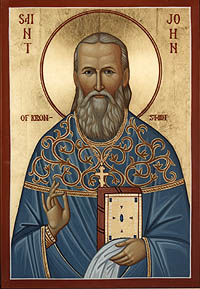
Troparion of St John of Kronstadt Tone 4
With the Apostles thy message has gone out to the ends of the world,/ and with the Confessors thou didst suffer for Christ;/ thou art like the Hierarchs through thy preaching of the Word;/ with the Righteous thou art radiant with God's grace./ The Lord has exalted thy humility above the heavens/ and given us thy name as a source of miracles./ O wonderworker living in Christ forever,/ have mercy on those in trouble/ and hear us when we call to thee with faith, O our beloved shepherd John.
Another Troparion of St John of Kronstadt (composed by Archbishop Maximovich of San Francisco) Tone 4
O Wonderworker living in Christ forever,/ with love have mercy on those in danger;/ hear thy children who call upon thee with faith;/ be compassionate to those who hope for aid from thee,/ O Father John of Kronstadt, our beloved shepherd.
Kontakion of St John of Kronstadt Tone 4
Thou wast chosen by God in infancy/ and in childhood received the gift of learning./ Thou wast called to the priesthood in a vision during sleep/ and didst become a wonderful shepherd of Christ's Church./ Pray to Christ our God/ that we may all be with thee in the Kingdom of heaven,/ O Father John, namesake of grace.
From a life of St. John:
Born in 1829 from pious parents of very modest means, St. John was quick to learn the power of prayer. As a child he was a slow learner, but one night after fervently praying for God's help in his studies, he suddenly felt as if he were violently shaken, as if "the mind opened up in his head." From then on he became a good pupil, graduating at the head of his class. He went on to seminary in St. Petersburg where he began to prepare for missionary activity in Siberia and Alaska. But in a dream he saw himself as a priest in a large cathedral and soon thereafter he married and was ordained and appointed to serve in the St. Andrew Cathedral of Kronstadt--the very cathedral which had appeared in his dream. Kronstadt was a port city full of poverty, drunkenness and immorality. It was here that Father John poured out his compassionate love and began his extraordinary ministry founded on prayer. Literally thousands, including Jews and Moslems, flocked to him for spiritual and material aid and were witnesses to his God given powers of healing, spiritual discernment and prophecy. His genuine Christian love brought many to repentance and conversion and the cathedral which held up to 5,000 people was packed every day for Divine Liturgy. He died Dec. 20, 1908, and his funeral, attended by tens of thousands, conveyed that radiance of Paschal joy which constantly shone upon the face of Father John whom many affectionately called, the "Easter batiushka".
From a life by Blessed Seraphim Rose:
In her canonization and glorification of St. John of Kronstadt, the Russian Orthodox Church Abroad not only confirms for her own faithful the sanctity of their beloved and venerated pastor and father, but now holds up his holy example of a life in Christ for the whole world to see. Up to this time, one might say, he has belonged to the Orthodox Russian people. Few outside of faithful Russians have been aware of the last flowering of Holy Russia, of the profoundest Orthodox spirituality that occurred just before the Revolution; St John was the most fragrant blossom of this flowering. In his life of asceticism and constant prayer, in the spiritual care he devoted to the thousands and millions of Orthodox believers who comprised his flock, and above all in the untold miracles he worked during his own lifetime and after his death, miracles which continue to the present day, - St. John is revealed to be beyond doubt one of the greatest of Russian and, indeed, of all Orthodox Saints.
This great Saint has had a special role to play in the life of the Orthodox Russian people. He was a prophet who foresaw the fall of the Russian Empire and the exile of the Russian faithful. Seeing the spiritual cause of this fall in the worldliness and lack of living faith that were so widespread in the last days of the Empire, he called Orthodox faithful to repentance and renewed awareness of their Christian vocation and responsibility. His appeal is still heard today, and if the Orthodox Russian people dispersed in exile throughout the world are still faithful to Holy Orthodoxy – even if only a small remnant – it is in part due to his still-living example and his holy prayers.
But now St. John, while remaining the spiritual patron of the suffering Russian people, has become a Saint of the universal Orthodox Church of Christ. It is no accident that his canonization has taken place outside of Russia, in the still free world into which he foresaw that the Russian people would be sent, and in which Orthodox churches would be erected, as a testimony of Christian Truth before a world that is, despite its pretensions, unbelieving. To this unbelieving world, in all the languages in which his words have been and will yet be translated, he now speaks the same message that he spoke to the Russian people in his own lifetime. This world, with its imposing outward structure that makes it seem to some so secure, is actually tottering, its foundation rotting away from the self-love and unbelief with which it is filled. Its fall is at hand, and the same godless beast that once swallowed the holy Russian land now stands ready to devour the rest of the world and complete his aim to exterminate the last Christians and lead apostate humanity in its worship of Antichrist.
This, perhaps, is what lies before us if we do not return to the path of a righteous Christian life. There are some who would consider such thoughts of the imminent Second Coming of Christ and the terrible Last Judgment, of which St. John constantly reminded us, to be too “negative.” But if his warnings were correct, then we have to fill our hearts not with fear and terror, but with tearful repentance, with zeal to lead a truly Christian life, and with fervent hope of attaining the Kingdom of Heaven, which is our true home.
It is to nothing but a genuine and profound Christian faith that St. John calls us. In an age when too many pastors preach a “new Christianity” that is only worldliness in disguise, his is a rare and much-needed voice – not for Russians alone, not for Orthodox Christians alone, but for the whole world, if it will but listen.
O holy Saint of Christ, John of Kronstadt, pray to God for us!
As may be guessed, St. John is a very popular saint, and there are many accounts of his life:
Life of St. John of Kronstadt (a full multi-part reading)
Saint John of Kronstadt by Bishop Alexander (Mileant), translated by Marina Vraciu/ Seraphim Larin (a full multi-part reading)
A Spiritual Portrait of Saint John of Kronstadt
And if you wondered what it was like to make Holy Confession with Saint John of Kronstadt, you can go here.
And here is a preparation for confession by St. John.
Bishop Kallistos Ware has an article on confession and St. John.
October 18, 2004
The Election Debates in Terms of Viewership
The viewership for the presidential debates this year was nothing short of phenomenal: Between all three debates more than 157 million people watched the presidential debates; throw in the vice presidential debate and you have more than 200 million viewers.
First Presidential Debate: 62.5 million (46.6 million for Bush v. Gore 2000 first debate)
Vice Presidential Debate: 43.6 million (28.5 million for Cheney v. Lieberman 2000 Debate)
Second Presidential Debate: 46.7 million--and this was a Friday night! (37.6 million for Bush v. Gore 2000 second debate)
Third Presidential Debate: 51 million (37.7 million for Bush v. Gore 2000 third debate)
Clearly people understand the importance, from a human perspective, of this election.
October 17, 2004
The Holy Fathers of the Seventh Ecumenical Council
Troparion Tone 8
Glorious art Thou, O Christ our God/ Who hast established our holy fathers as stars on earth./ Through them Thou dost guide us to the True Faith./ O Most Merciful One, glory to Thee.
Kontakion Tone 8
The preaching of the Apostles and the doctrine of the Fathers confirmed the one faith in the Church./ In the garment of truth woven from theology on high she rightly divides and glorifies true piety.
Another Kontakion Tone 2
The Son Who shone from the Father/ was ineffably born in two natures of a woman./ We do not deny the image of His form/ but depict it piously and revere it./ For this cause the Church, holding the true Faith,/ kisses the icon of Christ's Incarnation.
From Orthodox Online:
"Sir, Whose image is this?"
"It is mine," answered the emperor. Then Stephen, a monk, threw the coin on the ground and stepped on it. He was seized by imperial guards and taken away to be punished.
"Remember this!" cried Stephen as he was being led away. "If I am punished for dishonoring the image of an earthly king, what punishment do they deserve who burn the icon of Christ!"
An excerpt from the decree from the Seventh Ecumenical Council:
We, therefore, following the royal pathway and the divinely inspired authority of our Holy Fathers and the traditions of the Catholic Church (for, as we all know, the Holy Spirit indwells her), define with all certitude and accuracy that just as the figure of the precious and life-giving Cross, so also the venerable and holy images, as well in painting and mosaic as of other fit materials, should be set forth in the holy churches of God, and on the sacred vessels and on the vestments and on hangings and in pictures both in houses and by the wayside, to wit, the figure of our Lord God and Saviour Jesus Christ, of our spotless Lady, the Mother of God, of the honourable Angels, of all Saints and of all pious people. For by so much more frequently as they are seen in artistic representation, by so much more readily are men lifted up to the memory of their prototypes, and to a longing after them; and to these should be given due salutation and honourable reverence, not indeed that true worship of faith which pertains alone to the divine nature; but to these, as to the figure of the precious and life-giving Cross and to the Book of the Gospels and to the other holy objects, incense and lights may be offered according to ancient pious custom. For the honour which is paid to the image passes on to that which the image represents, and he who reveres the image reveres in it the subject represented. For thus the teaching of our holy Fathers, that is the tradition of the Catholic Church, which from one end of the earth to the other hath received the Gospel, is strengthened. Thus we follow Paul, who spake in Christ, and the whole divine Apostolic company and the holy Fathers, holding fast the traditions which we have received. So we sing prophetically the triumphal hymns of the Church, "Rejoice greatly, O daughter of Sion; Shout, O daughter of Jerusalem. Rejoice and be glad with all thy heart. The Lord hath taken away from thee the oppression of thy adversaries; thou art redeemed from the hand of thine enemies. The Lord is a King in the midst of thee; thou shalt not see evil any more, and peace be unto thee forever."
[Note: the full decree follows below.]
The Decree of the Holy, Great, Ecumenical Synod, the Second of Nice:
The holy, great, and Ecumenical Synod which by the grace of God and the will of the pious and Christ-loving Emperors, Constantine and Irene, his mother, was gathered together for the second time at Nice, the illustrious metropolis of Bithynia, in the holy church of God which is named Sophia, having followed the tradition of the Catholic Church, hath defined as follows:
Christ our Lord, who hath bestowed upon us the light of the knowledge of himself, and hath redeemed us from the darkness of idolatrous madness, having espoused to himself the Holy Catholic Church without spot or defect, promised that he would so preserve her: and gave his word to this effect to his holy disciples when he said: "Lo! I am with you always, even unto the end of the world," which promise he made, not only to them, but to us also who should believe in his name through their word. But some, not considering of this gift, and having become fickle through the temptation of the wily enemy, have fallen from the right faith; for, withdrawing from the traditions of the Catholic Church, they have erred from the truth and as the proverb saith: "The husbandmen have gone astray in their own husbandry and have gathered in their hands nothingness," because certain priests, priests in name only, not in fact, had dared to speak against the God-approved ornament of the sacred monuments, of whom God cries aloud through the prophet, "Many pastors have corrupted my vineyard, they have polluted my portion."
And, forsooth, following profane men, led astray by their carnal sense, they have calumniated the Church of Christ our God, which he hath espoused to himself, and have failed to distinguish between holy andprofane, styling the images of our Lord andof his Saints by the same name as the statues of diabolical idols. Seeing whichthings, our Lord God (not willing to behold his people corrupted by such manner of plague) hath of his good pleasure called us together, the chief of his priests, from every quarter, moved with a divine zeal andbrought hither by the will of our princes, Constantine and Irene, to the end that the traditions of the Catholic Church may receive stability by our common decree. Therefore, with all diligence, making a thorough examination and analysis, and following the trend of the truth, we diminish nought, we add nought, but we preserve unchanged all things which pertain to the Catholic Church, and following the Six Ecumenical Synods, especially that which met in this illustrious metropolis of Nice, as also that which was afterwards gathered together in the God-protected Royal City.
We believe ...life of the world to come. Amen.1
We detest and anathematize Arius and all the sharers of his absurd opinion; also Macedonius and those who following him are well styled "Foes of the Spirit" (Pneumatomachi). We confess that our Lady, St. Mary, is properly and truly the Mother of God, because she was the Mother after the flesh of One Person of the Holy Trinity, to wit, Christ our God, as the Council of Ephesus has already defined when it cast out of the Church the impious Nestorius with his colleagues, because he taught that there were two Persons [in Christ]. With the Fathers of this synod we confess that he who was incarnate of the immaculate Mother of God and Ever-Virgin Mary has two natures, recognizing him as perfect God and perfect man, as also the Council of Chalcedon hath promulgated, expelling from the divine Atrium [aulhj] as blasphemers, Eutyches and Dioscorus; and placing in the same category Severus, Peter and a number of others, blaspheming in divers fashions. Moreover, with these we anathematize the fables of Origen, Evagrius, and Didymus, in accordance with the decision of the Fifth Council held at Constantinople. We affirm that in Christ there be two wills and two operations according to the reality of each nature, as also the Sixth Synod, held at Constantinople, taught, casting out Sergius, Honorius, Cyrus, Pyrrhus, Macarius, and those who agree with them, and all those who are unwilling to be reverent.
To make our confession short, we keep unchanged all the ecclesiastical traditions handed down to us, whether in writing or verbally, one of which is the making of pictorial representations, agreeable to the history of the preaching of the Gospel, a tradition useful in many respects, but especially in this, that so the incarnation of the Word of God is shown forth as real and not merely phantastic, for these have mutual indications and without doubt have also mutual significations.
We, therefore, following the royal pathway and the divinely inspired authority of our Holy Fathers and the traditions of the Catholic Church (for, as we all know, the Holy Spirit indwells her), define with all certitude and accuracy that just as the figure of the precious and life-giving Cross, so also the venerable and holy images, as well in painting and mosaic as of other fit materials, should be set forth in the holy churches of God, and on the sacred vessels and on the vestments and on hangings and in pictures both in houses and by the wayside, to wit, the figure of our Lord God and Saviour Jesus Christ, of our spotless Lady, the Mother of God, of the honourable Angels, of all Saints and of all pious people. For by so much more frequently as they are seen in artistic representation, by so much more readily are men lifted up to the memory of their prototypes, and to a longing after them; and to these should be given due salutation and honourable reverence (aspasmon kai timhtikhn proskunh-sin), not indeed that true worship of faith (latreian) which pertains alone to the divine nature; but to these, as to the figure of the precious and life-giving Cross and to the Book of the Gospels and to the other holy objects, incense and lights may be offered according to ancient pious custom. For the honour which is paid to the image passes on to that which the image represents, and he who reveres the image reveres in it the subject represented. For thus the teaching of our holy Fathers, that is the tradition of the Catholic Church, which from one end of the earth to the other hath received the Gospel, is strengthened. Thus we follow Paul, who spake in Christ, and the whole divine Apostolic company and the holy Fathers, holding fast the traditions which we have received. So we sing prophetically the triumphal hymns of the Church, "Rejoice greatly, O daughter of Sion; Shout, O daughter of Jerusalem. Rejoice and be glad with all thy heart. The Lord hath taken away from thee the oppression of thy adversaries; thou art redeemed from the hand of thine enemies. The Lord is a King in the midst of thee; thou shalt not see evil any more, and peace be unto thee forever."
Those, therefore who dare to think or teach otherwise, or as wicked heretics to spurn the traditions of the Church and to invent some novelty, or else to reject some of those things which the Church hath received (e.g., the Book of the Gospels, or the image of the cross, or the pictorial icons, or the holy reliques of a martyr), or evilly and sharply to devise anything subversive of the lawful traditions of the Catholic Church or to turn to common uses the sacred vessels or the venerable monasteries,2 if they be Bishops or Clerics, we command that they be deposed; if religious or laics, that they be cut off from communion.
[After all had signed, the acclamations began (col. 576).]
The holy Synod cried out: So we all believe, we all are so minded, we all give our consent and have signed. This is the faith of the Apostles, this is the faith of the orthodox, this is the faith which hath made firm the whole world. Believing in one God, to be celebrated in Trinity, we salute the honourable images! Those who do not so hold, let them be anathema. Those who do not thus think, let them be driven far away from the Church. For we follow the most ancient legislation of the Catholic Church. We keep the laws of the Fathers. We anathematize those who add anything to or take anything away from the Catholic Church. We anathematize the introduced novelty of the revilers of Christians. We salute the venerable images. We place under anathema those who do not do this. Anathema to them who presume to apply to the venerable images the things said in Holy Scripture about. idols. Anathema to those who do not salute the holy and venerable images. Anathema to those who call the sacred images idols. Anathema to those who say that Christians resort to the sacred images as to gods. Anathema to those who say that any other delivered us from idols except Christ our God. Anathema to those who dare to say that at any time the Catholic Church received idols.
Many years to the Emperors, etc., etc.
October 15, 2004
Thoughts on God and Free Will
The following excerpts are from comments I've posted on the atheist/antiChristian message board I've mentioned in an earlier post. They have mainly to do with God, suffering and freewill. But since they deal with omniscience, omnipresence and omnipotence, they also have to do with space, time, and the nature of God (an essence or a person?). The comments are excerpted from a couple of different message threads, so there's little continuity between excerpts, and some repetition.
But I thought I'd offer them for your review and comment.
On omnipotence and free will:
There is no logical necessity, or contradiction, between omniscience, omnipotence and free will. Omnipotence, for example, does not necessitate that one always exercise omnipotence. One may, indeed, refrain from using one's power. If one MUST always use one's omnipotence, then, by definition, one is not omnipotent. In other words, precisely because one is omnipotent, one may refrain from using one's power.
Omniscience in no way precludes free will, either. To deny free will, omniscience must be combined with omnipotence (an omnipotence which must always be used). But as we've seen there is no logical necessity that omnipotence must always be used.
On what is properly basic to God, essence or personhood:
Strictly speaking, in Christian theology, it is not proper to posit a philosophical category (immutability) in place of a person. That is to say, what is "essential" as it were to God is personhood, not any sort of quality. God does not change in terms of personhood, but whether and to what degree God does engage in any other sort of change (not in terms of mutability), is debated.
On God's omniscience and on time:
First of all, you have to determine how it is that God knows the future. He clearly does not know it in the way we do, since we are temporal beings and cannot but exist in time. God, being eternal, which is to say, ex-temporal, or outside time, knows our future in a way we do not. We experience time in only a linear way. But if God is outside time, he experiences all time as present, as it were; as if it were happening now. (These are temporally-founded expressions so can only approximate what God's experiencing of time actually is.) And if the "non-temporal now" that God knows (which is our future) is the arena in which we exercise our choice, then clearly God's knowing of the future does not eliminate our free will.
On whether God must act in terms of his essence, or is a free person who acts as he will:
I would say that the Christian God is not jealous, spiteful, etc. Whether or not he can be these things, in terms of whether he can freely choose to do or be these things, is nonsensical if he is the sort of person who does not do these things. In other words, he is not precluded from doing these things simply on the basis of free will consideration. Rather it is the sort of person he is that is under consideration. The Christian claim is that all God's acts are love. That all he does is holy. That everything he says is true. But we do not say such things as God must love because it is his nature so to do, that he must act in holy ways, or that he cannot but speak truth. Though these claims are, in certain ways true, they are misleading because they presuppose that his nature is more fundamental than his personhood. But in point of fact, for Christians, the personhood of God is the basic reality of the Godhead.
On God's omnipotence and whether he acts only in special circumstances in this world, or always acts in this world:
But understand, I'm not denying that there are real "natural laws" in the universe. I'm not denying the law of gravity. But neither am I denying the miraculous, which you are required to do by your presuppositions. In other words, yours is a case of special pleading, whereas mine does not seek to make any exceptions as yours does.
That is to say, the Christian understanding of God's activity in the world is that it is always ongoing at every moment. Thus miracles, though they are in seeming contradiction to observable natural causes and effects, are not special instances of actions that God does, while the rest of the time he's off doing whatever it is that God is doing. On the contrary, the Christian understanding is that the universe always has God's special attention: he ensures the orderly processes that sustain human life and strethces out the galaxies, as well as acting in ways that are "exceptional" (from our perspective) to those processes (what we call miracles). He is not some deist watchmaker, but is, in fact, the consummate lover of all such that his care and attention is always in love directed toward that which he has made.
On whether creating humans with freewill is compassionate and loving or not:
Well, since Christians (among others) believe in free will, that God created it as a fundamental human reality and works to preserve and honor that freedom, then it would be contradictory to who God is to force people to believe in him and that what he has done is indeed his work. If you think not having free will is a better world you're free to argue it. But then if you really believed it, you wouldn't argue it. It would be pointless to do so.
On whether suffering is pointless:
You characterize rape as pointless suffering. You are right that it is suffering. It is evil. Is it pointless? No. How could any of us ever say that such a deep and violating evil such as rape causes a suffering that is pointless? To do so is to say of the victim that she is incapable of rising above the evil that has happened to her. You reduce and minimize her humanity at the expense of proving a philosophical point of injustice. Suffering at the hands of evil and injustice should never ever--in my opinion and according to the theology of the Church--be explained by whatever effects or results it may engender, no matter how noble or positive. This sort of suffering is evil and unjust. Full stop.
But then to conclude from that that the humans who suffer these things are incapable of overcoming that suffering through their inherent worth and nobility as made in God's very image--that is also truly evil.
In other words, the Christian view is that not even evil and injustice can overcome Christ's love and the power of God. In the face of radical nothingness and insatiable evil, the Christian can know and experience the reality that suffering is not the final word.
And from that standpoint, suffering is never pointless.
On freewill and suffering:
But if you don't believe in free will, then you don't believe in evil and injustice, and therefore don't believe in suffering. If it is all cause and effect, then our moral evaluations of pain and actions are merely effects of other causes and have no intrinsic meaning. Indeed, not only can you not escape not believing in God, neither can I escape believing in him. Let's turn out all the prison inmates, let's allow more Islamic terrorist beheadings, let's let be what will be, since it's all determined cause and effect, and nothing we can really choose to do anyway.
Your position is nonsensical in the truest sense.
More on freewill and God:
I note here, then, that you have failed to address the issue of co-free will. God has free will, and in creating beings like himself (angels and humans) did so such that they, like him, had free will. You may well note that God, in his foreknowledge, could have foreseen that evil would occur as the result of misuse of the free will he'd given creatures he'd made like ourselves. But you have not proven that foreknowledge necessarily entails the negating of free will.
You also claim that since God foreknew that humans would sin, he could have saved himself the trouble and eliminated free will such that humans could never do anything but the good that God himself always willed. But this effectively eliminates any sort of sentience which eliminates any sort of actual relationship.
The picture you paint of God is a picture not even deserving of attributing to my one-year old daughter. God would not only be less than childish, in your view, he would effectively demonstrate his powerlessness. The Christian view of God keeps in perfect tension God's omnipotence, his foreknowledge and his love.
In your view, humans would be nothing better than automatons. You seem to prefer the fact that in your conception you would be incapable of sentience, incapable of anything but enslavement to your drives and needs. Granted, in the perfect world you've mentioned, you wouldn't hunger. But neither would you think. How could you, your entire being would be subsumed under the domination of forces you can neither control or understand, but could only obey. You would have no capacity to relate to God, of course, because you could not exercise love, which demands free will. But you would also have no relationship with anyone else.
In short, everything you now value you could not enjoy, because you would not have free will. All you could do is experience them. You could not enjoy them because you would have no contrary against which to judge them. Indeed, you could not judge them at all. Because your will would not be free. And if your reaction to something MUST be, you cannot truly be said to enjoy it. It would be an automatic response.
And this is a better world, you think?
No, the Christian view notes that it is precisely the gift of free will (in humans) that both causes injustice AND enables humans to fight injustice. Indeed, your free will is the very basis of your umbrage at what you take the christian position to be. Without free will, you would have no ability to either resist the umbrage you would feel, or, conversely the satisfaction you would feel, and without the ability to resist the impulse you could not judge which would be better.
On God and time:
Since God does not experience time as we do, to speak of God's knowing of his action beforehand is a bit misleading. God's knowing and willing are the very same act, at least speaking in terms of temporal events. Indeed, for God, willing and acting are the same event. Or at least there is no inhibition of his will. Everything he wills to do, he does; thus his will is both free and omnipotent. Everything he knows he knows as present to himself, and all his knowing is unfrustrated, uninhibited. If he knows it, it is. But this knowledge is simultaneous with the reality of what it is that God knows. Thus he knows, for example, whether or not I will die in the faith. For me, this is an unknown. It is hidden. But God knows it. And since his knowing of it is simultaneous with it's reality, then it is the case both that I freely exercise my will in the moment of my action and that God knows I have so willed and acted in the moment I do so. It is not as though God were ignorant of my act until I do it, because for him this knowledge is always now a reality. But by the same token, he does not know it prior to my willing and acting it in such a way as to determine it, because the reality of it happens in the moment in which I will and act. A moment that is always present to god, but is, for now, a moment hidden to me.
On freewill, time and atemporality:
Free-will exists in a temporal space: I'm not sure that it is the case that free will must be limited to temporal conditions. If free-will is the choice between two or more options, then why must time be a necessary condition for such a choice? That it inescapably is for humans, sure. But unless you can tie a logical necessity between choosing and time, you are merely asserting a proposition which is debatable.
Furthermore, if it is the case that freewill must demand a temporal locus, then in an atemporal locus, it is not the case that a divine and eternal being would not have freewill, only that it wouldn't make sense to speak of freewill as attributed to a divine being. In other words, while it would be true that one could not ascribe freewill to such a being, it would also be true that one could not deny freewill to such a being. Neither assertion would make sense since an atemporal divine being would necessarily not be subject to any assertions about a temporally-located freewill.
But what one could determine about a divine being is if there were any constraints on such a being such that in a given scenario an atemporal being could not but think/act in a specific way. Some conceptions of God do in fact posit such a thing: that God must necessarily be utterly good and act in good ways, that such a being must necessarily be all-powerful and act in omnipotent ways, and so on. But the Christian conception of God rejects such descriptions since for the Christian God is not a sum of attributes or traits but is fundamentally a person. If God is determined in anyway it is that he is a person, but as a person he can think and act in whatever way as a person he chooses so to do. What we say about God's attributes and traits--that he is good, all-powerful, and so on--are a result of a personal experience (note: I do NOT mean an individual experience) of who God is and how he acts and the thoughts he articulates to us. That is to say, we do not come to know these traits by rational cognition primarily but rather by personal (not individual) experience.
More on God and time:
If one posits that there is a reality which is throughly located in time (as you do), it is not necessary to conclude that all reality is so located. If God is the sort of person Christians claim him to be, then his is a reality that is outside time. But if that is the case, this does not eliminate the temporal experience, but rather that God is not limited by that experience. For God, then, all things are seen, as it were, as simultaneously present (though to speak of God's reality in temporal terms is admittedly to speak only by analogy).
On God, acting and thinking, and atemporality:
For humans, we can only know decision making and action in temporal terms. But Christians understand their God to both think and act simultaneously. From a human perspective, God's acts unfold in time. We do not know how God's acts unfold for him.
But it is not necessary to assume sequence as limited to time. Though in an atemporal sequence there is no time between one thing and another in the sequence, but just because this happens atemporally it does not mean it cannot happen sequentially. It's just that the sequential events happen as though it were simultaneously. by way of analogy, one may point to conception: at the moment of conception other things that will unfold in time have already become fact: hair and eye color, sex, and so forth. From a temporal perspective, these attributes only develop sequentially in time. But from the standpoint of the makeup of the person, it has already happened simultaneous with the coming into being of the person. (I grant you this is an imperfect illustration, but it gets at what I'm trying to communicate.)
On God's extratemporality:
On the contrary, if God created all that is, as the Christian view asserts, then God created time and can do with it as he will. But as the creator of time his person is not bound by time. He can cross into time at will. In fact, the Christian view is that he has done and is doing so, most quintessentially in the Incarnation.
On God, time and place:
It doesn't seem to me to be logically necessary to posit a place that exists outside time. Indeed, if place involves extension and magnitude, even in nonmaterial ways, thus extrauniversal, it would seem to follow that space and time are also necessary, even if space and time as applied to these nonmaterial, extrauniversal "places" were of a fundamentally different character than is the space and time we experience.
Rather, it seems that all one needs to say is that the Christian God is a person who is extrauniversal and who is extra-temporal. God, in his essence, has no extension or magnitude, and therefore space and time, even the extrauniversal nonmaterial sort I posit above, do not properly apply to God. It thus becomes nonsensical to ask "Where" God is, since God, having no extension or magnitude, is nowhere, in terms of place. But if God is nowhere, then place does not properly apply, and therefore all wheres, just as all times, are present to him. Only in this way can he be omnipresent. And being thus omnipresent he can observe all things (past, present and future to us) as eternally now.
October 14, 2004
The "Debate" III
The watching of this debate was made much more enjoyable by the gracious presence of my liberal friend, Tripp, and my Democratic friend, Justin. Anna missed most of the debate because she had a meeting with fellow children's book writers and illustrators in Wilmette. That left me car-less at home with Sofie. And Tripp and Justin decided to crash the party. I'm glad they did.
Well, you'll notice the quotation marks went back up in the post title. Geez. Back to talking points. Back to scripts. Back to little actual exchange. All the debates should have been townhall meeting style.
Kerry remained consistent both in his debating ability and in his dogged determination to not say anything new. One mercy: we only heard "I have a plan" a few times. His debate coach must have threatened to take away his snowboard if he said it more than five times. "Senator Kerry!" "Reporting for duty, sir!" "How many times did you say you had a plan?" "Seven times, sir!" "Drop and give me twenty!" "Sir, yes, sir!" If it's losing ground in a debate to go back and answer a previous question or respond to a previous attack, then Kerry, though consistent, wasn't as good as in the first debate, though he was a bit better than the second. Still, it was all rerun. Nothing knew. He did get the Soprano soundbyte in, but I don't think it will play that well, since it's a bit too-cliched and doesn't speak to any specific thing.
Bush was definitely better in this debate than the first, and, having thought about it, was better in style than the second debate. I still think Bush was better in substance in debate two, but in this third debate he was not only self-possessed (style), he had the facts and figures and direct responses to Kerry he couldn't seem to must in debate one. And Bush definitely landed more substantive soundbytes. They were both memborable and specific. My favorite: "A plan is not a litany of complaints. And a plan is not to lay out programs you can't pay for." Unfortunately, his coaching on job questions was blindingly evident: "Don't talk about jobs, talk about education." I thought that this, though a valid point to make, was a big loss of opportunity for Bush. The actual economic figures are robust and good, despite some areas of concern. Unemployment is the lowest it's been in some time even if the jobs being created are not as many in bulk as in other fiscal periods. Further, I think Bush should have touted the mistaken basis for the jobloss claim: the report only focuses on employer payroll, it doesn't focus on entrepeneurial job creation (small-business, and home-based work). I don't have actual figures to hand, but these numbers are solid. And these numbers play to the middle class where the jobless numbers have hit.
Be that as it may, neither candidate did as well as in the two previous debates. Kerry was best in debate one; Bush in debate two. Last night, Kerry looked tired, almost as if even he no longer believed he had "the plan." Bush looked invigorated and controlled, but missed some opportunities to tamp down Kerry. But given that the DNC was saying Kerry would mop the floor with Bush . . . um, I'm going to have to dock Kerry points. Bush did better than expected, but not as well as hoped.
Immediately after the debate, my gut instinct was to say that Kerry had won the debate. Tripp didn't think so. I can't remember whether Justin voiced his opinion on the winner, but I would guess he would argue for a Kerry win. After thinking about it, I wondered if last night wasn't a draw.
But then I got to thinking in terms of perception. Bush got schelacked in the first debate. Then came back and gave what for in debate two. Last night was Kerry's to end with on a dominant note and in his supposedly stronger area. It was his to end with: leave the American people with an image that could counter the coming attacks and could build a lead in the polls. I don't think he did that. I think the game stayed even, which leaves the Bush team openings for more hammering. I may be wrong in this, but I don't think Kerry will build a solid gain and maintain a lead out of this. He may get a little bump, as he did after the first debate. But that bump returned to the status quo fairly quickly. And the remaining three weeks is a long time.
So, with these additional considerations in mind . . . 2004 Presidential Debates: Kerry 1, Bush 2. See you at the polls on 2 Nov.
October 13, 2004
Father Seraphim Books
Yesterday, I received in the mail the four books I'd ordered from St. Herman Press, all by my patron, Father Seraphim Rose:
The Soul After Death
The Place of Blessed Augustine in the Orthodox Church
God's Revelation to the Human Heart
Orthodoxy and the Religion of the Future
I've read all these before (see list below), having checked them out from the libraries at the seminary or Loyola, but got some birthday money last month, and had just enough to order these four books and pay for shipping, so I decided to add them to my home collection. (They're also all in newer editions than the ones I've read, so they have extra material I'd like to read, too.)
Although Blessed Seraphim's list of authored books is relatively finite, as can be seen from the list below, his list of translated books is relatively larger. What makes these translated books valuable is not just the translation of previously unavailable texts, but Father Seraphim's godly-wise introductions.
A case in point. I'm currently re-reading the out-of-print Vita Patrum: The Life of the Fathers, a translation of a portion of a work by St. Gregory of Tours (historian of the Franks). (By the way, it is currently in revision and soon to be republished under the title Western Orthodox Roots.) The first one-hundred-fifty pages are a detailed introduction by Father Seraphim on monasticism in fifth and sixth century Gaul, and its relevance to modern Orthodox Christianity. Clearly, Father Seraphim's introductions are important works in their own right.
In any case, I remember reading the books listed above, particularly Orthodoxy and the Religion of the Future and The Soul After Death, and being a bit mystified by them. Keep in mind that this was early on in my intensive investigations into Orthodoxy. On the one hand, much of what they said I could definitely agree with. The dangers of occultism and the lifting up of religious experience over dogma. The necessity of sobriety about one's own death. But there were other teachings of ancient Christianity that struck me as, well, frankly, weird. Prelest, or spiritual delusion, and the necessity to focus on religious struggle. The reality behind the metaphor of the toll-houses.
But recently I reread Father Seraphim's Nihilism, as I commuted on the bus. I also remember my first experience with this book, and coming at it from a philosophical perspective. I thought, "Father Seraphim doesn't understand the philosophers he's criticizing." But now I've got more than a year of Divine Liturgies under my belt, and something like a discipline of daily prayer. I also am more grounded in my academic discipline. So when I came to Nihilism again, I thought, "Man, Blessed Seraphim is dead on."
It was partly as a result of that experience that motivated me to go ahead and purchase these books so I can more receptively take in the godly insights of this saint.
So, although I should have dutifully plowed through "Observing Reason" in Hegel's Phenomenology of Spirit on the commute this morning, instead I pulled out God's Revelation to the Human Heart and read the first section. I was almost in tears. (I'm very emotional of late. What's up with that?) Father Seraphim indeed spoke the truth, a truth he both knew personally and struggled through suffering to know.
Blessed Seraphim, our father in the faith, pray for us.
Works written or translated by, or biographies of, Blessed Seraphim and when I read them:
1. The Soul After Death (November 02 and October 04)
2. God's Revelation to the Human Heart (November 02 and October 04)
3. Heavenly Realm (December 02)
4. [Tr] A Treasury of St. Herman's Spirituality (Little Russian Philokalia v. 3) (December 02)
5. The Place of Blessed Augustine in the Orthodox Church (January 03 and October 04)
6. [Tr] St. Seraphim of Sarov (Little Russian Philokalia v. 1) (January 03)
7. Orthodoxy and the Religion of the Future (February 03 and October 04)
8. [Tr] Vita Patrum: The Life of the Fathers (February 03 and December 04)
9. [Tr] On the Orthodox Veneration of Mary the Birthgiver of God (February 03 and October 04 and October 04)
10. [Bio] Not of This World (October 02-March 03)--Purchased 30 May 03* [Cf. this post here as to why this purchase is significant.]
11. [Tr] The Apocalypse in the Ancient Teachings of Christianity (May 03)
12. Nihilism (July 03 and October 04)
13. [Tr] Orthodox Dogmatic Theology (July 03)
14. [Tr] First-Created Man (July 03)
15. Genesis, Creation and Early Man (August 03)
16. [Tr] Guidance Toward the Spiritual Life (September 03)
17. [Bio] Father Seraphim Rose: His Life and Works (September-December 03 and September-November 04)
18. Letters from Father Seraphim (December 03 and January 05)
19. [Bio] Seraphim Rose: The True Story and Private Letters (March 04 and July 05)**
20. Blessed John the Wonderworker (March 04)
21. [Tr] The Spiritual Life and How to Be Attuned to It (May 04)
22. [Tr] The Path to Salvation (June 04)
23. [Tr] The Northern Thebaid (July 05)
24. [Tr] Abbot Nazarius (Little Russian Philokalia v. 2) (September 05)
*Note: Not of This World is the first edition of Father Seraphim's biography. It was written at a time in the life of the St. Herman Brotherhood in which some problems in leadership in the brotherhood resulted in some regrettable decisions. The end of the book has almost nothing to do with the life of Father Seraphim, and is written to justify some of these questionable decisions. If one is interested in Father Seraphim's life, the second edition of his biography, Father Serpahim Rose: His Life and Works, is a very significant revision and should be considered the authoritative and trustworthy source.
**Note: Cathy Scott is a niece of the late Father Seraphim. Her biography, Seraphim Rose: The True Story and Private Letters was written to counter some of the things written and implied in Not of This World. Unfortunately, Ms. Scott's own biography is marred by her agenda, which includes the revelation early on in the book of Father Seraphim's homosexuality and his homosexual relationship of several years prior to becoming Orthodox, and the contradiction of a handful of points, such as whether and how often Father Seraphim bathed, which seem fairly petty. That Father Seraphim was gay is hardly a matter about which to be concerned; he repented of his behavior upon becoming Orthodox and led a celibate life till his death. But Ms. Scott gives almost no context for Father Seraphim's homosexuality, and seems to imply that Father Seraphim's conversion was an unhealthy one. The book focuses almost exclusively on Father Seraphim's life pre-conversion and on his early years as Orthodox. His life as a monk is given much less coverage. On the one hand, the details learned of Father Seraphim's early life are invaluable in the context of his whole life, especially, given today's obsession with sexuality issues, the revelation of Father Seraphim's life pre-conversion. But if Ms. Scott's book is read by itself, the picture of Father Seraphim one receives is severely distorted. One should read the second edition of Father Seraphim's biography prior to reading Ms. Scott's book.
The Fatherhood Chronicles XLIX
The following are some photos from our trip a week and a half ago to Goebbert's Pumpkin Farms.

Here's momma and Sofie looking at the chickens. Sofie was particularly enamoured of the lightning-quick chicks.

Me and Sofie with llamas. Sofie liked the llamas best of all. She likes big dogs--Jeff and Catherine's Sydney, Mitch and Denise's Zack--so I wonder if she thought they were unusually large dogs.
Yep. That's Sofie grabbing a teat. A fake one, to be sure. But we have another picture (not as good quality) that shows her squatted down both hands grabbing rubber teats and trying to milk. You go little farmgirl!

Sofie in the midst of a bunch of pumpkins.
This one makes me tear up especially. Sofie's getting independent, which means she's going to spend the next several years walking away from me. Sigh. It's necessary, I know, so that she can walk right back. But the walking away still doesn't feel all that good.
October 12, 2004
The Fatherhood Chronicles XLVIII
Playing Mr. Mom
I scheduled a vacation day today last week. I felt it would be good to have a whole day to spend grading final exams and final papers. But then reality stepped in.
Sofie got sick. She has a mild cold, which has her feeling poorly, but hasn't diminished her energy and enthusiasm too much. Pretty much the only difference is the snot faucet attached to her face, and the extra hugs and kisses she gives--she knows she's feeling bad and wants bunches of lovin' from momma and daddy.
I did get the final exams graded, but still have the papers to do. But those probably won't be touched till tonight. You see, it's a Mr. Mom day. Anna has seized the day with my being home and has left for a lunch date with a fellow children's author. I'm solo till she gets home.
It ain't too bad. I blessed Sofie with the cross today, and a little later she pointed to the icons and made kissing sounds. So we venerated the Theotokos and Jesus. She's learning to make the sign of the cross, though it's usually either the vertical motion or the horizontal. But she's starting to put it together. She puts her fingers together just like daddy and the other people at Church. That just amazes me: that she would notice such a detail as that.
Lunch went okay, though she is now proceeding to take all my books off the shelves--for the third time this morning. And all the toys are coming out of the toy box, off the shelves and out from other places. Once these get cleaned up this will be the fourth time. But she's dressed in her purple jogging suit. She's so dang cute there ain't no way I can get angry at her.
How do mommas handle these sorts of things? I don't know if I'm a typical dad or not, but I'm looking for order and discipline. From a fourteen-month old. Yep. I'm in a fantasy world.
Today ain't too bad, but I do have to say this: There's a song on the radio with a chorus that runs:
Well
Pampers melt in a Maytag dryer
Crayons go up one drawer higher
Rewind Barney for the fifteenth time
Breakfast six, naps at nine
There's bubble gum in the baby's hair
Sweet potatoes in my lazy chair
Been crazy all day long and it's only Monday
Mr. Mom
Today, I am sympathetic to those words. But it's the final bridge out that really expresses what I feel today:
Balancin' checkbooks, juggling bills
Thought there was nothing to it
Baby, now I know how you feel
What I don't know is how you do it
The full song:
Lost my job, came home mad
Got a hug and kiss and "That's too bad"
She said I can go to work until you find another job
I thought I like the sound of that
Watch TV and take long naps
Go from a hard-working dad to being Mr. Mom
Well
Pampers melt in a Maytag dryer
Crayons go up one drawer higher
Rewind Barney for the fifteenth time
Breakfast six, naps at nine
There's bubble gum in the baby's hair
Sweet potatoes in my lazy chair
Been crazy all day long and it's only Monday
Mr. Mom
Football, soccer and ballet
Squeeze in Scouts and PTA
And there's that shopping list she left
That's seven pages long
How much smoke can one stove make
The kids won't eat my charcoal cake
It's more than any man can take
Being Mr. Mom
Well
Pampers melt in a Maytag dryer
Crayons go up one drawer higher
Rewind Barney for the sixteenth time
Breakfast six, naps at nine
There's bubble gum in the baby's hair
Sweet potatoes in my lazy chair
Been crazy all day long and it's only Monday
Mr. Mom
Before I fall in bed tonight
If the dog didn't eat the classifieds
I'm gonna look just one more time
'Cause
Pampers melt in a Maytag dryer
Crayons go up one drawer higher
Rewind Barney for the eighteenth time
Breakfast six, naps at nine
There's bubble gum in the baby's hair
Sweet potatoes in my lazy chair
Been crazy all day long
Oh been crazy all day long and it's only Monday
Mr. Mom
Balancin' checkbooks, juggling bills
Thought there was nothing to it
Baby, now I know how you feel
What I don't know is how you do it
Lonestar, "Mr. Mom" (Note: The song plays when the link opens.)
October 10, 2004
The Holy Elder Ambrose of Optina

Troparion Tone 5
We run to the O Ambrose our Father,
as to a healing spring.
For thou dost truly instruct us on the path of salvation,
preserving us from misfortune and calamity by thy prayers,
consoling us in sorrows of body and soul,
teaching above all by humilty, patience and love.
Pray to Christ, the Lover of mankind, and to our Fervent Intercessor
that our souls may be saved.
Kontakion Tone 3
Having fulfilled the precepts of the Shepherd of shepherds,
thou didst inherit the grace of eldership,
having pity for all who run to thee with faith.
Therefore we, thy children, cry out to thee with love:
Holy Father Ambrose, pray to Christ our God that He would save our souls.
An account of his life:
On October 23rd (the 10th, old style) the Church commemorates the assembly of the holy Optina elders, and among them the holy elder Ambrose, who died on precisely that day in 1891.
The venerable Ambrose of Optina was born Alexander Grenkov in 1812, in the family of church sacristan Mikhail Grenkov. In his youth, while studying at the Tambov Theological Seminary, Alexander became terribly ill and gave a vow, if he regained his health, to enter a monastery. But becoming well, the lively and sociable youth did not hurry to fulfill his vow. However, new health problems reminded him of his promise, and in 1839 he entered the Optina Hermitage in the Kaluga province, becoming a disciple of the famous elder Leo. From him the young novice gained the experience of the great saints of antiquity in acquiring grace. In 1845 he fell prey to a new and severe illness, which because monk Ambrose’s cross to the end of his life. Soon he began to help the elder Macarius as a confessor, began to see people, to participate in the hermitage’s publishing efforts. After the repose of the elder, hieroschemamonk Macarius, in 1860, St. Ambrose became the brothers’ spiritual advisor.
Thousands of believers from all corners of Russia came to the clairvoyant elder for advice. He was visited and engaged in spiritual discussions by the writers Dostoyevsky, Solovyev, Leontyev, Aleksey Tolstoy, Leo Tolstoy… The venerable elder never allowed himself to say a vain or wrathful word, but spoke only for the purpose of correction or spiritual guidance. From the Lord he received the gifts of healing and clairvoyance. Never refusing to help those in need, the holy elder could appear to people who entreated him at a distance, in dreams and face-to-face. He became a great intercessor for the Russian people, having transformed thousands of human destinies by the grace of the Holy Spirit.
Saint Ambrose reposed on October 10, 1891 in the Shamordino convent which he had founded. His relics remain at the Optina Hermitage.
A more detailed life can be found here.
Another life can be found here.
A prophecy of Elder Ambrose can be found here.
A selections of letters of Elder Ambrose can be found here.
The book Elder Ambrose of Optina, can be obtained from St. Herman Press.
The Coherence of Christian Theology VI
The Incarnation and the Church
The Incarnation is not only the dogmatic center from which the spokes of the Trinity, union with God, and the Resurrection extend, but it is the doctrinal foundation of the Church as well. In fact, I do not think it too hyperbolic to state that ecclesiology is Christology. What we believe about the Church is, and ought to be, a reflection of our belief about Christ. And because the Incarnation is the foundation of our soteriology, what we believe about the Church will also reflect what we believe it means to be saved. That is to say, the doctrines about salvation and the Church are essentially linked to one another, in and through the dogma of the Incarnation.
The Church is Christ's Body. This is often thought of as a metaphor, a comparison between two different things. It is that. But the strength of such a comparison comes only from the reality it purports to limn. Or to say it another way, it only counts as a metaphor because it is true. But if the Church is Christ's Body it shares the same divine-human realities that Christ himself exhibits. If Christ is the theandros, the God-man, then the Church is similarly theandric, divine-human. If, in Christ's Person, the union of two natures was accomplished perfectly, so in the Church is the accomplishment of the union of the human and divine. If in the Person of Christ is the hypostasis which accomplishes the union of the human and divine, without separation, confusion, change or division, and if it is on this union that our salvation is predicated, then our incorporation into the Church is an experience of that hypostatic union, and it is only in the Church that we experience such a salvation.
This divine-human nature of the Church is often overlooked in our mostly Protestant and evangelical culture here in the U.S. Even the U.S. Roman Catholic Church, careful as is her theology, experiences the Protestant influence when her members feel free to hold their own contradictory opinions over the teaching of their church, or live lives in direct violation of her strictures, and still consider themselves members in good standing. (I'm too new to Orthodoxy to comment on Orthodox parish culture here in the U.S.) In many churches, then, on any given Sunday, the Church is not seen as a theandric entity, but rather as a fraternal organization: recite the pledge, pay your members' dues, vaguely own the organization's ethos, but pretty much do what you want, so long as you still get to call yourself "Brother So-and-so." And if ever the Church does or requires something you don't like, lobby to change it, or just leave and go elsewhere.
This is a focus on the human aspect of the Church, though a distorted one, but it completely misses, in an Arian-like heresy, that the Church is as divine as is her Head, the Lord Jesus. And in missing the divine nature it diminishes and distorts the human nature.
The reality is that the Church is a divine entity, while it is a human one. We human members of the Church do not contribute to it its divine element; we are incorporated into its divine life. It is true, that in God's unfathomable wisdom, we humans enter the Church still struggling with the sin and passions which continue to suffuse our persons. But our sinfulness does not diminish the divine reality of the Church. Rather the divine reality, if we freely struggle in concert with that reality, purges us of our sin. Indeed, the necessity of struggling against sin, as lived in our own specific particularities and under guidance of the Church, in the Church's priest or confessor, is part and parcel of being a member of the Church, for the characteristic facet of the life of the Church prior to the consummation is the struggle against sin and the enemies of God.
While the divine nature of the Church bestows upon her divine authority, and while that authority is worked out in the various institutional ways adapted to multiple times and cultures, the institution is not the primary structural form of the Church. If the Trinity is a relation of divine Persons, and if the incarnate Christ was the union of the divine and the human, then the primary structural form of the Church must be the family. God the Father is the heavenly patriarch of the Church, the Father who is iconized in the priest, for the priest (at the authorization of the bishop) is the human representation of Christ, and whoever has seen the Christ has seen the Father. The Churchly family then is one with authority, with hierarchy, but it is a divine-human one, one exercised in grace by faith. The Church is not a democracy, she has a Head, and that Head has given to his ministers authority to loose and to bind. But this authority is familial, so when the heads of the Church consult in council, their decisions are accepted by the faithful family. This is the manifestation of fatherly authority and is no autocracy, for the faithful family may say to her heads, "This is not of the apostles," and she has for not all councils are authoritative. But the Churchly family knows that authority nonetheless has been given and looks to her Bishops for the faithful transmission of the authentic mind and witness of the Church.
This familial, patriarchal mixing of the human and the divine then does not diminish that divinity, though the members of Christ's Body struggle always against their sins and passions, but rather, the divinity of the Church raises the human and deifies it. But this deification can only happen in the Church, for one becomes a Christian not as an orphan but as a newborn child into a large family. Only those certified as members of the family, through the apostolic authority and the grace of God in baptism and chrismation, can have confidence of their heritage. This does not eliminate the possibility, indeed the reality, that orphans have been, are, and will continue to be born to the Church, but these are known to God alone, and his dealings with them are subject to his discretion. One can say with certainty where the Church is, how far extends the familial boundaries. But one cannot so surely say where the Church is not, or what long-lost son or daughter will find their way home in the consummation.
So, the Church is life for us, because in the Incarnation the human is united to the divine, we are deified, and given a family with memories, heirlooms and names, all things which signify for us life. And if the Church is the locus of life and salvation through the Incarnation of our Lord Jesus Christ, then the Mysteries (or Sacraments) that it is hers to safeguard and to freely give, are another manifestation of the energetic grace of God and a means of our salvation.
October 09, 2004
The Debate II
The sickness continues. Anna and I watched the second installment of the presidential debates. This time, there was some actual direct exchange (thus the elimination of the quotes in the title) between the candidates, though it still fell short of an actual debate.
Everyone was playing the expectation game: giving low expectations for Kerry, high expectations for Bush; that for Bush this was a "make or break" moment; and other sorts of hooha. And the spin afterwards was a bunch of deep doodoo. I watched NBC and the ex-Mrs. Prez was so over the top it was mindboggling. I'm sure Kerry supporters thought he won the debate, but Ms. Clinton was so unequivocal in her view that Kerry dominated (her word) the debate, one wonders if she's gone off her meds. That being said, it's clear that not even Sen. Clinton believed her own blathering. Her delivery of her evaluation of the debate was flat and lifeless. She seemed rather bored.
Now Kerry did land a few good ones, particularly on domestic policy, assertions that Bush did not directly respond to: the funding of the No Child Left Behind Act, the loss of health care for many millions, the net job loss during this administration thus far, and so forth. But he also did little more than repeat the same old mantras from last Thursday. Cheney had put to rest the notion of $200 billion for Iraq on Tuesday night, but there Kerry was mindlessing putting it out there again. Last presidential debate, the more Bush talked about how hard the work is, I wanted to throw things at the TV. Last night, the more Kerry said "I have a plan" I wanted to throw the TV out the window. Enough with "the plan" already, Senator. What the frick-frack is your plan? Oh, sure, I know he has a website we can all go to, but he should give us one or two examples. Bush did (note to self: when your opponent is giving details of your own plan, it's not a good thing). Kerry said Bush was mistaken on those details, but then never gave the actual details.
In short, through the whole debate Kerry was reduced to merely saying, "No, what President Bush told you was just wrong," but then instead of explaining why, he went on to say what Bush has been doing is bad and dangerous. In other words, Kerry came off as a big and empty windbag last night--nothing to offer us voters out here anything more than "Bush is bad and I can do better." I guess we just have to take it on faith, because Kerry has given us no reason to believe that his claim (and so far it's little more than that) is actually anything more than mere rhetoric.
As much as Bush sucked last week, last night Bush kicked some political butt. Some of it was show, I know. The springing from the chair--gotta show how energetic and "fired up" he was, donchaknow--the talking over Mr. Gibson at one point so as to respond to one of Kerry's criticisms--gotta show how he's the leader and in control even in the debate--all of that I'm fairly certain was staged. But in point of fact, President Bush had his facts and landed some charges that Kerry just couldn't respond to: how to cover the gap between the revenue Kerry would raise by taxing only the rich, and the full cost of Kerry's proposed budget (a difference, said Bush, of hundreds of billions of dollars); how you create an alliance when you call the world "coerced and bribed" and your enterprise a big mistake (and France and Germany have pointedly said they ain't sending anybody to Iraq); how you can be for our troops, but not vote to give them money for equipment (Kerry was reduced to saying "I said it badly." Huh?); and how Kerry nor Edwards, who claim to be for tort reform, never showed up for a vote on tort reform. And the one on the gap between Kerry's proposed budget and his tax-only-the-rich revenue, this came after Kerry's hokey look-in-the-camera and promise of "no-new-taxes" (hmmmm, I seem to remember another Bush doing something like that; didn't work for him either). Bush did a masterful job of calling up Kerry's record to counter some of the very promises Kerry has been making with regard to health care, taxes, and so forth. Last time it was Bush who was caught flatfooted. Last nght Kerry just came off as the professional politician with nothing meaningful to say.
Yes, they both hit their talking points. It was frustrating to hear them not respond to questions. But such is the nature of the game. Contrary to last time, no one sucked last night.
But still the clear winner was President Bush. 2004 Presidential Debates: Kerry 1, Bush 1. Here's to next Thursday.
One last thought, and this one's pretty subjective, I admit. Still, I think it's pretty indicative. If you watched the candidates greeting the crowd last night, there was a very marked and noticeable difference in how the audience received them. Kerry received polite, and surely heartfelt, applause, and people came up to him to get pictures taken, signatures, and so on. (Although both Anna and I noticed one gentlemen pointedly refusing to shake Kerry's hand.)
But Bush . . . Bush was like a rock star. The applause was hearty and enthusiastic. People rushed to him to shake his hand and get him to pose with them in pictures. It was a clear and telling difference: people love Bush the man, even when they disagree with his policies.
A final and side note: Doesn't the billionaire heiress Ms. Heinz Kerry have more than one presidential debate outfit? It sure looked like the senator's wife was wearing the same frock as a week ago. Maybe it's just me. Then again, at least the candidates wives' didn't look last night like they'd forgotten to call one another and coordinate their outfits. (What was with the matching white outfits last week?)
October 08, 2004
"How Do You Tell a Witch?": Today's Lesson in Logic from Monty Python
Well, all the punditry (radio, web, news programs) is really getting to me today. Not the pugilistic atmosphere itself, mind you. After all, politics is a full-body contact sport. But the endless illogical bloviations and outright falsehoods. That's right, even though all the world believed Saddam had WMDs, since Bush acted on what everyone else believed, he lied--er, I mean, intentionally misled the world, who, now say they never believed Iraq had WMDs. I would flunk any freshmen in my logic class who tried that stunt. Oh, and don't forget: we can trust the U.N.'s assessment on Iraqi WMDs, since just about the entire anti-Bush Eurocrat crowd was on the bogus Oil-for-Food take. (Was that what Kedwards meant by global test?) Logic!
So, in moments like these, I turn to Monty Python to soothe my troubled mind. Today, I consoled myself with the logic lession contained in "How Do You Tell a Witch" (scroll down to scene five):
MONKS: [chanting] Pie Iesu domine, dona eis requiem.
[bonk]
Pie Iesu domine,...
[bonk]
...dona eis requiem.
[bonk]
Pie Iesu domine,...
[bonk]
...dona eis requiem.
CROWD: A witch! A witch! [bonk] A witch! A witch!
MONKS: [chanting] Pie Iesu domine...
CROWD: A witch! A witch! A witch! A witch! We've found a witch! A witch! A witch! A witch! A witch! We've got a witch! A witch! A witch! Burn her! Burn her! Burn her! We've found a witch! We've found a witch! A witch! A witch! A witch!
VILLAGER #1: We have found a witch. May we burn her?
CROWD: Burn her! Burn! Burn her! Burn her!
BEDEVERE: How do you know she is a witch?
VILLAGER #2: She looks like one.
CROWD: Right! Yeah! Yeah!
BEDEVERE: Bring her forward.
WITCH: I'm not a witch. I'm not a witch.
BEDEVERE: Uh, but you are dressed as one.
WITCH: They dressed me up like this.
CROWD: Augh, we didn't! We didn't...
WITCH: And this isn't my nose. It's a false one.
BEDEVERE: Well?
VILLAGER #1: Well, we did do the nose.
BEDEVERE: The nose?
VILLAGER #1: And the hat, but she is a witch!
VILLAGER #2: Yeah!
CROWD: We burn her! Right! Yeaaah! Yeaah!
BEDEVERE: Did you dress her up like this?
VILLAGER #1: No!
VILLAGER #2 and 3: No. No.
VILLAGER #2: No.
VILLAGER #1: No.
VILLAGERS #2 and #3: No.
VILLAGER #1: Yes.
VILLAGER #2: Yes.
VILLAGER #1: Yes. Yeah, a bit.
VILLAGER #3: A bit.
VILLAGERS #1 and #2: A bit.
VILLAGER #3: A bit.
VILLAGER #1: She has got a wart.
RANDOM: [cough]
BEDEVERE: What makes you think she is a witch?
VILLAGER #3: Well, she turned me into a newt.
BEDEVERE: A newt?
VILLAGER #3: I got better.
VILLAGER #2: Burn her anyway!
VILLAGER #1: Burn!
CROWD: Burn her! Burn! Burn her!...
BEDEVERE: Quiet! Quiet! Quiet! Quiet! There are ways of telling whether she is a witch.
VILLAGER #1: Are there?
VILLAGER #2: Ah?
VILLAGER #1: What are they?
CROWD: Tell us! Tell us!...
BEDEVERE: Tell me, what do you do with witches?
VILLAGER #2: Burn!
VILLAGER #1: Burn!
CROWD: Burn! Burn them up! Burn!...
BEDEVERE: And what do you burn apart from witches?
VILLAGER #1: More witches!
VILLAGER #3: Shh!
VILLAGER #2: Wood!
BEDEVERE: So, why do witches burn? [pause]
VILLAGER #3: B--... 'cause they're made of... wood?
BEDEVERE: Good! Heh heh.
CROWD: Oh yeah. Oh.
BEDEVERE: So, how do we tell whether she is made of wood?
VILLAGER #1: Build a bridge out of her.
BEDEVERE: Ah, but can you not also make bridges out of stone?
VILLAGER #1: Oh, yeah.
RANDOM: Oh, yeah. True. Uhh...
BEDEVERE: Does wood sink in water?
VILLAGER #1: No. No.
VILLAGER #2: No, it floats! It floats!
VILLAGER #1: Throw her into the pond!
CROWD: The pond! Throw her into the pond!
BEDEVERE: What also floats in water?
VILLAGER #1: Bread!
VILLAGER #2: Apples!
VILLAGER #3: Uh, very small rocks!
VILLAGER #1: Cider!
VILLAGER #2: Uh, gra-- gravy!
VILLAGER #1: Cherries!
VILLAGER #2: Mud!
VILLAGER #3: Churches! Churches!
VILLAGER #2: Lead! Lead!
ARTHUR: A duck!
CROWD: Oooh.
BEDEVERE: Exactly. So, logically...
VILLAGER #1: If... she... weighs... the same as a duck,... she's made of wood.
BEDEVERE: And therefore?
VILLAGER #2: A witch!
VILLAGER #1: A witch!
CROWD: A witch! A witch!...
VILLAGER #4: Here is a duck. Use this duck. [quack quack quack]
BEDEVERE: We shall use my largest scales.
CROWD: Ohh! Ohh! Burn the witch! Burn the witch! Burn her! Burn her! Burn her! Burn her! Burn her! Burn her! Burn her! Ahh! Ahh...
BEDEVERE: Right. Remove the supports! [whop] [clunk] [creak]
CROWD: A witch! A witch! A witch!
WITCH: It's a fair cop.
VILLAGER #3: Burn her!
CROWD: Burn her! Burn her! Burn her! Burn! Burn!...
BEDEVERE: Who are you who are so wise in the ways of science?
ARTHUR: I am Arthur, King of the Britons.
BEDEVERE: My liege!
ARTHUR: Good Sir Knight, will you come with me to Camelot, and join us at the Round Table?
BEDEVERE: My liege! I would be honored.
ARTHUR: What is your name?
BEDEVERE: Bedevere, my liege.
ARTHUR: Then I dub you Sir Bedevere, Knight of the Round Table.
October 06, 2004
Political Pet Peeve #71
Edwards invoked the Democratic mantra last night during the veep debate: "The president said that he would unite this country, that he was a uniter, not a divider. Have you ever seen America more divided? Have you ever seen Washington more divided?"
Of course, this is the same Edwards that said, "I'd say if you live in the United States of America and you vote for George Bush, you've lost your mind."
But never mind, that's not divisive.
Really, though, this whole blather about "dividing," well it plays well on Oprah, and we can all gather round the campfire and sing "Kum By Ya" and feel all united and stuff, but unity ain't all what it's cracked up to be. A herd of swine going over a cliff are united, but they're also going to their destruction.
Furthermore, this whole "the President must be a uniter" is just plain bovine scatology.
First of all, it fails to acknowledge that the American electorate are free moral agents. The way you'd hear some folks tell it, so long as the president rings the divider bell, we Pavlovian dogs out here can do nothing else but snarl and snap at one another. Puh-leeeze. No, fact of the matter is, whatever rhetoric and polemic any politician or party utilizes, we don't either have to swallow it or allow it to stir up our emotion or dictate our actions.
Secondly, the cause of division in our society is not uniquely located in the office of the president, the person of George W. Bush, or any other external thing. Oh, how we would like it to be. It would sure make it easier for us. We could pass the blame off on someone or something else, and not give it another thought. But fact of the matter is, the principle of division in this country is located right there deep inside of us in the passions and behaviors we refuse to acknowledge, address, and repent of. That we allow political figures and their rhetoric to exacerbate the evil we already coddle and nurse within us is to our shame and condemnation.
No, folks, President Bush could be evil incarnate (and some of you think he is), but the one who is dividing this country is you. And me.
God forgive us and have mercy.
The Fatherhood Chronicles XLVII
Sofie Sings
Sofie has been singing for some weeks now. I think it was a couple of months ago, she was sitting in her high chair as I was getting her breakfast ready, and just siiiiinging away. There's nothing more beautiful than listening to your infant daughter sing her first songs.
She gets this, I'm fairly certain from two main sources: her parents and her church. Several months ago, Anna began humming to Sofie when trying to get her down for her naps during the day. It calmed her, and soon Sofie sort of made some efforts to hum, too. Anna still hums, and Sofie still joins in when she does.
I started singing to Sofie at bedtime many months ago, as well, but was not very consistent with it. I mainly used it when Sofie was unusually fussy. More recently, I began to make it a consistent and essential part of bedtime.
And since the only church Sofie has ever known is her Orthodox parish, and since every liturgy is chanted, she's frequently surrounded by singing.
So, this past Saturday night, Anna and I were awakened about 3:00 a.m. (okay, that makes it Sunday morning, but anywho . . .) by Sofie fussing. As we always do, we waited to see if she would go back to sleep, or whether she would wake herself up. She normally goes on back to sleep. But this weekend was different. Sofie would start fussing, but before she quieted down again, she would pass over into singing. It was very obvious that though she started fussing, she was singing herself back to sleep. She did this a handful of times over the space of about ten minutes. Anna and I lay in bed listening to the monitor and just grinning and chuckling. I can't tell you how cute that was.
Then this morning for the first time that I can remember since Sofie was born, she woke up without crying. She fussed once or twice at four a.m. and again at five a.m., then once more just before six. But as I was moving about the apartment getting ready for the day, I paused. Yep. I distinctly heard singing from behind the closed door of the nursery. When I went into the nursery, there was Sofie sitting up in her crib jibber jabbering to her stuffed animals and singing.
As her father, I am just about ready to bust with joy. (And yes, that's a bit of moisture hanging out in the corner of my eye.) What a blessed, blessed gift from God.
The Veep Debate: John Edwards Sez "[spank]Thank You, Sir! May I Have Another?[/spank]"
Thanks to the wondrous technology we have today, I've been able to watch the entire veep debate on my computer. Thanks be to God.
Let's get down to business: Dr. Evil Cheney ate Forrest Gump Edwards' lunch, spit it back out, and stomped up and down on it. Then for good measure, made Edwards eat it. With a large spoon. A silver one.
Now, no one really thought Cheney would perform badly. The only question was whether Edwards would do very well. My take on Cheney: absolutely awesome on substance. He corrected Edwards' manipulation of the "facts." I loved the exchange over including Iraqi deaths in the figures of the war. His refusal to do more than thank Edwards for his kind words about his love for his gay daughter was masterful. Cheney outlined the administration policy, let Edwards compliment him, then let the senator blather on and on about something, I'm not sure what it was. The contrast between the adult and the kid was palpable.
And I'm not really all that enamored of Cheney the man. But damn! He was good.
The other half of the Perfect Hair Ticket had his trademark pearly white teeth--can you believe that cheesy game show facing of the camera when he was introduced and flashing (no, really, flashing) his grin? I felt like I was watching reruns of the Match Game. Despite his best efforts, Edwards was little more than like that cartoon dog on the Bugs Bunny show, jumping up and down and yapping at the bulldog. To which the bulldog repititiously replies, "Awwww, shuddup!" Edwards did get better on domestic issues, but couldn't successfully land his attacks on jobs and health care. His trial lawyer background did him well in terms of presentation, but it was once again a failure of substance. And this time, a failure of style, too.
A note on Ms. Ifill. Her colleague, Lehrer, did a much better job of moderating without inserting his personal views. So many of the Ifill questions were more instances of pontifications than they were of actual interrogatories, that it was remarkable Edwards couldn't perform better than he did.
The veep debate for 2004: Advantage Cheney.
On to the next presidential debate on Friday.
A Follow Up to Yesterday's Post Re: Atheists and Christ Mythers
On the message board I referred to yesterday, the director of the movie, Brian Fleming posted this query:
For the sake of argument, suppose there was a guy named Jesus running around Palestine around the time that Jesus was supposed to have lived.
But that's it. He did nothing else attributed to the Jesus of Christianity except have the name Jesus.
He never preached. He never went to Jerusalem. He never performed miracles, nor was rumored to. He wasn't executed, in fact never got in trouble with Romans or Jewish authorities.
He was just some guy. Does this mean "Jesus existed"?
Now suppose all of the above, but add that he did wander around preaching for a few years. But nothing else.
Is this now enough to say that "Jesus existed"?
I'm interested to know at what point people think it's enough to say "Jesus existed."
Or what has to be subtracted from the Gospel Jesus in order to say "Jesus didn't exist"?
I'd especially like to hear a Christian perspective on that last question.
To which I replied:
Mr. Fleming:
If I may be so bold: Your problem (or challenge) is to determine what form of Christianity is going to be your standard against which the critique of your movie will play. As "A Christian" has indicated, the opinions of Christians on various and central dogmas is as varied as the Christians expressing them.
That being said, there is an objective and historical standard against which these various opinions can be measured or at least compared, a consensus fidelium, if you will. I need not suggest any sort of monolithic orthodoxy over against a plethora of heresies. If you've done any research at all on this matter, you are perhaps at least aware of Walter Bauer's thesis (taken up and modified more recently by Dr. Bart Ehrman). But that still does not negate the historical record: there is a standard.
I have no idea what you think of Dan Brown's novel, but outside the choir to which Mr. Brown was preaching, his novel is ridiculed and mocked for its intentional distortion of the historic record (and not just about Christianity). Granted, such distortion pays, and Mr. Brown is reaping a lucrative reward for his tabloid-trashy presentation.
I'm not sure what you're after. If you really want a thoughtful engagement of your thesis, then you would do well to present your thesis over against the best possible argument Christianity has to offer, which is to say over against the consensus of the historic record. By doing this, you will earn the respect--if not the conviction--of your critics, and the choir which is ready-made for your film's preaching as well. This, however, may not be the more lucrative option for you.
On the other hand, if you want suspense and the glitter of the gold, then you may want to go the route of straw man arguments, fringe conspiracies, and the distortion of the facts. You will, of course, convince no one but the already-convinced, and the lampooning of your movie will follow just as surely as it has the novel of Mr. Brown.
It is possible, I suppose, to have both: an accurate portrayal of the consensus of Christian faith with suspencse and thrill. I, for one, am hopeful that you will at least choose the best argument.
Eliciting from Mr. Fleming this reply:
Chealy--the Christians in the movie are fundamentalist Christians, whose views I know all too well from my own personal experience. Liberal and moderate Christians will not make much of an appearance, nor will the movie pretend to represent their views (which, to me, amount to "We believe nonsense but we don't really believe it"). Also, while I'm familiar with plenty of the writing on the mythicist view, there is no way the movie will be able to present a comprehensive view of all sides of that issue, nor will it attempt to do so. It is not a documentary or a docu-drama. The movie assumes the premise that Christ did not exist and that the church is engaged in a cover-up. Arguments pro and con for that premise are left to better qualified sources outside the movie. The movie will focus on being a good thriller.
I liked the Da Vinci Code okay. But I don't dispute (or particularly care) that it is inaccurate. I do find it amusing, though, that people who assert that a man existed who was born of a virgin, walked on water, raised the dead, rose from the dead himself and then flew into the air criticize a novel for being...far-fetched. Glass houses and all that.
Now, about my question, which you apparently missed: Hypothetically, what elements of the Christ figure portrayed in the Gospels would have to be subtracted for you to agree with the statement "Christ did not exist"?
If you want to challenge the question instead of answering it, well, okay, fine. But it really is a simple question.
To which I asserted:
Mr. Fleming:
On the contrary, I did not miss your question, but went beyond its immediate surface to its substance. You've answered my questions as to substance: you have no intention of dealing with standard Christianity, but intend to deal with its caricature. In which case it is clear that your movie is a straw man. It may be a good thriller, but it will not engage the sort of substantive debate you and others claim to seek.
To answer your question more immediately: classical, standard Christianity is quite clear. The virgin birth, the crucifixion and real death, the bodily resurrection and ascension, and indeed, the fact of the hypostatic union of God and man in the man (and God) Jesus of Nazareth, you may well consider essential and non-negotiable tenets of Christian belief.
October 05, 2004
Two Months with the Atheists and Christ Mythers
Near mid-August, a message board (tied as a promotional device to a forthcoming movie) debuted on the internet. That forthcoming movie, riding the coattails of Dan Brown's novel, The Da Vinci Code, intends to show that the biblical Christ never existed. The day after the message board hit the internet, I came across it via a link from one of the blogs I read, and I, myself, signed up. It has been an enlightening and interesting two months, not the least of which is that I came away with the distinct understanding and experience that Christians have very little to fear when it comes to defending the faith once for all delivered to the saints.
That being said, I am not going to provide a link to the message board, for a number of reasons. First, not every Christian is intellectually nor emotionally equipped to handle the radical challenges to the faith presented on the board, and by providing a link, I will, in effect, be providing the potential means to cause a brother or sister to stumble. And in any case, any Christian determined to find the message board can do so very shortly via a web search. Secondly, these sorts of things can be consuming: of time, of mental and spiritual energy, and of the need to be right. There are stewardship issues here. On the day I started posting on the boards, another blogger whom I read asked me: “Is this for the salvation of your soul?” I can now say, “Yes, it was,” but I'm not sure, early on, that I could have given such an answer. Finally, the sort of engagement necessary for a Christian in such a context demands a particular gift, the gift, if you will, of apology. There are Christians, such as St. Justin the Philosopher, or St. Catherine of Alexandria, whose works clearly reveal their ability to communicate the truth in the face of pagan opposition.
All that being said, I learned some important things among the atheists and Christ mythers. First, that nearly all of those who submit that they accept claims only on the basis of reason, don't. That rationalist skeptics are as loony as the groups they lambaste and lampoon. And finally that apologetics is never only about human reasoning: it is first, last, and always about the will.
When first confronted by the demand of atheists and others to present the Christian faith in rationally defensible terms, one is rightly taken aback. None of us became Christians on the basis of reason alone. It was first and finally a step of faith. Not an irrational step, mind you. We are called to and can give a reasonable defense. But many of us came to faith before we could rightly reason. I myself am one. I was seven when I was baptized in the name of the Trinity. Our faith has since been assisted by, though it's perhaps not correct to say confirmed by, reasonable arguments. We have had our moments of doubt, our rational struggles with an irrational fallen world and a suprarational God. But this is not the same as being led to the Faith first by way of reason. I do not myself know if that is even possible.
Be that as it may, there are two responses a Christian will make to such demands. Which response one leads with will depend upon the gifts and temperament of the individual Christian and the person or group he is addressing. The first and obvious one is to respond with the reasonable arguments that have already been well-formulated by those who've gone before us. (May I recommend the “mere Christian” C. S. Lewis' works?) But this response will be met by ever more retrenched rebuttals. These rebuttals, too, have their own responses, and so on. A Christian so confronted can be confident that her responses to such critiques and demands will be both rational, logical and potentially persuasive (though more on that below).
Sometimes, however, the atheist interlocutor will be skillful enough to turn the conversation to the ultimate and real end: becoming a Christian is a matter of faith. For the rationalist atheist (or agnostic, but in practical terms it doesn't matter), this is game, set and match. If there is any aspect of Christianity that must be finally accepted on faith, it is not rational and therefore not something worthy of reasonable human consideration. This is where the second response is called for, and here the Christian must wield such a weapon carefully. At this point all that can be done is to show that the rationalist claims to base everything on reason alone itself cannot be based on reason alone. I'll not here go into detail, since the arguments can be subtle, but I'll send you first to Sextus Empiricus' Outlines of Pyrrhonism, especially Book II, which develops three important points (there are more, but these will do): The claim to base all knowledge and action on reason alone (or even primarily) fails three important tests of reason: it begs the question (by assuming the conclusion in the premise), it is circular (by assuming something else, say, objective reality to prove reason, which is then used to prove objective reality), and it falls prey to infinite regress (on what foundation is reason based, and on what foundation is that based, and so on).
Now I should note that the sort of rationalism you will run into here is that of the scientistic variety. Not scientific, but scientistic. That is to say, the claim that is being made is that science is the final arbiter of truth, a very close minded and subjective opinion that is ultimately unverifiable on science's own terms. Here the second response is actually rather more simple: ask what the atomic weight of justice is, or how to measure the redshift of evil; heck, even ask them to verify on scientific terms that science is the final arbiter of truth (and what is the molecular makeup of truth?).
If your interlocutor disavows any claim to such extrascientific realities, that is to say, denies any sort of metaphysic at all, you have on your hands a materialist and likely a determinist, who fails to realize that their own claims are metaphysical ones. One can first of all note that we accept as true all sorts of things that science cannot test; namely, various historical claims, that our beloved loves us, indeed, that we love our beloved, and so forth. This is why I like to use such nonsensical items like the “atomic weight of justice” since most scientistic folks do believe in nonscientific metaphysical realities like justice.
In other words, the second response to rationalism or scientism is to simply take the argument apart on its own terms. This will not ultimately resolve the debate (see below on the will), but it will do two things at once: demonstrate that your interlocutor ultimately takes the positions they do on faith, not reason, and thereby also demonstrate that your doing so with regard to Christian claims is no different in substance (though very different in effect).
Now that we have Dan Brown's novel as material evidence, is it really so surprising that rationalists, atheists and agnostics swallow so gullibly and uncritically any argument that seems to disprove Christianity? The message board I've frequented these last several weeks in particular is very well overrun with those who rely on arguments dating back to the eighteenth century: the Gospels were not written till late in the second century, the Jesus story is all myth, and so on. For all their claims to rationality, the message board adherents are awfully lazy in their research. I came thinking I would have to debunk the arguments of Bart Ehrman on the “Orthodox corruption of Scripture” and “lost Christianities.” I need not even have wasted my time checking the volumes out from the library: the message board adherents didn't even know they existed. (This is not to say the Ehrman and Walter Bauer before him have not presented challenges that orthodox—and Orthodox—Christians need to address. But that's another post.)
Worse, all these rationalists and purported hard-core “scientists” subscribed to such debunked ideas that the Jesus story is nothing more than a creative borrowing from all the other mythologies that preceded it. Never mind that no manuscripts that seem to provide such one-to-one correspondence with various Christian doctrines can be found that predate Christianity. Never mind that scholars have shown that the original versions of these pre-Christian myths did not contain the supposedly borrowed elements (and in fact, may well have borrowed them from Christianity), and never mind that these supposed borrowings were from such a vast array of cultures and climes that the early Christians must have been not only the most well-traveled of ancient groups, but the most polymathic. The thinking seems to be that if it sounds like a duck . . . Never mind that we never really established that what we heard was actually a duck.
This of course does not excuse Christians for their hypersensitive conspiracy theories and end times ruminations. But for those Christians concerned that Christianity might not carry the same intellectual weight of certain Joseph Campbell wannabes, have no fear. There's looniness out there. Don't take it for scholarship or serious thought. Demand references and original sources. And be ready to show the early dates and original sources for Christianity.
But there is a certain corrosive impact to rationalist demands. With a dogged and gifted interlocutor, a Christian offering her apologetic will very likely find herself boxed in: the rationalist will eventually be able to bring the conversation to a draw. He will claim that there is no overwhelming reason to put one's faith in the Gospel. One may get him to admit that such a faith is a reasonable one, but he will likely still insist that the respective arguments carry equal weight, and he is doing just fine with his convictions, thank you very much.
This, ultimately, is the point of my eight weeks with the atheists and Christ mythers. What it boils down to is the will. Apologetics is not about merely presenting overwhelming rational arguments for the faith. Apologetics is not about convincing the unconvinced or persuading the unpersuaded—not primarily. Apologetics is about, first, middle and last, addressing the will. One does not enter the Kingdom by syllogism, but by faith. Pascal's wager is, in the end, little more than a wager. What is needed is an address to the will.
And the only persuasive way to address the will is to live in such a way that an apologetic is simply another name for matyrdom. Time and time again, various threads and arguments were brought to the point of diversion or termination because it finally came down to: this or that Christian acted like an animal. Salem witch trials, the Inquisition, the Christian “father” who mercilessly beats his children. Offenses imagined or offenses real, we Christians do not persuade by argument but by love. Love for one another, love for our enemies.
The Athenians were not persuaded despite St. Paul's rhetoric: their wills balked at the Resurrection and an incarnate Faith. I submit that it wasn't St. Stephen's speech but his death the unleashed not only a great persecution, but a great number of conversions.
Ultimately it is the embodiment of the cross of the Lord in our daily lives that persuades. If they do not see this in us, this love of God and one another, they will not believe, no matter the arguments we form.
October 04, 2004
For My Anglican Brothers and Sisters: On the Future of Anglicanism
The good Rev. Pontificator has a series of posts ruminating on Three Possible Futures of Anglicanism. (Note: The series begins with the first of four parts, scroll down the page.)
Of the options:
1. Go with revisionism. But he doesn't think this is a valid option.
2. Go with free-church evangelicalism (bishops a nice extra). This is fine in some ways, but lacks certain important and essential features of the Church.
3. Go with Orthodoxy or Roman Catholicism. It's the only way to be orthodox or catholic.
It's worth a good read.
The Fatherhood Chronicles XLVI
Sofie and the Daddy-Shower-Time Follies
Sometimes Sofie's independence can be, well, inconvenient.
First, I get up with Sofie so Anna can sleep till about the time I leave for work (sometimes as much as another two and a half hours). But I also need to take a shower in the morning. So today I turn on the shower a little before I'm ready so that by the time I'm ready, the water will be warm. (We live on the third floor, so the warm water has something like a mile to travel before it gets to us.) While I'm getting ready today, Sofie opens the drawers containing her play toys and washcloths. She likes bathtime, so any time water is running in the tub, she wants to get her playtoys in the tub and ready. This morning, she throws in a yellow bag to see it get wet. Then she decides she wants to get the bag. She leans way over the edge of the tub, then tumbles in. A too-surprised-to-cry Sofie looks up at me, getting drenched. I chuckle and pick her up. We change her pajamas so she's dry.
I'm about to climb in the shower, when I hear something hit the floor in the nursery and Sofie starts crying. I head back to the nursery. Sofie has grabbed her "Baby's First Bible," a board book we read at bedtime. It has a plastic latch which keeps it closed. She couldn't get it open and tripped and fell with the book in her hands. No harm done, and the tears were mostly from frustration. I open the latch, leave the book in her hands, and head back to the bathroom to jump in the shower.
By the way, we don't have a shower door, we have a shower curtain. This will will be important when I describe the next phase of the Daddy-Shower-Time Follies.
So, Sofie, as I expected, wanders into the bathroom while I'm in the shower. I can see her through the curtain, so I talk to her and encourage her to read her book. She does. So far, so good. I lather up the shampoo and the soap.
You shouldn't try to open your eyes after having scrubbed your face with Irish Spring.
I hear Sofie approach the shower and I open my eyes to see what she's doing.
"No, Sofie! Don't put the book in the tub! No!" Then: "Ow!"
The water from the showerhead has expertly placed the maximum amount of soap in my eyes to achieve the precise amount of stinging blindness.
"Arrrgh! Sofie! No! No book in tub!"
I blink through the tears and soap. Sofie is pushing back the shower curtain with baby Bible in hand. "No, Sofie!"
I blindly reach forward, eyes stinging, and grab Sofie's arm. "Sit down, sweetie! And read your book." I gently push her to a sitting position and open the book in her lap. She dutifully complies.
I have just bought myself a few minutes. I rinse off and finish. Breathing a sigh of relief, I turn off the water.
Next time I'll put the gate in front of the bathroom door. Sofie might fuss at not being able to get in. But who knows how many books will be saved.
Weekend Odds and Ends
On Saturday, the Healy's celebrated the onset of autumn (some week and a half earlier) by traveling an hour west to Goebbert's Pumpkin and Farm Market. For parents with grade school age kids, and for others who want to enjoy plucking your own pumpkin right off the vine, I highly recommend Goebbert's. It's an eighty-cent toll on I-90 (one way) and five dollar per person-over-1-year admission (Sofie was free, though technically was over a year). But the weather was great. They have some great cider and (of course) pumpkin pie, with some other more substantial goodies. We found some great pumpkins. And Sofie just loved the petting zoo. Especially llamas. She also was enamored of the chickens and goats. Sofie didn't care so much for the bunnies. (Daddy mentally scratches that item of the future family pet list.) Being out on the plains, though the weather was comfortable in the city, the breeze was pretty nippy on the farm. Bring a jacket or windbreaker.
Sunday we were back at All Saints. It was convocation Sunday, or, in other words, the annual parish meeting. What an amazing parish we go to. We are very, very fortunate and blessed. Half our membership added in the past year were infants. (By the way, for all you evangelicals out there: Trust me, this is a good thing.) In fact, ten percent of our membership is under two years old. (Sofie, when she gets baptized, would make it twelve percent.)
The convocation, as you might imagine, went quite long. Sofie only lasted a short while down in the nursery. So we brought her upstairs with the rest of us. She did pretty well, in terms of noise, but literally walked a path in the carpet through all the chairs and around Father's podium. She didn't seem to disturb too many people, so we just sort of coralled her away from the stairs and let her go. If I may be so bold: this is a quintessential sign of our parish--we are a family, and little children wandering around during a mandatory and official parish meeting doesn't cause very many of us to bat an eye.
In fact, there was one moment which pretty much sums up our parish. While the Sunday School superintendent was talking about the past year and our needs (which have more to do with finding space than volunteers or class members), Sofie decided it was time to go up to the iconostasis. She just about wandered through the Royal Doors, but Anna deftly stopped her. At which point Sofie decided to venerate the diptych of the Annunciation which adorns the Doors. Sofie kept wanting to go through the doors, which Anna was holding shut, so I came up and grabbed her up in my arms. As we passed the icon of the Forerunner, Sofie leaned forward to venerate the Saint. So I brought her up to the icon, and she kissed it with a resounding smack.
How's that for an advertisement for Church School?