August 31, 2006
Humor 101
I've come to realize that a very valuable asset in education, humor, is incredibly underutilized. To this end I intend to write a scholarly, researched article on the uses of humor in the classroom tentatively titled: "Humor 101: How to turn that class clown into a teacher's pet." More to come...
August 24, 2006
August 17, 2006
Note to self..
UPDATE: I will be turning in a strategic plan for the studio as my optional assignment for EDD 761 - Organizational Theory and Development.
Dr. Tucker has mentioned that my "grand vision" for the UTC Television Studio should be a big part of my ILLP. More to come.
April 27, 2006
Done with optionals
So I finished and turned in the last of my optional assignments today. Having the "Create a Self-guided Tutorial" project last was really a bad idea. Here are the three things I chose to do which will end up constituting about half of my grade:
1. Design a seminar to teach teachers how to design a curriculum (Seminar should include a detailed agenda, handouts, presentation materials, etc.)
Since I have no background in education, I thought this would be good for me to investigate and report to others on. My idea was to create a workshop for new instructors at UTC who have been hired to teach in a particular content area, but who may have no prior teaching or course design experience. I'll never forget environmental law--great guy, but didn't really have the course together.
Was difficult to put into notes and Powerpoint the content of the workshop since I would be basically facilitating a discussion about curriculum design, but I tried to script it more in the re-write.
2. Investigate and conduct an abbreviated curriculum audit that looks at a curriculum in-depth. Identify the strengths, weaknesses, areas for improvement, use of an appropriate set of standards, etc.
I looked at the broadcasting curriculum offered by UTC's COMM dept, particularly relating stated objectives on course syllabi and how they relate to the department's core competencies. Also a difficult paper to write.
3. Design a "training film" to assist teachers on the use of a selected product as part of the curriculum.
This project was INCREDIBLY more difficult than I first imagined. I chose to teach educators how to use Final Cut Pro or Express in their courses and I realized quickly how much more difficult this program is to use for beginners than I realized. I guess when you spend at least 30 hours a week in front of something it becomes second-nature.
I would like this to have been an interactive presentation and self-guided tutorial on CD-ROM created with Macromedia Flash MX. However, I can't seem to wrap my head around Flash enough to get it to do what I want. Ideally the video will play in a small window on the right side of your screen with text instructions below it in a sidebar similar to Microsoft Office's Help function. It should have pause and play, skip forward and back and a link to a dynamic table of contents. Will attempt to get this finished in May, but had to turn it in as a DVD with chapters for now, which is still pretty useful. Just painful switchinig between the tutorial instructions and the software you are working with. iMovie 2 had a grat tutorial that minimized while you performed the steps, so maybe I can figure something like that out.
I REALLY thought about asking for an extension to complete these projects during May and taking an imcomplete for this course, but I think that could set me on a slippery path toward ABD (All But Dissertation).
April 23, 2006
Integrated Thematic Curriculum = Awesome TV Show!!!
So on Saturday I did my first ever pitch for How Can I Do That? a children's educational television program with an integrated, thematic curriculum. The theme of the program is discovery learning--focusing on the process of learning, both deductive and inductive, and a variety of subjects are integrated into this theme. The content of the program will be driven largely from local museums, historical sites, factories and businesses, etc. I don't want to say too much more about the show on here, but I think my idea was well received. I had one professor who came back several times later that day and said, "That might just take off." I hope so.
For this project I basically created a show proposal as I've been teaching my students to do for years in Video I. I included relevant learning theories and a design model for the curriculum (though this area was weak in my presentation). I talked about how Gardners's MI theory and Kolb's learning inventories would be used in casting. I also requested ideas for show topics and funding sources and got several for the former.
April 04, 2006
Curriculum Design Activities - Filmmaking Workshop
So, for whatever reasons this spring semester I commited my student workers and myself to putting on a series of free filmmaking workshops for teens that took place at the Hunter Museum. Was a pretty big success in my book, since we got kids from very diverse backgrounds and schools including UTC, GPS, Baylor, McCallie, Red Bank, and Howard (thank you Ms. Lyon!)
The purpose for me was to try to do everything possible to promote local film submission for the Back Row Film Series. The other reason I guess was to make use of the amazing resources of two of my current student workers who are into filmmaking in a big way, as well as to get other local filmmakers to come out and share their expertise. All of this took place with degrees of success ranging from better than I could have expected to OK, let's just get this over with. All-in-all I think everyone involved had a good time and enjoyed the events.
I basically coordinated the whole thing with assistance from the curators of education at the museum. The idea was to do three workshops, the first on pre-production (writing scripts), the second on production (shooting), and the third on (postproduction). I leaned heavily on my students, Ryan and Kashad, for the first one, since I haven't written the first screenplay. We did cover som other materials that day as well, but for the most part followed the curriculum described here. The next workshop I had more expertise in and planned the workshop accordingly. Tried to cram too much into 2.5 hours, but all in all it was effective. That day's plan can be seen here. Finally we closed with postproduction which was planned during most kids spring breaks and was poorly attended. That curriculum is still in note form but will appear as an article on the Chattanooga Film Blog shortly.
We used a bit of material from the Film Foundation who have two terrific curriculums for teach film appreciation and filmmaking to kids call The Story of Movies and Creativity on Film. These are very rich resources that I would like to incorporate more fully if I ever do this again.
This was a very interesting project because I have some good information and experience to share, but putting it into the form of a 3-day workshop series that would be useful and fun for students who signed up was difficult. Also, collaboratively building the curriculum with the other filmmakers was tough, since all most filmmakers want to do is sit around and trash popular directors and so forth, but we made it, and I think I learned a lot from the experience.
Check out my student's amazing work and a cameo by Mr. Willis at Lazy Bear Productions and Killing Elvis.
April 02, 2006
Academic Scholarly Journals: Look Out!
I finished my journal article a bit ahead of the buzzer this time and did some great work I think toward the end. The article was flailing for some time without the local connection which I finally made by meeting with Jill Levine at Normal Park Elementary. This gave my paper a very grounded, practical feel I think and her insight was valuble.
Thanks to Jim for pointing out potential for plagiarism, though I think a few of his notes on my paper pointed to my synthesis of other's ideas. I feel like if I've quoted and cited others work properly, then I go on to synthesize that into my own understanding of the topic in my own words with my new ideas--that would not be plagiarism. However, as Dean Hicks says, better safe than sorry since if I get into trouble I'll have to go see him. So I played it safe and shall continue to do so.
Also, when I get around to submitting this, I think I will remove some of the learning theory regurgitation, since I really just put that in there to adequately cover the assignment. As for an article for educators on curriculum design, I think readers will not need a refresher course in cognitivist and constructionist frameworks. I won't cut them out entirely, but I do plan to reduce those sections.
Click below to read The curriculum of museum magnet schools
and how it can be adapted to traditional classrooms.
Introduction
The information age has brought changes in all aspects of society--particularly public education. Many of the concepts our public educational system is built upon are remnants of the industrial age and gaps can be seen in what teachers and administrators are expected to achieve with students in these outdated systems (King, 1998). School systems have been attempting a wide variety of education reforms that employ various learning strategies. One of these strategies is the creation of magnet schools whose curriculums are focused on a particular theme or learning theory. An effective use of this practice has been the creation of museum magnet schools. In these schools the curriculum is tied in closely to local museums and the focus of learning is in the investigation and creation of exhibits. With this, curriculum school systems have been able to create a learning environment where students are able to participate in hands-on, object-based learning. This paper will demonstrate how the museum magnet school curriculum provides such a hands-on learning environment. Additionally, aspects of this curriculum will be discussed that can be adapted to be used in traditional school settings.
History of magnet schools
Museum schools have evolved in part from the recognition that in many cases schools must re-design themselves in order to adapt to society’s changing needs (King, 1998). Museum schools are often connected with or categorized as a magnet school. Magnet school programs have had a relatively short history in the United States, often occurring as a response to calls for voluntary desegregation in racially-divided school systems (Foster, 1976). One goal for the creation of magnet schools was to develop a curriculum and educational environment so desirable that parents from diverse background would want to enroll their children there regardless of racial stereotypes (Foster, 1976).
Magnet schools have been successful as measured by academic achievement tests and in comparison to their district’s averages. In a study on magnet schools performed in 1984 and repeated in 1989, it was found that of the sample population 80% or more had average reading and math scores that were higher than district averages (Blank, 1992). Other research has claimed that the educational quality in magnets schools does vary, but no more so than that in non-magnets (Foster, 1976). As will be shown, the academic achievement scores in certain schools adopting the museum magnet school curriculum have shown great improvements since that adoption and as compared to their school district’s averages.
Whether started to improve racial integration or to help with low-achievement on standardized tests, magnet schools “provide additional options to children whose current schools are in need of improvement, and… serve as laboratories of successful educational practice” (Creating Successful Magnet School Programs).
History of museum magnets
Magnets schools with a museum curriculum are the result of museums and school districts joining forces to create new and innovative educational institutions (King, 1998). A museum school can be defined as a partnership between at least one museum and at least one school in which curriculum is created that embeds state and federal mandates into experiential, hands-on learning (King, 1998). The benefits of such a partnership extend to the museum as well. A museum is able to more easily fulfill its educational role in the community with direct access to students in the school system. Through the partnership, they can increase community involvement in the museum, obtain greater resources for the collections, and build a more diverse audience as family members of the students also become more involved with the museum (King, 1998).
The history of museum magnet schools is relatively short. Kira King (1996), who has done a significant amount of research on the topic, believes the first school that fits the above definition opened around 1990. Out of several thousand magnet schools and magnet programs across the United States, there are still relatively few schools that fit the definition of a museum school. The implementation of the museum magnet school curriculum represents a complete re-design of a school and its entire curriculum, rather than applying superficial modifications to the existing structures (King, 1996). The result of this new school design is typically a collaboration of stakeholders and museum and school representatives that is uniquely capable of responding to the needs of the community.
Basic concepts of the curriculum
Three distinct terms arise in the discussion of museum magnet schools: museum learning, the museum process, and a museum school (King, 1998). Museum learning occurs when these schools use the creation and examination of exhibits to enable “project-enhanced learning” (Takahisa & Chalusian, 1995). One such form is to encourage students to take on research apprenticeships. In this scenario, students work closely with museum curators to investigate and create exhibits. The museum staff is able to mentor students as they model the lifelong learning that occurs in their workplace.
The museum school curriculum is founded firmly on the concept that teachers do not hold the body of knowledge and distribute it to students in bits and chunks. In museum learning, students are empowered to choose what learning paths they wish to pursue and in turn are responsible for management of the information they acquire (King, 1998). The role of the teacher is thereby transformed into more of a facilitator than a content matter expert. Application from the museum learning experience is made in different subject areas in order to comply with state and federal mandates and to insure better performance on achievement tests.
An instructional strategy that works very well within this curriculum is object-based learning. The underlying assumption of this strategy is that there is “an interconnection between an object and the ideas that it communicates” (Object-based Learning). As students observe and research objects in a museum, they have unique learning experiences—each with their own thoughts, feelings, and emotions. This can be an effective starting point for incorporation of new knowledge by a teacher who facilitates learning rather than trying to dictate it.
Measurement of learning in the museum school environment is achieved by combining measurements of attention paid to museum exhibits and non-traditional measures of classroom learning. Frequently used measures in museums are “attracting power and holding power” (Donald, 1991, p. 371), essentially measures of an exhibit’s appeal to the museum visitor. These can be applied to the exhibits created by students in the museum school learning environment. Other scholastic measures can be applied to the student’s approach to and accomplishment of projects. These are the amount of time spent on task, measuring the knowledge gained, development of thinking and problem-solving skills, and “motivation or attitudes, and creativity” (Donald, 1991, p.371). A common problem of this type of learning is the subjective nature of works, thus rubrics for evaluation each project must be carefully followed when assigning a grade.
Many scholars in learning and formal education have recognized the need for students to be embedded in experiential learning environments. Museums offer learning experiences that realize many of the goals set forth by many of the education scholars of the last century. In 1938, Dewey’s (as cited in Neill, 2005) Experience in Education was a call for recognition of practical, hands-on learning experiences for students in formal education. He proposed that learning should have “continuity of experience” (Dillon, 2001)—every learning experience should build upon existing knowledge and should influence future experiences. This occurs when teachers prepare students for a museum visit, then the students explore the museum, and finally, reports and follow-up discussions take place. Another concept Dewey advocates is interaction—learning takes place by interacting with the physical world (as cited in Neill, 2005). Interaction is often more likely to occur in a museum than in a classroom.
Piaget’s cognitive development theory places emphasis on the cyclical interactions between the learner and the environment that occur in each of four major stages during a child’s development (Ormrod, 154), a principle which builds on Dewey’s principle of interaction. These stages are from birth to two, from two to six, from seven to eleven, and from twelve to fifteen years of age (Dillon, 2001). Vygotsky included a social dimension to this type of learning when he asserted that much of it is “culturally mediated” (Ormrod, 1999, p. 161). His argument proposed that advanced concepts appear first in social interactions and then are slowly absorbed by the individual.
George Hein espouses the constructivist learning theory which emphasizes active participation in learning, using both “their hands and their minds” (Dillon, 2001). A modification of this theory, situated constructionism is even more focused on the idea of “learning-by-making” which appeals to many different learning styles (Papert & Harel, 1991). Students should be given the freedom and challenge to produce work that reflects their own interests and personal growth. Therefore, conclusions reached by each learner should not be compared to external standards because “people make their own meaning out of experience” (Hein, 1994, p. 34).
Museums offer an environment that caters particularly well to experiential and constructivist models of learning. Terry Russell points out how adept museums are able to effectively engage visitors by connecting old and new ideas, by providing hands-on experiences, and creating forums for social interaction (Russell, 1994). Mihalyi Csikszentmihalyi suggests that intrinsic motivation for learning can be sparked by supportive environments where learners are curious to find out more about each new topic (Csikszentmihalyi, as cited in Dillon, 2001). Exhibits in museums can provide this scenario and more museums are now including even more diverse ways of interacting with the content—a concept which supports Howard Gardner’s Multiple Intelligences theory. Gardner (1993) points out that many schools are striving to recreate the learner-centered environments that exist in museums.
An over-arching framework used in the development of the curriculum of the museum magnet school, one that encompasses many of the concepts listed above, is called Understanding by Design—an idea developed by Grant Wiggins and Jay McTighe (Brown, 2004, p.13). The focus of their framework is to enhance student understanding, rather than focusing on rote recall or covering textbook material (Wiggins & McTighe, 1998). Their book, Understanding by Design, promotes facets of student understanding that should be at the forefront of any curriculum design. They present a backward design process calls for educators to ask essential questions, such as, “What should students know?” or What is worthy of understanding?” (Wiggins & McTighe, 1998, p. 8). By incorporating curriculum standards into the creation of learning modules, teachers can insure that classroom time is useful and meaningful for the students (Brown, 2004). Further, Understanding by Design recommends that students have a “photo album” of student performance rather than a “snapshot” as their learning is being assessed(Brown, 2004, p. 15). Clearly, this framework calls for a completely new approach to curriculum design and implementation.
During the exploration and creation of interactive, interdisciplinary exhibits, students in museum magnet schools are engaged in topics and information in a very different way than in a traditional classroom with a textbook. Experiential learning calls for active involvement and hands-on exploration (Sternberg and Zhang, 2000). This differs greatly from the traditional classroom model of teaching to the test. Museum experiences that are designed to stimulate a person’s intrinsic motivations to investigate, explore, and synthesize, can lead to the building of salient learning constructs to which further knowledge can be added. Intrinsic motivation in students has a multitude of advantages over extrinsic motivators, including: not needing to constantly compel student to perform tasks, the students are generally more engaged in the topics of study, and they learn new information in a more meaningful, connected fashion (Ormrod, 1999, p. 409). For these reasons, museum education is a particularly useful model of education that has been used by some as the basis of a new kind of curriculum for K-12 schools.
An added benefit of museum magnet schools is that they do not typically cost additional money or require new resources to enable. Because of the symbiotic relationship between the museum and the schools, resources can be shared for a mutually beneficial partnership. This partnership--where the school is incorporated into its surrounding environment, can be described as an integrated learning community (Glencoe Online, 2005). Their non-traditional approach to learning provides new ways to “bridge economic, generational, and institutional gaps” that may be present in the existing school system (Glencoe Online, 2005). Also, such partnerships can often be used as the basis for requests for grant funding, a resource almost all public schools require and often are in competition for.
An example of an integrated, learning community is the partnership between the two schools in Washington, D.C. and the Smithsonian Institution (King, 1999). Of course, a partnership with a museum holding one of the largest and most diverse collections in the world has a tremendous impact on each of the schools involved. In these schools students are encouraged to explore and research existing exhibitions, then work collaboratively to create exhibits. Museum education specialists are available to the students during each step of the process. Finally, the exhibits are put on display and the public is able to view their work, thus finalizing the real-world experience and fulfilling a “real sense of accomplishment” (Glencoe Online, 2005).
Many other school systems have applied the magnet museum school curriculum as successfully. One such school is the Normal Park Museum Magnet in Chattanooga, Tennessee which has partnered with no less than seven local museums (Headley, 2006). Students there engage in “hands-on, minds-on” learning with an emphasis on literacy (Normal Park Museum Magnet School). Once a predominantly black school with low achievement, Normal Park now serves students a very diverse population. Now only about 30% of the students in the school are minority and 70% are non-minority and the achievement gap between the two groups has been reduced by over 40 points (Levine, 2006). Gaps between students from varying economic backgrounds have been reduced significantly as well (Levine, 2006). Jill Levine, the principal at Normal Park, reports that test scores have improved in almost every area (J. Levine, personal interview, March 30, 2006).
In creating the curriculum for the school which re-opened as a museum magnet in 2002, Levine hand chose teachers from the county school system that were willing to think progressively about creating a new kind of educational experience for the students (Battles, 2004). State curriculums were unpacked (Brown, 2004), or taken apart and placed into a more concrete learning context as parts of 9-week modules that focus on specific topics (Battles, 2004). Fort instance, a 5th-grade student spends a 9 week block focused on the civil war. During this time that student will prepare for and then visit the Chattanooga Regional History Museum, report back on that experience, and then apply knowledge gained to the creation of an exhibit on the civil war. That exhibit will then be displayed in the school building and presented on one of four exhibit nights. On that night the student acts as a docent, explaining his or her work and demonstrating an understanding of its sociocultural context (Levine, personal interview, March, 30, 2006).
“Student work is put on a pedestal,” is the phrase Levine uses to describe the unique approach to teaching and learning taken at Normal Park (Levine, personal interview, March 30, 2006). Student projects are on display in every inch of the school building and even on the grounds. Every piece of work is unique and a student’s background cannot be determined by the exhibits they’ve created. This proves that the curriculum can work with students from any background (Creating Successful Magnet School Programs). Levine believes that homework can be an equity issue. When asked about parental involvement with the creation of the exhibits, she explained that the exhibits displayed in the schools are created entirely in the classroom. When parents volunteer they are encouraged to help their student’s entire class, not just their own child (Levine, personal interview, March 30, 2006). Parents at the Normal Park Museum Magnet must volunteer a minimum of 18 hours at the school each year (Normal Park Museum Magnet School). This provides teachers with much of the additional support needed to work in such a demanding teaching role, and it saves thousands of dollars each year for the school’s budget.
Administrators of museum magnets may be presented with more challenges than administrators of traditional schools. Continued funding must constantly be sought for the added costs related to development of the curriculum such as: busing costs for the trips to the museums, materials and supplies needed to create museum quality products, and funding for additional staff such as a museum coordinator (J. Stepanske, personal communication, March 28, 2004). Also additional time must be spent by teachers to create new and unique instructional units each year (Levine, personal interview, March 30, 2006). More teaching assistants are often needed, and this need cannot always be met by parent volunteers, however, even with all of these factors to overcome, administrators in these programs are very optimistic about the new programs they are creating (Battles, 2004).
Museum magnet schools represent one of the most effective education reforms of the last century. With its unique curriculum built upon Understanding by Design and its focus on hands-on, project-based, object-oriented learning, student achievement results at museum magnet school are very high. Normal Park’s school averages were once some of the lowest in Hamilton County, but now they bring up the average. When comparing the academic achievement of advanced students, those who typically score very highly on standardized tests, Normal Park’s students’ scores are consistently higher than advanced students throughout the county (Normal Park School Improvement Plan).
Adapting the Curriculum
The concepts used in magnet schools can be adapted to and used in more traditional school settings to achieve similar results. The Queensland, Australia Museum Magnet schools program represents an effort to embed components of the museum school curriculum into a traditional classroom setting. Students and teachers in this program are similar to those in the magnet schools described above in that they “collect objects, study them to derive knowledge and present their findings through exhibitions and publications” (Museum Magnet Schools). However, these schools have not created an entirely new design in order to adopt the curriculum. Instead they have modified their existing curriculum to incorporate similar goals and have done so quite successfully.
The partnership at the heart of this program exists between four schools under the Queensland Department of Education and the Queensland Museum as well as the Smithsonian Institution in Washington, D.C. (Museum Magnet Schools). Students in this program create exhibits in their classrooms that are then displayed on the world wide web to be shared with other schools in the program and partner museum schools in the United States. Even though these schools do not fit the definition of a museum school as put forth by Kira King and others, these schools have been able to achieve many of the same results are possible with the museum school curriculum. Many of the adaptations have involved creative uses of technology, such as virtual field trips and presenting student work online (Museum Magnet Schools).
Jill Levine believes that components of the museum curriculum certainly be transferred to classrooms in non-museum schools. “It just takes a lot of extra work for teachers” (Levine, personal interview, March, 30, 2006). The preparation of the lessons and the museum visits, planning and arranging the projects, and finding materials and funds for purchase of materials can be exhausting, as many schoolteachers and administrators know. But the resulting learning and understanding of what is learned by the students is certainly worth the extra effort.
Teachers today in almost all subject areas are under pressure to adapt their instructional styles to incorporate situated, hands-on learning as is described by the constructivist and constructionist learning theories and to cater to multiple intelligences as described by Howard Gardner. Museums and schools are able to partner in ways that create new types of learning experiences for students of many different backgrounds and with many different learning styles. It should not be interpreted that traditional classrooms are inadequate when compared to the experiences provided by a museum but rather that, as stated by Sarah Dillon, “the learning experiences available in museums and schools can complement each other to the benefit of all learners” (2001). Partnerships between museums and schools are certain to be increasing in numbers and in complexity over coming years, and further research into the curriculum that is developing from those partnerships will be needed.
The current research, although limited, as a whole presents a very positive view of what the future holds for both museum magnet schools and even non-magnet schools. Traditional schools that are able to adapt their existing curriculum to include object-oriented learning experiences and the creation of exhibits in the classroom will likely be able to increase achievement scores and reach students with diverse learning styles. Further empirical research into achievement measures of these schools and cost/benefit analysis could benefit administrators and stakeholders as they proceed with future museum school partnerships.
References
Battles, L. (2004). A Magnet for Learning. Dimensions. 17-18.
Blank, R. K. and Archbald, D. (1992). Magnet schools and issues of education quality. The Clearing House.
Davis, J. and Gardner H. (1993). Open Windows, Open Doors. Museum News Jan/Feb. 34-37, 57-59.
Dillon, S. (2001). Learning Theories and Museum Education Practice: Food for Thought. MERT Journal 2:1.
Donald, J. (1991). The Measurement of Learning in the Museum. Canadian Journal of Education. 175:2. 179-192.
Education Queensland, (n.d.). Museum magnet schools. Retrieved Mar. 12, 2006, from Museum Magnet Schools Web site: http://mms.eq.edu.au/.
Foster, G. (1973). “Desegregating schools: A review of techniques.” Harvard Educational Review v 43 n 1.
Gardner, H. (1993). Multiple intelligences: The theory in practice. New York: Basic Books.
George Mason University Instructional Technology Program, (n.d.). Object-based learning. Retrieved Mar. 14, 2006, from http://chd.gmu.edu/immersion/knowledgebase/strategies/constructivism/objectbased.htm.
Glencoe Online, (2005). Integrated learning communities: communities building better schools. Retrieved Mar. 1, 2006, from Education Up Close Web site: http://www.glencoe.com/sec/teachingtoday/educationupclose.phtml/34.
Hamilton County Department of Education, (n.d.). Normal park museum magnet. Retrieved Mar. 11, 2006, from Education on the Move Web site: http://www.hcde.org/magnet/npmm.htm.
Headley, A. (2006). Normal Park Museum Magnet School. CityScope. 60-64.
Hein, G. (1994). Learning in the Museum. New York: Routledge.
King, K. (1996). Alternative educational systems: A multi-case study in museum schools. Retrieved Feb. 21, 2006, from Dissertations in instructional systems technology. Web site: http://www.indiana.edu/~educr795/prop2.html.
King, K. (1998). Museum Schools: Institutional Partnerships and Museum Learning. AERA Annual Meeting. San Diego.
King, K. (1999). Transforming education: Case studies in systems thinking. Retrieved Mar. 30, 2006, from http://education.indiana.edu/~frick/aera99/transform.pdf.
Neill, J. (2005). Experiential learning. Retrieved Feb. 21, 2006, from 500 Word Summary of Dewey’s “Experience & Education” Web site: http://www.wilderdom.com/experiential/SummaryJohnDeweyExperienceEducation.html.
Ormrod, J. E. (2004). Human learning. 4th Edition. Upper Saddle River, NJ: Merrill Prentice Hall.
Papert, S. (1991). Situating constructionism. In I. Harel & S. Papert (Eds.) Constructionism. Norwood, NJ: Ablex Publishing Corporation.
Russell, T. (1994) The Enquiring Visitor: Usable Learning Theory For Museum Contexts. Journal of Education in Museums. 15. 19-21.
Takahisa, S. & Chalusian, R. (1995). New initiatives for museum-school partnerships. American association of museums’s 90th annual meeting. Washington, DC: American association of museums.
US Department of Education, (n.d.). Creating successful magnet school programs. Retrieved Feb. 22, 2006, from Innovations in Education Web site: http://www.ed.gov/admins/comm/choice/magnet/report_pg8.
Sternberg, R. J. and Zhang, L. F. (2000). Perspectives on cognitive, learning, and thinking styles. NJ: Lawrence Erlbaum, 2000. html.
March 31, 2006
Expert Learners?
Had some discussion and disagreement tonight with my instructor about learners. What started from a thread on adult learning theories--which I know very little about and think I mostly disagree with, led to the idea of expert learning, which the professor disagrees with. WHile not literate on an research into the topic, my thought is that people who can look at learning, particularly at their own learning (metacognition?), those people are able to view learning as a process.
Thus two people may be experts in any specialty (same or different), but the one who recognizes, Hey, I know everything there is to know about fixing cars--or computers, or jet engines, or counseling kids with disabilities, or whatever; but I could also use that same process with which I become an master of this subject to tackle any other. That person is an expert learner because they've have mastered their own learning style, whereas the other person may just say, Well, I only know about these here cars.
I would also venture to say that expert learners may not be masters of any topic, but they know enough about their learning style and how to gain new knowledge, that they could be a jack of just about any trade. This does not extend to Howard Gardner's (or whoever else's) multiple intelligences. Just because someone is a math whiz, doesn't mean they are automatically going to be able to master the saxophone, or dance the Nutcracker.
I am not an expert learner. I am not sure how I learn. I do know that it comes in bursts of interest and skips from topic to topic. Guess thats why we have so many different "learning" channels on TV. I had no idea Saddam Hussein's rise to power was closely linked to Nazi Germany. Thank you History Channel!
March 24, 2006
Filmmaking Curriculum - Production
So our second workshop at the Hunter Museum on February 18th focused on the production phase of making your film. Quite honestly, the day wasn’t as action-packed as the first workshop on screenwriting, but there were some highlights. One was a presentation of Lazy Bear Productions’ “How to Make Your Movie: Episode 1 – Twelve Simple Steps.” Check it out on Google Video here. Another was Jim Burer’s presentation of “Krusty,” which can be seen on his site, www.angusgroove.com.
Other than the above-mentioned highlights we did take time to point out some basic DV filmmaking tips and tricks, starting with the very basics.
1. Use a tripod! It’s much easier to look amateur than professional and usually the main difference is shaky handheld video. When should you go handheld? Only when the action or pacing of a scene calls for it. However, unless you’re shooting a spaghetti western, don’t move the camera, use the zoom, or change the shot mid-scene.
I like to encourage students in my classes to think of shooting video the exact same way we shoot pictures from a photography standpoint. Set up the shots, compose all of the elements, roll the tape, call for action, then try it again from a different angle. It’s a lot of trouble, but taking the time to carefully compose each shot will make all the difference in your final product.
2. Shoot closeups. The closeup shot is essentially the key to connecting with your audience in filmmaking. Lasting images are usually those that were carefully composed (like a good photo) and effectively isolate the subject from its surroundings. Closeups are important visually in this way but are also useful as cutaways in the editing process. For instance, if you shot a long conversation of two friends arguing and decide to cut the scene shorter but you only have a wide shot of the scene, cutaways of hands wringing or on one character’s eyes, or just about anything in the scene, this can be inserted into the scene and allows you to start back further into the conversation without an annoying jumpcut.
How close it too close? A lot of times scenes are shot extremely close to make them feel more intense. While this effect works, it can be horribly overused, particulary in fight sequences--Batman Begins, Point Break, Braveheart (wide scenes are epic, but when the fighting starts you can’t tell what’s going on.)
3. Use good lighting. When shooting outdoors in the sun you can usually get away with natural lighting. Mid-day sunlight is actually much too harsh for most DV camcorders, but by scheduling shoots earlier or later in the day this can be effectively handles. However, when shooting outdoors at night or anytime indoors you WILL NEED lighting. Here are some cheap ways to getting better lighting when shooting indoors.
Turn on the lights. All of them. If you have a halogen torchiere lamp that can be set up in the room out of the shot go for it. Also, cheap halogen work lights can be reflected off of a white wall or ceiling to brighten the scene. Also, take off the lamp shade of any lamps that are not in the shot. Finally, try swapping out the bulbs in lamps with the brightest wattage bulbs you can use in them. Again, it’s a lot of trouble, but worth every bit of it for a better final product.
Also, you’ll likely need to perform a manual white balance with your camera. Usually there is a control for this in the camera’s menu, so check your manual about how to do this. Orange-tinted interior shots are another great way to look amateur, so try to avoid them by doing a white balance.
We talked a little further about directing actors and coming up with props and scenery, but most of this you can figure out for yourself. There are several great websites below with tips on how to make fake blood, sugar glass, etc., for very little cost, so check those out or send me references if you know of others or have favorite tips you'd like to share.
Chris Willis
Further Resources
The Complete Eejit's Guide to Film-Making
DV for Beginners
Extreme Indie
The Digital Filmmaker
Cyber Film School
March 21, 2006
Funny curriculum
It seems to me that humor is underutilized in instruction and curriculum design, particularly at the college level. I asked a couple of my students to create the following video last semester for me to show my class at the beginning of the semester. I was so impressed I've decided to build my curriculum around creating how-to videos for each unit next fall. Will post the plans as I develop them this summer. Until then enjoy 12 Steps. (Watch for step 10, it's a doozy!)
March 18, 2006
Multiple Intelligences Test
That's my score on the test found on this site. Kind of a cheesy little test for a scholarly page..
The greatest paper--I never wrote.
Spent half a day Thursday with this mensa trying to gather research for the article I wanted to write, How do slackers learn? but finally realized that the topic just doesn't fit the assignment or my more immediate needs that well. Based on the lack of scholarly writing on the topic I think there is a need for such a paper, so when I get done with this paper I at least want to post an essay on that with my thoughts on the topic and what little I found.
I believe a great percentage of HS and college students I deal with fall into this category and I have certain leanings myself. It's not a bad label in my opinion (like my previous post about Freaks) but it's basically a question of motivation. Ron Livingston's character in Office Space is my example of a slacker. He is not lazy or incompetent, but in his own words, a slacker basically needs the right kind of motivation:
Peter Gibbons: You see Bob, it's not that I'm lazy, it's that I just don't care.Bob Porter: Don't... don't care?
Peter Gibbons: It's a problem of motivation, all right? Now if I work my ass off and Initech ships a few extra units, I don't see another dime, so where's the motivation? And here's another thing, I have eight different bosses right now.
Bob Porter: Eight?
Peter Gibbons: Eight, Bob. So that means when I make a mistake, I have eight different people coming by to tell me about it. That's my only real motivation is not to be hassled, that, and the fear of losing my job. But you know, Bob, that will only make someone work just hard enough not to get fired.
Reminds me so much of when I have a student ask, What's the lowest grade I can make on the exam and still pass the class. So, more to come on slackers and how they learn, or as I am calling it--Slacker Learning Theory, very soon.
See also: Slackers on imdb.
February 27, 2006
Teaching for Non-Teachers?
Are there any resources available for curriculum development for non-educators or is there a better phrasing of that idea I could search?
My googling tells me there isn't much available so I'm planning to write on that topic. However, I was hoping to find some existing research to go from. Any suggestions?
ILLP items
Stuff i keep forgetting to blog about:
Working with UTC faculty to develop a curriculum for Girl's Inc. camps taking place on campus this summer. During this camp girls will learn about journalism and television news production. This will include how to write, shoot, and edit news packages; working as various crewmembers during the studio production; and working with local news anchors on delivery and presentation. Will post more as this develops.
February 25, 2006
Filmmaking Curriculum - Preproduction/Screenwriting
Screenwriting Resources
As a resource for those taking our filmmaking workshop, and for whoever else stumbles onto the CFB searching for filmmaking tips, I’ve compiled the following information as a resource for beginning screenwriters. I’d like to thank my former intern Ryan DiGiorgi of LazyBear Productions for gathering most of this research, and to a lesser extent my current intern, Kashad Moore (j/k Kashad).
The purpose of the workshops is to promote story-telling with film/digital video, to encourage local submissions for the Back Row Film Festival, and to generally encourage young filmmakers.
The first workshop covers preproduction, specifically, writing your script. Why is writing so important, isn’t film a visual medium? Well, yes, but, that is only the finished product. The first step is getting the idea out of your head and onto paper. Everything you see on the screen starts with the script. And the script starts with a single idea.
Where do good ideas for stories come from? Check out some scripts from films you’ve seen:
http://www.script-o-rama.com/, http://www.screenplays-online.de/
These Hollywood films required months, even years of preproduction, script development, and planning.
But where do story ideas come from? Random conversations with friends, waking up in the middle of the night (a vision from God), locations that evoke a feeling, where else? A good story idea can come from anywhere, but the question is, where is this story going?
Every story has already basically been told in some form. Man vs. Man, Man vs. Nature, Man vs. Self. Any new idea, no matter how original, can be compared to an existing work. This isn’t necessarily a bad thing. It can be helpful to look at previous work to get your ideas in motion.
How do these story ideas then get turned into films? Not just by talking about them! They had to be written down first--then submitted to film companies, completely re-written, then made into Hollywood films.
A lot of the movies you see started with a “what if” statement? From a conversation, someone came up with, What if _____ happened to _______?
What if an alien visitor was left behind on Earth and discovered by a child?
What if werewolves fought vampires?
What if a psychopath designed traps where people had to hurt themselves or others to save their own life?
What if we made a movie about a young rapper trying to make it?
What if toys came to life?
What if a student skipped school and had hilarious hijinx in Chicago?
What if four brothers vowed to avenge their mothers death?
What if two cowboys fell in love?
What if two professional killers were married to each other and didn’t know the truth about each other?
The “Chris Willis” method, as I like to call it is very similiar. Basically I have sat around and heard a thousand converations where someone said, “Wouldn’t it be cool if ______ happened in a movie?” Same concept.
All screenplays have common elements that need to be addressed, but the place to start is with the subject. What is your story about? (Field) Figure this out first, then move on to plot, characters, and endings.
What happens? “The story is NOT an action scene, it’s not a guy falling down the stairs, it’s not ‘wouldn’t it be funny if we dressed up like ninjas’ unless that sentence ends with ‘and then something interesting happens’” (DiGiorgi, 2006).
What else makes a story? Structure. Hollywood agents for writers have very particular criteria they are looking for. One thing in particular is that submitted stories have a “Three Act Structure.”
ACT 1
Setup
Who is the main character and what does he want?
Why?
What does he intend to do to get it?
ACT 2
Struggle
The hero’s plan goes into action
There are problems
He tries several different methods, meeting new obstacles and learning new things at each turn
Just when he’s sure he has everything figured out, his worst fear comes true. He’s ready to give up.
EVERY good movie has this scene, try to find it.
But WAIT. There might be hope.
One last plan
ACT 3
Payoff
CLIMAX: The hero’s last plan is put into action.
The plan pays off and he has the power to get what he wants.
But was it really what he NEEDS?
He takes everything he learned in Act 2 and applies it to his final decision to accept what he wants or reject it.
Resolution
How did everything turn out for everyone?
The Punctuation Method (The Screenwriter Within)
ACT 1 ends with a “?”
The premise is setup, what will happen?
ACT 2 ends with a “!”
Holy crap, I did not think that would happen!
ACT 3 ends with a “.”
Well, I guess it all worked out.
If you don’t know your ending, make up three. The real ending is probably a mixture of these:
The happiest possible ending
The saddest possible ending
The most absurd ending
-The Screenwriter Within
Another important point for scripts submitted to film companies is using the proper screen writing format. Eejit’s Guide has a very good explanation of how to write for independent films.
Is the format really that important? Depends on what you’re doing. The main things is to get your ideas out of your head and onto paper. People can’t read your mind.
Storyboarding is another useful tool in preproduction. Check Eejit’s Guide for help with this as well.
So get to work. And if you'd like to post your ideas or get other feedback from area writers, contact me at Chris-Willis@utc.edu.
For more info see:
Books on screenwriting:
King, Viki. How to Write a Movie in 21 Days.
Gilles, D. B. The Screenwriter Within.
Field, Syd. Screenplay : The Foundations of Screenwriting.
Field, Syd. The Screenwriters Workbook.
Useful websites:
http://www.indiewire.com/
http://www.exposure.co.uk/eejit/
http://www.screenwriting.info/
http://www.dvshop.ca/dvcafe/writing/beginners.html
http://www.bbc.co.uk/worldservice/arts/features/howtowrite/screenplay.shtml
http://worldfilm.about.com/c/ht/00/07/How_Write_Screenplay_For0962933827.htm
February 24, 2006
Information Processing ala Tucker
On Friday, Feb 24, Dr. Jim Tucker spoke to my class about information processing and learning concepts. Very thought-provoking presentation with interesting ideas to consider about cognition and learning. Will write up notes here shortly.
February 18, 2006
Article grade
So. I got a grade of 3.06 on my Parenting article. Thats out of 5 total points, not a big deal for the semester, but basically a 61 out of 100 for the assignment. For all me being the "i-don't-care-about-grades-guy" I definitely feel a loss of wind in my sails. Now, I was late turning it in and points were deducted for that, but only by 2 or 3 minutes, so I would LOVE to know how many points that cost me.
Whatever, I stand by my work.
February 16, 2006
Books
This semester I am trying to cram in all of the following:
 Eisner, E. W. (2002). The educational imagination: On the design and evaluation of school programs. 3rd Edition. Upper Saddle River, NJ: Merrill Prentice Hall.
Read this last semester and refreshed during January. This book makes a lot of sense out of what curriculum is and isn't. Particularly liked the case study on slackers (guess I can relate..)
Ormrod, J. E. (2004). Human learning. 4th Edition. Upper Saddle River, NJ: Merrill Prentice Hall.
Excellent synopsis of everything I missed or couldn't remember from Psych 101, specifically about the bigger learning theories.
Oliva, P. F. (2005). Developing the curriculum, 6th Edition. Boston: Pearson Education, Inc.
Not read yet.
 Gladwell, Malcolm. (2002). How little things can make a big difference.
Pretty cool idea that seems to explain in some ways how learning takes place, but doesn't seem that much different than chaos theory..
Kohn, Alfie. (1995). Punished by rewards: The trouble with gold stars, incentive plans, A's, praise, and other bribes.
Like the concept, but haven't read this yet.
 Gary B. Shelly, Thomas J. Cashman, Randolph E. Gunter, Glenda A. Gunter. (2003). Integrating Technology in the Classroom.
 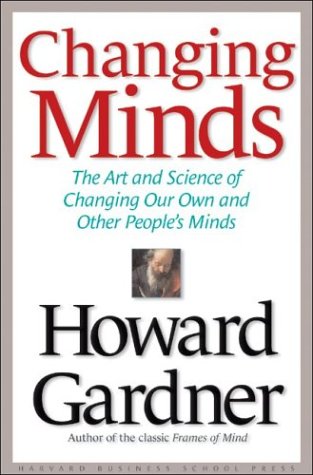 Gardner, Howard (2004). Changing Minds.
Got a free copy of this at the conference. Good stuff.
Schirripa, Steven. The Goomba's Book of Love.
Kerry bought me this. I'm not enough like Tony Soprano? OK.
February 11, 2006
Schmiberal Arts
After class today I've been thinking a lot about learning theories and learning styles and issues related thereunto. One idea I have is related to the common complaint I here among students, How is this going to apply to me after I graduate, or What is useful about this subject required by my degree?
As a supporter of the concept of liberal arts education, I have usually responded with, We're not teaching you specifics so much as we are teaching you how to learn effectively in the future. Indeed, if we are going to be successful, we need to be lifelong learners. But then what about all those complaining students? If they disagree should they drop out of four-year institutions and get a certified in whatever program certifies people for their chosen profession? Maybe, but maybe not.
Why can't liberal arts be embedded within professional programs,
where students are actively engaged in work, real work with real expectations and outcomes, but the learning model is still multidiciplinary and broad-based? I've cited this before, and it seems cheesy I know, the I really like the learning model presented in the movie The School of Rock.
Not that Jack Black's character in the film was primarily concerned with the kid's learning--he wanted to win a battle of the bands contest, but he created a curriculum in which kid's were able to choose what they wanted to learn, how they were going to approach the tasks assigned to them based on those choices, and what level of understanding they needed to accomplish their goals. At first the kid's questioned and resisted the curriculum change, but eventually they had a happy ending, as any Hollywood movie should, because they took on the tasks and performed very well.
What learning is lost when students are given hands-on practical work to do, work that could possibly benefit society in some way?
In my Video II class students are making PSAs (public service announcements) for local non-profit agencies. They investigate a menu of agencies to choose from and find one they are interested in. They meet with representatives from the agency and discuss the project including the group's immediate needs for advertising--whether they need recruitment, funding, or volunteers. They work with the agency to come up with a concept for the production--hopefully a metaphor that will stick in viewer's minds that reflects on the group's core values. Then they schedule shoots of the agency's activities, shoot testimonials of clients or participants, or shoot according to the metaphor being used. They edit the materials together, present them to the client, and if accepted by the client, we broadcast the PSA on our cable TV airtime and the agency can buy airtime for the spot on network TV as well.
Some other student's are receiving credit for doing a local version of Fox Sports' Best Damn Sport Show or ESPN2'sCold Pizza. In the past student's have produced several comedy shows and a somehwat successful late-night talk show. Are they learning anything? I really, really think so, because they are doing something they want to be doing. I also have some kids coming over from Howard High School working with me getting HS credit. Its all pretty recent and unmeasured, but I think these kids are going to get a lot out of the experience.
Again, I believe that learning can and should be fun. Sure there are concepts and groundwork courses that must be taken. Kids should know how to read and do math. They should be able to express themselves both orally and with writing by the time they get to college, and certainly by the time they get to my class. But what incentive are we dangling in front of them to get them to push themselves to learn these things. Grades? For many students this isn't working. I have had enough students ask me what the minimum was they would have to make on a final to get a passing grade--D, to pass my course to know that grades are not motivating students. We have a huge population os students who are happy doing the bare minimum, heck, I'm one of them, unless it's something I want to do or learn. Wouldn't they do more if they thought their work was to be used in some way.
What if they don't learn calculus? What if they don't ever read Shakespeare? They obviously don't care about the value of these things, I wonder why do we? What is the harm of allowing a student to choose to explore conceptually their own areas of interest--within the broad categories prescribed by a liberal arts education?
I have a couple of suggestions for "learning by doing" that I want to investigate further:
1. English 121 and 122 need to be embedded in some kind of real-world experience. They do this on MTV's Real World every season now, the housemates have to work together on some project. Working for a recording studio, starting a business, producing a documentary. Let's face it, the kids are watching the MTV anyway, let's model some of our curriculum after the popular culture the kids are more concerned with anyway.
2. Every subject should involve some hands-on learning. EVERY ONE. Science courses have a 1 hour lab requirement for every 3 hours of lecture. Shouldn't that be the other way around? Math doesn't have any lab requirement, yet its one of the most practical day-to-day applications we have. Get those kids to an accounting firm, or auto shop, or a hair boutique, or anywhere and show them the VALUE of using math skills on the job.
3. Create assignments whose end-results are shared. If kids write a speech on MLK, post it online. If they are learning history, hold a discussion on how whatever topics are applicable today. Kids/students/learners need to feel like they are moving toward an established goal and more and more the goal of making an A has less value for kids. It does for me, but I would sacrifice any A on something I could care less about for a D in something that actively engaged my interests. My thought is though that the potential for success is much higher in the latter situation.
I have a friend who is an admitted C student in Biology and Chemistry but who is highly regarded at the Tennessee Aquarium for being somewhat of an expert in how to treat chemical problems around the fish. Is he learning? Of course, but the application of the textbook knowledge is what drives him, not the grade. He likes fish, and there's nothing wrong with that.
Most of this falls under the Cognitive and Constructivist learning theories, though I would argue that Motivation has EVERYTHING to do with student's learning. I'll keep exploring this idea to see where it leads me. Any suggestions or other examples of this would be appreciated.
February 07, 2006
Article
So, here it is. A very good educational toy product that does not work with Windows Media Center 2004, but pretty well with just about any other DVD player.
InteracTV by Fisher-Price: Children’s television you can feel good about.
 The Fisher-Price InteracTV DVD-based Learning System is a very simple concept, with very lofty goals. It is essentially nothing more than an oversized universal remote control for your DVD player and a collection of specialized interactive DVDs similar to Scene It? But what it accomplishes is so much more. The product actually has the potential to take one of our worst vices as a parent—allowing our children to watch television, and make it a virtue.
The innovative product uses existing technology, DVD players found in most homes, and programs that your child is already familiar with. These include: Dora the Explorer, SpongeBob, Scooby-Doo, and many more. As the program progresses, the characters ask your child a series of questions. This level of interactivity has been going on in children’s television for years, but now there is a distinct difference. Your child can answer back.
The packaging of the product indicates that the system allows children “to interact with their favorite characters and shows in a fun and educational way.” The curriculum includes about 100 learning questions that are included during each show. This supports the claim that this toy is focused on the child’s cognitive development skills. The box lists a variety of learning objectives that can be achieved as the child uses the toy. Perhaps even more important than these is the way this product can change the experience of television viewing for your child for years to come.
Jackson loves television.
My two and half year old son loves watching TV. He would watch TV all day long, every day! Early on in his television viewing we were amazed at how quickly he learned the names of characters on TV. He often knew names for programs that he had not even seen. Despite our best efforts to ban certain programs we didn’t like, Jackson was learning about them from storybooks, advertisements on other children’s T-shirts and sneakers, and talk amongst children at his daycare.
What is the harm in watching television? I did it. So did my wife. And we both seem relatively normal. We both even went to college and have respectable jobs. Television didn’t ruin our lives. Yet you hear so much negativity about children’s television viewing these days. News programs and magazine articles suggest all types of negative outcomes for children from watching too much TV. You might think allowing your child to watch television was on a par with encouraging your child to smoke cigarettes or drop out of school. But what does the research really say?
Children’s TV Viewing: How much is too much?
In my graduate program I am doing my research on children’s television. In a review of literature on children’s television I found that children’s viewing habits were shown to have effects on subsequent learning patterns. A great deal of research points out that even too much viewing of educational programs such as Sesame Street can have negative effects . This is usually said to be caused by displacing other important learning activities such as reading and social interaction. Another concern that has been heavily researched in recent years is the relationship of children’s television viewing and childhood obesity. Because of these concerns, the American Academy of Pediatrics has called for reduced levels of television viewing in children ages 2 and up, and urges parents of children under 2 to not allow any viewing at all (http://www.aap.org/family/smarttv.htm).
I was concerned about the possible negative effects that watching too much television could have on my child. The literature I reviewed led me to the summary that any amount over two hours each day may be too much television. With that general rule of thumb in mind, my wife and I have decided to do “No TV” nights, in which we plan activities that would otherwise have been replaced by sitting in front of the television. Of course these don’t completely counteract “Movie Nights” where we purposely all watch television together, but at the end of the week we believe our average viewing time is lowered to about 2 hours per day or less.
What kind of viewing is taking place?
Other research into children’s television has shown that it is equally important that we pay attention to how our children are watching television. Does your child slump back on the couch and barely blink or do she jump and down when something funny happens? Does he clam up when Dora the Explorer or Steve from Blue’s Clues asks a question, or is he calling out the answers? Does your child seem to be interacting and engaged, or catatonic? These behaviors may indicate whether a child is an active or a passive viewer of television.
This is where Fisher-Price’s InteracTV system shines—in creating a more interactive learning experience out of an activity otherwise referred to as being a couch potato. The system encourages a more interaction with the content of the programs and compels the child to think critically, rather than just viewing the content hypnotically. This new way of viewing television can develop into patterns of engaged viewing that last a lifetime.
Engaged viewing is when your child is plugged in and engaged while watching a program. When a child is actively engaged in watching a TV program, he uses the same cognitive skills as are used when reading a book. In cognitive learning theory, knowledge is thought to be created when a child is actively involved. Jean Piaget, renowned psychologist, emphasized that children aged 2 to 7 need new concrete experiences upon which to build learning cognitive structures—the building blocks of knowledge (http://www.funderstanding.com/piaget.cfm).
The Fisher-Price InteracTV system causes a child to be more engaged while viewing. They do this by periodically pausing the action during which the characters ask questions. Your child must then press the appropriate button on the InteracTV controller before the program will continue. If wrong buttons are pressed the question is either repeated or advice is given on getting it right. This series of questions is repeated each time the game is played, but they are randomized and the answers are never in the same order on the screen. In this way, the experience is never the same for the child.
What do children learn while watching television?
When children watch television they learn quite a bit more than just what is presented on the screen. They learn patterns of viewing behaviors that will last for many years to come. If the pattern that is learned is that of a “couch potato,” it is very likely that the child will not be interested in challenges and critical thinking opportunities that appear in other media as well.
In a study of the effects of children’s viewing of learning-based programs such as Blue’s Clues it was found that viewing such a program can affect how a child watches other shows (Crawley et al., 2002). For instance, if children begin watching television that is entertainment-based, they will more likely watch other shows passively. This is true even of educational shows which present material in a straightforward manner, but do not ask the child to participate in meaningful ways. If the child is not encouraged to interact with the material by their parents, they will likely zone out, and not construct new knowledge with the presented material.
On the other hand, if children watch shows that are learning-based first, they will be more likely to be engaged, interactive viewers of many different types of programs—and of other types of media as well (van den Broek, 2001). This is particularly encouraging for Fisher-Price and other toy manufacturers, as well as television production companies, because they would like to use children’s television to help build reading and literacy skills, rather than taking away from them. Rather than allowing television to displace activities such as reading and play that promote learning (Wan, 2000), TV can actually be a source for all of the above.
InteracTV has the potential to take this to a whole new level, largely due to its most important selling point—it’s fun! The product is a game, and it is a game that kids will want to play. Yes, children can learn by playing with it. They can learn math, vocabulary, and observation skills as the packaging suggests. But most importantly they are learning to be active, engaged viewers. This is a learning behavior that will be important for them in years to come as they encounter other forms of media. Will they be mesmerized by the screens of videogames and dulled to sleep by textbooks? Or will they interact with television programs and dig deep into books to find the answers their brains are wired toward figuring out? I believe that InteracTV has the capability to expand a child’s capacity for critical thinking, for developing a curious mind, and for making the most of their entertainment-time—teaching them that learning can be and is fun.
Final Analysis
There are just a few drawbacks to this product that a parent must consider. It does heavily encourage TV viewing. If your child is already having difficulty tearing him or herself away from the tube, you may want to consider buying a few more books and investing in a pair of earplugs as you guide them through TV withdrawals. But, if you can incorporate InteracTV into a healthy TV diet of no more than 2 hours per day, this product definitely has the potential to fulfill a variety of learning outcomes.
A quick check of user reviews online will tell you that several people have had trouble with the setup of the DVD remote controller. My tests worked fine with all of the suggested methods of teaching the remote to work with my DVD player. I never could get it to work with my Windows Media Center PC however, even though it uses an infrared remote control and has all of the same buttons as my DVD player’s remote.
The price and flexibility of this product’s being able to work with the majority of DVD players on the market make it a very effective and relatively low-cost educational toy. It is both age appropriate and safe, though it should never be used as a sitter for your child, which is generally the problem with children’s television viewing. If you are in the market for something that will cause your child to tune in to the learning possibilities offered by educational television, rather than vegging out while watching any form of TV, I highly recommend this product.
References
Crawley, A., Daniel R. Anderson, Angela Santomero, Alice Wilder, Marsha
Williams, Marie K. Evans, Jennings Bryant. (2002). Do children learn to watch television? The impact of extensive experience with Blue’s Clues on pre-school children’s television viewing behavior. Journal of Communication. June 2002. 264-280.
Piaget. Retrieved Feb. 01, 2006, from Funderstanding Web site: http://www.funderstanding.com/piaget.cfm.
Smart Guide to Kid's TV. American Academy of Pediatrics. Retrieved Nov. 20, 2005, from http://www.aap.org/family/smarttv.htm.
van den Broek, P. (2001). The role of television viewing in the development of reading comprehension. Office of Educational Research and Improvement, U.S. Department of Education. Retrieved November 17, 2005, from www.ciera.org/library/archive/2001-01/04Oct99-58-MSarchive.html.
Wan, G. (2000). “Barney and Friends”: An evaluation of the literacy learning environment created by the TV series for children. (ERIC Document Reproduction No. ED 438 900).
February 04, 2006
Podcasting assignments?
I am curious about how podcasting is being used as an instructional tool. Perhaps I can do a paper on it. I know many universities are using the technology to push delivery of lectures and materials, but I am more curious about where it is being used as a portfolio of student presentations and so forth. I have seen several locally from Baylor High School and I know that there were talks between the COMM dept and the Hunter museum about creating a series of podcasts, but I am not sure how well they are being integrated into the curriculum.
At my suggestion (and others) a couple of students I know have started a weekly 30 minute podcast in which they review movies and dialog about filmmaking. It is featured on the PulseBlog and on the Chattanooga Film Blog. Check it out below.

January 28, 2006
Parenting Article
Keeping up with my homework, which is to wrtie an article for submission to Parenting magazine recommending a toy that is particularly useful in its learning value for the kids. I have narrowed it down to the following toys:
Junior Explorer Globe
For Ages 3 Years and Up
Or an awesome DVD set with a special remote controller that I saw in a magazine that I can't find again. The DVDs were of Dora the Explorer and other popular shows and the remote had LeapPad like sheets that the kids would use to interact with the program with. This ties in nicely to my research proposal, so I have a lot of good data on how interactive viewing is superior to using TV as a babysitter.
This was my top choice, so if anyone knows what I am talking about here please let me know where to find info on it.
January 21, 2006
EDD740/750
Today in class we tackled the problem of writing an article for Parenting magazine, describing a toy that is particularly useful as a learning tool. I quite frankly would have dove right into this assignment, but all in all, I guess I did get more out of doing it as a group, though that gets very tedious.
Our approach was to divide and conquer, so I chipped in with Jim and Gilda on Learning Theories, which was helpful for me since it's been a LONG time since Psych 101. Found out that cognitive and constructivist theories prevail today, but many people fall back on behaviorism, or reinforcement and so on, in their instruction. My thought is that learning never takes place in a vacuum. The context of learning, the prior knowledge, and the student's motivation are all very important, perhaps even more so than the delivery method.
So now to pick a toy to review.. Any suggestions?