February 19, 2006
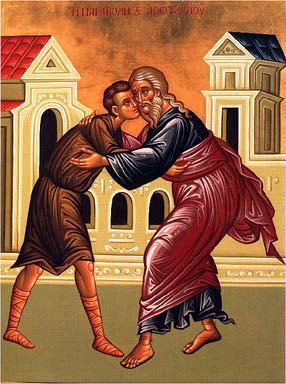
Sunday of the Prodigal Son
Troparion Tone 8
The doors of repentance do Thou open to me, O Giver of life,
for my spirit waketh at dawn toward Thy holy temple,
bearing a temple of the body all defiled.
But in Thy compassion, cleanse it by the loving-kindness of Thy mercy.
Theotokion Tone 8
Guide me in the paths of salvation, O Theotokos,
for I have defiled my soul with shameful sins,
and have wasted all my life in slothfulness,
but by thine intercessions deliever me from all uncleanness.
Troparion Tone 6
Have mercy on me, O God, according to Thy great mercy
Glory to the Father and to the Son and to the Holy Spirit
And according to the multitude of Thy compassions, blot out my transgressions.
Both now and ever and unto ages of ages, Amen.
When I think of the multitude of evil things I have done, I, a wretched one,
I tremble at the fearful day of judgment;
but trusting in the mercy of Thy loving-kindness, like David do I cry unto Thee:
Have mercy on me, O God, according to Thy great mercy.
Kontakion of the Sunday of the Prodigal Son Tone 3
Having foolishly abandoned Thy paternal glory,
I squandered on vices the wealth which Thou gavest me.
Wherefore, I cry unto Thee with the voice of the prodigal:
I have sinned before Thee, O compassionate Father.
Receive me as one repentant,
and make me as one of Thy hired servants.
Protopresbyter Alexander Schmemann writes:
Together with the hymns of this day, the parable reveals to us the time of repentance as man's return from exile. The prodigal son, we are told, went to a far country and there spent all that he had. A far country! It is this unique defintion of our human condition that we must assume and make ours as we begin our approach to God. A man who has never had that experience, be it only very briefly, who has never felt that he is exiled from God and from real life, will never understand what Christianity is about. And the one who is perfectly "at home" in this world and its life, who has ever been wounded by the nostalgic desire for another Reality, will not understand what is repentance. (Great Lent: Journey to Pascha, p. 21)
Schmemann goes on to talk about how this sense of exile is essential to confession and repentance. We can, surely, engage in "cool and 'objective' enumeration of our sins and transgressions," in repentance "as the act of 'pleading guilty' to a legal indictment." But, Schmemann writes,
something very essential is overlookd--without which neither confession nor absolution have any real meaning or power. This "something" is precisely the feeling of alienation from God, from the joy of communion with Him, from the real life as created and given by God. It is easy indeed to confess that I have not fasted on prescribed days, or missed my prayers, or become angry. It is quite a different thing, however, to realize suddenly that I have defiled and lost my spiritual beauty, that I am far away from my real home, my real life, and that something precious and pure and beautiful has been hopelessly broken in the very texture of my existence. Yet this, and only this, is repentance, and therefore it is also a deep desire to re[t]urn, to go back, to recover that lost home. (Great Lent: Journey to Pascha, pp. 21-22)
Luke 15:11-32:
And he said, A certain man had two sons: And the younger of them said to his father, Father, give me the portion of goods that falleth to me. And he divided unto them his living. And not many days after the younger son gathered all together, and took his journey into a far country, and there wasted his substance with riotous living. And when he had spent all, there arose a mighty famine in that land; and he began to be in want. And he went and joined himself to a citizen of that country; and he sent him into his fields to feed swine. And he would fain have filled his belly with the husks that the swine did eat: and no man gave unto him. And when he came to himself, he said, How many hired servants of my father's have bread enough and to spare, and I perish with hunger! I will arise and go to my father, and will say unto him, Father, I have sinned against heaven, and before thee, And am no more worthy to be called thy son: make me as one of thy hired servants. And he arose, and came to his father. But when he was yet a great way off, his father saw him, and had compassion, and ran, and fell on his neck, and kissed him. And the son said unto him, Father, I have sinned against heaven, and in thy sight, and am no more worthy to be called thy son. But the father said to his servants, Bring forth the best robe, and put it on him; and put a ring on his hand, and shoes on his feet: And bring hither the fatted calf, and kill it; and let us eat, and be merry: For this my son was dead, and is alive again; he was lost, and is found. And they began to be merry. Now his elder son was in the field: and as he came and drew nigh to the house, he heard musick and dancing. And he called one of the servants, and asked what these things meant. And he said unto him, Thy brother is come; and thy father hath killed the fatted calf, because he hath received him safe and sound. And he was angry, and would not go in: therefore came his father out, and intreated him. And he answering said to his father, Lo, these many years do I serve thee, neither transgressed I at any time thy commandment: and yet thou never gavest me a kid, that I might make merry with my friends: But as soon as this thy son was come, which hath devoured thy living with harlots, thou hast killed for him the fatted calf. And he said unto him, Son, thou art ever with me, and all that I have is thine. It was meet that we should make merry, and be glad: for this thy brother was dead, and is alive again; and was lost, and is found.
February 12, 2006
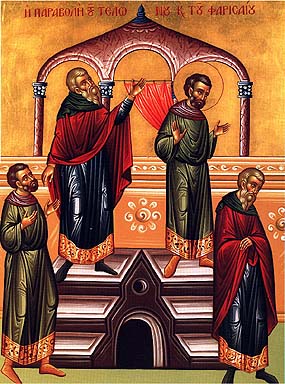
Sunday of the Publican and Pharisee
Troparion of the Sunday of the Publican and the Pharisee Tone 8
The doors of repentance do Thou open to me, O Giver of life,
for my spirit waketh at dawn toward Thy holy temple,
bearing a temple of the body all defiled.
But in Thy compassion, cleanse it by the loving-kindness of Thy mercy.
Theotokion Tone 8
Guide me in the paths of salvation, O Theotokos,
for I have defiled my soul with shameful sins,
and have wasted all my life in slothfulness,
but by thine intercessions deliever me from all uncleanness.
Troparion Tone 6
Have mercy on me, O God, according to Thy great mercy
Glory to the Father and to the Son and to the Holy Spirit
And according to the multitude of Thy compassions, blot out my transgressions.
Both now and ever and unto ages of ages, Amen.
When I think of the multitude of evil things I have done, I, a wretched one,
I tremble at the fearful day of judgment;
but trusting in the mercy of Thy loving-kindness, like David do I cry unto Thee:
Have mercy on me, O God, according to Thy great mercy.
Kontakion of the Sunday of the Publican and the Pharisee Tone 4
Let us flee the bragging of the Phraisee,
and learn the humility of the Publican,
while crying out unto the Savior with groanings:
Be gracious unto us, O Thou Who alone dost already forgive.
Luke 18:9-14:
And He spoke this parable also to some who had trusted in themselves that they were righteous, and made of no account the rest: "Two men went up into the temple to pray, the one a Pharisee and the other a tax collector. The Pharisee, having assumed a stance, was praying these things to himself, 'God, I thank Thee that I am not as the rest of men--rapacious, unjust, adulterers, or even as this one, the tax collector. I fast twice a week; I tithe all things, as much as I acquire.' And the tax collector, having stood afar off, was not willing even to life up his eyes to the heaven but kept beating upon his breast, saying, 'God, be gracious to me the sinner.' I say to you this one went down to his house having been justified rather than that one; for everyone who exalteth himself shall be humbed, and the one who humbleth himself shall be exalted." (Orthodox New Testament, © 2004 Holy Apostles Convent)
And so begins the preparation for the Lenten season. As Protopresbyter Alexander Schmemann puts it:
[Great Lent] is indeed a school of repentance to which every Christian must go every year in order to deepen his faith, to re-evaluate, and, if possible, to change his life. It is a wonderful pilgrimage to the very sources of Orthodox faith--a rediscovery of the Orthodox way of life. (Great Lent: Journey to Pascha, p. 9)
Already, last week, the Sunday of Zachaeus, we have been pointed toward Great Lent, with Zachaeus' desire for Christ and repentance. Today's Gospel highlights the humility necessary for repentance. As Fr Schmemann writes:
The lenten season begins then by a quest, a prayer for humility which is the beginning of true repentance. For repentance, above everything else, is a return to the genuine order of things, the restoration of the right vision. (Great Lent: Journey to Pascha, p. 20)
It is not by coincidence that the Orthodox do not fast the week following the Sunday of the Publican and the Pharisee. The Pharisee prided himself on his twice-weekly fasting. To guard against the danger of comparing ourselves to others (and favorably) the Church says "Don't fast." Instead on Wednesday and Friday recall this Gospel text and remember the humility of the Son of God who became man that we might become god.
February 05, 2006
Sunday of the Canaanite Woman
Matthew 15:21-28
Then Jesus went thence, and departed into the coasts of Tyre and Sidon. And, behold, a woman of Canaan came out of the same coasts, and cried unto him, saying, Have mercy on me, O Lord, thou son of David; my daughter is grievously vexed with a devil. But he answered her not a word. And his disciples came and besought him, saying, Send her away; for she crieth after us. But he answered and said, I am not sent but unto the lost sheep of the house of Israel. Then came she and worshipped him, saying, Lord, help me. But he answered and said, It is not meet to take the children's bread, and to cast it to dogs. And she said, Truth, Lord: yet the dogs eat of the crumbs which fall from their masters' table. Then Jesus answered and said unto her, O woman, great is thy faith: be it unto thee even as thou wilt. And her daughter was made whole from that very hour.
February 02, 2006
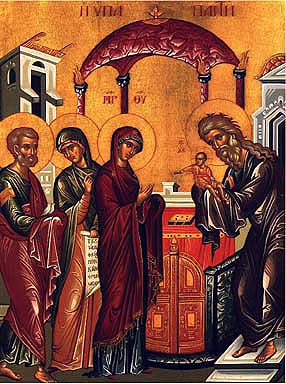
The Meeting of Our Lord Jesus Christ in the Temple
Troparion of the Meeting Tone 1
Rejoice, thou who art full of grace,/ Mother of God and Virgin,/ for from thee arose the Sun of Righteousness, Christ our God,/ to give light to those in darkness./ Rejoice thou also, righteous Elder, who didst take in thine arms the Redeemer of our souls,/ Who also gives us the grace of resurrection.
Kontakion of the Meeting Tone 1
Thou Who didst sanctify the Virgin's womb by Thy birth/ and bless Symeon's hands as was fitting/ hast now come to us and saved us, O Christ our God./ But grant peace in the midst of wars to Thy community,/ and strengthen the Church which Thou hast loved,/ O only Lover of mankind.
Hebrews 7:7-17
And without all contradiction the less is blessed of the better. And here men that die receive tithes; but there he receiveth them, of whom it is witnessed that he liveth. And as I may so say, Levi also, who receiveth tithes, payed tithes in Abraham. For he was yet in the loins of his father, when Melchisedec met him. If therefore perfection were by the Levitical priesthood, (for under it the people received the law,) what further need was there that another priest should rise after the order of Melchisedec, and not be called after the order of Aaron? For the priesthood being changed, there is made of necessity a change also of the law. For he of whom these things are spoken pertaineth to another tribe, of which no man gave attendance at the altar. For it is evident that our Lord sprang out of Juda; of which tribe Moses spake nothing concerning priesthood. And it is yet far more evident: for that after the similitude of Melchisedec there ariseth another priest, Who is made, not after the law of a carnal commandment, but after the power of an endless life. For he testifieth, Thou art a priest for ever after the order of Melchisedec.
Luke 2:22-40
And when the days of her purification according to the law of Moses were accomplished, they brought him to Jerusalem, to present him to the Lord; (As it is written in the law of the LORD, Every male that openeth the womb shall be called holy to the Lord;) And to offer a sacrifice according to that which is said in the law of the Lord, A pair of turtledoves, or two young pigeons. And, behold, there was a man in Jerusalem, whose name was Simeon; and the same man was just and devout, waiting for the consolation of Israel: and the Holy Ghost was upon him. And it was revealed unto him by the Holy Ghost, that he should not see death, before he had seen the Lord's Christ. And he came by the Spirit into the temple: and when the parents brought in the child Jesus, to do for him after the custom of the law, Then took he him up in his arms, and blessed God, and said, Lord, now lettest thou thy servant depart in peace, according to thy word: For mine eyes have seen thy salvation, Which thou hast prepared before the face of all people; A light to lighten the Gentiles, and the glory of thy people Israel. And Joseph and his mother marvelled at those things which were spoken of him. And Simeon blessed them, and said unto Mary his mother, Behold, this child is set for the fall and rising again of many in Israel; and for a sign which shall be spoken against; (Yea, a sword shall pierce through thy own soul also,) that the thoughts of many hearts may be revealed. And there was one Anna, a prophetess, the daughter of Phanuel, of the tribe of Aser: she was of a great age, and had lived with an husband seven years from her virginity; And she was a widow of about fourscore and four years, which departed not from the temple, but served God with fastings and prayers night and day. And she coming in that instant gave thanks likewise unto the Lord, and spake of him to all them that looked for redemption in Jerusalem. And when they had performed all things according to the law of the Lord, they returned into Galilee, to their own city Nazareth. And the child grew, and waxed strong in spirit, filled with wisdom: and the grace of God was upon him.
From the OCA website:
The Meeting of the Lord -- Today the Church commemorates an important event in the earthly life of our Lord Jesus Christ (Lk 2:22-40). Forty days after His birth the God-Infant was taken to the Jerusalem Temple, the center of the nation's religious life. According to the Law of Moses (Lev 12:2-8), a woman who gave birth to a male child was forbidden to enter the Temple of God for forty days. At the end of this time the mother came to the Temple with the child, to offer a young lamb or pigeon to the Lord as a purification sacrifice. The Most Holy Virgin, the Mother of God, had no need of purification, since she had given birth to the Source of purity and sanctity without defilement. However, she humbly fulfilled the requirements of the Law.At this time the righteous Elder Symeon (February 3) was living in Jerusalem. It had been revealed to him that he would not die until he should behold the promised Messiah. By inspiration from above, St. Symeon went to the Temple at the very moment when the Most Holy Theotokos and St. Joseph had brought the Infant Jesus to fulfill the Law.
The God-Receiver Symeon took the divine Child in his arms, and giving thanks to God, he spoke the words repeated by the Church each evening at Vespers: "Lord, now lettest Thou Thy servant depart in peace, according to Thy word, for mine eyes have seen Thy salvation, which Thou hast prepared before the face of all people, a light to enlighten the Gentiles, and the glory of Thy people Israel" (Lk 2:29-32). Righteous Symeon said to the Most Holy Virgin: "Behold, this child is set for the fall and rising again of many in Israel, and for a sign which shall be spoken against. Yea, a sword shall pierce through your own soul also, that the thoughts of many hearts may be revealed" (Lk 2:34-35).
At the Temple was the 84-year-old widow Anna the Prophetess, daughter of Phanuel (February 3), "who did not leave the temple, but served God with fasting and prayers night and day. And she coming at that instant, also gave thanks to the Lord and spoke of Him to all those who looked for redemption in Jerusalem" (Lk 2:37-38). In the icon of the Feast she holds a scroll which reads: "This Child has established Heaven and earth."
Before Christ was born, righteous men and women lived by faith in the promised Messiah, and awaited His coming. The Righteous Symeon and the Prophetess Anna, the last righteous ones of the Old Testament, were deemed worthy to meet the Savior in the Temple.
The Feast of the Meeting of the Lord is among the most ancient feasts of the Christian Church. We have sermons on the Feast by the holy bishops Methodios of Patara (+ 312), Cyril of Jerusalem (+ 360), Gregory the Theologian (+ 389), Amphilokios of Iconium (+ 394), Gregory of Nyssa (+ 400), and John Chrysostom (+ 407). Despite its early origin, this Feast was not celebrated so splendidly until the sixth century.
In 528, during the reign of Justinian, an earthquake killed many people in Antioch. Other misfortunes followed this one. In 541 a terrible plague broke out in Constantinople, carrying off several thousand people each day. During this time of widespread suffering, a solemn prayer service (Litia) for deliverence from evils was celebrated on the Feast of the Meeting of the Lord, and the plague ceased. In thanksgiving to God, the Church established a more solemn celebration of this Feast.
Church hymnographers adorned this Feast with their hymns: St. Andrew of Crete in the seventh century; St. Cosmas Bishop of Maium, St. John of Damascus, and St. Germanos Patriarch of Constantinople in the eighth century; and St. Joseph, Archbishop of Thessalonika in the ninth century.
On this day we also commemorate the icon of the Most Holy Theotokos known as "the Softening of Evil Hearts" or "Symeon's Prophecy." The Mother of God is depicted without Her Child, with seven swords piercing her breast: three from the left side, three from the right, and one from below.
A similar icon, "Of the Seven Swords" (August 13) shows three swords on the left side and four from the right.
The icon "Symeon's Prophecy" symbolizes the fulfillment of the prophecy of the righteous Elder Symeon: "a sword shall pierce through your own soul" (Lk 2:35).
January 29, 2006
Zacchaeus Sunday
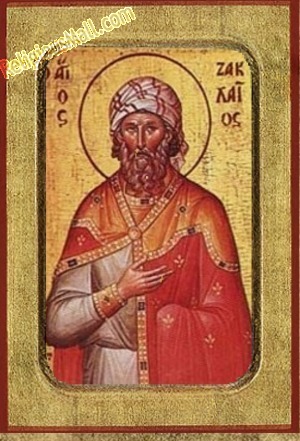
I don't know why it is but this year, like last year, and the last couple of years, this particular Sunday takes me by surprise. I'm going along, minding my own business, then bam Zacchaeus jumps out from behind the sycamore tree and says: "Great and Holy Lent is around the corner." Next week, the Sunday of the Publican and Pharisee, begins the Lenten Triodion, the three-week "ramp up" to Forgiveness Vespers and Great Lent. Gradually, the Church will wean herself of dairy products, olive oil, wine, and meat and eggs. We will be confronted with our hypocritical judgmentalism in the Pharisee and our need for humble repentance in the tax collector. We will be forced to let go the rigidity of the elder son, and own up to our own sinful wanderings in the prodigal son. We will face the last Judgment and our deeds to the least of these in whom Christ is present. And we will seek, give and receive the forgiveness of all in our local parish, and among our family and friends, even our enemies.
With such a preparation, we are then ready to face the testing of Great Lent, and to find in that testing and its culmination, Zacchaeus' desire, our heart's desire: to see Christ himself. This desire is awakened in us today. May we fan it to flame in the coming days.
Luke 19:1-10
And Jesus entered and passed through Jericho. And, behold, there was a man named Zacchaeus, which was the chief among the publicans, and he was rich. And he sought to see Jesus who he was; and could not for the press, because he was little of stature. And he ran before, and climbed up into a sycomore tree to see him: for he was to pass that way. And when Jesus came to the place, he looked up, and saw him, and said unto him, Zacchaeus, make haste, and come down; for to day I must abide at thy house. And he made haste, and came down, and received him joyfully. And when they saw it, they all murmured, saying, That he was gone to be guest with a man that is a sinner. And Zacchaeus stood, and said unto the Lord: Behold, Lord, the half of my goods I give to the poor; and if I have taken any thing from any man by false accusation, I restore him fourfold. And Jesus said unto him, This day is salvation come to this house, forsomuch as he also is a son of Abraham. For the Son of man is come to seek and to save that which was lost.
January 06, 2006
The Holy Theophany of Our God and Savior Jesus Christ
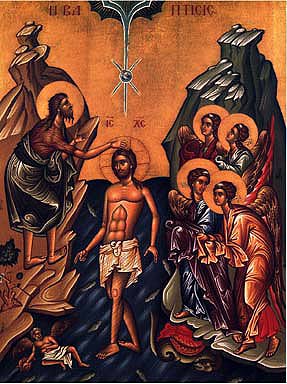
Troparion of the Theophany Tone 1
When Thou wast baptized in the Jordan, O Lord,/ the worship of the Trinity made its appearance./ For the voice of the Father bore witness to Thee/ when He called Thee His beloved Son./ And the Spirit in the form of a dove/ confirmed the truth of the word./ O Christ our God, Who hast appeared and hast enlightened the world,/ glory to Thee!
Kontakion of the Theophany Tone 4
Thou hast appeared today to the world,/ and Thy light, O Lord, has been signed upon us/ who with full knowledge sing to Thee./ Thou hast come, Thou hast appeared,/ O Unapproachable Light.
Titus 2:11-14; 3:4-7
For the grace of God that bringeth salvation hath appeared to all men, Teaching us that, denying ungodliness and worldly lusts, we should live soberly, righteously, and godly, in this present world; Looking for that blessed hope, and the glorious appearing of the great God and our Saviour Jesus Christ; Who gave himself for us, that he might redeem us from all iniquity, and purify unto himself a peculiar people, zealous of good works. But after that the kindness and love of God our Saviour toward man appeared, Not by works of righteousness which we have done, but according to his mercy he saved us, by the washing of regeneration, and renewing of the Holy Ghost; Which he shed on us abundantly through Jesus Christ our Saviour; That being justified by his grace, we should be made heirs according to the hope of eternal life.
Matthew 3:13-17
Then cometh Jesus from Galilee to Jordan unto John, to be baptized of him. But John forbad him, saying, I have need to be baptized of thee, and comest thou to me? And Jesus answering said unto him, Suffer it to be so now: for thus it becometh us to fulfil all righteousness. Then he suffered him. And Jesus, when he was baptized, went up straightway out of the water: and, lo, the heavens were opened unto him, and he saw the Spirit of God descending like a dove, and lighting upon him: And lo a voice from heaven, saying, This is my beloved Son, in whom I am well pleased.
From the OCA website:
Theophany is the Feast which reveals the Most Holy Trinity to the world through the Baptism of the Lord (Mt 3:13-17; Mk 1:9-11; Lk 3:21-22). God the Father spoke from Heaven about the Son, the Son was baptized by the St. John the Forerunner, and the Holy Spirit descended upon the Son in the form of a dove. From ancient times this Feast was called the Day of Illumination and the Feast of Lights, since God is Light and has appeared to illumine "those who sat in darkness," and "in the region of the shadow of death" (Mt 4:16), and to save the fallen race of mankind by grace.In the ancient Church it was the custom to baptize catechumens at the Vespers of Theophany, so that Baptism also is revealed as the spiritual illumination of mankind.
The origin of the Feast of Theophany goes back to Apostolic times, and it is mentioned in The Apostolic Constitutions (Book V:13). From the second century we have the testimony of St. Clement of Alexandria concerning the celebration of the Baptism of the Lord, and the night vigil before this Feast.
There is a third century dialogue about the services for Theophany between the holy martyr Hippolytus and St. Gregory the Wonderworker. In the following centuries, from the fourth to ninth century, all the great Fathers of the Church: Gregory the Theologian, John Chrysostom, Ambrose of Milan, John of Damascus, commented on the Feast of Theophany.
The monks Joseph the Studite, Theophanes and Byzantios composed much liturgical music for this Feast, which is sung at Orthodox services even today. St. John of Damascus said that the Lord was baptized, not because He Himself had need for cleansing, but "to bury human sin by water," to fulfill the Law, to reveal the mystery of the Holy Trinity, and finally, to sanctify "the nature of water" and to offer us the form and example of Baptism.
On the Feast of the Baptism of Christ, the Holy Church proclaims our faith in the most sublime mystery, incomprehensible to human intellect, of one God in three Persons. It teaches us to confess and glorify the Holy Trinity, one in Essence and Indivisible. It exposes and overthrows the errors of ancient teachings which attempted to explain the Creator of the world by reason, and in human terms.
The Church shows the necessity of Baptism for believers in Christ, and it inspires us with a sense of deep gratitude for the illumination and purification of our sinful nature. The Church teaches that our salvation and cleansing from sin is possible only by the power of the grace of the Holy Spirit, therefore it is necessary to preserve worthily these gifts of the grace of holy Baptism, keeping clean this priceless garb, for "As many as have been baptized into Christ, have put on Christ" (Gal 3:27).
January 05, 2006
Eve of Theophany Ninth Hour Readings
Isaiah 49:8-15
Thus saith the LORD, In an acceptable time have I heard thee, and in a day of salvation have I helped thee: and I will preserve thee, and give thee for a covenant of the people, to establish the earth, to cause to inherit the desolate heritages; That thou mayest say to the prisoners, Go forth; to them that are in darkness, Shew yourselves. They shall feed in the ways, and their pastures shall be in all high places. They shall not hunger nor thirst; neither shall the heat nor sun smite them: for he that hath mercy on them shall lead them, even by the springs of water shall he guide them. And I will make all my mountains a way, and my highways shall be exalted. Behold, these shall come from far: and, lo, these from the north and from the west; and these from the land of Sinim. Sing, O heavens; and be joyful, O earth; and break forth into singing, O mountains: for the LORD hath comforted his people, and will have mercy upon his afflicted. But Zion said, The LORD hath forsaken me, and my Lord hath forgotten me. Can a woman forget her sucking child, that she should not have compassion on the son of her womb? yea, they may forget, yet will I not forget thee.
Titus 2:11-14, 3:4-7
For the grace of God that bringeth salvation hath appeared to all men, Teaching us that, denying ungodliness and worldly lusts, we should live soberly, righteously, and godly, in this present world; Looking for that blessed hope, and the glorious appearing of the great God and our Saviour Jesus Christ; Who gave himself for us, that he might redeem us from all iniquity, and purify unto himself a peculiar people, zealous of good works. But after that the kindness and love of God our Saviour toward man appeared, Not by works of righteousness which we have done, but according to his mercy he saved us, by the washing of regeneration, and renewing of the Holy Ghost; Which he shed on us abundantly through Jesus Christ our Saviour; That being justified by his grace, we should be made heirs according to the hope of eternal life.
Luke 3:1-18
Now in the fifteenth year of the reign of Tiberius Caesar, Pontius Pilate being governor of Judaea, and Herod being tetrarch of Galilee, and his brother Philip tetrarch of Ituraea and of the region of Trachonitis, and Lysanias the tetrarch of Abilene, Annas and Caiaphas being the high priests, the word of God came unto John the son of Zacharias in the wilderness. And he came into all the country about Jordan, preaching the baptism of repentance for the remission of sins; As it is written in the book of the words of Esaias the prophet, saying, The voice of one crying in the wilderness, Prepare ye the way of the Lord, make his paths straight. Every valley shall be filled, and every mountain and hill shall be brought low; and the crooked shall be made straight, and the rough ways shall be made smooth; And all flesh shall see the salvation of God. Then said he to the multitude that came forth to be baptized of him, O generation of vipers, who hath warned you to flee from the wrath to come? Bring forth therefore fruits worthy of repentance, and begin not to say within yourselves, We have Abraham to our father: for I say unto you, That God is able of these stones to raise up children unto Abraham. And now also the axe is laid unto the root of the trees: every tree therefore which bringeth not forth good fruit is hewn down, and cast into the fire. And the people asked him, saying, What shall we do then? He answereth and saith unto them, He that hath two coats, let him impart to him that hath none; and he that hath meat, let him do likewise. Then came also publicans to be baptized, and said unto him, Master, what shall we do? And he said unto them, Exact no more than that which is appointed you. And the soldiers likewise demanded of him, saying, And what shall we do? And he said unto them, Do violence to no man, neither accuse any falsely; and be content with your wages. And as the people were in expectation, and all men mused in their hearts of John, whether he were the Christ, or not; John answered, saying unto them all, I indeed baptize you with water; but one mightier than I cometh, the latchet of whose shoes I am not worthy to unloose: he shall baptize you with the Holy Ghost and with fire: Whose fan is in his hand, and he will throughly purge his floor, and will gather the wheat into his garner; but the chaff he will burn with fire unquenchable. And many other things in his exhortation preached he unto the people.
Eve of Theophany Sixth Hour Readings
Isaiah 12:3-6
Therefore with joy shall ye draw water out of the wells of salvation. And in that day shall ye say, Praise the LORD, call upon his name, declare his doings among the people, make mention that his name is exalted. Sing unto the LORD; for he hath done excellent things: this is known in all the earth. Cry out and shout, thou inhabitant of Zion: for great is the Holy One of Israel in the midst of thee.
Romans 6:3-11
Know ye not, that so many of us as were baptized into Jesus Christ were baptized into his death? Therefore we are buried with him by baptism into death: that like as Christ was raised up from the dead by the glory of the Father, even so we also should walk in newness of life. For if we have been planted together in the likeness of his death, we shall be also in the likeness of his resurrection: Knowing this, that our old man is crucified with him, that the body of sin might be destroyed, that henceforth we should not serve sin. For he that is dead is freed from sin. Now if we be dead with Christ, we believe that we shall also live with him: Knowing that Christ being raised from the dead dieth no more; death hath no more dominion over him. For in that he died, he died unto sin once: but in that he liveth, he liveth unto God. Likewise reckon ye also yourselves to be dead indeed unto sin, but alive unto God through Jesus Christ our Lord.
Mark 1:9-15
And it came to pass in those days, that Jesus came from Nazareth of Galilee, and was baptized of John in Jordan. And straightway coming up out of the water, he saw the heavens opened, and the Spirit like a dove descending upon him: And there came a voice from heaven, saying, Thou art my beloved Son, in whom I am well pleased. And immediately the spirit driveth him into the wilderness. And he was there in the wilderness forty days, tempted of Satan; and was with the wild beasts; and the angels ministered unto him. Now after that John was put in prison, Jesus came into Galilee, preaching the gospel of the kingdom of God, And saying, The time is fulfilled, and the kingdom of God is at hand: repent ye, and believe the gospel.
Eve of Theophany Third Hour Readings
Isaiah 1:16-20
Wash you, make you clean; put away the evil of your doings from before mine eyes; cease to do evil; Learn to do well; seek judgment, relieve the oppressed, judge the fatherless, plead for the widow. Come now, and let us reason together, saith the LORD: though your sins be as scarlet, they shall be as white as snow; though they be red like crimson, they shall be as wool. If ye be willing and obedient, ye shall eat the good of the land: But if ye refuse and rebel, ye shall be devoured with the sword: for the mouth of the LORD hath spoken it.
Acts 19:1-18
And it came to pass, that, while Apollos was at Corinth, Paul having passed through the upper coasts came to Ephesus: and finding certain disciples, He said unto them, Have ye received the Holy Ghost since ye believed? And they said unto him, We have not so much as heard whether there be any Holy Ghost. And he said unto them, Unto what then were ye baptized? And they said, Unto John's baptism. Then said Paul, John verily baptized with the baptism of repentance, saying unto the people, that they should believe on him which should come after him, that is, on Christ Jesus. When they heard this, they were baptized in the name of the Lord Jesus. And when Paul had laid his hands upon them, the Holy Ghost came on them; and they spake with tongues, and prophesied. And all the men were about twelve. And he went into the synagogue, and spake boldly for the space of three months, disputing and persuading the things concerning the kingdom of God. But when divers were hardened, and believed not, but spake evil of that way before the multitude, he departed from them, and separated the disciples, disputing daily in the school of one Tyrannus. And this continued by the space of two years; so that all they which dwelt in Asia heard the word of the Lord Jesus, both Jews and Greeks. And God wrought special miracles by the hands of Paul: So that from his body were brought unto the sick handkerchiefs or aprons, and the diseases departed from them, and the evil spirits went out of them. Then certain of the vagabond Jews, exorcists, took upon them to call over them which had evil spirits the name of the LORD Jesus, saying, We adjure you by Jesus whom Paul preacheth. And there were seven sons of one Sceva, a Jew, and chief of the priests, which did so. And the evil spirit answered and said, Jesus I know, and Paul I know; but who are ye? And the man in whom the evil spirit was leaped on them, and overcame them, and prevailed against them, so that they fled out of that house naked and wounded. And this was known to all the Jews and Greeks also dwelling at Ephesus; and fear fell on them all, and the name of the Lord Jesus was magnified. And many that believed came, and confessed, and shewed their deeds.
Mark 1:1-8
The beginning of the gospel of Jesus Christ, the Son of God; As it is written in the prophets, Behold, I send my messenger before thy face, which shall prepare thy way before thee. The voice of one crying in the wilderness, Prepare ye the way of the Lord, make his paths straight. John did baptize in the wilderness, and preach the baptism of repentance for the remission of sins. And there went out unto him all the land of Judaea, and they of Jerusalem, and were all baptized of him in the river of Jordan, confessing their sins. And John was clothed with camel's hair, and with a girdle of a skin about his loins; and he did eat locusts and wild honey; And preached, saying, There cometh one mightier than I after me, the latchet of whose shoes I am not worthy to stoop down and unloose. I indeed have baptized you with water: but he shall baptize you with the Holy Ghost.
Eve of Theophany First Hour Readings
Isaiah 35:1-10
The wilderness and the solitary place shall be glad for them; and the desert shall rejoice, and blossom as the rose. It shall blossom abundantly, and rejoice even with joy and singing: the glory of Lebanon shall be given unto it, the excellency of Carmel and Sharon, they shall see the glory of the LORD, and the excellency of our God. Strengthen ye the weak hands, and confirm the feeble knees. Say to them that are of a fearful heart, Be strong, fear not: behold, your God will come with vengeance, even God with a recompence; he will come and save you. Then the eyes of the blind shall be opened, and the ears of the deaf shall be unstopped. Then shall the lame man leap as an hart, and the tongue of the dumb sing: for in the wilderness shall waters break out, and streams in the desert. And the parched ground shall become a pool, and the thirsty land springs of water: in the habitation of dragons, where each lay, shall be grass with reeds and rushes. And an highway shall be there, and a way, and it shall be called The way of holiness; the unclean shall not pass over it; but it shall be for those: the wayfaring men, though fools, shall not err therein. No lion shall be there, nor any ravenous beast shall go up thereon, it shall not be found there; but the redeemed shall walk there: And the ransomed of the LORD shall return, and come to Zion with songs and everlasting joy upon their heads: they shall obtain joy and gladness, and sorrow and sighing shall flee away.
Acts 13:25-32
And as John fulfilled his course, he said, Whom think ye that I am? I am not he. But, behold, there cometh one after me, whose shoes of his feet I am not worthy to loose. Men and brethren, children of the stock of Abraham, and whosoever among you feareth God, to you is the word of this salvation sent. For they that dwell at Jerusalem, and their rulers, because they knew him not, nor yet the voices of the prophets which are read every sabbath day, they have fulfilled them in condemning him. And though they found no cause of death in him, yet desired they Pilate that he should be slain. And when they had fulfilled all that was written of him, they took him down from the tree, and laid him in a sepulchre. But God raised him from the dead: And he was seen many days of them which came up with him from Galilee to Jerusalem, who are his witnesses unto the people. And we declare unto you glad tidings, how that the promise which was made unto the fathers.
Matthew 3:1-11
In those days came John the Baptist, preaching in the wilderness of Judaea, And saying, Repent ye: for the kingdom of heaven is at hand. For this is he that was spoken of by the prophet Esaias, saying, The voice of one crying in the wilderness, Prepare ye the way of the Lord, make his paths straight. And the same John had his raiment of camel's hair, and a leathern girdle about his loins; and his meat was locusts and wild honey. Then went out to him Jerusalem, and all Judaea, and all the region round about Jordan, And were baptized of him in Jordan, confessing their sins. But when he saw many of the Pharisees and Sadducees come to his baptism, he said unto them, O generation of vipers, who hath warned you to flee from the wrath to come? Bring forth therefore fruits meet for repentance: And think not to say within yourselves, We have Abraham to our father: for I say unto you, that God is able of these stones to raise up children unto Abraham. And now also the axe is laid unto the root of the trees: therefore every tree which bringeth not forth good fruit is hewn down, and cast into the fire. I indeed baptize you with water unto repentance: but he that cometh after me is mightier than I, whose shoes I am not worthy to bear: he shall baptize you with the Holy Ghost, and with fire.
January 01, 2006
The Circumcision of Our Lord and Savior Jesus Christ
Troparion of the Feast Tone 1
Thou Who art by nature God, didst without change take human form,/ O most compassionate Lord,/ and in fulfilling the Law of Thine own will didst receive circumcision in the flesh,/ to banish hades and roll away the veil of our passions./ Glory to Thy goodness; glory to Thy compassion;/ glory to Thy condescension, O Word.
Another Troparion of the Feast Tone 1
Thou Who sittest with the Father/ on a fiery throne in the heights/ wast pleased to be born of a Virgin through the Divine Spirit on earth./ Wherefore Thou wast circumcised as a man on the eighth day./ Glory to Thine all-gracious will; glory to Thy providence;/ glory to Thy condescension, O only Lover of mankind.
Kontakion of the Feast Tone 3
In undergoing clrcumcision/ the Lord of all has circumcised the sins of mortal men./ On this day He gives salvation to the world./ And the Hierarch Basil, the Creator's lightbearer/ and Christ's mystic, rejoices in the highest.
Colossians 2:8-12
Beware lest any man spoil you through philosophy and vain deceit, after the tradition of men, after the rudiments of the world, and not after Christ. For in him dwelleth all the fulness of the Godhead bodily. And ye are complete in him, which is the head of all principality and power: In whom also ye are circumcised with the circumcision made without hands, in putting off the body of the sins of the flesh by the circumcision of Christ: Buried with him in baptism, wherein also ye are risen with him through the faith of the operation of God, who hath raised him from the dead.
Luke 2:20-21, 40-52
And the shepherds returned, glorifying and praising God for all the things that they had heard and seen, as it was told unto them. And when eight days were accomplished for the circumcising of the child, his name was called JESUS, which was so named of the angel before he was conceived in the womb. And the child grew, and waxed strong in spirit, filled with wisdom: and the grace of God was upon him. Now his parents went to Jerusalem every year at the feast of the passover. And when he was twelve years old, they went up to Jerusalem after the custom of the feast. And when they had fulfilled the days, as they returned, the child Jesus tarried behind in Jerusalem; and Joseph and his mother knew not of it. But they, supposing him to have been in the company, went a day's journey; and they sought him among their kinsfolk and acquaintance. And when they found him not, they turned back again to Jerusalem, seeking him. And it came to pass, that after three days they found him in the temple, sitting in the midst of the doctors, both hearing them, and asking them questions. And all that heard him were astonished at his understanding and answers. And when they saw him, they were amazed: and his mother said unto him, Son, why hast thou thus dealt with us? behold, thy father and I have sought thee sorrowing. And he said unto them, How is it that ye sought me? wist ye not that I must be about my Father's business? And they understood not the saying which he spake unto them. And he went down with them, and came to Nazareth, and was subject unto them: but his mother kept all these sayings in her heart. And Jesus increased in wisdom and stature, and in favour with God and man.
From the OCA website:
The Circumcision of the Lord: On the eighth day after His Nativity, our Lord Jesus Christ, in accordance with the Old Testament Law, accepted circumcision, which was decreed for all male infants as a sign of the Covenant of God with the Forefather Abraham and his descendants (Gen 17:10-14, Lev 12:3). Upon the performing of this ritual the Divine Infant was given the name Jesus, as the Archangel Gabriel declared on the day of the Annunciation to the Most Holy Theotokos (Lk 1:31-33, 2:21). The Fathers of the Church explain that the Lord, the Creator of the Law, accepted circumcision in order to give people an example how faithfully the divine ordinances ought to be fulfilled. The Lord was circumcised so that later no one would doubt that He had truly assumed human flesh, and that His Incarnation was not merely an illusion, as certain heretics (Docetists) taught.In the New Testament, the ritual of circumcision gave way to the Mystery of Baptism, which it prefigured (Col 2:11-12). Accounts of the Feast of the Circumcision of the Lord continue in the Eastern Church right up through the fourth century. The Canon of the Feast was written by St. Stephen of the St. Sabbas Monastery (October 28 and July 13).
Together with circumcision, which the Lord accepted as a sign of God's Covenant with mankind, He also received the Name Jesus (Savior) as an indication of His service, the work of the salvation of the world (Mt 1:21; Mk 9:38-39, 16:17; Lk 10:17; Acts 3:6, 16; Phil 2:9-10). These two events, the Circumcision and Naming, remind Christians that they have entered into a New Covenant with God and "are circumcised with a circumcision made without hands, in putting off the body of the sins of the flesh by the circumcision of Christ" (Col 2:11). The very name "Christian" is a sign of mankind's entrance into a New Covenant with God.
December 27, 2005
The Truth About Christmas, the Twelve Day Feast
These links have already been going around the internet, but I thought it would be helpful for the perhaps one reader of my blog who hasn't encountered them to be exposed to them.
First, a couple of excellent articles as to why the choice of 25 December for the celebration of the birth of our Lord God and Saviour Jesus Christ was NOT the coopting of a pagan holiday.
First from Dr. William Tighe, and his Touchstone article from December 2003: Calculating Christmas.
The idea that the date was taken from the pagans goes back to two scholars from the late seventeenth and early eighteenth centuries. Paul Ernst Jablonski, a German Protestant, wished to show that the celebration of Christ’s birth on December 25th was one of the many “paganizations” of Christianity that the Church of the fourth century embraced, as one of many “degenerations” that transformed pure apostolic Christianity into Catholicism. Dom Jean Hardouin, a Benedictine monk, tried to show that the Catholic Church adopted pagan festivals for Christian purposes without paganizing the gospel.In the Julian calendar, created in 45 B.C. under Julius Caesar, the winter solstice fell on December 25th, and it therefore seemed obvious to Jablonski and Hardouin that the day must have had a pagan significance before it had a Christian one. But in fact, the date had no religious significance in the Roman pagan festal calendar before Aurelian’s time, nor did the cult of the sun play a prominent role in Rome before him.
There were two temples of the sun in Rome, one of which (maintained by the clan into which Aurelian was born or adopted) celebrated its dedication festival on August 9th, the other of which celebrated its dedication festival on August 28th. But both of these cults fell into neglect in the second century, when eastern cults of the sun, such as Mithraism, began to win a following in Rome. And in any case, none of these cults, old or new, had festivals associated with solstices or equinoxes.
As things actually happened, Aurelian, who ruled from 270 until his assassination in 275, was hostile to Christianity and appears to have promoted the establishment of the festival of the “Birth of the Unconquered Sun” as a device to unify the various pagan cults of the Roman Empire around a commemoration of the annual “rebirth” of the sun. He led an empire that appeared to be collapsing in the face of internal unrest, rebellions in the provinces, economic decay, and repeated attacks from German tribes to the north and the Persian Empire to the east.
In creating the new feast, he intended the beginning of the lengthening of the daylight, and the arresting of the lengthening of darkness, on December 25th to be a symbol of the hoped-for “rebirth,” or perpetual rejuvenation, of the Roman Empire, resulting from the maintenance of the worship of the gods whose tutelage (the Romans thought) had brought Rome to greatness and world-rule. If it co-opted the Christian celebration, so much the better.
It is true that the first evidence of Christians celebrating December 25th as the date of the Lord’s nativity comes from Rome some years after Aurelian, in A.D. 336, but there is evidence from both the Greek East and the Latin West that Christians attempted to figure out the date of Christ’s birth long before they began to celebrate it liturgically, even in the second and third centuries. The evidence indicates, in fact, that the attribution of the date of December 25th was a by-product of attempts to determine when to celebrate his death and resurrection. . . .
At this point, we have to introduce a belief that seems to have been widespread in Judaism at the time of Christ, but which, as it is nowhere taught in the Bible, has completely fallen from the awareness of Christians. The idea is that of the “integral age” of the great Jewish prophets: the idea that the prophets of Israel died on the same dates as their birth or conception.
This notion is a key factor in understanding how some early Christians came to believe that December 25th is the date of Christ’s birth. The early Christians applied this idea to Jesus, so that March 25th and April 6th were not only the supposed dates of Christ’s death, but of his conception or birth as well. There is some fleeting evidence that at least some first- and second-century Christians thought of March 25th or April 6th as the date of Christ’s birth, but rather quickly the assignment of March 25th as the date of Christ’s conception prevailed.
It is to this day, commemorated almost universally among Christians as the Feast of the Annunciation, when the Archangel Gabriel brought the good tidings of a savior to the Virgin Mary, upon whose acquiescence the Eternal Word of God (“Light of Light, True God of True God, begotten of the Father before all ages”) forthwith became incarnate in her womb. What is the length of pregnancy? Nine months. Add nine months to March 25th and you get December 25th; add it to April 6th and you get January 6th. December 25th is Christmas, and January 6th is Epiphany.
Christmas (December 25th) is a feast of Western Christian origin. In Constantinople it appears to have been introduced in 379 or 380. From a sermon of St. John Chrysostom, at the time a renowned ascetic and preacher in his native Antioch, it appears that the feast was first celebrated there on 25 December 386. From these centers it spread throughout the Christian East, being adopted in Alexandria around 432 and in Jerusalem a century or more later. The Armenians, alone among ancient Christian churches, have never adopted it, and to this day celebrate Christ’s birth, manifestation to the magi, and baptism on January 6th.
Western churches, in turn, gradually adopted the January 6th Epiphany feast from the East, Rome doing so sometime between 366 and 394. But in the West, the feast was generally presented as the commemoration of the visit of the magi to the infant Christ, and as such, it was an important feast, but not one of the most important ones—a striking contrast to its position in the East, where it remains the second most important festival of the church year, second only to Pascha (Easter). . . .
Thus, December 25th as the date of the Christ’s birth appears to owe nothing whatsoever to pagan influences upon the practice of the Church during or after Constantine’s time. It is wholly unlikely to have been the actual date of Christ’s birth, but it arose entirely from the efforts of early Latin Christians to determine the historical date of Christ’s death.
And the pagan feast which the Emperor Aurelian instituted on that date in the year 274 was not only an effort to use the winter solstice to make a political statement, but also almost certainly an attempt to give a pagan significance to a date already of importance to Roman Christians. The Christians, in turn, could at a later date re-appropriate the pagan “Birth of the Unconquered Sun” to refer, on the occasion of the birth of Christ, to the rising of the “Sun of Salvation” or the “Sun of Justice.”
Dr. Gene Edward Veith and his World Magazine article Why December 25? draws heavily fom Dr. Tighe's work.
And finally, Terry Mattingly reveals why we've lost the twelve-day feast.
It took time for the nativity feast to become the 12-day Christmas season. Today, Christmas has become something else altogether.Easter traditions developed first, with Holy Week events on specific days of the week and a firm link to the Jewish Passover. A nativity date was harder to pin down and, over time, conflicting traditions created tensions. The Second Council of Tours clarified matters in 567, establishing Dec. 25 as the nativity date and Jan. 6 as Epiphany.
The council took another diplomatic step and proclaimed the 12 days between the feasts the holy season of Christmas--the biggest party in Christendom.
This act linked believers in East and West and offered a symbolic alternative to competing pagan festivals in the marketplace. Drawing a parallel with Easter, it also made sense for a reflective season of prayer and fasting to precede Christmas. This became Advent in the West and Nativity Lent in the East.
That was then. This is now.
[Most] assume that Christmas equals "The Holidays," the marketing season between Thanksgiving and Dec. 25, which is followed by a festival of returned gifts and football games. Most do not know that there is more to the 12 days of Christmas than a song about a partridge, a pear tree and other bizarre gifts.
Times change. A few generations ago, department stores stayed open until midnight on Christmas Eve, a tradition seen in many old Christmas movies.
"Why did they do that? Because people were out doing the shopping that we start doing in October," said Walsh. "The days before could get pretty intense, but that's the way things were. Christmas was still Christmas. That really didn't change until Christmas got sucked into the whole industrialized-commercialized complex that is modern life."
This happened for many reasons. The Puritan revolution in England played a major role, with its rejection of anything Catholic. Many liturgical and cultural traditions were weakened and never fully recovered, even if they were later celebrated by writers such as Charles Dickens. This had a major impact in the American colonies, where Christmas celebrations were frowned upon or in some cases banned.
At the same time, explosive growth of English cities during the industrial revolution uprooted millions of ordinary people, breaking centuries of ties binding families to churches, land, farms, shops and kin, said Walsh. Quaint traditions that united villages were hard to move to slums in London, Birmingham and Manchester. And what about New York City and the American frontier? Modern suburbs do not have a church in a public square at the center of town. Most don't have a public square at all and the true community center is the shopping mall. While many people complain that lawyers and activists have "taken Christ out of Christmas," the truth is more complex than that. The reality is that almost everyone, including church people, is skipping the 12-day Christmas season.
There is no time. There is no place. There is no season.
Only the churches can make the countrt-cultural change and return to the Tradition.
December 25, 2005
The Blessed and Holy Nativity of our Lord God and Savior Jesus the Christ
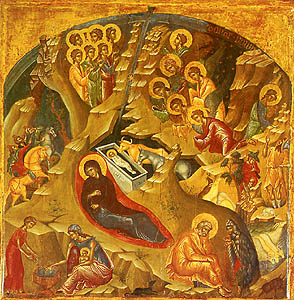
"Then the angel said to her, 'Do not be afraid, Mary, for you have found favor with God. And behold, you will conceive in your womb and bring forth a Son, and shall call His name Jesus. He will be great, and will be called the son of the Highest; and the Lord God will give Him the throne of his father David. And He will reign over the house of Jacob forever, and of His kingdom there will be no end.' . . . 'The Holy Spirit will come upon you, and the power of the Highest will overshadow you; therefore, also, that Holy One who is to be born will be called the Son of God.'" (Luke 1:30-33, 35 NKJV)
"So it was, that while they were there, the days were completed for her to be delivered. And she brought forth her firstborn Son, and wrapped Him in swaddling cloths, and laid Him in a manger, because there was no room for them in the inn." (Luke 2:6-7 NKJV)
"Then the angel said to them, 'Do not be afraid, for behold, I bring you good tidings of great joy which will be to all people. For there is born to you this day in the city of David a Savior, who is Christ the Lord." (Luke 2:10-11 NKJV)
"So all this was done that it might be fulfulled which was spoken by the Lord through the prophet, saying: 'Behodl, the virgin shall be with child, and bear a Son, and they shall call His name Immanuel' which is translated, 'God with us.'" (Matthew 1:22-23 NJKV; cf. Isaiah 7:14)
"And Mary said:
'My soul magnifies the Lord,
And my spirit has rejoiced in God my Savior.
For He has regarded the lowly state of His maidservant;
For behold, henceforth all generations will call me blessed.
For He who is mighty has done great things for me,
And holy is His name.
And His mercy is on those who fear him
From generation to generation.
He has shown strength with His arm;
He has scattered the proud in the imagination of their hearts.
He has put down the mighty from their thrones,
And exalted the lowly.
He has filled the hungry with good things,
And the rich He has sent away empty.
He has helped His servant Israel,
In remembrance of His mercy,
As He spoke to our fathers,
To Abraham and to his seed forever."
(Luke 1:46-55 NKJV)
More honorable than the cherubim, and more glorious beyond compare than the seraphim, thou who without stain barest God the Word, and art truly Theotokos, we magnify thee.
Troparion:
Thy Nativity, O Christ our God,
has shone to the world as the light of wisdom.
For by it those who worshipped the stars
were taught by a star to adore Thee,
the Sun of Righteousness,
and to know Thee, the Orient from on high.
O Lord, glory to Thee.
Kontakion:
Today the Virgin gives birth to the Transcendent One,
and the earth offers a cave to the Unapproachable One.
Angels with Shepherds glorify Him,
the wise men journey with the star;
since for our sake the eternal God was born as a little child.
December 06, 2005
St. Nicholas Stuff
Today is the feast day of St. Nicholas. It was fun putting some "gold" coins (i.e., chocolate wrapped in gold foil) in Sofie's slippers and pointing out to her that St. Nicholas had visited and left a gift. I asked her if she remembered St. Nicholas visiting our Church on Sunday and handing her a stocking. With typical Sofie exuberance she said, "Oh, yes! St. Nich'las!" I told her St. Nicholas was in heaven with Jesus but that he helps us with his prayers for us.
I love Sofie's growing comprehension of our faith traditions. It is such a joy to participate with her and observe her participation in things that fill her with happiness.
I sent a link to coloring pictures and other ready-to-print activities for Sofie and other kids from the St. Nicholas website. I'll tell Sofie some more stories about St. Nicholas when I get home from work this evening, but I'll save this one for when she's a bit older (she's two, after all, and she is being taught that we musn't hit):
In 325 Emperor Constantine convened the Council of Nicaea, the very first ecumenical council. More than 300 bishops came from all over the Christian world to debate the nature of the Holy Trinity. It was one of the early church's most intense theological questions. Arias, who was from Egypt, was teaching that Jesus the Son was not equal to God the Father. This was known as the Arian controversy and it shook the very foundations of Christianity. Arias argued his position forcefully and at great length. The assembly listened in total silence and did not interrupt the presentation.As Arias continued to present his case vigorously, Nicholas became more and more upset. Finally, Nicholas could contain himself no longer-what he saw as essential to Christian belief was under attack. An outraged Nicholas got up, crossed the room, and slapped Arias in the face! The other bishops were shocked. It was simply unbelievable that a bishop would lose control and be so hotheaded in such a solemn assembly. Arias' supporters demanded that Nicholas be brought to Constantine for discipline. Constantine, acknowledging that it was illegal for anyone to strike another in his presence, said that in this case, however, it was the bishops themselves who must determine the punishment.
The bishops decided to strip Nicholas of his bishop's garments, chain him, and throw him into jail. That way Nicholas would not participate in the rest of the meeting. When the Council was over a final judgment would be made. So a shackled Nicholas was put into jail.
Nicholas was surely ashamed of his outburst and prayed for forgiveness, though he did not waver in his belief that Arias was wrong. During the night, Jesus with Mary his Mother appeared to Nicholas, asking, "Why are you imprisoned?" "Because of my love for you," he replied. Jesus then gave the Holy Scriptures to Nicholas. Mary went away and returned with bishop's garments, including the stole, so Nicholas would be dressed with proper dignity in the robes of his office. At peace, Nicholas studied the Scriptures throughout the night.
When the jailer came to check on him in the morning, he found the chains loose on the floor and Nicholas, dressed in bishop's robes, quietly reading the Scriptures. When this was reported to Constantine, the emperor asked that Nicholas be freed. Nicholas was fully reinstated as Bishop of Myra.
The Council of Nicaea agreed with Nicholas' views, deciding the question against Arias. The work of the Council produced the Nicaene Creed which to this day many Christians use when they stand and say what they believe.
November 21, 2005
The Presentation of the Most Holy Theotokos and Ever-Virgin Mary in the Temple
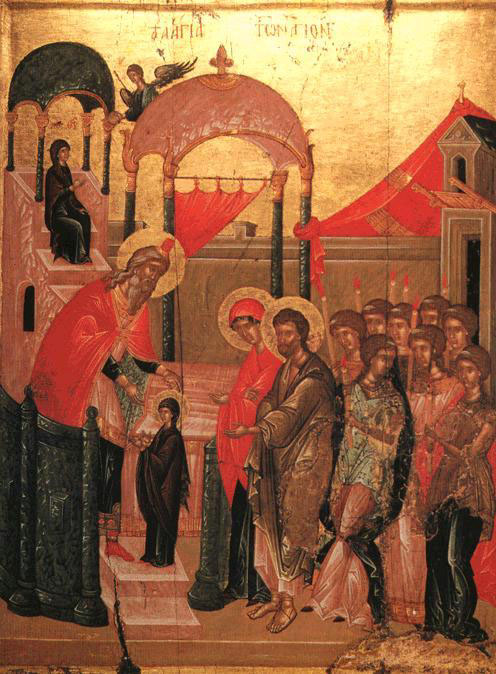
Troparion of the Mother of God Tone 4
Today is the prelude of God's goodwill/ and the prophecy of the salvation of men./ The Virgin appears openly in the temple of God/ and foretells Christ to all./ So let us cry to her with loud voices:/ Rejoice, thou who art the fulfillment/ of the Creator's providence.
Kontakion of the Mother of God Tone 4
The most pure Temple of the Saviour,/ the most precious bridal chamber and Virgin,/ the sacred treasury of the glories of God,/ today enters into the house of the Lord,/ bringing with her the grace that is the Divine Spirit./ And the Angels of God sing of her:/ This is the heavenly tabernacle.
If a tree is known by its fruit, and a good tree bears good fruit (Mt. 7:17; Lk. 6:44), then is not the Mother of Goodness Itself, She who bore the Eternal Beauty, incomparably more excellent than every good, whether in this world or the world above? Therefore, the coeternal and identical Image of goodness, Preeternal, transcending all being, He Who is the preexisting and good Word of the Father, moved by His unutterable love for mankind and compassion for us, put on our image, that He might reclaim for Himself our nature which had been dragged down to uttermost Hades, so as to renew this corrupted nature and raise it to the heights of Heaven. For this purpose, He had to assume a flesh that was both new and ours, that He might refashion us from out of ourselves. Now He finds a Handmaiden perfectly suited to these needs, the supplier of Her own unsullied nature, the Ever-Virgin now hymned by us, and Whose miraculous Entrance into the Temple, into the Holy of Holies, we now celebrate. God predestined Her before the ages for the salvation and reclaiming of our kind. She was chosen, not just from the crowd, but from the ranks of the chosen of all ages, renowned for piety and understanding, and for their God-pleasing words and deeds.In the beginning, there was one who rose up against us: the author of evil, the serpent, who dragged us into the abyss. Many reasons impelled him to rise up against us, and there are many ways by which he enslaved our nature: envy, rivalry, hatred, injustice, treachery, slyness, etc. In addition to all this, he also has within him the power of bringing death, which he himself engendered, being the first to fall away from true life.
The author of evil was jealous of Adam, when he saw him being led from earth to Heaven, from which he was justly cast down. Filled with envy, he pounced upon Adam with a terrible ferocity, and even wished to clothe him with the garb of death. Envy is not only the begetter of hatred, but also of murder, which this truly man-hating serpent brought about in us. For he wanted to be master over the earth-born for the ruin of that which was created in the image and likeness of God. Since he was not bold enough to make a face to face attack, he resorted to cunning and deceit. This truly terrible and malicious plotter pretended to be a friend and useful adviser by assuming the physical form of a serpent, and stealthily took their position. By his God-opposing advice, he instills in man his own death-bearing power, like a venomous poison.
If Adam had been sufficiently strong to keep the divine commandment, then he would have shown himself the vanquisher of his enemy, and withstood his deathly attack. But since he voluntarily gave in to sin, he was defeated and was made a sinner. Since he is the root of our race, he has produced us as death-bearing shoots. So, it was necessary for us, if he were to fight back against his defeat and to claim victory, to rid himself of the death-bearing venomous poison in his soul and body, and to absorb life, eternal and indestructible life.
It was necessary for us to have a new root for our race, a new Adam, not just one Who would be sinless and invincible, but one Who also would be able to forgive sins and set free from punishment those subject to it. And not only would He have life in Himself, but also the capacity to restore to life, so that He could grant to those who cleave to Him and are related to Him by race both life and the forgiveness of their sins, restoring to life not only those who came after Him, but also those who already had died before Him. Therefore, St. Paul, that great trumpet of the Holy Spirit, exclaims, "the first man Adam was made a living soul, the last Adam was made a quickening spirit" (1 Cor. 15:45).
Except for God, there is no one who is without sin, or life-creating, or able to remit sin. Therefore, the new Adam must be not only Man, but also God. He is at the same time life, wisdom, truth, love, and mercy, and every other good thing, so that He might renew the old Adam and restore him to life through mercy, wisdom and righteousness. These are the opposites of the things which the author of evil used to bring about our aging and death.
As the slayer of mankind raised himself against us with envy and hatred, so the Source of life was lifted up [on the Cross] because of His immeasurable goodness and love for mankind. He intensely desired the salvation of His creature, i.e., that His creature would be restored by Himself. In contrast to this, the author of evil wanted to bring God's creature to ruin, and thereby put mankind under his own power, and tyrannically to afflict us. And just as he achieved the conquest and the fall of mankind by means of injustice and cunning, by deceit and his trickery, so has the Liberator brought about the defeat of the author of evil, and the restoration of His own creature with truth, justice and wisdom.
It was a deed of perfect justice that our nature, which was voluntarily enslaved and struck down, should again enter the struggle for victory and cast off its voluntary enslavement. Therefore, God deigned to receive our nature from us, hypostatically uniting with it in a marvellous way. But it was impossible to unite that Most High Nature,Whose purity is incomprehensible for human reason, to a sinful nature before it had been purified. Therefore, for the conception and birth of the Bestower of purity, a perfectly spotless and Most Pure Virgin was required.
Today we celebrate the memory of those things that contributed, if only once, to the Incarnation. He Who is God by nature, the Co-unoriginate and Coeternal Word and Son of the Transcendent Father, becomes the Son of Man, the Son of the Ever-Virgin. "Jesus Christ the same yesterday and today, and forever" (Heb. 13:8), immutable in His divinity and blameless in His humanity, He alone, as the Prophet Isaiah prophesied, "practiced no iniquity, nor deceit with His lips" (Is. 53: 9). He alone was not brought forth in iniquity, nor was He conceived in sin, in contrast to what the Prophet David says concerning himself and every other man (Ps. 50/51: 5). Even in what He assumes, He is perfectly pure and has no need to be cleansed Himself. But for our sake, He accepted purification, suffering, death and resurrection, that He might transmit them to us.
God is born of the spotless and Holy Virgin, or better to say, of the Most Pure and All-Holy Virgin. She is above every fleshly defilement, and even above every impure thought. Her conceiving resulted not from fleshly lust, but by the overshadowing of the Most Holy Spirit. Such desire being utterly alien to Her, it is through prayer and spiritual readiness that She declared to the angel: "Behold the handmaiden of the Lord; be it unto Me according to thy word" (Lk. 1:38), and that She conceived and gave birth. So, in order to render the Virgin worthy of this sublime purpose, God marked this ever-virgin Daughter now praised by us, from before the ages, and from eternity, choosing Her from out of His elect.
Turn your attention then, to where this choice began. From the sons of Adam God chose the wondrous Seth, who showed himself a living heaven through his becoming behavior, and through the beauty of his virtues. That is why he was chosen, and from whom the Virgin would blossom as the divinely fitting chariot of God. She was needed to give birth and to summon the earth-born to heavenly sonship. For this reason also all the lineage of Seth were called "sons of God," because from this lineage a son of man would be born the Son of God. The name Seth signifies a rising or resurrection, or more specifically, it signifies the Lord, Who promises and gives immortal life to all who believe in Him.
And how precisely exact is this parallel! Seth was born of Eve, as she herself said, in place of Abel, whom Cain killed through jealousy (Gen. 4:25); and Christ, the Son of the Virgin, was born for us in place of Adam, whom the author of evil also killed through jealousy. But Seth did not resurrect Abel, since he was only a foretype of the resurrection. But our Lord Jesus Christ resurrected Adam, since He is the very Life and the Resurrection of the earth-born, for whose sake the descendents of Seth are granted divine adoption through hope, and are called the children of God. It was because of this hope that they were called sons of God, as is evident from the one who was first called so, the successor in the choice.This was Enos, the son of Seth, who as Moses wrote, first hoped to call on the Name of the Lord (Gen. 4:26).
In this manner, the choice of the future Mother of God, beginning with the very sons of Adam and proceeding through all the generations of time, through the Providence of God, passes to the Prophet-king David and the successors of his kingdom and lineage. When the chosen time had come, then from the house and posterity of David, Joachim and Anna are chosen by God. Though they were childless, they were by their virtuous life and good disposition the finest of all those descended from the line of David. And when in prayer they besought God to deliver them from their childlessness, and promised to dedicate their child to God from its infancy. By God Himself, the Mother of God was proclaimed and given to them as a child, so that from such virtuous parents the all-virtuous child would be raised. So in this manner, chastity joined with prayer came to fruition by producing the Mother of virginity, giving birth in the flesh to Him Who was born of God the Father before the ages.
Now, when Righteous Joachim and Anna saw that they had been granted their wish, and that the divine promise to them was realized in fact, then they on their part, as true lovers of God, hastened to fulfill their vow given to God as soon as the child had been weaned from milk. They have now led this truly sanctified child of God, now the Mother of God, this Virgin into the Temple of God. And She, being filled with Divine gifts even at such a tender age, ... She, rather than others, determined what was being done over Her. In Her manner She showed that She was not so much presented into the Temple, but that She Herself entered into the service of God of her own accord, as if she had wings, striving towards this sacred and divine love. She considered it desirable and fitting that she should enter into the Temple and dwell in the Holy of Holies.
Therefore, the High Priest, seeing that this child, more than anyone else, had divine grace within Her, wished to set Her within the Holy of Holies. He convinced everyone present to welcome this, since God had advanced it and approved it. Through His angel, God assisted the Virgin and sent Her mystical food, with which She was strengthened in nature, while in body She was brought to maturity and was made purer and more exalted than the angels, having the Heavenly spirits as servants. She was led into the Holy of Holies not just once, but was accepted by God to dwell there with Him during Her youth, so that through Her, the Heavenly Abodes might be opened and given for an eternal habitation to those who believe in Her miraculous birthgiving.
So it is, and this is why She, from the beginning of time, was chosen from among the chosen. She Who is manifest as the Holy of Holies, Who has a body even purer than the spirits purified by virtue, is capable of receiving ... the Hypostatic Word of the Unoriginate Father. Today the Ever-Virgin Mary, like a Treasure of God, is stored in the Holy of Holies, so that in due time, (as it later came to pass) She would serve for the enrichment of, and an ornament for, all the world. Therefore, Christ God also glorifies His Mother, both before birth, and also after birth.
We who understand the salvation begun for our sake through the Most Holy Virgin, give Her thanks and praise according to our ability. And truly, if the grateful woman (of whom the Gospel tells us), after hearing the saving words of the Lord, blessed and thanked His Mother, raising her voice above the din of the crowd and saying to Christ, "Blessed is the womb that bore Thee, and the paps Thou hast sucked" (Lk. 11:27), then we who have the words of eternal life written out for us, and not only the words, but also the miracles and the Passion, and the raising of our nature from death, and its ascent from earth to Heaven, and the promise of immortal life and unfailing salvation, then how shall we not unceasingly hymn and bless the Mother of the Author of our Salvation and the Giver of Life, celebrating Her conception and birth, and now Her Entry into the Holy of Holies?
Now, brethren, let us remove ourselves from earthly to celestial things. Let us change our path from the flesh to the spirit. Let us change our desire from temporal things to those that endure. Let us scorn fleshly delights, which serve as allurements for the soul and soon pass away. Let us desire spiritual gifts, which remain undiminished. Let us turn our reason and our attention from earthly concerns and raise them to the inaccessable places of Heaven, to the Holy of Holies, where the Mother of God now resides.
Therefore, in such manner our songs and prayers to Her will gain entry, and thus through her mediation, we shall be heirs of the everlasting blessings to come, through the grace and love for mankind of Him Who was born of Her for our sake, our Lord Jesus Christ, to Whom be glory, honor and worship, together with His Unoriginate Father and His Coeternal and Life-Creating Spirit, now and ever and unto ages of ages. Amen.
September 14, 2005
The Elevation of the Precious And Lifegiving Cross

Troparion Tone 1
O Lord, save Thy people/ and bless Thine inheritance./ Grant victory over their enemies to Orthodox Christians,/ and protect Thy people with Thy Cross.
Kontakion Tone 4
O Christ our God,/ Who wast voluntarily lifted up on the Cross,/ grant Thy mercies to Thy new people named after Thee./ Gladden with Thy power Orthodox Christians/ and give them victory over their enemies./ May they have as ally/ that invincible trophy, Thy weapon of peace.
From a sermon of St. John the Wonderworker:
Before the time of Christ, the cross was an instrument of punishment; it evoked fear and aversion. But after Christ's death on the Cross it became the instrument of our salvation. Through the Cross, Christ destroyed the devil; from the Cross He descended into hades and, having liberated those languishing there, led them into the Kingdom of Heaven. The sign of the Cross is terrifying to demons and, as the sign of Christ, it is honored by Christians.
"O Lord, save Thy people and bless Thine inheritance. Grant victory unto Orthodox Christians over their adversaries, and by the virtue of Thy Cross, preserve Thy community."
The beginning of this prayer is taken from the twenty-seventh Psalm. In the Old Testament the word "people" designated only those who confessed the true faith, people faithful to God. "Inheritance" referred to everything which properly belonged to God, God's property, which in the New Testament is the Church of Christ. In praying for the salvation of God's people (the Christians), both from eternal torments and from earthly calamities, we beseech the Lord to bless, to send down grace, His good gifts upon the whole Church as well, and inwardly strengthen her.
The petition for granting "victory to kings" (Grant victory to Orthodox Christians over their adversaries) (ie: to the bearers of Supreme authority), has its basis in Psalm 143, verse 10, and recalls the victories of King David achieved by God's power, and likewise the victories granted Emperor Constantine through the Cross of the Lord.
This appearance of the Cross made emperors who had formerly persecuted Christians into defenders of the Church from her external enemies, into "external bishops," to use the expression of the holy Emperor Constantine. The Church, inwardly strong by God's grace and protected outwardly, is, for Orthodox Christians, "the city of God." Heavenly Jerusalem has its beginning. Various calamities have shaken the world, entire peoples have disappeared, cities and states have perished, but the Church, in spite of persecutions and even internal conflicts, stands invincible; for the gates of hell shall not prevail against her (Matt. 16:18).
Today, when world leaders try in vain to establish order on earth, the only dependable instrument of peace is that about which the Church sings:
"The Cross is the guardian of the whole world; the Cross is the beauty of the Church, the Cross is the might of kings; the Cross is the confirmation of the faithful, the Cross is the glory of angels and the wounding of demons." (Exapostilarion of the Exaltation of the Cross)
From the Orthodox Church in America website:
The pagan Roman emperors tried to completely eradicate from human memory the holy places where our Lord Jesus Christ suffered and was resurrected for mankind. The Emperor Hadrian (117-138) gave orders to cover over the ground of Golgotha and the Sepulchre of the Lord, and to build a temple of the pagan goddess Venus and a statue of Jupiter.
Pagans gathered at this place and offered sacrifice to idols there. Eventually after 300 years, by Divine Providence, the great Christian sacred remains, the Sepulchre of the Lord and the Life-Creating Cross were again discovered and opened for veneration. This took place under the Emperor Constantine the Great (306-337) after his victory in the year 312 over Maxentius, ruler of the Western part of the Roman empire, and over Licinius, ruler of its Eastern part. In the year 323 Constantine became the sole ruler of the vast Roman empire.
In 313 he had issued the Edict of Milan, by which the Christian religion was legalized and the persecutions against Christians in the Western half of the empire were stopped. The ruler Licinius, although he had signed the Edict of Milan to oblige Constantine, still fanatically continued the persecutions against Christians. Only after his conclusive defeat did the 313 Edict of toleration extend also to the Eastern part of the empire. The Holy Equal-to-the-Apostles Emperor Constantine, having gained victory over his enemies in three wars with God's assistance, had seen in the heavens the Sign of the Cross, and written beneath: "By this you shall conquer."
Ardently desiring to find the Cross on which our Lord Jesus Christ was crucified, St. Constantine sent his mother, the pious Empress Helen (May 21), to Jerusalem, providing her with a letter to St. Makarios, Patriarch of Jerusalem.
Although the holy empress Helen was already in her declining years, she set about completing the task with enthusiasm. The empress gave orders to destroy the pagan temple and the statues in Jerusalem. Searching for the Life-Creating Cross, she made inquiry of Christians and Jews, but for a long time her search remained unsuccessful.
Finally, they directed her to a certain elderly Hebrew by the name of Jude who stated that the Cross was buried where the temple of Venus stood. They demolished the pagan temple and, after prayer, they began to excavate the ground. Soon the Tomb of the Lord was uncovered. Not far from it were three crosses, a board with the inscription ordered by Pilate, and four nails which had pierced the Body of the Lord.
In order to discern on which of the three crosses the Savior was crucified, Patriarch Makarios alternately touched the crosses to a corpse. When the Cross of the Lord touched the dead one, he came to life. Having beheld the raising of the dead man, everyone was convinced that the Life-Creating Cross was found.
Christians came in a huge throng to venerate the Holy Cross, beseeching St. Makarios to elevate the Cross, so that even those far off might reverently contemplate it. Then the Patriarch and other spiritual leaders raised up the Holy Cross, and the people, saying "Lord have mercy," reverently prostrated before the Venerable Wood. This solemn event occurred in the year 326.
During the discovery of the Life-Creating Cross another miracle took place: a grievously sick woman, beneath the shadow of the Holy Cross, was healed instantly. The elder Jude and other Jews there believed in Christ and accepted Holy Baptism. Jude received the name Kyriakos and afterwards was consecrated Bishop of Jerusalem.
During the reign of Julian the Apostate (361-363) he accepted a martyr's death for Christ (see October 28). The holy empress Helen journeyed to the holy places connected with the earthly life of the Savior, building more than 80 churches, at Bethlehem the birthplace of Christ, and on the Mount of Olives where the Lord ascended to Heaven, and at Gethsemane where the Savior prayed before His sufferings and where the Mother of God was buried after her death.
Saint Helen took part of the Life-Creating Wood and nails with her to Constantinople. The holy emperor Constantine gave orders to build at Jerusalem a majestic and spacious church in honor of the Resurrection of Christ, also including under its roof the Life-Giving Tomb of the Lord and Golgotha. The temple was constructed in about ten years. St. Helen did not survive until the dedication of the temple, she died in the year 327. The church was consecrated on September 13, 335. On the following day, September 14, the festal celebration of the Exaltation of the Venerable and Life-Creating Cross was established.
Another event connected to the Cross of the Lord is remembered also on this day: its return to Jerusalem from Persia after a fourteen year captivity. During the reign of the Byzantine emperor Phokas (602-610) the Persian emperor Khozroes II in a war against the Greeks defeated the Greek army, plundered Jerusalem and captured both the Life-Creating Cross of the Lord and the Holy Patriarch Zachariah (609-633).
The Cross remained in Persia for fourteen years and only under the emperor Heraklios (610-641), who with the help of God defeated Khozroes and concluded peace with his successor and son Syroes, was the Cross of the Lord returned to the Christians.
With great solemnity the Life-creating Cross was transferred to Jerusalem. Emperor Heraklios in imperial crown and royal purple carried the Cross of Christ into the temple of the Resurrection. With the emperor went Patriarch Zacharios. At the gates by which they ascended Golgotha, the emperor suddenly stopped and was not able to proceed farther. The holy Patriarch explained to the emperor that an angel of the Lord was blocking his way. The emperor was told to remove his royal trappings and to walk barefoot, since He Who bore the Cross for the salvation of the world from sin had made His way to Golgotha in all humility. Then Heraklios donned plain garb, and without further hindrance, carried the Cross of Christ into the church.
In a sermon on the Exaltation of the Cross, Saint Andrew of Crete (July 4) says: "The Cross is exalted, and everything true gathers together, the Cross is exalted, and the city makes solemn, and the people celebrate the feast".
September 08, 2005
The Nativity of the Theotokos
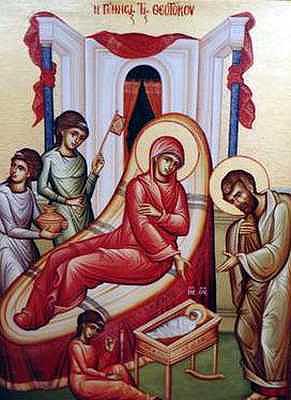
Troparion of the Mother of God Tone 4
Thy Nativity, O Mother of God,/ has brought joy to all the world;/ for from thee arose the Sun of Righteousness, Christ our God,/ Who, having dissolved the curse, has given His blessing,/ and having abolished death, has granted us life eternal.
Kontakion of the Mother of God Tone 4
Joachim and Anna were freed from the reproach of childlessness/ and Adam and Eve from the corruption of death, O Immaculate One, by thy holy nativity./ And thy people, redeemed from the guilt of sin,/ celebrate thy birth by crying to thee:/ The barren woman gives birth to the Mother of God and the nurse of our life.
St. Andrew of Crete: Sermon on the Nativity of the Virgin Mary
From the Orthodox Church in America website:
In addition to the celebration of the Annunciation, there are three major feasts in the Church honoring Mary, the Theotokos. The first of these is the feast of her nativity which is kept on the eighth of September.The record of the birth of Mary is not found in the Bible. The traditional account of the event is taken from the apocryphal writings which are not part of the New Testament scriptures. The traditional teaching which is celebrated in the hymns and verses of the festal liturgy is that Joachim and Anna were a pious Jewish couple who were among the small and faithful remnant-"the poor and the needy"-who were awaiting the promised messiah. The couple was old and childless. They prayed earnestly to the Lord for a child, since among the Jews barrenness was a sign of God's disfavor. In answer to their prayers, and as the reward of their unwavering fidelity to God, the elderly couple was blessed with the child who was destined, because of her own personal goodness and holiness, to become the Mother of the Messiah-Christ.
Your nativity, 0 Virgin, has proclaimed joy to the whole universe. The Sun of Righteousness, Christ our God, has shone from you, 0 Theotokos. By annulling the curse he bestowed a blessing. By destroying death he has granted us eternal life. (Troparion)By your nativity, 0 most pure virgin, Joachim and Anna are freed from barrenness; Adam and Eve from the corruption of death. And we, your people, freed from the guilt of sin, celebrate and sing to you: The barren woman gives birth to the Theotokos, the Nourisher of our Life. (Kontakion)The fact that there is no Biblical verification of the facts of Mary's birth is incidental to the meaning of the feast. Even if the actual background of the event as celebrated in the Church is questionable from an historical point of view, the divine meaning of it "for us men and for our salvation" is obvious. There had to be one born of human flesh and blood who would be spiritually capable of being the Mother of Christ, and she herself had to be born into the world of persons who were spiritually capable of being her parents.
The feast of the Nativity of the Theotokos, therefore, is a glorification of Mary's birth, of Mary herself and of her righteous parents. It is a celebration as well of the very first preparation of the salvation of the world. For the "Vessel of Light," the "Book of the Word of Life," the "Door to the Orient," the "Throne of Wisdom" is being prepared on earth by God himself in the birth of the holy girl-child Mary.
The verses of the feast are filled with titles for Mary such as those in the quotations above. They are inspired by the message of the Bible, both the Old and New Testaments. The specific Biblical readings of the feast give indications of this.
At the Vespers the three Old Testamental readings are "mariological" in their New Testamental interpretation. Thus, Jacob's Ladder which unites heaven and earth and the place which is named "the house of God" and the "gate of heaven" (Genesis 28:10-17) are taken, to indicate the union of God with men which is realized most fully and perfectly-both spiritually and physically-in Mary the Theotokos, Bearer of God. So also the vision of the temple with the "door 'to the East" perpetually closed and filled with the "glory of the Lord" symbolizes Mary, called in the hymns of the feast "the living temple of God filled with the divine Glory." (Ezekiel 43:27-44:4) Mary is also identified with the "house" which the Divine Wisdom has built for himself according to the reading from Proverbs 9:1-11.
The Gospel reading of Matins is the one read at all feasts of the Theotokos, the famous Magnificat from St. Luke in which Mary says: "My soul magnifies the Lord and my spirit rejoices in God my Saviour, for he has regarded the low estate of his handmaiden, for behold, henceforth all generations will call me blessed."(Luke 1:47)
The epistle reading of the Divine Liturgy is the famous passage about the coming of the Son of God in "the form of a servant, being born in the likeness of man" (Philippians 2:5-11) and the gospel reading is that which is always read for feasts of the Theotokos- The woman in the crowd glorifies the Mother of Jesus, and the Lord himself responds that the same blessedness which his mother receives is for all "who hear the word of God and keep it." (Luke 11:27-28)
Thus, on the feast of the Nativity of the Theotokos, as on all liturgical celebrations of Christ's Mother, we proclaim and celebrate that through God's graciousness to mankind every Christian receives what the Theotokos receives, the "great mercy" which is given to human persons because of Christ's birth from the Virgin.
September 01, 2005
The Indiction of the Ecclesiastical Year
Happy New Year to all my Orthodox brothers and sisters!
Troparion of the New Year Tone 2
Lord of the universe who by Thy power hast established the times and seasons,/ bless this year with Thy goodness,/ preserve our rulers and keep Thy flock in peace,/ through the prayers of the Mother of God, and save us.
Kontakion of the New Year Tone 4
Creator and Lord of the ages,/ God of all, transcendent in essence: Bless this year./ Save all who worship and cry:/ Grant us a fruitful year,/ O Compassionate Redeemer.
Fr. Michael Harper here explains the Orthodox New Year:
It can be frustrating to move suddenly from the end, back to the beginning of something. But this is what Orthodox believers do as we move from August 31st - the last day of the old year, to September 1st, the first day of the new year.
It is part of the goodness of God, that He, who has no beginning and no ending, the Eternal Trinity, should take such care to give us a year which begins and ends, and then begins all over again. In our human and finite state we need fresh starts, and this is one of them. From the peaks of Pascha, Ascension, Pentecost, and Transfiguration, we move back to beginnings, the Nativity of the Mother of God, and then in December of the Son of God Himself. We start this wonderful cycle all over again. But the Holy Spirit, as we trust Him, will renew this new year to us, and give us a whole new understanding of it. . . .
It is significant that the last great feast of the old year is that of the Dormition of Mary, the Mother of God. Her human passing was to heaven's glory. And the first great feast of the new year is her Nativity. It is not that Mary is more important that Christ, around which most of the Calendar revolves. Mary is not God. She did not exist from eternity. But she is honoured in this way because she is our supreme example. She lived a life of complete obedience to God.
Another explanation is given here.
August 15, 2005
The Dormition of our Most Holy Lady, the Mother of God and Ever-Virgin Mary
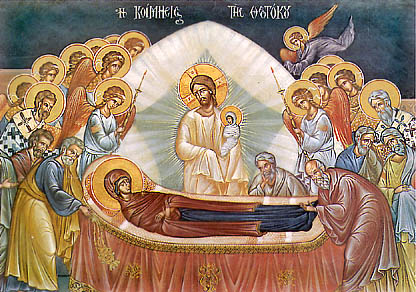
Troparion Tone 1
In giving birth thou didst preserve thy virginity;/ in falling asleep thou didst not forsake the world, O Theotokos./ Thou wast translated to life, O Mother of Life,/ and by your prayers you deliver our souls from death.
Kontakion Tone 2
Neither the tomb nor death could hold the Theotokos,/ who is sleepless in her intercessions and an unchanging hope in her mediations./ For as the Mother of Life she was transferred to life/ by Him Who dwelt in her ever-virgin womb.
From the OCA website comes this explanation of The Feast of the Dormition:
After the Ascension of the Lord, the Mother of God remained in the care of the Apostle John the Theologian, and during his journeys She lived at the home of his parents, near the Mount of Olives. She was a source of consolation and edification both for the Apostles and for all the believers. Conversing with them, She told them about miraculous events: the Annunciation, the seedless and undefiled Conception of Christ born of Her, about His early childhood, and about His earthly life. Like the Apostles, She helped plant and strengthen the Christian Church by Her presence, Her discourse and Her prayers.
The reverence of the Apostles for the Most Holy Virgin was extraordinary. After the receiving of the Holy Spirit on the day of Pentecost, the Apostles remained at Jerusalem for about ten years attending to the salvation of the Jews, and wanting moreover to see the Mother of God and hear Her holy discourse. Many of the newly-enlightened in the Faith even came from faraway lands to Jerusalem, to see and to hear the All-Pure Mother of God.
During the time of the persecution initiated by King Herod against the young Church of Christ (Acts 12: 1-3), the Most Holy Virgin and the Apostle John the Theologian withdrew to Ephesus in the year 43. The preaching of the Gospel there had fallen by lot to the Apostle John the Theologian. The Mother of God was on Cyprus with St. Lazarus the Four-Days-Dead, where he was bishop. She was also on Holy Mount Athos. St. Stephen of the Holy Mountain says that the Mother of God prophetically spoke of it: "Let this place be my lot, given to me by my Son and my God. I will be the Patroness of this place and intercede with God for it."
The respect of ancient Christians for the Mother of God was so great that they preserved what they could about Her life, what they could take note of concerning Her sayings and deeds, and they even passed down to us a description of Her outward appearance.
According to Tradition, based on the words of the Hieromartyrs Dionysios the Areopagite (October 3), Ignatios the God-Bearer (December 20), St. Ambrose of Milan (December 7) had occasion to write in his work "On Virgins" concerning the Mother of God: "She was a Virgin not only in body, but also in soul, humble of heart, circumspect in word, wise in mind, not overly given to speaking, a lover of reading and of work, and prudent in speech. Her rule of life was to offend no one, to intend good for everyone, to respect the aged, not envy others, avoid bragging, be healthy of mind, and to love virtue."
When did She ever hurl the least insult in the face of Her parents? When was She at discord with Her kin? When did She ever puff up with pride before a modest person, or laugh at the weak, or shun the destitute? With Her there was nothing of glaring eyes, nothing of unseemly words, nor of improper conduct. She was modest in the movement of Her body, Her step was quiet, and Her voice straightforward; so that Her face was an expression of soul. She was the personification of purity.
All Her days She was concerned with fasting: She slept only when necessary, and even then, when Her body was at rest, She was still alert in spirit, repeating in Her dreams what She had read, or the implementation of proposed intentions, or those planned yet anew. She was out of Her house only for church, and then only in the company of relatives. Otherwise, She seldom appeared outside Her house in the company of others, and She was Her own best overseer. Others could protect Her only in body, but She Herself guarded Her character."
According to Tradition, that from the compiler of Church history Nikephoros Kallistos (fourteenth century), the Mother of God "was of average stature, or as others suggest, slightly more than average; Her hair golden in appearance; Her eyes bright with pupils like shiny olives; Her eyebrows strong in character and moderately dark, Her nose pronounced and Her mouth vibrant bespeaking sweet speech; Her face was neither round nor angular, but somewhat oblong; the palm of Her hands and fingers were longish.
In conversation with others She preserved decorum, neither becoming silly nor agitated, and indeed especially never angry; without artifice, and direct, She was not overly concerned about Herself, and far from pampering Herself, She was distinctly full of humility. Regarding the clothing which She wore, She was satisfied to have natural colors, which even now is evidenced by Her holy head-covering. Suffice it to say, a special grace attended all Her actions." (Nicephoros Kallistos borrowed his description from St. Epiphanios of Cyprus (May 12), from the "Letter to Theophilos Concerning Icons."
The circumstances of the Dormition of the Mother of God were known in the Orthodox Church from apostolic times. Already in the first century, the Hieromartyr Dionysios the Areopagite wrote about Her "Falling-Asleep." In the second century, the account of the bodily ascent of the Most Holy Virgin Mary to Heaven is found in the works of Meliton, Bishop of Sardis. In the fourth century, St. Epiphanios of Cyprus refers to the tradition about the "Falling-Asleep" of the Mother of God. In the fifth century, St. Juvenalios, Patriarch of Jerusalem, told the holy Byzantine Empress Pulcheria: "Although in Holy Scripture there is no account about the circumstances of Her death, we know about them otherwise from the most ancient and credible Tradition." This tradition was gathered and expounded in the Church history of Nikephoros Kallistos during the fourteenth century.
At the time of Her blessed "Falling-Asleep", the Most Holy Virgin Mary was again at Jerusalem. Her fame as the Mother of God had already spread throughout the land and had aroused many of the envious and the spiteful against Her, who wanted to make attempts on Her life; but God preserved Her from enemies.
Day and night She spent at prayer. The Most Holy Mother of God went often to the Holy Sepulchre of the Lord, and here She offered up fevent prayer. More than once, enemies of the Savior sought to hinder Her from visiting her holy place, and they asked the High Priest for a guard to watch over the Grave of the Lord. But the Holy Virgin Mary, unseen by anyone, continued to pray in front of them.
In one such visit to Golgotha, the Archangel Gabriel appeared to Her and announced Her approaching transfer from this life to eternal life. In pledge of this, the Archangel gave Her a palm branch. With these Heavenly tidings the Mother of God returned to Bethlehem with the three girls attending Her (Sepphora, Abigail, and Jael). She summoned Righteous Joseph of Aramathea and other disciples of the Lord, and told them of Her impending Repose.
The Most Holy Virgin prayed also that the Lord would have the Apostle John come to Her. The Holy Spirit transported him from Ephesus, setting him in that very place where the Mother of God lay. After the prayer, the Most Holy Virgin offered incense, and John heard a voice from Heaven, closing Her prayer with the word "Amen." The Mother of God took it that the voice meant the speedy arrival of the Apostles and the Disciples and the holy Bodiless Powers.
The faithful, whose number by then was impossible to count, gathered together, says Saint John of Damascus, like clouds and eagles, to listen to the Mother of God. Seeing one another, the Disciples rejoiced, but in their confusion they asked each other why the Lord had gathered them together in one place. St. John the Theologian, greeting them with tears of joy, said that the time of the Virgin's repose was at hand.
Going in to the Mother of God, they beheld Her lying upon the bed, and filled with spiritual joy. The Disciples greeted Her, and then they told her how they had been carried miraculously from their places of preaching. The Most Holy Virgin Mary glorified God, because He had heard Her prayer and fulfilled Her heart's desire, and She began speaking about Her imminent end.
During the time of this conversation the Apostle Paul also appeared in a miraculous manner together with his disciples Dionysios the Areopagite, St. Hierotheos, St. Timothy and others of the Seventy Apostles. The Holy Spirit had gathered them all together so that they might be granted the blessing of the All-Pure Virgin Mary, and more fittingly to see to the burial of the Mother of the Lord. She called each of them to Herself by name, She blessed them and extolled them for their faith and the hardships they endured in preaching the Gospel of Christ. To each She wished eternal bliss, and prayed with them for the peace and welfare of the whole world.
Then came the third hour (9 A.M.), when the Dormition of the Mother of God was to occur. A number of candles were burning. The holy Disciples surrounded her beautifully adorned bed, offering praise to God. She prayed in anticipation of Her demise and of the arrival of Her longed-for Son and Lord. Suddenly, the inexpressible Light of Divine Glory shone forth, before which the blazing candles paled in comparison. All who it saw took fright. Descending from Heaven was Christ, the King of Glory, surrounded by hosts of Angels and Archangels and other Heavenly Powers, together with the souls of the Forefathers and the Prophets, who had prophesied in ages past concerning the Most Holy Virgin Mary.
Seeing Her Son, the Mother of God exclaimed: "My soul doth magnify the Lord, and my spirit hath rejoiced in God My Savior, for He hath regarded the low estate of His Handmaiden" (Lk 1:46-48) and, rising from Her bed to meet the Lord, She bowed down to Him, and the Lord bid Her enter into Life Eternal. Without any bodily suffering, as though in a happy sleep, the Most Holy Virgin Mary gave Her soul into the hands of Her Son and God.
Then began a joyous angelic song. Accompanying the pure soul of the God-betrothed and with reverent awe for the Queen of Heaven, the angels exclaimed: "Hail, Full of Grace, the Lord is with Thee, blessed art Thou among women! For lo, the Queen, God's Maiden comes, lift up the gates, and with the Ever-Existing One, take up the Mother of Light; for through Her salvation has come to all the human race. It is impossible to gaze upon Her, and it is impossible to render Her due honor" (Stikherion on "Lord, I Have Cried"). The Heavenly gates were raised, and meeting the soul of the Most Holy Mother of God, the Cherubim and the Seraphim glorified Her with joy. The face of the Mother of God was radiant with the glory of Divine virginity, and from Her body there came a sweet fragrance.
Miraculous was the life of the All-Pure Virgin, and wondrous was Her Repose, as Holy Church sings: "In Thee, O Queen, the God of all hath given thee as thy portion the things that are above nature. Just as in the Birth-Giving He did preserve Thine virginity, so also in the grave He did preserve Thy body from decay" (Canon 1, Ode 6, Troparion 1).
Kissing the all-pure body with reverence and in awe, the Disciples in turn were blessed by it and filled with grace and spiritual joy. Through the great glorification of the Most Holy Theotokos, the almighty power of God healed the sick, who with faith and love touched the holy bed.
Bewailing their separation from the Mother of God, the Apostles prepared to bury Her all-pure body. The holy Apostles Peter, Paul, James and others of the Twelve Apostles carried the funeral bier upon their shoulders, and upon it lay the body of the Ever-Virgin Mary. St. John the Theologian went at the head with the resplendent palm-branch from Paradise. The other saints and a multitude of the faithful accompanied the funeral bier with candles and censers, singing sacred songs. This solemn procession went from Sion through Jerusalem to the Garden of Gethsemane.
With the start of the procession there suddenly appeared over the all-pure body of the Mother of God and all those accompanying Her a resplendent circular cloud, like a crown. There was heard the singing of the Heavenly Powers, glorifying the Mother of God, which echoed that of the worldly voices. This circle of Heavenly singers and radiance accompanied the procession to the very place of burial.
Unbelieving inhabitants of Jerusalem, taken aback by the extraordinarily grand funeral procession and vexed at the honor accorded the Mother of Jesus, complained of this to the High Priest and scribes. Burning with envy and vengefulness toward everything that reminded them of Christ, they sent out their own servants to disrupt the procession and to set the body of the Mother of God afire.
An angry crowd and soldiers set off against the Christians, but the circular cloud accompanying the procession descended and surrounded them like a wall. The pursuers heard the footsteps and the singing, but could not see any of those accompanying the procession. Indeed, many of them were struck blind.
The Jewish priest Athonios, out of spite and hatred for the Mother of Jesus of Nazareth, wanted to topple the funeral bier on which lay the body of the Most Holy Virgin Mary, but an angel of God invisibly cut off his hands, which had touched the bier. Seeing such a wonder, Athonios repented and with faith confessed the majesty of the Mother of God. He received healing and joined the crowd accompanying the body of the Mother of God, and he became a zealous follower of Christ.
When the procession reached the Garden of Gethsemane, then amidst the weeping and the wailing began the last kiss to the all-pure body. Only towards evening were the Apostles able to place it in the tomb and seal the entrance to the cave with a large stone.
For three days they did not depart from the place of burial, praying and chanting Psalms. Through the wise providence of God, the Apostle Thomas was not to be present at the burial of the Mother of God. Arriving late on the third day at Gethsemane, he lay down at the tomb and with bitter tears asked that l he might be permitted to look once more upon the Mother of God and bid her farewell. The Apostles out of heartfelt pity for him decided to open the grave and permit him the comfort of venerating the holy relics of the Ever-Virgin Mary. Having opened the grave, they found in it only the grave wrappings and were thus convinced of the bodily ascent of the Most Holy Virgin Mary to Heaven.
On the evening of the same day, when the Apostles had gathered at a house to strengthen themselves with food, the Mother of God appeared to them and said: "Rejoice! I am with you all the days of your lives." This so gladdened the Apostles and everyone with them, that they took a portion of the bread, set aside at the meal in memory of the Savior ("the Lord's Portion"), and they exclaimed : "Most Holy Theotokos, save us". (This marks the beginning of the rite of offering up the "Panagia" ("All-Holy"), a portion of bread in honor of the Mother of God, which is done at monasteries to the present day).
The sash of the Mother of God, and Her holy garb, preserved with reverence and distributed over the face of the earth in pieces, have worked miracles both in the past and at present. Her numerous icons everywhere pour forth signs and healings, and Her holy body, taken up to Heaven, bears witness to our own future life there. Her body was not left to the vicissitudes of the transitory world, but was incomparably exalted by its glorious ascent to Heaven.
The Feast of the Dormition of the Most Holy Theotokos is celebrated with special solemnity at Gethsemane, the place of Her burial. Nowhere else is there such sorrow of heart at the separation from the Mother of God, and nowhere else such joy, because of Her intercession for the world.
The holy city of Jerusalem is separated from the Mount of Olives by the valley of Kedron on Josaphat. At the foot of the Mount of Olives is the Garden of Gethsemane, where olive trees bear fruit even now.
The holy Ancestor-of-God Joachim had himself reposed at 80 years of age, several years after the Entry of the Most Holy Theotokos into the Temple (November 21). St. Anna, having been left a widow, moved from Nazareth to Jerusalem, and lived near the Temple. At Jerusalem she bought two pieces of property: the first at the gates of Gethsemane, and the second in the valley of Josaphat. At the second locale she built a tomb for the members of her family, and where also she herself was buried with Joachim. It was there in the Garden of Gethsemane that the Savior often prayed with His disciples.
The most-pure body of the Mother of God was buried in the family tomb. Christians honored the sepulchre of the Mother of God, and they built a church on this spot. Within the church was preserved the precious funeral cloth, which covered Her all-pure and fragrant body.
The holy Patriarch Juvenalios of Jerusalem (420-458) testified before the emperor Marcian (450-457) as to the authenticity of the tradition about the miraculous ascent of the Mother of God to Heaven, and he sent to the empress, St. Pulcheria (September 10), the grave wrappings of the Mother of God from Her tomb. St. Pulcheria then placed these grave-wrappings within the Blachernae church.
Accounts have been preserved, that at the end of the seventh century a church had been built atop the underground church of the Dormition of the Most Holy Theotokos, and that from its high bell-tower could be seen the dome of the Church of the Resurrection of the Lord. Traces of this church are no longer to be seen. And in the ninth century near the subterranean Gethsemane church a monastery was built, in which more than 30 monks struggled.
Great destruction was done the Church in the year 1009 by the despoiler of the holy places, Hakim. Radical changes, the traces of which remain at present, also took place under the crusaders in the year 1130. During the eleventh to twelfth centuries the piece of excavated stone, at which the Savior had prayed on the night of His betrayal disappeared from Jerusalem. This piece of stone had been in the Gethsemane basilica from the sixth century.
But in spite of the destruction and the changes, the overall original cruciform (cross-shaped) plan of the church has been preserved. At the entrance to the church along the sides of the iron gates stand four marble columns. To enter the church, it is necessary to go down a stairway of 48 steps. At the 23rd step on the right side is a chapel in honor of the holy Ancestors-of-God Joachim and Anna together with their graves, and on the left side opposite, the chapel of St. Joseph the Betrothed with his grave. The right chapel belongs to the Orthodox Church, and the left to the Armenian Church (since 1814).
The church of the Dormition of the Theotokos has the following dimensions: in length it is 48 arshin, and in breadth 8 arshin [1 arshin = 28 inches]. At an earlier time the church had also windows beside the doors. The whole temple was adorned with a multitude of lampadas and offerings. Two small entrances lead into the burial-chamber of the Mother of God. One enters through the western doors, and exits at the northern doors. The burial-chamber of the All-Pure Virgin Mary is veiled with precious curtains. The burial place was hewn out of stone in the manner of the ancient Jewish graves and is very similar to the Sepulchre of the Lord. Beyond the burial-chamber is the altar of the church, in which Divine Liturgy is celebrated each day in the Greek language.
The olive woods on the eastern and northern sides of the temple was acquired from the Turks by the Orthodox during the seventh and eighth centuries. The Catholics acquired the olive woods on the east and south sides in 1803, and the Armenians on the west side in 1821.
On August 12, at Little Gethsemane, at the second hour of the night, the head of the Gethsemane church celebrates Divine Liturgy. With the end of Liturgy, at the fourth hour of the morning, he serves a short Molieben before the resplendent burial shroud, lifts it in his hands and solemnly carries it beyond the church to Gethsemane proper where the holy sepulchre of the Mother of God is situated. All the members of the Russian Spiritual Mission in Jerusalem, with the head of the Mission presiding, participate each year in the procession (called the "Litania") with the holy burial shroud of the Mother of God.
The rite of the Burial of the Mother of God at Gethsemane begins customarily on the morning of August 14. A multitude of people with hierarchs and clergy at the head set off from the Jerusalem Patriarchate (nearby the Church of the Resurrection of Christ) in sorrowful procession. Along the narrow alley-ways of the Holy City the funeral procession makes its way to Gethsemane. Toward the front of the procession an icon of the Dormition of the Most Holy Theotokos is carried. Along the way, pilgrims meet the icon, kissing the image of the All-Pure Virgin Mary and lift children of various ages to the icon. After the clergy, in two rows walk the black-robed monks and nuns of the Holy City: Greeks, Roumanians, Arabs, Russians. The procession, going along for about two hours, concludes with Lamentations at the Gethsemane church. In front the altar, beyond the burial chamber of the Mother of God, is a raised-up spot, upon which rests the burial shroud of the Most Holy Mother of God among fragrant flowers and myrtle, with precious coverings.
"O marvelous wonder! The Fount of Life is placed in the grave, and the grave doth become the ladder to Heaven..." Here at the grave of the All-Pure Virgin, these words strike deep with their original sense and grief is dispelled by joy: "Hail, Full of Grace, the Lord is with Thee, granting the world, through Thee, great mercy!"
Numerous pilgrims, having kissed the icon of the Dormition of the Most Holy Theotokos, following an ancient custom, then stoop down and go beneath it.
On the day of the Leave-taking of the feast (August 23), another solemn procession is made. On the return path, the holy burial shroud is carried by clergy led by the Archimandrite of Gethsemane. . . .
Today flowers are blessed in church, and people keep them in their homes. During times of family strife or illness, the flower petals are placed in the censer with the incense, and the whole house is censed. See the Prayer at the Sanctification of any Fragrant Herbage.
There is also this helpful article from Christianity Today and Christian History and Biography.
August 06, 2005
The Holy Transfiguration of Our Lord and Savior Jesus Christ
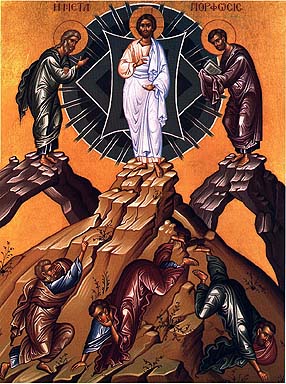
Matthew 17:1-9
And after six days Jesus taketh Peter, James, and John his brother, and bringeth them up into an high mountain apart, And was transfigured before them: and his face did shine as the sun, and his raiment was white as the light. And, behold, there appeared unto them Moses and Elias talking with him. Then answered Peter, and said unto Jesus, Lord, it is good for us to be here: if thou wilt, let us make here three tabernacles; one for thee, and one for Moses, and one for Elias. While he yet spake, behold, a bright cloud overshadowed them: and behold a voice out of the cloud, which said, This is my beloved Son, in whom I am well pleased; hear ye him. And when the disciples heard it, they fell on their face, and were sore afraid. And Jesus came and touched them, and said, Arise, and be not afraid. And when they had lifted up their eyes, they saw no man, save Jesus only. And as they came down from the mountain, Jesus charged them, saying, Tell the vision to no man, until the Son of man be risen again from the dead.
Troparion Tone 7
Thou wast transfigured on the mount, O Christ God,/ revealing Thy glory to Thy disciples as far as they could bear it./ Let Thine everlasting light shine upon us sinners/ through the prayers of the Theotokos, O Giver of Light, glory to Thee.
Kontakion Tone 7
Thou wast transfigured on the mountain, O Christ our God,/ and Thy disciples beheld Thy glory as far as they were capable,/ that when they should see Thee crucified,/ they might know that Thy suffering was voluntary/ and might proclaim to the world/ that Thou art indeed the reflection of the Father.
An explanation of the festal icon:
In the icon of the Feast of the Transfiguration, Christ is the central figure, appearing in a dominant position within a circular mandorla. He is clearly at the visual and theological center of the icon. His right hand is raised in blessing, and his left hand contains a scroll. The mandorla with its brilliant colors of white, gold, and blue represent the divine glory and light. The halo around the head of Christ is inscribed with the Greek words O on, meaning "The One Who is".
Elijah and Moses stand at the top of separate mountain peaks to the left and right of Christ. They are bowing toward Christ with their right hands raised in a gesture of intercession towards Him. Saint John Chrysostom explains the presence of these two fathers of the faith from the Old Testament in three ways. He states that they represent the Law and the Prophets (Moses received the Law from God, and Elijah was a great prophet); they both experienced visions of God (Moses on Mount Sinai and Elijah on Mount Carmel); and they represent the living and the dead (Elijah, the living, because he was taken up into heaven by a chariot of fire, and Moses, the dead, because he did experience death).
Below Christ are the three Apostles, who by their posture in the icon show their response to the transfiguration of Christ. James has fallen over backwards with his hands over his eyes. John in the center has fallen prostrate. Peter is kneeling and raises his right hand toward Christ in a gesture expressing his desire to build the three booths. The garments of the Apostles are in a state of disarray as to indicate the dramatic impact the vision has had on them.
The icon of the feast directs our attention toward the event of the Transfiguration and specifically to the glory of God as revealed in Christ. This event came at a critical point in the ministry of our Lord, just as He was setting out on His journey to Jerusalem. He would soon experience the humiliation, suffering, and death of the Cross. However, the glorious light of the Resurrection was revealed to strengthen His disciples for the trials that they would soon experience.
The feast also points to the great and glorious Second Coming of our Lord and the fulfillment of the Kingdom of God when all of creation will be transfigured and filled with light.
From the OCA website comes this explanation of the feast:
The transfiguration of Christ is one of the central events recorded in the gospels. Immediately after the Lord was recognized by his apostles as "the Christ [Messiah], the Son of the Living God," he told them that "he must go up to Jerusalem and suffer many things ... and be killed and on the third day be raised" (Mt 16). The announcement of Christ's approaching passion and death was met with indignation by the disciples. And then, after rebuking them, the Lord took Peter, James, and John "up to a high mountain" -- by tradition Mount Tabor -- and was "transfigured before them."... and his face shone like the sun, and his garments became white as snow and behold, there appeared to them Moses and Elijah, talking with him. And Peter said to Jesus, "Lord, it is well that we are here; if you wish I will make three booths here, one for you and one for Moses and one for Elijah." He was still speaking when lo, a bright cloud overshadowed them, and a voice from the cloud said, "This is my Beloved Son, with whom I am well pleased; listen to him." When the disciples heard this, they fell on their faces with awe. But Jesus came and touched them, saying, "Rise, and have no fear." And when they lifted up their eyes, they saw no one but Jesus only. And as they were coming down the mountain, Jesus commanded them, "Tell no one the vision, until the Son of Man is raised from the dead" (Mt 17:1-92, see also Mk 9:1-9; Lk 9:28-36; 2 Peter 1:16-18).
The Jewish Festival of Booths was a feast of the dwelling of God with men, and the transfiguration of Christ reveals how this dwelling takes place in and through the Messiah, the Son of God in human flesh. There is little doubt that Christ's transfiguration took place at the time of the Festival of Booths, and that the celebration of the event in the Christian Church became the New Testamental fulfillment of the Old Testamental feast in a way similar to the feasts of Passover and Pentecost.
In the Transfiguration, the apostles see the glory of the Kingdom of God present in majesty in the person of ChriSt They see that in him, indeed, all the fullness of God was pleased to dwell," that "in him the whole fulness of deity dwells bodily" (Col 1:19, 2:9). They see this before the crucifixion so that in the resurrection they might know who it is who has suffered for them, and what it is that this one, who is God, has prepared for those who love him. This is what the Church celebrates in the feast of the Transfiguration.Thou wast transfigured on the mount. 0 Christ God, revealing Thy glory to Thy disciples as they could bear it. Let Thine everlasting light shine upon us sinners. Through the prayers of the Theotokos, O Giver of Light, glory to Thee (Troparion).On the mountain wast Thou transfigured, 0 Christ God, and Thy disciples beheld Thy glory as far as they could see it; so that when they would behold Thee crucified, they would understand that Thy suffering was voluntary, and would proclaim to the world that Thou art truly the Radiance of the Father (Kontakion).
Besides the fundamental meaning which the event of the Transfiguration has in the context of the life and mission of Christ, and in addition to the theme of the glory of God which is revealed in all of its divine splendor in the face of the Saviour, the presence of Moses and Elijah is also of great significance for the understanding and celebration of the feast. Many of the hymns refer to these two leading figures of the Old Covenant as do the three scripture readings of Vespers which tell of the manifestation of the glory of God to these holy men of old (Ex 24:12-18; 33:11-34:8; 1 Kings 19:3-16).
Moses and Elijah, according to the liturgical verses, are not only the greatest figures of the Old Testament who now come to worship the Son of God in glory, they also are not merely two of the holy men to whom God has revealed himself in the prefigurative theophanies of the Old Covenant of Israel. These two figures actually stand for the Old Testament itself: Moses for the Law and Elijah for the Prophets. And Christ is the fulfillment of the Law and the Prophets (Mt 5:17).
They also stand for the living and dead, for Moses died and his burial place is known, while Elijah was taken alive into heaven in order to appear again to announce the time of God's salvation in Christ the Messiah. Thus, in appearing with Jesus on the mount of Transfiguration, Moses and Elijah show that the Messiah Saviour is here, and that he is the Son of God to whom the Father himself bears witness, the Lord of all creation, of the Old and New Testaments, of the living and the dead. The Transfiguration of Christ in itself is the fulfillment of all of the theophanies and manifestations of God, a fulfillment made perfect and complete in the person of Christ. The Transfiguration of Christ reveals to us our ultimate destiny as Christians, the ultimate destiny of all men and all creation to be transformed and glorified by the majestic splendor of God himself.
There is little doubt that the feast of the Transfiguration of Christ belonged first to the pre-Easter season of the Church. It was perhaps celebrated on one of the Sundays of Lent, for besides certain historical evidence and the fact that today Saint Gregory Palamas, the great teacher of the Transfiguration of Christ, is commemorated during Lent, the event itself is one which is definitely connected with the approaching death and resurrection of the Saviour.... for when they would behold Thee crucified, they would understand that Thy suffering was voluntary (Kontakion).
The feast of the Transfiguration is presently celebrated on the sixth of August, probably for some historical reason. The summer celebration of the feast, however, has lent itself very well to the theme of transfiguration. The blessing of grapes, as well as other fruits and vegetables on this day is the most beautiful and adequate sign of the final transfiguration of all things in Christ. It signifies the ultimate flowering and fruitfulness of all creation in the paradise of God's unending Kingdom of Life where all will he transformed by the glory of the Lord.
June 26, 2005
The Sunday of All Saints
Troparion in Tone VIII
As a beautiful fruit of the sowing of Thy salvation, the lands of America doth offer to Thee, O Lord, all the Saints that have shone in her. By their prayers keep the Church and the world in profound peace, through the Theotokos, O Most-merciful One.
Kontaktion in Tone III
Today the choir of the saints who pleased God in the lands of America doth stand before us in church and invisibly doth pray for us to God. With them the angels glorify Him, and all the saints of the Church of Christ keep festival with them; and they all pray together for us to the eternal God.
The saints depicted in the icon (l to r) and their feast dates:
St. Herman of Alaska 9 August (glorification) and 12 December
St. John Maximovitch of Shanghai and San Francisco 2 July
St. Innocent of Alaska 31 March
St. Juvenaly 25 December (Synaxis of the First Martyrs of the American Land)
St. Patriarch Tikhon 18 October
St. Peter the Aleut 25 December (Synaxis of the First Martyrs of the American Land)
Biographies of the Saints of North America
June 24, 2005
The Nativity of the Prophet and Forerunner, John the Baptist
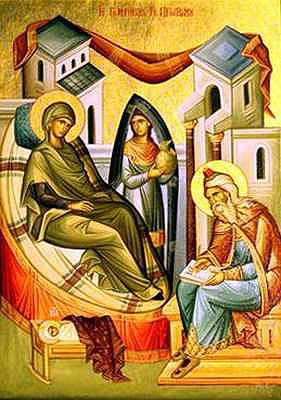
Troparion of the Forerunner Tone 4
O Prophet and Forerunner of the coming of Christ,/ we honour thee lovingly but cannot extol thee worthily;/ for by thy birth/ thy mother's barrenness and thy father's dumbness were unloosed;/ and the Incarnation of the Son of God is proclaimed to the world.
Kontakion of St John the Baptist Tone 3
The formerly barren one today gives birth to the Forerunner of Christ/ Who is the fulfillment of prophecy./ For the Prophet, Herald and Forerunner of the Word/ submitted to Him Whom the prophets foretold/ by laying his hand on Him in the Jordan.
Luke 1:24-25, 57-68, 76, 80
And after those days his wife Elisabeth conceived, and hid herself five months, saying, Thus hath the Lord dealt with me in the days wherein he looked on me, to take away my reproach among men. Now Elisabeth's full time came that she should be delivered; and she brought forth a son. And her neighbours and her cousins heard how the Lord had shewed great mercy upon her; and they rejoiced with her. And it came to pass, that on the eighth day they came to circumcise the child; and they called him Zacharias, after the name of his father. And his mother answered and said, Not so; but he shall be called John. And they said unto her, There is none of thy kindred that is called by this name. And they made signs to his father, how he would have him called. And he asked for a writing table, and wrote, saying, His name is John. And they marvelled all. And his mouth was opened immediately, and his tongue loosed, and he spake, and praised God. And fear came on all that dwelt round about them: and all these sayings were noised abroad throughout all the hill country of Judaea. And all they that heard them laid them up in their hearts, saying, What manner of child shall this be! And the hand of the Lord was with him. And his father Zacharias was filled with the Holy Ghost, and prophesied, saying, Blessed be the Lord God of Israel; for he hath visited and redeemed his people, And thou, child, shalt be called the prophet of the Highest: for thou shalt go before the face of the Lord to prepare his ways; And the child grew, and waxed strong in spirit, and was in the deserts till the day of his shewing unto Israel.
June 20, 2005
Day of the Holy Spirit (Whit Monday)
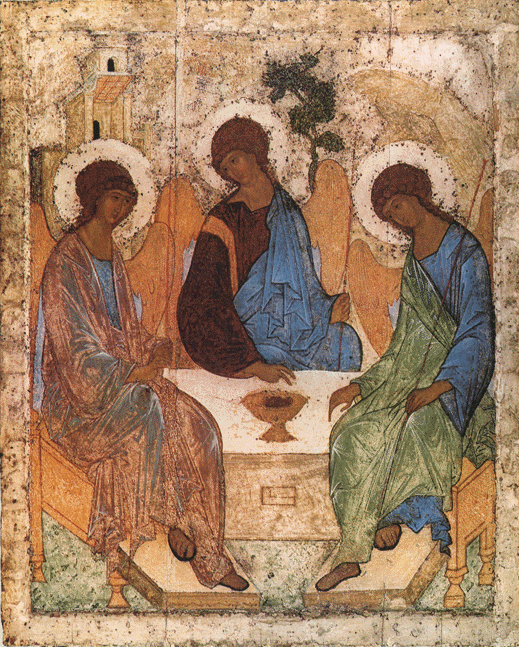
Ephesians 5:9-19:
(For the fruit of the Spirit is in all goodness and righteousness and truth;) Proving what is acceptable unto the Lord. And have no fellowship with the unfruitful works of darkness, but rather reprove them. For it is a shame even to speak of those things which are done of them in secret. But all things that are reproved are made manifest by the light: for whatsoever doth make manifest is light. Wherefore he saith, Awake thou that sleepest, and arise from the dead, and Christ shall give thee light. See then that ye walk circumspectly, not as fools, but as wise, Redeeming the time, because the days are evil. Wherefore be ye not unwise, but understanding what the will of the Lord is. And be not drunk with wine, wherein is excess; but be filled with the Spirit; Speaking to yourselves in psalms and hymns and spiritual songs, singing and making melody in your heart to the Lord.
From the GOArch website:
As it is the custom of the Church, on the day after every great Feast, to honour those through whom it came to pass our Lady on the day after the Lord's Nativity, Joachim and Anna after our Lady's Nativity, the holy Baptist the day after Theophany, and so forth, on this day we honour our God the All-holy Spirit, the Comforter promised by our Saviour to His disciples (John 14:16), Who descended upon them at holy Pentecost and guided them "into all truth" (ibid. 16:13), and through them, us.
June 19, 2005
Pentecost and Trinity Sunday
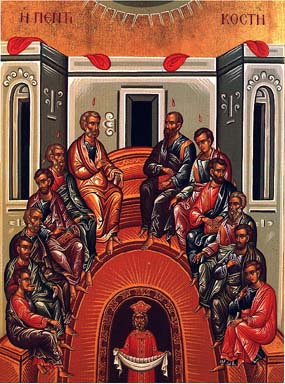
Troparion Tone 8
Blessed art Thou O Christ Our God / Who has revealed the fishermen as most wise / By sending down upon them the Holy Spirit / Through them Thou didst draw the world into Thy net / O Lover of Man, Glory to Thee!
Kontakion Tone 8
When the most High came down and confused the tongues, / He divided the nations; / But when he distributed the tongues of fire / He called all to unity. / Therefore, with one voice, we glorify the All-holy Spirit!
Acts 2:1-11:
And when the day of Pentecost was fully come, they were all with one accord in one place. And suddenly there came a sound from heaven as of a rushing mighty wind, and it filled all the house where they were sitting. And there appeared unto them cloven tongues like as of fire, and it sat upon each of them. And they were all filled with the Holy Ghost, and began to speak with other tongues, as the Spirit gave them utterance. And there were dwelling at Jerusalem Jews, devout men, out of every nation under heaven. Now when this was noised abroad, the multitude came together, and were confounded, because that every man heard them speak in his own language. And they were all amazed and marvelled, saying one to another, Behold, are not all these which speak Galilaeans? And how hear we every man in our own tongue, wherein we were born? Parthians, and Medes, and Elamites, and the dwellers in Mesopotamia, and in Judaea, and Cappadocia, in Pontus, and Asia, Phrygia, and Pamphylia, in Egypt, and in the parts of Libya about Cyrene, and strangers of Rome, Jews and proselytes, Cretes and Arabians, we do hear them speak in our tongues the wonderful works of God.
John 7:37-52; 8:12:
In the last day, that great day of the feast, Jesus stood and cried, saying, If any man thirst, let him come unto me, and drink. He that believeth on me, as the scripture hath said, out of his belly shall flow rivers of living water. (But this spake he of the Spirit, which they that believe on him should receive: for the Holy Ghost was not yet given; because that Jesus was not yet glorified.) Many of the people therefore, when they heard this saying, said, Of a truth this is the Prophet. Others said, This is the Christ. But some said, Shall Christ come out of Galilee? Hath not the scripture said, That Christ cometh of the seed of David, and out of the town of Bethlehem, where David was? So there was a division among the people because of him. And some of them would have taken him; but no man laid hands on him. Then came the officers to the chief priests and Pharisees; and they said unto them, Why have ye not brought him? The officers answered, Never man spake like this man. Then answered them the Pharisees, Are ye also deceived? Have any of the rulers or of the Pharisees believed on him? But this people who knoweth not the law are cursed. Nicodemus saith unto them, (he that came to Jesus by night, being one of them,) Doth our law judge any man, before it hear him, and know what he doeth? They answered and said unto him, Art thou also of Galilee? Search, and look: for out of Galilee ariseth no prophet. Then spake Jesus again unto them, saying, I am the light of the world: he that followeth me shall not walk in darkness, but shall have the light of life.
From the OCA website:
In the Old Testament Pentecost was the feast which occurred fifty days after Passover. As the passover feast celebrated the exodus of the Israelites from the slavery of Egypt, so Pentecost celebrated God's gift of the ten commandments to Moses on Mount Sinai.In the new covenant of the Messiah, the passover event takes on its new meaning as the celebration of Christ's death and resurrection, the "exodus" of men from this sinful world to the Kingdom of God. And in the New Testament as well, the pentecostal feast is fulfilled and made new by the coming of the "new law," the descent of the Holy Spirit upon the disciples of Christ.
When the day of Pentecost had come they were all together in one place. And suddenly a sound came from heaven like the rush of a mighty wind, and it filled all the house where they were sitting. And there appeared to them tongues as of fire, distributed as resting upon each one of them. And they were all filled with the Holy Spirit ... (Acts 2:1-4).The Holy Spirit that Christ had promised to his disciples came on the day of Pentecost (Jn 14:26, 15:26; Lk 24:49; Acts 1:5). The apostles received "the power from on high," and they began to preach and bear witness to Jesus as the risen Christ, the King and the Lord. This moment has traditionally been called the birthday of the Church.
In the liturgical services of the feast of Pentecost, the coming of the Holy Spirit is celebrated together with the full revelation of the divine Trinity: Father, Son, and Holy Spirit. The fulness of the Godhead is manifested with the Spirit's coming to man, and the Church hymns celebrate this manifestation as the final act of God's self-disclosure and self-donation to the world of His creation. For this reason Pentecost Sunday is also called Trinity Day in the Orthodox tradition. Often on this day the icon of the Holy Trinity -- particularly that of the three angelic figures who appeared to Abraham, the forefather of the Christian faith - is placed in the center of the church. This icon is used with the traditional pentecostal icon which shows the tongues of fire hovering over Mary and the Twelve Apostles, the original prototype of the Church, who are themselves sitting in unity surrounding a symbolic image of "cosmos," the world.
On Pentecost we have the final fulfillment of the mission of Jesus Christ and the first beginning of the messianic age of the Kingdom of God mystically present in this world in the Church of the Messiah. For this reason the fiftieth day stands as the beginning of the era which is beyond the limitations of this world, fifty being that number which stands for eternal and heavenly fulfillment in Jewish and Christian mystical piety: seven times seven, plus one.
Thus, Pentecost is called an apocalyptic day, which means the day of final revelation. It is also called an eschatological day, which means the day of the final and perfect end (in Greek eschaton> means the end). For when the Messiah comes and the Lord's Day is at hand, the "last days" are inaugurated in which "God declares: ... I will pour out my Spirit upon all flesh." This is the ancient prophecy to which the Apostle Peter refers in the first sermon of the Christian Church which was preached on the first Sunday of Pentecost (Acts 2: 1 7; Joel 2: 28-32).
Once again it must be noted that the feast of Pentecost is not simply the celebration of an event which took place centuries ago. It is the celebration of what must happen and does happen to us in the Church today. We all have died and risen with the Messiah-King, and we all have received his Most Holy Spirit. We are the "temples of the Holy Spirit." God's Spirit dwells in us (Rom 8; 1 Cor 2-3, 12; 2 Cor 3; Gal 5; Eph 2-3). We, by our own membership in the Church, have received "the seal of the gift of the Holy Spirit" in the sacrament of chrismation. Pentecost has happened to us.
The Divine Liturgy of Pentecost recalls our baptism into Christ with the verse from Galatians again replacing the Thrice-Holy Hymn. Special verses from the psalms also replace the usual antiphonal psalms of the liturgy. The epistle and gospel readings tell of the Spirit's coming to men. The kontakion sings of the reversal of Babel as God unites the nations into the unity of his Spirit. The troparion proclaims the gathering of the whole universe into God's net through the work of the inspired apostles. The hymns 0 Heavenly King and We have seen the True Light are sung for the first time since Easter, calling the Holy Spirit to "come and abide in us", and proclaiming that "we have received the heavenly Spirit." The church building is decorated with flowers and the green leaves of the summer to show that God's divine Breath comes to renew all creation as the "lifeÄcreating Spirit." In Hebrew the word for Spirit, breath and wind is the same word, ruah.
Blessed art Thou, O Christ our God, who hast revealed the fishermen as most wise by sending down upon them the Holy Spirit: through them Thou didst draw the world into Thy net. 0 Lover of Man, Glory to Thee (Troparion).When the Most High came down and confused the tongues, he divided the nations. But when he distributed the tongues of fire, he called all to unity. Therefore, with one voice, we glorify the All-Holy Spirit! (Kontakion)
The Great Vespers of Pentecost evening features three long prayers at which the faithful kneel for the first time since Easter. The Monday after Pentecost is the feast of the Holy Spirit in the Orthodox Church, and the Sunday after Pentecost is the feast of All Saints. This is the logical liturgical sequence since the coming of the Holy Spirit is fulfilled in men by their becoming saints, and this is the very purpose of the creation and salvation of the world. "Thus says the Lord: Consecrate yourselves therefore, and be holy, for I your God am holy" (Lev 11:44-45, 1 Pet 1:15-16).
Also from the OCA website:
In the Church's annual liturgical cycle, Pentecost is "the last and great day." It is the celebration by the Church of the coming of the Holy Spirit as the end - the achievement and fulfillment - of the entire history of salvation. For the same reason, however, it is also the celebration of the beginning: it is the "birthday" of the Church as the presence among us of the Holy Spirit, of the new life in Christ, of grace, knowledge, adoption to God and holiness.This double meaning and double joy is revealed to us, first of all, in the very name of the feast. Pentecost in Greek means fifty, and in the sacred biblical symbolism of numbers, the number fifty symbolizes both the fulness of time and that which is beyond time: the Kingdom of God itself. It symbolizes the fulness of time by its first component: 49, which is the fulness of seven (7 x 7): the number of time. And, it symbolizes that which is beyond time by its second component: 49 + 1, this one being the new day, the "day without evening" of God's eternal Kingdom. With the descent of the Holy Spirit upon Christ's disciples, the time of salvation, the Divine work of redemption has been completed, the fulness revealed, all gifts bestowed: it belongs to us now to "appropriate" these gifts, to be that which we have become in Christ: participants and citizens of His Kingdom.
THE VIGIL OF PENTECOST
The all-night Vigil service begins with a solemn invitation:
"Let us celebrate Pentecost, the coming of the Holy Spirit, The appointed day of promise, and the fulfillment of hope, The mystery which is as great as it is precious."
In the coming of the Spirit, the very essence of the Church is revealed:
"The Holy Spirit provides all, Overflows with prophecy, fulfills the priesthood, Has taught wisdom to illiterates, has revealed fishermen as theologians, He brings together the whole council of the Church."
In the three readings of the Old Testament (Numbers 11:16-17, 24-29; Joel 2:23-32; Ezekiel 36:24-28) we hear the prophecies concerning the Holy Spirit. We are taught that the entire history of mankind was directed towards the day on which God "would pour out His Spirit upon all flesh." This day has come! All hope, all promises, all expectations have been fulfilled. At the end of the Aposticha hymns, for the first time since Easter, we sing the hymn: "O Heavenly King, the Comforter, the Spirit of Truth…," the one with which we inaugurate all our services, all prayers, which is, as it were, the life-breath of the Church, and whose coming to us, whose "descent" upon us in this festal Vigil, is indeed the very experience of the Holy Spirit "coming and abiding in us."
Having reached its climax, the Vigil continues as an explosion of joy and light for "verily the light of the Comforter has come and illumined the world." In the Gospel reading (John 20:19-23) the feast is interpreted to us as the feast of the Church, of her divine nature, power and authority. The Lord sends His disciples into the world, as He Himself was sent by His Father. Later, in the antiphons of the Liturgy, we proclaim the universality of the apostles' preaching, the cosmical significance of the feast, the sanctification of the whole world, the true manifestation of God's Kingdom.
THE VESPERS OF PENTECOST
The liturgical peculiarity of Pentecost is a very special Vespers of the day itself. Usually this service follows immediately the Divine Liturgy, is "added" to it as its own fulfillment. The service begins as a solemn "summing up" of the entire celebration, as its liturgical synthesis. We hold flowers in our hands symbolizing the joy of the eternal spring, inaugurated by the coming of the Holy Spirit. After the festal Entrance, this joy reaches its climax in the singing of the Great Prokeimenon:
"Who is so great a God as our God?"
Then, having reached this climax, we are invited to kneel. This is our first kneeling since Easter. It signifies that after these fifty days of Paschal joy and fulness, of experiencing the Kingdom of God, the Church now is about to begin her pilgrimage through time and history. It is evening again, and the night approaches, during which temptations and failures await us, when, more than anything else, we need Divine help, that presence and power of the Holy Spirit, who has already revealed to us the joyful End, who now will help us in our effort towards fulfillment and salvation.
All this is revealed in the three prayers which the celebrant reads now as we all kneel and listen to him. In the first prayer, we bring to God our repentance, our increased appeal for forgiveness of sins, the first condition for entering into the Kingdom of God.
In the second prayer, we ask the Holy Spirit to help us, to teach us to pray and to follow the true path in the dark and difficult night of our earthly existence. Finally, in the third prayer, we remember all those who have achieved their earthly journey, but who are united with us in the eternal God of Love.
The joy of Easter has been completed and we again have to wait for the dawn of the Eternal Day. Yet, knowing our weakness, humbling ourselves by kneeling, we also know the joy and the power of the Holy Spirit who has come. We know that God is with us, that in Him is our victory.
Thus is completed the feast of Pentecost and we enter "the ordinary time" of the year. Yet, every Sunday now will be called "after Pentecost" - and this means that it is from the power and light of these fifty days that we shall receive our own power, the Divine help in our daily struggle. At Pentecost we decorate our churches with flowers and green branches - for the Church "never grows old, but is always young." It is an evergreen, ever-living Tree of grace and life, of joy and comfort. For the Holy Spirit - "the Treasury of Blessings and Giver of Life - comes and abides in us, and cleanses us from all impurity," and fills our life with meaning, love, faith and hope.
Father Alexander Schmemann (1974)
June 09, 2005
The Holy Ascension of Our Lord and Savior Jesus Christ into Heaven
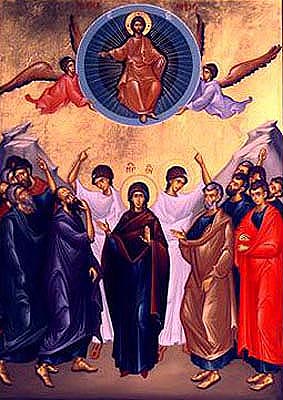
Troparion of the Holy Ascension Tone 4
Thou hast ascended in glory, O Christ our God, and gladdened Thy disciples with the promise of the Holy Spirit; and they were assured by the blessing that Thou art the Son of God and Redeemer of the world.
Kontakion of the Holy Ascension Tone 2
When Thou didst fulfil Thy dispensation for our sakes, uniting things on earth with the Heavens, Thou didst ascend in glory, O Christ our God, departing not hence, but remaining inseparable from us, and crying unto them that love Thee: I am with you, and no one can be against you.
Acts 1:1-12
The former treatise have I made, O Theophilus, of all that Jesus began both to do and teach, Until the day in which he was taken up, after that he through the Holy Ghost had given commandments unto the apostles whom he had chosen: To whom also he shewed himself alive after his passion by many infallible proofs, being seen of them forty days, and speaking of the things pertaining to the kingdom of God: And, being assembled together with them, commanded them that they should not depart from Jerusalem, but wait for the promise of the Father, which, saith he, ye have heard of me. For John truly baptized with water; but ye shall be baptized with the Holy Ghost not many days hence. When they therefore were come together, they asked of him, saying, Lord, wilt thou at this time restore again the kingdom to Israel? And he said unto them, It is not for you to know the times or the seasons, which the Father hath put in his own power. But ye shall receive power, after that the Holy Ghost is come upon you: and ye shall be witnesses unto me both in Jerusalem, and in all Judaea, and in Samaria, and unto the uttermost part of the earth. And when he had spoken these things, while they beheld, he was taken up; and a cloud received him out of their sight. And while they looked stedfastly toward heaven as he went up, behold, two men stood by them in white apparel; Which also said, Ye men of Galilee, why stand ye gazing up into heaven? this same Jesus, which is taken up from you into heaven, shall so come in like manner as ye have seen him go into heaven. Then returned they unto Jerusalem from the mount called Olivet, which is from Jerusalem a sabbath day's journey.
May 01, 2005
The Bright Resurrection of Christ, the Pascha of the Lord
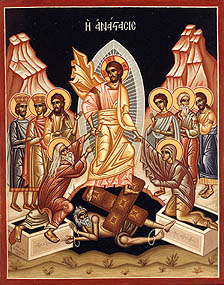
Thy Resurrection, O Christ our Savior, the angels in heaven sing,
enable us here on earth to glorify Thee in purity of heart.
Christ is risen from the dead,
trampling down death by death,
and upon those in the tombs bestowing life.
It is the Day of Resurrection, let us be radiant, O ye people; Pascha, the Lord's Pascha: for from death to life, and from earth to heaven, Christ God hath brought us, as we sing the hymn of victory.
Let us purify our senses, and we shall behold Christ, radiant with the unapproachable light of the Resurrection, and we shall hear Him say, "Rejoice!" as we sing the hymn of victory.
Let the heavens be glad as is meet, and let the earth rejoice, and let the whole world both visible and invisible, keep festival: for Christ is risen, O gladness eternal.
Having beheld the Resurrection of Christ, let us worship the holy Lord Jesus, the only Sinless One. We worship Thy Cross, O Christ, and Thy holy Resurrection we hymn and glorify; for Thou art our God, and we know none other beside Thee, we call upon Thy name. O come all ye faithful, let us worship Christ's holy Resurrection, for behold, through the Cross joy hath come to all the world. Ever blessing the Lord, we hymn His Resurrection; for, having endured the Cross, He hath destroyed death by death.
Jesus, having risen from the grave as He foretold, hath given us life eternal and great mercy.
March 27, 2005
The Sunday of St. Gregory Palamas (The Second Sunday of Great and Holy Lent)

Troparion Tone 8
Light of Orthodoxy, pillar and doctor of the Church, adornment of monks, invincible champion of theologians, O Gregory the wonderworker, praise of Thessalonica, preacher of grace, ever pray that our souls may be saved.
Kontakion Tone 2
Organ of wisdom, holy and divine, bright clarion of theology, we praise thee in harmony, O divine speaker Gregory: But as a mind standing before the First Mind, direct our mind to Him, father, that we may cry: Rejoice, preacher of grace!
From the OCA website:
This Sunday was originally dedicated to St. Polycarp of Smyrna (February 23). After his glorification in 1368, the commemoration of St. Gregory Palamas (November 14) was appointed for the Second Sunday of Great Lent as a second "Triumph of Orthodoxy."
Introduction to Saint Gregory Palamas (from Saint Gregory Palamas Monastery)
A Homily on the Dormition of Our Supremely Pure Lady Theotokos and Ever-Virgin Mary
St Gregory Palamas: On the Holy Icons
Knowledge of God according to St. Gregory Palamas (from Orthodox Psychotherapy, Chapter Six)
St. Gregory Palamas and the Tradition of the Fathers by Fr. George Florovsky
The Teaching of Gregory Palamas on Man by Panayiotis Christou
Light to the World: The Life of Saint Gregory Palamas (1296--1359) (from AGAIN magazine)
More from the OCA site:
Saint Gregory Palamas, Archbishop of Thessalonica, was born in the year 1296 in Constantinople. St. Gregory's father became a prominent dignitiary at the court of Andronicus II Paleologos (1282-1328), but he soon died, and Andronicus himself took part in the raising and education of the fatherless boy. Endowed with fine abilities and great diligence, Gregory mastered all the subjects which then comprised the full course of medieval higher education. The emperor hoped that the youth would devote himself to government work. But Gregory, barely twenty years old, withdrew to Mount Athos in the year 1316 (other sources say 1318) and became a novice in the Vatopedi monastery under the guidance of the monastic Elder St. Nicodemus of Vatopedi (July 11). There he was tonsured and began on the path of asceticism. A year later, the holy Evangelist John the Theologian appeared to him in a vision and promised him his spiritual protection. Gregory's mother and sisters also became monastics.After the demise of the Elder Nicodemus, St. Gregory spent eight years of prayerful effort under the guidance of the Elder Nicephorus, and after the latter's death, Gregory transferred to the Lavra of St. Athanasius (July 5). Here he served in the trapeza, and then became a church singer. But after three years, striving for a greater degree of spiritual perfection, he resettled in the small skete of Glossia. The head of this monastery began to teach the youth the method of concentrated spiritual prayer and mental activity, which was gradually appropriated and cultivated by monastics, beginning with the great desert ascetics of the fourth century: Evagrius Pontikos and St. Macarius of Egypt (January 19).
Later on, in the eleventh century in the works of St. Simeon the New Theologian (March 12), those praying in outward manner received detailed instruction in mental activity, and it was implemented by the Athos ascetics. The experienced use of mental prayer (or prayer of the heart), requiring solitude and quiet, is called "Hesychasm" (from the Greek "hesychia" meaning calm, silence), and those practicing it were called "hesychasts." During his stay at Glossia the future hierarch Gregory became fully embued with the spirit of hesychasm and adopted it as an essential part of his life. In the year 1326, because of the threat of Turkish invasions, he and the brethren retreated to Thessalonica, where he was then ordained to the holy priesthood.
St. Gregory combined his priestly duties with the life of a hermit. Five days of the week he spent in silence and prayer, and only on Saturday and Sunday did the pastor come out to his people. He celebrated divine services and preached sermons. For those present in church, his teaching often evoked both tenderness and tears. Sometimes he visited theological gatherings of the city's educated youth, headed by the future patriarch, Isidore. After he returned from a visit to Constantinople, he found near Thessalonica the locale of Bereia, a place suitable for solitary life. Soon he gathered here a small community of solitary monks and guided it for five years. In 1331 the saint withdrew to Mt. Athos and lived in solitude at the skete of St. Sava, near the Lavra of St. Athanasius. In 1333 he was appointed Igumen of the Esphigmenou monastery in the northern part of the Holy Mountain. In 1336 the saint returned to the skete of St. Sava, where he devoted himself to theological works, continuing with this until the end of his life.
But amidst all this, in the 1330s events took place in the life of the Eastern Church which put St. Gregory among the most significant universal apologists of Orthodoxy, and brought him reknown as the teacher of hesychasm.
In about the year 1330 the learned monk Barlaam had arrived in Constantinople from Calabria, in Italy. He was the author of treatises on logic and astronomy, a skilled and sharp-witted orator, and he received a university chair in the capital city and began to expound on the works of St. Dionysius the Areopagite (October 3), whose "apophatic" ("negative", in contrast to "kataphatic" or "positive") theology was acclaimed in equal measure in both the Eastern and the Western Churches. Soon Barlaam journeyed to Mt. Athos, where he became acquainted with the the hesychasts' manner of spiritual life. Saying that it was impossible to know the essence of God, he declared mental prayer a heretical error. Journeying from Mt. Athos to Thessalonica, and from there to Constantinople and later again to Thessalonica, Barlaam entered into disputes with the monks and attempted to demonstrate the created, material nature of the light of Tabor (i.e. at the Transfiguration). He ridiculed the teachings of the monks about the methods of prayer and about the uncreated light seen by the hesychasts.
St. Gregory, at the request of the Athonite monks, countered at first with verbal admonitions. But seeing the futility of such efforts, he put his theological arguments in writing. Thus appeared the "Triads in Defense of the Holy Hesychasts" (1338). Towards the year 1340 the Athonite ascetics, with the assistance of the saint, compiled a general reply to the attacks of Barlaam, the so-called "Hagiorite Tome." At the Constantinople Council of 1341 in the church of Hagia Sophia St. Gregory Palamas debated with Barlaam, focusing upon the nature of the light of Mount Tabor. On May 27, 1341 the Council accepted the position of St. Gregory Palamas, that God, unapproachable in His Essence, reveals Himself through His energies, which are directed towards the world and are able to be perceived, like the light of Tabor, but which are neither material nor created. The teachings of Barlaam were condemned as heresy, and he himself was anathemized and fled to Calabria.
But the dispute between the Palamites and the Barlaamites was far from finished. To these latter belonged Barlaam's disciple, the Bulgarian monk Akyndinos, and also Patriarch John XIV Kalekos (1341-1347); the emperor Andronicus III Paleologos (1328-1341) was also inclined toward their opinion. Akyndinos, whose name means "one who inflicts no harm," actually caused great harm by his heretical teaching. Akyndinos wrote a series of tracts in which he declared St. Gregory and the Athonite monks guilty of causing church disorders. The saint, in turn, wrote a detailed refutation of Akyndinos' errors. The patriarch supported Akyndinos and called St. Gregory the cause of all disorders and disturbances in the Church (1344) and had him locked up in prison for four years. In 1347, when John the XIV was replaced on the patriarchal throne by Isidore (1347-1349), St. Gregory Palamas was set free and was made Archbishop of Thessalonica.
In 1351 the Council of Blachernae solemnly upheld the Orthodoxy of his teachings. But the people of Thessalonica did not immediately accept St. Gregory, and he was compelled to live in various places. On one of his travels to Constantinople the Byzantine ship fell into the hands of the Turks. Even in captivity, St. Gregory preached to Christian prisoners and even to his Moslem captors. The Hagarenes were astonished by the wisdom of his words. Some of the Moslems were unable to endure this, so they beat him and would have killed him if they had not expected to obtain a large ransom for him. A year later, St. Gregory was ransomed and returned to Thessalonica.
St. Gregory performed many miracles in the three years before his death, healing those afflicted with illness. On the eve of his repose, St. John Chrysostom appeared to him in a vision. With the words "To the heights! To the heights!" St. Gregory Palamas fell asleep in the Lord on November 14, 1359. In 1368 he was canonized at a Constantinople Council under Patriarch Philotheus (1354-1355, 1364-1376), who compiled the Life and Services to the saint.
March 20, 2005
The Sunday of Orthodoxy (The First Sunday of Great and Holy Lent)
Troparian Tone 2
We venerate Your most pure image, O Good One,
and ask forgiveness of our transgressions, O Christ God.
Of Your own will You were pleased to ascend the Cross in the flesh
to deliver Your creatures from bondage to the enemy.
Therefore with thanksgiving we cry aloud to You:
You have filled all with joy, O our Savior,
by coming to save the world.
Kontakion Tone 8
No one could describe the Word of the Father;
but when He took flesh from you, O Theotokos, He accepted to be described,
and restored the fallen image to its former beauty.
We confess and proclaim our salvation in word and image
From Greek Orthodox Archdiocese website:
The dominant theme of this Sunday since 843 has been that of the victory of the icons. In that year the iconoclastic controversy, which had raged on and off since 726, was finally laid to rest, and icons and their veneration were restored on the first Sunday in Lent. Ever since, that Sunday been commemorated as the "triumph of Orthodoxy."Orthodox teaching about icons was defined at the Seventh Ecumenical Council of 787, which brought to an end the first phase of the attempt to suppress icons. That teaching was finally re-established in 843, and it is embodied in the texts sung on this Sunday.
In the liturgy, after the Nicene Creed, is said:
Deacon: This is the faith of the apostles! This is the faith of the fathers! This is the Orthodox faith! This faith has established the universe!Furthermore, we accept and confirm the councils of the holy fathers, and their traditions and writings which are agreeable to divine revelation.
And though the enemies of Orthodoxy oppose this providence and the saving revelation of the Lord, yet the Lord has considered the reproaches of His servants, for He mocks those who blaspheme His Glory, and has challenged the enemies of Orthodoxy and put them to flight!
As we therefore bless and praise those who have obeyed the divine revelation and have fought for it; so we reject and anathematize those who oppose this truth, if while waiting for their return and repentance, they refuse to turn again to the Lord; and in this we follow the sacred tradition of the ancient Church, holding fast to her traditions.
To those who deny the existence of God, and assert that the world is self-existing, and that all things in it occur by chance, and not by the providence of God, Anathema!
All: Anathema! (...and after each exclamation.)
Deacon: To those who say that God is not spirit, but flesh; or that He is not just, merciful, wise and all-knowing, and utter similar blasphemies, Anathema!
To those who dare to say that the Son of God and also the Holy Spirit are not one in essence and of equal honor with the Father, and confess that the Father, and the Son, and the Holy Spirit are not one God, Anathema!
To those who foolishly say that the coming of the Son of God into the world in the flesh, and His voluntary passion, death, and resurrection were not necessary for our salvation and the cleansing of sins, Anathema!
To those who reject the grace of redemption preached by the Gospel as the only means of our justification before God, Anathema!
To those who dare to say that the all-pure Virgin Mary was not virgin before giving birth, during birthgiving, and after her child-birth, Anathema!
To those who do not believe that the Holy Spirit inspired the prophets and apostles, and by them taught us the true way to eternal salvation, and confirmed this by miracles, and now dwells in the hearts of all true and faithful Christians, and teaches them in all truth, Anathema!
To those who reject the immortality of the soul, the end of time, the future judgment, and eternal reward for virtue and condemnation for sin, Anathema!
To those who reject all the holy mysteries held by the Church of Christ, Anathema!
To those who reject the Councils of the holy fathers and their traditions, which are agreeable to divine revelation and kept piously by the Orthodox Catholic Church, Anathema!
To those who mock and profane the holy images and relics which the holy Church receives as revelations of God's work and of those pleasing to Him, to inspire their beholders with piety, and to arouse them to follow these examples; and to those who say that they are idols, Anathema!
To those who dare to say and teach that our Lord Jesus Christ did not descend to earth, but only seemed to; or that He did not descend to the earth and become incarnate only once, but many times, and who likewise deny that the true Wisdom of the Father is His only-begotten Son, Anathema!
To the followers of the occult, spiritualists, wizards, and all who do not believe in the one God, but honor the demons; or who do not humbly give their lives over to God, but strive to learn the future through sorcery, Anathema!
(From the Service of the Triumph of Orthodoxy.)
March 13, 2005
The Sunday of Forgiveness
Troparion Tone 8
The doors of repentance do Thou open to me, O Giver of life,
for my spirit waketh at dawn toward Thy holy temple,
bearing a temple of the body all defiled.
But in Thy compassion, cleanse it by the loving-kindness of Thy mercy.
Theotokion Tone 8
Guide me in the paths of salvation, O Theotokos,
for I have defiled my soul with shameful sins,
and have wasted all my life in slothfulness,
but by thine intercessions deliever me from all uncleanness.
Troparion Tone 6
Have mercy on me, O God, according to Thy great mercy
Glory to the Father and to the Son and to the Holy Spirit
And according to the multitude of Thy compassions, blot out my transgressions.
Both now and ever and unto ages of ages, Amen.
When I think of the multitude of evil things I have done, I, a wretched one,
I tremble at the fearful day of judgment;
but trusting in the mercy of Thy loving-kindness, like David do I cry unto Thee:
Have mercy on me, O God, according to Thy great mercy.
Kontakion of the Sunday of Forgiveness Tone 6
O Thou Guide unto wisdom, Bestower of prudence, Instructor of the foolish, and Defender of the poor;
establish and grant understanding unto my heart, O Master.
Grant me speech, O Word of the Father;
for behold, I shall not keep my lips from crying unto Thee:
O Merciful One, have mercy on me who have fallen.
Protopresbyter Alexander Schmemann says, of this morning's Gospel:
Lent is the liberation of our enslavement to sin, from the prison of "this world." And the Gospel lesson of this last Sunday (Matt. 6:14-21) sets the conditions for that liberation. The first one is fasting--the refusal to accept the desires and urges of our fallen nature as normal, the effort to free ourselves from the dictatorship of flesh and matter over the spirit. To be effective, however, our fast must not be hypocritical, a "showing off." We must "appear not unto men to fast but to our Father who is in secret." The second condition is forgiveness--"If you forgive men their trespasses, your Heavenly Father will also forgive you." The triumph of sin, the main sign of its rule over the world, is division, opposition, separation, hatred. Therefore, the first break through this fortress of sin is forgiveness: the return to unity, solidarity, love. To forgive is to put between me and my "enemy" the radiant forgiveness of God Himself. To forgive is to reject the hopeless "dead-ends" of human relations and to refer them to Christ. Forgiveness is truly a "breakthrough" of the Kingdom into this sinful and fallen world. (Great Lent: Journey to Pascha, p. 28)
He continues, discussing the Vesperal service of this evening, at the point of the Prokeimenon:
Turn not away Thy face from Thy servant for I am afflicted!
Hear me speedily.
Attend to my soul and deliver it!Listen to the unique melody of this verse--to this cry that suddenly fills the church: ". . . for I am afflicted!"--and you will understand this starting point of Lent: the mysterious mixture of despair and hope, of darkness and light. All preparation has now come to an end. I stand before God, before the glory and the beauty of His kingdom. I realize that I belong to it, that I have no other home, no other joy, no other goal; I also realize that I am exiled from it into the darkness and sadness of sin, "for I am afflicted!" And finally, I realize that only God can help in that affliction, that only He can "attend to my soul." Repentance is, above everything else, a desperate call for that divine help.
Five times we repeat the Prokeimenon. And then, Lent is here! Bright vestments are put aside; lights are extinguished. When the celebrant intones the petitions for the evening litany, the choir responsds in the lenten "key." For the first time the lenten prayer of St. Ephrem accompanied by prostrations is read. At the end of the service all the faithful approach the priest and one another asking for mutual forgiveness. But as they perform this rite of reconciliation, as Lent is inaugurated by this movement of love, reunion, and brotherhood, the choir sings the Paschal hymns. We will have to wander forty days through the desert of Lent. Yet at the end already shines the light of Easter, the light of the Kingdom. (Great Lent: Journey to Pascha, pp. 29-30)
October 17, 2004
The Holy Fathers of the Seventh Ecumenical Council
Troparion Tone 8
Glorious art Thou, O Christ our God/ Who hast established our holy fathers as stars on earth./ Through them Thou dost guide us to the True Faith./ O Most Merciful One, glory to Thee.
Kontakion Tone 8
The preaching of the Apostles and the doctrine of the Fathers confirmed the one faith in the Church./ In the garment of truth woven from theology on high she rightly divides and glorifies true piety.
Another Kontakion Tone 2
The Son Who shone from the Father/ was ineffably born in two natures of a woman./ We do not deny the image of His form/ but depict it piously and revere it./ For this cause the Church, holding the true Faith,/ kisses the icon of Christ's Incarnation.
From Orthodox Online:
"Sir, Whose image is this?"
"It is mine," answered the emperor. Then Stephen, a monk, threw the coin on the ground and stepped on it. He was seized by imperial guards and taken away to be punished.
"Remember this!" cried Stephen as he was being led away. "If I am punished for dishonoring the image of an earthly king, what punishment do they deserve who burn the icon of Christ!"
An excerpt from the decree from the Seventh Ecumenical Council:
We, therefore, following the royal pathway and the divinely inspired authority of our Holy Fathers and the traditions of the Catholic Church (for, as we all know, the Holy Spirit indwells her), define with all certitude and accuracy that just as the figure of the precious and life-giving Cross, so also the venerable and holy images, as well in painting and mosaic as of other fit materials, should be set forth in the holy churches of God, and on the sacred vessels and on the vestments and on hangings and in pictures both in houses and by the wayside, to wit, the figure of our Lord God and Saviour Jesus Christ, of our spotless Lady, the Mother of God, of the honourable Angels, of all Saints and of all pious people. For by so much more frequently as they are seen in artistic representation, by so much more readily are men lifted up to the memory of their prototypes, and to a longing after them; and to these should be given due salutation and honourable reverence, not indeed that true worship of faith which pertains alone to the divine nature; but to these, as to the figure of the precious and life-giving Cross and to the Book of the Gospels and to the other holy objects, incense and lights may be offered according to ancient pious custom. For the honour which is paid to the image passes on to that which the image represents, and he who reveres the image reveres in it the subject represented. For thus the teaching of our holy Fathers, that is the tradition of the Catholic Church, which from one end of the earth to the other hath received the Gospel, is strengthened. Thus we follow Paul, who spake in Christ, and the whole divine Apostolic company and the holy Fathers, holding fast the traditions which we have received. So we sing prophetically the triumphal hymns of the Church, "Rejoice greatly, O daughter of Sion; Shout, O daughter of Jerusalem. Rejoice and be glad with all thy heart. The Lord hath taken away from thee the oppression of thy adversaries; thou art redeemed from the hand of thine enemies. The Lord is a King in the midst of thee; thou shalt not see evil any more, and peace be unto thee forever."
[Note: the full decree follows below.]
The Decree of the Holy, Great, Ecumenical Synod, the Second of Nice:
The holy, great, and Ecumenical Synod which by the grace of God and the will of the pious and Christ-loving Emperors, Constantine and Irene, his mother, was gathered together for the second time at Nice, the illustrious metropolis of Bithynia, in the holy church of God which is named Sophia, having followed the tradition of the Catholic Church, hath defined as follows:
Christ our Lord, who hath bestowed upon us the light of the knowledge of himself, and hath redeemed us from the darkness of idolatrous madness, having espoused to himself the Holy Catholic Church without spot or defect, promised that he would so preserve her: and gave his word to this effect to his holy disciples when he said: "Lo! I am with you always, even unto the end of the world," which promise he made, not only to them, but to us also who should believe in his name through their word. But some, not considering of this gift, and having become fickle through the temptation of the wily enemy, have fallen from the right faith; for, withdrawing from the traditions of the Catholic Church, they have erred from the truth and as the proverb saith: "The husbandmen have gone astray in their own husbandry and have gathered in their hands nothingness," because certain priests, priests in name only, not in fact, had dared to speak against the God-approved ornament of the sacred monuments, of whom God cries aloud through the prophet, "Many pastors have corrupted my vineyard, they have polluted my portion."
And, forsooth, following profane men, led astray by their carnal sense, they have calumniated the Church of Christ our God, which he hath espoused to himself, and have failed to distinguish between holy andprofane, styling the images of our Lord andof his Saints by the same name as the statues of diabolical idols. Seeing whichthings, our Lord God (not willing to behold his people corrupted by such manner of plague) hath of his good pleasure called us together, the chief of his priests, from every quarter, moved with a divine zeal andbrought hither by the will of our princes, Constantine and Irene, to the end that the traditions of the Catholic Church may receive stability by our common decree. Therefore, with all diligence, making a thorough examination and analysis, and following the trend of the truth, we diminish nought, we add nought, but we preserve unchanged all things which pertain to the Catholic Church, and following the Six Ecumenical Synods, especially that which met in this illustrious metropolis of Nice, as also that which was afterwards gathered together in the God-protected Royal City.
We believe ...life of the world to come. Amen.1
We detest and anathematize Arius and all the sharers of his absurd opinion; also Macedonius and those who following him are well styled "Foes of the Spirit" (Pneumatomachi). We confess that our Lady, St. Mary, is properly and truly the Mother of God, because she was the Mother after the flesh of One Person of the Holy Trinity, to wit, Christ our God, as the Council of Ephesus has already defined when it cast out of the Church the impious Nestorius with his colleagues, because he taught that there were two Persons [in Christ]. With the Fathers of this synod we confess that he who was incarnate of the immaculate Mother of God and Ever-Virgin Mary has two natures, recognizing him as perfect God and perfect man, as also the Council of Chalcedon hath promulgated, expelling from the divine Atrium [aulhj] as blasphemers, Eutyches and Dioscorus; and placing in the same category Severus, Peter and a number of others, blaspheming in divers fashions. Moreover, with these we anathematize the fables of Origen, Evagrius, and Didymus, in accordance with the decision of the Fifth Council held at Constantinople. We affirm that in Christ there be two wills and two operations according to the reality of each nature, as also the Sixth Synod, held at Constantinople, taught, casting out Sergius, Honorius, Cyrus, Pyrrhus, Macarius, and those who agree with them, and all those who are unwilling to be reverent.
To make our confession short, we keep unchanged all the ecclesiastical traditions handed down to us, whether in writing or verbally, one of which is the making of pictorial representations, agreeable to the history of the preaching of the Gospel, a tradition useful in many respects, but especially in this, that so the incarnation of the Word of God is shown forth as real and not merely phantastic, for these have mutual indications and without doubt have also mutual significations.
We, therefore, following the royal pathway and the divinely inspired authority of our Holy Fathers and the traditions of the Catholic Church (for, as we all know, the Holy Spirit indwells her), define with all certitude and accuracy that just as the figure of the precious and life-giving Cross, so also the venerable and holy images, as well in painting and mosaic as of other fit materials, should be set forth in the holy churches of God, and on the sacred vessels and on the vestments and on hangings and in pictures both in houses and by the wayside, to wit, the figure of our Lord God and Saviour Jesus Christ, of our spotless Lady, the Mother of God, of the honourable Angels, of all Saints and of all pious people. For by so much more frequently as they are seen in artistic representation, by so much more readily are men lifted up to the memory of their prototypes, and to a longing after them; and to these should be given due salutation and honourable reverence (aspasmon kai timhtikhn proskunh-sin), not indeed that true worship of faith (latreian) which pertains alone to the divine nature; but to these, as to the figure of the precious and life-giving Cross and to the Book of the Gospels and to the other holy objects, incense and lights may be offered according to ancient pious custom. For the honour which is paid to the image passes on to that which the image represents, and he who reveres the image reveres in it the subject represented. For thus the teaching of our holy Fathers, that is the tradition of the Catholic Church, which from one end of the earth to the other hath received the Gospel, is strengthened. Thus we follow Paul, who spake in Christ, and the whole divine Apostolic company and the holy Fathers, holding fast the traditions which we have received. So we sing prophetically the triumphal hymns of the Church, "Rejoice greatly, O daughter of Sion; Shout, O daughter of Jerusalem. Rejoice and be glad with all thy heart. The Lord hath taken away from thee the oppression of thy adversaries; thou art redeemed from the hand of thine enemies. The Lord is a King in the midst of thee; thou shalt not see evil any more, and peace be unto thee forever."
Those, therefore who dare to think or teach otherwise, or as wicked heretics to spurn the traditions of the Church and to invent some novelty, or else to reject some of those things which the Church hath received (e.g., the Book of the Gospels, or the image of the cross, or the pictorial icons, or the holy reliques of a martyr), or evilly and sharply to devise anything subversive of the lawful traditions of the Catholic Church or to turn to common uses the sacred vessels or the venerable monasteries,2 if they be Bishops or Clerics, we command that they be deposed; if religious or laics, that they be cut off from communion.
[After all had signed, the acclamations began (col. 576).]
The holy Synod cried out: So we all believe, we all are so minded, we all give our consent and have signed. This is the faith of the Apostles, this is the faith of the orthodox, this is the faith which hath made firm the whole world. Believing in one God, to be celebrated in Trinity, we salute the honourable images! Those who do not so hold, let them be anathema. Those who do not thus think, let them be driven far away from the Church. For we follow the most ancient legislation of the Catholic Church. We keep the laws of the Fathers. We anathematize those who add anything to or take anything away from the Catholic Church. We anathematize the introduced novelty of the revilers of Christians. We salute the venerable images. We place under anathema those who do not do this. Anathema to them who presume to apply to the venerable images the things said in Holy Scripture about. idols. Anathema to those who do not salute the holy and venerable images. Anathema to those who call the sacred images idols. Anathema to those who say that Christians resort to the sacred images as to gods. Anathema to those who say that any other delivered us from idols except Christ our God. Anathema to those who dare to say that at any time the Catholic Church received idols.
Many years to the Emperors, etc., etc.
August 29, 2004
The Beheading of the Forerunner, St. John the Baptist
From the Prolog of Ohrid:
THE BEHEADING OF SAINT JOHN THE BAPTIST [ST. MATTHEW 14:1-12]
Herod Antipas, son of the elder Herod, who was the slayer of the children of Bethlehem at the time of the birth of the Lord Jesus, was ruler of Galilee at the time when John the Baptist was preaching. This Herod was married to the daughter of Aretas, an Arabian prince. But Herod, an evil sprout of an evil root, put away his lawful wife and unlawfully took unto himself Herodias as his concubine, the wife of his brother Philip, who was still living. John the Baptist stood up against this lawlessness and strongly denounced Herod who then cast John into prison. At the time of a banquet in his court in Sebastia in Galilee Salome, the daughter of Herodias and Philip, danced before the guests. The drunken Herod was so taken by this dance that he promised Salome that he would give her whatever she asked of him, even though it be half of his kingdom. Being persuaded by her mother, Salome asked for the head of John the Baptist. Herod gave the order and John was beheaded in prison and his head brought to him on a platter. John's disciples took the body of their teacher by night and honorably buried it and Herodias pierced the tongue of John with a needle in many places and buried the head in an unclean place. What later happened to John the Baptist's head can be read on February 24. However, God's punishment quickly befell this group of evil doers. Prince Aretas, in order to cleanse his daughter's honor, attacked Herod with his army and defeated him. The defeated Herod was sentenced by the Roman Caesar, Caligula, to exile at first to Gaul and later to Spain. As exiles, Herod and Herodias lived in poverty and humiliation until the earth opened up and swallowed them. Salome died an evil death on the Sikaris (Sula) river. The death of St. John occurred before the Pascha [Passover] but its celebration on August 29 was established because, on that day, a church which had been built over his grave in Sebastia by Emperor Constantine and Empress Helena was consecrated. In this church the relics of John's disciples, Eliseus and Audius, were also placed.
Troparion of St John the Baptist Tone 2
The memory of the just is celebrated with hymns of praise/ but the Lord's testimony is enough for thee, O Forerunner,/ for thou wast shown to be more wonderful than the Prophets/ since thou wast granted to baptize in the running waters / Him Whom thou didst proclaim./ Then having endured great suffering for the Truth,/ Thou didst rejoice to bring, even to those in hell/ the good tidings that God Who had appeared in the flesh/ takes away the sin of the world/ and grants us the great mercy.
Kontakion of St John the Baptist Tone 5
The beheading of the glorious Forerunner/ was a divine dispensation/ that the coming of the Savior might be preached to those in hell./ Lament then, Herodias,/ that thou didst demand a murder/ despising the law of God and eternal life.
Matthew 14:1-13
At that time Herod the tetrarch heard of the fame of Jesus, And said unto his servants, This is John the Baptist; he is risen from the dead; and therefore mighty works do shew forth themselves in him. For Herod had laid hold on John, and bound him, and put him in prison for Herodias' sake, his brother Philip's wife. For John said unto him, It is not lawful for thee to have her. And when he would have put him to death, he feared the multitude, because they counted him as a prophet. But when Herod's birthday was kept, the daughter of Herodias danced before them, and pleased Herod. Whereupon he promised with an oath to give her whatsoever she would ask. And she, being before instructed of her mother, said, Give me here John Baptist's head in a charger. And the king was sorry: nevertheless for the oath's sake, and them which sat with him at meat, he commanded it to be given her. And he sent, and beheaded John in the prison. And his head was brought in a charger, and given to the damsel: and she brought it to her mother. And his disciples came, and took up the body, and buried it, and went and told Jesus. When Jesus heard of it, he departed thence by ship into a desert place apart: and when the people had heard thereof, they followed him on foot out of the cities.
From the Orthodox Church of America website:
The Evangelists Matthew (Mt 14:1-12) and Mark (Mk 6:14-29) provide accounts about the martyric end of John the Baptist in the year 32 after the Birth of Christ.
Following the Baptism of the Lord, St. John the Baptist was locked up in prison by Herod Antipas, the Tetrarch (ruler of one fourth of the Holy Land) and governor of Galilee. (After the death of king Herod the Great, the Romans divided the territory of Palestine into four parts, and put a governor in charge of each part. Herod Antipas received Galilee from the emperor Augustus).
The prophet of God John openly denounced Herod for having left his lawful wife, the daughter of the Arabian king Aretas, and then instead cohabiting with Herodias, the wife of his brother Philip (Lk 3:19-20). On his birthday, Herod made a feast for dignitaries, the elders and a thousand chief citizens. Salome, the daughter of Herod, danced before the guests and charmed Herod. In gratitude to the girl, he swore to give her whatever she would ask, up to half his kingdom.
The vile girl on the advice of her wicked mother Herodias asked, that she be given at once the head of John the Baptist on a plate. Herod became apprehensive, for he feared the wrath of God for the murder of a prophet, whom earlier he had heeded. He feared also the people, who loved the holy Forerunner. But because of the guests and his careless oath, he gave orders to cut off the head of St. John and to give it to Salome.
According to Tradition, the mouth of the dead preacher of repentance once more opened and proclaimed: "Herod, you should not have the wife of your brother Philip." Salome took the plate with the head of St. John and gave it to her mother. The frenzied Herodias repeatedly stabbed the tongue of the prophet with a needle and buried his holy head in a unclean place. But the pious Joanna, wife of Herod's steward Chuza, buried the head of John the Baptist in an earthen vessel on the Mount of Olives, where Herod had a parcel of land. (The Uncovering of the Venerable Head is celebrated (February 24). The holy body of John the Baptist was taken that night by his disciples and buried at Sebastia, there where the wicked deed had been done.
After the murder of St. John the Baptist, Herod continued to govern for a certain time. Pontius Pilate, governor of Judea, later sent Jesus Christ to him, Whom he mocked (Lk 23:7-12).
The judgement of God came upon Herod, Herodias and Salome, even during their earthly life. Salome, crossing the River Sikoris in winter, fell through the ice. The ice gave way in such a way that her body was in the water, but her head was trapped above the ice. It was similar to how she once had danced with her feet upon the ground, but now she flailed helplessly in the icy water. Thus she was trapped until that time when the sharp ice cut through her neck.
Her corpse was not found, but they brought the head to Herod and Herodias, as once they had brought them the head of St. John the Baptist. The Arab king Aretas, in revenge for the disrespect shown his daughter, made war against Herod. The defeated Herod suffered the wrath of the Roman emperor Caius Caligua (37-41) and was exiled with Herodias first to Gaul, and then to Spain.
The Beheading of St. John the Baptist, a Feast day established by the Church, is also a strict fast day because of the grief of Christians at the violent death of the saint. In some Orthodox cultures pious people will not eat food from a flat plate, use a knife, or eat food that is round in shape on this day.
Today the Church makes remembrance of Orthodox soldiers killed on the field of battle, as established in 1769 at the time of Russia's war with the Turks and the Poles.