October 31, 2003
The Fatherhood Chronicles XX: The Physicality of Being a Dad
I may not be an overly demonstrative guy when it comes to my "love language." Growing up we just didn't physically demonstrate our love with hugs and kisses all over the place. Add to that an introverted personality, and sex in the form of a handshake might well have been good enough if it were possible.
Okay, a bit of an exaggeration. But you get the point.
But now I'm a dad. And our little girl, Sofie, is just about the most beautiful thing I've ever known or seen.
And the one thing that has so forcefully struck me as to always bring wonderment whenever I think of it is that I have something like a physical need to hold and cuddle my daugher. I call it my "Sofie fix." If Anna brings her to meet me between work and my night classes, it's all I can do to tear myself away and go on to class.
If I am not there or am otherwise busy and don't get to help my wife bathe and dress her, to read to her while holding her in my lap, to embrace her while giving her her bottle, and the other thousand and one ways, large and small, in which touch incarnates love, then it's like there's a big, huge something missing.
To go from distance and reserve to goofy, giddy, slobbery hugs and kisses is a change. That's for sure.
But I like it.
October 30, 2003
Ten Years Later: A Personal Reflection
[Note: About a year ago, I sent the following out to some family and friends. It reflects on my sojourn within the Episcopal Church. The story has been told frequently on my blog and home page. But since I have been critical of the powerful elite in the Episcopal Church--and really, such persons claiming Christianity but denigrating and abusing it as they do deserve criticism--I wanted to again reiterate that it's not Anglicanism nor every Episcopal Church parish that I rail against. The following was edited in two places--the bracketed note in the first sentence and one misspelling. Otherwise it remains exactly as I first wrote it. And I still fully own the thoughts expressed.]
Ten years ago [at the time I then wrote this entry] in 1992, 4 October was a Sunday, and in the Western Christian calendar, the feast of St. Francis of Assisi. It was also the day I worshipped for the first time in a formal liturgy. The liturgy was the Rite I service of the Episcopal Church's 1979 Book of Common Prayer. The church was Trinity Episcopal Church in Lawrence, Kansas. To this day, I can recall the contemplative silence that greeted me as I entered the nave. A small handful of parishioners knelt in prayer in the minutes before the service began. I took a seat in the back, bulletins in hand, prayerbook at the ready.
When the service began I experienced a drenching in the written Word of God. Having studied Scripture on my own and formally at Bible college and seminary, I recognized the numerous biblical verses and phrases that made up the liturgy. And when the time came for the reading of the Word, I was delighted at the length of the passages--one each from the Old and New Testaments and from the Gospels, and a complete Psalm. No mere couple of verses and the preacher's take on them. Here was the written Word itself, large portions, and enough to satisfy.
Here, too, was the Lord's Supper, served with a reverence and quiet beauty the penetrated right through to the heart. I did not participate in the elements with the other parishioners that day--everything was all too new for me to do so with any sort of understanding--though later the Eucharist became an important and powerful aspect of my corporate worship.
You can see, no doubt, how attractive the Episcopal Church was to me. That attraction only deepened with time, and about three and a half years later I was confirmed in the Episcopal Church. That decision was a complex one. On the one hand, the decision came only a few months after my wife and I left a ministry, after a couple of the most excruciatingly painful months either of has had known, where we'd been serving for about a year and a half. I didn't handle my decision to join the Episcopal Church very well with my wife. I suppose that is to be expected, given that we'd been married less than a year when we took on the ministry, and had unconsciously put the development of our relationship on hold for a year and a half as we tried simply to survive an abusive church with our marriage intact. On the other hand, it was the culmination of a personal
journey that had gone back to my last year and a half at Bible college. I had done as thorough and patient investigation into the Anglican tradition and the Episcopal Church as I knew then to do. I had thought and prayed about it. I had intended becoming an Episcopalian as a deep, heartfelt expression of my Restoration Movement beliefs, particularly that of unity.
About six months after having been confirmed in the Episcopal Church, my parish priest and I were talking about my previous ministry experience, and the idea was presented that perhaps, having pursued a vocation of ministry in another church context, I should seriously consider doing so in the Episcopal Church. A little more than two years later, I finally agreed to pursue ordination to the priesthood in the Episcopal Church. Anna and I weighed our educational options and decided that the Chicago area would suit our combined needs and goals best, and so in January 2000 we moved to Chicago to work and pursue our vocational and educational goals.
By the time I began my studies at the Episcopal seminary, I had had inklings that things weren't altogether healthy in the Episcopal Church. The Episcopal Church's legislative body, the General Convention, which meets triennially, in 1997 passed legislation mandating the acceptance by all of the ordination of women. I, myself, at the time, was not opposed to the ordaining of women to leadership positions in the church, however, I knew that many were so opposed in good conscience. For the General Convention to make mandatory what to me was a matter of personal conviction gave me some pause.
But what was merely an honest concern in early 2000, by March 2000 had become real and honest alarm. When I got to seminary I was confronted with the acceptance of cohabiting, sexually active, gay and lesbian, as well as heterosexual, students. I witnessed first hand what can only be considered racist condescension by white affluent American students who ridiculed--albeit "politely"--the conservative and biblical beliefs of the poorer African students, students who came from such countries as Nigeria and Ghana. I endured the gutting of the liturgy I had come to love so as to remove any sort of language that might refer to God or Jesus in masculine terms. Having come from a conservative and theologically sound Episcopal diocese and parish, I had to endure in silence the scorn, derision and ridicule my bishop was subjected to by students who were clearly not his moral or intellectual equal.
There was no acclimation. It was a sudden and excruciating drenching in a theological world where humans are the measure of all things, where the only thing that counts is power and the political tools by which to wield it. No doubt the pain of the experience shows clearly. But don't mistake me: there were godly men and women who were part of the seminary while I was there. I started an online email group for them. Nevertheless, we were by far the minority.
And it wasn't just the seminary. The Episcopal Church's General Convention that year (2000) passed a resolution accepting non-married "monogamous" relationships, such as cohabitation, as the moral and pastoral equivalent of marriage. In the couple of years since, heretic bishops have utilized church law in such a way as to oust conservative and traditional priests from their parishes, while in the same diocese, a priest convicted of a lewd public act has been allowed to retain his ministry.
I was ready to quit after my first term at the seminary. But ever since my dad refused to let me quit football until the season was over (of course, I didn't quit, and kept returning every autumn till I graduated high school), I've only allowed myself once or twice not to see something through to the end. So I hung in there, hoping it would get better; or failing that, hoping I might find a way to influence change. Neither happened. So on Christmas Eve morning 2001 I listed about twenty reasons why I could not continue to seek ordination in the Episcopal Church. Less than a week later, I told Anna I was not going to seek to be a priest any longer. "Good," she said. "You're making the right decision."
Mine is a life blessed with very few regrets. I've certainly committed my share of sins, and I still wince at the memory of some of them. But as far as big "life" decisions go, I've not got a lot I feel any regret over. I do regret not being an exchange student to Germany when I was given the chance in high school. I regret not planning my education after Ozark a little better. But by God's grace, for most of the rest of my life I've lived with as much integrity as a sinner such as myself can live. So when it comes to my decision to become confirmed in the Episcopal Church, given the description above, it may come as a surprise to say that any regret I feel is a mitigated one. That is to say, I can't just simply write off the previous six years and say, "Whew! I'm glad that's over. Now to move on."
Part of the reason is that it was a decision I made with my eyes wide open, with as much honesty and good faith as I could muster, and with some understanding of possible consequences. In turning down the exchange student opportunity, I pretty much acted out of fear of the unknown. In not planning my graduate education better I allowed myself to remain too confused too long about my vocation, and lost some valuable time. But in becoming a part of the Episcopal Church I was acting out my Restoration convictions and seeking something greater than the "Jesus and Me" syndrome that plagues much of modern Protestant Christianity.
Do I regret the pain, frustration and sorrow Anna and I went through at the hands of so-called "Christians"? Yes. Do I regret the temporary loss of meaningful worship, shared spiritual struggle with brothers and sisters in Christ, and a place of holy service? Yes.
But had I not gone through these past six years I would have also lost a lot of valuable insights, and lost the opportunity to sharpen and clarify my understanding of the Gospel, the Church, theology and grace. I now know better why it is important to insist on the bodily Resurrection of Jesus from the dead. I know more so now what it means to have a healthy understanding of the awful destructiveness of sin. I know better what it means to insist on holiness as the characterization of God and of our life in him. There is a great deposit of faith that has once for all been given to the Church. Having gone through this wilderness in the last six years, I now know how precious that is. And how precious the friendships I've made in the Episcopal Church.
I also know now more deeply God's providential care of us. He does redeem us, and all our acts, frustrating Satan by turning evil inside out. The pain and consequences are still there, but so is grace. And I know which is more powerful. In all things he works for the good of those who love him and are called by his name. Or as the Orthodox liturgy puts it: "He is good and loves mankind." What more do we need?
Although I never left my Restoration roots, many will have perceived me to have done so. I'll not argue the point. But if I have left my roots, I think I have now returned to them in a much deeper and original way than once was the case. Those who will have taken offense at my confirmation in the Episcopal Church will likely not understand where this journey has now brought me. God is utterly redemptive. Humans may sometimes fail to be. So be it.
Perhaps the ultimate test of regret is to answer this question: "If I had it to do over again, would I?" Knowing what I now know about the Episcopal Church? No, I would not have chosen to be confirmed in the Episcopal Church. But knowing what it is I have gained, which arguably may not have been gained in any other way? Yes, by all means.
Letter to Parents from a Marine: You're Gonna Love This One, Folks
This is a letter home from a new Marine recruit.
Dear Ma and Pa:
I am well. Hope you are. Tell Brother Walt and Brother Elmer the Marine Corps beats working for old man Minch by a mile. Tell them to join up quick before maybe all of the places are filled.
I was restless at first because you got to stay in bed till nearly 6 a.m., but am getting so I like to sleep late. Tell Walt and Elmer all you do before breakfast is smooth your cot and shine some things. No hogs to slop, feed to pitch, mash to mix, wood to split, fire to lay. Practically nothing.
Men got to shave but it is not so bad, there's warm water.
Breakfast is strong on trimmings like fruit juice, cereal, eggs, bacon, etc., but kind of weak on chops, potatoes, ham, steak, fried eggplant, pie and other regular food. But tell Walt and Elmer you can always sit by the two city boys that live on coffee. Their food plus yours holds you till noon when you get fed again.
It's no wonder these city boys can't walk much. We go on "route" marches, which the Platoon Sergeant says are long walks to harden us. If he thinks so, it is not my place to tell him different. A "route march" is about as far as to our mailbox at home. Then the city guys get sore feet and we all ride back in trucks. The country is nice, but awful flat.
The Sergeant is like a schoolteacher. He nags some. The Capt. is like the school board. Majors and Colonels just ride around and frown. They don't bother you none.
This next will kill Walt and Elmer with laughing. I keep getting medals for shooting. I don't know why. The bulls-eye is near as big as a chipmunk head and don't move. And it ain't shooting at you, like the Higgett boys at home. All you got to do is lie there all comfortable and hit it. You don't even load your own cartridges. They come in boxes.
Then we have what they call hand-to-hand combat training. You get to wrestle with them city boys. I have to be real careful though, they break real easy. It ain't like fighting with that ole bull at home. I'm about the best they got in this except for that Tug Jordan from over in Silver Lake. He joined up the same time as me. But I'm only 5' 6" and 130 pounds and he's 6' 8" and weighs near 300 pounds dry.
Be sure to tell Walt and Elmer to hurry and join before other fellers get onto this setup and come stampeding in.
Your loving daughter, Gail
Wouldn't it be great if this had been a real letter? A shorter version (with a cute P. S. and minus the hand-to-hand combat paragraph) can be found here.
October 29, 2003
Why Orthodoxy? Excursus Pt. I
Alana and James of the Northwest both comment on a particularly pertinent question for those of us who have made (or in my case are still making) the journey to Orthodoxy:
Alana: "If one were to use Orthodoxy to protest Protestantism, wouldn't that still be being protestant?"
James OFTNW: "Has our journey into Orthodoxy been fueled by what we leave behind, or by what lies ahead?"
These are good questions. And as with many good either/or questions, the answer is "Both."
It seems to me that it cannot but be both. If one is choosing to leave one's religious affiliation for the Orthodox Church, there is necessarily a negative relation with one's former affiliation. In choosing Orthodoxy one is "un-choosing," to say it in as neutral if neologistic way as possible, the former affiliation.
But this isn't really the question is it? For there are some aspects of "un-choosing" which are forceful, radical, and, shall we say, spirited. So the question really becomes, Are we choosing Orthodoxy primarily on its own terms, or primarily on the terms of "un-choosing" our former affiliation? That is to say, is our act really more about choosing Orthodoxy or leaving Church Body X?
I have had it put to me that I am choosing Orthodoxy, not because of the reality of what the Orthodox Church really is (in which case I don't really see it as it is but as I want it to be), but, disappointed at excruciating failures of the church bodies of which I have been a member, I have reified my desire for the sort of church I seek and have overlaid that reification on the Orthodox Church. Or, to say it more simply, my pursuit of Orthodoxy is little more than the projection of my desire for the perfect Church on the Orthodox Church. Understandable, given my personal history, but in the end escapist.
Of course, we Orthodox inquirers want to assert that we seek Orthodoxy for itself, while our critics and sceptics want to assert that we seek Orthodoxy as an escape from something else. We Orthodox inquirers are hesitant to admit any escapist motivations lest it delegitimize our search or denigrate the Orthodox Church. Our critics and sceptics are perhaps hesitant to admit that we seek Orthodoxy for what it is lest our search cast doubt on their own situations.
But the fact of the matter is, any change of religious venue--if it is sincere--will include elements of attraction to the newly-owned affiliation and rejection of the former affiliation. How could it be otherwise?
We Orthodox inquirers need not be fearful that admission of certain so-called escapist motivations are somehow illegitimate or not a pure enough basis from which to start and finish our journey. After all, if what we believe about the Orthodox Church is true, then we should wish to escape (or, more neutrally, leave) our one-time homes.
Our Orthodox inquiries almost always begin in disquiet. That is to say, we are moved on our journey by some disconnect or contradiction, something that lacks resolution. A problem, contradiction or conundrum--an aporia--confronts us. To be true to our convictions, and to ourselves, we have to resolve this impasse.
For me personally, I came to impasses in my heritage churches of the Restoration Movement, and to my one-time adopted churches of the Episcopal Church. In my heritage churches there was a disconnect from the historic Church and there were inconsistencies of biblical interpretation and of doctrine relating to baptism and the Lord's Supper. In the Episcopal Church the impasses had to do with the implicit and explicit rejection of Scripture and Tradition. In both these church bodies, the impasses could not be resolved from within the resources of the groups themselves. Furthermore, these contradictions in each of these groups were unlivable. Therefore I had to seek resolution of these impasses from sources outside them.
Now it is true that in bringing resolution to these matters, the Orthodox Church does so, at least implicitly, on the original terms of the groups themselves. That is to say, these resolutions take place from the Orthodox Church allowing itself to be limited to, in a certain sense, and understood in, the presuppositions and on the terms of the original groups. How could it not? What sort of resolution would it be if it did not, in part, meet the original terms and conditions of the impasse?
But if the search for Orthodoxy is left there, if one makes the decision to become Orthodox merely because Orthodoxy best resolves the impasses of our former religious affiliations on their own terms, and does not proceed from there, then our sceptics and critics would be justified in their allegations and complaints of escapism. And such a state may well be worse than the first, as our house may well have been swept clean but left empty.
However, it's hardly the case that, simply becaue our journey begins as a reaction to a problem, that it must end there, or be characterized only as a negative reaction. Indeed, it is our disquiet that is itself evidence of another desire, a desire different from mere quiet of soul. We do not seek mere comfort. There are remedies, however unhealthy, present to hand for that. We seek Truth.
And it is here that we move from the realm of escapism to the arena of authenticity. The second most important question after "Who do you say that the Christ is?" is "What is the Church?" If our answer is merely: "Spackle to fill in the holes of the walls of our religious affiliations," we are a sorry lot indeed. I daresay for all those I know, and, if I may, for myself, the answer may have begun with the filling of holes, but it has moved on to something else. Indeed, we are leaving, or have left, behind the spackle-covered walls for an altogether different home.
I have been formulating an account of my journey to Orthodoxy in this series of reflections. As is clear, my account is a mix of leaving behind and of stretching out toward. For myself, I suspect this dual nature of my journey will remain long after the oil of the chrism (may that day come soon!) has dried. But eventually the character of that journey must cease having this dual nature. Eventually the leaving must give way wholly to the arriving and staying. Who knows how long this will be? One can never say, for repentance and salvation are lifelong projects.
October 23, 2003
Why Orthodoxy? Pt. V
4. Fullness of the Faith (Part V of IX)
By now it will have been clear that not only do I believe that the Restoration Movement churches in which I grew up and the Episcopal Church which I joined as an adult both have theological and ecclesial deficiencies, but that I also believe that the Orthodox Church fills up the lack. Indeed, it is something of an Orthodox proverb that the Orthodox Church holds the Faith in its purity (without adding to it as the Roman Catholic Church has done) and in its totality (without taking away from it as the Protestant churches have done). The Orthodox Church rejects additions to the Faith such as papal primacy and infallibility and the Immaculate Conception, and abhors the denial of important teachings of the Faith such as the Mysteries (Sacraments), theosis (or deification), and the visible unity of the Body of Christ. It is precisely this fullness of Faith that Orthodox claims and reveals that draws me to the Orthodox Church.
As I've already mentioned, my heritage churches did not accept the sacramentality of the Lord's Supper (or Eucharist). For the Restorationist churches, the Eucharist is nothing more than a memorial. The elements remain bread and wine (or small squares of cracker-like bread and a thimble-full of grape juice); they do not become the Body and Blood of Christ. Granted, although it is only a memorial, in Restorationist belief, it is still a very important observance. We observed it every week. During the observance we were taught to confess our sins to God, and to meditate deeply on the meaning of the death and resurrection of our Lord. We observed it with all solemnity. And the practice was a very meaningful one for us all.
But meaningful though it was, I soon began to sense something lacking. By the time I was in my next-to-last year at Bible college, while serving two churches as a student pastor, I began to desire something more. Trained as I was in biblical exegesis, I began finally to admit to myself that the Scriptural texts which spoke of the Lord's Supper had something more in mind than Zwinglian memorial. After many years, I began to realize that the Lord's Supper is just as salvifically efficacious as the baptism I believed in.
I've also mentioned that my inquiry and later confirmation in the Episcopal Church was due to a sense of a lack of real connection to the historic Church. When I started attending the Episcopal Church I was thrilled. The liturgical forms and sacramental beliefs that I had eventually found myself drawn to were here. It was a little maddening not to have a single, definitive Anglican askesis (I could as easily have found low-church Protestant as high-church Catholic), but being one longing for the historic Church--and also entering the Episcopal Church through a traditionally Anglo-Catholic diocese and parish--I soon found my way to more Catholic askeses and doctrines.
But though the forms were more full than in my heritage churches, in some ways the content of those forms were less full. I soon began to realize that a creeping nominalism invaded the Episcopal Church I had come into. I learned that two parishioners could stand side by side at the communion rail, both having recited the Nicene Creed together, yet one accepting the Creed as it had been handed down through the centuries by the Church, with the other rejecting every single tenet as traditionally taught (no Virgin Birth, no Resurrection, so Trinity) for some modernist interpretation which fit his personal sensibilities. One person believed the elements to be the Body and Blood of Christ, another believed it was the Zwinglian memorial I had grown up with.
Then there was the experience in various liturgies which denied the basic and non-negotiable tenets of the Christian Faith: the Fatherhood of God, the two Persons of Jesus of Nazareth, the Trinity, the reality of sin, etc. Here was ritual without substance. I had thought I had found what I was looking for in the Episcopal Church, but discovered that I had chased a fantasy.
When I first began seriously looking at Orthodoxy, I was drawn to the liturgy. Being a "smells and bells" Anglo-Catholic, the rich festal beauty of the Divine Liturgy fed me like no Anglican liturgy ever had--despite the almost total foreignness to me of the Liturgy. I recognized the Gloria (which actually ends the service of Orthros or Matins), the Nicene Creed (sans filioque), the Sursam Corda, the Lord's Prayer, and the Great Ekteina (or Great Litany). But the vast majority of the service was totally new.
Still, from the start it filled me in ways I had not experienced before. Here was form with substance; substance wrapped in ancient form. The first thing I noticed, for example, was the ubiquitous presence of the invocation of the Holy Trinity. The Orthodox Church would never be accused of being crypto-Unitarian (as has the Episcopal Church).
My heritage churches grounded me in the essentials of the Faith, though leaving out some of the important ones. I was taught the centrality of and respect for the written Word of God, the Scriptures. I was taught the sacramentality of baptism and the necessity of weekly observance of the Lord's Supper. I was taught the necessity of holiness of life, and the importance of prayer. I was taught the essential nature of discipleship to Christ as Lord, to daily take up my cross and follow him. But I lacked a real connection to the New Testament Church which I was taught to revere and to work to make a reality in my day.
The Episcopal Church held out to me the historic connections I was seeking, through the prayerbook liturgies and daily office, through the Sacraments and through the historic tracing of the apostolic succession. I was given the Anglo-Catholic askesis of Eucharist, daily office and private prayers. I was shaped by the liturgies toward more mature and grounded prayer. The Episcopal Church encouraged, though did not give me, devotion to my patron saint, Benedict of Nursia, and gave me access to a Benedictine abbey through which I could pursue prayer, vocation, and, indeed, God. But the Episcopal Church lacked grounding in the Tradition. Having sold itself to the modernist mindset, it gave itself over to refashioning the Faith in its own image. What had once been the norm, and which had drawn me to it, soon became the exception. Laying claim to apostolic succession, the Episcopal Church became as congregationalist as the churches in which I had been raised.
But all the gifts I had been given by my heritage churches and the Episcopal Church I have found whole and entire in Orthodoxy. And all the deficiencies and emptiness has been filled by the ancient Faith and Life of the Body of Christ. Here is a Church anchored in the past, but living fully in the present. It does not succumb to present day fashions of belief, but having a rich store of two millennia of pastoral care, knows how best to minister to and care for those who are wounded and disfigured by the chaos and self-justification of our present age.
I have had it said to me that the Orthodox Church is like any other denomination and may find itself caught in the same heresies. My seeking after a Church which "has it all" is a chasing of a chimera. But while it is true that the Church has had leaders and laypersons who have succumbed to heresy, and even times when the heretics outnumbered the faithful, the Orthodox Church has the best track record going. While I believe the Orthodox Church's claims to be the Body of Christ, and thus sustained by Christ's promise that the gates of Hades will not prevail against his Church, even granting the premise of my skeptics, the historical facts weigh heavily in favor of Orthodoxy. Protestantism keeps dividing, until one finds oneself a lonely twig on an overlong branch. Roman Catholicism in America cannot keep modernist heresies at bay (witness the oxymoronic "dissenting Catholic" phenomenon). Only the Orthodox Church can provide the long, two thousand year evidence of faithfulness and adherence to the entire Faith (nothing more, nothing less) given to the Church by Christ through his Apostles.
[Please note: Speaking as I must about my previous and present church experiences in light of my attraction to Orthodoxy, I must necessarily and frequently take up a critical stance to many aspects of these experiences. But I have also tried to offer honest and heartfelt positive appraisals where I can.]
Next: 5. Objective and Existential Worship and Askesis
October 22, 2003
Aristotle on the Active Intellect and Being: Or, Aristotle and Christian Epistemology
[This one's for Jeff. Hope you like, bro.]
I am, as a graduate lecturer in philosophy, often in the to me surprising position of justifying to my students my decision to teach a particular Aristotelian text (normally the Ethics, though recently the De Anima) in my introductory philosophy class. I say surprising because to me the importance of Aristotle and his philosophy is so self-evident.
I am even more surprised when put in this defensive posture by Christians who object (though largely unreflectively) to Aristotle and his philosophical paradigms. In some cases this is just ignorance of Christian history. Some just do not know (though they should) how Aristotelian thought dominated the Western Church through the labors of the Angelic Doctor, St Thomas Aquinas. In other cases, certain presupposed commitments to relativism and/or skepticism, or just blinkered devotion to the present, lead to a largely irrational opposition to Aristotle and his thought.
My present taks is to highlight points at which Christian concepts of knowing and Aristotelian concpetions both converge and diverge.
In the De Anima 3.4-8, but especially 3.5, distinguishes between the potential intellect (the intellect of potency [dynamis]) and the active intellect (the being-at-work [energeia] intellect). The latter, the active intellect, is that capacity of the intellect to, as it were, grasp the essential nature (form [eidos, morphe]) of an object of the senses (material [hule]). Since the essence (or thinghood [ousia]) of a thing, its being-at-work, is its form, and since form actualizes the material which is a potency, the active knowledge of a thing is identical with its object. This claim, in its exact wording, is made twice (at 430a19-21 and 431a1-2): "Knowledge, in its being-at-work is the same as the thing it knows." (Literally: And the same thing it is, the according-to-being-at-work knowledge, as the thing.) Clearly this is important. But Aristotle repeats this claim, with variant phraseology at 430a3-5 ("and it [the intellect] is intelligible in the same way its intelligible objects are"), 430a5-6 ("for in the case of things without material what thinks and what is thought are the same thing"), 431b18-19 ("But in all cases the intellect, in its being-at-work, is the things it thinks"), and 431b21-22 ("let us say again that the soul is in a certain way all beings . . . While knowledge in a certain way is the things it knows"). The soul is all beings, because it apprehends all forms. It is a place of all forms. We might say, then, that our knowing of a thing participates directly in that thing.
This is an all-too-brief recapitulation of Aristotle's epistemology (and it does not even touch on the relationship of the divine knower to the human knower), and admittedly does ignores contemplation (theoria) so as to focus on knowledge (episteme). Nor is it the case that Aristotelian epistemology translates completely (or even mostly) into a Christian worldview. But there are some important points of convergence which I find interesting and illumining.
It would be appropriate here to provide a tantalizingly brief sketch of the foundations of a Christian epistemology by way of comparison to Aristotle. In sum we can say that an epistemology that is distinctly Christian is one which founds Truth in and on a Person and in and on a Body. That is to say, Christian knowing is both personal and corporate. Christ says of himself that he is the Truth (John 14.6). St Paul says that in Christ are hid all the treasures of wisdom and knowledge (Colossians 2.3)--and significantly our knowing and understanding are predicated on our incorporation in him (Colossians 2.1-2). And St Paul also says that in the Church is the fulness of Christ (Ephesians 1.22). Since this is the case, the Church is the pillar and ground of the Truth (1 Timothy 3.15). Because Truth is anchored in the Christ, the Truth is absolute; it does not change from time period to time period, for Christ is the same yesterday, today and forever (Hebrews 13.8). On the other hand, because Truth is a Person, Truth is relational (one wants to say "relative," but this would be misleading), or perhaps existential or communal. That is to say, in human terms, it cannot be individual. (See Addendum.)
I now want to reflect on where these two admittedly different epistemologies both converge and diverge. That is to say, I want to show how Aristotle is useful, though not exhaustively so. Or to say it another way, in what way does Christ fill up that in Aristotle which though true is yet partial?
First it can be said that Aristotle's epistemology seems to converge with Christian knowing in the point of incarnationality. For Aristotle, however, the term would not be incarnational but hylomorphic--or, "enformed matter." There are no mere things--in Enlightenment terms--but all things have form (eidos, morphe). These various forms, which give the many things their particular being, or their individual "whatness," in their particularity yet participate in the general modes of all being. (Aristotle gives eight modes in Metaphysic and ten modes in Categories .) In Christianity, we are each persons, and so reveal a particularity founded in the fecundity of life which is Christ and originates in him. Yet our personhood is a particular participation in Christ--we share a general being in that life of which we are his image and likeness.
But Aristotle is no Christian, and thoug his epistemology is a precursor to the fullness of the Truth that is Christ, yet in its partiality it diverges. That is to say, the Aristotelian understanding of the relationship between form and matter, when followed to its logical conclusion, leads to a being (a whatness) that is impersonal. Aristotle's unmoved mover is not the Christian God but an impersonal motive cause necessitated to avoid a logical conundrum.
Secondly, Aristotelian epistemology may converge with Christian knowing at the point of participation. For Aristotle, this concept is contained in the sentence, "Knowledge, it its being-at-work [energeia] is the same [thing] as its object." Knowledge becomes, or better is, what it knows. (Thus for Hegel, Spirit is all Reality.) In Christianity this understanding is fulfilled in the doctrine of theosis (or deification). Contra some Protestant teachings, Christian salvation is not merely about a juridical fiat declaring us righteous, but is rather the partaking of the divine nature (2 Peter 1.4). We become, by God's grace (and to the degree or in the way he has determined) gods ourselves. Or, in the more traditional formulation, we are by grace what God is by nature. We participate in God's being through and in his gracious uncreated energies. This participation, however, takes place through the union of the divine and human that has been achieved in the Person of Christ through the means of his Body, the Church.
But where Aristotle, in his incompleteness, diverges from Christian knowing is his identification (one could argue confusion) of knowing with the thing known. Though Christians know Christ and by participation become like Christ through his Body, the one who knows Christ does not become Christ. We partake of God's energies, not his essence. Knowing, in Christian terms, is communion, but it is not identification.
Finally, Aristotelian epistemology may converge with Christian knowing at the point of absolutivity. That is to say, both Aristotle and Christianity posit an absolute point of reference, an unvarying standard, by which to measure and to conform our rational explorations. In our radically relative century, the self is seen as the measure and confirmation of truth. But both Aristotle and Christ (though in different ways) reject his standard. Aristotle's criterion is the divine knower; that of Christ is himself, or more accurately, the Godhead, the Trinity. The absolute nature of Truth, grounded as it is (for the Christian) in God, does not admit of contraries. Similarly, Aristotle's divine knower, though not a person per se, grounds the uniformity of the being of actual things in a constant standard which it itself is.
However, there are certain problems, from a Christian viewpoint, with Aristotle's conception of absolute Truth. First, as already alluded to, Aristotle's divine knower is impersonal, whereas for Christians the Truth is a Person and a community hypostatized in that Person. And if this ground for the absolute is some impersonal intellective capacity or force, then it is difficult to discern how it is that human freedom (even the freedom to know) can be guaranteed, or even made real. Indeed, it seems that only because in the Christian worldview the absolute bedrock of Truth is a Person, that human freedom can be real.
It has famously been said that all truths are God's truth. And if Christ is the Truth, and if all humans are created in the image of the Trinity, then it would seem reasonable to conclude that wherever Truth is found, it ought to be celebrated. Aristotle is a uniquely useful all to Christians, as St Thoms himself found. But apart from Christ and his Body, the Church, all human philosophies are subject to revision.
Addendum:
It is interesting to note--though I will not develop this thought here--that for Plato intellect (nous) if left to itself gets lost in mere speculation. Rather, the intellect needs love (eros) to provide intellect with both a disposition toward the good and the beautiful and the motive force to induce its journey after knowledge (of the good and the beautiful--incidentally both translations of the same Greek word). One is right, then, to say that apart from love, the possibility of real knowledge is ever more remote.
October 20, 2003
"The Nightmares of Choice"
What do abortion practitioners know that their supporters don't?
"I have fetus dreams, we all do here: dreams of abortions one after the other; of buckets of blood splashed on the walls; trees full of crawling fetuses," reported Sallie Tisdale of her time as a nurse in an abortion facility. Writing in Harper’s magazine, she told of dreaming that two men grabbed her and dragged her away.
"Let’s do an abortion," they said with a sickening leer, and I began to scream, plunged into a vision of sucking, scraping pain, of being spread and torn by impartial instruments that do only what they are bidden. I woke from this dream barely able to breathe and thought of kitchen tables and coat hangers, knitting needles striped with blood, and women all alone clutching a pillow in their teeth to keep the screams from piercing the apartment-house walls.
It is not joyful or easy work. "There are weary, grim moments when I think I cannot bear another basin of bloody remains, utter another kind phrase of reassurance," she wrote. ". . . I prepare myself for another basin, another brief and chafing loss. ‘How can you stand it?’ Even the clients ask. . . . I watch a woman’s swollen abdomen sink to softness in a few stuttering moments and my own belly flip-flops with sorrow."
What is the emotional impact of doing abortions on the people who do them? Those who do them have written and said enough to show that it is no ordinary medical procedure. Some, like Tisdale, suffer nightmares. Others suffer many of the other symptoms associated with Posttraumatic Stress Disorder (PTSD), once called "shell shock" and "battle fatigue." The practice of medicine, of healing, should not give you nightmares, should not leave you shell-shocked.
Though "The case that abortion practitioners suffer from PTSD because they perform abortions cannot yet be made", still:
Remarkably little study has been done of the doctors, nurses, counselors, and other staff in abortion facilities. Only two scientific studies that look at a large number of people have been done by researchers who did not work in the abortion field. One (by M. Such-Baer) appeared in Social Casework in 1974 and the other (by K. M. Roe) in Social Science and Medicine in 1989.
Both studies were done by people in favor of legal abortion, yet they both note the high prevalence of symptoms that fit the condition now called Posttraumatic Stress Disorder (PTSD). The study published in 1974, before the term was adopted, noted that "obsessional thinking about abortion, depression, fatigue, anger, lowered self-esteem, and identity conflicts were prominent. The symptom complex was considered a ‘transient reactive disorder,’ similar to ‘combat fatigue’."
The other study listed similar symptoms: "Ambivalent periods were characterized by a variety of otherwise uncharacteristic feelings and behavior including withdrawal from colleagues, resistance to going to work, lack of energy, impatience with clients, and an overall sense of uneasiness. Nightmares, images that could not be shaken, and preoccupation were commonly reported. Also common was the deep and lonely privacy within which practitioners had grappled with their ambivalence."
Indeed, in the words of the author, " the evidence so far accumulated shows that further research is certainly needed."
In the meantime, wouldn't it make sense that providers experiencing these severe emotional and psychological events ought reexamine what it is that they are doing?
October 13, 2003
Why Orthodoxy? Pt. IV
3. Consistency of Theology (Part IV of IX)
Because Orthodoxy honors the present and respects the past (even enough to confront it), it can also display a greater consistency of theology.
One of the first impasses in the beliefs of my heritage churches I came to while training for the ministry. Ours was a group of churches seeking to best understand the New Testament, and the Church of Christ revealed in it, so best to believe and practice those things the New Testament Church believed and practiced. This led to an historical-grammatical hermeneutic (much like the ancient Antiochene "school" which shaped St. John Chrysostom). Our intent, and tendency, was to let the Scripture speak for itself and understand it on its own terms.
So, it will come as no surprise that our view of baptism was that it was an act of immersion done in the name of the Trinity, for the forgiveness of sins and the receiving of the gift (and seal) of the Holy Spirit. Though my heritage churches would have rejected the term "sacrament," nonetheless, this view of baptism is very sacramental. The view that we espoused was one which really took the Scriptural passages "on their face," as it were. However, in complete contradistinction to our view of baptism, our hermeneutic was left off to one side when it came to the Lord's Supper (or Eucharist). Here, rather than take the passages "on their face" (i. e., that consumption of the elements was consumption of the Body and Blood of our Lord, clearly stated by Paul in 1 Corinthians 10-11, for example), we took them "symbolically." The "body" Paul was referring to was the Church. When Jesus spoke about eating his Body and Blood in John 6, he was just exagerrating to prove a point. And so forth.
This was inconsistent.
When I became an Episcopalian, the inconsistencies mounted. One was ostensibly free to believe what one wanted on women's ordination, yet it was mandatory that if a woman qualified for the priesthood, then her gender could not be a factor refusing her ordination. So much the worse for one's convictions. The liturgy of common prayer was said to be the sine qua non of worship life in the Episcopal Church, but by the time I left ECUSA, there were nine different possibilities for a liturgy of the Eucharist. On any given day in any given diocese nine different liturgies could be used. Apparently, common prayer only applied to the local parish, severing ties to its sister parishes within the same diocese. So much for common prayer. Marriage, according to the prayerbook, was one man and one woman for life. But it was also legitimate to bless couples who were sexually active though not married and couples of the same sex who were sexually active. So much the worse for marriage.
This was inconsistent.
Now I fully realize that it is one thing to have a standard and not live up to it. That's one kind of inconsistency. And except where it is arrogantly willful, it is sadly the normal course of fallen humanity. We sin, repent, sin and repent.
But it's quite another to have espoused a particular theology, only to espouse another that contradicts it. One cannot, on my own heritage churches' terms, have both a sacramental view of baptism, but a Zwinglian view of the Eucharist. One cannot call it common prayer, if the only thing common about it is that everyone meets at the same time in one particular location and, at least for that day, all say the same words. One cannot claim a sacramentality of marriage, then turn right around and claim some sort of "sacramentality" (thus the "blessing" and also cf. Bishop-elect Robinson's own words about his relationship) for relationships that violate the marriage standard. One cannot proclaim freedom of conscience, but then mandate processes that cannot but violate that conscience.
The Orthodox Church, on the other hand, maintains a most dogged consistency in its theology. One cannot speak of Christ in such a way as to lose the dogmatic understanding of the Incarnation: that in the one Person of Jesus of Nazareth, the two natures of divinity and humanity were united without change, separation, confusion or division. Because if one loses the Incarnation, the whole faith unravels. No Incarnation, in short, no Church, no salvation. One cannot speak of God in such a way as to deny his Fatherhood. For in denying the Fatherhood of God, one ultimately denies the Trinity. And denying the Trinity, one denies the whole of the Christian faith. If one loses the Mysteries (or Sacraments), in some sort of Zwinglian reduction, then one loses the Incarnation. The Orthodox Church witnesses to the truth of the Faith: one cannot deny one tenet of the Faith, without ultimately denying the whole. One cannot claim an a la carte method of retrieving those ancient doctrines one prefers and claim that one is honoring the ancient Faith of the Church. It is, quite literally, all or nothing.
This is not to say that somehow the actions of individuals in the Orthodox Church are without sin or censure. Consistency of life with belief is damnably hard in our fallen state. But my point is not about the ubiquitous variety of sinners of which all churches are full. Rather, my point is the consistency of belief itself. I am attracted to Orthodoxy precisely because the Faith all hangs together of one cloth. And it is a most generous cloth, one which can cover all of one's life and destiny.
[Please note: Speaking as I must about my previous and present church experiences in light of my attraction to Orthodoxy, I must necessarily and frequently take up a critical stance to many aspects of these experiences. But I have also tried to offer honest and heartfelt positive appraisals where I can.]
Next: 4. Fullness of the Faith
October 10, 2003
Why Orthodoxy? Pt. III
2. Respecting the Present (Part III of IX)
Anchored as they are in the Church's Tradition, the Orthodox do not so readily succumb to modern pressures to change doctrine and canonical practice. More than many, the Orthodox Church understands that the most pressing concerns of today are frequently left on the ash heap of history tomorrow.
History is, in part, a display of ephemeral fashions. I think it was Chesterton who expressed something like, "He who today marries himself to the present age, will tomorrow find himself a widower." Churches that find their guidance for life in the modern age find themselves bound to the age and unable to speak a credible witness against it.
The Episcopal Church has endorsed abortion by refusing to condemn it in General Convention referenda. Both the Episcopal Church and my heritage churches accept, and even encourage in some cases, divorce. The Episcopal Church accepts the propriety of sexual acts outside of the marriage covenant of one man and one woman. But all these beliefs are unremarkable to the present age. After all, this is what the present age itself believes. And so the present age largely ignores the Episcopal Church and my heritage churches. The present age certainly doesn't need its beliefs reinforced by these churches. The popular media functions in that role quite nicely. Indeed, these churches only look silly to the present age precisely because they are so far behind the curve. My heritage churches only now are investing thousands and millions of dollars in media equipment. But MTV was on this "cutting edge" of marketing and outreach more than twenty years ago. The present age bought in to indiscriminate sexual activity more than thirty years ago (though personal immorality has been around, oh, since the Fall). The Episcopal Church has only just got around to endorsing it in the General Convention previous to this last one (though individual parishes and dioceses have been doing it for some time).
So here's my question. When the present age--even if only from nostalgia--returns to a marriage as one-man-one-woman-for-life sexuality, as an unbroken lifelong covenant, will these churches take twenty or thirty years to "catch up"? The present age--at least the gen x and younger crowd--seems to be abandoing the ethic of abortion on demand. Will it take those churches who endorse it now twenty or thirty years to finally acquiesce to this development?
On the matter of abortion, the Orthodox Church holds to the ancient texts and canons (dating from the first and second centuries) that explicitly equate with murderers those who give abortifacients or who perform abortions. With regard to divorce, the Orthodox Church only allows it in extreme cases. And in the case of remarriage makes a change in the liturgical celebration of the marriage to indicate this is a concession to human sinfulness and our mortality. In the case of human sexuality, the Orthodox Church has held firm on the historic Church's teaching. In all these cases the Orthodox Church utilizes the Mysteries of Confession and the Eucharist, and much loving pastoral counsel, to assist those who have fallen from the Church's standard, to live lives of repentance, mercy and forgiveness.
And it is precisely this stance, anchored as it is in Tradition, and not subject to the whims and mores of the present age, that enables the Orthodox Church to speak to the world. Because the Orthodox Church has this two-thousand-year expertise in ministering to human beings of all ages, sexes, ethnic groups, and religious faiths, it can say a word to the present.
More to the point, precisely because it can speak against the present age, is the very reason it can show the most respect to this age than can any other ecclesial body (though the Amish run a close second in my view). Anchored as it is in the past, with an unbroken living Tradition, the Orthodox Church is the only ecclesial body that can most consistently and with the most authority say, "Here there be dragons."
Because the Episcopal Church and my heritage churches (ironically in the latter case) are so immersed in the modernist worldview, because they have conformed themselves to the mores and convictions of the present age in so many respects, they have no authority to speak saving truth. They can most certainly, and do, speak the living Truth, but it is with no real authenticity. Much like we teenagers did, the world ignores the "authority figures" who join in its games and try to be "relevant." Afraid to lose their audience by being different, it is because they are so much the same that these, the churches of my previous allegiances, have a message no one takes seriously.
The Orthodox Church knows where she's going, because she knows where she's been and who is her Head. She is willing to be crucified, to be rejected. She has survived Muslim persecution, the savage crusade of her own Western Christian brothers and sisters, and the Communist purges. She knows there are only two ways: life and death. And she is not afraid to die, and dying to live and witness with authority.
And it is this combination of faithfully held Tradition and authentic present witness that evidences the Orthodox Church's consistent theology.
[Please note: Speaking as I must about my previous and present church experiences in light of my attraction to Orthodoxy, I must necessarily and frequently take up a critical stance to many aspects of these experiences. But I have also tried to offer honest and heartfelt positive appraisals where I can.]
Next: 3. Consistency of Theology
October 08, 2003
Why Orthodoxy? Pt. II
1. Honoring the Past (Part II of IX)
I come by this "back to the future" look at ecclesiology honestly. The Restoration Movement churches which are my heritage were built on the presupposition that it is our Christian duty to both understand fully what the New Testament Church was, and to restore its beliefs and practices fully in our own day. This presupposition leant itself to a naive if well-intentioned purity of doctrine and polity unmixed by (mostly Prostestant) confessional and denominational loyalties. It also leant itself to a stance of seeking justification for church endeavors from the pages of the New Testament. This is why our churches were governed locally, and by the congregational elders and deacons. This is why we observed the Lord's Supper weekly. And this is why we baptized for the remission of sins and the gift of the Holy Spirit. Were I to have been raised in any other Protestant church (such as the Southern Baptist churches my father had known all his life), I doubt whether my need for this historic connection to the New Testament Church would have been so consciously felt.
But there was a problem with my heritage churches and their presuppositions regarding the New Testament Church. They believed that sometime shortly after the death of the apostles, the Church began to stray from its original dominical and apostolic simplicity and purity. They believed that human traditions soon began to infiltrate and compromise the pure Gospel of the New Testament Church. There were several varieties of this understanding.
The most extreme version was the "trail of blood" history of the Church, in which the larger institutional Church persecuted the faithful remnants that fought to keep pure the Gospel Jesus had preached. This was the history I had grown up with. Unfortunately, this was a terribly naive and ignorant historical understanding. For these "faithful remnants" were the heretics: the Montanists, the Monophysites, the Pneumatmachoi, and so forth. A real historical understanding of their teachings as placed side by side with the Gospel would have shown that to have been the case.
While in training for the ministry at Bible college, however, I was given a much more moderate and educated, albeit still naive, understanding. The Church still went off the rails (almost always associated with Constantine the Great), but despite the great compromises it had made in Church polity and doctrine, still proclaimed the kernel of the Gospel. The promise that Christ had made that the gates of Hades would not prevail against his Church still held. But the Church was in a bad way. The first Reformation with Luther and Calvin did much to bring back the doctrines and polity of the New Testament Church, but it would take a second Reformation (our very own Restoration Movement) to take the task further.
So this heritage which ostensibly gave great doctrinal and ecclesial weight to the New Testament Church, failed to take seriously the ensuing fourteen centuries. We failed to adequately recognize that all our beliefs--ostensibly drawn on our own from the New Testament itself--came directly from the work of the councils of the fourth century: the divine-human nature of Christ, the Trinity, the canon of the Scriptures, etc.
When I encountered the Episcopal Church, I thought that I had overcome some of the deficiencies of my heritage churches. Here was a church which explicitly laid claim to apostolic succession and thus laid claim to the "missing centuries" of my own heritage churches. Yet here, too, was a church which took seriously the Protestant critique: catholicity and reform in the same body. And especially since I came into the Episcopal Church in a diocese with a long history of Anglo-Catholicism, this look to history was strong and normative.
Unfortunately, this local understanding was not matched, in my view, by the denomination's national leadership, nor by General Convention. Homage to history was usually given along the lines of "History informs us, it does not constrain us." But this view was only marginally positive of history. Mostly what was expressed was that we now knew better than Moses, Paul, and even Jesus himself about various present-day concerns (ordination of women, sexuality, divorce), and so could feel free to take these men "under advisement" while we went along with the agenda to which we were committed.
Needless to say, having this longing for some sort of real connection to the historic Church, and having though I had had it only to lose it twice, made for feelings of incipient hopelessness. There were only two other options potentially open for me: Rome and Orthodoxy. Rome wasn't a real possibility since they, too, had departed from the historic purity of the truths of the Church by the promulgation of papal primacy and infallibility, among other matters (not the least of which was the filioque). So I was left with Orthodoxy.
What helped me to enter as fully as I could into Orthodox thought and worship, was the great love I had come to have for liturgy. Growing up in vocally non-liturgical churches, I had later found a suprising and welcome love for liturgy. The Episcopal Church definitely fostered this in spades. And I will ever owe Bp Beckwith and the Springfield diocese, and especially Fr Cravens and Trinity parish, an everlasting debt of gratitude for their role in nurturing this in me. My first worship service in the Orthodox Church was, to speak quite literally, heavenly. Coming as I had, just weeks before, from seminary liturgies which refused to acknowledge the Fatherhood of God, the humanity of Jesus (by denying him his maleness), and the reality of sin (by the consistent omission of the confession), the Orthodox liturgical insistence, by repetition, on the Trinity, God's Fatherhood, the divine-human nature of Christ, and the fact of our sinfulness which serves to highlight even more the mercy and kindness of God--well, let's just say I felt as though I had finally come home.
The more I engaged with Orthodoxy the more I understood how it was that the Orthodox, better than any churches I had had experience with, honor the past. They hold the faith once for all delivered to the saints in its entirety and its purity. They do not deny the Trinity, as some Pentecostal holiness churches do. They do not deny the Fatherhood of God, as many mainline churches do. More fully than do many evangelicals, they affirm the Incarnation by their ecclesiology and the place the Sacraments (Mysteries) play in the life, faith and worship of the Orthodox.
In short, the Orthodox honor the past by keeping it and living it today. This is not some "museum piece" ecclesiology, a mere retention of form for the sake of tradition. Rather, this is the life-giving Faith of the Church. The Wednesday and Friday fasts are kept today as they were two thousand years ago, and with the same sort of pastoral provisions for pregnant and nursing mothers, young children, and those with health concerns (as well as those adults new in the faith). The same Divine Liturgy which the Church had developed in its fullness by the fourth and fifth centuries (the core of which dates from the practices of the New Testament Christians), is still used to guide the theology and living of the faithful today. This is Tradition. And this is an honoring of the past that lives.
This honoring of the past, is perhaps the first existential reason I am drawn to Orthodoxy. But the Orthodox Church is not just mired in the past. Precisely because it so faithfully honors the Church's Tradition, it is in the best possible position to respect the present.
[Please note: Speaking as I must about my previous and present church experiences in light of my attraction to Orthodoxy, I must necessarily and frequently take up a critical stance to many aspects of these experiences. But I have also tried to offer honest and heartfelt positive appraisals where I can.]
Next: 2. Respecting the Present
October 07, 2003
Fr. Seraphim (Rose) of Platina: His Life (Pre-Conversion)
[Note: On 24 September 2003, I received the revised biography of Father Seraphim Rose, one of my patron saints. I am currently reading slowly through the massive, 1100-plus-page volume. I will from time to time post excerpts here that I find relevant, moving or convicting.]
Long before the word "hippie" entered our lexicon, the progressive intellectuals of San Francisco had turned away from the American dream, with its ideals of family and Judeo-Christian religion. They were delving into anything that was different, drawing above all from Eastern religions. In rejecting Western morality and taking only what they wanted from the East, they were free to explore forms of debauchery, degradation, and perversion with what Eugene [N.B.: the future Father Seraphim] would later refer to as "the spirit of lawlessness." . . .
Eugene, too, would follow this philosophy to its logical conclusion. Together with many of his young contemporaries, he entered upon a life of hedonism and sexual immorality. . . .
Compared with what went on in San Francisco bohemian subculture, the acts of nonconformity among Eugene's friends at Pomona [where Eugene earned his undergraduate degree] were quite tame. In some letters to his Pomona friends, Eugene took on the flippant, devil-may-care attitude of a twenty-two-year-old youth experimenting in what before had been barred to him; but this seems to have been just bravado. As he stated in later years, this was the darkest, most miserable period of his life. Forbidden deeds, he said, had disgusted him even at the time he was committing them. They would precipitate long periods of depression afterward. . . .
Many years later, describing the end of his exploration and experimentation outside the will of God, he could only say, "I was in hell. I know what hell is." . . .
This was a hell that Eugene wished on no one. In later life he said that certain sinful realities, which he had known while being in that hell, are best left unmentioned so that they will not be put into the air. . . . [N. B.: It is now known that Eugene was referring, in part, to his homosexual activities and to his alcohol abuse.]
--Father Seraphim Rose: His Life and Works, pp. 55, 57, 59, 61
October 06, 2003
The Fatherhood Chronicles XIX: Some Firsts
The last few weeks have been amazing for this new father.
Sofie has begun to smile. At first it was just spontaneous smiling with some cooing and proto-giggles. But then . . . she smiled back at her daddy! So in the mornings (between 6:00 and 9:00) when she is more alert and awake, her dad puts her on the changing table, and talks to her, grinning as big as he can. And that little looker just grins right back, her face scrunching up in an all-over body smile. Sometimes she'll even sort of giggle. (Sniff.)
Then, a week ago this past Saturday, daddy gave Sofie her first bottle. He has been looking forward to this since she was born. You should rightly assume that he had very high hopes and expectations how this first time would go. Wrapped like a burrito in her pink blanket, he grabbed the bottle--chock full of good stuff from momma--and took a deep breath. She took it right off. No fuss (though plenty of mess--she's a vigorous eater!). That was just dang cool enough. But then . . . she looked me dead in the eye and locked on. (Sniffles.)
Then today, Anna called my cell phone during the class I was teaching. I answered, because I thought it might be my sister, Stephanie, who is due to give birth in the next 24 hours. Instead, Anna gave me the news: Sofie, during her "tummy time" on her Baby Einstein play mat, rolled over! And not just once, but five or six times. I missed it. But I'll get to see other times.
I tell you what, folks. When this little girl laughs with me in the morning, or looks me in the eye while feeding her (somtimes giving a mischievous grin), this new daddy's heart just goes bang!
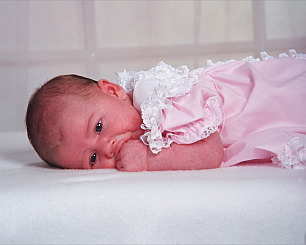
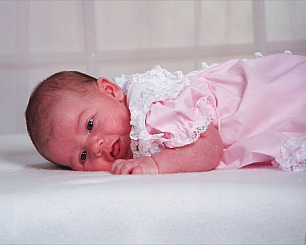
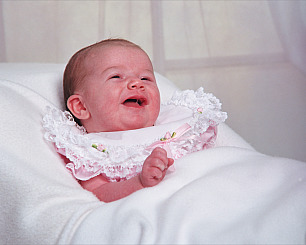
So, in celebration, I'm posting these recent studio proofs of Sofie at four weeks.
October 05, 2003
Why Orthodoxy? Pt. I
Prelude: Setting the Stage (Part I of IX)
At the beginning of the summer of 2000, for various reasons which I have explored elsewhere, I began to take a serious look at the Orthodox Church. I come from a non-denominational ("independent") conservative evangelical Protestant background. In part because of a longing for a real, tangible connection to the New Testament Church which my upbringing had taught me to seek and to make a reality in my own day, I began to explore within the historic Church the disciplines of the monastic orders, the daily office and liturgy. In the course of my exploration, over some five years, I looked seriously, if only briefly, at the Roman Church, but soon focused my attention on the Anglican Communion, and the Episcopal Church here in the States. Because of my strong Protestant sensibilities, and because of the historic ties of Anglicanism to apostolic origins, the liturgies, and the sacraments, the Episcopal Church made a lot of sense to me, and I was confirmed at the hands of Bishop Peter Beckwith on 14 April 1996. My parish priest, Fr. Jim Cravens, was my sponsor.
Beginning in 2000, I began to have misgivings about certain issues in the Episcopal Church, but I was also pursuing ordination. So, as an aspirant, I began to attend an Episcopal seminary. My experiences there, in the space of about three months, were the catalyst for me to reignite my previous search for the historic Church and a way to find tangible connections to it. Orthodoxy was my only other option. I began to read a dozens of books, popular and scholarly, on Orthodoxy, especially several books describing the testimonies of various Jews, agnostics and atheists, Roman Catholics, and Protestants of diverse varieties, and how they came to be baptized or chrismated into the Orthodox Church.
On 23 July 2000, I worshipped for the first time at All Saints Orthodox Church. In the ensuing three years, it has become my home parish. I am not yet Orthodox, not having yet been chrismated. But here is a list of reasons why I want to be.
[Please note: Speaking as I must about my previous and present church experiences in light of my attraction to Orthodoxy, I must necessarily and frequently take up a critical stance to many aspects of these experiences. But I have also tried to offer honest and heartfelt positive appraisals where I can.]
Next: 1. Honoring the Past (Part II of IX)