January 04, 2007
Argument, Meet Coffin, Silver Bullet, Wooden Stake and Final Nail
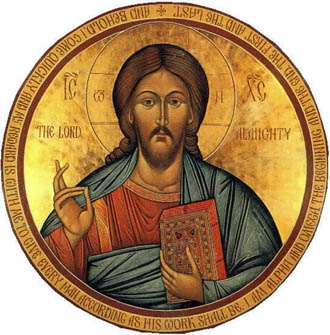 In my earlier post, I dealt with William J. Baldwin’s paper criticizing the use of icons. If I’d waited a few more days to finish St. Theodore’s third refutation of the iconoclast heresy, I would have had a much more impressive, almost one-to-one, point-by-point refutation of good ol’ Billy Baldwin’s “argument”.
As a reminder, here is Mr. Baldwin’s “devastating” syllogism with which he thinks he destroys the Orthodox practice of icon veneration:
The paradigm argument against icons takes the form of a syllogism:MP: Scripture prohibits making images of God.
mp: Christ is God.
Conclusion: Scripture prohibits making images of Christ.
Mr. Baldwin cleverly notes that one cannot equivocate on the term “God” (meaning it differently when applied to the first premise as when applied to the second premise). To do so would violate the Orthodox affirmation of the Nicene Creed.
So Mr. Baldwin then moves on to attempt to show that Orthodox are forced by their own theology and practice into Monophysitism or Nestorianism depending upon how they justify the veneration of icons. Baldwin revises the above syllogism into what he thinks looks like the Orthodox defense of icons:
MP: Scripture prohibited the making of images of God.
mp: Christ is God.
Conclusion: There is no longer any prohibition against making images of God as he has revealed himself in his Son.
Here Baldwin attempts to hoist the Orthodox on their own petard (though, actually, as we will see, it is not their own petard):
It's an amazing leap of logic from the premise (God has revealed himself once for all in his Son) to the conclusion (we may now make images of God). Yet the Orthodox do not seem to notice that they have leaped at all. They barely attempt to explain how to get from the premise to the conclusion. To them, the conclusion is obvious. And when they do attempt an explanation, they stumble into Nestorianism. This is almost inevitable. The only alternative is Monophysitism, of which they have an even greater horror. Yet one or the other error awaits them. To say that the Incarnation legitimizes icons is either to say that God's nature changed when he became a man and thus is now depictable. Or it is to say that God became depictable as a man but remained undepictable as God.
It’s almost as though St. Theodore foresaw Billy Baldwin’s paper, and wrote his third refutation in argumentative sequence. Or, it’s as if Baldwin channels the ancient iconoclasts. Take note of this from the third refutation:
An objection as from the iconoclasts: “If Christ is of two natures, when you claim to portray Him why do you not portray both natures from which and in which He is, if you are speaking the truth? But since one of the two is falsified, because the human circumscription does not contain the uncircumscribability of the divine nature, it is heretical to circumscribe Christ.”Answer: When anyone is portrayed, it is not the nature but the hypostasis which is portrayed. For how could a nature be portrayed unless it were contemplated in a hypostasis? For example, Peter is not portrayed insofar as he is animate, rational, mortal, and capable of thought and understanding; for this does not define Peter only, but also Paul and John, and all those of the same species. But insofar as he adds along with the common definition certain properties, such as a long or short nose, curly hair, a good complexion, bright eyes, or whatever else characterizes his particular appearance, he is distinguished from the other individual of the same species. Moreover, although he consists of body and soul, he does not show the property of soul in the appearance of his form: how could he, since the soul is invisible? The same applies to the case of Christ. It is not because He is man simply (along with being God) that He is able to be portrayed; but because He is differentiated from all others of the same species by His hypostatic properties. He is crucified and has a certain appearance. Therefore Christ is circumscribed in respect to His hypostasis, though uncircumscribable in His divinity; but the natures of which He is composed are not circumscribed. (3.A34)
St. Theodore nicely avoids the charge of monophysitism by noting that it is not either of Christ’s natures that are depicted in the icon, but, rather, his hypostasis (a term that is commonly translated as “person” though the rigorous will quibble over the accuracy of that term). That is to say, we do not confuse the divine nature with the human nature and then depict the human nature in the icon, therefore making an idol containing divinity. Strictly speaking natures are not depictable.
As the saint explains (my emphases added):
. . . The prototype is not essentially in the image [i.e., the nature is not literally in icon—cdh]. If it were, the image would be called prototype as conversely the prototype would be called image. This is not admissible, because the nature of each has its own definition. Rather, the prototype is in the image by the similarity of hypostasis, which does not have a different principle of definition for the prototype and for the image. Therefore we do not understand that the image lacks equality with the prototype and has an inferior glory in respect to similarity, but in respect to its different essence. The essence of the image is not of a nature to be venerated, although the one who is portrayed appears in it for veneration. Therefore there is no introduction of a different kind of veneration, but the image has one and the same veneration with the prototype, in accordance with the identity of likeness.It is not the essence of the image which we venerate, but the form of the prototype which is stamped upon it, since the essence of the image is not venerable. Neither is it the material which is venerated, but the prototype is venerated together with the form and not the essence of the image. But if the image is venerated, it has one veneration with the prototype, just as they have the same likeness. Therefore when we veneration the image, we do not introduce another kind of veneration different from the veneration of the prototype. (3.C1-2)
Clearly, Baldwin’s charge of monophysitism cannot stand—unless he wants to deny that the Orthodox hold the teachings of St. Theodore as normative for icon veneration—since the Orthodox do not confuse the divine and human natures in the iconographic depiction.
But neither does Baldwin’s charge of Nestorianism stand: there is no separation of the two natures. St. Theodore carefully distinguishes between the prototype and the icon, the natures and the hypostasis, and the relationship between the icon and prototype.
Every image has a relation to its archetype; the natural image has a natural relation, while the artificial image has an artificial relation. The natural image is identical both in essence and in likeness with that of which it bears the imprint: thus Christ is identical with His Father in respect to divinity, but identical with His mother in respect to humanity. The artificial image is the same as its archetype in likeness, but different in essence, like Christ and His icon. Therefore there is an artificial image of Christ to whom the image has its relation.. . . In their great foolishness the iconoclasts mix things which cannot be mixed and do not understand how to attribute to each origin its own properties, because of which Christ is both uncircumscribable and circumscribed. In respect to His coming forth from the uncircumscribable Father, since He is uncircumscribable, He would not have an artificial image: with what likeness can the Godhead be compared, for which the divine Scripture utterly forbids any representation? But in respect to His birth from a circumscribed mother, with good reason he has an image, just as His mother’s image is expressed in Him. But if He should not have an image, then He would not be from a circumscribed mother, and is of only one origin, namely the paternal—which destroys the divine economy. (3.B2-3)
Again: clearly Baldwin’s charge of Nestorianism cannot stand either. The natures are not separated, because they are united hypostatically, and it is that circumcribable hypostasis that is depicted in the icon.
Indeed, to put the point on it, St. Theodore affirms:
The fact that man is made in the image and likeness of God shows that the work of iconography is a divine action. But since an image can be copied from an image, inasmuch as Christ is man, though also God, He can be portrayed in an image, not in spirit but in body. But if He is portrayed in one of the two, then obviously He has an image exactly resembling Him which reveals the shared likeness. (3.B5)
And if the icon shares, relatively, in the union of the natures in the hypostasis, then the icon can receive the veneration which the hypostasis receives.
That which is similar in some degree to another thing shares its veneration to the degree in which it is similar. That which is similar in all ways shares the veneration fully. The Son is similar to the Father in all ways, as He has the same essence; therefore He has the same veneration. The image of Christ is similar to Him only in the likeness of His hypostasis; therefore it could share His veneration only in this respect.If he who has seen the image sees in it the likeness of the prototype, then he who venerates the image necessarily venerates in it the appearance of the prototype. But since the likeness is one, the veneration of both must also be one. (3.C12-13)
And this, in large measure, is Baldwin’s failure, as I noted in my previous post: he fails to properly delineate the relationship, both in point of difference and in point of union, between the icon and the image it portrays, or between the image and the prototype respectively:
The prototype and the image are one in hypostatic likeness, but two in nature: one entity is not split into two likenesses, so as thereafter to have no participation or relation with each other; nor is one and the same entity called by two names, so that at one time the prototype would be called image, and at another time the image would be called prototype. For the prototype would always be called prototype, just as the image would be called image, one never changing into the other. Although this is the fact, and although the number is dual, both have one likeness, and one name in accordance with the likeness: as for example the emperor’s image is also called emperor, yet there are not two emperors [cf. St. Basil the Great, On the Holy Spirit 18.45]. But if this is so, then also the image of Christ has one veneration with Christ its prototype. (3.D1)
As I said before, most hardboiled iconoclasts assert their simplistic and misinformed syllogisms in complete ignorance or disregard for the actual beliefs of the Orthodox.
There are other so-called “iconoclasts” who reject icons, but only because they do not understand them and the veneration given them. Once the Orthodox teaching is explained, very few of them remain locked into their iconoclasm.
And St. Theodore is as excellent a teacher of the Orthodox beliefs and practices regarding icons as one can get among the Church Fathers.
Holy father Theodore, pray for us.
Posted by Clifton at January 4, 2007 03:27 PM | TrackBack
The Orthodox do not fix their eyes on a Jesus who has both authored and perfected the faith, who has sat down at the right hand of God the Father. They do not look by faith upon an exalted Christ. He is humiliated again and again. They fix their eyes on a Christ who again and again takes a mortal body, who again and again walks this earth.
Unbelievable! Good summary of St. Theodore.
Posted by: Gina at January 4, 2007 04:22 PM