March 18, 2006
St. Cyril's "One Physis or Hypostasis of God the Logos Incarnate" and Chalcedon
From Dr. John Romanides' St. Cyril's "One Physis or Hypostasis of God the Logos Incarnate" and Chalcedon:
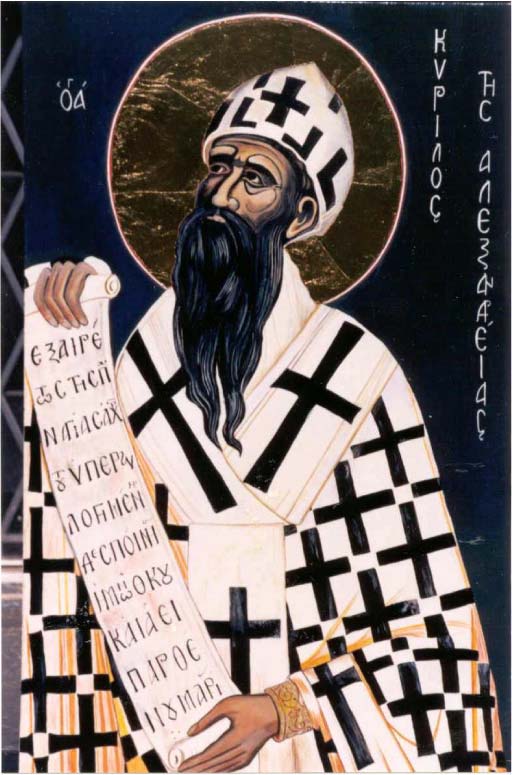 Both Chalcedonian and non-Chalcedonian Orthodox accept St. Cyril as the chief Patristic exponent of Orthodox Christology. Yet both accuse each other of not remaining completely faithful to Cyril.
The non-Chalcedonian Orthodox reject the Council of Chalcedon and accuse it of Nestorianism because it accepted the Tome of Leo, two natures after the union, and allegedly omitted from its definition of faith such Cyrillian expressions as One Nature of God the Logos Incarnate, hypostatic or natural union, and from two natures or from two One Christ. The failure of Chalcedon to make full use of Cyril's Twelve Chapters, to condemn the Christology of Theodore, and its acceptance of Theodoret and Ibas throws suspicion on it. Then there is the weighty accusation that the very act of composing a new definition of the faith contradicted the decision of Ephesus (431) which decreed that, It is unlawful for anyone to bring forward or to write or to compose another Creed besides that determined by the Holy Fathers assembled with the Holy Spirit in Nicaea. [ 2 ]
The Chalcedonian Orthodox, on the other hand, believe that it was Cyril's Christology which was not only fully accepted at Ephesus, but served as the basis of all judgments concerning Christology at Ghalcedon in 451 and especially at Constantinople in 553. In spite of its obvious deficiencies the Tome of Leo is adequately Orthodox, definitely not Nestorian, and was accepted only as a document against Eutyches, but again only in the light of and in subordination to the synodical letters (especially the Twelve Chapters) of Cyril to Nestorius and John of Antioch, as we shall see. The terminology and faith of Cyril were fully accepted, although the Eutychian heresy, the chief concern of the Council, called for some adaptation to the new situation. One may point out that the acceptance of the Chalcedonian definition was no different from the acceptance of Cyril's letters at Ephesus. Neither the one act nor the other can be considered as a composition of a new Creed. They are both interpretations and clarifications of the Nicaean faith m the light of modern circumstances. It is noteworthy that even Cyril had to defend himself against the accusation that he accepted a new Creed in his reconciliatory correspondence with John of Antioch. [ 3 ] Theodoret and Ibas were restored to the episcopacy because they accepted Ephesus I and especially the Twelve Chapters, which acceptance is in itself a condemnation of what they had written about and against Cyril and his anathemas. The Fifth Ecumenical Council of 553 anathematized the writings of Theodoret and Ibas against Cyril and the very person of Theodore, the Father of Nestorianism.
The non-Chalcedonian Orthodox have been for centuries accusing the Chalcedonian Orthodox of being Nestortans. On the other hand, the Chalcedonians have been accusing the non-Chalcedonians of either being monophysites (which for them means believers in one ousia in Christ) or of a one-sided insistence on Cyrillian terminology to the exclusion of Cyril's own acceptance of two natures in the confession of faith of john of Antioch which brought about the reconciliation of 433. This one-sidedness was adopted by the Ephesine Council of 449 and rejected by the Council of Chalcedon. It should also be noted that the Flavian Endemousa Synod of 448 was one-sided in its use of and insistence on the Cyrillian terminology of the 433 reconciliation to the near exclusion of Cyril's normal way of speaking about the incarnation. From Chalcedon and especially from Constantinople II it is clear that the Chalcedonians without compromise allow for variations in terms which express the same faith. On the non-Chalcedonian side Severus of Antioch seems to be the only one who comes close to Cyril's acceptance of two natures tei theoriai monei after the union, a position adopted at Chalcedon and clearly stated in the definition or anathemas of the Fifth Ecumenical Council. . . .
1) Nestorius rejected the fact that He Who was born of the Virgin is consubstantial with the Father according to divinity and thus by nature God. Another way of saying this is that he rejected the fact that He Who before the ages is born from and is consubstantial with the Father was in the last days born according to His Own and proper humanity from the Virgin Mary having become thus by nature man and consubstantial with us. On the basis of this rejection Nestorius distorted the true significance of the title Theotokos which he in reality denied to the Mother of God. The most Nestorius could say is that Christ is the one person of the union of two natures, the one nature being by nature God and the other by nature man. The name Christ is not properly predicated of the Logos, but is the narne of the person of union born of Mary and in whom the Logos dwells and who was assumed by the Logos. Nestorius fanatically insisted that the Logos was not born of the Virgin according to His Humanity and did not, therefore, become by nature man. On the basis of this he divided the natures and predicates of Christ attributing the human to the assumed man and the divine to the Logos.
In the light of his denial of the two births of the Logos and the double consubstantiality of the One and the Same Logos, Son of God and the Self-Same also Son of Mary, and thus of the true meaning of the title Theotokos, Nestorius insistence that he does not divide Christ into two persons, but only the natures and names, was judged a mockery of the faith and on this basis he was condemned by the Third and Fourth Ecumenical Councils and rejected by John of Antio