August 15, 2006
The Dormition of our Most Holy Lady, the Mother of God and Ever-Virgin Mary
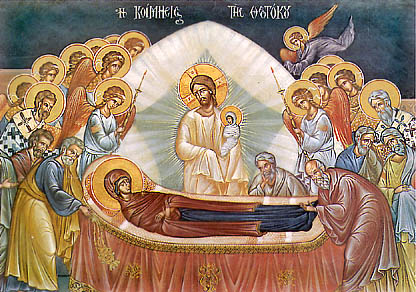
Troparion Tone 1
In giving birth thou didst preserve thy virginity;/ in falling asleep thou didst not forsake the world, O Theotokos./ Thou wast translated to life, O Mother of Life,/ and by your prayers you deliver our souls from death.
Kontakion Tone 2
Neither the tomb nor death could hold the Theotokos,/ who is sleepless in her intercessions and an unchanging hope in her mediations./ For as the Mother of Life she was transferred to life/ by Him Who dwelt in her ever-virgin womb.
From the OCA website comes this explanation of The Feast of the Dormition:
After the Ascension of the Lord, the Mother of God remained in the care of the Apostle John the Theologian, and during his journeys She lived at the home of his parents, near the Mount of Olives. She was a source of consolation and edification both for the Apostles and for all the believers. Conversing with them, She told them about miraculous events: the Annunciation, the seedless and undefiled Conception of Christ born of Her, about His early childhood, and about His earthly life. Like the Apostles, She helped plant and strengthen the Christian Church by Her presence, Her discourse and Her prayers.
The reverence of the Apostles for the Most Holy Virgin was extraordinary. After the receiving of the Holy Spirit on the day of Pentecost, the Apostles remained at Jerusalem for about ten years attending to the salvation of the Jews, and wanting moreover to see the Mother of God and hear Her holy discourse. Many of the newly-enlightened in the Faith even came from faraway lands to Jerusalem, to see and to hear the All-Pure Mother of God.
During the time of the persecution initiated by King Herod against the young Church of Christ (Acts 12: 1-3), the Most Holy Virgin and the Apostle John the Theologian withdrew to Ephesus in the year 43. The preaching of the Gospel there had fallen by lot to the Apostle John the Theologian. The Mother of God was on Cyprus with St. Lazarus the Four-Days-Dead, where he was bishop. She was also on Holy Mount Athos. St. Stephen of the Holy Mountain says that the Mother of God prophetically spoke of it: "Let this place be my lot, given to me by my Son and my God. I will be the Patroness of this place and intercede with God for it."
The respect of ancient Christians for the Mother of God was so great that they preserved what they could about Her life, what they could take note of concerning Her sayings and deeds, and they even passed down to us a description of Her outward appearance.
According to Tradition, based on the words of the Hieromartyrs Dionysios the Areopagite (October 3), Ignatios the God-Bearer (December 20), St. Ambrose of Milan (December 7) had occasion to write in his work "On Virgins" concerning the Mother of God: "She was a Virgin not only in body, but also in soul, humble of heart, circumspect in word, wise in mind, not overly given to speaking, a lover of reading and of work, and prudent in speech. Her rule of life was to offend no one, to intend good for everyone, to respect the aged, not envy others, avoid bragging, be healthy of mind, and to love virtue."
When did She ever hurl the least insult in the face of Her parents? When was She at discord with Her kin? When did She ever puff up with pride before a modest person, or laugh at the weak, or shun the destitute? With Her there was nothing of glaring eyes, nothing of unseemly words, nor of improper conduct. She was modest in the movement of Her body, Her step was quiet, and Her voice straightforward; so that Her face was an expression of soul. She was the personification of purity.
All Her days She was concerned with fasting: She slept only when necessary, and even then, when Her body was at rest, She was still alert in spirit, repeating in Her dreams what She had read, or the implementation of proposed intentions, or those planned yet anew. She was out of Her house only for church, and then only in the company of relatives. Otherwise, She seldom appeared outside Her house in the company of others, and She was Her own best overseer. Others could protect Her only in body, but She Herself guarded Her character."
According to Tradition, that from the compiler of Church history Nikephoros Kallistos (fourteenth century), the Mother of God "was of average stature, or as others suggest, slightly more than average; Her hair golden in appearance; Her eyes bright with pupils like shiny olives; Her eyebrows strong in character and moderately dark, Her nose pronounced and Her mouth vibrant bespeaking sweet speech; Her face was neither round nor angular, but somewhat oblong; the palm of Her hands and fingers were longish.
In conversation with others She preserved decorum, neither becoming silly nor agitated, and indeed especially never angry; without artifice, and direct, She was not overly concerned about Herself, and far from pampering Herself, She was distinctly full of humility. Regarding the clothing which She wore, She was satisfied to have natural colors, which even now is evidenced by Her holy head-covering. Suffice it to say, a special grace attended all Her actions." (Nicephoros Kallistos borrowed his description from St. Epiphanios of Cyprus (May 12), from the "Letter to Theophilos Concerning Icons."
The circumstances of the Dormition of the Mother of God were known in the Orthodox Church from apostolic times. Already in the first century, the Hieromartyr Dionysios the Areopagite wrote about Her "Falling-Asleep." In the second century, the account of the bodily ascent of the Most Holy Virgin Mary to Heaven is found in the works of Meliton, Bishop of Sardis. In the fourth century, St. Epiphanios of Cyprus refers to the tradition about the "Falling-Asleep" of the Mother of God. In the fifth century, St. Juvenalios, Patriarch of Jerusalem, told the holy Byzantine Empress Pulcheria: "Although in Holy Scripture there is no account about the circumstances of Her death, we know about them otherwise from the most ancient and credible Tradition." This tradition was gathered and expounded in the Church history of Nikephoros Kallistos during the fourteenth century.
At the time of Her blessed "Falling-Asleep", the Most Holy Virgin Mary was again at Jerusalem. Her fame as the Mother of God had already spread throughout the land and had aroused many of the envious and the spiteful against Her, who wanted to make attempts on Her life; but God preserved Her from enemies.
Day and night She spent at prayer. The Most Holy Mother of God went often to the Holy Sepulchre of the Lord, and here She offered up fevent prayer. More than once, e